9/5/16 12:43 PMjeddah
Page 1 of 3file:///Users/mimac/Desktop/jeddah.webarchive
J E D D A H I N T E R N A T I O N A L A I R P O R T , S A U D I A R A B I A
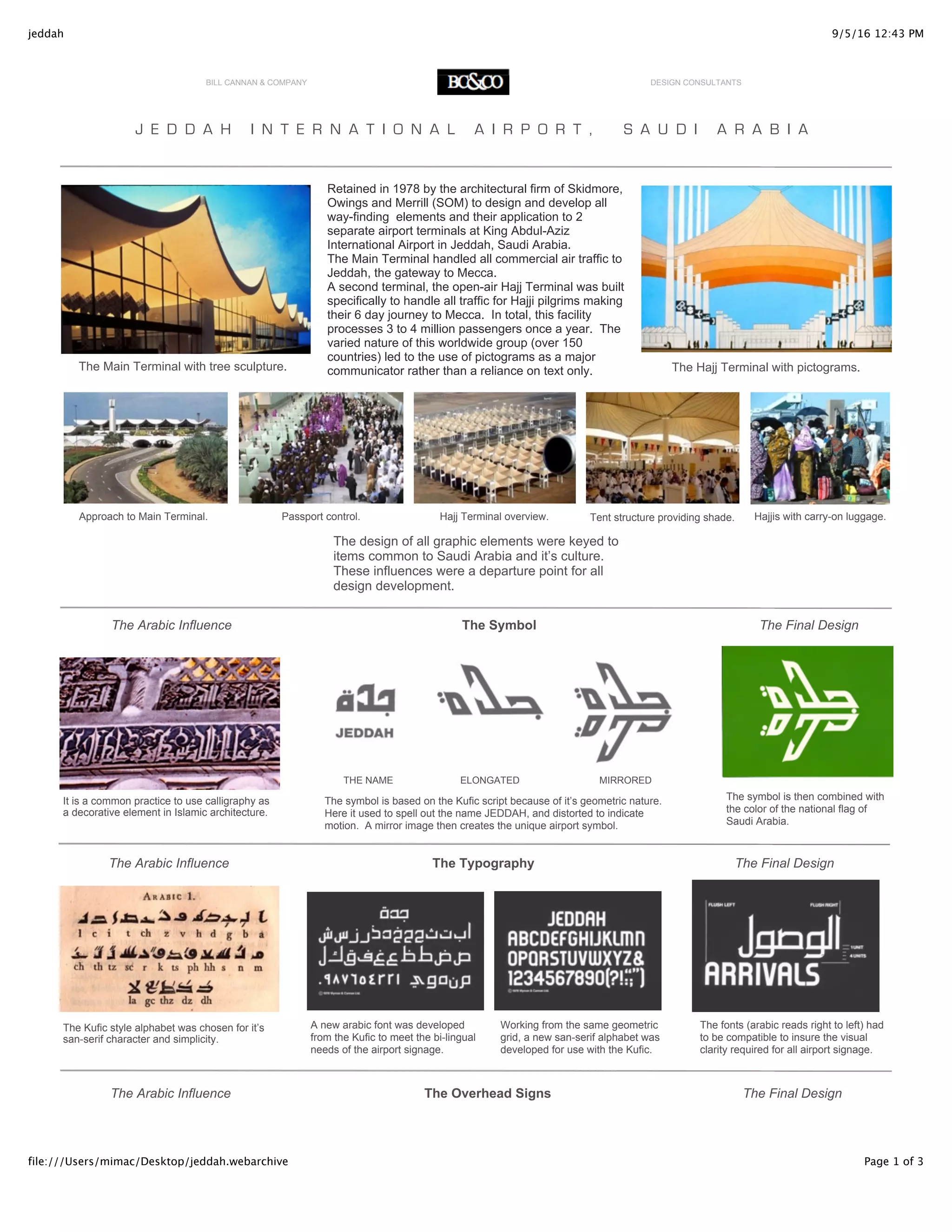
Retained in 1978 by the architectural firm of Skidmore,
Owings and Merrill (SOM) to design and develop all
way-finding elements and their application to 2
separate airport terminals at King Abdul-Aziz
International Airport in Jeddah, Saudi Arabia.
The Main Terminal handled all commercial air traffic to
Jeddah, the gateway to Mecca.
A second terminal, the open-air Hajj Terminal was built
specifically to handle all traffic for Hajji pilgrims making
their 6 day journey to Mecca. In total, this facility
processes 3 to 4 million passengers once a year. The
varied nature of this worldwide group (over 150
countries) led to the use of pictograms as a major
communicator rather than a reliance on text only.The Main Terminal with tree sculpture. The Hajj Terminal with pictograms.
THE NAME MIRROREDELONGATED
The Arabic Influence
Approach to Main Terminal. Tent structure providing shade.Passport control. Hajj Terminal overview. Hajjis with carry-on luggage.
The Symbol The Final Design
It is a common practice to use calligraphy as
a decorative element in Islamic architecture.
The symbol is based on the Kufic script because of it’s geometric nature.
Here it used to spell out the name JEDDAH, and distorted to indicate
motion. A mirror image then creates the unique airport symbol.
The symbol is then combined with
the color of the national flag of
Saudi Arabia.
The Arabic Influence The Typography The Final Design
The Kufic style alphabet was chosen for it’s
san-serif character and simplicity.
A new arabic font was developed
from the Kufic to meet the bi-lingual
needs of the airport signage.
The fonts (arabic reads right to left) had
to be compatible to insure the visual
clarity required for all airport signage.
Working from the same geometric
grid, a new san-serif alphabet was
developed for use with the Kufic.
The Arabic Influence The Overhead Signs The Final Design
The design of all graphic elements were keyed to
items common to Saudi Arabia and it’s culture.
These influences were a departure point for all
design development.
BILL CANNAN & COMPANY DESIGN CONSULTANTS
9/5/16 12:43 PMjeddah
Page 2 of 3file:///Users/mimac/Desktop/jeddah.webarchive
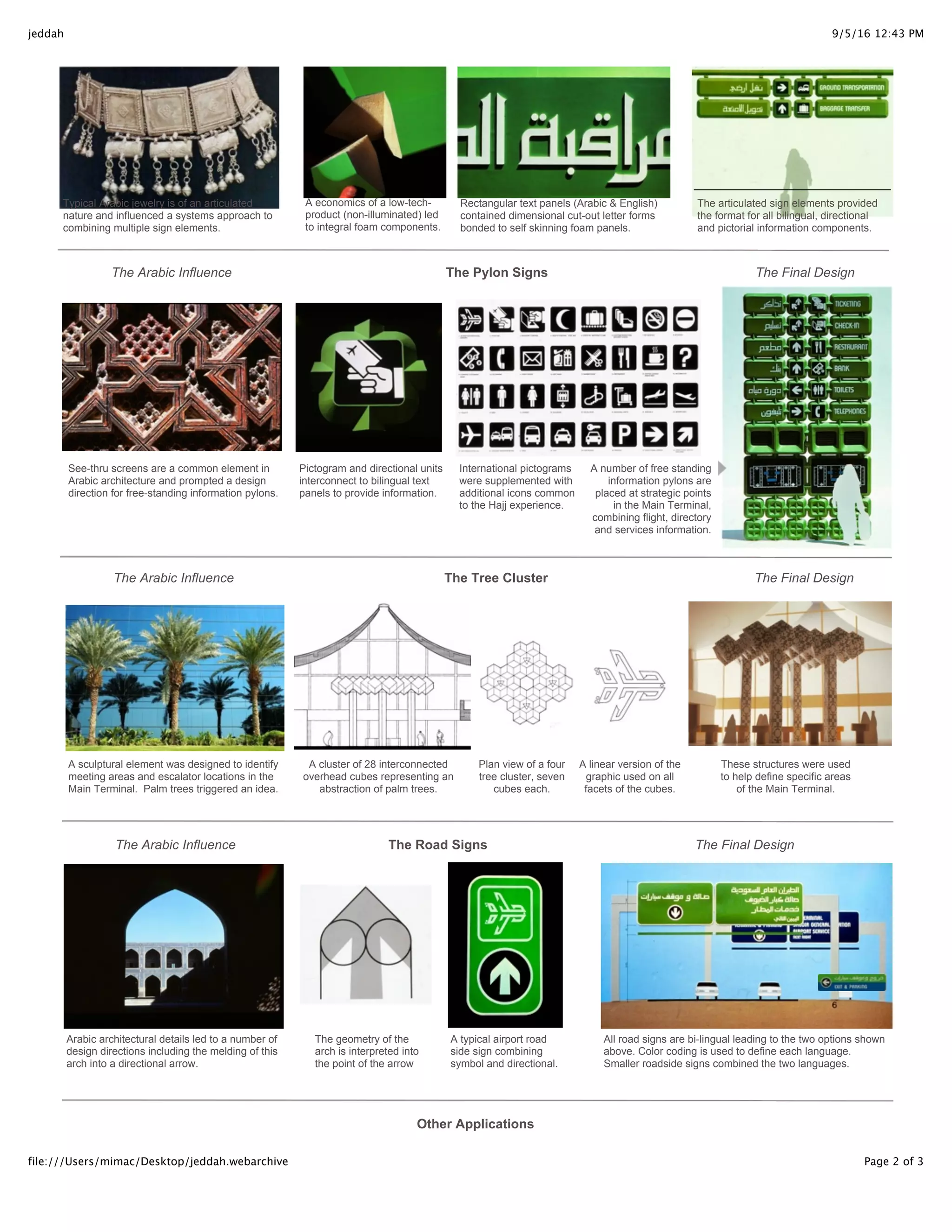
Typical Arabic jewelry is of an articulated
nature and influenced a systems approach to
combining multiple sign elements.
A economics of a low-tech-
product (non-illuminated) led
to integral foam components.
The articulated sign elements provided
the format for all bilingual, directional
and pictorial information components.
Rectangular text panels (Arabic & English)
contained dimensional cut-out letter forms
bonded to self skinning foam panels.
The Arabic Influence The Pylon Signs The Final Design
See-thru screens are a common element in
Arabic architecture and prompted a design
direction for free-standing information pylons.
Pictogram and directional units
interconnect to bilingual text
panels to provide information.
A number of free standing
information pylons are
placed at strategic points
in the Main Terminal,
combining flight, directory
and services information.
International pictograms
were supplemented with
additional icons common
to the Hajj experience.
The Arabic Influence The Tree Cluster The Final Design
A sculptural element was designed to identify
meeting areas and escalator locations in the
Main Terminal. Palm trees triggered an idea.
A cluster of 28 interconnected
overhead cubes representing an
abstraction of palm trees.
These structures were used
to help define specific areas
of the Main Terminal.
Plan view of a four
tree cluster, seven
cubes each.
The Arabic Influence The Road Signs The Final Design
Arabic architectural details led to a number of
design directions including the melding of this
arch into a directional arrow.
The geometry of the
arch is interpreted into
the point of the arrow
All road signs are bi-lingual leading to the two options shown
above. Color coding is used to define each language.
Smaller roadside signs combined the two languages.
A typical airport road
side sign combining
symbol and directional.
A linear version of the
graphic used on all
facets of the cubes.
Other Applications
9/5/16 12:43 PMjeddah
Page 3 of 3file:///Users/mimac/Desktop/jeddah.webarchive
The Airport symbol
was to be used in a
variety of ways
including dimensional
wall tiles in public
areas and in a repeat
pattern for print
applications.
A series of movable
floor signs were
developed to adjust to
changing needs and
control of traffic flow.
The embossed 12” x 12”
ceramic tile.
Design: Wyman & Cannan - Bill Cannan - Lance Wyman - Kurt Heinz - Farid Iskander - Brian Flahive - Frank Rispoli - Jose Luis Ortiz Tellez - Masahiro Ogyu
Client: Skidmore Owings & Merrill - Gordon Bunshaft - Tony Thompson - John Winkler - Kim Goluska
contact: Bill Cannan / bcnco@optonline.net

jeddah

  • 1.
    9/5/16 12:43 PMjeddah Page1 of 3file:///Users/mimac/Desktop/jeddah.webarchive J E D D A H I N T E R N A T I O N A L A I R P O R T , S A U D I A R A B I A Retained in 1978 by the architectural firm of Skidmore, Owings and Merrill (SOM) to design and develop all way-finding elements and their application to 2 separate airport terminals at King Abdul-Aziz International Airport in Jeddah, Saudi Arabia. The Main Terminal handled all commercial air traffic to Jeddah, the gateway to Mecca. A second terminal, the open-air Hajj Terminal was built specifically to handle all traffic for Hajji pilgrims making their 6 day journey to Mecca. In total, this facility processes 3 to 4 million passengers once a year. The varied nature of this worldwide group (over 150 countries) led to the use of pictograms as a major communicator rather than a reliance on text only.The Main Terminal with tree sculpture. The Hajj Terminal with pictograms. THE NAME MIRROREDELONGATED The Arabic Influence Approach to Main Terminal. Tent structure providing shade.Passport control. Hajj Terminal overview. Hajjis with carry-on luggage. The Symbol The Final Design It is a common practice to use calligraphy as a decorative element in Islamic architecture. The symbol is based on the Kufic script because of it’s geometric nature. Here it used to spell out the name JEDDAH, and distorted to indicate motion. A mirror image then creates the unique airport symbol. The symbol is then combined with the color of the national flag of Saudi Arabia. The Arabic Influence The Typography The Final Design The Kufic style alphabet was chosen for it’s san-serif character and simplicity. A new arabic font was developed from the Kufic to meet the bi-lingual needs of the airport signage. The fonts (arabic reads right to left) had to be compatible to insure the visual clarity required for all airport signage. Working from the same geometric grid, a new san-serif alphabet was developed for use with the Kufic. The Arabic Influence The Overhead Signs The Final Design The design of all graphic elements were keyed to items common to Saudi Arabia and it’s culture. These influences were a departure point for all design development. BILL CANNAN & COMPANY DESIGN CONSULTANTS
  • 2.
    9/5/16 12:43 PMjeddah Page2 of 3file:///Users/mimac/Desktop/jeddah.webarchive Typical Arabic jewelry is of an articulated nature and influenced a systems approach to combining multiple sign elements. A economics of a low-tech- product (non-illuminated) led to integral foam components. The articulated sign elements provided the format for all bilingual, directional and pictorial information components. Rectangular text panels (Arabic & English) contained dimensional cut-out letter forms bonded to self skinning foam panels. The Arabic Influence The Pylon Signs The Final Design See-thru screens are a common element in Arabic architecture and prompted a design direction for free-standing information pylons. Pictogram and directional units interconnect to bilingual text panels to provide information. A number of free standing information pylons are placed at strategic points in the Main Terminal, combining flight, directory and services information. International pictograms were supplemented with additional icons common to the Hajj experience. The Arabic Influence The Tree Cluster The Final Design A sculptural element was designed to identify meeting areas and escalator locations in the Main Terminal. Palm trees triggered an idea. A cluster of 28 interconnected overhead cubes representing an abstraction of palm trees. These structures were used to help define specific areas of the Main Terminal. Plan view of a four tree cluster, seven cubes each. The Arabic Influence The Road Signs The Final Design Arabic architectural details led to a number of design directions including the melding of this arch into a directional arrow. The geometry of the arch is interpreted into the point of the arrow All road signs are bi-lingual leading to the two options shown above. Color coding is used to define each language. Smaller roadside signs combined the two languages. A typical airport road side sign combining symbol and directional. A linear version of the graphic used on all facets of the cubes. Other Applications
  • 3.
    9/5/16 12:43 PMjeddah Page3 of 3file:///Users/mimac/Desktop/jeddah.webarchive The Airport symbol was to be used in a variety of ways including dimensional wall tiles in public areas and in a repeat pattern for print applications. A series of movable floor signs were developed to adjust to changing needs and control of traffic flow. The embossed 12” x 12” ceramic tile. Design: Wyman & Cannan - Bill Cannan - Lance Wyman - Kurt Heinz - Farid Iskander - Brian Flahive - Frank Rispoli - Jose Luis Ortiz Tellez - Masahiro Ogyu Client: Skidmore Owings & Merrill - Gordon Bunshaft - Tony Thompson - John Winkler - Kim Goluska contact: Bill Cannan / bcnco@optonline.net