Java Web Services
Sharmila Chalasani
MS Computer Science
State university of New York at Binghamton
Termination Project
Summer 2004
Outline
 Introduction to web services
 Existing solutions
 Web service Architecture
 Standards used
 Web services technology
 JAX-RPC Architecture
 Hosting using Java web services
 Steps involved in creating weather web service
 Consuming my weather forecast web service (client details)
 Some facts about web services
 References
Why are we here?
 "Web Services" contain the word "Web" and Web
technologies matter.
More and more people get connected using
computers, televisions, mobiles, …
 "Web Services" contain the word "services" and we
wonder why kind of services they will fulfill for us.
We already have services on the Web, so what's
missing?
The Problem (eg. how to buy tomatoes)
 Find the tomato sellers;
Yellow Pages: contain companies that are selling
tomatoes, their location, and contact information.
 Find the service offered according to my needs;
Where, when and how can I buy tomatoes?
 Buy the tomatoes;
do the transaction
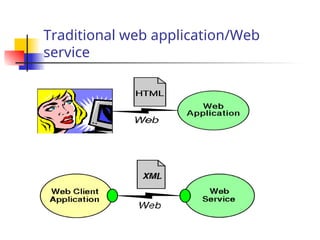
Traditional web application/Web
service
Web Service Requirement
 Applications need to communicate:
Unless tomato buyers can communicate to tomato sellers, there
will be no business.
 The system must scale:
-As many tomato buyers and sellers as possible.
-Being able to use any future new kind of tomatoes or any kind of
products (potatoes, video games, …)
-Add new layers: security!
 The solution must be portable across environments:
-Not all tomato buyers and sellers will use the same system or the
same language.
Used by anyone, anywhere, and with any kind of devices.
Existing solutions
 How can two (or more) applications communicate
today?
 Ad Hoc solutions:
Unless you want to buy your own tomatoes, it won't
be useful.
 Language-oriented solutions (Java RMI, …)
Works well if the tomato seller uses your language
 Service-oriented solutions (CORBA, DCE, DCOM)
And about the Web?
Web service: definition
 A Web service is a software system identified by a
URI, whose public interfaces and bindings are
defined and described using XML. Its definition can
be discovered by other software systems. These
systems may then interact with the Web service in a
manner prescribed by its definition, using XML based
messages conveyed by Internet protocols.
 Loosely coupled, reusable software components that
semantically encapsulate discrete functionality and
are distributed and programmatically accessible over
standard Internet protocols.
Advantages of Web service
 Not based on a programming language:
Java, .Net, C, C++, Python, Perl, …
 Not based on a programming data model:
objects vs non-objects environments.
 Convergence of SOA (Service-Oriented
Architecture) and Web.
 Based on web technologies
 Do not need huge framework of memory
 Basic usage is b-to-b ,remote controlled
devices,internal external appl communications
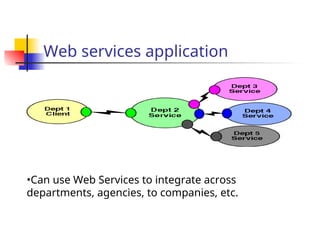
Web services application
•Can use Web Services to integrate across
departments, agencies, to companies, etc.
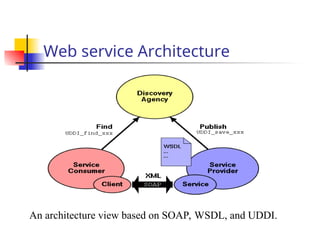
Web service Architecture
An architecture view based on SOAP, WSDL, and UDDI.
Web service Transport
 Data format
XML (subset of XML 1.0), URL encoding.
Data format schema definition: XML Schema
 Wire format
XML Protocol (XML-RPC, SOAP), URI
Transfer protocol: HTTP, SMTP, JMS, BEEP, …
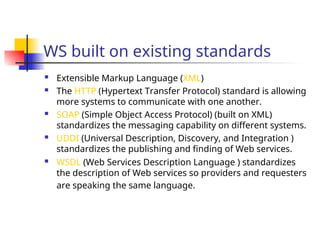
WS built on existing standards
 Extensible Markup Language (XML)
 The HTTP (Hypertext Transfer Protocol) standard is allowing
more systems to communicate with one another.
 SOAP (Simple Object Access Protocol) (built on XML)
standardizes the messaging capability on different systems.
 UDDI (Universal Description, Discovery, and Integration )
standardizes the publishing and finding of Web services.
 WSDL (Web Services Description Language ) standardizes
the description of Web services so providers and requesters
are speaking the same language.
Web Services technology
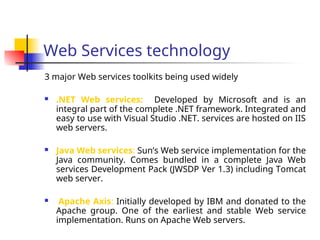
3 major Web services toolkits being used widely
 .NET Web services: Developed by Microsoft and is an
integral part of the complete .NET framework. Integrated and
easy to use with Visual Studio .NET. services are hosted on IIS
web servers.
 Java Web services: Sun’s Web service implementation for the
Java community. Comes bundled in a complete Java Web
services Development Pack (JWSDP Ver 1.3) including Tomcat
web server.
 Apache Axis: Initially developed by IBM and donated to the
Apache group. One of the earliest and stable Web service
implementation. Runs on Apache Web servers.
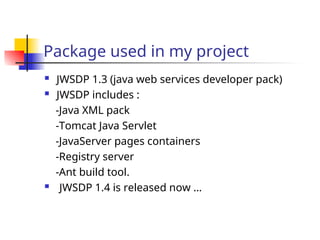
Package used in my project
 JWSDP 1.3 (java web services developer pack)
 JWSDP includes :
-Java XML pack
-Tomcat Java Servlet
-JavaServer pages containers
-Registry server
-Ant build tool.
 JWSDP 1.4 is released now …
Java API used in my project
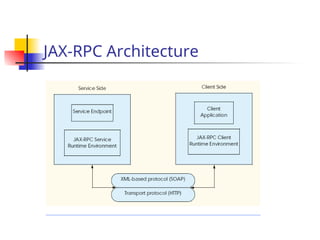
 JAX-RPC (Java API for XML based RPC)

Features and Developer Benefits :
- Portable and interoperable web services
- Ease of development of web services endpoints & clients
- Increased developer productivity
- Support for open standards: XML, SOAP, WSDL
- Standard API developed under Java Community Process
- Support for tools
- RPC programming model with support for attachments
- Support for SOAP message processing model & extensions
- Secure web services
- Extensible type mapping
JAX-RPC Architecture
Hosting using Java Web Services
 Required tools and files to create java web service :
Ant Tool : This a tool extensively used in J2EE architecture for
handling multiple configuration files while compiling several
files. You can consider it similar to make utility in unix platforms.
Build.xml : This is the file used by the Ant tool to get the
compilation and path directives. It contains options to selectively
compile-server, compile-client, generate-client, run-client etc
Build.properties : Some misc properties and path settings that
are referred to by build.xml.
config.xml : Defines the URL for WSDL file location. Each Web
services has a corresponding WSDL (Web service Definition
Language) document.
Hosting Java web services cont.
jaxrpc-ri.xml: Defines the various end points for referencing a
Web service.
Misc. utilities:
wscompile: The wscompile tool generates stubs, ties,
serializers, and WSDL files used in JAX-RPC clients and
services. The tool reads as input a configuration file and either
a WSDL file or an RMI interface that defines the service.
wsdeploy: Reads a WAR file (something like Jar file) and the
jaxrpc-ri.xml file and then generates another WAR file
that is ready for deployment
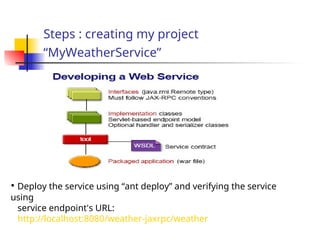
Steps : creating my project
“MyWeatherService”
• Deploy the service using “ant deploy” and verifying the service
using
service endpoint's URL:
http://localhost:8080/weather-jaxrpc/weather
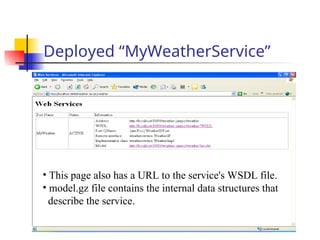
Deployed “MyWeatherService”
• This page also has a URL to the service's WSDL file.
• model.gz file contains the internal data structures that
describe the service.
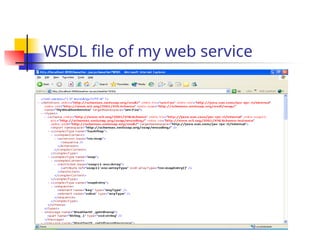
WSDL file of my web service
“MyWeatherService” functions
 Functions available from service endpoint interface :
- boolean isvalidZipCode(String zip)
- String getWeatherReport(String zip)
- HashMap getZipcodeListMap()
- getHighTemp , getLowTemp, getHumidity,
getWind, getVisibility etc.
Communicating modes accessing web service
Stubs, dynamic proxy,DII(dynamic invocation interface)
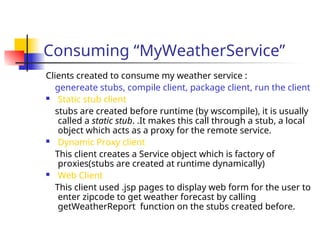
Consuming “MyWeatherService”
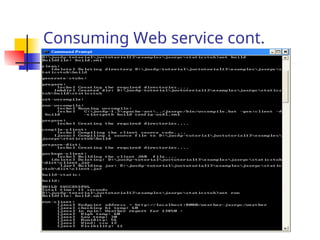
Clients created to consume my weather service :
genereate stubs, compile client, package client, run the client
 Static stub client
stubs are created before runtime (by wscompile), it is usually
called a static stub. .It makes this call through a stub, a local
object which acts as a proxy for the remote service.
 Dynamic Proxy client
This client creates a Service object which is factory of
proxies(stubs are created at runtime dynamically)
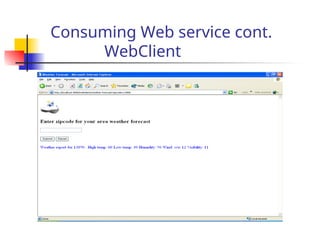
 Web Client
This client used .jsp pages to display web form for the user to
enter zipcode to get weather forecast by calling
getWeatherReport function on the stubs created before.
Consuming Web service cont.
WebClient
Web services: challenges
 A whole suite of technologies to design:
communication protocol
description of services
enable security and privacy
describe complex interactions
...
 Must design to be interoperable and Web-
friendly
Some facts
 Web service is a new paradigm, it is in initial stages.
 Web service tech is evolving rapidly, sometimes in
unexpected directions .such changes may cause
difficulties early on.
 Various standards and specifications are still being
defined and refined.
 Security standards are also being defined.
 The key security issues for WS concern authentication ,
authorization, and ensuring security at the transport
and message level.They remain a work in progress by
the community.
References
 Java web services tutorial from sun
http://java.sun.com/webservices/docs/1.1/tutorial/doc/
 Java Web services In a Nutshell O’Reilly – Kim
Topley
 XML In a Nutshell O'Reilly
 Java Web Services for Experienced Programmers
Deitel developer series
 Java Web Services David Chappell O’Reilly
 New updates about the package jwsdp & projects
are discussed here https://jwsdp.dev.java.net/
Thanks

java web services - soap and rest services

  • 1.
    Java Web Services SharmilaChalasani MS Computer Science State university of New York at Binghamton Termination Project Summer 2004
  • 2.
    Outline  Introduction toweb services  Existing solutions  Web service Architecture  Standards used  Web services technology  JAX-RPC Architecture  Hosting using Java web services  Steps involved in creating weather web service  Consuming my weather forecast web service (client details)  Some facts about web services  References
  • 3.
    Why are wehere?  "Web Services" contain the word "Web" and Web technologies matter. More and more people get connected using computers, televisions, mobiles, …  "Web Services" contain the word "services" and we wonder why kind of services they will fulfill for us. We already have services on the Web, so what's missing?
  • 4.
    The Problem (eg.how to buy tomatoes)  Find the tomato sellers; Yellow Pages: contain companies that are selling tomatoes, their location, and contact information.  Find the service offered according to my needs; Where, when and how can I buy tomatoes?  Buy the tomatoes; do the transaction
  • 5.
  • 6.
    Web Service Requirement Applications need to communicate: Unless tomato buyers can communicate to tomato sellers, there will be no business.  The system must scale: -As many tomato buyers and sellers as possible. -Being able to use any future new kind of tomatoes or any kind of products (potatoes, video games, …) -Add new layers: security!  The solution must be portable across environments: -Not all tomato buyers and sellers will use the same system or the same language. Used by anyone, anywhere, and with any kind of devices.
  • 7.
    Existing solutions  Howcan two (or more) applications communicate today?  Ad Hoc solutions: Unless you want to buy your own tomatoes, it won't be useful.  Language-oriented solutions (Java RMI, …) Works well if the tomato seller uses your language  Service-oriented solutions (CORBA, DCE, DCOM) And about the Web?
  • 8.
    Web service: definition A Web service is a software system identified by a URI, whose public interfaces and bindings are defined and described using XML. Its definition can be discovered by other software systems. These systems may then interact with the Web service in a manner prescribed by its definition, using XML based messages conveyed by Internet protocols.  Loosely coupled, reusable software components that semantically encapsulate discrete functionality and are distributed and programmatically accessible over standard Internet protocols.
  • 9.
    Advantages of Webservice  Not based on a programming language: Java, .Net, C, C++, Python, Perl, …  Not based on a programming data model: objects vs non-objects environments.  Convergence of SOA (Service-Oriented Architecture) and Web.  Based on web technologies  Do not need huge framework of memory  Basic usage is b-to-b ,remote controlled devices,internal external appl communications
  • 10.
    Web services application •Canuse Web Services to integrate across departments, agencies, to companies, etc.
  • 11.
    Web service Architecture Anarchitecture view based on SOAP, WSDL, and UDDI.
  • 12.
    Web service Transport Data format XML (subset of XML 1.0), URL encoding. Data format schema definition: XML Schema  Wire format XML Protocol (XML-RPC, SOAP), URI Transfer protocol: HTTP, SMTP, JMS, BEEP, …
  • 13.
    WS built onexisting standards  Extensible Markup Language (XML)  The HTTP (Hypertext Transfer Protocol) standard is allowing more systems to communicate with one another.  SOAP (Simple Object Access Protocol) (built on XML) standardizes the messaging capability on different systems.  UDDI (Universal Description, Discovery, and Integration ) standardizes the publishing and finding of Web services.  WSDL (Web Services Description Language ) standardizes the description of Web services so providers and requesters are speaking the same language.
  • 14.
    Web Services technology 3major Web services toolkits being used widely  .NET Web services: Developed by Microsoft and is an integral part of the complete .NET framework. Integrated and easy to use with Visual Studio .NET. services are hosted on IIS web servers.  Java Web services: Sun’s Web service implementation for the Java community. Comes bundled in a complete Java Web services Development Pack (JWSDP Ver 1.3) including Tomcat web server.  Apache Axis: Initially developed by IBM and donated to the Apache group. One of the earliest and stable Web service implementation. Runs on Apache Web servers.
  • 15.
    Package used inmy project  JWSDP 1.3 (java web services developer pack)  JWSDP includes : -Java XML pack -Tomcat Java Servlet -JavaServer pages containers -Registry server -Ant build tool.  JWSDP 1.4 is released now …
  • 16.
    Java API usedin my project  JAX-RPC (Java API for XML based RPC)  Features and Developer Benefits : - Portable and interoperable web services - Ease of development of web services endpoints & clients - Increased developer productivity - Support for open standards: XML, SOAP, WSDL - Standard API developed under Java Community Process - Support for tools - RPC programming model with support for attachments - Support for SOAP message processing model & extensions - Secure web services - Extensible type mapping
  • 17.
  • 18.
    Hosting using JavaWeb Services  Required tools and files to create java web service : Ant Tool : This a tool extensively used in J2EE architecture for handling multiple configuration files while compiling several files. You can consider it similar to make utility in unix platforms. Build.xml : This is the file used by the Ant tool to get the compilation and path directives. It contains options to selectively compile-server, compile-client, generate-client, run-client etc Build.properties : Some misc properties and path settings that are referred to by build.xml. config.xml : Defines the URL for WSDL file location. Each Web services has a corresponding WSDL (Web service Definition Language) document.
  • 19.
    Hosting Java webservices cont. jaxrpc-ri.xml: Defines the various end points for referencing a Web service. Misc. utilities: wscompile: The wscompile tool generates stubs, ties, serializers, and WSDL files used in JAX-RPC clients and services. The tool reads as input a configuration file and either a WSDL file or an RMI interface that defines the service. wsdeploy: Reads a WAR file (something like Jar file) and the jaxrpc-ri.xml file and then generates another WAR file that is ready for deployment
  • 20.
    Steps : creatingmy project “MyWeatherService” • Deploy the service using “ant deploy” and verifying the service using service endpoint's URL: http://localhost:8080/weather-jaxrpc/weather
  • 21.
    Deployed “MyWeatherService” • Thispage also has a URL to the service's WSDL file. • model.gz file contains the internal data structures that describe the service.
  • 22.
    WSDL file ofmy web service
  • 23.
    “MyWeatherService” functions  Functionsavailable from service endpoint interface : - boolean isvalidZipCode(String zip) - String getWeatherReport(String zip) - HashMap getZipcodeListMap() - getHighTemp , getLowTemp, getHumidity, getWind, getVisibility etc. Communicating modes accessing web service Stubs, dynamic proxy,DII(dynamic invocation interface)
  • 24.
    Consuming “MyWeatherService” Clients createdto consume my weather service : genereate stubs, compile client, package client, run the client  Static stub client stubs are created before runtime (by wscompile), it is usually called a static stub. .It makes this call through a stub, a local object which acts as a proxy for the remote service.  Dynamic Proxy client This client creates a Service object which is factory of proxies(stubs are created at runtime dynamically)  Web Client This client used .jsp pages to display web form for the user to enter zipcode to get weather forecast by calling getWeatherReport function on the stubs created before.
  • 25.
  • 26.
    Consuming Web servicecont. WebClient
  • 27.
    Web services: challenges A whole suite of technologies to design: communication protocol description of services enable security and privacy describe complex interactions ...  Must design to be interoperable and Web- friendly
  • 28.
    Some facts  Webservice is a new paradigm, it is in initial stages.  Web service tech is evolving rapidly, sometimes in unexpected directions .such changes may cause difficulties early on.  Various standards and specifications are still being defined and refined.  Security standards are also being defined.  The key security issues for WS concern authentication , authorization, and ensuring security at the transport and message level.They remain a work in progress by the community.
  • 29.
    References  Java webservices tutorial from sun http://java.sun.com/webservices/docs/1.1/tutorial/doc/  Java Web services In a Nutshell O’Reilly – Kim Topley  XML In a Nutshell O'Reilly  Java Web Services for Experienced Programmers Deitel developer series  Java Web Services David Chappell O’Reilly  New updates about the package jwsdp & projects are discussed here https://jwsdp.dev.java.net/
  • 30.

Editor's Notes

  • #7 DCE->Distributed Computing Environment, is a technology that is a bit older than CORBA, but a good bit more stable and scalable. Not only does it offer the basic RPC mechanisms and IDL stub compilers needed to create distributed applications, but it also offers security & authentication through Kerberos. From the point of view of implementing Microsoft-style software components on a non-Windows operating system, where binary compatibility is impractical, DCOM is more interesting than in-proc COM. DCOM is the over-the-wire protocol for ``out-of-proc'', remote Microsoft component object messages. This is micro soft competition to Corba.
  • #21 model.gz file contains the internal data structures that describe the service.