Java Microservices in 2025
Which Framework Should You Learn
First?
(Spring Boot, Quarkus, Micronaut,
Helidon & Friends)
Why Framework Choice Matters
• You’ll write the same business logic, but:
– Different startup times, memory usage, and developer experience (DX)
– Different cloud-native integrations (Kubernetes, GraalVM, observability…)
• Most teams standardize on one microservices stack.
• As a student:
– Know one framework deeply (often Spring Boot).
– Understand what alternatives exist so you don’t panic in a new job.
Spring Boot – The Industry Default
• Pros:
– Huge ecosystem and community; lots of starters and tutorials.
– Tight integration with Spring projects (Data, Security, Cloud, Batch…).
– Mature production tooling: Actuator, Micrometer, observability.
– Widely used in enterprises and cloud platforms.
• Cons:
– Can feel heavy for very small services.
– Historically slower startup and higher memory than native-first rivals (AOT is
improving this).
• Market share (rough):
– ~60%+ of cloud-native Java developers use Spring / Spring Boot.
– Safest first framework to learn for jobs.
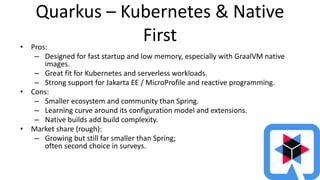
Quarkus – Kubernetes & Native
First
• Pros:
– Designed for fast startup and low memory, especially with GraalVM native
images.
– Great fit for Kubernetes and serverless workloads.
– Strong support for Jakarta EE / MicroProfile and reactive programming.
• Cons:
– Smaller ecosystem and community than Spring.
– Learning curve around its configuration model and extensions.
– Native builds add build complexity.
• Market share (rough):
– Growing but still far smaller than Spring;
often second choice in surveys.
Micronaut – Ahead-of-Time &
Lightweight
• Pros:
– Compile-time DI & AOP: very fast startup, low memory.
– Good fit for microservices, serverless, and resource-constrained environments.
– Strong GraalVM support; works with Java, Kotlin, Groovy.
• Cons:
– Smaller ecosystem and community than Spring.
– Some familiar Spring libraries/integrations may not exist.
– Different annotations and project structure vs classic Spring.
• Market share (rough):
– Popular in discussions, but niche vs Spring (low single-digit share).
Helidon – Oracle’s Cloud-Native
Stack
• Pros:
– Backed by Oracle; designed for Kubernetes and cloud-native apps.
– Helidon SE: lightweight, reactive, functional-style APIs.
– Helidon MP: MicroProfile / Jakarta EE model with standard APIs.
– Good integration with Kubernetes, Prometheus, etc.
• Cons:
– Less mainstream; fewer tutorials and community resources.
– Smaller ecosystem than Spring; more manual wiring sometimes.
– More common in Oracle-centric organizations.
• Market share (rough):
– Recognized but niche; low single-digit usage.
Jakarta EE & MicroProfile –
Standards-First
• Pros:
– Open standards supported by multiple runtimes (Open Liberty, Payara, WildFly, etc.).
– Modern Jakarta EE and MicroProfile focus on cloud-native features.
– Good for organizations that value vendor neutrality and portability.
• Cons:
– Historical perception of classic Java EE as heavy, even if modern runtimes are lighter.
– Ecosystem is more fragmented across many runtimes.
– Learning curve if coming from Spring’s ecosystem.
• Market share (rough):
– Widely used overall,
– but usage is split across several servers/runtimes.
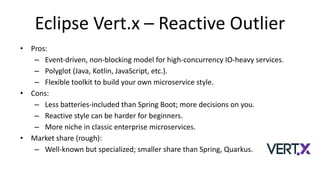
Eclipse Vert.x – Reactive Outlier
• Pros:
– Event-driven, non-blocking model for high-concurrency IO-heavy services.
– Polyglot (Java, Kotlin, JavaScript, etc.).
– Flexible toolkit to build your own microservice style.
• Cons:
– Less batteries-included than Spring Boot; more decisions on you.
– Reactive style can be harder for beginners.
– More niche in classic enterprise microservices.
• Market share (rough):
– Well-known but specialized; smaller share than Spring, Quarkus.
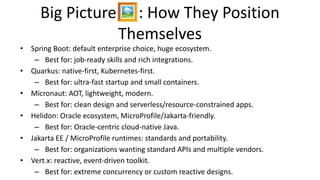
Big Picture🖼: How They Position
Themselves
• Spring Boot: default enterprise choice, huge ecosystem.
– Best for: job-ready skills and rich integrations.
• Quarkus: native-first, Kubernetes-first.
– Best for: ultra-fast startup and small containers.
• Micronaut: AOT, lightweight, modern.
– Best for: clean design and serverless/resource-constrained apps.
• Helidon: Oracle ecosystem, MicroProfile/Jakarta-friendly.
– Best for: Oracle-centric cloud-native Java.
• Jakarta EE / MicroProfile runtimes: standards and portability.
– Best for: organizations wanting standard APIs and multiple vendors.
• Vert.x: reactive, event-driven toolkit.
– Best for: extreme concurrency or custom reactive designs.
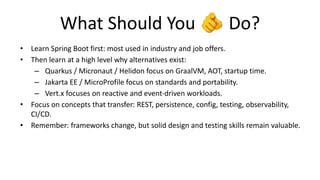
What Should You 🫵 Do?
• Learn Spring Boot first: most used in industry and job offers.
• Then learn at a high level why alternatives exist:
– Quarkus / Micronaut / Helidon focus on GraalVM, AOT, startup time.
– Jakarta EE / MicroProfile focus on standards and portability.
– Vert.x focuses on reactive and event-driven workloads.
• Focus on concepts that transfer: REST, persistence, config, testing, observability,
CI/CD.
• Remember: frameworks change, but solid design and testing skills remain valuable.
https:/
/spring-book.mystrikingly.com

☕ JAVA MICROSERVICES IN 2025 Choosing a Java framework for microservices can feel… overwhelming.

  • 1.
    Java Microservices in2025 Which Framework Should You Learn First? (Spring Boot, Quarkus, Micronaut, Helidon & Friends)
  • 2.
    Why Framework ChoiceMatters • You’ll write the same business logic, but: – Different startup times, memory usage, and developer experience (DX) – Different cloud-native integrations (Kubernetes, GraalVM, observability…) • Most teams standardize on one microservices stack. • As a student: – Know one framework deeply (often Spring Boot). – Understand what alternatives exist so you don’t panic in a new job.
  • 3.
    Spring Boot –The Industry Default • Pros: – Huge ecosystem and community; lots of starters and tutorials. – Tight integration with Spring projects (Data, Security, Cloud, Batch…). – Mature production tooling: Actuator, Micrometer, observability. – Widely used in enterprises and cloud platforms. • Cons: – Can feel heavy for very small services. – Historically slower startup and higher memory than native-first rivals (AOT is improving this). • Market share (rough): – ~60%+ of cloud-native Java developers use Spring / Spring Boot. – Safest first framework to learn for jobs.
  • 4.
    Quarkus – Kubernetes& Native First • Pros: – Designed for fast startup and low memory, especially with GraalVM native images. – Great fit for Kubernetes and serverless workloads. – Strong support for Jakarta EE / MicroProfile and reactive programming. • Cons: – Smaller ecosystem and community than Spring. – Learning curve around its configuration model and extensions. – Native builds add build complexity. • Market share (rough): – Growing but still far smaller than Spring; often second choice in surveys.
  • 5.
    Micronaut – Ahead-of-Time& Lightweight • Pros: – Compile-time DI & AOP: very fast startup, low memory. – Good fit for microservices, serverless, and resource-constrained environments. – Strong GraalVM support; works with Java, Kotlin, Groovy. • Cons: – Smaller ecosystem and community than Spring. – Some familiar Spring libraries/integrations may not exist. – Different annotations and project structure vs classic Spring. • Market share (rough): – Popular in discussions, but niche vs Spring (low single-digit share).
  • 6.
    Helidon – Oracle’sCloud-Native Stack • Pros: – Backed by Oracle; designed for Kubernetes and cloud-native apps. – Helidon SE: lightweight, reactive, functional-style APIs. – Helidon MP: MicroProfile / Jakarta EE model with standard APIs. – Good integration with Kubernetes, Prometheus, etc. • Cons: – Less mainstream; fewer tutorials and community resources. – Smaller ecosystem than Spring; more manual wiring sometimes. – More common in Oracle-centric organizations. • Market share (rough): – Recognized but niche; low single-digit usage.
  • 7.
    Jakarta EE &MicroProfile – Standards-First • Pros: – Open standards supported by multiple runtimes (Open Liberty, Payara, WildFly, etc.). – Modern Jakarta EE and MicroProfile focus on cloud-native features. – Good for organizations that value vendor neutrality and portability. • Cons: – Historical perception of classic Java EE as heavy, even if modern runtimes are lighter. – Ecosystem is more fragmented across many runtimes. – Learning curve if coming from Spring’s ecosystem. • Market share (rough): – Widely used overall, – but usage is split across several servers/runtimes.
  • 8.
    Eclipse Vert.x –Reactive Outlier • Pros: – Event-driven, non-blocking model for high-concurrency IO-heavy services. – Polyglot (Java, Kotlin, JavaScript, etc.). – Flexible toolkit to build your own microservice style. • Cons: – Less batteries-included than Spring Boot; more decisions on you. – Reactive style can be harder for beginners. – More niche in classic enterprise microservices. • Market share (rough): – Well-known but specialized; smaller share than Spring, Quarkus.
  • 9.
    Big Picture🖼: HowThey Position Themselves • Spring Boot: default enterprise choice, huge ecosystem. – Best for: job-ready skills and rich integrations. • Quarkus: native-first, Kubernetes-first. – Best for: ultra-fast startup and small containers. • Micronaut: AOT, lightweight, modern. – Best for: clean design and serverless/resource-constrained apps. • Helidon: Oracle ecosystem, MicroProfile/Jakarta-friendly. – Best for: Oracle-centric cloud-native Java. • Jakarta EE / MicroProfile runtimes: standards and portability. – Best for: organizations wanting standard APIs and multiple vendors. • Vert.x: reactive, event-driven toolkit. – Best for: extreme concurrency or custom reactive designs.
  • 10.
    What Should You🫵 Do? • Learn Spring Boot first: most used in industry and job offers. • Then learn at a high level why alternatives exist: – Quarkus / Micronaut / Helidon focus on GraalVM, AOT, startup time. – Jakarta EE / MicroProfile focus on standards and portability. – Vert.x focuses on reactive and event-driven workloads. • Focus on concepts that transfer: REST, persistence, config, testing, observability, CI/CD. • Remember: frameworks change, but solid design and testing skills remain valuable.
  • 11.