Java Concepts Early Objects 7th Edition Cay S. Horstmann
Java Concepts Early Objects 7th Edition Cay S. Horstmann
Java Concepts Early Objects 7th Edition Cay S. Horstmann
Java Concepts Early Objects 7th Edition Cay S. Horstmann
Java Concepts Early Objects 7th Edition Cay S. Horstmann
1.
Java Concepts EarlyObjects 7th Edition Cay S.
Horstmann pdf download
https://ebookfinal.com/download/java-concepts-early-objects-7th-
edition-cay-s-horstmann/
Explore and download more ebooks or textbooks
at ebookfinal.com
2.
Here are somerecommended products for you. Click the link to
download, or explore more at ebookfinal
Late Early objects Big Java 5th Edition Cay Horstmann
https://ebookfinal.com/download/late-early-objects-big-java-5th-
edition-cay-horstmann/
Java Concepts Compatible with Java 5 6 and 7 6th Edition
Cay S. Horstmann
https://ebookfinal.com/download/java-concepts-compatible-with-
java-5-6-and-7-6th-edition-cay-s-horstmann/
Big Java 3rd Edition Cay S. Horstmann
https://ebookfinal.com/download/big-java-3rd-edition-cay-s-horstmann/
Core Java 2 Advanced Features 5th Edition Cay S. Horstmann
https://ebookfinal.com/download/core-java-2-advanced-features-5th-
edition-cay-s-horstmann/
3.
C for Everyone2nd Edition Cay S. Horstmann
https://ebookfinal.com/download/c-for-everyone-2nd-edition-cay-s-
horstmann/
C for Everyone 1st Edition Cay S. Horstmann
https://ebookfinal.com/download/c-for-everyone-1st-edition-cay-s-
horstmann/
Java Design Objects UML and Process 1st Edition Kirk
Knoernschild
https://ebookfinal.com/download/java-design-objects-uml-and-
process-1st-edition-kirk-knoernschild/
Starting Out with C Early Objects 5th Edition Tony Gaddis
https://ebookfinal.com/download/starting-out-with-c-early-objects-5th-
edition-tony-gaddis/
Java How to Program 7th Edition Harvey M. Deitel
https://ebookfinal.com/download/java-how-to-program-7th-edition-
harvey-m-deitel/
5.
Java Concepts EarlyObjects 7th Edition Cay S.
Horstmann Digital Instant Download
Author(s): Cay S. Horstmann
ISBN(s): 9781118431122, 111843112X
Edition: 7
File Details: PDF, 99.52 MB
Year: 2012
Language: english
7.
Selected Operators andTheir Precedence
(See Appendix B for the complete list.)
[] Array element access
++ -- ! Increment, decrement, Boolean not
* / % Multiplication, division, remainder
+ - Addition, subtraction
< <= > >= Comparisons
== != Equal, not equal
&& Boolean and
|| Boolean or
= Assignment
Conditional Statement
if (floor >= 13)
{
actualFloor = floor - 1;
}
else if (floor >= 0)
{
actualFloor = floor;
}
else
{
System.out.println("Floor negative");
}
Condition
Executed when condition is true
Second condition (optional)
Executed when
all conditions are
false (optional)
Class Declaration
public class CashRegister
{
private int itemCount;
private double totalPrice;
public void addItem(double price)
{
itemCount++;
totalPrice = totalPrice + price;
}
. . .
}
Method
Instance variables
do
{
System.out.print("Enter a positive integer: ");
input = in.nextInt();
}
while (input <= 0);
for (double value : values)
{
sum = sum + value;
}
An array or collection
Executed for each element
Loop body executed
at least once
Set to a new element in each iteration
Executed while
condition is true
Condition
Initialization Condition Update
Loop Statements
while (balance < TARGET)
{
year++;
balance = balance * (1 + rate / 100);
}
for (int i = 0; i < 10; i++)
{
System.out.println(i);
}
String Operations
String s = "Hello";
int n = s.length(); // 5
char ch = s.charAt(1); // 'e'
String t = s.substring(1, 4); // "ell"
String u = s.toUpperCase(); // "HELLO"
if (u.equals("HELLO")) ... // Use equals, not ==
for (int i = 0; i < s.length(); i++)
{
char ch = s.charAt(i);
Process ch
}
Mathematical Operations
Math.pow(x, y) Raising to a power xy
Math.sqrt(x) Square root x
Math.log10(x) Decimal log log10
(x)
Math.abs(x) Absolute value |x|
Math.sin(x)
Math.cos(x) Sine, cosine, tangent of x (x in radians)
Math.tan(x)
Variable and Constant Declarations
int cansPerPack = 6;
final double CAN_VOLUME = 0.335;
Type Name Initial value
Parameter
type and name
Exits method and
returns result.
Return type
Modifiers
Method Declaration
public static double cubeVolume(double sideLength)
{
double volume = sideLength * sideLength * sideLength;
return volume;
}
Input
Scanner in = new Scanner(System.in);
// Can also use new Scanner(new File("input.txt"));
int n = in.nextInt();
double x = in.nextDouble();
String word = in.next();
String line = in.nextLine();
while (in.hasNextDouble())
{
double x = in.nextDouble();
Process x
}
Linked Lists, Sets, and Iterators
LinkedList<String> names = new LinkedList<String>();
names.add("Bob"); // Adds at end
ListIterator<String> iter = names.listIterator();
iter.add("Ann"); // Adds before current position
String name = iter.next(); // Returns "Ann"
iter.remove(); // Removes "Ann"
Set<String> names = new HashSet<String>();
names.add("Ann"); // Adds to set if not present
names.remove("Bob"); // Removes if present
Iterator<String> iter = names.iterator();
while (iter.hasNext())
{
Process iter.next()
}
Arrays
int[] numbers = new int[5];
int[] squares = { 0, 1, 4, 9, 16 };
int[][] magicSquare =
{
{ 16, 3, 2, 13},
{ 5, 10, 11, 8},
{ 9, 6, 7, 12},
{ 4, 15, 14, 1}
};
for (int i = 0; i < numbers.length; i++)
{
numbers[i] = i * i;
}
for (int element : numbers)
{
Process element
}
System.out.println(Arrays.toString(numbers));
// Prints [0, 1, 4, 9, 16]
Element
Element type type Length
All elements are zero.
Maps
Map<String, Integer> scores = new HashMap<String, Integer>();
scores.put("Bob", 10);
Integer score = scores.get("Bob");
for (String key : scores.keySet())
{
Process key and scores.get(key)
}
Key Value
type type
Returns null if key not present
Output
System.out.print("Enter a value: ");
System.out.println("Volume: " + volume);
System.out.printf("%-10s %10d %10.2f", name, qty, price);
PrintWriter out = new PrintWriter("output.txt");
out.close();
Left-justified string Integer Floating-point number
Field width Precision
Does not advance to new line.
Use + to concatenate values.
Remember to close output file.
Use print/println/printf
to write output to file.
Array Lists
ArrayList<String> names = new ArrayList<String>();
names.add("Ann");
names.add("Cindy"); // [Ann, Cindy], names.size() is now 2
names.add(1, "Bob"); // [Ann, Bob, Cindy]
names.remove(2); // [Ann, Bob]
names.set(1, "Bill"); // [Ann, Bill]
String name = names.get(0); // Gets "Ann"
System.out.println(names); // Prints [Ann, Bill]
Element type
Use wrapper type,
Integer, Double, etc.,
for primitive types.
Add elements to the end
Initially empty
bj5jc7_insidecovers_8x10.indd 1 10/15/12 12:05 PM
vi Preface
or languagefeatures when the reader is ready for the additional information. You will
not find artificial over-simplifications that give an illusion of knowledge.
Reinforce sound engineering practices.
A multitude of useful tips on software quality and common errors encourage the
development of good programming habits. The optional testing track focuses on
test-driven development, encouraging students to test their programs systematically.
Provide an optional graphics track.
Graphical shapes are splendid examples of objects. Many students enjoy writing pro-
grams that create drawings or use graphical user interfaces. If desired, these topics can
be integrated into the course by using the materials at the end of Chapters 2, 3, and 10.
New to This Edition
Problem Solving Strategies
This edition adds practical, step-by-step illustrations of techniques that can help stu-
dents devise and evaluate solutions to programming problems. Introduced where
they are most relevant, these strategies address barriers to success for many students.
Strategies included are:
• Algorithm Design (with pseudocode)
• Tracing Objects
• First Do It By Hand (doing sample calculations by hand)
• Flowcharts
• Selecting Test Cases
• Hand-Tracing
• Storyboards
• Adapting Algorithms
• Discovering Algorithms by Manipulating Physical Objects
• Patterns for Object Data
• Thinking Recursively
• Estimating the Running Time of an Algorithm
Optional Science and Business Exercises
End-of-chapter exercises have been enhanced with problems from scientific and
business domains. Designed to engage students, the exercises illustrate the value of
programming in applied fields.
New and Reorganized Topics
All chapters were revised and enhanced to respond to user feedback and improve the
flow of topics. Loop algorithms are now introduced explicitly in Chapter 6. Addi-
tional array algorithms are presented in Chapter 7 and incorporated into the prob-
lem-solving sections. Chapter 8 is more clearly focused on the design of a single class,
whereas Chapter 12 deals with relationships between classes. Chapter 15 shows how
jc7_fm_06.indd 6 10/25/12 9:51 AM
14.
Preface vii
to usethe basic data structures from the standard library. New example tables, photo-
graphs, and exercises appear throughout the book.
A Tour of the Book
The book can be naturally grouped into three parts, as illustrated by Figure 1. The
organization of chapters offers the same flexibility as the previous edition; dependen-
cies among the chapters are also shown in the figure.
Figure 1 Chapter Dependencies
9. Inheritance
10. Interfaces
13. Recursion
14. Sorting and
Searching
15. The Java
Collections
Framework
6. Iteration
8. Designing
Classes
Fundamentals
Object-Oriented Design
Data Structures & Algorithms
Online Chapters
2. Using Objects
3. Implementing
Classes
4. Fundamental
Data Types
5. Decisions
6. Loops
7. Arrays
and Array Lists
11. Input/Output
and Exception
Handling
Sections 11.1 and 11.2
(text file processing) can be
covered with Chapter 6.
1. Introduction
12. Object-
Oriented Design
jc7_fm_06.indd 7 10/24/12 6:11 PM
15.
viii Preface
Part A:Fundamentals (Chapters 1–7)
Chapter 1 contains a brief introduction to computer science and Java programming.
Chapter 2 shows how to manipulate objects of predefined classes. In Chapter 3,
you will build your own simple classes from given specifications. Fundamental data
types, branches, loops, and arrays are covered in Chapters 4–7.
Part B: Object-Oriented Design (Chapters 8–12)
Chapter 8 takes up the subject of class design in a systematic fashion, and it intro-
duces a very simple subset of the UML notation. The discussion of polymorphism
and inheritance is split into two chapters. Chapter 9 covers inheritance and polymor-
phism, whereas Chapter 10 covers interfaces. Exception handling and basic file input/
output are covered in Chapter 11. The exception hierarchy gives a useful example for
inheritance. Chapter 12 contains an introduction to object-oriented design, including
two significant case studies.
Part C: Data Structures and Algorithms (Chapters 13–15)
Chapters 13 through 15 (available on the book’s companion sites) contain an intro-
duction to algorithms and data structures, covering recursion, sorting and searching,
linked lists, sets, maps, stacks, and queues. These topics may be outside the scope of
a one-semester course, but can be covered as desired after Chapter 7 (see Figure 1).
Recursion, in Chapter 13, starts with simple examples and progresses to meaning-
ful applications that would be difficult to implement iteratively. Chapter 14 covers
quadratic sorting algorithms as well as merge sort, with an informal introduction to
big-Oh notation. Each data structure is presented in the context of the standard Java
collections library. You will learn the essential abstractions of the standard library
(such as iterators, sets, and maps) as well as the performance characteristics of the
various collections.
Appendices
Many instructors find it highly beneficial to require a consistent style for all assign-
ments. If the style guide in Appendix I conflicts with instructor sentiment or local
customs, however, it is available in electronic form so that it can be modified. Appen-
dices E–J are available on the Web.
A. The Basic Latin and Latin-1 Subsets of Unicode
B. Java Operator Summary
C. Java Reserved Word Summary
D. The Java Library
E. Java Syntax Summary
F. Tool Summary
G. Number Systems
H. UML Summary
I. Java Language Coding Guidelines
J. HTML Summary
jc7_fm_06.indd 8 10/26/12 11:10 AM
16.
Preface ix
Custom Bookand eBook Options
Java Concepts may be ordered as a custom print or eBook that includes your choice
of chapters—including those from other Horstmann titles. Visit customselect.wiley.
com to create your custom book order.
To order the Wiley Select Edition of Java Concepts with all 15 chapters in the
printed book, specify ISBN 978-1-119-93669-5 when you order books.
Java Concepts is available in a variety of eBook formats at prices that are signifi-
cantly lower than the printed book. Please contact your Wiley sales rep for more
information or check www.wiley.com/college/horstmann for available versions.
Web Resources
This book is complemented by a complete suite of online resources. Go to www.wiley.
com/college/horstmann to visit the online companion sites, which include
• “CodeCheck,” a new online service currently in development by Cay Horstmann
that students can use to check their homework assignments and to work on addi-
tional practice problems. Visit http://horstmann.com/codecheck to learn more and to
try it out.
• Source code for all example programs in the book and in online examples.
• Worked Examples that apply the problem-solving steps in the book to other
realistic examples.
• Animations of key concepts.
• Lab exercises that apply chapter concepts (with solutions for instructors only).
• Lecture presentation slides (for instructors only).
• Solutions to all review and programming exercises (for instructors only).
• A test bank that focuses on skills, not just terminology (for instructors only). This
extensive set of multiple-choice questions can be used with a word processor or
imported into a course management system.
FULL CODE EXA
Go to wiley.com/go/
javacode to download
a program that dem
onstrates variables
and assignments.
WORKED EXAMPLE 6.3 A Sample Debugging Session
Learn how to find bugs in an algorithm for counting the
syllables of a word. Go to wiley.com/go/javaexamples and
download Worked Example 6.3.
MPLE
-
Pointers in the book
describe what students
will find on the Web.
jc7_fm_06.indd 9 10/26/12 11:10 AM
17.
x Walkthrough
A Walkthroughof the Learning Aids
The pedagogical elements in this book work together to focus on and reinforce key
concepts and fundamental principles of programming, with additional tips and detail
organized to support and deepen these fundamentals. In addition to traditional
features, such as chapter objectives and a wealth of exercises, each chapter contains
elements geared to today’s visual learner.
FULL CODE EXAMPLE
Go to wiley.com/go/
javacode to download
a program that
uses common loop
algorithms.
Additional full code examples
provides complete programs for
students to run and modify.
254 Chapter 6 Loops
6.3 The for Loop
It often happens that you want to execute a sequence of statements a given number
of times. You can use a while loop that is controlled by a counter, as in the following
example:
int counter = 1; // Initialize the counter
while (counter <= 10) // Check the counter
{
System.out.println(counter);
counter++; // Update the counter
}
Because this loop type is so common, there is a spe-
cial form for it, called the for loop (see Syntax 6.2).
for (int counter = 1; counter <= 10; counter++)
{
System.out.println(counter);
}
Some people call this loop count-controlled. In con-
trast, the while loop of the preceding section can be
called an event-controlled loop because it executes
until an event occurs; namely that the balance reaches
the target. Another commonly used term for a
count-controlled loop is definite. You know from
the outset that the loop body will be executed a
definite number of times; ten times in our example.
In contrast, you do not know how many iterations it
takes to accumulate a target balance. Such a loop is
called indefinite.
The for loop is
used when a
value runs from a
starting point to an
ending point with a
constant increment
or decrement.
You can visualize the for loop as
an orderly sequence of steps.
Syntax 6.2 for Statement
for (int i = 5; i <= 10; i++)
{
sum = sum + i;
}
This loop executes 6 times.
See page 260.
This initialization
happens once
before the loop starts.
The condition is
checked before
each iteration.
This update is
executed after
each iteration.
The variable i is
defined only in this for loop.
See page 261.
These three
expressions should be related.
See page 259.
for (initialization; condition; update)
{
statements
}
Syntax
Throughout each chapter,
margin notes show where
new concepts are introduced
and provide an outline of key ideas.
Annotations explain required
components and point to more
information on common errors
or best practices associated
with the syntax.
Annotated syntax boxes
provide a quick, visual overview
of new language constructs.
Like a variable in a computer
program, a parking space has
an identifier and a contents.
Analogies to everyday objects are
used to explain the nature and behavior
of concepts such as variables, data
types, loops, and more.
jc7_fm_06.indd 10 10/24/12 6:11 PM
18.
Walkthrough xi
7.5 ProblemSolving: Discovering Algorithms by Manipulating Physical Objects 339
Now how does that help us with our problem, switching the first and the second
half of the array?
Let’s put the first coin into place, by swapping it with the fifth coin. However, as
Java programmers, we will say that we swap the coins in positions 0 and 4:
Problem Solving sections teach
techniques for generating ideas and
evaluating proposed solutions, often
using pencil and paper or other
artifacts. These sections emphasize
that most of the planning and problem
solving that makes students successful
happens away from the computer.
Next, we swap the coins in positions 1 and 5:
Memorable photos reinforce
analogies and help students
remember the concepts.
In the same way that there can be a street named “Main Street” in different cities,
a Java program can have multiple variables with the same name.
Step 1 Decide what work must be done inside the loop.
Every loop needs to do some kind of repetitive work, such as
• Reading another item.
• Updating a value (such as a bank balance or total).
• Incrementing a counter.
If you can’t figure out what needs to go inside the loop, start by writing down the steps that
HOW TO 6.1 Writing a Loop
This How To walks you through the process of implementing a
loop statement. We will illustrate the steps with the following
example problem.
Problem Statement Read twelve temperature values (one for
each month) and display the number of the month with the high-
est temperature. For example, according to worldclimate.com, the
average maximum temperatures for Death Valley are (in order by
month, in degrees Celsius):
18.2 22.6 26.4 31.1 36.6 42.2 45.7 44.5 40.2 33.1 24.2 17.6
In this case, the month with the highest temperature (45.7 degrees
Celsius) is July, and the program should display 7.
How To guides give step-by-step
guidance for common programming
tasks, emphasizing planning and
testing. They answer the beginner’s
question, “Now what do I do?” and
integrate key concepts into a
problem-solving sequence.
WORKED EXAMPLE 6.1 Credit Card Processing
Learn how to use a loop to remove spaces from a credit card
number. Go to wiley.com/go/javaexamples and download
Worked Example 6.1.
Worked Examples apply
the steps in the How To to a
different example, showing
how they can be used to
plan, implement, and test
a solution to another
programming problem.
Table 1 Variable Declarations in Java
Variable Name Comment
int width = 20; Declares an integer variable and initializes it with 20.
int perimeter = 4 * width; The initial value need not be a fixed value. (Of course, width
must have been previously declared.)
String greeting = "Hi!"; This variable has the type String and is initialized with the
string “Hi”.
height = 30; Error: The type is missing. This statement is not a declaration
but an assignment of a new value to an existing variable—see
Section 2.2.5.
int width = "20"; Error: You cannot initialize a number with the string “20”.
(Note the quotation marks.)
int width; Declares an integer variable without initializing it. This can be a
cause for errors—see Common Error 2.1 on page 42.
int width, height; Declares two integer variables in a single statement. In this
book, we will declare each variable in a separate statement.
Example tables support beginners
with multiple, concrete examples.
These tables point out common
errors and present another quick
reference to the section’s topic.
jc7_fm_06.indd 11 10/24/12 6:15 PM
19.
xii Walkthrough
section_1/Investment.java
1 /**
2A class to monitor the growth of an investment that
3 accumulates interest at a fixed annual rate.
4 */
5 public class Investment
6 {
7 private double balance;
8 private double rate;
9 private int year;
10
11 /**
12 Constructs an Investment object from a starting balance and
13 interest rate.
14 @param aBalance the starting balance
15 @param aRate the interest rate in percent
16 */
17 public Investment(double aBalance, double aRate)
18 {
19 balance = aBalance;
20 rate = aRate;
21 year = 0;
22 }
23
24 /**
25 Keeps accumulating interest until a target balance has
26 been reached.
27 @param targetBalance the desired balance
28 */
The for loop neatly groups the initialization, condition, and update expressions
together. However, it is important to realize that these expressions are not executed
together (see Figure 3).
• The initialization is executed once, before the loop is entered. 1
• The condition is checked before each iteration. 2 5
• The update is executed after each iteration. 4
A N I M AT I O N
The for Loop
Figure 3
Execution of a
for Loop
for (int counter = 1; counter <= 10; counter++)
{
System.out.println(counter);
}
Initialize counter
1
for (int counter = 1; counter <= 10; counter++)
{
System.out.println(counter);
}
Check condition
2
for (int counter = 1; counter <= 10; counter++)
{
System.out.println(counter);
}
Execute loop body
3
for (int counter = 1; counter <= 10; counter++)
{
System.out.println(counter);
}
Update counter
4
for (int counter = 1; counter <= 10; counter++)
{
System.out.println(counter);
}
Check condition again
5
counter = 1
counter = 1
counter = 1
counter = 2
counter = 2
Students can view animations
of key concepts on the Web.
Self-check exercises at the
end of each section are designed
to make students think through
the new material—and can
spark discussion in lecture.
Optional science and business
exercises engage students with
realistic applications of Java.
Program listings are carefully
designed for easy reading,
going well beyond simple
color coding. Methods are set
off by a subtle outline.
This means “compute the value of width + 10 1 and store that value in the variable
width 2 ” (see Figure 4).
In Java, it is not a problem that the variable width is used on both sides of the = sym-
bol. Of course, in mathematics, the equation width = width + 10 has no solution.
Figure 4
Executing the Statement
width = width + 10
1
width =
width + 10
40
30
2
width = 40
Compute the value of the right-hand side
Store the value in the variable
Progressive figures trace code
segments to help students visualize
the program flow. Color is used
consistently to make variables and
other elements easily recognizable.
11. Write the for loop of the Investment class as a while loop.
12. How many numbers does this loop print?
for (int n = 10; n >= 0; n--)
{
System.out.println(n);
}
13. Write a for loop that prints all even numbers between 10 and 20 (inclusive).
14. Write a for loop that computes the sum of the integers from 1 to n.
Practice It Now you can try these exercises at the end of the chapter: R6.4, R6.10, E6.8, E6.12.
S E L F C H E C K
•• Business E6.17 Currency conversion. Write a program
that first asks the user to type today’s
price for one dollar in Japanese yen,
then reads U.S. dollar values and
converts each to yen. Use 0 as a sentinel.
• Science P6.15 Radioactive decay of radioactive materials can be
modeled by the equation A = A0e-t(log 2/h)
, where A is
the amount of the material at time t, A0 is the amount
at time 0, and h is the half-life.
Technetium-99 is a radioisotope that is used in imaging
of the brain. It has a half-life of 6 hours. Your program
should display the relative amount A /A0 in a patient
body every hour for 24 hours after receiving a dose.
jc7_fm_06.indd 12 10/24/12 6:11 PM
20.
Walkthrough xiii
Length andSize
Unfortunately, the Java syntax for
determining the number of elements
in an array, an array list, and a string
is not at all consistent. It is a com-
mon error to confuse these. You just
have to remember the correct syntax
for every data type.
Common Error 7.4
Data Type Number of Elements
Array a.length
Array list a.size()
String a.length()
Common Errors describe the kinds
of errors that students often make,
with an explanation of why the errors
occur, and what to do about them.
Hand-Tracing
A very useful technique for understanding whether a pro-
gram works correctly is called hand-tracing. You simulate
the program’s activity on a sheet of paper. You can use this
method with pseudocode or Java code.
Get an index card, a cocktail napkin, or whatever sheet
of paper is within reach. Make a column for each variable.
Have the program code ready. Use a marker, such as a
paper clip, to mark the current statement. In your mind,
execute statements one at a time. Every time the value of a
variable changes, cross out the old value and write the new
value below the old one.
For example, let’s trace the getTax method with the data
from the program run above.
When the TaxReturn object is constructed, the income
instance variable is set to 80,000 and status is set to MARRIED. Then the getTax method is called.
In lines 31 and 32 of TaxReturn.java, tax1 and tax2 are initialized to 0.
29 public double getTax()
30 {
31 double tax1 = 0;
32 double tax2 = 0;
33
Programming Tip 5.5
Hand-tracing helps you
understand whether a
program works correctly.
income status tax1 tax2
80000 MARRIED 0 0
Because status is not SINGLE, we move to the else
branch of the outer if statement (line 46).
34 if (status == SINGLE)
35 {
36 if (income <= RATE1_SINGLE_LIMIT)
37 {
38 tax1 = RATE1 * income;
39 }
40 else
41 {
42 tax1 = RATE1 * RATE1_SINGLE_LIMIT;
43 tax2 = RATE2 * (income - RATE1_SINGLE_LIMIT);
44 }
45 }
46 else
47 {
File Dialog Boxes
In a program with a graphical user interface, you will want to use a file dialog box (such as the
one shown in the figure below) whenever the users of your program need to pick a file. The
JFileChooser class implements a file dialog box for the Swing user-interface toolkit.
The JFileChooser class has many options to fine-tune the display of the dialog box, but in its
most basic form it is quite simple: Construct a file chooser object; then call the showOpenDialog
or showSaveDialog method. Both methods show the same dialog box, but the button for select-
ing a file is labeled “Open” or “Save”, depending on which method you call.
For better placement of the dialog box on the screen, you can specify the user-interface
component over which to pop up the dialog box. If you don’t care where the dialog box pops
up, you can simply pass null. The showOpenDialog and showSaveDialog methods return either
JFileChooser.APPROVE_OPTION, if the user has chosen a file, or JFileChooser.CANCEL_OPTION, if the
user canceled the selection. If a file was chosen, then you call the getSelectedFile method to
obtain a File object that describes the file. Here is a complete example:
JFileChooser chooser = new JFileChooser();
Scanner in = null;
if (chooser.showOpenDialog(null) == JFileChooser.APPROVE_OPTION)
{
File selectedFile = chooser.getSelectedFile();
in = new Scanner(selectedFile);
. . .
}
Special Topic 11.2
A JFileChooser Dialog Box
Call with
showOpenDialog
method
Button is “Save” when
showSaveDialog method
is called
FULL CODE EXAMPLE
Go to wiley.com/go/
javacode to download
a program that
demonstrates how to
use a file chooser.
When computers
were first invented
in the 1940s, a computer filled an
entire room. The photo below shows
the ENIAC (electronic numerical inte-
grator and computer), completed in
1946 at the University of Pennsylvania.
The ENIAC was used by the military
to compute the trajectories of projec-
tiles. Nowadays, computing facilities
of search engines, Internet shops, and
social networks fill huge buildings
called data centers. At the other end of
the spectrum, computers are all around
us. Your cell phone has a computer
inside, as do many credit cards and fare
cards for public transit. A modern car
has several computers––to control the
engine, brakes, lights, and the radio.
This transit card contains a computer.
The advent of ubiqui-
tous computing changed
many aspects of our
lives. Factories used
to employ people to
do repetitive assembly
tasks that are today car-
ried out by computer-
controlled robots, oper-
ated by a few people
who know how to work
with those computers.
Books, music, and mov-
ies are nowadays often
consumed on com-
puters, and comput-
ers are almost always
involved in their production. The
book that you are reading right now
could not have been written without
computers.
Computing & Society 1.1 Computers Are Everywhere
Computing & Society presents social
and historical topics on computing—for
interest and to fulfill the “historical and
social context” requirements of the
ACM/IEEE curriculum guidelines.
Special Topics present optional
topics and provide additional
explanation of others. New
features of Java 7 are also
covered in these notes.
Programming Tips explain
good programming practices,
and encourage students to be
more productive with tips and
techniques such as hand-tracing.
jc7_fm_06.indd 13 10/24/12 6:11 PM
21.
xiv Walkthrough
Test BankInstructors can use quiz and
test questions designed to exercise
students’ code reading and writing skills.
Web Resources
CodeCheck “CodeCheck” is a new
online service currently in development
by Cay Horstmann that students can
use to check their homework and to
work on additional practice problems.
Visit http://horstmann.com/codecheck
to learn more and to try it out.
10) What is displayed after executing the given code snippet?
int[] mymarks = new int[10];
int total = 0;
Scanner in = new Scanner(System.in);
for (int cnt = 1; cnt <= 10; cnt++)
{
System.out.print("Enter the marks: ");
mymarks[cnt] = in.nextInt();
total = total + mymarks[cnt];
}
System.out.println(total);
a) The code snippet displays the total marks of all ten subjects.
b) The for loop causes a run-time time error on the first iteration.
c) The code snippet causes a bounds error.
d) The code snippet displays zero.
1.1) Consider the following Card class.
public class Card
{
private String name;
public Card()
{
name = "";
}
public Card(String n)
{
name = n;
}
public String getName()
{
return name;
}
public boolean isExpired()
{
return false;
}
public String format()
{
return "Card holder: " + name;
}
}
Use this class as a superclass to implement a hierarchy of related classes:
Class Data
IDCard ID number
CallingCard Card number, PIN
DriverLicense Expiration year
Write declarations for each of the subclasses. For each subclass, supply private instance variables. Leave the
bodies of the constructors and the format methods blank for now.
Lab Exercises These multi-part
exercises ask students to apply
chapter concepts. They can serve
as “warm-ups” in the lab or to
provide additional practice.
Animations Students can
play and replay dynamic
explanations of concepts
and program flow.
http://horstmann.com/codecheck/
jc7_fm_06.indd 14 10/24/12 6:11 PM
22.
Acknowledgments xv
Acknowledgments
Many thanksto Beth Lang Golub, Don Fowley, Elizabeth Mills, Katherine Willis,
Jenny Welter, Wendy Ashenberg, Lisa Gee, Kevin Holm, and Tim Lindner at John
Wiley & Sons, and Vickie Piercey at Publishing Services for their help with this proj-
ect. An especially deep acknowledgment and thanks goes to Cindy Johnson for her
hard work, sound judgment, and amazing attention to detail.
I am grateful to Jose Cordova, University of Louisiana, James Johnson, Norm
Krumpe, Miami University Ohio, Kathy Liszka, University of Akron, Donald Smith,
Columbia College, Brent Wilson, George Fox University, and David Woolbright,
Columbus State University, for their excellent contributions to the supplementary
materials.
Many thanks to the individuals who reviewed the manuscript for this edition,
made valuable suggestions, and brought an embarrassingly large number of errors
and omissions to my attention. They include:
Eric Aaron, Wesleyan University
James Agnew, Anne Arundel
Community College
Greg Ballinger, Miami Dade College
Jon Beck, Truman State University
Matt Boutell, Rose-Hulman Institute
of Technology
John Bundy, DeVry University Chicago
Michael Carney, Finger Lakes
Community College
Christopher Cassa, Massachusetts
Institute of Technology
Dr. Suchindran S. Chatterjee, Arizona
State University
Tina Comston, Franklin University
Lennie Cooper, Miami Dade College
Sherif Elfayoumy, University of
North Florida
Henry A Etlinger, Rochester Institute
of Technology
Guy Helmer, Iowa State University
Ed Holden, Rochester Institute
of Technology
Steven Janke, Colorado College
Mark Jones, Lock Haven University of
Pennsylvania
Dr. Mustafa Kamal, University of
Central Missouri
Gary J. Koehler, University of Florida
Ronald Krawitz, DeVry University
Norm Krumpe, Miami University Ohio
Jim Leone, Rochester Institute
of Technology
Kevin Lillis, St. Ambrose University
Darren Lim, Siena College
Hong Lin, DeVry University
Kuber Maharjan, Purdue University
College of Technology at Columbus
Patricia McDermott-Wells, Florida
International University
Bill Mongan, Drexel University
George Novacky, University
of Pittsburgh
Mimi Opkins, California State
University Long Beach
Derek Pao, City University of
Hong Kong
Katherine Salch, Illinois Central
College
Javad Shakib, DeVry University
Charlie Shu, Franklin University
Joslyn A. Smith, Florida International
University
Robert Strader, Stephen F. Austin
State University
Jonathan S. Weissman, Finger Lakes
Community College
Katherine H. Winters, University of
Tennessee Chattanooga
Tom Wulf, University of Cincinnati
Qi Yu, Rochester Institute of
Technology
jc7_fm_06.indd 15 10/24/12 6:11 PM
23.
xvi Acknowledgments
Tim Andersen,Boise State University
Ivan Bajic, San Diego State University
Ted Bangay, Sheridan Institute
of Technology
Ian Barland, Radford University
George Basham, Franklin University
Sambit Bhattacharya, Fayetteville
State University
Rick Birney, Arizona State University
Paul Bladek, Edmonds Community
College
Joseph Bowbeer, Vizrea Corporation
Timothy A. Budd, Oregon State
University
Robert P. Burton, Brigham Young
University
Frank Butt, IBM
Jerry Cain, Stanford University
Adam Cannon, Columbia University
Nancy Chase, Gonzaga University
Archana Chidanandan, Rose-Hulman
Institute of Technology
Vincent Cicirello, The Richard Stockton
College of New Jersey
Teresa Cole, Boise State University
Deborah Coleman, Rochester Institute
of Technology
Jose Cordova, University of Louisiana,
Monroe
Valentino Crespi, California State
University, Los Angeles
Jim Cross, Auburn University
Russell Deaton, University of Arkansas
Geoffrey Decker, Northern Illinois
University
H. E. Dunsmore, Purdue University
Robert Duvall, Duke University
Eman El-Sheikh, University of
West Florida
John Fendrich, Bradley University
David Freer, Miami Dade College
John Fulton, Franklin University
David Geary, Sabreware, Inc.
Margaret Geroch, Wheeling Jesuit
University
Ahmad Ghafarian, North Georgia
College & State University
Rick Giles, Acadia University
Stacey Grasso, College of San Mateo
Jianchao Han, California State
University, Dominguez Hills
Lisa Hansen, Western New
England College
Elliotte Harold
Eileen Head, Binghamton University
Cecily Heiner, University of Utah
Brian Howard, Depauw University
Lubomir Ivanov, Iona College
Norman Jacobson, University of
California, Irvine
Curt Jones, Bloomsburg University
Aaron Keen, California Polytechnic
State University, San Luis Obispo
Mugdha Khaladkar, New Jersey
Institute of Technology
Elliot Koffman, Temple University
Kathy Liszka, University of Akron
Hunter Lloyd, Montana State
University
Youmin Lu, Bloomsburg University
John S. Mallozzi, Iona College
John Martin, North Dakota
State University
Jeanna Matthews, Clarkson University
Scott McElfresh, Carnegie Mellon
University
Joan McGrory, Christian Brothers
University
Carolyn Miller, North Carolina State
University
Sandeep R. Mitra, State University of
New York, Brockport
Teng Moh, San Jose State University
John Moore, The Citadel
Jose-Arturo Mora-Soto, Jesica Rivero-
Espinosa, and Julio-Angel Cano-
Romero, University of Madrid
Faye Navabi, Arizona State University
Parviz Partow-Navid, California State
University, Los Angeles
Every new edition builds on the suggestions and experiences of prior reviewers and
users. I am grateful for the invaluable contributions these individuals have made:
jc7_fm_06.indd 16 10/24/12 6:11 PM
24.
Acknowledgments xvii
Kevin O’Gorman,California
Polytechnic State University,
San Luis Obispo
Michael Olan, Richard Stockton College
Kevin Parker, Idaho State University
Jim Perry, Ulster County Community
College
Cornel Pokorny, California Polytechnic
State University, San Luis Obispo
Roger Priebe, University of Texas,
Austin
C. Robert Putnam, California State
University, Northridge
Kai Qian, Southern Polytechnic
State University
Cyndi Rader, Colorado School of Mines
Neil Rankin, Worcester Polytechnic
Institute
Brad Rippe, Fullerton College
Pedro I. Rivera Vega, University of
Puerto Rico, Mayaguez
Daniel Rogers, SUNY Brockport
Chaman Lal Sabharwal, Missouri
University of Science and Technology
John Santore, Bridgewater
State College
Carolyn Schauble, Colorado
State University
Brent Seales, University of Kentucky
Christian Shin, SUNY Geneseo
Jeffrey Six, University of Delaware
Don Slater, Carnegie Mellon University
Ken Slonneger, University of Iowa
Donald Smith, Columbia College
Stephanie Smullen, University of
Tennessee, Chattanooga
Monica Sweat, Georgia Institute
of Technology
Peter Stanchev, Kettering University
Shannon Tauro, University of
California, Irvine
Ron Taylor, Wright State University
Russell Tessier, University of
Massachusetts, Amherst
Jonathan L. Tolstedt, North Dakota
State University
David Vineyard, Kettering University
Joseph Vybihal, McGill University
Xiaoming Wei, Iona College
Todd Whittaker, Franklin University
Robert Willhoft, Roberts Wesleyan
College
Lea Wittie, Bucknell University
David Womack, University of Texas
at San Antonio
David Woolbright, Columbus State
University
Catherine Wyman, DeVry University
Arthur Yanushka, Christian Brothers
University
Salih Yurttas, Texas A&M University
jc7_fm_06.indd 17 10/24/12 6:11 PM
This ebook isfor the use of anyone anywhere in the United States
and most other parts of the world at no cost and with almost no
restrictions whatsoever. You may copy it, give it away or re-use it
under the terms of the Project Gutenberg License included with this
ebook or online at www.gutenberg.org. If you are not located in the
United States, you will have to check the laws of the country where
you are located before using this eBook.
Title: The Duke's Daughter; and, The Fugitives; vol. 3/3
Author: Mrs. Oliphant
Release date: November 28, 2020 [eBook #63903]
Most recently updated: October 18, 2024
Language: English
Credits: Chuck Greif and the Online Distributed Proofreading Team
at http://www.pgdp.net (This file was produced from
images
available at The Internet Archive)
*** START OF THE PROJECT GUTENBERG EBOOK THE DUKE'S
DAUGHTER; AND, THE FUGITIVES; VOL. 3/3 ***
32.
T H ED U K E ’ S D A U G H T E R
AND
T H E F U G I T I V E S
“Lady, you come hither to be married to this count?”
“I do.”
—Much Ado about Nothing.
T h e D u k e ’ s D a u g h t e r
AND
T h e F u g i t i v e s
BY
MRS OLIPHANT
33.
IN THREE VOLUMES
VOL.III.
WILLIAM BLACKWOOD AND SONS
EDINBURGH AND LONDON
MDCCCXC
T H E F U G I T I V E S
( C O N T I N U E D )
THE FUGITIVES.
34.
CHAPTER VI.
Next morningLatour was more cheerful than usual. The men who had
come to inspect the woods were not indeed picturesque figures, nor of a
very elevated class, but still they made the village street lively, which was
delightful to Janey, and cheered Helen in spite of herself. Everything looks
a little more cheerful, more comfortable, in the morning. The sun shone
down the village street, catching here and there upon a little window in a
thatched roof, upon the weather-cock on the tower of the château, and on
the church spire—and shedding a ruddy glow, touched with frost, over all
the country. The woods looked as if they had been crimsoned permanently
by the red tint in the sunshine, so harmonious were their hues. The road was
flecked by yellow bars looking like rays of gold; everything was mellow
and warm in colour, notwithstanding the chill of coming winter in the air.
Little groups of men took their way in a broken stream towards the woods.
Some of them burly French farmers, of the better sort, with close-cropped
heads, and overcoats of picturesque green-blue, that favoured tint which is
“the fashion”; some in blouses, not so ambitious; with one or two wood
merchants from the neighbouring towns, prim and well-shaven, in the
frock-coat of respectability. There had been a great deal of drinking and
bargaining in all the cabarets about, the evening before. The villagers had
given their advice, especially those among them who were the least
creditable members of society, the poachers of the commune, who knew
every tree. Some of them, the idlest, the least satisfactory of all, to whom
the loss of a day’s work was rather a pleasure than a misfortune,
accompanied the intending purchasers to the woods.
“Keep up by the pond, monsieur,” said one of these fellows, attaching
himself to Mr Goulburn. “There is some oak that might build ships of war
——”
“The best trees are on the Côte du Midi,” said another. “If monsieur will
confide himself to me——”
“I don’t mean to confide myself to any one, my good fellow,” Mr
Goulburn said. He walked along a little in advance of the two, with an air
alert and vigorous, restored by the new possibility of traffic.
35.
Janey ran byher father’s side, clinging to his finger, and chattering all
the way. “What are they saying, papa? They speak so funny. Why don’t they
speak English? Couldn’t they speak English if they liked?”
Mr Goulburn was a man who liked to be popular. He was of the class
which servants declare to be “not the least proud.” “My little girl thinks you
could speak English if you liked,” he said, turning to Antoine, the most
noted poacher in the district.
“Ah! je voudrais bien! I should then have the pleasure of talking to these
demoiselles,” the man said, taking off his hat.
“I don’t like him,” said little Janey. “He has a big cut on his head; he has
eyes like the ogre in ‘Jack the Giant-killer.’ What does he want with you,
papa? He will take you into a cave, and he will eat you up. I like the other
one best.”
The other was Baptiste, who was the son of the landlady at the Lion
d’Or. It was he who advised the Côte du Midi. He knew all the coverts as
well as the partridges did, or the old wolf that lurked in the darkest shades
of the forest. And his woodland likings had brought him woe; but he was
bent upon defending l’Anglais, who was his private property for the
moment, his mother’s lodger, from the clutches of Antoine.
When they came as far as the château, Janey consented to give up her
father’s finger, and to withdraw from the procession of the wood merchants.
The château was not one of those deserted grey houses they had passed on
their way from Montdard, but a fine medieval building, surrounded by a
moat, and modernised under Louis Quatorze. It occupied three sides of a
square, and at the end nearest the village was distinguished by a noble
tower, covered with a pointed roof, from the windows of which the lights
always shone at night, like a sort of lighthouse to the village. Helen stopped
to look at it with a little quickening of natural interest. There was nothing
about it of the luxury of the English home. It stood close to the road, no
privacy of exquisite lawns or wealthy foliage withdrawing it from the
humblest of its neighbours, a poor little plot of shrubs occupying the centre
of the square within the gravelled drive. The long row of large white
windows, very close to each other, which ran round two sides of the square,
were undraped and unornamented, not a curtain, not a piece of furniture,
showing from the outside. The great door underneath them stood open, and
showed only a narrow corridor, and a bare stone staircase, mounting
36.
between two whitewalls. Helen stood and looked at it wistfully. She
scarcely seemed to remember her own past life—it was a life which had no
sort of connection with the cottages of Latour, the women in their white
caps, the strange existence of the Lion d’Or; but here there was a kind of
link of connection. If there were girls in the château, theirs might be a
French version of her old life. They would be in the neighbourhood, in the
village, something like what she had been. If they but knew! “But I hope,”
she said to herself with a sigh, realising vividly the imagination that had
presented itself to her, as if the fancied daughters of this house were
certainly existing, “I hope that nothing will ever happen to them!” As the
thought passed through her mind, the very creatures of her fancy appeared
at the open door, two girls, she thought about her own age, though they
were both older than Helen, dressed in the gloomy mourning of France,
without an edge of white anywhere. They came out with a little clamour of
talk, their voices louder than Helen was used to, though finely modulated
and sweetly toned. Their French gave her that sense of giddiness, as if her
head was turning round, which a new language imperfectly understood is
apt to give. She went on, thinking it rude to stand and stare after they
appeared; but the attraction was strong, and she turned when they had gone
a few steps farther, to go back again, almost meeting the two girls as they
came out of the gate. Their pleasant voices seemed to make a difference in
the air. When they perceived her their lively talk broke off suddenly. Helen
felt sure they were asking each other in undertones, “Who is that? Where
has she come from? Do you think she looks nice?” though all in their
French. She scarcely liked to look at them, but her heart beat; for they
seemed to make a pause and consult each other. She wondered would they
speak to her? It went to her heart when, after that consultation, they went
on, though with a momentary hesitation. “They do not like the looks of us,
Janey,” she said.
“Where are they doing to?” said Janey. “What are they thinking about? I
wonder if there are any little children in that big funny castle. Little children
are everywhere,” said the little girl mournfully, “but you tan’t play with
them. Helen, don’t you want to do home?”
“I don’t know; perhaps it would not be home now—not like what it used
to be. But you are too little,” said Helen, with a sigh; “if I were to tell you,
you wouldn’t understand.”
37.
“I understand morebetter than you,” said Janey, promptly, “for papa tells
me everything. I know,” she said, clapping her hands, “I am not to be called
the old name any more. I am little Janey Harford. Papa told me so. It is
because of naughty, wicked men. Is it not funny, Helen? And you are Helen
Harford too. I sing it to myself, over and over, not to forget. Nursey
wouldn’t know who we were, if she were to hear. We are all different
people now. Dolly, that I put in my little bed is me, and I’m little Janey
Harford.” The child made a little chant of it as she frisked along the road.
“I’m little Janey Harford, I am little Janey Haar-ford!” It was a piece of
delightful fun to Janey. What child can resist the pleasure of being not me,
but somebody else? The spirit of an adventurer was in the little girl. She did
not cling to the superstitions of propriety and an honest life as Helen did.
The mystification charmed her. “It will not be you and me, but it will be
two other girls,” Janey said. Perhaps the profound gravity of this new step
was lessened to Helen also by its effect upon her little sister. “It is I who am
silly,” poor Helen said to herself. She reminded herself how common it was
for people to travel incognito. “That means out of their right name. The
Queen does it!” Helen said suddenly to herself, with a sense of relief and
consolation unspeakable. She knew that august lady could do no wrong.
They went back slowly through the village, following at a long interval
the young ladies from the château, in whom Helen felt so great an interest,
and who stopped to speak to M. le Curé, and turned round, plainly
indicating to him the two figures in the distance. M. le Curé looked very
closely at Helen and Janey when he passed them a little afterwards. He was
an active, spare, tall man, in his long black soutane and his three-cornered
hat of fluffy beaver on his head. He let his eyes rest with a lingering look of
pleasure and interest upon the child. Most likely he took Helen, who looked
older than her eighteen years, for a young mother with her child, and the
Curé knew how to win the hearts of parents. Now that all the intending
purchasers had passed, there were very few people about. The cottages did
not stand open, as at Fareham; here and there a woman washing her
vegetables outside the door, or chopping her wood into small pieces, would
break the monotony, but there was no lively coming and going of gossips
and neighbours. At one of the two larger houses an old man had come out,
and was standing at the door. He had a handkerchief tied round his head,
and a long coat, half a dressing-gown, folded across his long legs, and was
looking out with the keenest malignant eyes, as if in search of some one.
38.
The Curé passedthis personage with a stiff nod, but the other only grinned
in reply. He grinned also at the young strangers as they came along, and at a
lady who suddenly appeared from the door of the other house, dressed in
the simple morning dress, fitting the figure behind, but falling straight and
loose in front, which is common in France. There was a little conversation
between these two, in the high-pitched voices which made every word
audible.
“Madame goes out early,” said the old man. “M. le Précepteur perhaps
has gone to the forest to lay in wood for the winter?”
“No; Monsieur le Précepteur has his public duties to think of. Persons in
the public service have not time to consider their own advantage,” said the
lady.
“Ah, how right madame is! how fine is devotion to one’s country!” cried
the old man, with a grin which divided his long face into two halves,
shrivelling up both. He laughed when his neighbour had passed, and went
on laughing sardonically under his breath. Then his eyes fell upon Helen
and the child. “Tiens! des Anglaises,” he said.
Even Janey knew now that des Anglaises had something to do with her
small self. She drew up her little person with conscious dignity, averting her
head as she walked past.
“Bonjour, mes demoiselles,” he said, and straightway addressed the
alarmed Helen in a speech which drove all idea of amusement out of her
head, comical though his grimaces were. To be addressed in so much
French bewildered the girl, especially as he seemed to be asking something
of her which she could not fathom. “Belle appartement, beau jardin,
pension si on le veut.”
What was it he was offering her? She blushed to the roots of her hair,
and faltered in her English-French, “Pardonnez-moi, s’il vous plaît. Mon
père n’est pas ici. Je ne sais pas. Mon père est——”
Helen’s words failed her. She pointed with much embarrassment along
the road by which her father had gone.
“Ah! monsieur est là-bas? in the woods? Bien, bien, bien! I will wait for
monsieur,” said the old man.
The girls quickened their steps as they got away from him.
“What does he want, Helen?” Janey said in great alarm.
39.
“Oh, I thinkhe wants us to lodge there,” said the elder sister, scarcely
less uncomfortable.
The little girl looked up in her face with a dismayed and frightened
countenance. “Are we doing to stay here—always?” little Janey said.
The question appalled them both, but the one knew as little as the other
how to answer it. They went on softly in the sudden gloom which this idea
spread round them. To drop suddenly from the skies from one new place
into another, might be amusing enough for a little while; but to remain—
always, as Janey said! Helen’s imagination was scarcely less young than her
little sister’s. To-day and always were the only alternatives. They held each
other fast by the hand, and walked along the village street, feeling a sudden
dreariness steal over the whole scene. It had relapsed into its usual quiet,
though there were ranges of tables outside the Lion d’Or, and the rival
auberge on the other side of the street, to accommodate the thirsty visitors
when they should return from the woods. In the distance the young ladies
from the château were disappearing round the corner. The woman who had
been washing her vegetables had also disappeared, but another had come
out to help her who was chopping the wood. And the old man still stood at
his door, peering up and down the village. It was strange to go on disturbing
the silence, interrupting the sunshine, in a place so quiet; their steps seemed
to send echoes through all the tranquil place.
“Is it always so quiet?” Helen asked timidly when they reached the Lion
d’Or. The mistress of the house stood at the door, shading her eyes with her
hand, and looking out for the return of the expected purchasers. She was a
buxom woman, in a white cap, with long, heavy ear-rings and bright eyes.
“Does mademoiselle think it so quiet?” she said. “Wait till they begin to
come back. Ma foi! it is a crowd, a tumult. In half an hour we shall not
know where to turn to find a seat that is unoccupied. Ah! the ‘vente des
bois’ is a great day. There is nothing like it out of Paris. But in Paris it lasts
continually, that is the difference. Mademoiselle has been in Paris?”
“Only for a day.”
“Aha! that is nothing at all. Paris cannot be seen in so little time. The
English go too quickly, if you will pardon me for saying so. Paris! Figure to
yourself that I was there, mademoiselle, effectively there, for all of a month.
I know Paris at my fingers’ ends.”
40.
“Are the youngladies very nice,” said Helen, hesitating—(she did not
know how to say nice, that accommodating word. “Les jeunes dames, sont-
elles très-agréables”—which, even to her English ear, did not sound right—
was what she said)—“at the château?”
“Comment?—ah! you would say the demoiselles who passed just now.
Yes, not amiss. We do not find fault with them,” said Madame Dupré, with
a slight shrug of the shoulders; “but speaking of Paris, mademoiselle. Ah! if
I could but have sent my Baptiste there, what a happiness! He might have
been clerk in one of the best magasins on the Boulevard. But boys are
obstinate beyond all things, beyond the very mules. He prefers his village,
and the woods, and the chasse. He gives me a great deal of inquietude, my
boy. Should he draw a bad number it will be an evil day for the Lion d’Or.
There is always that hanging over us. When a poor woman has several sons,
instead of being a help to her it is but opening the gates to evil. She who has
only one may keep him safe. And what does it matter, when they are
helpless children, how many sons you have, mademoiselle? Till the tirage is
over, I shall never know a day’s ease. Sometimes I think it is better to have
no children at all, as old M. Goudron says.”
“Is that old M. Goudron?” said Helen, pointing to the old man who still
stood at his door and watched, with his red and yellow handkerchief tied
round his head.
“He is what we call a richard, mademoiselle, the most rich person in the
village. He has so much that he thinks it is a crime to be poor; he thinks it is
your fault, not circumstances. His poor little granddaughter lives with him
in that big house, and he leads her a life! Fancy, mademoiselle, the poor girl
loves my Baptiste! they have always had a fancy for each other; and if the
old man would give her a dot as he promised, and Baptiste drew a good
number——”
“What is a good number?” said Helen, in her ignorance. She did not
know what it meant. That the young man’s fate should depend on the very
insignificant fact whether he drew five or fifty, was incomprehensible to
Helen.
Madame Dupré on her side was equally incapable of understanding how
any one could be ignorant on the subject of the conscription. It did not
require a very strong inducement to make her talk. And she launched
forthwith into an eloquent denunciation of the evils of the system. “A low
41.
number is agood number,” she said; “but figure to yourself, mademoiselle,
what will happen to me if it comes otherwise. Either my Baptiste marched
away to the life of the caserne,—such a life, such a life, mon Dieu! and
though he is a good son, he is idle, I do not deny it—he loves to wander; it
would be his destruction,—or all that we have taken from us to buy a
substitute. Often it is a thousand francs, no less. Think of that,
mademoiselle, a thousand francs! and I but a poor widow with four
children. When I think of it in the night my sleep goes from me. Certainly
M. Goudron has reason. Children are the chief pleasures in our existence,
but it is true that they are at the same time our torment—they are our cross
that we must bear.”
She lifted up the corner of her apron to her eye, but seeing under its
shadow the first person of the crowd coming into sight, she returned at once
to her business.
“Quick, Jeanne!” she said—“the soup! they come.” And sure enough, the
one figure was soon followed by others. Madame Dupré lost not another
moment. She took the long rolls out of the basket and put them by every
plate. She set upon the table, at equal distances, the vin du pays, which was
given with the meal. Her long ear-rings swung in her ears with the
vehemence of her movements, her cap-strings floated in the air. She sent
little Auguste, the waiter, in three directions at once, and, wonderful to
relate, he went. Auguste was ubiquitous; he could carry any number of
plates, full or empty, and a laden tray on four fingers of his extended hand.
His feet, in their low shoes, twinkled over the floor like lightning. He was
never still for a moment. The two girls stood looking on at all these
arrangements till Madame Dupré ran against them. “Pardon me, mes
demoiselles,” she said, “you will be better up-stairs. When monsieur your
father comes back he will like to find you in your own apartment. The Lion
d’Or is very well regulated, but there are mauvais sujets that will take more
wine than is good for them. When the bustle is over, Auguste shall mount
up-stairs with the young ladies’ breakfast.”
This speech, delivered without one pause for breath, was very puzzling
to Helen, who had only understood approximately. But she understood
enough to lead Janey, very reluctant, up-stairs. And here they watched the
return of the buyers, which went on for the next two hours, one group and
another coming in till the whole village was overflowing. The most
important among them had maps of the property, to which they referred,
42.
perpetually pointing outto one another the different lots, and quarrelling
about the position of their bits of timber. Mr Goulburn returned as he had
gone away, with young Baptiste and Antoine discoursing to him on either
side. He had the air, radiant and satisfied, of a man who had done a good
morning’s work. He listened to all they said to him with a smile, but he did
not accept Antoine’s offers of guidance in the matter of cutting up the wood
he had bought, or getting the best price for it. “We will talk of that
afterwards, my good friends,” he said. He was willing to hear what they
said to him, but he did not pledge himself to follow either. Meanwhile it
was quite a gay scene from the windows of the Lion d’Or. The old man still
stood at his door, exchanging a word here and there, and asking eager
questions about the buyers. He had nothing to do with the old Count’s
wood, but to have something happening was a godsend to him. As for little
Janey, the bustle in the street was delightful to her. She leaned out of the
window, keeping Helen in terror. She called “Papa,” making a pretty
babyish grimace as she looked down upon him, watching her opportunity to
drop something upon his head or his plate. However impatient of others, he
was always tolerant of Janey’s freaks. Her countenance was as gay as that
of the happiest child in Christendom; and his was bright with satisfaction
and pleasure. It was not possible to Helen to change so easily. She gazed
upon the happiness in both their faces with an envy that perhaps had a little
disdain in it. How easily they threw over their burdens, while she—— And
once more it became apparent to Helen that they were very likely to remain
a long time at Latour.
43.
CHAPTER VII.
“I havebought a corner of the wood; I could not resist the temptation. So
far as I can see, I must be able to make my own out of it. Well, perhaps it
was foolish; but I must do something, and there is no likelihood of loss at
least.”
Thus he explained himself somewhat lamely, with a consciousness that
what he was saying must sound very strange to her. What did Helen know
about his plans, or whether it was foolish or not, and why should he have
explained it to her? It alarmed her as much as everything else in the strange
and terrible imbroglio through which she could see no light.
“Papa, I—— You said you were poor——”
“Poor! And you think it is inconsistent with poverty that I should buy a
few miserable bits of wood? You have made great progress lately, Helen, to
permit yourself to sit in judgment on your father.”
She looked at him piteously, with an appeal in her face. “I don’t know
about it, papa; how can I know, or how can I sit in judgment? Will you
please not tell me anything? Because I don’t understand, and then it looks
as if I understood.”
“It seems to me you are no better than a fool, Helen.” But when he had
said this he went away, and relieved her from the pressure of the new
burden to which she was so unaccustomed. The excuse, the apology
conveyed in his explanations, gave her a sense of confused misery,
incongruity, impossibility, which was almost the worst of all. Oh, why had
he ever told her anything? Why had he raised her against her will into that
position in which she was forced more or less to judge against her will? She
sat, when he had gone, at the window of the little room up-stairs, which was
the best room in the Lion d’Or. The white curtains, it need not be said, were
fixed fast as if they were glued to the window. To draw them aside would
have been more terrible to Madame Dupré than to break a moral law; the
one might have been condoned by public opinion, but the other! Helen sat
within the primly fixed muslin which veiled all the world without, and
sometimes shed a few tears quietly, while she made an attempt to mend
Janey’s frock. It was not a handicraft she understood, but at least she could
44.
fasten the twogaping sides of a rent together, and that was always some
good.
But Janey was enchanted with the corner of the wood which her father
had bought. He took them to see it in the afternoon, Antoine and Baptiste
both following—Antoine as the possible wood-cutter for the removal of the
trees, Baptiste as the host and natural care-taker of the strangers. With the
latter, Janey had already made great friends in her fashion. The means of
communication between them was limited, but that has little to do with real
amity. When there had been something in the conversation which pleased
Janey, she left her father’s hand, and came up running and smiling to this
new ally. “N’est-ce pas, Monsieur Baptiste?” Janey cried; and the young
fellow replied with a broad grin, “Oui, mademoiselle.” Janey’s little laugh
rang through the trees after every interpellation of this kind. It was an
admirable joke, which pleased everybody. As for Antoine, he did his best to
attract a similar confidence, but without any success. He was not young and
smiling like his rival. He was a tall and powerful man, with the head of a
brigand, black-eyed and black-bearded, and his smile was uneasy and
unreal; but Baptiste was brown and curly, his hair all hyacinthine, his
boyish moustache curling over a perpetual smile. And the road into the
woods was so cheerful and bright, that no wonder Janey was delighted. The
oaks had begun to blaze in red and brown; the feathery larches drooped
their delicate branches against an illuminated background of autumn tints;
big green laurels and hollies made solid towers of green among the varied
copse. A few magnificent foxgloves still remaining threw up their shafts of
flowers, and there was not a bit of brushwood that had not some cluster of
scarlet haws or trailing russet of a bramble to make it bright. The corner
which Mr Goulburn had bought was like a little pine-forest in itself—a
regiment of tall and even firs. The sun was slanting in upon the red and
golden columns upon which the dense yet varied roof of green was
supported. Underneath, the brown carpet of fallen foliage, years upon years
of growth, made slippery elastic cushions, which, with here and there a
bank of emerald moss breaking through, were warm and soft. There were
projections of twisted roots to make thrones of, and a tinkle of an unseen
rivulet close by filled the air with music, when it could be heard for the
sighing and murmuring overhead as the wind swept through the boughs.
“Oh, let us never do away again! let us stay here for ever and ever!” cried
little Janey; and then her little voice rang off into peals of laughter as she
45.
called out, “N’est-cepas, Monsieur Baptiste?” “Oui, ma bonne petite
demoiselle,” said Baptiste, with his genial grin. He did not understand a
word, but what did that matter? Mr Goulburn was touched by his child’s
enthusiasm. “We shall not stay for ever and ever, but we may stay a good
long time, my little Janey,” he said; “it is a pretty place and quiet. Even
Helen thinks so, who is never pleased.”
The same night, when they were rising from the table in the little salle à
manger where they had just dined, the old man whom Helen and her little
sister had seen in the village street came in with his hat in his hand. He
came up to their father with elaborate politeness. “Monsieur will pardon
me,” he said. “I know what is required by persons comme il faut, and
though I have nothing to say against my good neighbour Madame Dupré,
yet it cannot be denied that the arrangements of the house leave much to be
desired. Would monsieur do me the favour to look at my apartment which is
to let? I have already had the honour of mentioning it to mademoiselle. My
house is the best house in Latour. There is a garden, which is laid out after
the best models. If monsieur will permit me to show it to him, he will make
me happy.”
Mr Goulburn had been puzzled by the preamble about the wants of
persons comme il faut. Everything that was unknown was a little alarming
to him; but he recovered his placidity when the word appartement met his
ear. “It is true,” he said, “the arrangements of the Lion d’Or leave much to
be desired, as this gentleman says. Shall we go and inspect his house as he
proposes? It would not be a bad thing to do.
“Oh no, no, no!” cried little Janey, like a little fury. This time her father
was not so much touched by her opinion. He told her she was a little goose,
and finally he went out himself with old M. Goudron, desiring severely that
the heroine of the afternoon should be put to bed. The day is over early in
October, and when the two girls went up to their room, and lighted their
solitary candle, it was a great deal less cheerful than in the ruddy woods,
with the sunshine penetrating between the tall columns of the pines. The
rush-bottomed chairs groaned at every movement upon the wooden floor.
There was no fire, though the evening was cold, and the candle threw but a
miserable light upon the two little wooden beds and the humble furniture, of
which there was so little. “I want to do home,” sobbed little Janey as she
went weeping to bed. And Helen sat down again, and put the two gaping
mouths of the rent together; or, rather, finished the joining of them which
46.
she had begunin the morning. She felt that it was not very well done. The
daughter of a millionaire, with all kinds of servants at her call, how was she
to know how to mend her little sister’s frock? If that had been all! Helen felt
herself able to learn; but how to arrange into something that was
comprehensible this jarred and broken thread of life she did not know. By-
and-by the nightly noise began below, which had ceased to disturb little
Janey’s sleep. Madame Dupré kept good wine, and Baptiste was a favourite
in the village. The men came in, in their heavy boots, and talked in voices
louder than the clodhoppers of an English village. Often Helen sprang to
her feet and ran to the door, thinking there was some deadly quarrel. It was
only Jean or Pierre more eloquent than usual. Opposite, at the Cheval
Blanc, there was the same tumult; but the village round about these two
noisy places was as silent as a sleeping city. It was too cold for the women
to stand about the doors and have their evening gossip. Helen went to her
window and peeped out by the side of the blind when she had finished her
mending. She could see M. Goudron’s house opposite, and her father
standing in the moonlight outside the door. A little superstitious thrill ran
through her, she could not tell why; and just then Antoine came up, and
stood and talked. They came back to the inn together, the big hulking figure
of the villager, in his blue blouse, towering over Mr Goulburn. Helen did
not like the man, but her dislike of him did not seem enough to account for
the sense of alarm with which she saw them cross the street together. She
was relieved when her father came into the light under the window and
entered the Lion d’Or.
Old Goudron was one of those born fortune-makers whose gift is as little
capable of being crushed by circumstances as is the genius of a poet. He
would have amassed wealth on a desert island. He had dealt in every kind
of merchandise in his day, and it was believed that the manner of his traffic
had not been always blameless. He had gone through all the possible
industries of the village: he had dealt in ship stores at Marseilles, in wine-
casks at Dijon; he had pounced on a hundred small gainful speculations
which only a keen microscopic eye, always intent on profit, could see. He
had neglected nothing, overlooked nothing, by which a penny could be
made. Even now that he was old, and the richard of the village, supposed to
possess unbounded wealth, his eyes were as keenly open as ever to all the
possibilities of adding to his store. When he stood at his door with the
handkerchief tied about his head nothing escaped him. If a child dropped a
47.
sou on theroad it was supposed that old Goudron picked it up. Money stuck
to his fingers, the people said; they were half afraid of him, yet almost
reverential of his genius. M. Goudron, however, to this one faculty, which is
cosmopolitan, added others which belong more exclusively to his country.
He scoffed at religion in all its forms, and he was republican of the
republicans. He scoffed at most things, it is well to add. His long
countenance, cut in two by the mockery of his characteristic grin, was that
of a vulgar and mean Voltaire, always on the watch for an opportunity of
reviling. Naturally such remains of his family as were left to him did
everything that in them lay to thwart all the objects of his life. His children
were dead, and he had but three grandchildren remaining to him in the
world. Of these, two girls lived with him in his house, suffered all his
caprices, and crossed him in every instinct of his nature; and the remaining
one, his son’s son, his natural representative, was a spendthrift and good-
for-nothing, abroad somewhere in the world, of whom the old man knew
nothing, except that he was sure to turn up some time to reclaim his part of
the succession, from which, according to French law, he could not be shut
out.
Thus M. Goudron knew that his cherished money, when he left it behind
him, would go to Blanchette, the girl who wanted to marry Baptiste Dupré
without a sou; and to Ursule, who had a vocation, and was bent on
becoming a nun; and to Léon, who was a good-for-nothing, and spent every
penny he could get before he earned it. This was not a pleasant prospect for
the old richard. Perhaps it embittered him against the world. It certainly
made life so much the harder for the two poor girls who were his
descendants, but who had no sympathy with him. Though he was so rich,
they were exactly like the other cottage girls of Latour. Margot, the good
woman who lived in the next cottage, came in, before she attended to her
own household, to do what was wanted for M. Goudron’s lodgers; but
Blanchette and Ursule, though they were heiresses, did all the household
work in their own apartment up-stairs. Margot’s children chopped the wood
and drew the water; but it was Ursule who kept the house in that chill and
waxy cleanliness which is the French ideal, and Blanchette who cooked,
and washed, and served the table. Work, indeed, is reduced to its easiest
proportions in a house where there are only as many rooms as are
absolutely wanted, and no carpets in these rooms; and where the kitchen
fire is a little pan of charcoal, capable of being lighted or extinguished in a
48.
moment. Margot, withher smiling brown face and her white cap, did all this
for the lodgers down-stairs. She swept their bare salon at an unusually early
hour in the morning, waking the girls by the vigorous sounds of her broom,
and dusted the long formal candelabra and large bronze clock which half
covered the old mirror over the chimney-piece. When they came in on the
first morning there was a log blazing in the wide chimney, sending its ruddy
sparks and almost all the warmth it produced up that vast aperture. Janey
coming in, flew to the fire with delight, putting her little hands out to the
ruddy glow. “It is as nice as the forest,” Janey said; “I am so glad we came
here!” Margot let her brush of feathers drop, and folded her arms, and
looked on with a broad smile.
“The little one is charming,” she said. “She is not so tranquil,
mademoiselle, saving your respect, as most of you other English. Do you
never talk, what we call causer, among yourselves?”
“I do not know what is the difference between parler and causer,” said
Helen.
“Ah, mademoiselle, such a difference! I am too ignorant to explain; one
feels it, one does not know how to describe. Tenez! if mademoiselle knew
the young persons up-stairs—Ursule, who is as good as a little saint; she
has her mind full of religion, she is always serious. Mademoiselle knows
that she has a vocation, and but for that old Père Goudron, who is
Voltairian, who is—hush! he has ears that go over all the house. Bien!
Ursule talks, elle parle; but her sister, little Blanchette, who is the little
merry one, she who is always singing, she who chatters, chatters all day
long, and never is quiet—elle cause. Now mademoiselle will see the
difference. And perhaps the English, too, causent, though we never hear
them, when they are at home, as we are here.”
“It is because we only know a few words,” said Helen. “I should like to
causer like Mademoiselle Blanchette, but——”
“Ah!” cried Margot, “here is a beginning! Mademoiselle is ten times
more pretty when her face lights up. When we allow ourselves to criticise,
this is what we say of the English—‘They are too serious; they have what
we call figures de bois.’ When one chatters, when one smiles, all is
changed. She is charming, la petite.”
“What is she saying about la petite?” said Janey. “La petite, that is me! I
want to know what she says.”
49.
“Je dis quevous êtes charmante, mademoiselle,” cried Margot, with a
laugh. “You see I understand the English. If the little demoiselle will
condescend to amuse herself with my little Marion and Petit-Jean, she will
soon learn to chatter like the rest. Monsieur your father speaks very good
French, and I hear that he knows himself in affairs to perfection,
mademoiselle. They say he had the best bargain of all in the ‘vente des
bois,’ and that he will make enormously by it. Ah, the English, they are the
people for affairs!” said Margot, admiringly. “But to imagine that one like
monsieur should have taken the trouble to come all this way to little Latour
for the ‘vente des bois!’ That shows how the English always have their wits
about them, while we, who are on the spot, and who ought to know, we are
so bête, we let those good bargains slip out of our hands.”
“We did not hear of it in England,” said Helen; “we were travelling
——”
“Ah! and one knows how to join affairs to one’s pleasure when one is
English. It is extraordinary; they never forget themselves,” Margot said.
“But monsieur is rich?” she added interrogatively. “It makes nothing to him
to gain a little, to take the profits out of another’s hands. It is pour s’amuser,
to distract himself, to forget the ennui which is peculiar to the English.”
“We were once rich,” said Helen, “but we are not rich now; papa says so.
And we have no ennui, as you call it, in England,” she cried indignantly.
Margot smiled; she could forgive the patriotic denial, but she was aware
that she knew better. “All the same,” she said, “it must be sad to live in a
perpetual fog and never to see the sun. For that I could never support your
England, notwithstanding all that you have there. Of what use is wealth
when you cannot see the sky?” said Margot. Helen was too indignant to
reply.
But in the course of the first day she got a great deal of information from
Margot, who told her all about the young ladies at the château, who talked
English comme deux diablesses, the woman said—and who were indeed
English-mad, and betrothed, one of them, to an Englishman. When Helen
asked once more in her halting French, whether they were très-agréables,
meaning “very nice,” Margot answered with a shrug of her shoulders—
“I do not know anything to the contrary. What does that matter to us
others if the aristocrats are agréable or not? They are not as we are, they are
not of us. They have got their château and their bois, and all that, though
50.
many people thinkthey have no right, and should not be allowed to retain
it. But I say to my man, ‘What is that to us? We have not the money to buy
it. Let them stay. Madame la Comtesse is better than old Père Goudron,
who would buy it all if it were taken away from them. So why should we
interfere?’ That is what I always say——”
“Interfere!” said Helen, not knowing what to think.
“Jacques, who is my man, is not always of my opinion, mademoiselle.
He says, why should there be a château for one and a little cabin for
another? But I say, ‘Hold thy tongue, mon homme. How would it advantage
thee?’ It is hard, nevertheless,” said Margot, “that we should have to go and
buy our own woods to warm us in the winter. The trees were not made by
M. le Comte; they are there for all the world. Yet we must spend our little
money, and go to the vente, and pay for what has grown out of the earth!
This is an injustice. When anything passes through a fabrique, and is
manufactured, I allow that it should be paid for; but that which grows by
itself, which comes out of the ground, that is different. Figure to yourself
that I am talking politics to the English young lady. Va, Margot, thou art a
fool for thy pains! Naturally mademoiselle is Conservative—she loves the
aristocrats, like all her nation?”
“I don’t know,” said Helen, surprised. She had heard her father rail
against aristocrats, but she had understood that it was because the great
people round Fareham had been uncivil. She had never supposed the
existence of such a feeling in a cottage, and it puzzled her too much to
make any reply possible. “But surely——” she began, then stopped, for she
was not very sure of anything in French, and even in English could not
venture upon a political argument. She returned with some difficulty and
discomfort to the original question.
“The young ladies at the château, are they not good to the poor?”
“Oh, les pauvres! Yes, yes; they are kind enough. When one is ill they
will come and demand, ‘What can one do for you?’ It is true, mademoiselle;
but one does not like to have it thus forced upon one brutally that others are
better off than one’s self. That humbles you. I prefer, for my part, that they
should not interfere. Assez! let us talk of something else,” said Margot,
taking up her plumet, which in her fervour she had allowed to drop from her
hand. This was the worst of Margot’s ministrations. When she became
interested in the conversation, the feather-brush always dropped and the
51.
dusting was suspended.As for Helen, she felt her world widening around
her. She forgot the strange sentiments she had been hearing, and the strange
position in which she found herself. On one hand, there was little
Blanchette with her story; and on the other, the young ladies at the château,
who spoke English. Her heart filled with excitement and hope. They were
nothing to her, but they opened once more the ordinary world, and delivered
her from her own tribulations and thoughts.
52.
CHAPTER VIII.
Helen andher little sister were left very much to themselves for some time
after they settled in M. Goudron’s house, and the village life going on round
them soon became interesting and important to the strangers. Little Janey
played all day long with Marie and Petit-Jean, and acquired a Burgundian
accent, and an ease of speech much beyond that of Helen, who still talked
as with a shadow behind her of her governess, and was tremulous about her
genders, and afraid of the subjunctive mood. It was wonderful how soon
they came to know the stories which hid under each little thatched roof.
Though Helen did not dare in the face of public opinion to unfasten the
closely strained curtain that covered her windows, she managed to draw its
fulness towards the centre, leaving a little corner by which she could see
what was going on. The chief thing she saw, it must be allowed, was old
Goudron standing at the door watching everything that went on with his
hungry old eyes, and grinning with malicious pleasure at every mishap.
Nothing escaped the old man, and his grin was the chief thing in Latour
which soured the milk of human kindness, made the good wives cross, they
could not tell why, and exasperated the men. He was always there with
malignant and mocking words whatever happened, to say that “I told you
so”—which makes every misfortune a little more unbearable;—“if you had
listened to me.” The house next door was the only house in the village
which made any pretensions to gentility. M. le Précepteur who lived in it
was not a schoolmaster, as the English reader may suppose, but the
collector of taxes, a Government employé, who held on with a very stern
clutch to the skirts of the aristocracy, as a man well born, with a wife who
found herself sadly out of place in this desert. When madame went by in her
pretty toilets, M. Goudron had always a gibe. The public virtue of M. le
Précepteur, and his devotion to the country, was his favourite subject.
“Quoi, madame! it is too much to have an old Roman for a husband. Again
you go out alone,” he would say. Madame knew that her irreproachable
husband was playing billiards at the moment, thinking very little of public
duty, and still less of the enormity of leaving her to go out alone, but she
held up her head and smiled disdainfully. “In our class, monsieur,” she said,
“we are trained from our cradles to recognise that each has their share of
53.
duty—society for thewomen, but for the men the country. It is difficult, I
am aware, to make it comprehensible among the bourgeois,” she added,
sweeping past with the sweetest smile. Old Goudron grinned, but he had his
match. Helen watched their passages of arms daily. The employé’s wife was
a good mother and an excellent housewife, but neither for home nor
children would she have relinquished the grandeur of her caste. She paid
visits at the château; she patronised the Curé; and visited the good Sisters,
who kept their little school at the other end of the village; and maintained
her little social circle with the stateliness of a duchess. Once a-week she had
her little reception, which was attended by M. le Curé, M. le Vicaire (for it
was a large parish), and the notary. Once a-week she and her husband dined
at the château. Regularly as the weeks came round were these social rules
observed, for, as she justly remarked, “Without society one vegetates, one
does not live.” It was much in the mind of this one representative of high
life in Latour, to open her doors to the strangers. The father’s appearance
was perfectly comme il faut; and though Helen was shy, she had still the air
of a young person who had been instructed, and might have been né, like
madame herself.
Nobody else in Latour had a salon or the ghost of a salon. But Helen,
peeping from her corner, soon got to know which of the cottage wives
looked out anxiously for the return of their husbands, and which reposed
with pride and calm upon the certainty of Jean or Jacques’ sobriety and
good behaviour. She began to know the different clank of the sabots—from
the little patter of the children, in their dark-blue homespun frocks and close
little caps, to the heavy resounding tread of the big boys and men. She knew
M. le Curé’s measured step, and the pause he made to leave his wooden
overshoes behind when he went in to see a sick man; and the brisker little
trot of M. le Vicaire, who had been in the war, and who was a fiery little
martyr, tramping leagues off to the edge of the parish to see the sick, or any
one who called for his aid. On Monday every week M. le Curé went to the
château to say a mass for the old Count in the little chapel, and stayed
afterwards to take his déjeûner, the second breakfast, which, till all these
masses were over, was the first meal for the good Curé. It was on Thursday
that the priest and the Précepteur and his wife dined at the Château of
Latour, and on Sunday was the reception of madame next door. On Sunday
all the village was astir. There was a great deal going on in the church in the
morning, and a tolerable amount of people there—a far larger number than
54.
was justified bythe professions of the villagers, who disowned all the habits
of piety, and made themselves out much less Christian than they were. It is
the fashion to be religious in the upper classes, and all who would aspire to
belong to them in France: and it is the fashion among the peasantry to hate
the Church; yet notwithstanding, there were a great many people at High
Mass, wherever they came from. M. le Précepteur was there with his wife
in her prettiest toilet, and their little girl as fine as a little girl could be; and
M. le Maire and the adjoint both thought it expedient to set a good example
to the community. But it was only the morning that the best of Catholics
thought it necessary to devote to the services of religion. Even Madame la
Comtesse at the château, though orthodox to the fingers’ tips, took care to
assure her guests that vespers were not a duty, pas obligatoire, and in the
afternoon and evening all the merriment of the village, such as it was, was
in full swing. The Lion d’Or and the Cheval Blanc were both full; and in a
large loft belonging to the former there was dancing, which Helen and
Janey watched with a fearful joy through the open window. To be able to
see this, even at a distance, was an amusement they had not hoped for; yet
Helen was very uneasy as to whether it was justifiable on Sunday even to
look on at a dance. But it was not very riotous dancing, or even very gay, as
we are led to suppose the amusements of our gayer neighbours are. They
took their pleasure very seriously, these Burgundian peasants, just as our
own country folks do. The violinist of the village had no great variety of
music in his répertoire, and the peasant couples, solemnly circling round
and round with their hands on each others’ shoulders, displayed little of that
characteristic gaiety of France which we hear so much about.
Down below, in front of the windows on the benches outside, the men
drank steadily and talked, till it became too cold, while the women sitting
by, knitting their stockings, sometimes threw in a word. They made a great
deal more noise than similar assemblies do in England, but there was not
much more mirth. Very often a passing show, a travelling establishment of
pedlar’s wares—a “Cheap Jack,” or at the worst, a dentist in a triumphal
car, making their last rounds before the winter set in, would arrive at Latour,
and this made Sunday very piquant, before everything succumbed under the
chills of the declining season. Madame Dupré at the Lion d’Or, in her
whitest cap, with her long ear-rings, occupied the large chair on these
Sundays, leaving the waiting to Auguste, and Baptiste, and Jeanne from the
kitchen, whose holiday it was to emerge from that hot and stifling place,
55.
putting also longear-rings in her ears, and a cap that might have been
starched in Paris, it was so comme il faut. Jeanne liked to show herself in
the salle among all the people on these Sunday nights. But Baptiste for his
part was always seeking to get away. He stole up to the dancing-room to
have one waltz with his Blanchette, then rushed down to get a chope for
Jean Pierre, or a new bottle of piquette for Père Roussel, or the absinthe
which the little city clerk, who had come to help M. le Notaire, thought it
fine to call for. And thus the Sunday evenings went on. Madame la
Comtesse would have liked to shut up the auberges and have Sunday kept
as in England, if she could; and Madame Vincent, the Précepteur’s wife,
had fixed her reception for Sunday in order to prevent her husband and the
notary from patronising the vulgar popular meeting in the Lion d’Or. But
neither of these great ladies influenced the village. The first it regarded as a
hostile power, whom to thwart was one of the first of its duties, the other as
a laughing-stock.
Mr Goulburn walked about the village for the first Sunday evening, and
amused himself, while his daughters at the window saw all the rude little
frolicking at a distance—the dancing-room with its open windows, the oil-
lamps burning hot and smoky in the gloom, the dancers gyrating, not
always in time, to the squeak of the village fiddle; and down below, the
light in the windows of the salle at the Lion d’Or broken by the figures of
the people who sat outside. The girls were not so soon bored as he was. He
was a man who liked to be popular, as has been said. He went in to pay his
respects to Madame Dupré and made her his little compliments.
“All the world is here,” he said, “to-night. I find you on your throne,
madame, the queen of the village.”
Madame Dupré was so pleased that she accorded him a civility shown to
few. She got up to offer him a seat, and called to Baptiste to bring her a
certain precious little bottle.
“Monsieur must taste it—it is genuine,” she said; “it was brought me
from the hands of the monks who have the secret.”
“Ah, the monks!” some one said; “they like to keep all the good things to
themselves.”
“And with good reason,” said Mr Goulburn. “Could I make anything so
good as this, certainly I should keep it to myself.”
56.
This mot hada little succès in the company which pleased its author. It is
hard to say how far down we will go for applause without any sense of
lowering ourselves. Praise is always pleasant.
“Monsieur has reason,” said Madame Dupré. “I am not dévote, but now
and then I like to hear one who will say a good word for the clergy.”
Old M. Goudron, who was sitting by, took his cigar out of his mouth.
“Madame is too good,” said the old man; “she would say a good word
for the devil, if there is such a person, and if he were a customer at the Lion
d’Or.”
“The clergy are no customers of mine, nor do I hold with them any more
than you do,” Madame Dupré began, with rising colour, when the
Englishman poured oil on the waves.
“In my country,” he said, “the clergy are not a separate class as in yours.
They marry and live like other men; but no one in England speaks of them
as you do here in France. They do a great deal of good among us. They take
care of the poor.”
“Pah! a married priest!” cried Madame Dupré, with an expression of
disgust. “I am no bigot, but I could not put up with that.”
“And as for what monsieur says about the poor,” cried M. Goudron,
“there ought not to be any poor. A man who wants help, who cannot keep
himself alive, there is no place for him in the world.”
At this a little murmur rose, and one of the silent spectators spoke. “We
are all poor,” he said; “and when there is a bad harvest, or a bad winter, or
illness in the house, how are we to live without the help of a kind hand?”
“Ah, it is you, Paul le Roux; every one knows why you speak. There is
solidarity between the enemies of mankind,—the priest and the aristocrat;
they have but one end. It is for this they wander about the village to take
persons at a disadvantage who may happen to be badly off. You do not see
how their charity is an impudence. What! give you their crumbs, and their
fragments! ‘Take what falls from my table, I am better than thou.’ It is an
insult—such an insult,” old Goudron said suddenly, with the grin that
divided his face in two, “as I never would venture to offer to any
neighbours of mine.”
At this there was a general laugh. “Père Goudron,” said some one from
the window, “will never fail in respect to his neighbours in that way.”
57.
“Never!” cried theold man, with his malignant grin.
In the meantime young Baptiste had escaped from the table and the
drinking, and had gone back to the dancers, who were now beginning to
disperse. He went across the street with his Blanchette and her friends, and
secure in the occupation of both their parents, talked for half a happy hour
with her at the door. When he bade her good night at last, and little
Blanchette went in with the blush on her cheeks, Helen, somewhat pale
from her vigil, was standing at the door of the sitting-room. “Will you come
in?” she said. She had been sitting there a long time alone, since Janey went
to bed, watching the dancers, and listening to the squeak of the fiddle and
the hum of all the voices. It was not a kind of merrymaking which Helen
could have shared; yet to see people enjoying themselves, and to sit alone
and look from a distance at their pleasure, is sad when one is young. She
was glad to see the bright countenance of the other girl, who was in the
midst of all that little agitation of youthful life from which she was herself
shut out. There was but one candle in the bare little salon, and that was put
away in a corner not to interrupt the sight of the village gaiety outside.
Blanchette came in, proud of the invitation, and looked out with great
sympathy upon the scene she had herself left, where now the dancing
figures were fewer and more irregular, and the lights more smoky and lurid
than ever.
“Was mademoiselle looking at us all the time?” she said; and then she
suddenly took and kissed with fervour, to Helen’s great surprise, her
unwilling hand. “Mon dieu!” said little Blanchette, “but how sad for
mademoiselle!”
“Oh, thanks,” cried Helen, much confused and not knowing what to do.
She would have liked to kiss the little girl who felt for her, but she was too
shy to do this. “It amused me very much,” she said with a little sigh—
perhaps she had scarcely thought that her amusement was sad till
Blanchette suggested it. “I think I saw you dancing with Baptiste.”
“Oh yes, mademoiselle. He came as often as he could. Mademoiselle
knows that we are fiancés.”
“Yes; but you are too young to be married,” Helen said.
“Does mademoiselle think so? Baptiste is almost twenty. Provided that
he draws a good number, that is all we have to hope for. Will mademoiselle
say a little prayer for us when the moment comes? Ursule has promised a
58.
Welcome to ourwebsite – the ideal destination for book lovers and
knowledge seekers. With a mission to inspire endlessly, we offer a
vast collection of books, ranging from classic literary works to
specialized publications, self-development books, and children's
literature. Each book is a new journey of discovery, expanding
knowledge and enriching the soul of the reade
Our website is not just a platform for buying books, but a bridge
connecting readers to the timeless values of culture and wisdom. With
an elegant, user-friendly interface and an intelligent search system,
we are committed to providing a quick and convenient shopping
experience. Additionally, our special promotions and home delivery
services ensure that you save time and fully enjoy the joy of reading.
Let us accompany you on the journey of exploring knowledge and
personal growth!
ebookfinal.com




![Selected Operators and Their Precedence
(See Appendix B for the complete list.)
[] Array element access
++ -- ! Increment, decrement, Boolean not
* / % Multiplication, division, remainder
+ - Addition, subtraction
< <= > >= Comparisons
== != Equal, not equal
&& Boolean and
|| Boolean or
= Assignment
Conditional Statement
if (floor >= 13)
{
actualFloor = floor - 1;
}
else if (floor >= 0)
{
actualFloor = floor;
}
else
{
System.out.println("Floor negative");
}
Condition
Executed when condition is true
Second condition (optional)
Executed when
all conditions are
false (optional)
Class Declaration
public class CashRegister
{
private int itemCount;
private double totalPrice;
public void addItem(double price)
{
itemCount++;
totalPrice = totalPrice + price;
}
. . .
}
Method
Instance variables
do
{
System.out.print("Enter a positive integer: ");
input = in.nextInt();
}
while (input <= 0);
for (double value : values)
{
sum = sum + value;
}
An array or collection
Executed for each element
Loop body executed
at least once
Set to a new element in each iteration
Executed while
condition is true
Condition
Initialization Condition Update
Loop Statements
while (balance < TARGET)
{
year++;
balance = balance * (1 + rate / 100);
}
for (int i = 0; i < 10; i++)
{
System.out.println(i);
}
String Operations
String s = "Hello";
int n = s.length(); // 5
char ch = s.charAt(1); // 'e'
String t = s.substring(1, 4); // "ell"
String u = s.toUpperCase(); // "HELLO"
if (u.equals("HELLO")) ... // Use equals, not ==
for (int i = 0; i < s.length(); i++)
{
char ch = s.charAt(i);
Process ch
}
Mathematical Operations
Math.pow(x, y) Raising to a power xy
Math.sqrt(x) Square root x
Math.log10(x) Decimal log log10
(x)
Math.abs(x) Absolute value |x|
Math.sin(x)
Math.cos(x) Sine, cosine, tangent of x (x in radians)
Math.tan(x)
Variable and Constant Declarations
int cansPerPack = 6;
final double CAN_VOLUME = 0.335;
Type Name Initial value
Parameter
type and name
Exits method and
returns result.
Return type
Modifiers
Method Declaration
public static double cubeVolume(double sideLength)
{
double volume = sideLength * sideLength * sideLength;
return volume;
}
Input
Scanner in = new Scanner(System.in);
// Can also use new Scanner(new File("input.txt"));
int n = in.nextInt();
double x = in.nextDouble();
String word = in.next();
String line = in.nextLine();
while (in.hasNextDouble())
{
double x = in.nextDouble();
Process x
}
Linked Lists, Sets, and Iterators
LinkedList<String> names = new LinkedList<String>();
names.add("Bob"); // Adds at end
ListIterator<String> iter = names.listIterator();
iter.add("Ann"); // Adds before current position
String name = iter.next(); // Returns "Ann"
iter.remove(); // Removes "Ann"
Set<String> names = new HashSet<String>();
names.add("Ann"); // Adds to set if not present
names.remove("Bob"); // Removes if present
Iterator<String> iter = names.iterator();
while (iter.hasNext())
{
Process iter.next()
}
Arrays
int[] numbers = new int[5];
int[] squares = { 0, 1, 4, 9, 16 };
int[][] magicSquare =
{
{ 16, 3, 2, 13},
{ 5, 10, 11, 8},
{ 9, 6, 7, 12},
{ 4, 15, 14, 1}
};
for (int i = 0; i < numbers.length; i++)
{
numbers[i] = i * i;
}
for (int element : numbers)
{
Process element
}
System.out.println(Arrays.toString(numbers));
// Prints [0, 1, 4, 9, 16]
Element
Element type type Length
All elements are zero.
Maps
Map<String, Integer> scores = new HashMap<String, Integer>();
scores.put("Bob", 10);
Integer score = scores.get("Bob");
for (String key : scores.keySet())
{
Process key and scores.get(key)
}
Key Value
type type
Returns null if key not present
Output
System.out.print("Enter a value: ");
System.out.println("Volume: " + volume);
System.out.printf("%-10s %10d %10.2f", name, qty, price);
PrintWriter out = new PrintWriter("output.txt");
out.close();
Left-justified string Integer Floating-point number
Field width Precision
Does not advance to new line.
Use + to concatenate values.
Remember to close output file.
Use print/println/printf
to write output to file.
Array Lists
ArrayList<String> names = new ArrayList<String>();
names.add("Ann");
names.add("Cindy"); // [Ann, Cindy], names.size() is now 2
names.add(1, "Bob"); // [Ann, Bob, Cindy]
names.remove(2); // [Ann, Bob]
names.set(1, "Bill"); // [Ann, Bill]
String name = names.get(0); // Gets "Ann"
System.out.println(names); // Prints [Ann, Bill]
Element type
Use wrapper type,
Integer, Double, etc.,
for primitive types.
Add elements to the end
Initially empty
bj5jc7_insidecovers_8x10.indd 1 10/15/12 12:05 PM](https://image.slidesharecdn.com/65068-250404232507-cd865440/85/Java-Concepts-Early-Objects-7th-Edition-Cay-S-Horstmann-7-320.jpg)


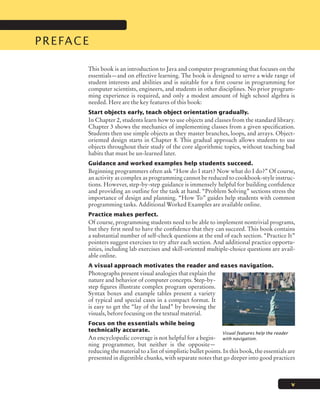
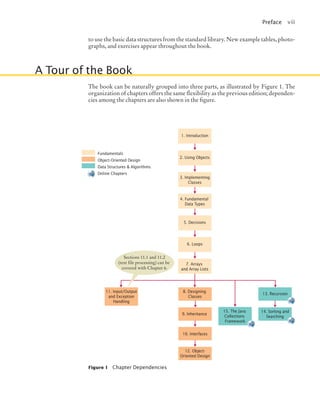

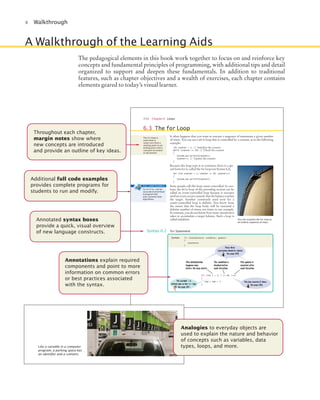
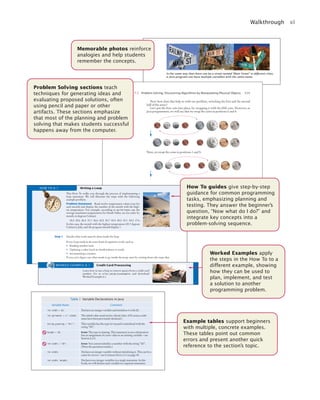
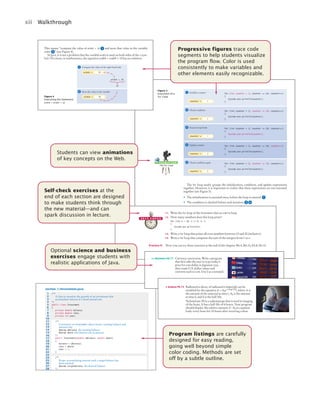
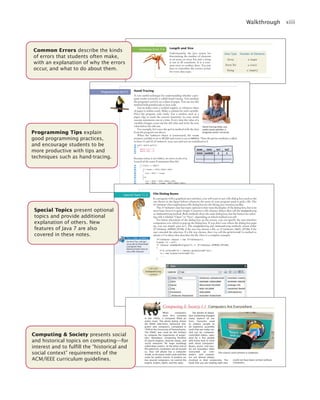
![xiv Walkthrough
Test Bank Instructors can use quiz and
test questions designed to exercise
students’ code reading and writing skills.
Web Resources
CodeCheck “CodeCheck” is a new
online service currently in development
by Cay Horstmann that students can
use to check their homework and to
work on additional practice problems.
Visit http://horstmann.com/codecheck
to learn more and to try it out.
10) What is displayed after executing the given code snippet?
int[] mymarks = new int[10];
int total = 0;
Scanner in = new Scanner(System.in);
for (int cnt = 1; cnt <= 10; cnt++)
{
System.out.print("Enter the marks: ");
mymarks[cnt] = in.nextInt();
total = total + mymarks[cnt];
}
System.out.println(total);
a) The code snippet displays the total marks of all ten subjects.
b) The for loop causes a run-time time error on the first iteration.
c) The code snippet causes a bounds error.
d) The code snippet displays zero.
1.1) Consider the following Card class.
public class Card
{
private String name;
public Card()
{
name = "";
}
public Card(String n)
{
name = n;
}
public String getName()
{
return name;
}
public boolean isExpired()
{
return false;
}
public String format()
{
return "Card holder: " + name;
}
}
Use this class as a superclass to implement a hierarchy of related classes:
Class Data
IDCard ID number
CallingCard Card number, PIN
DriverLicense Expiration year
Write declarations for each of the subclasses. For each subclass, supply private instance variables. Leave the
bodies of the constructors and the format methods blank for now.
Lab Exercises These multi-part
exercises ask students to apply
chapter concepts. They can serve
as “warm-ups” in the lab or to
provide additional practice.
Animations Students can
play and replay dynamic
explanations of concepts
and program flow.
http://horstmann.com/codecheck/
jc7_fm_06.indd 14 10/24/12 6:11 PM](https://image.slidesharecdn.com/65068-250404232507-cd865440/85/Java-Concepts-Early-Objects-7th-Edition-Cay-S-Horstmann-21-320.jpg)


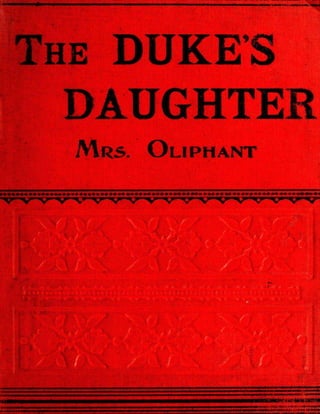
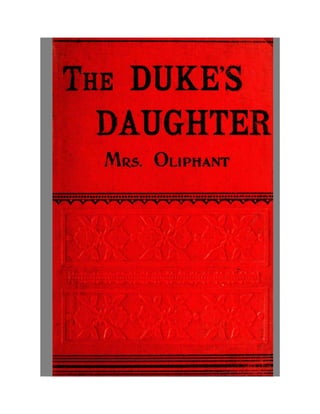

![This ebook is for the use of anyone anywhere in the United States
and most other parts of the world at no cost and with almost no
restrictions whatsoever. You may copy it, give it away or re-use it
under the terms of the Project Gutenberg License included with this
ebook or online at www.gutenberg.org. If you are not located in the
United States, you will have to check the laws of the country where
you are located before using this eBook.
Title: The Duke's Daughter; and, The Fugitives; vol. 3/3
Author: Mrs. Oliphant
Release date: November 28, 2020 [eBook #63903]
Most recently updated: October 18, 2024
Language: English
Credits: Chuck Greif and the Online Distributed Proofreading Team
at http://www.pgdp.net (This file was produced from
images
available at The Internet Archive)
*** START OF THE PROJECT GUTENBERG EBOOK THE DUKE'S
DAUGHTER; AND, THE FUGITIVES; VOL. 3/3 ***](https://image.slidesharecdn.com/65068-250404232507-cd865440/85/Java-Concepts-Early-Objects-7th-Edition-Cay-S-Horstmann-31-320.jpg)