Computer
Networking: A Top
Down Approach
A note on the use of these Powerpoint slides:
We’re making these slides freely available to all (faculty, students, readers).
They’re in PowerPoint form so you see the animations; and can add, modify,
and delete slides (including this one) and slide content to suit your needs.
They obviously represent a lot of work on our part. In return for use, we only
ask the following:
 If you use these slides (e.g., in a class) that you mention their source
(after all, we’d like people to use our book!)
 If you post any slides on a www site, that you note that they are adapted
from (or perhaps identical to) our slides, and note our copyright of this
material.
Thanks and enjoy! JFK/KWR
All material copyright 1996-2016
J.F Kurose and K.W. Ross, All Rights Reserved
7th
edition
Jim Kurose, Keith Ross
Pearson/Addison Wesley
April 2016
Chapter 7
Wireless and
Mobile Networks
7-1
Wireless and Mobile Networks
Ch. 6:Wireless and Mobile Networks
Background:
 # wireless (mobile) phone subscribers now exceeds #
wired phone subscribers (5-to-1)!
 # wireless Internet-connected devices equals #
wireline Internet-connected devices
• laptops, Internet-enabled phones promise anytime untethered
Internet access
 two important (but different) challenges
• wireless: communication over wireless link
• mobility: handling the mobile user who changes point of
attachment to network
7-2
Wireless and Mobile Networks
Chapter 7 outline
7.1 Introduction
Wireless
7.2 Wireless links,
characteristics
• CDMA
6.73 IEEE 802.11 wireless
LANs (“Wi-Fi”)
67.4 Cellular Internet Access
• architecture
• standards (e.g., 3G, LTE)
Mobility
7.5 Principles: addressing and
routing to mobile users
7.6 Mobile IP
7.7 Handling mobility in
cellular networks
7.8 Mobility and higher-layer
protocols
7-3
Wireless and Mobile Networks
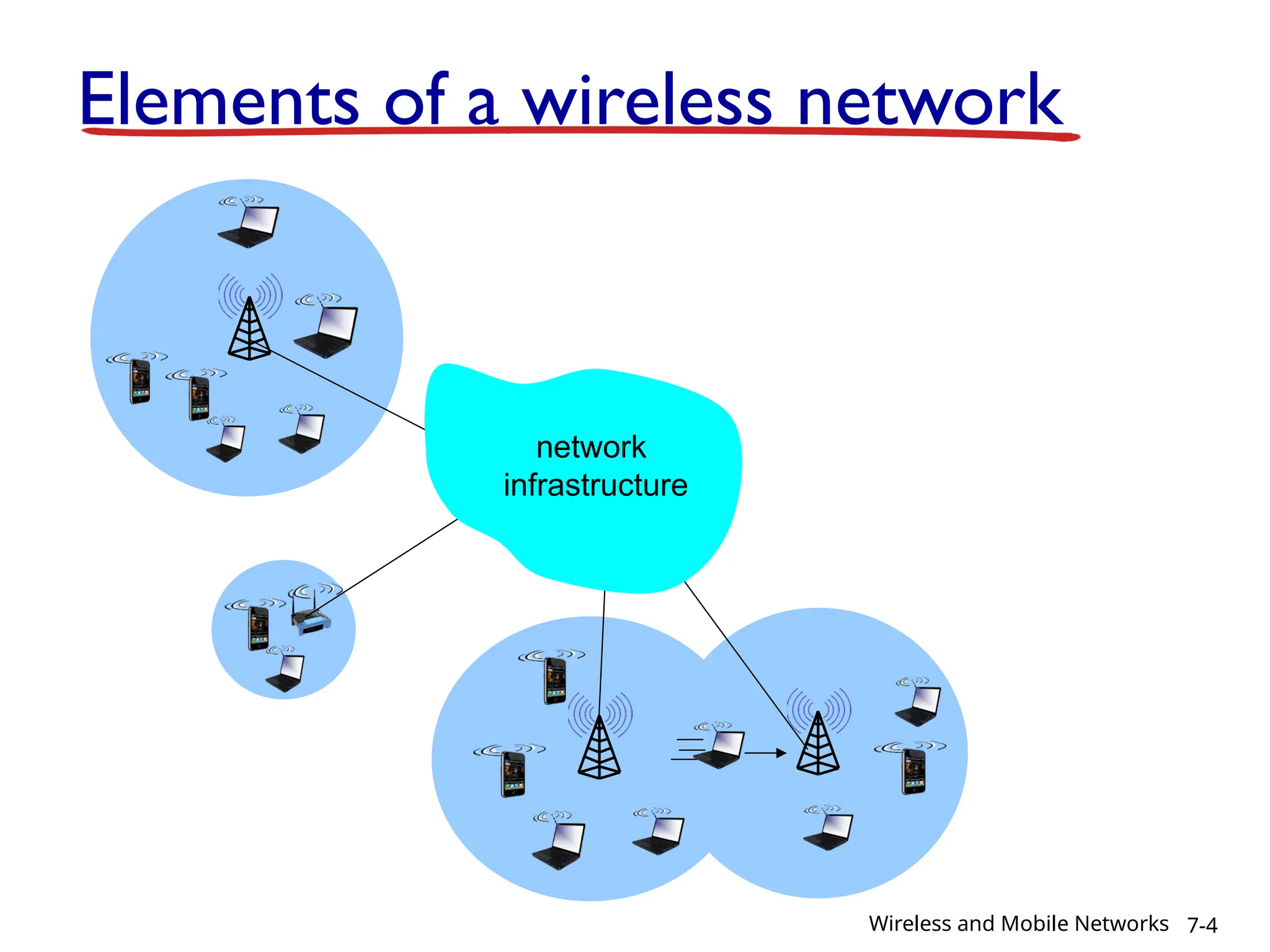
Elements of a wireless network
network
infrastructure
7-4
Wireless and Mobile Networks
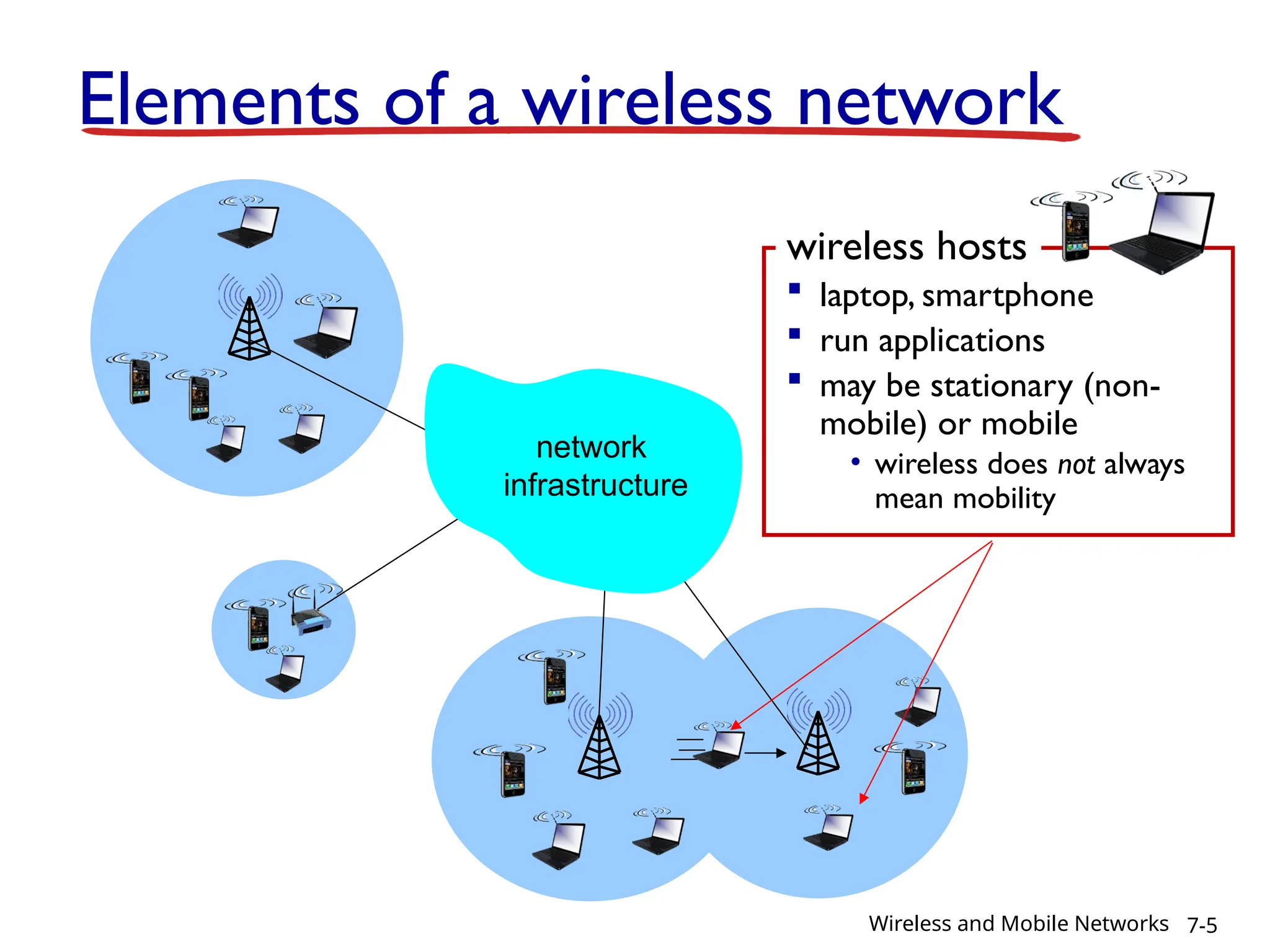
wireless hosts
 laptop, smartphone
 run applications
 may be stationary (non-
mobile) or mobile
• wireless does not always
mean mobility
Elements of a wireless network
network
infrastructure
7-5
Wireless and Mobile Networks
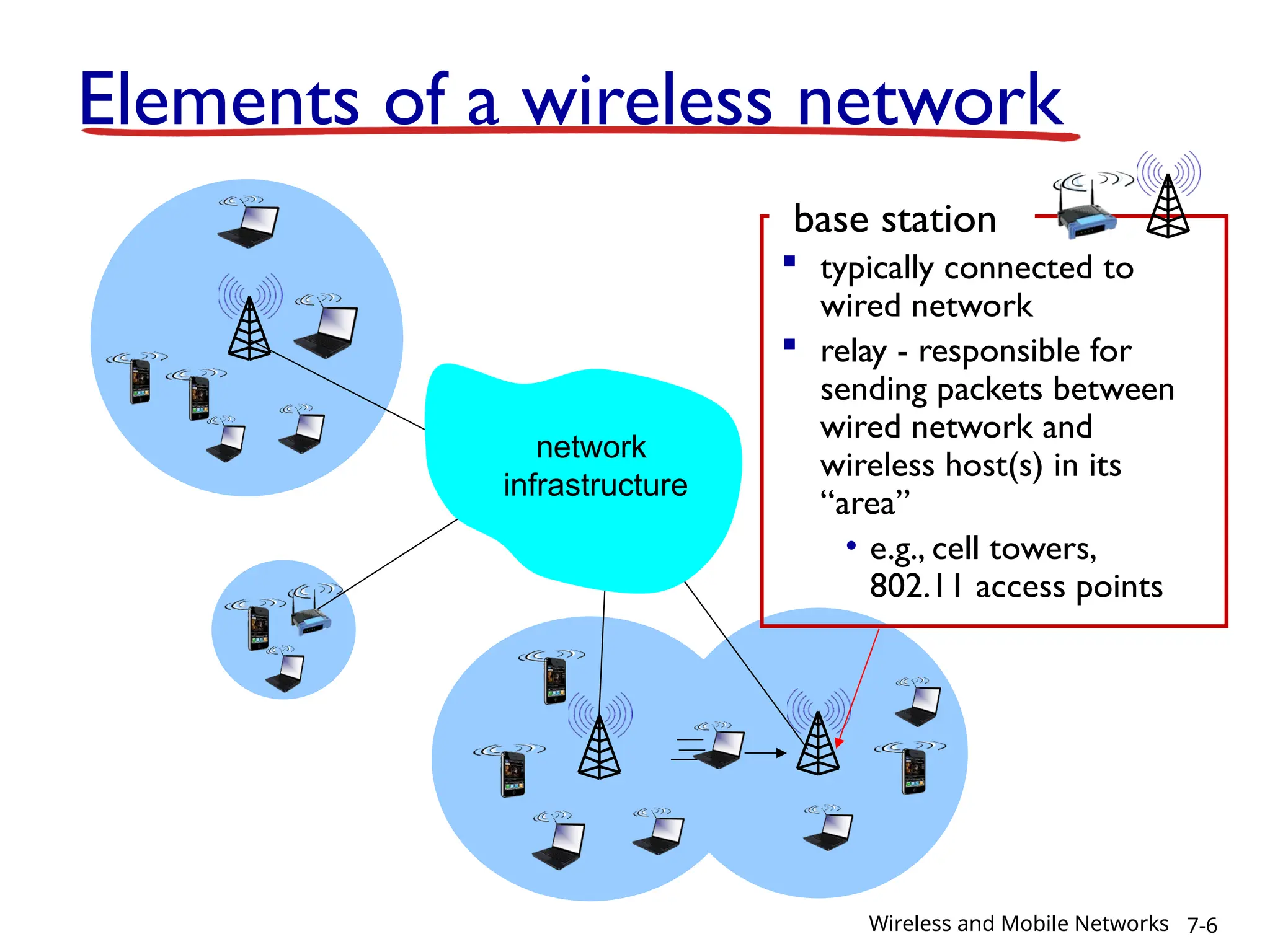
base station
 typically connected to
wired network
 relay - responsible for
sending packets between
wired network and
wireless host(s) in its
“area”
• e.g., cell towers,
802.11 access points
Elements of a wireless network
network
infrastructure
7-6
Wireless and Mobile Networks
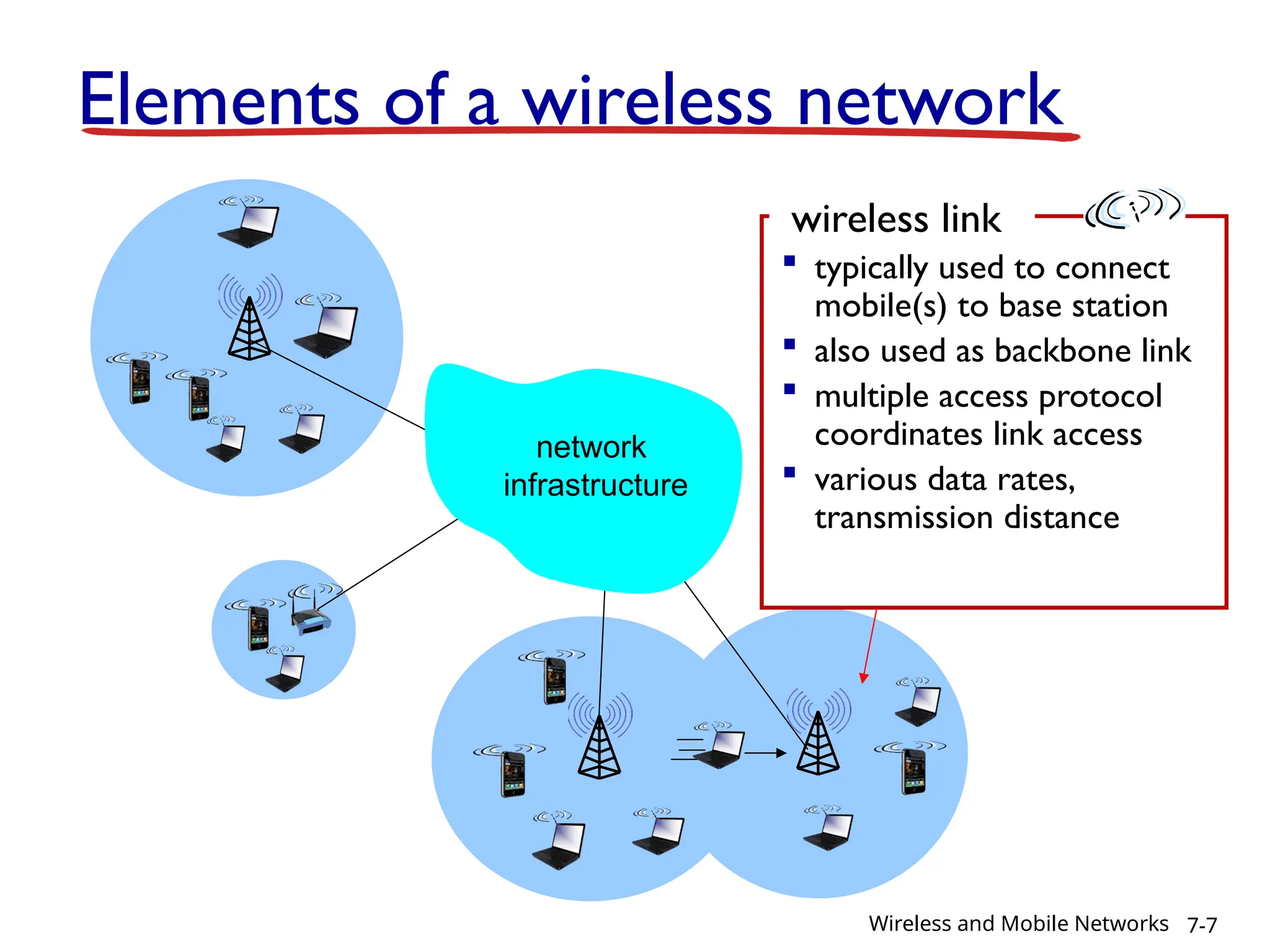
wireless link
 typically used to connect
mobile(s) to base station
 also used as backbone link
 multiple access protocol
coordinates link access
 various data rates,
transmission distance
Elements of a wireless network
network
infrastructure
7-7
Wireless and Mobile Networks
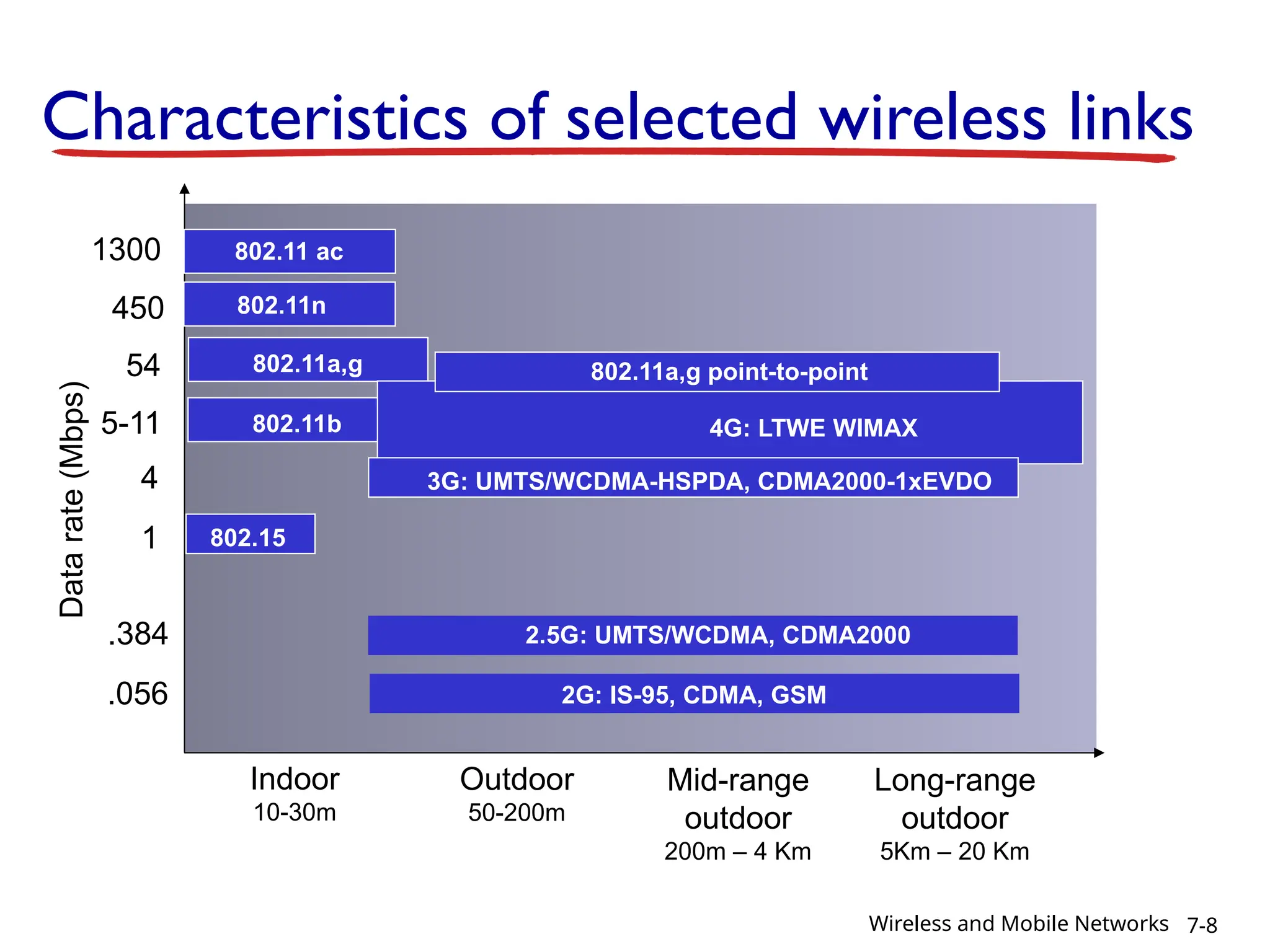
Characteristics of selected wireless links
Indoor
10-30m
Outdoor
50-200m
Mid-range
outdoor
200m – 4 Km
Long-range
outdoor
5Km – 20 Km
.056
.384
1
4
5-11
54
2G: IS-95, CDMA, GSM
2.5G: UMTS/WCDMA, CDMA2000
802.15
802.11b
802.11a,g
3G: UMTS/WCDMA-HSPDA, CDMA2000-1xEVDO
4G: LTWE WIMAX
802.11a,g point-to-point
450 802.11n
Data
rate
(Mbps)
7-8
Wireless and Mobile Networks
1300 802.11 ac
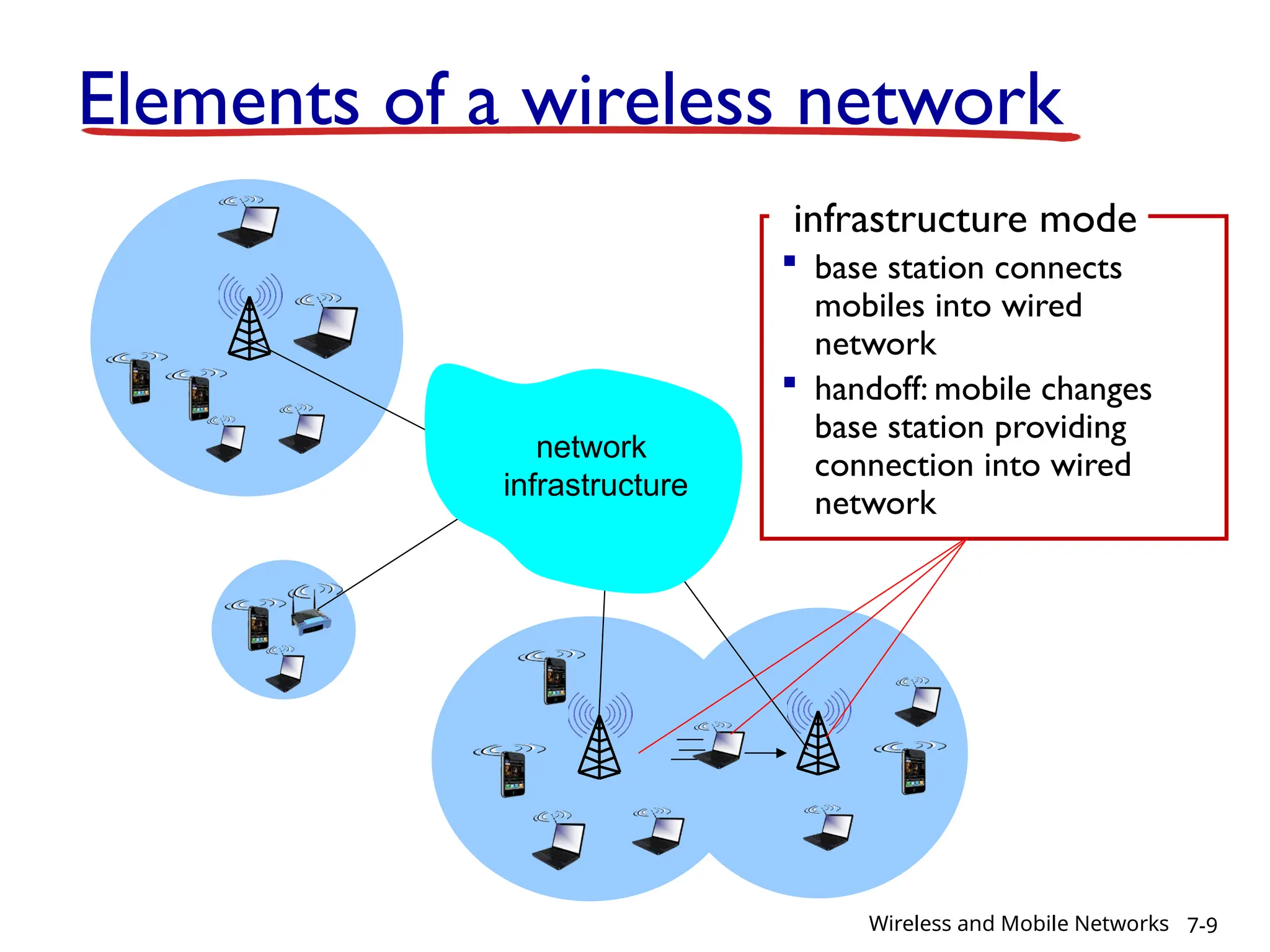
infrastructure mode
 base station connects
mobiles into wired
network
 handoff: mobile changes
base station providing
connection into wired
network
Elements of a wireless network
network
infrastructure
7-9
Wireless and Mobile Networks
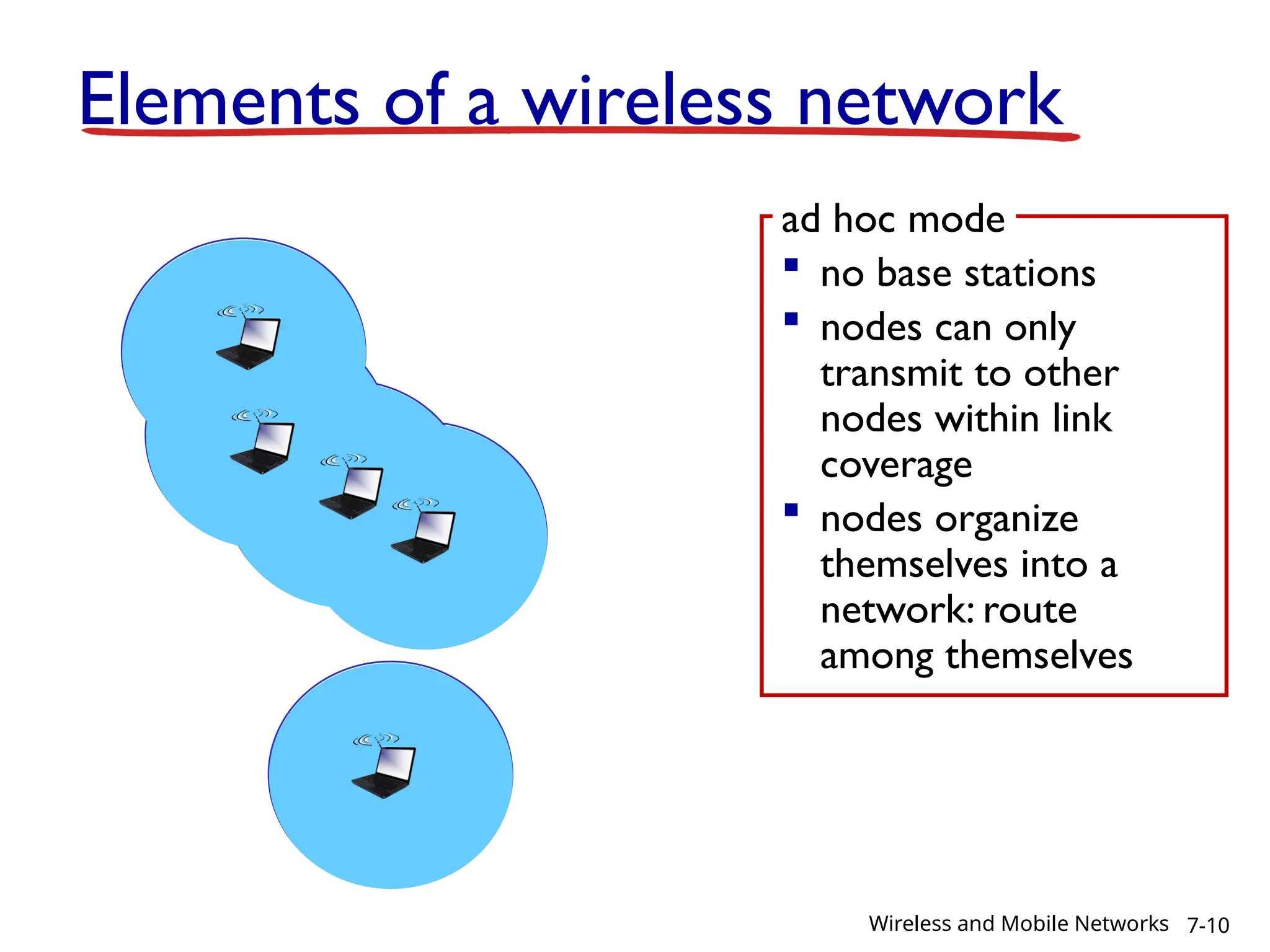
ad hoc mode
 no base stations
 nodes can only
transmit to other
nodes within link
coverage
 nodes organize
themselves into a
network: route
among themselves
Elements of a wireless network
7-10
Wireless and Mobile Networks
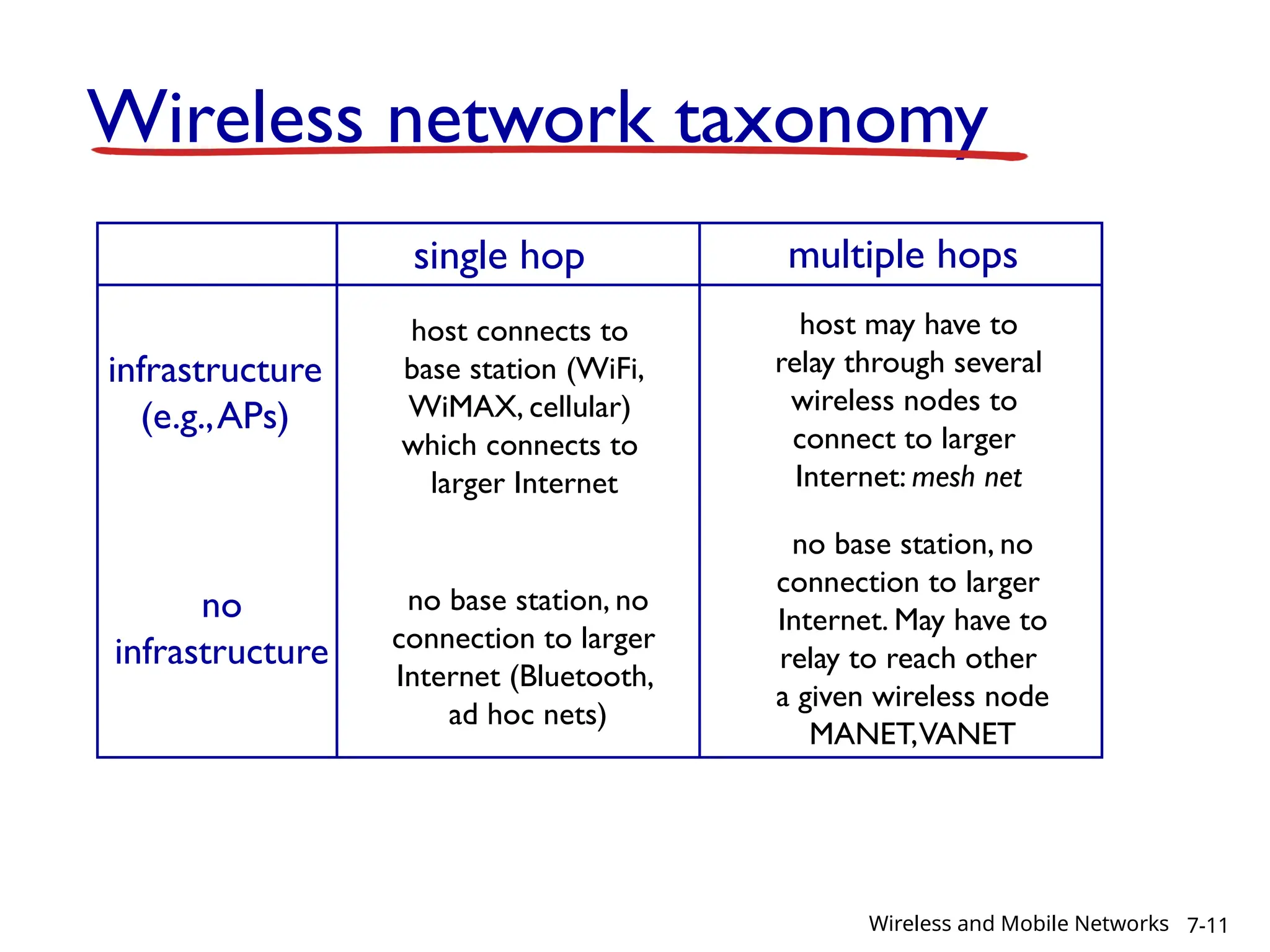
Wireless network taxonomy
single hop multiple hops
infrastructure
(e.g.,APs)
no
infrastructure
host connects to
base station (WiFi,
WiMAX, cellular)
which connects to
larger Internet
no base station, no
connection to larger
Internet (Bluetooth,
ad hoc nets)
host may have to
relay through several
wireless nodes to
connect to larger
Internet: mesh net
no base station, no
connection to larger
Internet. May have to
relay to reach other
a given wireless node
MANET,VANET
7-11
Wireless and Mobile Networks
Chapter 7 outline
7.1 Introduction
Wireless
7.2Wireless links,
characteristics
• CDMA
7.3 IEEE 802.11 wireless
LANs (“Wi-Fi”)
7.4 Cellular Internet Access
• architecture
• standards (e.g., 3G, LTE)
Mobility
7.5 Principles: addressing and
routing to mobile users
7.6 Mobile IP
7.7 Handling mobility in
cellular networks
7.8 Mobility and higher-layer
protocols
7-12
Wireless and Mobile Networks
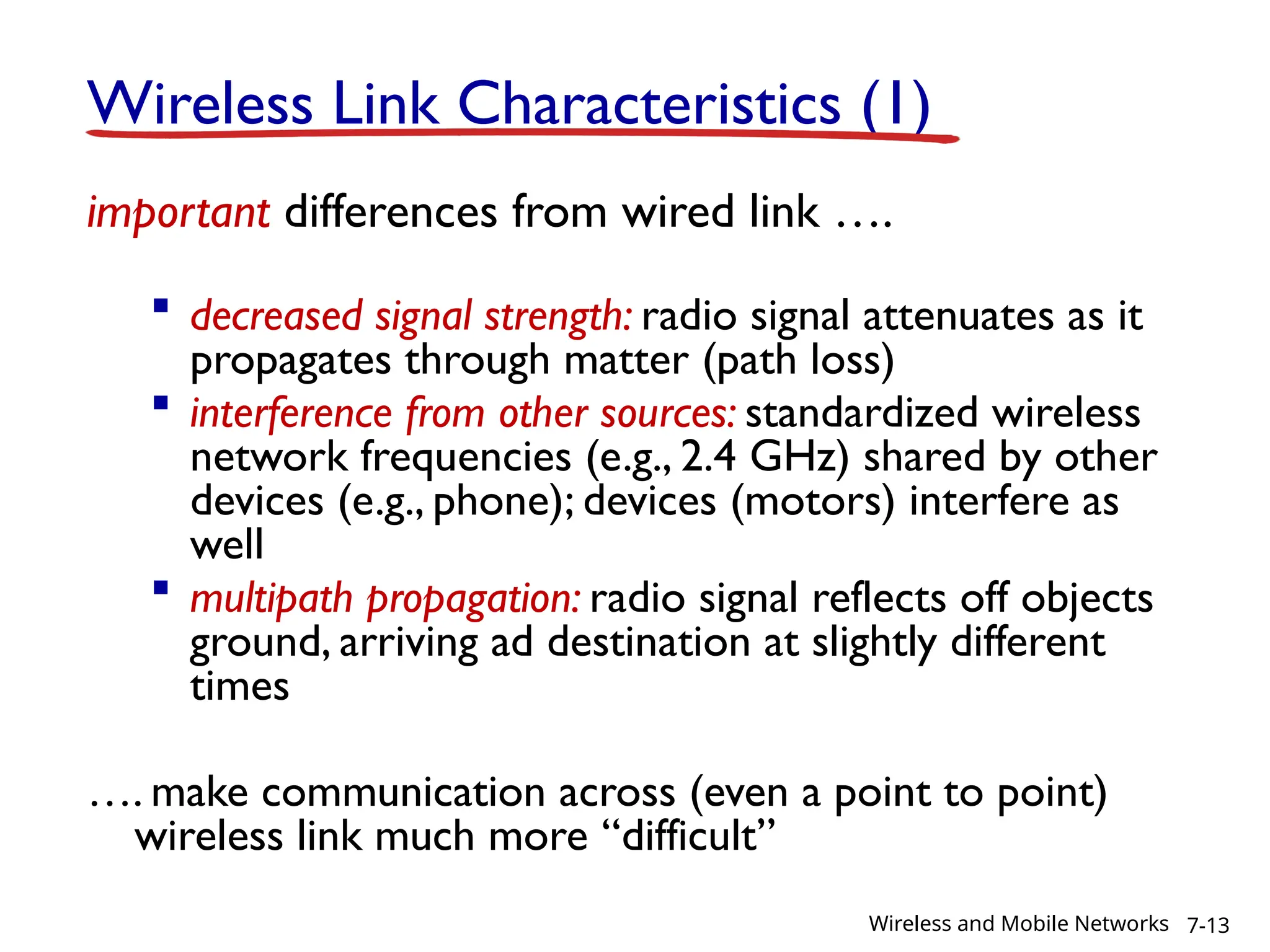
Wireless Link Characteristics (1)
important differences from wired link ….
 decreased signal strength: radio signal attenuates as it
propagates through matter (path loss)
 interference from other sources: standardized wireless
network frequencies (e.g., 2.4 GHz) shared by other
devices (e.g., phone); devices (motors) interfere as
well
 multipath propagation: radio signal reflects off objects
ground, arriving ad destination at slightly different
times
…. make communication across (even a point to point)
wireless link much more “difficult”
7-13
Wireless and Mobile Networks
Wireless Link Characteristics (2)
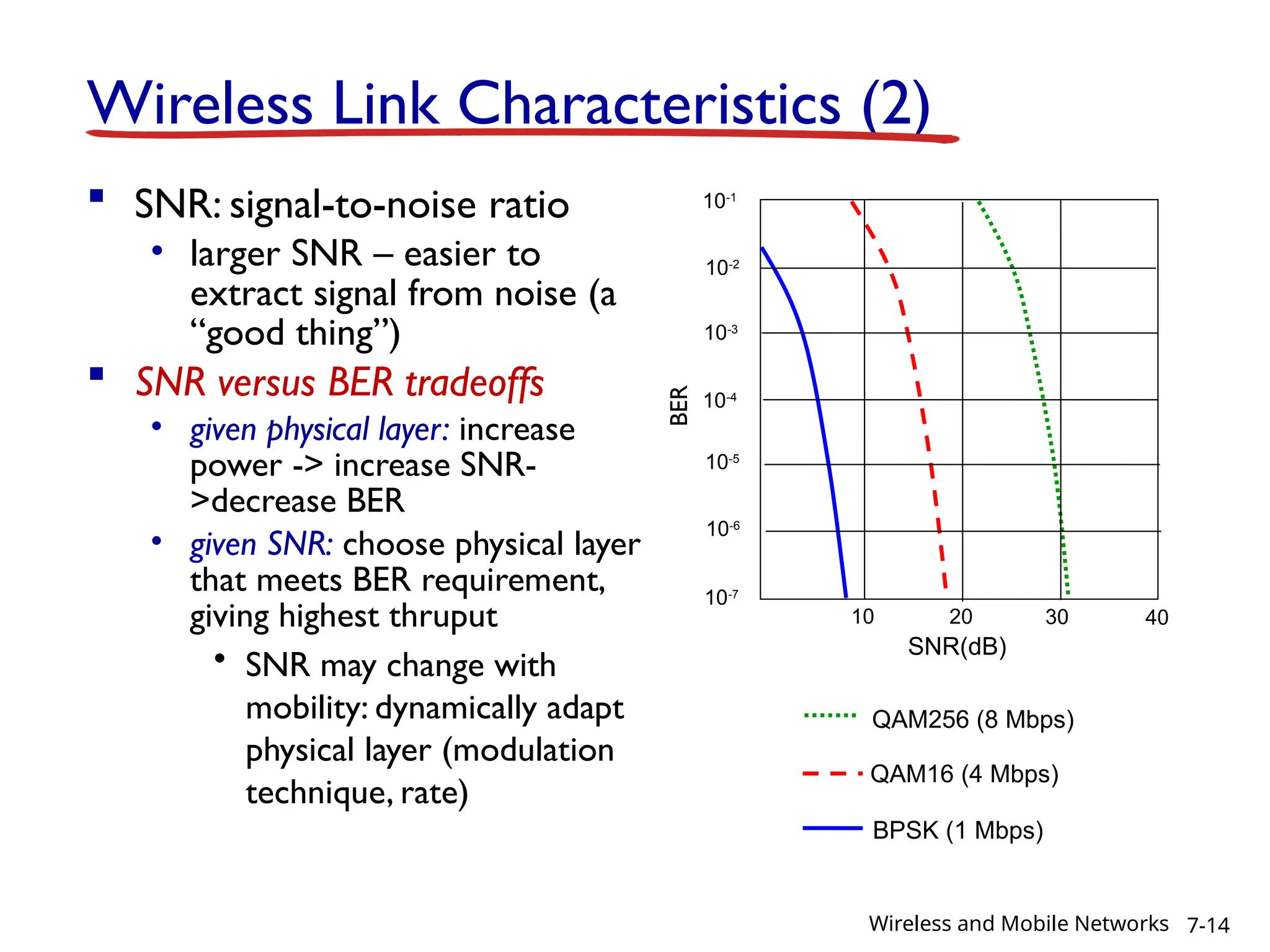
 SNR: signal-to-noise ratio
• larger SNR – easier to
extract signal from noise (a
“good thing”)
 SNR versus BER tradeoffs
• given physical layer: increase
power -> increase SNR-
>decrease BER
• given SNR: choose physical layer
that meets BER requirement,
giving highest thruput
• SNR may change with
mobility: dynamically adapt
physical layer (modulation
technique, rate)
10 20 30 40
QAM256 (8 Mbps)
QAM16 (4 Mbps)
BPSK (1 Mbps)
SNR(dB)
BER
10-1
10-2
10-3
10-5
10-6
10-7
10-4
7-14
Wireless and Mobile Networks
Wireless network characteristics
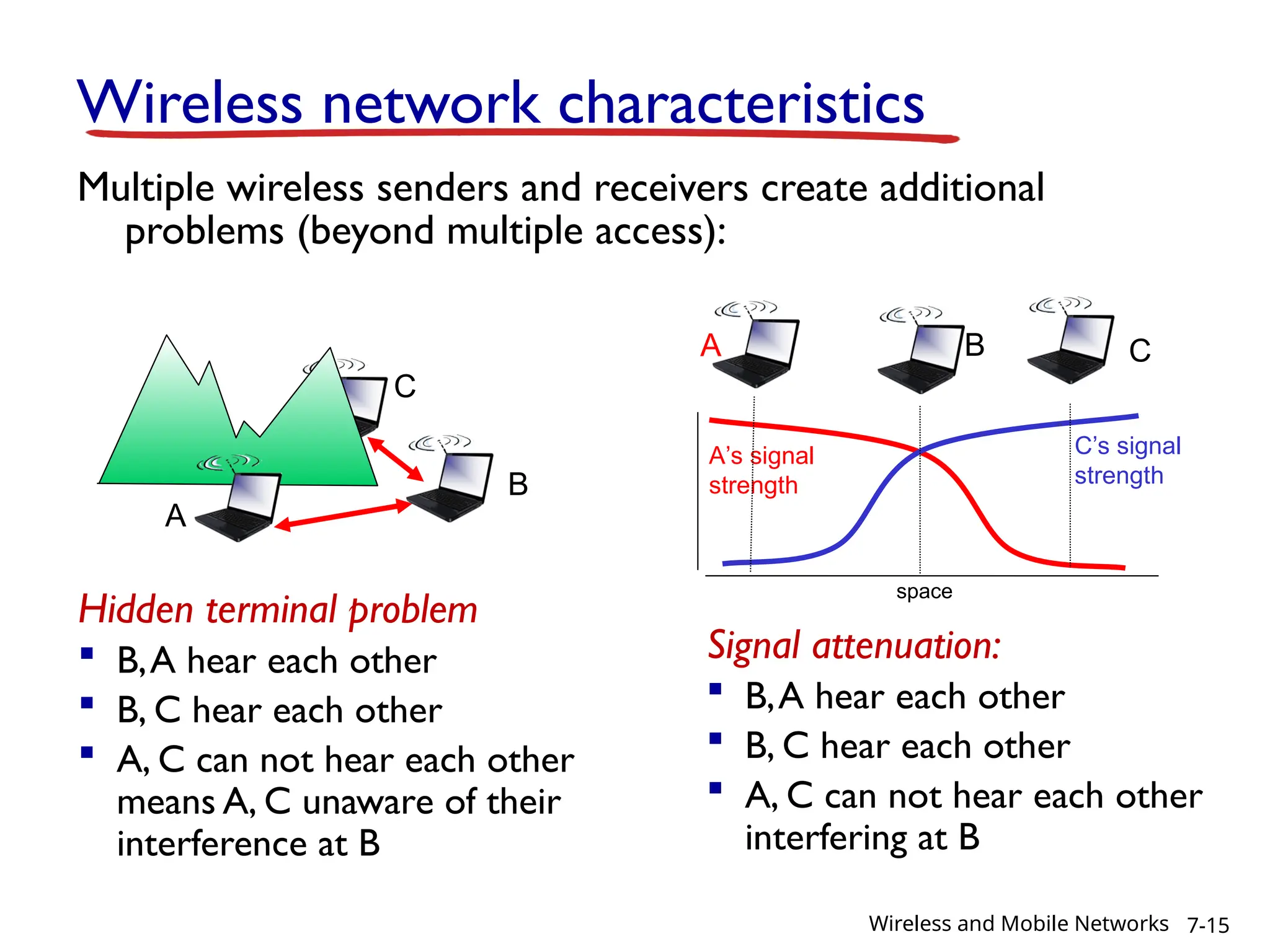
Multiple wireless senders and receivers create additional
problems (beyond multiple access):
A
B
C
Hidden terminal problem
 B,A hear each other
 B, C hear each other
 A, C can not hear each other
means A, C unaware of their
interference at B
A B C
A’s signal
strength
space
C’s signal
strength
Signal attenuation:
 B,A hear each other
 B, C hear each other
 A, C can not hear each other
interfering at B
7-15
Wireless and Mobile Networks
Code Division Multiple Access (CDMA)
 unique “code” assigned to each user; i.e., code set
partitioning
• all users share same frequency, but each user has own
“chipping” sequence (i.e., code) to encode data
• allows multiple users to “coexist” and transmit
simultaneously with minimal interference (if codes are
“orthogonal”)
 encoded signal = (original data) X (chipping
sequence)
 decoding: inner-product of encoded signal and
chipping sequence
7-16
Wireless and Mobile Networks
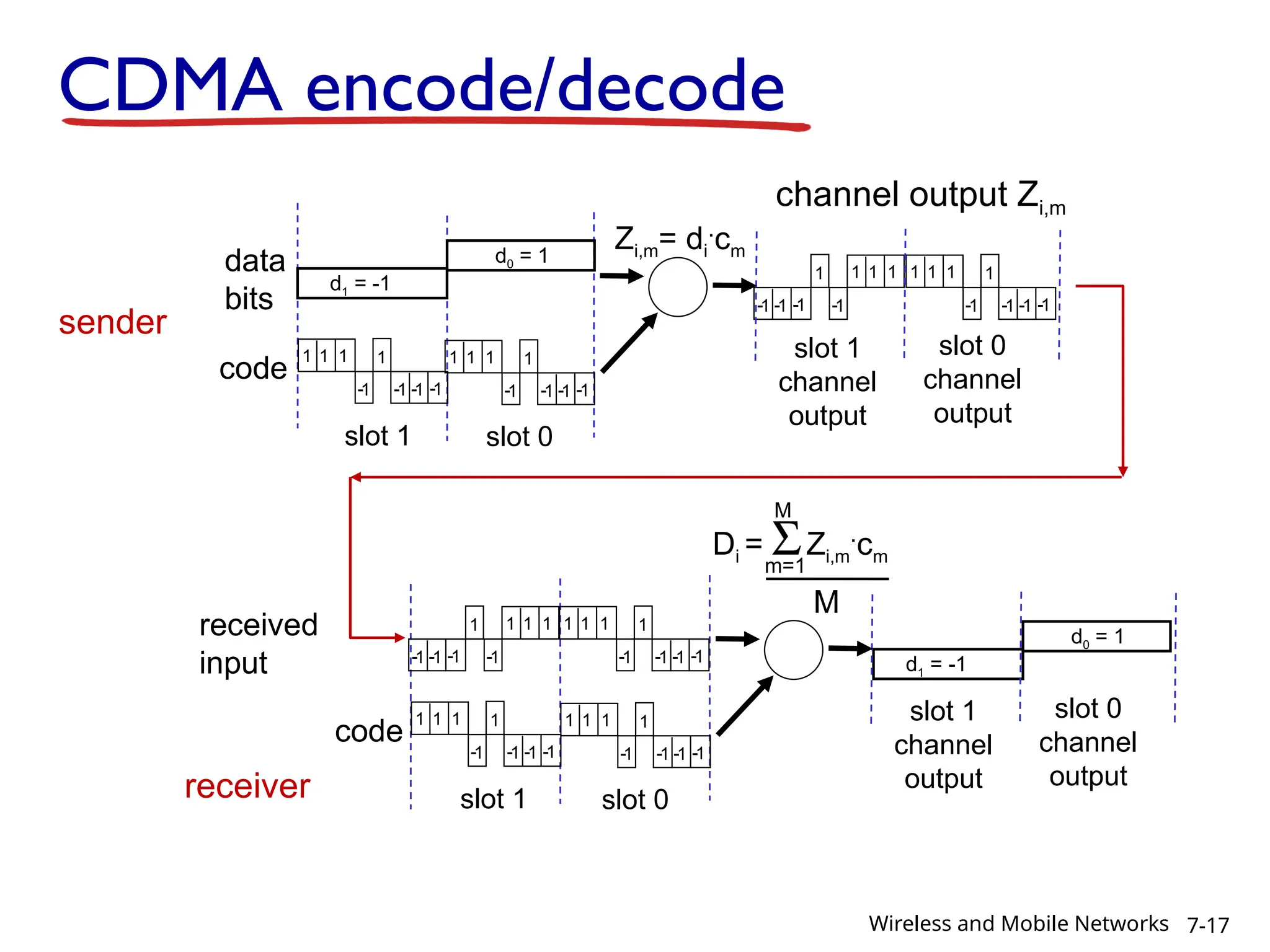
CDMA encode/decode
slot 1 slot 0
d1 = -1
1 1 1 1
1
- 1
- 1
- 1
-
Zi,m= di
.
cm
d0 = 1
1 1 1 1
1
- 1
- 1
- 1
-
1 1 1 1
1
- 1
- 1
- 1
-
1 1 1
1
1
-
1
- 1
- 1
-
slot 0
channel
output
slot 1
channel
output
channel output Zi,m
sender
code
data
bits
slot 1 slot 0
d1 = -1
d0 = 1
1 1 1 1
1
- 1
- 1
- 1
-
1 1 1 1
1
- 1
- 1
- 1
-
1 1 1 1
1
- 1
- 1
- 1
-
1 1 1
1
1
-
1
- 1
- 1
-
slot 0
channel
output
slot 1
channel
output
receiver
code
received
input
Di = SZi,m
.
cm
m=1
M
M
7-17
Wireless and Mobile Networks
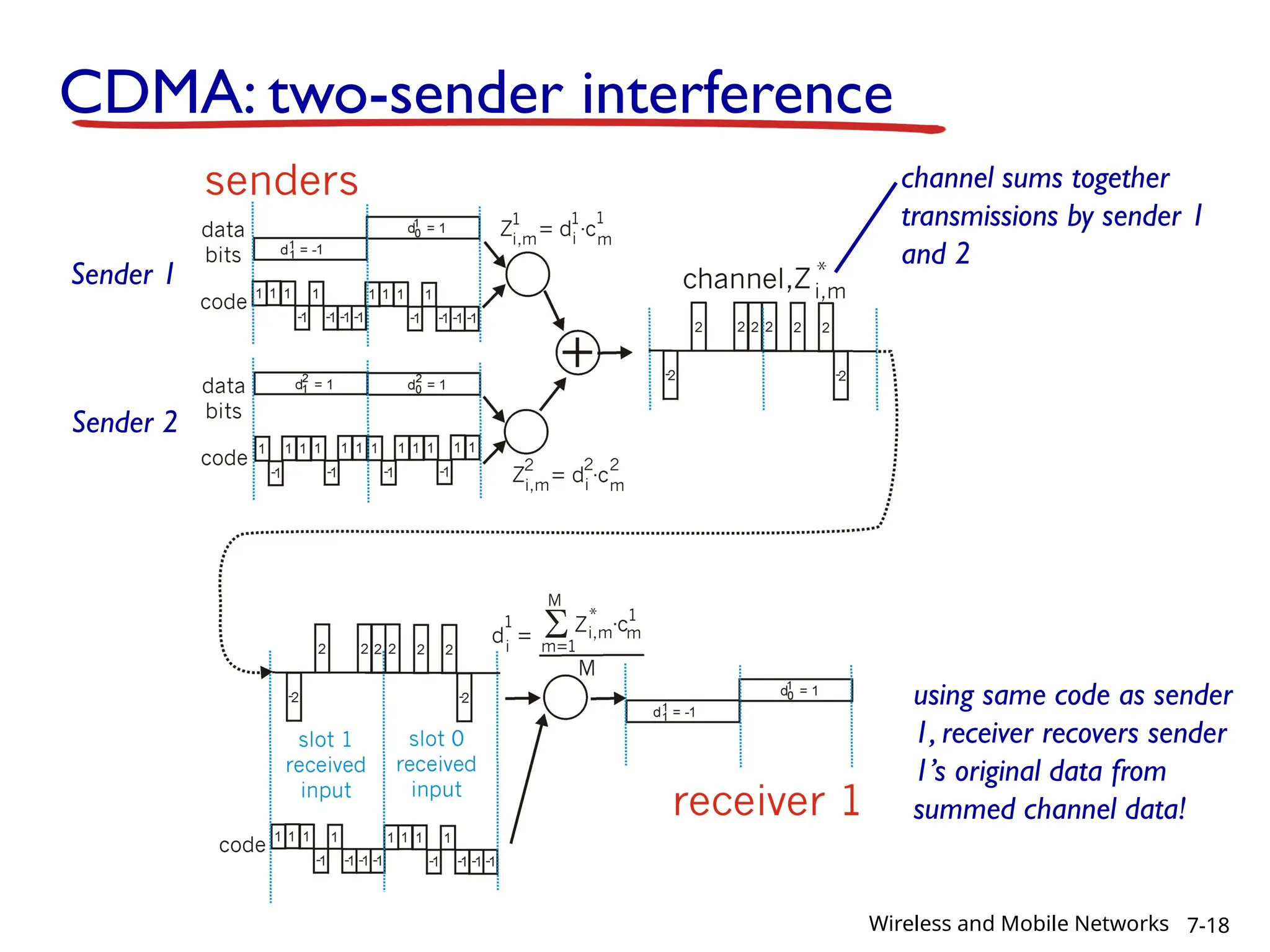
CDMA: two-sender interference
using same code as sender
1, receiver recovers sender
1’s original data from
summed channel data!
Sender 1
Sender 2
channel sums together
transmissions by sender 1
and 2
7-18
Wireless and Mobile Networks
Chapter 7 outline
7.1 Introduction
Wireless
7.2 Wireless links,
characteristics
• CDMA
7.3 IEEE 802.11 wireless
LANs (“Wi-Fi”)
7.4 Cellular Internet Access
• architecture
• standards (e.g., 3G, LTE)
Mobility
7.5 Principles: addressing and
routing to mobile users
7.6 Mobile IP
7.7 Handling mobility in
cellular networks
7.8 Mobility and higher-layer
protocols
7-19
Wireless and Mobile Networks
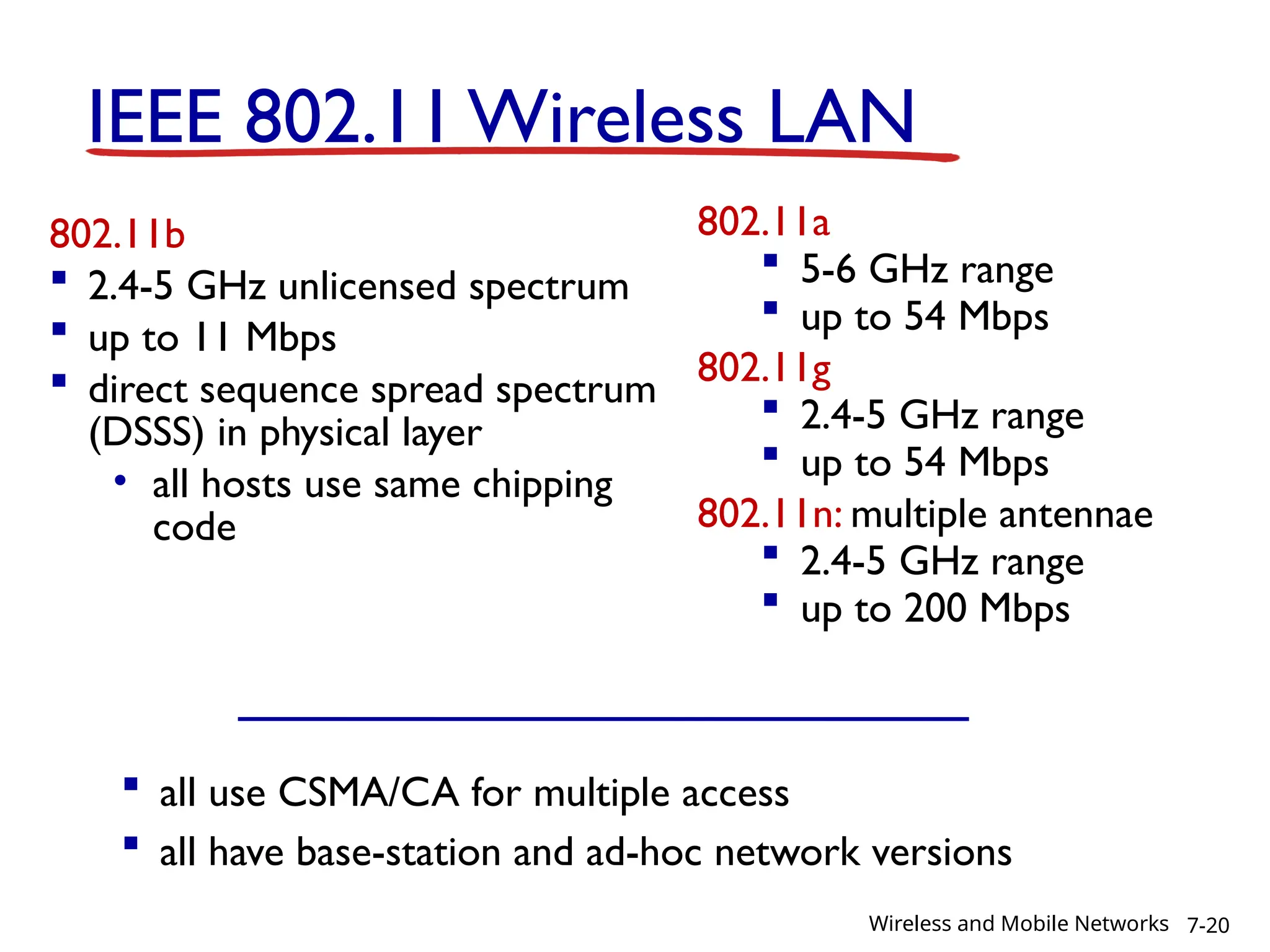
IEEE 802.11 Wireless LAN
802.11b
 2.4-5 GHz unlicensed spectrum
 up to 11 Mbps
 direct sequence spread spectrum
(DSSS) in physical layer
• all hosts use same chipping
code
802.11a
 5-6 GHz range
 up to 54 Mbps
802.11g
 2.4-5 GHz range
 up to 54 Mbps
802.11n: multiple antennae
 2.4-5 GHz range
 up to 200 Mbps
 all use CSMA/CA for multiple access
 all have base-station and ad-hoc network versions
7-20
Wireless and Mobile Networks
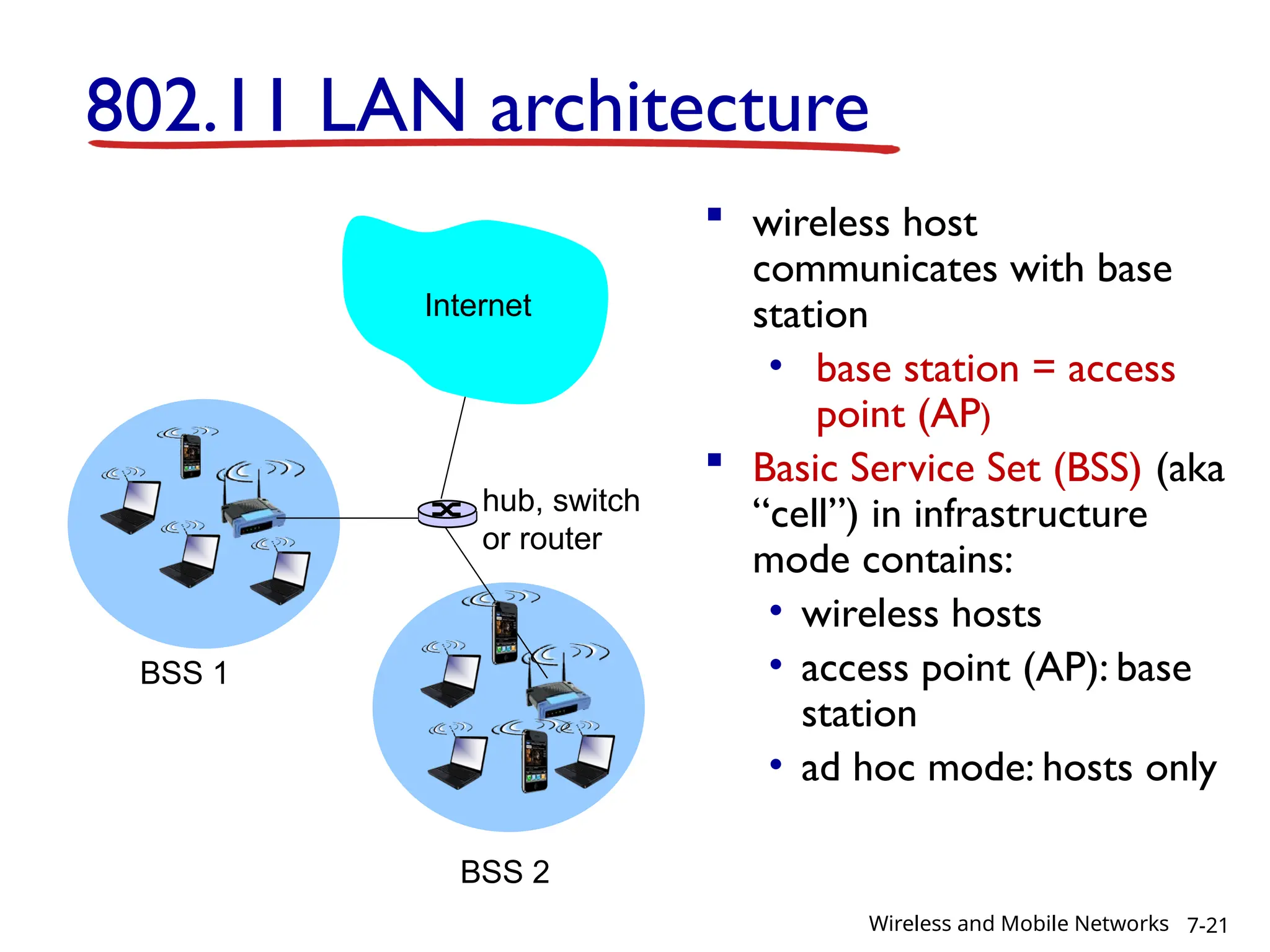
802.11 LAN architecture
 wireless host
communicates with base
station
• base station = access
point (AP)
 Basic Service Set (BSS) (aka
“cell”) in infrastructure
mode contains:
• wireless hosts
• access point (AP): base
station
• ad hoc mode: hosts only
BSS 1
BSS 2
Internet
hub, switch
or router
7-21
Wireless and Mobile Networks
802.11: Channels, association
 802.11b: 2.4GHz-2.485GHz spectrum divided into 11
channels at different frequencies
• AP admin chooses frequency for AP
• interference possible: channel can be same as that
chosen by neighboring AP!
 host: must associate with an AP
• scans channels, listening for beacon frames containing
AP’s name (SSID) and MAC address
• selects AP to associate with
• may perform authentication [Chapter 8]
• will typically run DHCP to get IP address in AP’s
subnet
7-22
Wireless and Mobile Networks
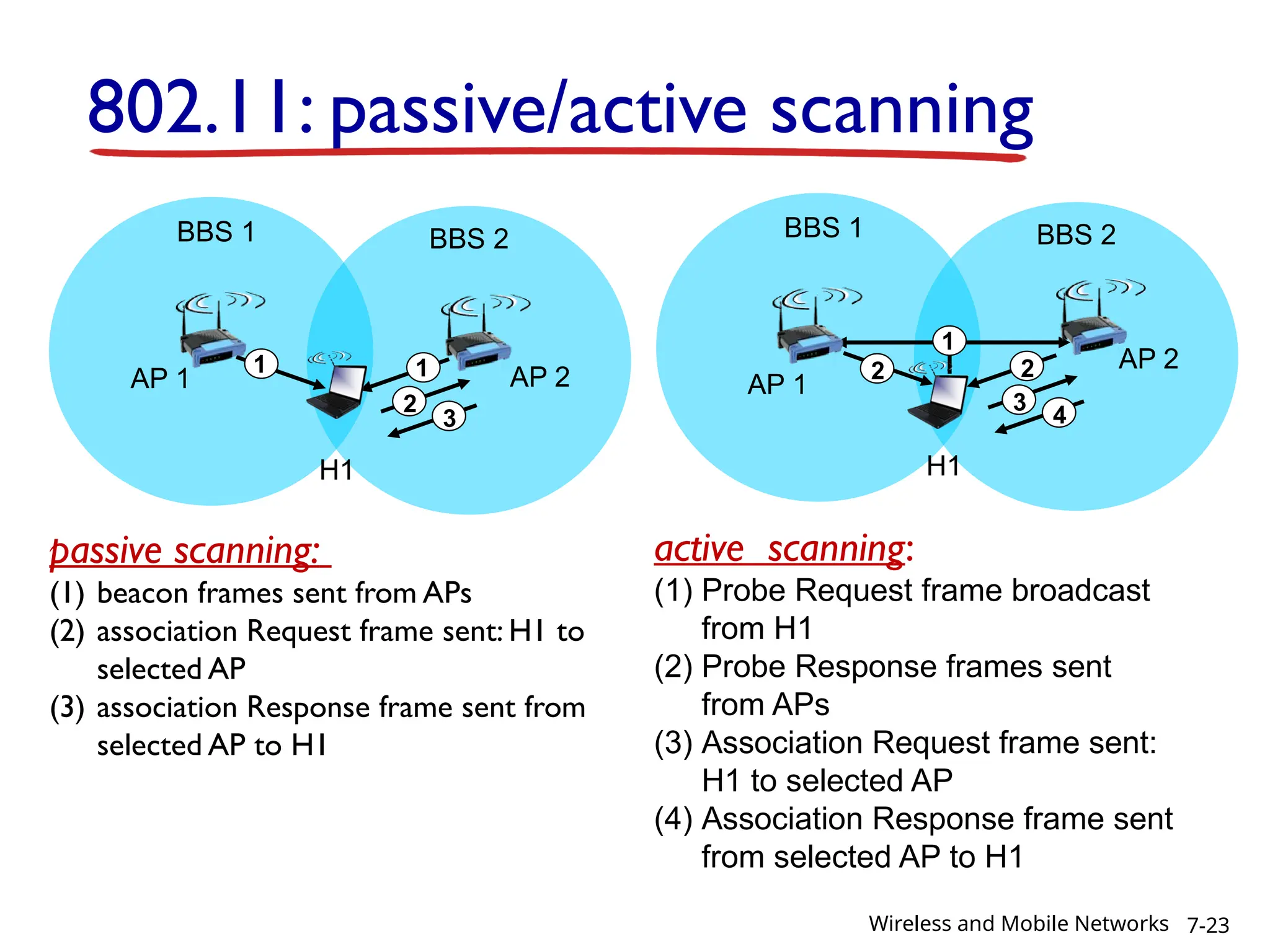
802.11: passive/active scanning
AP 2
AP 1
H1
BBS 2
BBS 1
1
2
3
1
passive scanning:
(1) beacon frames sent from APs
(2) association Request frame sent: H1 to
selected AP
(3) association Response frame sent from
selected AP to H1
AP 2
AP 1
H1
BBS 2
BBS 1
1
2
2
3
4
active scanning:
(1) Probe Request frame broadcast
from H1
(2) Probe Response frames sent
from APs
(3) Association Request frame sent:
H1 to selected AP
(4) Association Response frame sent
from selected AP to H1
7-23
Wireless and Mobile Networks
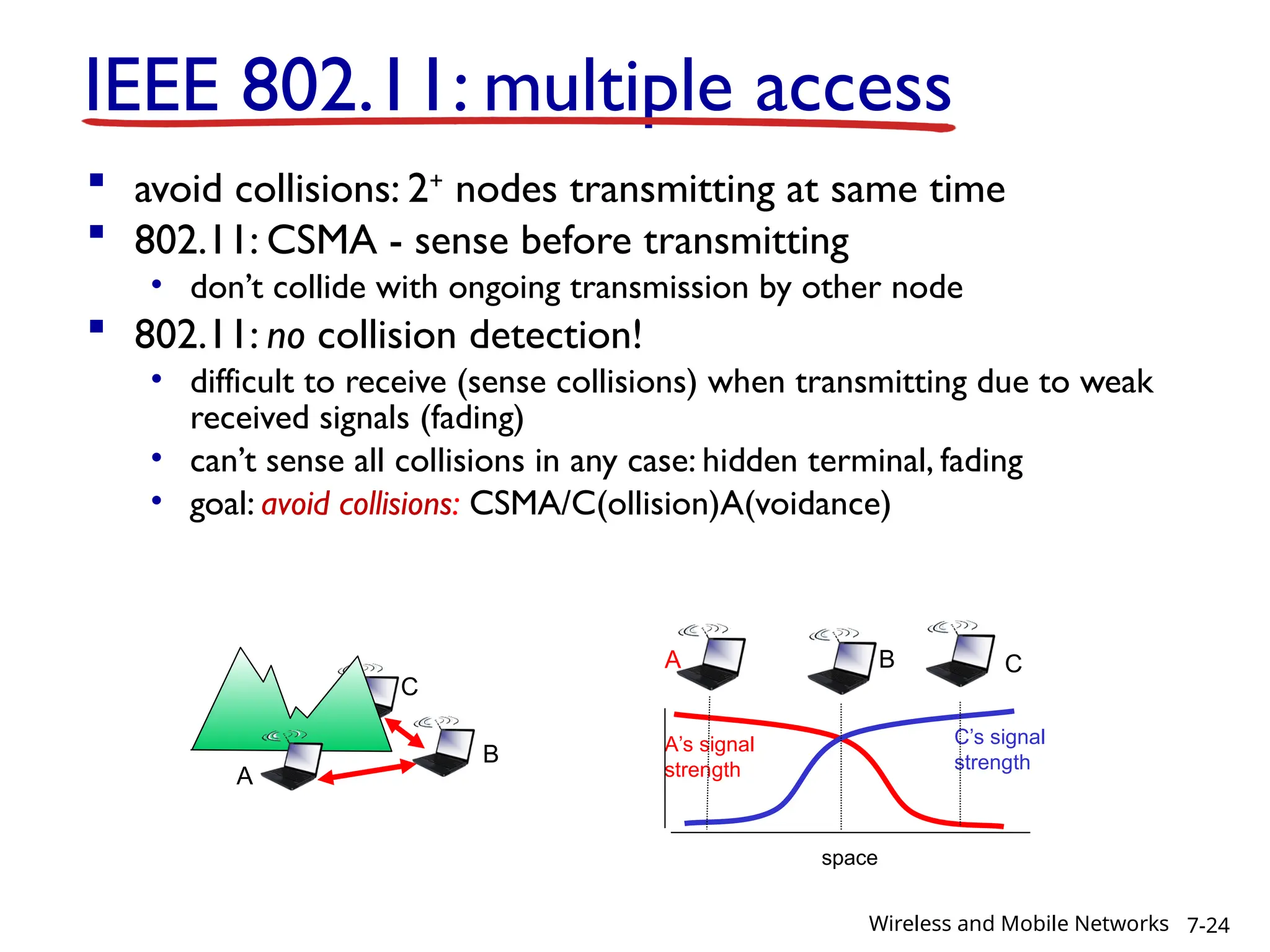
IEEE 802.11: multiple access
 avoid collisions: 2+
nodes transmitting at same time
 802.11: CSMA - sense before transmitting
• don’t collide with ongoing transmission by other node
 802.11: no collision detection!
• difficult to receive (sense collisions) when transmitting due to weak
received signals (fading)
• can’t sense all collisions in any case: hidden terminal, fading
• goal: avoid collisions: CSMA/C(ollision)A(voidance)
space
A
B
C
A B C
A’s signal
strength
C’s signal
strength
7-24
Wireless and Mobile Networks
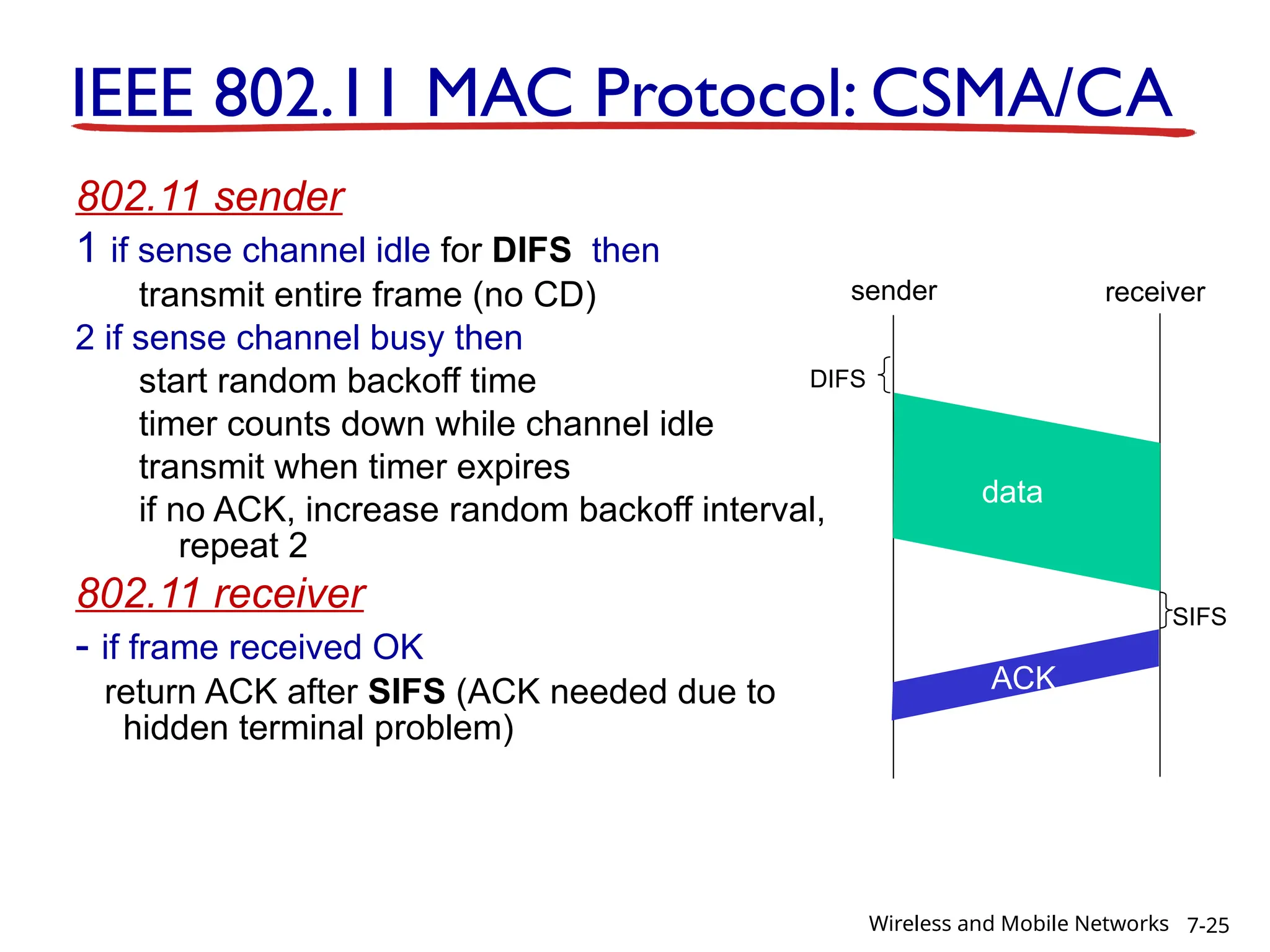
IEEE 802.11 MAC Protocol: CSMA/CA
802.11 sender
1 if sense channel idle for DIFS then
transmit entire frame (no CD)
2 if sense channel busy then
start random backoff time
timer counts down while channel idle
transmit when timer expires
if no ACK, increase random backoff interval,
repeat 2
802.11 receiver
- if frame received OK
return ACK after SIFS (ACK needed due to
hidden terminal problem)
sender receiver
DIFS
data
SIFS
ACK
7-25
Wireless and Mobile Networks
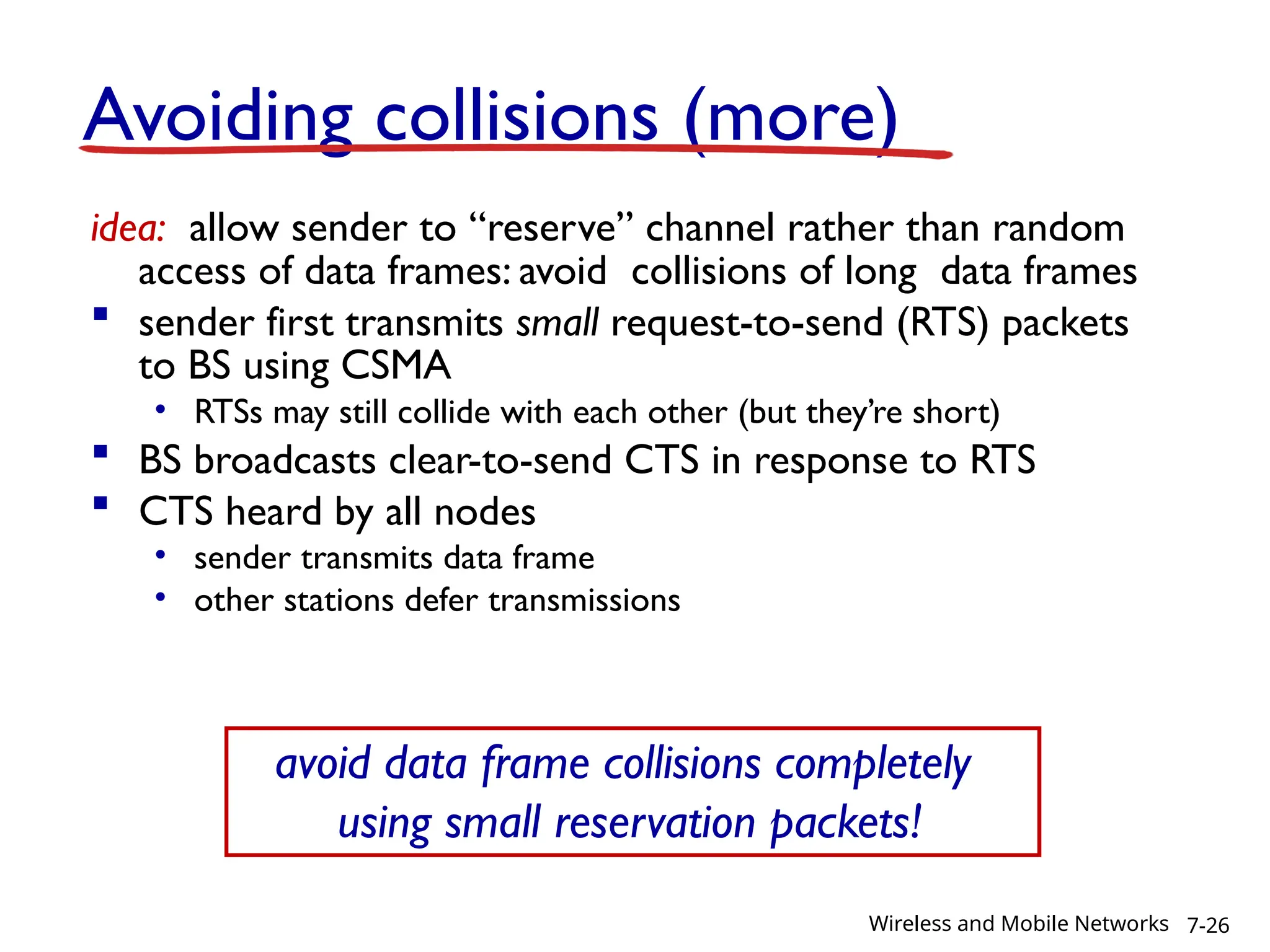
Avoiding collisions (more)
idea: allow sender to “reserve” channel rather than random
access of data frames: avoid collisions of long data frames
 sender first transmits small request-to-send (RTS) packets
to BS using CSMA
• RTSs may still collide with each other (but they’re short)
 BS broadcasts clear-to-send CTS in response to RTS
 CTS heard by all nodes
• sender transmits data frame
• other stations defer transmissions
avoid data frame collisions completely
using small reservation packets!
7-26
Wireless and Mobile Networks
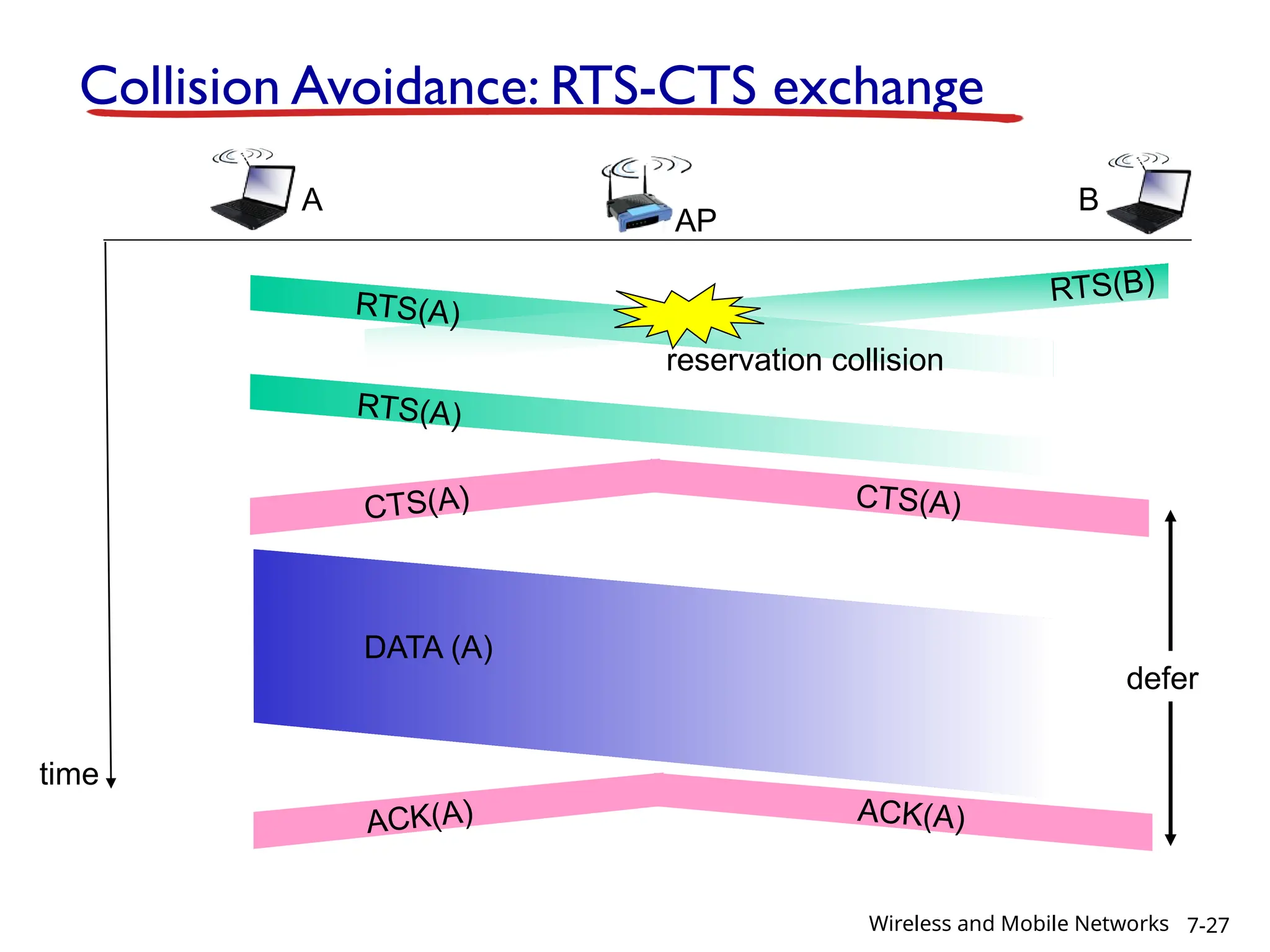
Collision Avoidance: RTS-CTS exchange
AP
A B
time
RTS(A)
RTS(B)
RTS(A)
CTS(A) CTS(A)
DATA (A)
ACK(A) ACK(A)
reservation collision
defer
7-27
Wireless and Mobile Networks
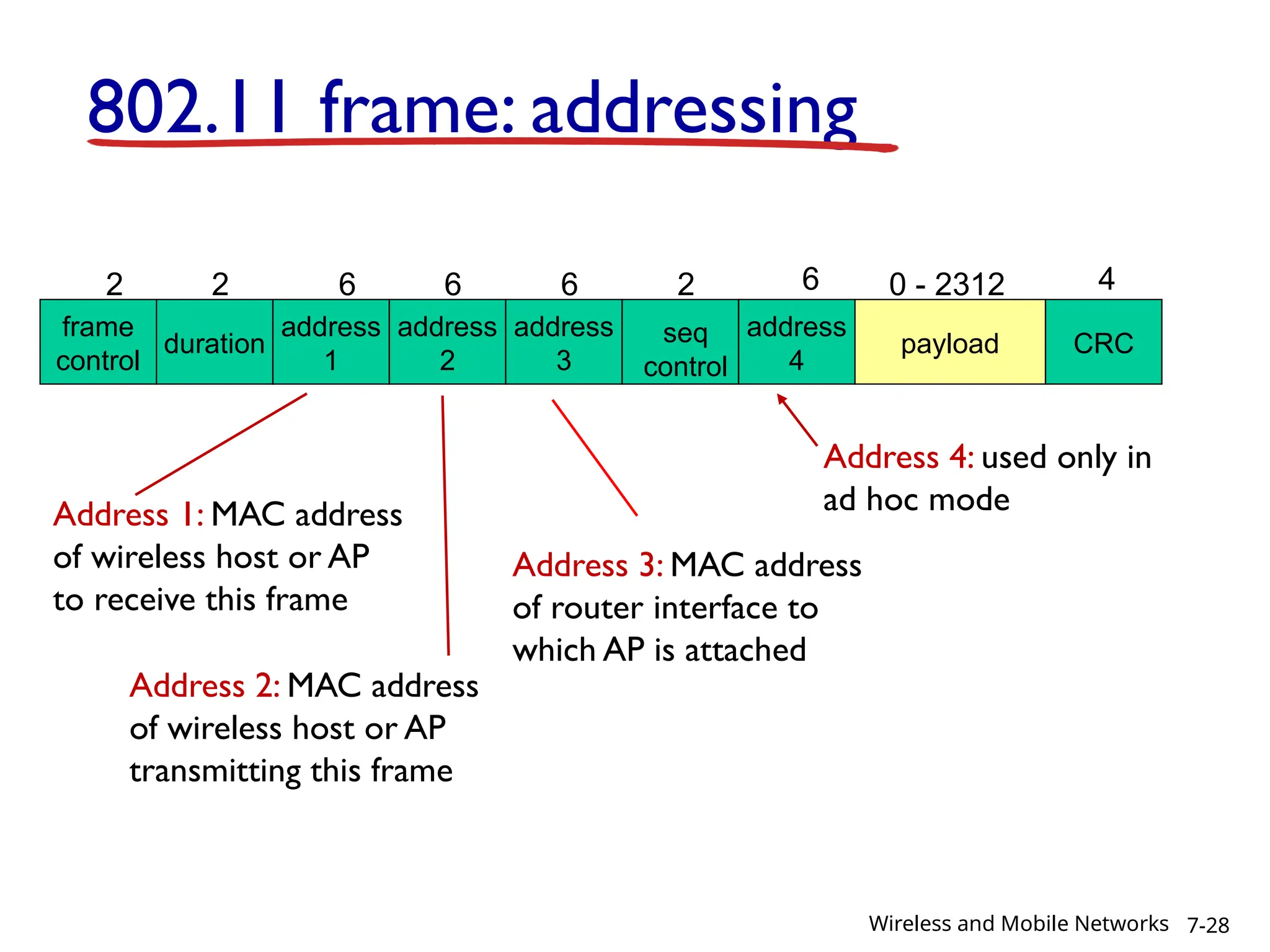
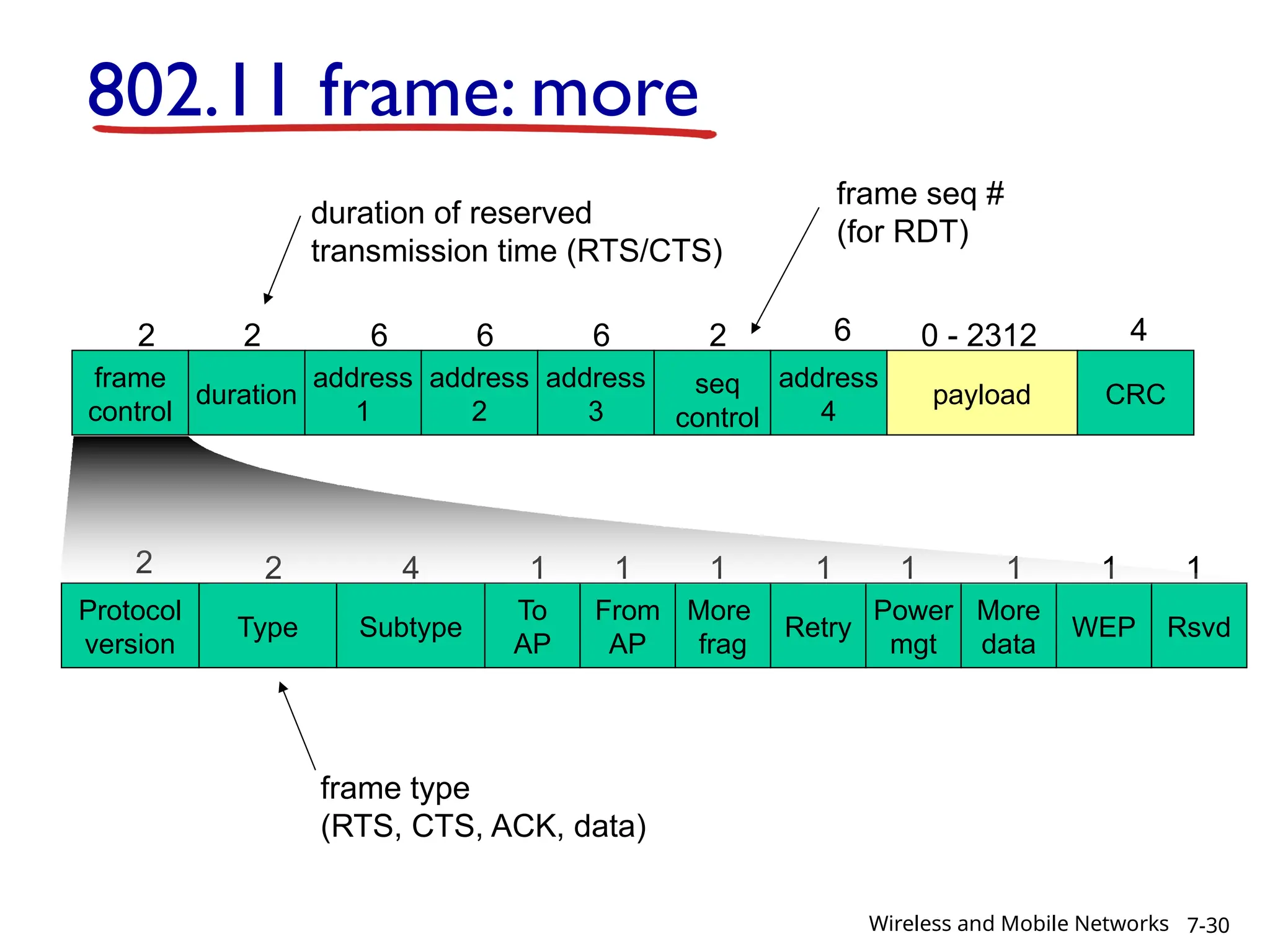
frame
control
duration
address
1
address
2
address
4
address
3
payload CRC
2 2 6 6 6 2 6 0 - 2312 4
seq
control
802.11 frame: addressing
Address 2: MAC address
of wireless host or AP
transmitting this frame
Address 1: MAC address
of wireless host or AP
to receive this frame
Address 3: MAC address
of router interface to
which AP is attached
Address 4: used only in
ad hoc mode
7-28
Wireless and Mobile Networks
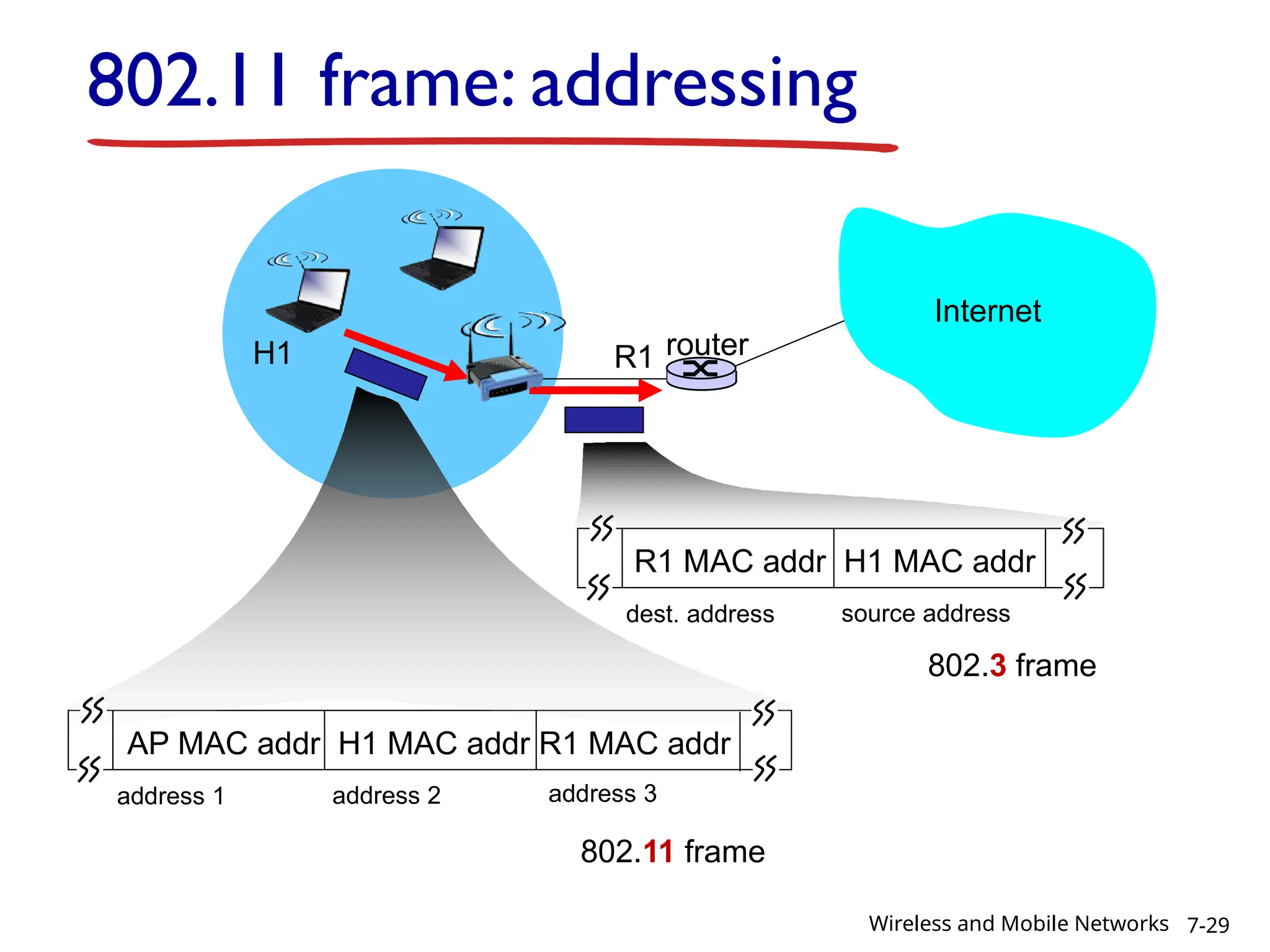
Internet
router
H1 R1
AP MAC addr H1 MAC addr R1 MAC addr
address 1 address 2 address 3
802.11 frame
R1 MAC addr H1 MAC addr
dest. address source address
802.3 frame
802.11 frame: addressing
7-29
Wireless and Mobile Networks
frame
control
duration
address
1
address
2
address
4
address
3
payload CRC
2 2 6 6 6 2 6 0 - 2312 4
seq
control
Type
From
AP
Subtype
To
AP
More
frag
WEP
More
data
Power
mgt
Retry Rsvd
Protocol
version
2 2 4 1 1 1 1 1 1
1 1
duration of reserved
transmission time (RTS/CTS)
frame seq #
(for RDT)
frame type
(RTS, CTS, ACK, data)
802.11 frame: more
7-30
Wireless and Mobile Networks

Jaringan Komputer wirelss and mobile network, power point

  • 1.
    Computer Networking: A Top DownApproach A note on the use of these Powerpoint slides: We’re making these slides freely available to all (faculty, students, readers). They’re in PowerPoint form so you see the animations; and can add, modify, and delete slides (including this one) and slide content to suit your needs. They obviously represent a lot of work on our part. In return for use, we only ask the following:  If you use these slides (e.g., in a class) that you mention their source (after all, we’d like people to use our book!)  If you post any slides on a www site, that you note that they are adapted from (or perhaps identical to) our slides, and note our copyright of this material. Thanks and enjoy! JFK/KWR All material copyright 1996-2016 J.F Kurose and K.W. Ross, All Rights Reserved 7th edition Jim Kurose, Keith Ross Pearson/Addison Wesley April 2016 Chapter 7 Wireless and Mobile Networks 7-1 Wireless and Mobile Networks
  • 2.
    Ch. 6:Wireless andMobile Networks Background:  # wireless (mobile) phone subscribers now exceeds # wired phone subscribers (5-to-1)!  # wireless Internet-connected devices equals # wireline Internet-connected devices • laptops, Internet-enabled phones promise anytime untethered Internet access  two important (but different) challenges • wireless: communication over wireless link • mobility: handling the mobile user who changes point of attachment to network 7-2 Wireless and Mobile Networks
  • 3.
    Chapter 7 outline 7.1Introduction Wireless 7.2 Wireless links, characteristics • CDMA 6.73 IEEE 802.11 wireless LANs (“Wi-Fi”) 67.4 Cellular Internet Access • architecture • standards (e.g., 3G, LTE) Mobility 7.5 Principles: addressing and routing to mobile users 7.6 Mobile IP 7.7 Handling mobility in cellular networks 7.8 Mobility and higher-layer protocols 7-3 Wireless and Mobile Networks
  • 4.
    Elements of awireless network network infrastructure 7-4 Wireless and Mobile Networks
  • 5.
    wireless hosts  laptop,smartphone  run applications  may be stationary (non- mobile) or mobile • wireless does not always mean mobility Elements of a wireless network network infrastructure 7-5 Wireless and Mobile Networks
  • 6.
    base station  typicallyconnected to wired network  relay - responsible for sending packets between wired network and wireless host(s) in its “area” • e.g., cell towers, 802.11 access points Elements of a wireless network network infrastructure 7-6 Wireless and Mobile Networks
  • 7.
    wireless link  typicallyused to connect mobile(s) to base station  also used as backbone link  multiple access protocol coordinates link access  various data rates, transmission distance Elements of a wireless network network infrastructure 7-7 Wireless and Mobile Networks
  • 8.
    Characteristics of selectedwireless links Indoor 10-30m Outdoor 50-200m Mid-range outdoor 200m – 4 Km Long-range outdoor 5Km – 20 Km .056 .384 1 4 5-11 54 2G: IS-95, CDMA, GSM 2.5G: UMTS/WCDMA, CDMA2000 802.15 802.11b 802.11a,g 3G: UMTS/WCDMA-HSPDA, CDMA2000-1xEVDO 4G: LTWE WIMAX 802.11a,g point-to-point 450 802.11n Data rate (Mbps) 7-8 Wireless and Mobile Networks 1300 802.11 ac
  • 9.
    infrastructure mode  basestation connects mobiles into wired network  handoff: mobile changes base station providing connection into wired network Elements of a wireless network network infrastructure 7-9 Wireless and Mobile Networks
  • 10.
    ad hoc mode no base stations  nodes can only transmit to other nodes within link coverage  nodes organize themselves into a network: route among themselves Elements of a wireless network 7-10 Wireless and Mobile Networks
  • 11.
    Wireless network taxonomy singlehop multiple hops infrastructure (e.g.,APs) no infrastructure host connects to base station (WiFi, WiMAX, cellular) which connects to larger Internet no base station, no connection to larger Internet (Bluetooth, ad hoc nets) host may have to relay through several wireless nodes to connect to larger Internet: mesh net no base station, no connection to larger Internet. May have to relay to reach other a given wireless node MANET,VANET 7-11 Wireless and Mobile Networks
  • 12.
    Chapter 7 outline 7.1Introduction Wireless 7.2Wireless links, characteristics • CDMA 7.3 IEEE 802.11 wireless LANs (“Wi-Fi”) 7.4 Cellular Internet Access • architecture • standards (e.g., 3G, LTE) Mobility 7.5 Principles: addressing and routing to mobile users 7.6 Mobile IP 7.7 Handling mobility in cellular networks 7.8 Mobility and higher-layer protocols 7-12 Wireless and Mobile Networks
  • 13.
    Wireless Link Characteristics(1) important differences from wired link ….  decreased signal strength: radio signal attenuates as it propagates through matter (path loss)  interference from other sources: standardized wireless network frequencies (e.g., 2.4 GHz) shared by other devices (e.g., phone); devices (motors) interfere as well  multipath propagation: radio signal reflects off objects ground, arriving ad destination at slightly different times …. make communication across (even a point to point) wireless link much more “difficult” 7-13 Wireless and Mobile Networks
  • 14.
    Wireless Link Characteristics(2)  SNR: signal-to-noise ratio • larger SNR – easier to extract signal from noise (a “good thing”)  SNR versus BER tradeoffs • given physical layer: increase power -> increase SNR- >decrease BER • given SNR: choose physical layer that meets BER requirement, giving highest thruput • SNR may change with mobility: dynamically adapt physical layer (modulation technique, rate) 10 20 30 40 QAM256 (8 Mbps) QAM16 (4 Mbps) BPSK (1 Mbps) SNR(dB) BER 10-1 10-2 10-3 10-5 10-6 10-7 10-4 7-14 Wireless and Mobile Networks
  • 15.
    Wireless network characteristics Multiplewireless senders and receivers create additional problems (beyond multiple access): A B C Hidden terminal problem  B,A hear each other  B, C hear each other  A, C can not hear each other means A, C unaware of their interference at B A B C A’s signal strength space C’s signal strength Signal attenuation:  B,A hear each other  B, C hear each other  A, C can not hear each other interfering at B 7-15 Wireless and Mobile Networks
  • 16.
    Code Division MultipleAccess (CDMA)  unique “code” assigned to each user; i.e., code set partitioning • all users share same frequency, but each user has own “chipping” sequence (i.e., code) to encode data • allows multiple users to “coexist” and transmit simultaneously with minimal interference (if codes are “orthogonal”)  encoded signal = (original data) X (chipping sequence)  decoding: inner-product of encoded signal and chipping sequence 7-16 Wireless and Mobile Networks
  • 17.
    CDMA encode/decode slot 1slot 0 d1 = -1 1 1 1 1 1 - 1 - 1 - 1 - Zi,m= di . cm d0 = 1 1 1 1 1 1 - 1 - 1 - 1 - 1 1 1 1 1 - 1 - 1 - 1 - 1 1 1 1 1 - 1 - 1 - 1 - slot 0 channel output slot 1 channel output channel output Zi,m sender code data bits slot 1 slot 0 d1 = -1 d0 = 1 1 1 1 1 1 - 1 - 1 - 1 - 1 1 1 1 1 - 1 - 1 - 1 - 1 1 1 1 1 - 1 - 1 - 1 - 1 1 1 1 1 - 1 - 1 - 1 - slot 0 channel output slot 1 channel output receiver code received input Di = SZi,m . cm m=1 M M 7-17 Wireless and Mobile Networks
  • 18.
    CDMA: two-sender interference usingsame code as sender 1, receiver recovers sender 1’s original data from summed channel data! Sender 1 Sender 2 channel sums together transmissions by sender 1 and 2 7-18 Wireless and Mobile Networks
  • 19.
    Chapter 7 outline 7.1Introduction Wireless 7.2 Wireless links, characteristics • CDMA 7.3 IEEE 802.11 wireless LANs (“Wi-Fi”) 7.4 Cellular Internet Access • architecture • standards (e.g., 3G, LTE) Mobility 7.5 Principles: addressing and routing to mobile users 7.6 Mobile IP 7.7 Handling mobility in cellular networks 7.8 Mobility and higher-layer protocols 7-19 Wireless and Mobile Networks
  • 20.
    IEEE 802.11 WirelessLAN 802.11b  2.4-5 GHz unlicensed spectrum  up to 11 Mbps  direct sequence spread spectrum (DSSS) in physical layer • all hosts use same chipping code 802.11a  5-6 GHz range  up to 54 Mbps 802.11g  2.4-5 GHz range  up to 54 Mbps 802.11n: multiple antennae  2.4-5 GHz range  up to 200 Mbps  all use CSMA/CA for multiple access  all have base-station and ad-hoc network versions 7-20 Wireless and Mobile Networks
  • 21.
    802.11 LAN architecture wireless host communicates with base station • base station = access point (AP)  Basic Service Set (BSS) (aka “cell”) in infrastructure mode contains: • wireless hosts • access point (AP): base station • ad hoc mode: hosts only BSS 1 BSS 2 Internet hub, switch or router 7-21 Wireless and Mobile Networks
  • 22.
    802.11: Channels, association 802.11b: 2.4GHz-2.485GHz spectrum divided into 11 channels at different frequencies • AP admin chooses frequency for AP • interference possible: channel can be same as that chosen by neighboring AP!  host: must associate with an AP • scans channels, listening for beacon frames containing AP’s name (SSID) and MAC address • selects AP to associate with • may perform authentication [Chapter 8] • will typically run DHCP to get IP address in AP’s subnet 7-22 Wireless and Mobile Networks
  • 23.
    802.11: passive/active scanning AP2 AP 1 H1 BBS 2 BBS 1 1 2 3 1 passive scanning: (1) beacon frames sent from APs (2) association Request frame sent: H1 to selected AP (3) association Response frame sent from selected AP to H1 AP 2 AP 1 H1 BBS 2 BBS 1 1 2 2 3 4 active scanning: (1) Probe Request frame broadcast from H1 (2) Probe Response frames sent from APs (3) Association Request frame sent: H1 to selected AP (4) Association Response frame sent from selected AP to H1 7-23 Wireless and Mobile Networks
  • 24.
    IEEE 802.11: multipleaccess  avoid collisions: 2+ nodes transmitting at same time  802.11: CSMA - sense before transmitting • don’t collide with ongoing transmission by other node  802.11: no collision detection! • difficult to receive (sense collisions) when transmitting due to weak received signals (fading) • can’t sense all collisions in any case: hidden terminal, fading • goal: avoid collisions: CSMA/C(ollision)A(voidance) space A B C A B C A’s signal strength C’s signal strength 7-24 Wireless and Mobile Networks
  • 25.
    IEEE 802.11 MACProtocol: CSMA/CA 802.11 sender 1 if sense channel idle for DIFS then transmit entire frame (no CD) 2 if sense channel busy then start random backoff time timer counts down while channel idle transmit when timer expires if no ACK, increase random backoff interval, repeat 2 802.11 receiver - if frame received OK return ACK after SIFS (ACK needed due to hidden terminal problem) sender receiver DIFS data SIFS ACK 7-25 Wireless and Mobile Networks
  • 26.
    Avoiding collisions (more) idea:allow sender to “reserve” channel rather than random access of data frames: avoid collisions of long data frames  sender first transmits small request-to-send (RTS) packets to BS using CSMA • RTSs may still collide with each other (but they’re short)  BS broadcasts clear-to-send CTS in response to RTS  CTS heard by all nodes • sender transmits data frame • other stations defer transmissions avoid data frame collisions completely using small reservation packets! 7-26 Wireless and Mobile Networks
  • 27.
    Collision Avoidance: RTS-CTSexchange AP A B time RTS(A) RTS(B) RTS(A) CTS(A) CTS(A) DATA (A) ACK(A) ACK(A) reservation collision defer 7-27 Wireless and Mobile Networks
  • 28.
    frame control duration address 1 address 2 address 4 address 3 payload CRC 2 26 6 6 2 6 0 - 2312 4 seq control 802.11 frame: addressing Address 2: MAC address of wireless host or AP transmitting this frame Address 1: MAC address of wireless host or AP to receive this frame Address 3: MAC address of router interface to which AP is attached Address 4: used only in ad hoc mode 7-28 Wireless and Mobile Networks
  • 29.
    Internet router H1 R1 AP MACaddr H1 MAC addr R1 MAC addr address 1 address 2 address 3 802.11 frame R1 MAC addr H1 MAC addr dest. address source address 802.3 frame 802.11 frame: addressing 7-29 Wireless and Mobile Networks
  • 30.
    frame control duration address 1 address 2 address 4 address 3 payload CRC 2 26 6 6 2 6 0 - 2312 4 seq control Type From AP Subtype To AP More frag WEP More data Power mgt Retry Rsvd Protocol version 2 2 4 1 1 1 1 1 1 1 1 duration of reserved transmission time (RTS/CTS) frame seq # (for RDT) frame type (RTS, CTS, ACK, data) 802.11 frame: more 7-30 Wireless and Mobile Networks