JALT West Tokyo, JALT Vocabulary SIG, and Oxford University Press
                                       are pleased to present…
                       A day of lexical intrigue and discovery…

                        Spreading the Good Word:
                     Introducing the Vocabulary SIG.

Date:          Saturday, May 19, 2012
Time:          Doors Open 10:30 am. Complete Program 10:45 - 5:15 pm
Speakers:      Charles Browne, Rory Rosszell, Jeffrey Stewart, Charles J. Anderson, & Rob
               Waring.
Fee:           JALT members, Vocabulary SIG members and TKU faculty: Free!
               Non-members/one-day members: ¥1000
               #You can join or renew your memberships at the event!
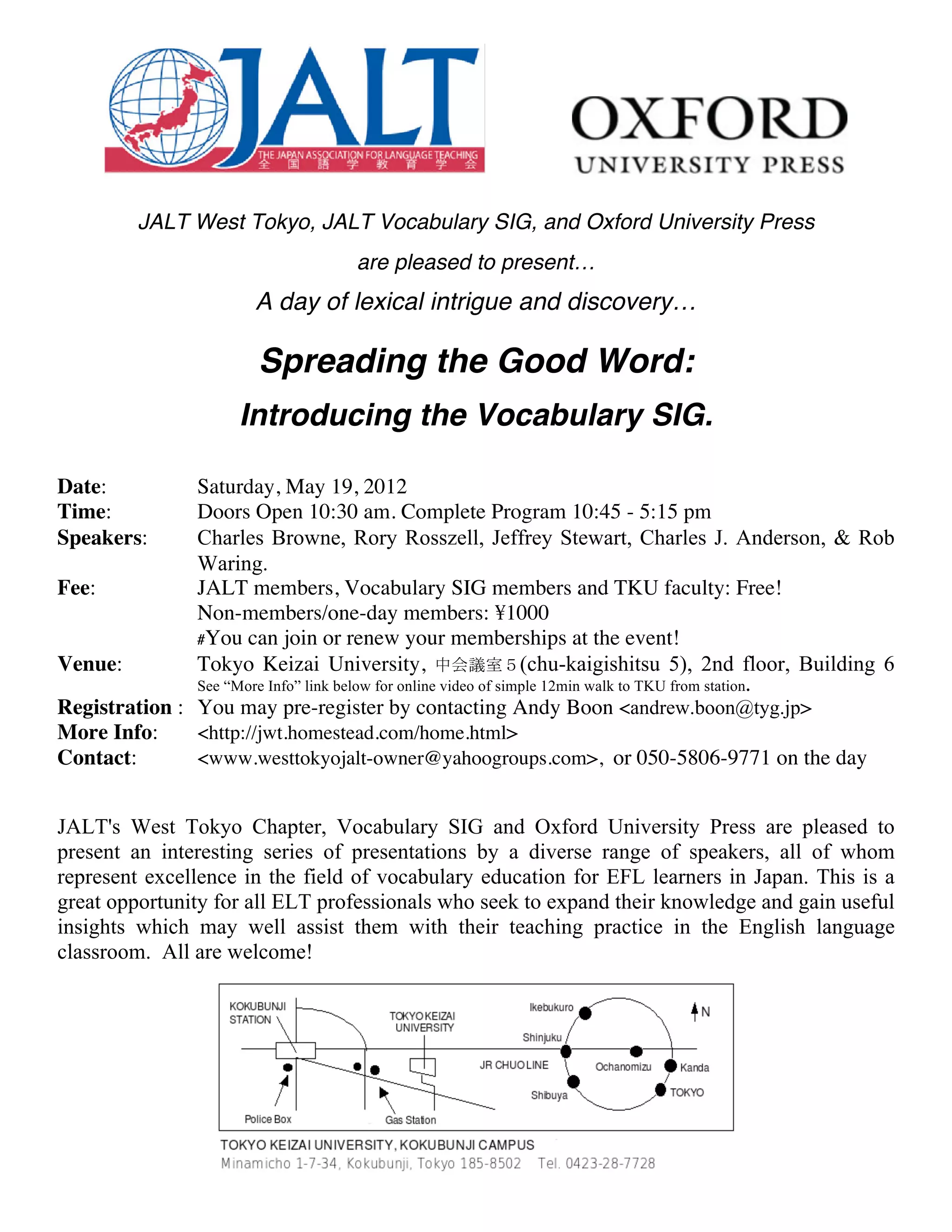
Venue:         Tokyo Keizai University, 中会議室5(chu-kaigishitsu 5), 2nd floor, Building 6
               See “More Info” link below for online video of simple 12min walk to TKU from station.
Registration : You may pre-register by contacting Andy Boon <andrew.boon@tyg.jp>
More Info:     <http://jwt.homestead.com/home.html>
Contact:       <www.westtokyojalt-owner@yahoogroups.com>, or 050-5806-9771 on the day


JALT's West Tokyo Chapter, Vocabulary SIG and Oxford University Press are pleased to
present an interesting series of presentations by a diverse range of speakers, all of whom
represent excellence in the field of vocabulary education for EFL learners in Japan. This is a
great opportunity for all ELT professionals who seek to expand their knowledge and gain useful
insights which may well assist them with their teaching practice in the English language
classroom. All are welcome!
10:45-11:00 ► Introduction to the Vocabulary SIG – Mark Howarth

11:00-11:45 ► Embracing the Vocabulary Challenge in Comprehending Authentic Video
Charles Browne, Meiji Gakuin University
Although there are now many online resources for accessing authentic video in and out of the classroom, this presentation
argues that the gap between the average vocabulary size of typical EFL language learners and the amount of vocabulary needed
to comprehend those videos is usually quite daunting. In this session, the presenter will begin by developing the argument for
the importance of teaching high frequency vocabulary, citing some of his background research on the serious vocabulary gaps
that face EFL learners in Asia. After a discussion of the differences between high frequency vocabulary needed for proficiency
in reading and that for listening, he will then describe the theoretical underpinnings of several online scaffolding tools he helped
to develop for assisting students to be able to better comprehend unsimplified videos (as well as many freeware and shareware
equivalents). Participants will also be introduced to an approach for rating the difficulty of videos by their vocabulary content
and simple techniques for developing targeted special purpose vocabulary lists based on corpus research of the transcripts of the
video.


12:00-12:45 ► Using	
  Word	
  Engine	
  to	
  boost	
  learners’	
  vocabulary	
  knowledge	
  
Rory Rosszell, Meiji University
Word	
  Engine	
   is	
   an	
   on-­‐line,	
   fee-­‐based	
   vocabulary	
   study	
   program	
   that	
   incorporates	
   spaced	
   repetition	
   and	
   allows	
   learners	
  
to	
  target	
  various	
  kinds	
  of	
  vocabulary.	
  After	
  introducing	
  the	
  program	
  and	
  demonstrating	
  a	
  number	
  of	
  its	
  features,	
  I	
  will	
  
provide	
   a	
   description	
   of	
   how	
   its	
   use	
   has	
   been	
   integrated	
   into	
   a	
   number	
   of	
   my	
   classes	
   over	
   the	
   past	
   couple	
   of	
   years.	
  
Descriptive	
  and	
  questionnaire-­‐based	
  data	
  will	
  then	
  be	
  introduced	
  to	
  provide	
  a	
  more	
  detailed	
  picture	
  of	
  my	
  students	
  use	
  
and	
  perceptions	
  of	
  the	
  program,	
  and	
  finally,	
  the	
  session	
  will	
  round	
  up	
  with	
  an	
  opportunity	
  to	
  ask	
  (further)	
  questions.	


1:00-2:00 ► Lunch – food and drink courtesy of OUP.

2:00-2:45 ► Creating vocabulary word lists using yes/no checklists
Jeffrey Stewart, Kyushu Sangyo University, Swansea University
Word lists used in ESL curricula are often organized by word frequency, as this is a strong predictor of their occurrence in text.
However, while frequency lists can indicate which words are most important for students to learn, they tell us less about which
words students already know. By identifying gaps in students’ knowledge of frequent words, we can create more effective and
succinct wordlists. Using a case study involving 2000 learners and checklist tests of 900 words, the presenter will detail how
educators can collect, compile and analyze checklist data of their students’ word knowledge. Topics addressed will include
scanners, OMR software, and equating estimates of word difficulty under Item Response Theory. Finally, using data collected
in the case study, major contributors to word difficulty for Japanese learners will be examined using a logistic regression
analysis.


3:00-3:45 ► Utilizing pictures for formative vocabulary instruction
Charles J. Anderson, Kyushu Sangyo University
This presentation’s intention is twofold. First, it will theoretically justify, then outline, a relatively uncommon but effective way
to assist students in acquiring vocabulary knowledge. Second, it will situate this teaching approach within a larger, more
important reconceptualization of feedback practice. Drawing on recent research in psychology, neurobiology and language
acquisition, this paper will argue that drawing pictures, in conjunction with appropriate feedback, may be the most effective
way to encourage logographically literate students to establish a strong initial L1-L2 association for core English vocabulary
that can then be elaborated upon. While this research is still largely theoretical, preliminary findings from a large scale
ecologically valid, longitudinal study indicate it to be effective in promoting vocabulary acquisition.


4:00-4:45 ► A framework for selecting appropriate online vocabulary learning environments
Dr. Rob Waring, Notre Dame Seishin University
This talk will first present an overall view of the vocabulary needs of learners - receptive and productive as well as language
focused and fluency-focused activities. We will then examine many of the online resources that can fit this framework from
decontextual memorization environments such as Anki, iknow or Quizlet to the more integrated environments such as
EnglishCentral and graded reading online. The participants will then be tasked to deciding which ones would best fit their
needs.


5:00-5:15 ► Book draw by OUP / Closing remarks.                                                                               Hope to see you there! J

Jalt 2012...spreading it...vocab sig presentation event...flyer & program final

  • 1.
                                              JALT West Tokyo, JALT Vocabulary SIG, and Oxford University Press are pleased to present… A day of lexical intrigue and discovery… Spreading the Good Word: Introducing the Vocabulary SIG. Date: Saturday, May 19, 2012 Time: Doors Open 10:30 am. Complete Program 10:45 - 5:15 pm Speakers: Charles Browne, Rory Rosszell, Jeffrey Stewart, Charles J. Anderson, & Rob Waring. Fee: JALT members, Vocabulary SIG members and TKU faculty: Free! Non-members/one-day members: ¥1000 #You can join or renew your memberships at the event! Venue: Tokyo Keizai University, 中会議室5(chu-kaigishitsu 5), 2nd floor, Building 6 See “More Info” link below for online video of simple 12min walk to TKU from station. Registration : You may pre-register by contacting Andy Boon <andrew.boon@tyg.jp> More Info: <http://jwt.homestead.com/home.html> Contact: <www.westtokyojalt-owner@yahoogroups.com>, or 050-5806-9771 on the day JALT's West Tokyo Chapter, Vocabulary SIG and Oxford University Press are pleased to present an interesting series of presentations by a diverse range of speakers, all of whom represent excellence in the field of vocabulary education for EFL learners in Japan. This is a great opportunity for all ELT professionals who seek to expand their knowledge and gain useful insights which may well assist them with their teaching practice in the English language classroom. All are welcome!
  • 2.
    10:45-11:00 ► Introductionto the Vocabulary SIG – Mark Howarth 11:00-11:45 ► Embracing the Vocabulary Challenge in Comprehending Authentic Video Charles Browne, Meiji Gakuin University Although there are now many online resources for accessing authentic video in and out of the classroom, this presentation argues that the gap between the average vocabulary size of typical EFL language learners and the amount of vocabulary needed to comprehend those videos is usually quite daunting. In this session, the presenter will begin by developing the argument for the importance of teaching high frequency vocabulary, citing some of his background research on the serious vocabulary gaps that face EFL learners in Asia. After a discussion of the differences between high frequency vocabulary needed for proficiency in reading and that for listening, he will then describe the theoretical underpinnings of several online scaffolding tools he helped to develop for assisting students to be able to better comprehend unsimplified videos (as well as many freeware and shareware equivalents). Participants will also be introduced to an approach for rating the difficulty of videos by their vocabulary content and simple techniques for developing targeted special purpose vocabulary lists based on corpus research of the transcripts of the video. 12:00-12:45 ► Using  Word  Engine  to  boost  learners’  vocabulary  knowledge   Rory Rosszell, Meiji University Word  Engine   is   an   on-­‐line,   fee-­‐based   vocabulary   study   program   that   incorporates   spaced   repetition   and   allows   learners   to  target  various  kinds  of  vocabulary.  After  introducing  the  program  and  demonstrating  a  number  of  its  features,  I  will   provide   a   description   of   how   its   use   has   been   integrated   into   a   number   of   my   classes   over   the   past   couple   of   years.   Descriptive  and  questionnaire-­‐based  data  will  then  be  introduced  to  provide  a  more  detailed  picture  of  my  students  use   and  perceptions  of  the  program,  and  finally,  the  session  will  round  up  with  an  opportunity  to  ask  (further)  questions.     1:00-2:00 ► Lunch – food and drink courtesy of OUP. 2:00-2:45 ► Creating vocabulary word lists using yes/no checklists Jeffrey Stewart, Kyushu Sangyo University, Swansea University Word lists used in ESL curricula are often organized by word frequency, as this is a strong predictor of their occurrence in text. However, while frequency lists can indicate which words are most important for students to learn, they tell us less about which words students already know. By identifying gaps in students’ knowledge of frequent words, we can create more effective and succinct wordlists. Using a case study involving 2000 learners and checklist tests of 900 words, the presenter will detail how educators can collect, compile and analyze checklist data of their students’ word knowledge. Topics addressed will include scanners, OMR software, and equating estimates of word difficulty under Item Response Theory. Finally, using data collected in the case study, major contributors to word difficulty for Japanese learners will be examined using a logistic regression analysis. 3:00-3:45 ► Utilizing pictures for formative vocabulary instruction Charles J. Anderson, Kyushu Sangyo University This presentation’s intention is twofold. First, it will theoretically justify, then outline, a relatively uncommon but effective way to assist students in acquiring vocabulary knowledge. Second, it will situate this teaching approach within a larger, more important reconceptualization of feedback practice. Drawing on recent research in psychology, neurobiology and language acquisition, this paper will argue that drawing pictures, in conjunction with appropriate feedback, may be the most effective way to encourage logographically literate students to establish a strong initial L1-L2 association for core English vocabulary that can then be elaborated upon. While this research is still largely theoretical, preliminary findings from a large scale ecologically valid, longitudinal study indicate it to be effective in promoting vocabulary acquisition. 4:00-4:45 ► A framework for selecting appropriate online vocabulary learning environments Dr. Rob Waring, Notre Dame Seishin University This talk will first present an overall view of the vocabulary needs of learners - receptive and productive as well as language focused and fluency-focused activities. We will then examine many of the online resources that can fit this framework from decontextual memorization environments such as Anki, iknow or Quizlet to the more integrated environments such as EnglishCentral and graded reading online. The participants will then be tasked to deciding which ones would best fit their needs. 5:00-5:15 ► Book draw by OUP / Closing remarks. Hope to see you there! J