Jackie Kay Poetry
Ms Nitsche
About Jackie Kay
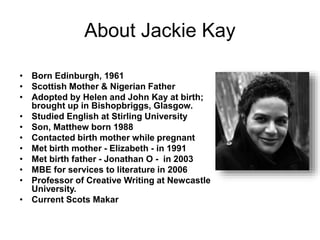
• Born Edinburgh, 1961
• Scottish Mother & Nigerian Father
• Adopted by Helen and John Kay at birth;
brought up in Bishopbriggs, Glasgow.
• Studied English at Stirling University
• Son, Matthew born 1988
• Contacted birth mother while pregnant
• Met birth mother - Elizabeth - in 1991
• Met birth father - Jonathan O - in 2003
• MBE for services to literature in 2006
• Professor of Creative Writing at Newcastle
University.
• Current Scots Makar
What’s in a name?
In pairs discuss the following questions:
• What do the names of the six poems we will study
suggest to you?
• What do you think the poems will be about?
• What themes might they explore?
Keeping Orchids
Gap Year
Lucozade
My Grandmother’s Houses
Old Tongue
Whilst Leila Sleeps
Family
• One of the main themes that connects many of
the poems is that of FAMILY.
• The poems explore inter-generational
relationships, such as:
- Daughter & mother
- Daughter & birth mother
- Granddaughter & grandmother
- Mother & son
- Daughter & parents.
Poetic Voice
• The ‘voice’ is the point of view that a poem is
seen from, like a narrator or persona.
• The poems feature the voice of a female
persona (although ‘Lucozade’ is a little more
ambiguous).
• This female persona explores family
relationships – as a result, all offer a thoroughly
domestic discourse or series of ideas.
Keeping Orchids
What’s it about?
The speaker – apparently Kay herself
reflects on meeting her birth mother for
the first time. Written in couplets and
touches on themes of secrets and
discoveries, as well as adoption and
family relationships.
Keeping Orchids
This poem describes the poet’s first meeting with her
birth mother. It is a painful emotional journey for both
women. The poet uses the images of the orchids her
birth mother gave her on their first meeting and of her
own and her mother’s “troubled hands” as symbols of the
complex, painful emotions they both feel. It is not a joyful
meeting. Jackie Kay can articulate her own feelings but
finds it hard to read her mother’s feelings as “she tells
the story of her life”. The poet describes her mother’s
account of her life as “compressed”, “airtight”, “a sad
square”. It does not reveal enough; it does not bring
comfort to her daughter, hungry for emotional connection
and revelation.
Keeping Orchids
In pairs, discuss these questions:
• What are your initial thoughts on the poem?
• What language techniques does the writer use?
• What is she trying to say by using these
techniques?
Keeping Orchids
• Full of emotion but very controlled and
restrained.
• Appears more about objects than emotions,
or, in other words, descriptive rather than
reflective.
• Title parallels the adoption – central image
of ‘Keeping Orchids’ is important.
• The most abstract of the poems; offers the
widest opportunities for interpretation.
The orchids my mother gave me when we first met
are still alive, twelve days later. Although
some of the buds remain closed as secrets.
Twice since I carried them back, like a baby in a shawl,
from her train station to mine, then home. Twice
since then the whole glass carafe has crashed
falling over, unprovoked, soaking my chest of drawers.
All the broken waters. I have rearranged
the upset orchids with troubled hands. Even after
that the closed ones did not open out. The skin
shut like an eye in the dark; the closed lid.
Twelve days later, my mother’s hands are all I have.
Her voice is fading fast. Even her voice rushes
through a tunnel the other way from home.
I close my eyes and try to remember exactly:
a paisley pattern scarf, a brooch, a navy coat.
A digital watch her daughter was wearing when she died.
Now they hang their heads,
and suddenly grow old – the proof of meeting. Still,
her hands, awkward and hard to hold
fold and unfold a green carrier bag as she tells
the story of her life. Compressed. Airtight.
A sad square, then a crumpled shape. A bag of tricks.
Her secret life – a hidden album, a box of love letters.
A door opens and closes. Time is outside waiting.
I catch the draught in my winter room.
Airlocks keep the cold air out.
Boiling water makes flowers live longer. So does
cutting the stems with a sharp knife.
This poem describes the poet’s first meeting with her birth
mother. It is a painful emotional journey for both women.
The poet uses the images of the orchids her birth mother
gave her on their first meeting and of her own and her
mother’s “troubled hands” as symbols of the complex,
painful emotions they both feel. It is not a joyful meeting.
Jackie Kay can articulate her own feelings but finds it hard
to read her mother’s feelings as “she tells the story of her
life”. The poet describes her mother’s account of her life as
“compressed”, “airtight”, “a sad square”.
It does not reveal enough; it does not bring comfort to her
daughter, hungry for emotional connection and revelation.
Task
 As we go through each of the poems, make a note of any poetic techniques
you see, and what meaning and effect the writer is trying to convey by using
these.
 Each group member will be responsible for a section of the poem, and you
will then teach the other members in the group about that section.
 You must come up with as much detailed analysis of these lines as you can.
 Remember, it’s not enough to say that something is a metaphor – WHAT
does that metaphor suggest to us? HOW does it do that?
Social Skill: Ensuring we all contribute effectively to the group.
YOU HAVE TEN MINUTES
Task
• Using the notes you have taken on your own section, each of
you will now teach the members in the group about the work
you have done.
• Remember: - What TECHNIQUES does the writer use?
- What MEANING do these convey?
- HOW do they convey that meaning?
Social Skill: Ensuring we all contribute effectively to the group.
YOU HAVE FIFTEEN MINUTES
1. Why does the poet emphasise in lines 1 and 2 that the orchids are
still alive?
2. What does the line “I carried them back, like a baby in a shawl”
reveal about the poet’s feelings?
3. Why does the poet emphasise that “twice since” she carried the
orchids home, their glass carafe had fallen over causing her to
rearrange them “with troubled hands”?
4. Why does the poet repeat the image of the buds “closed as secrets”
in stanza 5?
5. How does the poet develop the image of her mother’s troubled hands
in stanzas 10 and 11?
6. “A door opens and closes. Time is outside waiting”. What two
meanings could these lines have?
7. Using “boiling water” and “cutting the stems with a sharp knife” are
somewhat drastic but effective remedies for wilting flowers. Why is it
so important for the poet to try to make the orchids last?
Keeping Orchids
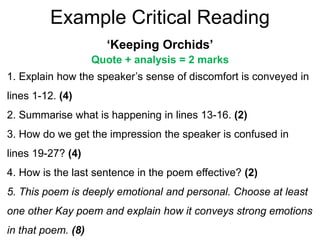
Example Critical Reading
‘Keeping Orchids’
Quote + analysis = 2 marks
1. Explain how the speaker’s sense of discomfort is conveyed in
lines 1-12. (4)
2. Summarise what is happening in lines 13-16. (2)
3. How do we get the impression the speaker is confused in
lines 19-27? (4)
4. How is the last sentence in the poem effective? (2)
5. This poem is deeply emotional and personal. Choose at least
one other Kay poem and explain how it conveys strong emotions
in that poem. (8)
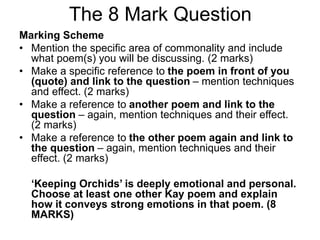
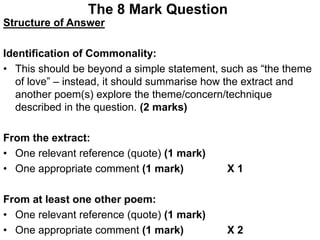
The 8 Mark Question
Marking Scheme
• Mention the specific area of commonality and include
what poem(s) you will be discussing. (2 marks)
• Make a specific reference to the poem in front of you
(quote) and link to the question – mention techniques
and effect. (2 marks)
• Make a reference to another poem and link to the
question – again, mention techniques and their effect.
(2 marks)
• Make a reference to the other poem again and link to
the question – again, mention techniques and their
effect. (2 marks)
‘Keeping Orchids’ is deeply emotional and personal.
Choose at least one other Kay poem and explain
how it conveys strong emotions in that poem. (8
MARKS)
The 8 Mark Question
Marking Scheme
• Mention the specific area of commonality and include
what poem(s) you will be discussing. (2 marks)
• Make a specific reference to the poem in front of
you (quote) and link to the question – mention
techniques and effect. (2 marks)
• Make a reference to another poem and link to the
question – again, mention techniques and their
effect. (2 marks)
• Make a reference to the other poem again and link
to the question – again, mention techniques and
their effect. (2 marks)
Gap Year
What’s it about?
Written in the voice of the poet and dedicated
to her son, Matthew. Describes his travels
abroad and leads to reflections on her
feelings about his childhood and newfound
independence. Explores themes of
motherhood, closeness and distance, and
the passage of time.
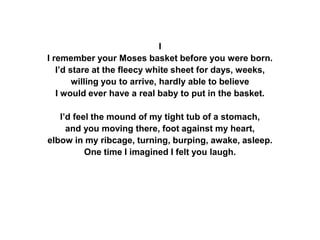
I
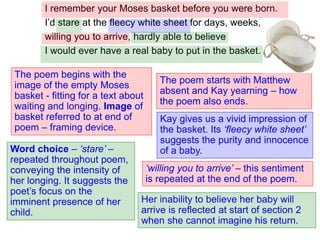
I remember your Moses basket before you were born.
I’d stare at the fleecy white sheet for days, weeks,
willing you to arrive, hardly able to believe
I would ever have a real baby to put in the basket.
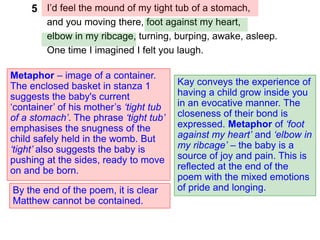
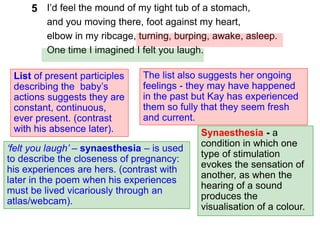
I’d feel the mound of my tight tub of a stomach,
and you moving there, foot against my heart,
elbow in my ribcage, turning, burping, awake, asleep.
One time I imagined I felt you laugh.
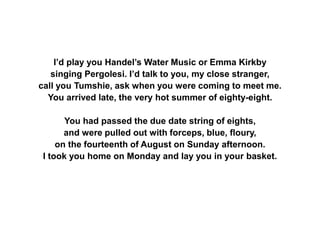
I’d play you Handel’s Water Music or Emma Kirkby
singing Pergolesi. I’d talk to you, my close stranger,
call you Tumshie, ask when you were coming to meet me.
You arrived late, the very hot summer of eighty-eight.
You had passed the due date string of eights,
and were pulled out with forceps, blue, floury,
on the fourteenth of August on Sunday afternoon.
I took you home on Monday and lay you in your basket.
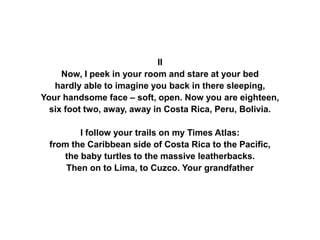
II
Now, I peek in your room and stare at your bed
hardly able to imagine you back in there sleeping,
Your handsome face – soft, open. Now you are eighteen,
six foot two, away, away in Costa Rica, Peru, Bolivia.
I follow your trails on my Times Atlas:
from the Caribbean side of Costa Rica to the Pacific,
the baby turtles to the massive leatherbacks.
Then on to Lima, to Cuzco. Your grandfather
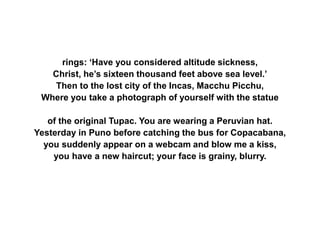
rings: ‘Have you considered altitude sickness,
Christ, he’s sixteen thousand feet above sea level.’
Then to the lost city of the Incas, Macchu Picchu,
Where you take a photograph of yourself with the statue
of the original Tupac. You are wearing a Peruvian hat.
Yesterday in Puno before catching the bus for Copacabana,
you suddenly appear on a webcam and blow me a kiss,
you have a new haircut; your face is grainy, blurry.
Seeing you, shy, smiling, on the webcam reminds me
of the second scan at twenty weeks, how at that fuzzy
moment back then, you were lying cross-legged with
an index finger resting sophisticatedly on one cheek.
You started the Inca trail in Arctic conditions
and ended up in subtropical. Now you plan the Amazon
in Bolivia. Your grandfather rings again to say
‘There’s three warring factions in Bolivia, warn him
against it. He canny see everything. Tell him to come home.’
But you say all the travellers you meet rave about Bolivia. You
want
to see the Salar de Uyuni,
the world’s largest salt-flats, the Amazonian rainforest.
And now you are not coming home till four weeks after
your due date. After Bolivia, you plan to stay
with a friend’s Auntie in Argentina.
Then – to Chile where you’ll stay with friends of Diane’s.
And maybe work for the Victor Jara Foundation.
I feel like a home-alone mother; all the lights
have gone out in the hall, and now I am
wearing your large black slippers, flip-flopping
into your empty bedroom, trying to imagine you
in your bed. I stare at the photos you send by messenger:
you on the top of the world, arms outstretched, eager.
Blue sky, white snow; you by Lake Tararhua, beaming.
My heart soars like the birds in your bright blue skies.
My love glows like the sunrise over the lost city.
I sing along to Ella Fitzgerald, A tisket A tasket.
I have a son out in the big wide world.
A flip and a skip ago, you were dreaming in your basket.
Gap Year
• This poem is written in the form of an address to her son, Mateo. It
expresses her love for and pride in her son, who is spending a gap
year travelling widely in South America.
• In the first section she describes her memories of the weeks before
he was born: her excited anticipation, the difficult birth.
• In the second section she describes the progress of his travels and
her mixed feelings about his departure. She is caught up in the
romance and adventure of his travels in exotic places but misses
him greatly. In contrast, his grandfather’s blunt advice reminds her of
the very real dangers he might encounter.
• She cannot hide her strong feelings of disappointment when she
learns he will return home four weeks later than she had expected,
but comments with wry humour that she feels “like a home-alone
mother”.
• In the last two stanzas, however, her mood changes to one of
elation and pride when she looks at photos of her son “on top of the
world”. It seems no time since he was a baby dreaming in his Moses
basket.
Gap Year
In pairs, discuss these questions:
• What are your initial thoughts on the poem?
• What language techniques does the writer use?
• What is she trying to say by using these
techniques?
Task
 As we go through each of the poems, make a note of any poetic techniques
you see, and what meaning and effect the writer is trying to convey by using
these.
 Each group member will be responsible for a section of the poem, and you
will then teach the other members in the group about that section.
 You must come up with as much detailed analysis of these lines as you can.
 Remember, it’s not enough to say that something is a metaphor – WHAT
does that metaphor suggest to us? HOW does it do that?
Social Skill: Ensuring we all contribute effectively to the group.
YOU HAVE TEN MINUTES
Task
• Using the notes you have taken on your own section, each of
you will now teach the members in the group about the work
you have done.
• Remember: - What TECHNIQUES does the writer use?
- What MEANING do these convey?
- HOW do they convey that meaning?
Social Skill: Ensuring we all contribute effectively to the group.
YOU HAVE FIFTEEN MINUTES
Gap Year
• Think about your relationship with your
own parents.
• How has it changed from when you were a
small child until now?
• Make a list of how your relationship and
how you see each other has altered over
time.
Gap Year
• Written in two defined sections.
• Offers many parallels and connections between
past and present – Matthew’s childhood and
adulthood.
• At one and the same time celebrates and
laments his independence.
• Provides a contrast between the speaker at
home, and the son exploring and investigating.
• Indeed, the second section allows the reader to
track his adventures as the speaker does.
• "I remember your Moses basket before you were born" – The
word choice of “remember” shows us she is reminiscing positively
about her memories of the past.
• "willing you to arrive, hardly able to believe" – “willing” suggests a
sense of urgency and wish that he would be born quickly – she can’t
wait.
• "Your handsome face – soft, open..." – positive word choice shows
her pride and admiration for her son’s appearance and personality.
• "I feel like a home-alone mother" – this comparison subverts our
normal expectation of ‘home alone’ and almost suggests that she felt
she was looked after by her son. This emphasises her sadness and
loneliness.
• "your empty bedroom, trying to imagine you in your bed" –
“empty bedroom” suggests a sense of loss in comparison to the baby
in the basket earlier in the text.
• "My heart soars like the birds in your bright blue skies.
My love glows like the sunrise over the lost city." – these similes
use extremely positive vocabulary suggesting her extreme pride and
happiness at the person her son has become and how much she
cares about him.
• "I have a son out in the big wide world." – She is proud and
almost surprised that he has grown into a man in what seems such a
short space of time.
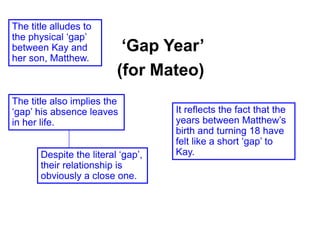
‘Gap Year’
(for Mateo)
The title alludes to
the physical ‘gap’
between Kay and
her son, Matthew.
It reflects the fact that the
years between Matthew’s
birth and turning 18 have
felt like a short ‘gap’ to
Kay.
The title also implies the
‘gap’ his absence leaves
in her life.
Despite the literal ‘gap’,
their relationship is
obviously a close one.
I remember your Moses basket before you were born.
I’d stare at the fleecy white sheet for days, weeks,
willing you to arrive, hardly able to believe
I would ever have a real baby to put in the basket.
The poem begins with the
image of the empty Moses
basket - fitting for a text about
waiting and longing. Image of
basket referred to at end of
poem – framing device.
The poem starts with Matthew
absent and Kay yearning – how
the poem also ends.
Word choice – ‘stare’ –
repeated throughout poem,
conveying the intensity of
her longing. It suggests the
poet’s focus on the
imminent presence of her
child.
Kay gives us a vivid impression of
the basket. Its ‘fleecy white sheet’
suggests the purity and innocence
of a baby.
‘willing you to arrive’ – this sentiment
is repeated at the end of the poem.
Her inability to believe her baby will
arrive is reflected at start of section 2
when she cannot imagine his return.
I’d feel the mound of my tight tub of a stomach,
and you moving there, foot against my heart,
elbow in my ribcage, turning, burping, awake, asleep.
One time I imagined I felt you laugh.
Metaphor – image of a container.
The enclosed basket in stanza 1
suggests the baby's current
‘container’ of his mother’s ‘tight tub
of a stomach’. The phrase ‘tight tub’
emphasises the snugness of the
child safely held in the womb. But
‘tight’ also suggests the baby is
pushing at the sides, ready to move
on and be born.
Kay conveys the experience of
having a child grow inside you
in an evocative manner. The
closeness of their bond is
expressed. Metaphor of ‘foot
against my heart’ and ‘elbow in
my ribcage’ – the baby is a
source of joy and pain. This is
reflected at the end of the
poem with the mixed emotions
of pride and longing.
5
By the end of the poem, it is clear
Matthew cannot be contained.
I’d feel the mound of my tight tub of a stomach,
and you moving there, foot against my heart,
elbow in my ribcage, turning, burping, awake, asleep.
One time I imagined I felt you laugh.
5
List of present participles
describing the baby’s
actions suggests they are
constant, continuous,
ever present. (contrast
with his absence later).
‘felt you laugh’ – synaesthesia – is used
to describe the closeness of pregnancy:
his experiences are hers. (contrast with
later in the poem when his experiences
must be lived vicariously through an
atlas/webcam).
The list also suggests her ongoing
feelings - they may have happened
in the past but Kay has experienced
them so fully that they seem fresh
and current.
Synaesthesia - a
condition in which one
type of stimulation
evokes the sensation of
another, as when the
hearing of a sound
produces the
visualisation of a colour.
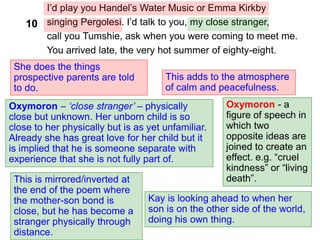
I’d play you Handel’s Water Music or Emma Kirkby
singing Pergolesi. I’d talk to you, my close stranger,
call you Tumshie, ask when you were coming to meet me.
You arrived late, the very hot summer of eighty-eight.
She does the things
prospective parents are told
to do.
Oxymoron – ‘close stranger’ – physically
close but unknown. Her unborn child is so
close to her physically but is as yet unfamiliar.
Already she has great love for her child but it
is implied that he is someone separate with
experience that she is not fully part of.
This adds to the atmosphere
of calm and peacefulness.
Kay is looking ahead to when her
son is on the other side of the world,
doing his own thing.
Oxymoron - a
figure of speech in
which two
opposite ideas are
joined to create an
effect. e.g. “cruel
kindness” or “living
death”.
This is mirrored/inverted at
the end of the poem where
the mother-son bond is
close, but he has become a
stranger physically through
distance.
10
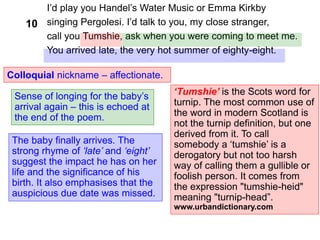
I’d play you Handel’s Water Music or Emma Kirkby
singing Pergolesi. I’d talk to you, my close stranger,
call you Tumshie, ask when you were coming to meet me.
You arrived late, the very hot summer of eighty-eight.
Colloquial nickname – affectionate.
‘Tumshie’ is the Scots word for
turnip. The most common use of
the word in modern Scotland is
not the turnip definition, but one
derived from it. To call
somebody a ‘tumshie’ is a
derogatory but not too harsh
way of calling them a gullible or
foolish person. It comes from
the expression "tumshie-heid"
meaning "turnip-head”.
www.urbandictionary.com
The baby finally arrives. The
strong rhyme of ‘late’ and ‘eight’
suggest the impact he has on her
life and the significance of his
birth. It also emphasises that the
auspicious due date was missed.
10
Sense of longing for the baby’s
arrival again – this is echoed at
the end of the poem.
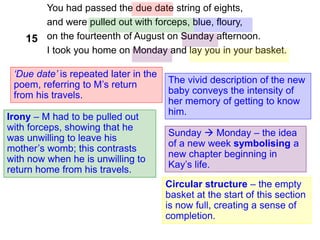
You had passed the due date string of eights,
and were pulled out with forceps, blue, floury,
on the fourteenth of August on Sunday afternoon.
I took you home on Monday and lay you in your basket.
‘Due date’ is repeated later in the
poem, referring to M’s return
from his travels.
Irony – M had to be pulled out
with forceps, showing that he
was unwilling to leave his
mother’s womb; this contrasts
with now when he is unwilling to
return home from his travels.
Circular structure – the empty
basket at the start of this section
is now full, creating a sense of
completion.
15
Sunday  Monday – the idea
of a new week symbolising a
new chapter beginning in
Kay’s life.
The vivid description of the new
baby conveys the intensity of
her memory of getting to know
him.
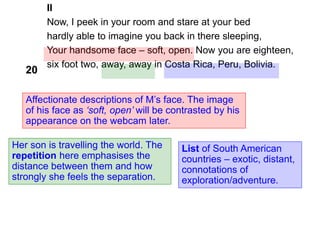
II
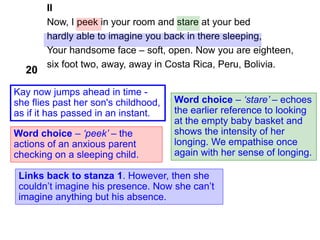
Now, I peek in your room and stare at your bed
hardly able to imagine you back in there sleeping,
Your handsome face – soft, open. Now you are eighteen,
six foot two, away, away in Costa Rica, Peru, Bolivia.
Word choice – ‘peek’ – the
actions of an anxious parent
checking on a sleeping child.
Word choice – ‘stare’ – echoes
the earlier reference to looking
at the empty baby basket and
shows the intensity of her
longing. We empathise once
again with her sense of longing.
20
Links back to stanza 1. However, then she
couldn’t imagine his presence. Now she can’t
imagine anything but his absence.
Kay now jumps ahead in time -
she flies past her son's childhood,
as if it has passed in an instant.
II
Now, I peek in your room and stare at your bed
hardly able to imagine you back in there sleeping,
Your handsome face – soft, open. Now you are eighteen,
six foot two, away, away in Costa Rica, Peru, Bolivia.
Her son is travelling the world. The
repetition here emphasises the
distance between them and how
strongly she feels the separation.
List of South American
countries – exotic, distant,
connotations of
exploration/adventure.
20
Affectionate descriptions of M’s face. The image
of his face as ‘soft, open’ will be contrasted by his
appearance on the webcam later.
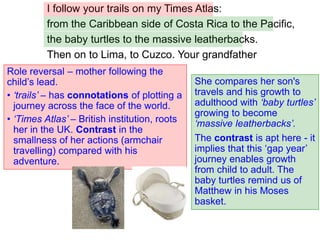
I follow your trails on my Times Atlas:
from the Caribbean side of Costa Rica to the Pacific,
the baby turtles to the massive leatherbacks.
Then on to Lima, to Cuzco. Your grandfather
She compares her son's
travels and his growth to
adulthood with ‘baby turtles’
growing to become
‘massive leatherbacks’.
The contrast is apt here - it
implies that this ‘gap year’
journey enables growth
from child to adult. The
baby turtles remind us of
Matthew in his Moses
basket.
Role reversal – mother following the
child’s lead.
• ‘trails’ – has connotations of plotting a
journey across the face of the world.
• ‘Times Atlas’ – British institution, roots
her in the UK. Contrast in the
smallness of her actions (armchair
travelling) compared with his
adventure.
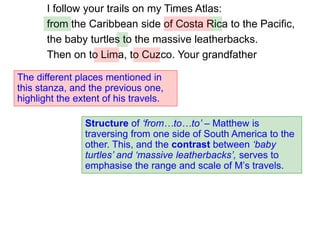
I follow your trails on my Times Atlas:
from the Caribbean side of Costa Rica to the Pacific,
the baby turtles to the massive leatherbacks.
Then on to Lima, to Cuzco. Your grandfather
Structure of ‘from…to…to’ – Matthew is
traversing from one side of South America to the
other. This, and the contrast between ‘baby
turtles’ and ‘massive leatherbacks’, serves to
emphasise the range and scale of M’s travels.
The different places mentioned in
this stanza, and the previous one,
highlight the extent of his travels.
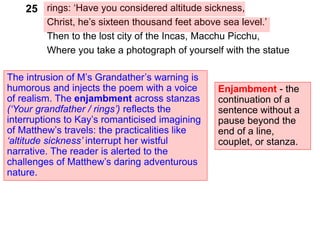
rings: ‘Have you considered altitude sickness,
Christ, he’s sixteen thousand feet above sea level.’
Then to the lost city of the Incas, Macchu Picchu,
Where you take a photograph of yourself with the statue
The intrusion of M’s Grandather’s warning is
humorous and injects the poem with a voice
of realism. The enjambment across stanzas
(‘Your grandfather / rings’) reflects the
interruptions to Kay’s romanticised imagining
of Matthew’s travels: the practicalities like
‘altitude sickness’ interrupt her wistful
narrative. The reader is alerted to the
challenges of Matthew’s daring adventurous
nature.
25
Enjambment - the
continuation of a
sentence without a
pause beyond the
end of a line,
couplet, or stanza.
rings: ‘Have you considered altitude sickness,
Christ, he’s sixteen thousand feet above sea level.’
Then to the lost city of the Incas, Macchu Picchu,
Where you take a photograph of yourself with the statue
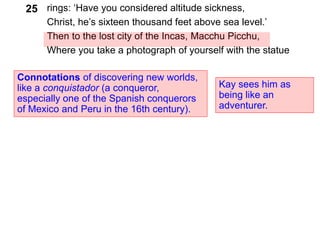
Connotations of discovering new worlds,
like a conquistador (a conqueror,
especially one of the Spanish conquerors
of Mexico and Peru in the 16th century).
25
Kay sees him as
being like an
adventurer.
of the original Tupac. You are wearing a Peruvian hat.
Yesterday in Puno before catching the bus for
Copacabana,
you suddenly appear on a webcam and blow me a kiss,
you have a new haircut; your face is grainy, blurry.
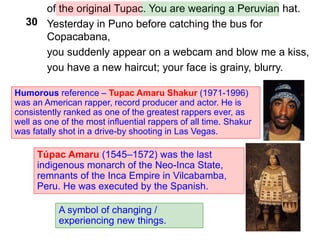
Humorous reference – Tupac Amaru Shakur (1971-1996)
was an American rapper, record producer and actor. He is
consistently ranked as one of the greatest rappers ever, as
well as one of the most influential rappers of all time. Shakur
was fatally shot in a drive-by shooting in Las Vegas.
30
A symbol of changing /
experiencing new things.
Túpac Amaru (1545–1572) was the last
indigenous monarch of the Neo-Inca State,
remnants of the Inca Empire in Vilcabamba,
Peru. He was executed by the Spanish.
of the original Tupac. You are wearing a Peruvian hat.
Yesterday in Puno before catching the bus for Copacabana,
you suddenly appear on a webcam and blow me a kiss,
you have a new haircut; your face is grainy, blurry.
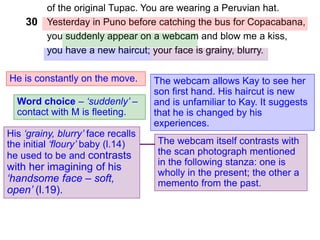
He is constantly on the move.
30
Word choice – ‘suddenly’ –
contact with M is fleeting.
The webcam allows Kay to see her
son first hand. His haircut is new
and is unfamiliar to Kay. It suggests
that he is changed by his
experiences.
His ‘grainy, blurry’ face recalls
the initial ‘floury’ baby (l.14)
he used to be and contrasts
with her imagining of his
‘handsome face – soft,
open’ (l.19).
The webcam itself contrasts with
the scan photograph mentioned
in the following stanza: one is
wholly in the present; the other a
memento from the past.
Seeing you, shy, smiling, on the webcam reminds me
of the second scan at twenty weeks, how at that fuzzy
moment back then, you were lying cross-legged with
an index finger resting sophisticatedly on one cheek.
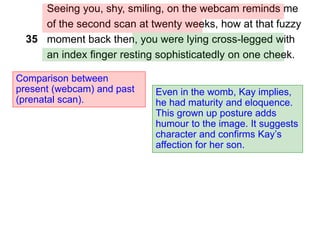
Comparison between
present (webcam) and past
(prenatal scan).
35
Even in the womb, Kay implies,
he had maturity and eloquence.
This grown up posture adds
humour to the image. It suggests
character and confirms Kay’s
affection for her son.
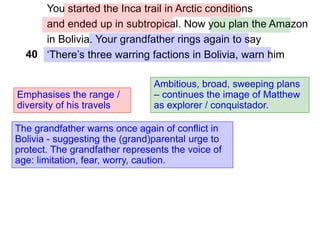
You started the Inca trail in Arctic conditions
and ended up in subtropical. Now you plan the Amazon
in Bolivia. Your grandfather rings again to say
‘There’s three warring factions in Bolivia, warn him
Emphasises the range /
diversity of his travels
40
Ambitious, broad, sweeping plans
– continues the image of Matthew
as explorer / conquistador.
The grandfather warns once again of conflict in
Bolivia - suggesting the (grand)parental urge to
protect. The grandfather represents the voice of
age: limitation, fear, worry, caution.
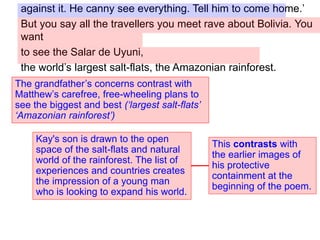
against it. He canny see everything. Tell him to come home.’
But you say all the travellers you meet rave about Bolivia. You
want
to see the Salar de Uyuni,
the world’s largest salt-flats, the Amazonian rainforest.
The grandfather’s concerns contrast with
Matthew’s carefree, free-wheeling plans to
see the biggest and best (‘largest salt-flats’
‘Amazonian rainforest’)
Kay's son is drawn to the open
space of the salt-flats and natural
world of the rainforest. The list of
experiences and countries creates
the impression of a young man
who is looking to expand his world.
This contrasts with
the earlier images of
his protective
containment at the
beginning of the poem.
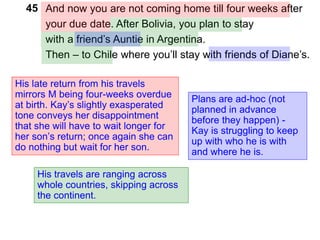
And now you are not coming home till four weeks after
your due date. After Bolivia, you plan to stay
with a friend’s Auntie in Argentina.
Then – to Chile where you’ll stay with friends of Diane’s.
His late return from his travels
mirrors M being four-weeks overdue
at birth. Kay’s slightly exasperated
tone conveys her disappointment
that she will have to wait longer for
her son’s return; once again she can
do nothing but wait for her son.
His travels are ranging across
whole countries, skipping across
the continent.
Plans are ad-hoc (not
planned in advance
before they happen) -
Kay is struggling to keep
up with who he is with
and where he is.
45
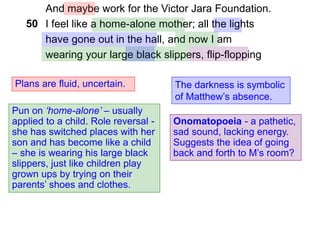
And maybe work for the Victor Jara Foundation.
I feel like a home-alone mother; all the lights
have gone out in the hall, and now I am
wearing your large black slippers, flip-flopping
Plans are fluid, uncertain.
Pun on ‘home-alone’ – usually
applied to a child. Role reversal -
she has switched places with her
son and has become like a child
– she is wearing his large black
slippers, just like children play
grown ups by trying on their
parents’ shoes and clothes.
The darkness is symbolic
of Matthew’s absence.
50
Onomatopoeia - a pathetic,
sad sound, lacking energy.
Suggests the idea of going
back and forth to M’s room?
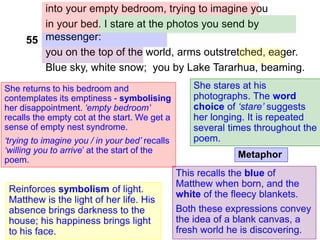
into your empty bedroom, trying to imagine you
in your bed. I stare at the photos you send by
messenger:
you on the top of the world, arms outstretched, eager.
Blue sky, white snow; you by Lake Tararhua, beaming.
She returns to his bedroom and
contemplates its emptiness - symbolising
her disappointment. ‘empty bedroom’
recalls the empty cot at the start. We get a
sense of empty nest syndrome.
‘trying to imagine you / in your bed’ recalls
‘willing you to arrive’ at the start of the
poem.
She stares at his
photographs. The word
choice of ‘stare’ suggests
her longing. It is repeated
several times throughout the
poem.
55
Metaphor
This recalls the blue of
Matthew when born, and the
white of the fleecy blankets.
Both these expressions convey
the idea of a blank canvas, a
fresh world he is discovering.
Reinforces symbolism of light.
Matthew is the light of her life. His
absence brings darkness to the
house; his happiness brings light
to his face.
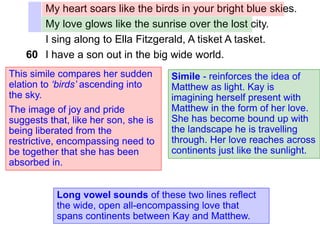
My heart soars like the birds in your bright blue skies.
My love glows like the sunrise over the lost city.
I sing along to Ella Fitzgerald, A tisket A tasket.
I have a son out in the big wide world.
This simile compares her sudden
elation to ‘birds’ ascending into
the sky.
The image of joy and pride
suggests that, like her son, she is
being liberated from the
restrictive, encompassing need to
be together that she has been
absorbed in.
Simile - reinforces the idea of
Matthew as light. Kay is
imagining herself present with
Matthew in the form of her love.
She has become bound up with
the landscape he is travelling
through. Her love reaches across
continents just like the sunlight.
60
Long vowel sounds of these two lines reflect
the wide, open all-encompassing love that
spans continents between Kay and Matthew.
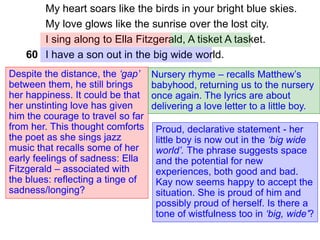
My heart soars like the birds in your bright blue skies.
My love glows like the sunrise over the lost city.
I sing along to Ella Fitzgerald, A tisket A tasket.
I have a son out in the big wide world.
Despite the distance, the ‘gap’
between them, he still brings
her happiness. It could be that
her unstinting love has given
him the courage to travel so far
from her. This thought comforts
the poet as she sings jazz
music that recalls some of her
early feelings of sadness: Ella
Fitzgerald – associated with
the blues: reflecting a tinge of
sadness/longing?
Nursery rhyme – recalls Matthew’s
babyhood, returning us to the nursery
once again. The lyrics are about
delivering a love letter to a little boy.
60
Proud, declarative statement - her
little boy is now out in the ‘big wide
world’. The phrase suggests space
and the potential for new
experiences, both good and bad.
Kay now seems happy to accept the
situation. She is proud of him and
possibly proud of herself. Is there a
tone of wistfulness too in ‘big, wide’?
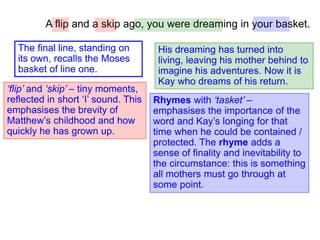
A flip and a skip ago, you were dreaming in your basket.
‘flip’ and ‘skip’ – tiny moments,
reflected in short ‘I’ sound. This
emphasises the brevity of
Matthew’s childhood and how
quickly he has grown up.
His dreaming has turned into
living, leaving his mother behind to
imagine his adventures. Now it is
Kay who dreams of his return.
Rhymes with ‘tasket’ –
emphasises the importance of the
word and Kay’s longing for that
time when he could be contained /
protected. The rhyme adds a
sense of finality and inevitability to
the circumstance: this is something
all mothers must go through at
some point.
The final line, standing on
its own, recalls the Moses
basket of line one.
Themes
Growing up
Kay explores the theme of growing up in this poem -
mainly from a parent’s perspective.
Childhood is all too brief and soon your child is out in the
‘big, wide world’. The image of the basket which frames
the poem suggests both joy and a mother's instinct to
protect her child. It suggests that for a parent, their child
will always partly be remembered as an innocent,
vulnerable baby.
Themes
Growing up
As much as the ‘Gap Year’ is about Matthew’s adventure into
maturity, Kay herself must also ‘grow’ to accept that she must
let go of her urge to follow him around. She must embrace that
he is away exploring without her. By the end of the poem we
get the impression that Kay has accepted this, despite the fact
she cannot believe how quickly he has grown up.
The fact that the poem is dedicated ‘for Mateo’ (the Spanish
for Matthew) shows that Kay embraces her son's new identity,
as an adult exploring Spanish-speaking countries.
Themes
Love
Kay's love for her son pervades the whole poem. Her
affection is expressed in the initial nicknames like
‘Tumshie’ and the way she stares longingly at the Moses
basket. A loving bond she has established even before he
is born.
This is then developed by the portrayal of a very close
relationship as we move into Section II. She charts all his
travels on her atlas and recognises any changes in him –
‘a new haircut’, his ‘eagerness’ to explore.
Themes
Love
She paces his empty room imagining his ‘soft face’ - it is
clear that she misses him. But through her love she is
able to let him go. Kay finds herself exuberant at the end
of the poem, contemplating her son ‘out in the big wide
world’, despite the fact he has delayed his return. Her
feelings are no longer about herself, but her son and his
adventure. This suggests the ultimate selfless act of a
mother to put the needs of her child before her own.
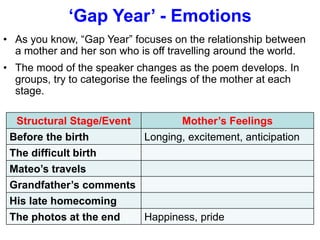
‘Gap Year’ - Emotions
• As you know, “Gap Year” focuses on the relationship between
a mother and her son who is off travelling around the world.
• The mood of the speaker changes as the poem develops. In
groups, try to categorise the feelings of the mother at each
stage.
Structural Stage/Event Mother’s Feelings
Before the birth Longing, excitement, anticipation
The difficult birth
Mateo’s travels
Grandfather’s comments
His late homecoming
The photos at the end Happiness, pride
‘Gap Year’ - Continuum of Emotion Task
In groups:
• Draw a line on a landscape sheet of paper
representing the emotions of the speaker throughout
the poem: happiness at one end, sadness at the
other.
• Write down relevant quotations from the poem on the
continuum – where do fit on the scale of this emotion?
What other emotions do they suggest?
• Discuss and justify your choices, then analyse at least
three pieces of evidence – how do these quotations
suggest these emotions to us? Feedback your
choices to the class.
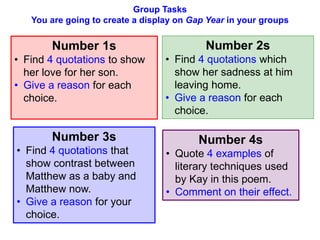
Group Tasks
You are going to create a display on Gap Year in your groups
Number 1s
• Find 4 quotations to show
her love for her son.
• Give a reason for each
choice.
Number 2s
• Find 4 quotations which
show her sadness at him
leaving home.
• Give a reason for each
choice.
Number 3s
• Find 4 quotations that
show contrast between
Matthew as a baby and
Matthew now.
• Give a reason for your
choice.
Number 4s
• Quote 4 examples of
literary techniques used
by Kay in this poem.
• Comment on their effect.
Gap Year
1. Summarise the main points in lines 1-16. (4 marks)
2. How is a sense of longing established in lines 17-20? (4
marks)
3. By referring to ONE example, show how the writer uses
language to emphasise her feelings of loss during her
son’s gap year. (2 marks)
4. The last two stanzas signal a further mood change.
Comment on the effectiveness of the language the poet
uses to convey her feelings.(2 marks)
5. Kay often uses her poetry to explore relationships. Using
one other poem show how she manages to do this
effectively in her poems. (8 marks)
Lucozade
What’s it about?
Told from the perspective of a 16 year
old persona visiting his/her mother in
hospital. Charts a turn in the mother’s,
and ultimately the speaker’s, attitudes
about death.
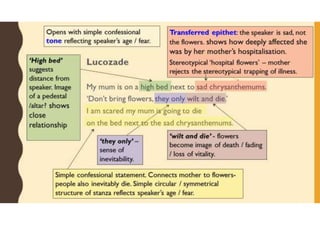
My mum is on a high bed next to sad chrysanthemums.
‘Don’t bring flowers, they only wilt and die.’
I am scared my mum is going to die
on the bed next to the sad chrysanthemums.
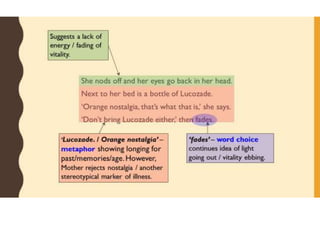
She nods off and her eyes go back in her head.
Next to her bed is a bottle of Lucozade.
‘Orange nostalgia, that’s what that is,’ she says.
‘Don’t bring Lucozade either,’ then fades.
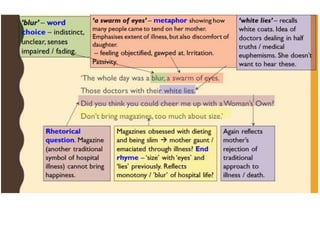
‘The whole day was a blur, a swarm of eyes.
Those doctors with their white lies.
Did you think you could cheer me up with a Woman’s Own?
Don’t bring magazines, too much about size.’
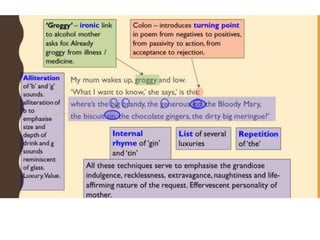
My mum wakes up, groggy and low.
‘What I want to know,’ she says,’ is this:
where’s the big brandy, the generous gin, the Bloody Mary,
the biscuit tin, the chocolate gingers, the dirty big meringue?’
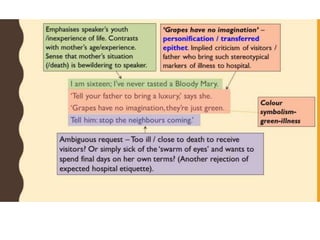
I am sixteen; I’ve never tasted a Bloody Mary.
‘Tell your father to bring a luxury,’ says she.
‘Grapes have no imagination, they’re just green.
Tell him: stop the neighbours coming.’
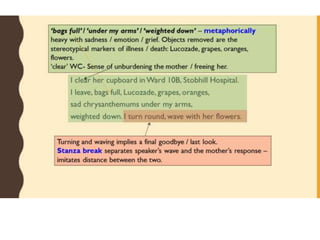
I clear her cupboard in Ward 10B, Stobhill Hospital.
I leave, bags full, Lucozade, grapes, oranges,
sad chrysanthemums under my arms,
weighted down. I turn round, wave with her flowers.
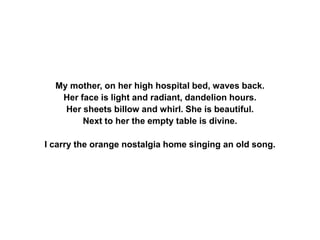
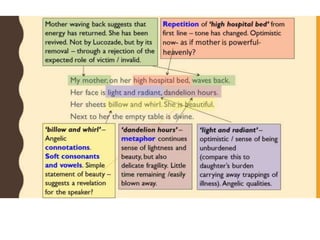
My mother, on her high hospital bed, waves back.
Her face is light and radiant, dandelion hours.
Her sheets billow and whirl. She is beautiful.
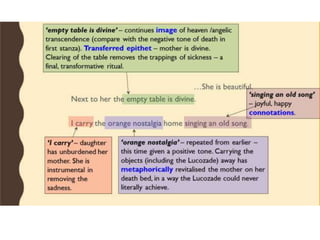
Next to her the empty table is divine.
I carry the orange nostalgia home singing an old song.
Lucozade
• In this poem Jackie Kay describes visiting her mother in hospital.
She was a young girl of sixteen, afraid that her mother would die.
• The poem not only describes the shock of seeing her mother but
conveys the personality of her mother expressively and with humour.
• Her mother’s ironic questions, her humorous commands, her
idiosyncratic remarks may be partially the result of her treatment or
operation but strongly suggest a person who faces her hospital
experience with spirit and humour.
• The last two stanzas describe the euphoria of relief the poet feels
when she realises her mother will not die but has recovered enough
to wave from her hospital bed.
• The clearing of her mother’s ward cupboard of the traditional gifts an
invalid receives, which her mother had decisively rejected, is a
cathartic moment for the poet.
• For the sixteen-year-old poet, her senses heightened after the
trauma of her mother’s hospitalisation, the sight of her mother
waving becomes for her a beautiful, almost heavenly vision.
Lucozade
In pairs, discuss these questions:
• What are your initial thoughts on the poem?
• What language techniques does the writer use?
• What is she trying to say by using these
techniques?
Lucozade
• Offers the complex image of the Lucozade – initially
present in the title.
• Rejection of the typical ‘markers’ of sickness, in
favour of luxury and the decadent ‘markers’ of life.
• Seems to be a formative experience for the speaker.
• Recognises her youth but suggests she learns
something about life and death.
• Speaker literally and metaphorically unburdens the
mother in what appears to be a final ritual – clearing
the hospital cabinet.
Task
 As we go through each of the poems, make a note of any poetic techniques
you see, and what meaning and effect the writer is trying to convey by using
these.
 Each group member will be responsible for a section of the poem, and you
will then teach the other members in the group about that section.
 You must come up with as much detailed analysis of these lines as you can.
 Remember, it’s not enough to say that something is a metaphor – WHAT
does that metaphor suggest to us? HOW does it do that?
Social Skill: Ensuring we all contribute effectively to the group.
YOU HAVE TEN MINUTES
Task
• Using the notes you have taken on your own section, each of
you will now teach the members in the group about the work
you have done.
• Remember: - What TECHNIQUES does the writer use?
- What MEANING do these convey?
- HOW do they convey that meaning?
Social Skill: Ensuring we all contribute effectively to the group.
YOU HAVE FIFTEEN MINUTES
Lucozade
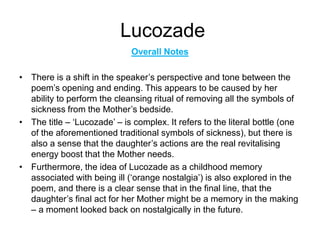
Overall Notes
• There is a shift in the speaker’s perspective and tone between the
poem’s opening and ending. This appears to be caused by her
ability to perform the cleansing ritual of removing all the symbols of
sickness from the Mother’s bedside.
• The title – ‘Lucozade’ – is complex. It refers to the literal bottle (one
of the aforementioned traditional symbols of sickness), but there is
also a sense that the daughter’s actions are the real revitalising
energy boost that the Mother needs.
• Furthermore, the idea of Lucozade as a childhood memory
associated with being ill (‘orange nostalgia’) is also explored in the
poem, and there is a clear sense that in the final line, that the
daughter’s final act for her Mother might be a memory in the making
– a moment looked back on nostalgically in the future.
The 8 Mark Question
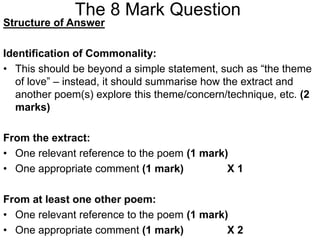
Structure of Answer
Identification of Commonality:
• This should be beyond a simple statement, such as “the theme
of love” – instead, it should summarise how the extract and
another poem(s) explore this theme/concern/technique, etc. (2
marks)
From the extract:
• One relevant reference to the poem (1 mark)
• One appropriate comment (1 mark) X 1
From at least one other poem:
• One relevant reference to the poem (1 mark)
• One appropriate comment (1 mark) X 2
2014 Past Paper
1. Look at stanzas 1 and 2 (lines 1—8). Why does the
poet’s mother not want her to bring flowers or
Lucozade? 4
2. Referring to lines 9—20, show how the poet gives the
reader a clear impression of the mother’s character or
personality. 4
3. Explain how the poet uses language in lines 21—29 to
indicate a clear change in the girl’s feelings. 4
4. Kay often uses her poetry to explore relationships. Using
one other poem show how she manages to do this
effectively in her poems. 8
Using the 3 Steps of Analysis, analyse these
quotations from the poems we have studied so far.
Lucozade
“I leave, bags full, Lucozade,
grapes, oranges,/
sad chrysanthemums under my
arms,/
weighted down.”
Gap Year
“I stare at the photos you send
by messenger:/
you on the top of the world,
arms outstretched, eager.”
Divorce
“There are parents who stroke
their children’s cheeks/
in the dead of night/
and sing in the colourful voices
of rainbows,/
red to blue.”
Keeping Orchids
“A door opens and closes.
Time is outside waiting./
I catch the draught in my winter
room.”
My Grandmother’s Houses
What’s it about?
Monologue told by a female persona
describing the time she spends with her
grandmother, both at her grandmother’s
homes (initially a tenement and then a high
rise block of flats) and the house her
grandmother cleans for a living. Explores
ideas about the passage of time and
intergenerational/family relationships.
1
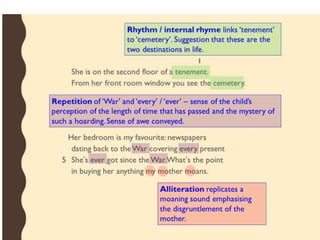
She is on the second floor of a tenement.
From her front room window you see the cemetery.
Her bedroom is my favourite: newspapers
dating back to the War covering every present
she’s ever got since the War. What’s the point
in buying her anything my mother moans.
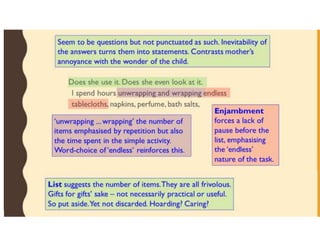
Does she use it. Does she even look at it.
I spend hours unwrapping and wrapping endless
tablecloths, napkins, perfume, bath salts,
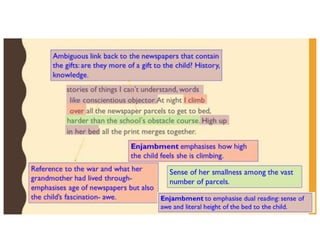
stories of things I can’t understand, words
like conscientious objector. At night I climb
over all the newspaper parcels to get to bed,
harder than the school’s obstacle course. High up
in her bed all the print merges together.
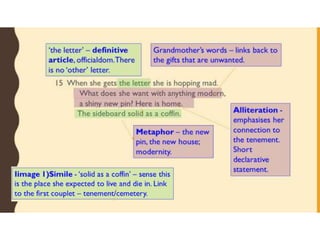
When she gets the letter she is hopping mad.
What does she want with anything modern,
a shiny new pin? Here is home.
The sideboard solid as a coffin.
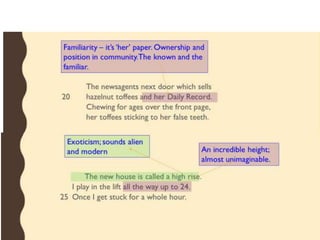
The newsagents next door which sells
hazelnut toffees and her Daily Record.
Chewing for ages over the front page,
her toffees sticking to her false teeth.
2
The new house is called a high rise.
I play in the lift all the way up to 24.
Once I get stuck for a whole hour.
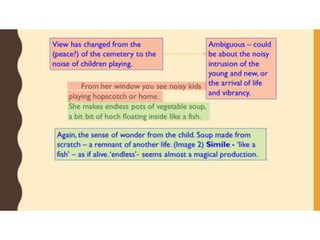
From her window you see noisy kids
playing hopscotch or home.
She makes endless pots of vegetable soup,
a bit bit of hoch floating inside like a fish.
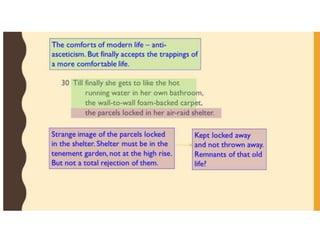
Till finally she gets to like the hot
running water in her own bathroom,
the wall-to-wall foam-backed carpet,
the parcels locked in her air-raid shelter.
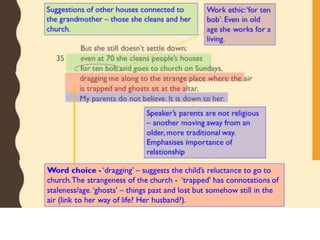
But she still doesn’t settle down;
even at 70 she cleans people’s houses
for ten bob and goes to church on Sundays,
dragging me along to the strange place where the air
is trapped and ghosts sit at the altar.
My parents do not believe. It is down to her.
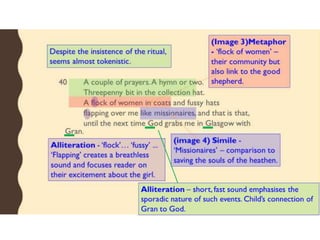
A couple of prayers. A hymn or two.
Threepenny bit in the collection hat.
A flock of women in coats and fussy hats
flapping over me like missionaires, and that is that,
until the next time God grabs me in Glasgow with Gran.
3
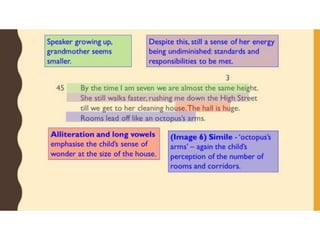
By the time I am seven we are almost the same height.
She still walks faster, rushing me down the High Street
till we get to her cleaning house. The hall is huge.
Rooms lead off like an octopus’s arms.
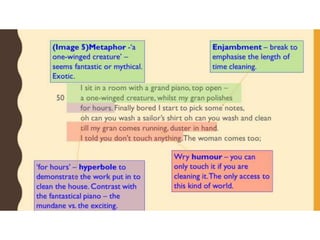
I sit in a room with a grand piano, top open –
a one-winged creature, whilst my gran polishes
for hours. Finally bored I start to pick some notes,
oh can you wash a sailor’s shirt oh can you wash and clean
till my gran comes running, duster in hand.
I told you don’t touch anything. The woman comes too;
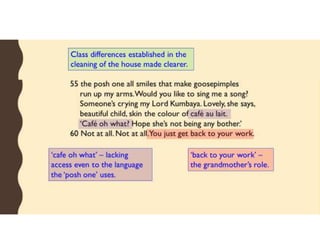
the posh one all smiles that make goosepimples
run up my arms. Would you like to sing me a song?
Someone’s crying my Lord Kumbaya. Lovely, she says,
beautiful child, skin the colour of café au lait.
‘Café oh what? Hope she’s not being any bother.’
Not at all. Not at all. You just get back to your work.
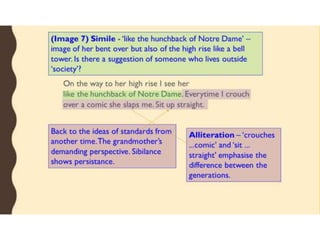
On the way to her high rise I see her
like the hunchback of Notre Dame. Everytime I crouch
over a comic she slaps me. Sit up straight.
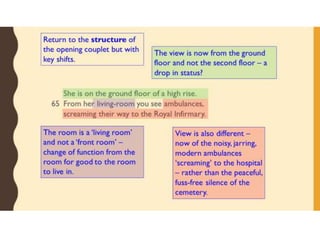
She is on the ground floor of a high rise.
From her living-room you see ambulances,
screaming their way to the Royal Infirmary.
My Grandmother’s Houses
• In this poem, the poet simultaneously recreates her childhood
experiences and voices her adult perceptions of her grandmother.
• Each section of the poem describes a different house, each flat
reflecting different aspects of her life, work and personality. This
structure enables Jackie Kay to create a vivid, memorable portrait
of her grandmother.
• The first section describes her tenement flat with her bedroom’s
idiosyncratic clutter.
• In the second section the poet creates a picture of her life in her
new high-rise flat.
• We learn that she is always busy, still cleaning people’s houses at
the age of seventy and taking her reluctant grandchild to church with
her on Sundays.
• The third section describes the child’s perceptions of her
grandmother’s “cleaning house” and uses snatches of remembered
conversations to portray the somewhat patronising “posh one”.
• The final three lines suggest that her grandmother had moved to a
ground floor flat, where she is disturbed by screaming ambulances.
• It is a sombre ending to a poem which pays tribute to the life of this
spirited, hard-working and devout woman.
My Grandmother’s Houses
In pairs, discuss these questions:
• What are your initial thoughts on the poem?
• What language techniques does the writer use?
• What is she trying to say by using these
techniques?
Task
 As we go through each of the poems, make a note of any poetic techniques
you see, and what meaning and effect the writer is trying to convey by using
these.
 Each group member will be responsible for a section of the poem, and you
will then teach the other members in the group about that section.
 You must come up with as much detailed analysis of these lines as you can.
 Remember, it’s not enough to say that something is a metaphor – WHAT
does that metaphor suggest to us? HOW does it do that?
Social Skill: Ensuring we all contribute effectively to the group.
YOU HAVE TEN MINUTES
Task
• Using the notes you have taken on your own section, each of
you will now teach the members in the group about the work
you have done.
• Remember: - What TECHNIQUES does the writer use?
- What MEANING do these convey?
- HOW do they convey that meaning?
Social Skill: Ensuring we all contribute effectively to the group.
YOU HAVE FIFTEEN MINUTES
My Grandmother’s Houses
• Sense of the ‘standards’ of the older generation –
work ethic, religious sensibilities, asceticism.
• Sense of the child’s awe at the grandmother’s
life/possessions.
• Explores ideas about displacement – physical and
temporal.
• Also looks at notions of traditional versus modern
ways of life – is embracing the new a rejection of the
past?
1. Describe how the poet structures this poem.
2. Comment on the content of the first and the last two lines,
suggesting why the poet has framed the main body of the
poem in this way.
3. Look closely at the poet’s detailed descriptions of the
tenement flat and the high-rise flat. What do they suggest
about her grandmother’s personality and her way of life?
4. “even at 70 she cleans people’s houses / for ten bob” What
does this statement reveal about the poet’s grandmother?
5. Choose three phrases which show that the child is reluctant
to accompany her to church and does not enjoy the
experience and suggest why they are effective.
6. “like an octopus’s arms”; “a one winged creature”. Name the
language technique used in each of these phrases and
suggest what you think the poet is trying to convey.
7. What do the snatches of remembered conversation suggest
about “the posh one”?
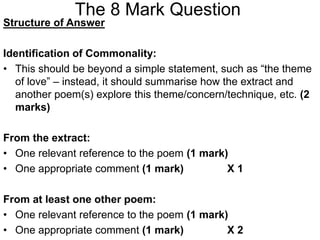
The 8 Mark Question
Structure of Answer
Identification of Commonality:
• This should be beyond a simple statement, such as “the theme
of love” – instead, it should summarise how the extract and
another poem(s) explore this theme/concern/technique, etc. (2
marks)
From the extract:
• One relevant reference to the poem (1 mark)
• One appropriate comment (1 mark) X 1
From at least one other poem:
• One relevant reference to the poem (1 mark)
• One appropriate comment (1 mark) X 2
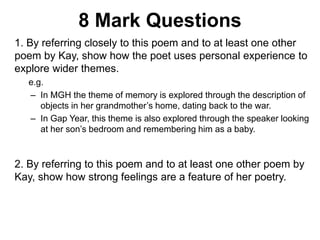
8 Mark Questions
1. By referring closely to this poem and to at least one other
poem by Kay, show how the poet uses personal experience to
explore wider themes.
e.g.
– In MGH the theme of memory is explored through the description of
objects in her grandmother’s home, dating back to the war.
– In Gap Year, this theme is also explored through the speaker looking
at her son’s bedroom and remembering him as a baby.
2. By referring to this poem and to at least one other poem by
Kay, show how strong feelings are a feature of her poetry.
Group Tasks
You are going to create a display on the Kay poems we have
studied so far in your groups
Number 1s
• Keeping Orchids
• Choose 4 quotations and
analyse them fully
• Explain in a paragraph how this
poem is similar/different to the
others
Number 2s
• Gap Year
• Choose 4 quotations and analyse
them fully
• Explain in a paragraph how this
poem is similar/different to the
others
Number 3s
• Lucozade
• Choose 4 quotations and
analyse them fully
• Explain in a paragraph how this
poem is similar/different to the
others
Number 4s*
• My Grandmother’s Houses
• Choose 4 quotations and analyse
them fully
• Explain in a paragraph how this
poem is similar/different to the
others
*If there are only three in your group, you will all share responsibility of
Number 4’s task.
• In this poem Kay looks at the experience of her then-partner, who moved
away from Scotland when she was an eight year old child. Kay considers
the effect this move had on her accent. She laments the loss of the
Scottish words she used to say such as "dreich", "wabbit" and "crabbit"
and compares them to words with longer vowels spoken down south.
• Throughout the poem, Kay implies that the girl had no control over the
change in her accent. It is something that happens when you become
surrounded by different voices. The experience is not just one person's,
it is universal.
• Despite this, she wants her "old tongue" back. She prefers it to the
English words she has grown used to saying and endeavours to
resuscitate it. The poem suggests that the words are still part of her,
lying dormant in the soil, ready to be found and brought back to life.
Old Tongue
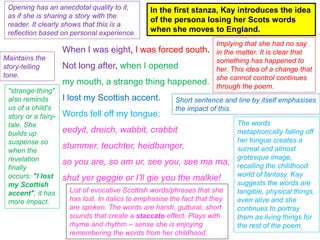
When I was eight, I was forced south.
Not long after, when I opened
my mouth, a strange thing happened.
I lost my Scottish accent.
Words fell off my tongue:
eedyit, dreich, wabbit, crabbit
stummer, teuchter, heidbanger,
so you are, so am ur, see you, see ma ma,
shut yer geggie or I’ll gie you the malkie!
In the first stanza, Kay introduces the idea
of the persona losing her Scots words
when she moves to England.
Opening has an anecdotal quality to it,
as if she is sharing a story with the
reader. It clearly shows that this is a
reflection based on personal experience.
Implying that she had no say
in the matter. It is clear that
something has happened to
her. This idea of a change that
she cannot control continues
through the poem.
Maintains the
story-telling
tone.
"strange-thing"
also reminds
us of a child's
story or a fairy-
tale. She
builds up
suspense so
when the
revelation
finally
occurs: "I lost
my Scottish
accent", it has
more impact.
Short sentence and line by itself emphasises
the impact of this.
The words
metaphorically falling off
her tongue creates a
surreal and almost
grotesque image,
recalling the childhood
world of fantasy. Kay
suggests the words are
tangible, physical things,
even alive and she
continues to portray
them as living things for
the rest of the poem.
List of evocative Scottish words/phrases that she
has lost. In italics to emphasise the fact that they
are spoken. The words are harsh, guttural, short
sounds that create a staccato effect. Plays with
rhyme and rhythm – sense she is enjoying
remembering the words from her childhood.
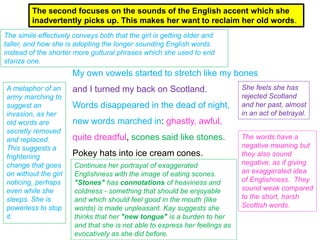
My own vowels started to stretch like my bones
and I turned my back on Scotland.
Words disappeared in the dead of night,
new words marched in: ghastly, awful,
quite dreadful, scones said like stones.
Pokey hats into ice cream cones.
The second focuses on the sounds of the English accent which she
inadvertently picks up. This makes her want to reclaim her old words.
The simile effectively conveys both that the girl is getting older and
taller, and how she is adopting the longer sounding English words
instead of the shorter more guttural phrases which she used to end
stanza one.
She feels she has
rejected Scotland
and her past, almost
in an act of betrayal.
A metaphor of an
army marching to
suggest an
invasion, as her
old words are
secretly removed
and replaced.
This suggests a
frightening
change that goes
on without the girl
noticing, perhaps
even while she
sleeps. She is
powerless to stop
it.
The words have a
negative meaning but
they also sound
negative, as if giving
an exaggerated idea
of Englishness. They
sound weak compared
to the short, harsh
Scottish words.
Continues her portrayal of exaggerated
Englishness with the image of eating scones.
"Stones" has connotations of heaviness and
coldness - something that should be enjoyable
and which should feel good in the mouth (like
words) is made unpleasant. Kay suggests she
thinks that her "new tongue" is a burden to her
and that she is not able to express her feelings as
evocatively as she did before.
Oh where did all my words go –
my old words, my lost words?
Did you ever feel sad when you lost a word,
did you ever try and call it back
like calling in the sea?
If I could have found my words wandering,
I swear I would have taken them in,
swallowed them whole, knocked them back.
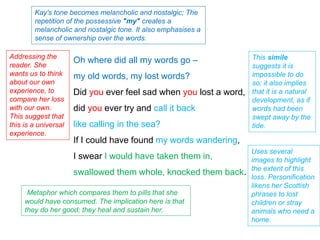
Kay's tone becomes melancholic and nostalgic; The
repetition of the possessive "my" creates a
melancholic and nostalgic tone. It also emphasises a
sense of ownership over the words.
Addressing the
reader. She
wants us to think
about our own
experience, to
compare her loss
with our own.
This suggest that
this is a universal
experience.
This simile
suggests it is
impossible to do
so; it also implies
that it is a natural
development, as if
words had been
swept away by the
tide.
Uses several
images to highlight
the extent of this
loss. Personification
likens her Scottish
phrases to lost
children or stray
animals who need a
home.
Metaphor which compares them to pills that she
would have consumed. The implication here is that
they do her good; they heal and sustain her.
Out in the English soil, my old words
buried themselves. It made my mother’s blood boil.
I cried one day with the wrong sound in my mouth.
I wanted them back; I wanted my old accent back,
my old tongue. My dour soor Scottish tongue.
Sing-songy. I wanted to gie it laldie.
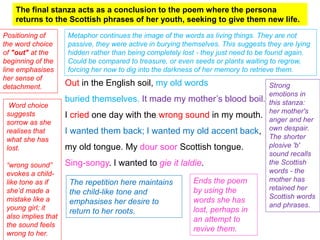
The final stanza acts as a conclusion to the poem where the persona
returns to the Scottish phrases of her youth, seeking to give them new life.
Positioning of
the word choice
of "out" at the
beginning of the
line emphasises
her sense of
detachment.
Metaphor continues the image of the words as living things. They are not
passive, they were active in burying themselves. This suggests they are lying
hidden rather than being completely lost - they just need to be found again.
Could be compared to treasure, or even seeds or plants waiting to regrow,
forcing her now to dig into the darkness of her memory to retrieve them.
Strong
emotions in
this stanza:
her mother's
anger and her
own despair.
The shorter
plosive 'b'
sound recalls
the Scottish
words - the
mother has
retained her
Scottish words
and phrases.
Word choice
suggests
sorrow as she
realises that
what she has
lost.
“wrong sound”
evokes a child-
like tone as if
she’d made a
mistake like a
young girl; it
also implies that
the sound feels
wrong to her.
The repetition here maintains
the child-like tone and
emphasises her desire to
return to her roots.
Ends the poem
by using the
words she has
lost, perhaps in
an attempt to
revive them.
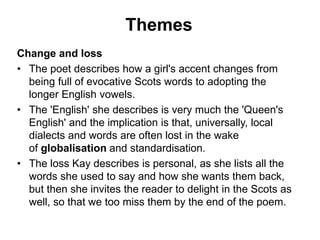
Themes
Change and loss
• The poet describes how a girl's accent changes from
being full of evocative Scots words to adopting the
longer English vowels.
• The 'English' she describes is very much the 'Queen's
English' and the implication is that, universally, local
dialects and words are often lost in the wake
of globalisation and standardisation.
• The loss Kay describes is personal, as she lists all the
words she used to say and how she wants them back,
but then she invites the reader to delight in the Scots as
well, so that we too miss them by the end of the poem.
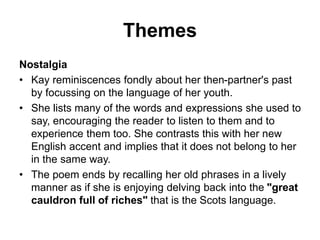
Themes
Nostalgia
• Kay reminiscences fondly about her then-partner's past
by focussing on the language of her youth.
• She lists many of the words and expressions she used to
say, encouraging the reader to listen to them and to
experience them too. She contrasts this with her new
English accent and implies that it does not belong to her
in the same way.
• The poem ends by recalling her old phrases in a lively
manner as if she is enjoying delving back into the "great
cauldron full of riches" that is the Scots language.
Themes
Displacement and identity
• It is clear the poet/speaker feels a sense of
displacement in this poem, as the words she is
used to saying simply disappear as a result of
relocation.
• This is upsetting to the speaker who wants them
back and writes the poem in an effort to summon
them from her memory.
• There is an implication that they give her
feelings of belonging and identity.
Whilst Leila Sleeps
I am moving in the dead of night,
packing things, turning out lights.
My fingers tie knots like fish nets.
I want to be in my mother’s house
but she is all the way over
the other side of the world. Boxes;
I can’t see out of the back window.
Leila is a bundle in her car seat.
Her small mouth hanging open.
Maybe it is not innocence after all,
it could be the sleep of oblivion.
My headlights are paranoiac eyes
sweeping the streets for – what?
A split second before they appeared
I thought I was safe. What is that fear.
Does it have a name. They want my name.
Their smiles tighten my stomach.
I bite on my tongue, hard. Their faces.
I have no witness. They take my licence,
my papers. Now there is nothing left
but to go with the men in plain suits.
Leila stirs and opens her eyes wide.
I try and say something to soothe.
My voice is a house with the roof
blown off. What do I tell my daughter –
We are done for. There is a need to worry.
I cannot lie to her. The night dreams
my terror; a slow light tails the fast car;
Leila tugs at my coat. I whisper
her cradle song and she holds on.
This is a topical poem about a mother who is forced to flee her home with her
daughter in the middle of the night. It is suggested that she is an immigrant
woman perhaps facing deportation. Kay deliberately holds back details so
that the situation becomes universal - it could be set anywhere and in any
modern time period. It does have particular resonance in our current political
climate.
Kay uses the first-person narrative throughout to make it immediate. The
reader is thrust into this woman's experience and we feel her fear when she
is caught by the authority figures, who are significantly male.
The relationship between mother and daughter is central to this poem. The
'Leila' from the title is the speaker’s daughter, who despite the danger and
her mother's anxiety sleeps until she is awakened by the presence of "the
men in plain suits" in the penultimate verse. Her mother must soothe her,
although she is very frightened herself.
Whilst Leila Sleeps
Task
 As we go through each of the poems, make a note of any poetic techniques
you see, and what meaning and effect the writer is trying to convey by using
these.
 Each group member will be responsible for a section of the poem, and you
will then teach the other members in the group about that section.
 You must come up with as much detailed analysis of these lines as you can.
 Remember, it’s not enough to say that something is a metaphor – WHAT
does that metaphor suggest to us? HOW does it do that?
Social Skill: Ensuring we all contribute effectively to the group.
YOU HAVE TEN MINUTES
Task
• Using the notes you have taken on your own section, each of
you will now teach the members in the group about the work
you have done.
• Remember: - What TECHNIQUES does the writer use?
- What MEANING do these convey?
- HOW do they convey that meaning?
Social Skill: Ensuring we all contribute effectively to the group.
YOU HAVE FIFTEEN MINUTES
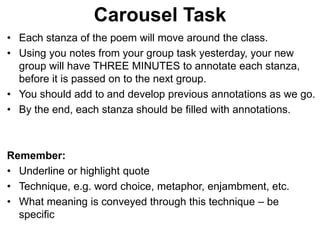
Carousel Task
• You will be given a number from 1-6
• Go to a table with those who have been
given the same number.
• Say hi – this is your group for this task.
• EVERYONE has to participate.
• Each stanza of the poem will move around the class.
• Using you notes from your group task yesterday, your new
group will have THREE MINUTES to annotate each stanza,
before it is passed on to the next group.
• You should add to and develop previous annotations as we go.
• By the end, each stanza should be filled with annotations.
Remember:
• Underline or highlight quote
• Technique, e.g. word choice, metaphor, enjambment, etc.
• What meaning is conveyed through this technique – be
specific
Carousel Task
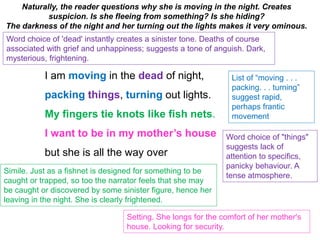
I am moving in the dead of night,
packing things, turning out lights.
My fingers tie knots like fish nets.
I want to be in my mother’s house
but she is all the way over
List of “moving . . .
packing. . . turning”
suggest rapid,
perhaps frantic
movement
Word choice of "things"
suggests lack of
attention to specifics,
panicky behaviour. A
tense atmosphere.
Word choice of 'dead' instantly creates a sinister tone. Deaths of course
associated with grief and unhappiness; suggests a tone of anguish. Dark,
mysterious, frightening.
Naturally, the reader questions why she is moving in the night. Creates
suspicion. Is she fleeing from something? Is she hiding?
The darkness of the night and her turning out the lights makes it very ominous.
Simile. Just as a fishnet is designed for something to be
caught or trapped, so too the narrator feels that she may
be caught or discovered by some sinister figure, hence her
leaving in the night. She is clearly frightened.
Setting. She longs for the comfort of her mother's
house. Looking for security.
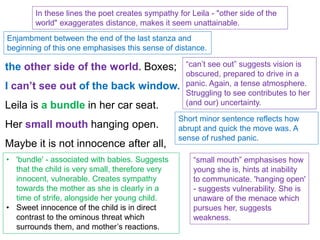
the other side of the world. Boxes;
I can’t see out of the back window.
Leila is a bundle in her car seat.
Her small mouth hanging open.
Maybe it is not innocence after all,
In these lines the poet creates sympathy for Leila - "other side of the
world" exaggerates distance, makes it seem unattainable.
Enjambment between the end of the last stanza and
beginning of this one emphasises this sense of distance.
“can’t see out” suggests vision is
obscured, prepared to drive in a
panic. Again, a tense atmosphere.
Struggling to see contributes to her
(and our) uncertainty.
Short minor sentence reflects how
abrupt and quick the move was. A
sense of rushed panic.
• 'bundle' - associated with babies. Suggests
that the child is very small, therefore very
innocent, vulnerable. Creates sympathy
towards the mother as she is clearly in a
time of strife, alongside her young child.
• Sweet innocence of the child is in direct
contrast to the ominous threat which
surrounds them, and mother’s reactions.
“small mouth” emphasises how
young she is, hints at inability
to communicate. 'hanging open'
- suggests vulnerability. She is
unaware of the menace which
pursues her, suggests
weakness.
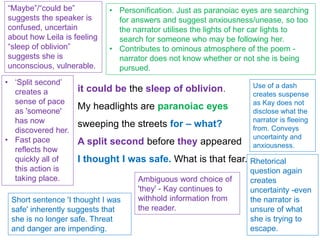
it could be the sleep of oblivion.
My headlights are paranoiac eyes
sweeping the streets for – what?
A split second before they appeared
I thought I was safe. What is that fear.
“Maybe”/“could be”
suggests the speaker is
confused, uncertain
about how Leila is feeling
“sleep of oblivion”
suggests she is
unconscious, vulnerable.
• Personification. Just as paranoiac eyes are searching
for answers and suggest anxiousness/unease, so too
the narrator utilises the lights of her car lights to
search for someone who may be following her.
• Contributes to ominous atmosphere of the poem -
narrator does not know whether or not she is being
pursued.
Use of a dash
creates suspense
as Kay does not
disclose what the
narrator is fleeing
from. Conveys
uncertainty and
anxiousness.
• ‘Split second’
creates a
sense of pace
as 'someone'
has now
discovered her.
• Fast pace
reflects how
quickly all of
this action is
taking place.
Short sentence 'I thought I was
safe' inherently suggests that
she is no longer safe. Threat
and danger are impending.
Ambiguous word choice of
'they' - Kay continues to
withhold information from
the reader.
Rhetorical
question again
creates
uncertainty -even
the narrator is
unsure of what
she is trying to
escape.
Does it have a name. They want my name.
Their smiles tighten my stomach.
I bite on my tongue, hard. Their faces.
I have no witness. They take my licence,
my papers. Now there is nothing left
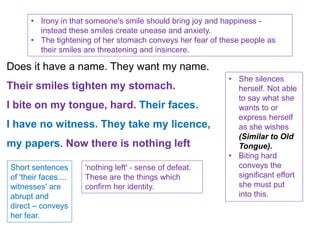
• Irony in that someone's smile should bring joy and happiness -
instead these smiles create unease and anxiety.
• The tightening of her stomach conveys her fear of these people as
their smiles are threatening and insincere.
• She silences
herself. Not able
to say what she
wants to or
express herself
as she wishes
(Similar to Old
Tongue).
• Biting hard
conveys the
significant effort
she must put
into this.
Short sentences
of 'their faces....
witnesses' are
abrupt and
direct – conveys
her fear.
'nothing left' - sense of defeat.
These are the things which
confirm her identity.
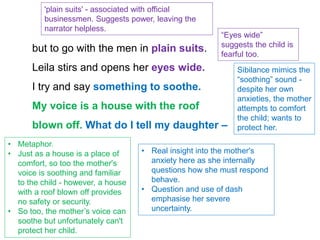
but to go with the men in plain suits.
Leila stirs and opens her eyes wide.
I try and say something to soothe.
My voice is a house with the roof
blown off. What do I tell my daughter –
'plain suits' - associated with official
businessmen. Suggests power, leaving the
narrator helpless.
“Eyes wide”
suggests the child is
fearful too.
Sibilance mimics the
“soothing” sound -
despite her own
anxieties, the mother
attempts to comfort
the child; wants to
protect her.
• Metaphor.
• Just as a house is a place of
comfort, so too the mother's
voice is soothing and familiar
to the child - however, a house
with a roof blown off provides
no safety or security.
• So too, the mother’s voice can
soothe but unfortunately can't
protect her child.
• Real insight into the mother's
anxiety here as she internally
questions how she must respond
behave.
• Question and use of dash
emphasise her severe
uncertainty.
We are done for. There is a need to worry.
I cannot lie to her. The night dreams
my terror; a slow light tails the fast car;
Leila tugs at my coat. I whisper
her cradle song and she holds on.
Short sentence -
finality. Loss of
hope.
Word choice – contrasts with
usual sentiment; confirms that she
is under threat and in danger.
Suggests
that, despite
the situation,
she feels a
duty not
to deceive.
• “whisper” suggests she maintains the need to
appear calm and soothing
• “cradle song” suggests a strong mother/baby
closeness, associated with safety, security –
she tries to provide some even now.
Enjambment
emphasises
the mother’s
visceral fear
• Personification - the
paranoia continues
in the line
• The opposites
"slow" and "fast"
imply that however
speedily she tries to
get away, she will
always be followed.
Common Themes Table
• Complete the themes table with quotations
and analysis, linking back to the common
themes.
• This will help with preparation for the 8
mark questions.
Main Concerns of the Poems
• What do you think the MAIN CONCERNS of the poems
are?
• This does not mean exactly what happens in them –
think about the issues they explore.
E.g. ‘Lucozade’
• The debilitating power of illness
• The fear of losing a parent, safety, security
• The rejection of the typical markers of illness
Revision Tasks
Revision Task
Create a giant mind map covering ALL the poems and
how they link together. Use your notes, annotations and
shared themes table to help.
Jackie
Kay
Lucozade
Quotes
About
Themes
Structure
Gap
Year
Quotes
About
Themes
Structure
Revision Tasks
• Make a mind map of each poem, outlining key themes,
important quotes and techniques, analysis, etc.
• Make flashcards for quotations – quote on the front;
bullet points of analysis on the back.
• Create a giant mind map covering ALL the poems and
how they link together. Use your shared themes table to
help.
Revision
Using your notes and annotations as a guide, answer the following general questions
for each poem:
1. What is the poem about? General ideas/events & wider themes?
2. What type of narrator is used? Is the narrator a character in the poem – 1st
person; or are the ideas being described as a witness – 3rd person?
3. What is the RELATIONSHIP between the characters in the poem?
4. How is the poem STRUCTURED? Are stanzas the same length? How is
punctuation used between lines and stanzas? Is the poem split into sections?
5. WORD CHOICE – Identify examples of words which have been used successfully
as they add meaning or emotion – e.g. powerful words showing anger or
happiness?
6. IMAGERY – How does Kay create pictures (images) for the audience – Find
examples of similes, metaphors, personification…?
7. SOUND TECHNIQUES – Does Kay use alliteration, onomatopoeia, soft/hard
sounding words? For each example EXPLAIN WHY she uses the technique.
8. SUCCESSFUL ENDING – How does the end of the poem make you feel? Does it
clearly reveal the message / theme of the poem?
9. THEMES / KEY IDEAS – What key themes and ideas are explore din the poem?
How does it link to the others?
Revision Tasks:
Group Presentations
• In groups you will have a discussion of 5-10 minutes on
ONE of the Jackie Kay poems we have studied this year.
• Your discussion should be in-depth, with detailed analysis
and evaluation, as well as explore links between poems.
• As well as looking over your notes, you will be expected to
research the poem complete work at home.
• EVERYONE is to contribute equally – anyone not pulling
their weight will face the consequences.
• These discussions will take place ________________, and
you will have today and tomorrow to work on them in class
– after that, any work will need to be completed at home.
• Groups and poems will be assigned by me.
Group Presentation
A sensible format would be:
• Introduction to the poem – what it’s about, what
happens and the main themes and techniques
used.
• Structure – stanzas, sections, rhyme and
rhythm, use of enjambment, etc., and what this
conveys to us.
• Language – word choice, imagery, alliteration,
etc., and what this conveys to us.
EVALUATE THROUGHOUT
The 8 Mark Question
Structure of Answer
Identification of Commonality:
• This should be beyond a simple statement, such as “the theme
of love” – instead, it should summarise how the extract and
another poem(s) explore the theme/concern/technique
described in the question. (2 marks)
From the extract:
• One relevant reference (quote) (1 mark)
• One appropriate comment (1 mark) X 1
From at least one other poem:
• One relevant reference (quote) (1 mark)
• One appropriate comment (1 mark) X 2
Past Paper 8 Mark Questions
Lucozade
• Kay often uses her poetry to explore relationships. Using one
other poem show how she manages to do this effectively in her
poems.
My Grandmother’s Houses
• By referring to this extract and to at least one other poem by
Kay, show how strong feelings are a feature of her poetry.
Gap Year (lines 1-32)
• By referring to this extract and to at least one other poem by
Kay, show how setting is an important feature.
Keeping Orchids
• By referring closely to this poem and to at least one other
poem by Kay, show how the poet uses personal experience to
explore wider themes.

jackie-kay-poetry-2.pptx

  • 1.
  • 2.
    About Jackie Kay •Born Edinburgh, 1961 • Scottish Mother & Nigerian Father • Adopted by Helen and John Kay at birth; brought up in Bishopbriggs, Glasgow. • Studied English at Stirling University • Son, Matthew born 1988 • Contacted birth mother while pregnant • Met birth mother - Elizabeth - in 1991 • Met birth father - Jonathan O - in 2003 • MBE for services to literature in 2006 • Professor of Creative Writing at Newcastle University. • Current Scots Makar
  • 3.
    What’s in aname? In pairs discuss the following questions: • What do the names of the six poems we will study suggest to you? • What do you think the poems will be about? • What themes might they explore? Keeping Orchids Gap Year Lucozade My Grandmother’s Houses Old Tongue Whilst Leila Sleeps
  • 4.
    Family • One ofthe main themes that connects many of the poems is that of FAMILY. • The poems explore inter-generational relationships, such as: - Daughter & mother - Daughter & birth mother - Granddaughter & grandmother - Mother & son - Daughter & parents.
  • 5.
    Poetic Voice • The‘voice’ is the point of view that a poem is seen from, like a narrator or persona. • The poems feature the voice of a female persona (although ‘Lucozade’ is a little more ambiguous). • This female persona explores family relationships – as a result, all offer a thoroughly domestic discourse or series of ideas.
  • 6.
    Keeping Orchids What’s itabout? The speaker – apparently Kay herself reflects on meeting her birth mother for the first time. Written in couplets and touches on themes of secrets and discoveries, as well as adoption and family relationships.
  • 7.
    Keeping Orchids This poemdescribes the poet’s first meeting with her birth mother. It is a painful emotional journey for both women. The poet uses the images of the orchids her birth mother gave her on their first meeting and of her own and her mother’s “troubled hands” as symbols of the complex, painful emotions they both feel. It is not a joyful meeting. Jackie Kay can articulate her own feelings but finds it hard to read her mother’s feelings as “she tells the story of her life”. The poet describes her mother’s account of her life as “compressed”, “airtight”, “a sad square”. It does not reveal enough; it does not bring comfort to her daughter, hungry for emotional connection and revelation.
  • 8.
    Keeping Orchids In pairs,discuss these questions: • What are your initial thoughts on the poem? • What language techniques does the writer use? • What is she trying to say by using these techniques?
  • 9.
    Keeping Orchids • Fullof emotion but very controlled and restrained. • Appears more about objects than emotions, or, in other words, descriptive rather than reflective. • Title parallels the adoption – central image of ‘Keeping Orchids’ is important. • The most abstract of the poems; offers the widest opportunities for interpretation.
  • 10.
    The orchids mymother gave me when we first met are still alive, twelve days later. Although some of the buds remain closed as secrets. Twice since I carried them back, like a baby in a shawl, from her train station to mine, then home. Twice since then the whole glass carafe has crashed falling over, unprovoked, soaking my chest of drawers. All the broken waters. I have rearranged the upset orchids with troubled hands. Even after that the closed ones did not open out. The skin shut like an eye in the dark; the closed lid. Twelve days later, my mother’s hands are all I have.
  • 11.
    Her voice isfading fast. Even her voice rushes through a tunnel the other way from home. I close my eyes and try to remember exactly: a paisley pattern scarf, a brooch, a navy coat. A digital watch her daughter was wearing when she died. Now they hang their heads, and suddenly grow old – the proof of meeting. Still, her hands, awkward and hard to hold fold and unfold a green carrier bag as she tells the story of her life. Compressed. Airtight.
  • 12.
    A sad square,then a crumpled shape. A bag of tricks. Her secret life – a hidden album, a box of love letters. A door opens and closes. Time is outside waiting. I catch the draught in my winter room. Airlocks keep the cold air out. Boiling water makes flowers live longer. So does cutting the stems with a sharp knife.
  • 13.
    This poem describesthe poet’s first meeting with her birth mother. It is a painful emotional journey for both women. The poet uses the images of the orchids her birth mother gave her on their first meeting and of her own and her mother’s “troubled hands” as symbols of the complex, painful emotions they both feel. It is not a joyful meeting. Jackie Kay can articulate her own feelings but finds it hard to read her mother’s feelings as “she tells the story of her life”. The poet describes her mother’s account of her life as “compressed”, “airtight”, “a sad square”. It does not reveal enough; it does not bring comfort to her daughter, hungry for emotional connection and revelation.
  • 14.
    Task  As wego through each of the poems, make a note of any poetic techniques you see, and what meaning and effect the writer is trying to convey by using these.  Each group member will be responsible for a section of the poem, and you will then teach the other members in the group about that section.  You must come up with as much detailed analysis of these lines as you can.  Remember, it’s not enough to say that something is a metaphor – WHAT does that metaphor suggest to us? HOW does it do that? Social Skill: Ensuring we all contribute effectively to the group. YOU HAVE TEN MINUTES
  • 15.
    Task • Using thenotes you have taken on your own section, each of you will now teach the members in the group about the work you have done. • Remember: - What TECHNIQUES does the writer use? - What MEANING do these convey? - HOW do they convey that meaning? Social Skill: Ensuring we all contribute effectively to the group. YOU HAVE FIFTEEN MINUTES
  • 16.
    1. Why doesthe poet emphasise in lines 1 and 2 that the orchids are still alive? 2. What does the line “I carried them back, like a baby in a shawl” reveal about the poet’s feelings? 3. Why does the poet emphasise that “twice since” she carried the orchids home, their glass carafe had fallen over causing her to rearrange them “with troubled hands”? 4. Why does the poet repeat the image of the buds “closed as secrets” in stanza 5? 5. How does the poet develop the image of her mother’s troubled hands in stanzas 10 and 11? 6. “A door opens and closes. Time is outside waiting”. What two meanings could these lines have? 7. Using “boiling water” and “cutting the stems with a sharp knife” are somewhat drastic but effective remedies for wilting flowers. Why is it so important for the poet to try to make the orchids last? Keeping Orchids
  • 17.
    Example Critical Reading ‘KeepingOrchids’ Quote + analysis = 2 marks 1. Explain how the speaker’s sense of discomfort is conveyed in lines 1-12. (4) 2. Summarise what is happening in lines 13-16. (2) 3. How do we get the impression the speaker is confused in lines 19-27? (4) 4. How is the last sentence in the poem effective? (2) 5. This poem is deeply emotional and personal. Choose at least one other Kay poem and explain how it conveys strong emotions in that poem. (8)
  • 18.
    The 8 MarkQuestion Marking Scheme • Mention the specific area of commonality and include what poem(s) you will be discussing. (2 marks) • Make a specific reference to the poem in front of you (quote) and link to the question – mention techniques and effect. (2 marks) • Make a reference to another poem and link to the question – again, mention techniques and their effect. (2 marks) • Make a reference to the other poem again and link to the question – again, mention techniques and their effect. (2 marks) ‘Keeping Orchids’ is deeply emotional and personal. Choose at least one other Kay poem and explain how it conveys strong emotions in that poem. (8 MARKS)
  • 19.
    The 8 MarkQuestion Marking Scheme • Mention the specific area of commonality and include what poem(s) you will be discussing. (2 marks) • Make a specific reference to the poem in front of you (quote) and link to the question – mention techniques and effect. (2 marks) • Make a reference to another poem and link to the question – again, mention techniques and their effect. (2 marks) • Make a reference to the other poem again and link to the question – again, mention techniques and their effect. (2 marks)
  • 20.
    Gap Year What’s itabout? Written in the voice of the poet and dedicated to her son, Matthew. Describes his travels abroad and leads to reflections on her feelings about his childhood and newfound independence. Explores themes of motherhood, closeness and distance, and the passage of time.
  • 21.
    I I remember yourMoses basket before you were born. I’d stare at the fleecy white sheet for days, weeks, willing you to arrive, hardly able to believe I would ever have a real baby to put in the basket. I’d feel the mound of my tight tub of a stomach, and you moving there, foot against my heart, elbow in my ribcage, turning, burping, awake, asleep. One time I imagined I felt you laugh.
  • 22.
    I’d play youHandel’s Water Music or Emma Kirkby singing Pergolesi. I’d talk to you, my close stranger, call you Tumshie, ask when you were coming to meet me. You arrived late, the very hot summer of eighty-eight. You had passed the due date string of eights, and were pulled out with forceps, blue, floury, on the fourteenth of August on Sunday afternoon. I took you home on Monday and lay you in your basket.
  • 23.
    II Now, I peekin your room and stare at your bed hardly able to imagine you back in there sleeping, Your handsome face – soft, open. Now you are eighteen, six foot two, away, away in Costa Rica, Peru, Bolivia. I follow your trails on my Times Atlas: from the Caribbean side of Costa Rica to the Pacific, the baby turtles to the massive leatherbacks. Then on to Lima, to Cuzco. Your grandfather
  • 24.
    rings: ‘Have youconsidered altitude sickness, Christ, he’s sixteen thousand feet above sea level.’ Then to the lost city of the Incas, Macchu Picchu, Where you take a photograph of yourself with the statue of the original Tupac. You are wearing a Peruvian hat. Yesterday in Puno before catching the bus for Copacabana, you suddenly appear on a webcam and blow me a kiss, you have a new haircut; your face is grainy, blurry.
  • 25.
    Seeing you, shy,smiling, on the webcam reminds me of the second scan at twenty weeks, how at that fuzzy moment back then, you were lying cross-legged with an index finger resting sophisticatedly on one cheek. You started the Inca trail in Arctic conditions and ended up in subtropical. Now you plan the Amazon in Bolivia. Your grandfather rings again to say ‘There’s three warring factions in Bolivia, warn him
  • 26.
    against it. Hecanny see everything. Tell him to come home.’ But you say all the travellers you meet rave about Bolivia. You want to see the Salar de Uyuni, the world’s largest salt-flats, the Amazonian rainforest. And now you are not coming home till four weeks after your due date. After Bolivia, you plan to stay with a friend’s Auntie in Argentina. Then – to Chile where you’ll stay with friends of Diane’s.
  • 27.
    And maybe workfor the Victor Jara Foundation. I feel like a home-alone mother; all the lights have gone out in the hall, and now I am wearing your large black slippers, flip-flopping into your empty bedroom, trying to imagine you in your bed. I stare at the photos you send by messenger: you on the top of the world, arms outstretched, eager. Blue sky, white snow; you by Lake Tararhua, beaming.
  • 28.
    My heart soarslike the birds in your bright blue skies. My love glows like the sunrise over the lost city. I sing along to Ella Fitzgerald, A tisket A tasket. I have a son out in the big wide world. A flip and a skip ago, you were dreaming in your basket.
  • 29.
    Gap Year • Thispoem is written in the form of an address to her son, Mateo. It expresses her love for and pride in her son, who is spending a gap year travelling widely in South America. • In the first section she describes her memories of the weeks before he was born: her excited anticipation, the difficult birth. • In the second section she describes the progress of his travels and her mixed feelings about his departure. She is caught up in the romance and adventure of his travels in exotic places but misses him greatly. In contrast, his grandfather’s blunt advice reminds her of the very real dangers he might encounter. • She cannot hide her strong feelings of disappointment when she learns he will return home four weeks later than she had expected, but comments with wry humour that she feels “like a home-alone mother”. • In the last two stanzas, however, her mood changes to one of elation and pride when she looks at photos of her son “on top of the world”. It seems no time since he was a baby dreaming in his Moses basket.
  • 30.
    Gap Year In pairs,discuss these questions: • What are your initial thoughts on the poem? • What language techniques does the writer use? • What is she trying to say by using these techniques?
  • 31.
    Task  As wego through each of the poems, make a note of any poetic techniques you see, and what meaning and effect the writer is trying to convey by using these.  Each group member will be responsible for a section of the poem, and you will then teach the other members in the group about that section.  You must come up with as much detailed analysis of these lines as you can.  Remember, it’s not enough to say that something is a metaphor – WHAT does that metaphor suggest to us? HOW does it do that? Social Skill: Ensuring we all contribute effectively to the group. YOU HAVE TEN MINUTES
  • 32.
    Task • Using thenotes you have taken on your own section, each of you will now teach the members in the group about the work you have done. • Remember: - What TECHNIQUES does the writer use? - What MEANING do these convey? - HOW do they convey that meaning? Social Skill: Ensuring we all contribute effectively to the group. YOU HAVE FIFTEEN MINUTES
  • 33.
    Gap Year • Thinkabout your relationship with your own parents. • How has it changed from when you were a small child until now? • Make a list of how your relationship and how you see each other has altered over time.
  • 34.
    Gap Year • Writtenin two defined sections. • Offers many parallels and connections between past and present – Matthew’s childhood and adulthood. • At one and the same time celebrates and laments his independence. • Provides a contrast between the speaker at home, and the son exploring and investigating. • Indeed, the second section allows the reader to track his adventures as the speaker does.
  • 35.
    • "I rememberyour Moses basket before you were born" – The word choice of “remember” shows us she is reminiscing positively about her memories of the past. • "willing you to arrive, hardly able to believe" – “willing” suggests a sense of urgency and wish that he would be born quickly – she can’t wait. • "Your handsome face – soft, open..." – positive word choice shows her pride and admiration for her son’s appearance and personality. • "I feel like a home-alone mother" – this comparison subverts our normal expectation of ‘home alone’ and almost suggests that she felt she was looked after by her son. This emphasises her sadness and loneliness. • "your empty bedroom, trying to imagine you in your bed" – “empty bedroom” suggests a sense of loss in comparison to the baby in the basket earlier in the text. • "My heart soars like the birds in your bright blue skies. My love glows like the sunrise over the lost city." – these similes use extremely positive vocabulary suggesting her extreme pride and happiness at the person her son has become and how much she cares about him. • "I have a son out in the big wide world." – She is proud and almost surprised that he has grown into a man in what seems such a short space of time.
  • 36.
    ‘Gap Year’ (for Mateo) Thetitle alludes to the physical ‘gap’ between Kay and her son, Matthew. It reflects the fact that the years between Matthew’s birth and turning 18 have felt like a short ‘gap’ to Kay. The title also implies the ‘gap’ his absence leaves in her life. Despite the literal ‘gap’, their relationship is obviously a close one.
  • 37.
    I remember yourMoses basket before you were born. I’d stare at the fleecy white sheet for days, weeks, willing you to arrive, hardly able to believe I would ever have a real baby to put in the basket. The poem begins with the image of the empty Moses basket - fitting for a text about waiting and longing. Image of basket referred to at end of poem – framing device. The poem starts with Matthew absent and Kay yearning – how the poem also ends. Word choice – ‘stare’ – repeated throughout poem, conveying the intensity of her longing. It suggests the poet’s focus on the imminent presence of her child. Kay gives us a vivid impression of the basket. Its ‘fleecy white sheet’ suggests the purity and innocence of a baby. ‘willing you to arrive’ – this sentiment is repeated at the end of the poem. Her inability to believe her baby will arrive is reflected at start of section 2 when she cannot imagine his return.
  • 38.
    I’d feel themound of my tight tub of a stomach, and you moving there, foot against my heart, elbow in my ribcage, turning, burping, awake, asleep. One time I imagined I felt you laugh. Metaphor – image of a container. The enclosed basket in stanza 1 suggests the baby's current ‘container’ of his mother’s ‘tight tub of a stomach’. The phrase ‘tight tub’ emphasises the snugness of the child safely held in the womb. But ‘tight’ also suggests the baby is pushing at the sides, ready to move on and be born. Kay conveys the experience of having a child grow inside you in an evocative manner. The closeness of their bond is expressed. Metaphor of ‘foot against my heart’ and ‘elbow in my ribcage’ – the baby is a source of joy and pain. This is reflected at the end of the poem with the mixed emotions of pride and longing. 5 By the end of the poem, it is clear Matthew cannot be contained.
  • 39.
    I’d feel themound of my tight tub of a stomach, and you moving there, foot against my heart, elbow in my ribcage, turning, burping, awake, asleep. One time I imagined I felt you laugh. 5 List of present participles describing the baby’s actions suggests they are constant, continuous, ever present. (contrast with his absence later). ‘felt you laugh’ – synaesthesia – is used to describe the closeness of pregnancy: his experiences are hers. (contrast with later in the poem when his experiences must be lived vicariously through an atlas/webcam). The list also suggests her ongoing feelings - they may have happened in the past but Kay has experienced them so fully that they seem fresh and current. Synaesthesia - a condition in which one type of stimulation evokes the sensation of another, as when the hearing of a sound produces the visualisation of a colour.
  • 40.
    I’d play youHandel’s Water Music or Emma Kirkby singing Pergolesi. I’d talk to you, my close stranger, call you Tumshie, ask when you were coming to meet me. You arrived late, the very hot summer of eighty-eight. She does the things prospective parents are told to do. Oxymoron – ‘close stranger’ – physically close but unknown. Her unborn child is so close to her physically but is as yet unfamiliar. Already she has great love for her child but it is implied that he is someone separate with experience that she is not fully part of. This adds to the atmosphere of calm and peacefulness. Kay is looking ahead to when her son is on the other side of the world, doing his own thing. Oxymoron - a figure of speech in which two opposite ideas are joined to create an effect. e.g. “cruel kindness” or “living death”. This is mirrored/inverted at the end of the poem where the mother-son bond is close, but he has become a stranger physically through distance. 10
  • 41.
    I’d play youHandel’s Water Music or Emma Kirkby singing Pergolesi. I’d talk to you, my close stranger, call you Tumshie, ask when you were coming to meet me. You arrived late, the very hot summer of eighty-eight. Colloquial nickname – affectionate. ‘Tumshie’ is the Scots word for turnip. The most common use of the word in modern Scotland is not the turnip definition, but one derived from it. To call somebody a ‘tumshie’ is a derogatory but not too harsh way of calling them a gullible or foolish person. It comes from the expression "tumshie-heid" meaning "turnip-head”. www.urbandictionary.com The baby finally arrives. The strong rhyme of ‘late’ and ‘eight’ suggest the impact he has on her life and the significance of his birth. It also emphasises that the auspicious due date was missed. 10 Sense of longing for the baby’s arrival again – this is echoed at the end of the poem.
  • 42.
    You had passedthe due date string of eights, and were pulled out with forceps, blue, floury, on the fourteenth of August on Sunday afternoon. I took you home on Monday and lay you in your basket. ‘Due date’ is repeated later in the poem, referring to M’s return from his travels. Irony – M had to be pulled out with forceps, showing that he was unwilling to leave his mother’s womb; this contrasts with now when he is unwilling to return home from his travels. Circular structure – the empty basket at the start of this section is now full, creating a sense of completion. 15 Sunday  Monday – the idea of a new week symbolising a new chapter beginning in Kay’s life. The vivid description of the new baby conveys the intensity of her memory of getting to know him.
  • 43.
    II Now, I peekin your room and stare at your bed hardly able to imagine you back in there sleeping, Your handsome face – soft, open. Now you are eighteen, six foot two, away, away in Costa Rica, Peru, Bolivia. Word choice – ‘peek’ – the actions of an anxious parent checking on a sleeping child. Word choice – ‘stare’ – echoes the earlier reference to looking at the empty baby basket and shows the intensity of her longing. We empathise once again with her sense of longing. 20 Links back to stanza 1. However, then she couldn’t imagine his presence. Now she can’t imagine anything but his absence. Kay now jumps ahead in time - she flies past her son's childhood, as if it has passed in an instant.
  • 44.
    II Now, I peekin your room and stare at your bed hardly able to imagine you back in there sleeping, Your handsome face – soft, open. Now you are eighteen, six foot two, away, away in Costa Rica, Peru, Bolivia. Her son is travelling the world. The repetition here emphasises the distance between them and how strongly she feels the separation. List of South American countries – exotic, distant, connotations of exploration/adventure. 20 Affectionate descriptions of M’s face. The image of his face as ‘soft, open’ will be contrasted by his appearance on the webcam later.
  • 45.
    I follow yourtrails on my Times Atlas: from the Caribbean side of Costa Rica to the Pacific, the baby turtles to the massive leatherbacks. Then on to Lima, to Cuzco. Your grandfather She compares her son's travels and his growth to adulthood with ‘baby turtles’ growing to become ‘massive leatherbacks’. The contrast is apt here - it implies that this ‘gap year’ journey enables growth from child to adult. The baby turtles remind us of Matthew in his Moses basket. Role reversal – mother following the child’s lead. • ‘trails’ – has connotations of plotting a journey across the face of the world. • ‘Times Atlas’ – British institution, roots her in the UK. Contrast in the smallness of her actions (armchair travelling) compared with his adventure.
  • 46.
    I follow yourtrails on my Times Atlas: from the Caribbean side of Costa Rica to the Pacific, the baby turtles to the massive leatherbacks. Then on to Lima, to Cuzco. Your grandfather Structure of ‘from…to…to’ – Matthew is traversing from one side of South America to the other. This, and the contrast between ‘baby turtles’ and ‘massive leatherbacks’, serves to emphasise the range and scale of M’s travels. The different places mentioned in this stanza, and the previous one, highlight the extent of his travels.
  • 47.
    rings: ‘Have youconsidered altitude sickness, Christ, he’s sixteen thousand feet above sea level.’ Then to the lost city of the Incas, Macchu Picchu, Where you take a photograph of yourself with the statue The intrusion of M’s Grandather’s warning is humorous and injects the poem with a voice of realism. The enjambment across stanzas (‘Your grandfather / rings’) reflects the interruptions to Kay’s romanticised imagining of Matthew’s travels: the practicalities like ‘altitude sickness’ interrupt her wistful narrative. The reader is alerted to the challenges of Matthew’s daring adventurous nature. 25 Enjambment - the continuation of a sentence without a pause beyond the end of a line, couplet, or stanza.
  • 48.
    rings: ‘Have youconsidered altitude sickness, Christ, he’s sixteen thousand feet above sea level.’ Then to the lost city of the Incas, Macchu Picchu, Where you take a photograph of yourself with the statue Connotations of discovering new worlds, like a conquistador (a conqueror, especially one of the Spanish conquerors of Mexico and Peru in the 16th century). 25 Kay sees him as being like an adventurer.
  • 49.
    of the originalTupac. You are wearing a Peruvian hat. Yesterday in Puno before catching the bus for Copacabana, you suddenly appear on a webcam and blow me a kiss, you have a new haircut; your face is grainy, blurry. Humorous reference – Tupac Amaru Shakur (1971-1996) was an American rapper, record producer and actor. He is consistently ranked as one of the greatest rappers ever, as well as one of the most influential rappers of all time. Shakur was fatally shot in a drive-by shooting in Las Vegas. 30 A symbol of changing / experiencing new things. Túpac Amaru (1545–1572) was the last indigenous monarch of the Neo-Inca State, remnants of the Inca Empire in Vilcabamba, Peru. He was executed by the Spanish.
  • 50.
    of the originalTupac. You are wearing a Peruvian hat. Yesterday in Puno before catching the bus for Copacabana, you suddenly appear on a webcam and blow me a kiss, you have a new haircut; your face is grainy, blurry. He is constantly on the move. 30 Word choice – ‘suddenly’ – contact with M is fleeting. The webcam allows Kay to see her son first hand. His haircut is new and is unfamiliar to Kay. It suggests that he is changed by his experiences. His ‘grainy, blurry’ face recalls the initial ‘floury’ baby (l.14) he used to be and contrasts with her imagining of his ‘handsome face – soft, open’ (l.19). The webcam itself contrasts with the scan photograph mentioned in the following stanza: one is wholly in the present; the other a memento from the past.
  • 51.
    Seeing you, shy,smiling, on the webcam reminds me of the second scan at twenty weeks, how at that fuzzy moment back then, you were lying cross-legged with an index finger resting sophisticatedly on one cheek. Comparison between present (webcam) and past (prenatal scan). 35 Even in the womb, Kay implies, he had maturity and eloquence. This grown up posture adds humour to the image. It suggests character and confirms Kay’s affection for her son.
  • 52.
    You started theInca trail in Arctic conditions and ended up in subtropical. Now you plan the Amazon in Bolivia. Your grandfather rings again to say ‘There’s three warring factions in Bolivia, warn him Emphasises the range / diversity of his travels 40 Ambitious, broad, sweeping plans – continues the image of Matthew as explorer / conquistador. The grandfather warns once again of conflict in Bolivia - suggesting the (grand)parental urge to protect. The grandfather represents the voice of age: limitation, fear, worry, caution.
  • 53.
    against it. Hecanny see everything. Tell him to come home.’ But you say all the travellers you meet rave about Bolivia. You want to see the Salar de Uyuni, the world’s largest salt-flats, the Amazonian rainforest. The grandfather’s concerns contrast with Matthew’s carefree, free-wheeling plans to see the biggest and best (‘largest salt-flats’ ‘Amazonian rainforest’) Kay's son is drawn to the open space of the salt-flats and natural world of the rainforest. The list of experiences and countries creates the impression of a young man who is looking to expand his world. This contrasts with the earlier images of his protective containment at the beginning of the poem.
  • 54.
    And now youare not coming home till four weeks after your due date. After Bolivia, you plan to stay with a friend’s Auntie in Argentina. Then – to Chile where you’ll stay with friends of Diane’s. His late return from his travels mirrors M being four-weeks overdue at birth. Kay’s slightly exasperated tone conveys her disappointment that she will have to wait longer for her son’s return; once again she can do nothing but wait for her son. His travels are ranging across whole countries, skipping across the continent. Plans are ad-hoc (not planned in advance before they happen) - Kay is struggling to keep up with who he is with and where he is. 45
  • 55.
    And maybe workfor the Victor Jara Foundation. I feel like a home-alone mother; all the lights have gone out in the hall, and now I am wearing your large black slippers, flip-flopping Plans are fluid, uncertain. Pun on ‘home-alone’ – usually applied to a child. Role reversal - she has switched places with her son and has become like a child – she is wearing his large black slippers, just like children play grown ups by trying on their parents’ shoes and clothes. The darkness is symbolic of Matthew’s absence. 50 Onomatopoeia - a pathetic, sad sound, lacking energy. Suggests the idea of going back and forth to M’s room?
  • 56.
    into your emptybedroom, trying to imagine you in your bed. I stare at the photos you send by messenger: you on the top of the world, arms outstretched, eager. Blue sky, white snow; you by Lake Tararhua, beaming. She returns to his bedroom and contemplates its emptiness - symbolising her disappointment. ‘empty bedroom’ recalls the empty cot at the start. We get a sense of empty nest syndrome. ‘trying to imagine you / in your bed’ recalls ‘willing you to arrive’ at the start of the poem. She stares at his photographs. The word choice of ‘stare’ suggests her longing. It is repeated several times throughout the poem. 55 Metaphor This recalls the blue of Matthew when born, and the white of the fleecy blankets. Both these expressions convey the idea of a blank canvas, a fresh world he is discovering. Reinforces symbolism of light. Matthew is the light of her life. His absence brings darkness to the house; his happiness brings light to his face.
  • 57.
    My heart soarslike the birds in your bright blue skies. My love glows like the sunrise over the lost city. I sing along to Ella Fitzgerald, A tisket A tasket. I have a son out in the big wide world. This simile compares her sudden elation to ‘birds’ ascending into the sky. The image of joy and pride suggests that, like her son, she is being liberated from the restrictive, encompassing need to be together that she has been absorbed in. Simile - reinforces the idea of Matthew as light. Kay is imagining herself present with Matthew in the form of her love. She has become bound up with the landscape he is travelling through. Her love reaches across continents just like the sunlight. 60 Long vowel sounds of these two lines reflect the wide, open all-encompassing love that spans continents between Kay and Matthew.
  • 58.
    My heart soarslike the birds in your bright blue skies. My love glows like the sunrise over the lost city. I sing along to Ella Fitzgerald, A tisket A tasket. I have a son out in the big wide world. Despite the distance, the ‘gap’ between them, he still brings her happiness. It could be that her unstinting love has given him the courage to travel so far from her. This thought comforts the poet as she sings jazz music that recalls some of her early feelings of sadness: Ella Fitzgerald – associated with the blues: reflecting a tinge of sadness/longing? Nursery rhyme – recalls Matthew’s babyhood, returning us to the nursery once again. The lyrics are about delivering a love letter to a little boy. 60 Proud, declarative statement - her little boy is now out in the ‘big wide world’. The phrase suggests space and the potential for new experiences, both good and bad. Kay now seems happy to accept the situation. She is proud of him and possibly proud of herself. Is there a tone of wistfulness too in ‘big, wide’?
  • 59.
    A flip anda skip ago, you were dreaming in your basket. ‘flip’ and ‘skip’ – tiny moments, reflected in short ‘I’ sound. This emphasises the brevity of Matthew’s childhood and how quickly he has grown up. His dreaming has turned into living, leaving his mother behind to imagine his adventures. Now it is Kay who dreams of his return. Rhymes with ‘tasket’ – emphasises the importance of the word and Kay’s longing for that time when he could be contained / protected. The rhyme adds a sense of finality and inevitability to the circumstance: this is something all mothers must go through at some point. The final line, standing on its own, recalls the Moses basket of line one.
  • 60.
    Themes Growing up Kay exploresthe theme of growing up in this poem - mainly from a parent’s perspective. Childhood is all too brief and soon your child is out in the ‘big, wide world’. The image of the basket which frames the poem suggests both joy and a mother's instinct to protect her child. It suggests that for a parent, their child will always partly be remembered as an innocent, vulnerable baby.
  • 61.
    Themes Growing up As muchas the ‘Gap Year’ is about Matthew’s adventure into maturity, Kay herself must also ‘grow’ to accept that she must let go of her urge to follow him around. She must embrace that he is away exploring without her. By the end of the poem we get the impression that Kay has accepted this, despite the fact she cannot believe how quickly he has grown up. The fact that the poem is dedicated ‘for Mateo’ (the Spanish for Matthew) shows that Kay embraces her son's new identity, as an adult exploring Spanish-speaking countries.
  • 62.
    Themes Love Kay's love forher son pervades the whole poem. Her affection is expressed in the initial nicknames like ‘Tumshie’ and the way she stares longingly at the Moses basket. A loving bond she has established even before he is born. This is then developed by the portrayal of a very close relationship as we move into Section II. She charts all his travels on her atlas and recognises any changes in him – ‘a new haircut’, his ‘eagerness’ to explore.
  • 63.
    Themes Love She paces hisempty room imagining his ‘soft face’ - it is clear that she misses him. But through her love she is able to let him go. Kay finds herself exuberant at the end of the poem, contemplating her son ‘out in the big wide world’, despite the fact he has delayed his return. Her feelings are no longer about herself, but her son and his adventure. This suggests the ultimate selfless act of a mother to put the needs of her child before her own.
  • 64.
    ‘Gap Year’ -Emotions • As you know, “Gap Year” focuses on the relationship between a mother and her son who is off travelling around the world. • The mood of the speaker changes as the poem develops. In groups, try to categorise the feelings of the mother at each stage. Structural Stage/Event Mother’s Feelings Before the birth Longing, excitement, anticipation The difficult birth Mateo’s travels Grandfather’s comments His late homecoming The photos at the end Happiness, pride
  • 65.
    ‘Gap Year’ -Continuum of Emotion Task In groups: • Draw a line on a landscape sheet of paper representing the emotions of the speaker throughout the poem: happiness at one end, sadness at the other. • Write down relevant quotations from the poem on the continuum – where do fit on the scale of this emotion? What other emotions do they suggest? • Discuss and justify your choices, then analyse at least three pieces of evidence – how do these quotations suggest these emotions to us? Feedback your choices to the class.
  • 66.
    Group Tasks You aregoing to create a display on Gap Year in your groups Number 1s • Find 4 quotations to show her love for her son. • Give a reason for each choice. Number 2s • Find 4 quotations which show her sadness at him leaving home. • Give a reason for each choice. Number 3s • Find 4 quotations that show contrast between Matthew as a baby and Matthew now. • Give a reason for your choice. Number 4s • Quote 4 examples of literary techniques used by Kay in this poem. • Comment on their effect.
  • 67.
    Gap Year 1. Summarisethe main points in lines 1-16. (4 marks) 2. How is a sense of longing established in lines 17-20? (4 marks) 3. By referring to ONE example, show how the writer uses language to emphasise her feelings of loss during her son’s gap year. (2 marks) 4. The last two stanzas signal a further mood change. Comment on the effectiveness of the language the poet uses to convey her feelings.(2 marks) 5. Kay often uses her poetry to explore relationships. Using one other poem show how she manages to do this effectively in her poems. (8 marks)
  • 68.
    Lucozade What’s it about? Toldfrom the perspective of a 16 year old persona visiting his/her mother in hospital. Charts a turn in the mother’s, and ultimately the speaker’s, attitudes about death.
  • 69.
    My mum ison a high bed next to sad chrysanthemums. ‘Don’t bring flowers, they only wilt and die.’ I am scared my mum is going to die on the bed next to the sad chrysanthemums. She nods off and her eyes go back in her head. Next to her bed is a bottle of Lucozade. ‘Orange nostalgia, that’s what that is,’ she says. ‘Don’t bring Lucozade either,’ then fades.
  • 70.
    ‘The whole daywas a blur, a swarm of eyes. Those doctors with their white lies. Did you think you could cheer me up with a Woman’s Own? Don’t bring magazines, too much about size.’ My mum wakes up, groggy and low. ‘What I want to know,’ she says,’ is this: where’s the big brandy, the generous gin, the Bloody Mary, the biscuit tin, the chocolate gingers, the dirty big meringue?’
  • 71.
    I am sixteen;I’ve never tasted a Bloody Mary. ‘Tell your father to bring a luxury,’ says she. ‘Grapes have no imagination, they’re just green. Tell him: stop the neighbours coming.’ I clear her cupboard in Ward 10B, Stobhill Hospital. I leave, bags full, Lucozade, grapes, oranges, sad chrysanthemums under my arms, weighted down. I turn round, wave with her flowers.
  • 72.
    My mother, onher high hospital bed, waves back. Her face is light and radiant, dandelion hours. Her sheets billow and whirl. She is beautiful. Next to her the empty table is divine. I carry the orange nostalgia home singing an old song.
  • 73.
    Lucozade • In thispoem Jackie Kay describes visiting her mother in hospital. She was a young girl of sixteen, afraid that her mother would die. • The poem not only describes the shock of seeing her mother but conveys the personality of her mother expressively and with humour. • Her mother’s ironic questions, her humorous commands, her idiosyncratic remarks may be partially the result of her treatment or operation but strongly suggest a person who faces her hospital experience with spirit and humour. • The last two stanzas describe the euphoria of relief the poet feels when she realises her mother will not die but has recovered enough to wave from her hospital bed. • The clearing of her mother’s ward cupboard of the traditional gifts an invalid receives, which her mother had decisively rejected, is a cathartic moment for the poet. • For the sixteen-year-old poet, her senses heightened after the trauma of her mother’s hospitalisation, the sight of her mother waving becomes for her a beautiful, almost heavenly vision.
  • 74.
    Lucozade In pairs, discussthese questions: • What are your initial thoughts on the poem? • What language techniques does the writer use? • What is she trying to say by using these techniques?
  • 75.
    Lucozade • Offers thecomplex image of the Lucozade – initially present in the title. • Rejection of the typical ‘markers’ of sickness, in favour of luxury and the decadent ‘markers’ of life. • Seems to be a formative experience for the speaker. • Recognises her youth but suggests she learns something about life and death. • Speaker literally and metaphorically unburdens the mother in what appears to be a final ritual – clearing the hospital cabinet.
  • 76.
    Task  As wego through each of the poems, make a note of any poetic techniques you see, and what meaning and effect the writer is trying to convey by using these.  Each group member will be responsible for a section of the poem, and you will then teach the other members in the group about that section.  You must come up with as much detailed analysis of these lines as you can.  Remember, it’s not enough to say that something is a metaphor – WHAT does that metaphor suggest to us? HOW does it do that? Social Skill: Ensuring we all contribute effectively to the group. YOU HAVE TEN MINUTES
  • 77.
    Task • Using thenotes you have taken on your own section, each of you will now teach the members in the group about the work you have done. • Remember: - What TECHNIQUES does the writer use? - What MEANING do these convey? - HOW do they convey that meaning? Social Skill: Ensuring we all contribute effectively to the group. YOU HAVE FIFTEEN MINUTES
  • 78.
    Lucozade Overall Notes • Thereis a shift in the speaker’s perspective and tone between the poem’s opening and ending. This appears to be caused by her ability to perform the cleansing ritual of removing all the symbols of sickness from the Mother’s bedside. • The title – ‘Lucozade’ – is complex. It refers to the literal bottle (one of the aforementioned traditional symbols of sickness), but there is also a sense that the daughter’s actions are the real revitalising energy boost that the Mother needs. • Furthermore, the idea of Lucozade as a childhood memory associated with being ill (‘orange nostalgia’) is also explored in the poem, and there is a clear sense that in the final line, that the daughter’s final act for her Mother might be a memory in the making – a moment looked back on nostalgically in the future.
  • 87.
    The 8 MarkQuestion Structure of Answer Identification of Commonality: • This should be beyond a simple statement, such as “the theme of love” – instead, it should summarise how the extract and another poem(s) explore this theme/concern/technique, etc. (2 marks) From the extract: • One relevant reference to the poem (1 mark) • One appropriate comment (1 mark) X 1 From at least one other poem: • One relevant reference to the poem (1 mark) • One appropriate comment (1 mark) X 2
  • 88.
    2014 Past Paper 1.Look at stanzas 1 and 2 (lines 1—8). Why does the poet’s mother not want her to bring flowers or Lucozade? 4 2. Referring to lines 9—20, show how the poet gives the reader a clear impression of the mother’s character or personality. 4 3. Explain how the poet uses language in lines 21—29 to indicate a clear change in the girl’s feelings. 4 4. Kay often uses her poetry to explore relationships. Using one other poem show how she manages to do this effectively in her poems. 8
  • 89.
    Using the 3Steps of Analysis, analyse these quotations from the poems we have studied so far. Lucozade “I leave, bags full, Lucozade, grapes, oranges,/ sad chrysanthemums under my arms,/ weighted down.” Gap Year “I stare at the photos you send by messenger:/ you on the top of the world, arms outstretched, eager.” Divorce “There are parents who stroke their children’s cheeks/ in the dead of night/ and sing in the colourful voices of rainbows,/ red to blue.” Keeping Orchids “A door opens and closes. Time is outside waiting./ I catch the draught in my winter room.”
  • 90.
    My Grandmother’s Houses What’sit about? Monologue told by a female persona describing the time she spends with her grandmother, both at her grandmother’s homes (initially a tenement and then a high rise block of flats) and the house her grandmother cleans for a living. Explores ideas about the passage of time and intergenerational/family relationships.
  • 91.
    1 She is onthe second floor of a tenement. From her front room window you see the cemetery. Her bedroom is my favourite: newspapers dating back to the War covering every present she’s ever got since the War. What’s the point in buying her anything my mother moans. Does she use it. Does she even look at it. I spend hours unwrapping and wrapping endless tablecloths, napkins, perfume, bath salts, stories of things I can’t understand, words like conscientious objector. At night I climb over all the newspaper parcels to get to bed, harder than the school’s obstacle course. High up in her bed all the print merges together.
  • 92.
    When she getsthe letter she is hopping mad. What does she want with anything modern, a shiny new pin? Here is home. The sideboard solid as a coffin. The newsagents next door which sells hazelnut toffees and her Daily Record. Chewing for ages over the front page, her toffees sticking to her false teeth.
  • 93.
    2 The new houseis called a high rise. I play in the lift all the way up to 24. Once I get stuck for a whole hour. From her window you see noisy kids playing hopscotch or home. She makes endless pots of vegetable soup, a bit bit of hoch floating inside like a fish.
  • 94.
    Till finally shegets to like the hot running water in her own bathroom, the wall-to-wall foam-backed carpet, the parcels locked in her air-raid shelter. But she still doesn’t settle down; even at 70 she cleans people’s houses for ten bob and goes to church on Sundays, dragging me along to the strange place where the air is trapped and ghosts sit at the altar. My parents do not believe. It is down to her. A couple of prayers. A hymn or two. Threepenny bit in the collection hat. A flock of women in coats and fussy hats flapping over me like missionaires, and that is that, until the next time God grabs me in Glasgow with Gran.
  • 95.
    3 By the timeI am seven we are almost the same height. She still walks faster, rushing me down the High Street till we get to her cleaning house. The hall is huge. Rooms lead off like an octopus’s arms. I sit in a room with a grand piano, top open – a one-winged creature, whilst my gran polishes for hours. Finally bored I start to pick some notes, oh can you wash a sailor’s shirt oh can you wash and clean till my gran comes running, duster in hand. I told you don’t touch anything. The woman comes too; the posh one all smiles that make goosepimples run up my arms. Would you like to sing me a song?
  • 96.
    Someone’s crying myLord Kumbaya. Lovely, she says, beautiful child, skin the colour of café au lait. ‘Café oh what? Hope she’s not being any bother.’ Not at all. Not at all. You just get back to your work. On the way to her high rise I see her like the hunchback of Notre Dame. Everytime I crouch over a comic she slaps me. Sit up straight. She is on the ground floor of a high rise. From her living-room you see ambulances, screaming their way to the Royal Infirmary.
  • 97.
    My Grandmother’s Houses •In this poem, the poet simultaneously recreates her childhood experiences and voices her adult perceptions of her grandmother. • Each section of the poem describes a different house, each flat reflecting different aspects of her life, work and personality. This structure enables Jackie Kay to create a vivid, memorable portrait of her grandmother. • The first section describes her tenement flat with her bedroom’s idiosyncratic clutter. • In the second section the poet creates a picture of her life in her new high-rise flat. • We learn that she is always busy, still cleaning people’s houses at the age of seventy and taking her reluctant grandchild to church with her on Sundays. • The third section describes the child’s perceptions of her grandmother’s “cleaning house” and uses snatches of remembered conversations to portray the somewhat patronising “posh one”. • The final three lines suggest that her grandmother had moved to a ground floor flat, where she is disturbed by screaming ambulances. • It is a sombre ending to a poem which pays tribute to the life of this spirited, hard-working and devout woman.
  • 98.
    My Grandmother’s Houses Inpairs, discuss these questions: • What are your initial thoughts on the poem? • What language techniques does the writer use? • What is she trying to say by using these techniques?
  • 99.
    Task  As wego through each of the poems, make a note of any poetic techniques you see, and what meaning and effect the writer is trying to convey by using these.  Each group member will be responsible for a section of the poem, and you will then teach the other members in the group about that section.  You must come up with as much detailed analysis of these lines as you can.  Remember, it’s not enough to say that something is a metaphor – WHAT does that metaphor suggest to us? HOW does it do that? Social Skill: Ensuring we all contribute effectively to the group. YOU HAVE TEN MINUTES
  • 100.
    Task • Using thenotes you have taken on your own section, each of you will now teach the members in the group about the work you have done. • Remember: - What TECHNIQUES does the writer use? - What MEANING do these convey? - HOW do they convey that meaning? Social Skill: Ensuring we all contribute effectively to the group. YOU HAVE FIFTEEN MINUTES
  • 101.
    My Grandmother’s Houses •Sense of the ‘standards’ of the older generation – work ethic, religious sensibilities, asceticism. • Sense of the child’s awe at the grandmother’s life/possessions. • Explores ideas about displacement – physical and temporal. • Also looks at notions of traditional versus modern ways of life – is embracing the new a rejection of the past?
  • 102.
    1. Describe howthe poet structures this poem. 2. Comment on the content of the first and the last two lines, suggesting why the poet has framed the main body of the poem in this way. 3. Look closely at the poet’s detailed descriptions of the tenement flat and the high-rise flat. What do they suggest about her grandmother’s personality and her way of life? 4. “even at 70 she cleans people’s houses / for ten bob” What does this statement reveal about the poet’s grandmother? 5. Choose three phrases which show that the child is reluctant to accompany her to church and does not enjoy the experience and suggest why they are effective. 6. “like an octopus’s arms”; “a one winged creature”. Name the language technique used in each of these phrases and suggest what you think the poet is trying to convey. 7. What do the snatches of remembered conversation suggest about “the posh one”?
  • 117.
    The 8 MarkQuestion Structure of Answer Identification of Commonality: • This should be beyond a simple statement, such as “the theme of love” – instead, it should summarise how the extract and another poem(s) explore this theme/concern/technique, etc. (2 marks) From the extract: • One relevant reference to the poem (1 mark) • One appropriate comment (1 mark) X 1 From at least one other poem: • One relevant reference to the poem (1 mark) • One appropriate comment (1 mark) X 2
  • 118.
    8 Mark Questions 1.By referring closely to this poem and to at least one other poem by Kay, show how the poet uses personal experience to explore wider themes. e.g. – In MGH the theme of memory is explored through the description of objects in her grandmother’s home, dating back to the war. – In Gap Year, this theme is also explored through the speaker looking at her son’s bedroom and remembering him as a baby. 2. By referring to this poem and to at least one other poem by Kay, show how strong feelings are a feature of her poetry.
  • 119.
    Group Tasks You aregoing to create a display on the Kay poems we have studied so far in your groups Number 1s • Keeping Orchids • Choose 4 quotations and analyse them fully • Explain in a paragraph how this poem is similar/different to the others Number 2s • Gap Year • Choose 4 quotations and analyse them fully • Explain in a paragraph how this poem is similar/different to the others Number 3s • Lucozade • Choose 4 quotations and analyse them fully • Explain in a paragraph how this poem is similar/different to the others Number 4s* • My Grandmother’s Houses • Choose 4 quotations and analyse them fully • Explain in a paragraph how this poem is similar/different to the others *If there are only three in your group, you will all share responsibility of Number 4’s task.
  • 120.
    • In thispoem Kay looks at the experience of her then-partner, who moved away from Scotland when she was an eight year old child. Kay considers the effect this move had on her accent. She laments the loss of the Scottish words she used to say such as "dreich", "wabbit" and "crabbit" and compares them to words with longer vowels spoken down south. • Throughout the poem, Kay implies that the girl had no control over the change in her accent. It is something that happens when you become surrounded by different voices. The experience is not just one person's, it is universal. • Despite this, she wants her "old tongue" back. She prefers it to the English words she has grown used to saying and endeavours to resuscitate it. The poem suggests that the words are still part of her, lying dormant in the soil, ready to be found and brought back to life. Old Tongue
  • 121.
    When I waseight, I was forced south. Not long after, when I opened my mouth, a strange thing happened. I lost my Scottish accent. Words fell off my tongue: eedyit, dreich, wabbit, crabbit stummer, teuchter, heidbanger, so you are, so am ur, see you, see ma ma, shut yer geggie or I’ll gie you the malkie! In the first stanza, Kay introduces the idea of the persona losing her Scots words when she moves to England. Opening has an anecdotal quality to it, as if she is sharing a story with the reader. It clearly shows that this is a reflection based on personal experience. Implying that she had no say in the matter. It is clear that something has happened to her. This idea of a change that she cannot control continues through the poem. Maintains the story-telling tone. "strange-thing" also reminds us of a child's story or a fairy- tale. She builds up suspense so when the revelation finally occurs: "I lost my Scottish accent", it has more impact. Short sentence and line by itself emphasises the impact of this. The words metaphorically falling off her tongue creates a surreal and almost grotesque image, recalling the childhood world of fantasy. Kay suggests the words are tangible, physical things, even alive and she continues to portray them as living things for the rest of the poem. List of evocative Scottish words/phrases that she has lost. In italics to emphasise the fact that they are spoken. The words are harsh, guttural, short sounds that create a staccato effect. Plays with rhyme and rhythm – sense she is enjoying remembering the words from her childhood.
  • 122.
    My own vowelsstarted to stretch like my bones and I turned my back on Scotland. Words disappeared in the dead of night, new words marched in: ghastly, awful, quite dreadful, scones said like stones. Pokey hats into ice cream cones. The second focuses on the sounds of the English accent which she inadvertently picks up. This makes her want to reclaim her old words. The simile effectively conveys both that the girl is getting older and taller, and how she is adopting the longer sounding English words instead of the shorter more guttural phrases which she used to end stanza one. She feels she has rejected Scotland and her past, almost in an act of betrayal. A metaphor of an army marching to suggest an invasion, as her old words are secretly removed and replaced. This suggests a frightening change that goes on without the girl noticing, perhaps even while she sleeps. She is powerless to stop it. The words have a negative meaning but they also sound negative, as if giving an exaggerated idea of Englishness. They sound weak compared to the short, harsh Scottish words. Continues her portrayal of exaggerated Englishness with the image of eating scones. "Stones" has connotations of heaviness and coldness - something that should be enjoyable and which should feel good in the mouth (like words) is made unpleasant. Kay suggests she thinks that her "new tongue" is a burden to her and that she is not able to express her feelings as evocatively as she did before.
  • 123.
    Oh where didall my words go – my old words, my lost words? Did you ever feel sad when you lost a word, did you ever try and call it back like calling in the sea? If I could have found my words wandering, I swear I would have taken them in, swallowed them whole, knocked them back. Kay's tone becomes melancholic and nostalgic; The repetition of the possessive "my" creates a melancholic and nostalgic tone. It also emphasises a sense of ownership over the words. Addressing the reader. She wants us to think about our own experience, to compare her loss with our own. This suggest that this is a universal experience. This simile suggests it is impossible to do so; it also implies that it is a natural development, as if words had been swept away by the tide. Uses several images to highlight the extent of this loss. Personification likens her Scottish phrases to lost children or stray animals who need a home. Metaphor which compares them to pills that she would have consumed. The implication here is that they do her good; they heal and sustain her.
  • 124.
    Out in theEnglish soil, my old words buried themselves. It made my mother’s blood boil. I cried one day with the wrong sound in my mouth. I wanted them back; I wanted my old accent back, my old tongue. My dour soor Scottish tongue. Sing-songy. I wanted to gie it laldie. The final stanza acts as a conclusion to the poem where the persona returns to the Scottish phrases of her youth, seeking to give them new life. Positioning of the word choice of "out" at the beginning of the line emphasises her sense of detachment. Metaphor continues the image of the words as living things. They are not passive, they were active in burying themselves. This suggests they are lying hidden rather than being completely lost - they just need to be found again. Could be compared to treasure, or even seeds or plants waiting to regrow, forcing her now to dig into the darkness of her memory to retrieve them. Strong emotions in this stanza: her mother's anger and her own despair. The shorter plosive 'b' sound recalls the Scottish words - the mother has retained her Scottish words and phrases. Word choice suggests sorrow as she realises that what she has lost. “wrong sound” evokes a child- like tone as if she’d made a mistake like a young girl; it also implies that the sound feels wrong to her. The repetition here maintains the child-like tone and emphasises her desire to return to her roots. Ends the poem by using the words she has lost, perhaps in an attempt to revive them.
  • 125.
    Themes Change and loss •The poet describes how a girl's accent changes from being full of evocative Scots words to adopting the longer English vowels. • The 'English' she describes is very much the 'Queen's English' and the implication is that, universally, local dialects and words are often lost in the wake of globalisation and standardisation. • The loss Kay describes is personal, as she lists all the words she used to say and how she wants them back, but then she invites the reader to delight in the Scots as well, so that we too miss them by the end of the poem.
  • 126.
    Themes Nostalgia • Kay reminiscencesfondly about her then-partner's past by focussing on the language of her youth. • She lists many of the words and expressions she used to say, encouraging the reader to listen to them and to experience them too. She contrasts this with her new English accent and implies that it does not belong to her in the same way. • The poem ends by recalling her old phrases in a lively manner as if she is enjoying delving back into the "great cauldron full of riches" that is the Scots language.
  • 127.
    Themes Displacement and identity •It is clear the poet/speaker feels a sense of displacement in this poem, as the words she is used to saying simply disappear as a result of relocation. • This is upsetting to the speaker who wants them back and writes the poem in an effort to summon them from her memory. • There is an implication that they give her feelings of belonging and identity.
  • 128.
    Whilst Leila Sleeps Iam moving in the dead of night, packing things, turning out lights. My fingers tie knots like fish nets. I want to be in my mother’s house but she is all the way over the other side of the world. Boxes; I can’t see out of the back window. Leila is a bundle in her car seat. Her small mouth hanging open. Maybe it is not innocence after all,
  • 129.
    it could bethe sleep of oblivion. My headlights are paranoiac eyes sweeping the streets for – what? A split second before they appeared I thought I was safe. What is that fear. Does it have a name. They want my name. Their smiles tighten my stomach. I bite on my tongue, hard. Their faces. I have no witness. They take my licence, my papers. Now there is nothing left
  • 130.
    but to gowith the men in plain suits. Leila stirs and opens her eyes wide. I try and say something to soothe. My voice is a house with the roof blown off. What do I tell my daughter – We are done for. There is a need to worry. I cannot lie to her. The night dreams my terror; a slow light tails the fast car; Leila tugs at my coat. I whisper her cradle song and she holds on.
  • 131.
    This is atopical poem about a mother who is forced to flee her home with her daughter in the middle of the night. It is suggested that she is an immigrant woman perhaps facing deportation. Kay deliberately holds back details so that the situation becomes universal - it could be set anywhere and in any modern time period. It does have particular resonance in our current political climate. Kay uses the first-person narrative throughout to make it immediate. The reader is thrust into this woman's experience and we feel her fear when she is caught by the authority figures, who are significantly male. The relationship between mother and daughter is central to this poem. The 'Leila' from the title is the speaker’s daughter, who despite the danger and her mother's anxiety sleeps until she is awakened by the presence of "the men in plain suits" in the penultimate verse. Her mother must soothe her, although she is very frightened herself. Whilst Leila Sleeps
  • 132.
    Task  As wego through each of the poems, make a note of any poetic techniques you see, and what meaning and effect the writer is trying to convey by using these.  Each group member will be responsible for a section of the poem, and you will then teach the other members in the group about that section.  You must come up with as much detailed analysis of these lines as you can.  Remember, it’s not enough to say that something is a metaphor – WHAT does that metaphor suggest to us? HOW does it do that? Social Skill: Ensuring we all contribute effectively to the group. YOU HAVE TEN MINUTES
  • 133.
    Task • Using thenotes you have taken on your own section, each of you will now teach the members in the group about the work you have done. • Remember: - What TECHNIQUES does the writer use? - What MEANING do these convey? - HOW do they convey that meaning? Social Skill: Ensuring we all contribute effectively to the group. YOU HAVE FIFTEEN MINUTES
  • 134.
    Carousel Task • Youwill be given a number from 1-6 • Go to a table with those who have been given the same number. • Say hi – this is your group for this task. • EVERYONE has to participate.
  • 135.
    • Each stanzaof the poem will move around the class. • Using you notes from your group task yesterday, your new group will have THREE MINUTES to annotate each stanza, before it is passed on to the next group. • You should add to and develop previous annotations as we go. • By the end, each stanza should be filled with annotations. Remember: • Underline or highlight quote • Technique, e.g. word choice, metaphor, enjambment, etc. • What meaning is conveyed through this technique – be specific Carousel Task
  • 136.
    I am movingin the dead of night, packing things, turning out lights. My fingers tie knots like fish nets. I want to be in my mother’s house but she is all the way over List of “moving . . . packing. . . turning” suggest rapid, perhaps frantic movement Word choice of "things" suggests lack of attention to specifics, panicky behaviour. A tense atmosphere. Word choice of 'dead' instantly creates a sinister tone. Deaths of course associated with grief and unhappiness; suggests a tone of anguish. Dark, mysterious, frightening. Naturally, the reader questions why she is moving in the night. Creates suspicion. Is she fleeing from something? Is she hiding? The darkness of the night and her turning out the lights makes it very ominous. Simile. Just as a fishnet is designed for something to be caught or trapped, so too the narrator feels that she may be caught or discovered by some sinister figure, hence her leaving in the night. She is clearly frightened. Setting. She longs for the comfort of her mother's house. Looking for security.
  • 137.
    the other sideof the world. Boxes; I can’t see out of the back window. Leila is a bundle in her car seat. Her small mouth hanging open. Maybe it is not innocence after all, In these lines the poet creates sympathy for Leila - "other side of the world" exaggerates distance, makes it seem unattainable. Enjambment between the end of the last stanza and beginning of this one emphasises this sense of distance. “can’t see out” suggests vision is obscured, prepared to drive in a panic. Again, a tense atmosphere. Struggling to see contributes to her (and our) uncertainty. Short minor sentence reflects how abrupt and quick the move was. A sense of rushed panic. • 'bundle' - associated with babies. Suggests that the child is very small, therefore very innocent, vulnerable. Creates sympathy towards the mother as she is clearly in a time of strife, alongside her young child. • Sweet innocence of the child is in direct contrast to the ominous threat which surrounds them, and mother’s reactions. “small mouth” emphasises how young she is, hints at inability to communicate. 'hanging open' - suggests vulnerability. She is unaware of the menace which pursues her, suggests weakness.
  • 138.
    it could bethe sleep of oblivion. My headlights are paranoiac eyes sweeping the streets for – what? A split second before they appeared I thought I was safe. What is that fear. “Maybe”/“could be” suggests the speaker is confused, uncertain about how Leila is feeling “sleep of oblivion” suggests she is unconscious, vulnerable. • Personification. Just as paranoiac eyes are searching for answers and suggest anxiousness/unease, so too the narrator utilises the lights of her car lights to search for someone who may be following her. • Contributes to ominous atmosphere of the poem - narrator does not know whether or not she is being pursued. Use of a dash creates suspense as Kay does not disclose what the narrator is fleeing from. Conveys uncertainty and anxiousness. • ‘Split second’ creates a sense of pace as 'someone' has now discovered her. • Fast pace reflects how quickly all of this action is taking place. Short sentence 'I thought I was safe' inherently suggests that she is no longer safe. Threat and danger are impending. Ambiguous word choice of 'they' - Kay continues to withhold information from the reader. Rhetorical question again creates uncertainty -even the narrator is unsure of what she is trying to escape.
  • 139.
    Does it havea name. They want my name. Their smiles tighten my stomach. I bite on my tongue, hard. Their faces. I have no witness. They take my licence, my papers. Now there is nothing left • Irony in that someone's smile should bring joy and happiness - instead these smiles create unease and anxiety. • The tightening of her stomach conveys her fear of these people as their smiles are threatening and insincere. • She silences herself. Not able to say what she wants to or express herself as she wishes (Similar to Old Tongue). • Biting hard conveys the significant effort she must put into this. Short sentences of 'their faces.... witnesses' are abrupt and direct – conveys her fear. 'nothing left' - sense of defeat. These are the things which confirm her identity.
  • 140.
    but to gowith the men in plain suits. Leila stirs and opens her eyes wide. I try and say something to soothe. My voice is a house with the roof blown off. What do I tell my daughter – 'plain suits' - associated with official businessmen. Suggests power, leaving the narrator helpless. “Eyes wide” suggests the child is fearful too. Sibilance mimics the “soothing” sound - despite her own anxieties, the mother attempts to comfort the child; wants to protect her. • Metaphor. • Just as a house is a place of comfort, so too the mother's voice is soothing and familiar to the child - however, a house with a roof blown off provides no safety or security. • So too, the mother’s voice can soothe but unfortunately can't protect her child. • Real insight into the mother's anxiety here as she internally questions how she must respond behave. • Question and use of dash emphasise her severe uncertainty.
  • 141.
    We are donefor. There is a need to worry. I cannot lie to her. The night dreams my terror; a slow light tails the fast car; Leila tugs at my coat. I whisper her cradle song and she holds on. Short sentence - finality. Loss of hope. Word choice – contrasts with usual sentiment; confirms that she is under threat and in danger. Suggests that, despite the situation, she feels a duty not to deceive. • “whisper” suggests she maintains the need to appear calm and soothing • “cradle song” suggests a strong mother/baby closeness, associated with safety, security – she tries to provide some even now. Enjambment emphasises the mother’s visceral fear • Personification - the paranoia continues in the line • The opposites "slow" and "fast" imply that however speedily she tries to get away, she will always be followed.
  • 142.
    Common Themes Table •Complete the themes table with quotations and analysis, linking back to the common themes. • This will help with preparation for the 8 mark questions.
  • 143.
    Main Concerns ofthe Poems • What do you think the MAIN CONCERNS of the poems are? • This does not mean exactly what happens in them – think about the issues they explore. E.g. ‘Lucozade’ • The debilitating power of illness • The fear of losing a parent, safety, security • The rejection of the typical markers of illness Revision Tasks
  • 144.
    Revision Task Create agiant mind map covering ALL the poems and how they link together. Use your notes, annotations and shared themes table to help. Jackie Kay Lucozade Quotes About Themes Structure Gap Year Quotes About Themes Structure
  • 145.
    Revision Tasks • Makea mind map of each poem, outlining key themes, important quotes and techniques, analysis, etc. • Make flashcards for quotations – quote on the front; bullet points of analysis on the back. • Create a giant mind map covering ALL the poems and how they link together. Use your shared themes table to help.
  • 146.
    Revision Using your notesand annotations as a guide, answer the following general questions for each poem: 1. What is the poem about? General ideas/events & wider themes? 2. What type of narrator is used? Is the narrator a character in the poem – 1st person; or are the ideas being described as a witness – 3rd person? 3. What is the RELATIONSHIP between the characters in the poem? 4. How is the poem STRUCTURED? Are stanzas the same length? How is punctuation used between lines and stanzas? Is the poem split into sections? 5. WORD CHOICE – Identify examples of words which have been used successfully as they add meaning or emotion – e.g. powerful words showing anger or happiness? 6. IMAGERY – How does Kay create pictures (images) for the audience – Find examples of similes, metaphors, personification…? 7. SOUND TECHNIQUES – Does Kay use alliteration, onomatopoeia, soft/hard sounding words? For each example EXPLAIN WHY she uses the technique. 8. SUCCESSFUL ENDING – How does the end of the poem make you feel? Does it clearly reveal the message / theme of the poem? 9. THEMES / KEY IDEAS – What key themes and ideas are explore din the poem? How does it link to the others?
  • 147.
    Revision Tasks: Group Presentations •In groups you will have a discussion of 5-10 minutes on ONE of the Jackie Kay poems we have studied this year. • Your discussion should be in-depth, with detailed analysis and evaluation, as well as explore links between poems. • As well as looking over your notes, you will be expected to research the poem complete work at home. • EVERYONE is to contribute equally – anyone not pulling their weight will face the consequences. • These discussions will take place ________________, and you will have today and tomorrow to work on them in class – after that, any work will need to be completed at home. • Groups and poems will be assigned by me.
  • 148.
    Group Presentation A sensibleformat would be: • Introduction to the poem – what it’s about, what happens and the main themes and techniques used. • Structure – stanzas, sections, rhyme and rhythm, use of enjambment, etc., and what this conveys to us. • Language – word choice, imagery, alliteration, etc., and what this conveys to us. EVALUATE THROUGHOUT
  • 149.
    The 8 MarkQuestion Structure of Answer Identification of Commonality: • This should be beyond a simple statement, such as “the theme of love” – instead, it should summarise how the extract and another poem(s) explore the theme/concern/technique described in the question. (2 marks) From the extract: • One relevant reference (quote) (1 mark) • One appropriate comment (1 mark) X 1 From at least one other poem: • One relevant reference (quote) (1 mark) • One appropriate comment (1 mark) X 2
  • 150.
    Past Paper 8Mark Questions Lucozade • Kay often uses her poetry to explore relationships. Using one other poem show how she manages to do this effectively in her poems. My Grandmother’s Houses • By referring to this extract and to at least one other poem by Kay, show how strong feelings are a feature of her poetry. Gap Year (lines 1-32) • By referring to this extract and to at least one other poem by Kay, show how setting is an important feature. Keeping Orchids • By referring closely to this poem and to at least one other poem by Kay, show how the poet uses personal experience to explore wider themes.