Course Outlines
DEPARTMENT: DEPARTMENT OF MECHANICAL ENGINEERING
PROGRAMME: DIPLOMA IN MECHANICAL ENGINEERING / DIPLOMA IN MECHANICAL
ENGINEERING (AUTOMOTIVE)
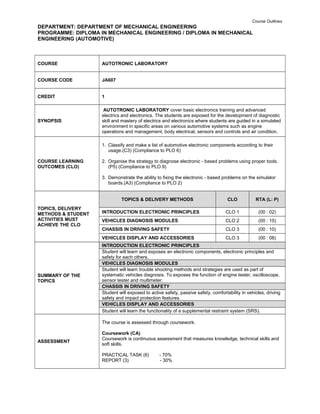
COURSE AUTOTRONIC LABORATORY
COURSE CODE JA607
CREDIT 1
SYNOPSIS
AUTOTRONIC LABORATORY cover basic electronics training and advanced
electrics and electronics. The students are exposed for the development of diagnostic
skill and mastery of electrics and electronics where students are guided in a simulated
environment in specific areas on various automotive systems such as engine
operations and management, body electrical, sensors and controls and air condition.
COURSE LEARNING
OUTCOMES (CLO)
1. Classify and make a list of automotive electronic components according to their
usage.(C3) (Compliance to PLO 6)
2. Organise the strategy to diagnose electronic - based problems using proper tools.
(P5) (Compliance to PLO 9)
3. Demonstrate the ability to fixing the electronic - based problems on the simulator
boards.(A3) (Compliance to PLO 2)
TOPICS, DELIVERY
METHODS & STUDENT
ACTIVITIES MUST
ACHIEVE THE CLO
TOPICS & DELIVERY METHODS CLO RTA (L: P)
INTRODUCTION ELECTRONIC PRINCIPLES CLO 1 (00 : 02)
VEHICLES DIAGNOSIS MODULES CLO 2 (00 : 10)
CHASSIS IN DRIVING SAFETY CLO 3 (00 : 10)
VEHICLES DISPLAY AND ACCESSORIES CLO 3 (00 : 08)
SUMMARY OF THE
TOPICS
INTRODUCTION ELECTRONIC PRINCIPLES
Student will learn and exposes an electronic components, electronic principles and
safety for each others.
VEHICLES DIAGNOSIS MODULES
Student will learn trouble shooting methods and strategies are used as part of
systematic vehicles diagnosis. To exposes the function of engine tester, oscilloscope,
sensor tester and multimeter.
CHASSIS IN DRIVING SAFETY
Student will exposed to active safety, passive safety, comfortability in vehicles, driving
safety and impact protection features.
VEHICLES DISPLAY AND ACCESSORIES
Student will learn the functionality of a supplemental restraint system (SRS).
ASSESSMENT
The course is assessed through coursework.
Coursework (CA)
Coursework is continuous assessment that measures knowledge, technical skills and
soft skills.
PRACTICAL TASK (6) - 70%
REPORT (3) - 30%
Course Outlines
DEPARTMENT: DEPARTMENT OF MECHANICAL ENGINEERING
PROGRAMME: DIPLOMA IN MECHANICAL ENGINEERING / DIPLOMA IN MECHANICAL
ENGINEERING (AUTOMOTIVE)
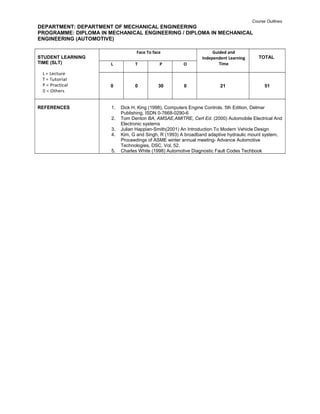
STUDENT LEARNING
TIME (SLT)
L = Lecture
T = Tutorial
P = Practical
O = Others
Face To face Guided and
Independent Learning
Time
TOTAL
L T P O
0 0 30 0 21 51
REFERENCES 1. Dick H. King (1998), Computers Engine Controls. 5th Edition, Delmar
Publishing. ISDN 0-7668-0290-6
2. Tom Denton BA, AMSAE,AMITRE, Cert Ed. (2000) Automobile Electrical And
Electronic systems
3. Julian Happian-Smith(2001) An Introduction To Modern Vehicle Design
4. Kim, G and Singh, R (1993) A broadband adaptive hydraulic mount system,
Proceedings of ASME winter annual meeting- Advance Automotive
Technologies, DSC. Vol. 52.
5. Charles White (1998) Automotive Diagnostic Fault Codes Techbook

Course Outline JA607

  • 1.
    Course Outlines DEPARTMENT: DEPARTMENTOF MECHANICAL ENGINEERING PROGRAMME: DIPLOMA IN MECHANICAL ENGINEERING / DIPLOMA IN MECHANICAL ENGINEERING (AUTOMOTIVE) COURSE AUTOTRONIC LABORATORY COURSE CODE JA607 CREDIT 1 SYNOPSIS AUTOTRONIC LABORATORY cover basic electronics training and advanced electrics and electronics. The students are exposed for the development of diagnostic skill and mastery of electrics and electronics where students are guided in a simulated environment in specific areas on various automotive systems such as engine operations and management, body electrical, sensors and controls and air condition. COURSE LEARNING OUTCOMES (CLO) 1. Classify and make a list of automotive electronic components according to their usage.(C3) (Compliance to PLO 6) 2. Organise the strategy to diagnose electronic - based problems using proper tools. (P5) (Compliance to PLO 9) 3. Demonstrate the ability to fixing the electronic - based problems on the simulator boards.(A3) (Compliance to PLO 2) TOPICS, DELIVERY METHODS & STUDENT ACTIVITIES MUST ACHIEVE THE CLO TOPICS & DELIVERY METHODS CLO RTA (L: P) INTRODUCTION ELECTRONIC PRINCIPLES CLO 1 (00 : 02) VEHICLES DIAGNOSIS MODULES CLO 2 (00 : 10) CHASSIS IN DRIVING SAFETY CLO 3 (00 : 10) VEHICLES DISPLAY AND ACCESSORIES CLO 3 (00 : 08) SUMMARY OF THE TOPICS INTRODUCTION ELECTRONIC PRINCIPLES Student will learn and exposes an electronic components, electronic principles and safety for each others. VEHICLES DIAGNOSIS MODULES Student will learn trouble shooting methods and strategies are used as part of systematic vehicles diagnosis. To exposes the function of engine tester, oscilloscope, sensor tester and multimeter. CHASSIS IN DRIVING SAFETY Student will exposed to active safety, passive safety, comfortability in vehicles, driving safety and impact protection features. VEHICLES DISPLAY AND ACCESSORIES Student will learn the functionality of a supplemental restraint system (SRS). ASSESSMENT The course is assessed through coursework. Coursework (CA) Coursework is continuous assessment that measures knowledge, technical skills and soft skills. PRACTICAL TASK (6) - 70% REPORT (3) - 30%
  • 2.
    Course Outlines DEPARTMENT: DEPARTMENTOF MECHANICAL ENGINEERING PROGRAMME: DIPLOMA IN MECHANICAL ENGINEERING / DIPLOMA IN MECHANICAL ENGINEERING (AUTOMOTIVE) STUDENT LEARNING TIME (SLT) L = Lecture T = Tutorial P = Practical O = Others Face To face Guided and Independent Learning Time TOTAL L T P O 0 0 30 0 21 51 REFERENCES 1. Dick H. King (1998), Computers Engine Controls. 5th Edition, Delmar Publishing. ISDN 0-7668-0290-6 2. Tom Denton BA, AMSAE,AMITRE, Cert Ed. (2000) Automobile Electrical And Electronic systems 3. Julian Happian-Smith(2001) An Introduction To Modern Vehicle Design 4. Kim, G and Singh, R (1993) A broadband adaptive hydraulic mount system, Proceedings of ASME winter annual meeting- Advance Automotive Technologies, DSC. Vol. 52. 5. Charles White (1998) Automotive Diagnostic Fault Codes Techbook