Revisiting Recommendations   Jessica Pickett  Drug Resistance Working Group March 7, 2008
Mapping Out Emerging Solution Areas Cataloguing Recent Recommendations (2000-Present) Examples of Current Proposals Working Group ‘Best & Wildest’ Ideas Group Discussion: What’s worked, what hasn’t, and where we can make a difference.
Preliminary Sources WHO “Global Strategy for the Containment of Antimicrobial Resistance” (2001; reaffirmed in 2005 and 2007 WHA Resolutions) APUA “Antibiotic resistance: synthesis of recommendations by expert policy groups” (2001) MSH Drug Management Program’s “Interventions and strategies to improve the use of antimicrobials in developing countries” (2001) Institute of Medicine “Microbial Threats to Health: Emergence, Detection, and Response” (2003) IOM “Saving Lives, Buying Time: Economics of Malaria Drugs in an Age of Resistance” (2004) Disease Control Priorities Project (2006) The Lancet Gupta, Rajesh. et al. “Scaling up treatment for HIV/AIDS: lessons learned from multi-drug resistant tuberculosis.” (2004) Outterson, Kevin. “Will longer antimicrobial patents improve global health?” (2007) Clinical Microbiology and Infection Power, Edward. “Impact of antibiotic restrictions: the pharmaceutical perspective” (2006)
Key Considerations Does the recommendation address the underlying incentives? Are there entrenched interests or political hurdles? Is there a clear chain of accountability for action? Others?
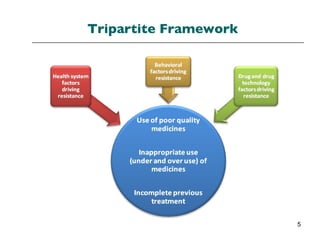
Tripartite Framework
Recommendations I: Health Systems
Regulation Establish an effective  national registration scheme  for dispensing outlets and create  economic incentives  for the appropriate use of antimicrobials WHO Global Strategy for the Containment of Antimicrobial Resistance Driver:  Poor/weak regulation and enforcement Target:  National governments Medium-term action required, with the potential for immediate impact
Regulation Limit the availability of (most) antimicrobials to  prescription-only status  and link to regulations regarding the sale, supply, dispensing and allowable promotional activities; institute  mechanisms to facilitate compliance  by practitioners and systems to monitor compliance. WHO Global Strategy for the Containment of Antimicrobial Resistance Driver:  Poor/weak regulation and enforcement Target:  National governments Medium-term action required, with the potential for immediate impact
Regulation Ensure that only antimicrobials meeting  international quality, efficacy and safety standards  are granted marketing authorization, and introduce  legal requirements for manufacturers to track data  on antimicrobial distribution. WHO Global Strategy for the Containment of Antimicrobial Resistance Driver:  Poor/weak regulation and enforcement Target:  National governments and industry Medium-term action required
Regulation Consider  centralizing the regulation of product procurement, distribution and use  for specific diseases (as in the case of the Green Light Committee for TB). Gupta, Rajesh. et al. “Scaling up treatment for HIV/AIDS: lessons learned from multi-drug resistant tuberculosis.”  The Lancet. Driver:  Poor/weak regulation and supply chains Target:  International agencies
Regulation Establish  international inspection teams  to conduct valid assessments of pharmaceutical manufacturing plants and support an international approach to the  control of counterfeit antimicrobials . WHO Global Strategy for the Containment of Antimicrobial Resistance Driver:  Substandard drug quality Target:  International agencies Medium-term action required
Regulation Other Working Group Ideas: Give  Interpol  responsibility for tracking counterfeit drugs Create a  SWAT team  of technical collaborators and emergency funds to respond to resistance “hot spots” comprised of WHO, CDC and public health collaborators in developing countries.
Treatment Protocols & Guidelines Establish, maintain and implement updated national  Standard Treatment Guidelines  and develop a corresponding  Essential Medicines List  to ensure the accessibility and quality of these drugs. WHO Global Strategy for the Containment of Antimicrobial Resistance Driver:  Inappropriate/inconsistent treatment; drug access Target:  National governments and industry Current status:  Ongoing on a country-by-country basis
Treatment Protocols & Guidelines Tailor treatment strategies to limit the development of resistance by employing  combination therapies  (particularly fixed-dose combinations),  cycling strategies ,  drug heterogeneity , and  directly observed therapy . Disease Control Priorities in Developing Countries Driver:  Biological factors Target:  National governments Current status:  Strategies are currently recommended on a country-by-country, disease-by-disease basis, with the exception of international support for ACTs for malaria and DOTS for TB.
Treatment Protocols & Guidelines Enhance  immunization  coverage and other  disease preventive measures  to reduce the need for antimicrobials WHO Global Strategy for the Containment of Antimicrobial Resistance Driver:  Biological factors Target:  National governments Long-term action required, with major potential for impact
Treatment Protocols & Guidelines  Other Working Group Ideas: Reduce susceptibility to other drug resistant infections in HIV patients by  improving nutrition programs  through donor programs, complemented by social messaging about the importance of nutrition as a way to boost immunity. Integrate treatment  for other neglected tropical diseases with treatment for HIV/AIDS, malaria and TB to create incentives to increase resource pool for treatment and capacity building, reduce over- and mistreatment for co-morbidity. Include capacity-building for national drug regulatory agencies (as a cross-cutting intervention) in areas like post-marketing surveillance. Avoid global first line treatments wherever possible in favor of having  localized treatment guidelines  to reduce overall drug use, including technical support for drug use and resistance surveillance and an understanding of the correct resistance threshold when treatment guidelines should be changed. Develop  regional cycling campaigns  for a given pathogen and create price neutrality to individual countries for all medicines for that agent providing they adhere to the cycling program as guided by a regional drug resistance surveillance system (coordinating across diseases if necessary).
Clinical Environment Establish programs for  nosocomial infection control  and ensure that all hospitals have access WHO Global Strategy for the Containment of Antimicrobial Resistance Driver:  Poor disease control & hospital-acquired infections Target:  Hospitals & clinics Current status:  Ongoing on a country-by-country basis
Clinical Environment Establish effective  hospital therapeutics committees  to oversee and monitor antimicrobial use; link these findings to resistance and disease surveillance data. WHO Global Strategy for the Containment of Antimicrobial Resistance Driver:  Hospital-acquired infections, low surveillance Target:  Hospitals & clinics
Surveillance & Diagnostic Capacity Designate or develop  reference microbiology lab facilities  to coordinate effective epidemiologic surveillance of AMR among common pathogens in the community, hospitals & other health facilities. Ensure  access to these lab services  matched to the level of the affiliated hospital for the performance and quality assurance of appropriate diagnostic tests, microbial identification, antimicrobial susceptibility tests, and timely reporting. WHO Global Strategy for the Containment of Antimicrobial Resistance Driver:  Poor diagnosis and surveillance capacity Target:  National governments, hospitals & lab facilities
Surveillance & Diagnostic Capacity Ensure that  laboratory data are recorded  in a database and used to produce clinical and epidemiological surveillance reports of resistance patterns. Adapt and  apply WHO model systems for AMR surveillance  and  ensure data flow  to a national task force, authorities responsible for national STGs and drug policy, infection control programs and prescribers. WHO Global Strategy for the Containment of Antimicrobial Resistance Driver:  Low surveillance Target:  National governments; laboratories
Surveillance & Diagnostic Capacity Establish  national surveillance  for key infectious diseases and syndromes according to country priorities, and link this information to other surveillance data. WHO Global Strategy for the Containment of Antimicrobial Resistance Driver:  Low surveillance Target:  National governments; laboratories
Surveillance & Diagnostic Capacity Consider information on antimicrobial use and resistance from surveillance as  global public goods  to which all governments should contribute. Establish  surveillance networks  (in coordination with NGOs, professional societies and international agencies) with trained staff and adequate infrastructures to provide information for the optimal containment of resistance. WHO Global Strategy for the Containment of Antimicrobial Resistance Driver:  Low surveillance Target:  National governments & international agencies Current status:  Ongoing (see the information paper for more details). Examples include WARN (malaria) and Resnet (HIV/AIDS) Immediate priority for attention, with high impact over the long term
Surveillance   Other Working Group Ideas: Global network for regional and/or sub-regional reference labs and analytic “centers of excellence” to support and coordinate surveillance of drug resistance with financial support from donors, pharma,  and  developing countries as  joint ventures . (These centers could also serve other disease prevention and control functions as well.) Donor funding for  pharmacovigilance
Information Disclosure & Best Practices Establish an  international database of potential research funding agencies  with an interest in antimicrobial resistance; create and strengthen  programs for researchers  to improve the design, preparation and conduct of research to contain AMR. WHO Global Strategy for the Containment of Antimicrobial Resistance Driver:  Poor information sharing Target:  Academics, donors and international agencies
Other Working Group Ideas: Voluntary  multi-company disclosure  of resistance events, with an accompanying tracking system. A “ resistance burden footprint ” on all drugs dispersed (like a carbon footprint) to let each actor at least know the true social cost. Create a  rating or rankings system  for national or donor programs based on the steps they have taken to minimize resistance to HIV/AIDS and other diseases. Donors should  enforce adherence and compliance measures  as part of their grant-funding criterion and strictly adhere to it (particularly for ARVs). This could also be used for implementers to target poor performing facilities that need to improve adherence. Also track CD4 count and viral load monitoring for HIV/AIDS. Information Disclosure & Best Practices
Health Systems   Which recommendations have been successful?  Which ones haven’t? Why not?
Recommendations II: Behavior
Prescriber Behavior Educate prescribers & dispensers  on: appropriate antimicrobial use and containment of resistance for specific drugs; disease prevention (immunization, etc.) and infection control; and factors that may influence prescribing habits (economic incentives, promotional activities, industry inducements, etc.) WHO Global Strategy for the Containment of Antimicrobial Resistance Driver:  Patient-provider interaction Target:  Prescribers and dispensers
Prescriber Behavior Promote targeted  under- and post-graduate training programs  for all health workers to improve the accurate diagnosis and management of common infections WHO Global Strategy for the Containment of Antimicrobial Resistance Driver:  Patient-provider interaction Target:  Prescribers and dispensers
Prescriber Behavior Supervise & support clinical practices  (esp. diagnostic and treatment strategies) to improve antimicrobial use, and/or  audit prescribing and dispensing practices  using peer group or external standards to provide feedback on appropriate prescribing WHO Global Strategy for the Containment of Antimicrobial Resistance Driver:  Patient-provider interaction; quality of care Target:  Prescribers and dispensers
Prescriber Behavior Develop and use  guidelines and treatment algorithms  for appropriate antimicrobial use; and empower formulary managers to limit antimicrobial use to the prescription of a  pre-selected range of antimicrobials WHO Global Strategy for the Containment of Antimicrobial Resistance Driver:  Patient-provider interaction Target:  Prescribers and dispensers
Prescriber Behavior Link  professional registration requirements  for prescribers and dispensers to requirements for training and continuing education WHO Global Strategy for the Containment of Antimicrobial Resistance Driver:  Provider education; inappropriate prescribing patterns Target:  Prescribers and dispensers; national governments Related ideas :  Voluntary accreditation; regulation
Prescriber Behavior Control and  monitor pharmaceutical company promotional activities  within the clinical environment and ensure that such activities have educational benefits for prescribers. Identify and  eliminate the use of economic incentives  that encourage inappropriate prescribing practices. WHO Global Strategy for the Containment of Antimicrobial Resistance Driver:  Inappropriate prescribing patterns Target:  Prescribers/dispensers, pharma industry
Prescriber Behavior Require pharmaceutical companies to comply with national and international  codes of practice on promotional activities  (including direct-to-consumer advertising), and institute systems for  monitoring compliance  with legislation on promotional activities. WHO Global Strategy for the Containment of Antimicrobial Resistance Driver:  Inappropriate prescribing patterns Target:  Pharmaceutical companies, national governments
Prescriber Behavior Other Working Group Ideas: Diagnostics at the point of care  required  of clinical staff (to create expectation to use lab tests), which would require the support of academic, diagnostic manufacturers, labs and medical professionals.
Patient Behavior Educate patients & the general community  on: the appropriate use of and adherence to antimicrobials; the importance of measures to prevent infection (immunization, handwashing, vector control, etc.); measures to reduce infection transmission; and suitable alternatives to self-initiated antimicrobial treatment WHO Global Strategy for the Containment of Antimicrobial Resistance Driver:  Cultural preferences & beliefs Target:  Patients
Patient Behavior Other Working Group Ideas: Pay patients  for evidence that they have appropriately complied .
Behavior   Which recommendations have been successful?  Which ones haven’t? Why not?
Recommendations III: Technology
Diagnostics Development Creating  better diagnostic tests  to determine the type of infection and susceptibility status before antimicrobials are administered. IOM Microbial Threats to Health: Emergence, Detection, and Response Driver:  Poor diagnosis and overtreatment Target:  Pharmaceutical/medical device industry
Diagnostics Development Other Working Group Ideas: A  subsidization mechanism  for rapid diagnostic tests, with a particular focus on developing rapid diagnostic tests for febrile illness that detects all diseases (malaria, pneumonia, etc.) in one kit.  Development of new  multiplexed diagnostics  at point of care that is used by drug sellers, primary health care workers, and is attached to first line drug product and sold with it.  This would require cooperation between at least one drug and multiple diagnostic innovators. Stimulate  generic production  of viral load and CD4 reagents. Develop a  diagnostic chip  for use at point of care that identifies the infecting pathogen and its susceptibility profile; while patients/health systems pay for drugs, the diagnostics would be free.
Drug Financing Encourage cooperation between industry, academia and governments to search for new drugs and vaccines via  public-private partnerships ; focus on drug development programs that seek to  optimize treatment regimens  with regard to safety, efficacy and the risk of selecting resistance organisms. WHO Global Strategy for the Containment of Antimicrobial Resistance Driver:  Inadequate R&D Target:  Pharmaceutical industry Current status:  Ongoing, with examples ranging from MMV to FIND
Drug Financing Provide  incentives for industry to invest in R&D  for new therapeutic agents with novel modes of action to treat and control resistant infections, and seek innovative  partnerships to improve access to existing drugs  (including drug donation programs where appropriate). WHO Global Strategy for the Containment of Antimicrobial Resistance Driver:  Inadequate R&D & low access to existing products Target:  Pharmaceutical industry, donors
Drug Financing Subsidize combination therapies  at the global level to stave off resistance, engage private sector supply chains, and drive manufacturers of monotherapies out of the market (malaria-specific) IOM Saving Lives, Buying Time: Economics of Malaria Drugs in an Age of Resistance (2004) Driver:  Substandard products; poor access Target:  Pharmaceutical industry, donors, distributors Current status:  Recently taken forward under the auspices of the new Access to Medicines Facility-malaria.
Drug Financing Issue  tax credits  on R&D investments for new antimicrobials Power, Edward. “Impact of antibiotic restrictions: the pharmaceutical perspective,”  Clinical Microbiology and Infection. Driver:  Inadequate R&D  Target:  Pharmaceutical industry, donors Related proposals : Kerry vaccine legislation (including tax credits); other “pull” mechanisms such as advance market commitments for vaccines or FDA priority review vouchers
Drug Financing Other Working Group Ideas: Provide a mechanism to  sell tax losses  related to R&D for start up bio tech companies as a means of developing currency in exchange for the time to develop a new product.  And that those R&D taxes credits could be exchanged and sold for cash to companies who had a need for tax loses. Allow pharmaceutical companies to  defer taxes  on profits that would be put into an R&D fund to study new solutions to targeted diseases and that those funds could only be spent on new research on the targeted diseases that were determined by a priority rating. Promote R&D related to  resistance reversal technologies  that can be used to a) rehabilitate the safest and cheapest treatments, and b) protect new or second-line medicines. Funding for these anti-resistance drugs might include permeability enhancers, plasmid expellers and other drugs which may have no activity but return resistant strains to susceptibility. Use  global subsidies  to assure private sector access (buidling on the AMFm). Donors should create and implement “ readiness standards ,” where no more drugs will be funded until x, y, and z systems are in place.
Patents & Regulatory Processes Consider establishing or utilizing  fast-track marketing authorization  for safe new agents, and/or using an  orphan drug scheme  where available and applicable. WHO Global Strategy for the Containment of Antimicrobial Resistance Driver:  Inadequate R&D  Target:  Pharmaceutical industry, donors Related proposals : EMEA Article 58
Patents & Regulatory Processes Make available  time-limited exclusivity  for new formulations or indications for use of antimicrobials, and align IPR to provide suitable  patent protection  for new agents and vaccines. WHO Global Strategy for the Containment of Antimicrobial Resistance Driver:  Inadequate R&D  Target:  Pharmaceutical industry, donors
Patents & Regulatory Processes Extend patent protection  for eligible new antibiotics to increase incentives for manufacturer R&D. Power, Edward. “Impact of antibiotic restrictions: the pharmaceutical perspective,”  Clinical Microbiology and Infection.  (2006) Driver:  Inadequate R&D  Target:  Pharmaceutical industry, donors Related Ideas : Patent duration based on resistance levels (see  Mechoulan, Stephane. “Market Structure and Communicable Diseases.”)
Patents & Regulatory Processes Guaranteed orders  or  national formulary inclusion  for an antibiotic proven to meet a certain medical need (non-exclusive or time limited). Power, Edward. “Impact of antibiotic restrictions: the pharmaceutical perspective,”  Clinical Microbiology and Infection.  (2006) Driver:  Inadequate R&D  Target:  Pharmaceutical industry, donors
Patents & Regulatory Processes Compensate patent owners for conservation efforts  (e.g.  temporarily removing a drug from the market or severely restricting its use for a specific duration to stave off resistance) by direct payments, a full patent buyout, or patent extensions for the off-market period. Outterson, Kevin. “Will longer antimicrobial patents improve global health?”  The Lancet.  (2007) Driver:  Pharmaceutical profit incentives Target:  Pharmaceutical industry, donors Related recommendation : Voluntary product withdrawal of monotherapies for malaria (advocated by WHO in 2006)
Patents & Regulatory Processes Compensate pharmaceutical companies for valuable antimicrobial innovation by setting  high reimbursement prices. Outterson, Kevin. “Will longer antimicrobial patents improve global health?”  The Lancet.  (2007); Power, Edward. “Impact of antibiotic restrictions: the pharmaceutical perspective,”  Clinical Microbiology and Infection.  (2006) Driver:  Inadequate R&D  Target:  Pharmaceutical industry, donors
Patents & Regulatory Processes  Other Working Group Ideas: Create a  World Medicines Agency  (independent of WHO) to approve new drugs for safety and efficacy that are intended for use in developing countries, using standards for clinical trials and documentation appropriate to and reflective of health care in those countries. The incentives would encourage targeted drug development at lower cost and by more mid-size manufacturers. Exchange the patent rights on an existing drug with a new generic drug that is needed for a high priority disease (similar to a  wild card patent ). Create a  global  mechanism to  delay/restrict marketing approval  of an important new antibiotic (modeled on U.S. Schedule III Narcotics); this would include compensation to the patent-holder
Technology   Which recommendations have been successful?  Which ones haven’t? Why not?
Opportunities for Impact Where should the Working Group focus? And what can we do differently?
ANNEX A Recommendations: External Factors
Advocacy Encourage  international collaboration  between governments, NGOs, professional societies & international agencies to: recognize the importance of AMR; present consistent, simple and accurate messages regarding the importance of antimicrobial use, resistance and its containment; and implement joint strategies. WHO Global Strategy for the Containment of Antimicrobial Resistance Driver:  Low political prioritization Target:  National governments
Advocacy Make the containment of AMR a national priority by creating an  intersectoral task force  (incl. health professionals, agriculturalists, industry, government, media & civil society) to raise awareness about AMR, organize data collection and oversee local task forces. WHO Global Strategy for the Containment of Antimicrobial Resistance Driver:  Low political prioritization Target:  National governments
Advocacy Allocate  national resources  to promote the implementation of resistance containment activities, and develop indicators to monitor and evaluate their impact. WHO Global Strategy for the Containment of Antimicrobial Resistance Driver:  Low political prioritization Target:  National governments
Agricultural Use of Antimicrobials Require  obligatory prescriptions  for antimicrobials to control disease in food animals; develop  guidelines for veterinarians  to reduce overuse and misuse of antimicrobials; and create  national systems to monitor antimicrobial usage  in animals WHO Global Principals for the Containment of Antimicrobial Resistance in Animals Intended for Food (2002) Driver:  Agricultural & veterinary use Target:  Agricultural sector Note:  Outside the Working Group’s scope
Agricultural Use of Antimicrobials Terminate or  phase out the use of antimicrobials for growth promotion  if they are also used for the treatment of humans. WHO Global Principals for the Containment of Antimicrobial Resistance in Animals Intended for Food (2002) Driver:  Agricultural & veterinary use Target:  Agricultural sector Current status:  Banned in Europe in 2006 Note:  Outside the Working Group’s scope
Agricultural Use of Antimicrobials Introduce  pre-licensing safety evaluation  of antimicrobials with consideration of potential resistance to human drugs;  monitor resistance  to identify emerging health problems and take corrective actions to protect human health WHO Global Principals for the Containment of Antimicrobial Resistance in Animals Intended for Food (2002) Driver:  Agricultural & veterinary use Target:  Agricultural sector Note:  Outside the Working Group’s scope
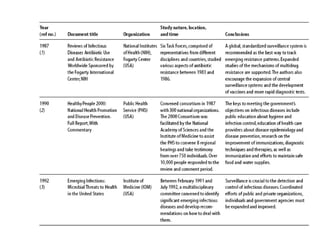
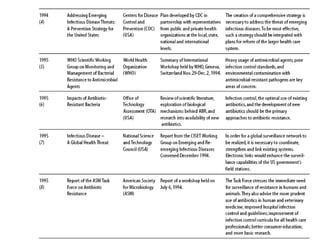
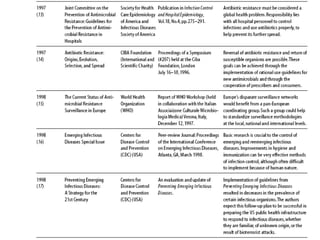
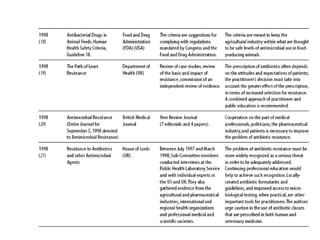
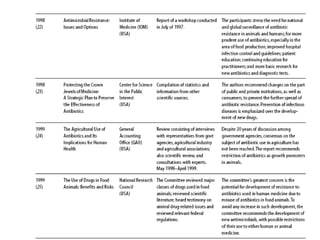
ANNEX B APUA Synthesis Report
Revisiting Recommendations on Drug Resistance from Past Studies

Revisiting Recommendations on Drug Resistance from Past Studies

  • 1.
    Revisiting Recommendations Jessica Pickett Drug Resistance Working Group March 7, 2008
  • 2.
    Mapping Out EmergingSolution Areas Cataloguing Recent Recommendations (2000-Present) Examples of Current Proposals Working Group ‘Best & Wildest’ Ideas Group Discussion: What’s worked, what hasn’t, and where we can make a difference.
  • 3.
    Preliminary Sources WHO“Global Strategy for the Containment of Antimicrobial Resistance” (2001; reaffirmed in 2005 and 2007 WHA Resolutions) APUA “Antibiotic resistance: synthesis of recommendations by expert policy groups” (2001) MSH Drug Management Program’s “Interventions and strategies to improve the use of antimicrobials in developing countries” (2001) Institute of Medicine “Microbial Threats to Health: Emergence, Detection, and Response” (2003) IOM “Saving Lives, Buying Time: Economics of Malaria Drugs in an Age of Resistance” (2004) Disease Control Priorities Project (2006) The Lancet Gupta, Rajesh. et al. “Scaling up treatment for HIV/AIDS: lessons learned from multi-drug resistant tuberculosis.” (2004) Outterson, Kevin. “Will longer antimicrobial patents improve global health?” (2007) Clinical Microbiology and Infection Power, Edward. “Impact of antibiotic restrictions: the pharmaceutical perspective” (2006)
  • 4.
    Key Considerations Doesthe recommendation address the underlying incentives? Are there entrenched interests or political hurdles? Is there a clear chain of accountability for action? Others?
  • 5.
  • 6.
  • 7.
    Regulation Establish aneffective national registration scheme for dispensing outlets and create economic incentives for the appropriate use of antimicrobials WHO Global Strategy for the Containment of Antimicrobial Resistance Driver: Poor/weak regulation and enforcement Target: National governments Medium-term action required, with the potential for immediate impact
  • 8.
    Regulation Limit theavailability of (most) antimicrobials to prescription-only status and link to regulations regarding the sale, supply, dispensing and allowable promotional activities; institute mechanisms to facilitate compliance by practitioners and systems to monitor compliance. WHO Global Strategy for the Containment of Antimicrobial Resistance Driver: Poor/weak regulation and enforcement Target: National governments Medium-term action required, with the potential for immediate impact
  • 9.
    Regulation Ensure thatonly antimicrobials meeting international quality, efficacy and safety standards are granted marketing authorization, and introduce legal requirements for manufacturers to track data on antimicrobial distribution. WHO Global Strategy for the Containment of Antimicrobial Resistance Driver: Poor/weak regulation and enforcement Target: National governments and industry Medium-term action required
  • 10.
    Regulation Consider centralizing the regulation of product procurement, distribution and use for specific diseases (as in the case of the Green Light Committee for TB). Gupta, Rajesh. et al. “Scaling up treatment for HIV/AIDS: lessons learned from multi-drug resistant tuberculosis.” The Lancet. Driver: Poor/weak regulation and supply chains Target: International agencies
  • 11.
    Regulation Establish international inspection teams to conduct valid assessments of pharmaceutical manufacturing plants and support an international approach to the control of counterfeit antimicrobials . WHO Global Strategy for the Containment of Antimicrobial Resistance Driver: Substandard drug quality Target: International agencies Medium-term action required
  • 12.
    Regulation Other WorkingGroup Ideas: Give Interpol responsibility for tracking counterfeit drugs Create a SWAT team of technical collaborators and emergency funds to respond to resistance “hot spots” comprised of WHO, CDC and public health collaborators in developing countries.
  • 13.
    Treatment Protocols &Guidelines Establish, maintain and implement updated national Standard Treatment Guidelines and develop a corresponding Essential Medicines List to ensure the accessibility and quality of these drugs. WHO Global Strategy for the Containment of Antimicrobial Resistance Driver: Inappropriate/inconsistent treatment; drug access Target: National governments and industry Current status: Ongoing on a country-by-country basis
  • 14.
    Treatment Protocols &Guidelines Tailor treatment strategies to limit the development of resistance by employing combination therapies (particularly fixed-dose combinations), cycling strategies , drug heterogeneity , and directly observed therapy . Disease Control Priorities in Developing Countries Driver: Biological factors Target: National governments Current status: Strategies are currently recommended on a country-by-country, disease-by-disease basis, with the exception of international support for ACTs for malaria and DOTS for TB.
  • 15.
    Treatment Protocols &Guidelines Enhance immunization coverage and other disease preventive measures to reduce the need for antimicrobials WHO Global Strategy for the Containment of Antimicrobial Resistance Driver: Biological factors Target: National governments Long-term action required, with major potential for impact
  • 16.
    Treatment Protocols &Guidelines Other Working Group Ideas: Reduce susceptibility to other drug resistant infections in HIV patients by improving nutrition programs through donor programs, complemented by social messaging about the importance of nutrition as a way to boost immunity. Integrate treatment for other neglected tropical diseases with treatment for HIV/AIDS, malaria and TB to create incentives to increase resource pool for treatment and capacity building, reduce over- and mistreatment for co-morbidity. Include capacity-building for national drug regulatory agencies (as a cross-cutting intervention) in areas like post-marketing surveillance. Avoid global first line treatments wherever possible in favor of having localized treatment guidelines to reduce overall drug use, including technical support for drug use and resistance surveillance and an understanding of the correct resistance threshold when treatment guidelines should be changed. Develop regional cycling campaigns for a given pathogen and create price neutrality to individual countries for all medicines for that agent providing they adhere to the cycling program as guided by a regional drug resistance surveillance system (coordinating across diseases if necessary).
  • 17.
    Clinical Environment Establishprograms for nosocomial infection control and ensure that all hospitals have access WHO Global Strategy for the Containment of Antimicrobial Resistance Driver: Poor disease control & hospital-acquired infections Target: Hospitals & clinics Current status: Ongoing on a country-by-country basis
  • 18.
    Clinical Environment Establisheffective hospital therapeutics committees to oversee and monitor antimicrobial use; link these findings to resistance and disease surveillance data. WHO Global Strategy for the Containment of Antimicrobial Resistance Driver: Hospital-acquired infections, low surveillance Target: Hospitals & clinics
  • 19.
    Surveillance & DiagnosticCapacity Designate or develop reference microbiology lab facilities to coordinate effective epidemiologic surveillance of AMR among common pathogens in the community, hospitals & other health facilities. Ensure access to these lab services matched to the level of the affiliated hospital for the performance and quality assurance of appropriate diagnostic tests, microbial identification, antimicrobial susceptibility tests, and timely reporting. WHO Global Strategy for the Containment of Antimicrobial Resistance Driver: Poor diagnosis and surveillance capacity Target: National governments, hospitals & lab facilities
  • 20.
    Surveillance & DiagnosticCapacity Ensure that laboratory data are recorded in a database and used to produce clinical and epidemiological surveillance reports of resistance patterns. Adapt and apply WHO model systems for AMR surveillance and ensure data flow to a national task force, authorities responsible for national STGs and drug policy, infection control programs and prescribers. WHO Global Strategy for the Containment of Antimicrobial Resistance Driver: Low surveillance Target: National governments; laboratories
  • 21.
    Surveillance & DiagnosticCapacity Establish national surveillance for key infectious diseases and syndromes according to country priorities, and link this information to other surveillance data. WHO Global Strategy for the Containment of Antimicrobial Resistance Driver: Low surveillance Target: National governments; laboratories
  • 22.
    Surveillance & DiagnosticCapacity Consider information on antimicrobial use and resistance from surveillance as global public goods to which all governments should contribute. Establish surveillance networks (in coordination with NGOs, professional societies and international agencies) with trained staff and adequate infrastructures to provide information for the optimal containment of resistance. WHO Global Strategy for the Containment of Antimicrobial Resistance Driver: Low surveillance Target: National governments & international agencies Current status: Ongoing (see the information paper for more details). Examples include WARN (malaria) and Resnet (HIV/AIDS) Immediate priority for attention, with high impact over the long term
  • 23.
    Surveillance Other Working Group Ideas: Global network for regional and/or sub-regional reference labs and analytic “centers of excellence” to support and coordinate surveillance of drug resistance with financial support from donors, pharma, and developing countries as joint ventures . (These centers could also serve other disease prevention and control functions as well.) Donor funding for pharmacovigilance
  • 24.
    Information Disclosure &Best Practices Establish an international database of potential research funding agencies with an interest in antimicrobial resistance; create and strengthen programs for researchers to improve the design, preparation and conduct of research to contain AMR. WHO Global Strategy for the Containment of Antimicrobial Resistance Driver: Poor information sharing Target: Academics, donors and international agencies
  • 25.
    Other Working GroupIdeas: Voluntary multi-company disclosure of resistance events, with an accompanying tracking system. A “ resistance burden footprint ” on all drugs dispersed (like a carbon footprint) to let each actor at least know the true social cost. Create a rating or rankings system for national or donor programs based on the steps they have taken to minimize resistance to HIV/AIDS and other diseases. Donors should enforce adherence and compliance measures as part of their grant-funding criterion and strictly adhere to it (particularly for ARVs). This could also be used for implementers to target poor performing facilities that need to improve adherence. Also track CD4 count and viral load monitoring for HIV/AIDS. Information Disclosure & Best Practices
  • 26.
    Health Systems Which recommendations have been successful? Which ones haven’t? Why not?
  • 27.
  • 28.
    Prescriber Behavior Educateprescribers & dispensers on: appropriate antimicrobial use and containment of resistance for specific drugs; disease prevention (immunization, etc.) and infection control; and factors that may influence prescribing habits (economic incentives, promotional activities, industry inducements, etc.) WHO Global Strategy for the Containment of Antimicrobial Resistance Driver: Patient-provider interaction Target: Prescribers and dispensers
  • 29.
    Prescriber Behavior Promotetargeted under- and post-graduate training programs for all health workers to improve the accurate diagnosis and management of common infections WHO Global Strategy for the Containment of Antimicrobial Resistance Driver: Patient-provider interaction Target: Prescribers and dispensers
  • 30.
    Prescriber Behavior Supervise& support clinical practices (esp. diagnostic and treatment strategies) to improve antimicrobial use, and/or audit prescribing and dispensing practices using peer group or external standards to provide feedback on appropriate prescribing WHO Global Strategy for the Containment of Antimicrobial Resistance Driver: Patient-provider interaction; quality of care Target: Prescribers and dispensers
  • 31.
    Prescriber Behavior Developand use guidelines and treatment algorithms for appropriate antimicrobial use; and empower formulary managers to limit antimicrobial use to the prescription of a pre-selected range of antimicrobials WHO Global Strategy for the Containment of Antimicrobial Resistance Driver: Patient-provider interaction Target: Prescribers and dispensers
  • 32.
    Prescriber Behavior Link professional registration requirements for prescribers and dispensers to requirements for training and continuing education WHO Global Strategy for the Containment of Antimicrobial Resistance Driver: Provider education; inappropriate prescribing patterns Target: Prescribers and dispensers; national governments Related ideas : Voluntary accreditation; regulation
  • 33.
    Prescriber Behavior Controland monitor pharmaceutical company promotional activities within the clinical environment and ensure that such activities have educational benefits for prescribers. Identify and eliminate the use of economic incentives that encourage inappropriate prescribing practices. WHO Global Strategy for the Containment of Antimicrobial Resistance Driver: Inappropriate prescribing patterns Target: Prescribers/dispensers, pharma industry
  • 34.
    Prescriber Behavior Requirepharmaceutical companies to comply with national and international codes of practice on promotional activities (including direct-to-consumer advertising), and institute systems for monitoring compliance with legislation on promotional activities. WHO Global Strategy for the Containment of Antimicrobial Resistance Driver: Inappropriate prescribing patterns Target: Pharmaceutical companies, national governments
  • 35.
    Prescriber Behavior OtherWorking Group Ideas: Diagnostics at the point of care required of clinical staff (to create expectation to use lab tests), which would require the support of academic, diagnostic manufacturers, labs and medical professionals.
  • 36.
    Patient Behavior Educatepatients & the general community on: the appropriate use of and adherence to antimicrobials; the importance of measures to prevent infection (immunization, handwashing, vector control, etc.); measures to reduce infection transmission; and suitable alternatives to self-initiated antimicrobial treatment WHO Global Strategy for the Containment of Antimicrobial Resistance Driver: Cultural preferences & beliefs Target: Patients
  • 37.
    Patient Behavior OtherWorking Group Ideas: Pay patients for evidence that they have appropriately complied .
  • 38.
    Behavior Which recommendations have been successful? Which ones haven’t? Why not?
  • 39.
  • 40.
    Diagnostics Development Creating better diagnostic tests to determine the type of infection and susceptibility status before antimicrobials are administered. IOM Microbial Threats to Health: Emergence, Detection, and Response Driver: Poor diagnosis and overtreatment Target: Pharmaceutical/medical device industry
  • 41.
    Diagnostics Development OtherWorking Group Ideas: A subsidization mechanism for rapid diagnostic tests, with a particular focus on developing rapid diagnostic tests for febrile illness that detects all diseases (malaria, pneumonia, etc.) in one kit. Development of new multiplexed diagnostics at point of care that is used by drug sellers, primary health care workers, and is attached to first line drug product and sold with it. This would require cooperation between at least one drug and multiple diagnostic innovators. Stimulate generic production of viral load and CD4 reagents. Develop a diagnostic chip for use at point of care that identifies the infecting pathogen and its susceptibility profile; while patients/health systems pay for drugs, the diagnostics would be free.
  • 42.
    Drug Financing Encouragecooperation between industry, academia and governments to search for new drugs and vaccines via public-private partnerships ; focus on drug development programs that seek to optimize treatment regimens with regard to safety, efficacy and the risk of selecting resistance organisms. WHO Global Strategy for the Containment of Antimicrobial Resistance Driver: Inadequate R&D Target: Pharmaceutical industry Current status: Ongoing, with examples ranging from MMV to FIND
  • 43.
    Drug Financing Provide incentives for industry to invest in R&D for new therapeutic agents with novel modes of action to treat and control resistant infections, and seek innovative partnerships to improve access to existing drugs (including drug donation programs where appropriate). WHO Global Strategy for the Containment of Antimicrobial Resistance Driver: Inadequate R&D & low access to existing products Target: Pharmaceutical industry, donors
  • 44.
    Drug Financing Subsidizecombination therapies at the global level to stave off resistance, engage private sector supply chains, and drive manufacturers of monotherapies out of the market (malaria-specific) IOM Saving Lives, Buying Time: Economics of Malaria Drugs in an Age of Resistance (2004) Driver: Substandard products; poor access Target: Pharmaceutical industry, donors, distributors Current status: Recently taken forward under the auspices of the new Access to Medicines Facility-malaria.
  • 45.
    Drug Financing Issue tax credits on R&D investments for new antimicrobials Power, Edward. “Impact of antibiotic restrictions: the pharmaceutical perspective,” Clinical Microbiology and Infection. Driver: Inadequate R&D Target: Pharmaceutical industry, donors Related proposals : Kerry vaccine legislation (including tax credits); other “pull” mechanisms such as advance market commitments for vaccines or FDA priority review vouchers
  • 46.
    Drug Financing OtherWorking Group Ideas: Provide a mechanism to sell tax losses related to R&D for start up bio tech companies as a means of developing currency in exchange for the time to develop a new product. And that those R&D taxes credits could be exchanged and sold for cash to companies who had a need for tax loses. Allow pharmaceutical companies to defer taxes on profits that would be put into an R&D fund to study new solutions to targeted diseases and that those funds could only be spent on new research on the targeted diseases that were determined by a priority rating. Promote R&D related to resistance reversal technologies that can be used to a) rehabilitate the safest and cheapest treatments, and b) protect new or second-line medicines. Funding for these anti-resistance drugs might include permeability enhancers, plasmid expellers and other drugs which may have no activity but return resistant strains to susceptibility. Use global subsidies to assure private sector access (buidling on the AMFm). Donors should create and implement “ readiness standards ,” where no more drugs will be funded until x, y, and z systems are in place.
  • 47.
    Patents & RegulatoryProcesses Consider establishing or utilizing fast-track marketing authorization for safe new agents, and/or using an orphan drug scheme where available and applicable. WHO Global Strategy for the Containment of Antimicrobial Resistance Driver: Inadequate R&D Target: Pharmaceutical industry, donors Related proposals : EMEA Article 58
  • 48.
    Patents & RegulatoryProcesses Make available time-limited exclusivity for new formulations or indications for use of antimicrobials, and align IPR to provide suitable patent protection for new agents and vaccines. WHO Global Strategy for the Containment of Antimicrobial Resistance Driver: Inadequate R&D Target: Pharmaceutical industry, donors
  • 49.
    Patents & RegulatoryProcesses Extend patent protection for eligible new antibiotics to increase incentives for manufacturer R&D. Power, Edward. “Impact of antibiotic restrictions: the pharmaceutical perspective,” Clinical Microbiology and Infection. (2006) Driver: Inadequate R&D Target: Pharmaceutical industry, donors Related Ideas : Patent duration based on resistance levels (see Mechoulan, Stephane. “Market Structure and Communicable Diseases.”)
  • 50.
    Patents & RegulatoryProcesses Guaranteed orders or national formulary inclusion for an antibiotic proven to meet a certain medical need (non-exclusive or time limited). Power, Edward. “Impact of antibiotic restrictions: the pharmaceutical perspective,” Clinical Microbiology and Infection. (2006) Driver: Inadequate R&D Target: Pharmaceutical industry, donors
  • 51.
    Patents & RegulatoryProcesses Compensate patent owners for conservation efforts (e.g. temporarily removing a drug from the market or severely restricting its use for a specific duration to stave off resistance) by direct payments, a full patent buyout, or patent extensions for the off-market period. Outterson, Kevin. “Will longer antimicrobial patents improve global health?” The Lancet. (2007) Driver: Pharmaceutical profit incentives Target: Pharmaceutical industry, donors Related recommendation : Voluntary product withdrawal of monotherapies for malaria (advocated by WHO in 2006)
  • 52.
    Patents & RegulatoryProcesses Compensate pharmaceutical companies for valuable antimicrobial innovation by setting high reimbursement prices. Outterson, Kevin. “Will longer antimicrobial patents improve global health?” The Lancet. (2007); Power, Edward. “Impact of antibiotic restrictions: the pharmaceutical perspective,” Clinical Microbiology and Infection. (2006) Driver: Inadequate R&D Target: Pharmaceutical industry, donors
  • 53.
    Patents & RegulatoryProcesses Other Working Group Ideas: Create a World Medicines Agency (independent of WHO) to approve new drugs for safety and efficacy that are intended for use in developing countries, using standards for clinical trials and documentation appropriate to and reflective of health care in those countries. The incentives would encourage targeted drug development at lower cost and by more mid-size manufacturers. Exchange the patent rights on an existing drug with a new generic drug that is needed for a high priority disease (similar to a wild card patent ). Create a global mechanism to delay/restrict marketing approval of an important new antibiotic (modeled on U.S. Schedule III Narcotics); this would include compensation to the patent-holder
  • 54.
    Technology Which recommendations have been successful? Which ones haven’t? Why not?
  • 55.
    Opportunities for ImpactWhere should the Working Group focus? And what can we do differently?
  • 56.
    ANNEX A Recommendations:External Factors
  • 57.
    Advocacy Encourage international collaboration between governments, NGOs, professional societies & international agencies to: recognize the importance of AMR; present consistent, simple and accurate messages regarding the importance of antimicrobial use, resistance and its containment; and implement joint strategies. WHO Global Strategy for the Containment of Antimicrobial Resistance Driver: Low political prioritization Target: National governments
  • 58.
    Advocacy Make thecontainment of AMR a national priority by creating an intersectoral task force (incl. health professionals, agriculturalists, industry, government, media & civil society) to raise awareness about AMR, organize data collection and oversee local task forces. WHO Global Strategy for the Containment of Antimicrobial Resistance Driver: Low political prioritization Target: National governments
  • 59.
    Advocacy Allocate national resources to promote the implementation of resistance containment activities, and develop indicators to monitor and evaluate their impact. WHO Global Strategy for the Containment of Antimicrobial Resistance Driver: Low political prioritization Target: National governments
  • 60.
    Agricultural Use ofAntimicrobials Require obligatory prescriptions for antimicrobials to control disease in food animals; develop guidelines for veterinarians to reduce overuse and misuse of antimicrobials; and create national systems to monitor antimicrobial usage in animals WHO Global Principals for the Containment of Antimicrobial Resistance in Animals Intended for Food (2002) Driver: Agricultural & veterinary use Target: Agricultural sector Note: Outside the Working Group’s scope
  • 61.
    Agricultural Use ofAntimicrobials Terminate or phase out the use of antimicrobials for growth promotion if they are also used for the treatment of humans. WHO Global Principals for the Containment of Antimicrobial Resistance in Animals Intended for Food (2002) Driver: Agricultural & veterinary use Target: Agricultural sector Current status: Banned in Europe in 2006 Note: Outside the Working Group’s scope
  • 62.
    Agricultural Use ofAntimicrobials Introduce pre-licensing safety evaluation of antimicrobials with consideration of potential resistance to human drugs; monitor resistance to identify emerging health problems and take corrective actions to protect human health WHO Global Principals for the Containment of Antimicrobial Resistance in Animals Intended for Food (2002) Driver: Agricultural & veterinary use Target: Agricultural sector Note: Outside the Working Group’s scope
  • 63.
    ANNEX B APUASynthesis Report