Inbound CustomerService
SystemsIntegration Training
James Richard Dooling
M OF 1508A ∞ Hu ma n R e so urc e s M an age me nt
Dr. M aj a Z e l i hi c
March 9, 2015
• What is Customer Service?
Who are our customers and what do they need?
How do we rely on technology at work?
Automating certain tasks is good for everyone.
• TheIncreasing Role & Capabilities of Technology in Society
Understanding social media
How do define artificial intelligence?
What are the drawbacks of technology?
• TheIncreasing Role & Capabilities of Technology in Business
New business technology
How do we rely on technology at work?
What are the limitations of technology?
• Handling Customer Calls
How are calls screened and routed?
What jobs are currently automated?
The Human Touch
• TheAutomation Alternative
Technology influences metrics and performance
The Seven-Minute Model
Introducing: The Dialer
• TheChanging Role of Technology
The future of inbound customer service
Humans benefit from automation
Smaller workforces mean more specialization.
• TheChanging Role of Recruiting & Staffing
Sourcing better candidates
Using exclusivity to drive recruiting
Fewer positions means greater demand.
• TheChanging Role of Human Resources Management
Fewer workers means better oversight
Improving management as an alternative to outsourcing
The Dialer’s ultimate impact
In working to develop a clear and
effective training program for
telephone-based customer service-
related employees, HR must conduct
an array of assessments which will
be used to determine:
∞ Company labor needs (past, current
& future)
∞ Job details, requirements &
beneficial skills
∞ Applicant vetting parameters
∞ Performance metrics
∞ Learning & teaching practices
∞ Organizational culture
conceptualization
The needs assessment component of
successful training programs strive to
∞ Telephone-based customer service
agents represent a unique set of skills with
regard to empathy, professionalism,
patience, rapport building and a mellow
personality combined with the ability to
quickly and accurately navigate records
and data while working to keep customers
satisfied. These workers are the voice of
the firm and have a direct impact on
business.
∞Understanding the desired character traits
ofthe candidate for aposition andhaving a
clear picture ofthe job responsibilities for
which you will be developing atraining
programarekey tosuccessful training (Badawy,
2007).
∞The training oftelephone-based customer
service agents wouldbenefit from interactive
andconversational learning exercises.
∞The heavy use of computer terminals and
earphone headsets should be recreated in
the classroom environment.
∞ Thetrainingof changeand changesin the workplace can often be metwith great resistance (Murray&
Lynn, 1997). Ina two-pronged training campaign suchas this whereboth new-hiresand currentemployees
are facing trainingperiods due to new technological roll-outs, thematerials should beconstructed in
such a wayas to speak to both new and veterancompanyinformation systems users.
∞ Understanding the job of the telephone-based customer service agent will
requirea full complement of new computer interface screenshots to be
used as orientating handoutmaterials. Keys and legends are invaluable in
this regard. Slides of these screenshots will also be used for classroom
presentations and could serve as group activity focal points in theearliest
days of training. This helps orient new users to the experience of the shared
task.
Training mustbe used to promote thepositive implicationsof
automation. The changingsets of tasks could prove difficultto
teacheffectively withoutthe trainers first each mastering the
new technologypersonally.
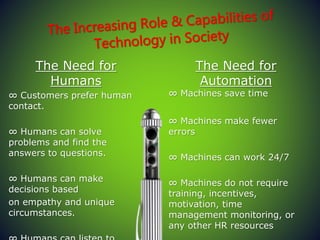
The Need for
Automation
∞ Machines save time
∞ Machines make fewer
errors
∞ Machines can work 24/7
∞ Machines do not require
training, incentives,
motivation, time
management monitoring, or
any other HR resources
The Need for
Humans
∞ Customers prefer human
contact.
∞ Humans can solve
problems and find the
answers to questions.
∞ Humans can make
decisions based
on empathy and unique
circumstances.
∞Findingwaysfortraineestorelate
totheuseofmoderntechnologyin
technologyintheir dailylives.
dailylives.
∞Howhastechnologychanged
duringthetrainees’lifetime?
lifetime?
∞What isthefutureoftechnologyin
theworkplace?
TofirstunderstandArtificialIntelligence, we mustdeterminethe
needsanon-human“consciousness”serves andthe fundamental
goals itmight attainwherehumanscannot.
Secondly,wemustdecide whatseparateshumanityfromall
otherlife.Doreasonandlogic ahumanmake?Creativity?
Emotion?
Compassion,empathyanda desiretolearn, teachorunderstand?
How doemotions servebusiness? Thecustomerservice agent?
Whichof thesetraitscanweprogramintoamachine andwhich
ofthesetraitscan weaffordtosacrificein ordertoachieve a
perfect,capableandtrustworthytechnology?
350B.C.
Archytas’Pigeon
1495A.D.
DaVinci’s
Armored
Knight
1801
Joseph Jacquard’s
Automated Loom
1940
Isaac Asimov’s
ThreeLaws of Robotics
1966
Stanford Research
Institute’s (SRI)
“Shakey”
2011
IBM’s Watson
Why Machines?
• Traininginvolves not only imparting functional
knowledge, but the transfer oforganizational
information:
– Goals
– Missionstatement
– Identity& branding
– Corporateculture(Youssef-Morgan&Stark, 2014)
• Integrating the new functionality of the updated systems
with new standards will work tothwart fears of change
andpushback. Veteran workers will not feel forced to
live up toold metrics using new technology; this breeds
disdain.
• All workers will begin on equal footing.
Why Not Man?
• Calltimes arecalculated from the moment the phone is
answered. Computerized routing has been an industry
practice fortwodecades.
• Imagine modern hold-time with humans still in charge
oftransferring calls tothe proper department.
• Human workers spend unnecessary time handling
simple information requests that can be handled via
automation (Murray& Lynn, 1997).
• What does this new “free time” mean tophone workers?
How will performance be monitored?
• HR’s evolving understanding ofmetrics and
performance appraisals. Influencing job satisfaction
reports and productivity.
Introducing New Technology
∞Introducing“theDialer”
∞Specificsofthe system;new responsibilities
∞Increased capabilitiesandaninnovativelearning process;howworkers
canteachthe Dialer
∞How trainees/retrainedveteransmight perceive theDialer;mention
revamped metrics
∞Overcoming perceived threatstojobsecurityandthe future;HR’s
move fromrecruiting/staffingto trainingandperformance
monitoring/reward
SPECIFIC– Learn the Dialer
MEASURABLE– Periodic Exams
ATTAINABLE – 6 Weeks PaidTraining
REALISTIC –Training not Weeding
TIMELY– Hands-on Experiences
∞ SMART objectivesarea criticalcomponentof
well-developedtrainingexercises(Youssef-Morgan
& Stark, 2014). Specific,Measurable,Attainable,
Realisticand Timely.
∞ Basedonneedsassessments,the SMART
trainingobjectivesfor‘Integratingwith
Technology’areclearlydefinedfortrainersand
willbe strictlyfocusedonforthe first-halfof
TrainingDay1.
∞ Developmentoftheseobjectivesprovidesa
roadmapfortraineesandtraineralike.
∞ IntroduceHRSMART Councilvolunteer
opportunities!
Developing SMART objectives?
SPECIFIC –_____________________
MEASURABLE –__________________
ATTAINABLE –___________________
REALISTIC –____________________
TIMELY –______________________
How are calls screened &
routed?
∞ Explaining howtheDialerwillfunction
∞ TheDialer’sever-increasingworkload
∞ Time-savingcustomeraccount access
∞ Customizableinterfacepreferences
Customer
Service
Gatekeepers
The
Dialer
Can it be self-serviced?
Who takes the call?
Does it require escalation?
Veteran workers will
demonstrate more resistance to
the Dialer than new-hires.
• What other industries have
benefitted from automation?
• Where are workers happier
working alongside machines?
• How can training exercises
work to assuage fears?
• What does this training course
provide that workers couldn’t
learn on their own?
Automation increases
worker productivity on
more important matters
by freeing up time
otherwise spent on trivial
tasks.
The Key to Success:
The Human Touch
∞Whatkindoftaskscannotbeautomated?
∞Howdopeoplerespondtomachinesinbusinesssettings?
businesssettings?
∞What are theadvantagesofliveoperators?
∞Is therepublicresistance?
∞Is theDialerthefuture?
The implementation of the Dialer will significantly reduce the company’s labor and man-hour requirements. With more than 60-
percent of current call volumes expected to migrate to the Dialer queues, the need for human operators will be bypassed in all but
the most challenging of customer situations. However, as an integral component of this automation migration, human employees
need tocontinue to feel valued, challenged andsatisfied with both the company andthe workload.
∞What are HR considerations?
Does less hiringmean less recruiting?Or,does it mean
more timefor more focused and/or specialized
recruiting?
Do fewer new-hiresalter the need or requirements for
trainingobjective development? How do needs
assessment parameters changewith fewer employees
needing to be trained?
How important is changemanagement?
HRresponsibilities mayease upwith automation and
fewer workers, but what does that say for the futureof
HR?
Fewer open
positions means
greater demand
from candidates;
quality of
candidates
increases.
Providing job-
specific training is
an investment in
the employee; this
represents a real
and quantifiable
cost to the
company.
Performance management
becomes easier to monitor,
define and adjust with better
technology.
Training effectiveness is easier
to determine and regulate with
smaller, more specialized
groups of worker populations.
Evaluating both the short- and long-term effects of training will be
partially integrated into the Dialer’s capabilities. The system is
designed to provide management with real-time red flags which allow
for immediate management intervention for the purposes rectifying
and noting incongruent worker behavior. This behavior will become
routine for front-line management and will in turn teach the Dialer’s
Why are Staffing & Recruiting
priorities shifting toward a Learning
and Development-based model? Who
benefits from employee training?
HR’s responsibilities are
divided into a number of
areas. Recruiting and
staffing are traditionally
among the most labor-
intensive and time-
consuming duties assumed
by the department
(Vanderbroeck, 1992).
Attracting qualified talent
has become an
increasingly important
aspect of recruiting. The
current employment
market is difficult for
young people, recent
graduates and older
applicants looking to make
a career change.
Recruiting on college
campuses remains one
The Changing Role of Human
Resources
How does HR begin to shift its
priorities from staffing and
recruiting to focus on increased
training and development
projects?
Where does HR begin to look for
high-value applicants? Does
social media continue to play a
role in recruiting?
How does the application
encourage/discourage possible
candidates?
Do our vetting practices need re-
examination in light of the
Dialer’s implementation?
What kind of experience and
educational background should
RECRUIT!
HIRE!
TRAIN!
EX-
TERMINATE!!!
Badawy, M.K. (2007). Managing human resources. Research
Technology Management,
50(4), pgs. 56-74.
Bielenberg, C. (1992). Winning the customer service war. Managing
Service Quality,
3(1), pgs. 411-416.
Murray, M.A. & Lynn, M.P. (1997). Business process re-
engineering/information system
development to improve customer service quality. Business
Process Management Journal, 3(1), pgs. 9-19.
Vanderbroeck, P. (1992). Long-term human resource development in
multinational
organizations. Sloan Management Review, 34(1), pgs. 95-
102.
Youssef-Morgan, C.M. & Stark. E. (2014). Strategic human resource
management: Concepts, controversies, and evidence-based
applications. San Diego, CA: Bridgepoint Education, Inc.

J dooling ppt_hrmgmt_3-9-15

  • 1.
    Inbound CustomerService SystemsIntegration Training JamesRichard Dooling M OF 1508A ∞ Hu ma n R e so urc e s M an age me nt Dr. M aj a Z e l i hi c March 9, 2015
  • 2.
    • What isCustomer Service? Who are our customers and what do they need? How do we rely on technology at work? Automating certain tasks is good for everyone. • TheIncreasing Role & Capabilities of Technology in Society Understanding social media How do define artificial intelligence? What are the drawbacks of technology? • TheIncreasing Role & Capabilities of Technology in Business New business technology How do we rely on technology at work? What are the limitations of technology? • Handling Customer Calls How are calls screened and routed? What jobs are currently automated? The Human Touch
  • 3.
    • TheAutomation Alternative Technologyinfluences metrics and performance The Seven-Minute Model Introducing: The Dialer • TheChanging Role of Technology The future of inbound customer service Humans benefit from automation Smaller workforces mean more specialization. • TheChanging Role of Recruiting & Staffing Sourcing better candidates Using exclusivity to drive recruiting Fewer positions means greater demand. • TheChanging Role of Human Resources Management Fewer workers means better oversight Improving management as an alternative to outsourcing The Dialer’s ultimate impact
  • 4.
    In working todevelop a clear and effective training program for telephone-based customer service- related employees, HR must conduct an array of assessments which will be used to determine: ∞ Company labor needs (past, current & future) ∞ Job details, requirements & beneficial skills ∞ Applicant vetting parameters ∞ Performance metrics ∞ Learning & teaching practices ∞ Organizational culture conceptualization The needs assessment component of successful training programs strive to ∞ Telephone-based customer service agents represent a unique set of skills with regard to empathy, professionalism, patience, rapport building and a mellow personality combined with the ability to quickly and accurately navigate records and data while working to keep customers satisfied. These workers are the voice of the firm and have a direct impact on business.
  • 5.
    ∞Understanding the desiredcharacter traits ofthe candidate for aposition andhaving a clear picture ofthe job responsibilities for which you will be developing atraining programarekey tosuccessful training (Badawy, 2007). ∞The training oftelephone-based customer service agents wouldbenefit from interactive andconversational learning exercises. ∞The heavy use of computer terminals and earphone headsets should be recreated in the classroom environment.
  • 6.
    ∞ Thetrainingof changeandchangesin the workplace can often be metwith great resistance (Murray& Lynn, 1997). Ina two-pronged training campaign suchas this whereboth new-hiresand currentemployees are facing trainingperiods due to new technological roll-outs, thematerials should beconstructed in such a wayas to speak to both new and veterancompanyinformation systems users. ∞ Understanding the job of the telephone-based customer service agent will requirea full complement of new computer interface screenshots to be used as orientating handoutmaterials. Keys and legends are invaluable in this regard. Slides of these screenshots will also be used for classroom presentations and could serve as group activity focal points in theearliest days of training. This helps orient new users to the experience of the shared task.
  • 7.
    Training mustbe usedto promote thepositive implicationsof automation. The changingsets of tasks could prove difficultto teacheffectively withoutthe trainers first each mastering the new technologypersonally.
  • 8.
    The Need for Automation ∞Machines save time ∞ Machines make fewer errors ∞ Machines can work 24/7 ∞ Machines do not require training, incentives, motivation, time management monitoring, or any other HR resources The Need for Humans ∞ Customers prefer human contact. ∞ Humans can solve problems and find the answers to questions. ∞ Humans can make decisions based on empathy and unique circumstances.
  • 9.
  • 11.
    TofirstunderstandArtificialIntelligence, we mustdeterminethe needsanon-human“consciousness”servesandthe fundamental goals itmight attainwherehumanscannot. Secondly,wemustdecide whatseparateshumanityfromall otherlife.Doreasonandlogic ahumanmake?Creativity? Emotion? Compassion,empathyanda desiretolearn, teachorunderstand? How doemotions servebusiness? Thecustomerservice agent? Whichof thesetraitscanweprogramintoamachine andwhich ofthesetraitscan weaffordtosacrificein ordertoachieve a perfect,capableandtrustworthytechnology?
  • 12.
    350B.C. Archytas’Pigeon 1495A.D. DaVinci’s Armored Knight 1801 Joseph Jacquard’s Automated Loom 1940 IsaacAsimov’s ThreeLaws of Robotics 1966 Stanford Research Institute’s (SRI) “Shakey” 2011 IBM’s Watson
  • 13.
    Why Machines? • Traininginvolvesnot only imparting functional knowledge, but the transfer oforganizational information: – Goals – Missionstatement – Identity& branding – Corporateculture(Youssef-Morgan&Stark, 2014) • Integrating the new functionality of the updated systems with new standards will work tothwart fears of change andpushback. Veteran workers will not feel forced to live up toold metrics using new technology; this breeds disdain. • All workers will begin on equal footing. Why Not Man? • Calltimes arecalculated from the moment the phone is answered. Computerized routing has been an industry practice fortwodecades. • Imagine modern hold-time with humans still in charge oftransferring calls tothe proper department. • Human workers spend unnecessary time handling simple information requests that can be handled via automation (Murray& Lynn, 1997). • What does this new “free time” mean tophone workers? How will performance be monitored? • HR’s evolving understanding ofmetrics and performance appraisals. Influencing job satisfaction reports and productivity.
  • 14.
    Introducing New Technology ∞Introducing“theDialer” ∞Specificsofthesystem;new responsibilities ∞Increased capabilitiesandaninnovativelearning process;howworkers canteachthe Dialer ∞How trainees/retrainedveteransmight perceive theDialer;mention revamped metrics ∞Overcoming perceived threatstojobsecurityandthe future;HR’s move fromrecruiting/staffingto trainingandperformance monitoring/reward
  • 15.
    SPECIFIC– Learn theDialer MEASURABLE– Periodic Exams ATTAINABLE – 6 Weeks PaidTraining REALISTIC –Training not Weeding TIMELY– Hands-on Experiences ∞ SMART objectivesarea criticalcomponentof well-developedtrainingexercises(Youssef-Morgan & Stark, 2014). Specific,Measurable,Attainable, Realisticand Timely. ∞ Basedonneedsassessments,the SMART trainingobjectivesfor‘Integratingwith Technology’areclearlydefinedfortrainersand willbe strictlyfocusedonforthe first-halfof TrainingDay1. ∞ Developmentoftheseobjectivesprovidesa roadmapfortraineesandtraineralike. ∞ IntroduceHRSMART Councilvolunteer opportunities! Developing SMART objectives? SPECIFIC –_____________________ MEASURABLE –__________________ ATTAINABLE –___________________ REALISTIC –____________________ TIMELY –______________________
  • 16.
    How are callsscreened & routed? ∞ Explaining howtheDialerwillfunction ∞ TheDialer’sever-increasingworkload ∞ Time-savingcustomeraccount access ∞ Customizableinterfacepreferences Customer Service Gatekeepers The Dialer Can it be self-serviced? Who takes the call? Does it require escalation?
  • 17.
    Veteran workers will demonstratemore resistance to the Dialer than new-hires. • What other industries have benefitted from automation? • Where are workers happier working alongside machines? • How can training exercises work to assuage fears? • What does this training course provide that workers couldn’t learn on their own? Automation increases worker productivity on more important matters by freeing up time otherwise spent on trivial tasks.
  • 18.
    The Key toSuccess: The Human Touch ∞Whatkindoftaskscannotbeautomated? ∞Howdopeoplerespondtomachinesinbusinesssettings? businesssettings? ∞What are theadvantagesofliveoperators? ∞Is therepublicresistance? ∞Is theDialerthefuture?
  • 19.
    The implementation ofthe Dialer will significantly reduce the company’s labor and man-hour requirements. With more than 60- percent of current call volumes expected to migrate to the Dialer queues, the need for human operators will be bypassed in all but the most challenging of customer situations. However, as an integral component of this automation migration, human employees need tocontinue to feel valued, challenged andsatisfied with both the company andthe workload.
  • 20.
    ∞What are HRconsiderations? Does less hiringmean less recruiting?Or,does it mean more timefor more focused and/or specialized recruiting? Do fewer new-hiresalter the need or requirements for trainingobjective development? How do needs assessment parameters changewith fewer employees needing to be trained? How important is changemanagement? HRresponsibilities mayease upwith automation and fewer workers, but what does that say for the futureof HR?
  • 21.
    Fewer open positions means greaterdemand from candidates; quality of candidates increases. Providing job- specific training is an investment in the employee; this represents a real and quantifiable cost to the company. Performance management becomes easier to monitor, define and adjust with better technology. Training effectiveness is easier to determine and regulate with smaller, more specialized groups of worker populations. Evaluating both the short- and long-term effects of training will be partially integrated into the Dialer’s capabilities. The system is designed to provide management with real-time red flags which allow for immediate management intervention for the purposes rectifying and noting incongruent worker behavior. This behavior will become routine for front-line management and will in turn teach the Dialer’s
  • 22.
    Why are Staffing& Recruiting priorities shifting toward a Learning and Development-based model? Who benefits from employee training? HR’s responsibilities are divided into a number of areas. Recruiting and staffing are traditionally among the most labor- intensive and time- consuming duties assumed by the department (Vanderbroeck, 1992). Attracting qualified talent has become an increasingly important aspect of recruiting. The current employment market is difficult for young people, recent graduates and older applicants looking to make a career change. Recruiting on college campuses remains one
  • 23.
    The Changing Roleof Human Resources How does HR begin to shift its priorities from staffing and recruiting to focus on increased training and development projects? Where does HR begin to look for high-value applicants? Does social media continue to play a role in recruiting? How does the application encourage/discourage possible candidates? Do our vetting practices need re- examination in light of the Dialer’s implementation? What kind of experience and educational background should RECRUIT! HIRE! TRAIN! EX- TERMINATE!!!
  • 24.
    Badawy, M.K. (2007).Managing human resources. Research Technology Management, 50(4), pgs. 56-74. Bielenberg, C. (1992). Winning the customer service war. Managing Service Quality, 3(1), pgs. 411-416. Murray, M.A. & Lynn, M.P. (1997). Business process re- engineering/information system development to improve customer service quality. Business Process Management Journal, 3(1), pgs. 9-19. Vanderbroeck, P. (1992). Long-term human resource development in multinational organizations. Sloan Management Review, 34(1), pgs. 95- 102. Youssef-Morgan, C.M. & Stark. E. (2014). Strategic human resource management: Concepts, controversies, and evidence-based applications. San Diego, CA: Bridgepoint Education, Inc.