15 copies of the main ITIL Foundation reference book
15 copies of the ITIL Foundation pocket guide
Access to the official ITIL website for all trainees
Access to the APM Group website for all trainees
Deputy of training
Planand curriculums office
Job Training standard
Title
ITIL® V3 Foundation Level
Occupational group
Information Technology(IT)
International Code
Date of standard compilation: 2015/01/10
2513-53-100-1
Ministry of cooperatives
Labour and Social Welfare
Iran Technical and Vocational
Training Organization
2.
1
Control of boardon content compilation and accreditation: Plan and curriculums office
National code: 2513-53-100-1
Plan & Curriculum Office
97, nosrat avenue –Tehran, Iran
Tel:+98-21-66569900-9
Fax: +98-21-66944117
E-mail:Barnamehdarci@yahoo.com
Member of Specialized commission IT Curriculum development:
-Ali Mousavi: Director General of Curriculum office
-javad salehi : Director General of international office
-Shahram Shokofian: Manager of Iran TVTO IT Curriculum Development
-Zahra Zamani: Member of Iran TVTO IT Curriculum Development
-Hassan Solimany: Member of Iran TVTO IT Curriculum Development
-Sarang Ghorbanian: Member of Iran TVTO IT Curriculum Development
-Dariush Esmaeili: Member of Iran TVTO IT Curriculum Development
-marziyeh adabi : expert of international office
Cooperator Specialized organizations for compiling the training standard:
- Iran Information Technology Development Co
- Iran Information Technology Development University
Revision Process:
- Scientific content
- According to market
- Equipment
- Tools
3.
2
Relevant experiencesJob &postfield
Academic
document
Name & family name
17 Years
Manager of
Iran TVTO
IT
Curriculum
Development
Computer
Engineering
M.Sc.Shahram Shokofian
1
14 Years
Manager of
Iran TVTO
Training
Curriculum
Development
Educational
Training
M.Sc.Zahra Zamani Zenooz
2
20 Years
Manager and
University of
Applied Science
and Technology
Instructor
IT&ICTM.Sc.Sarang Ghorbanian
3
18 Years
Manager of
Computer
And IT Co
IT&ICTB.ScHassan Solimany
4
20 Years
Manager and
University of
Applied Science
and Technology
Instructor
IT&ICTM.Sc.Dariush Esmaeili
5
6
7
4.
3
Definitions:
Job standard:
The characteristics' required competencies and abilities for Efficient Performance in work
environment is called "the Job standard", and sometimes “The Occupational standard”
Training standard:
The Training Map for achieving the Job’s subset Competencies.
Job title:
Is a set of Tasks and Abilities which is expected from an employed person in the defined level
Job description:
A statement covering the most important elements of a job, namely the position or title of the job, the
duties, job’s relation with other jobs in a occupational field, the responsibilities, workplace conditions
and required performance standards.
Course duration:
The minimum of time which is required to achieve the training objects.
Admission requirements:
The minimum of competencies and abilities which are obligatory for a potential admission.
Evaluation:
The process of collecting evidence and judgment about wetter a competency is achieved or not.
Include: written examination, practical examination
Required Qualifications for Trainers:
The minimum of Trainer’s technical and vocational abilities which the trainer is required to have.
Competency:
The ability of efficient performing a duty in a variety of workplaces conditions
Knowledge:
The minimum set of facts and mental capacities which is necessary for achieving a competency. This
can include science, (Mathematics, physics, chemistry or biology), technology or technical.
Skill:
The minimum coordination between mind and body for achieving an ability or competency. It
normally applied to practical skills.
Attitude:
A set of emotional behaviors required for achieving a competency and can have non-technical skills
and occupational ethics.
Safety:
The cases which doing or not doing something can cause harm or accident
Environmental Consideration:
A set of consideration about the act which should be done to minimize the environmental damage or
pollution.
5.
4
Job title:
ITIL® V3Foundation Level
Job description:
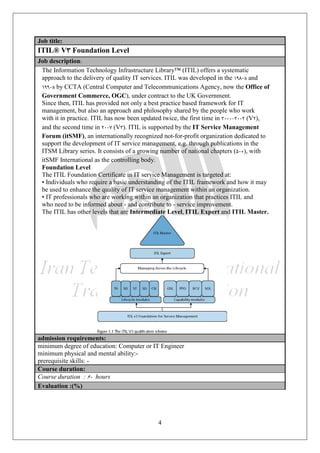
The Information Technology Infrastructure Library™ (ITIL) offers a systematic
approach to the delivery of quality IT services. ITIL was developed in the 1980s and
1990s by CCTA (Central Computer and Telecommunications Agency, now the Office of
Government Commerce, OGC), under contract to the UK Government.
Since then, ITIL has provided not only a best practice based framework for IT
management, but also an approach and philosophy shared by the people who work
with it in practice. ITIL has now been updated twice, the first time in 2000-2002 (V2),
and the second time in 2007 (V3). ITIL is supported by the IT Service Management
Forum (itSMF), an internationally recognized not-for-profit organization dedicated to
support the development of IT service management, e.g. through publications in the
ITSM Library series. It consists of a growing number of national chapters (50+), with
itSMF International as the controlling body.
Foundation Level
The ITIL Foundation Certificate in IT service Management is targeted at:
• Individuals who require a basic understanding of the ITIL framework and how it may
be used to enhance the quality of IT service management within an organization.
• IT professionals who are working within an organization that practices ITIL and
who need to be informed about - and contribute to - service improvement.
The ITIL has other levels that are Intermediate Level, ITIL Expert and ITIL Master.
admission requirements:
minimum degree of education: Computer or IT Engineer
minimum physical and mental ability:-
prerequisite skills: -
1BCourse duration:
Course duration : 60 hours
Evaluation :(%)
6.
5
Required Exams
ITIL FoundationExam
1-Prerequisites
There are no formal criteria or prerequisites for candidates wishing to take the ITIL
Foundation exam. However, candidates are recommended to attend an accredited
training course. Candidates attending a training course are recommended to choose
one of the accredited course providers.
2-Format
The ITIL V3 Foundation exam consists of 40 multiple choice questions. To pass the
examination, 26 out of the 40 questions (65%) must be answered correctly. The duration
of the examination is 60 minutes. Candidates sitting the examination in a language other
than their native language have a maximum of 75 minutes and are allowed the use of a
dictionary. It is not allowed to use books during the examination. The examination can
be online or paper based. Candidates who fail may retake the examination, there is no
limit to the number of times a candidate may retake the exam.
3-Exam Preparations
To enhance your chances for success in the examinations for the ITIL Foundation
Certificate there are a couple of precautions you can take, the first one being to take the
examination seriously.
3.1 Preparation for the exam
• Participate in an accredited training course. Learning the basics of IT service
management is more fun and more effective if done in a group of professionals
sharing experiences and with an experienced tutor with a depth of understanding
and practical working experience.
• Plan to spend enough time for private study and revision of course materials, ITIL
documentation and this training guide.
• Discuss what you learned in the training course and from the books with colleagues
and friends. Sharing experiences about best practice helps you to understand IT
service management principles.
3.2 Preparation for the day of the exam
• Plan your journey to the examination center. Aim to arrive fifteen minutes early to
have a quiet start of the examination; for example, with a coffee or tea.
• Have a good night sleep and start the examination session well rested. Do not try to
study the course material until deep into the night.
• Choose clothes that make you feel comfortable, you do not have to represent your
company, you are representing yourself.
• Do not forget to bring a valid personal ID paper (passport, ID card).
3.3 Hints and tips during the exam
• Carefully read all the questions.
• Start answering the easy questions first.
• In answering the multiple-choice questions, first try to think of an answer yourself
before choosing one of the options. Your first hunch is often the best.
• Do not complicate the question by trying to find counter-examples for the answer
you think is best. The questions are not meant to be tricky and, in exceptional
circumstances, almost certainly, most answers will turn out not to be the whole
truth.
• Before the end of the examination sessions, check whether you have answered all the
7.
6
questions. If youare not sure, try your best choice.
• Do not spend too much time on any one question
• Do not panic. With the right kind of preparation, the examination is not very difficult,
you can do it!
Required Qualifications for Trainers:
ITIL degree holders with 2 years experience
8.
7
Job Training Standard
Competency
Title
2BTheITIL Qualification Scheme1
3BIntroduction2
4BService Strategy3
5BService Design4
6BService Transition5
7BService Operation6
8BContinual Service Improvement (CSI)7
9BITIL Foundation Exam8
9
10
11
9.
8
Training standard
Contents analysisform
time
10BTitle:
11BThe ITIL Qualification Scheme
totalpracticaltheoretical
Determined by the instructor
Equipments ,tools,
materials ,books
Knowledge ,skill ,attitude ,safety, Environmental Consideration
Equipment &
Tools &
Materials &
Resources (books,
site, software…)
Determined by the
instructor
Knowledge and Skill:
About ITIL
The ITIL Qualification Scheme
Foundation Level
Intermediate Level
ITIL Expert
ITIL Master
Examination Institutes
APMG
DANSK IT
DF Certifiering AB
EXIN
ISEB
LCS
Accredited Training Organizations
About this Study Guide
Attitude:
Speed and accuracy in doing the right thing
Health & Safety:
Compliance with safety protection in the workplace
Environmental Consideration:
Compliance with environmental protection
10.
9
time
Title:
ITIL Introduction
totalpracticaltheoretical
Determined bythe instructor
Equipments ,tools,
materials ,books
Knowledge ,skill ,attitude ,safety, Environmental Consideration
Equipment &
Tools &
Materials &
Resources
(books, site,
software…)
Determined by the
instructor
Knowledge and Skill:
Definition of Service Management
Service Management Technology
overview of the Service Lifecycle
ITIL Library
Introduction to Functions and Processes
Sample Questions
Attitude:
Speed and accuracy in doing the right thing
Health & Safety:
Compliance with safety protection in the workplace
Environmental Consideration:
Compliance with environmental protection
11.
10
time
Title:
Service Strategy
totalpracticaltheoretical
Determined bythe instructor
Equipments ,tools,
materials ,books
Knowledge ,skill ,attitude ,safety, Environmental Consideration
Equipment &
Tools &
Materials &
Resources
(books, site,
software…)
Determined by the
instructor
Knowledge and Skill:
Lifecycle Phase
Introduction
Basic concepts
Processes and other activities
Organization
Methods, techniques and tools
Implementation and operation
Functions and Processes
Financial Management
Service Portfolio Management
Demand Management
Sample Questions
Attitude:
Speed and accuracy in doing the right thing
Health & Safety:
Compliance with safety protection in the workplace
Environmental Consideration:
Compliance with environmental protection
12.
11
time
Title:
Service Design
totalpracticaltheoretical
Determined bythe instructor
Equipments ,tools,
materials ,books
Knowledge ,skill ,attitude ,safety, Environmental Consideration
Equipment &
Tools &
Materials &
Resources
(books, site,
software…)
Determined by the
instructor
Knowledge and Skill:
Lifecycle Phase
Introduction
Basic concepts
Processes and other activities
Organization
Methods, techniques and tools
Implementation and operation
Functions and Processes
Service Catalogue Management
Service Level Management
Capacity Management
Availability Management
IT Service Continuity Management
Information Security Management
Supplier Management
Sample Questions
Attitude:
Speed and accuracy in doing the right thing
Health & Safety:
Compliance with safety protection in the workplace
Environmental Consideration:
Compliance with environmental protection
13.
12
timeTitle:
Service Transition totalpracticaltheoretical
Determinedby the instructor
Equipments ,tools,
materials ,books
Knowledge ,skill ,attitude ,safety, Environmental Consideration
Equipment &
Tools &
Materials &
Resources
(books, site,
software…)
Determined by the
instructor
Knowledge and Skill:
Lifecycle Phase
Introduction
Basic concepts
Processes and other activities
Organization
Methods, techniques and tools
Implementation and operation
Functions and Processes
Transition Planning and Support
Change Management
Service Asset and Configuration
Management
Release and Deployment Management
Service Validation and Testing
Evaluation
Knowledge Management
Sample Questions
Attitude:
Speed and accuracy in doing the right thing
Health & Safety:
Compliance with safety protection in the workplace
Environmental Consideration:
Compliance with environmental protection
14.
13
time
Title:
Service Operation
totalpracticaltheoretical
Determined bythe instructor
Equipments ,tools,
materials ,books
Knowledge ,skill ,attitude ,safety, Environmental Consideration
Equipment &
Tools &
Materials &
Resources
(books, site,
software…)
Determined by the
instructor
Knowledge and Skill:
Lifecycle Phase
Introduction
Basic concepts
Processes and other activities
Organization
Methods, techniques and tools
Implementation and operation
Functions and Processes
Event Management
Incident Management
Request Fulfillment
Problem Management
Access Management
Monitoring and Control
IT Operations
Sample Questions
Attitude:
Speed and accuracy in doing the right thing
Health & Safety:
Compliance with safety protection in the workplace
Environmental Consideration:
Compliance with environmental protection
15.
14
time
Title:
Continual Service Improvement(CSI)
totalpracticaltheoretical
Determined by the instructor
Equipments ,tools,
materials ,books
Knowledge ,skill ,attitude ,safety, Environmental Consideration
Equipment &
Tools &
Materials &
Resources
(books, site,
software…)
Determined by the
instructor
Knowledge and Skill:
Lifecycle Phase
Introduction
Basic concepts
Processes and other activities
Organization
Methods, techniques and tools
Implementation and operation
Functions and Processes
CSI Improvement Process
Service Reporting
Sample Questions
Attitude:
Speed and accuracy in doing the right thing
Health & Safety:
Compliance with safety protection in the workplace
Environmental Consideration:
Compliance with environmental protection
16.
15
timeTitle:
ITIL Foundation Examtotalpracticaltheoretical
Determined by the instructor
Equipments ,tools,
materials ,books
Knowledge ,skill ,attitude ,safety, Environmental Consideration
Equipment &
Tools &
Materials &
Resources
(books, site,
software…)
Determined by the
instructor
Knowledge and Skill:
Prerequisites
Format
Exam Preparations
Preparation for the exam
Preparation for the day of the exam
Hints and tips during the exam
Sample Questions
Attitude:
Speed and accuracy in doing the right thing
Health & Safety:
Compliance with safety protection in the workplace
Environmental Consideration:
Compliance with environmental protection
17.
16
Equipment & Tools& Materials & Resources (books, site, software…)form
APM Group Website. http://www.apmgroup.co.uk
Bon, J. van, (Ed.) (2007). Foundations of IT Service Management, Based on ITIL V3.
Zaltbommel: Van Haren Publishing for itSMF.
Bon, J. van, (Ed.) (2007). IT Service Management, Based on ITIL V3.- A Pocket Guide.
Zaltbommel: Van Haren Publishing
ITIL. Continual Service Improvement (2007). OGC. London: TSO.
ITIL. Service Design (2007). OGC. London: TSO.
ITIL. Service Operation (2007). OGC. London: TSO.
ITIL. Service Strategy (2007). OGC. London: TSO.
ITIL. Service Transition (2007). OGC. London: TSO.
ITIL Service Management Practices V3 Qualification Scheme (2007). APM Group
The Official ITIL Site, http://www.itil-officialsite.com
The INTERIM ITIL Foundation Certificate in IT Service Management SYLLABUS,
Version 3.1. APM Group London
*Required quantity for each 15 Trainees