A BRIEF ON IT AND ITES
INDUSTRIES & ITS GROWTH.
WHAT IS IT ?
 As defined by
INFORMATION
TECHNOLOGY
ASSOCIATION OF
AMERICA (ITAA)
“IT” is the “study,
design, development,
implementation, support
or management of
computer based
information system
particularly software's
applications & computer
hardware.
IT SECTOR IN INDIA
IT sector in the country has increased at an incredible
rate of 35% per year for the last 10 years reinforces
the view that India is world class in IT
In IT services , India is emerging as one of the most
preferred destinations for BPO’S.
It is playing an important role in economic development
in a broader sense, beyond just economic growth.
The IT sector is one of the largest employers of women,
and therefore, can play a crucial role in women
empowerment and the reduction of gender inequalities.
 The growth in the BPO sector under the supervision of
the IT-ITES sector has been phenomenal. According to
NASSCOM, “The IT-BPO sector in India aggregated
revenue of US$ 100 billion in 2012, where export and
domestic revenue stood at US$ 69.1 billion and US
$31.7 billion respectively”.
 The estimated employment generation in the 2012 was
an expected 230,000 thus providing direct employment
to 2.8 million and indirect employment 88.9 million
people all over the country. According to a report
prepared by Gartner, the top five outsourcing companies
of India are TCS, Cognizant, Infosys, Wipro and HCL
Technologies.
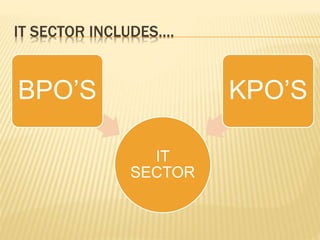
IT SECTOR INCLUDES….
IT
SECTOR
BPO’S KPO’S
WHAT IS BPO ?
 BPO stands for Business processing
outsourcing. It includes contracting of a
specific business task, such as payroll to a
third party service provider.
 BPO is implemented as a cost saving
measure for tasks that a company requires,
but does not depend upon to maintain their
position in the market place..
TOP 5 BPO’S IN INDIA
 TCS (TATA CONSULTANCY SERVICES) -
It is the largest IT employer in India, with more
than 126,000 employees.
 INFOSYS:- it has more than 1,04,850 employees.
 WIPRO:- it has carved a unique position in the
outsourcing company opreates from 10 different
locations. It has more than 98,000 employees.
 COGNIZANT:-it is a forbes global 200
companies,and is a member of fortune 1000,and
is ranked among the information technology
companies.
 HCL TECH-it has more than 54,000 employees
and HCL’S BPO’S focuses on sectors like telecom
,retail ,banking and financial services.
WHAT IS KPO’S ?
 KPO stands for knowledge process
outsourcing. It is claimed that it is one step
extension of BPO.
 KPO industry is handling more amount of
high skilled work other than the BPO industry.
TOP 5 KPO’S IN INDIA.
1.Genpact.
2.Evalueserve.
3.Ugam solutions.
4.WNS global service.
5.24/7 customer.
INDIAN SCENARIO
 Creating opportunities for the
‘out-of-the-mainstream’
candidates.
 India is a popular choice for
customers seeking outsourcing
services because it is able to
offer a 24*7 services by
reduction in costs while
maintaining quality.
 Some flagship companies that
are providing good career in IT
sector are – Infosys
technologies, TCS,
WiproTechnologies, Tech
Mahindra,
Cognizant, HCL technologies,
Satyam Computers etc.
TOP THREE PLAYERS IN IT SECTOR
CURRENT EMPLOYMENT IN IT AND ITES
INDUSTRIES
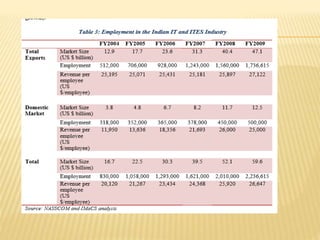
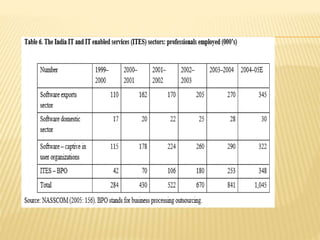
 The Indian IT and ITES industry currently
employs about 2.2 million persons in
comparison to 0.8 million in 2004.
 In the context of growth forecasted for the
industry, availability of skilled human
resource supported by appropriate skill
building initiatives will be key to this growth.
 In the near term, it is expected that the IT
and ITES industry can achieve an export
target of USD 60- 62 billion by FY 2014,
employing 2.5-3 million professionals directly
in the export segment and contributing
substantially to the socio-economic
development of the country.
PROJECTED INDUSTRY SIZE AND HUMAN
RESOURCE REQUIREMENT
 As outlined in the earlier sections,
sustained technology spending globally,
and increasing GDP growth and spending
in India are expected to be primary drivers
of growth.
 Post 2020, growth drivers in addition to
traditional IT and BPO services large
companies (in the Fortune 500) in US and
EU will arise from Small and Medium
Businesses (SMBs), public sector,
healthcare, media, and utilities.
 A significant portion of the growth would be driven by markets
in BRIC countries, APAC, Japan, and Rest of the world. A shift
would occur in terms of customer expectations, led by
innovation, end-to- end offerings, risk management, and
compliance. It is expected that the ‘outsourceable’ market
would expand from the current US $ 500 billion to about US $
1.5 to 1.6 trillion by 2020.
 Sustained GDP growth, increasing public sector spends, and
adoption of IT by industry would drive the domestic
component of the market.
 Given these factors, it is expected that the Indian IT and ITES
Industry would record about US $ 220 billion in exports and
US $ 60 billion domestically by 2022, totalling to about US $
260 billion growing at a CAGR of 12.8%.
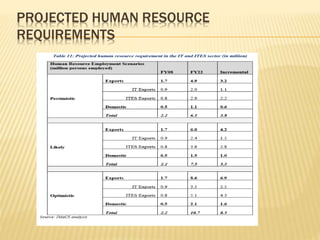
PROJECTED HUMAN RESOURCE
REQUIREMENTS
SUPPLY OF MANPOWER IN IT SECTOR
 India’s public investment in technical education
beginning in the 1960s provided the foundation for
growth of the IT industry. Lack of adequate
opportunities for Indian engineers in the domestic
economy has ensured an abundant and cost
effective workers for Indian export software
industry.
 In the 1960s the govt. created a series of elite
institutes for higher education in engineering and
management, in collaboration with leading
universities in USA, that was IIT and IIM.
L
 Professional in India attracts large number of
applicants. Most of the IIT, REC and IIM admissions
programs are able to choose one out of 100 or more
applicants. This selectivity and reasonably good
training produces the higher calib engineers that
formed the backbone of the software industry in its
early years.
 After that subsequent expansion of technical and
management in India helped fuel the numbers
needed for the high growth.
 Now India has a large higher education system with
about 253 universities and nearly 13000 colleges
producing 2.5 million graduates every year.
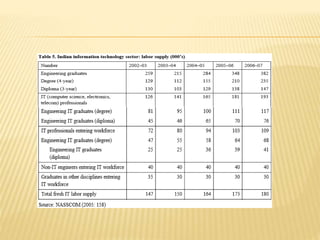
 Nearly 3,00,000 engineering degree and other
graduates enter the workforce every year. Since
engineers from any specialty are willing to work
in the software industry, so far supply has kept
pace with the demand.
 Many initiative by the HRD ministry helped to
multiply technical institutions and technically
qualified graduates.
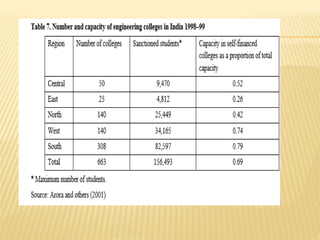
 Recently privatization of technical produced in
an ever increasing technical labor supply to
meet demand. By the end of last decade, there
was an estimated 660 engineering colleges in
the country.
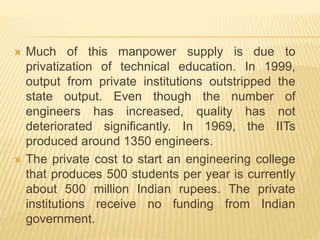
 Much of this manpower supply is due to
privatization of technical education. In 1999,
output from private institutions outstripped the
state output. Even though the number of
engineers has increased, quality has not
deteriorated significantly. In 1969, the IITs
produced around 1350 engineers.
 The private cost to start an engineering college
that produces 500 students per year is currently
about 500 million Indian rupees. The private
institutions receive no funding from Indian
government.
 One reason for the concentration of software
industries in south is the proximity of the
locations to a very large number of engineering
college.
 The HRD ministry played a facilitating role in
ensuring adequate supply and quality of the
technical labour force.
 Ministry policies encouraged creation of private
engineering colleges and industry IT training
institution with the proliferation of new private
colleges and IT training institutions.
 The HRD ministry developed mechanism to assure
quality control , including the establishment of an All
India Council For Technical Education to regulate
technical education.
 Additionally, the introduction of a MCA degree in
many universities in late 1980s was aimed at
producing graduates with combination of technical
and management skills required for expanding It
industry.
Spending By IT Companies On
Training & development.
WHAT IS TRAINING & DEVELOPMENT:-
 A learning process and task oriented
activity.
 The process of teaching new employees the
basic skills they need to perform their jobs.
Effective trainings convey relevant and
useful information that inform participants and
develop skills and behaviors that can be
transferred back to the workplace.
Edwin B. Flippo :
"Training is the act of increasing the
knowledge and skill of an employee for doing
a particular job.'
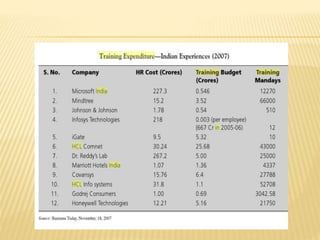
SPENDINGS ON TRAINING & DEVELOPMENT:-
 Indian organizations on average spent US $331 per
employee on training and development in 2011,
according to a study on learning and development
trends in India, by the American Society for Training
& Development (ASTD) and Harvard Business
Publishing (HBP).
 The figure includes learning and development staff
salaries, travel costs for L&D staff, administrative
costs, non salary development costs, delivery costs
(such as classroom facilities and online learning
technology infrastructure), outsourced activities and
tuition
 In terms of IT industries,Infosys annually spends
over Rs 800 crore (Rs 8 billion) on training alone.
Wipro spends about 2 per cent of its net sales in
providing training to employees.
 Infosys is rated amongst world best in employees
training and development.
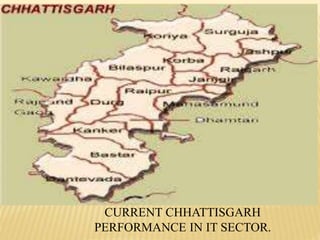
CURRENT CHHATTISGARH
PERFORMANCE IN IT SECTOR.
CHHATTISGARH(C.G)
 Chhattisgarh state was formed on 1 November 2000.Raipur was
made its capital city. C.G is a state in Central India . It is the 10th
largest state in India . With a population of 25.5 million,
Chhattisgarh is the 16th most-populated state of the nation. It is a
source of electricity and steel for India . Chhattisgarh accounts for
15% of the total steel produced in the country. Chhattisgarh is one
of the fastest developing states in India.
 C.G is generously best toward with natural resources like- forests ,
minerals & surface water.
 South eastern coal field limited, NTPC have presence in state.
But in IT sector chhattisgarh do not have any big company.
CG PERFORMANE FOR IT COMPANIES:-
 In recent years, Chhattisgarh is also getting exposure in information
technology (IT) projects and consultancy.
 Its government is also promoting IT and has set up a body to take care of
the IT solutions. The body, known as CHIPS , is providing large IT projects
such as Choice, Swan, etc.
WHAT IS CHIPS –
 Chhattisgarh infotech and biotech Promotion Society (CHiPS) has been
set up to give impetus to IT growth in the State and implement initiatives for
overall socio economic development.
 CHiPS ensures top-of-the-board institutionalised coordination and
implementation of State’s plans for enabling benefits of IT to every one.
CG PERFORMANE FOR IT COMPANIES:-
Companies of IT in c.g :-
 Nimble Technologies:
Software Development Company, Website Designing
IT company korba.
 Prima Softtech.com
Prima softtech as a provide IT services, consulting and business
solutions partner,
IT companies Bilaspur.
 Mini Infotech
IT companies raipur.
INTRODUCTION OF IT POLICY
Chhattisgarh announced many initiatives in the
IT sector, which deliver significant benefits to
all the citizens & all the businesses.
Our state vision of pioneering e-Governance
initiatives in India that serve as a benchmark
for others to follow.
IT Policy is culmination of our clear vision
and goal of leveraging the potential of
Information Technology for rapid social and
economic development aimed at significantly
improving the quality of life for all citizens of
the State.
The Government of Chhattisgarh visions ‘Vikas
mool mantra, Aadhar loktantra’ (‘Driving
Development through Democratic Governance’)
and believes Information and Communication
Technology (ICT) is a particularly important medium
for the state in reaching out and improving
livelihoods specially for its overwhelming SC / ST
population across 44% forest area, which had
largely remained untouched by modern
development.
 An overwhelming proportion of this population are
dependent upon agriculture and forest for their basic
livelihood. Despite significant bottlenecks of limited
access to market related information, monsoon
forecasts, government schemes etc. ICTs has the
potential to significantly improve this contribution.
VISION
 The State of Chhattisgarh recognizes the
importance of Information and Communication
Technology as a key enabler in its economic
development and improving the quality of life.
 The State has prepared its IT policy with a vision
of establishing an information society consisting of
informed, active and therefore responsible citizens
– the basic tenet of a true democracy. It seeks to
provide all citizens widespread and easy access to
government services, in the local language
effectively addressing the existing digital divide
and promoting entrepreneurs.
 The State's IT Policy has been designed
to achieve the Governments vision of
creating an ‘enabled Society
effectively contributing to the Social
and Economic Development of the
State’.
 The state seeks to create a knowledge
society where access to information and
knowledge would be symmetric
amongst all seekers and users and
every citizen must feel comfortable in
accessing information through IT.
OBJECTIVE OF IT POLICY
 To create job creators rather than job
seekers.
 To establish Chhattisgarh as the leading
destination of choice for IT investments.
 To provide an enabling environment for a
robust growth of local IT industry in the State.
 Leveraging IT for improving governance in
the state.
 Taking internet to masses for facilitating
information access.
TARGETS
 Ensure anytime and anywhere connectivity
setting the stage for fostering a competitive IT
Industry. This approach besides resulting in
additional employment and raise incomes
would lead to productivity and better services in
other sectors.
 Provide all citizens widespread and easy
access to government services at an affordable
cost and in local language by setting up
Integrated Service Delivery Centres across the
entire state.
 100% IT literacy in all schools and colleges
in a phased manner.
 Promote entrepreneurs, increase investment
and employment.
DEVELOPMENT STRATEGIES
 Technology enabled governance
To start the use of IT , develop the market for IT
product, the Government would maximise the
use of technology in all its processes. In doing so
Government Process Reengineering would be
encouraged wherever necessary.
 Infrastructure and Human Resource
Development
The State should build best-in class education,
training facilities and R&D infrastructure to equip
its citizens. State should work towards
establishment of software parks and extension.
An Information Technology University will be
 Extended Government support for
Information Technology Development
Chhattisgarh has very high priority to
Information Technology. IT has been identified
as a ‘Special Thrust Sector’ industry in the
Industrial policy.
The some incentives are –
 Interest subsidy on term loan and working
capital paid by SSI.
 Subsidy on Capital Investment by SSI.
 Subsidy on Commercial Tax paid within the
State.
 Exemption from payment of electricity duty for
new units.
 Subsidy on Allotment of land premium.
 Exemption from payment of entry tax.
 New small scale industries will be given full
exemption from payment of land revenue on
diverted land up to a maximum of 5 acres.
 Reimbursement of up to 50% of the fee paid
up to Rs.75,000/- for an ISO or any
international certification.
 NRI and FDI investors will be eligible to get
additional 5% directed incentives more than
general category investors.
ACTION PLAN
 Supportive Institutional Structure – CHiPS
The Chhattisgarh infotech and biotech
Promotion Society (CHiPS) has been set up
to give impetus to IT growth in the State and
implement initiatives for overall socio-economic
development.
CHiPS ensures top-of-the-board
institutionalised coordination and
implementation of State’s plans for enabling
benefits of IT to every one.
The Chief Minister of Chhattisgarh heads the
High Powered Governing Council of CHiPS.
The Council includes eminent persons from
Knowledge and Technology sectors,
representatives from Government of India and
National Agencies, and key State Government
 Departmental Computerization for enhanced
Service Delivery Capability
To facilitate computerisation in all departments,
each department will have an IT working group,
a Chief Information Officer (CIO) and a
representative from CHiPS besides co-opting
IT professionals on voluntary or contractual
basis from other Departments or Agencies.
A major emphasis of the computerization in
departments would be to ensure the
investments in computerizations are directed at
improving the service delivery capabilities of
the Government departments.
Some of the major e-governance
initiatives are-
 CHOiCE : Chhattisgarh Online
information System for Citizen
Empowerment. CHOiCE provides one
stop solution, for anywhere, any time,
based secure services for all the
requirements of citizen. CHOiCE centres
will provide a wide range of services
including connectivity, information, IT
education, e-governance and e-
commerce.
 Local Language solution: State is
committed for improving standards in local
 SWAN (State Wide Area Network): For
interdepartmental communication and data sharing
within the state communication infrastructure has
been planned under this project. The State
presently have connectivity up to block level with
data and video communication via VSAT (Very
Small Aperture Terminal) under programme
called e-Panchayat.
 e-Procurement: State encourages to implement e-
Procurement in all the Departments of the State to
capture whole purchase cycle. The implementation
of e-Procurement is now in the pilot stage in the
five Departments of the State viz; Chhattisgarh
State Infrastructure Development Corporation
(CSIDC), Health Department, Public Works
Department (PWD), Water Resource Department
(WRD) and Chhattisgarh State Electricity
Board(CSEB).
 Telemedicine: A comprehensive
telemedicine network would be
launched which would also ride over
State Wide Area Network. The objective
of the State telemedicine net would be
to provide instant medical advice and
facilities to the citizens of the State, This
would cover backward areas.
IT role AND ITES important verynice.pptx

IT role AND ITES important verynice.pptx

  • 1.
    A BRIEF ONIT AND ITES INDUSTRIES & ITS GROWTH.
  • 2.
    WHAT IS IT?  As defined by INFORMATION TECHNOLOGY ASSOCIATION OF AMERICA (ITAA) “IT” is the “study, design, development, implementation, support or management of computer based information system particularly software's applications & computer hardware.
  • 3.
    IT SECTOR ININDIA IT sector in the country has increased at an incredible rate of 35% per year for the last 10 years reinforces the view that India is world class in IT In IT services , India is emerging as one of the most preferred destinations for BPO’S. It is playing an important role in economic development in a broader sense, beyond just economic growth. The IT sector is one of the largest employers of women, and therefore, can play a crucial role in women empowerment and the reduction of gender inequalities.
  • 4.
     The growthin the BPO sector under the supervision of the IT-ITES sector has been phenomenal. According to NASSCOM, “The IT-BPO sector in India aggregated revenue of US$ 100 billion in 2012, where export and domestic revenue stood at US$ 69.1 billion and US $31.7 billion respectively”.  The estimated employment generation in the 2012 was an expected 230,000 thus providing direct employment to 2.8 million and indirect employment 88.9 million people all over the country. According to a report prepared by Gartner, the top five outsourcing companies of India are TCS, Cognizant, Infosys, Wipro and HCL Technologies.
  • 5.
  • 6.
    WHAT IS BPO?  BPO stands for Business processing outsourcing. It includes contracting of a specific business task, such as payroll to a third party service provider.  BPO is implemented as a cost saving measure for tasks that a company requires, but does not depend upon to maintain their position in the market place..
  • 7.
    TOP 5 BPO’SIN INDIA  TCS (TATA CONSULTANCY SERVICES) - It is the largest IT employer in India, with more than 126,000 employees.  INFOSYS:- it has more than 1,04,850 employees.  WIPRO:- it has carved a unique position in the outsourcing company opreates from 10 different locations. It has more than 98,000 employees.  COGNIZANT:-it is a forbes global 200 companies,and is a member of fortune 1000,and is ranked among the information technology companies.  HCL TECH-it has more than 54,000 employees and HCL’S BPO’S focuses on sectors like telecom ,retail ,banking and financial services.
  • 8.
    WHAT IS KPO’S?  KPO stands for knowledge process outsourcing. It is claimed that it is one step extension of BPO.  KPO industry is handling more amount of high skilled work other than the BPO industry. TOP 5 KPO’S IN INDIA. 1.Genpact. 2.Evalueserve. 3.Ugam solutions. 4.WNS global service. 5.24/7 customer.
  • 9.
    INDIAN SCENARIO  Creatingopportunities for the ‘out-of-the-mainstream’ candidates.  India is a popular choice for customers seeking outsourcing services because it is able to offer a 24*7 services by reduction in costs while maintaining quality.  Some flagship companies that are providing good career in IT sector are – Infosys technologies, TCS, WiproTechnologies, Tech Mahindra, Cognizant, HCL technologies, Satyam Computers etc.
  • 10.
    TOP THREE PLAYERSIN IT SECTOR
  • 11.
    CURRENT EMPLOYMENT INIT AND ITES INDUSTRIES  The Indian IT and ITES industry currently employs about 2.2 million persons in comparison to 0.8 million in 2004.  In the context of growth forecasted for the industry, availability of skilled human resource supported by appropriate skill building initiatives will be key to this growth.
  • 12.
     In thenear term, it is expected that the IT and ITES industry can achieve an export target of USD 60- 62 billion by FY 2014, employing 2.5-3 million professionals directly in the export segment and contributing substantially to the socio-economic development of the country.
  • 14.
    PROJECTED INDUSTRY SIZEAND HUMAN RESOURCE REQUIREMENT  As outlined in the earlier sections, sustained technology spending globally, and increasing GDP growth and spending in India are expected to be primary drivers of growth.  Post 2020, growth drivers in addition to traditional IT and BPO services large companies (in the Fortune 500) in US and EU will arise from Small and Medium Businesses (SMBs), public sector, healthcare, media, and utilities.
  • 15.
     A significantportion of the growth would be driven by markets in BRIC countries, APAC, Japan, and Rest of the world. A shift would occur in terms of customer expectations, led by innovation, end-to- end offerings, risk management, and compliance. It is expected that the ‘outsourceable’ market would expand from the current US $ 500 billion to about US $ 1.5 to 1.6 trillion by 2020.  Sustained GDP growth, increasing public sector spends, and adoption of IT by industry would drive the domestic component of the market.  Given these factors, it is expected that the Indian IT and ITES Industry would record about US $ 220 billion in exports and US $ 60 billion domestically by 2022, totalling to about US $ 260 billion growing at a CAGR of 12.8%.
  • 16.
  • 17.
    SUPPLY OF MANPOWERIN IT SECTOR  India’s public investment in technical education beginning in the 1960s provided the foundation for growth of the IT industry. Lack of adequate opportunities for Indian engineers in the domestic economy has ensured an abundant and cost effective workers for Indian export software industry.  In the 1960s the govt. created a series of elite institutes for higher education in engineering and management, in collaboration with leading universities in USA, that was IIT and IIM.
  • 18.
    L  Professional inIndia attracts large number of applicants. Most of the IIT, REC and IIM admissions programs are able to choose one out of 100 or more applicants. This selectivity and reasonably good training produces the higher calib engineers that formed the backbone of the software industry in its early years.  After that subsequent expansion of technical and management in India helped fuel the numbers needed for the high growth.  Now India has a large higher education system with about 253 universities and nearly 13000 colleges producing 2.5 million graduates every year.
  • 19.
     Nearly 3,00,000engineering degree and other graduates enter the workforce every year. Since engineers from any specialty are willing to work in the software industry, so far supply has kept pace with the demand.  Many initiative by the HRD ministry helped to multiply technical institutions and technically qualified graduates.  Recently privatization of technical produced in an ever increasing technical labor supply to meet demand. By the end of last decade, there was an estimated 660 engineering colleges in the country.
  • 22.
     Much ofthis manpower supply is due to privatization of technical education. In 1999, output from private institutions outstripped the state output. Even though the number of engineers has increased, quality has not deteriorated significantly. In 1969, the IITs produced around 1350 engineers.  The private cost to start an engineering college that produces 500 students per year is currently about 500 million Indian rupees. The private institutions receive no funding from Indian government.
  • 24.
     One reasonfor the concentration of software industries in south is the proximity of the locations to a very large number of engineering college.  The HRD ministry played a facilitating role in ensuring adequate supply and quality of the technical labour force.  Ministry policies encouraged creation of private engineering colleges and industry IT training institution with the proliferation of new private colleges and IT training institutions.
  • 25.
     The HRDministry developed mechanism to assure quality control , including the establishment of an All India Council For Technical Education to regulate technical education.  Additionally, the introduction of a MCA degree in many universities in late 1980s was aimed at producing graduates with combination of technical and management skills required for expanding It industry.
  • 27.
    Spending By ITCompanies On Training & development.
  • 28.
    WHAT IS TRAINING& DEVELOPMENT:-  A learning process and task oriented activity.  The process of teaching new employees the basic skills they need to perform their jobs. Effective trainings convey relevant and useful information that inform participants and develop skills and behaviors that can be transferred back to the workplace. Edwin B. Flippo : "Training is the act of increasing the knowledge and skill of an employee for doing a particular job.'
  • 30.
    SPENDINGS ON TRAINING& DEVELOPMENT:-  Indian organizations on average spent US $331 per employee on training and development in 2011, according to a study on learning and development trends in India, by the American Society for Training & Development (ASTD) and Harvard Business Publishing (HBP).  The figure includes learning and development staff salaries, travel costs for L&D staff, administrative costs, non salary development costs, delivery costs (such as classroom facilities and online learning technology infrastructure), outsourced activities and tuition
  • 31.
     In termsof IT industries,Infosys annually spends over Rs 800 crore (Rs 8 billion) on training alone. Wipro spends about 2 per cent of its net sales in providing training to employees.  Infosys is rated amongst world best in employees training and development.
  • 33.
  • 34.
    CHHATTISGARH(C.G)  Chhattisgarh statewas formed on 1 November 2000.Raipur was made its capital city. C.G is a state in Central India . It is the 10th largest state in India . With a population of 25.5 million, Chhattisgarh is the 16th most-populated state of the nation. It is a source of electricity and steel for India . Chhattisgarh accounts for 15% of the total steel produced in the country. Chhattisgarh is one of the fastest developing states in India.  C.G is generously best toward with natural resources like- forests , minerals & surface water.  South eastern coal field limited, NTPC have presence in state. But in IT sector chhattisgarh do not have any big company.
  • 35.
    CG PERFORMANE FORIT COMPANIES:-  In recent years, Chhattisgarh is also getting exposure in information technology (IT) projects and consultancy.  Its government is also promoting IT and has set up a body to take care of the IT solutions. The body, known as CHIPS , is providing large IT projects such as Choice, Swan, etc. WHAT IS CHIPS –  Chhattisgarh infotech and biotech Promotion Society (CHiPS) has been set up to give impetus to IT growth in the State and implement initiatives for overall socio economic development.  CHiPS ensures top-of-the-board institutionalised coordination and implementation of State’s plans for enabling benefits of IT to every one.
  • 36.
    CG PERFORMANE FORIT COMPANIES:- Companies of IT in c.g :-  Nimble Technologies: Software Development Company, Website Designing IT company korba.  Prima Softtech.com Prima softtech as a provide IT services, consulting and business solutions partner, IT companies Bilaspur.  Mini Infotech IT companies raipur.
  • 37.
    INTRODUCTION OF ITPOLICY Chhattisgarh announced many initiatives in the IT sector, which deliver significant benefits to all the citizens & all the businesses. Our state vision of pioneering e-Governance initiatives in India that serve as a benchmark for others to follow. IT Policy is culmination of our clear vision and goal of leveraging the potential of Information Technology for rapid social and economic development aimed at significantly improving the quality of life for all citizens of the State.
  • 38.
    The Government ofChhattisgarh visions ‘Vikas mool mantra, Aadhar loktantra’ (‘Driving Development through Democratic Governance’) and believes Information and Communication Technology (ICT) is a particularly important medium for the state in reaching out and improving livelihoods specially for its overwhelming SC / ST population across 44% forest area, which had largely remained untouched by modern development.  An overwhelming proportion of this population are dependent upon agriculture and forest for their basic livelihood. Despite significant bottlenecks of limited access to market related information, monsoon forecasts, government schemes etc. ICTs has the potential to significantly improve this contribution.
  • 39.
    VISION  The Stateof Chhattisgarh recognizes the importance of Information and Communication Technology as a key enabler in its economic development and improving the quality of life.  The State has prepared its IT policy with a vision of establishing an information society consisting of informed, active and therefore responsible citizens – the basic tenet of a true democracy. It seeks to provide all citizens widespread and easy access to government services, in the local language effectively addressing the existing digital divide and promoting entrepreneurs.
  • 40.
     The State'sIT Policy has been designed to achieve the Governments vision of creating an ‘enabled Society effectively contributing to the Social and Economic Development of the State’.  The state seeks to create a knowledge society where access to information and knowledge would be symmetric amongst all seekers and users and every citizen must feel comfortable in accessing information through IT.
  • 41.
    OBJECTIVE OF ITPOLICY  To create job creators rather than job seekers.  To establish Chhattisgarh as the leading destination of choice for IT investments.  To provide an enabling environment for a robust growth of local IT industry in the State.  Leveraging IT for improving governance in the state.  Taking internet to masses for facilitating information access.
  • 42.
    TARGETS  Ensure anytimeand anywhere connectivity setting the stage for fostering a competitive IT Industry. This approach besides resulting in additional employment and raise incomes would lead to productivity and better services in other sectors.  Provide all citizens widespread and easy access to government services at an affordable cost and in local language by setting up Integrated Service Delivery Centres across the entire state.
  • 43.
     100% ITliteracy in all schools and colleges in a phased manner.  Promote entrepreneurs, increase investment and employment.
  • 44.
    DEVELOPMENT STRATEGIES  Technologyenabled governance To start the use of IT , develop the market for IT product, the Government would maximise the use of technology in all its processes. In doing so Government Process Reengineering would be encouraged wherever necessary.  Infrastructure and Human Resource Development The State should build best-in class education, training facilities and R&D infrastructure to equip its citizens. State should work towards establishment of software parks and extension. An Information Technology University will be
  • 45.
     Extended Governmentsupport for Information Technology Development Chhattisgarh has very high priority to Information Technology. IT has been identified as a ‘Special Thrust Sector’ industry in the Industrial policy. The some incentives are –  Interest subsidy on term loan and working capital paid by SSI.  Subsidy on Capital Investment by SSI.  Subsidy on Commercial Tax paid within the State.
  • 46.
     Exemption frompayment of electricity duty for new units.  Subsidy on Allotment of land premium.  Exemption from payment of entry tax.  New small scale industries will be given full exemption from payment of land revenue on diverted land up to a maximum of 5 acres.  Reimbursement of up to 50% of the fee paid up to Rs.75,000/- for an ISO or any international certification.  NRI and FDI investors will be eligible to get additional 5% directed incentives more than general category investors.
  • 47.
    ACTION PLAN  SupportiveInstitutional Structure – CHiPS The Chhattisgarh infotech and biotech Promotion Society (CHiPS) has been set up to give impetus to IT growth in the State and implement initiatives for overall socio-economic development. CHiPS ensures top-of-the-board institutionalised coordination and implementation of State’s plans for enabling benefits of IT to every one. The Chief Minister of Chhattisgarh heads the High Powered Governing Council of CHiPS. The Council includes eminent persons from Knowledge and Technology sectors, representatives from Government of India and National Agencies, and key State Government
  • 48.
     Departmental Computerizationfor enhanced Service Delivery Capability To facilitate computerisation in all departments, each department will have an IT working group, a Chief Information Officer (CIO) and a representative from CHiPS besides co-opting IT professionals on voluntary or contractual basis from other Departments or Agencies. A major emphasis of the computerization in departments would be to ensure the investments in computerizations are directed at improving the service delivery capabilities of the Government departments.
  • 49.
    Some of themajor e-governance initiatives are-  CHOiCE : Chhattisgarh Online information System for Citizen Empowerment. CHOiCE provides one stop solution, for anywhere, any time, based secure services for all the requirements of citizen. CHOiCE centres will provide a wide range of services including connectivity, information, IT education, e-governance and e- commerce.  Local Language solution: State is committed for improving standards in local
  • 50.
     SWAN (StateWide Area Network): For interdepartmental communication and data sharing within the state communication infrastructure has been planned under this project. The State presently have connectivity up to block level with data and video communication via VSAT (Very Small Aperture Terminal) under programme called e-Panchayat.  e-Procurement: State encourages to implement e- Procurement in all the Departments of the State to capture whole purchase cycle. The implementation of e-Procurement is now in the pilot stage in the five Departments of the State viz; Chhattisgarh State Infrastructure Development Corporation (CSIDC), Health Department, Public Works Department (PWD), Water Resource Department (WRD) and Chhattisgarh State Electricity Board(CSEB).
  • 51.
     Telemedicine: Acomprehensive telemedicine network would be launched which would also ride over State Wide Area Network. The objective of the State telemedicine net would be to provide instant medical advice and facilities to the citizens of the State, This would cover backward areas.

Editor's Notes