IT ORIENTATION
CIMAR THE WOMENS HOSPITAL
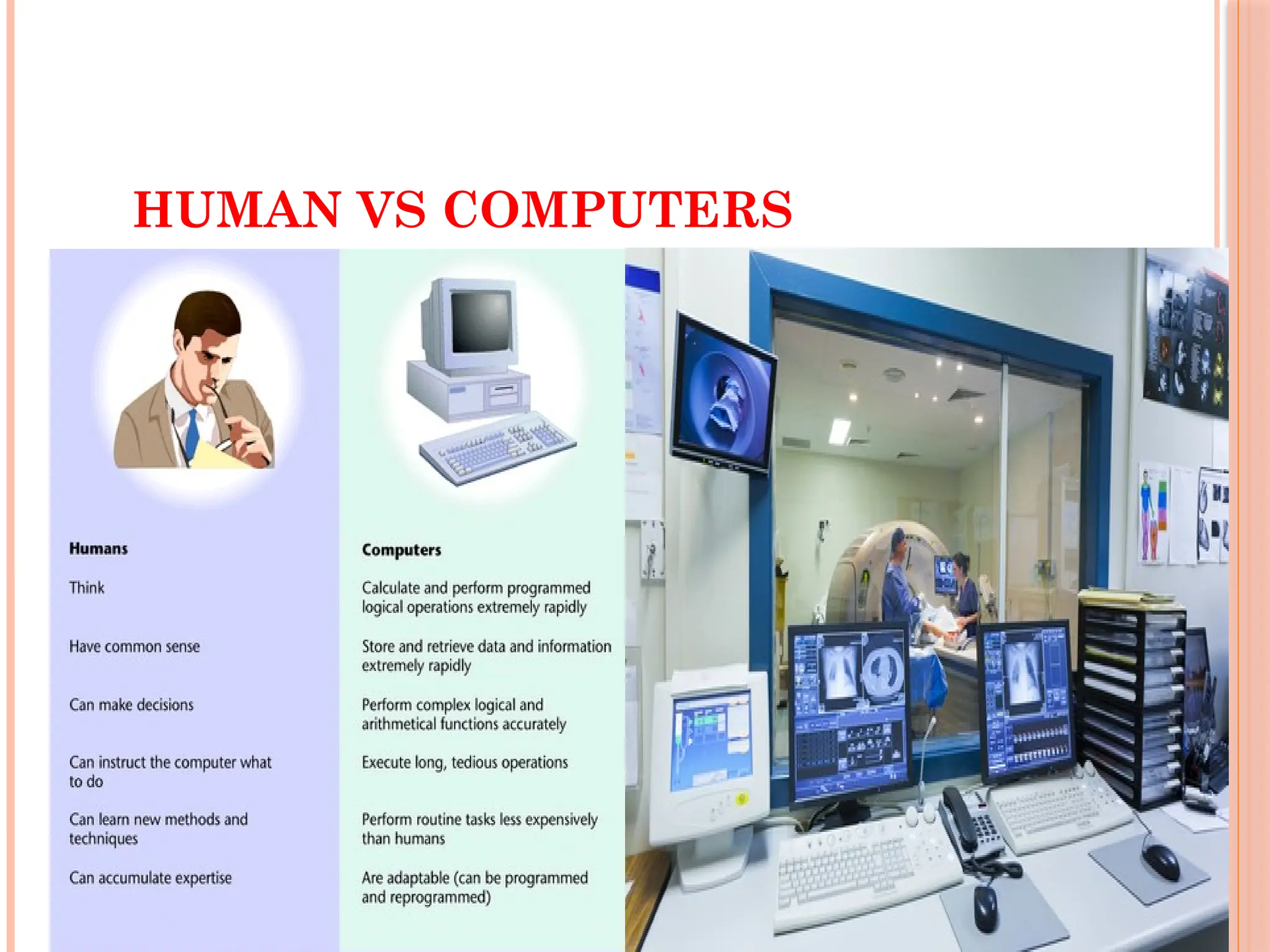
HUMAN VS COMPUTERS
WHAT IS INFORMATION TECHNOLOGY?
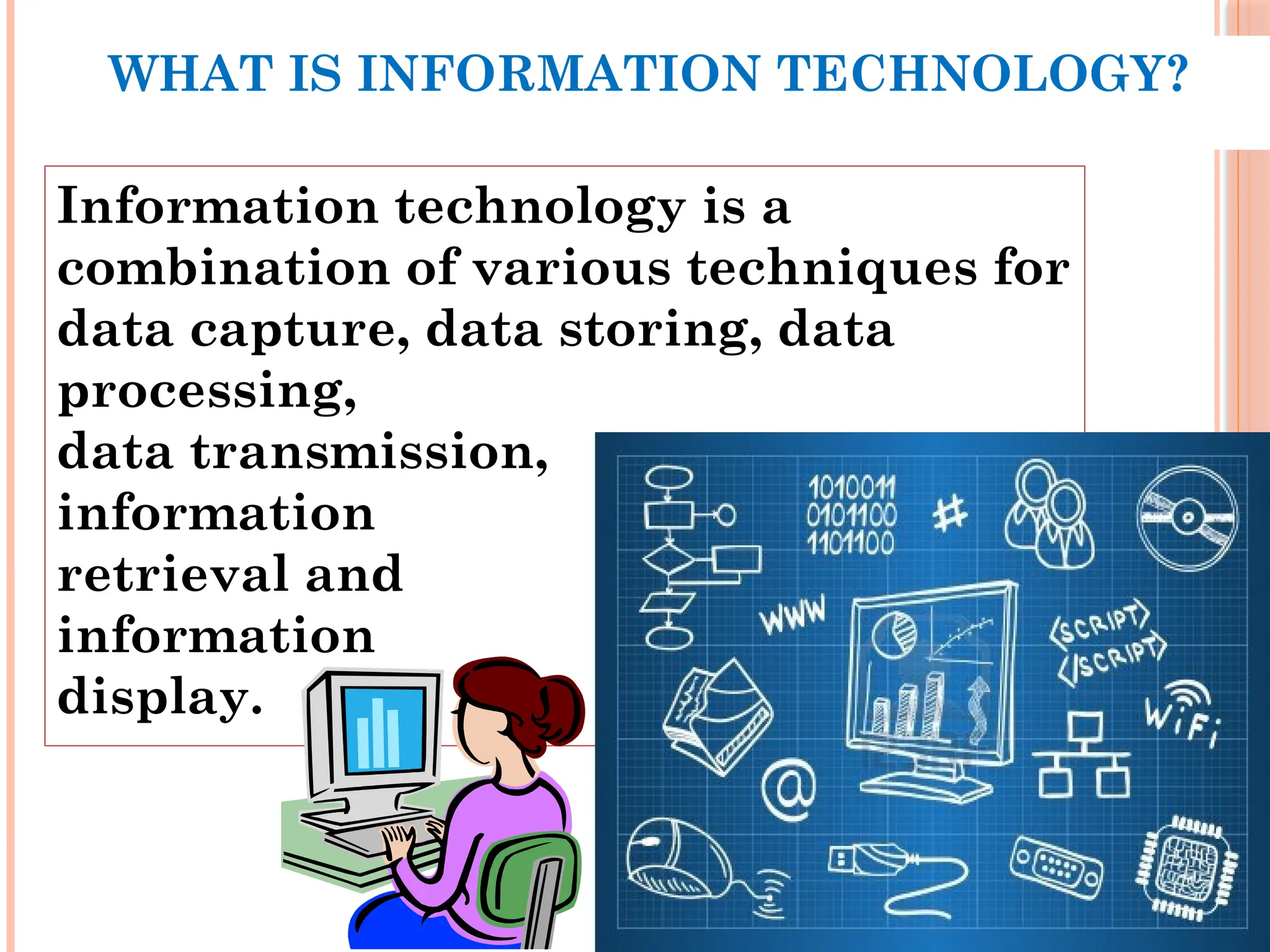
Information technology is a
combination of various techniques for
data capture, data storing, data
processing,
data transmission,
information
retrieval and
information
display.
CHANGING ROLE OF IT
PROFESSIONALS IN
HOSPITALS
 IT use to be a secondary
dept. since need of It was
not realized.
 The main work use to be
troubleshooting and
maintenance of network
infrastructure.
ROLE OF INFROMATION TECHNOLOGY

DATA CAPTURE - collect data from various sources

DATA STORAGE - data is stored in media for future use
DATA TRANSMISSION - data is transmitted from one
place to another
DATA PROCESSING - conversion of data into information

DATA RETRIEVAL - finding out the needed information

DATA DISPLAY - presenting information to the user
NEED FOR HIS
 However, as the services of the hospital expanded and the number
of patients soared, so also did the need for storage and sharing of
data.
 Results entered in the labs would previously take at least a day to
reach the doctors desk based on which treatment would be
modified.
 The lack of integration caused significant delays in patient
billing, increased waiting time, and incurred additional costs in
terms of finance and resources.
 Retrieving patient and financial information was difficult,
thereby limiting decision-making processes.
 Manual processes were subject to entry errors. Information was
available at limited areas and sometimes could not be provided in
real-time.
 Gathering information for statistics and research was a complex
operation. Generating financial statements was a phenomenal
task.
THE IMPORTANCE OF IT SERVICES
FOR HEALTHCARE
The IT department of a hospital is not only
responsible for managing clinical software and the
other processes that help administrative staff to keep
patient records and admissions systems ticking along,
they also have an important role to play in ensuring
medical wards, operating rooms, labor and delivery
suites and emergency departments run smoothly.
Some of these functions include billing, registration,
health information management, ordering and
receiving lab results, and specialist software for
things like radiology
This is in addition to the usual tasks an IT department
of a hospital performs such as providing network
infrastructure, IT security, server maintenance,
software deployments and so on.
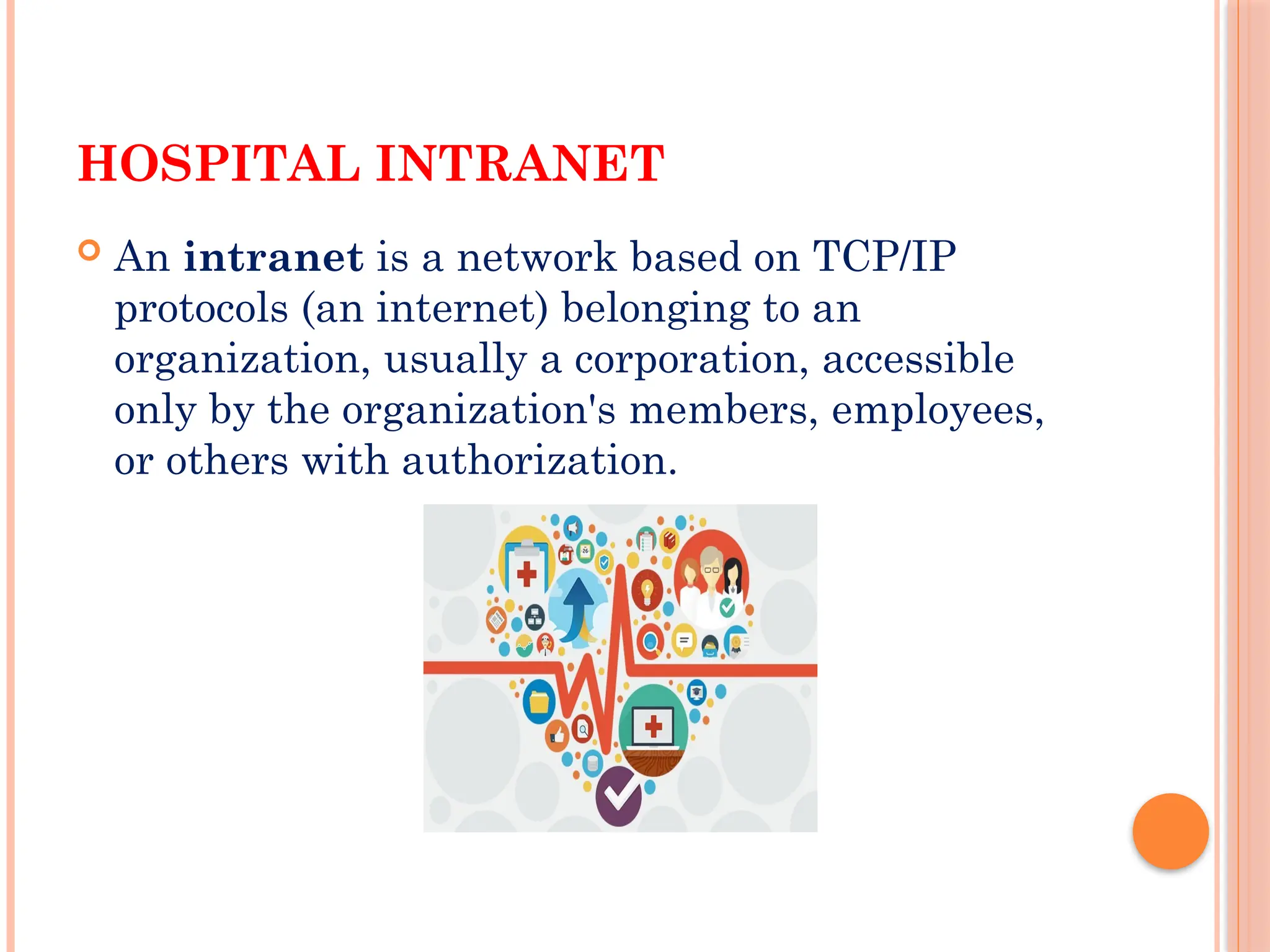
HOSPITAL INTRANET
 An intranet is a network based on TCP/IP
protocols (an internet) belonging to an
organization, usually a corporation, accessible
only by the organization's members, employees,
or others with authorization.
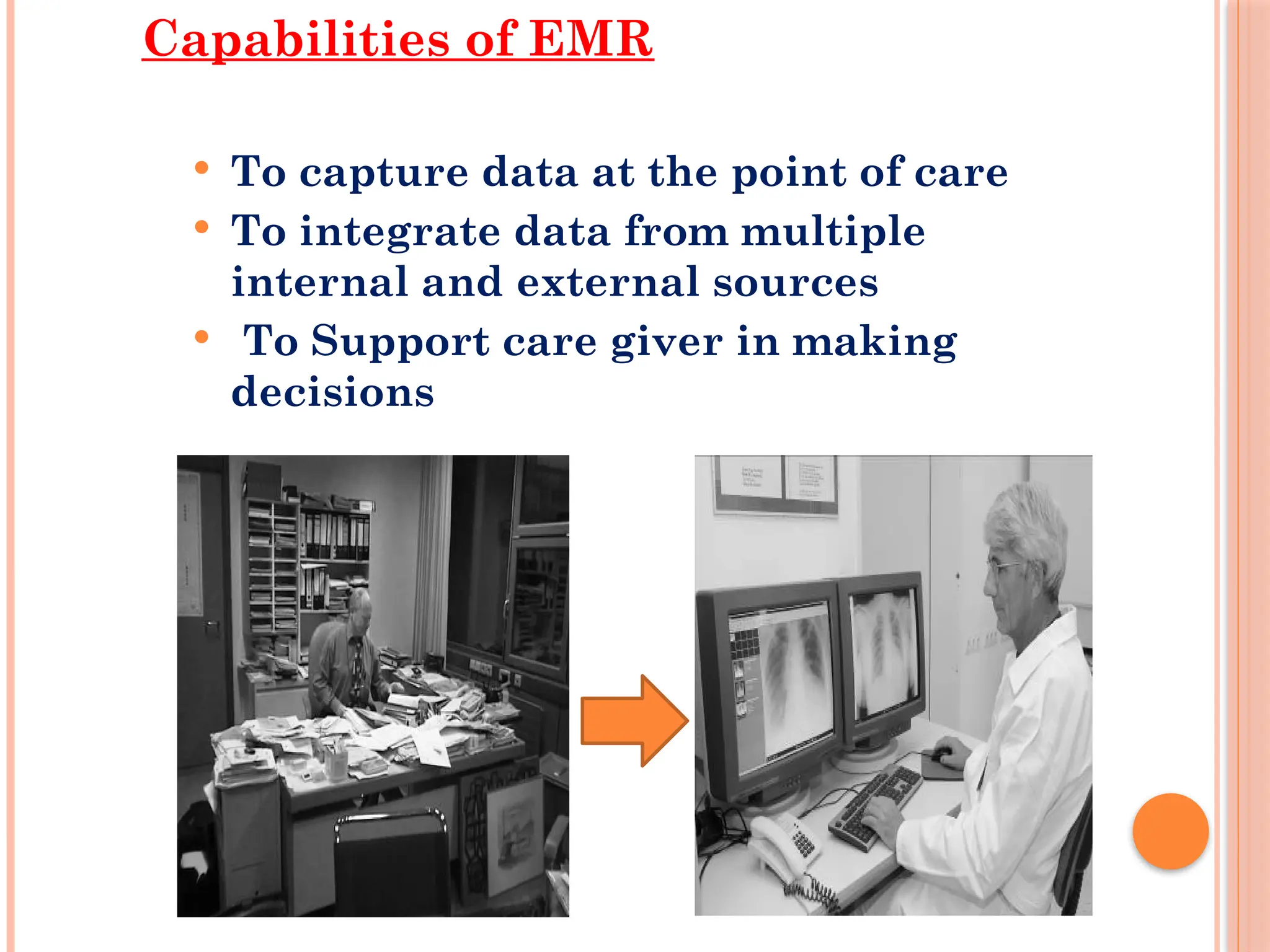
Capabilities of EMR
 To capture data at the point of care
 To integrate data from multiple
internal and external sources
 To Support care giver in making
decisions
Objectives for Implementing
EMR
 Improve Quality Care
 Avoid Adverse Drug Events
 Improve Quality Measures
 Enhance Resident Safety
 Improve Operational Efficiencies
and Reallocate Staff
 Increase Reimbursements
COMPARISON OF THE PRE-DEPLOYMENT
SCENARIO AND POST DEPLOYMENT
BENEFITS
 The development of the HIS brought about a sea
change in the organizational capabilities of the
institution, besides boosting efficiency at every level.
 Speed of service has increased significantly
 Patient billing delays have decreased dramatically
 Secure, real-time, relevant information is now
available anywhere on the institutional campuses
 MIS for Administration and Auditors
 Online investigation results available as soon as they
are ready, thus aiding clinical decision making.
Trend of lab investigations over a time period can be
studied using graphical displays.
 Change in workflow can be easily managed
since an in-house team has developed the
solution
 Patient reports are generated quickly
without needing re-entry of data.
 Information regarding drug interactions is
available in real-time, as a prescription is
being written
PACS
 A picture archiving and communication system
(PACS) is a medical imaging technology which
provides economical storage and convenient access
to images from multiple modalities (source machine
types).
 Electronic images and reports are transmitted
digitally via PACS, this eliminates the need to
manually file, retrieve, or transport film jackets.
 The universal format for PACS image storage and
transfer is DICOM (Digital Imaging and
Communications in Medicine).
WHY PACS?
 PACS resolves many of the problems that were
associated with film.
 Film could only be available in one place at a
time and would frequently result in delayed
patient care if it was not immediately available to
the referring physician.
 With PACS, patient studies can be viewed from
any computer at any of our facilities or from a
referring physician’s office.
 PACS also allows the radiologists to read studies
performed at any of our facilities, from any of our
facilities, making them much more efficient and
greatly reducing the turn around time for report
dictation.
SERVERS USED
 APPLICATION SERVER
 WEBSERVER
 SONOCARE
 BIT VOICE
MODULES
 APPLICATIONS
 OP- http://192.168.50.251/opnurse
 IP
 PHARMACY
 GENERAL STORE
 FMS
 LAB
 HR
WEB MODULES
 IP NURSE
 OP NURSE
 FD
 ITEM CONSUMPTION

IT ORIENTATION SLIDES FOR HOSPITAL IT ORIENTATION

  • 1.
    IT ORIENTATION CIMAR THEWOMENS HOSPITAL
  • 2.
  • 3.
    WHAT IS INFORMATIONTECHNOLOGY? Information technology is a combination of various techniques for data capture, data storing, data processing, data transmission, information retrieval and information display.
  • 4.
    CHANGING ROLE OFIT PROFESSIONALS IN HOSPITALS  IT use to be a secondary dept. since need of It was not realized.  The main work use to be troubleshooting and maintenance of network infrastructure.
  • 5.
    ROLE OF INFROMATIONTECHNOLOGY  DATA CAPTURE - collect data from various sources  DATA STORAGE - data is stored in media for future use DATA TRANSMISSION - data is transmitted from one place to another DATA PROCESSING - conversion of data into information  DATA RETRIEVAL - finding out the needed information  DATA DISPLAY - presenting information to the user
  • 6.
    NEED FOR HIS However, as the services of the hospital expanded and the number of patients soared, so also did the need for storage and sharing of data.  Results entered in the labs would previously take at least a day to reach the doctors desk based on which treatment would be modified.  The lack of integration caused significant delays in patient billing, increased waiting time, and incurred additional costs in terms of finance and resources.  Retrieving patient and financial information was difficult, thereby limiting decision-making processes.  Manual processes were subject to entry errors. Information was available at limited areas and sometimes could not be provided in real-time.  Gathering information for statistics and research was a complex operation. Generating financial statements was a phenomenal task.
  • 7.
    THE IMPORTANCE OFIT SERVICES FOR HEALTHCARE The IT department of a hospital is not only responsible for managing clinical software and the other processes that help administrative staff to keep patient records and admissions systems ticking along, they also have an important role to play in ensuring medical wards, operating rooms, labor and delivery suites and emergency departments run smoothly. Some of these functions include billing, registration, health information management, ordering and receiving lab results, and specialist software for things like radiology This is in addition to the usual tasks an IT department of a hospital performs such as providing network infrastructure, IT security, server maintenance, software deployments and so on.
  • 8.
    HOSPITAL INTRANET  Anintranet is a network based on TCP/IP protocols (an internet) belonging to an organization, usually a corporation, accessible only by the organization's members, employees, or others with authorization.
  • 9.
    Capabilities of EMR To capture data at the point of care  To integrate data from multiple internal and external sources  To Support care giver in making decisions
  • 10.
    Objectives for Implementing EMR Improve Quality Care  Avoid Adverse Drug Events  Improve Quality Measures  Enhance Resident Safety  Improve Operational Efficiencies and Reallocate Staff  Increase Reimbursements
  • 11.
    COMPARISON OF THEPRE-DEPLOYMENT SCENARIO AND POST DEPLOYMENT BENEFITS  The development of the HIS brought about a sea change in the organizational capabilities of the institution, besides boosting efficiency at every level.  Speed of service has increased significantly  Patient billing delays have decreased dramatically  Secure, real-time, relevant information is now available anywhere on the institutional campuses  MIS for Administration and Auditors  Online investigation results available as soon as they are ready, thus aiding clinical decision making. Trend of lab investigations over a time period can be studied using graphical displays.
  • 12.
     Change inworkflow can be easily managed since an in-house team has developed the solution  Patient reports are generated quickly without needing re-entry of data.  Information regarding drug interactions is available in real-time, as a prescription is being written
  • 13.
    PACS  A picturearchiving and communication system (PACS) is a medical imaging technology which provides economical storage and convenient access to images from multiple modalities (source machine types).  Electronic images and reports are transmitted digitally via PACS, this eliminates the need to manually file, retrieve, or transport film jackets.  The universal format for PACS image storage and transfer is DICOM (Digital Imaging and Communications in Medicine).
  • 14.
    WHY PACS?  PACSresolves many of the problems that were associated with film.  Film could only be available in one place at a time and would frequently result in delayed patient care if it was not immediately available to the referring physician.  With PACS, patient studies can be viewed from any computer at any of our facilities or from a referring physician’s office.  PACS also allows the radiologists to read studies performed at any of our facilities, from any of our facilities, making them much more efficient and greatly reducing the turn around time for report dictation.
  • 15.
    SERVERS USED  APPLICATIONSERVER  WEBSERVER  SONOCARE  BIT VOICE
  • 16.
    MODULES  APPLICATIONS  OP-http://192.168.50.251/opnurse  IP  PHARMACY  GENERAL STORE  FMS  LAB  HR
  • 17.
    WEB MODULES  IPNURSE  OP NURSE  FD  ITEM CONSUMPTION