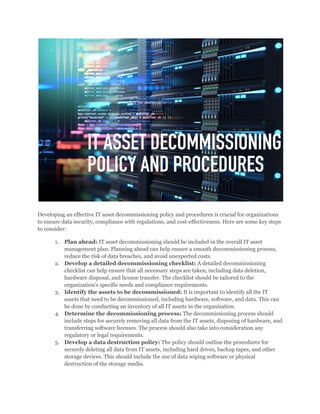
Developing an effective IT asset decommissioning policy and procedures is crucial for organizations
to ensure data security, compliance with regulations, and cost-effectiveness. Here are some key steps
to consider:
1. Plan ahead: IT asset decommissioning should be included in the overall IT asset
management plan. Planning ahead can help ensure a smooth decommissioning process,
reduce the risk of data breaches, and avoid unexpected costs.
2. Develop a detailed decommissioning checklist: A detailed decommissioning
checklist can help ensure that all necessary steps are taken, including data deletion,
hardware disposal, and license transfer. The checklist should be tailored to the
organization’s specific needs and compliance requirements.
3. Identify the assets to be decommissioned: It is important to identify all the IT
assets that need to be decommissioned, including hardware, software, and data. This can
be done by conducting an inventory of all IT assets in the organization.
4. Determine the decommissioning process: The decommissioning process should
include steps for securely removing all data from the IT assets, disposing of hardware, and
transferring software licenses. The process should also take into consideration any
regulatory or legal requirements.
5. Develop a data destruction policy: The policy should outline the procedures for
securely deleting all data from IT assets, including hard drives, backup tapes, and other
storage devices. This should include the use of data wiping software or physical
destruction of the storage media.
6. Use data wiping software: Data wiping software can securely erase all data from hard
drives, making it virtually impossible to recover. This should be done before disposing of
the hardware.
7. Verify data deletion: Before disposing of any IT asset, it is important to verify that all
data has been securely deleted. This can be done by using data wiping software or by
physically destroying the hard drive.
8. Choose a secure hardware disposal method: The hardware disposal method
should be chosen based on the sensitivity of the data and the organization’s compliance
requirements. Options include physical destruction, secure recycling, and donating to a
reputable organization.
9. Ensure compliance with regulations: Compliance with regulations such as HIPAA,
GDPR, and PCI-DSS should be considered when developing the decommissioning policy
and procedures. This may require additional steps such as obtaining certificates of
destruction or documenting the entire process.
10. Train employees: All employees involved in the decommissioning process should be
trained on the decommissioning policy and procedures to ensure consistent execution
and avoid any data breaches.
11. Audit and review the policy and procedures: The decommissioning policy and
procedures should be reviewed regularly to ensure they remain up-to-date and effective.
An audit can be conducted to identify any gaps or areas for improvement.
12. Document the entire process: All steps in the decommissioning process should be
documented, including data deletion, hardware disposal, and license transfer. This can
help ensure compliance with regulations and provide a record of the decommissioning
process.
By following these tips, organizations can ensure a secure and cost-effective IT asset
decommissioning policy and procedures.
Read More Clink Link Below:
https://spascomputers.com/it-asset-decommissioning-redeployment/

IT ASSET DECOMMISSIONING POLICY AND PROCEDURES

  • 1.
    Developing an effectiveIT asset decommissioning policy and procedures is crucial for organizations to ensure data security, compliance with regulations, and cost-effectiveness. Here are some key steps to consider: 1. Plan ahead: IT asset decommissioning should be included in the overall IT asset management plan. Planning ahead can help ensure a smooth decommissioning process, reduce the risk of data breaches, and avoid unexpected costs. 2. Develop a detailed decommissioning checklist: A detailed decommissioning checklist can help ensure that all necessary steps are taken, including data deletion, hardware disposal, and license transfer. The checklist should be tailored to the organization’s specific needs and compliance requirements. 3. Identify the assets to be decommissioned: It is important to identify all the IT assets that need to be decommissioned, including hardware, software, and data. This can be done by conducting an inventory of all IT assets in the organization. 4. Determine the decommissioning process: The decommissioning process should include steps for securely removing all data from the IT assets, disposing of hardware, and transferring software licenses. The process should also take into consideration any regulatory or legal requirements. 5. Develop a data destruction policy: The policy should outline the procedures for securely deleting all data from IT assets, including hard drives, backup tapes, and other storage devices. This should include the use of data wiping software or physical destruction of the storage media.
  • 2.
    6. Use datawiping software: Data wiping software can securely erase all data from hard drives, making it virtually impossible to recover. This should be done before disposing of the hardware. 7. Verify data deletion: Before disposing of any IT asset, it is important to verify that all data has been securely deleted. This can be done by using data wiping software or by physically destroying the hard drive. 8. Choose a secure hardware disposal method: The hardware disposal method should be chosen based on the sensitivity of the data and the organization’s compliance requirements. Options include physical destruction, secure recycling, and donating to a reputable organization. 9. Ensure compliance with regulations: Compliance with regulations such as HIPAA, GDPR, and PCI-DSS should be considered when developing the decommissioning policy and procedures. This may require additional steps such as obtaining certificates of destruction or documenting the entire process. 10. Train employees: All employees involved in the decommissioning process should be trained on the decommissioning policy and procedures to ensure consistent execution and avoid any data breaches. 11. Audit and review the policy and procedures: The decommissioning policy and procedures should be reviewed regularly to ensure they remain up-to-date and effective. An audit can be conducted to identify any gaps or areas for improvement. 12. Document the entire process: All steps in the decommissioning process should be documented, including data deletion, hardware disposal, and license transfer. This can help ensure compliance with regulations and provide a record of the decommissioning process. By following these tips, organizations can ensure a secure and cost-effective IT asset decommissioning policy and procedures. Read More Clink Link Below: https://spascomputers.com/it-asset-decommissioning-redeployment/