IT 340: Final Project Guidelines and Grading Guide
Overview
The final project for this course is the creation of a networking
report that outlines the business and technical network
requirements for a fictional advertising agency. The report will
include strategies for WAN connectivity, IP addressing, and
wireless access, along with the business and technical rationale
for the recommendations. Terms and concepts used in the report
must also be explained clearly and thoroughly.
The project includes two milestones submitted in Modules
Three and Five. The final project is submitted in Module Seven.
In this assignment, you will demonstrate your mastery of the
following course outcomes:
· Understand the language, theory, and concepts involved in
telecommunications and networks
· Understand the relationship between networking technology,
network services, and business
· Demonstrate practical hands-on competency with networking
hardware and software
· Present and communicate networking concepts to others
Prompt
The scenario: Newton Ad Agency is a startup with three
locations. The headquarters is located in Austin, TX, with a
satellite office located 2 miles away in a rural area. There is a
clear line of sight between the two offices. The New York
office needs to share large media files with the Austin office.
The New York office will also have a web server for clients to
download large media files and needs to be able to do it
quickly.
To hire the best talents, Newton Ad Agency allows employees
to work from home full-time. Remote workers will need access
to the network in Austin. The IT Department should have the
ability to log into all of the workstations, including the remote
computers, when they are connected to the network.
You have been hired as the network administrator. You are
tasked with building the network IP strategy, building a remote
access strategy, and selecting WAN technologies that meet the
business requirements. As one of your first tasks, you have been
asked to develop a proposal for the management team. These
members have varying backgrounds and sometimes limited
knowledge of IT services.
Newton Ad Agency: Business and Technical Requirements
1. Spend no more than $1,100 per month on internet for all sites
(after initial hardware and setup costs)
2. The company IP addresses should be within the following
range: 192.168.100.0–192.168.103.255
Austin Headquarters: Business and Technical Requirements
1. Fast WAN connectivity
2. Must have backup WAN connectivity with 99.999% uptime
3. IP addresses must support 500 hosts
4. Must provide wireless access for users
5. All wireless connectivity must be centrally managed
Austin Headquarters: Available Internet Options
1. Fiber Optics ($700)
2. T1 ($300)
3. Cable ($175)
4. DSL ($75)
New York Office: Business and Technical Requirements
1. Fast WAN connectivity
2. IP address strategy for 200 users/PCs
New York Office: Available Internet Options
1.
Fiber Optics ($600)
2. T1 ($300)
3. Cable ($125)
4. DSL ($50)
Rural Satellite Office: Business and Technical Requirements
1. Does not have any type of commercial WAN connectivity
2. Needs to have WAN connectivity (located 2 miles from
headquarters and line of sight—show this in a diagram)
3. IP address strategy needs to support 200 users/PCs
Critical Elements
Based on the scenario above, students will develop a 5- to 7-
page networking report for the owners of the advertising
agency. The report must include the following:
1. The WAN connectivity at each location
2. A diagram showing the WAN connectivity
3. An explanation of why the specific WAN technology was
chosen
4. IP address strategies at each location
5. Wireless access strategy at the Austin office
a) List and explain the services that will support remote workers
b) List and explain the service(s) that IT will use to access all
workstations on the network
6. An explanation of the terms and concepts used in the paper
Milestones
Milestone One: IP Assignments
In task 3-3,you will submit the IP assignments for each site
along with the calculations on how you subnetted the addresses.
This milestone is graded with the Final Project Milestone One:
IP Assignments Rubric.
Milestone Two: WAN Technology Requirements
In task 5-2, you will submit a report on the WAN technologies
chosen for each site, along with a diagram showing the
connectivity. This milestone is graded with the Final Project
Milestone Two: WAN Technology Requirements Rubric.
Final Submission: Networking Report
In task 7-2, you will submit the final networking report for the
advertising agency scenario. It should be a complete, polished
artifact containing all of the critical elements of the final
product. It should reflect the incorporation of feedback gained
throughout the course. This will be graded using the Final
Product Rubric (below).
Final Product Rubric
Format: Written components of project must follow these
formatting guidelines when applicable: double spacing, 12-point
Times New Roman font, one-inch margins, and discipline-
appropriate citations. The paper should be 5 to 7 pages, not
including cover page and resources.
Instructor Feedback: Students can find their feedback in the
Grade Center.
Critical Elements
Exemplary
Proficient
Needs Improvement
Not Evident
Value
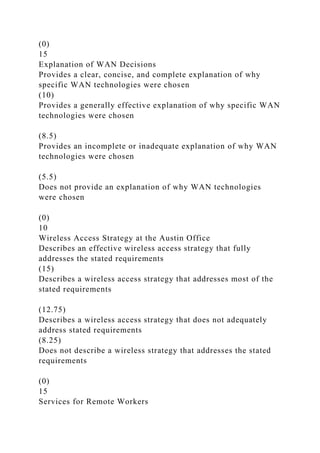
WAN Connectivity
Recommends an effective WAN connectivity solution that fully
meets the requirements of each office
(15)
Recommends a WAN connectivity solution that generally meets
the requirements of each office
(12.75)
Recommends a WAN connectivity solution, but does not
adequately address the requirements of each office
(8.25)
Does not recommend a WAN connectivity solution for each
office
(0)
15
WAN Diagram
Provides a professional-quality diagram that fully illustrates the
proposed WAN solution
(15)
Provides a high-quality diagram that illustrates the proposed
WAN solution
(12.75)
Provides a diagram that does not fully illustrate the proposed
WAN solution
(8.25)
Does not provide a diagram that illustrates the proposed WAN
solution
(0)
15
Explanation of WAN Decisions
Provides a clear, concise, and complete explanation of why
specific WAN technologies were chosen
(10)
Provides a generally effective explanation of why specific WAN
technologies were chosen
(8.5)
Provides an incomplete or inadequate explanation of why WAN
technologies were chosen
(5.5)
Does not provide an explanation of why WAN technologies
were chosen
(0)
10
Wireless Access Strategy at the Austin Office
Describes an effective wireless access strategy that fully
addresses the stated requirements
(15)
Describes a wireless access strategy that addresses most of the
stated requirements
(12.75)
Describes a wireless access strategy that does not adequately
address stated requirements
(8.25)
Does not describe a wireless strategy that addresses the stated
requirements
(0)
15
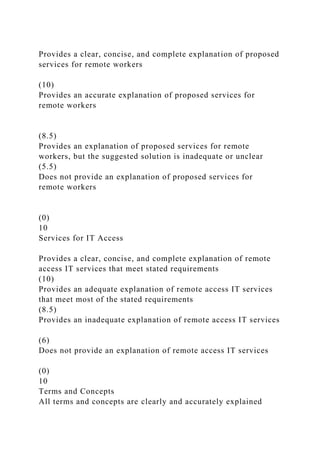
Services for Remote Workers
Provides a clear, concise, and complete explanation of proposed
services for remote workers
(10)
Provides an accurate explanation of proposed services for
remote workers
(8.5)
Provides an explanation of proposed services for remote
workers, but the suggested solution is inadequate or unclear
(5.5)
Does not provide an explanation of proposed services for
remote workers
(0)
10
Services for IT Access
Provides a clear, concise, and complete explanation of remote
access IT services that meet stated requirements
(10)
Provides an adequate explanation of remote access IT services
that meet most of the stated requirements
(8.5)
Provides an inadequate explanation of remote access IT services
(6)
Does not provide an explanation of remote access IT services
(0)
10
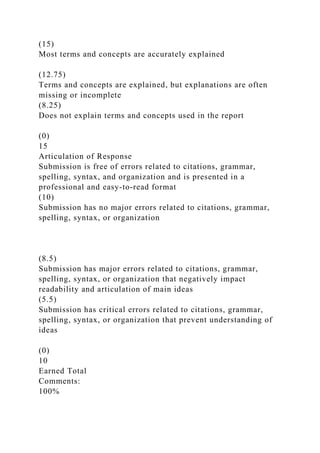
Terms and Concepts
All terms and concepts are clearly and accurately explained
(15)
Most terms and concepts are accurately explained
(12.75)
Terms and concepts are explained, but explanations are often
missing or incomplete
(8.25)
Does not explain terms and concepts used in the report
(0)
15
Articulation of Response
Submission is free of errors related to citations, grammar,
spelling, syntax, and organization and is presented in a
professional and easy-to-read format
(10)
Submission has no major errors related to citations, grammar,
spelling, syntax, or organization
(8.5)
Submission has major errors related to citations, grammar,
spelling, syntax, or organization that negatively impact
readability and articulation of main ideas
(5.5)
Submission has critical errors related to citations, grammar,
spelling, syntax, or organization that prevent understanding of
ideas
(0)
10
Earned Total
Comments:
100%
IT 340: FinalProject Guidelines and Grading Guide
Overview
The final project for this course is the creation of
a networking report that outlines the
business and technical network requirements for a
fictional
advertising agency. The report will include
strategies for WAN connectivity, IP addressing,
and wireless access, along with the business
and technical
rationale for the recommendations. Terms and
concepts used in the report must also be
explained clearly and thoroughly.
The project includes two milestones submitted in
Modules Three and Five.The final project is
submitted in Module Seven.
In this assignment, you will demonstrate your mastery
of the following course outcomes:
• Understand the language, theory, and concepts
involved in telecommunications and networks
• Understand the relationship between networking
technology, network services, and business
• Demonstrate practical hands-on competency with
networking hardware and software
• Present and communicate networking concepts to
others
Prompt
The scenario: Newton Ad Agency is a startup
with threelocations. The headquarters is located in
Austin, TX, with a satellite office located 2
miles
awayin a rural area. There is a clear line of
sight between the two offices. The New York office
needs to share largemedia files with the
Austin
office. The New York office will also have a web
server for clients to download largemedia
files and needs to be able to do it
quickly.
To hire the best talents, Newton Ad Agency allows
employees to work from home full-time. Remote
workers will need access to the network in
Austin. The IT Department should have the ability
to log into all of the workstations, including
the remote computers, when they are
connected to
the network.
You have been hiredas the network administrator. You
are tasked with building the network IP
strategy, building a remote access strategy,
and
selecting WAN technologies that meet the business
requirements. As one of your first tasks, you
have been asked to develop a proposal for
the
management team. These members have varying
backgrounds and sometimes limited knowledge
of IT services.
IT 340: FinalProject Guidelines and Grading
Guide
Overview
The final project for this course is the creation of
a networking report that outlines the
business and technical network requirements for a
fictional
advertising agency. The report will include
strategies for WAN connectivity, IP addressing,
and wireless access, along with the business
and technical
rationale for the recommendations. Terms and
concepts used in the report must also be
explained clearly and thoroughly.
The project includes two milestones submitted in
Modules Three and Five.The final project is
submitted in Module Seven.
In this assignment, you will demonstrate your mastery
of the following course outcomes:
• Understand the language, theory, and concepts
involved in telecommunications and networks
• Understand the relationship between networking
technology, network services, and business
• Demonstrate practical hands-on competency with
networking hardware and software
• Present and communicate networking concepts to
others
Prompt
The scenario: Newton Ad Agency is a startup
with threelocations. The headquarters is located in
Austin, TX, with a satellite office located 2
miles
awayin a rural area. There is a clear line of
sight between the two offices. The New York office
needs to share largemedia files with the
Austin
office. The New York office will also have a web
server for clients to download largemedia
files and needs to be able to do it
quickly.
To hire the best talents, Newton Ad Agency allows
employees to work from home full-time. Remote
workers will need access to the network in
Austin. The IT Department should have the ability
to log into all of the workstations, including
the remote computers, when they are
connected to
the network.
You have been hiredas the network administrator. You
are tasked with building the network IP
strategy, building a remote access strategy,
and
selecting WAN technologies that meet the business
requirements. As one of your first tasks, you
have been asked to develop a proposal for
the
management team. These members have varying
backgrounds and sometimes limited knowledge
of IT services.
IT 340: Final Project Guidelines and Grading Guide
Overview
The final project for this course is the creation of a networking
report that outlines the business and technical network
requirements for a fictional advertising agency. The report will
include strategies for WAN connectivity, IP addressing, and
wireless access, along with the business and technical rationale
for the recommendations. Terms and concepts used in the report
must also be explained clearly and thoroughly.
The project includes two milestones submitted in Modules
Three and Five. The final project is submitted in Module Seven.
In this assignment, you will demonstrate your mastery of the
following course outcomes:
· Understand the language, theory, and concepts involved in
telecommunications and networks
· Understand the relationship between networking technology,
network services, and business
· Demonstrate practical hands-on competency with networking
hardware and software
· Present and communicate networking concepts to others
Prompt
The scenario: Newton Ad Agency is a startup with three
locations. The headquarters is located in Austin, TX, with a
satellite office located 2 miles away in a rural area. There is a
clear line of sight between the two offices. The New York
office needs to share large media files with the Austin office.
The New York office will also have a web server for clients to
download large media files and needs to be able to do it
quickly.
To hire the best talents, Newton Ad Agency allows employees
to work from home full-time. Remote workers will need access
to the network in Austin. The IT Department should have the
ability to log into all of the workstations, including the remote
computers, when they are connected to the network.
You have been hired as the network administrator. You are
tasked with building the network IP strategy, building a remote
access strategy, and selecting WAN technologies that meet the
business requirements. As one of your first tasks, you have been
asked to develop a proposal for the management team. These
members have varying backgrounds and sometimes limited
knowledge of IT services.
Newton Ad Agency: Business and Technical Requirements
1. Spend no more than $1,100 per month on internet for all sites
(after initial hardware and setup costs)
2. The company IP addresses should be within the following
range: 192.168.100.0–192.168.103.255
Austin Headquarters: Business and Technical Requirements
1. Fast WAN connectivity
2. Must have backup WAN connectivity with 99.999% uptime
3. IP addresses must support 500 hosts
4. Must provide wireless access for users
5. All wireless connectivity must be centrally managed
Austin Headquarters: Available Internet Options
1. Fiber Optics ($700)
2. T1 ($300)
3. Cable ($175)
4. DSL ($75)
New York Office: Business and Technical Requirements
1. Fast WAN connectivity
2. IP address strategy for 200 users/PCs
New York Office: Available Internet Options
1. Fiber Optics ($600)
2. T1 ($300)
3. Cable ($125)
4. DSL ($50)
Rural Satellite Office: Business and Technical Requirements
1. Does not have any type of commercial WAN connectivity
2. Needs to have WAN connectivity (located 2 miles from
headquarters and line of sight—show this in a diagram)
3. IP address strategy needs to support 200 users/PCs
Critical Elements
Based on the scenario above, students will develop a 5- to 7-
page networking report for the owners of the advertising
agency. The report must include the following:
1. The WAN connectivity at each location
2. A diagram showing the WAN connectivity
3. An explanation of why the specific WAN technology was
chosen
4. IP address strategies at each location
5. Wireless access strategy at the Austin office
a) List and explain the services that will support remote workers
b) List and explain the service(s) that IT will use to access all
workstations on the network
6. An explanation of the terms and concepts used in the paper
Milestones
Milestone One: IP Assignments
In task 3-3,you will submit the IP assignments for each site
along with the calculations on how you subnetted the addresses.
This milestone is graded with the Final Project Milestone One:
IP Assignments Rubric.
Milestone Two: WAN Technology Requirements
In task 5-2, you will submit a report on the WAN technologies
chosen for each site, along with a diagram showing the
connectivity. This milestone is graded with the Final Project
Milestone Two: WAN Technology Requirements Rubric.
Final Submission: Networking Report
In task 7-2, you will submit the final networking report for the
advertising agency scenario. It should be a complete, polished
artifact containing all of the critical elements of the final
product. It should reflect the incorporation of feedback gained
throughout the course. This will be graded using the Final
Product Rubric (below).
Final Product Rubric
Format: Written components of project must follow these
formatting guidelines when applicable: double spacing, 12-point
Times New Roman font, one-inch margins, and discipline-
appropriate citations. The paper should be 5 to 7 pages, not
including cover page and resources.
Instructor Feedback: Students can find their feedback in the
Grade Center.
Critical Elements
Exemplary
Proficient
Needs Improvement
Not Evident
Value
WAN Connectivity
Recommends an effective WAN connectivity solution that fully
meets the requirements of each office
(15)
Recommends a WAN connectivity solution that generally meets
the requirements of each office
(12.75)
Recommends a WAN connectivity solution, but does not
adequately address the requirements of each office
(8.25)
Does not recommend a WAN connectivity solution for each
office
(0)
15
WAN Diagram
Provides a professional-quality diagram that fully illustrates the
proposed WAN solution
(15)
Provides a high-quality diagram that illustrates the proposed
WAN solution
(12.75)
Provides a diagram that does not fully illustrate the proposed
WAN solution
(8.25)
Does not provide a diagram that illustrates the proposed WAN
solution
(0)
15
Explanation of WAN Decisions
Provides a clear, concise, and complete explanation of why
specific WAN technologies were chosen
(10)
Provides a generally effective explanation of why specific WAN
technologies were chosen
(8.5)
Provides an incomplete or inadequate explanation of why WAN
technologies were chosen
(5.5)
Does not provide an explanation of why WAN technologies
were chosen
(0)
10
Wireless Access Strategy at the Austin Office
Describes an effective wireless access strategy that fully
addresses the stated requirements
(15)
Describes a wireless access strategy that addresses most of the
stated requirements
(12.75)
Describes a wireless access strategy that does not adequately
address stated requirements
(8.25)
Does not describe a wireless strategy that addresses the stated
requirements
(0)
15
Services for Remote Workers
Provides a clear, concise, and complete explanation of proposed
services for remote workers
(10)
Provides an accurate explanation of proposed services for
remote workers
(8.5)
Provides an explanation of proposed services for remote
workers, but the suggested solution is inadequate or unclear
(5.5)
Does not provide an explanation of proposed services for
remote workers
(0)
10
Services for IT Access
Provides a clear, concise, and complete explanation of remote
access IT services that meet stated requirements
(10)
Provides an adequate explanation of remote access IT services
that meet most of the stated requirements
(8.5)
Provides an inadequate explanation of remote access IT services
(6)
Does not provide an explanation of remote access IT services
(0)
10
Terms and Concepts
All terms and concepts are clearly and accurately explained
(15)
Most terms and concepts are accurately explained
(12.75)
Terms and concepts are explained, but explanations are often
missing or incomplete
(8.25)
Does not explain terms and concepts used in the report
(0)
15
Articulation of Response
Submission is free of errors related to citations, grammar,
spelling, syntax, and organization and is presented in a
professional and easy-to-read format
(10)
Submission has no major errors related to citations, grammar,
spelling, syntax, or organization
(8.5)
Submission has major errors related to citations, grammar,
spelling, syntax, or organization that negatively impact
readability and articulation of main ideas
(5.5)
Submission has critical errors related to citations, grammar,
spelling, syntax, or organization that prevent understanding of
ideas
(0)
10
Earned Total
Comments:
100%
Running head: BACTERIOPHAGE THERAPY 1
BACTERIOPHAGE THERAPY 2
BACTERIOPHAGE THERAPY ON Pseudomonas aeruginosa
NAME: Roaya Alhawsawi
LIU
11/13/2016
BACTERIOPHAGE THERAPY ON Pseudomonas aeruginosa
Introduction
Bacteriophages are viruses that infect bacteria and replicate
within the bacterial cell wall. Most have double-stranded DNA
genomes found in heads with icosahedral symmetry, and their
tails vary in length. All bacteriophages are classified in the
order Caudovirales and belong to the families Myoviridae (long,
contractile tail), Siphoviridae (long, non-contractile tail)and
Podoviridae (short, non-contractile tail) (Harper & Enright,
2011). Bacteriophages were first discovered by Fredrick Twort
and Felix D’Herelle in 1915. Since then, bacteriophages started
being widely used for treating bacterial infections. This,
however, did not last long as chemical antibiotics were
discovered and preferred because bacteriophages were not well
understood and their efficacy was controversial. Things have
now changed due to the development of antibiotic-resistant
bacterial strains and bacteriophages have started being used
again. Comment by Daniel Ginsburg: You need more
background on phage. Life cycle. Lytic vs. lysogenic, etc.
Pseudomonas aeruginosa is a multidrug-resistant Gram-negative
bacteria that causes infections in the lungs of cystic fibrosis
patients and is a regular cause of hospital-acquired bacterial
pneumonia and ventilator-associated pneumonia. Since
bacteriophages are capable of reaching bacteria protected within
biofilms (such as those found in the lungs of patients with
cystic fibrosis), they are being considered as an alternative
treatment to antibiotics. Comment by Daniel Ginsburg: You
need more about P. aeruginosa. How many people get it every
year? It is lethal? Who is infected? You should get some
statistics from the CDC or WHO. I would also start with this
and then talk about phage.
You should also talk about the developent of drug resistance.
What are they resistant to?
Types of P.aeruginosa bacteriophages
Many P.aeruginosa bacteriophages have been discovered,
and they are classified into at least seven genera of lytic
phages. These include T7-like, ɸKMV-like, LUZ24- like, N4-
like, PB1-like, ɸKZ-like and JG004-like including a similar
number of temperate genera.(Essoh et al., 2013). Therapeutic
bacteriophage cocktails such as “pyophage” have also been
formulated. “Pyophage” contains many different phages that
target streptococcus, staphylococcus, Escherichia coli, proteus
and P. aeruginosa. Comment by Daniel Ginsburg: How are
these different from each other?
In- vitro and In- vivo Phage Trials
Many in-vitro and in-vivo phage trials have been conducted on
animal models and human patients. In in-vitro trials, the
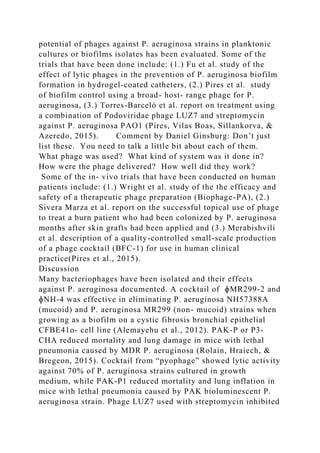
potential of phages against P. aeruginosa strains in planktonic
cultures or biofilms isolates has been evaluated. Some of the
trials that have been done include: (1.) Fu et al. study of the
effect of lytic phages in the prevention of P. aeruginosa biofilm
formation in hydrogel-coated catheters, (2.) Pires et al. study
of biofilm control using a broad- host- range phage for P.
aeruginosa, (3.) Torres-Barceló et al. report on treatment using
a combination of Podoviridae phage LUZ7 and streptomycin
against P. aeruginosa PAO1 (Pires, Vilas Boas, Sillankorva, &
Azeredo, 2015). Comment by Daniel Ginsburg: Don’t just
list these. You need to talk a little bit about each of them.
What phage was used? What kind of system was it done in?
How were the phage delivered? How well did they work?
Some of the in- vivo trials that have been conducted on human
patients include: (1.) Wright et al. study of the the efficacy and
safety of a therapeutic phage preparation (Biophage-PA), (2.)
Sivera Marza et al. report on the successful topical use of phage
to treat a burn patient who had been colonized by P. aeruginosa
months after skin grafts had been applied and (3.) Merabishvili
et al. description of a quality-controlled small-scale production
of a phage cocktail (BFC-1) for use in human clinical
practice(Pires et al., 2015).
Discussion
Many bacteriophages have been isolated and their effects
against P. aeruginosa documented. A cocktail of ɸMR299-2 and
ɸNH-4 was effective in eliminating P. aeruginosa NH57388A
(mucoid) and P. aeruginosa MR299 (non- mucoid) strains when
growing as a biofilm on a cystic fibrosis bronchial epithelial
CFBE41o- cell line (Alemayehu et al., 2012). PAK-P or P3-
CHA reduced mortality and lung damage in mice with lethal
pneumonia caused by MDR P. aeruginosa (Rolain, Hraiech, &
Bregeon, 2015). Cocktail from “pyophage” showed lytic activity
against 70% of P. aeruginosa strains cultured in growth
medium, while PAK-P1 reduced mortality and lung inflation in
mice with lethal pneumonia caused by PAK bioluminescent P.
aeruginosa strain. Phage LUZ7 used with streptomycin inhibited
growth of the P. aeruginosa PAOI strain, while Engineered T7
phage with aiiA gene inhibited biofilm formation in the P.
aeruginosa PAOI strain. Phage PB-1 and tobramycin reduced
resistance to tobramycin in the P. aeruginosa PAOI strain
(Rolain et al., 2015). Phage P2-10Ab01 isolated from sewage
water in Abidjan could lyse two pyophage-resistant strains, C7-
6 and C9-5, and PAP3 was capable of lysogenization (Essoh et
al., 2013). Comment by Daniel Ginsburg: How effective?
Comment by Daniel Ginsburg: How were the phage
delivered? Comment by Daniel Ginsburg: What is this?
Comment by Daniel Ginsburg: You need a little more
detail about each of these. How did they work? How was the
experiment done?
Quorum Sensing Inhibition
Since hydrolyzing acyl homoserine lactonases can decrease in
vivo virulence of P. aeruginosa and in vitro biofilm production,
bacteriophages can be modified genetically to produce
lactonase, which would facilitate inhibition of P.aeruginosa
biofilm production (Rolain et al., 2015). … Comment by
Daniel Ginsburg: How do these work?
I don’t understand what this has to do with quoroum sensing.
Mechanism of Bacteriophage Resistance
Even though bacteriophage therapy has made headway in the
treatment of bacterial infections, the issue of bacteria that are
resistant to phages has come up. The mechanisms of bacterial
resistance to phages drive the evolution of both bacteria and
bacteriophages, and ongoing isolation of new bacteriophages
targeting various hosts and host receptors is, therefore,
necessary. Bacterial resistance to phages may involve three
mechanisms: inhibition of the adsorption of phages on the
bacteria and injection of DNA, use of restriction enzymes to
degrade phage DNA and the CRISPR- Cas system that gives
bacteria immunity against the phages (Essoh et al., 2013). The
CRISPR-Cas mediates interference against certain types of
temperate phages. However, some phages found in the Mu- like
genus have been found to carry genes that can inactivate the
system.
Challenges Facing Use of Bactereophages
The potential disadvantages of bacteriophages can be
categorized into four: phage selection, phage-host- range
limitation uniqueness of phages as pharmaceuticals and
unfamiliarity with phages (Loc-Carrillo & Abedon, 2011). Not
all phages are good for therapeutics since some of them may
cause the development of immunogenic reactions due to large
uncontrolled amounts of phages in circulation (Paul et al.,
2011). However, use of bacteriophages devoid of endotoxins
should not induce a strong stimulation of the pro-inflammatory
markers (Morello et al., 2011).
Conclusion
In this therapy, isolation of bacteriophage using the strain from
the patient is preferred over using readymade phages (Henry,
Lavigne, & Debarbieux, 2013). Moreover, bioluminescent
bacteria can be used to compare several bacteriophages, so as to
establish candidates for therapeutics based on their real in vivo
efficacy instead of they are in vitro performance (Debarbieux et
al., 2010). With a combination of proper selection of phages,
proper formulation and improved clinical understanding of how
phages work, bacteriophage could easily become the most
effective way for treating bacterial infections. Comment by
Daniel Ginsburg: As I see it, everything up to this point is
Body. This would be your Discussion and it needs to be
expanded. Can you talk more about isolating phage from
patients, using bioluminescent bacteria, etc.?
References
Alemayehu, D., Casey, P. G., McAuliffe, O., Guinane, C. M.,
Martin, J. G., Shanahan, F., … Hill, C. (2012). Bacteriophages
φMR299-2 and φNH-4 can eliminate Pseudomonas aeruginosa
in the murine lung and on cystic fibrosis lung airway cells.
mBio, 3(2), e00029-12. http://doi.org/10.1128/mBio.00029-12
Debarbieux, L., Leduc, D., Maura, D., Morello, E., Criscuolo,
A., Grossi, O., … Touqui, L. (2010). Bacteriophages can treat
and prevent Pseudomonas aeruginosa lung infections. The
Journal of Infectious Diseases, 201(7), 1096–104.
http://doi.org/10.1086/651135
Essoh, C., Blouin, Y., Loukou, G., Cablanmian, A., Lathro, S.,
Kutter, E., … Qimron, U. (2013). The Susceptibility of
Pseudomonas aeruginosa Strains from Cystic Fibrosis Patients
to Bacteriophages. PLoS ONE, 8(4), e60575.
http://doi.org/10.1371/journal.pone.0060575
Harper, D. R., & Enright, M. C. (2011). Bacteriophages for the
treatment of Pseudomonas aeruginosa infections. Journal of
Applied Microbiology, 111(1), 1–7.
http://doi.org/10.1111/j.1365-2672.2011.05003.x
Henry, M., Lavigne, R., & Debarbieux, L. (2013). Predicting in
vivo efficacy of therapeutic bacteriophages used to treat
pulmonary infections. Antimicrobial Agents and Chemotherapy,
57(12), 5961–5968. http://doi.org/10.1128/AAC.01596-13
Loc-Carrillo, C., & Abedon, S. T. (2011). Pros and cons of
phage therapy. Bacteriophage, 1(2), 111–114.
http://doi.org/10.4161/bact.1.2.14590
Morello, E., Saussereau, E., Maura, D., Huerre, M., Touqui, L.,
& Debarbieux, L. (2011). Pulmonary bacteriophage therapy on
Pseudomonas aeruginosa cystic fibrosis strains: first steps
towards treatment and prevention. PloS One, 6(2), e16963.
http://doi.org/10.1371/journal.pone.0016963
Paul, V., Sundarrajan, S., Rajagopalan, S., Hariharan, S.,
Kempashanaiah, N., Padmanabhan, S., … Watson, J. (2011).
Lysis-deficient phages as novel therapeutic agents for
controlling bacterial infection. BMC Microbiology, 11(1), 195.
http://doi.org/10.1186/1471-2180-11-195
Pires, D. P., Vilas Boas, D., Sillankorva, S., & Azeredo, J.
(2015). Phage Therapy: a Step Forward in the Treatment of
Pseudomonas aeruginosa Infections. Journal of Virology,
89(15), 7449–56. http://doi.org/10.1128/JVI.00385-15
Rolain, J.-M., Hraiech, S., & Bregeon, F. (2015).
Bacteriophage-based therapy in cystic fibrosis-associated
Pseudomonas aeruginosa infections: rationale and current
status. Drug Design, Development and Therapy, Volume 9,
3653. http://doi.org/10.2147/DDDT.S53123
Running head: IT 340 MILESTONE TWO 1
WAN CONFIGURATIONWireless Access Network Plan
27 November 2016
Southern New Hampshire University
Wireless Access Network Plan
Newton Ad Agency is a start up with three locations; two
offices located in Austin, (headquarters rural satellite office) as
well as one office in New York. To connect all three offices, a
WAN configuration must be created. The network requires a
fast connectivity to support large files for all workstations and
remote users. To complete this task a recommendation for WAN
technology will be proposed along with a picture diagram to
visualize the overall WAN connectivity.
A wide area network (WAN) is a geographically distributed
private telecommunications network that interconnects multiple
local area networks (LANs); In an enterprise, a WAN may
consist of connections to a company's headquarters, branch
offices, colocation facilities, cloud services and other facilities
(Rouse, 2016). For the Newton Ad Agency each branch office
will be connected using a single dedicated private network that
is point to point between Austin, New York, and the Satellite
office. The Austin office will be the main support of the
Internet connection using a public internet link. To support the
connection, it is recommended to use a Hybrid WAN with
MPLS. MPLS will reduce the cost of WAN Bandwidth with an
average savings of 17 percent, while providing a guaranteed
performance for real-time, IP-based applications such as voice
and video (Sturt, 2015). A solid Hybrid WAN is underpinned by
solid integration between private IP to ensure performance
(Sturt, 2015).
The multi-protocol label switching will be a great fit for fast
connectivity for the main headquarters and New York offices,
which is used for high-performance telecommunications. Austin
headquarters will have a local area network with two WAN
connections. There will be a direct-to-public internet service as
well as a managed WAN provider that provides routing traffic
to each branch. Two routers will be used for the public internet
and access to the private WAN. Lastly, the internet connectivity
will be secured using a secure virtual private connection. Below
is an example of the WAN connection. The connection will
ensure performance and guarantee the WAN is sufficient for
future business needs.
Cloud
References
Rouse, M. (2016, October). What is WAN (wide area network)?
- Definition from WhatIs.com. Retrieved from
http://searchenterprisewan.techtarget.com/definition/WAN
Sturt. (2015, March). What is a hybrid WAN service? Retrieved
from http://searchnetworking.techtarget.com/answer/What-is-a-
hybrid-WAN-service
IT 340 Network Telecommunications
13 November 2016
Milestone One: IP Assignments
Newton Ad Agency is a start-up business with two locations in
Austin, TX; the main headquarters and the Rural Satellite office
located two miles from the central hub as well as a location in
New York. The business and technical necessities require IP
addresses assigned within the range of 192.168.100.0-
192.168.103.255. The Rural Satellite Office and the New York
office must support 200 PC users each respectively, and the
Austin headquarters will need to support 500 hosts. To complete
this task, each location will be assigned a designated IP address
over a Virtual Private Network to create an encrypted
connection allowing the appropriate level of security for the
connected systems when the underlying network infrastructure
alone cannot provide it (Rouse, 2016). In addition, a remote
access VPN would be beneficial, providing secure access to the
remote user organization’s network, all while keeping in
budget.
To complete IP assignments for each location, we need to
identify the class of our starting IP 192.168.100.0 or
11000000.1010100.01100100.00000000. By looking at the first
three numbers of the IP, we can establish that the IP addresses
for each location will be in class C, with a default subnet mask
of 255.255.255.0. All addresses assigned will be 32 bit IPv4,
meaning Each byte, or 8-bit segment of the address is divided
by a period and typically expressed as a number 0-255
(Ellingwood,2014). The Austin headquarters being the largest
requires 500 hosts will need two assigned IP addresses, the
default subnet falls under a /24, which is a total of 2^8=256-2=
254 possible hosts. We need 500 hosts for Austin, so the next
possible CIDR to use would be /23 totaling to 2^9-2= 510
possible hosts. The binary subnet would be
11111111.11111111.11111110.00000000 for Austin making the
IP addresses 192.168.100.0/23 and 192.168.101.0/23. The hosts'
addresses will be 192.168.100.1 to 192.168.101.1 allocating to
510 hosts for Austin headquarters with a subnet mask of
255.255.254.0.
For the New York and Rural Satellite offices both require
200 hosts a piece, equivalent to 2^8-2=254 hosts total for each
office with a /24= 11111111.11111111.11111111.00000000.
The New York office will run on the IP address
192.168.102.0/24 with hosts addresses of 192.168.102.1 to
192.168.102.254. Lastly, you have the Rural Satellite office that
will have an assigned IP of 192.168.103.0/24 with hosts
addresses ranging from 192.168.103.1 to 192.168.103.254. The
New York and Rural Satellite office will have an identical
subnet mask of 255.255.255.0.

IT 340 Final Project Guidelines and Grading GuideOverviewTh.docx

  • 1.
    IT 340: FinalProject Guidelines and Grading Guide Overview The final project for this course is the creation of a networking report that outlines the business and technical network requirements for a fictional advertising agency. The report will include strategies for WAN connectivity, IP addressing, and wireless access, along with the business and technical rationale for the recommendations. Terms and concepts used in the report must also be explained clearly and thoroughly. The project includes two milestones submitted in Modules Three and Five. The final project is submitted in Module Seven. In this assignment, you will demonstrate your mastery of the following course outcomes: · Understand the language, theory, and concepts involved in telecommunications and networks · Understand the relationship between networking technology, network services, and business · Demonstrate practical hands-on competency with networking hardware and software · Present and communicate networking concepts to others Prompt The scenario: Newton Ad Agency is a startup with three locations. The headquarters is located in Austin, TX, with a satellite office located 2 miles away in a rural area. There is a clear line of sight between the two offices. The New York office needs to share large media files with the Austin office. The New York office will also have a web server for clients to download large media files and needs to be able to do it quickly.
  • 2.
    To hire thebest talents, Newton Ad Agency allows employees to work from home full-time. Remote workers will need access to the network in Austin. The IT Department should have the ability to log into all of the workstations, including the remote computers, when they are connected to the network. You have been hired as the network administrator. You are tasked with building the network IP strategy, building a remote access strategy, and selecting WAN technologies that meet the business requirements. As one of your first tasks, you have been asked to develop a proposal for the management team. These members have varying backgrounds and sometimes limited knowledge of IT services. Newton Ad Agency: Business and Technical Requirements 1. Spend no more than $1,100 per month on internet for all sites (after initial hardware and setup costs) 2. The company IP addresses should be within the following range: 192.168.100.0–192.168.103.255 Austin Headquarters: Business and Technical Requirements 1. Fast WAN connectivity 2. Must have backup WAN connectivity with 99.999% uptime 3. IP addresses must support 500 hosts 4. Must provide wireless access for users 5. All wireless connectivity must be centrally managed Austin Headquarters: Available Internet Options 1. Fiber Optics ($700)
  • 3.
    2. T1 ($300) 3.Cable ($175) 4. DSL ($75) New York Office: Business and Technical Requirements 1. Fast WAN connectivity 2. IP address strategy for 200 users/PCs New York Office: Available Internet Options 1. Fiber Optics ($600) 2. T1 ($300) 3. Cable ($125) 4. DSL ($50) Rural Satellite Office: Business and Technical Requirements 1. Does not have any type of commercial WAN connectivity 2. Needs to have WAN connectivity (located 2 miles from headquarters and line of sight—show this in a diagram) 3. IP address strategy needs to support 200 users/PCs Critical Elements Based on the scenario above, students will develop a 5- to 7- page networking report for the owners of the advertising agency. The report must include the following: 1. The WAN connectivity at each location 2. A diagram showing the WAN connectivity 3. An explanation of why the specific WAN technology was chosen 4. IP address strategies at each location 5. Wireless access strategy at the Austin office
  • 4.
    a) List andexplain the services that will support remote workers b) List and explain the service(s) that IT will use to access all workstations on the network 6. An explanation of the terms and concepts used in the paper Milestones Milestone One: IP Assignments In task 3-3,you will submit the IP assignments for each site along with the calculations on how you subnetted the addresses. This milestone is graded with the Final Project Milestone One: IP Assignments Rubric. Milestone Two: WAN Technology Requirements In task 5-2, you will submit a report on the WAN technologies chosen for each site, along with a diagram showing the connectivity. This milestone is graded with the Final Project Milestone Two: WAN Technology Requirements Rubric. Final Submission: Networking Report In task 7-2, you will submit the final networking report for the advertising agency scenario. It should be a complete, polished artifact containing all of the critical elements of the final product. It should reflect the incorporation of feedback gained throughout the course. This will be graded using the Final Product Rubric (below). Final Product Rubric Format: Written components of project must follow these formatting guidelines when applicable: double spacing, 12-point Times New Roman font, one-inch margins, and discipline- appropriate citations. The paper should be 5 to 7 pages, not including cover page and resources. Instructor Feedback: Students can find their feedback in the Grade Center.
  • 5.
    Critical Elements Exemplary Proficient Needs Improvement NotEvident Value WAN Connectivity Recommends an effective WAN connectivity solution that fully meets the requirements of each office (15) Recommends a WAN connectivity solution that generally meets the requirements of each office (12.75) Recommends a WAN connectivity solution, but does not adequately address the requirements of each office (8.25) Does not recommend a WAN connectivity solution for each office (0) 15 WAN Diagram Provides a professional-quality diagram that fully illustrates the proposed WAN solution (15) Provides a high-quality diagram that illustrates the proposed WAN solution (12.75) Provides a diagram that does not fully illustrate the proposed WAN solution (8.25) Does not provide a diagram that illustrates the proposed WAN solution (0) 15
  • 6.
    Explanation of WANDecisions Provides a clear, concise, and complete explanation of why specific WAN technologies were chosen (10) Provides a generally effective explanation of why specific WAN technologies were chosen (8.5) Provides an incomplete or inadequate explanation of why WAN technologies were chosen (5.5) Does not provide an explanation of why WAN technologies were chosen (0) 10 Wireless Access Strategy at the Austin Office Describes an effective wireless access strategy that fully addresses the stated requirements (15) Describes a wireless access strategy that addresses most of the stated requirements (12.75) Describes a wireless access strategy that does not adequately address stated requirements (8.25) Does not describe a wireless strategy that addresses the stated requirements (0) 15 Services for Remote Workers Provides a clear, concise, and complete explanation of proposed
  • 7.
    services for remoteworkers (10) Provides an accurate explanation of proposed services for remote workers (8.5) Provides an explanation of proposed services for remote workers, but the suggested solution is inadequate or unclear (5.5) Does not provide an explanation of proposed services for remote workers (0) 10 Services for IT Access Provides a clear, concise, and complete explanation of remote access IT services that meet stated requirements (10) Provides an adequate explanation of remote access IT services that meet most of the stated requirements (8.5) Provides an inadequate explanation of remote access IT services (6) Does not provide an explanation of remote access IT services (0) 10 Terms and Concepts All terms and concepts are clearly and accurately explained (15) Most terms and concepts are accurately explained
  • 8.
    (12.75) Terms and conceptsare explained, but explanations are often missing or incomplete (8.25) Does not explain terms and concepts used in the report (0) 15 Articulation of Response Submission is free of errors related to citations, grammar, spelling, syntax, and organization and is presented in a professional and easy-to-read format (10) Submission has no major errors related to citations, grammar, spelling, syntax, or organization (8.5) Submission has major errors related to citations, grammar, spelling, syntax, or organization that negatively impact readability and articulation of main ideas (5.5) Submission has critical errors related to citations, grammar, spelling, syntax, or organization that prevent understanding of ideas (0) 10 Earned Total Comments: 100%
  • 9.
    IT 340: FinalProjectGuidelines and Grading Guide Overview The final project for this course is the creation of a networking report that outlines the business and technical network requirements for a fictional advertising agency. The report will include strategies for WAN connectivity, IP addressing, and wireless access, along with the business and technical rationale for the recommendations. Terms and concepts used in the report must also be explained clearly and thoroughly. The project includes two milestones submitted in Modules Three and Five.The final project is submitted in Module Seven. In this assignment, you will demonstrate your mastery of the following course outcomes: • Understand the language, theory, and concepts involved in telecommunications and networks • Understand the relationship between networking technology, network services, and business • Demonstrate practical hands-on competency with networking hardware and software • Present and communicate networking concepts to others
  • 10.
    Prompt The scenario: NewtonAd Agency is a startup with threelocations. The headquarters is located in Austin, TX, with a satellite office located 2 miles awayin a rural area. There is a clear line of sight between the two offices. The New York office needs to share largemedia files with the Austin office. The New York office will also have a web server for clients to download largemedia files and needs to be able to do it quickly. To hire the best talents, Newton Ad Agency allows employees to work from home full-time. Remote workers will need access to the network in Austin. The IT Department should have the ability to log into all of the workstations, including the remote computers, when they are connected to the network. You have been hiredas the network administrator. You are tasked with building the network IP strategy, building a remote access strategy, and selecting WAN technologies that meet the business requirements. As one of your first tasks, you have been asked to develop a proposal for the management team. These members have varying backgrounds and sometimes limited knowledge of IT services.
  • 11.
    IT 340: FinalProjectGuidelines and Grading Guide Overview The final project for this course is the creation of a networking report that outlines the business and technical network requirements for a fictional advertising agency. The report will include strategies for WAN connectivity, IP addressing, and wireless access, along with the business and technical rationale for the recommendations. Terms and concepts used in the report must also be explained clearly and thoroughly. The project includes two milestones submitted in Modules Three and Five.The final project is submitted in Module Seven. In this assignment, you will demonstrate your mastery of the following course outcomes: • Understand the language, theory, and concepts involved in telecommunications and networks • Understand the relationship between networking technology, network services, and business • Demonstrate practical hands-on competency with networking hardware and software • Present and communicate networking concepts to
  • 12.
    others Prompt The scenario: NewtonAd Agency is a startup with threelocations. The headquarters is located in Austin, TX, with a satellite office located 2 miles awayin a rural area. There is a clear line of sight between the two offices. The New York office needs to share largemedia files with the Austin office. The New York office will also have a web server for clients to download largemedia files and needs to be able to do it quickly. To hire the best talents, Newton Ad Agency allows employees to work from home full-time. Remote workers will need access to the network in Austin. The IT Department should have the ability to log into all of the workstations, including the remote computers, when they are connected to the network. You have been hiredas the network administrator. You are tasked with building the network IP strategy, building a remote access strategy, and selecting WAN technologies that meet the business requirements. As one of your first tasks, you have been asked to develop a proposal for the management team. These members have varying backgrounds and sometimes limited knowledge of IT services.
  • 13.
    IT 340: FinalProject Guidelines and Grading Guide Overview The final project for this course is the creation of a networking report that outlines the business and technical network requirements for a fictional advertising agency. The report will include strategies for WAN connectivity, IP addressing, and wireless access, along with the business and technical rationale for the recommendations. Terms and concepts used in the report must also be explained clearly and thoroughly. The project includes two milestones submitted in Modules Three and Five. The final project is submitted in Module Seven. In this assignment, you will demonstrate your mastery of the following course outcomes: · Understand the language, theory, and concepts involved in telecommunications and networks · Understand the relationship between networking technology, network services, and business · Demonstrate practical hands-on competency with networking hardware and software · Present and communicate networking concepts to others Prompt The scenario: Newton Ad Agency is a startup with three locations. The headquarters is located in Austin, TX, with a satellite office located 2 miles away in a rural area. There is a clear line of sight between the two offices. The New York
  • 14.
    office needs toshare large media files with the Austin office. The New York office will also have a web server for clients to download large media files and needs to be able to do it quickly. To hire the best talents, Newton Ad Agency allows employees to work from home full-time. Remote workers will need access to the network in Austin. The IT Department should have the ability to log into all of the workstations, including the remote computers, when they are connected to the network. You have been hired as the network administrator. You are tasked with building the network IP strategy, building a remote access strategy, and selecting WAN technologies that meet the business requirements. As one of your first tasks, you have been asked to develop a proposal for the management team. These members have varying backgrounds and sometimes limited knowledge of IT services. Newton Ad Agency: Business and Technical Requirements 1. Spend no more than $1,100 per month on internet for all sites (after initial hardware and setup costs) 2. The company IP addresses should be within the following range: 192.168.100.0–192.168.103.255 Austin Headquarters: Business and Technical Requirements 1. Fast WAN connectivity 2. Must have backup WAN connectivity with 99.999% uptime 3. IP addresses must support 500 hosts 4. Must provide wireless access for users
  • 15.
    5. All wirelessconnectivity must be centrally managed Austin Headquarters: Available Internet Options 1. Fiber Optics ($700) 2. T1 ($300) 3. Cable ($175) 4. DSL ($75) New York Office: Business and Technical Requirements 1. Fast WAN connectivity 2. IP address strategy for 200 users/PCs New York Office: Available Internet Options 1. Fiber Optics ($600) 2. T1 ($300) 3. Cable ($125) 4. DSL ($50) Rural Satellite Office: Business and Technical Requirements 1. Does not have any type of commercial WAN connectivity 2. Needs to have WAN connectivity (located 2 miles from headquarters and line of sight—show this in a diagram) 3. IP address strategy needs to support 200 users/PCs Critical Elements Based on the scenario above, students will develop a 5- to 7- page networking report for the owners of the advertising agency. The report must include the following: 1. The WAN connectivity at each location 2. A diagram showing the WAN connectivity 3. An explanation of why the specific WAN technology was chosen
  • 16.
    4. IP addressstrategies at each location 5. Wireless access strategy at the Austin office a) List and explain the services that will support remote workers b) List and explain the service(s) that IT will use to access all workstations on the network 6. An explanation of the terms and concepts used in the paper Milestones Milestone One: IP Assignments In task 3-3,you will submit the IP assignments for each site along with the calculations on how you subnetted the addresses. This milestone is graded with the Final Project Milestone One: IP Assignments Rubric. Milestone Two: WAN Technology Requirements In task 5-2, you will submit a report on the WAN technologies chosen for each site, along with a diagram showing the connectivity. This milestone is graded with the Final Project Milestone Two: WAN Technology Requirements Rubric. Final Submission: Networking Report In task 7-2, you will submit the final networking report for the advertising agency scenario. It should be a complete, polished artifact containing all of the critical elements of the final product. It should reflect the incorporation of feedback gained throughout the course. This will be graded using the Final Product Rubric (below). Final Product Rubric Format: Written components of project must follow these formatting guidelines when applicable: double spacing, 12-point Times New Roman font, one-inch margins, and discipline- appropriate citations. The paper should be 5 to 7 pages, not including cover page and resources.
  • 17.
    Instructor Feedback: Studentscan find their feedback in the Grade Center. Critical Elements Exemplary Proficient Needs Improvement Not Evident Value WAN Connectivity Recommends an effective WAN connectivity solution that fully meets the requirements of each office (15) Recommends a WAN connectivity solution that generally meets the requirements of each office (12.75) Recommends a WAN connectivity solution, but does not adequately address the requirements of each office (8.25) Does not recommend a WAN connectivity solution for each office (0) 15 WAN Diagram Provides a professional-quality diagram that fully illustrates the proposed WAN solution (15) Provides a high-quality diagram that illustrates the proposed WAN solution (12.75) Provides a diagram that does not fully illustrate the proposed WAN solution (8.25) Does not provide a diagram that illustrates the proposed WAN solution
  • 18.
    (0) 15 Explanation of WANDecisions Provides a clear, concise, and complete explanation of why specific WAN technologies were chosen (10) Provides a generally effective explanation of why specific WAN technologies were chosen (8.5) Provides an incomplete or inadequate explanation of why WAN technologies were chosen (5.5) Does not provide an explanation of why WAN technologies were chosen (0) 10 Wireless Access Strategy at the Austin Office Describes an effective wireless access strategy that fully addresses the stated requirements (15) Describes a wireless access strategy that addresses most of the stated requirements (12.75) Describes a wireless access strategy that does not adequately address stated requirements (8.25) Does not describe a wireless strategy that addresses the stated requirements (0) 15 Services for Remote Workers
  • 19.
    Provides a clear,concise, and complete explanation of proposed services for remote workers (10) Provides an accurate explanation of proposed services for remote workers (8.5) Provides an explanation of proposed services for remote workers, but the suggested solution is inadequate or unclear (5.5) Does not provide an explanation of proposed services for remote workers (0) 10 Services for IT Access Provides a clear, concise, and complete explanation of remote access IT services that meet stated requirements (10) Provides an adequate explanation of remote access IT services that meet most of the stated requirements (8.5) Provides an inadequate explanation of remote access IT services (6) Does not provide an explanation of remote access IT services (0) 10 Terms and Concepts All terms and concepts are clearly and accurately explained
  • 20.
    (15) Most terms andconcepts are accurately explained (12.75) Terms and concepts are explained, but explanations are often missing or incomplete (8.25) Does not explain terms and concepts used in the report (0) 15 Articulation of Response Submission is free of errors related to citations, grammar, spelling, syntax, and organization and is presented in a professional and easy-to-read format (10) Submission has no major errors related to citations, grammar, spelling, syntax, or organization (8.5) Submission has major errors related to citations, grammar, spelling, syntax, or organization that negatively impact readability and articulation of main ideas (5.5) Submission has critical errors related to citations, grammar, spelling, syntax, or organization that prevent understanding of ideas (0) 10 Earned Total Comments: 100%
  • 21.
    Running head: BACTERIOPHAGETHERAPY 1 BACTERIOPHAGE THERAPY 2 BACTERIOPHAGE THERAPY ON Pseudomonas aeruginosa NAME: Roaya Alhawsawi LIU 11/13/2016 BACTERIOPHAGE THERAPY ON Pseudomonas aeruginosa Introduction Bacteriophages are viruses that infect bacteria and replicate within the bacterial cell wall. Most have double-stranded DNA genomes found in heads with icosahedral symmetry, and their tails vary in length. All bacteriophages are classified in the order Caudovirales and belong to the families Myoviridae (long, contractile tail), Siphoviridae (long, non-contractile tail)and Podoviridae (short, non-contractile tail) (Harper & Enright, 2011). Bacteriophages were first discovered by Fredrick Twort and Felix D’Herelle in 1915. Since then, bacteriophages started being widely used for treating bacterial infections. This,
  • 22.
    however, did notlast long as chemical antibiotics were discovered and preferred because bacteriophages were not well understood and their efficacy was controversial. Things have now changed due to the development of antibiotic-resistant bacterial strains and bacteriophages have started being used again. Comment by Daniel Ginsburg: You need more background on phage. Life cycle. Lytic vs. lysogenic, etc. Pseudomonas aeruginosa is a multidrug-resistant Gram-negative bacteria that causes infections in the lungs of cystic fibrosis patients and is a regular cause of hospital-acquired bacterial pneumonia and ventilator-associated pneumonia. Since bacteriophages are capable of reaching bacteria protected within biofilms (such as those found in the lungs of patients with cystic fibrosis), they are being considered as an alternative treatment to antibiotics. Comment by Daniel Ginsburg: You need more about P. aeruginosa. How many people get it every year? It is lethal? Who is infected? You should get some statistics from the CDC or WHO. I would also start with this and then talk about phage. You should also talk about the developent of drug resistance. What are they resistant to? Types of P.aeruginosa bacteriophages Many P.aeruginosa bacteriophages have been discovered, and they are classified into at least seven genera of lytic phages. These include T7-like, ɸKMV-like, LUZ24- like, N4- like, PB1-like, ɸKZ-like and JG004-like including a similar number of temperate genera.(Essoh et al., 2013). Therapeutic bacteriophage cocktails such as “pyophage” have also been formulated. “Pyophage” contains many different phages that target streptococcus, staphylococcus, Escherichia coli, proteus and P. aeruginosa. Comment by Daniel Ginsburg: How are these different from each other? In- vitro and In- vivo Phage Trials Many in-vitro and in-vivo phage trials have been conducted on animal models and human patients. In in-vitro trials, the
  • 23.
    potential of phagesagainst P. aeruginosa strains in planktonic cultures or biofilms isolates has been evaluated. Some of the trials that have been done include: (1.) Fu et al. study of the effect of lytic phages in the prevention of P. aeruginosa biofilm formation in hydrogel-coated catheters, (2.) Pires et al. study of biofilm control using a broad- host- range phage for P. aeruginosa, (3.) Torres-Barceló et al. report on treatment using a combination of Podoviridae phage LUZ7 and streptomycin against P. aeruginosa PAO1 (Pires, Vilas Boas, Sillankorva, & Azeredo, 2015). Comment by Daniel Ginsburg: Don’t just list these. You need to talk a little bit about each of them. What phage was used? What kind of system was it done in? How were the phage delivered? How well did they work? Some of the in- vivo trials that have been conducted on human patients include: (1.) Wright et al. study of the the efficacy and safety of a therapeutic phage preparation (Biophage-PA), (2.) Sivera Marza et al. report on the successful topical use of phage to treat a burn patient who had been colonized by P. aeruginosa months after skin grafts had been applied and (3.) Merabishvili et al. description of a quality-controlled small-scale production of a phage cocktail (BFC-1) for use in human clinical practice(Pires et al., 2015). Discussion Many bacteriophages have been isolated and their effects against P. aeruginosa documented. A cocktail of ɸMR299-2 and ɸNH-4 was effective in eliminating P. aeruginosa NH57388A (mucoid) and P. aeruginosa MR299 (non- mucoid) strains when growing as a biofilm on a cystic fibrosis bronchial epithelial CFBE41o- cell line (Alemayehu et al., 2012). PAK-P or P3- CHA reduced mortality and lung damage in mice with lethal pneumonia caused by MDR P. aeruginosa (Rolain, Hraiech, & Bregeon, 2015). Cocktail from “pyophage” showed lytic activity against 70% of P. aeruginosa strains cultured in growth medium, while PAK-P1 reduced mortality and lung inflation in mice with lethal pneumonia caused by PAK bioluminescent P. aeruginosa strain. Phage LUZ7 used with streptomycin inhibited
  • 24.
    growth of theP. aeruginosa PAOI strain, while Engineered T7 phage with aiiA gene inhibited biofilm formation in the P. aeruginosa PAOI strain. Phage PB-1 and tobramycin reduced resistance to tobramycin in the P. aeruginosa PAOI strain (Rolain et al., 2015). Phage P2-10Ab01 isolated from sewage water in Abidjan could lyse two pyophage-resistant strains, C7- 6 and C9-5, and PAP3 was capable of lysogenization (Essoh et al., 2013). Comment by Daniel Ginsburg: How effective? Comment by Daniel Ginsburg: How were the phage delivered? Comment by Daniel Ginsburg: What is this? Comment by Daniel Ginsburg: You need a little more detail about each of these. How did they work? How was the experiment done? Quorum Sensing Inhibition Since hydrolyzing acyl homoserine lactonases can decrease in vivo virulence of P. aeruginosa and in vitro biofilm production, bacteriophages can be modified genetically to produce lactonase, which would facilitate inhibition of P.aeruginosa biofilm production (Rolain et al., 2015). … Comment by Daniel Ginsburg: How do these work? I don’t understand what this has to do with quoroum sensing. Mechanism of Bacteriophage Resistance Even though bacteriophage therapy has made headway in the treatment of bacterial infections, the issue of bacteria that are resistant to phages has come up. The mechanisms of bacterial resistance to phages drive the evolution of both bacteria and bacteriophages, and ongoing isolation of new bacteriophages targeting various hosts and host receptors is, therefore, necessary. Bacterial resistance to phages may involve three mechanisms: inhibition of the adsorption of phages on the bacteria and injection of DNA, use of restriction enzymes to degrade phage DNA and the CRISPR- Cas system that gives bacteria immunity against the phages (Essoh et al., 2013). The CRISPR-Cas mediates interference against certain types of temperate phages. However, some phages found in the Mu- like
  • 25.
    genus have beenfound to carry genes that can inactivate the system. Challenges Facing Use of Bactereophages The potential disadvantages of bacteriophages can be categorized into four: phage selection, phage-host- range limitation uniqueness of phages as pharmaceuticals and unfamiliarity with phages (Loc-Carrillo & Abedon, 2011). Not all phages are good for therapeutics since some of them may cause the development of immunogenic reactions due to large uncontrolled amounts of phages in circulation (Paul et al., 2011). However, use of bacteriophages devoid of endotoxins should not induce a strong stimulation of the pro-inflammatory markers (Morello et al., 2011). Conclusion In this therapy, isolation of bacteriophage using the strain from the patient is preferred over using readymade phages (Henry, Lavigne, & Debarbieux, 2013). Moreover, bioluminescent bacteria can be used to compare several bacteriophages, so as to establish candidates for therapeutics based on their real in vivo efficacy instead of they are in vitro performance (Debarbieux et al., 2010). With a combination of proper selection of phages, proper formulation and improved clinical understanding of how phages work, bacteriophage could easily become the most effective way for treating bacterial infections. Comment by Daniel Ginsburg: As I see it, everything up to this point is Body. This would be your Discussion and it needs to be expanded. Can you talk more about isolating phage from patients, using bioluminescent bacteria, etc.? References Alemayehu, D., Casey, P. G., McAuliffe, O., Guinane, C. M., Martin, J. G., Shanahan, F., … Hill, C. (2012). Bacteriophages φMR299-2 and φNH-4 can eliminate Pseudomonas aeruginosa in the murine lung and on cystic fibrosis lung airway cells. mBio, 3(2), e00029-12. http://doi.org/10.1128/mBio.00029-12 Debarbieux, L., Leduc, D., Maura, D., Morello, E., Criscuolo, A., Grossi, O., … Touqui, L. (2010). Bacteriophages can treat
  • 26.
    and prevent Pseudomonasaeruginosa lung infections. The Journal of Infectious Diseases, 201(7), 1096–104. http://doi.org/10.1086/651135 Essoh, C., Blouin, Y., Loukou, G., Cablanmian, A., Lathro, S., Kutter, E., … Qimron, U. (2013). The Susceptibility of Pseudomonas aeruginosa Strains from Cystic Fibrosis Patients to Bacteriophages. PLoS ONE, 8(4), e60575. http://doi.org/10.1371/journal.pone.0060575 Harper, D. R., & Enright, M. C. (2011). Bacteriophages for the treatment of Pseudomonas aeruginosa infections. Journal of Applied Microbiology, 111(1), 1–7. http://doi.org/10.1111/j.1365-2672.2011.05003.x Henry, M., Lavigne, R., & Debarbieux, L. (2013). Predicting in vivo efficacy of therapeutic bacteriophages used to treat pulmonary infections. Antimicrobial Agents and Chemotherapy, 57(12), 5961–5968. http://doi.org/10.1128/AAC.01596-13 Loc-Carrillo, C., & Abedon, S. T. (2011). Pros and cons of phage therapy. Bacteriophage, 1(2), 111–114. http://doi.org/10.4161/bact.1.2.14590 Morello, E., Saussereau, E., Maura, D., Huerre, M., Touqui, L., & Debarbieux, L. (2011). Pulmonary bacteriophage therapy on Pseudomonas aeruginosa cystic fibrosis strains: first steps towards treatment and prevention. PloS One, 6(2), e16963. http://doi.org/10.1371/journal.pone.0016963 Paul, V., Sundarrajan, S., Rajagopalan, S., Hariharan, S., Kempashanaiah, N., Padmanabhan, S., … Watson, J. (2011). Lysis-deficient phages as novel therapeutic agents for controlling bacterial infection. BMC Microbiology, 11(1), 195. http://doi.org/10.1186/1471-2180-11-195 Pires, D. P., Vilas Boas, D., Sillankorva, S., & Azeredo, J. (2015). Phage Therapy: a Step Forward in the Treatment of Pseudomonas aeruginosa Infections. Journal of Virology, 89(15), 7449–56. http://doi.org/10.1128/JVI.00385-15 Rolain, J.-M., Hraiech, S., & Bregeon, F. (2015). Bacteriophage-based therapy in cystic fibrosis-associated Pseudomonas aeruginosa infections: rationale and current
  • 27.
    status. Drug Design,Development and Therapy, Volume 9, 3653. http://doi.org/10.2147/DDDT.S53123 Running head: IT 340 MILESTONE TWO 1 WAN CONFIGURATIONWireless Access Network Plan 27 November 2016 Southern New Hampshire University Wireless Access Network Plan Newton Ad Agency is a start up with three locations; two offices located in Austin, (headquarters rural satellite office) as well as one office in New York. To connect all three offices, a WAN configuration must be created. The network requires a fast connectivity to support large files for all workstations and remote users. To complete this task a recommendation for WAN technology will be proposed along with a picture diagram to visualize the overall WAN connectivity. A wide area network (WAN) is a geographically distributed private telecommunications network that interconnects multiple local area networks (LANs); In an enterprise, a WAN may consist of connections to a company's headquarters, branch offices, colocation facilities, cloud services and other facilities (Rouse, 2016). For the Newton Ad Agency each branch office will be connected using a single dedicated private network that is point to point between Austin, New York, and the Satellite office. The Austin office will be the main support of the Internet connection using a public internet link. To support the connection, it is recommended to use a Hybrid WAN with MPLS. MPLS will reduce the cost of WAN Bandwidth with an average savings of 17 percent, while providing a guaranteed performance for real-time, IP-based applications such as voice
  • 28.
    and video (Sturt,2015). A solid Hybrid WAN is underpinned by solid integration between private IP to ensure performance (Sturt, 2015). The multi-protocol label switching will be a great fit for fast connectivity for the main headquarters and New York offices, which is used for high-performance telecommunications. Austin headquarters will have a local area network with two WAN connections. There will be a direct-to-public internet service as well as a managed WAN provider that provides routing traffic to each branch. Two routers will be used for the public internet and access to the private WAN. Lastly, the internet connectivity will be secured using a secure virtual private connection. Below is an example of the WAN connection. The connection will ensure performance and guarantee the WAN is sufficient for future business needs. Cloud References Rouse, M. (2016, October). What is WAN (wide area network)? - Definition from WhatIs.com. Retrieved from http://searchenterprisewan.techtarget.com/definition/WAN Sturt. (2015, March). What is a hybrid WAN service? Retrieved from http://searchnetworking.techtarget.com/answer/What-is-a- hybrid-WAN-service IT 340 Network Telecommunications 13 November 2016 Milestone One: IP Assignments Newton Ad Agency is a start-up business with two locations in Austin, TX; the main headquarters and the Rural Satellite office located two miles from the central hub as well as a location in
  • 29.
    New York. Thebusiness and technical necessities require IP addresses assigned within the range of 192.168.100.0- 192.168.103.255. The Rural Satellite Office and the New York office must support 200 PC users each respectively, and the Austin headquarters will need to support 500 hosts. To complete this task, each location will be assigned a designated IP address over a Virtual Private Network to create an encrypted connection allowing the appropriate level of security for the connected systems when the underlying network infrastructure alone cannot provide it (Rouse, 2016). In addition, a remote access VPN would be beneficial, providing secure access to the remote user organization’s network, all while keeping in budget. To complete IP assignments for each location, we need to identify the class of our starting IP 192.168.100.0 or 11000000.1010100.01100100.00000000. By looking at the first three numbers of the IP, we can establish that the IP addresses for each location will be in class C, with a default subnet mask of 255.255.255.0. All addresses assigned will be 32 bit IPv4, meaning Each byte, or 8-bit segment of the address is divided by a period and typically expressed as a number 0-255 (Ellingwood,2014). The Austin headquarters being the largest requires 500 hosts will need two assigned IP addresses, the default subnet falls under a /24, which is a total of 2^8=256-2= 254 possible hosts. We need 500 hosts for Austin, so the next possible CIDR to use would be /23 totaling to 2^9-2= 510 possible hosts. The binary subnet would be 11111111.11111111.11111110.00000000 for Austin making the IP addresses 192.168.100.0/23 and 192.168.101.0/23. The hosts' addresses will be 192.168.100.1 to 192.168.101.1 allocating to 510 hosts for Austin headquarters with a subnet mask of 255.255.254.0. For the New York and Rural Satellite offices both require 200 hosts a piece, equivalent to 2^8-2=254 hosts total for each office with a /24= 11111111.11111111.11111111.00000000. The New York office will run on the IP address
  • 30.
    192.168.102.0/24 with hostsaddresses of 192.168.102.1 to 192.168.102.254. Lastly, you have the Rural Satellite office that will have an assigned IP of 192.168.103.0/24 with hosts addresses ranging from 192.168.103.1 to 192.168.103.254. The New York and Rural Satellite office will have an identical subnet mask of 255.255.255.0.