ISUS NEWSLETTER
|
Volume 4, Issue 1, 2016
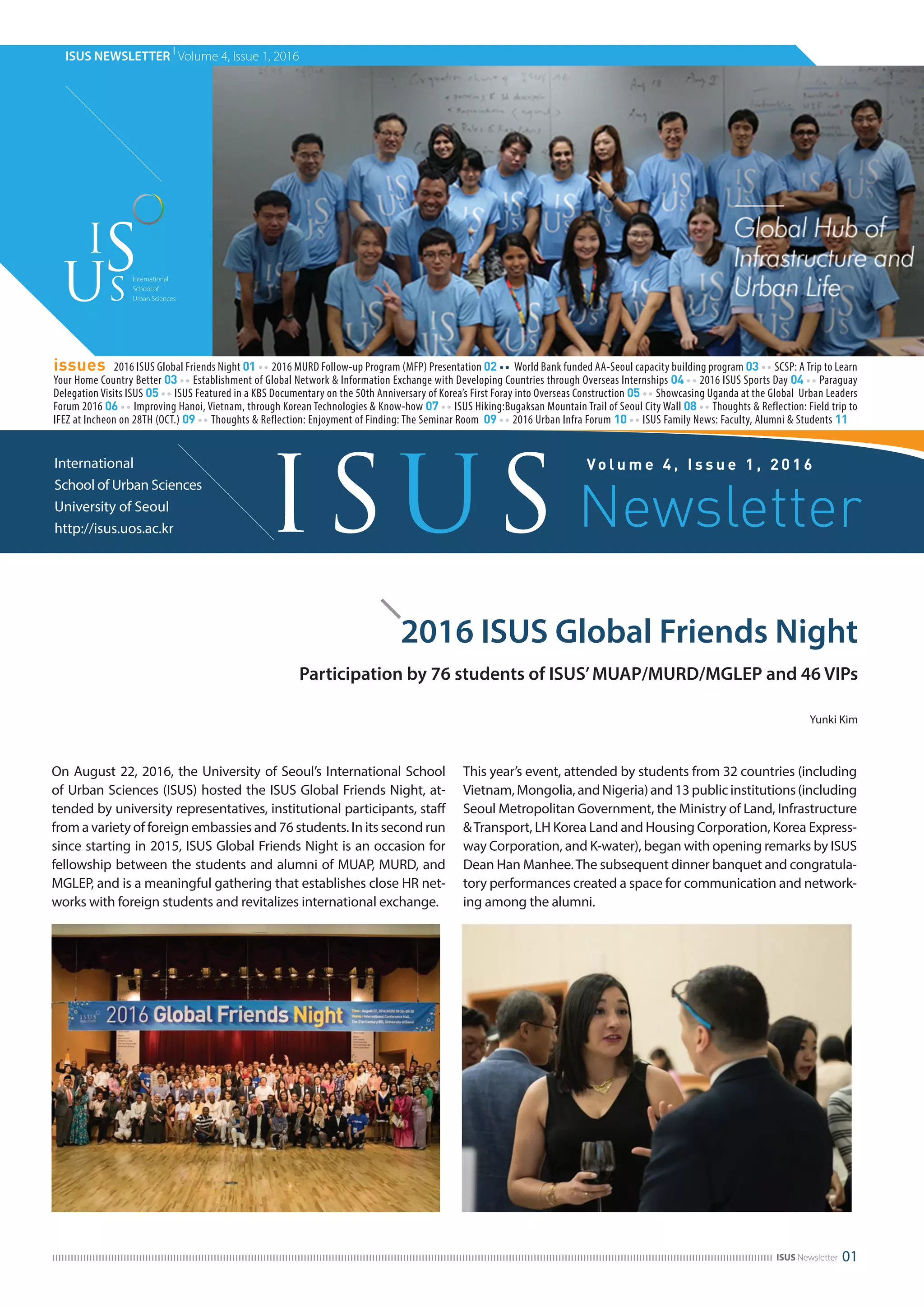
2016 ISUS Global Friends Night
Participation by 76 students of ISUS’MUAP/MURD/MGLEP and 46 VIPs
Yunki Kim
International
School of Urban Sciences
University of Seoul
http://isus.uos.ac.kr
Vo l u m e 4 , I s s u e 1 , 2 0 1 6
ISUS Newsletter
issues 2016 ISUS Global Friends Night 01∙∙2016 MURD Follow-up Program (MFP) Presentation 02∙∙ World Bank funded AA-Seoul capacity building program 03∙∙SCSP: A Trip to Learn
Your Home Country Better 03∙∙Establishment of Global Network & Information Exchange with Developing Countries through Overseas Internships 04∙∙2016 ISUS Sports Day 04∙∙Paraguay
Delegation Visits ISUS 05∙∙ISUS Featured in a KBS Documentary on the 50th Anniversary of Korea’s First Foray into Overseas Construction 05∙∙Showcasing Uganda at the Global Urban Leaders
Forum 2016 06∙∙Improving Hanoi, Vietnam, through Korean Technologies & Know-how 07∙∙ISUS Hiking:Bugaksan Mountain Trail of Seoul City Wall 08∙∙Thoughts & Reflection: Field trip to
IFEZ at Incheon on 28TH (OCT.) 09∙∙Thoughts & Reflection: Enjoyment of Finding: The Seminar Room 09∙∙2016 Urban Infra Forum 10∙∙ISUS Family News: Faculty, Alumni & Students 11
01ISUS Newsletter
On August 22, 2016, the University of Seoul’s International School
of Urban Sciences (ISUS) hosted the ISUS Global Friends Night, at-
tended by university representatives, institutional participants, staff
from a variety of foreign embassies and 76 students. In its second run
since starting in 2015, ISUS Global Friends Night is an occasion for
fellowship between the students and alumni of MUAP, MURD, and
MGLEP, and is a meaningful gathering that establishes close HR net-
works with foreign students and revitalizes international exchange.
This year’s event, attended by students from 32 countries (including
Vietnam,Mongolia,andNigeria)and13publicinstitutions(including
Seoul Metropolitan Government, the Ministry of Land, Infrastructure
&Transport, LH Korea Land and Housing Corporation, Korea Express-
way Corporation, and K-water), began with opening remarks by ISUS
Dean Han Manhee.The subsequent dinner banquet and congratula-
tory performances created a space for communication and network-
ing among the alumni.
Addis Ababa - Seoul Urban Planning Capacity Program (AACBP) was
held in Seoul, Republic of Korea, from 8th August to 2nd Septem-
ber 2016 coordinated by University of Seoul and Seoul Metropolitan
Government, which was funded by World Bank.
The four week intensive program was customized to cover specific
needs and challenges of Addis Ababa, improving implementability of
the master plan through enhanced capacity of the trainees. Both theo-
retical and practical aspects of urban planning and implementation
were addressed for urban professionals of Addis Ababa City Govern-
ment by inviting renowned professors, scholars, practitioners as well as
government officials, who have played important roles and are current-
lydeeplyinvolvedintheprocessofSeoul’sdevelopmentaskeyexperts.
Key areas covered during the program include (1) urban pattern and
urban planning, (2) land development and management, (3) hous-
ing provision and informal settlements upgrading, (4) transport
policy and traffic management system, (5) solid waste management
system, (6) water supply and management, (7) energy supply sys-
tem , (8) public space including green (park, forest) and blue (river
and river sides development), (9) business district development and
management, (10) permit regulation agency, urban development
corporation, and infrastructure development and management cor-
poration, and (12) vertical and horizontal institutional integration
and collaboration with key stakeholders including e-governance.
Wodefit engenagnalen! (See you, my friend!)
ISUS NEWSLETTER
|
Volume 4, Issue 1, 2016
02	 03ISUS Newsletter
World Bank funded
AA-Seoul capacity building program
ISUS NEWSLETTER
|
Volume 4, Issue 1, 2016
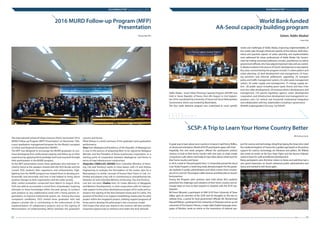
The International School of Urban Sciences (ISUS), has hosted“2016
MURD Follow-up Program (MFP) Presentation” on November 10th,
a post-graduation management program for the Master’s program
in Urban and Regional Development (MURD).
The MFP was designed to encourage the MURD graduates to con-
tinue developing their professional capacity and follow up on their
experience by applying the knowledge and tools acquired through
their participation in the MURD program.
At the MFP presentation event, three graduates who had been in-
vited to Seoul as the speakers shared with the ISUS faculty and the
current ISUS students their experience and achievements, high-
lighting how the MURD program has helped them to develop pro-
fessionally and personally and how it had helped to bring about
positive changes to their organization and the wider society.
After careful evaluation conducted from March to August 2016,
ISUS was able to accumulate a varied form of graduates’inspiring
attempts to share knowledge within the peer group, to conduct
joint projects or any collaborative work with a Korea partner or-
ganization, to improve institutional system, etc. Among the many
competent candidates, ISUS invited three graduates who had
played a pivotal role in contributing to the enforcement of the
implementation of collaborative projects and to the signing of
Memorandum of Understanding (MoU) between the graduate’s
country and Korea.
What follows is a brief summary of the graduates’ post-graduation
performance.
Aina from Madagascar(Presidency of the Republic of Madagascar)
is now in the process of preparing MoU to be signed by Malagasy
Minister and the President of Korea Expressway Corporation, as a
starting point of cooperation between Madagascar and Korea in
terms of road infrastructure construction.
Alejandro CEBALLOS JARABA from Colombia (Ministry of Hous-
ing, City and Territory) works in close liaison with LH and Dohwa
Engineering to evaluate the formulation of the master plan for a
Macroproject (a similar concept of Korean New Town) in Cali, Co-
lombia and played a key role in contributing to strengthening ties
between LH and Colombia Ministry of Housing, City and Territory.
Last but not least, Chathu from Sri Lanka (Ministry of Megapolis
and Western Development), in close cooperation with LH, had pro-
vide support to the urban development project of Sri Lanka and as-
sisted in the signing of the MoU between Korea and Sri Lanka. The
purpose of the MoU is to support establishing master plan for pilot
project within the megapolis project, utilizing support programs of
Korea and to develop the pilot project into a business model.
ISUS hopes that what was shared in the seminar will bear another
important opportunity to reinforce and widen the ISUS network.
2016 MURD Follow-up Program (MFP)
Presentation
Young Hee Kim Selam, Addis Ababa!
Joon Park
SCSP: A Trip to Learn Your Home Country Better
MinJoung Joung
‘A great way to learn about your country is to leave it.’said Henry Rollins,
an all-around entertainer.Would all SCSP participants agree with that?
Hopefully, this one week program offered the participants profuse
chances to look at their home country with new eyes, to make ample
comparisons with others and finally to have ideas about what’s best for
their home country and Seoul.
In 2016, a total of 106 participants from 12 Universities joined the Seoul
Case Study Program, a week-long study abroad program for the gradu-
ate students in public administration and urban science from universi-
tiesofU.S.andU.K.TheprogramofferslecturesandfieldvisitsonSeoul’s
best practices.
During the Program, joint seminars were held where ISUS students
presented the challenges and solutions of their home country and ex-
change ideas on how to best respond to situation with the SCSP par-
ticipants.
Mr.Trevor Minyard, a participant of 20th SCSP from University of Texas
Dallas, gave an overview of the SCSP and his thoughts on the trip on
website ELGL, a portal for local government officials. Mr. Muhammad
Naveed Iftikhar, a participant from University of Delaware and an op-ed
columnist ofThe ExpressTribune, a major daily English-language news-
paper of Pakistan, wrote an article on the importance of national sup-
port for science and technology citing King Sejong the Great who ruled
the medieval kingdom of Korea into a golden age based on his profuse
support for science, technology, art, literature and politics. Mr. Iftikhar
also wrote an article on the four Asian Tigers and the lessons Pakistan
needs to learn for swift and efficient development.
Many participants were first-time visitors to Korea and said they had a
very good impression on Seoul’s advanced public administration and
Seoul, and wanted to visit Seoul again.
ISUSnews
ISUS NEWSLETTER
|
Volume 4, Issue 1, 2016
04 05ISUS Newsletter
ISUS NEWSLETTER
|
Volume 4, Issue 1, 2016
ISUS offered an overseas summer internship program from July 2 to
August 13, 2016, as part of the project to train an advanced global
workforce in construction engineering (funded by the Ministry of
Land, Infrastructure & Transport). Groups of three to four students
from the Global Construction Department and
the Sustainable Urban Development Department
worked as a team through the internship program
in government departments or public institutions in
developing countries for one to two weeks. A total of
30 students participated in the program, interning at
eight institutions in seven developing countries, in-
cluding Malaysia, and are currently in the process of
finishing their final reports on their experiences.
Students who participated in this internship program
were able to network with local mid-level execu-
tives in charge of overseas construction projects and
high-level executives involved in decision-making,
and had opportunities to gain information about
the countries in which they were interning. They also
helped strengthen the global network through busi-
ness and exchanging domestic construction informa-
tion with overseas clients.
In particular, some of the teams, such as the Vietnam
internship team, are working on concretizing pro-
jects that were discussed during the internship and promoting as-
sociated projects, which involves conducting feasibility studies and
establishing master plans for specific projects as well as future policy
consulting for the developing countries.
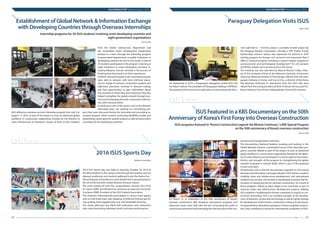
On September 8, 2016, a Paraguayan delegation visited ISUS, led
by Robert Salinas, the president of Paraguayan Railways (FEPASA).
The purpose of the visit was to seek advice on promoting the Asun-
ción Light Rail (L = 14.8 km) project, a privately-funded project by
the Paraguay Railway Corporation, through a PPP (Public Private
Partnership) scheme. Salinas also expressed his interest in ISUS’
training program for foreign civil servants and requested that it
offers a “research program including a master’s degree program in
socioeconomic and technological development” for civil servants
at FEPASA. Details are to be discussed in the future.
The meeting was also attended by Manuel Benitez Codas, Direc-
tor of the Graduate School at the National University of Asuncion
(Asuncion National Institute of Technology), officials from the Para-
guayan Embassy in Korea, and Soo-ik Cho, a director of the Korea
Rail Network Authority. In attendance from the ISUS side were
Hyeon Park, the acting president of ISUS, Professor Sin Lee, and Pro-
fessor Seok-jun Choi of the Undergraduate School of Economics.
Eun-su Park
Establishment of Global Network & Information Exchange
with Developing Countries through Overseas Internships
Internship programs for 30 ISUS students involving seven developing countries and
eight government organizations
Paraguay Delegation Visits ISUS
Hyeon Park
2016 ISUS Sports Day
Student Association
ISUS Featured in a KBS Documentary on the 50th
Anniversary of Korea’s First Foray into Overseas Construction
ISUS programs featured in“Korea’s Construction Legend: the Miracle Continues,”a KBS Special Program
on the 50th anniversary of Korea’s overseas construction
2016 ISUS Sports Day was held on Saturday, October 29, 2016 at
the Main Stadium in the campus. Even though the weather was not
pleasant, professors and students gathered to join the festive fun.
All participants and professors were divided into 4 groups based on
the 2016 Fall Semester Global Network Seminar classes.
The event kicked off with the congratulatory remarks from Prof.
Dr. Hyeon PARK and followed by warming up exercises led by Mr.
Soonkyoo PARK, President of the ISUS Student Association.
The students enthusiastically participated in various team games
such as hula hoop relay, rope skipping, shuttlecock kicking (jae-ki),
rope pulling, three-legged relay race, and basketball shooting.
The whole afternoon was filled with enthusiasm and excitement
with some fascinating individual results and team performances.
On March 31, in celebration of the 50th anniversary of Korea’s
overseas construction, KBS broadcast educational programs and
classroom scenes from ISUS with the aim of boosting the pride of
construction personnel and promoting the role and value of the con-
struction and transportation industries.
The documentary featured students studying and working in the
Global Network Seminar, a specialized course of the education pro-
grams currently offered as part of the project to train an advanced
global workforce in construction engineering (funded by the Minis-
try of Land, Infrastructure &Transport). It also focused on the charac-
teristics and strengths of the program for strengthening the global
network of people in relevant fields, which is part of the graduate
school curriculum.
Of particular note is that the documentary reported on the mutual
learning and information exchange between ISUS’ Korean students
studying urban and infrastructure development, and international
students who are also civil servants in developing countries that Ko-
rea plans on advancing into for overseas construction. As a result of
these programs, follow-up plans began to be conceived as part of
overseas urban and infrastructure development projects, helping
ISUS establish a bridgehead for Korean companies to export its con-
struction technology. This is an excellent example of the develop-
ment of domestic construction technology as well as a great strategy
for development of the Korean construction industry for the future.
As representative educational programs in Korea on global construc-
tion, they contribute to raising the international recognition of ISUS.
ISUSnews
ISUSnews
Eun-su Park
Showcasing Uganda
at the Global Urban Leaders Forum 2016
Olive Nalugo (MURD 2)
Improving Hanoi, Vietnam,
through Korean Technologies & Know-how
Winner of the 2017 Infrastructure Master Plan Project Open Competition
Gumin Jung
ISUS NEWSLETTER
|
Volume 4, Issue 1, 2016
06	 07ISUS Newsletter
In February 2016, the“Master Plan for Improving the Sewer System
in Hanoi, Vietnam”proposed by an international student and Kore-
an graduate students at the International School of Urban Sciences
(ISUS) at the University of Seoul was selected in the open competi-
tion for the 2017 Infrastructure Master Plan Project hosted by the
Ministry of Land, Infrastructure and Transport. More than a winner
of a national project, the master plan is receiving acclaim for laying
the foundation for enhancing Korea’s international prestige as well
as for exporting Korea’s sewage treatment technologies and know-
how to improve the environment and the quality of life of people
in other countries.	
The following is an excerpt from an interview published in the Uni-
versity of Seoul’s newsletter Vol. 73.
Q.
I am curious about the planning process behind the“Master Plan
for Improving the Sewer System in Hanoi, Vietnam.” Can you tell
us how you came up with this idea?
A. Sangchul Lee  ISUS
offers a course called Global
Network Seminar (GNS). In
this class, students work in
groups made up of an inter-
national student who works
in public service in his coun-
try and four to five Korean
students. Mostly, the class is
dedicated to seeking out and
developing facilities and re-
lated infrastructure that are
needed in the home countries
of the international students
in the groups. I met Mr. Tran in
this class. There was another international student in the class from
Poland, but Poland already has most of the needed infrastructure,
so the focus was more on maintenance than installation. Vietnam,
on the other hand, is a developing country, so there were a lot more
problems to resolve in the development process. We found that
the lack of a sewer system, in particular, was inducing a number of
environmental problems and posing health risks to the people of
Vietnam. The members of our group agreed that this was a serious
problem, and we came up with our Master Plan for Improving the
Sewer System in Hanoi, Vietnam.
Q.
We are also curious about the reaction from the people of Ha-
noi, Vietnam. As a civil servant in Vietnam, could you tell us how
Vietnamese perceive Korea and what you expect from this Mas-
ter Plan?
A. Duc Chi Tran Vietnam
and Korea share extremely
similar social and cultural
backgrounds. Vietnamese
people also have a favora-
ble opinion toward Korea.
But despite these things, the
project would not have been
pursued unless it was neces-
sary. Currently, there are not
enough sewage treatment
facilities in Vietnam, which
is leading to environmental
pollution, as well as disease
and health hazards for many
people. So the mayor of Hanoi
announced that we would increase sewage treatment plants from
five to 30 by 2030. Awareness of environmental issues is growing
in Vietnam, and this project will be a very important catalyst for
encouraging people’s to propose their opinions. I hope that it will
be a precedent to show that the country needs to resolve these
problems if it wishes to develop further.
Q.
It seems that all the conditions were lined up to conceive this
project. After final approval in December, how will this project
be implemented and what kind of associated projects will be
undertaken? Sangcheol Lee Once we sign a contract with the
Ministry of Land, Infrastructure and Trade, we have to submit a
report with a general framework for the project. This includes
a comprehensive plan that includes baseline surveys, manage-
ment of sewage treatment zones, planning of sewage treatment
plants, market analysis, scope and scale of the project, design,
financing, construction plans and maintenance plans. It will take
about one year to complete the plan, and after that we work on
making it into a BTL (Build-Transfer-Lease) project.
A. Yungwang Ji There are many tasks linked to this project.
First, planning includes design and supervision, which is for engi-
neers. A construction company will be required for construction,
and a financial institution will be required to procure the necessary
resources, along with those entities that can provide accounting
and legal advice. The most important part will be maintenance,
which includes the chemicals needed for the construction and
ISUS NEWSLETTER
|
Volume 4, Issue 1, 2016
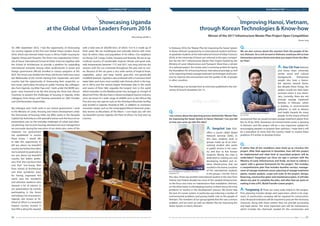
On 28th September 2016, I had the opportunity of showcasing
my country Uganda at the first ever Global Urban Leaders Forum
2016, which was themed Urban Issues in Africa: Public housing for
Uganda, Kenya and Tanzania. The forum was organized by Univer-
sity of Seoul, International School of Urban Sciences together with
the School of Architecture to provide a platform for expanding
international networks among urban professionals in Korea and
foreign government officials enrolled in various programs at the
ISUS. The forum was divided into three sub forums held once every
last Wednesday of the month starting from September, and each
country had the opportunity of showcasing their respective ur-
ban issues, particularly focusing on public housing. My colleague,
also from Uganda, Joy Mike Yiga and I –both under the MURD pro-
gram- were honored to be the first among the three East African
Countries to present the challenges of housing in Uganda, while
colleagues from Kenya and Tanzania presented on 26th October
and 23rd November respectively.
My colleague and I both work in our central government. I work
in the Ministry of Lands, Housing and Urban Development under
the Directorate of Housing while Joy Mike works in the Kampala
Capital City Authority as a GIS specialist and as such the focus of our
presentation was on the everyday challenges of urban and physi-
cal planning, low income housing development and management
we encounter during the execution of our duties plus some of the
measures our government
has established to resolve
these issues. I would like
to take this opportunity to
tell you about my beautiful
country but before that allow
me to extend my gratitude to
our you about my beautiful
country but before profes-
sors, Prof. Shin Lee from ISUS
and Prof. Sun-Young Rieh
from School of Architecture
and their wonderful team
for having organized this
event, plus the wonderful
and attentive audience who
showed a lot of interest in
our presentation by actively
participating in the forum
and asking a lot of questions.
Uganda, also known as ‘th-
ePearl of Africa’ is a beautiful
tropical country located in
East Africa along the equator
with a total area of 236,040 km2, of which 15.4 % is made up of
fresh water. We are multilingual and culturally diverse with more
than 56 ethnic tribes and population of 34 million. Our neighbors
are Kenya, D.R. Congo, Sudan, Tanzania and Rwanda. We are an ag-
ricultural country of comfortable tropical climate and good soils,
with temperatures between 17o
C and 30o
C, two rainy and two dry
seasons with the sun overhead throughout the year and no win-
ter. Because of this we grow a very wide variety of tropical foods,
vegetables, spices and keep mainly grass-fed, non-genetically
modified livestock. Uganda is also endowed with a numerous fresh
water lakes and rivers most notably Lake Victoria which is the larg-
est in Africa and the second largest freshwater lake in the world
and source of River Nile, arguably the longest river in the world
which meanders to the Mediterranean Sea via Egypt at a length of
about 6,670 km. We also have a vibrant ecological tourism industry
since we boast of a wide range of wildlife such as the Africa’s Big
Five and very rare species such as the Silverback Mountain Gorillas
only located in Uganda, Rwanda & DRC, in addition to numerous
mountain ranges such as the snowcapped Mount Rwenzori popu-
larly known as Mountains of the Moon. I sure hope you will visit
my beautiful country Uganda, the Pearl of Africa. For God and my
Country.
Korea Development Corporation, SOC Team,
Sangcheol Lee
International Urban Development Program,
Duc Chi Tran
For about 6 weeks now, I’ve been experiencing severe sleep disorder
(insomnia), and coupled with the fact that while I’m up, I seldom do
anything productive with my time. It was really disturbing to me as I
knew I was losing both sleep at night and also valuable lessons that
were later on over-taken by sleep during the day. As the saying goes
“you can never cheat nature”; therefore somehow, someway, nature
always wins. I was seriously losing as I lacked focus and couldn’t
catch up in class. This wasn’t typical of me.
Things are bound to change, as human beings believe nothing lasts
forever. In the recent turn of events, my MUAP colleague from Nige-
ria (Adams) introduced me to the ‘Seminar Room’. It was a secluded
area in the undergraduate wing of the student’s dormitory at the
University of Seoul.‘It felt like I had struck gold!’The room was peace-
ful. It had an aura that spelled focus. It was a contrast to my room in
the International house that had this ‘thing’ that always pushed me
to laziness and procrastination.
Here I could read peacefully with a clear head and the sight of other
serious students who seemed so engrossed in their studying was
also a motivating factor.
As I prepared for my mid-term exams and other preparations, I made
it a duty to always spend at least 3 hours or more in the seminar
room. I’m lucky for finding somewhere like this. I owe this one to Ad-
ams…thanks bro!
ISUS NEWSLETTER
|
Volume 4, Issue 1, 2016
08	 09ISUS Newsletter
ISUS NEWSLETTER
|
Volume 4, Issue 1, 2016
Enjoyment of Finding: The Seminar Room
	
George O. Nwosu (MUAP 9th Cohort)
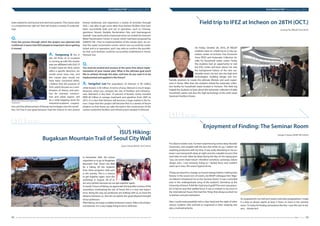
On Friday, October 28, 2016, all MGLEP
students went on a field trip to U-City op-
eration center of Incheon Free Economic
Zone (IFEZ) and Automatic Collection Fa-
cility for household waste center. Firstly,
the students had an opportunity to visit
the IFEZ center and learn about not only
the background history of the new sus-
tainable smart city but also the high-tech
technologies, building design and eco-
friendly practices to create the ultimate lifestyle and work experi-
ence in Korea. After that, the students visited the automatic collec-
tion facility for household waste located in Incheon. This field trip
helped the students to learn about the automatic collection of daily
household wastes and also the high-technology of the solid waste
treatment facility in Korea.
Field trip to IFEZ at Incheon on 28TH (OCT.)
Sa Aung Thu (MGLEP 2nd Cohort)
ISUSnews
In November 20th, the school
organized us to go to Bugaksan
Mountain Trail, Seoul City Wall
for a hiking. All the students
from three programs took part
in the activity. This is a chance
to get together again, since the
workshop in August. All of us
are very excited, because we can get together again.
In nearly 3 hours of hiking, we appreciate the beautiful scenery of the
mountains, overlooking the city of Seoul, this is a very rare experi-
ence. Along the way our professors are walking with us, to close the
distance between us. Also let me admire the good physical strength
of our professors.
After hiking, we enjoy a traditional Korean cuisine. After a lot of phys-
ical exercise, it is a very happy thing to eat so delicious.
ISUS Hiking:
Bugaksan Mountain Trail of Seoul City Wall
Zeyan Zhang (MGLEP 2nd Cohort)
ISUSnews
tasks related to mechanical and electrical systems.This master plan
is a comprehensive“gift set”that will involve a variety of undertak-
ings.
Q.
From the process through which this project was planned and
confirmed, it seems that ISUS played an important role in getting
it started.
A. Yungwang Ji Yes, it
did. All three of us involved
in coming up with this master
plan are affiliated with ISUS. If
it hadn’t been for ISUS, which
offers a specific direction, we
would never have met, and
this master plan would not
have been conceived either.
I believe that the purpose of
ISUS, which focuses on a com-
bination of theory and prac-
tice for overseas construc-
tion and urban export, will
be a solid stepping stone for
industrial-academic coopera-
tion and the advancement of Korean technologies into the world.
Duc Chi Tran It was great because I had the chance to visit several
Korean landmarks and experience a variety of activities through
ISUS. I was able to get some ideas from Korean facilities that have
been successfully built and are in operation, such as Cheong-
gyecheon Stream, Nanjido Reclamation Site, and Saemangeum
Seawall. I was particularly impressed when we visited the Seonam
Water Reclamation Center in Seoul, which had been proposed by
SAMOO CM. Prior to implementation of the master plan, we vis-
ited the water reclamation center, which was successfully estab-
lished and is in operation, and I was able to confirm the possibil-
ity that such facilities could be successfully established in Hanoi,
Vietnam too.
Q.
You must be excited and anxious at the same time about imple-
mentation of your master plan. What is the ultimate goal you’d
like to achieve through this plan, and how do you want it to be
implemented and applied in the future?
A. Sangchul Lee The population of Vietnam is 90 million,
while Korea’s is 50 million. In terms of area, Vietnam is much larger.
However, when you compare the size of facilities and infrastruc-
ture, Vietnam’s is less than 10 percent of Korea’s. Korea invested
KRW 40 trillion in sewage treatment and pipelines from 2005 to
2015. It is clear that Vietnam will become a huge market in the fu-
ture. I hope that this project will become first in a stream of future
projects so that Korea can take the lead in the construction of the
various treatment facilities and infrastructure needed in Vietnam.
SAMOO CM Infrastructure Project Team,
Yungwang Ji
ISUS NEWSLETTER
|
Volume 4, Issue 1, 2016
10	 11ISUS Newsletter
Dr. Man-Hee Han (Dean, ISUS)
Dr. Man-Hee Han, the Dean of ISUS,
who is on sabbatical leave in Birming-
ham, England, visited Colombo, Sri
Lanka with the Korean delegation to
attend the KSP Consulting meeting
which was held on Dec. 2nd to discuss
the development projects with the Sri
Lankan government officials. Dr. Han
was appointed as the special advisor
for the Sri Lankan development pro-
jects by K-EXIM Bank last September.
Professor Han also met Chaturanganie
Amarasekara, a 2015 MURD graduate in the Sri Lankan government, to
discussissuesonthenewtownbeingdevelopednearColomboandthe
future cooperation between the ISUS and the Sri Lankan government.
Dr. Hyeon PARK and Dr. Shin Lee (ISUS)
Prof. Hyeon PARK, president of the Korea Society of Transport Policy
and Economics, hosted 2016 annual conference at Coex on Fri, Nov 11.
Twenty six papers on transport policy and economics, and logistics and
aviationwerepresented.Prof.ShinLeeofISUSpresentedapaperonthe
impacts of light rail tran-
sitoncarusersinUK,and
Mr.YongSukBae,anISUS
graduate from Dept. of
Global Construction,
presented another one
on application of PPP for
maintenance of national
highway network.
Dr. Joon Park (Director, MUAP)
Dr.JoonParkhasjoinedthefacultyoftheISUSfrom March1st,2016 and
hastaughtGISandDataAnalysis,HousingandLandpolicies,UrbanEco-
nomics, LandTheory and Policies, and Smart City Development. As an
active and newest member of the ISUS faculty, Dr. Park has been proac-
tively leading MUAP as a director and SCSP as a deputy director. An ur-
ban economist and housing researcher, Dr. Park
has devoted himself on land/urban economics,
housing market analysis, and spatial analysis.
Prior to joining ISUS Park had been mainly en-
gaged in projects of land, housing, and real es-
tate policies as an associate research fellow at
KoreaResearchInstituteforHumanSettlements
(KRIHS)fromSeptember2012toFebruary2016. 
The ISUS Alumni Association, Cambodia Launched
On Monday, August 1, members of ISUS community in Cambodia got
together for dinner.This gathering was joined by ISUS Korean students
participating in the Global Internship Program at MLMUPC (Ministry of
Land Management, Urban Planning and Construction) on Aug 1-12.
There is a sizable ISUS community in Cambodia: 8 alumni, 5 registered
students, and 2 new coming students, making 15 in total. Over the
dinner, they organized
the ISUS Alumni Asso-
ciation, Cambodia. Mr.
Kimchhuon Man (far
right in the pic) a MUAP
cohort 6, who is work-
ing at the Phnom Penh
City Hall, was unani-
mously nominated as
thefirstpresidentofthe
Association. Good Luck
ISUS Cambodia!
ChongYonguk (GC, 2.5 Cohort)
Brian (Yong-Uk Chong) has moved to new project site as a construction
manager, LG Electronics’s North America Headquarter Project in New
Jersey, USA.
The project is four-story office building which has a rentable space of
350,000sf including parking space of 1,100 cars, now undergoing con-
struction document design stage.
JeongYoungil (SUD, 2 Cohort)
Youn-gilJeongwasselectedforanoverseasmaster’sdegreefromSeoul
MetropolitanGovernment.Nextyear,hewillgotoEnglandfortwoyears
asamaster’sdegree.Hesaysitwasveryhelpfultohavealotofoverseas
friends while attending graduate university. Also, he has a plan to share
his polices Knowledge with other countries after retiring.
ISUS NEWSLETTER
|
Volume 4, Issue 1, 2016
ISUS ALUMNIISUS FACULTY & STAFF
ISUS Family News:
Faculty & Staff, Alumni and Students
A discussion forum where domestic & overseas experts in urban de-
velopment and infrastructure construction will attend, discuss and
engage with each other. By bringing together public officials and
practitioners from various countries, the forum acts as a platform for
international networking and mutual learning.
Date Topic Affiliation
2016. 3. 9 Complicated Relationship with
Surrounding Nations
Jay ChangJoon KIM Former Member of U.S. Congress, Current Chairman of
Kim Chang Joon Academy
2016. 4. 14 How to Utilize Knowledge Sharing
Program (KSP) of Korean Economic
Development
Song Chang HONG Director of Policy Consultation and Planning, Center for
International Development, Korea Development
Institute
2016. 5. 19 ICT & Smart City Wonki MIN Deputy Minister at Ministry of Science, ICT and
Future Planning
2016. 6. 16 Water Quality Monitoring Systems and
Applications in Korea
Hee JinYANG Director of KORBI Co., Ltd / Head of R&D center &
Technical Strategy
2016. 9. 8 UNESCAP’s Role in Asian Transport
Network Development
Dong-Woo Ha Former Director of Transport Division, United Nations
Economic and Social Commission for Asia and
the Pacific (ESCAP) / Current Chair Research Fellow
Korea Maritime Institute
2016. 10. 13 Seoul's One Less Nuclear Power Plant :
An Energy Transition Experiment
through Citizen's Participation in
a Mega City
Sun-JinYun Professor & Vice Dean of Graduate School of
Environmental Studies, Seoul National University
2016. 11. 10 Smart Structure Technologies for Safe
and Resilient Urban Infrastructure
Chung BangYun Former Professor at KAIST / Current Professor
Emeritus at KAIST UNIST
2016 Urban Infra Forum
Urban Infra Forum
	 Gumin Jung
ISUS NEWSLETTER
|
Volume 4, Issue 1, 2016
ISUS
The International School of Urban Sciences (ISUS) at the Uni-
versity of Seoul (UOS) was launched in Spring 2013 in an effort to
contribute to the development of sustainable urban communities
in the world through an interdisciplinary program of teaching, re-
search, and outreach. ISUS offers various programs including two
graduate programs in Global Construction and Sustainable Urban
Development to seek an interdisciplinary and interactive learn-
ing environment where students from various fields acquire the
knowledge and professional skills necessary for becoming leading
practitioners in the global urban and regional profession.
In addition to the regular graduate programs, ISUS created the
International Urban Development Program (IUDP) in cooperation
with partner agencies and institutions in order to share Korea’s
achievement in urban and regional developments with scholars
and practitioners from around the world.
Each year, a total of 20 government officials from Seoul’s global
partner cities are invited for a masters degree program, Master of
Urban Administration and Planning (MUAP). The MUAP program,
sponsored by Seoul Metropolitan Government, is designed for
municipal government officials from Seoul’s global partner cities
to acquire academic and professional knowledge and skills that
can help them work on the special challenges their home commu-
nities have been facing.
Master of Urban and Regional Development (MURD) is offered by
theISUSinclosepartnershipwiththeKoreaInternationalCoopera-
tion Agency (KOICA). MURD is devised for the government officials
from KOICA’s partner countries.This program aims to develop par-
ticipants’faculty of embracing a wide range of urban and regional
development plans and enhance participants’ breadth of knowl-
edge and experiences in the various fields of urban and regional
development and territorial development including land use plan-
ning, real estate and housing development, urban redevelopment,
new town development, infrastructure development etc. Further-
more, the program seeks to strengthen participants’ understand-
ing in Korea’s development experiences and enable participants
to contribute to sustainable development in their respective coun-
tries with the knowledge acquired in Korea.
AnotherpostgraduateprogramISUShaslaunchedmorelatelyisMas-
ter’s program for Global Leaders in Environmental Policy (MGLEP).
ISUSrunsMGLEPinpartnershipwithKoreaEnvironmentalIndustry&
TechnologyInstitute(KEITI).Asmanyas15governmentofficialsfrom
KETI’s partner countries are invited to pursue the degree. MGLEP will
meet the demand of the partner countries for a longer-term train-
ing program that will help improve their capacity for developing en-
vironmental policies and for leading sustainable development and
environmentalmanagementintheirhomecountries.

ISUS Newsletter vol 4

  • 1.
    ISUS NEWSLETTER | Volume 4,Issue 1, 2016 2016 ISUS Global Friends Night Participation by 76 students of ISUS’MUAP/MURD/MGLEP and 46 VIPs Yunki Kim International School of Urban Sciences University of Seoul http://isus.uos.ac.kr Vo l u m e 4 , I s s u e 1 , 2 0 1 6 ISUS Newsletter issues 2016 ISUS Global Friends Night 01∙∙2016 MURD Follow-up Program (MFP) Presentation 02∙∙ World Bank funded AA-Seoul capacity building program 03∙∙SCSP: A Trip to Learn Your Home Country Better 03∙∙Establishment of Global Network & Information Exchange with Developing Countries through Overseas Internships 04∙∙2016 ISUS Sports Day 04∙∙Paraguay Delegation Visits ISUS 05∙∙ISUS Featured in a KBS Documentary on the 50th Anniversary of Korea’s First Foray into Overseas Construction 05∙∙Showcasing Uganda at the Global Urban Leaders Forum 2016 06∙∙Improving Hanoi, Vietnam, through Korean Technologies & Know-how 07∙∙ISUS Hiking:Bugaksan Mountain Trail of Seoul City Wall 08∙∙Thoughts & Reflection: Field trip to IFEZ at Incheon on 28TH (OCT.) 09∙∙Thoughts & Reflection: Enjoyment of Finding: The Seminar Room 09∙∙2016 Urban Infra Forum 10∙∙ISUS Family News: Faculty, Alumni & Students 11 01ISUS Newsletter On August 22, 2016, the University of Seoul’s International School of Urban Sciences (ISUS) hosted the ISUS Global Friends Night, at- tended by university representatives, institutional participants, staff from a variety of foreign embassies and 76 students. In its second run since starting in 2015, ISUS Global Friends Night is an occasion for fellowship between the students and alumni of MUAP, MURD, and MGLEP, and is a meaningful gathering that establishes close HR net- works with foreign students and revitalizes international exchange. This year’s event, attended by students from 32 countries (including Vietnam,Mongolia,andNigeria)and13publicinstitutions(including Seoul Metropolitan Government, the Ministry of Land, Infrastructure &Transport, LH Korea Land and Housing Corporation, Korea Express- way Corporation, and K-water), began with opening remarks by ISUS Dean Han Manhee.The subsequent dinner banquet and congratula- tory performances created a space for communication and network- ing among the alumni.
  • 2.
    Addis Ababa -Seoul Urban Planning Capacity Program (AACBP) was held in Seoul, Republic of Korea, from 8th August to 2nd Septem- ber 2016 coordinated by University of Seoul and Seoul Metropolitan Government, which was funded by World Bank. The four week intensive program was customized to cover specific needs and challenges of Addis Ababa, improving implementability of the master plan through enhanced capacity of the trainees. Both theo- retical and practical aspects of urban planning and implementation were addressed for urban professionals of Addis Ababa City Govern- ment by inviting renowned professors, scholars, practitioners as well as government officials, who have played important roles and are current- lydeeplyinvolvedintheprocessofSeoul’sdevelopmentaskeyexperts. Key areas covered during the program include (1) urban pattern and urban planning, (2) land development and management, (3) hous- ing provision and informal settlements upgrading, (4) transport policy and traffic management system, (5) solid waste management system, (6) water supply and management, (7) energy supply sys- tem , (8) public space including green (park, forest) and blue (river and river sides development), (9) business district development and management, (10) permit regulation agency, urban development corporation, and infrastructure development and management cor- poration, and (12) vertical and horizontal institutional integration and collaboration with key stakeholders including e-governance. Wodefit engenagnalen! (See you, my friend!) ISUS NEWSLETTER | Volume 4, Issue 1, 2016 02 03ISUS Newsletter World Bank funded AA-Seoul capacity building program ISUS NEWSLETTER | Volume 4, Issue 1, 2016 The International School of Urban Sciences (ISUS), has hosted“2016 MURD Follow-up Program (MFP) Presentation” on November 10th, a post-graduation management program for the Master’s program in Urban and Regional Development (MURD). The MFP was designed to encourage the MURD graduates to con- tinue developing their professional capacity and follow up on their experience by applying the knowledge and tools acquired through their participation in the MURD program. At the MFP presentation event, three graduates who had been in- vited to Seoul as the speakers shared with the ISUS faculty and the current ISUS students their experience and achievements, high- lighting how the MURD program has helped them to develop pro- fessionally and personally and how it had helped to bring about positive changes to their organization and the wider society. After careful evaluation conducted from March to August 2016, ISUS was able to accumulate a varied form of graduates’inspiring attempts to share knowledge within the peer group, to conduct joint projects or any collaborative work with a Korea partner or- ganization, to improve institutional system, etc. Among the many competent candidates, ISUS invited three graduates who had played a pivotal role in contributing to the enforcement of the implementation of collaborative projects and to the signing of Memorandum of Understanding (MoU) between the graduate’s country and Korea. What follows is a brief summary of the graduates’ post-graduation performance. Aina from Madagascar(Presidency of the Republic of Madagascar) is now in the process of preparing MoU to be signed by Malagasy Minister and the President of Korea Expressway Corporation, as a starting point of cooperation between Madagascar and Korea in terms of road infrastructure construction. Alejandro CEBALLOS JARABA from Colombia (Ministry of Hous- ing, City and Territory) works in close liaison with LH and Dohwa Engineering to evaluate the formulation of the master plan for a Macroproject (a similar concept of Korean New Town) in Cali, Co- lombia and played a key role in contributing to strengthening ties between LH and Colombia Ministry of Housing, City and Territory. Last but not least, Chathu from Sri Lanka (Ministry of Megapolis and Western Development), in close cooperation with LH, had pro- vide support to the urban development project of Sri Lanka and as- sisted in the signing of the MoU between Korea and Sri Lanka. The purpose of the MoU is to support establishing master plan for pilot project within the megapolis project, utilizing support programs of Korea and to develop the pilot project into a business model. ISUS hopes that what was shared in the seminar will bear another important opportunity to reinforce and widen the ISUS network. 2016 MURD Follow-up Program (MFP) Presentation Young Hee Kim Selam, Addis Ababa! Joon Park SCSP: A Trip to Learn Your Home Country Better MinJoung Joung ‘A great way to learn about your country is to leave it.’said Henry Rollins, an all-around entertainer.Would all SCSP participants agree with that? Hopefully, this one week program offered the participants profuse chances to look at their home country with new eyes, to make ample comparisons with others and finally to have ideas about what’s best for their home country and Seoul. In 2016, a total of 106 participants from 12 Universities joined the Seoul Case Study Program, a week-long study abroad program for the gradu- ate students in public administration and urban science from universi- tiesofU.S.andU.K.TheprogramofferslecturesandfieldvisitsonSeoul’s best practices. During the Program, joint seminars were held where ISUS students presented the challenges and solutions of their home country and ex- change ideas on how to best respond to situation with the SCSP par- ticipants. Mr.Trevor Minyard, a participant of 20th SCSP from University of Texas Dallas, gave an overview of the SCSP and his thoughts on the trip on website ELGL, a portal for local government officials. Mr. Muhammad Naveed Iftikhar, a participant from University of Delaware and an op-ed columnist ofThe ExpressTribune, a major daily English-language news- paper of Pakistan, wrote an article on the importance of national sup- port for science and technology citing King Sejong the Great who ruled the medieval kingdom of Korea into a golden age based on his profuse support for science, technology, art, literature and politics. Mr. Iftikhar also wrote an article on the four Asian Tigers and the lessons Pakistan needs to learn for swift and efficient development. Many participants were first-time visitors to Korea and said they had a very good impression on Seoul’s advanced public administration and Seoul, and wanted to visit Seoul again. ISUSnews
  • 3.
    ISUS NEWSLETTER | Volume 4,Issue 1, 2016 04 05ISUS Newsletter ISUS NEWSLETTER | Volume 4, Issue 1, 2016 ISUS offered an overseas summer internship program from July 2 to August 13, 2016, as part of the project to train an advanced global workforce in construction engineering (funded by the Ministry of Land, Infrastructure & Transport). Groups of three to four students from the Global Construction Department and the Sustainable Urban Development Department worked as a team through the internship program in government departments or public institutions in developing countries for one to two weeks. A total of 30 students participated in the program, interning at eight institutions in seven developing countries, in- cluding Malaysia, and are currently in the process of finishing their final reports on their experiences. Students who participated in this internship program were able to network with local mid-level execu- tives in charge of overseas construction projects and high-level executives involved in decision-making, and had opportunities to gain information about the countries in which they were interning. They also helped strengthen the global network through busi- ness and exchanging domestic construction informa- tion with overseas clients. In particular, some of the teams, such as the Vietnam internship team, are working on concretizing pro- jects that were discussed during the internship and promoting as- sociated projects, which involves conducting feasibility studies and establishing master plans for specific projects as well as future policy consulting for the developing countries. On September 8, 2016, a Paraguayan delegation visited ISUS, led by Robert Salinas, the president of Paraguayan Railways (FEPASA). The purpose of the visit was to seek advice on promoting the Asun- ción Light Rail (L = 14.8 km) project, a privately-funded project by the Paraguay Railway Corporation, through a PPP (Public Private Partnership) scheme. Salinas also expressed his interest in ISUS’ training program for foreign civil servants and requested that it offers a “research program including a master’s degree program in socioeconomic and technological development” for civil servants at FEPASA. Details are to be discussed in the future. The meeting was also attended by Manuel Benitez Codas, Direc- tor of the Graduate School at the National University of Asuncion (Asuncion National Institute of Technology), officials from the Para- guayan Embassy in Korea, and Soo-ik Cho, a director of the Korea Rail Network Authority. In attendance from the ISUS side were Hyeon Park, the acting president of ISUS, Professor Sin Lee, and Pro- fessor Seok-jun Choi of the Undergraduate School of Economics. Eun-su Park Establishment of Global Network & Information Exchange with Developing Countries through Overseas Internships Internship programs for 30 ISUS students involving seven developing countries and eight government organizations Paraguay Delegation Visits ISUS Hyeon Park 2016 ISUS Sports Day Student Association ISUS Featured in a KBS Documentary on the 50th Anniversary of Korea’s First Foray into Overseas Construction ISUS programs featured in“Korea’s Construction Legend: the Miracle Continues,”a KBS Special Program on the 50th anniversary of Korea’s overseas construction 2016 ISUS Sports Day was held on Saturday, October 29, 2016 at the Main Stadium in the campus. Even though the weather was not pleasant, professors and students gathered to join the festive fun. All participants and professors were divided into 4 groups based on the 2016 Fall Semester Global Network Seminar classes. The event kicked off with the congratulatory remarks from Prof. Dr. Hyeon PARK and followed by warming up exercises led by Mr. Soonkyoo PARK, President of the ISUS Student Association. The students enthusiastically participated in various team games such as hula hoop relay, rope skipping, shuttlecock kicking (jae-ki), rope pulling, three-legged relay race, and basketball shooting. The whole afternoon was filled with enthusiasm and excitement with some fascinating individual results and team performances. On March 31, in celebration of the 50th anniversary of Korea’s overseas construction, KBS broadcast educational programs and classroom scenes from ISUS with the aim of boosting the pride of construction personnel and promoting the role and value of the con- struction and transportation industries. The documentary featured students studying and working in the Global Network Seminar, a specialized course of the education pro- grams currently offered as part of the project to train an advanced global workforce in construction engineering (funded by the Minis- try of Land, Infrastructure &Transport). It also focused on the charac- teristics and strengths of the program for strengthening the global network of people in relevant fields, which is part of the graduate school curriculum. Of particular note is that the documentary reported on the mutual learning and information exchange between ISUS’ Korean students studying urban and infrastructure development, and international students who are also civil servants in developing countries that Ko- rea plans on advancing into for overseas construction. As a result of these programs, follow-up plans began to be conceived as part of overseas urban and infrastructure development projects, helping ISUS establish a bridgehead for Korean companies to export its con- struction technology. This is an excellent example of the develop- ment of domestic construction technology as well as a great strategy for development of the Korean construction industry for the future. As representative educational programs in Korea on global construc- tion, they contribute to raising the international recognition of ISUS. ISUSnews ISUSnews Eun-su Park
  • 4.
    Showcasing Uganda at theGlobal Urban Leaders Forum 2016 Olive Nalugo (MURD 2) Improving Hanoi, Vietnam, through Korean Technologies & Know-how Winner of the 2017 Infrastructure Master Plan Project Open Competition Gumin Jung ISUS NEWSLETTER | Volume 4, Issue 1, 2016 06 07ISUS Newsletter In February 2016, the“Master Plan for Improving the Sewer System in Hanoi, Vietnam”proposed by an international student and Kore- an graduate students at the International School of Urban Sciences (ISUS) at the University of Seoul was selected in the open competi- tion for the 2017 Infrastructure Master Plan Project hosted by the Ministry of Land, Infrastructure and Transport. More than a winner of a national project, the master plan is receiving acclaim for laying the foundation for enhancing Korea’s international prestige as well as for exporting Korea’s sewage treatment technologies and know- how to improve the environment and the quality of life of people in other countries. The following is an excerpt from an interview published in the Uni- versity of Seoul’s newsletter Vol. 73. Q. I am curious about the planning process behind the“Master Plan for Improving the Sewer System in Hanoi, Vietnam.” Can you tell us how you came up with this idea? A. Sangchul Lee  ISUS offers a course called Global Network Seminar (GNS). In this class, students work in groups made up of an inter- national student who works in public service in his coun- try and four to five Korean students. Mostly, the class is dedicated to seeking out and developing facilities and re- lated infrastructure that are needed in the home countries of the international students in the groups. I met Mr. Tran in this class. There was another international student in the class from Poland, but Poland already has most of the needed infrastructure, so the focus was more on maintenance than installation. Vietnam, on the other hand, is a developing country, so there were a lot more problems to resolve in the development process. We found that the lack of a sewer system, in particular, was inducing a number of environmental problems and posing health risks to the people of Vietnam. The members of our group agreed that this was a serious problem, and we came up with our Master Plan for Improving the Sewer System in Hanoi, Vietnam. Q. We are also curious about the reaction from the people of Ha- noi, Vietnam. As a civil servant in Vietnam, could you tell us how Vietnamese perceive Korea and what you expect from this Mas- ter Plan? A. Duc Chi Tran Vietnam and Korea share extremely similar social and cultural backgrounds. Vietnamese people also have a favora- ble opinion toward Korea. But despite these things, the project would not have been pursued unless it was neces- sary. Currently, there are not enough sewage treatment facilities in Vietnam, which is leading to environmental pollution, as well as disease and health hazards for many people. So the mayor of Hanoi announced that we would increase sewage treatment plants from five to 30 by 2030. Awareness of environmental issues is growing in Vietnam, and this project will be a very important catalyst for encouraging people’s to propose their opinions. I hope that it will be a precedent to show that the country needs to resolve these problems if it wishes to develop further. Q. It seems that all the conditions were lined up to conceive this project. After final approval in December, how will this project be implemented and what kind of associated projects will be undertaken? Sangcheol Lee Once we sign a contract with the Ministry of Land, Infrastructure and Trade, we have to submit a report with a general framework for the project. This includes a comprehensive plan that includes baseline surveys, manage- ment of sewage treatment zones, planning of sewage treatment plants, market analysis, scope and scale of the project, design, financing, construction plans and maintenance plans. It will take about one year to complete the plan, and after that we work on making it into a BTL (Build-Transfer-Lease) project. A. Yungwang Ji There are many tasks linked to this project. First, planning includes design and supervision, which is for engi- neers. A construction company will be required for construction, and a financial institution will be required to procure the necessary resources, along with those entities that can provide accounting and legal advice. The most important part will be maintenance, which includes the chemicals needed for the construction and ISUS NEWSLETTER | Volume 4, Issue 1, 2016 On 28th September 2016, I had the opportunity of showcasing my country Uganda at the first ever Global Urban Leaders Forum 2016, which was themed Urban Issues in Africa: Public housing for Uganda, Kenya and Tanzania. The forum was organized by Univer- sity of Seoul, International School of Urban Sciences together with the School of Architecture to provide a platform for expanding international networks among urban professionals in Korea and foreign government officials enrolled in various programs at the ISUS. The forum was divided into three sub forums held once every last Wednesday of the month starting from September, and each country had the opportunity of showcasing their respective ur- ban issues, particularly focusing on public housing. My colleague, also from Uganda, Joy Mike Yiga and I –both under the MURD pro- gram- were honored to be the first among the three East African Countries to present the challenges of housing in Uganda, while colleagues from Kenya and Tanzania presented on 26th October and 23rd November respectively. My colleague and I both work in our central government. I work in the Ministry of Lands, Housing and Urban Development under the Directorate of Housing while Joy Mike works in the Kampala Capital City Authority as a GIS specialist and as such the focus of our presentation was on the everyday challenges of urban and physi- cal planning, low income housing development and management we encounter during the execution of our duties plus some of the measures our government has established to resolve these issues. I would like to take this opportunity to tell you about my beautiful country but before that allow me to extend my gratitude to our you about my beautiful country but before profes- sors, Prof. Shin Lee from ISUS and Prof. Sun-Young Rieh from School of Architecture and their wonderful team for having organized this event, plus the wonderful and attentive audience who showed a lot of interest in our presentation by actively participating in the forum and asking a lot of questions. Uganda, also known as ‘th- ePearl of Africa’ is a beautiful tropical country located in East Africa along the equator with a total area of 236,040 km2, of which 15.4 % is made up of fresh water. We are multilingual and culturally diverse with more than 56 ethnic tribes and population of 34 million. Our neighbors are Kenya, D.R. Congo, Sudan, Tanzania and Rwanda. We are an ag- ricultural country of comfortable tropical climate and good soils, with temperatures between 17o C and 30o C, two rainy and two dry seasons with the sun overhead throughout the year and no win- ter. Because of this we grow a very wide variety of tropical foods, vegetables, spices and keep mainly grass-fed, non-genetically modified livestock. Uganda is also endowed with a numerous fresh water lakes and rivers most notably Lake Victoria which is the larg- est in Africa and the second largest freshwater lake in the world and source of River Nile, arguably the longest river in the world which meanders to the Mediterranean Sea via Egypt at a length of about 6,670 km. We also have a vibrant ecological tourism industry since we boast of a wide range of wildlife such as the Africa’s Big Five and very rare species such as the Silverback Mountain Gorillas only located in Uganda, Rwanda & DRC, in addition to numerous mountain ranges such as the snowcapped Mount Rwenzori popu- larly known as Mountains of the Moon. I sure hope you will visit my beautiful country Uganda, the Pearl of Africa. For God and my Country. Korea Development Corporation, SOC Team, Sangcheol Lee International Urban Development Program, Duc Chi Tran
  • 5.
    For about 6weeks now, I’ve been experiencing severe sleep disorder (insomnia), and coupled with the fact that while I’m up, I seldom do anything productive with my time. It was really disturbing to me as I knew I was losing both sleep at night and also valuable lessons that were later on over-taken by sleep during the day. As the saying goes “you can never cheat nature”; therefore somehow, someway, nature always wins. I was seriously losing as I lacked focus and couldn’t catch up in class. This wasn’t typical of me. Things are bound to change, as human beings believe nothing lasts forever. In the recent turn of events, my MUAP colleague from Nige- ria (Adams) introduced me to the ‘Seminar Room’. It was a secluded area in the undergraduate wing of the student’s dormitory at the University of Seoul.‘It felt like I had struck gold!’The room was peace- ful. It had an aura that spelled focus. It was a contrast to my room in the International house that had this ‘thing’ that always pushed me to laziness and procrastination. Here I could read peacefully with a clear head and the sight of other serious students who seemed so engrossed in their studying was also a motivating factor. As I prepared for my mid-term exams and other preparations, I made it a duty to always spend at least 3 hours or more in the seminar room. I’m lucky for finding somewhere like this. I owe this one to Ad- ams…thanks bro! ISUS NEWSLETTER | Volume 4, Issue 1, 2016 08 09ISUS Newsletter ISUS NEWSLETTER | Volume 4, Issue 1, 2016 Enjoyment of Finding: The Seminar Room George O. Nwosu (MUAP 9th Cohort) On Friday, October 28, 2016, all MGLEP students went on a field trip to U-City op- eration center of Incheon Free Economic Zone (IFEZ) and Automatic Collection Fa- cility for household waste center. Firstly, the students had an opportunity to visit the IFEZ center and learn about not only the background history of the new sus- tainable smart city but also the high-tech technologies, building design and eco- friendly practices to create the ultimate lifestyle and work experi- ence in Korea. After that, the students visited the automatic collec- tion facility for household waste located in Incheon. This field trip helped the students to learn about the automatic collection of daily household wastes and also the high-technology of the solid waste treatment facility in Korea. Field trip to IFEZ at Incheon on 28TH (OCT.) Sa Aung Thu (MGLEP 2nd Cohort) ISUSnews In November 20th, the school organized us to go to Bugaksan Mountain Trail, Seoul City Wall for a hiking. All the students from three programs took part in the activity. This is a chance to get together again, since the workshop in August. All of us are very excited, because we can get together again. In nearly 3 hours of hiking, we appreciate the beautiful scenery of the mountains, overlooking the city of Seoul, this is a very rare experi- ence. Along the way our professors are walking with us, to close the distance between us. Also let me admire the good physical strength of our professors. After hiking, we enjoy a traditional Korean cuisine. After a lot of phys- ical exercise, it is a very happy thing to eat so delicious. ISUS Hiking: Bugaksan Mountain Trail of Seoul City Wall Zeyan Zhang (MGLEP 2nd Cohort) ISUSnews tasks related to mechanical and electrical systems.This master plan is a comprehensive“gift set”that will involve a variety of undertak- ings. Q. From the process through which this project was planned and confirmed, it seems that ISUS played an important role in getting it started. A. Yungwang Ji Yes, it did. All three of us involved in coming up with this master plan are affiliated with ISUS. If it hadn’t been for ISUS, which offers a specific direction, we would never have met, and this master plan would not have been conceived either. I believe that the purpose of ISUS, which focuses on a com- bination of theory and prac- tice for overseas construc- tion and urban export, will be a solid stepping stone for industrial-academic coopera- tion and the advancement of Korean technologies into the world. Duc Chi Tran It was great because I had the chance to visit several Korean landmarks and experience a variety of activities through ISUS. I was able to get some ideas from Korean facilities that have been successfully built and are in operation, such as Cheong- gyecheon Stream, Nanjido Reclamation Site, and Saemangeum Seawall. I was particularly impressed when we visited the Seonam Water Reclamation Center in Seoul, which had been proposed by SAMOO CM. Prior to implementation of the master plan, we vis- ited the water reclamation center, which was successfully estab- lished and is in operation, and I was able to confirm the possibil- ity that such facilities could be successfully established in Hanoi, Vietnam too. Q. You must be excited and anxious at the same time about imple- mentation of your master plan. What is the ultimate goal you’d like to achieve through this plan, and how do you want it to be implemented and applied in the future? A. Sangchul Lee The population of Vietnam is 90 million, while Korea’s is 50 million. In terms of area, Vietnam is much larger. However, when you compare the size of facilities and infrastruc- ture, Vietnam’s is less than 10 percent of Korea’s. Korea invested KRW 40 trillion in sewage treatment and pipelines from 2005 to 2015. It is clear that Vietnam will become a huge market in the fu- ture. I hope that this project will become first in a stream of future projects so that Korea can take the lead in the construction of the various treatment facilities and infrastructure needed in Vietnam. SAMOO CM Infrastructure Project Team, Yungwang Ji
  • 6.
    ISUS NEWSLETTER | Volume 4,Issue 1, 2016 10 11ISUS Newsletter Dr. Man-Hee Han (Dean, ISUS) Dr. Man-Hee Han, the Dean of ISUS, who is on sabbatical leave in Birming- ham, England, visited Colombo, Sri Lanka with the Korean delegation to attend the KSP Consulting meeting which was held on Dec. 2nd to discuss the development projects with the Sri Lankan government officials. Dr. Han was appointed as the special advisor for the Sri Lankan development pro- jects by K-EXIM Bank last September. Professor Han also met Chaturanganie Amarasekara, a 2015 MURD graduate in the Sri Lankan government, to discussissuesonthenewtownbeingdevelopednearColomboandthe future cooperation between the ISUS and the Sri Lankan government. Dr. Hyeon PARK and Dr. Shin Lee (ISUS) Prof. Hyeon PARK, president of the Korea Society of Transport Policy and Economics, hosted 2016 annual conference at Coex on Fri, Nov 11. Twenty six papers on transport policy and economics, and logistics and aviationwerepresented.Prof.ShinLeeofISUSpresentedapaperonthe impacts of light rail tran- sitoncarusersinUK,and Mr.YongSukBae,anISUS graduate from Dept. of Global Construction, presented another one on application of PPP for maintenance of national highway network. Dr. Joon Park (Director, MUAP) Dr.JoonParkhasjoinedthefacultyoftheISUSfrom March1st,2016 and hastaughtGISandDataAnalysis,HousingandLandpolicies,UrbanEco- nomics, LandTheory and Policies, and Smart City Development. As an active and newest member of the ISUS faculty, Dr. Park has been proac- tively leading MUAP as a director and SCSP as a deputy director. An ur- ban economist and housing researcher, Dr. Park has devoted himself on land/urban economics, housing market analysis, and spatial analysis. Prior to joining ISUS Park had been mainly en- gaged in projects of land, housing, and real es- tate policies as an associate research fellow at KoreaResearchInstituteforHumanSettlements (KRIHS)fromSeptember2012toFebruary2016.  The ISUS Alumni Association, Cambodia Launched On Monday, August 1, members of ISUS community in Cambodia got together for dinner.This gathering was joined by ISUS Korean students participating in the Global Internship Program at MLMUPC (Ministry of Land Management, Urban Planning and Construction) on Aug 1-12. There is a sizable ISUS community in Cambodia: 8 alumni, 5 registered students, and 2 new coming students, making 15 in total. Over the dinner, they organized the ISUS Alumni Asso- ciation, Cambodia. Mr. Kimchhuon Man (far right in the pic) a MUAP cohort 6, who is work- ing at the Phnom Penh City Hall, was unani- mously nominated as thefirstpresidentofthe Association. Good Luck ISUS Cambodia! ChongYonguk (GC, 2.5 Cohort) Brian (Yong-Uk Chong) has moved to new project site as a construction manager, LG Electronics’s North America Headquarter Project in New Jersey, USA. The project is four-story office building which has a rentable space of 350,000sf including parking space of 1,100 cars, now undergoing con- struction document design stage. JeongYoungil (SUD, 2 Cohort) Youn-gilJeongwasselectedforanoverseasmaster’sdegreefromSeoul MetropolitanGovernment.Nextyear,hewillgotoEnglandfortwoyears asamaster’sdegree.Hesaysitwasveryhelpfultohavealotofoverseas friends while attending graduate university. Also, he has a plan to share his polices Knowledge with other countries after retiring. ISUS NEWSLETTER | Volume 4, Issue 1, 2016 ISUS ALUMNIISUS FACULTY & STAFF ISUS Family News: Faculty & Staff, Alumni and Students A discussion forum where domestic & overseas experts in urban de- velopment and infrastructure construction will attend, discuss and engage with each other. By bringing together public officials and practitioners from various countries, the forum acts as a platform for international networking and mutual learning. Date Topic Affiliation 2016. 3. 9 Complicated Relationship with Surrounding Nations Jay ChangJoon KIM Former Member of U.S. Congress, Current Chairman of Kim Chang Joon Academy 2016. 4. 14 How to Utilize Knowledge Sharing Program (KSP) of Korean Economic Development Song Chang HONG Director of Policy Consultation and Planning, Center for International Development, Korea Development Institute 2016. 5. 19 ICT & Smart City Wonki MIN Deputy Minister at Ministry of Science, ICT and Future Planning 2016. 6. 16 Water Quality Monitoring Systems and Applications in Korea Hee JinYANG Director of KORBI Co., Ltd / Head of R&D center & Technical Strategy 2016. 9. 8 UNESCAP’s Role in Asian Transport Network Development Dong-Woo Ha Former Director of Transport Division, United Nations Economic and Social Commission for Asia and the Pacific (ESCAP) / Current Chair Research Fellow Korea Maritime Institute 2016. 10. 13 Seoul's One Less Nuclear Power Plant : An Energy Transition Experiment through Citizen's Participation in a Mega City Sun-JinYun Professor & Vice Dean of Graduate School of Environmental Studies, Seoul National University 2016. 11. 10 Smart Structure Technologies for Safe and Resilient Urban Infrastructure Chung BangYun Former Professor at KAIST / Current Professor Emeritus at KAIST UNIST 2016 Urban Infra Forum Urban Infra Forum Gumin Jung
  • 7.
    ISUS NEWSLETTER | Volume 4,Issue 1, 2016 ISUS The International School of Urban Sciences (ISUS) at the Uni- versity of Seoul (UOS) was launched in Spring 2013 in an effort to contribute to the development of sustainable urban communities in the world through an interdisciplinary program of teaching, re- search, and outreach. ISUS offers various programs including two graduate programs in Global Construction and Sustainable Urban Development to seek an interdisciplinary and interactive learn- ing environment where students from various fields acquire the knowledge and professional skills necessary for becoming leading practitioners in the global urban and regional profession. In addition to the regular graduate programs, ISUS created the International Urban Development Program (IUDP) in cooperation with partner agencies and institutions in order to share Korea’s achievement in urban and regional developments with scholars and practitioners from around the world. Each year, a total of 20 government officials from Seoul’s global partner cities are invited for a masters degree program, Master of Urban Administration and Planning (MUAP). The MUAP program, sponsored by Seoul Metropolitan Government, is designed for municipal government officials from Seoul’s global partner cities to acquire academic and professional knowledge and skills that can help them work on the special challenges their home commu- nities have been facing. Master of Urban and Regional Development (MURD) is offered by theISUSinclosepartnershipwiththeKoreaInternationalCoopera- tion Agency (KOICA). MURD is devised for the government officials from KOICA’s partner countries.This program aims to develop par- ticipants’faculty of embracing a wide range of urban and regional development plans and enhance participants’ breadth of knowl- edge and experiences in the various fields of urban and regional development and territorial development including land use plan- ning, real estate and housing development, urban redevelopment, new town development, infrastructure development etc. Further- more, the program seeks to strengthen participants’ understand- ing in Korea’s development experiences and enable participants to contribute to sustainable development in their respective coun- tries with the knowledge acquired in Korea. AnotherpostgraduateprogramISUShaslaunchedmorelatelyisMas- ter’s program for Global Leaders in Environmental Policy (MGLEP). ISUSrunsMGLEPinpartnershipwithKoreaEnvironmentalIndustry& TechnologyInstitute(KEITI).Asmanyas15governmentofficialsfrom KETI’s partner countries are invited to pursue the degree. MGLEP will meet the demand of the partner countries for a longer-term train- ing program that will help improve their capacity for developing en- vironmental policies and for leading sustainable development and environmentalmanagementintheirhomecountries.