ASSOCIATION BETWEEN
QUALITY OF CLINICAL
PRACTICE GUIDELINES
AND CITATIONS GIVEN
TO THEIR REFERENCES
JENS PETER ANDERSEN
MEDICAL LIBRARY, AALBORG UNIVERSITY HOSPITAL
ROYAL SCHOOL OF LIBRARY AND INFORMATION SCIENCE,
UNIVERSITY OF COPENHAGEN
”In some ways bibliometrics is at the stage of European
navigation in the middle ages. The familiar territory is
well, even obsessively, charted but beyond te known
world there are only unknown dragons on the map:”
Lewison, 2002, p. 191
SETTING SAIL…
Clinical practice guidelines (CPGs)
as study object:
- Recommendations about best
treatment and diagnosis for
specific diseases.
- Varying quality of CPGs. They are
supposed to be based on the best
research evidence – not all are.
LET’S AGREE
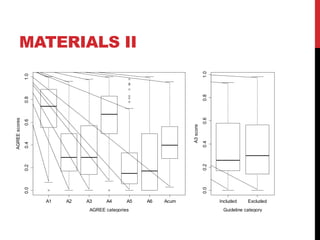
The AGREE instrument assesses six groups of variables
pertaining to the quality of CPGs.
The most elaborate group, A3, is labelled ”Rigour of
development” and pertains to the ways in which evidence
was sought, assessed and included in and from the
literature.
RESEARCH QUESTION
Is there a connection between the A3-score of CPGs and the
citations given to their references?
METHODS
A3 scores were collected from reviews of CPGs containing
AGREE-scores.
CPGs were extracted from Web of Science where possible.
All references from CPGs were extracted.
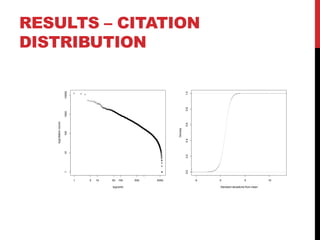
All citation scores of articles published in the same year and
journal as CPG references were extracted as control group.
METHODS II
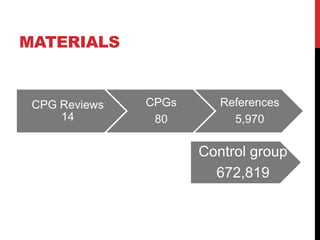
MATERIALS
CPG Reviews
14
CPGs
80
References
5,970
Control group
672,819
MATERIALS II
A1 A2 A3 A4 A5 A6 Acum
0.00.20.40.60.81.0
AGREE categories
AGREEscores
Included Excluded
0.00.20.40.60.81.0
Guideline category
A3score
RESULTS – CITATION
DISTRIBUTION
1 5 10 50 100 500 5000
110100100010000
log(rank)
log(citationcount)
-5 0 5 10
0.00.20.40.60.81.0 Standard deviations from mean
Density
RESULTS II – MAIN
FINDINGS
0.0 0.2 0.4 0.6 0.8
-1.0-0.50.00.51.01.52.0
A3
Z
cor = 0.471, r^2 = 0.222
0.0 0.2 0.4 0.6 0.8
0.00.20.40.60.81.0
A3
PPtop-10%
cor = 0.457, r^2 = 0.209
RESULTS III –
CONFOUNDERS?
0 100 200 300 400 500 600
-1.0-0.50.00.51.01.52.0
Number of references
Z
cor = 0.0305, r^2 = 0.000933
0 20 40 60 80
-1.0-0.50.00.51.01.52.0
citations / year
Z
cor = 0.239, r^2 = 0.0571
0 20 40 60 80
0.00.20.40.60.8
citations / year
A3
cor = 0.371, r^2 = 0.00036
0 100 200 300 400 500 600
0.00.20.40.60.81.0
Number of references
PPtop-10%
cor = 0.019, r^2 = 0.0429
0 20 40 60 80
0.00.20.40.60.81.0
citations / year
PPtop-10%
cor = 0.207, r^2 = 0.137
0 20 40 60 80
0.20.30.40.50.60.70.8
citations / year
Acum
cor = 0.317, r^2 = 0.101
RESULTS IV
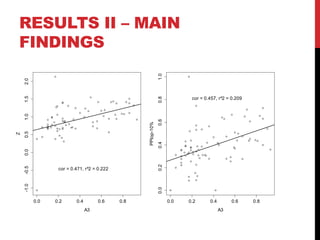
A medium-strength correlation between A3 score and
citedness of references.
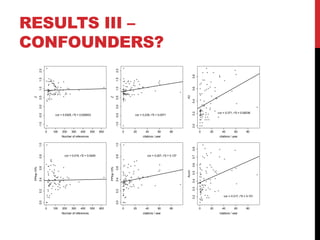
No apparent confounding from reference list length or
citedness of CPGs.
More data required.
Results are indicative of connections between citations,
clinical evidence and health impact – but there is no evidence
of causative mechanisms here.
DISCUSSION
Can references from other document types than journal
articles broaden the impact concept?
If a study is cited by a CPG, is this a clinical impact, or policy
impact – different from academic citation impact?
CPGs as mega-citations in specific contexts?
THANK YOU
FOR YOUR
ATTENTION

Association between quality of clinical practice guidelines and citations given to their references

  • 1.
    ASSOCIATION BETWEEN QUALITY OFCLINICAL PRACTICE GUIDELINES AND CITATIONS GIVEN TO THEIR REFERENCES JENS PETER ANDERSEN MEDICAL LIBRARY, AALBORG UNIVERSITY HOSPITAL ROYAL SCHOOL OF LIBRARY AND INFORMATION SCIENCE, UNIVERSITY OF COPENHAGEN
  • 2.
    ”In some waysbibliometrics is at the stage of European navigation in the middle ages. The familiar territory is well, even obsessively, charted but beyond te known world there are only unknown dragons on the map:” Lewison, 2002, p. 191
  • 3.
    SETTING SAIL… Clinical practiceguidelines (CPGs) as study object: - Recommendations about best treatment and diagnosis for specific diseases. - Varying quality of CPGs. They are supposed to be based on the best research evidence – not all are.
  • 4.
    LET’S AGREE The AGREEinstrument assesses six groups of variables pertaining to the quality of CPGs. The most elaborate group, A3, is labelled ”Rigour of development” and pertains to the ways in which evidence was sought, assessed and included in and from the literature.
  • 5.
    RESEARCH QUESTION Is therea connection between the A3-score of CPGs and the citations given to their references?
  • 6.
    METHODS A3 scores werecollected from reviews of CPGs containing AGREE-scores. CPGs were extracted from Web of Science where possible. All references from CPGs were extracted. All citation scores of articles published in the same year and journal as CPG references were extracted as control group.
  • 7.
  • 8.
  • 9.
    MATERIALS II A1 A2A3 A4 A5 A6 Acum 0.00.20.40.60.81.0 AGREE categories AGREEscores Included Excluded 0.00.20.40.60.81.0 Guideline category A3score
  • 10.
    RESULTS – CITATION DISTRIBUTION 15 10 50 100 500 5000 110100100010000 log(rank) log(citationcount) -5 0 5 10 0.00.20.40.60.81.0 Standard deviations from mean Density
  • 11.
    RESULTS II –MAIN FINDINGS 0.0 0.2 0.4 0.6 0.8 -1.0-0.50.00.51.01.52.0 A3 Z cor = 0.471, r^2 = 0.222 0.0 0.2 0.4 0.6 0.8 0.00.20.40.60.81.0 A3 PPtop-10% cor = 0.457, r^2 = 0.209
  • 12.
    RESULTS III – CONFOUNDERS? 0100 200 300 400 500 600 -1.0-0.50.00.51.01.52.0 Number of references Z cor = 0.0305, r^2 = 0.000933 0 20 40 60 80 -1.0-0.50.00.51.01.52.0 citations / year Z cor = 0.239, r^2 = 0.0571 0 20 40 60 80 0.00.20.40.60.8 citations / year A3 cor = 0.371, r^2 = 0.00036 0 100 200 300 400 500 600 0.00.20.40.60.81.0 Number of references PPtop-10% cor = 0.019, r^2 = 0.0429 0 20 40 60 80 0.00.20.40.60.81.0 citations / year PPtop-10% cor = 0.207, r^2 = 0.137 0 20 40 60 80 0.20.30.40.50.60.70.8 citations / year Acum cor = 0.317, r^2 = 0.101
  • 13.
    RESULTS IV A medium-strengthcorrelation between A3 score and citedness of references. No apparent confounding from reference list length or citedness of CPGs. More data required. Results are indicative of connections between citations, clinical evidence and health impact – but there is no evidence of causative mechanisms here.
  • 14.
    DISCUSSION Can references fromother document types than journal articles broaden the impact concept? If a study is cited by a CPG, is this a clinical impact, or policy impact – different from academic citation impact? CPGs as mega-citations in specific contexts?
  • 15.