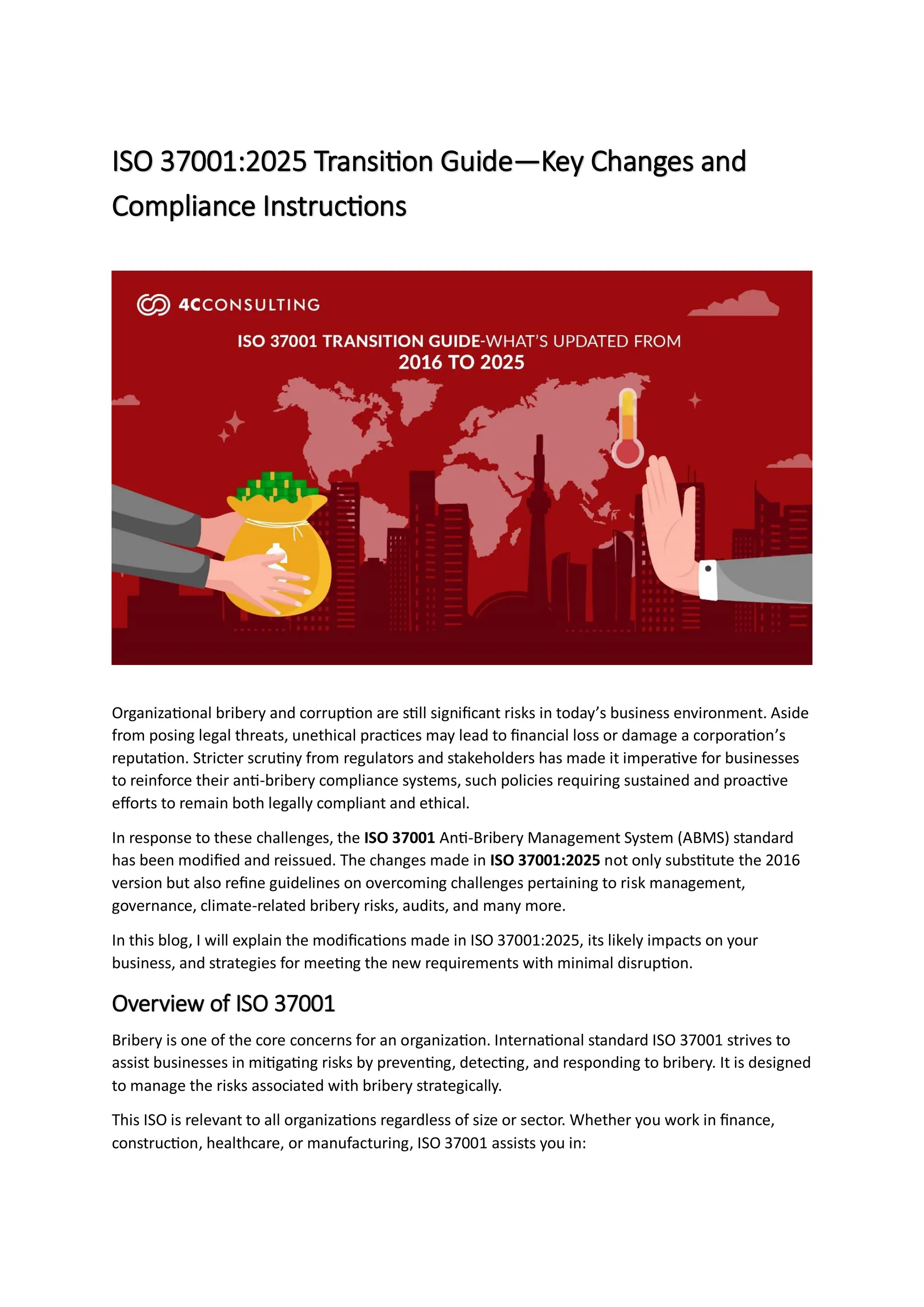
ISO 37001 Transition Guide: What’s Updated from 2016 to 2025
1.
ISO 37001:2025 TransitionGuide—Key Changes and
Compliance Instructions
Organizational bribery and corruption are still significant risks in today’s business environment. Aside
from posing legal threats, unethical practices may lead to financial loss or damage a corporation’s
reputation. Stricter scrutiny from regulators and stakeholders has made it imperative for businesses
to reinforce their anti-bribery compliance systems, such policies requiring sustained and proactive
efforts to remain both legally compliant and ethical.
In response to these challenges, the ISO 37001 Anti-Bribery Management System (ABMS) standard
has been modified and reissued. The changes made in ISO 37001:2025 not only substitute the 2016
version but also refine guidelines on overcoming challenges pertaining to risk management,
governance, climate-related bribery risks, audits, and many more.
In this blog, I will explain the modifications made in ISO 37001:2025, its likely impacts on your
business, and strategies for meeting the new requirements with minimal disruption.
Overview of ISO 37001
Bribery is one of the core concerns for an organization. International standard ISO 37001 strives to
assist businesses in mitigating risks by preventing, detecting, and responding to bribery. It is designed
to manage the risks associated with bribery strategically.
This ISO is relevant to all organizations regardless of size or sector. Whether you work in finance,
construction, healthcare, or manufacturing, ISO 37001 assists you in:
2.
Recognizing the briberyrisk
Establishing an effective policy framework and control mechanisms
Promoting transparency in processes and operations
Fostering trust with clients, regulators, and the general public
Attaining ISO 37001 Certification demonstrates the organization’s commitment to anti-bribery
compliance and good governance.
What’s New in ISO 37001:2025?
The update for ISO 37001:2025 comes with increased improvements.
Increased Engagement from Leadership Responsiveness
Enforcement of anti-bribery policies now falls heavily on top management. They are expected to
embrace the policies, support compliance units, and ensure coherent communication throughout
the organization.
More Comprehensive Assessments on Risk and Due Diligence
More comprehensive risk assessment for high-risk activities and third parties such as vendors,
agents, and politically exposed persons (PEPs) is now mandatory. These also require constant
observation and documentation.
Integration of Climate Change Risks
Bribery risks related to climate projects are now required to be evaluated under ISO 37001:2025.
This includes green infrastructure, carbon credit trading, and ESG investments, which are frequently
targeted for exploitation.
Better Internal Audits
Increased internal control procedures, including regular audits, real-time fraud detection systems,
and better structured compliance checks, have to be put in place.
Improved Protections for Whistle-Blowers
The latest standard mandates the establishment of safe and confidential whistle-blowing channels,
as well as robust anti-retaliation measures safeguarding individuals reporting unethical actions.
Incorporation of ISO 37301
ISO 37001:2025 now incorporates alignment with ISO 37301 (Compliance Management System),
thus providing additional functionality for organizations to manage anti-bribery and other
compliance requirements within a single system.
Emphasis on Risks from Third Parties
Companies are required to apply more rigorous screening, contract clauses, and continuous
oversight for vendors, suppliers, and contractors to mitigate bribery risks within the supply chain.
3.
Climate-Related Bribery: KeyPoints To Note
The growth of investment in green projects has simultaneously increased the risk of bribery
associated with environmental funding and carbon markets. As of now, ISO 37001:2025 stipulates
the following:
Evaluating bribery threats in climate and ESG-linked initiatives. Stricter checks of climate-related
subcontractors. Tighter financial controls to curb the abuse of green funding. Safeguarded
whistleblower alert systems to report climate-related corruption. Integration with ESG frameworks
for initiatives to ensure ethical and sustainable practices.
ISO 37001:2025 Transition Timeline
The following are pertinent deadlines to note:
March 31, 2024—The publication date for ISO 37001:2025 will be published.
January 1, 2025— All new certifications are required to adhere to the guidelines presented in ISO
37001:2025.
End of 2025—Businesses that hold existing certifications are recommended to switch to the new
standard.
Organizations are advised to update their Anti-Bribery Management
System (ABMS).
Benefits Of Switching to ISO 37001:2025
Outlined below are some notable advantages:
Enhanced governance at the corporate level.
Corporate leaders are now answerable for anti-bribery policies, and driving organizational culture
from the top-down fosters integrity.
Improved Risk Management
Bribery detection prevention strategies implemented through broadened evaluation scopes in newly
identified risks such as the climate finance framework. Enhanced Third-Party Monitoring
Enhanced due diligence mitigates risks in your supply chain and international partnerships.
ESG Integration
Adopting ESG policies helps in fostering trust among stakeholders and ensures that the funding for
green initiatives is not misused.
Preparedness for Audits Is Improved
Your business gets externally and internally audited any time because monitoring is done in real
time.
Trust in Competitive Global Markets
You gain a competitive advantage in the markets that value compliance and ethics most with having
the certification ISO 37001:2025.
4.
How 4C ConsultingCan Help:
We at 4C Consulting ensure that the transition to ISO 37001:2025 is not complex.
With over 15 years of industry experience, 4C Consulting has achieved a remarkable track record —
over 30,000 man-days in consultancy, more than 15,000 hours dedicated to training, and support
extended to over 12,000 clients across the globe. Our team comprises certified professionals
specializing in auditing and compliance.
Your trust empowers us to navigate the entire journey with you — from risk assessment, policy
revisions, and internal audits to post-certification support. At 4C Consulting, we ensure that your
Anti-Bribery Management System (ABMS) fully complies with the latest ISO 37001 requirements.