Islamic Studies
Grade 11
Given the dire need for Islamic studies material in
schools incorporating the subject in English,
Darussalam has endeavoured to publish an Islamic
Studies series covering all the grades, from grade
one through grade twelve.
Author
MOLVI ABDUL AZIZ
MA. English Literature
Revised and Edited
by Larbi Benrezzok
DARUSSALAM
GLOBAL LEADER IN ISLAMIC BOOKS
No part of this book may be reproduced or utilized in any form or by any means,
electronic or mechanical, including photocopying and recording or by any
information storage and reh·ieval system, without the permission of the publisher.
© Maktaba Dar-us-Salam, 2010
King Fahd National library Cataloging-in-Publication Data
Moulavi, Abdul aziz
Islamic studies- grade11 / Abdul Aziz MoulaviI Larbi Benrezzok- Riyadh 2010
254p : 28cm ISBN : 978-603-500-063-5
1- Islamic education 2- Islam studies
1· Larbi Benrezzok (editor) II-T itle
210.7 de 1431/9263
L.D. No. 1431/6847 ISBN: 978-603-500-063-5
Supervised by:
Abdul Malik Mujahid
HEAD OFFICE
P.O. Box: 22743, Riyadh 11416 K.S.A.Tel: 0096-1-4033962/4043432 Fax: 4021659
Website: www.darussalamksa.com Email: darussalam@awalnet.net.sa
K.S.A. Darussalam Showrooms:
Riyadh
Olaya branch: Tel 00966-1-4614483 Fax: 4644945
Malaz branch: Tel 00966-1-4735220 Fax: 4735221
Suwailam branch: Tel & Fax-1-2860422
• Jeddah
Tel: 00966-2-6879254 Fax: 6336270
• Madinah
Tel: 00966-503417155 Fax: 04-8151121
• AI-Khobar
Tel: 00966-3-8692900 Fax: 8691551
• Khamis Mushayt
Tel &Fax: 00966-072207055
•
Yanbu AI-Bahr Tel: 0500887341 Fax: 04-3908027
• AI-Buraida Tel: 0503417156 Fax: 063696124
U.A.E
• Darussalam, Sharjah U.A.E
Tel: 00971-6-5632623 Fax: 5632624
Sharjah@dar-us-salam.com.
PAKISTAN
• Darussalam, 36 B Lower Mall, Lahore
Tel: 0092-42-724 0024 Fax: 7354072
• Rahman Market, Ghazni Street,Urdu Bazar Lahore
Tel: 0092-42-7120054 Fax: 7320703
• Karachi, Tel: 0092-21-4393936 Fax: 4393937
• Islamabad, Tel: 0092-51-25 00237Fax: 51228151 3
U.S.A
• Darussalam, Houston
P.O Box: 79194 Tx 77279
Tel: 001-713-722 0419 Fax: 001-713-722 0431
E-mail: houston @dar-us-salam.com
• Darussalam, New York 486AtlanticAve, Brooklyn
New York-11217, Tel: 001-718-625 5925
Fax: 718-625 1511
E-mail: darussalamny@hotmail.com
U.K
• Darussalam International Publications Ltd.
Leyton Business Centre
Unit-17, Etloe Road, Ley1on, London, E10 7BT
Tel: 0044 20 8539 4885 Fax:0044 20 8539 4889
Website: www.darussalam.com
Email: info@darussalam.com
• DarussalamInternationalPublications Limited
Regents Park Mosque,146 Park Road
London NW8 7RG Tel: 0044- 207 725 2246
Fax: 0044 20 8539 4889
AUSTRALIA
• Darussalam, 153, Haldan St, Lakemba (Sydney)
NSW2195, Australia
Tel: 0061-2-974 07188 Fax: 0061-2-974 07199
Mobile: 0061-41458 0813 Res: 0061-2-9758 019 0
Email: abumuaaz@hotamail.com
CANADA
• lslmic Books S ervice
2200 South Sheridan way Mississauga,
Ontario Canada LSK2C8
Tel: 001-9 05-4 03-84 06 Ext.218 Fax:905-84 09
HONG KONG
• Peacetech
A2, 4/F Tsim Sha Mansion
83-87 Nathan Road Tsimbatsui
Kowloon, Hong Kong
Tel: 00852 2369 2722 Fax: 00852-23692944
Mobile: 00852 97123624
MALAYSIA
• Darussalam International Publication Ltd.
No.109A, Jalan SS 21/1A, Damansara Utama,
47400, Petaling Jaya, Selangor, Darul Ehsan, Malaysia
Tel: 00603 7710 9750 Fax: 7710 0749
E-mail: darussalm@streamyx.com
FRANCE
• Editions & Librairie Essalam
135, Bd de Menilmontant- 75011 Paris
Tel: 0033-01- 43 38 19 56/44 83
Fax: 0033- 01- 435744 31
E-mail: essalam@essalam com.
SINGAPORE
• Muslim Converts Association of Singapore
32 Onan Road The Galaxy
Singapore· 424484
Tel: 0065-44 06924, 348 8344 Fax:44 0 6724
SRI LANKA
• Darul Kitab 6, Nimal Road, Colombo-4
Tel: 0094 115 358712Fax: 115-358713
INDIA
• Islamic Books International
54, Tandel Street (North)
Dongri, Mumbai 4 000 09,
Tel: 009 1-22 -23 73 418 0, Fax: 0091-22-2373 0689
E-mail: sales@irf.net
SOUTH AFRICA
• Islamic oa·wah Movement (IDM)
48009 Qualbert 4078 Durban,South Africa
Tel: 0027-31-304-6883 Fax: 0027-31-305-1292
E-mail: idm@ion.co.za
All praise belongs to Allah; we praise Him and seek H is help
and forgiveness. We seek refuge i n Allah from the evil within us
and from our sinful deeds. Whomever Allah guides, there is none
to misguide him; and whomever He leads astray, none can guide
him. We bear witness that there is no god worthy of worship
except Allah, and we bear witness that Muhammad is H is servant
and Messenger. We pray to Allah the Almig hty to bestow H is
peace and blessings u pon Prophet Muhammad, upon his good
and pure fam ily, as wel l as upon all the noble com panions and
those who follow them in righteousness until the Day of
Judgement.
Given the dire need for Islamic studies material in schools
incorporating the subject in English, Darussalam has
endeavoured to publish an Islamic Studies series covering all the
grades, from grade one throug h grade twelve.
The present series covers all a reas of Islamic studies:
tafseer, fladeeth, tawfleed, flqh, seerah, and general etiquette
relating to different areas and situations. Due to the i mportance
of authentic Islamic knowledge, every effort has been made to
ensure that the material presented in the series is a uthentic. Also,
given the importance of Arabic Islamic terms, most of the terms
a re presented in their original Arabic script, along with the
transliteration and the translation of their meanings. This also
a pplies to supplications which have to be memorised in their
Arabic version. The aim here is to help the student read the
original text and understand its meaning. Each lesson is followed
by exercises covering questions a bout the lesson.
One striking feature in the series is the colourful artwork
used i n it that certainly a ppeals to children. This is certainly bound
to attract the young readers' attention, stim ulate them, a muse
them as well as educate them, even though this feature is not
stressed in books for the u pper grades.
The series aims to acquaint the student with the teachings of
Islam in every aspect: beliefs, practices and moral conduct. The
series, with its unique features, certainly fills a gap in this area
which has long been partially neglected.
The present breathtaking work was initiated by a n expert
i n the field of education, Maulvi Abdul Aziz, MA. English literature,
who has held different posts in the field including that of Senior
Administrative Officer in the Department of Private Education,
Ministry of Education, Dubai, UAE, from 1982 to 2002.
The current project also owes its existence i n its present
form to some people who made i nformative suggestions,
particularly Larbi Benrezzouk, College of Languages a nd
Translation, Imam Muhammad ibn Saud University, Riyadh, who
undertook the painstaking task of checking the authenticity of
the material presented in the series, proofreading the text as well
as adding references to certai n quotations from the Qur'an and
the hadeeth. Special thanks also go to Mr. Sajid Chaudhary for
proofreading in this addition and to Mr. Zulfiqar Mahmood who
conscientiously a pplied his expertise in the field of graphic design
to produce the series in a superb shape.
We pray to Almighty Allah to reward our endeavours and
to make the present series a bundantly beneficial to students in all
stages of education as well as to a ny one who reads them.
Abdul Malik Mujahid
Muharram, 1432 AH.
December 2010.
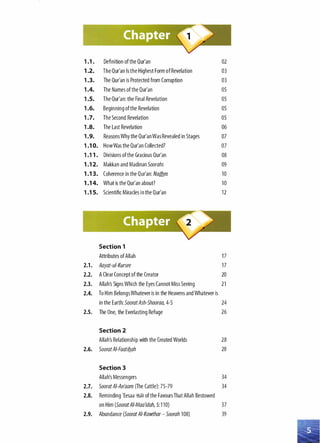
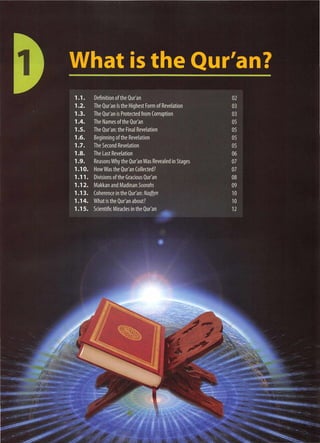
1.1 . Definition ofthe Qur'an 02
1 .2. The Qur'an Is the Highest Form ofRevelation 03
1.3. The Qur'an is Protected from Corruption 03
1.4. The Names ofthe Qur'an OS
1.5. The Qur'an: the Final Revelation OS
1.6. Beginning ofthe Revelation OS
1.7. The Second Revelation OS
1.8. The Last Revelation 06
1.9. Reasons Why the Qur'anWas Revealed in Stages 07
1.1 0. HowWas the Qur'an Collected? 07
1.11 . Divisions ofthe Gracious Qur'an 08
1 .1 2. Makkan and Madinan Soorahs 09
1 .1 3. Coherence in the Qur'an: Nadhm 10
1 .1 4. What is the Qur'an about? 10
1.1 5. Scientific Miracles inthe Qur'an 12
Section 1
Attributes ofAllah 17
2.1. Aayat-ui-Kursee 17
2.2. A Clear Concept of the Creator 20
2.3. Allah's Signs Which the Eyes Cannot Miss Seeing 21
2.4. To Him Belongs Whatever is in the Heavens and Whatever is
in the Earth: SooratAsh-Shooraa, 4-S 24
2.5. The One, the Everlasting Refuge 26
Section 2
Allah's Relationship with the Created Worlds 28
2.6. SooratAI-Faatiflah 28
Section 3
Allah's Messengers 34
2.7. SooratAI-An'aam (The Cattle): 7S-79 34
2.8. Reminding 'Eesaa �� ofthe Favours That Allah Bestowed
on Him (SooratAI-Maa'idah, S:110) 37
2.9. Abundance (Soorat AI-Kawthar- Soorah 108) 39
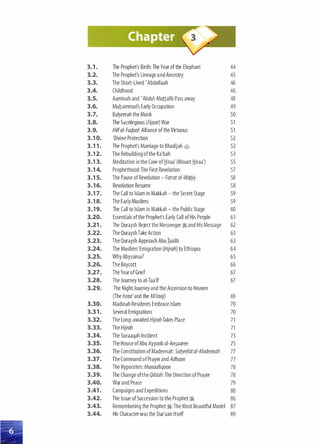
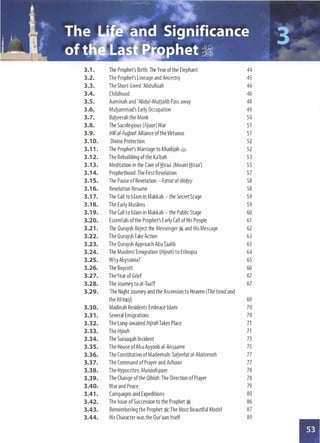
3.1 . The Prophet's Birth: The Year of the Elephant 44
3.2. The Prophet's Lineage and Ancestry 45
3.3. The Short-Lived'Abdullaah 46
3.4. Childhood 46
3.5. Aaminah and 'Abdui-Munalib Pass away 48
3.6. Muhammad's Early Occupation 49
3.7. Bab_eerah the Monk 50
3.8. The Sacrilegious (Fijaar) War 51
3.9. Hilf a/-Fufi.ool: Alliance of the Virtuous 51
3.1 0. Divine Protection 52
3.1 1 . The Prophet's Marriage to Khadijah � 52
3.1 2. The Rebuilding ofthe Ka'bah 53
3.1 3. Meditation inthe Cave ofHiraa' (Mount Hiraa') 55
3.1 4. Prophethood: The First Revelation 57
3.1 5. The Pause of Revelation- Fatratai-Wafliy 58
3.16. Revelation Resume 58
3.1 7. The Call to Islam in Makkah- the Secret Stage 59
3.1 8. The Early Muslims 59
3.19. The Call to Islam in Makkah- the Public Stage 60
3.20. Essentials ofthe Prophet's Early Call of His People 61
3.21 . The Quraysh Reject the Messenger� and His Message 62
3.22. The Quraysh Take Action 63
3.23. The Quraysh Approach Abu Iaalib 63
3.24. The Muslims' Emigration (Hijrah) to Ethiopia 64
3.25. Why Abyssinia? 65
3.26. The Boycott 66
3.27. The Year ofGrief 67
3.28. The Journey to at-Taa'if 67
3.29. The Night Journey and the Ascension to Heaven
(The lsraa' and the Mi'raaj) 69
3.30. Madinah Residents Embrace Islam 70
3.3 1 . Several Emigrations 70
3.32. The Long-awaited Hijrah Takes Place 71
3.33. The Hijrah 71
3.34. The Suraaqah Incident 73
3.35. The House ofAbu Ayyoob ai-An�aaree 75
3.36. The Constitution of Madeenah: Safleefatai-Madeenah 77
3.37. The Command of Prayer and Adhaan 77
3.38. The Hypocrites: Munaafiqoon 78
3.39. The Change ofthe Qib/ah: The Direction of Prayer 78
3.40. War and Peace 79
3.41 . Campaigns and Expeditions 80
3.42. The Issue ofSuccession to the Prophet� 86
3.43. Remembering the Prophet�: The Most Beautiful Model 87
3.44. His Character was the Qur'aan Itself 89
4.1 The Terms Sunnah and fi.adeeth 93
4.2 The Importance ofthe Sunnah 93
4.3 The Importance oftheSunnah in the Qur'an 94
4.4 The Prophet's Pronouncement regarding the Importance
of the Sunnah 95
4.5 Narration offi.adeeth During the Prophet's Lifetime 96
4.6 Writing ofH.adeeth During the lifetime ofthe Prophet* 96
4.7 Letters Sent by the Prophet� 98
4.8 Collection ofH.adeeth Continued After the Death ofthe
Prophet* 98
4.9 Travels For the Purpose of Seeking H.adeeth 99
4.1 0 The Major Collections offi.adeeth 100
4.1 1 Rules of Criticism offi.adeeth 102
4.1 2 Method of Counting Different Narrations 103
4.1 3 The /snaad- Chain ofTransmitters 103
4.1 4 Different Categories or Classes offi.adeeth 104
4.1 5 fi.adeeth Qudsee (Sacred fi.adeeth) 105
4.1 6 Obligation to Follow the Sunnah 106
5.1. Abu 'Abdullaah Muhammad ibn lsmaa'eel ai-AI-Bukhaaree 109
5.2. Abul-.t!usayn Muslim ibn al-.t!ajjaaj an-Naysaabooree
(lmaam Muslim) 110
5.3. Abu Daawood Sulaymaan ibn ai-Ash'ath as-Sijistaanee 112
5.4. Abu ' Eesaa Muhammad ibn 'Eesaa at- Tirmidhee 113
5.5. Abu 'Abdur-Rahmaan Ahmad ibn Shu'ayb ibn 'Ali an-Nasa'ee 114
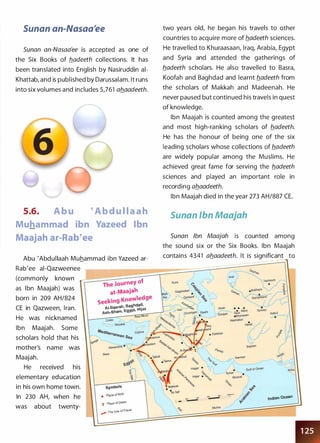
5.6. Abu 'Abdullaah Muhammad ibn Yazeed Ibn Maajah
ar-Rab'ee 115
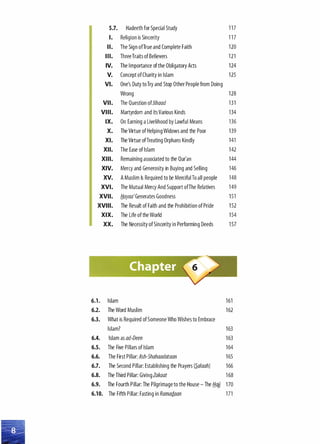
5.7. Hadeeth for Special Study 117
I. Religion is Sincerity 117
II. The Sign ofTrue and Complete Faith 120
Ill. ThreeTraits of Believers 121
IV. The Importance of the Obligatory Acts 124
v. Concept ofCharity in Islam 125
VI. One's Duty to Try and Stop Other People from Doing
Wrong 128
VII. The Question ofJihaad 131
VIII. Martyrdom and its Various Kinds 134
IX. On Earning a Livelihood by Lawful Means 136
X. The Virtue of Helping Widows and the Poor 139
XI. The Virtue ofTreating Orphans Kindly 141
XII. The Ease of Islam 142
XIII. Remaining associated to the Qur'an 144
XIV. Mercy and Generosity in Buying and Selling 146
XV. A Muslim Is Required to be Merciful To all people 148
XVI. The Mutual Mercy And Support ofThe Relatives 149
XVII. H.ayaa' Generates Goodness 151
XVIII. The Result of Faith and the Prohibition of Pride 152
XIX. The Life of the World 154
XX. The Necessity of Sincerity in Performing Deeds 157
6.1. Islam 161
6.2. The Word Muslim 162
6.3. What is Required of Someone Who Wishes to Embrace
Islam? 163
6.4. Islam as ad-Deen 163
6.5. The Five Pillars of Islam 164
6.6. The First Pillar: Ash-Shahaadataan 165
6.7. The Second Pillar: Establishing the Prayers (�alaah) 166
6.8. The Third Pillar: GivingZakaat 168
6.9. The Fourth Pillar: The Pilgrimage to the House- The fi.ajj 170
6.10. The Fifth Pillar: Fasting in RamarJ.aan 171
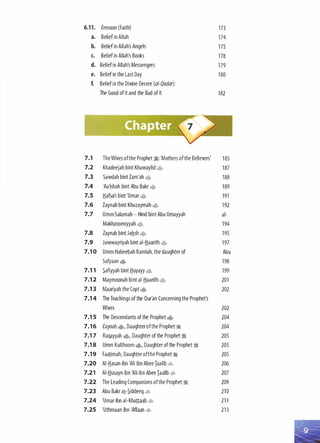
6.11. Eemaan (Faith) 173
a. Belief in Allah 174
b. Belief in Allah's Angels 175
c. Belief in Allah's Books 178
d. Belief in Allah's Messengers 179
e. Belief in the LastDay 180
f. Belief in theDivineDecree (ai-Qadar):
The Good of it and the Bad of it 182
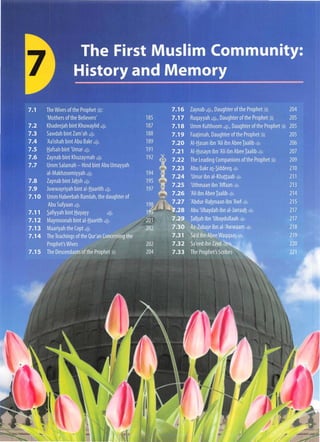
7.1 The Wives ofthe Prophet�: 'Mothers of the Believers' 185
7.2 Khadeejah bint Khuwaylid � 187
7.3 Sawdah bint Zam'ah � 188
7.4 'Aa'ishah bint Abu Bakr � 189
7.5 H_afsah bint 'Umar � 191
7.6 Zaynab bint Khuzaymah � 192
7.7 UmmSalamah- Hind bint Abu Umayyah al-
Makhzoomiyyah � 194
7.8 Zaynab bint Jahsh � 195
7.9 Juwwayriyah bint ai-H_aarith � 197
7.1 0 Umm Habeebah Ramlah, the daughter of Abu
Sufyaan � 198
7.1 1 �afiyyah bintH_uyayy � 199
7.1 2 Maymoonah bint ai-H_aarith � 201
7.1 3 Maariyah the Copt � 202
7.1 4 The Teachings of the Qur'an Concerning the Prophet's
Wives 202
7.1 5 TheDescendants of the Prophet � 204
7.16 Zaynab �
'
Daughterof the Prophet� 204
7.1 7 Ruqayyah �,Daughter of the Prophet� 205
7.1 8 Umm Kulthoom �,Daughter of the Prophet� 205
7.19 Faatimah,Daughter ofthe Prophet� 205
7.20 AI-H_asan ibn 'Ali ibn Abee Iaalib � 206
7.21 AI-H_usayn ibn 'Ali ibn Abee Iaalib � 207
7.22 The Leading Companions of the Prophet� 209
7.23 Abu Bakr a�-�iddeeq � 210
7.24 'Umar ibn ai-Khanaab � 211
7.25 'Uthmaan ibn 'Affaan � 213
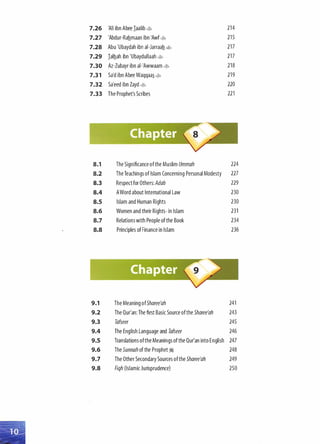
7.26 'Ali ibn Abee Iaalib 4> 214
7.27 'Abdur-Rahmaan ibn 'Awf4> 215
7.28 Abu 'Ubaydah ibn ai-Jarraah 4> 217
7.29 Ialhah ibn 'Ubaydullaah 4> 217
7.30 Az-Zubayr ibn ai-'Awwaam 4> 218
7.31 Sa'd ibn Abee Waqqaa� 4> 219
7.32 Sa'eed ibn Zayd � 220
7.33 The Prophet's Scribes 221
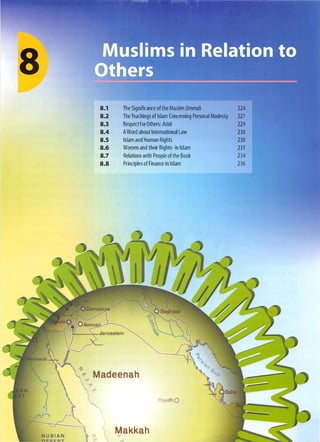
8.1 The Significance ofthe Muslim Ummah 224
8.2 The Teachings of Islam Concerning Personal Modesty 227
8.3 Respectfor Others: Adab 229
8.4 AWord about International Law 230
8.5 Islam and Human Rights 230
8.6 Women and their Rights- in Islam 231
8.7 Relations with People ofthe Book 234
8.8 Principles ofFinance in Islam 236
9.1 The Meaning ofSharee'ah 241
9.2 The Qur'an: The first Basic Source ofthe Sharee'ah 243
9.3 Tafseer 245
9.4 The English Language and Tafseer 246
9.5 Translations ofthe Meanings ofthe Qur'an into English 247
9.6 The Sunnah of the Prophet� 248
9.7 The Other Secondary Sources ofthe Sharee'ah 249
9.8 Fiqh (Islamic Jurisprudence) 250
1 .1 . Definition of the Qur.'an
The Qur'an is the Arabic Speech of Allah
which He revealed to Prophet Muhammad �
47:2) through Angel Jibreel �� in its precise
meaning and exact wording. It is the literal,
uncreated Word of Allah. The word 'Qur'an' is
frequently mentioned in the Glorious Book
itself (See for instance 2:1 85, 1 0:37, 1 0:61 and
1 7:1 06).
The Qur'an clearly states to whom, when, in
what language, how and why it was revealed:
It was revealed in the month of RamaQ.aan
(2:1 85) on the Night of Power or Decree 'Laylat­
ui-Qadr' (97:1 ): 'We revealed it on a blessed
Night: (44:3)
It was revealed in the Arabic language:
'Surely,WehavemadeitintheArabiclanguage
so that you may be able to understand it:
(43:3).
It was revealed in portions, each of which
was written and committed to memory as soon
as it was revealed, and its revelation was spread
over twenty-three years of the Prophet's life,
during which time he was occupied solely with
the spread of its message:
"It is a Qur'an which We have divided [into
parts from time to time] so that you may
recite it to the people at intervals; and We
have revealed it by stages." (1 7:1 06)
1 .2. The Qur'an is the Highest Form of Revelation
Although the Gracious Qur'an was revealed
piecemeat the entire revelation is one whole.
It is the Word of Allah revealed through the
Holy Spirit, that is, Angel Jibreel �1. Revelation
takes place in three forms: 'It is not fitting for
any human being that Allah should speak to
him except by revelation, from behind a veil
or by sending a messenger that reveals -by
His permission -whatever Allah wills: (42:51 )
The first of these modes is called waby, which
is used here in its literal sense of a/-ishaarah as­
saree'ah, that is to say, a quick suggestion into
the mind of man.
The Qur'an is unique. It is inimitable and is
protected by Allah from all forms ofcorruption.
The word Qur'an is a verbal noun which means
'the reading' or'recitation:
1 .3. The Qur'an is Protected by Allah from Corruption
Previous revelations had been corrupted
intentionally, but the Qur'an's final message to
man is exactly the same in its present form as
it was revealed to Prophet Muhammad � more
than 1 400 years ago.
Islam teaches us that Allah created the
entire universe, the angels, the jinn and
then mankind in the persons of
Adam and his wife. The history
of humanity began with
the disobedience of the
first couple and their
expulsion from Paradise,
but Allah did not
abandon them; rather,
He promised to guide
them by sending them prophets.
Adam �� was the first Prophet. Some of
the prophets brought people Sacred Books
from Allah: the best known were the Torah (at­
Tawraat), which was given to Prophet Moosaa
�; the Psalms (az-Zaboor), which was given
to Prophet Daawood �; and the Gospel (a/­
lnjeel) which was given to Prophet �Eesaa �1.
Many additions and deletions had crept into
these books, but the Qur'an has remained
intact because Allah the Almighty has taken it
upon Himself to protect it, as the Qur'an says,
'We have sent down the Reminder, and We
will guard it [from corruption]:(Soorat af-Hijr,
1 5:9)
Harun Yahya writes,
The Divine Scriptures that were
revealed before Islam lost their
original forms overtime;they
are either incomplete or
not fully accurate. In
the case of the Qur'an,
however, Allah placed
the revelations into
our Prophet's memory.
In addition, after he
received each revelation, the Prophet �told his
numerous companions to write them down,
thereby ensuring the Qur'an's preservation in
its original textual form. Caliph Abu Bakr (632-
634) had the Qur'an compiled into a single
copy, and Caliph �uthmaan (644-656) had
copies of it sent to important Islamic cities.
The following verses explain how our Prophet
� tried to remember the revelations, and how
Allah helped him do so:
Do not move your tongue trying to hasten it. Its collection and
recitation are Our affair. So when We recite it, follow its recitation. Then
its explanation is Our concern. (Soorat ai-Qiyaamah, 75:1 6-19)
Astheverses maintain, our Prophet;iremembered the Qur'an in a unique
way, for Allah implanted its verses in his mind. As his Companions wrote
it all down while he was still alive, in compliance with His promise, each
of its letters has remained unaltered since the beginning of its revelation
over 1 ,400 years ago. Therefore, Allah's revelation has survived intact to our
day.
The Qur'an's lack of any internal contradiction and discrepancy also
shows that it is from Allah and is immune to change. The Qur'an is internally
consistent and in full agreement with historical developments and scientific
discoveries. This attribute is so certain and explicit that our Lord stated:
Will they not ponder the Qur'an? If it had been from other than Allah,
they would have found many inconsistencies in it. (Soorat an-Nisaa', 4:
82)1
1 Harun Yahya, Allah Promised to Protect the Qur'an, available at: http:/I
www.nnseek.comjejaus.religion.islamjallah_promised_to_protect_the_
qur_an_24845933t.html
All the teachings contained in the former
scriptures thatwere meantto be oflasting value
and importance are included in the Qur'an.The
Qur'an gives some specific accounts of what
the pre-Qur'anic scriptures contained. The
basic message of all the prophets of Allah, and
hence all scriptures they brought, was one and
the same message from Allah to people:
Indeed, We have sent forth among
every community a messenger with the
commandment "Worship Allah Alone and
shun all false deities and objects of worship!"
(1 6:36)
Thus, the Qur'an not only preserves the
essential teachings of the previous revelations
but also sets out once and for all the eternal
truth in its entirety. Indeed, it is a book that
contains the essence of the revelations made
to the prophets, preserving them so perfectly
that the reader has no need to have recourse to
other sacred scriptures, which have undergone
all forms of corruption.
All the essential points, in every respect, are
given to us in the Qur'an.The MusHms,therefore,
regard the Qur'an as the Most Sacred object
on earth - Allah's Supreme Gift to mankind. It
is an object of veneration and the foundation
of human understanding of the universe and
man's place in it:
If all men andjinn were to collaborate, they
could not produce its like. (1 7:88)
The Prophet � was authorized to challenge
his critics and opponentsto produce something
comparable (1 0:38). The challenge was taken
up by more than one stylist in Arabic literature
- with a predictable result. The style of the
Qur'an is Allah's style - this is basically what
forms the miraculous character of the Qur'an.
1 .4. The Names of the Qur'an
Almighty Allah refers to the Qur'an by a number
of names. These include "the Qur'an" (1 7:88), the Book
"a/-Kitaab" (2:2), the Criterion "ai-Furqaan" (25:1 ), the
Reminder "ad-Ohikr" (1 5:9) and the Revelation sent
down "at-Tanzeel" (26:1 92).
1 .5. The Qur'an:
the Final Revelation
Prophet Muhammad :i was
the Last Messenger from Allah
to mankind; he brought the
final revelation - the Qur'an­
from Allah to man. Therefore,
the Qur'an is the last of the
Holy Scriptures.
Other references to the Qur'an are by such terms
as an-Noor (the Light), Hudaa (Guidance), Rab_mah
(Mercy), Majeed (Glorious), Mubaarak (Blessed) and
Nadheer (Warner), among other names.
1 .6. The
Revelation
Beginning of
The revelation ofthe Qur'an began in Laylat­
ui-Qadr (the Night of Power) of RamaQ_aan (the
twenty-seventh night or one of the odd nights
of its third part) after Prophet Muhammad ii
had passed the fortieth year of his life, during
his seclusion in the cave of Hiraa: on a mountain
near Makkah, in the year 6 1 0 CE.
The first revelation he received constitutes
the first five verses of Soorat a/-'Aiaq (the
Clinging Clot):
Read in the Name of your Lord, who
created; created man from a clinging clot.
Read! And your Lord is the Most Gracious
One; He Who has taught by the pen; He has
taught man that which he knew not. (96:1 -5)
The remainder part of this soorah, which
consists of 1 9 verses, was revealed on some
other occasion.
1 .7. The Second Revelation
The second portion of the Glorious Qur'an
revealed to Prophet Muhammad ii was the
beginning of Soorat AI-Muddath-thir (74:1 -5).
The rest of the soorah was revealed later. This
soorah consists of 56 verses.
1 .8. The Last Revelation
Many Muslim Scholars are agreed that the last revelation
was verse 281 of Soorat ai-Baqarah:
And fear the day whenyou shall be brought to Allah. Then
each soul shall be paid in full what it has earned and none
shall be dealt with unjustly.
The Prophet ;i passed away nine nights after the last
revelation. Some scholars, however, hold that the following
verse was the last verse to be revealed.
This day I have perfected your religion for you, completed
My favour upon you and have chosen for you Islam as
your religion. (Soorat a/-Maa'idah, 5:3)
This opinion, however, is not sound according to many
scholars who argue that this verse was actually revealed during
the Farewell Pilgrimage.
Define the word 'Qur'an:
What are the different names of the Qur'an?
Can you explain how the Qur'an is inimitable?
What are the three forms of revelation? How can the Qur'an be the highest
form of revelation?
The Qur'an is the essence of all former revelations. Discuss.
How and why has the Qur'an remained unchanged?
How can you prove that the Qur'an is the final revelation of Allah?
How did the revelation of the Qur'an begin? What do you know about the
final and last revelations?
What do you think is meant by "Farewell Pilgrimage"?
1 .9. Reasons why the Qur'an
was Revealed in Stages
• The Gracious Qur'an was sent down in stages
over a period of 23 years, and not as a complete
book in one single act of revelation. There are
several reasons for this, and the following are
the most significant:
• To strengthen the heart of Allah's Messenger
� from time to time and whenever the need for
guidance arose.
• Out of consideration for the Messenger of
Allah �
'
since revelation was a very difficult
experience for him.
• To gradually implement the commands of
Allah.
• To make understanding, translation into
action and memorization of the revelation
easier for the believers.
• It is established that the Qur'an had been
memorized in its entirety by the companions of
the Prophet � during his lifetime. This tradition
continued after the Prophet's death and later
among all generations of Muslims that have
followed, until today.
1 .1 0 How was the Qur'an
Collected?
AlthoughtheQur'anwasrevealed in portions,
it did not remain long on that fragmentary
condition. As its very name suggests, it was a
book from the first; it could not be complete
until its last verse was revealed; it was never
without some form of arrangement. In fact,
every single verse, part of a verse or soorah that
was revealed had its own definite place in the
Gracious Book. The arrangement of the Qur'an
was thus a part of divine scheme. It has been
established that the Qur'an had been written
down in its entirety in the lifetime of the
Prophet � but had not been brought together
in one single place. However, the ordering of
the Qur'an and the arrangement of the various
soorahs was fixed by the Prophet� himself and
safeguarded through oral transmission.
Whenever a soorah or verses of a soorah
were revealed to the Prophet �
'
he would call
one of his scribes1 and say to him, 'Write such-
1 A scribe is a person who made copies of written docu­
ments before printing was invented.
and-such a verse in the soorah where such­
and-such verses occur.' (Abu Daawood)
I n fact, if we keep in mind the use that
was made of the Qur'an, we cannot for a n
instant entertain the idea that the Glorious
Qur'an existed without arrangement of its
verses and soorahs in the lifetime of the
Prophet �. It was not only recited in the
daily prayers but also committed to memory
and regularly recited to keep it fresh in the
mind. Therefore, if the arrangement of the
verses and soorahs had not existed, it would
have been impossible to recite it in the daily
prayers, congregational or otherwise, or to
commit it to memory. If the prayer leader
(imaam) happens to make the slightest
change in the place of a verse during the
congregational prayer, he will immediately
be corrected by those behind him!
The Glorious Qur'an thus existed in a
complete and ordered form in the memories
of the companions of the Prophet � during
his lifetime, but no complete written copy of
it existed at the time, nor could such a copy
be made while the Prophet� was still alive
and still rece1v1ng revelations. However,
the entire Qur'an was safely preserved in
the memories of his com panions who were
called Qurraa; or reciters.
It so happened, however, that many of the
reciters fell in the famous Battle ofYa maamah
during in the caliphate of Abu Bakr a�­
S.iddeeq �� and it was then that �umar ibn
AI-Khattaab � pointed out to Abu Bakr the
necessity of compiling a standard written
copy so that no portion of the Qur'an would
be lost even if all the reciters died. This copy
was compiled from the manuscripts written
u nder the direction of the Prophet � himself,
and the arrangement followed was that of
the oral recitation as followed in the time of
the Messenger of Allah �. Thus a standard
written copy was prepared and entrusted to
the care of Hafsah �2;,, wife of the Prophet�
and daughter of ' Umar ibn ai-Khattaab. Later
on, ' Uthmaan ibn 'Affaan, the fourth rightly­
guided caliph ordered copies to be made
from this standard copy. These copies were
then sent to different parts of the Islamic
state.
1 .1 1 Divisions of the Glorious Qur'an
The Qur'an is divided into 1 1 4 soorahs. The
term soorah (pl. suwar, generally written as
soorahs here) literally means an enclosure or
fencing, such as the walls around a city. It is
also used to denote an elevated plain. When
applied to the Qur'an, it signifies a specific
group of verses, arranged in a specific manner.
In technical language, soorah is the chapter­
wise division of the Qur'anic text - a chapter or
part set apart from the preceding and following
text.
The Qur'an consists of 1 1 4 soorahs of
unequal length, the shortest consisting of
three and the longest of 286 verses, or aayaat.
The Arabic word aayah (pl. aayaat) means
sign. It is the shortest division of the Qur'anic
text, that is to say a phrase or sentence. The
Revelation is Guidance from Allah to mankind.
It is, therefore, not at all surprising to discover
that its small divisions are called Signs (Signs of
Guidance). The expression verse is not accurate
since the Qur'an is not poetry.
their names, which serve as a sort of heading.
Bot t e arrangement o t e soora s an
the order of the aayaat within each soorah
were determined by the Prophet � under the
guidance ofAngel Jibreel (Gabriel) �1.
Other Divisions of the Qur'anic Text
The Qur'an is divided into 30 portions of
approximately equal length for easy recitation
during the thirty days ofa month. Each ofthese
portions is called a juz' (pl. ajzaa'). Juz' literally
means 'part' or 'portion'. Some copies of the
Qur'an have the soorahs divided into ruku'
(sections or paragraphs). The ruku' is usually
accompanied by three numbers. The top
number denotes the number of the ruku' with
respect to that particular soorah, the middle
number indicates the number of verses in that
ruku' and the bottom number indicates the
number of the ruku' with respect to the juz' in
1 .1 2. Makkan and
Madinan Soorahs
An important division of the
Gracious Qur'an relates to the
Makkan and Madinan soorahs. After
having received the first revelation,
the Prophet � spent thirteen years
in Makkah and then was forced to
emigrate to Madeenah, where he
spent the last ten years of his life.
Hence, the soorahs of the Qur'an
have also been classified, according
to their origin, into Makkan and
Madinan soorahs.
which it occurs.
CopiesoftheQur'an printed in Arabcountries
in particular have eachjuz'subdivided into four
aflzaab (singular, flizb) indicated by the word
flizb, printed in Arabic. Each flizb is subdivided
into four quarters called rub'.
The Qur'anic text is also divided into seven
parts of approximately equal lengths, each of
which is called manzil, so that ifa person wishes
to complete the recitation of the Qur'an in one
week, he may do so by reciting one manzil a
day.
A soorah is said to be of Makkan
origin when its beginning was
revealed in the Makkan period even
if it contains verses from Madeenah.
Likewise, a soorah is said to be of
Madinan origin when its beginning
was revealed in the Madinan phase
even ifit has verses from the Makkan
period in its text.
Out of the total of 1 1 4 soorahs
into which the Glorious Qur'an is
divided, 85 soorahs are, according
to scholars, of Makkan origin. The
Madinan soorahs are longer than
the makkan ones and, therefore,
comprise a much larger part of the
Qur'an.
1 .1 3. Coherence in the
Qur'an: Nadhm
Coherence (nadhm) denotes clear
logical connection of ideas, arguments
and sentences, among other things, so
that together they make a whole. Every
soorah in the Qur'an is a perfect unit with
a central theme around which it revolves.
The central theme is the unifying 'thread'
in the soorah.
It is true that every soorah is a unit, but
there also exists a logical link between all
the soorahs as they follow one another.
Between different soorahs there is also a
logical unity and coherence.
With the exception of a few, all soorahs
are found in the Qur'an in pairs that
complement each other.
The concept of the pairing of the
soorahs is original to Amin Ahsan lslahi
(1 904-1 997). According to lslahi, the
Qur'anic soorahs in their arrangement
are, as a rule, paired.That is,just as, on one
level, each soorah is an integrated whole
and it is distinct from all the others, so on
another level, all soorahs exist in the form
of pairs, each of which is composed of
two closely matched soorahs and distinct
from other pairs. For a detailed and
interesting discussion of this approach
which is based and evolved around the
concept of order and coherence in the
contents of the Qur'an, you may refer to
Coherence in the Qur'an by Mustansir Mir,
American Trust Publications, I ndianapolis,
USA, and also to Pondering over the Qur'an
by Muhammad Saleem Kayani, ai-Kitab
Publications, London, UK.
1 .1 4. What is the Qur'an about?
The Qur'an is the word of Allah and a book of
guidance. A question may arise here: Guidance to
what? The answer is simply guidance to Allah, to His
Most Beautiful Names and Lofty Attributes, His Will
and the way in which one may conduct oneself to
attain His Good Pleasure.
The entire Qur'an, so to say, is the exposition of
the Names and Attributes of Allah the Almighty. In
other words, guiding the creation to understanding
Allah's Oneness (tawb_eed) is the overriding objective
of the Qur'an. Thus, one of the major objectives
of the Qur'an is to teach the creation about Allah.
The Qur'anic teachings about Allah's Names and
Attributes are extremely essential for the strength
and health of one's faith.
If one has knowledge and correct understanding
of Allah's Names and Attributes, then one would
never turn to anyone else or direct any form of
worship to anyone other than to Allah. It is
worth mentioning here that all that is in the
Sunnahofthe Prophet� is aIsothe exposition of
the Qur'an. This guidance to Allah, knowledge
of His Names of Attributes and His Will and
guidance to right conduct, cannot be obtained
by any means other than the Qur'an and its
complementary, the Sunnah: the sayings and
the excellent practices of the Messenger of
Allah �.
Th� Qur'an guides to the straight path that
leads·to Allah's pleasure and Paradise. It gives
)
truth-seekers the proper concept ofthe truth as
well as the willpower and the moral courage to
produce a living model of that concept in real
life. It helps them overcome
the obstacles they might
encounter from within or
without. Thus the Qur'an
is a book that is squarely
aimed at man. Indeed, it
is 'guidance for mankind'
(2:1 85), as Almighty Allah
says about it.
It is in fact guidance for
all the needs and benefits
of the life of this world and
that of the hereafter. It is
first and foremost a Book of
Guidance.
Allah also describes the Qur'an as light'noor'
(42:52). Light shows us the path in front of us.
In fact, it is through light that we can avoid
the harmful things in our way and follow the
safe path. However, this light is different from
the light one senses in the physical world. It
is a spiritual light whereby we recognize and
understand what is of real benefit to us in this
world and in the world to come.This light leads
to the Straight Path and to Allah's Grace and
Mercy. Nevertheless, this light is only beneficial
for those who follow it.
The Qur'an speaks about the past, the
present and the future. It also speaks about
the unseen. The verses of the Qur'an may be
classified into three categories:
those related to the stories of the prophets
and earlier communities, those related to
commands and prohibitions, and those related
to Allah and His Beautiful Names and Lofty
Attributes.
The Qur'an is Allah's speech. It is directly
related to His noble attributes of greatness,
mercy, forgiveness and knowledge. When we
live our life according to the teachings of the
Qur'an, we actually live it
in a way that is pleasing to
Allah - our Creator. Life in
the shade of the Qur'an is,
in reality, a life that brings
one closer to Almighty
Allah. Thus, there can be
no doubt then that one of
the major objectives of the
Qur'an is to teach people
about Allah - their Creator.
The Qur'an guides us in
every aspect of our lives.
It is undoubtedly one of
the greatest blessings that Allah has given us.
Among the most significant aspects to which
the Qur'an guides mankind is good character
and proper conduct. Speaking about the
purpose for which he has been sent, Allah's
Messenger� once said, 'I have only been sent
to perfect good morals: (ai-Haakim, graded
sab_eeb_ by Sheikh ai-Aibaanee)
When 'Aai'shah � was asked about the
character of the Messenger of Allah �
'
she
replied, 'His character was the Qur'an: (Muslim)
Thus, the Qur'an is not simply a book that
makes people grow morally and spiritually.
It is not just about imparting human
knowledge of what is right and correct. It
also instils in people's hearts and minds
the feeling of heedfulness, fear, love and
accountability to Allah that will make them
do what is proper and correct. The Qur'an,
therefore, vividly describes what will happen
on the Day of Judgment to both those who
are righteous and heedful of Allah and those
who are evil.
Thus, once we realize this Qur'anic
objective and sincerely strive hard to achieve
it through reading and studying the Qur'an,
Allah will certainly gra nt us knowledge and
fill our hearts with heedful ness (taqwaa). In
this way, we will become useful in our society
as well as in the world at large. Our conduct
and actions will change for the better, and
we will call people to the way of Allah - the
way of peace in the world.
Certainly, one of the objectives of the
Qur'an is to show the believers how to protect
themselves from all the forces of evil that are
trying to distance them from their Creator.
Allah cautions them concerning their own
lower self (an-nafs, or soul) - an enemy
concerning which most people would not
be aware were not for the revelation of Allah
and His guidance in this regard. Perhaps the
clearest example of this class of teachings in
the Qur'an deals with the devil, or Satan. The
Qur'an vividly describes the ways and means
of the devil. One such way is his appearing
as a sincere advisor and well-wisher, as was
the case in which he approached Adam and
Eve although Allah had warned them about
him, as He warns the believers about in the
Gracious Qur'an. (7: 20-22)
1 .1 5. Scientific Miracles in
the Qur'an
In fact, the Qur'an is not a book of science
or technology. It is a book of guidance which
principally aims at guiding people to the
true God - Allah, helps them establish
righteousness and create a virtuous society.
The Qur'an is the Word ofAllah. Its matchless
style and profound wisdom constitute some of
its definite proofs. Furthermore, its miraculous
attributes further prove that it is a revelation
from Allah. One of these attributes is the fact
that a number of scientific facts that have been
discovered in recent years with the help of
modern technology were stated in the Qur'an
over 1 400 years ago. These facts could not
have been known at the time of the Qur'an's
revelation. This conclusively provides further evidence that the Qur'an is
the Word of Allah and categorically points to Islam's genuineness. In fact,
many Western scientists have embraced Islam once they found out about
some of these scientific facts in the Qur'an.
The Prophet � was not familiar with such scientific facts which were
discovered only in recent decades. In fact, he was illiterate, which proves
beyond doubt that only God must have revealed them to him. These
scientific miracles relate to a number of matters including the following:
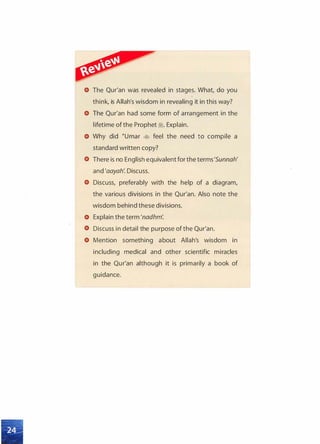
• Embryology and human creation
• Sensation of pain in the skin
• Recent scientific discoveries concerning the intestines
• The significance of the sense of hearing as compared with that of sight
• The origin of creation
• The miraculous nature offingerprints
• The miraculous healing honey provides
• The detrimental effects of carrion, blood and pork
• Health benefits of ablution, prayer and fasting
• The Qur'an, a healing and mercy
Dr. Sharif Kafai-Ghazal discusses these and many other scientific miracles
in his brilliantly written book MedicalMiracles ofthe Qur'an, which has been
published by the Islamic Foundation, Leicester, UK.
The Qur'an was revealed in stages. What, do you
think, is Allah's wisdom in revealing it in this way?
The Qur'an had some form of arrangement in the
lifetime ofthe Prophet ii. Explain.
Why did �umar � feel the need to compile a
standard written copy?
There is no English equivalent for the terms'Sunnah'
and 'aayah: Discuss.
Discuss, preferably with the help of a diagram,
the various divisions in the Qur'an. Also note the
wisdom behind these divisions.
Explain the term 'nadhm:
Discuss in detail the purpose of the Qur'an.
Mention something about Allah's wisdom in
including medical and other scientific miracles
in the Qur'an although it is primarily a book of
guidance.
For Further Reading
1 . Ahmad Von Denffer, 'Uloom ai-Qur'aan, Islamic
Foundation, Leicester, UK, 2009.
2. Abu �Ammar Yasir Qadhi, An introduction to the Sciences
of the Qur'an, AI Hidaayah Publishers & Distributors, UK,
1 999.
3. �Abdur-Rahman I. Doi, �Ulum ai-Qur'an - The Sciences of
the Qur'an: A Study in Method andApproach. Erasmia: AI­
Madinah Publishers, South Africa, 2000.
4. Mahmood ibn Ahmad ibn .S.aalih ad-Dusaree, The
Magnificence of the Qur'an, Darussalam Publishers and
Distributors, Riyadh, Saudi Arabia, 2006.
5. M. M. al-A'zmi, The History of the Qur'anic Text from
Revelation to Compilation, UK Islamic Academy: Leicester,
UK, 2003.
6. Muhammad Ali AIbar, Human Developmentas Revealedin
the Qur'an and Hadeeth, Saudi Publishing & Distributing
House, Saudi Arabia, 2002.
7. Mustan.s_ir Mir, Coherence in the Qur'an, American Trust
Publications, Plainfield, Indiana, 1 987.
8. M. A. Draz, Introduction to the Qur'an, I. B. Tauris &
Company Limited, London, 200 1 .
9. M. A. Draz, The Qur'an: An Eternal Challenge, Islamic
Foundation, Leicester, UK, 2007.
1 0. Khurram Murad, Way to the Qur'an, the Islamic
Foundation, Leicester, UK, 1 992.
1 1 . Sayyid Abui-Hasan Ali Nadwi, Studying the Glorious
Qur'an, Principles andMethodology, Islamic Academy, UK,
2003.
1 2. Jamaalud-Deen Zarabozo, How to Approach and
Understand the Qur'an, Al-Basheer Publications and
Translations, Denver, USA, 1 999.
Attributes of Allah
2.1 . Aayat-ul Kursee (Soorat ai-Baqarah,
2:255)
Translation ofthe Meanings ofthis Verse
Allah, there is no god except Him, the Ever-Living, the Ever-Lasting
Sustainer. Neither slumber, nor sleep overtakes Him. To Him belongs
whatever is in the heavens and whatever is in the earth.Who is he that can
intercede with Him except with His permission? He knows what happens
to them (i.e. creatures) [in this world] and what will happen to them [in
the hereafter]; and they will never encompass anything of His knowledge
except that which He wills. His Throne extends over the heavens and the
earth, and He feels no fatigue in guarding and preserving them. And He
is the Most High, the Most Great.
1 We have named this unit Readings from the Glorious Qur'an because we
believe it would not be appropriate to call it ' Selections from the Glorious
Qur'an', as the expression ' selections' gives the impression that what has not
been chosen is in some way or the other not adequate, while the Qur'an is
wholly beautiful, complete and sublime.
Explanatory Notes
This verse is known as the Throne Verse, and there are a number of ab_aadeeth (sing. b_adeeth)
which prove that it is the most excellent verse in the Qur'an. Ubayy ibn Ka�b � narrated that the
Prophet ;i asked him about the greatest aayah in the Book of Allah and he replied, 'Allah and His
Messenger know best: When the Prophet � repeated the question several times, Ubayy � said, 'It is
Aayat-ui-Kursee:The Prophet;i exclaimed, 'Congratulations! You possess true knowledge. By Him in
whose Hand my soul is, this verse has a tongue and two lips with which it praises the King (i.e. Allah)
at the foot ofthe Throne: (Ahmad: quoted in Tafseer Ibn Katheer, English Translation, vol. 2, p. 2 1 )
,_
The Word AI-Qayyoom
AI-Qayyoom is an intensive form which means the One
Who exists by Himself and supports, sustains and provides
means of subsistence for all His creations. AI-Hayy or the
Ever- Living' is one of the Most Beautiful Names of Allah.
Allah, the Ever-Living, is the source of all life. His Life is not
derived from anywhere else, while everyone else's life is
from Him and is dependent upon Him. It is He Who made
others live, and they are alive only as long as He wants them
to live. Allah was and will always be living. His Life, His being
ai-Hayy, is of very different High Order - not comparable
with the life of His creatures. What is true of a/-Hayy is true
of other similar Beautiful Names of Allah.
The Phrase
Sinatun wa Laa
Nawm
Sinatun means a doze
or nap, while nawm means
sleep.The negation ofthese
two negates both the initial
and full-fledged state of
sleep.This means that Allah
is absolutely free of any
trace or effect ofnegligence
or heedlessness.
The General Structure of
Aayah 2: 255
It is not difficult to see how various
themes are organized within this aayah.
The first sentence states the basic
theme, which is elaborated in the following
statements. Allah, the Only God, is the
source of all life. It is He Who controls the
whole universe - everything depends upon
Him and every event follows from Him.
He is not unmindful of His creation, even
for a single moment. He never sleeps or
slumbers.
He is the Master of all beings. Each and
everyone belong to Him.
In reality, no one would even dare to
speak as an intercessor for anyone on the
Day ofJudgment unless He Himself permits
it. He knows everything; therefore, He does
not need any recommendation of any sort,
which is usually required in human affairs.
He alone is the Ruler. Everything else is
responsible to Him. If any person fails to do
his or her duty, and thereby deserves His
punishment, no intercession can help that
person.
He knows everything, and no one else
knows anything without His giving him the
knowledge of it.
He rules the whole universe, and
everything is under His control at all times.
It is He Who takes constant care of the
whole universe and this is not a burden
upon Him at all.
To Him belongs all supremacy and all
majesty.
In the end, we quote a fladeeth about the
Prophet's intercession. Allah's Messenger
:i is reported as having said, '[on the Day
of Judgment] I will stand under the Throne
and fall in prostration, and Allah will allow
me to remain in that position as much as
He wills. I will thereafter be told, "Raise your
head, speak and you will be heard, intercede
and your intercession will be accepted:"The
Prophet � then said, 'He will allow me a
proportion whom I will enter into Paradise:
(Muslim)
What is the wisdom of using the term 'readings' as compared to 'selections'
as a title to this chapter?
What do the attributes a/-Hayy and a/-Qayyoom mean?
What is the meaning of the term Aayat-ui-Kursee? Mention the excellence of
the aayah according to a fladeeth?
2.2. A Clear Concept of the Creator: Soorat ai­
An�aam, 6:1 01 -1 03
Translation of the Meanings of these Verses
1 01 . [He is] the Originator of the heavens and the earth. How could He
have a son when He does not have a female companion? Rather, He created
everything and has full knowledge of all things.
1 02. Such is Allah, Your Lord; there is no god other than Him, the Creator
of everything. So worship Him alone, and he is Disposer of all things.
1 03. No vision can grasp Him, but His grasp is over all vision. He is above
all comprehension, yet is acquainted with all things.
Explanatory Notes
Verse 1 01
The word Badee', as applied to Almighty
Allah, means the one who produces something
without an earlier example; hence, the word
bid'ah which means a new practice that is
introduced in religion.
He is the Originator of the heavens and
the earth. In fact, the One who originates the
whole universe out of nothing is in no need
of a son. Offspring are needed by mortals.
They are needed by the weak who want help.
Moreover, anyone who desires offspring must
have a mate or a female consort from his
own species. How, then, can Allah have a son
when He has never had a mate, and when He
is One and unique and nothing and no one is
comparable to Him? How can any offspring be
born without a mate?
Verse 1 02
Allah is the Creator of all
Allah isthe Creator ofeverything.As He isthe
Creator of all, He also provides sustenance to
all using resources in which He has no partners.
Whatever all creatures eat and whatever they
enjoy in this life is part of what is the sole
property ofAllah. He is the Lord ofthe universe.
He controls everything. His is the authority to
which everything submits, and He operates the
system by which He takes care of His creation.
So He is the only one who deserves to be
worshipped in the full sense ofthe word, which
denotes total obedience and submission.
He controls not only human beings but also
everything else, since He is the sole Creator of
everything.
Verse 1 03
Visions cannot sight Him in this world. I n
the hereafter, the true believers will see Him,
but they will not be able to encompass Him
fully. Allah has spoken of His vision being
granted to the believers in several other parts
of the Qur'an. (For instance, 75:22-3; 83:1 5)
Allah's Messenger � once said, 'Indeed, Allah
does not sleep and it does not befit His Majesty
that He should sleep. He lowers the scale and
raises it. The deeds of the day are ascended
to Him before the night, and the deeds of the
night before the day. His Veil is Light, and if He
removes it the Light of His Face will burn every
created thing that His Sight reaches: (Muslim)
The term Lateef denotes something that
is extremely subtle in quality and, therefore,
intangible and unfathomable. It implies that
He is unique and absolute.
What does the term Badee� and Lateef
mean?
Why is it insane to say or assume that
Allah has a son?
2.3. Allah's Signs which the
Eyes Cannot Miss Seeing:
Soorat Fussilat, 41 : 37-39
Translation ofthe Meanings ofthese Verses
37. And of His signs are the night and the day
and the sun and the moon. Do not prostrate
yourselves to the sun or to the moon, but
prostrate yourselves to Allah who created them
if it is Him whom you worship.
38. But if they are too proud, then those who
are near your Lord glorify Him night and day,
and they never feel tired.
39. And of His signs is that you see the land still
and lifeless. Then, when We send down upon
it water, it stirs and swells with life. Indeed, the
One who gives it life can most surely give life to
the dead. Indeed, He is Powerful over all things.
Explanatory Notes
. , ,, i"�..�' ·: !!':.'� ��·.p·�·�,{.l ''' "''• ,.
I ,.., 1'. '
W
'o
' A ' t � ' #
"'
' ¥•
k 'I<
k- ;.::
*" ""
* *' * * •
Verse 37
Here Allah reminds His creation of His power
and states that He is the One who has no equal
and that He is able to do all things. 'And of His
signs are the night and the day and the sun
and the moon:This means He created the night
with its darkness and the day with its light, and
they alternate without stopping. He created
the sun with its bright light and the moon with
its reflected light. He allotted them their stages
and gave them separate orbits in the heavens
so that by the variations in their movements
people may know the stages of night and
day, of weeks, months, years and time periods
related to acts of worship.
It is unfortunate that as one of the most
prominent and powerful objects in the physical
world, the sun has attracted the attention
and obtained the homage of many races and
nations who have personified and worshipped
it as a god.
The Gracious Qur'an categorically rejects
this. Allah is the sole cause and source of
all that exists and whatever exists is but a
wondrous sign of His creative power. Hence, it
is blasphemy to ascribe real power to anything
created, whether it is a concrete phenomenon
or an abstract force of nature, or even an idea.
It is not Permissible to
Prostrate before Anyone
except Allah
'Do not prostrate yourselves to the sun or to
the moon:
This view makes it clear that prostration
or sujdood is the right of the Creator of the
universe. It is strictly forbidden (b.araam) to
prostrate before the sun, the moon or any
other person or thing, for that matter.
Prostration of worship for any other than
Allah has never been lawful for any community
in any law of any prophet.
It is interesting to note that the prayer
times in Islam have all been separated from
the hours when the sun was or is worshipped.
The Fojr prayer is offered before sunrise, Ohuhr
only after it has begun to decline, 'Asr when it
begins to lose its shine, Moghrib when it has set,
and '/shoo' only when its light has completely
vanished.
Verse 38
'But if they are too proud' means to worship
Allah Alone, and if they insist on associating
others with Him in worship, then there are
angels who are with your Lord. They constantly
glorify Him night and day and are never tired.
Sujood at-Tilaawah
There are fourteen (or fifteen) ooyoot in
the Qur'an which require us to perform a
prostration when we read or hear these verses.
In them it is mentioned that Allah's servants
and creation bow before their Lord. Aoyoh 38
is one of them.
Verse 39
The verse now moves on to portray other
scenes of creation and living creatures on earth
and in the world of plants.The state of being still
and lifeless, which is expressed in the Arabictext
with the word khooshroton is a state between
life and death. This is how the earth is when it
is starved of water, the basic ingredient for life
and the living. Thus, when rain water is poured
over it, 'it stirs and swells'. This is a remarkable
movement which the Qur'an recorded many
centuries before human science.
When the soil is very dry and then rain falls
over it, it makes a movement like shaking
or stirring. It is then full of life, bringing forth
blooming vegetation that radiates pleasure. Is
there anything more pleasing to the eye than
seeing life in bloom in an area that has long
remained barren? Here, the Qur'an cites these
as one of Allah's numerous signs. The Qur'an
reminds us: 'Indeed, the One who gives it life
can most surely give life to the dead. Indeed,
He is Powerful over all things:
Although the allusion to the reviving earth
often occurs in the Qur'an as a parable of
man's ultimate resurrection after death, in the
present context, it implies a call to the believer
never to abandon the hope that 'those who
deny the truth' may one day grasp the truth of
the Qur'anic message.
What does Allah expect from us
instead of worshipping the sun and
why?
How does prayer timing aid us in
avoiding sun worship?
Define the Arabic word khoashi'atan.
How will you relate it to the earth?
What does Allah want us to knowfrom
the parable of reviving the earth?
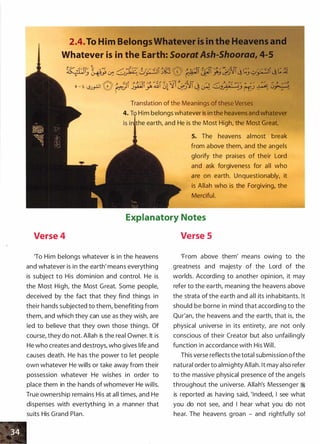
2.4.To Him Belongs
Whatever is in the Earth: Soorat
Translation of the Meanings of these Verses
4. � Him belongs whatever is in the heavens and whatever
he earth, and He is the Most High, the Most Great.
5. The heavens almost break
from above them, and the angels
glorify the praises of their Lord
and ask forgiveness for all who
are on earth. Unquestionably, it
is Allah who is the Forgiving, the
Merciful.
Explanatory Notes
Verse 4
'To Him belongs whatever is in the heavens
and whatever is in the earth' means everything
is subject to His dominion and control. He is
the Most High, the Most Great. Some people,
deceived by the fact that they find things in
their hands subjected to them, benefiting from
them, and which they can use as they wish, are
led to believe that they own those things. Of
course, they do not. Allah is the real Owner. It is
He who creates and destroys, who gives life and
causes death. He has the power to let people
own whatever He wills or take away from their
possession whatever He wishes in order to
place them in the hands of whomever He wills.
True ownership remains His at all times, and He
dispenses with evertything in a manner that
suits His Grand Plan.
Verse 5
'From above them' means owing to the
greatness and majesty of the Lord of the
worlds. According to another opinion, it may
refer to the earth, meaning the heavens above
the strata of the earth and all its inhabitants. It
should be borne in mind that according to the
Qur'an, the heavens and the earth, that is, the
physical universe in its entirety, are not only
conscious of their Creator but also unfailingly
function in accordance with His Will.
This verse reflects the total submission ofthe
natural order to almighty Allah. It may also refer
to the massive physical presence of the angels
throughout the universe. Allah's Messenger �
is reported as having said, 'Indeed, I see what
you do not see, and I hear what you do not
hear. The heavens groan - and rightfully so!
There is no space in the heavens the measure
of a hand-span or the measure of four fingers,
but that there
.
is an angel there, placing his
forehead in it prostrating to Allah. By Allah! If
you knew what I know, you would laugh little
and you would weep much, and you would not
enjoy your wives in bed, and you would come
out beseeching Allah: (at-Tirmidhee, fladeeth
no. 23 1 2, and it is classified as flasan)
The scope of the sources of knowledge,
hidden and apparent, such as the ears, the
eyes, the intellect, among other tools, given by
Allah to us, extends as far as the seen world. The
unseen world is beyond its capacity or domain.
The way to acquire authentic and dependable
knowledge about the unseen is to get it from
what the prophets and the messengers ofAllah
inform us on the basis of what Allah causes
them to see, hear and observe.
According to another opinion, the heavens
might nearly be rent asunder because of
ascribing a son to Allah, Most High. The
following verse supports this:
The heavens are a l most about to be rent asunder,
and the ea rth cloven and the mou ntains to
colla pse, razed, that they attribute to the All­
Mercifu l a son! (Soorat Maryam, 1 9:90-91 )
Commenting o n these verse, Sayyid Quib
writes,
The very sound of these verses and their rhythm
add to the air of anger at this fa lse claim. I n fact, the
whole universe rejects this claim most vehemently.
It shudders and q uivers with abhorrence as it hears
this fa lsehood against God Almighty. It is a reaction
similar to that of a person who feels that his very
integ rity is attacked, or that the honesty of someone
he loves is assai led. In their beat, the words here show
the movement of a violent attack.
Everyth ing that is settled and stable is thus shaken.
The whole universe is in anger at this false a l legation
agai nst God, the Creator. The statement is shocking to
everything in natu re: (Sayyid Qu!b, In the Shade ofthe
Qur'an, vol. 1 1 , p. 376, Eng. Tr. �Ad i i _S_a lahi)
In fact the idea that Allah might have a 'son'
- either in the real or in the metaphorical sense
of this term - would presuppose a degree of
innate likeness between 'the father' and 'the
son': but Allah is in every respect unique, so that
'there is nothing like Him (Soorat ash-Shooraa,
42: 1 1 ) and 'there is none comparable to Him'.
(Soorat al-lkh/aa�, 1 1 2: 4)
The idea of God having a son goes against
the teachings of Islam and is described in the
Qur'an as blasphemous, and it is for this reason
that the Qur'an criticises the Christians for
erroneously believing that �Eesaa :%!§ is the son
of God.
Explain the verse 'To Him belongs
whatever is in the heavens and
whatever is in the earth:
'The heavens almost break from
above them'. What does this verse
refer to?
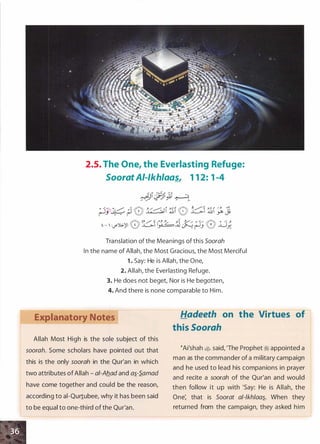
2.5. The One, the Everlasting Refuge:
SooratAl-lkhlaa� 1 1 2: 1 -4
Translation of the Meanings of this Soorah
In the name of Allah, the Most Gracious, the Most Merciful
1 . Say: He is Allah, the One,
2. Allah, the Everlasting Refuge.
3. He does not beget, Nor is He begotten,
4. And there is none comparable to Him.
Explanatory Notes"-----
Allah Most High is the sole subject of this
soorah. Some scholars have pointed out that
this is the only soorah in the Qur'an in which
two attributes of Allah - ai-Ab_ad and a�-S.amad
have come together and could b_e the reason,
according to ai-Qur1ubee, why it has been said
to be equal to one-third of the Qur'an.
Hadeeth on the Virtues of
this Soorah
�Ai'shah • said, 'The Prophet :1 appointed a
man as the commander of a military campaign
and he used to lead his companions in prayer
and recite a soorah of the Qur'an and would
then follow it up with 'Say: He is Allah, the
One: that is Soorat a/-/kh/aa�. When they
returned from the campaign, they asked him
why he had done so and he replied, "Because
[Soorat a/-/kh/aai] provides a description of ar­
Raflmah, and I love to recite it:'The Prophet ;I
said,"Inform him that Allah the Most High loves
him:" (ai-Bukhaaree)
The Word al-Ahad
The word ai-Aflad, which is differentfrom theword
Waaflid, has added the signification of absolute and
. continuous unity and the absence ofequals.
The Term as_-Samad
According to some scholars, the word a�­
S.amad is applied to one who has no stomach and
therefore does not eat or drink; in other words,
he is not dependent on anything. Yet, some other
scholars explain the term as meaning one whose
attributes have reached the highest point of their
development, so that they cannot be bettered.
'Eternal - One without a beginning and without an
end'is another interpretation provided bythe pious
predecessors (salaf).
Literally, a�-S.amad would also imply one who
stands in need of no one, while everyone stands
in need of him; in other words, one before whom
people put forward their needs.
Allah's Messenger � also said, 'By Him in
whose Hand my soul is, it is truly equivalent to
one third of the Qur'an: (ai-Bukhaaree)
What is the subject of Soorat a/-/kh/aa�?
Why is it considered as one third of the Qur'an?
Define the terms a/-Aflad and a�-S.amad.
Allah's Relationship with the
Created Worlds: Man-Allah
Relationship as �Abd-Rabb
Relation
•
2.6. SooratAI-Faatihah
•
.
•
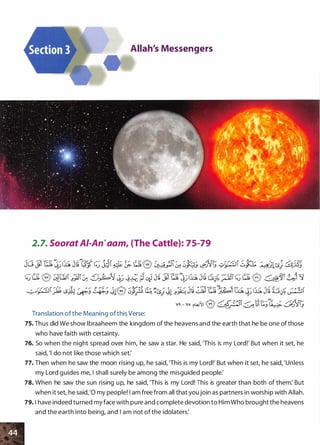
;_;_ � 0 �Ji py, 0 �� �� �- �:.:::-JI 0 �� .:J8i�i �;_
� �JI 1� 0 {i ·�il1�1 (� 0 � ���; � ��10 ���
v - 1 :�WI 0�T�li1;:.t:� y./ai.�J;;1�·};_
Translation ofthe Meanings of this Soorah
1 . In the Name of Allah, the Most Gracious, the Most Merciful
2. All praise is for Allah, Lord of the Worlds,
3. The Most Gracious, the Ever-Merciful,
4. Master of the Day ofJudgment.
5. You Alone we worship and You Alone we ask for help.
6. Guide us to the Straight Path,
7. The Path of those whom You have bestowed favours, not of those
who have earned [Your] anger, nor of those who have gone astray.
Explanatory Notes
AI-Faatib.ah has seven verses (aayaat
or signs). But which is the first verse of a/­
Faatib.ah? Every soorah of the Qur'an, with
the exception ofSooratat-Tawbah, the ninth
soorah, starts with the basmalah namely,
bismillaahir-Rab.maanir-Rab.eem. Still, this
aayah is not treated as part ofthe following
soorah, with the exception of the first
soorah of the Qur'an, where the basmalah
is treated by some scholars as being part
of it. All agree that this soorah has seven
aayaat (plural of aayaht but according to
those who do not regard the basmalah as
part of this soorah the first aayah of this
soorah is what is numbered 2 in the above,
and then in order to complete the number
of the aayaat as seven, the seventh aayah
is broken into aayah 6 and aayah 7. (See
if you can find any such difference in the
numbering of aayaat in different copies of
the Noble Qur'an)
There is, however, another place where
the basma/ah is according to everyone, part
of a Qur'anic soorah, that is Soorah number
27, or Soorat an-Naml, where it is part of
Aayah 30.
We would also draw our students'
attention to 1 6:98, according to which
seeking Allah's refuge from Satan is required
before we read or recite the Qur'an. That is
why whenever a Muslim wants to recite the
Qur'an, he must first say: Noodhu bil/aahi
minash-Shaytaan-ir-Rajeem (I seek refuge
with Allah from Satan, the one who has
been deprived ofAllah's mercy), then saythe
basmalah ifwhat he recites is the beginning
ofa soorah, otherwise seeking Allah's refuge
from Satan would be sufficient.
The Word ar-Rahmaan
The expression Bismi/1/aahir-Rab.maanir-Rab.eem
is composed of four Arabic words, the first two of
which mean 'In the Name of Allah: the other two
words add two of Allah's attributes derived from
the same root 'rab.ima', which signifies grace and
mercy. While the second ofthese two attributes, ar­
Rab.eem, is commonly used as a superlative form of
granting mercy, the first ar-Rab.maan is used only
to refer to Allah. In fact it was never used in Arabic
before Islam.
The structure of the word ar-Rab.maan suggests
emphasis upon the aspect of intensity. Thus the
Good Name 'ar-Rab.maan' signifies His over-flowing
love and mercy for all of His creatures, even if
someone turns away from Him thanklessly. He does
not immediately withdraw His mercy from such a
person. He gives sustenance to the believers as well
as to disbelievers. His sun shines for all of them. His
rain falls benefits everyone.
Commenting on these words, 'Adil Salahi writes,
'The term ar-Rab.maan bears connotations of
power, might and dominion alongside those of
grace and mercy. Therefore, an accurate translation
of the term should bring out these additional
connotations. . .Therefore, we can say that ar­
Rab.maan connotes 'the exercise of mercy on the
basis offree choice byone who is ableto inflict severe
punishment without fear of any consequence: '
He also says,
"By contrast ar-Rab.eem stresses the availability
of Allah's Mercy in all situations and to all creatures.
People only need to appeal for it and it is certain to be
granted. Indeed, it is given at all times without such
appeals. . .After a long reflection and consideration
of all these aspects, I have now settled on a new
form of translating these two attributes of God: In
the Name of God (AIIaht the Lord of Grace, the Ever
Merciful." (Sayyid Qu1b, In the Shade of the Qur'an,
vol. 1 4, Eng. Tr. �Adil S.alahi)
The Word Hamd
The Arabic word b_amd signifies a servant's
praise for Allah by way of thanks. In fact, the
Arabic word b_amd means both 'praise' and
'thanks'. Hence, it would be apt to say: All
praises and thanks are for Allah:
The Word Rabb: Man-Allah
Relationship
Rabb has often been translated as Lord. It is
a good translation in so far as it combines 'love
and concern' with 'authority: Some translators
have used 'Sustainer: 'Cherisher' or similar
words for Rabb. They try to be true to the root
meaning. Of course, our Rabb is One who takes
care of our nourishment and development. It
should, however, be borne in mind that Rabb
is a Qur'anic term, and as such it has a uniquely
comprehensive meaning. Therefore, it is not
possible to find an equivalent in languages
other than Arabic.
AI-�Aalameen: What are the
Worlds?
The word a/-�aalameen is the kind of plural,
which is used for beings like men, jinn and
angels. So in thanking the Rabb of all the
worlds, we are thanking the Rabb ofall human
beings, or even the Rabb ofall persons, that is
to say, of all humans, jinn and angels. When
you look into the past of humanity as well
as its possible future, there are many such
human worlds, and Allah is the Rabb of all
such human worlds. According to some
scholars af-taalameen refers to everything
in existence besides Allah. All praises and
thanks are due to Allah, to whom belongs the
creation in its entirety, the heavens and the
earth and whatever is in them, and whatever
is between them - that which is known and
unknown.
Master of the Day of
Judgment: The Word ad-Deen
The word ad-deen as used in the Qur'an has
several meanings. It is used in the sense of:
• Religion and divine law (3:83)
• The law of the land (1 2:76)
• Obedience (1 6:52; 61 :9)
• Recompense or reward (5 1 :5-6)
The term ad-deen in the sense of reward
and punishment causes both its positive and
negative aspects - (a) a reward for good, and
(b) a punishment for evil and wrongdoing.
The message contained in these words:
maaliki yawm-id-deen is clear - a day of
reckoning is inevitable: it will definitely come to
pass. A day when all human beings will return
to their Forgiving, Merciful and Just Lord to
receive their share of His reward or punishment.
Those who followed the divine law will be
rewarded, but those who refused to submit to
Him and did not seek His forgiveness will be
punished. On that day all powers will belong to
Allah alone; no one that day will challenge His
will or authority.
�lbaadah is what a �Abd Does
for His Rabb
The Arabic word 'ibaadah is often translated
as worship. �lbaadah is what a �abd does for
his Rabb. Allah-man relation is unique. It is
altogether different from any man-man or
man-thing relation. We call it the Rabb-�Abd
relation. Man is �abd or servant of Allah, and
Allah is Rabb or the Lord of man. But there
are �ibaad (plural of �abd) of Allah other than
human beings. Angels and jinn are also �ibaad
or servants of Allah. Thus all people are �ibaad
or servants of Allah. "We are servants of Allah
and Allah Alone" is the most basic principle of
Islam.
The expression 'ibaadah (worship) denotes
the submissiveness and humility that a person
ought to show towards his Creator. A sense of
obedience is also implied in the word 'ibaadah.
Worship
His Help:
and Asking for
Its Meaning and
Significance
Supplication (du�aa') is a part of worship, or
'ibaadah. The fact that we are the servants of
Allah implies that we must worship Him alone,
follow His commands and pray or supplicate to
Him alone.
Guide us to the Straight Path
Guiding is more than showing. Thus we are
not asking for light only; we are also asking
for strength. Life is a continuous journey. We
need Allah's guidance all the time. Every day
we face a new situation in life. Life is a journey
towards Allah, which we have to travel stage
by stage. We actually need light, strength and
support from Him in every step we take on this
journey. By making du�aa' (supplication) for
guidance, we are, in fact, asking Him to be with
us throughout the journey of our life.
A�-Siraat ai-Mustaqeem - the
Straight Path
This refers to the Straight Path Allah has
shown to human beings through His prophets
and messengers to achieve
success in this world
and eternal bliss
in the hereafter.
This path is
the shortest
path and the
easiest
follow.
to
Verse 7
Guide us to
the path of those
upon whom You have
bestowed favours: these
are the people who walked on the Straight
path, worshipping Allah alone, seeking His
help in every step. Allah guided them at every
stage of their journey and helped them to
acquire a better understanding of religion and
in living a pious life; in the hereafter, too, they
will receive Allah's special mercies. It is
important to note that by making
this supplication, we express our
belonging to the circle of all
the faithful servants of Allah.
But here we also observe that
some members of the human
family went off the right path.
They barred themselves from
the special mercy of Allah since
they did not mend their ways
in spite of His clear guidance and
warnings.Therefore, we express our separation
from them. Of course, the real punishment will
follow in the hereafter. But some people were
punished by Allah in this very life. The Qur'an
again and again tells us the stories of such
people so that we learn lessons from them. See
for example 7:59-1 67; 1 0:71 -92; 1 1 :25-1 02.
While making du'aa' that we do not
have the same fate, it is also required
that we try to understand why these
people deserved Allah's wrath and
then seriously try not to follow in
their footsteps.
Three groups of people are
mentioned in this verse: (1 )
Those blessed by Allah, (2) Those
who incurred His wrath, and (3)
Those who strayed from the right
path. Reference is to groups and not
to individual persons who had divine
blessings, divine wrath or who were
misguided. We, with all the righteous people
of the past and present, dissociate ourselves
from the group of wrongdoers. The Qur'an
discusses the rise and fall of some civilizations
and explains how victory and support of
Allah came to the followers of the
prophets, and how the
unjust were ultimately
punished.
It is important
note that
before the
punishment of
Allah comes,
Allah warns
and reminds
His servants first.
In fact, Allah gives
the unjust people a
fixed period of time to mend their ways. The
wrath of Allah does not descend before its
appointed time.
Therefore, ifsome people were not punished
in this life, it is not a sign of their being correct.
Some people may act as rebels and still prosper
in this life because the time of their being
punished has not yet come. (lrfaan Ahmad
Khan, Reflections on the Qur'an, the Islamic
Foundation)
It should be borne in mind that this soorah
is in the form of a supplication. Its style is not
didactic. It does not teach us how to supplicate.
Rather, the supplication itself is made to flow off
our tongue as a spontaneous hymn springing
from the very core of our being. The words of
the hymn are revealed by Allah, the Creator of
human beings. So there can hardly be a more
authentic expression of human nature. Soorat
a/-Faatib_ah is the greatest soorah ofthe Qur'an.
There is no other soorah like it in the rest of
the Gracious Book or in the previous revealed
scriptures. It is a light that was granted to Allah's
Messenger �
'
which He had not granted to any
prophet or messenger before him. It holds a
central position in daily prayers, and hence the
daily life of a Muslim.
Explain the two attributes of ar-Rab_maan and ar­
Rab_eem. How are thes� two related?
How does the term rabb signify Allah-man
relationship?
Explain the term ad-deen as used in the Qur'an.
What is the 'Straight Path'? What is the significance
of the word 'guide' in Verse 6?
This soorah is in the form of a supplication. Discuss.
Allah's Messengers
2.7. SooratAI-An�aam, (The Cattle): 75-79
Translation ofthe Meaning ofthis Verse:
75. Thus did We show lbraaheem the kingdom of the heavens and the earth that he be one ofthose
who have faith with certainty.
76. So when the night spread over him, he saw a star. He said, 'This is my Lord!' But when it set, he
said, 'l do not like those which set:
77. Then when he saw the moon rising up, he said, 'This is my Lord!' But when it set, he said, 'Unless
my Lord guides me, I shall surely be among the misguided people:
78. When he saw the sun rising up, he said, 'This is my Lord! This is greater than both of them: But
when it set, he said,'O my people! I am free from all that youjoin as partners in worship with Allah.
79. 1 have indeed turned myface with pure and complete devotion to Him Who brought the heavens
and the earth into being, and I am not ofthe idolaters:
Prophet lbraaheem �� Debates with His
People
It is significant to note here that Prophet lbraaheem �� was debating
with his people, explaining to them the error oftheir ways in worshipping
idols and images.
Allah showed lbraaheem �� the proofs of His Oneness over His
kingdom and His creation, which clearly indicate that there is no god
except Allah. lbraaheem �� explained to his people the error and
uselessness ofworshipping the various planets, which they said were the
Moon, Mercury, Venus, the Sun, Mars, Jupiter, and Saturn. The brightest
of these objects and the most honoured to them was the Sun, the Moon
and then Venus.
l braaheem �� first proved that Venus (the word used in the text is
kawkab) is not worthy of being worshipped. It is subject to a term and
course appointed that it does not resist. It does not swerve right or left.
Venus does not have any say in its affairs. It is only a heavenly object that
Allah created and made bright out of His wisdom. Venus rises from the
east and sets in the west where it disappears from sight. The rotation is
repeated the next night, and so forth. Such an object is not worthy of
being worshipped.
lbraaheem �� then went on to mention the Moon in the same manner
in which he mentioned Venus, and then the Sun. When he proved that
these three objects were not worthy of worship he declared: '0 my
people! I am free from all that you join as partners in worship with Allah:
These aayaat indicate that lbraaheem �� was debating with his people
about the shirk or polytheism they practised.
The word yaqeen used in the text denotes that state of certitude of the
heart, which is experienced when all doubts have been removed with the
help of evidence.
The Qur'an uses the word kawkab, which literally means anything that
shines brilliantly. It is applicable to both stars and planets.
It is not necessary that the sighting of the star and the moon should
have happened on the same night, with the sun sighted on the following
morning. The episode could have well run through several nights. It is
important to note the words: 'I am free from all that you join as partners
in worship with Allah'demonstrates that lbraaheem �� never committed
that sin.
Differences of opinion seem to have surfaced among Muslim scholars
as to the nature of the episode enumerated here, whether it was loud
thinking on the part of lbraaheem �, trying to figure out who his Lord
was, or was it an inductive method devised to convince the idolaters
of their folly. The majority of Qur'an exegetes (mufassiroon) argue that
Prophet lbraaheem's statements should be seen as premises (statements
or ideas that form the basis for a reasonable line of argument) of his
arguments against idolaters, rather than as stages in his enlightenment.
It was, in reality, a novel method in argumentation and not a mental
exercise to discover the truth.
Hence, according to lmaam ar-Raazee, the words, 'This is my Lord'were
satirical. When he uttered these words, he meant to say:'So, this according
toyouropinion is my lord. Let us see ifit provestobeso: Prophet lbraaheem
�� had to take this indirect route because his people were in no mood to
listen to any direct criticism. It should be remembered that the prophets
and messengers of Allah have never even thought of worshipping false
gods at any time in their lives. In fact, Prophet lbraaheem's reasoning was
divinely inspired.
The Word Haneef
The word used in the text is b_aneef. The word b_aneef, in its original
sense, means 'turning away from sin'. It implies turning away from idol­
worship and being a worshipper ofthe One true God - Allah.
What are the virtues ofSoorat ai-An�aam?
'I am free from all that you join as partners
in worship with Allah: Comment on how
l braaheem �� tried to convince his people to
worship Allah Alone.
2.8. Reminding
of the Favours
Bestowed on Him
Maa'idah, 5:1 1 0)
�Eesaa ��
that Allah
(Soorat a/-
0 ......- .J. _,, ..,. -:: _,. / � , 0 .-'-":(::' / -::..
· ,;_.jU � � )lllh 0l� ).,_ju .:_,:�1
Translation of the Meaning of this Verse
'When Allah will say: "0 ' Eesaa, son of
Maryam! Remember My favour to you and to
your mother: how I aided you with the Holy
Spirit so that you could speak to people in
your cradle and in maturity; how I taught you
the Book and wisdom, the Tawraah and the
lnjee/; how, by My leave, you formed out of clay
a bird-like figure, and breathed into it and, by
My leave, it became a living bird; how, by My
leave, you healed those born blind and the
lepers, and by My leave, you restored the dead
to life; how I prevented the Children of lsraa'eel
from harming you when you came to them
with clear proofs and those who disbelieved
among them, said: This is nothing but sorcery:"
(5:1 1 0)
Oneness of Allah: Tawheed
Oneness of Allah was the belief preached
by ' Eesaa �� and by every former prophet of
Allah. This verse aims to establish the truth
about the Oneness of Allah and servitude to
Him, as these are conceived in Islam.
This view presents this truth in a vivid scene
taken from the Day of Judgment in the same
way as the Qur'an presents various scenes of
that Great Day. In all such presentations, the
picture is portrayed in such an inspiring and
effective way that we almost see it before our
very eyes. We are moved by each such scene
as though it were taking place here and now.
We see what is taking place, hear what is being
said and feel every reaction and response. So,
what does this scene present?
The scene is taken from the Day ofJudgment.
Here we will have a full account of the various
aspects of grace bestowed by Allah on Prophet
�Eesaa �� and his mother Maryam �. To start
with, he was supported by the Holy Spirit in
his infancy. Then, he talked to people long
before children normally start to talk, freeing
his mother of all suspicion raised around her
on account of his miraculous birth that had no
parallel in history. He also talked to them in the
cradle and later as a grown man who was again
supported by Jibreel �1.
He was also given knowledge of the Book.
Allah imparted to him wisdom in order to deal
with different situations in the best way. Allah
also taught him the Tawraah (Torah), which had
been given to the Children of lsraa'eel, and the
lnjeel (Gospel) which Allah gave him to confirm
the Tawraah.
Moreover, Allah supported Prophet �Eesaa
(Jesus) �� with several miracles that no
human being could accomplish without Allah's
support. Thus, he could fashion a bird shape
of clay and breathe into it, and all at once it
became a living bird. How did it happen?We do
not know, because we do not know how Allah
creates life. Prophet �Eesaa �� cured people
born blind, by Allah's leave, when medicine
still does not know how to give eyesight to
such people. Almighty Allah, who gives human
beings their faculty of seeing, is able to open
a blind person's eye to see the light. Prophet
�Eesaa �� also cured the lepers without using
medicine. Medication is merely a tool, and
Allah is able to cure without any tool. Again,
�Eesaa �� was able to restore life to the dead,
by Allah's leave. The One who gives life is well
able to restore it at any time.
Allah further reminds Prophet �Eesaa �� of
His favours when He extended His protection
to him against the children of lsraa'eel who,
when he produced all these miracles, denied
him, claiming that they were plain sorcery.
Allah protected him and they were unable to
kill or crucify him as they were keen to do. Allah
� simply protected him and elevated him to
Himself. (In the Shade of the Qur'an, Vol. IV, pp
288-290; English Translation by Adil Salahi and
Ashur Shamis)
The use of the word kah/ in this verse
is significant. It is used for a person of age
between thirty-four and fifty-one, but Prophet
' Eesaa WI was raised up to the heaven when
he was only thirty-three. This clearly indicates
that he will come back towards the end of this
world, live in it and attain that age.
Enumerate the favours that Allah granted
�Eesaa �1.
What is the significance of the use of the term
'Kahl?
2.9. Abundance (SooratAI-Kawthar, Soorah 1 08)
������ �.,.. _ - - - -
Translation of the Meaning of this Soorah
In the Name of Allah, the Most Gracious, the Most Merciful
1 . Indeed, We have given you abundance,
2. So pray to your Lord and sacrifice [to Him alone].
3. As to the one who hates you; he is utterly cut off.
Soorat ai-Kawthar is the shortest soorah of
the Qur'an, not only in terms of the number of
verses but also in word count, for it consists of
only thirteen words. It shares distinction with
The soorah takes its title from the word a/­
Kawthar, which occurs in the first verse. The
word a/-Kawthar is an intense form of the noun
kathrah, which in its turn denotes abundance,
multitude or copiousness. In the above
context, which is the sole instance of its use in
the Qur'an, a/-Kawthar signifies, according to
Soorat ai-�Asr (1 03) and Soorat an-Naas (1 1 0).
The three verses ofthis soorah are addressed,
in the first place, to the Messenger of Allah �'
and through him to every believing man and
woman.
--- ------
several sound ab_aadeeth, a river in Paradise.
Allah's Messenger � said, 'Verily, it is a
river that my Lord, the Mighty and Majestic,
has provided for me, and it has abundant
goodness. It is a pond where my community
will be brought to on the Day of Judgement.
Its containers are as numerous as the stars
in the sky. When a servant of
Allah from among them will
be prevented from it, I will say,
"0 Lord! He is indeed from my
Ummah (followers):'Then He (i.e.
Allah) will say, "Verily, you do not
know about [the innovations]
he introduced [in religion] after
you:" (Muslim)
Allah's Messenger � also said,
'A/-Kawthar is a river in Paradise
with banks ofgold and it runs over
pearls. Its water is whiter than
milk and sweeter than honey:
(Ahmad and at-Tirmidhee)
Therefore, Turn in Prayer to Your Lord
and Sacrifice
The expression of gratitude for such bounteous favour
should be tremendous. The Prophet � should devote himself
heart and soul to worshipping and serving his Lord. We
have said above that this soorah addresses itself, in the first
place, to the Messenger of Allah � and through him to every
believing man and woman. Of all modes ofworship, the prayer
is the most outstanding. Likewise, among financial modes of
worship, sacrificing animals stands out above others, for it
signifies one's willingness to sacrifice one's own self. Animal
sacrifice was instituted in order to replace self-sacrifice. The
point comes out sharply in the story of Prophet lbraaheem &il§l.
As to One who Hates You, He is Utterly Cut off
Literally the word shaani' means one who hates, hating, or a hater and an
enemy. It signifies hatred, which is attended by anger.'As to one who hates you,
he is utterly cut offfrom all goodness'means: 0 Prophet, indeed whoever hates
you and hates the guidance, truth, clear proof and manifest light with which
you have been sent is utterly cut offfrom all goodness.The word abtar is used
to describe one who leaves no male offspring behind him and so is forgotten
after he is dead. A tailless animal is also called abtar. Some unbelievers used
to taunt the Prophet � with that word when his sons died in infancy, implying
that his death would be the end of his mission. Allah � denounced them by
assuring the Prophet � that it is his enemies who would be cut off.
Ibn Taymiyyah once mentioned that in every age, Allah Most High will
destroy the Prophet's enemies and those who hate him in such a way that
history will leave no trace of them.
In this verse, Allah throws back the taunt ofthose who hated and reviled the
Prophet �. Indeed, the promise of Allah has come true, for the influence and
legacy of the Prophet's enemies was short-lived, while his impact on human
history and human life has grown and deepened. Today we witness the truth
of divine pronouncement as clearly as no one among those addressed by the
Gracious Qur'an for the first time ever did or imagined.
Who does the soorah address?
Describe the pond of ai-Kawthar.
How does the word abtar aptly describe the enemies of
the Prophet �?
1 . Tafseer Ibn Katheer English Translation, 1 0 Volumes;
Darussalam, Riyadh, 2000.
2. Mufti Muhammad Shafi, Ma'riful Qur'an, (English), 8
Volumes, Darui-Uioom, Karachi, 1 995.
3. Sayyid Abul A'ala Mawdudi, Towards Understanding the
Qur'an, the Islamic Foundation, UK, 1 998.
4. Sayyid Qu1b, In the Shade of the Qur'an, (English), the
Islamic Foundation, UK, 2003.
5. Syed Iqbal Zaheer, Tafseer lshraq ai-Ma'anee, (English),
lqra Welfare Trust, Bangalore, India, 1 992.
6. Sayyid Abul Hasan Ali Nadwi, Guidance from the Holy
Qur'an, the Islamic Foundation, 2005.
7. Muhammad Taqi-ud-Deen ai-Hilali and Muhammad
Muhsin Khan, The Meaning of the Holy Qur'an,
Darussalam, Riyadh.
8. 'Abdullah Yusuf Ali, The Holy Qur'an, English Translation
oftheMeanings and Commentary, King Fahd Holy Qur'an
Printing Complex, Madeenah, Saudi Arabia.
9. Muhammad Marmaduke Pickthall, The Glorious Qur'an.
1 0. Ahmad Zaki Hammad, The Gracious Qur'an: A Modern­
Phrased Interpretation in English, Lucent Interpretations,
LLC, USA, 2007.
1 1 . Hanna E. Kassis, A Concordance ofthe Qur'an, U niversity
of California Press, 1 983.
3.1 . The Prophet's Birth: The Year of the Elephant 44
3.2. The Prophet's Lineage and Ancestry 45
3.3. The Short-Lived 'Abdullaah 46
3.4. Childhood 46
3.5. Aaminah and 'Abdui-Munalib Pass away 48
3.6. Muhammad's Early Occupation 49
3.7. Baheerah the Monk 50
3.8. The Sacrilegious (Fijaar) War 51
3.9. Hilf ai-Fud.ool: Alliance of the Virtuous 51
3.1 0. Divine Protection 52
3.1 1 . The Prophet's Marriage to Khadijah � 52
3.1 2. The Rebuilding of the Ka'bah 53
3.1 3. Meditation in the Cave of .tiiraa' (Mount .tiiraa') 55
3.1 4. Prophethood: The First Revelation 57
3.1 5. The Pause of Revelation- Fatratai-Waftiy 58
3.1 6. Revelation Resume 58
3.1 7. The Call to Islam in Makkah - the Secret Stage 59
3.1 8. The Early Muslims 59
3.1 9. The Call to Islam in Makkah - the Public Stage 60
3.20. Essentials of the Prophet's Early Call of His People 61
3.21 . The Quraysh Reject the Messenger� and His Message 62
3.22. The Quraysh Take Action 63
3.23. The Quraysh Approach AbuIaalib 63
3.24. The Muslims' Emigration (Hijrah) to Ethiopia 64
3.25. Why Abyssinia? 65
3.26. The Boycott 66
3.27. TheYear of Grief 67
3.28. The Journey to at-Taa'if 67
3.29. The Night Journey and the Ascension to Heaven (The lsraa'and
the Mi'raaj) 69
3.30. Madinah Residents Embrace Islam 70
3.3 1 . Several Emigrations 70
3.32. The Long-awaited Hijrah Takes Place 71
3.33. The Hijrah 71
3.34. The Suraaqah Incident 73
3.35. The House ofAbu Ayyoob ai- An�aaree 75
3.36. The Constitution of Madeenah: Safteefatai-Madeenah 77
3.37. The Command of Prayer and Adhaan 77
3.38. The Hypocrites: Munaafiqoon 78
3.39. The Change of the Qiblah: TheDirection of Prayer 78
3.40. War and Peace 79
3.41 . Campaigns and Expeditions 80
3.42. The Issue of Succession to the Prophet� 86
3.43. Remembering the Prophet�:The Most Beautiful Model 87
3.44. His Character was the Qur'aan Itself 89
3.1 . The Prophet's Birth: 'The Year of the Elephant'
The Messenger of Allah � was born in
Makkah on Monday morning, the 1 2th of
Rabee' ai-Awwal, in the Year ofthe Elephant, 571
CE, some fifty-five days after the unsuccessful
expedition of Abrahah against Makkah.
Yemen at that time was under the rule of
Ethiopia, and Abrahah was its governor. He
built a grand cathedral in .S.an�aa: hoping to
make it take the place of Makkah as the great
place of pilgrimage for all Arabia. A man from
Kinaanah, a large tribe of western Saudi Arabia
in Hijaz, understood Abrahah's motive, so he
went to .S.an�aa'with the deliberate intention of
defiling the church, which he did one night and
returned safely to his people.
When Abrahah heard of this, he swore that
he would raze the Ka�bah to the ground in
revenge. Having made his preparations, he
set off for Makkah with a large army of sixty
thousand warriors, in the front of which he
placed a colossal elephant. His army included
between nine to thirteen elephants. When
Abrahah reached ai-Muhassir Valley, between
Muzdalifah and Mina, the elephant knelt down
to the ground. Abraha's soldiers did everything
they possibly could to bring it to his feet, but
it stubbornly refused to move. Whenever they
directed it towards the north, south or east, the
elephant would move quickly, but whenever
they directed it towards Makkah it would kneel
down. This was the clearest of forewarnings for
the army not to move one step forward, but
Abrahah was blinded by his ambition for the
sanctuary he had built and his determination
to destroy the Ka�bah. Had he and his army
turned back, they would perhaps have escaped
the great disaster. But it was too late.
Suddenly the western sky grew dark, and
a strange sound was heard in the distance.
Its volume gradually increased. A great wave
of darkness arrived upon the army from the
direction of the sea, and the air above them
was full of birds which were very much like
sparrows and swallows. Each bird had three
pebbles the size of dried peas, one in its beak
and each one of the other two between the
claws of each foot.
They swooped to and fro over the army,
pelting them as they did so. The pebbles were
hard and they landed with such rapidity that
they even pierced coats of mail. Every stone
found its mark. Every pebble killed its man.
As soon as a soldier was hit, his flesh began
to rot. A large number of Abrahah's soldiers
were killed in this way. Many others, Abrahah
included, died soon aftertheir return to .S.an�aa:
The Arabs attached great importance to this
event.They dated their calendar from it saying,
'This occurred in the Year of the Elephant: 'so­
and-so was born in the Year of the Elephant' or
'this happened so many years after the Year of
the Elephant'.
According to many scholars, this event took
3.2. The Prophet's Lineage
and Ancestry
The Prophet's father was
�Abdullaah, and his mother was
Aaminah, daughter of Wahb ibn
�Abd Manaaf. �Abdui-Muttalib
was his grandfather, and Abu
Iaalib was one of his uncles.
The prophet � was born
among the best of tribes on
earth and was of the best of
lineages. His ancestry can
be traced back to Prophet
lbraaheem �. As soon as
AI-
he was born, his mother AI-Mu!!alib
sent word to his grandfather,
�Abdui-Muttalib, informing
him of the birth of a boy and
asking him to cometo see him.
�Abdui-Muttalib came, took
him in his arms and carried him
tothe Ka�bah, where he voiced, in
a passionate manner, an elaborate
invocation of thanks and gratitude
to Allah for this gift. Then he brought
him back to his mother and named him
Muhammad. The Arabs were not familiar
with this name and were rather surprised by it.
place in the year 571 of the Christian Calendar.
According to others, however, it occurred in
the year 570 CE.There is a difference ofopinion
among scholars concerning the exact date
of the birth of the Prophet :l. Some scholars
maintain that he was born on the gth Rabee' ai­
Awwal in the Year of the Elephant.
•
3.3. The Short-Lived �Abdullaah
We possess only scant information about �Abdullaah, the father of the Prophet �. He was the
favourite of his father, the celebrated �Abdui-Muttalib. He was married to Aaminah, the daughter of
Wahb, who was a noble lady from Banu Zuhrah of the Quraysh. The marriage was extremely short­
lived. �Abdullaah set out on a trading expedition to Syria, leaving Aaminah expecting his child. He
never returned. �Abdullaah died in Madeenah on his return trip from Syria. When news of his death
reached Makkah, Banu Haashim, and especially Aaminah, was grief-stricken. Allah's Messenger �
was not yet born. �Abdullaah had no children except the future Prophet, nor had Aaminah any other
child. �Abdullaah was buried in Madeenah. He was twenty-five when he died. Allah's Messenger ;!i
was born shortly after the death of his father.
3.4. Childhood
The first woman who suckled him after his
mother was Thuwaybah, the freed female
slave of Abu Lahab, with her son, Masruh. Abu
Lahab was one of the Prophet's uncles. The
real name of this uncle was �Abd ai-Uzzaa. He
was popularly nicknamed Abu Lahab, literally
'father of the flame' on account of his beauty
which was most notably expressed in his
glowing face. It was the general custom of
the Arabs living in towns to send
their children, soon after their
birth, away to Bedouin
wet nurses so that they
might grow up in the
free and healthy
surroundings of
the desert. Thereby
they would
develop a strong
body and acquire
the pure speech
and manners of the
Bedouins. They were
noted both for purity of
their language and for being
free from those vices which usually
develop in inactive societies.
Some of the tribes had a high reputation
for nursing and rearing children. Amongst
these were the Banu sa�d ibn Bakr, an outlying
branch of Hawaazin, whose territory lay to
the southeast of Makkah. The Prophet ti was
entrusted to Haleemah, the daughter of Abu
Dhu'ayb. She was from Banu Sa�d ibn Bakr.
Her husband was ai-Haarith ibn �Abd
ai-�Uzzaa, called Abu Kabshah,
from the same tribe.
Traditions describe
how Haleemah and
all her household
were favoured
by successive
strokes of
good fortune
while the child
Muhammad �
lived under her
care. It is narrated
that Haleemah
described in after-years
that she, along with her
husband and a recently born
son of their own whom she was nursing, set
out from her village in the company of some
women from Banu sa�d ibn Bakr in quest of
nurselings to suckle. She said,
It was a year of drought. We had nothing left. I set forth
on a grey female donkey of mine and we had with u s a n old
she-camel which could not yield one drop of milk. We were
kept awake all n ight by our son who would keep crying all
n ig ht because of hunger, for I had not enough i n my breast
to feed him. At length, we reached Makkah and set a bout
looking for nurselings. Aaminah offered her son first to one
and then to another, u ntil she had tried them all and they
had all refused.
That was because we hoped for some favours from the
boy's father. "An orphan!" we said, "What will his mother
and grandfather be able to give us?"We had fixed our eyes
on the reward that we would get from the child's father.
Every nurse who had come with me got a baby, and
when we were about to depart, I said to my husband, "I
hate to return in the company of my friends without having
taken a baby to suckle. I shall go to that orphan and take
him:' So I went and took him for no reason except that I
could find none but him.
I carried h i m back to where our mounts were stationed,
and no sooner had I put him in my bosom than my breasts
overflowed with milkfor him. He drank h is fill, and his foster­
brother a lso drank his fill. Then they both slept, although
my baby had not been able to sleep the previous night at
all. My husband went to that old she-camel of ours and
he found her udders full. He milked her and drank of her
milk. I also d ra n k with him until we could drink no more.
Our hunger was satisfied. We enjoyed a sound sleep during
the night, and in the morning my husband said to me, "By
Allah, J:::ialeema h, you have taken a blessed child:'
Then we set out. I carried him and rode my donkey
which outstripped the whole troops of fellow-travellers
so much so that none of their donkeys was able to keep
pace with her. We reached our dwellings in Banu Sa'd. It
was a barren place. But when we brought Muhammad �
to l ive with us, the barren land soon sprouted lush grass.
My flock would come fully satisfied at every evening full of
milk. We continued to enjoy this i ncrease and bounty from
Allah. The baby was growing well. None of the other boys
could match him for growth u ntil the baby's two years had
passed, and I weaned him.
By the time he was two-years old, Haleemah
took him again to his mother although she
was eager that he should stay with her for the
blessings he had brought her and her family.
The Prophet's mother gave him once more into
her keeping and Haleemah brought him again
to her home. The Prophet � stayed with them
until he was four or five years old.
While the Prophet � was staying in
Haleemah's house, a very strange incident
took place. An angel came, split open his chest
and removed a blood clot from his heart and
threw it away. Then he cleansed his heart and
replaced it. Muslim has recorded this incident in
his S.ab.eeb. on the authority of Anas ibn Maalik
� who said, 'While the Prophet � was playing
with some boys, Jibreel ;%§1 came to him, took
him, laid him to the ground and split open
his chest. Jibreel extracted his heart, removed
from it a black clot and said, "This is the portion ·
of Satan in you:' He then washed the heart with
Zamzam water in a basin made of gold, joined
the heart together and returned it to its place.
The children ran up to their mother and said,
"Muhammad has been murdered:'They hurried
to him to find him standing alone, pale and
shaken: Anas � added, 'I have seen the stitch
marks on his chest:
This incident certainly deserves more than a
passing thought or mention. What happened
on thatdaywas one ofthesigns ofProphethood.
It was a clear proof that Allah had chosen
Muhammad � for a very important message.
Purification from Satan's influence was in fact
preparation for protecting the Prophet �
from evil of every sort. Although idol-worship
and evil deeds were practised on a large scale
among the Quraysh, the Prophet � never ever
bowed down to an idol, nor committed a sin.
The removal of the blood-clot from his heart
•
certainly purified him from every immaturity
and recklessness of youth. The incident also
shows us the degree to which Allah protected
the Prophet � and prevented Satan from
having any influence over him whatsoever.
-
- _.
- -
3.5. Aa m i n a h a n d � A b d u i­
Muttalib Pass away
After this incident, Haleemah was so worried
about the boy that she took him once more to
Makkah and returned him to his mother. He was
six years old then. The boy lived happily with
his mother in Makkah for some time, winning
the affection of his grandfather and his uncles
and aunts, and his many cousins with whom he
played.
The reunion of orphan Muhammad � with
his real mother was destined to be short-lived
indeed. When he was six years old, his mother
decided to take him on a visit to his maternal
uncles in Madeenah. She was in her early
twenties then. She set out to cover a journey of
about 500 kilometres with her orphan boy and
her female servant Umm Ayman. She spent a
month there and then decided to go back to
Makkah. However, not long after they had set
out on their return journey, Aaminah fell ill.
After some days, she died at Abwaa: on the
road between Makkah and Madeenah, and she
was buried there.
Umm Ayman brought the boy
back to Makkah and she did all she
possibly could to comfort him now
that he had lost both his father and
mother. His grandfather 'Abdui­
Muttalib took complete charge of
him. It soon became clear that his
special fondness for �Abdullaah had
been transferred to �Abdullaah's
son.
�Abdui-Muttalib was the
foremost chief of Makkah and the
undisputed leaderofBanu Haashim.
He was the most handsome among
the Quraysh men. He was very tall,
kind-hearted, generous, kind and enjoyed
great character. He was held in high esteem,
and no ruler had ever met him but would show
him respect and hold him in awe. He had been
the leader of the Quraysh until his death.
�Abdui-Muttalib was very fond of his
grandson, and their intimate relationship
grew even stronger as time passed. Every day,
he would spread a couch in the shade of the
Ka'bah, and out of respect for their father none
of his sons would venture to sit on it, but he
would seat himself beside the Prophet � on
the couch and stroke his back. Almost everyday
they would be seen together. But, alas, him too
Muhammad � was destined to lose very soon.
When Muhammad � was eight years, two
months and ten days old, his grandfather
passed away in Makkah. Umm Ayman reported
that she had seen the youthful Muhammad �
weeping as he quickened his steps to follow
the coffin of his guardian and protector. The
princely patriarch died at the age of eighty­
two, according to the most reliable sources.
Some scholars put his age at over a hundred
years when he died. When he was dying,
�Abdui-Muttalib entrusted his grandson to
Abu Iaalib, who was a full brother of young
Muhammad's father.
Abu Iaalib continued the love and the
kindness that his nephew had received from
the old man. Henceforth he was as one of his
own sons, and his wife Faa1imah did all she
possibly could to take the place of his mother.
After many years, Allah's Messenger � used
to say of her that she would have let her own
children go hungry rather than him. Like his
father, Abu Iaalib was dignified, honoured
and greatly respected by his people.
What importancedid the Makkans
attach to the incident of the
Elephant?
Mention the Prophet's parents.
Who named him Muhammad?
Why, you think, the Arabs were
surprised by this name?
Why did Haleemah finally take
in baby Muhammad :i? What
blessings did she enjoy?
Howcan you saythatthe Prophet's
chest was literally opened? What
was the wisdom behind this?
3.6. Muhammad's
Occupation
Early
Muhammad � did what he could in his
early youth to earn his livelihood. In fact, he
tended sheep and goats for a wage and would
thus spend day after day alone in the hills
above Makkah or on the slopes of the valleys
beyond.
When Muhammad � was still young, Abu
Iaalib was going through a financial crisis. He
had many mouths to feed, and his business
was not going so well. To help his uncle get
through these hard times, Muhammad �
worked as a shepherd. In an authentic b_adeeth,
he is reported to have said, 'Every prophet
tended sheep: His Companions asked him,
'And did you?' He replied, 'Yes, I tended them
for the Makkans in return for qaraaree1: Ibn
Hajar mentions that scholars hold two opinions
concerning the meaning of the Arabic word
qaraaree1. The first opinion states that a qeeraat
(singular of qaraaree1) is a part of a dinar
or dirham, and the second one states that
qaraaree1 is the name of a place in Makkah.
Working as a shepherd afforded the Prophet
�thechancetoworkin peaceand quiet,toenjoy
the beauty of the desert and to contemplate
the wonders and grandeur of Allah's creation.
Indeed, Allah would have provided the Prophet
iiwith wealth and comfort so that he would not
have to work as a shepherd, but this practice
was a divine training for him so that it would
be much easier for him to deal with people and
tolerate their harm. Indeed, a shepherd needs
a great deal of patience and forbearance to
look after his flock. This practice proved useful
to the prophets. A shepherd picks up and
develops many wonderful qualities: the very
qualities that the Prophet ii needed to lead his
communitytothe truth. Some ofthese qualities
include patience, humbleness, bravery, mercy
and compassion, and above all the love of
earning one's living through hard work.
By doing so his followers were also taught a
very good lesson, namely, the most honourable
way to live is to eat from what one earns
by engaging in lawful work. A person who
invites others to Islam must especially avoid
taking from what is in their hands. He should
be independent of all human beings. A self­
sufficient man is dignified in the sight of others.
Whatever good he does, he does it for Allah.
The Prophet ii once said, "Never has any one
eaten a better food than what he has eaten out
of the labour of his own hands; and David, the
Prophet of Allah, used to eat out of the labour
of his own hands. (AI-Bukhaaree, b.adeeth no.
2072) Moreover, this b.adeeth is suggestive
of the adoption of a lawful occupation, no
matter how people may look askance at it. That
was the reason why the prophets took such
occupations.
When one is self-sufficient, depending upon
no one but Allah, one gains the freedom of
being able to speak the truth. Because they are
dependent upon thegenerosityofothers, many
people bow their heads low before evildoers.
They remain silent about their wrongdoing for
fear of losing their jobs and their livelihood.
3.7. Baheeraa the Monk
When Muhammad � was twelve years old,
he accompanied his uncle, Abu Iaalib, on a
trade journey to Syria. When they reached
Bu�raa, an ancient city in southern Syria that
was under the Roman rule, there was a monk
named Baheeraa, who came out of his cell to
meet them. Although he had not met them
before, he readily recognized the Prophet �
and said while taking his hand, 'This is the
master of all mankind. Allah will send him with
a message which will be a mercy to all beings:
Abu Iaalib asked him, 'How do you know that?'
Baheeraa replied, 'When you appeared from
the direction of �Aqabah, every single rock and
tree fell down in prostration, which they never
do except for a prophet. I can also recognize
him by the apple-like 'Seal of Prophethood'
below his shoulder bones: He also asked Abu
Iaalib to send the boy back to Makkah and
not to take him to Syria as there was a serious
danger to his life from the Romans and the
Jews. Abu Iaalib obeyed and sent him back to
Makkah with some of his servants.
The trip to Syria was no doubt a major event
in the life of the Prophet :;i. For the first time, he
saw the bustling commercial centres of other
lands. The trip brought him into contact with
a society which differed considerably from the
one in which he had grown up.
3.8. The Sacrilegious (Fijaar)
War
A war that raged between Kinaanah and
Quraysh on one side and Qays �Aylaan, an
important clan of the Hawaazin, on another
was called the Fijaar or the Sacrilegious War
because both sides violated the sanctity at the
Holy House. The conflict dragged on for three
or four years. Allah's Messenger :1 took part in
one of these battles. His efforts were, however,
confined to helping by gathering enemy arrows
that had missed their mark and handing them
over to his uncles so that they could shoot
them back. At that time, the Prophet :1 was
about twenty years old.
The Arabic word fijaar means wickedness.
This war was given such a name because the
sanctity of Makkah was being violated, and the
Arabs considered any violation of Makkah to be
a wicked crime. The Prophet :1 learnt about war
and chivalry during these tribal encounters.
3.9. Hilf ai-Fudool: Alliance
of the Virtuous
As a young man, the Prophet � took part in
the formation of the 'Alliance of the Virtuous'
in Makkah. He once said, 'I was present in the
house of �Abdullaah ibn Jud�aan at so excellent
a pact that I would not exchange my part in it
for a herd of red camels, and if now, in Islam,
I were summoned to it I would gladly respond:
The expression fudool comes from the word
fad/, which means nobility, superiority and
virtue. Hence, it was an appropriate name for
the alliance. The owner of red camels during
those times would today be equivalent to a
millionaire.1
In fact, Hilf ai-Fudoo/ was a kind of league
against injustice. Members of the alliance
were required to come to the aid of those who
needed an extra helping hand, such as the
oppressed victims of injustice, widows, slaves,
orphans, the travellers, the poorand the elderly.
The objective ofthis alliance wasto protect the
defenceless and ensure the safety of strangers
in Makkah. The league came about because a
stranger from Yemen sold goods in Makkah to
an influential member of a powerful local clan
who subsequently refused either to pay the
price orto return the goods, as a result ofwhich
the wronged seller stood up in the vicinity of
the Ka�bah and implored aid for himself as a
stranger in the city. Several members of the
Quraysh aristocracy rallied to his assistance
and secured the return of his goods. Meeting
in the house of �Abdullaah ibn Jud�aan, they
pledged henceforth to combat oppressive acts
and uphold justice. The Prophet �' then in his
early twenties, was present at this gathering.
1- Ali Mohammad as-Sallaabee, The Noble Life ofthe Prophet
�. Darussalam, Riyadh, Saudi Arabia, 2005, Vol. 1, p. 103.
6 1
3.1 . Divine Protection
Allah's Messenger � was protected by Allah. He
distanced himself from the indecencies and bad
habits of the Jaahiliyyah, the pre-Islamic period
of social and moral decline. The term Jaahiliyyah
is commonly translated as the 'Age of Ignorance':
ignorance, that is, ofthe word of Allah.
Allah's Messenger � felt a deep sense of
revulsion at the worship of idols. Once he was
requested to act in the name of the idols ai-Laat
and ai-�Uzzaa, but he replied with the startling
answer, 'Do not ever ask me anything for the sake
ofthese idols. I have never hated anything more:
The Prophet � never lied or deceived anyone;
he was sincere and truthful. He outshone everyone
in truthfulness, trustworthiness, bravery and
modesty. He respected family ties. He shared the
burden of others. He honoured his guests, always
provided his own food and was contentwith simple
meals.What set him apart from his fellow Makkans
was his absolute truthfulness, trustworthiness,
integrity, sense of justice and compassion for the
poor, the oppressed and the downtrodden, as
well as his total refusal to worship any idol or do
anything immoral. He had gained experience in
trading through his travels with the trade caravans
to greater Syria because of his honesty, hard work
and the business acumen he showed in trading;
he was soon being sought after to take charge
of other people's merchandise, that is to say, for
those who could not travel themselves so that
they would trade on their behalf.
Soon he was popularly acclaimed for these
qualities. A�-S_aadiq (the truthful) and ai-Ameen
(thetrustworthy) werethetitles on everybody's lips
for Muhammad �
'
which itself means 'the praised
one.' Always faithful and truthful, people used to
deposit their valuables with him for safekeeping.
3.1 1 . The Prophet's
Marriage to Khadeejah �
Khadeejah belonged to the famous
Quraysh tribe. She was the daughter
of Khuwaylid ibn Asad. She was from
the noblest of families and the richest
of their women. She was intelligent,
resourceful, discreet, affectionate and
of noble character. She conducted
trade with the help of active partners
who got a share in profits. When
she learnt of Muhammad's honesty,
trustworthiness and high moral
qualities, she sent him a message
expressing her desire to take her
goods for her to Syria. She promised
she would give him share ofthe profits
that was greater than what she would
normally give others. He agreed to the
terms and travelled in the company of
Maysarah, a servant she had provided
to be his travel companion.
The Prophet � succeeded in his
trade mission very well. The profits
were unusually high. His mild manners
and agreeable temperament won him
the hearts of men he employed in
the course of his journey. Throughout
the trip, Maysarah witnessed the
wonderful character, nobility and
truthfulness of the Prophet �.
In addition to that, Khadeejah experienced
plentiful blessings in her wealth. Based upon
these reasons, she had a heart to heart
discussion with her friend Nafeesah, the
daughter of Munyah, telling her about the
positive feelings she was having about the
Prophet �. Nafeesah went to the Prophet � and
proposed to him on behalf of Khadeejah. The
Prophet � was so pleased with the proposal
that he went to his uncles to seek their advice.
They all agreed to his marriage to her.
Khadeejah � was at that time a widow, at
the rather advanced age of forty. Very wealthy
and with a strong and independent will, she
had repeatedly declined marriage offers made
by some of the most prominent men of the
Quraysh, afterthe death ofhersecond husband.
She had previously been married to �Ateeq ibn
�Aa'idh ai-Makhzumee. She bore him a female
child. After him she was married to Abu Haalah
at-Tameemee. She bore him a boy. Abu Haalah
died before the advent of Islam.
Muhammad � married her at the age of
twenty-five years, in the prime of his youth.
The marriage proved to be one ofaffection and
happiness. She was the first woman that the
Messenger of Allah � married, and he did not
marry any other woman until she died. Their
marriage was wondrously blessed. She bore
him six children, two sons and four daughters.
Their eldest child was a son named ai-Qaasim,
and the Prophet � came to be known as Abui­
Qaasim, the father of ai-Qaasim. But the boy
died in infancy. The next child was a daughter
whom they named Zaynab, and she was
followed by three other daughters Ruqayyah,
Umm Kulthoom and Faa1imah; and finally
another short-lived son, 'Abdullaah who was
also called a1-Iaahir and a1-Iayyib.
All their daughters except Faa1imah �
died during the Prophet's lifetime. Faa1imah
t;t);; died six months after his own death. All his
daughters witnessed Islam, embraced it and
emigrated to Madeenah. Ofthe daughters who
married, only Faa1imah had descendants. She
was the mother ofai-Hasan and ai-Husayn. Her
husband �Ali was a cousin ofthe Prophet � and
the fourth rightly-guided caliph.
•
The Cave of!!iraa'
�¢1¢'¢�¢¢¢¢¢¢¢¢¢�.-t�..r¢¢�¢¢�� 3.1 3. Meditation in the Cave of Hiraa' R
� {Mount Hiraa')
ft� �
B
As the Prophet � approached the age of forty, he came a
� to spend more and more of his time in retreat. He would !­
-ij- withdrew into seclusion in the Cave of Hiraa: towards the top .J;f
fi, -�
��• of Mount Hiraa: some two miles northeast of Makkah towards "!t
� the back of the mountain. He applied himself there to ardent a
I devotions, i.e. worship. He spent his time in long vigils, prayers a
f,j
and contemplation-sometimes for several days at a time. This !l
ft mountain is called Jabal an-Noor (Mount of Light) because H
f,j there the first verses of the Qur'an were revealed.
�� At Mount Hiraa: he would remain plunged in deep thought �
�
and reflection. In his solitary retreat, the Prophet � would be a
f,j
quite alone most ofthe time. He would take with him provisions
1i­
-ij- and devote a certain number of nights to the worship of Allah. :2'li I
-if
Then he would return to Khadeejah �
'
and on his return take !4
]j more provisions and go again to the mountain. During these H
3
times it often happened that after he had left the town and was
a
�
approaching the mount he would hear clearly the words, 'Peace
-f.}.
f,j be on you: and he would turn and look for the speaker, but no H
li, •i,l��• one was in sight, and it was as if the words had come from a "!:it
� stone or a rock. Allah's Messenger � is reported to have said, 'I �
f,j know the rock in Makkah that used to greet me. I know it very -Jl
� well: (Muslim, hadeeth no. 2277)
�� �
•
� �
-e The first kind of revelation to which the Messenger of Allah i[
:fl
� was initiated was the true dreams during sleep, and he never
�l,! saw a dream but it came like the breaking of light and dawn.
g� (ai-Bukhaaree) This lasted for six months. The first of these Y,
� �e Prophetic dreams occurred in the month of Rabee� a!-Awwa/,
1t
e,1 when the Prophet � had just completed his fortieth year. tl
j The Prophet � once said that the true good dream is one s
£! of the forty-six parts of Prophethood. We know that the total
iif
�
period of revelation was twenty-three years, ofwhich the first six
�:J!
months formed oftrue dreams. It is important, however, to note
t[
� here that no verse ofthe Qur'an was revealed to him in his sleep.
if� The entire Qur'an was revealed to him while he was awake.
J���¢� �'¢.'¢.- �¢��¢� �'¢.¢'¢.� -
Who was Umm Ayman? What role did she play after the
death of Aaminah?
How can you say that �Abdui-Muttalib was very fond of
his grandson?
What was the Prophet's early occupation? How did it aid
in honing the skills needed for Prophethood?
Why, do you think, should a Muslim be self-sufficient?
Why do you think the Prophet � was very pleased with
his involvement in the formation of the Hilfa/-FuQ.oo/?
What prompted Khadeejah � to propose marriage to
the Prophet �? How was this marriage blessed?
During one Ramadhaan, in his third year
of solitude in the cave of Hiraa: the Prophet
� was alone in the cave of Hiraa' on the night
destined for the beginning of his prophetic
mission. He was precisely forty lunar years,
six months and twelve days old; that is to say,
thirty-nine Gregorian years, three months and
twenty days.2• It was the twenty-first night of
Ramadhaan, Monday, August 1 0, in the year
61 0 ofthe Christian Calendar.
The Prophet � was alone and fully awake
2- For more details, see Safi-ur-Ra�man a i - Mubarakpuri, The
Sealed Nectar, Darussalam, Riyadh, Saudi Arabia 2002, pp.
86-7.
in the cave when Angel Jibreel �� appeared
and said to him, 'Read!' The Prophet � replied,
'I cannot read: The Prophet � himself later
narrated what happened next:
'Then the angel took me and pressed me
until all strength went out of me, then he
released me and said, "Read!" I said, "I cannot
read:'Then he took hold of me and pressed me
again until all strength went out of me; then he
released me and said,"Read!" I replied, "I cannot
read:'Then he took me and pressed me a third
time; then he released me and said,
Read in the Name of your Lord Who has created!
He has created man from a clinging clot.
Read, for your Lord is the Most Gracious,
Who has taught by the pen,
Taught man what he knew not.' (Suratai-'Aiaq, 96:1 -5)
Trembling with fear, the Messenger of
Allah � returned to Khadeejah � and said,
'Wrap me up! Wrap me up!' She wrapped him
up until he felt secure again. Then he told her
about what had happened and said, 'Indeed,
I fear for myself!' Khadeejah � said, 'By Allah!
Allah will never humiliate you! You fulfil the
duties of kinship, support the weak, help the
poor, honour guests and help those in genuine
distress:
Then she set out with him to her parental
cousin Waraqah ibn Nawfal who had embraced
Christianity before Islam and used to write the
Bible in Hebrew. He was also old and blind.
Khadeejah � said to him, 'My cousin, listen to
your nephew: Waraqah turned to Muhammad
� and said, 'What did you see, my nephew?'
Muhammad � told him what he had seen.
Waraqah then said to him, 'That was the Angel
of Revelation whom Allah sent down upon
Moosaa. If only I were younger and would be
able to live up to the time when your people
will drive you out: Muhammad � asked, 'Will
they really expel me?"Yes: he replied, 'anyone
who ever brought something similar to what
you have brought was treated with hostility.
If I should live till then, I would certainly give
you support and assistance: Waraqah passed
away soon afterwards before the Prophet �
began to preach Islam publicly and before the
persecution by the Quraysh started, and the
revelations paused for a while. (ai-Bukhaaree)
It was an Arab custom, which is also prevalent
these days, to address an old and respected
man as uncle, hence Khadeejah's words 'your
nephew: Waraqah believed that Muhammad
� was the final Messenger sent to mankind.
He is counted among those who embraced
Islam. The Prophet � later stated that Waraqah
was one of the dwellers of Paradise. He once
said, 'Do not speak ill of Waraqah, for I indeed
saw that he had a garden or two gardens in
Paradise: (ai-Haakim)
•itt 3.1 5. The Pause of ��
Revelations - Fatrat a/-Wahiy
Between the first revelation
mentioned in the above tradition and
the next a period elapsed during which
the Prophet � received no revelation,
which was a time of deepest distress
for the him. There is no unanimity
regarding the duration of the pause of
the revelations or the intermission. It is,
however, reasonable to maintain that
it was in fact short, lasting only a few
days. To say that it lasted about two
and half or three years is not correct.
• Revelations Resume
I n fact, the pause of revelations
for a few days was to relieve the
Prophet � of the intensity of the
awe he had experienced in the Cave
of Hiraa' and to increase his longing
for revelations. And after the pause,
the revelation came to him again. It
is recorded in Saheeh ai-Bukhaaree
that the Messenger of Allah � was
heard tal king about the break of
revelation as follows:
'While I was walking, I heard a
voice coming from the sky. I looked
up and saw the same angel who
had visited me at the Cave of Hiraa:
sitting on a throne between the sky
and the earth. He filled me with awe
and I returned home and said, 'Wrap
me up! Wrap me up!'Then Allah the
Most High revealed the following
verses:
0 you wrapped in a mantle!
Arise and deliver your warning.
Magnify your Lord.
Purify your clothes,
And keep away from idolatry.
(Soorat ai-Muddath-thir, 74:1 -5)
After this the revelation started
coming frequently and regularly.'
Thus, forthe first time,the Prophet
� was commanded to preach Islam.
The above-quoted verses were the
first verses to be revealed after the
pause of revelations.
3.1 7. The Call to Islam in
Makkah - the Secret Stage
When Allah's Messenger � received
his Lord's command to 'rise and warn: he
indeed rose and warned his people and
carried doing so until he met his Lord,
some twenty-three years later. He spent
these twenty-three years vigorously and
relentlessly striving to abide by the noble
and weighty order to 'rise and warn: He
complied with his Lord's command with
unique vigour, energy and dedication. His
efforts in this respect fall into two major
stages: a secret stage and a public stage.
The secret stage was approximately for
the first three years of his mission. The
second stage lasted until he finally left
Makkah on his famous hijrah (emigration)
to Madeenah and the rest of his life.
The private stage was marked by
secrecy in conveying the message. It was
distinguished by great care and caution
in carefully inviting certain individuals to
Islam.
3.1 8. The Early Muslims
At first, as we have pointed out above,
Muhammad � preached Islam secretly among close
relatives, friends and acquaintances. The first to
accept Islam was, as is universally acknowledged,
his wife Khadeejah. �Ali ibn Abee Iaalib, who was a
ten-year-old cousin of the Prophet � and a member
of the household and later son-in-law, was the next
convert. The Prophet � undertook to support 'Ali
because of the limited resources of Abu Iaalib and
the large size of his family. Next was the Prophet's
freedman and adopted son Zayd ibn Haarithah. Next
to accept Islam was Abu Bakr who was the Prophet's
close friend and confidant for many years.
RegardingtheconversionofAbu Bakr,Muhammad
� said,
"I never invited anyone to Islam who did not
display some hesitation in embracing it except Abu
Bakr. He alone did not delay when I invited him to
Islam, nor did he hesitate."
Abu Bakr was the first convert outside the
immediate household of Muhammad �. He was
two years younger than the Prophet � who was
forty years old. Abu Bakr � was thus the first male
adult to accept Islam. Being a successful merchant,
he possessed considerable wealth. He was very
II
popular in Makkah owing to his fine and easy
manners. He was the first of the prominent
personalities of Makkah to accept Islam. He was
the first free-born man who openly declared
himself a Muslim. People regularly turned to
him for advice because of his knowledge and
experience.Through his personal efforts, quite a
good number of people embraced Islam. These
include �uthmaan ibn �Affaan, az-Zubayr ibn ai­
�Awwaam, �Abdur-Rahmaan ibn �Awf, sa�d ibn
Abee Waqqaas and Ialhah ibn �ubaydullaah.
Among the early Muslims were also Bilaal
ibn Rabaah the Ethiopian, Abu ' Ubaydah ibn
ai-Jarraah, Abu Salamah ibn 'Abdui-Asad,
ai-Arqam ibn Abee ai-Arqam, �uthmaan ibn
Madh�oon, and his two brothers Qudaamah
and �Abdullaah. �ubaydah ibn ai-Haarith,
Faa1imah bint ai-Khattaab, sister of �umar, the
second rightly-guided caliph, sa�eed ibn Zayd,
husband of Faa1imah bint ai-Khattaab and
several others who accepted Islam.
Among the first Muslims, the Quraysh were
a clear majority. The thought that the early
converts consisted primarily of slaves, social
outcasts and downtrodden persons is both
wrong and biased. The vast majority of those
early Muslims were, in fact, Quraysh free-born
men and were not slaves at all.
3.1 9. The Call to Islam in Makkah - the Public Stage
II
During the three years of the private stage,
many people accepted Islam in Makkah.
Groups ofmen and women entered Islam. Soon
the mention of Islam was on everyone's lips in
Makkah. Then Allah commanded
Messenger :i to proclaim publicly
what had come to him from his
Lord: 'And warn your nearest
relatives: (26: 2 1 4)
This verse was revealed
roughly three years after
thefirst revelation at Hiraa:
AI-Bukhaaree records that
when the verse, 'And warn
your nearest relatives,' was
revealed to the Prophet �, he
ascended the hill of a�-.S.afaa, near
the Ka�bah, and proclaimed in a
voice: '0 Banu Fihr, 0 Banu �Adiy; calling the
clans of the Quraysh, till they had all gathered.
Among those present was Abu Lahab, an
uncle of the Prophet �. The Prophet � then
addressed them, 'Tell me, if I were to inform
you that some cavalry in the valley were about
to attack you, would you believe me?'
They replied, 'Yes, we have never experienc­
ed any lie from you: He then said, 'I am a warner
to you before a severe punishment:
Abu Lahab shouted angrily,
'Perish you for the rest ofthe
day. Is it for this that you
have gathered us?'
The Prophet �
was dismayed by the
response. The response
of the Quraysh was not
warm. It was hostile in
the case of Abu Lahab. But
Allah comforted the Prophet
�. Abu Lahab was condemned
together with his wife in strong terms.
Sooratai-Masad was revealed to the Prophet �.
Thus the first person to threaten the Prophet �
and attempt to shout him down was his own
uncle, Abu Lahab.
The above-mentioned tradition from al-
Bukhaaree marks the beginning of the public
stage in which Allah's Messenger ·� openly
called the Quraysh to acknowledge and worship
no god apart from Allah, the onlyTrue God.
3.20. Essentials of the Prophet's Early Call of His People
In the first instance, Allah's Messenger �
invited the Quraysh idolaters of Makkah to
declare the testimony of faith: Laa ilaaha
il/al/aah, Mub_ammadun
Rasulul/aah (There
god but Allah, and
Muhammad is the
Messenger of Allah) -
the famous Muslim call
to pure monotheism
(tawb_eed).
The statement
Laa ilaaha illallaah
consists of two
phrases: one is a
negation, the other is
an affirmation. Laa ilaaha
(there is no god) wipes
out the existence of every
false god and condemns false
worship. The word i/aah could r e f e r
to any matter, person, idea or notion which is
undeservedly taken or adopted as an object of
worship or adoration, irrespective of whether it
is done out of excessive love or excessive fear,
while the words illal/aah affirm the existence of
the One, True God - Allah.
Allah is there. He is the only True God. He is
the Creatorand the Provider. He isyour Lord and
Master. Life and death are under His command.
He alone should be feared. From Him alone we
should ask everything. He alone is worthy of
worship. His order and His decree are fulfilled in
the heavens, in the farthest reachesofthe earth
and beneath it, in the seas, the skies and every
other part of the universe. His knowledge and
mercy encompass everyone and everything.
He forgives sins, relieves stress,
removes woes and
guides those who have
gone astray. He feeds
the hungry, clothes the
naked and heals the
sick. He is One and
Alone and has no
partners. Allah is your
only Lord and Master.
Surrender your beings
and your lives totally to
Him Alone. Worship
and serve no one but
Him. There is no god but
Allah and Muhammad is the
Messenger ofAllah.
Therootsfromwhichtheword Islam comes
means both 'submission: 'peace' and 'security:
The term Islam thus signifies the religion in
which peace, security and submission are
attained through total submission to the will
of Allah. Everything in the heavens and on
earth belongs to Him. No man has a right to be
master ofanother man or to spread corruption
on earth.
Allah's Messenger � told the Quraysh idol­
worshippers: An everlasting life awaits you
beyond where you will meet Allah and your life
will be justified. You must prepare yourselves
for that.
•
What role did true dreams play in Muhammad's Prophethood?
Was any part ofthe Qur'an revealed in his sleep?
How was Khadeejah • a pillar of support to the Prophet �
after he experienced his first revelation?
What is fatrat a/-wab_iy? How long did it last? What was the
wisdom behind it?
What was the characteristic of the secret stage to the Call of
Islam? Mention five of the earliest Muslims?
What was the initial basic message that the Prophet � invited
the people to?
3.21 . The Quraysh Reject the Messenger of Allah � and His Message
This simple message shook the very
foundations of the Makkan society. In reality,
the Quraysh lived under the yoke of false gods.
Idols lorded over them. Man-made gods of
their own desires lorded over them. When the
Quraysh saw that the Prophet's call was
directed against their gods,
their principles and their
long-standing · false
practices, they
were greatly
a l a r m e d .
P o l y t h e i s m
•
(the false belief
that there is more
than one god) was
deeply ingrained in their minds,
hearts and souls. Since they did not
believe in any divinely revealed religion, their
hearts had hardened. They had become a
materialistic people. They cared only for their
worldly welfare. The situation was extremely
grave, they thought.
The time of the pilgrimage would soon be
upon them. Arabs would come to Makkah
from all over Arabia. The Quraysh had a high
reputation for hospitality. Now the pilgrims
would hear their gods rejected by the Prophet
� and his followers. They would be
urged to forsake the religion
of their forefathers
and to embrace
Islam. They
were terrified.
They would
lose their
a u t h o r i t y .
Therefore, when
the message of Islam
threatened their authority in
kah, they made up their minds to
use all their energies and resources in an effort
to protect the authority and wealth to which
they had grown accustomed. It was very hard
for them to give up their ancesterors'way of life.
They feared that Islam would bring an end to
their economic well-being and would end their
free way of life and their superior social status.
Allah's Messenger :i taught that Allah is One.
The Makkans had many gods and goddesses.
Their fathers and grandfathers had worshipped
these gods for generations. The Makkans
drew economic benefits from their religious
beliefs, which they feared they might lose by
becoming Muslims. Makkah was the centre of
their religion. The Quraysh were in charge of
the Holy Ka�bah. The Ka'bah had three hundred
and sixty idols. People came from all over
Arabia to worship these idols in the Ka�bah.
The Prophet's :i message threatened them all.
It challenged them. It exposed them.Therefore,
his immediate enemies in Makkah rose against
the Prophet � and his call. They began to call
him a poet, a soothsayer, and a man possessed.
Many simply heard the Qur'an and embraced
Islam. Some saw the Prophet ·� and were
immediately captivated by the light of mercy,
generosity, and humanity that was visible in his
manners and morals, in his works and words.
Islam began to spread, and the opposition
continued to harden and intensify, growing all
the more furious and violent.
3.22.The Quraysh Take Action
Those who embraced Islam and joined the
Prophet �were also tortured in countless ways,
just as was the Prophet :i himself: They were
mocked, abused, tortured, flogged, imprisoned
and boycotted. The Quraysh turned to cheap
means in a desperate attempt to turn the tide
of the Prophet's call.
Someweresubjectedtomuch more inhuman
tortures.They were made to lie on burning coal
fires until the melting body fat extinguished
them. Some were dragged over burning sand
and rocks. Yet such was the strength of their
faith that none of them abandoned it in the
face of such trials and tribulations.
3.23. The Quraysh Approach
Abu Taalib
Muhammad � continued his mission.
He proclaimed the truth loudly. Abu Iaalib
continued to care for him and defend him.
Eventually, a delegation of the chiefs of the
Quraysh visited Abu Iaalib in a desperate effort
to persuade him to forsake his nephew. They
said, 'Abu Iaalib! Your nephew has insulted our
gods. He has criticized our religion, ridiculed
our customs and degraded our forefathers.
Either leave him to us or there will be a bitter
split between you and us:
They visited Abu Iaalib three times. Once
Abu Iaalib said to the Prophet �
'
'Nephew, your
people have come to me with threats. Spare
me and yourself. Do not burden me more than
I could bear:
Allah's Messenger � saw that Abu Iaalib was
very upset by what had happened. He found it
hard to carry on defending him. He said, 'Ifthey
were to place the sun in my right hand and the
moon in my left, I would still not leave it until
Allah makes me victorious or I perish doing it:
Another report states that the Prophet
� looked up into the sky and asked the
polytheists, "Can you see the sun?"They replied
in the affirmative. Then he said, 'I am no more
capable of giving up this mission than you are
capable of stealing a flame from the sun:3 Then
Abu Iaalib told the Prophet �, 'Nephew, go
and say whatever you like. By Allah, I will never
surrender you to anyone:
3- Mahdi Rizqullah A�mad, A Biography of the Prophet �.
Darussalam, Riyadh, Saud i Arabia, 2005, Vol. 1, p. 172.
•
AI-
P
Ula
.
Khaibar
Yan u
.
• AI-Madinah
Turabah
•
• At-Ta'if
'Y.
AI Qunfudah • �
Migration to Abyssinia
When the Prophet (�) saw that his Companions
were constantly persecuted, and that he cannot
protect them, he said to them: "If you leaveforthe
land of Abyssinia, there is a king who oppresses
no one, and it is a land of truth, stay there until
Allah finds you a relief from this misery," and this
was the firstmigration in Islam.
• Abha
• Najran
�) • Jizan
Farasan Shabwah
Ma'rib •
Kamaran o
.
Sana'
Shaqra •
Gulf of Aden
The Quraysh intensified their
efforts to repress the spread of Islam
and to oppress the new Muslim
converts. The noble and merciful
Prophet � was moved when he saw
the trials and tribulations to which his
followers were subjected. However, as
the persecution grew unbearable, the
Prophet � said to his Companions,
'If you go to Abyssinia (modern
Ethiopia), you will find there a king
in whose country no one is wronged:
The Prophet � himself and a few of
his Companions were comparatively
safe due to the protection afforded to
them by Abu Iaalib, but the same did
not apply to the rest of his followers.
So, it came about in the month of
Rajab, in the fifth year of the Prophet's
mission, that about a dozen Muslim
men and four women secretly left
Makkah for Ethiopia, where they
received a friendly reception by
Ashamah Negus, who had obviously
strong tendencies towards the
doctrine of pure Tawb..eed (Oneness of
Allah) preached by the Prophet �.
These emigrants included a
daughter of the Prophet :i, Ruqayyah
$, who was accompanied by her
husband �uthmaan ibn �Affaan. With
respect to these few emigrants, Allah's
Messenger � said, 'They are the first
people to emigrate in the cause of
Allah, after lbraaheem �� and Lu1 �1:
The first migration, or hijrah, made
a profound impression on the minds
of the idol-worshipping Quraysh, for
they realized that the Muslims were
prepared to sacrifice everything, even
home and country, for the sake of their faith.
Soon afterwards, the emigrants learnt of mass
conversion of the people of Makkah to Islam,
and some of them made their way back home
to Makkah. But this turned out to be only a
rumour.
The Prophet :1 ordered his followers again to
migrate to Ethiopia. In this second migration,
eighty-three men and eighteen women
participated, for the Muslim community had
obviously grown after ' Umar's acceptance
of Islam. Soon afterwards, the Quraysh sent
a deputation to Ethiopia, hoping that the
emigrants be forced to return to Makkah. But
the Negus was by this time fully convinced of
the divine origin ofthe Prophet's teachings, and
he firmly refused to surrender the emigrants.
It is important to note that the migration to
Ethiopia was not a single event, for it took place
in two successive stages. And this was the first
migration of Islam.
3.25. Why Abyssinia?
There are a number of reasons why the
Prophet � chose Abyssinia over other lands.
Firstly, the Negus, the king ofEthiopia, was ajust
king, a fact that the Prophet � himself pointed
out when he said that in the Abyssinian king's
country no one was wronged. This proved to
be true, for the Negus protected the Muslims
and refused to hand them over to the Quraysh.
Secondly, Abyssinia at that time was a land of
prosperity. It was a trade centre to which the
Quraysh travelled. Thirdly, and perhaps most
importantly, the Quraysh had no authority
whatsoever in Abyssinia. The Prophet's
Companions could not migrate to any other
place within the Arabian Peninsula, since for
the most part, and on most occasions, the
Arab tribes within Arabia obeyed the Quraysh.
Fourthly, the Prophet tj knew about life in
Abyssinia and loved it. His nursemaid Umm
Ayman, who was Abyssinian herself, spent a
lot of time with him during his childhood, and
it is not unlikely that she had spoken to him
about her homeland, its traditions and rulers.
Finally, and perhaps most significantly, the
main purpose of the migration was to spread
Islam outside of Makkah, and not simply flee
from persecution.
As In his book In the Shade of the Qur'an,
Sayyid Qutb writes,
The Messenger ofAllah � was searching fora stronghold
outside of Makkah, a stronghold that could protect the
beliefs of Islam and guarantee the freedom to openly
practise Islam. I n my estimation, this was the foremost
reason that pro mpted the migration. The view that the
Prophet's Companions migrated only to save themselves is
not supported by strong evidence. Had they migrated only
to save themselves from torture and temptation to leave
the fold of Islam, those Muslims who were the weakest
in status, strength and protection would have migrated
as well. But the fact is that slaves and weak Muslims, who
bore the major brunt of persecution and torture, did not
migrate. Only men who had strong tribal ties - ties that
protected them from torture and temptation - migrated
to Abyssinia (Ethiopia). In fact, the majority of those who
migrated were members of the Quraysh.4
The fact that the Negus and other
Abyssinian people embraced Islam supports
the view that spreading Islam in Ethiopia was
one of the reasons behind migration to that
land. This is not the place to elaborate on this
point here, but it is recommended to read Ali
Mohammad as-Sallaabee's The Noble Life of
the Prophet :1.
4- Quoted by Ali Moham m ad as-Sallaabee, The Noble Life of
the Prophet �. Darussalam, R i yadh, Saudi Arabia, 2005, Vol.
pp. 487-488.
•
2.26. The Boycott
The failure of the Makkan delegation to
obtain the expulsion of Muslims from Ethiopia
provoked hostile reaction in Makkah where the
persecution of Muslims was further intensified.
When the Quraysh saw that the Prophet's
Companions sought refuge in a country where
they had found security and stability, that the
Negus had undertaken to protect them, that
the fearsome �umar ibn ai-Khattaab � had
accepted Islam and that Islam continued to
spread among the tribes of Arabia, the Quraysh
decided on a total boycott of the Prophet �
and his family.
They wrote a document in which they made
it binding upon themselves that they would
not marry with them, nor give their daughters
in marriage to them; neither would they sell
them anything, nor buy anything from them;
nor would allow any kind of provision to reach
them, not to show mercy to them; not to mix
with them; not to sit with them; not to speak
to them; not to enter their houses until they
handed Allah's Messenger � over to them.They
vowed to observe the terms of the document
and vowed to observe its terms. They then
hung the document inside the Ka�bah, in order
to impress it even more upon themselves.
The boycott was fully enforced against the
Prophet �
'
his followers, and their protectors,
Muslims and idolaters alike. The boycott took
place in the beginning of the seventh year of
the Prophet's mission.The isolation and boycott
lasted for about three years.
The narrow pass, Shi�b of Abu Iaalib, to
which they had been confined, was a rugged
little valley enclosed by hills on all sides and
could be entered from Makkah by a narrow
way through the mountains. In this dry valley,
Allah's Messenger �� his followers and the
clans of Banu Haashim and Banu ai-Muttalib
were obliged to retire with limited supplies
of food and necessities. Soon the supplies of
food and basic necessities began to run short.
The Quraysh prevented them from going to
the market-place. Whenever any merchandise
arrived in Makkah from abroad, the Quraysh
would purchase all of it, regardless of whether
they needed it or not. Their sole intent was to
inflict as much harm as possible on the Banu
Haashim clans and consequently lay their
hands on the Prophet ;;i.
The hardship and suffering became their
lot. As days and months of their confinement
dragged along, the wailing of hungry children
and women in the valley could be heard in
Makkah. The siege and embargo became
too difficult to bear. They were forced, out of
hunger, to eat the leaves oftrees. Many idolaters
were moved to pity and sympathy. Others
were impressed by the courage, devotion and
dedication of the Muslims to their cause. The
Prophet � continued to go to the Ka�bah and
to pray openly. He used every opportunity
to preach to outsiders who visited Makkah
for trade or on pilgrimage during the sacred
months. In the third year of the boycott and
the siege, many Quraysh leaders began to feel
guilty about isolating their kinsmen to perish
in the valley. Ultimately, the unjust boycott was
lifted and the Muslims were allowed to return
to their homes.
The boycott is a useful reminder of the
hardships and sufferings which the early
Muslims had to bear in the cause of their faith.
It also shows that the boycott was a weapon to
which enemies of Islam have always resorted in
their futile effort to put an end to Islam.
3.27. The Year of Grief
Hardly had the Messenger of Allah ii settled
in Makkah after the end of the boycott when
two events took place that were particularly
hard for him to bear. First, Abu Iaalib, his uncle
and protector, passed away. It was the tenth
year of the Prophet's mission. Abu Iaalib,
however, never became a Muslim. He died as
an idolater.
A few days after Abu Iaalib's death,
Khadeejah $, the Prophet's beloved wife who
had always helped and consoled him in times of
hardship and distress, also died. She was about
sixty-five years old and he was nearly fifty.They
had lived together in profound harmony, and
she had been not only his wife, but also his
intimate companion, his wise counsellor and
the mother to his whole household, which
included �Ali and Zayd ibn Haarithah. Her
death left the Messenger of Allah ii without
that affectionate support which had for so
long helped to sustain him in the face of trial
and persecution. He was deeply grieved and
was almost overwhelmed by sorrow. The year
in which Abu Iaalib and Khadeejah $ died
became known as the Year of Grief (�Aam a/­
Huzn), because of the tremendous loss to the
already affected Prophet �.
3.28. The Journey to at-Taa'if
To preach in Makkah now seemed hopeless,
and to provoke the Quraysh was not the best
wisdom. The Prophet �
'
therefore, decided to
carry his message to the people of the nearby
green and beautiful town of a1-Ia'if. In the
month ofShawwaal, towards the end ofMay or
the beginning ofJune 61 9 CE, in the tenth year
of Prophethood, the Prophet ii set out on foot
towards a1-Iaa'if, about sixty to seventy miles
from Makkah, accompanied by his trusted
adopted son Zayd ibn Haarithah, to invite
people to Islam. Once there, he went straight to
a leading family in the city. But their response
to his call was very disappointing.
The tribal leaders ridiculed him and rejected
his call. They instigated their slaves and street
urchins to follow him and shout abuse at him.
They kept pelting him with stones until his
feet started bleeding. Zayd, who tried his best
to shield him, received a painful wound in the
head.The insolent mob continued to chase the
Prophet � and his Companion two or three
miles across the sandy plains until they were
driven to the outskirts of the city, where the
, - . .....- - -.J. ...
'Ain Zabidah
The Historical way between
Makkah and at-Taa'if
which the Prophet (:i)followed
•· - -
At-Ta'iL , '
-
••
' -t
Prophet :i and Zayd took shelter i n a vineyard.
When the vineyard's owners saw the Prophet
:i bleeding, they were obviously moved. They
sent their Christian slave, �Addaas with a cluster
of fresh grapes placed on a platter.
Before the Prophet � started eating he said,
'In the Name of Allah: �Addaas looked eagerly
into his face, then he said, 'These are not the
words that the people of this country normally
say: Allah's Messenger :i said, 'Where are you
from, and what is your religion?"! am a Christian
from Nineveh; �Addaas replied. The Prophet
:i then said, 'That means from the city of the
righteous man Yoonus the son of Mattaa: Upon
saying this, �Addaas bent over him and kissed
his head, his hands and feet. Later on, when the
Prophet :i felt somewhat refreshed, he set out
towards Makkah.
Late that night he reached the valley of
Nakhlah, halfway halt between a1-Iaa'if and
Makkah. While he was standing in prayer there,
a group of seven jinn who passed by listened
spellbound to his recitation. As soon as he
completed the recitation, they embraced Islam
and returned to their community, urging them
to favourably respond to the Prophet's call to
Islam. Ultimately, the Prophet :i returned to
Makkah. The Makkans had learnt of
the Prophet's disappointment at a1-
Iaa'if and were preparing a degrading
reception for him, but Allah's help
arrived. A good-hearted chief, ai­
Mufim ibn �Adiyy, took him under
his protection and brought him to his
home.Thus did Allah's Messenger::i re­
enter Makkah, guarded by a polytheist,
scoffed at by his fellow citizens.
A1-Iaa'if episode was the hardest
moment in the Prophet's life.
What was the main reason for the
Quraysh to reject Islam?
How did the Quraysh aim at putting
an end to the Prophet's Mission by:
a. torturing the reverts
b. approaching their leader Abu
Iaalib
What do you know about the
migration to Abyssinia? Why did the
Prophet ::i choose this land alone?
What were the terms of the boycott,
and where did the Muslims live
during it? Did the Quraysh manage
to curb the prophetic mission?
What is the Year of the Grief? Why
was it called as such?
Why did the Prophet :i go to a1-
Iaa'if? Was he successful in achieving
his goals?
3.29. The Night Journey and
the Ascension to Heaven (the
lsraa' and the Mrraaj)
It is in this period that the Prophet's Night
Journey to Jerusalem (lsraa') and his ascension
from there to heaven (Mrraaj) took place. One
night the Prophet � was awakened from sleep
and taken, in the company of Angel Jibreel &;§I,
first to Jerusalem. There he was met by all the
prophets, who gathered together behind him
as he prayed in the centre of the site of the
Sanctuary, the spot where the Dome of the
Rock stands today. From the rock, led by Angel
Jibreel &;§I, he ascended through the seven
heavens and beyond. Thus he saw what Allah
made him see, the heavenly worlds which no
human eye can see. During the journey, the
five daily prayers were made obligatory for his
followers.This event is referred to in Arabic as ai­
Mi�raaj (ascension into heaven) in the b_adeeth
and the Prophet's biography (seerah). It is also
briefly referred to in the Qur'an (Soorat al­
lsraa', 1 7:1 and Soorat an-Najm, 53: 1 3-1 8). Both
the Night Journey (lsraa') and the Ascension
(Mi�raaj) were bodily occurrences.
When Muhammad :i spoke to the people he
met in the mosque of his journey to Jerusalem,
Mediterranean
Sea
Daumatil Jandal
• • Sakakah
An Nafud Great Desert
•
Hail
(Yathrib)
• AI-Madinah
The Night Journey
From AI-Masjid AI-Haraam
(in Makkah)
To AI-Masjid AI-Aqsaa
(in Jerusalem) -
Sana'
•
his enemies were immediately victorious. They
now felt that they had a sure cause for mockery.
Every child of the Quraysh knew that it would
normally take a rider about a month to go
from Makkah to Syria and a month to return.
Muhammad :i, they mistakenly thought,
claimed to have gone there in one single night.
A group of men went to Abu Bakr and asked
him, 'What do you think ofyour friend now? He
has told us that he went to Jerusalem last night
and prayed there and then returned to Makkah:
Abu Bakr confidently replied, 'lf he says so, then
it is true. There is nothing surprinsing about
that. In fact, he tells me about the revelations
that he receives during any hour of the day or
night, and I know him to be speaking the truth:
It was for this reason that the Prophet :i gave
him the nickname Oi-S.iddeeq, which means
'the truthful:
E
"'
0
0
0
....
0
0
co
0
0
CD
0
0
oq-
0
0
N
.,
0
0
N
3.30. Madeenah Residents
Embrace Islam
Soon after the Prophet's return from a!­
Iaa'if and the Night Journey, at the time of
the pilgrimage, six men from Madeenah
embraced Islam. Madeenah, then known
as Yathrib, was a small oasis about 400
kilometres to the north of Makkah. It is now
known as Madeenat-un-Nabiy (the City of
the Prophet), a/-Madeenah ai-Munawwarah
(the Radiant City), or simply Madeenah,
for short. These six converts delivered the
message of Islam to as many as they could,
and at the time ofthe following pilgrimage
in the year 621 CE, twelve persons came.
They pledged to the Prophet � that they
would not associate anyone in worship with
Allah, not to steal, not to commit adultery,
not to kill their children, not to utter slander
and not to disobey him. This time the
Prophet � sent Mu��ab ibn �umayr with
them to teach them the Qur'an and Islam
and to spread the message of Islam.
More and more people in Madeenah -
men, women and tribal chiefs - accepted
Islam over the course of a year. At the time
of the following pilgrimage seventy-three
men and two women came. They met
the Prophet � at ai-�Aqabah, a place in
the valley of Mina, not far from Makkah.
They pledged to protect the Prophet :1 as
they would protect their own women and
children. They invited him and all Muslims
in Makkah to Madeenah. When asked what
would be theirs ifthey fulfilled their pledge,
the Prophet � replied, 'Paradise: Thus the
beginning was made, and the foundations
of Islamic society and civilization were set.
3.31 . Several Migrations
Makkah was no longer a safe place for Muslims to
live in. Therefore, Allah's Messenger � encouraged
his followers to migrate to Madeenah. Quietly they
started to move out. The Muslims of Quraysh began
to migrate in considerable numbers. In a few months,
more than a hundred families had lefttheir homes and
migrated to Madeenah. It was not long before most
of his Companions had migrated with the exception
of Abu Bakr and �Ali.
The Quraysh did all that they possibly could to
stop the migrations. They were aware of the power
of the Prophet's message. They sensed the danger
that Muslims' presence in Madeenah posed to their
northern trade caravan routes.They saw no other way
to stop all this but to kill the Messenger of Allah ;I.
The Quraysh notables consulted one another on what
course of action to take regarding Muhammad �.
They finally agreed that each clan would provide
one strong and well connected young man, give
them a sword each, and together they would attack
the Prophet �� each striking a blow the moment he
would leave his house. That way, they thought, the
responsibility for his murder would be divided among
the tribes, and his blood would thus be on all the
clans' hands. Consequently, the Prophet's clan would
have to accept blood money instead of revenge. The
Quraysh held this council on Thursday morning, S.afar
26, in the fourteenth year of the Prophet's mission
(September 1 2, 622 CE).
3.32. The Long-awaited
Hijrah Takes Place
However, Allah had already informed
the Prophet :i, through Angel Jibreel WI of
Quraysh's wicked plot. The long-awaited hour
of undertaking the hijrah had come. Having
learned ofthe plot and guided to leave Makkah
for Madeenah, Allah's Messenger � went at
midday to Abu Bakr's house to finalize the
emigration. Abu Bakr was overjoyed at having
been chosen for the honour and blessing of
being the Prophet's companion on his blessed
and epoch-making journey.
On that fateful night, as darkness fell, the
youths chosen by the Quraysh leaders to
murder the Prophet :i surrounded his house.
They had decided to pounce on him as soon as
he came out of his house for the dawn prayer.
Meanwhile, the Messenger of Allah :i handed
over all the money and belongings left by the
Makkans with him for safekeeping to �Ali �-The
Prophet � asked him to stay behind in Makkah
so that he would give all goods deposited
in their house for safekeeping back to their
owners.The Prophet :i had always been known
to be trustworthy (ai-Ameen), and there were
so many Quraysh polytheists who would trust
him with their property as they would trust no
one else.
The Prophet � also informed �Ali � of what
Jibreel WI had told him about the plot Quraysh
had hatched against him. The Prophet � took
up a green mantle in which he used to sleep
and gave it to �Ali, saying, 'Sleep on my bed in
it and no harm will cometoyou from them: �AliI
ibn Abee Iaalib lay down on the Prophet's bed
and covered himself with the latter's cloak in
order to deceive the Quraysh who had become
aware of his intention to emigrate and were
bent on killing him.
Then the Prophet � began to recite Surat
Yaa Seen. When he came to the words "And We
have put a barrier before them and a barrier
behind them; and We have veiled them so
that they cannot see (36:9)': he came out of his
house, and Allah took away the conspirators'
sight so that they could not see him, and so
he passed through their midst and went on
his way. When it was dawn, �Ali rose and went
to the door of the house, still wrapped in the
Prophet's green cloak. When the plotters saw
who it was, they realized that they had been
somehow outwitted.
3.33. The Hijrah
Allah's Messenger � thus left his house
during the night on S.afar 27, in the fourteenth
year of his mission, corresponding to the 1 2
or 1 3 September, 622 CE. He returned to Abu
Bakr, and losing no time they went out. As
they had planned, they made for a cave at
Mount Thawr, a little to the south on the way
•
The Hijrah
The route taken by the Messenger (�) from
Makkah toAI-Madinah
He left the Cave of Thawr on Monday 1 Rabee'
ai-Awwal and entered AI-Madeenah on Friday
1 2 Rabee' ai-Awwal ( 1 6 July 622 CE)
- The route followed by the Prophet (:I)
- The caravan route at that time
to Yemen. They knew that as soon as the Prophet's
absence was discovered search bands would be sent
out to cover all the northern outskirts of the city of
Makkah. When they had gone a little way beyond
the precincts of Makkah, the Prophet � stopped his
camel. He looked back and said, 'Of all Allah's earth,
you are the dearest place to me and the dearest to
Allah. Had my people not driven me out of you, I
would not have left you:
When the Quraysh realized that the Prophet
� had evaded them, they became furious. They
offered a reward of a hundred she-camels to anyone
who could find him and bring him back to Makkah.
Horsemen were already following each and every
route from Makkah to Madeenah. Both the Prophet
� and Abu Bakr � stayed in the Cave of Mount
Thawr for three days: Friday, Saturday and Sunday.
The Quraysh continued their search to get hold of
them. Both ai-Bukhaaree and Muslim mention that
the Quraysh pursuers actually came to the cave.
Abu Bakr � worried so much about the safety ofthe
Prophet � that he shook with fear, but the Prophet
� reassured him, 'What do you think of two men
whose third is Allah Himself, Abu Bakr?' The Qur'an
itself refers to this exchange between the Prophet �
and Abu Bakr �. When the pursuers were standing
above the cave, Abu Bakr� said,'lfone ofthem were
to look beneath his feet, he would see us, Prophet of
Allah:The Prophet � confidently answered, 'Do not
grieve, for Allah is with us: (9:40)
An expert and trustworthy man by the name of
'Abdullaah ibn Urayqit who had not yet embraced
Islam had been hired by Abu Bakr as a guide. He
reached the cave after three nights according to the
plan. He brought with him Abu Bakr's two camels.
The camels were very well looked after by Abu
Bakr. Allah's Messenger � insisted on paying the
cost of his camel, thus indicating the importance
and desirability of each Muslim paying, as far as
possible, the expenses of his own migration. It was
the Prophet's hijrah, his cutting off
of all ties of home and homeland
for the sake of Allah. The act of
emigration, therefore, must entirely
be his own; not shared by anyone
else - in any respect. The mount on
which the act was accomplished
must therefore be his own. The
camels name was ai-Qa�waa: and
she remained his favourite camel.
Afterthree days in the cave,when
Allah's Messenger ti; and Abu Bakr
were ready to be on the road again,
Abu Bakr's daughter Asmaa' came
along with a large bag of provisions
for the journey. She wanted to
fasten it to one of the camels, but
she could not find a string to tie it
with. As she had forgotten to bring
a rope, she took off her waistband
and tore it into two lengths, using
one to tie the bag securely to her
father's saddle, and the other to tie
their water skin. For this reason, this
noble and brave young woman who
was later married to the celebrated
Companion of the Prophet �, az­
Zubayr ibn ai-�Awwaam ti;, earned
the title 'Dhaat an-Nitaaqayn' (the
one with the two waistbands). A
nitaaq was a waistband of cloth
worn by women in the olden days.
The Prophet �, Abu Bakr, and
�Aamir ibn Fuhayrah, Abu Bakr's
freedman departed, and their guide
�Abdullaah ibn Urayqit led them
through the seldom used routes
along the coastal way. This incident
took place on 1 Rabee� ai-Awwal, 1
AH (September 1 6, 622 CE).
3.34. The Suraqah Incident
The award of one hundred camels, for each of them,
which the Quraysh had announced to anyone who would
capture the Prophet � and Abu Bakr, was so tempting that
young men were in pursuit on every possible trial. Allah's
Messenger � and Abu Bakr thus began their long and
unsafe journey to Yathrib (the old name of Madeenah).
They avoided the usual route as much as possible. Their
expert guide was remarkably useful in this regard.They had
to ride fast for almost all the night and most of the day. The
Quraysh were still searching for them.
Suraaqah ibn Maalik ai-Mudlijee was a Bedouin of the
Kinaanah tribe of Banu Mudlij. He was a warrior and poet
who mostly lived in his tribal village near Makkah. Having
learnt ofthe whereabouts ofthe Prophet � from a traveller,
Suraaqah stole out of Makkah in pursuit of the Prophet
� with the intention of capturing the Prophet :!t and Abu
Bakr himself so that he would not be obliged to divide the
reward with anyone else. When Suraaqah was in sight of
the Prophet :!t, his mare fell twice, but he
continued the chase. As he drew
still closer,
badly that
s a n k
k n e e s
g ro u n d,
t h r o w n
urged the
his mare fell so
its forelegs
up to the
into the
and he was
off. He then
animal by
shouts, and it pulled up,
dragging out itsforelegs with
difficulty. When it could stand again, there arose
from the holes which its forelegs had made dust into the
sky, like smoke. Suraaqah was very frightened. It became
clearto him that the Prophet:!t and his partywere protected
from him by divine force.
He called out loudly and named himself, vowing that he
intended no harm. Suraaqah remounted his mare and rode
towards them. When he saw how he had been withheld
from harming them, it came to his mind that the Prophet's
•
: �
cause would definitely triumph. He said to the
Prophet � that the Quraysh leaders had put a
priceon his head and informed him oftheir plans
regarding him. He offered them provisions and
utensils, but they accepted nothing from him.
The Prophet � simply requested him to keep
their whereabouts secret. Suraaqah asked him
to write a warrant of security, and the Prophet
tJj ordered tAamir ibn Fuhayrah to do so. He
wrote it on a piece of tanned leather. Then the
Prophet � went his way. Suraaqah embraced
Islam after the Conquest of Makkah and died
in 24 AH.
1lllu
,
Gradually the landscape began to change as
Yathrib drew closer. At length, it appeared on
the horizon. But it was not until noontime that
the Prophet � reached the southern end of the
city, a suburb called Qubaa'. He set out on 1 st of
Rabee' ai-Awwa/, 1 AH and reached Yathrib on
1 2th ofthe same month (September 24, 622 CE.)
Several days previously news from Makkah
ofthe Prophet's absence and the reward for him
had reached the oasis. The people of Qubaa'
were expecting him daily. The time of his
arrival was now overdue. Every morning, after
the dawn prayer, people would go out to look
for him. Crowds ofchieftains, men, women and
children, had been gathering on the outskirts
of the city ever since news of his setting out
from Makkah had reached them. They would
go out beyond the fields and palm groves and
would stop and wait until the sun became
intense, then they would return to their homes.
They had gone out one morning but
returned by the time the Prophet � and his
fellow travellers had begun their descent down
the rocky slope. A Jew who happened to be on
the roof of his house at that time caught sight
of them. Realizing who they were, he called
out at the top of his voice that Muhammad
� and his companions had appeared. The call
was immediately taken up. Men, women and
children hurried from their houses. But they
had not far to go. Allah's Messenger � and
his fellow travelling companions had by now
reached the outlying palm grove. It was the
noon of great delight on all sides. The Prophet
� stopped in the suburb of Qubaa� two miles
south of Yathrib. He spent four days there and
built Qubaa' Mosque which exists to this day.
The Qur'an highly commends that Mosque
because it was built on the foundation of piety
from the first day. (9:1 08)
On Friday morning, he set offagain. At noon,
he stopped among the Banu Saalim ibn tAwf,
where he offered the Jumutah prayer. This was
the first Friday prayer that he offered in the city
that from now on was to be his home. After the
prayer, he mounted ai-Qaswaa� and the others
also mounted their camels and set off for the
city. Upon his arrival Yathrib was renamed
Madeenat-un-Nabiy (The City ofthe Prophet �)
- Madeenah, for short.
What is meant by the words lsraa'and Mi�raaj? What special incidents did the Prophet :i
experience during the Night Journey?
How did Madeenah become an ideal place for the Muslims' emigration?
Give two reasons why the Prophet :i asked �Ali � to stay behind.
Why and for how long did the Prophet :i stay in the cave at Mount Thawr?
Who were �Abdullaah and Asmaa'? What roles did they play in the Prophet's hijrah?
How did Suraaqah realize that it was divine intervention that prevented him from
reaching the Prophet :i?
Write a brief paragraph on the Prophet's stopover at Qubaa'.
3.35. The House of Abu Ayyoob ai-An�aaree
In Madeenah, The Prophet � was greeted
warmly by its people. They all asked him to
stay with them. They grabbed the halter of his
she-camel he was riding but he said, 'Let her
go her own way, for she is under the command
of Allah: This happened several times. Many
eager invitations were offered. Eventually, the
Prophet's she-camel halted in the middle of a
large and open plot of land and knelt down.
The nearest house to where she knelt down
was that of Abu Ayyoob ai-An.s_aaree, who
immediately stepped forward and invited
Allah's Messenger :i, pointing to his two-storey
house, only a few metres away. The Prophet
� accepted the invitation and got off his she­
camel.
Abu Ayyoob lost no time in moving their
luggage into his house. In this way, the problem
•
•
•
• •
of the Prophet's stay in Madeenah was settled
without creating any feelings of favour or
disfavouramong the various clans ofMadeenah,
to whom playing hostto the Messenger ofAllah
� was a high honour.The Prophet � then asked
about who owned the large and open plot of
land, and he was informed that it belonged to
orphan boys. So he asked them if they would
sell him the courtyard and told him to name
their price. They said, 'No, we give it to you,
Messenger of Allah: The Prophet � would not,
however, take it as a gift. He insisted on paying
the price and the deal was concluded. Within
a few days, the building ofthe Mosque (Masjid
an-Nabawee) was well underway.
The Prophet � himself took an active part
in the construction of the mosque. The house
of Abu Ayyoob ai-An�aaree was, naturally,
the centre of all the attention and emotions
which the Prophet's presence attracted, and
it remained so for the full seven months of his
stay.
Abu Ayyoob � and his wife were greatly
delighted with their guests. Only two incidents
marred the happiness ofthe hosts.The first was
when an earthen potofwater broke and a great
deal of water spilt onto the floor. Afraid that
it might drip down to the floor below, where
Allah's Messenger � was staying, Abu Ayyoob
used the whole of his bed sheet in an attempt
to soak up the water. Then he went down to
the Prophet ;i and requested yet again that he
move to the upper floor. Seeing his anxiety, the
Prophet � agreed.
The second incident took place when the
Prophet :i once returned the food Abu Ayyoob
had prepared for him untouched. Deeply
upset, Abu Ayyoob rushed upset and asked
the Prophet �, 'Messenger of Allah, did you not
like the food tonight?' The Prophet � replied,
'No, Abu Ayyoob! But I found in it a strong
smell of garlic and onions. You may eat it, if
you wish. I speak to one, to whom you do not
speak; referring to Angel Jibreel. The hijrah of
the Prophet � and his companions heralded
an entirely new era in the history not only of
Islam but also that of the world. Thanks to the
support offered by the An�aar (literally Helpers
- the Madinan Muslims), the Prophet � was
able to realize the aim for which he had up till
then been striving: the establishment of an
Islamic society, the first of its kind in the world.
With the hijrah, suddenly it became clear
that Islam aimed at much more than a mere
moral reorientation of man. With the migration
of the Prophet � and his Companions to
Madeenah, it became clear that Islam aspired,
among other things, to the establishment of
a self-contained community, which cut across
the conventional divisions of tribe and race.
The fire of persecution, endured for more than
a decade, had purified and steeled the minds
ofthe Muslims. It had helped them realize that
tribal kinship ties were of no importance as
compared with higher loyalty towards an idea.
The new conception of a brotherhood of men,
united not by bonds of blood-relationship but
by the awareness of common outlook on life
and common objectives, found its expression
in the principle of the Ummah.
Ummah - an organization open to everyone
- of whatever race or colour one may be!
The emigration of the Prophet � and his
Companions to Madeenah became the living
symbol of this development. Years later,
�umar ibn ai-Khattaab, the second of the four
Rightly-guided Caliphs, would recognize the
significance ofthe hijrah and declare 622 to be
the first year of the new Islamic era. The first
thing Allah's Messenger :i did after settling
down in Madeenah was to tie the Emigrants (ai­
Muhaajiroon) and their hosts called the Helpers
(ai-An�aar) into one brotherhood.
Still today, this brotherhood remains the
hallmark of the believers. One person from the
Emigrants was made the brother of one from
amongst the Helpers. The Helpers offered to
share equally all that they possessed with the
Emigrants. Thus the Muslims were forged into a
close-knit community offaith and brotherhood.
At the same time, steps were taken and the
needed institutions built to integrate the entire
social life around the centre and heart of the
worshipofOne God -Allah. Forthis purpose,five
daily prayers in congregation were established.
The Constitution
of Madeenah: Saheefat ai-
Madeenah
Next, the Prophet � drew up a document
which detailed the relations primarily between
the Muhaajiroon (the Emigrants) and theAnsaar
and the Jews of Madeenah. This document
is known in Arabic as 5_afleefat a/-Madeenah
(literally 'The Document of Madeenah, or as is
more commonly translated into English as 'The
Constitution of Madeenah). The document has
been preserved in an early biography of the
Prophet � composed by Ibn lshaaq (d. 767),
which is available to us now in the edition
prepared by Ibn Hishaam (d. 833). Dr. Zakaria
Bashier discusses this in great detail in his
brilliant work entitled Sunshine at Madeenah
published by the Islamic Foundation, UK. An
English version of the Sab_eefah appears in this
book on pages 1 04-8.
The Prophet � guaranteed for the Jews their
religion and their property and conferred on
them specific rights and duties. The historic
significance ofthis constitution is considerable,
for it gives us a very clear idea about the nature
of society and of interfaith relations thought
up in this early period.
•
••
The Prophet � disliked the way the
Jews and Christians used horns and
bells to announce their calls to prayer.
Then Allah honoured the believers
with the adhaan (call to prayer). One
of the Prophet's Companions saw the
method in a dream. His name was
�Abdullaah ibn Zayd. The Prophet
:1 accepted �Abdullaah's dream as
authentic. Thereafter, the adhaan, as it
is known today, was called out loudly
by Bilaal ibn Rabaah as seen in the
dream by �Abdullaah ibn Zayd. Bilaal
was chosen because ofthe wonderful
qualities of his voice.
3.38. The Hypocrites:
Munaafiqoon (sing.
Munaafiq)
Islam began to spread rapidly
throughout Madeenah, and some of
the learned rabbis also embraced it.
These rabbis included �Abdullaah ibn
Salaam whose acceptance of Islam
annoyed otherJews.They envied Islam
and were, at the same time, frightened
of it. A group of hypocrites, therefore,
emerged. Their leader was �Abdullaah
ibn Ubayy ibn Salool, whose control
and authority were not questioned
before the advent of Islam. But his
people were now rapidly embracing
Islam. He and others like him who
were greedy for power and authority
became open enemies of Islam,
while others became hypocrites. The
hypocrites represented the 'internal'
unseen enemy.
I I
I I I I I I
! f.•!1 1 1 1 1 11!
,,imI I'
l l l l lllj
•
I I I I r f I
3.39. The Change of the Qiblah:
The Direction of Prayer
Until thetime he was in Makkah,the Prophet�and his
Companions used to offer the prayer in a manner that
he would be facing both the Ka�bah and Jerusalem. The
Prophet � prayed, as a rule, before the southern wall of
the Ka�bah, towards the north, so as to face the Ka�bah
and Jerusalem. This was, however, not prompted by any
specific revelation. After his migration to Madeenah,
this was no longer possible on account of a change in
directions to face the Ka�bah as before in prayer. This
separation from the Ka�bah was naturally very painful
for him, and he anxiously waited for guidance in this
regard.
For some eighteen months, after his arrival at
Madeenah, the Prophet � and the Muslims turned their
face in prayer towards Jerusalem (Bayt-ui-Maqdis), just
as the Jews used to do. About eighteen months after
his arrival at Madeenah, he received a revelation (Surat
ai-Baqarah, 2:1 42-1 50) which definitely established the
Ka�bah as the qiblah of the followers ofthe Qur'an. This
abandonment of Jerusalem obviously displeased the
Jews of Madeenah.
The wisdom ofmaintaining Jerusalem as the qib/ah in
this interim period and then changing it to the Ka�bah
as described by the Qur'an was to test the believers in
order to distinguish the true among them from
the false. This was necessary to sort the raw and
weaker elements that had joined the Muslims'
ranks from among the People ofthe Book. It was
expected that after going through this test, they
would wholeheartedly embrace Islam or would
clearly be separated from sincere Muslims. The
change in qib/ah was indeed a hard test. With
the announcement of the qib/ah, the Prophet
� and the Muslims rejoiced greatly and felt
relieved and honoured. But the Jews were
annoyed with the Prophet � and the Muslims.
This historic episode signalled the formation
of a Muslim community, charged with the
mission of Allah's guidance and following the
most ancient message of Prophet lbraaheem
�1, turning towards the most ancient House
of Allah, built by him. The Jews questioned the
causes and grounds of the sudden change and
expressed their disapproval of it.
How was the issue of the Prophet's stay in
Madeenah solved with divine wisdom?
How did the Prophet's hijrah to Madeenah
sow the seeds of Islamic brotherhood and
Muslim unity? Can we still achieve this
unity, and how?
Why was the Constitution of Madeenah
drawn up?
What role did �a/aat play in the life of the
Muslims in Madeenah?
Who were the munaafiqoon?
Why was the change in qib/ah an acid
test to distinguish between the Muslims
and non-Muslims and non-Muslims/
hypocrites?
3.40. War and Peace
As has already been mentioned, after the
Prophet � arrived in Madeenah, he formed an
alliance with the Jews. Next, he approached
all the nearby tribes and tried to persuade
them to make an alliance or at least enter
into a no-war pact. Many tribes did. Thus the
small group forced to leave Makkah assumed
strategic importance. But the Makkans who
had earlier plotted to kill the Prophet � were
now determined to wipe out this budding
community of Islam.
In the roughly thirteen years ofthe Prophet's
Makkan phase, resistance to the Makkan
establishment and defence against Makkan
persecution was conducted through peaceful
means: through the peaceful spread of the
message of Islam, freeing of slaves and other
acts ofcharity, and migration at first to Ethiopia
for some and then to Madeenah. But the
situation changed dramatically after migration
to Madeenah.
The Prophet � had already received a
revelation (Soorat al-
tl_ajj, 22:39-40)
p e r m i t t i n g
the Muslims
to resort
to armed
combat, for
the Muslims
had been
w r o n g e d
and unjustly
persecuted by the
Quraysh for over thirteen years. At the end of
the period, they were forced to migrate and
leave their homes, families, wealth, lands and
• •
•
property and their means of livelihood. It is very
important to note that the Quraysh pagans
persecuted the Muslims merely because they
said that 'Allah Alone is our Lord: The verse
quoted above calls the effort to fight against
religious oppression.
3.41 . Campaigns
Expeditions
and
The Prophet � now began sending out
military expeditions against his enemies.
Several such expeditions were sent before
the Battle of Badr, which took place on 1 7th
RamaQaan, 2 AH (634 CE).
A close look at the Prophet's expeditions
before Badr shows that the real object was
not to obtain booty. These expeditions were
merely meant to compel the Makkan Quraysh
to give open battle. The Prophet � understood
that the position of the Muslim community at
Madeenah could never become secure unless
the Quraysh were made to realize, by means of
a crushing defeat, that an entirely new period
had begun in the history of their country.
Great Badr
Expedition
(The Day of Criterion, the day
whenthetwoforcesmet)
17 Ramadan 2A.H.
13 March 624 A.D.
"Verily,Allahloves thosewhofight
in His Cause In rows (ranks) as if
theywere asolidstructure.·
(Qur'An 61:4)
·AndAllAh hasalready madeyou
victorious at Badr, when you were
a weak little force. So fear AllAh
much that you may be grateful."
(Qur'fm 3:123)
Polytheists FightingAccording to the Method of
Attack and Retreat
AJ-Madinah e ��
���� ]' Abwa
e Bad' :�
�o- �-�)'{1�'3"
cg�.Rabighr;T;;::ho-;:;;Sit::-:o o,.-11
ll;ll ' Badr
At the beginning of RamaQ_aan 2 AH, the
Prophet � set out from Madeenah at the
head of some 3 1 3 Companions, for the first
time assisted by warriors from the An�aar,
. '
seemingly with the intention of attacking the
great Makkan caravan led by Abu Sufyaan, now
on its way home from Syria. A heavily armed
Makkan force marched towards Madeenah, on
the pretext of protecting their trade caravan.
The Prophet �
'
despite his community's small
number and lack of arms, decided to face their
threat boldly. On 1 7th RamaQ_aan, at Badr, the
two forces met and fought a battle in which
31 3 believers defeated the 1 000-strong well­
equipped Makkan army.
Seventy of the Makkan chiefs who had been
most active and violent in persecuting the
Muslims were killed. Many others were taken
prisoner and were later released for ransom.
For the first time, prisoners of war were treated
humanely and kindly.They were fed and housed
in the same way as their captors ate and lived.
In the third year after the hijrah, a 3000-strong
Makkah force again marched on Madeenah
both to avenge the defeat at Badr and to make
another attempt to wipe out the Muslims. 700 of
them were chain-mailed and 200 mounted. The
Muslims numbered only 700. The two armies
metjust outside Madeenah near Mount Uhud.
Majma'AJ-Asyal
B'1r Rumah •
Expedition of U hud
1 5 Shawwal 3 A.H.
"And Alltlh did indeed fulfil His Promise to you
when you were killing them (your enemy) with
HisPermission: until(themoment)you lostyour
courage and feU to disputing about the order,
and disobeyed after He showed you (of the
booty)whichyoulove.·(Qur'An3:152)
Banu
Salamah
BanuAbdul Ash-hal
and Zawara'
Ratj
Banu Zafar
eanu AI1"art h !romAl-Khazrai
IYathrib)
Prophet's Mosque Banu An-Najjar
Waa; oanar
As-Sunh
�------------------------------------------
At first the Muslims were gaining ground in
this battle, but the tide turned against them
when a large contingent of Muslims archers,
sensing victory at hand, deserted their posts in
the hope of being able to collect their booty.
The Makkan cavalry led by the brave Khaalid
ibn ai-Waleed, who later rose to fame as a
stalwart warrior in the Muslim armies, saw his
chance and swooped down on the Muslim
flank and rear. In the resulting fight, some
seventy Muslims, including the Prophet's uncle
Hamzah, were martyred.The Prophet � himself
was wounded. The remaining Muslim forces at
the last minute rallied, causing the Makkans to
quit fighting instead of pursuing their earlier
partial victory.
As for the polytheists, twenty two of
them were killed. They failed to pursue their
advantage and clinch the victory.
The Confederates
by that time had been exiled to Khaybar
from Madeenah by the Prophet � for the
following reasons: (1 ) for non-payment oftheir
contribution to the blood money they owed to
the tribe of Banu �Aamir on account of tribal
alliances; and (2) the Qur'anic revelation to
the Prophet � warning him against Banu an­
Na.Qeer Jews' plot to kill him. Another Jewish
tribe, the Banu Qaynuqaa� had previously been
expelled from Madeenah after some of its men
put to death a Muslim man, who in defending
the honour of a Muslim woman, had killed a
Jewish man who had dishonoured her.
At the beginning of the Battle of the Trench,
the Banu an-Na.Qeer shamelessly came out
The Trench
against the Muslims and succeeded
Dimensions
Length : 5544 m
Average width : 4.62 m
Average Depth : 3.234 m
in arousing the Banu Gha1afaan tribe
to join the Makkan confederacy by
::��
�
�,;k�� ���
d
�h��,���� promising to offer them half the datemade a high barrier from
Banu Murrah
Banu Asad thedirection ofAl-Madinah.
, ' � harvest of Khaybar, on the anticipation
The Trench
Banu Abdui-Ash-hal
and Za'wara
An-Nubait
Banu Zafar
The Expedition of the
Confederates W As-Sunh
that they would regain their former
lands if the Muslims were defeated. A
third Jewish tribe,the Banu Quraydhah,
openly pretended neutrality while
hatching a secret conspiracy with
the Quraysh and the Banu Gha1afaanShawwal 5 A-H. The Prophet's Mosque
Banu AI-Harith from AI-Khazraj
"And when the eyes grew wild and the
hearts reached to the throats."
(Qur'iln 33:10)
Banu An-Najar
The next major battle known as a/-Khandaq
(the Battle of the Trench) took place in the
month of Shawwaal, in the year 5 AH (627 CE).
The Makkans now planned to make a final
attack on Madeenah to settle the matter once
and for all. The Makkans' resolve to break the
back of the Muslims had hardened, and a huge
army of about 1 0,000 soldiers was amassed
against them.
The Jewish tribe of Banu an-Na.Qeer played
a considerably evil role in the formation of
the Makkan confederacy. The Banu an-Na.Qeer
Baqi
against the Muslims. These actions of
theJewish tribes were in utter violation
of the terms ofthe Constitution of Madeenah.
The Battle of the Trench gained its name
from the trench (khandaq) thatwas dug around
the city of Madeenah, a strategy attributed
to the Companion Salmaan ai-Faarisee, who
knew it as defensive plan from his native Iran.
The pagan Makkans tried vainly to cross the
trench for several days, but they finally gave
up. The siege lasted for over 25 days. Internal
differences, lack of supplies, the deep trench,
the cold weather and the high winds forced
the Makkan army to withdraw. This was the
turning point in the history of conflict with the
Makkans. Madeenah was never to be attacked
again.
The Prophet:! now moved swiftlyagainstthe
treacherous Banu Quraydhah and demanded
their unconditional surrender. He realised the
threat they posed and decided that their fate
should be judged by a member of one of their
allied tribes, to which plan the Jews agreed; and
all present, accepted to abide by the decision.
Satd ibn Mutaadh was selected as the judge
from the Aws tribe, which was allied with the
Banu Quraydhah. Satd decided that all the men
ofBanu Quraydhah should be puttodeath,their
women and children made captive and their
property divided. The Prophet ':! said to him,
'You have judged with the judgement of Allah
from above the seven heavens: It is significant
to realize, however, that these Jewish tribes
were punished on account of their particular
acts of treachery, which threatened the safety
ofthe Muslim Community, and certainly not on
account oftheir being Jews.
From the beginning the Jews were given
full rights of citizenship. Yet they committed
acts of treason and deception. Subsequent
generations of Jews, however, were never held
responsible for the evil deeds of the Jews of
Madeenah. On the contrary, Muslims always
treated them justly and kindly.
In the sixth year after the hijrah (628 CE),
the Prophet :1 decided to set out with about
1 400 or 1 500 of his Companions to perform
the lesser pilgrimage ('Umrah) at Makkah. They
were unarmed, but the Quraysh chiefs, against
all established and standard traditions, refused
them admission. The Prophet :1 learnt of this
and encamped at a place called ai-Hudaybiyah
just outside the sanctuary at Makkah. The
Makkans sent emissaries to the Prophet
:j, informing him that they would not be
permitted to enter Makkah that yearto perform
the lesser pilgrimage. Negotiations took place
between the two sides. Finally a treaty known
in Arabic as S.ufh ai-Hudaybiyah was agreed
upon by the two sides which promised the
ending of hostilities for ten years. Some of the
conditions of the treaty of ai-Hudaybiyah were
unfavourable to the Muslim side, such as the
one which required that if an individual from
the Quraysh were to come over to the Muslims
without permission from his guardian, he was
to be sent back to his people. On the other
hand, a Muslim defector to the Quraysh would
not be returned. The Prophet :1 later made an
exception for the Quraysh women, who upon
accepting Islam, migrated to join the Muslims
in Madeenah. He refused to send them back.
He realized the unusually delicate situation in
which they would find themselves if they were
sent back to their Makkan relatives. Moreover,
a revelation came down to forbid the return
of any believing women to the disbelievers
(Soorat a/-Mumtab_inah, 60:1 0).
;- p·'·-�"""�""'IL.:>"�.H.-1 J
�_>l.Jl�..o;;:,tl�;-f l
·�� h
....,..-,,-Jiy,fo�l��l�-i }
�.L.L ·u=�)-��)k�l-�,
�����ol�l�-f
.��� ��.�,
"""'"'� � . :_
According to the terms of the treaty,
permission was given to the Muslims to
perform the lesser pilgrimage the following
year. While the negotiations were in progress,
Muslims swore a pledge to the Prophet �
'
which is known as Bay�at ar-RiQ_waan (the
Pledge of Good Pleasure). It is also referred to
as the Pledge of the Tree, (Bay�at ash-Shajarah)
on account of having sat under a tree while
making the pledge. Then the Prophet �
broke camp and returned to Madeenah.
On hisjourney back, Allah revealed tothe
Prophet�thatthetruceofai-Hudaybiyah
was not a setback but rather a victory
(Soorat a/-Fatb_, 48:1 -3). AI-Hudaybiyah
treaty gave the idol worshippers and
believers an opportunity to mix.The idol
worshippers soon came to appreciate
the good qualities of the Muslims. Many
of them embraced Islam during this
period.The pledge appears prominently
in accounts of the life of the Prophet �
and his Companions. It was a test offaith
for the Muslims in those sorely stressful
circumstances. The high estimation of those
who swore the pledge under the tree reflects
in a b.adeeth in which the Prophet � is reported
as having said, 'No one of those who pledged
their allegiance under the tree will enter the
Fire: (Muslim and Abu Daawood)
Although the terms of the truce appeared
highly unfavourable, even insulting, for the
Muslims, they made enormous gains by virtue
of the treaty. Those who were expelled out of
Makkah and attacked several times were now
recognized as an equal force, to be treated
respectfully and taken seriously. The result
was that many Makkans and Arab tribes
either accepted Islam or made peace with the
Prophet �.
As soon as ai-Hudaybiyah truce was
signed, the Prophet � sent letters to various
neighbouring Arab and non-Arabs rulers and
kings including Chosroes of Iran and Heraclius,
the emperor of the Byzantine Empire, inviting
them to Islam. He assured them that he was not
interested in their kingdoms or wealth. They
could keep these for themselves only if they
worshipped Allah alone, the only true God.
Within two years, however, in the year 8
AH (630 CE), the Makkans broke the treaty. It
was now time to deal with their never-ending
hostility. The Prophet � reacted firmly to this
turn of events. He mobilized an army of about
1 0,000 men and setoutfor Makkah.The Quraysh
had by now become quite demoralized; they
were aware that they had broken the terms of
the treaty. They no longer wished to put up a
resistance. The Prophet � captured the city
and declared a general amnesty for all those
inside Makkah who would surrender without
resistance. The Prophet � forgave all those
who had been his bitterest enemies all his life,
persecuted him and planned to kill him, driven
him and his Companions out of Makkah and
had marched thrice to Madeenah to destroy
the Muslims. This signal event is referred to as
a/-Fatb_, literally'the Opening: or the'Opening of
Makkah:
The Ka'bah was cleansed of the 360 idols
which had been housed within it. An icon of
the Virgin Mary with the Christ child in her
arms and a painting of the patriarch Abraham
(lbraaheem) were also destroyed. Taking his
cue from the words spoken by Prophet Joseph
(Yoosuf) to his errant brothers, the Prophet �
told those who had earlier shown merciless
hostility towards him or his family
and towards Islam in general,
'There shall be no reproach this
day. May Allah forgive you, for
He is the Most Merciful of the
merciful: (Soorat Yoosuf, 1 2:92)
Hind, the wife of Abu Sufyaan,
who had caused the death of
Hamzah, the Prophet's uncle, at
the Battle of Badr, was forgiven.
Habbaar ibn ai-Aswad, whose
chase of the Prophet's daughter Zaynab
while attempting to migrate from Makkah
to Madeenah had caused her to have a
miscarriage, was also pardoned.
The neighbouring Roman Empire now made
ready to attack and wipe out the Muslims in
Madeenah. However, when the Prophet �
marched to Tabook on the northern border,
his determination, courage and timely action
made the enemy lose heart and withdraw. The
Tabook Expedition took place in the year 9 AH.
After the Prophet � had subdued Makkah,
returned victorious from Tabook, and the
Thaqeef tribe of a1-Iaa'if embraced Muslim,
Arab delegations started pouring into
Madeenah from all directions to profess their
acceptance of Islam, or at least to express their
acknowledgement of the Prophet's political
authority.The year 9 AH (630-63 1 CE), therefore,
came to be known as the Year of Deputations.
The total number ofdelegations mentioned by
scholars was more than seventy.5
There was also a delegation of sixty men
from the Christians of Najraan which the
Prophet � kindly received. He concluded with
its members a pact according to which Muslims
would grant full protection to their churches
and possessions in return for the payment of
protection taxes.
In the year 1 0 AH (632 CE), the Prophet
� set out to perform the pilgrimage (Hajj)
in Makkah. This was the only pilgrimage he
ever performed. In the plain of �Arafaat, he
gave a sermon of supreme beauty and lasting
value, which is much cited by the Prophet's
biographers. Shortly after returning from the
pilgrimage, the Prophet � contracted an illness
from which he did not recover. His prophetic
5- Safi-ur- Rahman a i - Mubarakpuri, The Sealed Nectar,- -
Darussalam, R i yadh, Saud i Arabia 2002.
mission had achieved success and was nearing
its end. During the last few days ofhis illness, he
appointed Abu Bakr to lead the congregational
prayers. His sickness lasted ten days.
On Monday, 1 21h Rabee� ai-Awwa/, in the year
1 1 AH (Monday, June 8, 632 CE), the Prophet �
breathed his last in his home in Madeenah. He
was sixty-three years and four days old when
he died. The Companions now disagreed as
to where he should be buried. Abu Bakr �
recalled having heard him say, 'No prophet dies
but is buried where he has died: So the grave
was dug in the floor of �Aa'shah's apartment
near the couch where he was lying.Then all the
people of Madeenah visited him and prayed
over him. He was laid in his grave by �Ali and
others who had prepared him for burial. Later,
Abu Bakr and �umar too were buried in the
same apartment. With the passing away of the
'Seal of the Prophets' (Soorat ai-Ab_zaab, 33:40),
the age of prophets and revelation came to a
close.
How did the political strategy of the Muslims differ in Madeenah, as compared to that
in Makkah?
What was the purpose ofthe expeditions priorto the Battle of Badr?
How, in your opinion, should prisoners of war be treated?
What was the reason behind the Muslims' near-defeat at Uhud?
How can you say that the action meted out to the Jewish tribes was apt?
What is a�-�ulb_? Why was it drawn up? How did it prove to be a blessing in disguise?
What is al-fatb_? In what way was it a bloodless conquest?
What is the Year of Deputations?
Briefly write on the 'Farewell Pilgrimage:
•
3.42. The Issue of Succession to the Prophet �
'
When the earthly life of the Prophet � had come to an end, news
of his death fell on the Companions like a flash of lightning. They
were stunned because of their intense love for him. Every one of
them thought that the Prophet � was more gracious and considerate
to him than to any other Companion. Some of them could hardly �
'
believe the news of his death. tUmar ibn ai-Khattaab � rebuked the
man who told him about the Prophet's death. He went to the mosque
and warned the audience that he would cut offthe hands and legs of
those who claimed that the Prophet � was dead.
When tUmar � was speaking thus, Abu Bakr � arrived from as­
Sun� where he lived. The news had quickly spread over the whole
oasis. Without pausing to speak to anyone, he went straight to his
daughter's apartment and drew back from the Prophet's face the
mantle with which he had been covered. He kissed him between his
' eyes and said, 'Dearer than my father and mother, you have tasted
death which Allah had decreed for you. No death shall ever come to
you after this death:
As for the Caliphate of Abu Bakr a�-.S.iddeeq, he came about .
through the unanimous agreement of the Helpers (An�aar) and the
Emigrants (Muhaajiroon). In the hall of Banu Saatidah, Muslims paid
homage to Abu Bakr � as the successor of the Messenger of Allah �.
They were determined that the Prophet � would leave the world with
the Muslims united and under a strong leader who could take charge r.
of their affairs.
Then Abu Bakr gave thanks to Allah and addressed the people,
saying, 'I have been given the authority over you, and I am not the
best ofyou. If I perform my duty well, help me; and if I should deviate,
correct me. You must be God-fearing. Piety is the most intelligent
practice and immorality is the most foolish. The weak among you will
be strong in my sight until I secure his rights, if Allah wills. The strong '
' among you will be weak in my sight until I wrest the right from him,
if Allah Wills. Obey me so long as I obey Allah and His Messenger �. If
I disobey Allah and his Messenger �
'
you owe me no disobedience: �
Abu Bakr's inaugural address as the first caliph ranks as one of the
most important speeches in the records of Islamic history.
3.43. Remembering the Prophet �:
The Most Beautiful Model
One must always remember that Prophet Muhammad ;i never
claimed to possess any superhuman qualities: 'I am only a man like you.
It has been revealed to me that your God is One God: (Soorat as-Sajdah,
41 :6)
When the Makkans challenged him to provide proof for his
prophethood by performing miracles he said that the only miracle
he had was that he had received the divine revelation in clear Arabic
language, which was proclaimed through him, in the form ofthe Noble
Qur'an:
Say, " I f a l l the people a n d a l l t h ejinn were t o come together to produce the like o fthis
Qur'an, they would not produce its like even if they back up one another with help and
support:' (Soorat a/-/sraa', 1 7:88)
No matter how eloquent the Arabs were and how perfect their highly
refined traditional poetrywas, they could not produce something similar
in form and contenttothe Glorious Qur'an.The Qur'an challenged them
to produce ten soorahs but they could not:
Do they say, 'He has fabricated it?' Say, 'Bring then ten soorahs like it, and call all those
whom you can besides Allah, if you are truthful.' (Soorat Hud, 1 1 : 1 3)
The Qur'an also challenged them to produce one single soorah, but
they again failed:
And if you a re in some doubt, concerning whatWe sent down upon Our servant, then
bring one chapter like it, and call upon all your hel pers beside Allah, if you are truthful.
(Soorat AI-Baqarah, 1 :23)
The Prophet � knew that he was only a human being, and was
repeatedly reminded in the Qur'an that he was only a man whose only
privilege was that he was granted revelation. As the Qur'an cautions
him,
Say, 'I do not say to you that Allah's treasures a re with me, nor that I know the unseen,
nor do I say to you that I am an angel. I only follow what has been revealed to me:
(Soorat ai-An'aam, 6:50)
He was also reminded that only Allah the Almighty is able to guide
mankind:
I ndeed, you cannot guide all those whom you love [to Islam]. Rather it is Allah alone
who guides whomever He wills so: (Soorat a/-Qa5_a� 28:56)
Thus he was called to preach the message
of uncompromising monotheism (Tawbeed),
of absolute surrender to One God who alone is
the Creator, the Sustainer and the Judge.
When the Makkans ridiculed him, asking
persistently when the Hour of Judgement
would come, he had to repeat again that he too
was not informed about its time, and that he
was only a clear warner: (Soorat a/-�Ankaboot,
29:50); awakening the heart ofthose who are in
fear of this 'Hour' (See, for instance, Soorat Iaa
Haa, 20:1 5; Soorat an-Naazi�aat, 79:42, among
other verses ofthe Qur'an).
Yet there are several verses in the Qur'an
that point to the Prophet's exceptional role.
The Prophet � was sent as a mercy to all the
creatures: rab_matul-lil-�aalameen (Soorat
a/-Anbiyyaa', 21 :1 07); Allah and His angels
invoke peace and blessings upon him: (Soorat
a/-Ab_zaab, 33:56) 'He is most surely of an
outstanding character: (Soorat a/-Qalam, 68:4)
In several places one finds the divine command
'Obey Allah and obey the Messenger' or similar
commands. Such Qur'anic guidance formed
the basis ofa veneration ofthe Prophet �. Even
now Muslims will never mention anything
belonging to or relating to the Prophet �
without uttering the formula �allal/aahu �alayhi
wasal/am (Upon him be Allah's peace and
blessings of Allah).
The obedience due to the Prophet � plays
a central role in the development of Islamic
piety. In SooratAal �lmraan, 3:3 1 we read, 'Say,
"If you love God, then follow me. Allah will love
you and forgive you your sins111•
In the twofold profession of faith 'Loa ilaaha
i/1-A//aah, Mub.ammadur-Rasoolul/aah' (There
is no god worthy of worship except Allah,
and Muhammad is the Messenger of Allah),
the second half defines Islam as a distinctive
religion. The Prophet � is singled out by Allah
the Almighty. He is truly the chosen one, al­
mustafaa, and for this reason his Sunnah, his
way of life, emerges as the uniquely valid rule
of conduct for the Muslims. If you wish Allah
to love you, you must love His Messenger �
by following his Sunnah, for the Prophet �
is, indeed, as the Qur'an declares, "uswatun
b.asanatun" (an excellent model) (Soorat a/­
Ab_zaab, 33:21 ). The Prophet'sSunnah consistsof
his statements, actions, tacit approval, physical
appearance, inner qualities and biography;
and because of the great significance of the
Prophet's beautiful example, the science of
b_adeeth came to occupy a central place in
Islamic studies.
For Muslims, the Prophet � is the moral
exemplar of piety and ethical conduct for all
time and the best of mankind. His Sunnah
represents the realization of the Qur'anic ideals
and commands and it is second only to the
Qur'an. When �Aa'ishah �� the Prophet's wife,
was asked about his character, she replied
simply that his character was the Qur'an itself,
that is, he translated the Qur'an's commands
into reality.
Various ab.aadeeth from standard
compilations detail the Prophet's daily conduct
in the domestic field, in the mosque, in all
worldly matters, among other things. The love
nursed by Muslims for the Prophet � remains
undeniable and visible to this day and will
remain so forever. Such devotion tothe Prophet
� has inspired a scholarly genre in Islamic
lands known as shamaa'il, or characteristics
of the Prophet �
'
which detail, for instance,
the Prophet's inward and outward beauty
and nobility of character. One such work is ai­
QaaQ.ee �lyaaQ.'s As-Shifaa, which was translated
into English by Aisha Abdarrahman Bewley
under the title Muflammad, Messenger ofAllah.
Every student of Islam must read it. The book
praises in detail the Prophet's specific attributes,
such as his fortitude in the face of trials and
tribulations, the gentleness of his temperament,
his humility, aversion to showiness and his
physical handsomeness, which are to be used
as role models by all generations of believers. At
this point, we wish to present only some aspects
of these qualities that people nowadays badly
stand in need of emulation.
As we have observed above, �Aa'ishah �
'
the Mother of the Believers, described the
Prophet � in this way in an authentic fladeeth,
'His moral was the Qur'an itself: (Muslim) The
Qur'an itself says about him, 'And indeed, you
are most surely on an outstanding standard of
character: (Soorat ai-Qalam, 68:4)
The Prophet � was sent as a mercy to all
mankind. He was sent solely for the purpose
of perfecting good morals. The moral qualities
mentioned in the Qur'an and the injunctions
revealed by Allah, were all harmonized in his
person. He lived up to all the principles he
brought and to which he called, in private as
well as in public. Throughout human history,
great men have always sought to keep their
private lives and personal behaviour secret.
This is not the case with Prophet Muhammad�,
as is evident from the detailed record of the
Sunnah.
He was the very pattern of excellence and
the noblest exemplar. His own people used to
call him the "the truthful and trustworthy"even
before he received revelations from his Lord.
When Heraclius asked Abu Sufyaan, 'Have you
everaccused him oflying before the Qur'an was
revealed to him?' Abu Sufyaan replied, 'Never:
He never drank wine, nor worshipped idols,
nor sought amusement in an improper manner.
He was affectionate to the poor and tender­
hearted to the weak. He would never deny
anything he was asked for. He gave assistance
and support to the oppressed and never took
revenge for himself unless one of Allah's laws
was violated.
He devoted himself completely to the
worship of Allah. He fasted so much that it
sometimes seemed that he never went a day
without fasting. He would also spend long
stretches of the night in optional prayers until
his feet would swell. When �Aa'ishah � once
asked him why he would spend so much time
in prayer when Allah had forgiven him all his
past and future sins, he replied, 'Should I not be
a grateful servant?'
He shunned all forms of showiness
and appearances of pride that commonly
characterize holders of high offices and heads
of states. �Aa'ishah � once said, 'The family
• •
I I
of Muhammad � never had their fill of barley
bread for two consecutive days until he died:
(ai-Bukhaaree and Muslim)
The mattress on which the Prophet � slept
was made of leather stuffed with palm tree
fibre. According to ai-Bukhaaree and Muslim,
the Prophet � died in such a condition that
his armour was pledged to a Jew for some
food which he bought for his family. He always
practised what he preached and never broke
an agreement with any of his enemies or acted
treacherously even if he feared treachery from
them. He did not engage in falsehood in order
to gain victory in any of his battles.
The Prophet ·� commanded his followers
to show kindness not only to humans but
also to animals and insects. Abu Hurayrah �
narrated that the Prophet � said, "A traveller
who was thirsty saw a well on the way. He got
inside the well and when he came out he saw
a dog licking mud because of thirst. The man
thought to himself that the dog should be as
thirsty as he was, and so he got into the well
again, filled his leather sock with water and
carried it out holding it with his teeth. And thus
he quenched the dog's thirst. Allah was pleased
with this act of kindness and pardoned his sins:'
The Companions asked, "Messenger of Allah,
is there also a reward in the matter of beasts
and wild animals?"The Prophet replied, "There
is recompense in regard to every creature that
has a living heart:'
He prohibited all types of abuse and
tormenting a person under sentence of death.
However, in spite of his extreme tenderness, he
commanded severe retribution for criminals
and offenders.
He had enormous charm and a great sense
of humour. He used tojoke on occasion though
he uttered nothing except the truth. He used to
exchange good-natured fun in order to amuse
and delight them. ln fact, he would bend down
so that his grandsons, ai-Hasan and ai-Husayn
could ride on his back.
He was very brave. More than once fearless
men fled away, him alone, while he stood with
full composure facing the enemy without
turning his back. �Ali ibn Abee Iaalib �
'
who
was known for his valour, once said that when
fighting became intense on the battlefield, the
Prophet � would be seen in positions nearest
to the enemy. (Muslim)
He was always at great pains to look and act
human. He ate and worked, slept and entered
into conjugal relationships. He was involved in
trade, war, affairs ofthe state andthewide range
of matters that suited his sublime and noble
nature. As S.afi-ur-Rahman ai-Mubarakpuri has
put it:
Ill-manners and indecency are two qualities completely
alien to him. He was decent and did not call anybody
names. He was not the sort of person who cursed or
made noise in the streets. He did not exchange offences
with others. He pushed back an offence or an error by
forgiveness and overlooking. Nobody was allowed to
wal k behind him (i.e. as a bodyguard). He did not feel
himself superior to others not even to his slaves (men
or women) as far as food or clothes were concerned. (p.
321 )
When h e entered his house, h e behaved like
any other man and would help his wives. He
carried out household chores. He never stood
up or sat down without the name of Allah
being on his lips. He gave all those who sat
with him such attention that they believed that
he paid more attention to them than to anyone
else. When someone asked for help, he would
either give him what he needed or speak kindly
to him. He would never name a person whom
he had heard ill-news about which he hated.
Instead he would say, 'Why do certain people
do such-and-such a thing?'
The Prophet :I lived for twenty-three years
after the beginning of his mission. This period
of his life was the busiest and most fruitful. He
fulfilled his mission of calling mankind to the
worshipoftheOneTrueGod-AIIah.Throughout
this period, he strove hard against arrogance,
evil and unbelief. He taught and educated those
who followed him. He succeeded in establishing
Islam in the world, made it reign supreme and
built, on its basis, a state which was founded
on the principles of the worship of Allah and
brotherhood among the faithful.
He often advised his Companions to treat
their wives kindly. He would say, 'The best
among you are those who are the best to their
wives, and I am the best amongst you to my
wives: (at-Tirmidhee) He was once seen placing
his knees on the ground for his wife _$afiyyah
� to help her step on and mount a camel: (ai­
Bukhaaree)
In a word, his character was the Qur'an itself.
How did the Muslims react towards
the death of the Prophet ;:i?
How was Abu Bakr � the best
candidate as a successor to the
Prophet ;:i?
Write a paragraph on the status of
the Prophet :I and the lofty position
that he enjoys with the Muslims.
Explain �Aa'ishah's statement, 'His
character was the Qur'an itself
1 • .$afi-ur-Rahman ai-Mubarakpuri, TheSealedNectar, Darussalam, Riyadh, Saudi Arabia
2002.
2. Mahdi Rizqullah Ahmad, A Biography of the Prophet ;:i, Darussalam, Riyadh, Saudi
Arabia, 2005.
3. Ali Mohammad as-Sallaabee, The Noble Life of the Prophet ;:i, Darussalam, Riyadh,
Saudi Arabia, 2005.
4. Akram Dhiyaa' al-�umaree, Madinan Society at the Time ofthe Prophet ;:i, Translated
by Huda Khattab, International Institute of Islamic Thought, Herndon, USA, 1 99 1 .
5. Zakaria Bashier, War and Peace, In the Life of the Prophet Mub.ammad ;:i, The Islamic
Foundation, UK, 2006.
6. Mustan�ir Mir, Coherence in the Qur'an, American Trust Publications, Plainfield,
I ndiana, 1 987.
•
4.1 . The Terms
Sunnah and Hadeeth
Sunnah or b.adeeth is
undoubtedly the second source
from which the teachings of Islam
are drawn. Linguistically, Sunnah
means 'a way, rule, manner of
action or mode of life: whereas,
the word b_adeeth signifies
information, utterance, or
announcement, a thing or matter
that it talked of told or narrated.
Hence, the Qur'an is also spoken
ofas b_adeeth. (1 8:6; 39:23)
Technically, a fladeeth is
basically any report of the
Messenger of Allah's sayings,
actions, tacit approval, manners,
physical traits, or biographical
facts. Thus, Sunnah indicates
the doings and the b_adeeth the
sayings of the Prophet �. But in
fact both cover the same ground
and are applicable to his actions,
practices and sayings.
There are three kinds of
Sunnah. It may be a qawliyyah,
an utterance of the Prophet �,
which has a bearing on religious
matters; a fNiyyah, an action or a
practice of his; or a taqreeriyyah,
his tacit approval of the actions of
his companions.
4.2. The Importance of the Sunnah
Any student of the Glorious Qur'an will see that the
Qur'an deals with the broad principles, commands, or
essentials of religion-going into detail in very rare
cases. The details are provided by the Messenger of
Allah � himself, either by showing through his practice
how a command must be carried out, or by giving an
explanation in words.
Now consider this: the most important religious
institutions or pillars ofIslam, for instance, are the prayer
(�alaah) and the purifying dues (zakaat). Yet when the
commands relating to �afaahand zakaat were delivered,
both in Makkan and Madeenan revelations, no details
were supplied. Wa aqeemu�-�alaata 'and duly establish
the prayer' (2:43) is the Qur'anic injunction, and it was
the Prophet � himself who, by his own actions, gave
the details of its performance. In reality, the revelations
came down to the Prophet :i and Angel Jibreel ��
supplied him with the Sunnah, which explains it. A man
once claimed that there is no need for the Sunnah and
that the Qur'an is sufficient, but he was told, 'You are a
stupid man. Do you find in the Book of Allah that the
Dhuhr prayer consists of four rak�ats and recitation is
not aloud in it? Does the Qur'an specify the number of
prayers and the number of rak�ats in each one of them?
Does it specify the amount ofzakaat to be paid? Do you
find this explained in the Qur'an?'
Likewise, the verse: wa aatuz-zakaata 'and give the
Zakaat' (2:43) is again a command frequently repeated
in the Glorious Qur'an, yet it was the Messenger of Allah
� who gave the rules and regulations for its payment
and collection. Another example ofthis nature is zakaat­
ul-fitr, the zakaat that is paid at the end of the month of
RamaQ.aan.
'
AI-Bukhaaree and Muslim record on the
authority �Abdullaah I bn �umar � that
Allah's Messenger ::i made it obligatory for
the Muslims to pay zakaa-tul fitr at the end
of RamaQ_aan. Based on this narration and
other similar reports,there is consensusthat
zakaat-ul-fitr is obligatory (waajib). There is
absolutely no reference to zakaat-ul-fitr in
the Qur'an, but there is still consensus that
it is obligatory.
These are but three examples, but since
Islam covers the entire sphere of human
activity, for hundreds of points had to be
explained by the Messenger of Allah �
through his example in words and deeds.
The man, therefore, who claims to be a
Muslim or embraces Islam, stands in need
of both the Noble Qur'an and the Sunnah
of the Prophet �. No one can claim to be
able to understand the Qur'an and know
all its rulings without the assistance of the
Sunnah.
The Sunnah clarifies what is undefined
in the Qur'an, such as the religious
obligations which are unspecified in the
Qur'an. It provides the details and times
and shows when the general is meant
to be general in the Qur'an, and when
Allah means a particular category by a
general expression. The Sunnah adds, by
divine inspiration, rulings to obligations
confirmed by the text of the Qur'an, which
are a consequence of them or connected
to them. It provides rulings which are not
in the Qur'an and are not additions to it. It
should be remembered that the clarity of
the Qur'an is general and universal. The
Sunnah fleshes out the details and adds
more information to the generality of the
Qur'an.
4.3. The Importance of the
Sunnah in the Qur'an
There are many verses in the Glorious Qur'an
that point to the importance of the Sunnah. In
reality, many verses give a clear indication that
it is obligatory for a person who believes in Allah
to follow the Sunnah. Muslim scholars state that
the position of the Sunnah has been confirmed in
over forty places in the Qur'an. The following are
but a few just a few of these verses:
'0 you who believe, obey Allah and obey the
Messenger: (Soorat an-Nisaa', 4:59)
'Say [0 Muhammad, to them]: If you truly love Allah,
then follow me and Allah will love you and forgive
your sins; for Allah is Oft-Forgiving, Most Merciful:
(SooratAaf-t/mraan, 3:3 1 )
'Whoever obeys the Messenger has thus obeyed
Allah, but as to whoever turns away, We have not sent
you [0 Muhammad], to watch over [their evil deeds):
(Soorat an-Nisaa', 4:80)
'And obey Allah and the Messenger so that you may
be shown mercy: (SooratAal-tlmraan, 3:1 32)
'And whatever the Messenger gives you, take it; and
whatever he forbids foryou, desistfrom it. And be ever
conscious of Allah; for Allah is strict in punishment:
(SooratAI-Hashr, 59:7)
Thus, it is Allah Himself who commands
the Muslims to follow and obey the Prophet
Muhammad �. If anyone claims to follow the
Qur'an, then he must also follow the Sunnah of
the Prophet �' as the Qur'an itself commands
the Muslims to follow the Prophet �. Therefore,
it would be contradictory to claim to follow the
Qur'an while denying one's obligation to follow
the Sunnah.
4.4. The Prophet's Pronouncement regarding
the Importance of the Sunnah
Apart from the above Qur'anic verses that point to the obligation of
obeying the Prophet ij and the importance ofthe Sunnah, the Prophet:i
himself clearly declared the importance of his own Sunnah and warned
against abandoning it.
In S.ab.eeb. ai-Bukhaaree and S.ab.eeb. Muslim, Allah's Messenger � is
recorded to have said, 'Whoever obeys me actually obeys Allah; but
whoever disobeys me actually disobeys Allah: Hence, not following the
Sunnah or the commands of the Messenger of Allah ij is tantamount to
not following the commands of Allah �. This proves that anything that
comes from the Messenger � as a matter of fact originates with Allah.
Allah's Messenger :i is also reported as having said, 'I have left
behind among you [two] matters; if you adhere to them, you will never
be misguided: the Book of Allah and the Sunnah of His Prophet ;�: (ai­
Haakim)
Allah's Messenger :i also said, 'All [members of] my ummah will enter
Paradise except those who refuse to do so: His Companions asked, 'Who
would refuse?' He replied, 'Whoever obeys me will enter Paradise, but
whoever disobeys me has refused to do so: (ai-Bukhaaree)
These reports make it abundantly clear that a Muslim must follow the
Prophet's Sunnah in order to be rightly-guided.
I
)
,
"'
I
4.5. Narration of Hadeeth
during the Prophet's Lifetime
The narration of the excellent practices
and sayings of the Prophet ti from one
person to another thus became essential
during the lifetime of the Prophet ti. In fact,
he himself used to give instructions with
regard to conveying what he had taught. On
the occasion of the Farewell Pilgrimage, he
said, 'Let those who are present here carry
[this message] to those who are absent: (ai­
Bukhaaree)
4.6. Writing of Hadeeth
during the lifetime of the
Prophet �
The need of the Sunnah, its authority
and its preservation are all traceable to the
lifetime ofthe Prophet ti.
It is generally known that the Prophet ti
discouraged recording his own sayings and
the Sunnah at the early stages of his mission
in order to preserve the purity of the Qur'an
and prevent the possibility of confusing
between the Qur'an and his b_adeeth. He once
said to his companions, 'Do not write what I
say: If anyone has written anything which I
have said other than the Qur'an, let him blot
it out. You may speak about me and there is
no objection to that, but whoever attributes
a lie to me deliberately will have his place in
Hell: (Muslim)
BlJt there are reports that during the latter
part of his mission, that is, at a time when
mos: of the Qur'an had been revealed and
recofded,the Prophetti responded positively


to the requests of some of his Companions to
write down his utterances. Therefore, by the
time when much of the Qur'an was received,
memorized and documented, the Prophet ti
permitted documentation of his sayings.
AI-Bukhaaree and several other traditionists
(mub_addithoon) have recorded that in the
year 8 AH, on the occasion when the Prophet
ti victoriously returned to his native city of
Makkah, Allah's Messenger ti delivered a
sermon on the rights and duties ofMuslims and
other important matters. A man from Yemen,
Abu Shaah, who was present at the time said,
'Messenger of Allah! Have this written out for
me:The Prophet ti commanded, 'Write it down
for Abu Shaah:
The Prophet ti is also reported as having
said, 'May Allah make radiant the face of a man
who has heard what I said and has preserved
it in his memory until he conveys it to another.
Perhaps the person he conveyed it to has a
better understanding than him: (at-Tirmidhee)
Abu Daawood and at-Tirmidhee have also
reported that �Abdullaah ibn �Amr ibn ai-�Aas_
� used to write down the Prophet's sayings
with his knowledge and permission so that he
might not forget them. Some people told him
not to do so, saying that the Prophet ::!j was a
human being after all who may be angry at
times and pleased attimes and that itwould not
be right to record anything he said. �Abdullaah
went to the Prophet ti and asked, 'May I write
down whatever I hear from you?' The Prophet
ti replied,'Write [it down]. By the One in whose
Hand my soul is, nothing comes out of it except
the truth; pointing to his mouth. This means
that he always spoke the truth whether he was
angry or pleased.
AI-Bukhaaree has also reported in his
5_afleeh that Abu Hurayrah � said, 'None of
the companions of the Messenger of Allah �
has narrated more fladeeth than I have, except
�Abdullaah ibn �Amr, because he used to record
the fladeeth but I did not do so: Arabs, Arab
poets and genealogists were renowned for the
performance of amazing feats of memory and
relied on this a great deat and these traditional
skills were employed in the cause of Islam.
Abu Hurayrah � had a photographic
memory. He came to Madeenah in the year 7
AH when the Prophet � was at Khaybar. He
followed him there and accepted Islam. From
that time onward he never left the Prophet
� and was day and night in his attendance
as his most faithful servant. This accounts for
the great number of traditions (aflaadeeth)
attributed to him. His belly was easily satisfied.
He ate no leavened bread (the Arabic word used
by ai-Bukhaaree is a/-khameer) and wore no
showy garments. He did not pursue any trade
but preferred to remain in attendance on the
Prophet �- Abu Hurayrah � related some 5374
aflaadeeth. There is nothing to be surprised
about this. There were Arabs in the past who
memorized a total of 5000 long poems, and
there are many examples of this throughout
Arab history.
Abu Hurayrah � used to ascribe the strength
of his memory to the Prophet's blessing on him.
Hearing the fame of his memory, Marwaan ibn
ai-Hakam, the governor of Madeenah, on one
occasion, decided to test his memory. He sent
for him, and after having talked to him about
several matters, he began to ask him about the
fladeeth of the Prophet ;,1. Behind a curtain was
a scribe, who was writing down everything that
Abu Hurayrah � said, while Abu Hurayrah
was totally unaware of the arrangement.
The scribe relates, 'Marwaan went on asking
and I went on writing, and the fladeeth grew
considerable in number. After the lapse
of a year, Marwaan sent for Abu Hurayrah
again, and I was seated once more behind
the curtain. He went on questioning him on
the same traditions, and I was comparing
what he said now with what he had narrated
before: This establishes not only the truth
of Abu Hurayrah's strong memory but
also the fact that, by Marwaan's orders, a
number of aflaadeeth that Abu Hurayrah �
narrated were documented and that they
were also verified by way of comparison
with the original. (See Dr. Hamidullah in his
classic work entitled An Introduction to the
Conservation ofH.adeeth; p. 5 1 )
It should be remembered that according
to the Islamic belief, the Noble Qur'an is
Allah's final revelation, Muhammad � is
Allah's final messenger ;,1 and that Allah
commands the Muslims to follow the
Sunnah of the Prophet ;1. If the Sunnah was
not preserved, this would not be consistent
with Allah's mercy, wisdom and justice.
The Companions of the Prophet �
were fully aware of their responsibility for
conveying the fladeeth of the Prophet ;I and
they did this with great accuracy. Certainly,
in general, one of the ways of preserving
something is to record it. And the recording of
the fladeeth of the Prophet � actually began
during the Prophet's lifetime. The Prophet
;I made the Companions realize that it was
their responsibility to learn what he said and
to convey it to others just as they heard it.
J y_, ,....l - .J.j'-,.,._.;- �..
- � i ...Jt"".n ..� .. sJ' ...Jo$? rJ
lll.sl...... ,_ .1- . �"- t,.. r.,. io -,r..of
.J:,. . l t ,I' J(� ,._w_.,_,l.!.r' f !l>'i
&Mi l - t . � ,�,,....�) "...
J' t i. A� l-o. ,..- v , ,.. ._ _. _... , ,
-�- ' ,.. � !-"' l,j ,. ulo .lJ•P
$"'")
4.7. Letters Sent by the Prophet �
It is significant to note that Allah's Messenger � himself
sent hundreds of letters to several kings, emperors and tribal
chiefs. In reality, these were nothing more than the Prophet's
b_adeeth.
The first steps for the preservation of b_adeeth were thus
taken in the lifetime of the Prophet � and continued after his
death.
In his monumental workStudies in EarlyHadeeth Literature, Dr.
Muhammad Mustafa Atzami has listed some fifty companions
of the Prophet � who had recorded b.adeeth (Atzami p. 34-60).
In fact, Dr. Nzami has compiled a list of more than 400 scholars
who had documented b_adeeth, all of whom lived and died
before the year 250 AH. Many of them are from before the time
of tUmar ibn tAbdui-Azeez, who is inaccurately credited, by
some modern scholars, with having been the first person to ask
for the compilation of b_adeeth. tUmar ibn tAbdui-Azeez ruled
towards the close ofthe first century. He died in the year 1 01 AH.
Recent research has established that almost all the
ab_aadeeth ofthe Prophet � were written down in the life ofthe
Companions, which stretched to the end of the first century.
One may then ask: What happened to these early works? This is
a perfectly genuine question. Dr. Atzmi says, 'These books were
not destroyed, nor did they perish, but were absorbed into the
works of later authors. When the encyclopaedia-type books
were produced, scholars did not feel the necessity to keep
the early books or booklets, and so slowly they disappeared:
(Studies in b_adeeth Methodology and Literature, p. 75)
4.8. Collection of
Hadeeth Continued
after the Death of
the Prophet �
With the Prophet's death,
the collection of b_adeeth yet
entered another stage. Every
case that came up for decision
had now to be referred either
to the Noble Qur'an or to
some judgement or saying of
the Messenger of Allah �- The
Prophet's judgements thus
gained a wide circulation. There
are plenty of cases on record
in which a right was claimed
on the basis of a judgement or
saying of the Prophet �
'
and
evidence was demanded as
to the authority of the saying
or b_adeeth. Thus there was a
twofold process at work. Not
only the trustworthiness or
authenticity of the particular
b_adeeth was established beyond
doubt, but the b_adeeth also
gained a wide circulation from
being the knowledge of a few; it
passed on to that of many.
Yet this was not the only
factor that gave a spark to
the spread of the knowledge
of b_adeeth. There was
another factor of the utmost
importance.To the Companions
ofthe Messenger ofAllah �
'
the
religion which he had brought
was a priceless diamond; a
thing which they valued above
everything else. For its sake they
had given up their business, their
relatives and their very homes.
They had laid down their lives
to defend it. To carry the divine
blessing, this greatest gift ofAllah
to other people had become the
supreme goal of their lives.
Hence the spread of its
knowledge was their first and
foremost concern. They were
faithful to the great obligation,
which was laid on them. They
went eastwards and westwards
and northwards. In whichever
direction they went, and
to whichever country they
travelled, they carried with them
the message of the Qur'an and
the Sunnah. Every one of them
who had but the knowledge
of one-incident relating to the
Prophet's life considered it his
duty to deliver it to others.
Their places of residence, in
fact, became institutions for
the spread of the knowledge of
b_adeeth. Abu Hurayrah � alone
had eight hundred disciples.
eAa'ishah's house, too, was
resorted to by hundreds of
ardent pupils. The reputation
of eAbdullaah ibn eAbbaas �
was equally great. In spite of his
youth, he had a foremost place
among the counsellors of eumar
ibn ai-Khattaab on account of his
knowledge ofthe Qur'an and the
Sunnah.
Travels for the Purpose of Seeking
Hadeeth
The zeal ofthe new generation forthe acquisition of religious
knowledge was such that the students regularly travelled
from one place to another to complete their knowledge of
the Sunnah. Some would journey long distances to obtain
firsthand knowledge about one b_adeeth only.
It is reported that Jaabir ibn eAbdullaah � travelled from
Madeenah to Syria for the sake of a single b_adeeth. It was
a month's journey as Jaabir himself states in a report (ai­
Bukhaaree). AI-Bukhaaree's famous commentary Fatb_ai-Baaree
relates several incidents of this type. Abu Ayoob ai-Ans_aaree
� for instance, is related to have undertaken a long journey
to hear a saying of the Prophet ;i from euqbah ibn eAamir �­
He travelled all the way to Egypt. He told e uqbah that only he
and euqbah were left who had heard that particular b_adeeth
directly from the Prophet ;i. After hearing the b_adeeth, his
purpose was over in Egypt and thus returned to Madeenah.
saeeed ibn ai-Musayyab is reported to have said that he used
to travel for days and nights in search of a single b_adeeth.
This establishes beyond doubt that documentation of
b_adeeth became a major preoccupation of the scholars, which
they pursued as a form of service to Islam and a means of
gaining the pleasure of Allah. In the second century of the
Hijrah, b_adeeth began to assume a more permanent shape,
and written collections began to see the light of day. Hundreds
of b.adeeth students were engaged in the work of learning it in
various centres. But with every new teacher and student the
work of preserving the names of the transmitters along with
the b_adeeth itselfwas becoming difficult.
As time passed, the chains of transmitters (asaaneed;
singular. isnaad) grew longer and the details of names, places,
and dates in them became burdensome for memory. Written
collections of b_adeeth had thus become essential. The third
century of the Hijrah marked, yet again, a new phase in the
documentation ofb_adeeth. This great work reached its peak in
the third century ofthe Hijrah.
I •
Define the terms fladeeth and Sunnah. What is the basic difference
between them?
Show the importance of Sunnah in Islam. Give a few references
from the Qur'an and fladeeth to support your answer.
Write a note about Abu Hurayrah's amazing memory and how it
was, along with otherCompanions'memories, the keyto preserving
the hadeeth of the Prophet ii.
Aside from relying on memory, how else was the Prophet's b.adeeth
preserved?
What did the Muslims do after the death of the Prophet ii with
regard to the compilation of fladeeth?
4.1 0. The Major Collections of Hadeeth
lmaam Maalik's AI-Muwatta'
lmaam Maalik's AI-Muwatta' is often
described as the pioneering work among the
fladeeth collections, even preceding in some
ways that of ai-Bukhaaree. The classification
of its contents is organized in an order that is
typical of the works of jurisprudence, or fiqh.
That is why AI-Muwatta' is sometimes identified
as the work of both fladeeth and fiqh. lmaam
Maalik revised and strengthened his work
many times and it is said to have taken him
forty years to complete it. As far as reliability is
concerned, AI-Muwatta' stands in the first rank
with ai-Bukhaaree and Muslim. /maam Maalik
died in 1 79 AH.AI-Muwatta'has been translated
into English.
The Musnad of
Ahmad ibn Hanbal
lmaam
The term musnad is derived from sanad,
meaning authority, and the isnaad of a
fladeeth means the tracing of it back through
various transmitters to the Companion of the
Prophet ii on whose authority it is rested. The
collections of fladeeth known as masaaneed
(plural of musnad) are arranged, not according
to the subject-matter of the fladeeth, but
under the name of the Companion on whose
final authority the fladeeth rested. The most
important of this class is the Musnad of /maam
Ahmad ibn Hanbal, which contains about
30,000 reports. lmaam Ahmad was born in 1 64
AH and died in 241 AH, and is one of the four
recognized lmaams offladeeth.
J
Kura
Narrators of
the Noble Ahaadeeth
�iJI
Daghestan �·
. � (
)Tas:kent / .---..,
�erbent �� .__.) e Bukhara � �.0
/"'"'--"'.
--�6 � ) � �f---------.:--------..,.-J'"- 0 Van <SJ9-�I)
- ;"' ::JSamarkand
�
� o �
--" P�:· Orumiyeh Rash! • •
Crete Asia Minor � J:.
J
� I Atrak e
Rodhos .s>&
- ...,,....Gorgan Tauz
Mary%
/
0' {i. ......� .
0.0
0
) !!/ • •Khorasan
fV!eC/ite --:;:.r 'S'"'<$' �0
/
· CJ Qezvin •
rrane Cyprus �'? <SJ / Rey
a,., Se e'?-Cj � • Nahavand
a I
"0Damascus �,.QJ Baghdad
;'2J' • &. �.s>o-
• Esfahan
Alexandria ·  r..........___..Jerusalem <;>o;· .., ,......._ -
L �
• ..,-?!_ 'V
Siwa
•
�-1 QJ� -
�<%
-�'-5,� AI-Basrah • �'-?-· 11
i?QJ
� 1.., • Tabuk "-' Pers·
c:. rt' ) An Nafud '"'
Neyshabur
v�h • Taima � ;-..
�
�� i?.s>Q �Kerman
_.
v-7
� • '>'o .
;,
Sejstan
AI-Madinah � Hagar • l
f---------.0::."'-----, � � .;> / •
:i.· ".o Hajar • '? Suhar
Gulf of Oman
'>'.,> <9
<;>
'? •
The Six Authentic Books
1 . AI- Bukhaar ee
2. Muslim
3. Abu Daawood
4. At-Tirmidhee
5. An-Nasa'ee
6. Ibn Maajah
•
Makkah
•
At-Taif
% � M��
-�'v� o'?
.,.,
!=-c='':iii00--4it:OO==:::i'oo;.......iii"E::" =:::itoook.m.
/
Muhra ..,.../
Completion of Hadeeth
Books to Nine
7. lmaam Ahmad ibn !::!anbal
8. Ad-Daarimee
9. lmaam Malik
The Six Well-established Collections of Hadeeth
The most famous collections of b.adeeth, however, are (1 } the Sab.eeb. (the
sound or authentic) of Muhammad ibn lsmaa�eel ai-Bukhaaree (d. 256 AH/870
CEL usually called ai-Bukhaaree, (2} the S.ab.eeb. of Abui-Husayn Muslim ibn
ai-Hajjaaj (d. 261 AH/875 CE), usually called Muslim. These two S.ab.eeb.s or as­
S.ab.eeb.ayn (the Arabic dual of the word �ab.eeb.) are the most authentic of the
six well-established collections. The other four are (3} those of Abu Daawood
(d. 261 AH/875 CE); (4} at-Tirmidhee (d. 279 AH/892 CE); (5} an-Nasaa'ee, and
(6} Ibn Maajah (d. 273 AH/886 CE). These make up the Six Books or a/-Kutub
as-Sittah.
Mainly the works of ai-Bukhaaree and Muslim are referred to as a�­
S.ab.eeb.ayn, or the two sound collections. But it is very important to realize
that no one may call a b.adeeth unreliable or weak merely because it has not
appeared in ai-Bukhaaree or Muslim. Almost all the other major collections
contain many authentic ab.aadeeth. Some of them, however, also contain a
number of weak ab.aadeeth.
A detailed discussion concerning these Six Compilers of b.adeeth is
forthcoming.
4.1 1 . Rules of Criticism of Hadeeth as
There is no doubt at all that the collectors of b_adeeth attached great
importance to the trustworthiness of the narrators. Apart from this, they
tried their best to find out that the report was traceable all the way back to
the Prophet �, through various necessary stages.
The Companions of the Prophet � did not accept any b_adeeth until
they were fully satisfied that it came from the Messenger of Allah rj. AI­
Mub_addithoon or Traditionalists (that is, those specialized in the field of
b_adeeth) adopted rules of criticism which were applied to the subject­
matter of b_adeeth. In judging whether a particular b_adeeth was genuine
or fabricated, the collectors not only undertook a thorough investigation
regarding the trustworthiness of the transmitters but also applied several
other rules of criticism, which are in no way inferior to modern scientific
methods. A b_adeeth was not accepted under any ofthe following conditions:
• If it was contrary to the text of the Qur'an
• If it was against the plain teachings of Islam
• If the subject-matter or words were unsound or incorrect; for example,
the words were not in accordance with the Arabic medium, or the text
was unbecoming to the dignity of the Prophet �
• If it contained threatening of heavy punishment for ordinary sins or
promises of mighty reward for slight good deeds
• If the time and conditions of its narration contained evidence of forgery
• If it was opposed to any recognized historical fact
This list is, however, not comprehensive. Many other criteria are also
employed to determine the genuineness of a certain b_adeeth. In fact,
a complete science has been evolved, the sole objective of which is the
research into the meaning, the form and the way of transmission of the
Prophet's ab_aadeeth. ln our own times, �Abdui-Qaadir ai-Arnaa'oot Shu�ayb
ai-Arnaa'oot Muhammad Naa�irud-Deen ai-Aibaanee and several other
scholars have done a great deal to help revive the study ofb_adeeth.
Shaykh ai-Aibaanee's works in which he discusses the status of b_adeeth
in the greatest details are his own collections of authentic ab_aadeeth,
which run into many volumes. Besides, Shaykh ai-Aibaanee has sorted
weak ab_aadeeth and put them in several volumes. Shaykh Naa�irud-Deen
ai-Aibaanee died in 1 999, in Amman, Jordan. He was 88 years old.
4.1 2. Method of Counting
Different Narrations
Those who were engaged in the spread and
study ofb_adeeth looked upon every report as a
different b_adeeth when even a single narrator
of the b_adeeth was changed. Consider, for
example, a b_adeeth whose original narrator is
Abu Hurayrah �. Now Abu Hurayrah � had
800 disciples, and the same b_adeeth might
have been reported by ten of his disciples
with or without any change. Each of these
reports, according to b_adeeth collectors, forms
a separate b_adeeth. Thus the number would go
on increasing as the number ofreports increase.
That this was the method of AI-Bukhaaree's
counting of narrations is clear from his work
S.afleeb_ a/-Bukhaaree, which with the change of
even one narrator in chain of, say, four or five,
considers the report to be different or separate.
4.1 3. The lsnaad - Chain of
Transmitters
Everyb_adeeth consists oftwo parts. Here is a
b_adeeth quoted from AI-Bu khaaree:
AI-Bukhaaree said that Sulaymaan Abu ar­
Rabee� informed him saying that lsmaa'eel ibn
Ja�far said that Naafit ibn Maalik informed him
on the authority of his father that Abu Hurayrah
� related that the Prophet � said, 'The signs of
a hypocrite are three: Whenever he speaks, he
tells a lie; whenever he makes a promise, he
breaks it; and whenever he is entrusted with
something, he proves to be dishonest:
This b_adeeth contains a series of names of
narrators and then the actual subject relating
to the Prophet � arrives.
The first portion is called isnaad, while the
actual statement or information relating to the
Prophet � is called matn (literally, text). The
isnaad, according to the Arabic lexicography,
means something on which something else
relies. As we rely on the narrators for the
knowledge of the statement of the Prophet �
'
this chain is called isnaad. Its plural is asaaneed.
Sometimes, the term tareeq is used instead
of isnaad, and sometimes the term wajh is
used for the same purpose: (Studies in fjadeeth
Methodology and Literature: M. M. A�zami; p. 32)
4.1 5. Hadeeth Qudsee (Sacred Hadeeth)
This is a kind of b_adeeth in which Allah's Messenger � speaks to his
community and relates what he says directly from Allah Most High. Such
b_adeeth generally takes one of the following forms: (1 ) The Prophet � says
from among the sayings he related from his Lord . . ., (2) Allah Most High has
said . . ., or (3) Allah's Messenger � said that Allah has said . . .'
Ab_adeeth qudsee is also known as b_adeeth 1/aaheeand b_adeeth rabbaanee.
It is called b_adeeth qudsee because the speech is attributed to Allah Most
High in which case the Messenger of Allah � merely acts as a conveyer
of the divine message. The term qudsee means 'sacred, divine or pure: A
b_adeeth qudsee is so named because, unlike the majority of ab_aadeeth
which are Prophetic ab_aadeeth, their authority (sanad) is traced back not to
the Prophet � but to Almighty Allah.
The Glorious Qur'an is the real Word of Allah, Most High, and the
Messenger of Allah � had only to receive it and then to teach it to the
people, explain it to them and act upon its dictates. It is very important to
realize that other ab_aadeeth which are not called b_adeeth qudsee cannot
be said to be uninspired by Allah. The important point is that a fladeeth
qudsee is not part of the Qur'an although its wording comes directly from
Allah. Allah's Messenger � narrated such sacred ab_aadeeth as Allah's words.
This indicates that they are words from Allah, but it was made clear to the
Prophet � that they did not form part of the Qur'an.
In reality, the Sunnah or b_adeeth is a revelation from Allah: It is unrecited
revelation. It is the Prophet's exposition of the Qur'an, or the Qur'an
interpreted. It is important to realize that the Qur'an says about the Prophet
�: 'He does not speak of his own desire: (Surat an-Najm, 53:3)
•
•
4.1 6. The Obligation to
Follow the Sunnah
It is obligatory for a person who believes in
Allah to follow the Sunnah. In fact, the Sunnah
is the iron framework of the House of Islam. If
you remove the framework of a building, it will
break down like a house ofcards. Not following
the Sunnah or the teachings of the Prophet :i
is the same as not following the commands
of Allah �. Hence, accepting the Prophet's
commands, decisions and rulings is part and
parcel of faith. Following the Prophet :i is the
key to Allah's love, guidance and real life. The
Sunnah of the Prophet :i is, therefore, next to
the Qur'an, the second source of Islamic Law.
Denial of the Sunnah is in reality tantamount
to denial of the Glorious Qur'an. Anyone who
refuses to follow the 5unnah as embodied in the
authentic b.adeeth has left the fold of Islam.
Jamaal ad-Deen Zarabozo observesI
' By the grace ofAllah, unlike the Messengers
who preceded the Prophet Muhammad �,
Allah has preserved for Muslims the actual
statements and actions of His last Prophet.
The Prophet's statements, actions and even
his physical appearance are all captured in
the body of literature known as the b_adeeth
literature. Virtually nothing has been lost
from his life. A Muslim can know exactly
how he prayed, fasted, engaged in sport and
participated in daily matters with his fellow
Companions. He can visualize how he ate,
drank and sat. Such a miraculous and complete
record cannot be found for any other historical
figure since man's creation. This is actually
another sign of the truth of the Prophethood
of Muhammad, peace be upon him.' (Towards
Understanding Our Religion, vol. 1 p. 282-3)
Name the major collections ofb_adeeth.
Under what general conditions was a b_adeeth not
accepted?
What is an isnaad and asaaneed? What two other
names is the isnaad known by?
What are the various classes/categories of b_adeeth?
Describe each class.
What is a b_adeeth qudsee? How is it different from the
Prophetic b.adeeth?
Why is it obligatory to follow the Sunnah? What would
happen if one decides to follow only the Glorious
Qur'an?
For Further Reading
1 . Dr. Mustafa as-Siba'ee, The Sunnah and its Role in Islamic Legislation,
International Publishing House, Riyadh, Saudi Arabia, 1 st, Edition, 2008.
2. Dr. Yusuf ai-Qaradawi, Approaching the Sunnah, lilT, London, U K &
Washington, USA, 2006.
3. Dr. Muhammad Mustafa A'zami, Studies in Early Hadeeth Literature,
Islamic Book Trust, Malaysia, 2000.
4. Dr. Muhammad Mustafa A'zami, Studies in Hadeeth Literature and
Methodology, Lahore, Pakistan, Suhail Academy, 2002.
5. Jamaal ad-Deen M. Zarabozo, The Authority and Importance of the
Sunnah, ai-Basheer Publications & Translations, 2000.
6. Muhammad Zubayr Siddiq, Hadeeth Literature: Its Origin, Development
andSpecial Features. Calcutta University Press, 1 961 .
7. Muhammad Hashim Kamali, A Textbook ofHadeeth Studies. The Islamic
Foundation, Leicester, UK, 2009.
r::::-' ( Aral c::J
Istanbul Black  .·········. CJ ·. K kh t
�:....._;>-------...__ s
ea C�.
?ilisf-..
. ...
�- ···········.,:·
...���- s an
..····K��g;��;�·�··.....
)"
� • Ankara -.. ;-···· � v
·····..j3ukhara ···············'-!............/ ··
0
-····· · B k · " �'--- 1';, ··. x······ .. ch·l··... ··.
.
a u v· "'f' 0 ···... X • .....::, Tajikistan ··..... na
Turkey ? (:.:·:·,····��-�t � asa X.. e11,:s,;�·-.���:���t:= ......
....
1 .·····):.
Mediterranea� ---
....
s�;i·�
...··
..
::.::·,.......:;,�
. �
...........
;
........
.
...
�
.
::::/.
.
...
��
·
�:bul {
·(
�0:�::::.. : ·.Qazaln •Tehran :=......: • � • � � i '%:,Beirut • � 0 ..: /
.:;> Neshabur .: � ·::" •··.� ../it a��s X :. :' �- : ... .:
........_,__ Jerusale "!··......····: � •  ·�. � /Islamabad'(
- �:!• .......:...... ��
9
Baghdad.. : �'-'.1 ....... /
• �:'Amman
······... AI-Basrkh '<?;.'( ·...: X t·· IJJ.<:- !
..
.....·····  •X'·.. • / Sejsta�) • r.:,t(J .··'
Egypt
·. ... :............... -.L" :
···.,.::.::·..·:·....
.
:uwalt Kerman ··...... qiJJ.....- ..
...../ lt7
L� / S
...: '··
.s!"
···...
-.._...- ....
Recent Boundaries
Birth Places of the Reporters X
of f:J.adeeth and places
where they died
1
5.1 . Abu �Abdullaah
Muhammad ibn lsmaa�eel AI­
Bukhaaree
Abu 'Abdullaah Muhammad ibn lsmaa'eel
ai-Bukhaaree was born in 1 94 AH (81 0 CE) in
he would simply look at a book just once
and would memorize it. Almighty Allah
endowed him with great intellectual powers.
Completing his elementary studies at the
young age of eleven, he immersed himself in
the study of b_adeeth. Within six years, he had
mastered the knowledge of all the traditionists
(mub_addithoon, scholars of b_adeeth) of
Bukhaaraa. He used his God-given intellectual
powers in the service of Islam and the b_adeeth
of the Messenger of Allah �-
In his sixteenth year, ai-Bukhaaree made the
pilgrimage (flajj) and attended the lectures of
the most famous lectures ofb_adeeth in Makkah
and Madeenah. He was hardly eighteen years
old when he wrote at-Taareekh ai-Kabeer,
which has remained to this day a standard
work on the biography of b_adeeth narrators.
the city of Bukhaar
:
:
a
:,
�
n
:
o
:
w
�
p
:
a
:
r
�
t
�
o
:
f
�
p
:
re
:
s
:
e
;
n
:t
�
-
���������
�
���������day Uzbekistan. His
father lsmaa'eel
The Journey of
was a wei i-
respected scholar.
He died when his
son was still young.
A I - B u k h a a r e e
began the study
of the Prophet's
t r a d i t i o n s
(ab_aadeeth) at a
very young age. He
was well-known
for his retentive
memory. Many
Muslim scholars
have stated that
AI-Bukhaaree
Seeking Knowledge
t Ash-Sham
Khorasan, Iraq, EgYP •
Siwa
symbols
• Place of Birth
X Place of Death
T vel and the
.,.J- The Line of ra
Journey bacK to Buk.hara
,.--v
Sejstan
�
�.. Pe�
Kerman � S'j0"' _../
'?q"' <>'.;,4" '� �'Hagar •, � e, Gulf of oman
<2::1 dia
AI adinah ""7�"'c5!
r:. ..___
• �� c))<?;: Suhar •
�··
�..o Hajar • <>'"'>;: Muscat
""'"' Ma��ah
""-''(, .,1 0"'"''>
•
•At-Tail
i ""
� -:.,.....: "'"l"" Indian Ocean
Muhra
He then started a series ofjourneys in quest of
b_adeeth. He passed through all the important
Islamic centres of Islamic learning and stayed
in each place as long as he needed. He met
the traditionists, learnt all the ab_aadeeth they
knew and communicated his own knowledge
to them. He travelled to Egypt twice and to
Koofah and Baghdad many times.
lmaam AI-Bukhaaree's travels continued for
some four decades. In the year 250 AH/864 CE,
he came to the great Central Asian city Nishapur
(also spelt Nisapur) where he was given a
grand welcome suitable to a mub_addith of his
rank. From Nishapur, he travelled to Khartank,
a village some ten kilometres away from
Samarqand, at the request of its inhabitants. He
settled there and died in the year 256 AH/870
CE. His grave is situated in Khartank.
Throughout his life, lmaam AI-Bukhaaree,
was the character of sincere and saintly Muslim
scholar. He rigorously performed his religious
obligations. A good deal of his income, in
reality, was spent in helping students and the
poor. He never showed an ill-temper to anyone,
nor did he bear any ill-will against anybody.
Hadeeth was almost an obsession with AI­
Bukhaaree. He spared no pains to study it and
sacrificed almost everything for its sake. On one
of his journeys, he was so short of money that
he lived on wild herbs for three days. He was
very fond of archery in which he acquired great
skill. In fact, he was an excellent marksman.
On several occasions, lmaam AI-Bukhaaree's
learning was put to severe test, but he always
emerged with credit. These repeated tests and
successes won him recognition as the greatest
traditionist of his time. He recorded b_adeeth
from as many as 1 080 scholars. Those who
studied under him include famous subsequent
scholars such as at-Tirmidhee, an-Nasaa'ee,
Muslim, and many others.
Saheeh ai-AI-Bukhaaree
Among the Six Collections ofb_adeeth, which
are popularly known as as-S.iflaab. as-Sittah (the
Six sound collections ofb_adeeth), AI-Bukhaaree
holds the first place in several respects, while
Muslim comes second, and the two together
are known as the �ab_eeb_ayn (the two authentic
books of b_adeeth). lmaam ai-AI-Bukhaaree
travelled widely and devoted sixteen years
to the compilation of �ab_eeb. a/-AI-Bukhaaree.
S.ab.eeb_ ai-AI-Bukhaaree has remained to
this day the most authentic of all collections.
AI-Bukhaaree collected a vast number of
ab_aadeeth from which he then selected 9,082
ab_aadeeth. He repeated ab_aadeeth which had
more than one chain of narrators (isnaad).
Discounting all repetitions, ai-Bukhaaree
contains 2602 ab_aadeeth and is divided into
1 06 books and a total of 3450 chapters.
S.ab.eeb. ai-Bukhaaree has been translated
into English by Dr. Muhammad Muhsin Khan.
5.2. Abui-Husayn Muslim ibn
ai-Hajjaaj an-Naysaabooree
(lmaam Muslim)
The full name of lmaam Muslim is Abui­
Husayn Muslim ibn ai-Hajjaaj an-Naysaabooree
(Nishapuri). He �as· ��
������������������������
�born in Mishapur )r
The Journey of
in 204AH/81 7 CE, a
Muslim
city in Khuraasaan,
Seeking Knowledge
no� in I ran. His HijaZ, Egypt, Ash-Sham, Iraq
parents �ere
religiously minded
persons and as such
he �as brought
up a righteous
man and he al�ays
adhered to the path
of righteousness.
His excellent moral
character can be
judged from the
fact that he never
indulged in backbiting,
Crete o
� Rhodes
symbols
• Place of Birth
'j., Place of Death
-> The Line of Travel and the
,.,.,..
Journey back to Neshabur
a very common human �eakness.
lmaam Muslim travelled �idely to
collect traditions in Arabia, Egypt, Syria
and I raq, �here he attended lectures
of some of the prominent traditionists
of his time.
After completing his studies, he
settled do�n in Nishapur�here he came
into contact �ith /maam ai-Bukhaaree.
Apparently, he met al- Bukhaaree in the
year 250 AH �hen the latter came to
Nishapur. lt cannot be denied, ho�ever,
that he might have met al- Bukhaaree
even earlier than this during his travels.
lmaam Muslim �as so impressed by ai­
Bukhaaree's vast kno�ledge of b.adeeth
and his deep insight into it that he kept
himself attached to him up to the end
of his life. He �as thus a true disciple of
lmaam AI-Bukhaaree.
lmaam Muslim lived for about fifty­
seven years. Ofthis short span of his life,
,��·,vSejsan
Indian Ocean
he spent most of his time in learning,
collecting, teaching and transmitting b.adeeth. He �as
buried in the suburbs of Nishapur. Although he compiled
a number of �orks, /maam Muslim is best kno�n for his
S.ab.eeb.. He died in Nishapur in 261 AH/875 CE.
Saheeh Muslim
S.ab.eeb.Muslim ranks,along �ithS.ab.eeb.ai-Bukhaaree,
as the most authentic book after the Glorious Qur'an.
Yet, most scholars give preference to the compilation
of ai-Bukhaaree. Not counting repetitions, �ab.eeb.
Muslim contains 4000 ab.aadeeth; counting repetitions,
it contains 7275 ab.aadeeth. Any b.adeeth, �hich is
found in both the collections of ai-Bukhaaree and
Muslim carries great significance. Such ab.aadeeth are
called 'agreed upon: �hich means both ai-Bukhaaree
and Muslim have agreed that the traditions in them
are authentic. Saheeh Muslim is available in English
translation as �ell. It �as first rendered into English by
'Abdul-Hameed 5_iddeeq. This �ork does not contain
the Arabic text. The ne� English translation of S.ab.eeb.
Muslim �hich is published by Darusalam, Riyadh, Saudi
Arabia, does have the Arabic text.
5.3. lmaam Abu Daawood
Sulaymaan ibn ai-Ash�ath as­
Sijistaanee
Abu Daawood Sulayman ibn Ash'ath as­
Sijistaanee, commonly known as Abu Daawood,
was born in the year 202 AH/81 7 CE, in Sijistaan,
a region which today stretches from south
eastern Iran to south western Afghanistan.
His elementary education took place in his
native town. When he was ten, he joined a
school in Nishapur. He then travelled to Basra,
Iraq, where he received the bulk of his b.adeeth
training. He visited
Koofah, Hijaz,
Syria and Egypt.
He met most of
the prominent
traditionists of
his time, and
he gained from
them a profound
knowledge of
b_adeeth. Abu
Daawood's travels
regularly took
time to the city of
Baghdad.
Abu Daawood
The Journey of
Abu Daawood
· Knowedge
SeekiOQ
h Islamic Capitals
Baghdad, AI-Basra ,
symbols
• Place of Birth
X Place of Death
r ihe Line of iravel
had a photographic memory. His knowledge
of the Prophet's traditions was very vast and
deep. He was a man of upright character. Abu
Daawood died in Basra in the year 275 AH/883
CE, at the age of 73.
Sunan Abu Daawood: One of
his most Celebrated Hadeeth
Books
Sunan Abu Oaawood is among the most
important of the b.adeeth collections. This
work occupied Abu Daawood for twenty years.
Most of the scholars are agreed that Sunan
Abu Oaawood is the best of the four Sunan
compilations (the other three being Sunan at­
Tirmidhee, Sunan an-Nasaa'ee and Sunan Ibn
Majaah). Sunan Abu Oaawood is ranked as third
in importance after S.ab.eeb. ai-Bukhaaree and
S.ab.eeb. Muslim. Some Muslim scholars have
stated that if a person has the Book of Allah
and the Sunan of Abu Daawood, then he has
the fundamental text ofthe religion.
Indian Ocean
Muhra
Sunan Abu Daawood is available in English.
It has been recently rendered into English by
Yasir Qadhi and Nasiruddin ai-Khattab. It is
published by Darussalam, Riyadh; Saudi Arabia.
It contains the Arabic text and includes 5,274
narrations.
5.4. Abu �Eesaa Muhammad
ibn �Eesaa at-Tirmidhee
Abu tEesaa Muhammad ibn tEesaa at­
Tirmidhee was born in 209 AH (824 CE) in
Tirmidh (sometimes spelt Termez), which is
put to severe tests many times. He travelled
a great deal in search of traditions. He visited
the great centres of Islamic learning in Iran,
Khuraasaan and Iraq. There he was able to
associate with prominent traditionists such
as ai-Bukhaaree, Muslim, Abu Daawood and
several others. In fact, at-Tirmidhee was lmaam
ai-Bukhaaree's successor.
At-Tirmidhee was well-known for his
knowledge and piety. One of his works was
a compilation of the Prophet's character and
manners, commonly known as Shamaa'i/ at­
Tirmidhee.
lmaam at-Tirmidhee died in Tirmidh in the
year 279 AH (892 CE).
At-Tirmidhee's ai-Jaamr
A/-Jaami' or Sunan at-Tirmidhee is one of
what is called 'the Six Books of Hadeeth: It
contains chapters on all the essential fiqh
(jurisprudence) topics. It is one of the most
important works on b_adeeth literature. After
SunanAbu Doawood, at-Jaami' is considered to
situated on the north
=
===========:=.:;=�==
�
==
'=.':=�'J���
==
��==���bank of the river
--:::Oxus (Amu Darya) The Journey of Kura
in the present-day
Uzbekistan.
While he was
young, he began
learning in his
own city and later
travelled to learn
from the scholars of
various lands. Abu
' Eesaa possessed a
remarkably sharp
and retentive
memory, which was
at-Tirrnithee
Seeking Knowe�·
g
z
e
Khorasan, Iraq, 'Ia
Bukhara,
Swa
symbols
• Place of Birth
l( Place of Death
..,.,.. The Une of Travel and the
Journey back to Termez
Indian ocean
Muhra
be the most authentic among the four Sunan.
In fact, some scholars even considered Sunan
at-Tirmidhee to be the best out of all the Six
Books, not in terms ofauthenticity, but in terms
of organisation, making it easy for an average
person to find what he is looking for.
lmaam at-Tirmidhee categorizes ab_aadeeth
as either �ab_eeb. (sound), b_asan (fair or good),
b.asan �ab_eeb. (good, sound), �ab_eeb. b_asan
(sound, good), ghareeb (rare), Q_a'eef (weak)
and munkar (undetermined). But perhaps the
most significant trait of ai-Jaami', so far as
assessments ofauthenticity is concerned, is the
category ofb.asan (good). /maam at-Tirmidhee
defines a b_adeeth that is b.asan as one that has
been related by narrators who are not accused
of falsehood, provided it is handed down by
more than one chain of transmitters, and is not
opposed to what has been related by other
reliable narrators.
English by Abu Khaliyl and is published by
Darussalam, Riyadh; Saudi Arabia. This edition
runs into six volumes and contains 3956
ab_aadeeth.
5.5. Abu ('Abd u r-Ra h ma a n
Ahmad ibn Shu('ayb ibn ('Ali
an-Nasaa'ee
Thus, a/-Jaami' has enough virtues to ensure Abu 'Abdur-Rahmaan Ahmad ibn Shu'ayb
it a place as a distinctive work among b_adeeth ibn 'Ali an-Nasaa'ee was born in the year 21 5
collections. Jaami' at-Tirmidhee is now available AH/830 CE, in Nasaa, a town in Khuraasaan. He
in its English translation. It is rendered into received his elementary education in his home
r���������������������������� territor� At the age of
fifteen he travelled to
The Journey of
Balkh, Afghanistan,
an-Nasa'ee
Seeking Knowledge
d
where he studied
ut in the Land an
He wandered abo
d
' d in Ar-Ramlah,
h d th H t II dsettled in Egy_
pt
d
, i�e
Jerusalem
_a ee . e rave e
and bune
symbols
• Place of Birth
Y. Place of Death
�The Une of Travel Mutua
Indian ocean
extensively in search
of b_adeeth and
visited Khuraasaan,
Iraq, Arabia, Syria and
Egypt. He was a great
scholar of b_adeeth
and wrote many
books. He died in
Damascus in the
year 303 AH/91 5
CE at the age of 88.
Sunan an-Nasaa'ee
Sunan an-Nasaa'ee is accepted as one of
the Six Books of b_adeeth collections. It has
been translated into English by Nasiruddin ai­
Khattab, and is published by Darussalam. It runs
into six volumes and includes 5,761 ab_aadeeth.
5.6. A b u
Muhammad ibn
I! A b d u l l a a h
Yazeed Ibn
Maajah ar-Rabl!ee
Abu 'Abdullaah Muhammad ibn Yazeed ar­
Rab'ee ai-Qazweenee
(commonly known
as Ibn Maajah) was
born in 209 AH/824
CE in Qazween, Iran.
He was nicknamed
Ibn Maajah. Some
scholars hold that his
mother's name was
Maajah.
He received his
elementary education
in his own home town.
In 230 AH, when he
was about twenty-
The Journey of
at-Maajah
Seeking Knowledge
h Baghdad,
AI-Basra ,
H"'az
Ash-Sham, Egypt, '1
symbols
• Place of Birth
'1. Place of oealh
� The Une ofTravel
Asia Minor
two years old, he began his travels to other
countries to acquire more of b_adeeth sciences.
He travelled to Khuraasaan, Iraq, Arabia, Egypt
and Syria and attended the gatherings of
b_adeeth scholars. He also travelled to Basra,
Koofah and Baghdad and learnt b_adeeth from
the scholars of Makkah and Madeenah. He
never paused but continued his travels in quest
of knowledge.
Ibn Maajah is counted among the greatest
and most high-ranking scholars of b_adeeth.
He has the honour of being one of the six
leading scholars whose collections of hadeeth
are widely popular among the Muslims. He
achieved great fame for serving the b_adeeth
sciences and played an important role in
recording ab_aadeeth.
Ibn Maajah died in the year 273 AH/887 CE.
Sunan Ibn Maajah
Sunan Ibn Maajah is counted among
the sound six or the Six Books. Ibn Maajah
contains 4341 ab_aadeeth. It is significar:'.!
.
to
---
--- ---···
Indian ocean
realize that out of these 4,341 ab_aadeeth 3002
have been recorded by compilers of the other
Five Books, either by all or one of them. The
remaining 1 339 ab_aadeeth are collected by
Ibn Maajah alone. They are not recorded by the
other Five b_adeeth collectors. Scholars place
these traditions in the following ranks:
Out of 1 339 ab_aadeeth, 428 ab_aadeeth
are classified as '�ab_eeb' (authentic); 1 99
are classified as 'b_asan' (fair or good); 6 1 3
are classified as 'Q_a'eef (weak); while 99
are classified as 'munkar' (denounced) and
'mawQ_oo" (fabricated). It is highly rewarding
to note that the last b_adeeth recorded by Ibn
Maajah, namely b_adeeth no. 4341 , is one of
those ab_aadeeth or traditions that only Ibn
Maajah has recorded. The other five collectors
did not, and this b_adeeth is '�ab_eeb_' (authentic).
SunanIbn Maajah, which has been translated
into English by Nasiruddin ai-Khattab, is
published by Darussalam, Riyadh, Saudi Arabia
and runs into five volumes.
Write short notes on the following people's lives.
o Abu 'Abdullaah Muhammad ibn lsmaa'eel aiBukhaaree
o Abui-Husayn Muslim ibn ai-Hajjaaj an-Nishapuri
Abu Daawood Sulayman ibn ai-Ash'ath as-Sijistaanee
o Abu ' Eesaa Muhammad ibn ' Eesaa at-Tirmidhee
o Abu 'Abdur-Rahmaan Ahmad ibn Shu'ayb ibn 'Ali an-Nasaa'ee
o Abu 'Abdullaah Muhammad ibn Yazeed I bn Maajah ar-Rab'ee
Write short notes on the following works.
o S.ab_eeb_ ai-AI-Bukhaaree
o S.ab_eeb_ Muslim
o Sunan Abu Daawood
o Sunan at-Tirmidhee
o Sunan an-Nasaa'ee
o Sunan Ibn Maajah
5.7. Hadeeth for Special
Study
• • • • • • t
. . .. ... . . ' . . .. . . . . . . . . .
o • I • • fl • •
:::·:S3·:··
• • • 0
:·: . . .
.·=··
. :·
·. ... . . .. . . . .
Religion is an­
Naseehah
rtJ, I -:. " �,, �1 <� ill1 , ") 1111 � u, 1 : ,..r- '-:!!"' -..) :..r:_) '-?� � . _) -I .:r
::; """ ""' o;. } ""' "' ,... ,.. ::; ,..
' ill" : JIJ "� �" : 8; ".� &..:i.ll )) :JIJ ::..l:j �,.. , "' ... r-- ,...
(� :lj�).ll r-t��j&.�0 �il ��J' ���j ' ��j
Abu Ruqayyah Tameem ad-Daaree <:¥;
narrated that the Prophet � said, 'The religion
is sincerity (an-na�eeb.ah): We asked him, 'To
whom?' he replied, 'To Allah and His Book
and His Messenger, and to the leaders of the
Muslims and their common folk: (reported by
Muslim)
Religion is Sincerity (an­
Na�eehah)
This b.adeeth contains great intellectual
depth and understanding. If the Muslims act
upon it, it will undoubtedly be sufficient to
guide them. Some scholars have called this
b.adeeth one fourth of the religion, but in
reality, its meaning embraces the whole of the
religion of Islam.
The Meaning of the
Expression an-Na�eehah
The Arabic word na�eeflah is difficult to
translate into English. It embraces sincerity,
good advice and well-wishing. The word has
two basic linguistic meanings. One meaning
is to clean, to purify or to improve something;
for example to purify honey from impurities.
Hence, pure honey is called na�eeflat a/­
�asa/. The other meaning is 'to unite or to join
something together such as when sewing
a garment'. The word na�eeb.ah is usually
translated as giving sincere advice or a friendly
reminder. Thus, it is a very comprehensive term
and stands for all those virtues and deeds for
which the advice is given. In fact, na�eeb.ah
implies that a person loves for his brother what
is good, invites him to it, makes it clear to him
and encourages him to do it.
Ad-Deen or Religion is good
advice or well-wishing
In this fladeeth Allah's Messenger � states
that the religion of Islam is na�eeflah. This
profound statement is full of meanings. In this
one short sentence, the Prophet :i describes
the heart of Islam.
To Allah
When asked to whom this na�eeflah is
due, the Prophet :i first said, 'To Allah'. In this
fladeeth, na�eeb.ah in respect of Allah means:
believing in Him, denying any partners to Him,
affirming all His attributes that are stated in the
Qur'an and the Sunnah, fulfilling the obligatory
duties, obeying His commands, keeping away
from what He has prohibited, doing one's
best to remember Him under all conditions,
loving and hating for His sake, demonstrating
absolute sincerity and devotion to him, and
remaining grateful to Him for His blessings
and thanking Him. This implies that a Muslim
should strive hard to get as close to Allah as
possible by performing the obligatory duties,
doing voluntary deeds and remembering Him.
To His Book
Na�eeflah in respect of Allah's Book requires
that one must believe that the Qur'an is the
speech and the uncreated word of Allah.
Na�eeflah in respect of the Book also requires
that one must read and recite it properly, act
upon its teachings, and calls others to believe
in it. It also implies having respect for it and
treating it in the proper manner.
To His Messenger �
Na�eeflah in respect to His Messenger :i
includes the following: to believe and accept
him as the Last Messenger of Allah �
'
believe
his message, believe in all that he brought as
being divinely revealed, obey him, help and
defend him, defend his honour and respect his
status, and to accept him as the supreme guide
and the true leader. Everyone else's opinions
and utterances come after his statements.
To the Leaders of the
Muslims
Among Muslims there are two kinds of
leaders: religious leaders or scholars (�ulamaa')
and the worldly rulers or leaders. This fladeeth
signifies both these kinds.
Na�eeflah in respect of the leaders of the
Muslims includes: cooperating with them
for the truth, helping them when they are
following the truth, obeying them in what is
right, and reminding them if they should err or
forget. One should also pray for their guidance
and righteousness, because this would
ultimately benefit the Muslims in the first place,
uniting the hearts of the Muslims in obedience
to them and not revolting against their proper
authority. Muslim leaders are human beings
after alt and to err is human. Therefore, they are
in need of sincere advice like any other Muslim.
Part ofthe na�eeb_ah to the leaders also includes
when the leaders appoint someone to a task or
official position, that person should discharge
his duties honestly, carefully and painstakingly.
He should not cheat or defraud the authority in
any way.
Muslim scholars are leaders in the sense
that they guide the Muslim to the teachings
of Islam. They are the ones who know how the
teachings of the Qur'an and the Sunnah are to
be practised in daily life. Their position is one of
Define the terms:
ad-deen
an-na�eeflah
paramount significance for the Muslim society.
If they make mistakes, one should correct them
in an adequate manner. One may advise them
directly if it is possible. Otherwise, one could
write to them or get in touch with those who
are in direct contact with them. It is not proper
to search for their failings and shortcomings.
To the Common Folk of the
Muslims
Na�eeflah in respect of the common folk of
the Muslims includes: teaching them about
Islam and guiding them to what is good for
them in both this world and the hereafter. A
Muslim should accept the sound advice that
comes to him from any source. (For a brilliant
and fuller commentary on this fladeeth, it is
recommended to read Commentary on the
Forty fjadeeth of an-Nawawee by Jamaal ad­
Deen Zarabozo. This work, which falls in
three volumes, is a mine of information and
knowledge.)
Explain the meaning of the fladeeth: "Religion is sincerity:'
Briefly write about what the Prophet :i meant when he
said "Religion is sincerity to:"
Allah
His Book
His Messenger :i
The leaders of the Muslims
The common Muslim folk
•
The Sign of True
and Complete Faith
�)��� (�....UI :fP)) �� J. ��� �'!_;.. ""' ... .. ,.. ,..
/ ::'
""' , ...
"' ""' """ c: /�� <�..>-� � :� !Sl;.i � �-"�" :JIJ (�j � illl.
/ .. ..... ""'
/ . ,.. .. t....i> ,---
�.>:. ,� /
(�j '-,?J�I�jj) .((���:-;
Anas ibn Maalik � narrated that the Prophet
� said, 'None of you truly believes until he
loves for his brother what he loves for himself:
(Reported by ai-AI-Bukhaaree and Muslim)
This b.adeeth fixes one of the most vital rules
of behaviour in Islam. The significance of this
standard is so greatthatsome scholars consider
this b.adeeth one-fourth or one-third of Islam.
None of you truly believes until he loves
for his brother what he loves for himself. This
is the condition that the Messenger of Allah
� announced for true faith. What the fladeeth
stipulates is that a Muslim does not reach the
reality offaith (eemaan) until he loves for others
what he loves for himself.
It is, however, significant to realize that
a person who does not love for his brother
what he loves for himself does not become a
disbeliever. What the fladeeth indicates is that
for a person to have true and complete faith,
he must love for his brother what he loves for
himself. This fladeeth simply stresses the fact
that this attribute is an essential pillar of true
and complete faith. It should be kept clearly
in mind that there is much more to faith than
merely loving for one's brother what one loves
for oneself.
True believers want good not only for
themselves but also for each other. Describing
the community of believers, Allah's Messenger
� once said, 'The parable of the believers with
respect to their mutual compassion, love
and sympathy is like that of one body: if one
of its limbs is ill, the whole body suffers from
sleeplessness and fever: (Reported by Muslim)
Thus, the true believers feel happy when
they see that the other believers are happy,
and they feel sad when they see that they
are unhappy. But this can come about when
the person's heart is free of jealousy, grudges
and envy. Envy is a sickness of the soul which
disturbs the life of an individual and society as
a whole. It is like the plague. When a society
suffers from this psychological disease its
foundations are shaken, people are divided,
and the wellbeing of the whole community is
affected.
Envy, as defined by scholars, is the pain
felt when you see that another person has
something good or good moral qualities, and
you do your utmost to destroy his possession
or qualities. It is said that envy was the first
sin committed in heaven when Satan envied
Aadam �. In fact, it was the first sin committed
on earth when Cain envied Abel and killed
him. Thus, an envious person is a mean enemy
who cannot fulfil his wicked desire except by
wishing harm to others. An envious person
can never relax, and the corrupt person has
no dignity. The envious person feels sad when
he sees that someone has good fortune.
Therefore, there is no such thing as a true
believer who has such feelings in his heart for
others. A true believer knows that everything
comes from Allah. There is no need for him to
feel any sort of envy or jealousy with respect
to his fellow men.
According to some scholars, the principle
stipulated in this b.adeeth embraces both one's
brothers in faith as well as one's non-Muslim
brethren. It is, however, in the sense that
one loves for one's disbelieving brother: his
conversion to Islam, just as one loves for one's
Muslim brother his remaining in Islam. This
b.adeeth proves the incompleteness of the faith
of anyone who does not love for his brother
what he loves for himself.
'None of you truly believes until he loves
for his brother what he loves for himself:
Does this mean that an envious person
is not a Muslim? What does this b.adeeth
signify?
Explain the meaning of envy and why
Muslims must not be envious?
Three Traits of Believers
Abu Hurayrah � narrated thatthe Messenger
of Allah 1i said, 'Let him who believes in Allah
and the Last Day either speak good or keep
silent, and let him who believes in Allah and
the Last Day honour his neighbour, and let
him who believes in Allah and the Last Day
be generous to his guest: (Reported by ai-AI­
Bukhaaree and Muslim)
'Let him who Believes in
Allah and the Last Day..:
In this b.adeeth, Allah's Messenger �
mentions three traits of those who believe in
Allah and the Last Day. These traits or deeds
are parts of complete faith. This suggests
that the person who does not possess these
characteristics is not a true and complete
believer.
It is important to note that the Prophet �
mentions in this b.adeeth only belief in Allah
and the Last Day.This is because it will be on the
Last Day that everyone will be held accountable
for their actions. These actions include what
the person ever uttered, how they treated their
neighbours and how they treated their guests.
Hence, the Last Day, which will be the Day of
Judgment, is specifically mentioned so that it
could serve as a reminder or encouragement,
which should lead every believer to make sure
that he truly has the traits that the Messenger
of Allah 1i mentions in this b.adeeth.
Speaking Good or Keeping
Silent
The first trait that Allah's Messenger 1i
mentions in this tradition concerns the tongue.
Words have a far greater impact than one
might think. One might say a single word that is
bound to ruin his life and destroy his prospects
of success in the hereafter. On the other hand,
he might say a single word or phrase, which
recommended and required by Islam. A good
Muslim must engage only in good speech and
try his best to avoid speech that is not good
and that does not lead to goodness.
is so meaningful in a positive sense that Allah .,�--;;�·�.��·-··�·· �����������������
raises him by many degrees. The Prophet �
said, 'Indeed, a slave may utter a word without
contemplating its consequences and because
of it he slips into the Hellfire further than the
distance between the East and the West:
(Reported by ai-Bukhaaree and Muslim)
Therefore, a person who believes in Allah
and the Last Day should be very cautious about
their speech. Although some words might lead
to misery and punishment, there are yet other ,
words that can lead to happiness and a great
reward.The Prophet � said, 'Indeed, a slave may
utter a word that is so pleasing to Allah without
giving it any importance, and because of that
Allah will raise him to a number of degrees [of
reward]. Conversely, a slave [of Allah] may utter
a word carelessly without thinking of its gravity;
and because of that he will be thrown into the
Hellfire: (Reported by ai-Bukhaaree)
The Prophet � said in another b_adeeth:
'When the son of Adam wakes up in
the morning, his limbs humble themselves
before the tongue, saying, "Fear Allah for our
sake because we are with you (i.e. we will be
rewarded or punished as a result of what you
do). If you are straight, we will be straight; and
if you are crooked, we will become crooked."'
(Reported by Ahmad and at-Tirmidhee)
In fact, one's worth may be identified by
a very small part of one's body: the tongue.
Thus, whenever one intends to speak, it is
wise to weigh one's words and dwell upon the
worthiness of one's speech.
Good Speech embraces all sayings that are
Observing Silence
This is the second choice for the believer. It
is said silence is security. To say nothing at the
proper time is a characteristic of true believers,
just as to speak at the proper occasion is one of
'
the noble qualities. Nothing is worthier of a stay
in prison than the tongue. Allah has not made
two doors for everything, but He has made four
for the tongue: the two lips and the upper and
lower teeth.
The list of negative or harmful kinds ofspeech
is pretty long. People may easily get involved
into anyone of them. They include backbiting,
lying, giving false testimony, ridiculing others,
spreading rumours, cursing, abusing, disclosing
others' secrets, and breaking promises.
Honouring One's Neighbour
Honouring one's neighbour involves various
displays of kindness and friendliness, such as
making sure one's neighbour is doing well,
extending greetings of peace (salaam), giving
gifts, meeting one's neighbour with a smiling
face, helping them when they need help, and
so on. It also involves refraining from harming
them in any way.
The word neighbour applies to both
a Muslim and a non-Muslim, to a pious
worshipper and an evildoer, to a friend and
an enemy, to a relative and a non-relative, to
a kind neighbour and one who causes harm,
and to one whose house is near as well as one
whose house is slightly away.
Neighbours vary in degrees. One's next door
neighbour has more rights than a neighbour
who lives a little away, such as a person who
lives two houses down or on the next floor of
an apartment building, as opposed to one who
lives on the same floor. One should display
goodness towards one's neighbour by helping
them when they seek help and visiting them
when they fall ill. One should not attempt to
look into their private matters nor harm them
by letting one's rubbish onto their property
or at their doorsteps. These actions form part
of the goodness that one is commanded to
observe. Allah's Messenger ;I is reported as
having said,
'By Allah, he is not a true believer; by Allah,
he is not a true believer; by Allah, he is not a true
believer: It was asked, 'Who is that, Messenger
ofAllah?' He replied, 'The one whose neighbour
is not safe from his evil: (ai-Bukhaaree)
A person can harm their neighbour in varying
ways and degrees; the greatest degree being
harm that involves having sexual relations with
a neighbour's wife.
H o n o u r i n g
One's Guest
Allah's Messenger ;I then mentions that a
person who truly believes in Allah and the Last
Day is generous to his guests. Various authentic
aflaadeeth encourage believers to be generous
to their guests. Indeed, doing so is a Sunnah of
the Prophet ;1, which is recommended but not
obligatory, and the Prophet ;I considers doing
so a sign oftrue faith in Allah and the Last Day.
Some scholars maintain that hosting is an
obligation, in particular for the first day and
night, upon the person who has the means to
do so.
In the present-day social setup, the function
of entertainment and hospitality of guests has
been taken over by hotels and restaurants. But
in the past, hospitality had a special place in
households. Even today, entertaining guests is
an important part in Muslim society. Everyone,
at one time or another, becomes a guest of
another person. Allah's Messenger ;I said, 'Let
anyone who believes in Allah and the Last Day
honour his guest. His jaa'izah (special gift) is
one day and night. He is to be entertained for
three days. Whatever is beyond that is an act of
charity. It is not lawful for a guest to stay with
his host to the point that he makes it difficult
for him: (ai-Bukhaaree)
Exploring the term jaa'izah, Muslim scholars
state that a host should be extra generous on
the first night, and then should give his guest,
on the second and the third night what he
normally has himself.
What is the significance of mentioning
belief in 'the Last Day' in the above
Why does Allah command us to either
speak good or be silent?
What does the Arabic word 'neighbour'
signify in Islam? How are we supposed to
treat our neighbours?
What are the rights and responsibilities
of a guest in Islam? Answer this question
only with reference to the above fladeeth.
•
, ,...,-; �!) �
.....
�� JL::, �� �i (� illl ��) illl 4 J. .r.� �.. ,... .. ... ,... :::;/
.,;.,t; -���il..:,l)���·I�1;1 -.:...;1+' : <��.� .di.ill1 i -:..)
� .� � • ;: • .J J / �
J;-;�1�J'f1y;jl�?jJ�I.£1.dj '5���J
<�olj� ) ((·r" :JL; ((� ��JJ.;W.l;:.�;
Jaabir ibn �Abdullaah :1 narrated that a man
asked the Messenger of Allah :1, 'Do you think
that if I perform the obligatory prayers, fast
Ramadaan, treat that which is lawful as lawful
and treat that which is forbidden as forbidden,
and do nothing further, shall I enter Paradise?'
The Prophet :1 said, 'Yes: (Muslim)
In this tradition, the questioner only
mentioned the obligatory prayers and the
fast of Ramad_aan, but he did not mention the
pilgrimage (b_ajj) andzakaat(the purifying dues).
Why is that? Muslim scholars have provided two
different answers to this question: first, these
two acts may not have become obligatory by
the time the questioner asked the Prophet
:1 this question. Second, the questioner may
not have been a rich man, because both the
pilgrimage and zakaat require wealth.
'And do nothing further'
This tradition clearly indicates that
performing optional or recommended acts are
voluntary, not obligatory. If a person performs
the obligatory acts and keeps away from
the forbidden deeds, he is actually fulfilling
the necessary requirements of his religion.
However, for a person who truly desires to get
closer to Allah and gains His good pleasure,
he should not abandon the voluntary and
recommended acts, as there is a great reward
for performing them.
In fact, voluntary deeds include all the deeds
that are not strictly obligatory. These deeds
are also at different degrees of virtue. Some
virtuous deeds were greatly stressed by the
Messenger of Allah :1, while others were not
stressed. There is, however, a b_adeeth qudsee
in which Allah says, 'My servant does not draw
near to Me with anything more beloved to me
than the religious duties that I have imposed
upon him, and My servant continues to draw
near to Me with voluntary works such that I
love him: (Reported by ai-Bukhaaree)
It is instructive to note that the term
naafilah (plural: nawaafil) denotes, in its purely
linguistic sense, an accretion or addition
received, beyond one's due or 'something
given in excess of one's obligation'.
It is significant to realize that most people
will have some kind of failings in their
obligatory deeds.The optional deeds will make
up for any such shortcomings in the obligatory
acts. Besides, if someone continually avoids
the recommended acts, he will be losing a
great deal of reward and an opportunity to get
closer to Al lah. I n short the obligatory prayers
and the fast of RamaQ_aan are two essential
acts of Islam. Doing what is lawful and keeping
away from what is unlawful is also an essential
part of the religion.
If someone truly fulfils these essential
aspects of the religion, he will enter Paradise,
by the Grace and Mercy of Allah. (For a fuller
discussion of this b_adeeth, refer Jamaal ad­
Deen Zarabozo's Commentary of the Forty
Hadeeth ofan-Nawawee)
Why did the man in this b._adeeth not mention
giving zakaat or performing the b_ajj?
Explain what, according to this b_adeeth, are
the criteria to enter Paradise for a poor man?
What if the man has enough money?
What is the significance of voluntary/
optional good deeds?
Concept of Charity in Islam
, .... .
.. · - ...
.
..
.
"'
..
.
.
..
..
.
.
.
""'
0 J. � , ..,.,. / J. -:: J ""' 0 ..,, ....
/
""' ,..
'+.��;�P �j ,;,;� ;;�WI �lj ,;,;� �8 ij;le � C!:J
"" 0 ..,,. ,. � ........... o , ' ,....
(�j '-?��� :1j�) ".;,;� 0)aJI :_;. '-'��� �j ,;,;:L.;,
� �
Abu Hurayrah � narrated that the Messenger
:i said, 'Each person's small bones must perform a
charity every day the sun comes up: to act justly
between two people is a charity; to help a man
with his mount, lifting him onto it or hoisting up
his belongings onto it is a charity; a good word is
a charity; every step you take to prayers is a charity
and removing a harmful thing from the road is a
charity:
This tradition is a great reminder about how
AlmightyAllah has blessed mankind. It also indicates
how we should react to the great blessings and
,.-.r7LJLinties that our Creator has bestowed upon us.
• • t • ...... ...... ... ..... . �· .. . . . ... . ... ...-.....-. • • •.. • ... .. ...... .. • ..• • • ......... • •• • • • .... • .. •
..
..
.
.
.
.
.
.
.
Significance of the Arabic
Word Su/aamaa
According to E. W. Lane, the term sulaamaa
(translated in the b_adeeth as 'small bones')
signifies bones of the hands and of the feet: of
the fingers and the toes. (Arabic-English Lexicon,
vol. 1 , p. 1 41 6)
Commenting on this word, Zarabozo states,
'The word sulaamaa refers to the small
bones in the hands and feet. These bones are
put together in a magnificent manner. It is their
interaction that allows the dexterity (skill in
using your hands) that humans possess in their
hands. They are also what give the feet proper
balance to move about. . .These bones are some
of the keys to the progress and civilization that
humans have been able to achieve. It is these
bones that allow humans to grasp, move,
construct and build things. Therefore, they are
a great blessing for which one must truly be
thankful.' (Commentary on the Forty Hadeeth of
an-Nawawee, Vol. 2, p. 996)
One can simply imagine how difficult so
many daily chores would be without the use of
these essential and important bones. When one
takes the time to ponder over Allah's blessings
upon us for having these bones, one feels that
one must do something out of gratitude to
Allah for such blessings.
At the same time, it is very important to
note that apart from these small bones, Allah
has also given humans several other organs:
the heart, the brain, the lungs, the kidneys,
the liver, the eyes and the ears. The faculties of
hearing, seeing and thinking are the necessary
forces behind the proper use of the bones in
the hands and feet. Allah says in the Qur'an:
' It is He who has brought forth for [the
faculties of] hearing, and sight, feeling and
understanding. Little thanks you give.' (Soorat
ai-Mu'minoon, 23:78)
The small bones in our wrists, hands, and
feet, are something that we hardly even pause
to consider. In this b_adeeth, Allah's Messenger ;i
has brought our attention to them. We cannot
possibly count or even realize all of the great
blessings and bounties that Allah has given us.
A person, therefore, should perform some acts
of thankfulness for these blessings.
Various Forms of Charitable
Acts
The Arabic word �adaqah used in this
b_adeeth contains a wealth of meanings. It is
difficult to find an apt English equivalent for it,
but it is usually translated as 'charity:
S_adaqah in Islamic terminology is used for
that gift or charity that is given with purity
of intention and with a kind heart to gain
Allah's pleasure. There should be no intention
whatsoever of showing off, nor of putting
someone under an obligation so that they feel
grateful. The essence of �adaqah is �idq (truth),
from which this word is derived.
In a b.adeeth reported by Muslim in his
S.ab.eeb., Allah's Messenger � said, 'S.adaqah
is burhaan (a proof): This refers to the fact
that �adaqah is a sign of one's true belief. It is
human nature to love wealth and possessions.
Hence, to give up one's wealth for Allah's sake
testifies to the truthfulness of one's faith. It is for
this reason that withholding the necessities of
life and small kindnesses (maa�oon) as Soorat
ai-Maa�oon (1 07:7) mentions, which specially
indicates small acts of charity, is said to be
against the spirit of prayer.
Charity can take several forms, and the
b.adeeth is very clear about it. Examples of
other charitable deeds include extending the
greeting of Islam to others, enjoining what
is right and forbidding what is wrong, and
refraining from doing evil to anyone. The circle
ofthose towards whom an act ofcharity may be
done is equally wide. To give food to one's wife
or one's children is a charitable deed, and doing
good to animals is also a charity. Whoever tills a
field and birds and beasts eat of it, is a charity.
The Glorious Qur'an also speaks of extending
charity not only to all men including believers
and unbelievers (Soorat ai-Baqarah, 2:272), but
also to dumb creation (Soorat adh-Ohaariyaat,
5 1 :1 9). Charitable deeds may be done openly
or secretly:
'The likeness of those who spend their
wealth in the path of Allah is as the likeness
of a grain that sprouts seven ears. In every ear
are a hundred grains. Thus does Allah multiply
reward for whomever He wills.' (Soorat a/­
Baqarah, 2:26 1 )
To return to the b.adeeth under discussion:
'To act justly between two people is a
charity:
This means reconciling and bringing peace
between two people, judging justly between
two people, and so on.
'To help a man with his mount, lifting him
onto it or hoisting up his belongings onto it is
a charity:
This is one of the simple acts by which one
may express his gratitude to Allah for the many
bounties He has bestowed upon him. As Jamaal
ad-Deen Zarabozo puts it,
' I n modern times, of course, this portion
of the b.adeeth may be implemented in
many ways. Acts of charity would include,
for example, giving another brother a ride in
one's car, helping another brother to jumpstart
his car, helping his brother load his car, and
so forth. The Muslim should think of all of
these acts that he could face on a day-to-day
basis and remember that they are all acts of
charity that he should be happy to perform
in gratitude to Allah for the blessings he has
received.' (Commentaryon the Forty Uadeeth of
an-Nawawee, Vol. 2, p. 1 001 -2)
'A good word is a charity:
A good word includes many things. It could
be any word by which Allah is remembered or
any word that benefits any of Allah's creation.
'Every step you take to prayers is a charity:
This shows the importance of attending the
prayer in congregation in the mosque.
'And removing a harmful thing from the
road is a charitable act:
Fortunately, this is available to almost
everybody. This is perhaps the easiest way to
express one's gratitude to Allah.
0 What does the Arabic word su/aamaa
mean?
0 What does �adaqah mean? Give some
examples of �adaqah that can be
performed daily and with ease.
0 'To act justly between two people is a
charity; to help a man with his mount,
lifting him onto it or hoisting up his
belongings onto it is a charity; a good
word is a charity; every step you take
to prayers is a charity and removing
a harmful thing from the road is a
charity: Explain these five acts of
charity in your own words.
One's Duty to
Try and Stop Other
People from Doing
Wrong
Abu saeeed ai-Khudree � narrated that he
heard Allah's Messenger � say, 'Whoever ofyou
sees an evil action, let him change it with his
hand; and if he is not able to do so, then with
his tongue; and if he is not able to do so, then
with his heart; and that is the weakest form of
faith: (Reported by Muslim)
This hadeeth touches on one of the most
essential issues for the rescue and growth of
the Muslim community. The distinct quality
of removing evil distinguishes the Muslim
community from all other communities: past
and present. In this b_adeeth, Allah's Messenger
� makes it clear that removal of evil or wanting
to condemn it is an essential attribute of the
faith of a Muslim.
The Word 'Munkar'
Its Arabic root is n - k- r, which means not'to
know; to 'have no knowledge; to 'deny'. Hence,
munkar means disagreeable, objectionable,
and detestable acts which people generally
dislike. Such acts include abusing others,
doing wrongful acts, practising fraud, pride,
miserliness and shameful and lewd acts. Thus,
munkar, in a general sense, is everything
that is rejected, objectionable, false, untrue,
blameworthy and unfair from Sharee�ah point
of view. The word munkar occurs 1 6 times in
the Qur'an.
'Whoever of You Sees an Evil
Action'
In this tradition, the Messenger of Allah �
specifically indicates the situation where a
person sees the wrong that is being committed.
Thus, if there is an open and obvious evil that
is observed by Muslims, they must change it if
they have the ability to do so.
A person has a duty to condemn only that
which is manifestly wrong. To pry into that
which is hidden involves the disclosure of what
has been kept concealed. This is not allowed,
according to the Sacred Law (Sharee�ah).
As the Qur'an states, 'Do not spy: (Soorat a/­
Hujuraat,49:1 2)
Three Approaches to the
Condemnation of Evil: with
the Hand, with the Tongue,
and with the Heart
Once it has been established that the
condemnation of an evil action(munkar) is an
essential duty, it should be noted that those
who discharge the duty are grouped, according
to the b_adeeth under discussion, into three
distinct categories:
The first group includes those who are in a
position to give effect to their condemnation
through the use of force: literally 'by means
of the hand: It consists of the leaders of the
community, the officers in authority, parents,
teachers, principals, headmasters, husbands, as
well as wives. It is, however, instructive to realize
that this b_adeeth is talking about 'the changing
of evil' and not 'forbidding evil: Forbidding of
evil or wrong is a general concept. It has to do
with preventive measures to keep an evil from
happening. This b_adeeth is referring to the
condition where one is actually seeing an evil
currently occurring:
The second group consists of those who
express their condemnation verbally rather
than by using physical force, literally by means
of the tongue, not the hand. This category
includes, for instance, shouting for help, calling
the authorities, the police, and other emergency
agencies on phone, SMS, and so forth.
A Thing to Ponder:
'In the early evening of Thursday 22
September 1 988, a woman was raped at a
local train station in Chicago in the presence
of several people. . .' The salient feature of this
incident in this account was that nobody had
moved to help the victim, and her cries had
gone unheeded - for all that the rape took
place during the rush hour. . . several people
were looking and she asked for help, and no
one would help:
The above quote has been taken from
Michael Cook's Commanding Right and
Forbidding Wrong in Islamic Thought, a very
large book, perhaps the largest book ever
written in English on the subject. The book
contains 702 pages and is published by the
Cambridge University Press.
The third group consists of those who can
express their condemnation only through
their feelings, that is, with the heart. This group
consists of the mass of ordinary people.
Allah's Messenger � said, 'Whoever of you:
This clearly shows thatthis command is directed
to each and every Muslim. Everyone has the
abilityto condemn wrong ifhe has the means to
do so.This leads to a very important point. Does
this command extend to wrongdoers? Yes, the
address in this fladeeth extends to everyone
who can distinguish between right and wrong.
One does not have to be pious and free of sins
in order to command good and forbid evil. This
is an important principle in Islam.
By condemning evil (munkar), we are able
to correct our individual behaviour as well as
that of the community as a whole. Anyone who
criticizes and calls for reform and correction is
not necessarily perfect himself. If we require
perfection of any adviser, we should have to
wait forever. Someone may argue, 'I am not
perfect myself, so I cannot possibly advise
anyone about morality: But this is a dangerous
and misleading notion. Islam has nothing to do
with this.
Satan would certainly be happy if everyone
thought like this, since nobody is perfect and
without blemish, and that would leave nobody
to preach, which will lead society to collapse
into vice. Let us compare it with a society
suffering from the plague. Do physicians not
suffer along with their patients? Do they not
continue to attempt to treat them? In fact,
Islam does not compromise on the principle
of condemning evil, promoting good and
forbidding vice. But the criticism should be
wise and well-intentioned.
tliat is the Weakest
Form of faith'
Jamaal ai-Deen Zarabozo observes,
'This fladeeth is not talking about the ranks
of faith and believers. Therefore, it is wrong to
say, based on this fladeeth, that the one who
removes evil by his hand is at a higher level
of faith than the one who removes it by the
tongue and so forth . . .Therefore, what is meant
by faith here is actually the effect or fruit of
faith.' (Commentary on the Forty Hadeeth ofai­
Nawawee, Vol. 3 p. 1 232)
For a brilliant and lengthier explanation of
this fladeeth, see Zarabozo's Commentaryon the
Forty Hadeeth of an-Nawawee. For specialists,
this work is a feast; for non-specialists, it offers
fresh insights into an entire range of central
concerns about the Sunnah of the Prophet
:i. His analyses of aflaadeeth are consistently
deep and often startling.
What does munkar mean? Name few
things that are considered munkar in
Islam.
Why do you think Allah has made
it compulsory for Muslims to stop
evil actions that they see happening
around him?
What, according to this fladeeth, is
the best thing to do if we see an evil
action happening around us? And if
we are not able to do that, what other
reactions are at least expected of us
as Muslims?
One does not have to be pious and
free ofsins in orderto command good
and forbid evil. Elaborate.
The Question of
. · · Jihaad
Abu Sa'eed ai-Khudree � narrated that
someone asked the Prophet :i, 'Messenger of
Allah, who is the best among the people?' He
replied, 'A believer who strives his utmost in the
way of Allah with his person and his property:
(Reported by ai-Bukhaaree)
The Term Jihaad
Jihaad is the most abused or vilified word
in Islamic vocabulary. If you are vilified by
someone, they say or write very unpleasant
things about you. So is the case with jihaad,
which is commonly translated as 'holy war: But
this is simply not accurate. The term jihaad is
derived from the verb jaahada, which means
'to strive or exert oneself: namely against
anything that implies evil. The Prophet �
'
for
example, described man's struggle against his
own passions and weaknesses Uihaad an-nafs)
as the 'mightiest form ofjihaad: Thus jaahada
means to endeavour, strive and struggle. The
noun juhd means 'making one's utmost effort
and struggle to achieve one's object'.
I n the Qur'anic terminology, the term
jihaad means investing one's capabilities and
resources by the utmost striving - including
fighting - in order to obey Allah's commands,
to seek His pleasure and to establish the deen.
The word jihaad is often used as a synonym
for holy war, which is not accurate. When the
Qur'an specifically means fig hting in the way of
Allah, it uses the words qitaal or b_arb. The word
jihaad, therefore, has several other aspects
apart from war.
ToAcquire and Absorb Islamic
Values
The struggle one faces in acquiring and
absorbing Islamic values in one's life is a mighty
task, which takes three different forms.
Jihaad an-Nafs:
against the Self
Struggle
One's own desires, aspirations, passions,
likes and dislikes have to be brought under the
rule of the Sharee�ah or the Islamic Law. The
struggle against the self is an inner struggle,
for it is waged by the heart and the core of
one's being and by faith. When one struggles
against one's own selt their support and help
is the All-Merciful: ar-Rab_maan. Jihaad or
struggle against the selt in fact has no final
limit or point oftermination. It is perpetual and
everlasting. It lasts until one's last breath.This is
the reason why it is termed the most important
and mighty form of jihaad.
Jihaad against Satan
Satan is dedicated to the destruction of
human beings. He misses no opportunity to
cheat, deceive or trick people. His snares are
the lustful appetites, which tempt both the
pious and the sinful. He lures people into sinful
disobedience. His real purpose is to take them
back home with him to Hell (Soorat Faatir,
35:6)
Once we truly recognized Satan in this
capacity, it is therefore, incumbent upon us
to wage an all-out war on him and engage
in the sacred struggle of jihaad against him,
with utmost intensity, in private and in public,
outwardly and inwardly. We must pursue this
without respite and spare no effort in our
combat with him. We should seek refuge with
Allah and ask Him for help in all our operations
and schemes. No other creature treats us
more harshly than Satan does. So beware! This
constant awareness isjihaad an-nafs.
Jihaad against the Evil of
Society
Apart from recognizing one's own desires
and trying to protect oneself against evil
thoughts and actions, one sometimes faces
opposition from one's own family and friends.
The righteousness and religiousnes which are
displayed in one's life sometimes causes friction
as one is seen to be following a 'different path'.
The reason is that in some conditions the
demand of one's family may conflict with
one's moral and spiritual beliefs and duties.
In such conditions, believers often have to
endure hardships, opposition, oppression and
persecution. Such form of jihaad or struggle
against the evils of society is the outer form of
struggle or striving.
Guidance is Tied to Jihaad or
Striving
Allah says, 'As for those who strive for Our
cause, we will certainly guide them to Our
paths: (Soorat at-�Ankaboot, 29:69) Thus, Allah
connects guidance with striving in His cause.
The forms ofjihaad, which are obligatory upon
us are jihaad against one's own self, jihaad
against desires,jihaad against Satan andjihaad
against getting overcome by this worldly life.
Whoever strives hard against these for the sake
of Allah, Allah will most certainly guide him to
His paths that are pleasing to Him. These paths
will lead him to Paradise.
Calling People to Islam:
If one is convinced that one is following the
right path, then it is necessary upon them to
call others to this path. Such a person is praised
by Allah:
'There is no on who is better in speech
than one who calls others to Allah, works
righteousness, and says, "I am of those who
bow in Islam."' (Soorat Fussilat, 41 :33)
Thus da�wah, or inviting others to
Islam, is another form of jihaad, which
must be undertaken with sincerity and
wholeheartedness so that it can reach the
heart of the recipient of the noble message of
Islam. Of course when inviting others to the
path of righteousness, one should be able to
present a good model in one's own life. The
Qur'an provides many instructions in this
regard. (Soorat an-Nafll, 1 6:1 25; Soorat Fussi/at,
41 :34-36)
Applied to actual warfare, the termjihaadhas
been used in the Qur'an exclusively to denote
a war of defence - defence of our freedom of
religion, of our country and the liberty of our
community. (Soorat al-fj_ajj, 22:39-40)
It is a form ofjihaad in defence of Islam, in
defence of religions, sacred places, honour and
property. It does not contradict the kindness
and generosity of Islam, as it is only resorted to
when all other means fail.
Jihaad is the Highest Form of
Obedience
Islam's summit or pinnacle is jihaad. It is
the highest form of obedience because it is
only through it that Islam becomes dominant.
Therefore, it is the greatest act of worship. It is
through jihaad that the religion is protected,
defended and preserved. It also protects the honour
of the Muslims. Hence, jihaad is considered the most
important deed after the obligatory acts. This is why
the best among people is a believer who strives his
utmost in Allah's cause with his life and property.
Misunderstandings about Jihaad
As we have noted above,jihaad is the most abused
or vilified word in Islamic terminology. It is erroneously
translated as 'holy war'. The other misunderstanding
is that whatever war Muslims wage is termed jihaad.
Not every armed conflict is jihaad.
A Word of Caution about Jihaad
A struggle is not called a jihaad in its true sense
unless it is done for the sake of Allah, intending to
make His word supreme and raise the standard of
truth for Allah's good pleasure. If someone intends
the pleasure of this world, then his efforts cannot be
calledjihaad in the true sense of the word.The person
who fights to gain a position, to receive the spoils of
war, to demonstrate his bravery, or to gain some fame
will receive no reward whatsoever.
What does the term jihaad mean? What
does it signify in Qur'anic terminology?
Jihaad towards acquiring and absorbing
Islamic values takes on three forms. What
are they? Explain each one of them.
Write about jihaad in calling people to
Islam, mentioning when qitaal becomes
necessary.
Why isjihaadconsidered the most important
deed after the obligatory acts?
M a r t y r d o m
and its Various
Kinds
.JJI J�) Jli : Jii (� ill1 �)) o).� '-)�""
� � ��' /
"'
� ...
;;
((�� � A -��� -; ili t.;" : (� � ill1 1 -:... )
�� � <.JJ ,-�J / r..>-
-{} "" ,.. "" } ,.. ;. ""'
" . � �-'. .JjI I �. . l·o � � ! .JjI J -'� ; :I ·Iij"� '* �...)"':':""" ..;_ rJ":' rJ" .J-'.) • .:t'/
/
"" "" .. ,. /
/ ,/ .., ,.,. ,r; ...;,.. / ' -::; / /
� � �,, :l_,ll,; " . J:.W ��l
�
�� f.�� �r :Jij
'i.+�· � �� � J: � :;)) :Jli ((��� J�)/ / / M
_;_ ..;t.; :;.-; ,:)_+�· � �� � J: ..;t.; :;.-;..
/
""' / / ..
/ / 0 0 -{} ,.. /
;;
-� � �� J: ..;t.; :_;,.-; •Y � 0�.b.JI,.. / .. / /
.., ,.. ' , o (I'"
(� �ljj) ((.(� J.!f31j) .1i.i.l
J)
Abu Hurayrah � narrated that
Al lah's Messenger � once asked his
Companions, 'Who do you consider to
be the martyrs among you?' They said,
'Messenger ofAllah �, the person who is
killed in the cause of Allah is a martyr: He
said, '[If this is the definition of martyr],
then martyrs among my nation will
be small in number: They asked, 'Who
are they then, Messenger of Allah?' He
replied, 'A person who is kil led in the
cause of Allah is a martyr; a person who
dies in the cause of Allah is a martyr; a
person who dies of plague is a martyr;
and a person wh
martyr: (Reportecl
The Term Shaheed
The Arabic word shaheed means 'witness'
as well as 'martyr: Shaheed (plural: shuhadaa')
is the person who, by giving his life in the
process of fulfilling one's religious obligations,
bears witness to what he believes. (Soorat Aal
�lmraan, 3:140; Soorat ai-Aflzaab, 33:23) The
Qur'an instructs the believers not to call them
dead. (Soorat al-baqarah, 2:1 54) 'Indeed, they
A Person who is Killed in the
Way of Allah is a Martyr
This is the first type of martyrdom
mentioned by the Prophet � in the hadeeth
under discussion. In this life, we do not know
what type of life martyrs have, except for
whatever the Prophet � has told us in authentic
ahaadeeth. Nevertheless, the Qur'an is the
true Word of Allah, who knows everything. It
is enough as a basis for us to fundamentally
change our views of life and death. It is
sufficient to tell us that things need not be as
they appear. Allah forbids us to think of them
as dead. He assures us that they are with Him,
well provided for. They receive His bounty in
the same way as the living do.
Martyrs who seal their faith (eemaan) with
their death in battle is shaheed. Greatjoys await
them in Paradise. This is depicted in many
ahaadeeth of the Prophet �. The Prophet � is
reported as having said, 'A martyr is awarded
seven favours by Allah: he is forgiven with
the first gush of his blood, shown his place in
Paradise, protected from the torment of the
grave, saved from the Great Fear [on the Day
ofJudgment], adorned with the adornments of
are alive and are provided sustenance by Allah:
(Soorat Aal �lmraan, 3:1 69) 'And those who are
killed in the path of Allah, never will He waste
their deeds. He will guide them and improve
their condition and admit them into Paradise
which he has made known to them: (Soorat
Muflammad, 47:4-6)
Martyrs, of course, do not live in the physical
world. Due to their supreme sacrifice for the
sake of Allah, they attain everlasting life.
eemaan, married to maidens having beautiful
eyes, and permitted to intercede for seventy of
their relatives: (Reported by at-Tirmidhee and
Ibn Maajah and classified as'authentic' (saheeh)
by al-AIbaanee)
One of the Companions asked, 'Messenger
of Allah, why is it that all the believers are tried
in their graves, except a martyr?' He replied,
'The clashing of swords over his head was a
sufficient trial for him: (Saheeh al-jaamn
It is important to note that any Muslim who
sincerely desires for martyrdom will be granted
it, even if he does not die in the battlefield. The
Prophet � is reported to have said, 'He who
sincerely asks for martyrdom, Allah will grant
him the levels of martyrs, even if he dies in bed:
(Muslim)
The Prophet � also said, 'The souls of the
martyrs live in the bodies of green birds who
have nests in chandeliers hung from the
Throne of the Almighty. They eat of the fruits
of Paradise from wherever they like and then
nestle in these chandeliers: (Muslim)
None of the dwellers in Paradise would ever
like to come back to earth except the martyrs,
for on account of the very special bounties
which are granted them in Paradise, they wish
to suffer martyrdom another ten times.
1 45
The Rest of the Hadeeth:
Martyrdom of many Kinds
Besides this type of martyrdom - getting
killed in the way of Allah - there are other types
of deaths which merit one as a martyr.
A person who dies in the way of Allah is a
martyr. This refers to one's total dedication to
Islam. Peaceful moral duties are all deeds in the
way of Allah and may enable one to share in the
rewards, otherwise promised to a shaheed or
martyr. Thus anyone who dies of a disease like
the plague or a stomach disease is considered
a shaheed. Likewise, those who die as a result
O n Ear n i n g
a Livel ihood by
Lawful Means (ai­
Kasb min-ai-Ha/aal)
AI-Miqdaam ibn Ma 'd Karib narrated that
Allah's Messenger � said, 'No one has ever
eaten better food than that which he eats from
the work done by his own hand, and Prophet
Daawood used to eat from the work done by
his own hands: (Reported by ai-Bukhaaree)
This b_adeeth provides us with excellent
guidance on the subject of earning a
livelihood.
of drowning, being buried alive, burning are
martyrs. A mother who dies in childbirth is also
a martyr.
What does the Arabic word shaheed
mean?
Write a note on a person who is killed
in the way of Allah i.e. a martyr.
Aside from being killed in the way of
Allah, what other types of death are
considered as martyrdom by Allah?
Dignity of Labour
Some people consider certain kinds of jobs
as contemptible. However, Islam denounces
the validity of this erroneous notion, and
the Prophet � teaches us that the whole of
a human being's dignity is tied up with their
work - any sort of work. Real disgrace and
humiliation actually lies in depending on other
people's aid.
The Prophet � once observed, 'It is better
for one of you to take his rope, bring a load of
firewood on his back and sell it, God thereby
preserving his self-respect, than that he should
beg from people whether they give him
anything or refuse
him: (ai-Bukhaaree)
Every profession is, therefore, considered
honourable in Islam even that of cutting wood.
Among all means of livelihood, trade occupies
the most important place, and the honest
merchant being one of the righteous servants
of Allah. The seller is requested to be just in
weighing and generous in dealing. If there is
a defect in a thing sold, he must make it clear
to the buyer. Deceiving a purchaser through
a third party offering a higher price is strictly
forbidden in Islam.
AI-Bukhaaree mentions a number of
professions in the headings of his chapters, such
as that of butchers, goldsmiths, blacksmiths,
tailors, weavers and carpenters and mentions
traditions showing that the Prophet �
considered such jobs honourable. Those who
followed them were treated on a basis of
perfect equality with other members of the
Muslim community. The humblest work thus
carries with it a dignity. For further details, see
Kitaab ai-Buyoo� (Book of Buying and Selling) in
S.afleefl ai-Bukhaaree.
A Muslim may earn his livelihood by
agriculture, trade, industry, or by any other
profession or employment as long as it does
not involve doing, supporting or promoting
anything which is unlawful. In fact, Islam
considers obtainment of wealth or property
to be one of the fundamental laws regulating
human society. No limitation is placed upon the
wealth or property which an individual, male
or female, may acquire or give away. But Islam
guides people to the proper balance between
this life and the life to come. It is quite natural
for people to find the good things of this life
attractive and alluring, but a true believer does
not make the goods of this world their ultimate
goal. The worldly needs and pleasures never
penetrate their hearts, nor do they become their
foremost and main preoccupation and goal.
The Messenger of Allah � said, '0 people!
Fear Allah and be moderate in seeking a living,
for no person will die until they have received
all their provision, even if it is slow in coming. So
fear Allah and be moderate in seeking provision,
take that which is permissible and leave that
which is forbidden: (Ibn Maajah, fladeeth no.
2 1 44; graded 'authentic')
The Noble Qur'an denounces all unlawful
means of acquiring wealth:
'0 you who believe! Do not consume one
another's wealth by false means. But rather,
let there be free trade with consent among
yourselves: (Soorat an-Nisaa', 4:29)
'Consuming one another's wealth by false
means' in any way that is not permitted by
the Islamic Law. This includes theft, cheating,
misappropriation, usury, gambling, and the like:
The Glorious Qur'an urges Muslims to engage
in trade and commerce and to undertake
journeys for what the Qur'an calls 'seeking the
bounty of Allah: (See, for example, 73:20; 35:1 2;
30:46; 2:1 64 and 28:57)
According to Islam, the true believers are not
those who remain in the mosque all the time
without bothering to earn their livelihoods, nor
the recluses or mystics in their places of retreat.
Rather, the true believers are people of action.
Islam prohibits those trades which involve
injustice, cheating, making inordinate profits, or
the promotion of something which is unlawful
or b.araam.
Islam forbids doing business in alcoholic
beverages, intoxicants, drugs, swine, idols,
statues or anything of this sort whose use and
consumption Islam has prohibited. Honesty
and trustworthiness in such businesses will not
be counted as praiseworthy. Any earnings from
such businesses are sinful earnings.
E a r n i n g t h ro u g h o t h e r
Lawfu l M e a n s
In several verses of the Qur'an, there is
encouragement for Muslims to engage in
agricultural activity, for it has been made for
them as a divine favour. (See, for instance,
1 5:1 9-22; 55:1 0-1 3; 71 :1 9-20 and 80:24-28)
Islam, however, does not want people to limit
their economic activity solely to agriculture.
Islam gives dignity to many occupations, which
people considered lowly and degrading - for
example, the occupation of shepherding. Allah
did not send a prophet without his having
tended sheep. (ai-AI-Bukhaaree)
Prophet Daawood �� was a maker of coats
of mail and shields. Prophet Aadam �� was a
farmer; Nooh �� was a carpenter, ldrees ��
was a tailor, and Moosaa �� was a shepherd.
(Reported by ai-Haakim)
•
Islam, however, forbids certain professions
and industries to its followers, because they are
harmful to the beliefs, morals, honour and good
manners of members of society. Prostitution,
for example, is legal in many countries. Permits
and licenses are issued to those who practise
this trade. Islam strictly rejects and condemns
this practice. Islam forbids any woman to
earn money by selling her body. Islam also
forbids sexually exciting dances, and other
exotic activities, such as obscene songs and
provocative dramas.
All lawful jobs are honourable and
must not be treated with contempt.
Explain this with reference to the
above b.adeeth.
What kinds of trades/jobs are
forbidden in Islam?
All lawful types ofjobs deserve equal
respect, but what professions does
Allah encourage us to undertake?
Answer this question by giving
referenceofthe prophets'professions.
The Virtue of
Helping Widows
and the Poor
Abu Hurayrah � narrated that the Prophet
:i said, 'The person who strives hard to help
widows and the poor is like a mujaahid who
fights for Allah's cause, or like someone who
performs prayers all the nights and fasts all the
day: (reported by ai-Bukhaaree)
The person who strives to
help widows:
A widow is a woman whose husband has
died and who has not married again. The
Qur'an states, 'And marry the single (ayaamaa)
from among you: (Soorat an-Noor, 24:32).
The word ayaamaa, which is the plural of
the word ayyim means a person of either sex
who has no spouse, irrespective of whether
he or she has never been married, divorced or
widowed.
In pre-Islamic Arabia, widows suffered a
great deal of injustice at the hands of their own
families, their in-laws and society in general.
When a husband died, his widow would be
confined to an inferior part ofthe house and she
would be made to wear the shabbiest clothes.
She would also be prevented from using any
perfume or incense for one whole year.
In some religions, remarriage is not
permitted for a widow. Even if the husband
dies immediately after her marriage, she has to
remain a widow all her life, bearing the taunts
of her in-laws. In the first place, she is held
responsible for the death of her husband. It is
believed that she has brought an ill-omen, as a
result of which her husband died.
Islam did away with all those worthless
customs and set a waiting period of four
months and ten days. The purpose of the
waiting period is to determine whether the
woman is pregnant and to avoid hurting the
feelings of the family of the deceased husband
by leaving his home immediately after his
death. Once the waiting period
is over, no one from either her
family or that of her husband,
has the right to dictate to her
what to do with her life. She is
totally free to decide for herself
within the established traditions
and teachings of Islam. She is
free to wear all the adornments
permitted to Muslim women,
to receive marriage proposals,
and to give consent to marrying
anyone she chooses. She has
only Allah to please and fear.
� .
Allah's Messenger 1i greatly sympathized with the plight of
widows. He encouraged Muslims to help them in every possible
way. He said, 'The person who strives hard to help widows and the
poor is like a mujaahid in the cause of Allah: He promised great
reward for him and even compared him with the person who offers
voluntary prayers all night and one who observes voluntary fasts
all day.
The Ways of Helping Widows and Poor
The best charitable work is to bring relief to a widow in need and
the poor. The first duty is the material one. The second duty is to
render personal help to satisfy their needs. One should attend to
their needs even without waiting to be asked and make effort to
give them relief from every kind of discomfort and inconvenience.
The Prophet � once said, 'Whoever relieves a believer's distress of
the distressful aspects of this world, Allah will rescue him from a
difficulty of the difficulties of the Day of Judgment: (Reported by
Muslim)
Who are Considered Poor? Definition of
the Poor
According to Muslim scholars, the poor include the following:
• A person who has no property or income at all.
• A person whose wealth and income only partially satisfy their
essential needs.
• A person whose wealth and income satisfy more than halfoftheir
essential needs but still fall short offulfilment of these needs.
What was the plight of widows before Islam?
Draw a distinction between how some non-Muslim
widows are treated and the way Muslim widows are
treated in Islam.
Who are considered poor according to Islam?
The Virtue of
Treating Orphans
Kindly
Sahl ibn sa�d as-Saa�idee � narrated that
Allah's Messenger ::i said, 'The person who
looks after an orphan and provides for him
and I will be in Paradise like this; and he
put his index and middle fingers
together: (Reported by ai­
Bukhaaree)
The Glorious Qur'an is
emphatic in its demand for the
fair treatment of orphans. This is, in fact,
one of its recurrent themes, referred to
numerous places, precisely in 23 places.
It first occurs in Soorat a/-Baqarah (2:83),
and finally in Soorat ai-Maa�oon (1 07:2).
Indeed, in one of the verses, the Qur'an
warns:
' I ndeed, those who consume
the wealth of the orphan unjustly are only
consuming fire into their bellies; for they shall
roast in a flaming fire in Hell.' (4:1 0)
This verse made some of the Prophet's
Companions who were taking care of
orphans anxious about the consequences of
some unintentional miscalculation or casual
mishandling on their part, and asked the
Prophet :'jj about it. Thus another Qur'anic
verse reads:
'They ask you about the orphans. Say: The
best thing is their welfare, but if you mix their
propertywith yours, then they are to be treated
as your brothers in faith. And Allah knows the
one who makes mischief from the one who
means well.' (Soorat a/-Baqarah, 2:220)
Elsewhere, the Qur'an addresses the
Prophet � in these words: 'As for the orphan,
do not oppress him: (Soorat aQ.-Dub_aa, 93:9) In
another place, the Qur'an makes the treatment
oforphans a testing ground forthe truthfulness
of a believer's faith: ' Have you seen the one
who belies the Day of Judgment? This, then, is
the same one who repels the orphan'. (Soorat
a/-Maa�oon, 1 07: 1 -2)
Allah's Messenger :'i is reported
as having said, 'Among the
Muslims, the best house
is the house where an
orphan is being well­
treated. The worst
house among the Muslims is the
house where an orphan is being
ill-treated. The guardia·n
of the orphan and I will
be like this in Paradise.
The Prophet ::i indicated
this by showing his two
fingers [the index and the middle
finger]: (ai-Bukhaaree, a/-Adab ai-Mufrad,
b_adeeth no. 1 37)
These teachings of the Prophet ::i changed
the very nature of the Arabs. The same Arabs
who were hard-hearted towards helpless
orphans became tender hearted. The houses
of several of his Companions turned into
orphanages. The behaviour of �Abdullaah ibn
�umar � was such that he would never eat
food without sharing it with an orphan.
Who, according to Islam, is considered
an orphan?
With a few quotes from the Qur'an
and b_adeeth, show the importance of
treating orphans with great care.
Is a person who is looking after an
orphan allowed to use the orphan's
wealth? Explain.
The Ease of Islam
c ; , ; ; ; ;
�) �I J�) �, : JG (� aJI �)) �;_:J �i :_;... "" .. ,...
-!.�j :J� ·AI J1� J. ��j _;:..; � <�;·j � ill1; - ;
:J� � •0�� �lj :J� -�� :fl- � �( cl</ ::: "" .... ::: ..- J u
;. o
-8 ;. ,.,. ,. ,., o ""'
�
;. "" "' ,.,
Jl � �lj I< J.l.hj� . (1;� ')/
;
I; ';_
;;
d; � ;
�
')! ; I; � ;)
; ; - ; u- f-- J r.J _r-1'-J J .;-'..
(�);.;jl �ljj) (( . ...w
.. .... ""'""'
Abu Burdah � narrated that the Messenger
of Allah � sent Abu Moosaa and Mutaadh
ibn Jabal to Yemen. He sent each of them to
administer a province as Yemen consisted of
two provinces. The Prophet said to them, 'Make
things easy for the people and do not make
things difficult for them; be kind and lenient
with the people, and do not be hard on themI
and give the people good news but do not
repulse them: So each of them went to carry
out his job. (Reported by ai-Bukhaaree)
Abu Moosaa ai-Ash�aree �
His ful l name was tAbdullaah ibn Qays Abu
Moosaa ai-Ashtaree. He hailed from Yemen and
embraced Islam in Makkah at an early period
of the Islamic mission. He then migrated to
Ethiopia and later joined the Prophet � again
at the time of the Campaign of Khaybar in 7
AH. tUmar ibn ai-Khattaab � appointed him
governor of Basra, Iraq, in 20 AH. Abu Moosaa
� remained in the office until the beginning of
tUthmaan ibn tAffaan's reign. Subsequently, he
was transferred to Kufah, where he remained
until tUthmaan's martyrdom. He had the
most beautiful voice among the Prophet's
companions. Three hundred and thirty five
ab_aadeeth have been narrated on his authority.
He died in Kufah in 44 AH.
Mu�aadh ibn Jabal �
His full name was Mutaadh ibn Jabal ai­
Khazrajee ai-An�aaree. He was one of the
seventy delegates from Yathrib (the pre­
Islamic name of Madeenah) to the Prophet �
at al-tAqabah. He took part in all the battles
the Prophet ;i had fought. He was later
appointed by him as administrator and judge
of Yemen. The Prophet � often praised his
deep understanding of Islam, and is reported
to have said, 'The most learned from among my
community as regards the lawful (flalaan and
the unlawful (b_araam) is Mutaadh ibn Jabal:
When the Prophet � died, he returned from
Yemen to Madeenah. t Umar � ibn ai-Khattaab
� appointed him governor of Syria. He died in
1 8 AH.
Enjoining Right
Forbidding Wrong
and
This b_adeeth shows that ease and simplicity
of Islam are among its prominent features that
set it apart from all other religions. Ease is part
of Islam's objectives and goals. Allah says, 'He
has not placed on you any hardship in religion:
(Soorat at-Hajj, 22:78) He also says, 'Allah
intends for you ease, and does not intend for
you hardship: (Soorat a/-Baqarah, 2:1 85) The
Prophet � also said, 'Certainly this religion is
easy. No one overburdens himself in the religion
except that it overcomes him [and he will not
be able to continue it for long].' (Reported by
ai-Bukhaaree)
Once a man who had drunk alcohol was
brought to the Messenger ofAlla h �
'
and he said,
'Beat him: Some of the Prophet's companions
beat him with their hands, somewith their shoes,
and some with [a folded] piece of cloth. When
he left, someone said to him, 'May Allah disgrace
you: The Prophet � said, 'Do not say that. Do
not help Satan overcome him [by uttering such
words]: (Reported by ai-Bukhaaree)
A Bedouin once stood in the mosque and
urinated. The people around were about to
pounce upon him, but the Messenger of Allah
� told them, 'Leave him and pour a vessel full
of water over his urine. You have been sent to
be easy on people and not to be hard on them:
(Reported by ai-Bukhaaree)
These ab_aadeeth are but practical pictures
which demonstrate the manner ofthe Prophet�
in dealing with people and their offences. Allah's
Messenger � is reported as having said, 'Allah
did not send me as someone causing hardship,
or one who seeks out their mistakes and wrongs,
but He has sent me as a teacher and one who
brings ease: (Reported by ai-Bukhaaree)
Taking the simplest way was a principle in
the life of the Prophet �. Whenever he had a
choice between two matters, he would always
choose the easier one as long as it did not
involve any sin. He once said, 'Indeed, Allah is
Kind and Gentle and loves gentleness. He gives
for being gentle what he does not give for
being harsh: (Reported by Muslim)
'Make things easy for the people and do
not make things difficult for them: This is the
teaching of Islam. It is, however, important
to remember that this facility and flexibility
should be in harmony with the demands of
the Islamic Law (Sharee�ah) and justice. Allah
makes Islam compatible with human nature.
Matters in harmony with human nature are easy
for people to accept. It is part of human nature
to avoid difficulties and hardships. Therefore,
one should make things easy for people. One
should give good news and not incite hatred.
Who had the most beautiful voice
among the Prophet's companions?
Write a short biography of his life.
The Prophet :i is reported to have said,
'The most learned from among my
community as regards the lawful (fla/aa!)
and the unlawful (flaraam) is Mu�aadh
ibn Jabal: Write a short biography of
Mu�aadh's life.
Why do you think the Prophet � allowed
the people to beat the drunken man but
stopped them from saying 'May Allah
disgrace you'?
Why are Muslims encouraged by Allah
to always choose the easieroftwo ways?
What are the conditions when making
that choice?
Rem a i n i n g
Associated to
the Qur'an and Refreshing
One's Knowledge of it
�Abdullaah ibn �umar � narrated that Allah's
messenger ;i said, "The example of the person
who knows the Qur'an by heart is like the owner
of tied camels. If he keeps them tied,
he will control them, but if
he releases them, they will
run away:' (Reported by
ai-Bukhaaree)
The phrase �aafl_ib
a/-Qur'an, which
occurs in this
fladeeth, may
mean a person
who has committed the Qur'an to memory, or
one who has developed a kind of proficiency in
it by continually reciting it. It is clear that when
the camel is constantly watched and is kept
tied, it remains under control, otherwise it runs
away. Similarly, if a person recites the Qur'an
again and again and is vigilant enough as not to
let it slip from his memory, it becomes a source
of spiritual benefit to him. But when a person
becomes indifferent to it, it slips out of his mind
very quickly. The Prophet ;I once said, 'Keep
refreshing your knowledge of the Qur'an, for it
is more inclined to escape from the hearts of
men than camels from their ropes: (Reported
by Muslim, fladeeth no. 1 841 )
Thus, if the 'Companion of the Qur'an'
persists in reciting it by night and day, they will
definitely remember it; but if they do not do
that, they will forget it. This brings us to the
most important questions: How often to read
the Qur'an and how much of it to read?
There can be no fixed answer. It will vary
from one individual to another and from one
situationto another.The guiding principle must
be what Allah Most High says, 'Read so much
as may be easy for you: (Soorat ai-Muzzammil,
73:20) In other words: 'Read whatever you can
with ease:
The Practice of the Prophet's
C o m p a n i o n s
and those who
F o l l o w e d
them
The practice
of the Prophet's
C o m p a n i o n s
and those who
followed them varied considerably. Some used
to finish the whole Qur'an in two monthsI
some in ten days, some in one week, some
even in one day. One should, however, bear in
mind the following fladeeth, as the governing
principle in this respect:
'The person who reads the Qur'an in less
than three days will not be able to understand
it: (Reported by Abu Daawood and at­
Tirmidhee; classified as 'flasan' by al-AI baanee)
This b_adeeth, however, does not state that the person who reads
the Qur'an in less than three days is doing something forbidden. It
merely states that they will not be able to understand it. The safest
way is to follow what the Prophet � said in this respect.
Once, when eAbdullaah ibn eumar � - upon being asked by the
Prophet � to read the Qur'an in one month - insisted on doing so in
less time, the Prophet � told him, 'Read it in seven days and do not
increase on this: (AI-Bukhaaree)
It is instructive to realize that the Qur'an is divided into seven groups
(b_izb; plural: ab_zaab) and thirty parts Uuz'; plural: ajzaa). This should
give us some indication ofwhat is considered desirable.
In his brilliantly written book Way to the Qur'an, Khurram Murad
writes,
' I n this respect an-Nawawee's advice is very sensible. One who
can discover deeper meanings by contemplation should read less;
similarly one who has to devote time in pursuits like education, affairs
of government or important tasks entrusted by Islam may read less.'
Khurram Murad continues,
'The quantity of reading will very much depend on the purpose
of reading. If you want to just spend time with the Qur'an, or get a
quick overview you may read faster and, therefore, more. If you want
to ponder and reflect, you may read much slower and, therefore,
less. Under our present circumstances, I think, most of us should aim
to finish a general reading of the whole Qur'an at least once every
eight months. This, should not take more than 5-1 5 minutes every
day, depending on whether you understand the meaning directly or
through a translation. But, at least on a few occasions in your lifetime,
you should also attempt to finish one reading in seven days or, in one
month, especially in the month of RamaQ_aan. Some time should also
be devoted to reading slowly, with pondering and reflection.' (Way to
the Qur'an, pp. 60-1 )
In what way is the camel's behaviour similar to human
memory when it comes to the Qur'an?
What is the advice regarding how much time should we
take to finish reading the Qur'an?
Mercy and
Generosity in
Buying and
Selling
Jaabir ibn �Abdullaah � narrated that Allah's
Messenger � said, 'May Allah have mercy on
the man who is generous when he buys and
when he sells and when he demands his due:
(Reported by ai-AI-Bukhaaree)
The Glorious Qur'an lays stress on honesty
and straight dealing in the very earliest
revelations:
'Woe to those who give short measure,
who demand of other people full measures
for themselves, but give less than they should
when it is they who weigh or measures for
others.' (Soorat ai-Mutaffifeen, 83:1 -3)
These verses do not, of course, refer only to
commercial dealings. They touch upon every
aspect of social relations: political and moral.
Commerce (the activities and procedures
involved in buying and selling) has always had
a significant place in the minds of Muslims.
Commerce means the attempt to make a profit.
One buys goods at a low price, and then sells
them at a higher price. The accrued amount is
called profit. The truth about commerce can be
described in two words: buy cheap and sell dear.
Trade is a superior way of earning one's
livelihood. Islam looks with favour upon
commercial activity, but condemns fraudulent
practices. It is the characteristic of Islam that
business is not separate from the rest of life.
Islam places certain rules and regulations upon
a Muslim trader and certain trades. Islam is a
religion which regulates life in all its spheres.
It is not to be regarded, like the modern man's
religion, as a personal, private affair, which has
nothing to do with his economic and political
life. Islam censures economic exploitation
as strongly as social excesses and individual
dishonesty.
In fact, absolute honesty in business and
commerce is an Islamic concept. It is not
shared by any other religion. In Islam, it is
people who regulate and dominate business,
not business that dominates them. In business,
as well as in all other matters, it is not people
who ultimately order events, but Allah. Allah's
will is everywhere. Nothing is too trivial for His
attention.
Islam provides general rules for conducting
business affairs. A casual look at Kitaab a/­
Buyoo� (the book pertaining to buying and
selling) in the Six Sound Books of b.adeeth
collection will be enough to prove this.
The b.adeeth under study provides ethical
guidelines for regulating business and
economic life. Good business is a result of
goodwill. It cannot arise from fraud, force or
taking advantage of someone's desperate
conditions. One of the major factors that
imbalances personality, society and nature
is man's greed, which schemes and tricks to
derive more than a j ust share, more than what
is due.
Islam is most forceful in its condemnation
of commercial dishonesty. It denounces, in the
strongest possible terms, all sorts of deceitful
dealings and illegal profits. It prohibits all
transactions that are not based on justice
and fair-play. Admonishing a dishonest dealer
once, the Prophet � said, 'Whoever deceives
us is not one of us: (Muslim) He wanted that
both the buyer and the seller should be truly
sympathetic and considerate towards each
other. He strongly disapproved all transactions
which involve any kind of injustice or hardship
to the buyer or the seller. One should not take
undue advantage ofthe simplicity or ignorance
of the other. The seller should not think that
he has unrestricted liberty to extract as much
as possible from the buyer. He has to be just.
He has to be generous and honest and take
his own due and give the buyer what is his! All
transactions: buying, selling and demanding
dues should be based on the fundamental
principle of mutual cooperation for the cause
of goodness or piety.
One day the Prophet � was going to the
mosque to offer the prayer when he saw
people buying and selling. He called to the
merchants and traders, so that they looked
up. The Prophet � told them, 'Traders will be
resurrected on the Day of Judgment as sinners
except those who are honest and righteous.
(Reported by at-Tirmidhee; fladeeth no. 1 21 0)
Allah's Messenger � is reported as having said,
'Weigh and give a little more: (Reported by Abu
Daawood; fladeeth no. 3336) Abu Daawood
also reports Jaabir ibn �Abdullaah � as having
said, 'The Prophet � owed me something and
he paid me back and gave me something extra:
(Hadeeth no. 3347)
The Qur'an recounts the story of Prophet
Shu�ayb �� who admonished his people thus:
'Give full measure and be not one ofthose who
measure short. Weigh with true balance and
do not deprive people of their due. Do not go
about causing mischief (Soorat ash-Shu�araa',
26: 1 82)
The Islamic system ofcommerce and finance
is the answerto the present-day global financial
crisis and the Wall Street games. This is because
Islam insists that transactions are linked to the
real world economy, rather than being paper
pushed around.
Furthermore, when people are unable to
pay, the Islamic system encourages the rich
financial institutions to give them time to
reorganize their finances, rather than kicking
them out onto the street. Islam, of course,
encourages a freely flowing economy, but it
also looks to it that the money is not siphoned
off into hidden financial stockpiles, seen at its
ugliest in the form of a Swiss bank account.
Islam regulates people's economic
affairs too.What are the general Islamic
rules that a tradesman must keep in
mind when buying and selling?
Why did the Prophet � say: 'Traders
will be resurrected on the Day of
Judgment as sinners. . .'?
How does Islam advise us to treat
people in debt? What in turn is the
debtor advised to do when repaying
his debt?
. . . . . . .
. . . . . . . . . .
A Muslim Is
. . . . . . . .
Required to Be
Merciful to All
People
Abu Hurayrah � narrated that Allah's
Messenger � said, 'Allah is not merciful to him
who is not merciful to people: (Reported by ai­
Bukhaaree and Muslim)
Thus a Muslim is required to be merciful
to all men, whether they are Muslims or non­
Muslims. The Merciful One shows mercy to
those who are themselves merciful to others.
So show mercy to whatever is on earth, then
He who is in heaven will show mercy to you.
All human beings come from Adam. The
Prophet � has made no distinction between
Muslims and non-Muslims in matters of human
and moral obligations; relating to matters
of life, honour, property, and
human rights.
TheVerb Rahima Used in This
Hadeeth
The verb rab_ima is derived from the root r- h
- m, meaning 'to show mercy, to have mercy on
someone, to forgive, to spare, to rescue'. Of this
root, 1 1 forms occur 342 times in the Qur'an.
Mercy is one of the basic ethical qualities of
human beings.Therefore, mercy holds a special
importance in the ethical teachings of Islam.
Mercy may be explained with reference to
tender feelings and emotions. As a result one
displays the utmost love, warmth and affection
and kindness towards one's Muslim brothers
and sisters. One cannot even think of hurting
others. It was one of the outstanding qualities
of the Prophet's conduct, the Qur'an clearly
states. Faith prompts love for fellow beings.
A true Muslim is, therefore, kind-hearted. The
person who does not show mercy to fellow
beings is a wretched person who is denied
divine mercy. Those who are merciful are
shown mercy by Allah, the Most Merciful. You
should be merciful towards those on earth so
that Allah may be merciful to you.
It is related that a woman went to �Aa'ishah
�� and �Aa'ishah gave her three dates. The
woman gave one to each of her children and
kept one for herself. When the two
children had eaten their
dates, they began
glancing at their
mother. The
mother took the
date, divided it
and gave each
child a portion.
When the Prophet
� returned home,
�Aa'ishah told him what had happened and
he said, 'Why should this surprise you? Allah
showed mercy towards her for the mercy she
showed towards her children: (Reported by ai­
Bukhaaree in ai-Adab a/-Mufrad) The Prophet �
also said, 'He is not of us who does not show
mercy to our little ones and respect to our
elders: (Reported by a/-Bukhaaree)
Once Allah's Messenger � kissed his
grandson ai-Hasan ibn �Ali � while ai-Aqra�
ibn Haabis at-Tameemee � was sitting with
him. AI-Aqra� ibn Haabis exclaimed, 'I have ten
children but I have never kissed one of them:
The Prophet � looked at him and said, 'Those
who show no mercy will be shown no mercy:
(ai-Adab ai-Mufrad)
Thus, a Muslim embodies love and affection.
One who neither loves nor is loved does not
have any goodness. A true Muslim displays
affection for his fellow beings and tries his
best to please others and avoid any discomfort
for them, hence meeting all the conditions of
his close relationship. The teaching of mercy
is not limited to mankind only, but it extends
to animals as well. remember that if you are
dealing with a Muslim, you are dealing with
a brother in faith; if you are dealing with a
non-Muslim, you are dealing with a brother in
humanity.
What does the verb rab_ima mean?
The above hg_deeth shows the
importance of being merciful to
people. Elaborate on it, mentioning
non-Muslims, children, elders and
animals.
Mutual Mercy,
C o m p a s s i o n
and Support of
Relatives
An-Nu�maan ibn Basheer � narrated that
Allah's Messenger � said, 'The Muslims are
like one man: if his eye suffers, his whole body
suffers; and if his head suffers, his whole body
suffers: (Reported by Muslim; b_adeeth no. 6589)
This b_adeeth indicates the significance and
importance of the social aspects of mutual
help and cooperation among Muslims. Mutual
cooperation in all phases oflife is a fundamental
requirement of Islam. The Prophet � said, 'The
believers are to one another like [parts of] a
building: each part strengthening the others:
(Reported by Muslim)
In reality, Islam demands a society that
provides not only for the spiritual needs of its
members, but also for their bodily needs. Allah's
Messenger � said, 'The likeness ofthe believers
in their mutual love, mercy and compassion, is
that of the body; when one part of it is in pain,
the rest of the body joins it in restlessness and
fever: (Reported by Muslim; b_adeeth no. 6568)
He also said, 'You will see the believers in
their having mercy for each other and in their
love for each other, and in their kindness
towards each other, like the body; when one
member of it ails, the entire body suffers, one
part calling out the other with sleeplessness
and fever: (Reported by ai-Bukhaaree)
The Muslim society is based on brotherhood.
Brotherhood means love, respect, sincerity,
sympathy and mercy for those who share our
belief. The Qur'an says: 'The believers are but a
single brotherhood: (Soorat al-tf_ujuraat, 49:1 0)
The main objective offaith is to bring about the
moral and social change on a universal scale.
Therefore, everyone's contribution is of the
utmost importance in achieving this ideal.
A devout Muslim acts sincerely towards
fellow Muslims. He defers his own needs in
order to help others. Thus a Muslim owes many
obligations to fellow Muslims, such as help in
solving their financial problems, resolving their
worries and meeting their needs. One is, of
course, not legally bound to do so. However,
one may do so by way of doing good to
fellow Muslims. It is not possible to enact any
legislation on such an issue. It is rather the
obligation of a Muslim to feed, clothe or fulfil
the needs ofa fellow Muslim by way of offering
him/her financial help or emotional support.
If one refuses to do so in spite of one's ability,
Allah will take one to account and ask one
about His bounties He has bestowed on one,
which would have been sufficient to meet the
needs of fellow Muslims.
The Prophet � said that Allah, the Exalted
and Glorious, will say to such persons on the
Day of Judgment, 'I fell ill but you did not visit
Me. . . I asked you to give Me food, but you
did not feed Me. . . I asked you for a drink, but
you did not give Me any: (Excerpts from a long
b_adeeth qudsee reported by Muslim on the
authority of Abu Hurayrah �)
One will have no answer to these questions.
For meeting the needs of a Muslim for Allah's
sake is a good deed whose reward cannot
be imagined. Hence, one should help and
support a fellow Muslim in need, in whatever
way one can. This entitles one to Allah's help
and support, as evidenced by the b_adeeth in
which the Prophet � said, 'Whoever relieves
a believer's distress of the distressful aspects
of this world, Allah will rescue him from a
difficulty of the difficulties of the hereafter.
Whoever alleviates the situation of one in
dire straits who cannot repay his debt, Allah
will alleviate his lot in both this world and in
the hereafter. Whoever conceals the fault of a
Muslim, Allah will conceal his faults in this life
and in the hereafter. Allah helps the servant
as long as the servant helps his brother:
(Excerpts from a long fladeeth reported
by Muslim)
The Messenger of Allah � also said,
'A Muslim is a brother of a Muslim; he
neither oppresses him nor does he fail
him; he neither lies to him nor does
he hold him in contempt. Piety is right
here - and he pointed to his breast three
times. It is evil enough for a man to hold
his Muslim brother in contempt. The
whole of a Muslim for another Muslim
is inviolable: his blood, his property and
his honour: (Reported by Muslim)
The best type of behaviour for a
Muslim is to learn and to pass on what
he has learnt, to do full justice to people
under his control and to strive in Allah's
way.
Thus a Muslim should do as much
good as they can. They should visit their
sick neighbours, attend their funerals
and smile and show a cheerful face.
Every good act should arise from good
intentions and be done deliberately.
Intention (niyyah) is very significant in
Islam. One should not do good to show
off or to gain praise.
What are the obligations of
the members of this Muslim
Ummah towards one another?
Why does Almighty Allah
compare the entire Muslims to
one single body?
H a y a a '
G e n e r a t e s
Goodness
�lmraan ibn Hu�ayn � narrated that Allah's
Messenger :i said, 'Hayaa' (Shame or modesty)
produces nothing but good: (Recorded by ai­
Bukhaaree)
The importance of this fladeeth lies in the fact
that it points to one of the traits of flayaa' - shame,
modesty, shyness or bashfulness.
The Word Hayaa'
According to E. W. Lane, the Arabic word flayaa'
means shame, a sense of shame; shyness; bashfulness;
or modesty: a shrinking of the soul from foul conduct
through fear of blame: (Arabic-English Lexicon, Vol. 1 ,
p. 681 ; 2003 edition)
Modesty is Purity's Protecti
Shame or modesty is one of
the most important factors
that keep a person away
from committing a
shameful or sinful
act. If a person has no
feeling of shame, there
is nothing to stop them
from doing anything. They
would do almost anything,
because they have nothing 'within' them that would
tell them that such-and-such is not proper behaviour,
and that they should be ashamed to act in such a
manner. Thus, shame produces nothing but good.
It is often said that the person who has no
shame is like a dead person in this life. They have no
modesty or shame. Their heart is, therefore, dead. If
they possess shame, their heart will be sound and
healthy. The more modest a person is, the healthier
their heart is! It is in fact the feeling of shame that
prevents a person from performing evil deeds.
Shame is thus a very powerful preventing force in
the face of temptation. A person's sense of shame
bothers them even if nobody saw the shameful act
they have committed. Their heart becomes uneasy
and they become perturbed. Thus, shame generates
nothing but good.
Shame is an attribute that sets apart people from
animals. Animals do not feel any shame for their
actions.The Prophet � once said,'Hayaa'is from faith,
and faith is in Paradise. Obscenity (shamelessness)
is from rudeness, and rudeness is in the Fire: (at­
Tirmidhee; fladeeth no. 2009; graded as 'flasan')
Allah's Messenger � said, 'If you feel no shame, then
do as you wish: (Reported by al- Bukhaaree)
He also said, 'There is never any obscenity or
indecency in a thing but it mars it, and there is never
any modesty, but it beautifies it: (Ibn Maajah; Hadith
41 85; graded �afleefl) For a further discussion on this
subject, you may refer to lesson 3 in Islamic Studies
Grade Nine.
What does the Arabic word flayaa' mean?
What relation does flayaa' have with good
actions?
The Result of Faith and
the Prohibition of Pride
�Abdul laah ibn
Mas�ood � narrated
that Allah's Messenger
� said, 'No one who
has got faith (eemaan)
in his heart to the
weight of a mustard­
seed shall enter the Fire,
and no one who has got
pride (kibriyyaa') in his heart to
the weight of a mustard-seed shall
enter Paradise: (Reported by Muslim;
fladeeth no. 266)
What is Eemaan?
Eemaan means faith or belief, and the
person with eemaan is called mu'min
(feminine form: mu'minah), a believer. The
Arabic word eemaan signifies security. A
person who comes to believe becomes
secure against falsehood and misguidance in
this world and against punishment in the next,
as is indicated in the first part of the b_adeeth
mentioned above. The word eemaan is used
for faith or belief, as eemaan gives an individual
peace of mind. It also creates a harmonious
relationship between a human being and the
rest of the universe. The word eemaan is used
45 times in the Qur'an, and its related terms
are used 858 times.
The Articles of Eemaan
When Angel Jibreel �� asked Allah's
Messenger �, 'What is eemaan (faith)?'
He replied, 'It is to believe in Allah,
His Angels, His Books, His
Messengers, the Last Day,
and to believe in the Divine
Decree (al-qadar), the
good of it and the bad of
it: (Muslim)
The shahaadah: 'I bear
witness that there is no god
except Allah and I also bear
witness that Muhammad is
His servant and Messenger' is the
concise form in which the complete
creed of Islamic faith is expressed in the
Qu r'an.
The articles of faith are summed up in
essentially the three fundamental beliefs of
(1) tawb_eed, (2) risaalah and (3) aakhirah -
that is, (1 ) belief in the Oneness of Allah, (2)
the message with which Almighty Allah sent
Muhammad � to all mankind, and (3) the
Hereafter. The entire edifice of Islam rests on
these fundamental beliefs.
The Parts of Eemaan
Allah's Messenger :i said, 'femaan has more
than seventy parts, the highest is the testimony
that there is no god except Allah, and the
lowest is removing a harmful object from the
road: (Reported by ai-Bukhaaree) There are
other ab_aadeeth, such as 'Modesty is part of
faith: (Reported by at-Tirmidhee)
These ab_aadeeth show that eemaan
embraces the totality of a believer's life.
Of course, certain parts of eemaan - like
pronouncing the shahaadah, offering the
obligatory prayers, paying zakaat, fasting in
the month ofRamadaan and performing b_ajj ­
are more essential, and neglecting them would
lead tothe loss ofeemaan. Others like removing
a harmful object from a path are marginal
and their omission will not impair eemaan.
There are other aspects of varying degrees of
importance between these two. Eemaan in
the sense of'to become a believer' sets apart a
Muslim from non-Muslims. This b_adeeth gives
good news to the believers, 'No one who has
got faith (eemaan) in his heart to the weight of
a mustard-seed shall enter the Fire:
For a detailed discussion concerning
'eemaan; see Islamic Studies: Grade Eight.
Forbiddance of Pride (Kibr)
The word kibr (or kibriyyaa} signifies pride
or conceit. The second part of the b_adeeth
under discussion says, 'No one who has got
pride (kibriyyaa} in his heart to the weight of a
mustard-seed shall enter Paradise:
Pride is the offspring of self-conceit, and it
is the very negation of faith. Pride and faith
thus cannot go together. Eemaan inculcates in
people the spirit of humility and submission
to the truth. Pride is the expression of vanity.
It is one of the greatest obstacles in the path
of truth. Self-conceited people accept nothing
which does not satisfy their vanity. Therefore,
they cannot be true believers. They are
worshippers their own selves. Vain and self­
conceited people consider themselves to be
superior beings marked-off from the rest of
mankind.
The Prophet ii once said, 'Kibr (pride) is to
refuse and reject the truth [because of self­
esteem] and to look down on people:(Reported
by Muslim)
In reality, one ofthefirst sins ever committed,
the act of disobedience by Satan himself, was
built upon the disease of conceit or pride (kibr).
The evil of kibr can be so great that it can be
the main reason for a person refusing to accept
Islam and submit himself to Allah.
What is eemaan?
What are the articles of eemaan? How
can we sum them up in three basic
beliefs?
What is kibr?
Muslims are proud of their religion.
Some people like to wear good
clothes, for example. Is this type of
pride b_araam? What kind of pride has
Allah warned us against in the above
b_adeeth?
. .
. . . . . . . . .
The Life of
the World
(�
Abu Hurayrah �� narrated that Allah's
Messenger ii said, 'The world is a prison for
the believer but a paradise for the disbeliever:
(Reported by Muslim)
In this b_adeeth, Allah's Messenger ii
describes how the believer and the disbeliever
feel about this world. Let us first examine the
life of the world (dunyaa).
The Word Dunyaa
The Arabic word dunyaa is derived from the
root d - n - y, which means 'to be near; to come
close; to bring close this life as opposed to the
next; to behave contemptibly: (Lane, Arabic-
English Lexicon, Vol. 1 , pp. 920-22) Thus
the term dunyaa the nearest,
lowest in .--��---o:--------
value, the life
of this world
as opposed
to the next
life. The
word dunyaa
occurs 1 1 5
times in the
Glorious Qur'an.
Dunyaa is so called because it is the
nearest life that comes before the life to come
(aakhirah). It is also considered to be base and
low in comparison to the hereafter.
Characteristics of Dunyaa
As compared to the afterlife (aakhirah), this
worldly life (dunyaa) is more immediate and
visible, while the afterlife (aakhirah) is distant
and hidden.
Dunyaa is a Transitory Life
The Qur'an often emphasizes that this world
is short-lived and perishable as compared to the
afterlife, which is to remain forever (Soorat ai­
N/aa, 87:1 6-1 7) People are by nature impatient
(Sooratai-Anbiyyaa', 2 1 :37); they love haste and
thingsthatare achievable hastily. Forthis reason
they pin their hopes and efforts on transitory
things. They negate things of lasting value,
which come slowly but surely. They, however,
can only be seen in the afterlife. The life of the
world is called daar al-imtiflaan (place of test),
where people's faith is tested. Almighty Allah
has endowed them with free will so that they
can choose whatever way of life they desire:
either the path of Almighty Allah, which leads
......--------------. to Paradise,
or the path
of satan,
which will
c e r t a i n l y
lead to
Hellfire. It
is true that
they enjoy
this free will, but they will be held accountable
for their choices in the hereafter, when all
mankind will stand before Allah for judgment.
Foolish people waste their life and do not think
of the hereafter, which is the real life; smart
people, however, devote themselves in this
life to the worship of Allah and work really
hard in order to reap a reward from Allah in
the hereafter. For them, this life is just like a
'farmland'for the after life.
The Nature of this Worldly
Life as Described in the Qur'an
'The life of this world i s but amusement and
diversion and adornment and boasting to one
another and competition in increase of wealth
and children.' (Soorat a/-tf.adeed, 57:20)
'The worldly life is not but amusement and
diversion, but the home ofthe hereafter is best
for those who fear Allah.' (Soorat ai-An�aam,
6:32)
'The example of the life of this world is like
rain, which We send down from the sky, and the
vegetation of the earth mingles with it, then it
becomes dry remnants scattered by the wind.'
(Soorat ai-Kahf, 1 8:45-46)
The Nature of this Worldly
Life as Described in Hadeeth
Allah's Messenger :i said, 'By Allah, [the
bounties and length of] this world with respect
to the hereafter are but as if one were to put
his finger into the ocean and see with what it
comes out (compared to what it leaves into the
ocean). (Reported by Muslim)
He also said, 'lf the worldly life were worth a
mosquito's wing in the Sight of Allah, He would
not give a disbeliever even as much as a drink
of water from it: (Reported by at-Tirmidhee
who graded it as 'sound')
Surely, the believers suffer considerably in
this world. They find themselves exposed to
sudden desires, which they must resist. They
encounterviolent wishes.Theyfind themselves
torn apart between permitted things which
they strive after and forbidden things of which
they are fearful. They have needs but they give
priority to acts of obedience over their needs
when they conflict with them. For this reason,
They fast out of submission to the command
of Allah and pay no attention whatsoever to
their feelings of hunger and thirst. Likewise,
they pay the purifying dues (zakaat) to purify
their wealth and please Almig hty Allah in spite
of their love for wealth. This is because their
love for Allah is much greater.
Thus this world is a prison for the believers.
They only move towards desire within the
limits imposed on them by faith. They do not
covet any luxury without being in check by
awareness of Allah and the desire to please
Him. They know that when their time comes
they will find more with their Lord in the
hereafter than they could ever have imagined.
As for the disbelievers, they are not restrained
by obedience to Allah, nor does any divine
command curb them. They are totally free
from any restrictions in this world. They do not
believe in life after death.
On the other hand, the believers know that
human existence is a journey and this worldly
life (dunyaa) is nothing but a very short stage
on a much greater journey. It is a place of
transition in which the traveller stops to take
shade and to rest for a while during the day.
It is significant to realize that Islam does
not prohibit efforts to provide for livelihood in
this world. I nstead, it guides us to the proper
balance between this life and the hereafter. We,
therefore, do not make the goods of this world
our utmost goal. In otherwords, our utmost goal
always remains the pleasure of Allah and the
hereafter. This is not so with the non-believers
who always complain. Their complaint is that
they never have enough. They want more and
more wealth and comforts and desire even
greater luxury. Those who have a house seek
a palace, and those who own cars envy those
who have better cars. But true believers do
not put their aspirations and their hearts into
this world. They do not borrow money to buy
luxuries. They save first and buy later. This
world is not their real home. If the believers
lose anything in this world, it will not have a
great effect on their hearts and emotions. They
are not like the disbelievers who in reality and
practice, having nothing to live for but this life.
If they face some difficulty in this life, they are
sometimes even willing to kill themselves due
to their depression and lackofhaving anything
else to look forward to.
It is a well-known fact that during the
latter half of the year 2008, many Americans
and others throughout the world committed
suicide in the face of the global financial crisis
(far greater than the famous stock market crash
of 1 929) - as their whole world, everything and
all they had lived for - came crumbling down
around them.
Once lmaam ash-ShaaWee (1 50-204 AH/767
-81 9 CE) was sitting in a shade, immaculately
dressed in clean clothes. A Jew passed by him.
The Jew was struggling behind his donkey,
loaded with oil. His clothes were dirty, and his
manner was distasteful. The Jew paused and
asked ash-ShaaWee,'How is it that people
say the dunyaa is a prison for the believer
and a paradise for the disbeliever?'
indicating the blessings that surrounded
ash-ShaaWee and the striving and the toil
in which he found himself. It was as if he
wanted to suggest that those words were
simply not true and that if they were at
all true then ease and comfort should be
for the Jew and toil and struggle ought to
be the fate of ash-ShaaWee, who could
expect his blessings in the afterlife. Ash­
ShaaWee replied, 'Yes, it is true that the
worldly life is a prison for the believer
and a paradise for the disbeliever. It is
certain that the blessings I enjoy now, in
fact, represent a prison in relation to what
awaits me in the next world. And if you
knew what torments await you then, you
would realize that this worldly life you
now enjoy is, in fact, a paradise for you
compared to that:Thus the dunyaa is the
prison of the believer.
What does the word dunyaa
mean?
Write a note on the nature of
this life. Give a reference from
the Qur'an and fladeeth.
Why does a true believer
feel like he is in prison in this
world, and how is the worldly
life considered to be the
unbeliever's paradise?
• • • & & • • •
. . .. . . Ill • • • • •
The Necessity
of Sincerity in
P e r f o r m i n g
Deeds
Abu Hurayrah � narrated that Allah's Messenger
� said, 'Indeed, Allah does not look at your
appearances and wealth, but He looks at your hearts
and your actions: (Reported by Muslim)
This fladeeth expresses one of the fundamental
ethical principles of Islam. The Arabic word �uwar
(singular:�oorah) used in this fladeeth signifies shape,
form and image. The Qur'an says, 'In whatever form
He wills, He composes you: (Soorat al-lnfitaar, 82:8)
Allah does not look at our shapes or outward
appearances. He does not look at our riches. He
looks at our hearts and actions. Actions are of value
through the intention behind them. One's rightness
of intention makes one's action right.
Thus intention (niyyah) is required before the
performance of various acts of worship: ablution,
ghusl (ritual bath), prayers, fasting, zakaat,
pilgrimage, sacrifice, charity, and so forth. Moreover,
the intention must immediately precede the act.
Its place is the heart. A person should be well
acquainted with the act they want to perform. The
act must be performed for the sake of Allah, to
earn His good pleasure. In this sense, the intention
is of great importance. At the very beginning of
•
•
• •
his famous S.afleeb_, lmaam ai-Bukhaaree
has prefaced his vast collection of authentic
Prophetic traditions (aflaadeeth) with the
saying of Allah's Messenger :i, 'Indeed, actions
derive their value from the intentions and
every person is credited with what they have
actually intended: This b_adeeth is recorded
in practically all major works of b_adeeth. The
value of an act of worship, rather all actions,
even if performed in complete accord with
the rules of the Islamic Law, depends upon the
intention of the performer. A good intention is
taken into account by Allah, even if not carried
out. It heightens the value of the deed. On the
other hand, refraining from an evil intention is
reckoned as a good deed (AI-Bukhaaree) Allah
says, 'Neither their flesh reaches Allah nor their
blood; it is your piety that reaches Him: (Soorat
of-Hajj, 22:37)
In pre-Islamic times, the Arabs used to offer
the flesh of the animals they had sacrificed at
the altars of idols. In like manner, they brought
the flesh of animals so sacrificed to the Ka�bah,
smearing the walls of the Ka�bah with their
blood. Exposing the underlying folly of this
practice, the Qur'an points out that what
reaches Allah is not the blood or the flesh
of the sacrificial animals, but rather piety or
righteousness. If a person sacrifices an animal
out ofgenuine feelings ofthankfulness to Allah
and does so with purity of intention and for the
sake ofAllah alone, then the purity oftheir spirit
and intention is bound to reach Allah. Devoid
of the purity of intention, however, the mere
offerings of flesh and blood are meaningless.
The same point is made in the b_adeeth
under discussion. Indeed, Allah does not look
at forms and shapes. It is the intention behind
any action that gives it its worth.
The meaning of sincere devotion (ikhlaa�_)
is that the servant of the Lord devotes their
religion sincerely to Allah, that they put it
into practice for the sake of Allah, that they
attribute no partner to Him in his religion, and
that they do not seek to impress anyone with
their religious practice.
It is instructive to remember that we have
full control over one's intention. However,
we must make it clear that the intention is
not to be confused with wishing. Wishing to
do something is not synonymous with the
intention of doing it. Intention is a conscious
step. It reflects one's resolve: the intention or
resolve to seek Allah's Pleasure.
Why does Allah base His judgement on the intentions of
people and not on their outward condition?
What does this tell us when we are judging others or
forming opinions about others?
What does sincere devotion (ikhlaa�.) mean?
For Further Reading and ResearchJ
1 . Jamal ad-Deen Zarabozo, Commentary on the Forty Hadeeth ofan-Nawawee,
AI-Basheer Company for Publications and Translations, Denver, 1 999.
2. Muhammad Muhsin Khan, The Translation of the Meanings of S.afleefl AI­
Bukhaaree, Darussalam Publishers and Distributors, Riyadh, 1 997.
3. S.afleefl Muslim, English translation by Nasiruddin ai-Khattab. Darussalam
publishers and Distributors, Riyadh, 2007.
4. Sunan Abu Oaawood, English translation by Abu Ammar Yasir Qadhi,
Darussalam Publishers and Distributors, Riyadh, 2008.
5. Jaami� at-Tirmidhee, English translation by Abu Khaliyl, Darussalam Publishers
and Distributers, Riyadh, 2007.
6. Sunan an-Nasaa'ee, English translation by Nasiruddin ai-Khattab, Darussalam
Publishers and Distributors, Riyadh, 2007.
7. Sunan Ibn Maajah, English translation by Nasiruddin ai-Khattab, Darussalam
Publishers and Distributors, Riyadh, 2007.
8. lmaam AI-Bukhaaree's Book of Muslim Morals and Manners (ai-Adab ai­
Mufrad) English translation by Ysufialal Delorenzo, ai-Saadawi Publications,
Alexandria VA, 1 997.
9. Abdur Rashid Siddiqui, Qur'anic Keywords: A Reference Guide, the Islamic
Foundation, U K, 2008.
6.1. Islam 161
6.2. The Word Muslim 162
6.3. What is Required of Someone Who Wishes to Embrace Islam? 163
6.4. Islam as ad-Deen 163
6.5. The Five Pillars of Islam 164
6.6. The First Pillar: Ash-Shahaadataan 165
6.7. The Second Pillar: Establishing the Prayers (�alaah) 166
6.8. The Third Pillar: Giving lakaat 168
6.9. The Fourth Pillar: The Pilgrimage to the House - The Hajj 170
6.10. The Fifth Pillar: Fasting in Ramad.aan 171
6.l1. Eemaan (Faith) 173
a. Belief in Allah 174
b. Belief in Allah's Angels 175
c. Belief in Allah's Books 178
d. Belief in Allah's Messengers 179
e. Belief in the Last Day 180
f. Belief in the Divine Decree (ai-Qadar):
The Good of it and the Bad of it 182
Islam an emaan
t•:_-- -
·-
6.1 . Islam
The word Islam is derived from the Arabic root s - I - m, which means
'safety, calm, being safe, and sound, or to remain unharmed, being
free from obstacles, to hand over, to submit to, surrender to: The word
salaam, which comes from the same root, means 'peace: Thus, Islam
means total willing submission. (SooratAal-�lmraan, 3:1 9) Hence, Islam
is an act of total willing surrender to Allah's will and following His
commands. The term Islam occurs eight times in the Qur'an.
The religion sent down by Allah and brought into the world by His
prophets has been called Islam for the simple reason that, in it, the
servant surrenders completely to the power and control of the Lord
and obeys Him whole-heartedly. The Qur'an speaks of Aadam WI as
the first man and the first prophet. Prophethood began with Aadam ��
and came to a close with Prophet Muhammad �. Prophet Aadam ��
was the first Muslim. The religion of all the prophets and messengers
was Islam. This is the vital point which should be kept in mind in trying
to understand Islam.
1 16.2: L
The Word Muslim
Muslim means one who submits to Allah; (2:1 3 1 ) one who professes
the faith of Islam, (Soorat at-Hajj, 22:78) hence, a 'submitter� The term
in its singular form occurs twice in the Qur'an (Soorat Aai-�Jmraan,
3:67 and Soorat Yoosuf, 1 2:1 01 ). Discussing the term Muslim, Hasan
Gai Eaton states,
'The term 'Muslim' (with a capital letter) is properly applied only
to those who follow the Message of the Qur'an, but when it takes
the lower case, it has a far more universal meaning. In the first place,
everyone and everything is muslim, in the sense that all, knowingly or
unknowingly, are subject to the Divine Will and cannot escape from
it. The rock that falls by the force of gravity is muslim, so are the birds
and beasts of the field, so too is the humankind as a whole. All submit
to the will of their Creator.' (Remembering God, p. 5)
Since everything in this universe behaves in accordance with its
ingrained laws, they automatically obey the command of Allah.
The whole universe is, therefore, muslim, surrendering to the Will of
Allah. Man is the only exception in this universal law. This is because
he is endowed with the free choice of obeying or disobeying the
commands of Allah.
II
6.3.
_.11-
. j6.4.
I
,..._
,_
What is Required of Someone who Wishes to Embrace
Islam?
First of all, they must pronounce the two declarations of faith (ash­
Shahaadataan):
<1111 dvu1 £ldnd <1111 Ul dJI U
There is no god but Allah Laa i/aaha illal/aah
Muhammad is the Messenger of Allah Mub_ammad-ur-Rasoolullaah.
They must firmly and sincerely believe in the Oneness of Allah. they
must be detached from every other religion, since religion in the sight
of Allah is Islam (Soorat AaPimraan, 2:1 9). Thus, by simply sincerely
reciting ash-shahaadataan a non-Muslim enters the fold of Islam and
joins the community of Muslims.
Islam as ad-Deen
The Arabic word deen is usually translated as religion. But this
does not provide its true meaning. Deen, in fact, denotes a system
of beliefs, a code of life. It does not merely signify the spiritual
fulfilment of the individual. It means all matters pertaining to
a way of life, for it encompasses religion, law, trade, commerce,
morality, politics, justice, foods and drinks, clothing: in fact, all
aspects of life relating to people's thoughts or actions. This is
the most fundamental point that should be grasped in trying to
understand Islam, because, in this comprehensive sense, religion
is a Muslim's life. All prophets and messengers brought the same
deen. Any other deen besides Islam is unacceptableto Allah (Soorat
Aat-�tmraan, 3:85). Thus, it would appear that it is not possible to
translate the term in a single word in any other language.
What does Islam mean? How many times is this word repeated in the
Qur'an?
Explain the word Muslim.
What is ash-Shahaadataan? When does one become a Muslim?
What is the proper meaning of the word deen?
I
6.5.
I
The Five Pillars of Islam
The basic obligatory duties of a Muslim
towards Allah are known as the Five Pillars of
Islam. The Prophet � said,
' Islam is built upon five pillars1: Testifying
that there is no god but Allah and that
Muhammad is the Messenger of Allah,
establishing the [obligatory] prayers, giving the
zakaat, making the pilgrimage to the [Sacred]
House, and fasting in Rama.Qaan.' (Reported by
ai-Bukhaaree and Muslim)
1 - The word pillar does not appear in the Arabic text, but
it has been supplied for clarity of meaning: An-Nawaw­
ee's Forty Hadeeth. Tr. Ezzeddin Ibrahim-Denys Johnson
Davies, p. 34. The testimony of faith is: 'I bear witness that
there is no god but Allah and that Muhammad is His serv­
ant and Messenger'. By reciting this two-fold testimony
of faith, one comes into the fold of Islam. Although this is
a verbal affirmation, it requires conviction in one's heart
and then its manifestation by actions.
Importance of this Hadeeth
This b.adeeth is of great significance. It
lays down the fundamental aspects of one's
outward surrender to Allah. This self-surrender
is based on certain foundations, in a way
similar to a building. If a person carries all these
aspects, he lays down a solid foundation for
his religion as a whole. If a person lacks in any
of these pillars, then the entire building will
be exposed to danger. If any of the pillars is
missing, the house will stand but it will have
a deficiency. It is important to realize that the
main pillar is the testimony of faith. The first
pillar leads to the fulfilment of the remaining
pillars. The firmer the first pillar, the stronger
the remaining pillars!
_[I.I·�
II 6.6. The First Pillar: The Two Statements of Faith
{ash-Shahaadataan)
The Arabic word shahida means 'to witness, to experience personally, to be
present: From this root shahaadah means testimony, evidence or witness.
Being a Muslim is outwardly established by one's saying the two statements
of faith. One's submission is perfected through performing other obligatory
duties, mentioned in the b..adeeth above. Neglecting them suggests that one
has dissolved or weakened the terms of one's obedience. The testimony of
faith is a statement or kalimah. The Qur'an calls it Kalimatan-tayyibatan - a
good word (Soorat lbraaheem, 1 4:24), which is like a good tree firmly rooted,
its branches reaching out towards the sky. This testimony is so important and
significant that Allah Himself, His angels and those endowed with knowledge
bear witness to it and make this declaration. (SooratAal-�lmraan, 3:1 8)
a. There Is No god but Allah:
The Qur'anic Conception of
the Oneness of Allah - The
Tawheed
The word Allah is used with the highest
frequency in the Qur'an. lt is the personal name
ofthe Creator ofthe universe. The word Allah is
unique. It cannot be translated into any other
language. Allah is the personal name of the
Ultimate Reality in this universe. Thus, there
cannot be any plural of this word in the way
'God' becomes 'gods: nor has it a feminine form
as 'goddess or goddesses:
The Oneness of Allah (tawb_eed) is the
central theme of the Qur'an. The name Allah is
used exclusively for the One who created the
heavens and the earth and everything in the
universe. According to a b..adeeth ofthe Prophet
�� there are ninety-nine names of Allah. These
names are collectively known as a/-Asmaa'
al-fjusnaa (the most beautiful names), and
many of them are mentioned in the Qur'an.
However, the most repeated names of Allah
are ar-Rab..eem and ar-Rab..maan, which express
the immensity of Divine Mercy for everything
that is in the universe. They lead us to the
proper understanding of our relationship with
our Creator. (Abdur Rashid Siddiqui, Qur'anic
Keywords)
b. Muhammad-ur-Rasool-
ul/aah: Muhammad is the
Messenger of Allah
This is the second part of the Shahaadah
or the testimony of faith. Muhammad i; is the
Messenger of Allah. This means he was chosen
by Allah to be His Messenger in order to convey
His message. He is the final prophet sent by
Allah. He has been sent to all mankind until the Day of Judgment.
The Qur'an says, 'He is Allah's Messenger and the Seal of the Prophets:
(Soorata/-Aflzaab, 33:40)
Allah's Messenger� is described as the SeaI ofthe Prophets - Khaatam
an-Nabiyyeen - in this verse. he was the last in the line of prophets and
messengers, and there will be no other prophet after him.
What are the Pillars of Islam? Name them.
What is ash-shahadataan? Is the verbal affirmation of the
shahaadah enough for someoneto be considered a true Muslim?
Explain Laa i/aaha i/1-A//aah, Muflammad-ur-Rasoo/ullaah.
I
- _ _,._
I 16.7.j
The Second Pillar: Establishing the Prayers (Sa/aah)
S.alaah is an Arabic word which means 'to
turn towards something or to pay attention
to pray, to praise and to pay respect: It is a
Qur'anic keyword. Establishing the prayers
means the prescribed Islamic prayers: the
five daily prayers. (Soorat ai-Baqarah, 2:238)
The structure and timings of �a/aah as well
as its contents are all very wel l explained in
both the Qur'an and the Sunnah. It is not
only for this nation (Ummah) that �alaah was
made obligatory. The Qur'an declares that
Allah enjoined the performance of �a/aah to
the communities of all the earlier prophets.
However the form of �a/aah prescribed was
different from the one prescribed for this
community. But qiyyaam, rukoo� and sujood
were always parts of �a/aah. The word �alaah
occurs 78 times in the Qur'an.
Allah's Messenger� said,'Pray in the manner
that you have seen me praying: (Reported by
ai-Bukhaaree) The objective of �alaah is to
establish an intimate relationship between
the servant and his Creator. This is renewed
five times a day. It continues throughout one's
life until death. S.alaah is the most important
obligation for a Muslim. After pronouncing
the shahaadah by which one enters the fold
of Islam, the very first obligation testing one's
sincerity of faith is �afaah.
It is important to realize that the believers
are commanded to establish the five daily
prayers. This means that these prayers must
be performed at their proper timings in
congregation and in a mosque according to its
rules and regulations taught by the Messenger
of Allah �- The structure and timing of each of
the five prescribed daily prayers is recorded and fully explained in the traditions of
the Messenger of Allah �. It is important to note that �olooh will not be valid without
preceding it with wuQ.oo' (ritual ablution).
The five obligatory daily prayers are:
1 . S.oloot-ui-Fojr: the dawn prayer
2. S.oloot-udh- Dhuhr: the noon prayer
3. S.oloot-uPA�r: the mid-afternoon prayer
4. S.oloot-ui-Moghrib: the sunset prayer
5. S.oloot-uP!shoo': the nightfall prayer
The prayer times vary a little each day with the season and the year, and
from one town to another through the effects of latitude and longitude.
S.olooh can be performed individual ly or in congregation, but men
must perform it in a mosque in the congregation. Allah's Messenger
:;i said, 'The merit of the congregational prayer (�o/oot-ul­
jomoo�oh) surpasses that of the individual prayer by twenty­
seven degrees: (Reported by ai-Bukhaaree and Muslim)
The Prophet � also said, 'To perform the late evening
prayer (�!shoo} in congregation is equivalent to spending half
the night in prayer, while to perform the dawn prayer (Fojr)
in congregation is like praying the whole night: (Reported by
Muslim)
The Friday prayer, which is performed at Dhuhr time, has
special significance as it is preceded by a sermon (khutboh)
delivered bythe imoom. lt has to be performed in congregation
and is obligatory on all adult men.
What does �o/ooh mean?
How must we offer the �olooh? What is its objective?
How many times must we offer �o/ooh? Name them.
What are the merits of�o/ooh?
-111- - --
-
-
6.8. The Third Pillar: Giving Zakaat
The Arabic word zakaat is derived
from the root z - k - y, which means
'to grow, to flourish, to reach, to
purify, and to be purified: Zakaat is
meant to purify a person's capital and
income from the taint of selfishness,
hence the name zakaat - the purifying dues.
The term zakaat occurs 32 times in the Qur'an.2
Zakaat is the third pillar of Islam. It ranks
very close to �alaah, and they are both often
mentioned together in the Qur'an - in eighty­
two places to be precise. See, for instance,
73:20, 33:33 and 2:43.
The payment of zakaat purifies a believer
and their wealth. It purifies their soul by
cleansing it of the disease of tightfistedness
and miserliness. In Sharee�ah, zakaat's
technical meaning is in reference to a specific
portion of one's different type of wealth that
one must give every year to a specific group of
recipients mentioned in the Qur'an. See (Soorat
at-Tawbah, 9:60)
Zakaat is not a favour to be given to the poor
by the rich. Rather, it is the right of the poor
on the wealth of the rich. (Soorat a/-Ma�aarij,
70: 24-25) To withhold zakaat is to deprive
the poor of their rightful share. Thus, one who
gives zakaat actually purifies one's wealth by
separating from it the portion that belongs
to the poor. One who incurs zakaat and does
not give it will have severe punishment in the
hereafter. Traditions of the Prophet � describe
2- For more details, see Kassis's A Concordance ofthe
Qur'an, pp. 1 3 2 5-26.
in detail the punishment that will be inflicted
on those who do not give proper zakaat on
their wealth.
Zakaat is one of the pillars of Islam, and if a
Muslim denies its obligation or says that it is not
a part of Islam, then such a person becomes a
disbeliever, according to the agreement of
scholars. Zakaat is not imposed unless the
zakaatable wealth reaches a minimum level.
This level is called the ni�aab3 or scale. Different
types of properties have different ni�aabs.
Zakaat Year
Passage of one lunar year (according to
the hegira (hijrah) calendar) is required before
zakaat can be imposed on wealth. Assets that
remain with their owners for one full year are
zakaatable. Rich Muslims, therefore, must
establish their zakaat year. Many Muslims
calculate zakaat during RamaQ.aan for the
added reward of worshipping during the
blessed month. So, an example of zakaat year
3 - Nis.aab on money i s 8 5 grams o fgold and s o on. Nis.aab
must be in excess of the basic needs of the owner. Things
used for satisfying basic needs are not considered zakaat­
able. Basic necessities are food, shelter, clothes, house­
hold goods, utensils, furniture, money to pay back debts
and books of knowledge, among other things.
may be from 1 5th RamaQ_aan 1 430 AH to the 1 4th RamaQ_aan 1 43 1
A H (one full hijrah/ lunar calendar year). Once the zakaat year is set,
the same date range should be used for future years.
The wealth or property subject to zakaat should be of a growing
type. It should have the capability for growth and development.
Zakaat is obligatory on wealth regardless of whether the owner
is an adult or a minor. It is due on wealth owned by the insane as
well. Legal guardians should pay zakaat on behalf of minors and
the insane.
Zakaat is compulsory on merchandise or trading goods. If a
lunar year passes and the merchandise or trading goods reach
ni�aab, which is the value of85 grams ofgold, zakaat becomes due.
Zakaat on them is 2.5 % if their value reaches the ni�aab. Zakaat on
livestock and their ni�aab is different. Agricultural produce, such as
grains, is zakaatable. According to some scholars, however, zakaat
need not be given on jewels, pearls, diamonds, and precious stones
which are used for wearing. Ni�aab on jewellery is 85 grams of gold
or 595 grams of silver and the zakaat rate is 2.5 %.
Who are entitled to receive zakaat?
The Qur'an states that there are eight categories of people who
are entitled to receive zakaat (Sooratat-Tawbah, 9:60). They are: 'the
poor; the destitute and the needy; workers inzakaatadministration;
those whose hearts need to be reconciled; freeing from bondage;
those in debts; for the cause of Allah and the travellers:
What does the word zakaat mean?
What is the importance ofzakaat? What are its merits?
On whom is zakaat compulsory?
On what kind of wealth is zakaat compulsory, and how
much is to be paid?
Who are entitled to receive zakaat?
The Fourth Pillar:
The Pilgrimage to the House - The Hajj
The next pillar mentioned in the b..adeeth
above is the pilgrimage to the House - the b_ajj.
Hajj is an Arabic term whose primary meaning
is 'to intend to visit someone or somewhere
that is the object of reverence, respect,
veneration or honour'. In the terminology of
the Islamic Law (ShareetahL it is the pilgrimage
to the Katbah in Makkah during the prescribed
period: during certain specific days in the
month of Dhui-Hijjah.
The b_ajj is an obligation upon every adult
Muslim who is financially well offand physically
fit to undertake the journey, once in a lifetime.
It is, however, much more than an obligation.
It is a pillar of Islam itself.
The Institution of Hajj and
its Rites
In accordance with the command of Allah,
the call for b_ajj was first given by Prophet
lbraaheem �1. Since then it has been carried
on for the last four thousand years. Muslims
from all over the world, using different means
of transport come to Makkah to perform the
b_ajj.
There are various rites connected with the
b_ajj, including wearing a special garment to
enter the state of ib_raam (sacred purity) and
circling the Katbah seven times (tawaaf). The
climax of the b_ajj is the standing on tArafah, a
plain and hill to the east of Makkah. The time
for this is from midday to sunset on the ninth
of the month of Ohui-Hijjah.
The rites of b_ajj symbolically re-enact
many of the events in the lives of Prophet
l braaheem, his wife Haajar and their son
lsmaateel. The b_ajj ceremonies start on the 8th
of Ohu/-fj_ijjah with pilgrims doing the
tawaaf(circling the Katbah in an anti­
clockwise fashion) seven times. This is
followed by performing satee (a swift
walk) between the hillocks of .S.afaa
and Marwah, which are now included
in the Masjid ai-Haraam. Pilgrims
then proceed to Minaa, which is
about 5 miles from Makkah. After an
overnight stay there, they move to
tArafah on the 9th of Dhu/-fj_ijjah and spend
the whole day in prayers and supplications.
They leave the Plain of tArafah after the sunset
for a stop-over at Muzdalifah for the nig ht
and finally they return to Minaa to perform
the rest of the rites, including the sacrifice of
an ani mal (depending on the type of b_ajj one
intends to perform), the shaving or clipping of
the hair, the stoning at the three pillars and the
performance of another tawaafof the Ka�bah.
The b_ajj rites finish by the 1 2th or 1 3th ofDhu/­
Hijjah.
The rituals performed during the b_ajj create
bonds of brotherhood among Muslims. In
fact, b_ajj manifests the unity of the Muslim
Community as one family. It also removes
all differences of race, colour, language,
nationality and social position.
What does the term b_ajj mean?
What does it mean in the Sharee�ah?
On whom is the b_ajj compulsory?
Give an account of the rites of b_ajj.
-- -
The Jamraat
(stoning the
pillars)
--- - --- __j
6.10. 1!
IJ "'--'"�--�
r
The Fifth Pillar: Fasting in
Ramadaan
S_awm or �iyaam literally means 'to refrain
from something or to leave something'. In the
Sharee�ah, it denotes refraining from food,
drink and sexual intercourse during the days of
the month of RamaQ_aan. Fasting in the month
of RamaQ_aan is a pillar of Islam.
Who Must Fast Ramadaan?
f
Fasting RamaQ_aan is l
obligatory for every Muslim
(male or female), who has
reached puberty, is sane,
is healthy, and is capable
of bearing the fast; and if
female, is not in the period
of menstruation or postnatal
bleeding (nifaas) though
they are obliged to make up
for the days missed.
Those who Have a Valid
Reason
Fasting
to Postpone
The following are permitted, if
they find it necessary, to suspend
fasting. However, they must fast an
equal number of days after the end of
RamaQ..aan, but not on tEed days.
• The ill if the fasting is likely to increase
the illness,
• The traveller,
• A pregnant woman - if fasting is likely
to harm the health of the mother or
the unborn baby, and/or prevent her
from having enough milk for her baby.
Those who Are Excused
from Fasting altogether
• The terminally ill - those who suffer
from a terminal, serious illness that is
bound to worsen if they fast,
• The permanently insane,
• The very old - those who are too old
and feeble to fast at any time of the
year.
Instead, the terminally ill or old
person should feed one poor person
for everyday of fasting that they miss. If
the ill person or traveller takes it upon
themselves to fast, it is valid.
The Pillars of Fasting
• The niyyah (the intention)
• /msaak: abstaining from eating, drinking
and sexual intercourse during the daylight
hours of fasting - from the coming of dawn,
until the setting of the sun.
Fa s t i n g S h ows O n e's
Sincerity to Allah
Fasting i s an act of worship that shows one's
sincerity to one's Lord. Only Allah is aware
whether a person has truly fasted or not. No
one can know if they secretly break their fast.
Therefore, Allah has a special reward for those
who fast. Allah's Messenger � said, 'Whoever
fasts the month of RamaQ_aan with eemaan
and ifltisaab, all their previous sins are forgiven:
(Reported by ai-Bukhaaree and Muslim)
Eemaan and ifltisaab are technical terms.
They mean that all good deeds are done for the
sake of Allah with the hope of receiving reward
from Him. Thus, there should not be any other
motive. /fltisaab means scrutiny. One should
take account of all one's sins and shortcomings
and seek Allah's forgiveness.
What does �awm mean? What does it
mean in the Shareetah?
Upon whom is fasting during
RamaQ..aan compulsory?
Who are excused from fasting? Who
may give it up altogether?
What are the merits of fasting?
-�
6.1 1 . Eemaan (Faith)
Eemaan is an Arabic word which means faith. Hence, mu'min
(feminine form: mu'minah) means one who believes; an adherent to
the true faith. The term eemaan occurs 45 times in the Qur'an.
The word eemaan is used for faith or belief as it gives an individual
peace of mind and also creates a harmonious relationship between a
human being and the rest of the universe.
Eemaan
Statement
Action
is a
and
Eemaan is a statement and
action. In other words, it has three
essential elements: sincere belief in
the heart, profession by the tongue
and performance of the deeds by
the physical parts of the body.
Eemaan resides in the heart. The
heart is its locus, its foundation.
Eemaan increases by acts of
obedience to Allah and decreases
by acts of disobedience. If the heart
is filled with eemaan - with love of
Allah and His Messenger �
'
hope
in Allah's mercy and fearing His
punishment, it will certainly drive
one to perform acts of obedience to
Allah.
The Articles of
Faith
When Allah's Messenger �
was asked by Angel Jibreel i%§, 'What
is eemaan (faith)? He replied, 'It is to believe in
Allah, His Angels, His Books, His Messengers, the Last
Day, and to believe in the Divine Decree (a/-qadar), both
the good of it and the bad of it: (Reported by Muslim)
Thus, the essential elements of eemaan, according to
the fladeeth, are as follows:
To believe in Allah,
His Angels,
His Books,
His Messengers,
The Last Day, and
To believe in divine destiny: the good of it and the
bad of it.
Oneness of Allah (Tawheed):
the Importance of Correct
Belief in Allah
Tawb_eed is an Arabic word which means
'making something one' or 'asserting oneself:
Most of the Qur'an, rather almost all of it,
refers to tawfleed. In fact, the entire Qur'an is
the exposition of the Names and Attributes of
Allah.
The Oneness of Allah: His
Attributes
Faith in the Oneness ofAllah meansto believe
that Allah is the sole Creator and the Lord of
everything that exists in this universe. Allah
as one's Lord and Master requires voluntary
submission to His Commands.
Allah Alone is the Sustainer - the Lord (ar­
Rabb). He is the One without any partners
whatsoever in His Kingdom. He is the Only
Creator and the true Owner of the creation.
He is the only one who nourishes, sustains and
maintains His creation. Everythingthathappens
in this creation happens by His permission and
will. Sustenance and provisions are from Allah.
Life and death are in the Hands of Allah. All
bounties come from Him alone.
Allah commands and forbids. He elevates
and abases. He changes day into night. He
alternates the days of people and nations,
replacing one with another. Things occur
according to His will. Whatever He wills comes
into being in the time and manner He wills
it. His orders and decrees are fulfilled in the
heavens, in the farthest reaches of the earth,
and beneath it, in the seas, the skie, and every
other part of the universe. He encompasses all
things. With His knowledge, He keeps count of
every single thing.
His hearing encompasses all voices, yet they
do not blend into each other. Rather, He hears
the clamour of all the various tongues,
in all countless languages, distinct
in their countless supplications. His
Sight envelopes all things. He sees the
smallest black ant upon a piece of coal
in a moonless dark night. The hidden
for Him is visible and the secret is
public.
In His Hand is all good and to Him
returnall affairs. His powerencompasses
all things. All depend upon Him for
their safety and sustenance. He forgives
sins, relieves cares and removes woes.
He makes the broken whole, enriches
the poor, feeds the hungry, clothes the
naked and heals the sick. To Him do
the deeds of the night ascend before
those of the day, and the deeds of the
day before those of the night. There is
no one to withhold what He gives and
no one to give what He withholds. He is
the Supreme Lord without any partners
whatsoever. He is unique without equal.
He has no sons or daughters. He is the
one without comparison or kind. There
is nothing similar to Him. He is the All­
Hearing, the All-Seeing.
Hence, every act of worship, be it
prayer, fasting, pilgrimage, sacrificing
animals, and so forth, must be done for
the sake of Allah only. All supplications
and prayers must be directed to Him
alone. If someone does any of these
acts for someone other than Allah, he
is negating his tawb_eed. These include
putting one's trust in Allah, having
fear and devotion only for His sake,
and so on. Submission to Him alone
encompasses worshipping Him alone
and obeying Him alo.
One of the unseen worlds of which Islam tells us is
the world of angels. The angels are described in the
Qur'an and b_adeeth in great detail. Belief in the angels
is another essential belief that forms the cornerstone
of eemaan (faith). When Allah's Messenger � was asked
by Angel Jibreel ;%§1, 'What is faith?' he replied, 'It is to
believe in Allah, His Angels, His Books, His Messengers,
the Last Day, and to believe in the Divine Decree (a/­
qadar), both the good of it and the bad of it: (Reported
by Muslim) Thus, belief in the angels is the second
article offaith.
The Arabic word for angel is malak, of which the
plural form is malaa'ikah. The angels belong to the
unseen world (�aa/am a/-ghayb). They are created from
light and are invisible to human beings. Yet, they do not
have forms and bodies. The Glorious Qur'an speaks of
their having a set of wings. (Soorat Faatir, 35: 1 )
From the moment a n individual i s conceived i n his
mother's womb, until his death and beyond, angels play
a very significant role in human life. Allah's Messenger
:i said, 'When forty nights have passed for the
sperm drop (the nutfah), Allah sends an angel
to it, and it gives it its shape and creates its
hearing, sight, skin, flesh and bones. Then he
says,"O Lord, male orfemale?"Your Lord decrees
whatever He wills, and the angel writes it down.
Then he says, "0 Lord, his lifespan?" Your Lord
says whatever He wills, and the angel writes
it down. Then he says, "0 Lord, his provision?"
Your Lord decrees whatever He wills, and the
angel writes it down. Then the angel departs
with the scroll in his hand, and he adds nothing
to the decree, nor does he subtract anything
from it: (Reported by Muslim, fladeeth no. 6726)
Another fladeeth, narrated by both ai­
Bukhaaree and Muslim, states that an angel
follows the sperm drop (nutfah: sexual fluid:
gamete is the precise word for it) from the
time it enters the womb until it is completed or
aborted (Quoted by Dr. Mohammed Ali Albar
in his work entitled Human Development, p. 74).
Angels accompany human beings. They
protect them by Allah's leave and record all
their deeds. They extract the soul of the person
when the moment of their death arrives. The
common phrase 'an untimely death' seems
close to blasphemy (rude or disrespectful
thing for Allah): every death is right on time.
Moreover, to ask 'why' when someone dies
young is absurd. Our strictly limited minds
cannot grasp the total scheme of things willed
by Allah.
The angels form a world entirely different
from the world of mankind. It is a noble world,
completely pure. They are in total submission
to Allah. They are incapable of committing any
sin and are constantly engaged in Allah's praise.
Each one of them is assigned a specific task in
the governance ofthe universe. The number of
angels is known only to Allah. Angels are made
of light, and Allah has not given our eyes the
ability to see them.
The angels have wings: two, three, or four.
Angel Jibreel �� has six hundred wings. (ai­
Bukhaaree) Allah has created the angels in
noble and beautiful forms. They are not all the
same in their physical shape and status. They
vary in their status before their Lord. They are
neither male nor female. They do not eat or
drink or get married like humans do. They
have names, but the Qur'an and the fladeeth
mention only a few ofthem. They are as follows:
First and foremost is Angel Jibreel �� (also
called ar-Roofl ai-Ameen). He performed the
most important task of bringing the message
ofAllah to His prophets. He no longer performs
this duty as the institution of Prophethood
came to an end with Prophet Muhammad �.
The second angel is lsraafeel, who, by Allah's
command, will blow the Trumpet on the Day of
Resurrection and bring the present system and
order of the world to an end. The third angel is
Mikaa'eel, whose duty is to arrange for rainfall
and supply of provisions to the creation ofAllah
by His command. Finally, there is the angel of
death who has been appointed to take people's
souls. It is worth mentioning here, however,
that his name is not mentioned in the Qur'an
or in any sound fladeeth. Therefore, the name
�Azraa'eel (or �lzraa'eel) must not be attributed
to him, as some people mistakenly do, as there
is no evidence whatsoever to this effect.
Other angels mentioned in the Qur'an are
Kiraaman Kaatibeen - two honourable and
kind scribes, and Haaroot and Maaroot. The
former are attached to every human being, and
as their names suggest, they record good and
bad deeds.The latter were sent to the people of
Babylon as a test. Among the angels is Maalik,
the keeper of Hell (Soorat az-Zukhruf, 43:77).
Among the angels are Munkar and Nakeer, mentioned in the b_adeeth.
These two angels question the dead in their graves and put them through
an examination on the subject of their religious beliefs.
Allah has given the angels the ability to take up forms different from
their own. The speed of angels is far greater than that of light and cannot be
measured by human standards. But they are the servants of Allah and they
do not have any aspect ofdivinity in them, whatsoever.They submit to Allah's
commands completely and never stray away from obeying His orders.
The Great Size of One of the Angels of Allah
Jaabir ibn �Abdullaah �� narrated that the Messenger of Allah � said,
'I have been given permission to speak of one of the angels of Allah, one
of the bearers of the Throne. The distance between his earlobe and his
shoulder is like the distance of seven hundred years' travel: (Reported by
Abu Daawood, b_adeeth no. 4727, and graded �ab_eeb_ 'authentic')
Belief in Allah's angels is one of the essential articles offaith. For a detailed
and interesting discussion concerning the angels, see Umar S. ai-Ashqar's
book entitled The World ofthe Noble Angels.
What does the term eemaan mean?
What are the six articles of eemaan?
What does tawb_eed mean? Why is belief in Allah the first article of faith?
Give a few important attributes of Allah.
What does the term malak mean, and what is its plural form?
What are the angels made of? How many wings do they have?
Name a few angels and mention their duties.
c. Belief in Allah's Books
Belief in Allah's Books is the third article of eemaan.
This refers to the revelations Allah sent down to His
messengers. These revelations were a mercy and
guidance from Allah. Allah sent down many scriptures
for guiding and instructing human beings as to how
to lead their life in the right way.
The Scriptures Mentioned in the
Qur'an
• The Tawraah revealed to the Prophet Moosaa &;,§1.
• The Zaboor revealed to the Prophet Daawood &;,§1.
• The lnjeel revealed to the Prophet lsa &;,§1.
• There is also reference in the Qur'an to the Sufluf,
scrolls, or leaves, revealed to l braaheem and
Moosaa.
• The Glorious Qur'an, the final Book given to
Prophet Muhammad �-
All of the previous revelations have been cancelled
and abolished by the final revelation - the Glorious
Qur'an. The Qur'an is the 'ruler' over all the previous
revelations. It is the determinant factor in judging
what is genuine and what is false in the earlier
scriptures.
Allah sent specific
and different
revelations according
to the needs and
conditions ofdifferent
people over time. This
mercy of Allah in the
form of revelations
continued until the
Qur'an was revealed.
The Qur'an contains
all the guidance that
people need until
the Last Day. The Qur'an is meant to
be guidance for all times until the Day
of Resurrection. This is the reason why
Allah has protected the Qur'an from any
tampering, errors or distortions.
The Qur'an is the uncreated word of
Allah. It is the final message to mankind.
It is exactly the same in its present form
as it was at the time ofthe Prophet �- The
Qur'an has come down to us complete.
No additions have ever been made to it.
No part, not even a tiny syllable of it, is
forgotten or has gone unrecorded. The
Qur'an is protected by Allah Himself
from all corruptions and distortions. The
previous revelations or the Revealed
Books that were sent down before
Prophet Muhammad �
'
such as the
Torah and the Gospel, are not the same
as what people today possess.
Belief in Allah's Books requires that
one must believe that these books
were revealed from Allah �- However,
one must act in accordance with the
teachings of the Qur'an - which is the
final revelation.
d. BeliefinAllah'sMessengers
Belief in prophets and messengers is an
essential doctrine in Islam. Prophethood is
a favour and bounty from Allah. The terms
prophets and messengers are commonly used
interchangeably. However, there is a slight
difference between a prophet (nabiyy) and a
messenger (rasool). A messenger is a prophet
who was given divine guidance in the form of
scriptures, while a prophet came in the periods
between messengers and followed the divine
scripture, or Book, of the preceding messenger.
Thus, a messenger is a rasoo/ and nabiyy, but a
prophet is not a rasool (messenger). The term
nabiyy literally means 'a giver of news: the one
who gives news from Allah'.
All messengers and prophets have preached
essentially the same message that there is
One God, Allah, to whom worship and service
are due. All others are His creation. This is
the Qur'anic tawb_eed - the Oneness of Allah.
Islam is unthinkable without tawb_eed. All
messengers and prophets brought the same
deen (religion, way of life) for mankind. Their
fundamental teachings were the same. They
called upon their people,
saying, 'I am a messenger
worthy of all trust. So be
conscious of Allah and
obey me: (Soorat ash­
Shutaraa', 26: 1 61 -3) Of
course the Shareetah
(Islamic Law) differed
from one messenger to
the next due to change in
conditions. As prophets
and messengers were
models for humanity,
they were all human beings. They did not have
any divine status. Their loftiest attribute was
that of being servants of Allah. Such is Allah's
description of them in the Qur'an.
It is worth mentioning here, however, that
each prophet or messenger was sent to his own
people, but Prophet Muhammad ;!; was sent
to all mankind. Islam is, therefore, a universal
religion, unlike the previous ones which were
rather 'local:
Aadam �� was the first prophet. After
Aadam a succession of messengers and
prophets came to renew the guidance of
Allah, which was either lost or had become
polluted or mixed up with human interference.
The last messenger was Muhammad �
'
who
completed the chain of prophets and sealed
the succession. Thus, the golden chain of
prophets, which began with Aadam �, ended
with Prophet Muhammad ;!;. The Holy Qur'an
and the Prophet's teachings are preserved for
humanity till the end of time.
The stories ofthe prophets form a significant
portion of the Qur'an. The Qur'an, however,
tells the stories of some of the prophets and
messengers but does not tell the stories of a
large numberofthem. Among those mentioned
in the Qur'an are: Aadam; ldrees, Nooh, Hood,
S_aalih, lbraaheem, lsmaaeeel, lshaaq, Yaeqoob,
Loot Yoosuf, Shueayb, Ayyoob, Dhui-Kifl,
Moosaa, Haaroon, ai-Yasae, llyaas, Daawood,
Sulaymaan, euzayr, Zakariyyaa, Yahya, eEesaa
and Muhammad - Peace be upon them all. It
is important to realize that all over the world,
Allah's prophets and messengers were sent,
whether named or not in the Qur'an.
A Muslim, therefore, is required to believe
in all the messengers and prophets mentioned
in the Qur'an and the Sunnah. As for those not
mentioned in the Qur'an, one must believe in
them in general. One must believe that there is
not a single community among whom a warner
has not come.
If a person denies any single prophet or
messenger confirmed in the Qur'an and
Sunnah, then they are in fact denying all of
them. Denial of one amounts to denying all of
them.
Why did Allah send down books to
mankind?
Name some books and to whom they
were sent down?
Why did Allah not protect the previous
revelations? Why is Allah protecting the
What is the difference between a
prophet and a messenger?
What is the difference between the
Messenger of Allah ci and the previous
Prophets?
Can you supply the equivalent Biblical
names of prophets mentioned above?
e. Belief in the Last Day
Belief in the Last Day is one of the essential
articles offaith. It is cal led the Last Day because
no new day will come after that day. The word
generally used in the Qur'an to indicate life after
death is a/-aakhirah. The Last Day is also called
the Day of Resurrection, the Day of Rising, the
Day of Judgment, the other life (as opposed
to the near one ad-dunyaa), the Last Abode,
the Hereafter, and so on. The word al-aakhirah
occurs 1 1 5 times in the Glorious Qur'an, not
counting the other words of its root.
Belief in the Last Day consists of belief in
everything that the Glorious Qur'an or the
Messenger of Allah � has stated about the
events of that day and the events that wil l take
place thereafter. There are many aspects of
this day, like Resurrection, Judgment, Reward,
Paradise, and Hell, among other things, that
every Muslim is required to believe in with
certainty. The Qur'an and the Prophet � have
furnished graphic details of this overwhelming
day.
Proof of the Hereafter
The Qur'an often uses the comparison ofthe
rain to explain how it is possible to resurrect
the dead. Just as after a shower of rain, dead
earth becomes covered with greenery, so can
Allah resurrect the dead. See, for instance,
Soorat Qaaf, 50:1 1 ; Soorat ai-�Ankaboot, 29:20;
and Soorat a/-fj_ajj, 22:5-6)
The Qur'an also argues that if Allah is able
to create not only human beings but the whole
universe in the first place why should it be hard
for Him to recreate them. See. For instance,
Soorat Yaaseen, 36:79 and Soorat ai-Ab.qaafL
46:33).
Some of the prophets, including Prophet
lbraaheem ��. were shown how Allah brought
the dead to life (Soorat a/-Baqarah, 2: 259-260).
Likewise, the story of the Companions of the
Cave (A�-b.aab ai-Kahf) related in Soorat a/­
Kahf (soorah no. 1 8 of the Qur'an) is presented
as historical proof to prove that people can
be raised again after sleeping for about three
hundred years.
The Necessity of Judgment
We see countless injustices and wrongs
being done all around us. Perpetrators of such
crimes are not always caught nor are they
sufficiently punished in proportion to the
crime they have committed. Then consider
those pious believers who selflessly devote
their whole lives to doing good deeds. They
are not always rewarded for their good
actions. This is not fair at all. Therefore, if
there is no life after death, where people will
be punished and rewarded, all other beliefs
become meaningless. Without this belief, life
on this earth makes no sense at all. Likewise,
if a person does not believe in the Day of
Rising and does not consider that they are
accountable for their actions, then they can
pursue a life of pleasure and wickedness.
There will be no motivation or lure for those
to follow the code of life provided by Allah and
His Messenger �. Why should they go through
tests and tribulations and suffer hardships?
On the other hand, those who believe in the
Day of Judgment will be the ones who are
conscious in this life. They will act according to
the dictates of the Islamic Law (Sharee�ah) and
lead a life of piety and righteousness. Thus, this
belief has a sweeping effect on people's lives.
The only thing which can prevent the wicked
from pursuing the life of wickedness and evil is
the belief in the Last Day.
If a person were to ponder over how they
themselves were created, they would see
that life started as a tiny drop of semen that
grew in the womb. The One who gave life
first can give life again. It is not difficu lt to
understand. Belief in the Last Day consists
of belief in the Resu rrection, belief in the
reckoning of the deeds and belief in Paradise
and Hell. Belief in the Last Day also includes
belief in everything that happens to a person
after death and before the Day of Rising. This
consists of the trials in the grave and the joy
or punishment in the grave. The grave is the
first of the phases of al-aakhirah. The aakhirah
with tawheed (Oneness of Allah) and belief in
Allah's messengers and prophets are the three
main elements of faith (eemaan).
f. Belief in the Divine Decree
{ai-Qadar): The Good of it and
the Bad of it
It is an essential part of eemaan to believe in
a/-qadar.
The Term ai-Qadar
Al-qadar is an Arabic word whose linguistic
meaning is 'a specified measure or amount
whether ofquantities or qualities'. It also means,
among other things, 'to measure, to decide, to
estimate the quality, quantity, or position, etc.
of something before one actually makes it'. Al­
qadar also means 'decree, fate or destiny:
Al-eemaan bil-qadar denotes belief in the
divine decree. This means that whatever
happens comes from Allah. This belief makes
one dependent on Allah's will. Allah Alone
controls all affairs, and nothing happens in this
universe that is not in His prior knowledge and
will. (Soorat a/-An�aam, 6:59)
There are, in fact, four aspects of belief in
al-qadar. The first of these is to believe that
Allah has knowledge
of everything that
exists in the universe,
as we have pointed
out above. He
has knowledge of
everything, big and
small, before it comes
into existence.
The second aspect
of belief in al-qadar
is that Allah not only
knew and knows what
will happen but also
has recorded this knowledge or information in
minute details in the Preserved Tablet (ai-Lawb_
ai-Mab_foodh). All this is easy for Allah, and it is
a mistake to judge Allah's knowledge by our
rather limited knowledge.
The third aspect of belief in a/-qadar is to
believe in Allah's decreeing everything that
exists; if He does not will something, it can never
come into existence. In other words, this means
that a person may intend or try, for instance, to
shoot someone to death, but such a thing can
only happen ifAllah decrees it.The shooter may
take all the necessary precautions, but if Allah
does not will it to occur, it will not occur!
The fourth aspect of belief in a/-qadar is to
believe in Allah's ability to create everything
and bring everything into existence. He has
created everything and measured it exactly
according to its due measurement.
Thus, to qualify as a believer, a person must
believe in both the good side of destiny (a/­
qadar) and its bad side, in both the sweetness
of fate and its bitterness. They must believe
that everything that has ever happened in
former eras and ages and whatever will happen
in the future, until the Day of Resurrection, is
in accordance with the decree of Allah and His
foreordained destiny.
This is not difficult to understand. If one
pondelrs over one's life, looks deeply into onself
or into the functioning of one's body, one will
soon discover that there are several things
beyond one's freedom to choose. The reality is
that most of one's life is not subject to one's own
choice.
Think about the first moments when one
arrives, in the form of a baby, in this world, when
the first breath enters into one's lungs at the
moment of one's birth. Does one choose the
place of one's birth? Does one choose the hour,
the day of one's birth? None of us chooses the
moment of their arrival into this world. In other
words, we all come into this life by the will of
Allah. /maam Ahmad was once asked about al­
qadar, and he said,'AI-qadar is the power ofAllah:
A person who believes in al-qadaraffirms that
this universe and everything in it was created by
Allah. When a person believes that everything
that happens is decreed, and that provisions
and one's lifespan are in the hands ofAllah, then
they can face difficulties and trials with a strong
heart with their head held high. This belief is
one ofthe greatest resources of strength for the
righteous in confronting evildoers and tyrants.
What is the Last Day?
Give a few proofs of the coming of the
Last Day.
Why is the Last Day so important?
What does the word al-qadar mean?
Describe the four aspects of belief in al-
qadar.
For Further Reading and
Research
1 . Molvi Abdul Aziz, Islamic Education,
Grade EighC Darussalam Publishers and
Distributors, Riyadh. 2009.
2. Umar S. ai-Ashqar, Beliefin Allah in the
Light of the Qur'an and the Sunnah,
International Islamic Publishing House
(IIPH), Riyadh, 2003.
3. Umar S. ai-Ashqar, The World of Noble
Angels, International Islamic Publishing
House (II PHL Riyadh, 2003.
4. Sheikh Muhammad M. ai-Shar'rawi,
Fate and Predestination, translated by
Aisha Bewley, Dar ai-Taqwa, London,
2008.
5. Umar S. Ashqar, The Messengers
and Messages, International Islamic
Publishing House (IIPH), Riyadh, 2003.
6. Umar S. ai-Ashqar, The Day of
Resurrection, International Islamic
Publishing House (IIPH), Riyadh, 2003.
7. Jamal ad-Deen Zarabozo, Commentary
on the Forty Hadeeth of an-Nawawee,
Volume 1 , AI-Basheer Company for
Publications and Translations, Denver,
1 999.
8. Abdur Rashid Siddiqui, Qur'anic
Keywords:A Reference Guide, the Islamic
Foundation, U K, 2008.
Perhaps the aspect of Islam in respect of
women which is the most prominent in the
western mind is that of polygyny. The term
polygamy is often used to refer to the practice
of Muslims having more than one wife. While
the word polygamy can be used to describe
this practice, it is instructive to note that
polygamy also includes the action of women
taking more than one husband. Therefore, the
proper word to use is polygyny, which means
the practice of taking more than one wife.
As to the several marriages of the Prophet
�
'
it is important to realize that polygyny was
customary among the Arab and the Semitic
peoples in general in those times. Semitic
means the people who speak the Semitic
languages, especially Arabic and Hebrew.
Among many prophets and messengers of
ancient communities, polygynous marriages
were widespread. Thus, the prophets who
came before Prophet Muhammad �
'
for
instance, lbraaheem, Ya�qoob, Daawood and
Sulaymaan, practised polygyny.
However, an examination of the
circumstances and manner in which the
Prophet � practised polygyny will show that
these marriages were for honourable reasons.
They were forthe advancement and promotion
of Islam.
Allah's Messenger � had nine wives that
outlived him. He actually had a total ofthirteen,
two ofwhich he did not consummate marriage
with, and two of which died prior to his own
death. These two were of course the famous
Khadeejah bint Khuwaylid � and Zaynab bint
Khuzaymah �- Zaynab bint Khuzaymah �
was twice married and was divorced before
the Prophet � married her.
The other nine began with Sawdah bint
Zam�ah �- Shewasthefirstwoman the Prophet
� married afterthe death of Khadeejah �-They
married a few days after Khadeejah's death in
the tenth year of Prophethood. Sawdah had
been previously married to as-Sakraan ibn
�Amr with whom she emigrated to Ethiopia
and on their way back he died. Marrying her
was a way of honouring her sacrifice and
consoling her.
�Aa'ishah � and Hafs_ah � were the
daughters of his close companions. As far as
Juwwayriyah bint ai-Haarith � is concerned,
the Prophet :i married her to strengthen
relations with her tribe. Juwwayriyah was the
daughter of the chief of Banu ai-Mustaliq, of
Khuzaa�ah tribe. Having inflicted a crushing
defeat upon them, the Prophet :i quickly
moved to lighten some of their acute sense of
disgrace. Juwwayriyah t$ fell captive after the
defeat of her people. She came to the Prophet
:i seeking his help in restoring her freedom. He
was moved by her plight and saw a possibility
to reconcile a sub-clan of a noble Arabian tribe,
Khuzaa�ah, which was, in the main, a faithful
ally of the Muslims. As soon as news of the
Prophet's :i marriage to her became known,
more than a hundred families of Banu ai­
Mustaliq were freed from captivity in one day.
The 'in-laws of the Messenger of Allah :i: the
Muslims decided, could not be kept in captivity.
Thus, Juwwayriyah was a great blessing to her
people. The Banu ai-Mustaliq were living within
easy reach of Madeenah, and their friendship
was ofvital military significance.
The Prophet :i married S_afiyyah bint Huyayy
� out of sympathy for her plight, her Jewish
father having been killed in the battle of
Khaybar. She had no one to take care of her.
She accepted Islam. It is important to note that
when the Prophet :i emigrated to Madeenah,
enmity towards him had not remained limited
to the Quraysh. Rather, it spread to tribes
around Madeenah. It was necessary that the
Prophet :i should neutralize the enmity of as
many people as possible through marriages
with women of other tribes. It was the practice
among the Arabs that the tribe should defend
the husbands oftheir women.
Moreover, it is very important to realize
that the wives of the Prophet :i whom he left
behind served as teachers and jurists to men
and women of this nation. Apart from this, they
were models of piety and righteous living, as the
Prophet :i was a model in the way he dealt with
his wives. He treated them well, doing justice to
every one of them and taught them Islam.
As regards the status of the Prophet's
wives as the 'Mothers of the Believers: this
was granted by Allah himself to the believers
(Soorat ai-Ab_zaab, 33:6). This arises from the
fact of their having shared the Prophet's life in
its most intimate aspect. Consequently, they
could not marry after his death, since all the
believers were, spiritually, their'children�
How many wives did the Prophet :i
have in all? Name them and give the
circumstances in which he married
them.
•
Khadeejah bint Khuwaylid �2t
Khadeejah � was the daughter of Khuwaylid
ibn !Abd ai-!Uzzaa. The Prophet's marriage to
Khadeejah � took place about fifteen years
before the beginning of the revelation, when
he was twenty-five and she was forty years
old. She was a rich widow and ran a large trade
of her own. It was she who offered herself in
marriage to the Prophet �
'
who was associated
with her in her trading ventures. She soon
understood the extraordinary qualities with
which he was endowed and remained deeply
devoted to him and morally supported him
throughout her life. Khadeejah �
'
(also called
Khadeejah ai-Kubraa, or the Grand Khadeejah)
was the first wife of the Prophet �.
Khadeejah � belonged to the Quraysh tribe,
and the lineage of the Prophet � meets with
hers in the famous Qu.s_ayy, the great founder of
Makkah and famous chief of the Quraysh.
The marriage proved to be one of love and
happiness. Despite Khadeejah's comparatively
advanced age, it was the most fruitful the
Prophet � ever had. I ndeed, all his children,
with the exception of lbraaheem who died
as a little boy, were the fruit of this marriage.
Khadeejah � bore the Prophet � two sons, ai­
Qaa.s_im and �Abdullaah (also called at.-Iaahir)
who died at a very early age. Khadeejah �
proved to be a devoted soulmate who provided
comfort and helpful counsel throughout their
twenty-five year, monogamous marriage. The
Prophet � never married another woman
as long as Khadeejah � was alive. Although
Allah's Messenger � would go to marry other
women after her death, he never forgot her
and did not cease to speak affectionately about
her. The first to accept Islam, as is universally
acknowledged, was Khadeejah �· The
beautiful story of the Prophet's first encounter
with the Angel of Revelation (Jibreel �)
reminds us of Khadeejah �· Allah's Messenger
� told her what had happened to him and said
to her, 'Really, I fear for my life: AI-Bukhaaree
records, 'Then Khadeejah � said, 'No, by Allah,
never will Allah humiliate you! Look, you fulfil
the duties of kinship, support the weak, bring
gain to the destitute, are bounteous towards
guests and help those in genuine distress:
Allah's Messenger � once said about her,
'The best of the women of her time was
Maryam, and the best of the women of
her time was Khadeejah: (Reported by ai­
Bukhaaree) The Prophet's love for Khadeejah
remained undiminished even after her death.
In fact, her death, which took place about three
years before the Hijrah, so deeply affected the
Prophet � that his companions always referred
to that year as 'the year of grief She was indeed
a worthy mate of the Last Prophet � who,
although fifteen years younger, never thought
of marrying another woman as long as she was
alive.
• •
•
Sawdah bint Zameah �
Sawdah bint Zam�ah ., the Prophet's � second wife, was one of the
first women who accepted Islam. She accompanied her first husband
as-Sakraan ibn �Amr to Ethiopia (Abyssinia). The couple returned to
Makkah before the Hijrah, and as-Sakraan died there.
Sawdah's marriage to the Prophet ;I was arranged by Khawlah bint
Hakeem ., who wished to console him for the loss of Khadeejah •·
The marriage took place a few days after the latter's death, in 1 0 AH,
before the Prophet's journey to a1-Iaa'if. In the first year of the Hijrah,
Sawdah ., together with Allah's Messenger's daughters, joined him
in Madeenah. Her dwelling and �Aai'shah's were the first built close to
the Mosque. Sawdah • was no longer young at the time of her second
marriage.
As she grew older, she became overweight. Allah's Messenger �,
during a pilgrimage, allowed her the privilege of reaching Minaa for the
Fajr prayer before the crowd's arrival to avoid being inconvenienced.
As she grew older, she yielded her day to �Aai'shah •· �Aai'shah •
narrated, 'Never did I find any woman more loving to me than Sawdah
bint Zam�ah. l wished I could be exactly like her. She was so passionate:'
(Reported by Muslim)
Sawadah • agreed to give up her right of having the Prophet spend
every alternate night with her in favour of the Prophet's other wife
�Aa'ishah •· The reason Sawdah • gave up this right was her age. She
was old and, recognizing the Prophet's fondness for �Aa'ishah ., gave
up her nights to �Aa'ishah willingly. The Prophet � still maintained and
took care of Sawdah • in every other way in his home.
Sawdah was charitable and good-natured. Once she received a
gift of money from �umar ibn ai-Khattaab �, which she gave away in
charity. She died in Madeenah, in 23 AH/ 644 CE towards the end of
�umar's rule.
�Aa'ishah bint Abu Bakr �2t
The Prophet :i married �Aa'ishah ., shortly
after Khadeejah's death, about two and a half
years before the Hijrah, a year after his marriage
to Sawdah �- She was at that time between six
and seven years old.
On that occasion only the wedding
ceremony was performed. The marriage was
consummated in Madeenah, about three years
later. �Aa'ishah � was at that time between
nine and ten years old. The marriage was
consummated in the month of Shawwaa/ 1I
AH. The Prophet :i died in Rabee� ai-Awwal, 1 1
AH. Thus, �Aa'ishah lived with him in reality for
nine years and five months.
After the actual marriage ceremony, some
three years later, when theywere all established
in Madeenah, Abu Bakr �
'
her father, had to
remind the Prophet :i that he take his bride
home, for till then �Aa'ishah � had remained in
her father's house. Incidentally, this reminder
vyould suggest that by then �Aa'ishah had
reached puberty, and Abu Bakr � had become
aware of it.
Modern Muslims influenced by Western
conceptions of marriage and sex relations
in general are sometimes disturbed by the
thought that the Messenger :i ofAllah took for
his wife a girl of about nine or ten years. For
anyone, however, who knows something about
the rapid physical development of Arabian
women there is hardly anything astonishing
in such marriages. In fact, �Aa'ishah's mental
precocity (advanced or mature mental abilities
for one's age) is quite obvious from many
traditions. It is very probable that her physical
development went hand in hand with the
mental development. In any case, during the
years of her married life, she not only gave
happiness to her husband, but also herself
found, besides the honour of being allied to the
Prophet :i, all the happiness and satisfaction
which a woman could expect from a marriage.
In fact, the initiative in the matter of his
marriage with �Aa'ishah did not proceed
from the Prophet :i himself. After Khadeejah's
death, he was so sad and dispirited that his
companions were worried about him. Then,
a Muslim woman, Khawlah bint Hakeem �.
requested him to remarry and suggested
two women - the middle-aged Sawdah bint
Zama�ah, widow of a companion, and the
•
young daughter of Abu Bakr a.s_-S_iddeeq,
'Aa'ishah. The Prophet ;i allowed Khawlah to
arrange matters on his behalf.
Moreover, his marriage to �Aa'ishah was
motivated by dreams which were shown to the
Prophet ;i twice. In those dreams, he saw her
picture wrapped in a piece of silk. Someone
said, 'This is your wife: Then the Prophet ;i
uncovered the piece of cloth and saw her face.
The Prophet;i said to himself, 'If those dreams
were from Allah, this marriage would take
place: (Reported by ai-Bukhaaree)
�Aa'ishah's mother was cal led Umm
Roomaan bint 'Umar ibn 'Aamir, and her kunyah
(a respectable but intimate way of addressing
people as the fatherofso-and-so, or the mother
of so-and-so) was Umm �Abdullaah, after the
name of her nephew �Abdullaah ibn az-Zubayr.
�Aa'ishah � is arguably the most prominent
woman of early Islam. She is considered to have
been the nineteenth person to accept Islam.
She was clearly the Prophet's soulmate in
many ways, and although by no means the
only wife in his life, she was the best loved and
cherished in his household after his first wife
Khadeejah's death. Nicknamed ai-Humayraa'
(Red-faced or Little Ruddy One) by the Prophet
;1, his deep and abiding love for his youngest
and only virgin wife is touchingly displayed in
his traditions.
Allah Proclaimed �Aa'isha's Innocence in the Qur'an
The incident occurred when the Prophet ;I was returning from the campaign
against the Banu ai-Mustaliq in 628 CE. During one of the halts not very far from
Madeenah, �Aa'ishah � wandered off by herself to search for a missing necklace,
leaving the curtains of her camel litter shut. In the meantime, Allah's Messenger
ii gave the command for departure and the litter-bearers moved on without
perceiving her absence due to her light weight. When �Aa'ishah � came back to
the stop and discovered what had happened, she waited there for somebody to
escort her back.
A young man by the name of S_afwaan ibn ai-Mu�attal, happened to arrive at
the spot and brought her back to Madeenah, mounted on his camel, which he
held by the rein. The sight of �Aa'ishah arriving alone in the company of a young
man, made the tongue of the hypocrites wag with slander. The principal accuser
was �Abdullaah ibn Ubayy, who was one
of the notorious hypocrites in Madeenah:
the name given to lukewarm or nominal
Muslims at best. Shortly thereafter, her name
was cleared through verses revealed to the
Messenger of Allah ·� (Soorat an-Noor, 24:1 1 -
1 7), which condemned those who had spread
the unfounded accusations against her. These
verses became the basis for legal rulings on
establishing evidence of illicit sexual conduct.
The Glorious Qur'an (Soorat an-Noor, 24:1 3)
specifically enjoins that four eye-witnesses
who have witnessed the actual act of illicit sex
be produced before a charge of adultery can be
established. Apart from this, the Qur'an (24:4)
threatens with whipping eighty lashes those
who slander (qagf) chaste women without
producing such witnesses.
�Aa'ishah • used to take pride in the fact
that she had been a cause of revelation and that
Allah � Himself had declared her innocence in
these verses ofthe Qur'an. This critical incident
in the life of the young �Aa'ishah, is known as
Haadithat a/-lfk, or the Incident of the Slander.
The accusation was very hard on �Aa'ishah �·
She kept herself confined to herself, weeping
out the day and spending the night in sleepless
anxiety and depression. Yet her hope in the
mercy and justice of Allah never faded. It was
this hope in Allah and this trust in Him that
sustained her.
Her major contribution was in the areas of
religion and knowledge. The years she spent
in the house of the Messenger of Allah � were
just sufficient for her to master the sciences
and disciplines, which she did. She is reported
to have narrated more than two thousand
and three hundred of the Prophet's sayings
(ab._aadeeth). She is, therefore, the most widely
quoted person on the traditions ofthe Prophet
�. Many prominent and learned companions
of the Prophet � sought knowledge from her.
She had an excellent grasp of the Qur'an and
its meanings.
She witnessed and participated in a number
ofmilitary campaigns, alongside the Messenger
of Allah �. Prominent among them were the
Battle of Uhud and that of Banu ai-Mustaliq.
Her steadfastness, endurance and courage
during the Incident ofthe Slander are inspiring
examples for all time.
�Aa'ishah's love of charity is a source of
inspiration and pride to Muslim women of all
generations. She was dignified and benevolent.
She shunned pomp and the show of this world
and led a simple life. Her greatest endowments
were her quick wits and phenomenal memory.
She possessed extraordinary intellectual
abilities and had a good knowledge of the
history, language, poetry and the ancestry
of Arabia. Perhaps no other young girl of the
Quraysh was more qualified than her to occupy
the role of the wife and companion of the
Prophet �.
�Aa'ishah � played a leading role in many of
the activities in the Prophet's household, during
his lifetime and particularly in the period after
his death. Allah's Messenger � breathed his last
in her arms, when she was only eighteen years
old.
During the caliphates of Abu Bakr and
�umar, �Aa'ishah � lived quietly. It was afterthe
murder of �uthmaan �
'
the third caliph, in 656
CE, when she assumed a public political role.
�Aa'ishah • openly demanded that �Ali, who
had succeeded the slain caliph, find and bring
the killers to justice, which he was reluctant to
do for several reasons. But �Aa'ishah, along with
her two allies, Ialhah ibn �ubaydullaah � and
az-Zubayr ibn ai-�Awwaam �� launched the
•
Battle of the Camel against �Ali, in which
her side lost. It is so called because of the
camel she rode in this battle. �Aa'ishah
� was respectfully escorted back to
Madeenah by �Ali.
�Aa'ishah � took pride in claiming at
least ten honours that were her own.
( 1 ) she was the only virgin wife of the
Prophet :1
(2) Both her parents migrated to
Madeenah;
(3) Allah � declared her innocence in the
Qur'an;
(4) Jibreel W1 revealed her image to the
Prophet :1 and guided him to marry
her;
(5) she had washed in the same vessel
with the Messenger of Allah ;i ;
(6) she was the only wife in whose
presence he received revelations;
•
(7) she was the daughter of his best friend
and successor
(8) the Prophet :1 died in her arms
(9) he passed away on the night allotted
to her; and
(1 0) he was buried in her apartment.
�Aa'ishah • died in 58 AH (678 CE),
when she was about 67 years of age
during the reign of Mu�aawiyah �
'
the
first Umayyad Caliph. Her funeral was
attended by a large crowd of people
who were among the most prominent
Muslims ofthe time. Abu Hurayrah �
'
the
governor of Madeenah at the time, led
her funeral prayer. Her body was laid to
rest in the famous ai-Baqee� graveyard in
Madeenah.
Hafsah bint �umar ��
Haf�ah • was the
daughter of �umar ibn ai­
Khattaab �. She was born
in Makkah. She was first
married to Khu nays ibn
Hudhaafah as-Sahmee �
'
who had emigrated in the
way of Allah twice: once
to Ethiopia and another
time to Madeenah. He died in
Madeenah soon after the Battle of
Badr. He had participated in the Battle
of Badr and had been wounded. Haf�ah •
was then about twenty years of age.
--
Allah's Messenger ;I married her out of regard
for her father, who was very close to the Prophet ;i
and enjoyed his love and appreciation for services
rendered to the cause of Islam.
Haf�ah, the Mother of the Believers, was deeply
religious, steadfast in prayer and always observed
voluntary fasts. When her first h usband died, her
father, � umar ibn ai-Khattaab�, tried unsuccessfully
to persuade some of his close friends and brothers
in Islam to marry her.The noble-hearted Messenger
of Allah :1 was moved by the pain of his close aide
and companion �umar and offered to marry her
after the Battle of Uhud. She was once divorced on
account of her proneness to jealousy. But Angel
Jibreel W1 came with a divine command ordering
the Prophet :1 to take her back on account of her
piety and devotion to Allah.
Qays ibn Zayd � narrated that Allah's Messenger
:1 said, 'Jibreel told me, "Take her back because she
fasts and prays a great deal and she will be your
wife in Paradise,m (S_ab_eeb_ ai-Jaami�, hadeeth
no. 435 1 ) Her marriage to the Prophet � was a
childless one. Haf�ah lived to play a vital role in
the history of Islam. When the compilation of
the Qur'an was completed during the reign of
Abu Bakr, the manuscript was presented
to him, and it remained with him until
his death. lt then went to his successor
� umar, and after his martyrdom,
it passed into the custody of his
daughter Haf�ah, the widow of the
Prophet �. lt was �umar, after all, who
had entrusted the Qur'an manuscript
in his possession, which formed the
basis for the final form of the Qur'anic
text, to the safekeeping of his daug hter
Haf�ah, rather than to that one of his sons. She
kept the manuscript and painstakingly looked
after it. She had memorized the entire Qur'an.
During the time of � uthmaan �
'
differences
in reading the Qur'an became obvious
and after consultation with the Prophet's
companions, � uthmaan � had a standard
copy prepared from the manuscript of Abu
Bakr that was kept with Haf�ah at that time.
So �uthmaan � sent a message to Haf�ah
saying, 'Send us the manuscript of the Qur'an
so that we may compile the Qur'anic material
in perfect copies and return the manuscript
to you.' Haf�ah, therefore, sent it to � uthmaan
�. Later �uthmaan � did retu rn the original
manuscript to Haf�ah. Thus Haf�ah played a
very important part in the collection of the
Qur'an.
Haf�ah � died in the year 41 AH at the
age of about 59. She was fasting at the time
of her death. The funeral prayer was led by
the governor of Madeenah, Marwaan ibn ai­
Hakam. Her body was laid to rest in ai-Baqee�
graveyard in Madeenah.
Zaynab b i nt
Khuzaymah �.fo
The Prophet's next wife was Zaynab the
daughter of Khuzaymah of the Bedouin
tribe of �Aamir. Her first husband a1-Iufayl
ibn ai-Haarith had divorced her, the second,
�ubaydah ibn ai-Haarith, was martyred at
the Battle of Badr. She was very generous by
nature, and was known before the advent
of Islam as Umm-ui-Masaakeen (the Mother
of the Poor). A year after being widowed,
she was still unmarried, and the Prophet �
asked herto marry him. She gladly accepted.
The marriage took place in Shawwaal in 4
AH. A fourth apartment was made for her
in his house adjoining the Mosque. She was
twice married and was widowed before the
Prophet � married her. She was known for
her piety and charity.
However, Zaynab did not live long after
her marriage with the Prophet �. She fell ill
and died, less than eight months after he
had married her. He led her funeral prayer
and buried her in ai-Baqee� graveyard,
not far from the grave of his daughter
Ruqayyah. She was the first of the Mothers
of the Believers to be buried in ai-Baqee�
graveyard.
I
Umm Salamah - Hind bint Abu Umayyah ai­
Makhzumiyyah �-fo
The name Umm Salamah literally means
mother of Salamah. It is common among Arabs
to take a kunyah, a name which one is ascribed
to a son or daughter - usually, to the eldest son.
In the same manner, Umm Salamah's husband
became known as Abu Salamah, which literally
means, father of Salamah. Umm Salamah's
actual name was Hind bint Abu Umayyah ai­
Makhzumiyyah. Her husband was her cousin,
and his actual name was �Abdullaah ibn 'Abdui­
Asad. They were the earliest emigrants to
Ethiopia and later migrated to Madeenah. Abu
Salamah � died in 4 AH from wounds received
in the Battle of Uhud. The wounds had, in fact,
closed too soon but broke out afresh. The
Prophet ;!i was with him and prayed for him as
he was breathing his last, and it was the Prophet
;!i who closed his eyes when he was dead.
Umm Salamah � and Abu Salamah � had
both been through a lot of hardships that only
made their love for each other stronger. They
had been a most devoted couple, and she had
wanted him to make a pact with her that if
one of them died the other would not marry
again; but he told her that if he died first she
should marry again, and he prayed, May 'Allah
grant Umm Salamah after me a man who is
better than me, one who will cause her no
sadness and no hurt: 'And who is better than
Abu Salamah?' she thought. Four months after
his death, after the end of her waiting period,
Allah's Messenger ;!i approached her and asked
for her hand in marriage. She replied that she
feared that she was not a suitable match for him.
'I am the mother of orphans. Apart from this, I
have a nature of exceeding jealousy, and you,
Messenger of Allah ;!i, have more than one wife:
He said, 'As to your jealousy, I will pray to Allah
to take it from you; as to your orphan children,
Allah and His Messenger will care for them:
And so they were married, and he lodged her in
the house which had belonged to Zaynab. She
said after the marriage, 'Surely. Allah gave me
through the Prophet � someone better than
Abu Salamah:
There are several good reasons why the
Prophet;!i married Umm Salamah. Firstly, shewas
a woman of superior character and intelligence.
Secondly, by marrying her, Allah's Messenger �,
in his fatherly compassion wanted, as well as to
honour her, to provide for her and her children
and to give consolation for the loss of her
husband. Thirdly, Umm Salamah � was from
the Banu Makhzoom clan, a respected clan of
the Quraysh and, more importantly, the one
that carried the banner of war against the
Prophet �. It was hoped that the Prophet's
marriage to Umm Salamah would be seen as
a token of goodwill - a reason among other
reasons, for the people of Banu Makhzoom
to enter the fold of Islam, now that they had
become'in-laws'ofthe MessengerofAllah �.
Fourthly, by marrying Umm Salamah, whose
husband had died a martyr, the Prophet �
taught an important lesson to the Muslims
of his generation and to the Muslims of the
succeeding generations:When men sacrifice
their lives and are martyred, the men left
behind should honour them by doing
their utmost to take care of their bereaved
dependants.
The Prophet's marriage to Umm Salamah
proved a successful and affectionate
one. Umm Salamah � had many of the
qualities of Khadeejah �· Like her, she
came from a noble Quraysh family, being
of Banu Makhzoom and, like her, she was
beautiful and radiant despite her somewhat
advanced age. Like her, she had an engaging
and affectionate character and was a superb
and pleasant companion and partner. Allah's
Messenger � liked staying longer in her
apartment.
Umm Salamah � played a significant
role in supporting Allah's Messenger :i
and comforting him on the day of the
Peace Treaty of ai-Hudaybiyyah (Sulb_ ai­
H.udaybiyyah). Like �Aa'ishah and Haf�ah,
Umm Salamah had also become a b_aafidhah
- memorizer ofthe Qur'an. Umm Salamah �
held an eminent position due to her beauty,
knowledge and wisdom. Umm Salamah was
very learned in religious matters. She lived a
long life. She died in the year 61 AH and was
the last of the Prophet's wives to die. She was
84 years old.
Zaynab b i nt Jahsh •
Her full name was Zaynab bint Jahsh ibn Ri'aab ai­
Asadiyyah. Her mother was Umayyah the daughter
of �Abdui-Muttalib, the paternal aunt of the Prophet
:i. Zaynab �)>, therefore, was the first cousin of the
Prophet :i. She was one of the first emigrants to
Madeenah, and she was a very pious woman.
Several years before the Prophet's mission, his wife
Khadeejah � had made him a present of a young
slave, Zayd ibn Haarithah who had been taken captive
as a child in the course of one ofthe many tribal wars
and then sold into slavery at Makkah. As soon as he
became the boy's owner, Allah's Messenger :i freed
him, and shortly afterwards adopted him as his son.
Later, Zayd was among the first to embrace Islam.
Years later, impelled by the desire to break down
the ancient Arabian prejudice against a slave or
even a freeman marrying a freeborn woman, Allah's
Messenger :i persuaded Zayd to marry his (the
Prophet's) own cousin. Zaynab was closely known
to the Prophet :i. She consented to the proposal
with great reluctance, and only out of respect to the
authority of the Prophet ij%.
The Prophet I; wanted to destroy the class
system along with other customs and beliefs
of the days of the pre-Islamic ignorance
Uaahiliyyah). With the advent of Islam, all
people were equal 'like the teeth of a comb:
Only piety, and no other factor, raised some
people above others. Zaynab � obeyed the
Prophet's command and married Zayd. Thus
the Prophet � succeeded in destroying the
barriers between the classes in the Muslim
society according to the Law of Allah, starting
with his own house.
Since Zayd was not at all keen on this
alliance, it was not surprising that the marriage
did not bring happiness to either Zaynab or
Zayd. On several occasions Zayd was about to
divorce his wife, who, on her part, did not make
any secret of her dislike for Zayd; and each
time they were persuaded by the Prophet ;i
to persevere in patience and not to separate.
In the end, however, the marriage proved
untenable, obviously on account of Zaynab's
feeling of superiority over Zayd, a former slave,
and so Zayd divorced Zaynab in the year 5 AH.
(See Soorat ai-Aflzaab, 33:37)
Formerly Zayd used to be called Zayd ibn
Muhammad, but the Qur'an outlawed this
practice, commanding the believers to call their
adopted sons bythenameoftheirnaturalfathers.
(Soorat a/-Aflzaab, 33:5) Allah's Messenger �
was then commanded by the Qur'an to marry
her so as to abrogate the custom that fathers
of adopted sons may not marry the divorcees
of their adopted sons. This is because Zayd �
was not really the Prophet's son, which made
Zaynab � lawful for the Prophet ii once Zayd
divorced her. Therefore, their marriage made it
known to people that one does not become a
man's father through adoption; instead, his true
father was and always will remain his father, to
whom he must ascribe himself. The marriage
was ordered by Allah to abrogate an old custom
(Soorat ai-Aflzaab, 33:37).
Apart from this, Allah's Messenger I; married
her in order to redeem what he considered
to be his moral responsibility for her past
unhappiness. The Prophet � married her in
Dhu/-Qa�dah, 5 AH. She was then 35 years of
age. In fact, it was Almighty Allah � who had
given her to the Prophet � in marriage.
Zaynab was a woman of great piety. She
fasted much, offered voluntary night prayer a
great deal and gave generously to the poor.
There could be no question in her case of
any formal wedding, for the marriage was
announced in the revealed verses as a bond
already contracted. Moreover, it is significant to
note that the permission which Allah had given
to the Prophet ;I to have more than four wives
was for him alone, and not for the rest of the
community. Moreover, his wives were given
the title of the Mothers of the Believers. Their
status was such that having been married to
the Prophet �
'
their marriage to another man
was forbidden. Zaynab bint Jahsh died in the
year 20 AH at the age of 53.
Juwwayriyah bint ai-Haarith �
Juwwayriyah was the daughter ofai-Haarith ibn Abu Diraar. Her
name was Barrah, but the Prophet � changed it to Juwwayriyah.
Barrah means someone pious, and so it is a name that amounts to
a degree of self-praise. She was from the tribe of Banu ai-Mustaliq
and was taken as a war-captive during the Battle of ai-Muraysi�
in 5 AH. She had been married to MusaaW ibn S_afwaan who was
killed in this battle.
When Allah's Messenger � married her, she was twenty years
old. She was a very beautiful woman, as is attested to by her
co-wife, �Aa'ishah �· When Juwwayriyah came to the Prophet's
door seeking his help in restoring her freedom, she was met by
�Aa'ishah. Seeing her attractive looks, �Aa'ishah tried her best to
send her away without meeting the Prophet �. But as the two
women stood at the door, Allah's Messenger ;I chanced to look
out of the house and saw the ardent and eager Juwwayriyah
refusing to be sent away. �Aa'ishah later said that she tried to send
her away lest the Messenger of Allah ;I should see her and desire
to marry her. This indicates that she was an extremely beautiful
woman. Allah's Messenger � married her and she became a
mother to all the believers. She became very knowledgeable and
an ardent worshipper. Juwwayriyah • died in the year 50 AH at
the age of 65. She was buried in the famous ai-Baqee� graveyard
in Madeenah.
Umm Habeebah Ramlah, the Daughter of
Abu Sufyaan �
Her full name was Ramlah bint Abu Sufyaan.
In fact, her father, Abu Sufyaan ibn Harb, was
the one time arch-enemy and leader of the
Quraysh opposition. Ramlah �mbraced Islam
despite the attitude of her father and her family
and suffered a great deal of hardships as a result
of that. She was first married to �ubaydullaah
ibn Jahsh and emigrated with him to Ethiopia.
There �ubaydullaah abandoned Islam and
embraced Christianity. This had greatly
distressed Umm Habeebah, but she refused
to follow suit and remained faithful to Islam.
Subsequently �ubaydullaah died.
•
When news of the death of �ubaydullaah
came from Ethiopia, the Prophet � sent a
letter to the Negus, asking her in marriage, if
she were willing. The Prophet � did not send
the message directly to her, but she had a
dream in which someone came to her and
addressed her as 'Mother of the Believers:
and she interpreted this as meaning that
she would become the wife of the Prophet
:i. The next day she received the message
from the Negus, which confirmed her dream.
The ceremony was performed by the Negus
himself in the presence of Khaalid ibn sa�eed,
one of her relatives. Ja�far ibn Abee Iaalib and
other companions of the Prophet :i were also
present.
It is clear that the Prophet ·� wished thus
to distinguish and reward the faithfu l woman
who, in spite of her h usband's apostasy, had
remained true to her religion. Later Umm
Habeebah came to Madeenah together
with other companions who had migrated
to Ethiopia. This took place in the year 7 AH.
She was over thirty years of age at that time.
She had earlier given birth to a daughter who
was called Habeebah. While married to the
Prophet �
'
she received moral support for her
steadfastness in faith, her marriage hel ped
decrease Banu Umayyah's hatred for Islam
and its Prophet.This was one ofthe objectives
of the Messenger of Allah �. Umm Habeebah
died in Madeenah in the year 44 AH.
There is also the famous incident when her
father visited her when she was married to the
Prophet � and she refused to allow him to sit
on the Prophet's bed. Her understanding of
Islam was remarkably deep. Umm Habeebah's
father, Abu Sufyaan, embraced Islam when the
Prophet � victoriously returned to Makkah.
Safiyyah bint Huyayy �
She was .Safiyyah bint Huyayy ibn Akh1ab.
She was born in Madeenah and belonged to the
Jewish tribe of Banu an-Na.Qeer. Her father and
her uncle Abu Yaasir were the Prophet's bitterest
enemies. When their tribe was expelled from
Madeenah in 4 AH, Huyayy ibn Akh1ab was one
of those who settled in Khaybar, together with
Kinaanah ibn ar-Rabee� ibn Abui-Huqayq, to
whom .Safiyyah was married in 7 AH, a month
or two before the Prophet ;!i set out from
Madeenah for the Khaybar expedition.
She had formerly been the wife of Sallaam
ibn Mishkam, who had divorced her. She was
seventeen years old at this time. When Khaybar
fell in S.afar 7 AH, .Safiyyah was taken captive in a
fortress, along with other women and children.
Her husband was condemned to death by the
Prophet � for having concealed the treasure of
the Banu an-Na.Qeer. He was killed for treachery.
.Safiyyah was the daughter of that .tiuyayy who
had persuaded the Banu Quraydhah to break
their treaty with the Prophet ;!i, and who had
been put to death with them after the Battle
of the Trench. Unlike her father and her uncle,
.Safiyyah was of a deeply pious nature. From her
earliest years, she had heard her people talk of
the Prophet � who was soon to come, and this
had filled her imagination. Then they spoke of
an Arab in Makkah, and then came the news
that he had arrived at Qubaa: That was seven
years before, when she was a girl of ten.
Not long before the Prophet � arrived in
front of Khaybar, she had a dream in which she
saw a brilliant moon hanging in the sky, above
the city of Madeenah. Then the moon began to
move towards Khaybar, where it fell into her lap.
When she woke up, she told Kinaanah about her
dream, and he struck her a blow in the face and
said, 'This can mean that you desire the King of
Yathrib (Madeenah): The mark of the blow was
still visible when she was brought as a captive to
the Prophet �. He asked her what had caused it,
and she told him of her dream. Allah's Messenger
� then told .Safiyyah that he was prepared to set
her free, and offered her the choice between
staying a Jewess and going back to her people
or embracing Islam and becoming his wife. She
said, 'I choose Allah and His Messenger: They
were married at the first halt on the way back to
Madeenah. The Prophet � married .Safiyyah out
ofsympathyfor her plight. She was the daughter
ofa leader and chieftain. Her husband was killed
•
I
and she had no one to care for her. .S.afiyyah's
emancipation was her bridal gift (mohr).
Allah's Messenger ii married her for the same
reasons as he had married Juwwayriyah. Both
her father and her husband had died fighting
against Islam. It was necessary to treat her in
an honourable manner because of her status
among the Jews. The marriage clearly exposes
the falsehood of the allegation of the Jews that
the Prophet's quarrel with them was racial.
Racism never crossed the Prophet's mind.
Allah's Messenger :i held .S.afiyyah in high
esteem, and he would show it in the way he
treated her. For example, he would first kneel
on the ground so that Safiyyah could place her
foot on her knee and mount first. But she was so
polite and respectful of the Prophet :i that she
refused to place her foot on his knee; instead,
she would place her knee over his knee and,
from that position, climb onto the riding camel.
Once .S.afiyyah heard Hafsah saying that she
was after all the daughter of a Jew. When the
Prophet :i later found her crying as he went
into her apartment, he asked her about the
reason for crying and replied, '.tiaf�ah says I am
the daughter of a Jew: The Prophet :i told her,
'You are the daughter of a prophet, the niece of
a prophet and the wife of a prophet. How can
they ever seek to air superiority over you?'Then
he said, 'Fear Allah, .tiaf�ah: (Reported by at­
Tirmidhee, b_adeeth no. 3894)
It is said that the · Prophet ii abandoned
Zaynab bint Jahsh for three months when
she called .S.afiyyah a Jewess. When he finally
returned to her, she gifted one of her slaves to
the Prophet ii in celebration of his forgiveness,
and atonement for the slip. This was during the
Farewell Pilgrimage, as can be understood from
various reports in this connection. (Dr. Mahdi
Rizqullah Ahmed, Prophet of/slam, Vol. 2, p. 879)
Safiyyah � was noble by birth as well by
nature. She was pious, intelligent, beautiful,
patient, tolerant and dignified. She devoted a lot
of time to reciting the Qur'an, and its effect on
her heartwas so intense that tears would stream
down her cheeks, and she would start sobbing.
.S.afiyyah � loved the Prophet �. Actually,
she loved him more than she loved her father,
her relatives and all mankind. She even loved
him more than she loved herself. Without giving
the matter a second thought, she would gladly
sacrifice her life for him. When the Prophet :i
observed Nikaafin the mosque, .S.afiyyah would
frequently visit him.
One Rama.Qaan night, the Prophet ii was
observing Nikaaf (retreat or seclusion) when
she visited him. He went out with her to see her
off to her house, near the house of Usaamah
ibn Zayd. .S.afiyyah's house was on the outskirts
of Madeenah at that time. On the way, he met
two of his companions who were from the
An�aar. When they saw the Prophet ii, they
hurried their pace and moved out of the way,
feeling shy to embarrass him, because he was in
the company of his wife. The Prophet ii called
out loudly to them, 'Why are you hurrying?
This is .S.afiyyah bint Huyayy: Both of them said,
'Glorified be Allah! Messenger of Allah �! We
cannot conceive of anything doubtful even in
the remotest corners of our minds:The Prophet
:iJj then said, 'Satan circulates in the body of a
person like the circulation of blood, and I was
afraid lest it should instil any evil in your heart
or anything: (Reported by Muslim, fladeeth no.
5679) This shows that .S.afiyyah � often felt a
longing to see and talk with the Prophet ii, so
she used to visit him, even during the night.
.S.afiyyah � died in the month of Rama.Qaan in
the year 50 AH. She was laid to rest in ai-Baqee�
graveyard.
Maymoonah bint ai-Haarith •
1 2 Maymoonah bint ai-Haarith •
She was the daughter of ai-Haarith and a sister-in-law of ai-�Abbaas ibn
�Abdui-Muttalib, the Prophet's uncle. She was twice-married before. Her
first husband had divorced her. Her second husband, Abu Ruhm ibn �Abdul­
�uzzaa, died. She, therefore, asked her sister Umm ai-Fa.QI, the wife of ai­
�Abbaas, to find a suitable husband for her. Umm ai-Fa.QI delegated the task
offinding Maymoonah a husband to ai-�Abbaas. AI-�Abbaas � could not find
a better match for Maymoonah than his nephew, the Messenger of Allah �.
The matter was quickly decided upon and ai-�Abbaas gave her four hundred
dirhams (silver coins) as a bridal gift on behalfofthe Prophet �.This took place
at the time of the Prophet's compensatory �umrah, in the year 7 AH, in the
month of Ohu/-Qa�dah, right after the Prophet � had completed his �umrah.
The marriage was consummated at a place called Sarif, about 9 miles outside
of Makkah. She was then 26 years old.
Indeed, Maymoonah • was of such good qualities that she deserved to be
a member ofthe Prophet's family, in recognition of her virtues and in order to
soften her family towards Islam. She was the last woman to marry the Prophet
� and she was the last of his wives to die. She died in the year 61 AH at the age
of 81 . It is interesting to note that she died at Sarif and was buried there, the
very place where, years before, her marriage was consummated.
•
Maariyah the Copt ��
and
Rayhaanah
In addition, the Prophet � had at
least two female slaves. The first one was
Maariyah the Copt (an Egyptian Christian),
a gift from ai-Muqawqis, the Roman
viceroy ruling the Copts in Egypt. She bore
the Prophet � a son, who died before his
second year, in Shawwaal, in the year 1 0
AH.
The second one was Rayhaanah, taken
captive from the Banu Quraydhah, who
was originally Jewish. There is a difference
about her status, but it is generally held
that she was a slave-girl and not a wife.
As for Maariyah, it is reported that the
Prophet � said when she gave birth to his
child lbraaheem, 'Her son has freed her:
(Dr. Rizqullah Ahmed, Prophet ofIslam)
The Teachings of the Qur'an Concerning
the Prophet's Wives
The Qur'an allots a distinctive status to the Prophet's wives. It outlines their
special obligations and responsibilities.
The Qur'an states,
'0 wives of the Prophet! You are not like any of the other women, provided that
you remain conscious of Allah. Hence, be not soft in your speech [to men], lest any
whose heart is diseased should be moved to desire, but speak in a kindly way. And
abide quietly in your homes, and do not make a dazzling display ofyour beauty and
adornment like that of the old days of pagan ignorance. And be constant in prayer
and give the purifying dues. And obey Allah and His Messenger, for Allah only wants
to remove from you, 0 members of the Prophet's family, the impurity [of sin] and to
purify you with a thorough purification.' (Soorat ai-Ab_zaab, 33: 32-33)
The Glorious Qur'an also cautions them of severe punishment if they commit
immoral conduct:
'0 wives of the Prophet! Whoever of you commits manifest lewdness, the
punishment for her will be doubled, and that is very easy for Allah. And whoever
of you is obedient to Allah and His Messenger and does righteous good deeds,
We will reward her twice, and We have prepared for her a noble provision [in the
hereafter].' (Soorat a/-Ahzaab, 33:30-3 1 )
Write short notes on the following wives of the Prophet ij. Mention a few things
about each wife that sets her apart from the rest ofthem.
1 . Khadeejah bint Khuwaylid �
2. Sawdah bint Zam�ah �
3. �Aa'ishah bint Abu Bakr �
4. Hafs_ah bint �umar �
5. Zaynab bint Khuzaymah �
6. Umm Salamah �
7. Zaynab bint Jahsh •
8. Juwwayriyah bint ai-Haarith �
9. Umm Habeebah �
1 0. .S.afiyyah bint Huyayy �
1 1 . Maymoonah bint ai-Haarith �
What are the teachings of Islam regarding the Prophet's wives?
The Descendants of the Prophet �
T h e
marriage with
K h a d e e j a h
about fifteen
beginning of
was twenty-five and
P r o p h e t ' s
his first wife,
�
'
took place
years before the
the revelation, when he
she was forty. He did not marry
again as long as Khadeejah � lived. Khadeejah � bore him four
daughters: Zaynab, Ruqayyah, Umm Kulthoom, and Faa1imah and two
sons who died in their infancy.
Zaynab �' Daughter of the Prophet �
Zaynab � was the eldest of the Prophet's
daughters. Her mother was Khadeejah � and
her husband was tAli ibn Abee Iaalib �. She
was married to Abui-�Aa� ibn ar-Rabee�, a
nephew of Khadeejah before the beginning of
her father's Prophetic mission. His real name
is uncertain, but it was most probably Laqee1.
At the beginning, he sided with the pagan
Quraysh and took part with them in the Battle
of Badr. Taken prisoner by the Muslims, he was
ransomed by his wife, Zaynab, who, although
a Muslim, had remained with him in Makkah.
Zaynab � sent a necklace which had belonged
to Khadeejah � to ransom him. The Prophet
:i allowed him to return on condition that he
would send Zaynab to Madeenah, as she could
not remain the wife of a non-Muslim.
According to Islam, a Muslim woman cannot
be joined in marriage to a non-Muslim man.
Abui-�Aa� faithfully fulfilled his promise and
sent Zaynab to Madeenah. The separation of
Zaynab from her husband and her subsequent
emigration to Madeenah is one of the most
moving stories of the Muslim exodus. On her
way to Madeenah, she was maltreated by ai­
Habbaar ibn ai-Aswad, who was a pagan. She
was pregnant, and he threatened
her with his spear. The camel
on which she was riding
jerked violently and Zaynab
fell so heavily to the
ground that the fall caused
her to miscarry. Ultimately,
she safely made her way
to Madeenah and was
reunited with her father, the
Prophet �.
Shortly before the Conquest
of Makkah, Abui-�Aa� was again taken prisoner
by the Muslims in one ofthe minor campaigns.
In Madeenah, he took refuge in the house of
Zaynab and subsequently embraced Islam.
He was then reunited to Zaynab by a second
marriage, after many years of separation and
agony. This took place in 7 AH. She had two
children, �Ali and Umaamah. �Ali died in infancy
but Umaamah survived. Later, �Ali ibn Abee
Iaalib, the Commander of the Faithful, married
her, after the death of his first wife Faa1imah,
daughter of the Prophet �.
( ..;
* '{:
'I
-:7.1 7.
Ruqayyah �.fo,
Daughter of the
Prophet �
'
• j
Her mother was Khadeejah •· Ruqayyah
was born in Makkah and had been married
to �utbah ibn Abu Lahab ibn �Abdui-Muttalib
before the beginning of Prophethood. When
the Prophet � was sent on his divine mission
and Allah revealed the verse: 'Perish the hand
ofAbu Lahab' (Soorat al-Masad, 1 1 1 :1 ), �utbah's
fatherasked him to divorce Ruqayyah.So �utbah
divorced her without having consummated
the marriage. She embraced Islam when her
mother Khadeejah did and swore allegiance
to the Prophet �, together with the other
women.
Then �uthmaan ibn �Affaan
married her, and she migrated
twice to Ethiopia
with him. On the
first emigration,
she miscarried the
child she had from
�uthmaan, but she later bore him a
son whom he named �Abdullaah.
�Abdullaah lived to the age of two
and then a cock pecked his face which became
swollen and he soon died. When the Prophet �
emigrated to Madeenah, she followed suit.
Ruqayyah � fel l ill when the Prophet � was
preparing to set out for the Battle of Badr. So
he left �uthmaan behind to watch over her. She
died in RamaQ.aan, seventeen months after the
Prophet's, while the Prophet � was at Badr.
When Zayd ibn Haarithah arrived from Badr
with the good news ofthe victory and entered
Madeenah, the people were levelling the earth
over her grave. She was laid to rest in ai-Baqee�
graveyard in Madeenah.
....,,.. ,....:.
,,,
·�7.1 8.
Umm Kulthoom �)>,
Daughter of the
Prophet �
Her mother was Khadeejah �· She had
been married to �utaybah ibn Abu Lahab
before the Prophet � was sent on his divine
mission. He divorced her for the same reason
that his brother �utbah divorced her sister
Ruqayyah, even before the consummation of
their marriage.
Umm Kulthoom emigrated to Madeenah.
Following the death of Ruqayyah �
'
he gave
Umm Kulthoom in marriage to �uthmaan ibn
�Affaan, hence his title Dhun-Noorayn 'the one
with the two lights: She remained married to
him until her death. She bore him no children.
Umm Kulthoom � died in Sha�baan 9 AH.
Faatimah �.fo,
Daughter of the
Prophet �
Her mother was Khadeejah bint Khuwaylid
•· She was born in Makkah at the time when
the Quraysh were rebuilding the Ka�bah, five
years before the beginning of the Prophet's
mission. The Prophet � was then thirty-five
years old. She was the youngest ofthe Prophet's
daughters.
�Ali ibn Abee Iaalib married Faa1imah in
Rajab, five months after the Prophet's arrival in
Madeenah and consummated his marriage on
his return from the Battle of Badr. She was then
eighteen years old. The marriage produced the
two famous grandsons ai-Hasan and ai-Husayn.
A third son of �Ali and Faa1imah, Muhsin, died in
infancy. They also had two daughters: Zaynab
and Umm Kulthoom, the latter was born in the
last year of Faa1imah's life.
She is usually referred to as Faa1imah az­
Zahraa' (the Radiant). �Ali was the Prophet's
cousin, the son of Abu Iaalib, the Prophet's
kind uncle who protected him during the worst
trials of his life. �Ali's devotion to the Prophet
� is best evidenced during the emigration to
Madeenah, when he acted as the Prophet's
decoy in Makkah, while the Prophet � quietly
left his home under the cover of night.
Allah's Messenger � was very fond of
Faa1imah �· She bore a striking resemblance to
her father. She not only looked like him, but her
way of speaking, sitting, standing and walking,
were exactly like that of the Prophet �. Once
Allah's Messenger � said, 'Faa1imah is a part of
me, and whoever offends her actually offends
me: (Reported by ai-Bukhaaree)
During the illness preceding his death, the
Prophet � called his daughter Faa1imah �J;;
and spoke to her in secret, and she wept. He
addressed her again and spoke to her in secret,
but this time she laughed. Faa1imah � later
said, 'The Prophet � spoke to me in secret and
informed me that he would die in the course
of that illness, which did take him away, and
so I wept. Thereafter, he spoke to me in secret
and informed me that I would be the first of his
family to follow him and I laughed: (Reported
by ai-Bukhaaree)
Faa1imah �� died six months after the
Prophet �. She died on Monday the 3rd of
RamaQ_aan in the year 1 1 AH. She was laid to
rest in ai-Baqee� graveyard.
Faa1imah �J;; was the last surviving child of
the Prophet �. His other daughters, two of
whom in succession married �uthmaan �, died
during the lifetime ofthe Prophet �. Khadeejah
� had also borne him two sons who both died
in infancy in Makkah. A third son, by Maariyah
the Copt, died when he was sixteen months
old. There was thus no issue surviving in the
male line. But two grandsons, ai-Hasan and ai­
Husayn, were left by his daughter Faa1imah �·
They were then six or seven years of age..
AI-Hasan ibn �Ali
ibn Abee Taalib ¢�
AI-Hasan, the eldest grandson ofthe Prophet
� was born in the middle ofSha�baan 3 AH/625
CE. He resembled the Prophet � who named
him ai-Hasan.
After the assassination of �Ali �
'
ai-Hasan
was proclaimed caliph. AI-Hasan succeeded
his father �Ali in the year 40 AH to become
the fifth caliph. Mu�aawiyah, the Umayyad
governor of Damascus, attacked ai-Hasan, and
before a definite battle could take place, ai­
Hasan himself gave up the caliphate in return
for remuneration and pensions for himself and
his brother ai-Husayn. He handed over the
caliphate to Mu�aawiyah in Rabee� ai-Awwa/,
41 AH. Thus the caliphate of Mu�aawiyah ibn
Abu Sufyaan became validly established from
the moment ai-Hasan ibn �Ali renounced his
right to the caliphate and transferred it to
Mu�aawiyah. This in reality represented the
fulfilment of something that the Prophet :'i
had foretold, for he once said about ai-Hasan:
'This son of mine is a chieftain (sayyid) who will
be used by Allah as an agent of reconciliation
between two enormously powerful factions:
Mu�aawiyah's leadership was thus
made completely legitimate by ai-Hasan's
commitment to him. The year in which he
succeeded to the caliphate was called the Year
of the Reunion, because it marked the end
of discord among all members of the Muslim
community and the general agreement to
follow the rule of Mu�aawiyah.
AI-Hasan was a particular favourite of his
grandfather. He was very polite, generous
and commanded high respect. He had a
great dislike for disturbance and bloodshed.
He performed flajj twenty-five times on foot
although he had his camel with him. AI-Hasan's
caliphate lasted six months in all. He died in
Madeenah in the month of Rabee� a/-Awwal,
50 AH. It is generally held that he was poisoned
to death, but when ai-Husayn, his brother,
pressed him to tell the name of the person
who poisoned him, he said, 'If the suspect has
poisoned me, Allah will take revenge, otherwise
why should one be unjustly put to death for
me: He left behind nine sons and six daughters.
AI-Husayn ibn �Ali
ibn Abee Taalib �
AI-Husayn, the second son of �Ali and
Faa1imah, was born in Madeenah in the month
of Sha�baan in the year 4 AH/626 CE.
Mu�aawiyah had become the sixth caliph
and was the founder of the Umayyad dynasty,
having forced ai-Hasan, the son of �Ali, to
withdraw. Mu�aawiyah was the son of Abu
Sufyaan, who had led the Makkan opposition
against the Prophet �- Mu�aawiyah died
in Rajab, in the year 60 AH/680 CE. When
Mu�aawiyah died, his son Yazeed became
caliph in Damascus without the usual election.
He had a reputation as a pleasure-seeker. AI­
Husayn � refused to accept Yazeed as a caliph
and left Madeenah to take refuge in Makkah.
In Makkah, his supporters invited ai-Husayn
to Koofah, Iraq, and assured him of support
there against Yazeed. AI-Husayn � sent his
cousin Muslim ibn �Aqeel ahead to test how
matters stood and to prepare the way. On his
arrival thousands of people rushed to swear
loyalty to ai-Husayn. Muslim wrote to ai-Husayn
to persuade him to come to take charge of the
movement.
In the meantime, �ubaydullaah, the
governor of Iraq, captured Muslim ibn �Aqeel
and executed him. Leaving Makkah, where
he had sought refuge after refusing to swear
allegiance to Yazeed, ai-Husayn took the road
to Koofah, according to Muslim's instructions.
A few stages from Makkah, he learnt of the
tragic end of his envoy. �ubaydullaah had
set up outposts on all the roads leading from
Arabia to Iraq and bands of cavalry were
patrolling the roads. The escort of relatives and
devoted followers attached to ai-Husayn came
in contact with one of these detachments.
On their refusal to halt, �ubaydullaah's troops
accompanied them at a short distance.
Ultimately, they reached Karbala, ten days
later, which was destined to be the scene of
ai-Husayn's martyrdom. The iron ring formed
by the soldiers sent by �ubaydullaah closed in
around him. The governor wished to persuade
orforce him to surrender. He cut offall pathways
•
•
•
to the Euphrates, hoping to reduce him by thirst. The majority of ai-Husayn's
supporters were terrorized by the killing of Muslim.
The tenth of Muflarram 61 AH/1 0 October 680 CE dawned. An army of
four thousand led by eumar ibn saed, the son of the Companion saed ibn
Abee Waqqaas, surrounded him in Karbala near the Euphrates river. Cut off
from water for several days, he negotiated with the Caliph's troops until at
length the parties fought, at first in single combats, as was the custom of the
Arabs. Finally, ai-Husayn mounted his horse and went into the battle, where,
weakened by thirst, he was martyred. Only two of his children survived the
massacre which followed. The martyrdom took place on the 1 Oth Muflarram
in 61 AH/1 0 October 680 CE.
Muslims have held ai-Husayn in high esteem, particularly out ofsympathy
for the way in which he was killed. His decision to die for his principles rather
than surrender is seen as a sacrifice in order to defend and revive the true
religion of his grandfather.
Allah's Messenger once said, 'AI-Hasan and ai-Husayn are the chiefs of the
youths of Paradise: (Reported by at-Tirmidhee, fladeeth no. 3768) He also
said, 'lndeed, ai-Hasan and ai-Husayn are my two sweet basils in this world:
(Reported by at-Tirmidhee, fladeeth no. 3770) He is also reported to have
said, 'AI-Husayn is from me, and I am from ai-Husayn. Allah loves whoever
loves ai-Husayn. AI-Husayn is a sibi. among the Asbaat: (Reported by at­
Tirmidhee) Asbaat is the plural form of the Arabic word sibt, which means
that ai-Husayn would have many offspring such that they would become a
great tribe. This is exctly what happened.
Write short notes on the following descendants of the Prophet 1;.
Mention a few things that were special about them, that set them
apart from the rest.
1 . Zaynab �
2. Ruqayyah �
3. Umm Kulthoom �
4. Faatimah �
5. AI-Hasan Ibn eAii �
6. AI-Husayn Ibn eAii �
The Leading Companions of the Prophet �
Who is considered a Companion (�ab.aabee) of the Prophet �?
As a technical term, the word �ab.aabee (plural: �ab.aabah) signifies a
companion of the Prophet �- According to the majority of Muslim scholars,
every person who, while being a Muslim, saw the Prophet � even for a short
time, is called a �ab.aabee (companion ofthe Prophet �).The �ab_aabee occupy
high rank in the estimation ofSunni Islam, b_adeeth having been handed down
by them. To revile them is considered a grave sin.
In precedence among the Companions, the first four Rightly-guided
Caliphs occupy the highest rank. With six other �ab.aabah, they share the pre­
eminence of being promised Paradise by the Messenger of Allah � during
their lifetime. They are called a/-�Asharatu ai-Mubashaharoona bii-Jannah: the
ten to whom Paradise had been promised in their lifetime. They are: Abu Bakr
a�-�iddeeq, �umar ibn ai-Khattaab, �uthmaan ibn �Affaan and (Ali ibn Abee
Iaalib (The Four Rightly-Guided Caliphs: a/-Khulafaa' ar-Raashidoon), while
the other six were: az-Zubayr ibn ai-(Awwaam, Ialhah ibn �ubaydullaah,
�Abdur-Rahmaan ibn �Awf, Sa�d ibn Abee Waqqaa�, Sa(eed ibn Zayd and Abu
�ubaydah ibn ai-Jarraah. May Allah be pleased with them all.
Other categories among the �ab_aabah are determined by the different
nature of their contribution in the Prophet's mission: ai-Muhaajiroon (the
Migrants), ai-An�aar (the Helpers), a/-Badriyyoon (those who took part in
the Battle of Badr), among others. Muslims constantly make the tardiyah
invocation and follow the mention of any of the �ab_aabah in speech or
writing by saying rad_iyallaahu (anhu (May Allah be please with him). For a
female Companion (�ab_aabiyyah), the tard_iyah invocation would take the
female preposition (anhaa, and so forth.
•
•
Abu Bakr as-Siddeeq �
He was Abu Bakr
tAbdullaah ibn Abu
Quhaafah at-Taymee.
His surname was
tAteeq. His father
tUthmaan, who
was also called Abu
Quhaafah, and his
mother Umm ai-Khayr
Salmaa bint Sakhr both belonged
to the Makkan family of Katb ibn Satd
ibn Taym. His real name was tAbdullaah.
Abu Bakr (Father ofthe maiden) was his kunyah.
Abu Bakr� was three years younger than the
Prophet �. He lived as a rich trader in Makkah.
He was one of the first Muslims and one of
the Prophet's oldest supporters. Especially
characteristic of him was the unshakeable faith
with which he considered the Prophet � as the
chosen Messenger of Allah.
Shortly before his emigration to Madeenah,
Allah's Messenger � made his Night Journey
(lsraa') to Jerusalem and from there he
ascended to the heavens (Mrraaj). This event is
referred to in Arabic as lsraa' wal Mrraaj (Night
Journey and the Ascension to the heavens). It
is also partially referred to in the Qur'an (Soorat
a/-lsraa', 1 7:1 ; Soorat an-Najm, 53:1 6-1 8). When
the Prophet � spoke of his Night Journey the
day after this event, some expressed surprise
at his statement, but Abu Bakr � believed him
without any hesitation. Therefore, he earned
the epithet a�-S.iddeeq, or the truthful.
During the early days of Islam, Abu Bakr 4>
used his wealth to help the Muslims through
their difficult times
and brought freedom
for slaves who were
persecuted for their
faith in Islam.
He was of a gentle
character. During
the recitation of the
Qur'an, he shed tears and his
daughter tAa'ishah �� reported that
he wept with joy at the good news that
he might accompany the Messenger of Allah
� on his migration to Madeenah. His daughter
tAa'ishah � was the favourite wife of the
Prophet �. He was of an open, right thinking
nature. Amid the greatest dangers, he faithfully
stood by the Prophet �, his friend and master.
No sacrifice was too great in his sight for the
sake of the Prophet of Allah �.
His life reached its highest peak when Allah's
Messenger � chose him to accompany him
when he emigrated from Makkah, and his self­
sacrificing companionship was rewarded by
his name being immortalized in the Glorious
Qur'an as 'the second of the two who lay in
the Cave' (Soorat at-Tawbah, 9:40) in reference
to the cave in Mount Thawr, where he and the
Prophet � hid from the Makkan pursuers on
their migration to Madeenah.
In Madeenah, Abu Bakr 4> set up a modest
house in the suburb of as-Sunh. He was nearly
always with the Prophet � and accompanied
him on all his expeditions. The Prophet � sent
him in the year 9 AH to Makkah to conduct
the pilgrimage. When Allah's Messenger � fell
ill, Abu Bakr 4> led the prayers in the mosque
in his stead, with his express permission. This
honour made it possible for �umar and other
Companions, after the Prophet's death on
Rabee� ai-Awwal 1 2, 1 1 AH/ June 8, 632, to
propose Abu Bakr 4> as the head of the Muslim
community. Abu Bakr thus succeeded the
Prophet � with the title ofKhaleefah (successor
or caliph).
Abu Bakr � held together the Muslim
community after the Prophet's death and
managed to prevent the threatening split.
He consolidated Islam victories in Arabia and
played a profoundly significant role in the first
compilation of the Qur'an. As caliph he lived as
simply as before, in the beginning in his house
in as-Sunh and subsequently in the town itself.
Abu Bakr ruled for only two years and three
months (632-634 CE). In response to the refusal
of the rebellious tribes to pay their zakaat
to Madeenah, Abu Bakr � stated firmly that
even if only the hobble of a young camel were
withheld in payment of the purifying dues
(zakaat), he would fight those who refused to
pay them.
During his rule, practically all of Arabia was
brought under the control of Madeenah. Abu
Bakr's official title was Khaleefatu Rasoo/illah
- the successor to the Messenger of Allah �.
Abu Bakr 4> died on Monday, Jumaadaa ath­
Thaaniyah 22, 1 3 AH/ August 23, 634, and as
requested by Abu Bakr � himself, he was laid
to rest in �Aa'ishah's apartment close to where
the Prophet :1 lay buried.
�umar ibn ai-Khattaab �
He was �umar ibn ai­
Khattaab Abu Haf� ai­
Qurashee ai-�Adawee.
He embraced Islam
in 6 AH when he was
twenty-six years old.
The Quraysh regarded
his conversion as
a severe blow to their
prestige. �umar's acceptance of
Islam was a turning point in the fortunes
of Islam, for until his conversion, Muslims could
not hold their prayers in public. Now, after
his conversion, they held their prayers in the
courtyard of the Ka�bah.
�umar participated in all the battles of
the Prophet :1. Before his death, Abu Bakr �
appointed �umar as his
successor, a decision
which met with little
resistance from the
larger community.
There were many
good reasons for this
acceptance. �umar �
was a strong-willed person
and rankedveryhigh indeed due
to his record of his early and phenomenal
services to Islam. He was unquestionably the
greatest Companion of the Prophet � after
Abu Bakr �.
�umar's immediate goals as caliph included
consolidation of the gains made by his
predecessor and to build on them. This he
did with great resolution and considerable
brilliance. He led the defeat of the Persian
and the Roman empires. He extended the
rule of Islam from Iran to Egypt, laid down
the institutions of the new government and
society and transformed the young nation that
he inherited into a major world power upon
his death ten years later. The evaluation of
�umar and his far-sighted policies is captured
in a statement attributed to the Prophet ii:
'If there were a prophet after me, it would be
�umar: (at-Tirmidhee, fladeeth no. 3686, and
graded it as 'flasan') The Prophet ii also once
light-heartedly remarked that 'even Satan flees
from �umar: (at-Tirmidhee; fladeeth 3692, and
it is 'flasan')
He is known for his profound knowledge of
the Qur'an and the Sunnah and for his creative
insight into fiqh (Islamic jurisprudence). The
most important title applied to �umar ibn ai­
Khattaab � is a/-Faarooq, roughly'the one who
distinguishes between right and wrong: This
title is commonly understood to pointto his role
as a richly productive interpreter of the Islamic
Law (Sharee�ah). It was �umar � who adopted
the title 'Ameer-ui-Mu'mineen' (Commander
of the Believers) and established the Public
Treasury and offices of accounts. It was also
Umar � who regulated the Islamic Calendar.
He introduced for this purpose the Islamic
Year, commencing with the new moon of the
first month, Muflarram,
of the year
in which
the Prophet :i m i g r a t e d
from Makkah To Madeenah. The
Islamic Calendar counts the
days by the nights that precede them.
During his ten-and-a- half year caliphate,
Iraq, Iran, and all the Arabian Peninsula were
added to the dominion of Islam, and about
twelve thousand mosques were built. �umar
has related 530 aflaadeeth from the Prophet :t.
�umar � was not only a great ruler, but also
one ofthe most typical models of all the virtues
of Islam. Simplicity and duty were his guiding
principles, and impartiality and devotion were
the leading features of his administration. He
was the caliph of a vast empire, but he never
lost the balance ofa wise and soberjudgement.
His sense of justice was strong. Whip in hand,
he would tread the streets and markets of
Madeenah, ready to punish the offenders on
the spot. But even with all this, he was kind­
hearted.
�umar � was assassinated on the morning
of Ohu/-fj_ijjah 27, 23 AH (Nov 5, 644 CE) by
Abu Lu'lu'ah, a Persian slave of the governor
of Basra, ai-Mugheerah ibn Shu�bah. The
slave had made complaints to the Caliph
about his duties and wages but had been
dismissed. In revenge, he stabbed �umar �
as he was leading worshippers in the mosque
for the dawn prayer. On his deathbed, �umar
appointed a council, the Shooraa, to elect a
new caliph, which resulted in the election of
�uthmaan ibn �Affaan ii. Subsequently �umar
died ofthewounds and was buried on Sunday 1
Muflarram, 24 AH (November 9, 644 CE), beside
his two companions in �Aa'ishah's apartment.
�uthmaan ibn Affaan �
The six-man
electoral council set
up by �umar finally
elected �uthmaan
ibn �Affan�as the
third caliph. It came
about as a result
much of North Africa were added to the
dominion of Islam. The first half
of �uthmaan's Caliphate
was peaceful. Afterwards,
revolt began in Iraq
and Iran. Civil
war arose and
the unity of theof the unanimous
agreement of the
Prophet's companions.
l;�r��:;:������ Prophet's time was
� shattered. Despite the
�uthmaan ibn �Affaan �
was born in Makkah, in the year 577 CE, some
forty-seven years before the Prophet's migration
to Madeenah. He was one of the earliest people
to embrace Islam and he sacrificed much of his
wealth for the sake of his religion. He was always
a very close companion to the Prophet �. He
was married to two daughters of the Prophet
(s), Ruqayyah and then after her death, Umm
Kulthoom. For this distinction, he earned the
honorific title Dhun-Noorayn (the one with the
two lights).
�Uthmaan�wasvery handsome and elegant.
He was one of the few people of Makkah who
knew how to read and write. He took part in
the two emigrations to Ethiopia, along with
Ruqayyah �· He later emigrated to Madeenah.
Umm Kulthoom � died while �uthmaan was
away from Madeenah, participating in the
Tabook expedition. �uthmaan ibn �Affaan
was one of the ten companions to whom the
Prophet � gave the good news of Paradise in
their lifetime.
During his caliphate, Armenia, Caucasia,
Khuraasaan, Kirman, Sijistan, Cyprus, and
troubles of his Caliphate, �uthmaan
is held innocent of them. One of the most
significant acts ofthe caliph was the preparation
of the official copy of the Qur'an (ai-Mus'b.afa/­
Uthmaanee or The �uthmaanic Codex) and its
distribution to various parts of the state. This
�uthmaanic Codex superseded all other extant
manuscripts.
Unfortunately �uthmaan � was unfairly
accused of supporting members of his clan, the
Umayyads. This led to a group of rebels coming
to his home forcing him to resign. When he
refused, they climbed over the walls ofhis house
and martyred him, while �uthmaan sat reciting
the Qur'an. His blood spilled onto the pages of
the Sacred Text and his wife, Naa'ilah bint ai­
Faraafi�ah, was wounded while trying to protect
him, Naa'ilah cast herself upon her wounded
husband, and as she shielded him with her arm,
a sword cut severed several of her fingers, which
fell upon the ground. A scene of riot followed.
Women screamed. The house was gutted.
�uthmaan ibn �Affaan � died at the age of
eighty-two in the year 35 AH after a reign of
twelve years (24-35 AH/ 644-656 CE)
•
�Ali ibn Abee Taalib �
�Ali ibn Abee Iaalib � was the Prophet's
cousin, the son of Abu Iaalib, the Prophet's
caring uncle who protected him during the
worst trials of his life. He accepted Islam at the
tender age of about ten years. �Ali was born in
Makkah, twenty-three years before the Hijrah
and was raised from the age of five by the
Prophet �. �Ali married Faa1imah, the Prophet's
daughter, and the marriage produced the two
famous grandsons - ai-Ha.s_an and ai-Husayn.
The Prophet � gave him the kunyah of Abu
Turaab (the father ofdust).This happened when
the Prophet � once found him sleeping On the
dusty ground, so he brushed off his clothes
and fondly said to him, 'Wake up, Abu Turaab:
No name was dearer to �Ali � than this. �Ali
� was also one of the ten Companions
to whom the Prophet � promised
Paradise during their lifetime.
�Ali � became renowned as
a warrior during Islam's struggle
for survival. He participated in
the battles of Badr, Uhud, ai­
Khandaq (the Trench),
Khaybar and
in nearly all the
Prophet's expeditions except that
of Tabook, during which the Prophet �
commanded him to remain in Madeenah
in charge of the city and the Prophet's family,
while he himself was proceeding to Tabook.
During the siege of �uthmaan's house, �Ali
supported him in every possible way. After
�uthmaan's martyrdom, �Ali modestly refusedto
take the power into his hands. But he accepted
it later, and on Friday Dhui-Hijjah 25, 35 AH (656
CE), allegiance was paid to him in the Prophet's
mosque in Madeenah. �Ali was elected caliph
at a time of unrest and mounting difficulties.
Upon �uthmaan's martyrdom, the city was
horror-struck. The Prophet's companions had
never expected the tragic end. For several days
anarchy reigned in Madeenah. No bed of roses
was laid for �Ali whether at home or abroad,
rough and anxious tasks lay before him. He was
pressed to punish the men who had stained
their hands with the blood of �uthmaan.
Some people were extremely agitated at the
killing of the aged and pious caliph that they
demanded that the new caliph punish the
killers immediately. Others wanted 'Ali to act
cautiously. They wanted him to address the
problem of discontent first, and then proceed
to punish the killers of �uthmaan.
'Ali had to decide which problem to
address first. He wanted to
punish the killers for taking
the law into their own hands
and killing the caliph. But
he also wanted to
strengthen his own
position before taking
such an action that was
likely to weaken the caliphate.
However, before �Ali could decide which
course to follow, the situation worsened. He
immediately had to face a rebellion led by
Ialhah ibn �ubaydullaah and az-Zubayr ibn
ai-�Awwaam, in which �Aa'ishah, the Mother
of the Believers, also took part. In the year 36
AH, �Ali marched against Ba.s_rah, in the north
of Iraq, where �Aa'ishah, Ialhah and az-Zubayr
refused to acknowledge him. �Ali defeated
them in what is known as the Battle of the
Camel. Many of the supporters of �Aa'ishah •
were killed and she herself was captured. But
in accordance with her lofty station, �Aa'ishah
was shown proper respect and was escorted to
her home in Madeenah. �Aa'ishah • later felt a
great remorse for waging the war. She repented
to Allah and she asked His forgiveness. In this
battle, she rode in a litter on the back of a camel
called �Askar, and so the battle between her
and �Ali came to be known as the Battle of the
Camel.
In the year 36 AH, seven months after the
death of �uthmaan �
'
�Ali entered Koofah. He
spent the first four months in Madeenah, three
months in the Campaign of the Camel and
briefly in Ba.s_rah. Koofah was now going to be
the seat of 'Ali's government.Then Mu�aawiyah,
governorofDamascusand relative of�Uthmaan,
rose against the caliphate of �Ali, which resulted
in the Battle of $_iffeen. When �Ali was on the
point of winning, he accepted the proposal
of Mu�aawiyah to negotiate the conflict. This
was because �Ali � wished to avoid further
bloodshed. In any case, �Ali concluded the
struggle decisively. Nevertheless, he refused to
surrender his authority and established himself
at Koofah in Iraq.
On Friday, RamaQ.aan 1 7, 40 AH/January
24, 661 CE, as �Ali was preparing to lead the
Fajr prayer in the mosque of Koofah, he was
stabbed by �Abdur-Rahmaan ibn Muljam. �Ali
died three days after the attack. He was 63 years
old at the time of his death and was buried in
Koofah.
eAbdur-Rahmaan ibn eAwf �
�Abdur-Rahmaan ibn �Awf � was one of the
very early Muslims. He actually embraced Islam
in the very first year of the Prophet's mission.
He was one ofthe first eight people to embrace
Islam. He was also one of the ten companions
to whom the Prophet � promised Paradise in
their lifetime.
After �Abdur-Rahmaan � accepted Islam,
he faced his own share of persecution and
challenges of the Quraysh. When Allah's
Messenger � ordered his Companions to
migrate to Ethiopia, �Abdur-Rahmaan ibn �Awf
migrated but returned to Makkah. Then again
he immigrated to Ethiopia, and from there to
Madeenah. He participated in the Battle of
Badr, Uhud as well as all the campaigns of the
Prophet �.
�Abdur-Rahmaan � led the Fajr prayer on
the expedition to Tabook when the Prophet �
was late in coming to the congregation. When
the Prophet � arrived, he joined the prayer
behind him. The Tabook expedition took
place in Rajab, in the year 9 AH. From the time
�Abdur-Rahmaan � embraced Islam until he
died at the age of 75, he was a superb model
of a great believer, which made �umar ibn ai­
Khattaab � count him among the six advisers
to whom he assigned for succession after him.
Most of the Muhaajiroon (Emigrants)
who came from Makkah to Madeenah were
particularly poor. This was because on their
emigration, they had to leave their possessions
behind. So the Prophet � suggested to the
An�aar(the Helpers) thatthey should sharetheir
•
means with the poor emigrants. The An�aar
responded to the call with enthusiasm. In fact,
about 90 or 1 00 persons, one half ofthem from
among the An�aarand one halffrom among the
Muhaajiroon, established between themselves
bonds of brotherhood, each An�aaree taking
one muhaajir as a brother.
Allah's Messenger :i established bonds of
brotherhood between eAbdur-Rahmaan ibn
eAwf and Saed ibn ar-Rabeee. Saed ibn ar-Rabeee
was a very devout companion. He took part in
the Battle of Badr and fell in the Battle of Uhud.
After the Battle of Uhud, the Prophet :i ordered
a search for saed's body and he was later found
dying. When a man of the An�aar asked him
how he felt, he replied, 'Tell your people that
if the Messenger of Allah :i should die in this
battle while even one of them remained alive,
they will never be forgiven by Allah:
lmaam ai-Bukhaaree reports: 'On taking
eAbdur-Rahmaan as a brother, Saed told him,
"Look, I am the wealthiest of the An�aar,
and I will divide my
possessions into two
halves:' eAbdur­
Rahmaan said,
'May Allah bless
your family and -. :·
In fact, he w a n t e
to earn his livelihood through trade and
did not wish to depend on others. The main
marketplace was located in the Jewish quarter
of Banu Qaynuqaae. eAbdur Rahmaan �
went there and began to trade. He was a very
successful trader to his own amazement. He
exclaimed, 'lf I lift up a stone, I will certainly find
gold and silver beneath it: Trade for eAbdur-
•
Rahmaan, however, was not driven by greed
or desire to gather riches. It was work and
duty, whose success made him enjoy them.
He worked hard in his trade which thrived so
much that his trade caravans were arriving at
Madeenah from Egypt and Syria, laden with
almost everything that the country might need
in food and clothes.
eAbdur-Rahmaan was very generous. He
spent a lot of his wealth in the cause of Allah.
One day, he sold some land for 40,000 dinars
(gold coins at that time) and distributed it all
among the people of Zuhrah tribe, the Mothers
of the Believers and the poor Muslims. Next
day, he provided the Muslim armies with 500
horses, and on the third day with 1 ,500 camels.
Shortly before his death, he bequeathed 5000
dinars in the cause of Allah and 400 dinars for
each one who was still living of those who had
participated in the Battle of Badr. Thus, eAbdur­
Rahmaan � was the master of his riches, not
its slave.
One day, he came to see the
Prophet with traces of
yellow perfume
on him, and the
Prophet � asked
. him, 'What
this?'
e A b d u r -
R a h_m a a n
replied, 'I have
married a woman from among the An�aar:The
Prophet :i then said, 'Prepare a wedding feast,
even with a single sheep!'
eAbdur-Rahmaan ibn eAwf � died in 3 1
AH/652 C E during the caliphate of eAii �.
Abu �ubaydah ibn ai-Jarraah
Abu �ubaydah �Aamir ibn �Abdullaah � all his expeditions and commanded the
Ethiopia and participated in the
Battle of Badr. He was one ofthe ten
Companions to whom the Prophet �
promised Paradise during their lifetime.
Allah's Messenger :1 once said of him, 'Every
nation (ummah) has a trustworthy man, and
our trustworthy man is Abu �ubaydah ibn ai­
Jarraah: This occurred on the occasion of the
deputation from Najraan in 9 AH who asked
the Prophet :1 to send with them a trustworthy
man to be the governor of their country in his
name.
Abu �ubaydah � distinguished himself
by his bravery and selflessness on account of
which the Prophet :1 named him a/-ameen
(the trustworthy). He hastened to the Prophet's
help in the Battle of Uhud, accompanied him in
troops on several occasions.
He played a significant role in
the election of Abu Bakr, the first
caliph. Abu Bakr � sent him as the
head of a number of campaigns to
Syria. When �umar became caliph,
he gave Abu �ubaydah the supreme
command over the Syrian army and conquered
Damascus, Emesa, Aleppo, Antioch, among
other places. Later he became the governor of
Syria.
Abu �ubaydah � died of plague in the year
18 AH at Amwaas, at the age of fifty-eight.
�umar ibn ai-Khattaab � said on his deathbed,
'Had Abu �ubaydah ibn ai-Jarraah been alive, I
would have entrusted him with the caliphate;
and if Allah asked me about it, I would say, "I
assigned the caliphate to someone who is
known to be trustworthy by Allah and His
Messenger:"
Talhah ibn �ubaydullaah �
Ialhah ibn �ubaydullaah ai-Qurashee at­
Taymee :1 embraced Islam at about the same
time as Abu Bakr �-
Ten days before the Battle of Badr, he was
sent by the Prophet � together with sa�eed
ibn Zayd on a secret mission to the borders of
Syria, and returned too late to take part in the
Battle of Badr. During the Battle of Uhud, he
saved the Prophet's life at the expense of losing
the use of the fingers of one of his hands for the
rest of his life. He intercepted an arrow aimed
at the Prophet :1 with his bare hand, which was
shattered and subsequently dried up. Then he
bore the Prophet ;1, who himselfwas wounded,
on his shoulders out ofthe thickofthe battleand
up the hill. Abu Bakr � later saw thatialhah had
received on that day about seventy wounds.The
Prophet :i said about him that day, 'Whoever
wishes to see a martyr walking the face of the
earth, let him look at ialhah ibn tUbaydullaah:
Ialhah � subsequently took part in all the
campaigns led by the Prophet �. He was one
of the ten Companions to whom the Prophet �
promised Paradise in their lifetime.
In all the various events and expeditions led
by the Prophet �
'
Ialhah � was always to be
found in the forefront, fighting in the cause of
Allah. He was one of the wealthiest Muslims,
and he placed his whole fortune in the service of
Islam. He spent it liberally, and so Allah increased
it for him even more. How often did he give his
whole fortune away! He distributed his wealth
often among the poor and the needy until there
;as not a single dirham left. Allah
1 t h e Ever-generous would always
I return it
to him
manifold.
Ialhah � was very kind towards his relatives
and he supported them all though they
were many. He never left an orphan without
supporting him. He provided for the marriage
of the unmarried people and paid the debt of
those who were in debt. During the Battle ofthe
Camel, his own commander Marwaan ibn ai­
Hakam ordered his death and he was shot with
an arrow. He was taken aside and died later of
his wound
tUmar ibn ai-Khattaab � once said about of
him, 'The Prophet � remained pleased with him
until his death:
•
,,' ..
··k ,ayo.
,:;J.30.
Az-Zubayr
ibn ai-�Awwaam �
Az-Zubayr ibn al-tAwwaam ibn Khuwaylid's
mother was �afiyyah bint tAbdui-Muttalib,
and so he was the cousin of the Prophet �
and a nephew of Khadeejah • the daughter
of Khuwaylid. He embraced Islam at the age
of fifteen or sixteen, shortly after Abu Bakr
and was the fifth convert to Islam. He took
part in both migrations, first to Ethiopia and
then to Madeenah and participated in all the
expeditions of the Prophet �.
rv- �l��) � (!/'
·.illt J�)
I �, � Jll �
A z - Helper of
� Allah's
_
M�ssenger
;.l:;;.;)i.!&� - �
one � t h o s e
Companions to whom the Prophet
� promised Paradise during their lifetime. Once
Allah's Messenger� said,'lndeed, every prophet
has helpers (flawaariyyon), and az-Zubayr ibn
al-tAwwaam is a helperofmine:(Reported byai­
Bukhaaree) The word flawaariyyoon (singular:
flawaaree) is used in the Qur'an to denote the
disciples, or companions, of Prophet tEesaa
(Jesus) �1. More generally, it means 'one who
advises, counsels or acts sincerely, honestly
or faithfully, a friend, or true or sincere friend,
or an assistant of the prophets. The original
meaning of this word is probably 'one who
whitens clothes by washing and beating them:
But this the word is used in its general sense,
for az-Zubayr as 'helper of the Prophet �·.
Az-Zubayr � was one of the six men
recommended by �umar as his successors
in the caliphate. Az-Zubayr was married
to Asmaa; the daughter of Abu Bakr a�­
.Siddeeq �. Allah's Messenger� established
the bond of brotherhood (mu'aakhaat)
between az-Zubayr and �Abdullaah ibn
Mas�ood. It is related that az-Zubayr was
neither tall nor short. He was light-bearded,
dark-toned and hairy.
In his lifetime, az-Zubayr was the
wealthiest of all the Prophet's Companions.
The inheritance left by az-Zubayr amounted
to 40 million dirhams. He was extremely
generous and spent his wealth in the cause
ofAllah. Az-Zubayr � was given permission
to wear silk clothes because of some illness.
Islam forbids garments made wholly of silk
to men.
During the caliphate of �Ali, az-Zubayr
joined Talhah and �Aa'ishah in the Battle
of the Camel against �Ali. Subsequently he
left �Aa'ishah camp. It was �Ali himself who
met him on the day of the Battle of the
Camel, Jumaadaa a/-Aakhirah 1 0, 36 AH/
December4, 656 CE, and asked him to desist
from fighting. According to the historian a1-
Iabaree, after the battle had taken place, az­
Zubayr rode his horse, named Dhul Khimaar,
and left for Madeenah. He was killed on the
way in Waadee as-Sibaa� and was buried
there. He was sixty-four years old then.
Allah's Messenger � held az-Zubayr
in high esteem. The Prophet � once sent
him to the quarters of Banu Quraydhah to
bring him information about them. When
he returned, the Prophet � made use of
the expression 'Fidaaka abee wa ummee',
meaning I would sacrifice my father and my
mother for you!
*' �'' '
,,
�7. 31 .
sa�d
ibn Abee Waqqaas �
sa�d ibn Abee Waqqaa� � embraced Islam at a
very early period, on the same day as Abu Bakr �
'
when he was then nineteen years old. He was one
of the most intimate companions of the Prophet �
and took part in almost all the Prophet's campaigns.
He was one of the ten Companions to whom the
Prophet � promised Paradise during their lifetime.
sa�d � was sent by �umar � in 1 4 AH to Iraq as
commander-in-chief. He conqueredthatcountryand
founded the town of Koofah in 1 7 AH. Subsequently
he was the governor of that town and of the whole
of Iraq, until he called him back to Madeenah in the
year 21 AH.
sa�d � had many noble qualities which he could
be proud of. He was the first of the Arabs who shot
an arrow in the path of Allah. This refers to the first
military expedition ever sent by the Prophet � in
the year 1 AH. Its commander was �ubaydah ibn ai­
Haarith ibn ai-Muttalib and sa�d was the standard­
bearer. It was the first time the Prophet � employed
a standard of his own. The object of the expedition
was to intercept a caravan of the Quraysh, on the
west coast of Hijaz, but it ended with no more than
an exchange of arrow shots.
sa�d � was one of the oldest Companions of the
Prophet �. AI-Bukhaaree reports that he once said,
•
•
'Often we went forth with the Prophet :J% to fight
and had no food except tree leaves:Thus, sa�d
ibn AbeeWaqqaa�� suffered much forthe sake
of Islam. He was considered to be one of the
most courageous Arab and Muslim horsemen.
He possessed two weapons: his spear and his
supplication. In fact, his supplications were
always answered.
sa�d was one of the electors of the third
caliph �uthmaan. His devotion to the cause of
J
'-k: ,--:.., ,
:�·�'(1.32.
"
sa�eed ibn Zayd �
Muslim unity was so great that throughout the
civil wars, which followed �uthmaan's death he
remained secluded in his house and requested
his family not to inform him of anything that
happened until the whole community would
agree upon one leader. He died in his home
in ai-�Aqeeq, near Madeenah, in the year 55
AH. He was over eighty when he died and left
vast wealth behind him and was buried in
Madeenah.
sa�eed ibn Zayd � was an early convert to Islam. He was hardly twenty
years old then. Sa�eed's father, Zayd ibn �Amr ibn Nufayl, had abandoned
the religion of his people, the Quraysh. Zayd died while the Quraysh were
building the Ka�bah, five years before the Prophet � began to receive
revelations.
sa�eed � was the husband of Faa1imah bint ai-Khattaab, sister of
�umar, the second caliph. It was inside the house of sa�eed and Faa1imah
that �umar converted to Islam. sa�eed ibn Zayd � was a devout Muslim.
He participated with the Prophet :J% in the Battle of Uhud, the Battle of
the Trench, and all the other expeditions except for the Battle of Badr.
This was because he was sent beforehand by the Messenger of Allah :J%
with Ialhah ibn �ubaydullah to find out the whereabouts of the Makkan
trading caravan. However, Allah's Messenger :J% gave him a share of the
spoils of Badr and told him that he had all the reward of fighting in the
way of Allah there.
After the death of the Prophet :J%, sa�eed � continued to serve Islam
under each caliph. He participated in taking over Caesar's throne and
diminishing his kingdom. He exhibited rare and extraordinary heroism in
each battle. sa�eed ibn Zayd � participated in the conquest of Damascus
and was a commander ofthe armies that captured Palestine and Syria.
sa�eed ibn Zayd � died in ai-'Aqeeq, a valley west of Madeenah, and
people carried him to Madeenah, where he was buried. Several eminent
Qurayshites built castles there. He was seventy-odd years old when he died
in the year 50 or 5 1 AH/671 or 672 CE. He was one of the ten Companions
to whom the Prophet :J% promised Paradise during their lifetime.
The Prophet's Scribes
The Prophet :i did not know how to read or write. Upon the
arrival of waby (revelation), he routinely called for one of his scribes
to write down the latest verses. Zayd ibn Thaabit � narrated that,
because of his nearness to the Prophet's Mosque, he was often
summoned as scribe whenever the waby descended.
When the verse pertaining to jihaad (striving in the way of
Allah) was revealed, the Prophet ;t called on Zayd ibn Thaabit �
with an inkpot and writing material (the shoulder blade ofa camel)
and began dictating. There is also evidence of proofreading after
dictation.
Once the task of recording of verses was complete, Zayd
� would read them out to the Prophet ;i to make sure that no
writing error had crept in. Though revealed verbally, the Qur'an
consistently refers to itself as ai-Kitaab (the Book), as something
written. In fact, verses were recorded from the earliest stages of
Islam, even as the young community suffered countless hardships
under the wrath of the Quraysh. Thus verses revealed in Makkah
were recorded in Makkah. Muslim scholars have recorded the
names of approximately sixty-five Companions who worked
as scribes for the Prophet ;i at one time or another. For further
details, see M. M. ai-A'zami, The History ofthe Qur'anic Text - From
Revelation to Compilation.
The Arabic word for scribe is kaatib, which comes from the root
k - t- b, meaning 'to gather, to put letters together, to record: The
word kaatib denotes one who writes, one who records. The word
kaatib occurs four times in the Qur'an: once in verse 283 in Soorat
ai-Baqarah and three times in verse 282 in the same soorah).
The Prophet's scribes included Abaan ibn sa�eed, Abu Ayyoob
ai-An�aaree, Abu Bakr a�-.S.iddeeq, Abu Hudhayfah, Abu Sufyaan,
Abu Salamah, Ubayy ibn Ka�b, Thaabit ibn Qays, Ja�far ibn Abee
Ialib, az-Zubayr ibn ai-�Awwaam, Zayd ibn Thaabit, � umar ibn ai­
Khattaab, �uthmaan ibn �Affaan, �Ali ibn Abee Iaalib and Mu�adh
ibn Jabal.
The scribes set down the judgements the Prophet :i gave,
wrote letters for him, drew up treaties between him and tribal
chiefs and looked after the administrative affairs.
•
What does the term �ab_aabee mean?
0 Write short notes on the following
companions of the Prophet �.
Mention a few things that were special
about them that set them apart from
the rest.
1 . Abu Bakr a�-S.iddeeq �
2. �umar ibn ai-Khattaab �
3. � uthmaan ibn �Affaan �
4. �Ali ibn Abee Iaalib �
5. �Abdur-Rahmaan ibn �Awf '*'
6. Abu �ubaydah ibn ai-Jarraah �
7. Ialhah ibn �ubaydullaah �
8. Sa�d ibn Abee Waqqaa��
9. sa�eed ibn Zayd �
What does 'Prophet's Scribe' mean?
Name a few.
For Further Study
and Research
1 . Akbar Shah Najeebabadi, The
History of Islam, Darussalam
Publishers and DistributOrs,
Riyadh, 2001 .
2. Khalid Muhammad Khalid,
Men around the Messenger,
Islamic Book Trust, Selangor,
Malaysia, 2005.
3. Women around the
Messenger by Muhammad
Ali Qu1b; International Islamic
Publishing House (IIPH), 2007.
4. Noura Durkee, Those
Promised Paradise, Vol. I, lqra
International Educational
Foundation, Chicago, 1 999.
5. Noura Durkee, The First Ones,
Vol. II, lqra International
Educational Foundation,
Chicago, 1 999.
6. Mahmood Ahmad Ghadanfar,
Great Women of Islam who
were Given the Good News
of Paradise, Darussalam
Publishers and Distributors,
Riyadh, 2001 .
7. Dr. Mahdi Rizqullah Ahmad,
A Biography of the Prophet
of Islam (In the light of the
Original Sources: An Analytical
Study), translated by Syed
Iqbal Zaheer, Darussalam
Publishers and Distributers,
Riyadh, 2005.
8.1 The Significance ofthe Muslim Ummah 224
8.2 The Teachings of Islam Concerning Personal Modesty 227
8.3 Respectfor Others: Adab 229
8.4 A Word about International Law 230
8.5 Islam and Human Rights 230
8.6 Women and their Rights- in Islam 231
8.7 Relations with People ofthe Book 234
8.8 Principles of Finance in Islam 236
Madeenah
Riyadh Q
Makkah
Muslims in Relation to Others
The Significance of the
Muslim Ummah
Ummah is the Qur'anic word for people,
community, nation or generation. Its plural
form is umam. The term ummah is used for a
group of people who are related by a common
creed or geographical or natural similarity. The
expression is not limited to human beings, but
is used in relation to other
species:
'There is not
a single animal
treading on the earth,
nor a bird flying with
its two wings, but
they are communities
(umam) like you: (Soorat
ai-An�aam, 6:38)
Thus the word ummah primarily
denotes a group of living beings having certain
characteristics or circumstances in common.
The expression ummah is also used in the
Glorious Qur'an to mean a period of time or
a definite period or term (Soorat Hood, 1 1 :8;
Soorat Yoosuf, 1 2:45)
The human race is descended from the
children of one pair of male and female:
Aadam and Hawwaa' (may Allah's peace and
blessings be upon them). Therefore, the Qur'an
declares: ' Mankind was one single ummah
(community)'. (Soorat ai-Baqarah, 2:2 1 3) Later
as the population grew, people were divided
'into nations and tribes, so that you may know
each other. Indeed, the noblest of you in the
sight of Allah is the most righteous of you:
(Soorat a/-fjujuraat, 49:1 3) This was Allah's plan.
In His Wisdom, He divided people into different
races, languages and different physical feat Jres
to test them in what He has given them. For
Allah's message to reach all nations, Allah sent
to each ummah a messenger or warner to guide
them to the right path. All the messengers
brought the same message from Allah, and all
those who accepted this
message formed the
ummah as Muslims.
This is mentioned in
Prophet lbraaheem's
prayer in Soorat ai­
Baqarah (2:1 28) and
also in Soorat ai-Hajj
(22:78).
Before the advent of Prophet
Muhammad �
'
the Banu lsraa'eel
were the ummah entrusted to convey Allah's
message to mankind. As they failed in this duty,
this honour was handed over to the ummah of
Prophet Muhammad �. This was expressed by
the change of the qiblah from Bayt ai-Maqdis
in Jerusalem to the Ka�bah in Makkah. After
mentioning this change of the qiblah (the
direction of the Ka�bah in Makkah, which has
to be faced in �alaah), Allah says:
'And thus We have made you to be a nation
of the middle way that you will be witnesses
over mankind and the Messenger a witness
over you.' (Soorat ai-Baqarah, 2:1 43).
The phrase 'ummatan wa�aton' middlemost
community or justly balanced indicates the
essence of Islam as a median community,
avoiding all extremes and remaining moderate
and dignified, and leading all mankind to the
middle path ofjustice and peace.
The Importance
Muslim Community
of the
The status of Islam in the beginning was that
ofa state within a state in Makkah. Muslims lived
in the city state of Makkah. They obeyed their
own leader, the Prophet of Allah �
'
and turned
to him for guidance. After their emigration to
Madeenah, they founded a state and framed a
constitution for it.
On reaching Madeenah, the Prophet �
found that it was inhabited by many tribes,
which had been fighting with each other for
decades. AI-Aws and ai-Khazraj were the two
leading tribes which belonged to Madeenah.
They had pledged to obey and defend the
Prophet � in times of ease and adversity, even
against their own self interest. But Madeenah
also contained the Jews and a sprinkling of
Christians. There was no central authority, no
organized system and no government. Having
secured the support and allegiance of ai-Aws
and ai-Khazraj, the Prophet � was, in reality,
the leader of the commonwealth of Madeenah.
He commanded to the people of Madeenah
that they should organize themselves for the
purpose of defence and justice and choose
their leader. The proposal was accepted by the
local population and tribes.
The Prophet � drew up a document which
detailed the relations between theMuhaajiroon
(Emigrant Muslims from Makkah), the An�aar
(the Helpers, the Madinan Muslims), the Jews
of Madeenah and a sprinkling of Christians.
The articles of this document are known in
Arabic as S.afleefat ai-Madeenah, which literally
means the Document of Madeenah and is
commonly translated into English as 'the
Constitution of Madeenah'. The document has
been preserved in an early biography of the
Prophet � composed by Ibn 1�-haaq (d. 1 50
AH/767 CE), which was made available to us
by his student I bn Hishaam (d. 21 8 AH/833 CE).
The document was dictated by the Messenger
ofAllah �
'
gathering the Emigrants, the Helpers
and the Jews into a single, unified ummah,
with the Prophet � as its leader and governor.
These three parties were called the people of
the S.ab.eefah, signifying the fact that they were
its principal signatories. (For details concerning
the Sab_eefah, turn to Dr. Zakaria Bashier's
Sunshine at Madeenah, pp. 99-1 20)
The historical significance of the Constitu­
tion is considerable because it gives a very
clear idea ofthe nature ofthe organized society
and of interfaith relations thought of this early
period. Allah's Messenger � guaranteed for the
Jews their religion and their property and gave
them specific rights and duties.
The Qur'an and the b_adeeth are the sources
of guidance for all Muslims on how to conduct
their life and behave towards each other. The
Glorious Qur'an says,
' 0 you who believe! Stand out firmly for
Allah and be just witnesses and let not the
enmity and hatred of others make you avoid
justice. Be just. That is nearer to piety, and fear
Allah. Verily, Allah is well-acquainted with what
you do.' (Soorat a/-Maa'idah, 5:8)
Muslims and Interpersonal
Relations
The Messenger of Allah � said,
'The whole of a Muslim for another Muslim
is inviolable: his blood, his property and his
honour.' (Reported by Muslim)
' Each of you is a shepherd and each of
you is responsible for his flock. The leader is a
shepherd and is responsible for his flock; a man
is the shepherd of his family and is responsible
for his flock; a woman is the shepherd in the
house of her husband and is responsible for her
flock; a servant is the shepherd of his master's
wealth and is responsible for it. Each of you is
a shepherd and is responsible for his flock.'
(Reported by ai-Bukhaaree and Muslim on the
authority of �Abdullaah ibn �umar �)
'The believers are to one another like parts
of a building - each part strengthening the
others.' (Reported by ai-Bukhaaree and Muslim
on the authority ofAbu Moosaa ai-Ash�ree �)
'You will not enter Paradise until you have
faith, and you cannot attain to faith until you
love each other.' (Reported by Muslim on the
authority of Abu Hurayrah �)
'Allah will show no mercy to those who
have no mercy towards people.' (Reported by
ai-Bukhaaree and Muslim on the authority of
Jareer ibn �Abdullaah �)
' He is not a believer who eats his fill while
his neighbour by his side remains hungry.'
(Reported by ai-Bayhaqee on the authority of
�Abdullaah ibn �Abbaas �)
It is very important to realize that the
Prophet !; has made no distinction between
Muslims and non-Muslims in matters of human
and moral obligations relating to matters of
life, honour, property and human rights. As �Ali
ibn AbeeIaalib !; beautifully put it,
' If you are dealing with a Muslim, you
are dealing with a brother in faith; if you are
dealing with a non-Muslim, you are dealing
with a brother in humanity.'
Describe the term ummah. Why is the Muslim ummah known as
'ummatan wa�atan?
Explain in your own words the Qur'anic verse:'Mankind was one
single ummah (community): (Soorat a/-Baqarah, 2:21 3)
What is the significance of the ummah of the Constitution that
was drawn up by the Prophet :i?
What does Islam say about the relationship we share with non­
Muslims?
TheTeachings ofIslam
con ce r n i n g Person a l
Modesty
Islam lays some general principles regarding dress and
personal modesty. The first condition is that it should be
lawful or b_alaal, which carries the double significance of
being earned lawfully and not prohibited by Islam.
Definition of the Word �Awrah
The Arabic word �awrah (pl. �awraat) denotes parts
of the body which should be hidden from the eyes (lit.
nakedness) (Soorat an-Noor, 24:31 ). It has been agreed
on the basis of the teachings of the Qur'an and the
Sunnah that the �awrah for a woman is defined as the
whole body except for the face and the hands. For a man,
the �awrah is defined as the area between the navel and
the knees. Thus, the basic requirements or criteria are:
a. A man should fully cover his
�awrah.
b. Men's clothes should be loose
enough so as not to describe what
they are covering rawrah).
c. They should be thick enough
so as not to describe the colour or
the skin or the parts required to be
covered.
d. They should not be designed
in a way to attract attention. The
basic rule of modesty and avoiding
showing off applies to all believing
men and women.
e. They should not be similar
to what could be identified as the
dress of the disbelievers.
f. They should not be clothes of
fame, pride and vanity.
g. Men are not permitted to wear
silk and gold. This does not apply to
women.
Dress Code for Women
The first requirement is the extent
of covering the �awrah. The dress
should be large enough to cover a
woman's whole body (Soorat an­
Noor, 24:3 1 )
Khimaar (head cover): This is
the cloth which must cover all
of the hair ofthe head, the neck
and the bosom.
A Muslim woman should not
display her beauty and adornment
except for that which must
ordinarily appear of it, or that
which is apparent.
The part of the adornment
(zeenah) exempted from the
above injunction is 'the face and
the hands: Once the Prophet �
said, 'If a woman reaches the age
of puberty, no part of her body should be seen but this ­
and he pointed to his face and hands: (Reported by Abu
Daawood)
Whatever appears of the woman's body owing to the
uncontrollable factors, such as the blowing ofthe wind, or
out of necessity, such as bracelets or even the outer clothes
themselves falls under 'that which is apparent' (Soorat an­
Noor, 24:3 1 ). For a detailed discussion concerning a Muslim
woman's garments, see Islamic Dress Code for Women,
published by Darussalam.
Define the term �awrah. What is the �awrah for men and
What are the criteria ofthe dress code for Muslims in general?
Respect for Others: Adab
The Arabic word adab means discipline of the mind or
every praiseworthy discipline by which a person is trained
in any excellence. Good morals and good manners are the
real test of a person's excellence. Goodness to one's parents
occupies a very high place in the moral code of Islam, the
mother coming first, so much so that Paradise is said to be
beneath the mother's feet. Kindness and love for children
is inculcated, and suffering on account of them is called a
screen from Hellfire. Being kind towards one's relatives is a
source of blessings in this life and the next. Wives have their
rights over their husbands, and they must be kept in good
companionship. The Prophet � once remarked that the best
of men are those who are kindest to their wives, and it is
recommended that they should help them in her work.
Muslims are brothers - members of one body and parts of
one structure - and thus must help one another and honour
being inviolable. They are forbidden to hate and boycott each
other. A neighbour, whether or not a Muslim, must be treated
kindly. One must be kind and generous to one's servants or
employees who must in all other matters be treated on a
basis of equality. Looking after widows and orphans is an act
of high merit. Even an enemy must be treated generously.
Indeed, Allah shows mercy to those who show mercy towards
his creatures, even to dumb animals.
A Muslim must cultivate the habit of being truthful, for
truth is the basis from which virtue springs, while falsehood
leads to vice. Islam emphasises the fact that Muslims must
be fair and forgiving in their dealings with other people and
must avoid everything which hurts them. The Prophet �
made no distinction between Muslims and non-Muslims in
matters of human and moral obligations relating to matters
of life, honour, property or human rights.
A Word about
International Law
International law operates between
independent and sovereign states. Dr.
Muhammad Hamidullah observes:
' I nternational Law originated with the
advent of Islam, and the Muslims are perhaps
Islam and Human
Rights
Islam attaches high importance to the
preservation of human rights and the
fundamental freedom of the individual in
society. When we speak of human rights in
Islam, we mean those rights granted by Allah.
the only nation in the world, which can The basic human rights are:
legitimately �-IP""""":�----IIIIIl!J!I'I!IIIillllllll-
to possess an
international law.
An international law
which isbothtruly
' i nternationa l '
'law' began
with the Muslims.
It was
the ten years
the Prophet's stay in
Madeenah that the
international law came
to be formulated.'
(See Dr. Muhammad
Hamidullah, The
Emergence ofIslam)
• The right to life
• The right to the safety of life
• Respect for the chastity of
women
• The right to a basic standard
of life
• The individual right to
freedom
• The right to justice
• The equality of human
beings
• The right to cooperate
and not to cooperate. This
concerns the practice of
good and evil
• Protection of honour
• Freedom of
conscience and belief
• Protection of religious
sentiments
What is adab? Mention briefly a few traits that a believer must
have.
Why are the human rights granted by Allah superior to any
rights that man can chart out?
Women and their Rights in Islam
Islam confers on
women numerous
rights: to be educated,
to inherit and to
divorce, among other
things. In fact, Islam
released women from
slavery, honoured
and protected them
and improved their
position in many
ways.
The Qur'an gives
protection to women.
It forbids the Bedouin
custom of killing
infant girls. It grants
women rights which
women in the West gained only thirteen
centuries later. The most important of these
was the married woman's right to dispose of
her property including, of course, the bridal
gift (mahr) paid over to her by her husband
at the time of the wedding. In fact, the Qur'an
granted women a share in family inheritance in
the seventh century. European women had to
wait until the nineteenth century before they
gained legal rights over their own property.
It is only just over a hundred years since the
British parliament passed the Married Women's
Property Act, which for the first time gave wives
a degree of independence from their husbands.
In Islam, a widow or a divorced woman could
marry again. It is quite possible for an unhappy
wife to get a divorce
from her husband.
Such dissolution of
marriage at the wife's
instance is called
khur.
Is l a m h o l d s
women in high
esteem. The Our'an
regards men and
women as equal
in personal and
basic values, but
they have different
functions that are
c o m p l e m e n t a r y .
A woman is the
masterpiece of
Allah's creation. She is that creation into
whose delicate hands is the future of the world
entrusted. Once a woman asked the Prophet
�� 'Men go to war and have a great reward for
it. So what do women have?' He ;I said, 'When
a woman is pregnant, she has the reward of
someone who spends the whole night praying
and the whole day fasting; when labour pains
strike her, no one knows how mush reward
Allah gives her. For having to go through this,
and when she delivers her child, then for every
suck it draws from her, she receives reward
for keeping a soul alive: He � also said that
if a woman dies in childbirth, she is counted
as a martyr; and the reward for martyrdom is
Paradise.
The real foundation of women's dignity is the
same asthatofmen. Both are equally liabletofall
into wicked ways and both are equally capable
of following the right path. Both are equal in
worth but different in certain qualities in their
roles. The path of progress is open to both alike.
The reward for achieving this is the same for
both. In some things, men excel women, while
in others women excel men. Women in Islam
have the right to demand a say in the house
and in public life, to conduct business and to
have access to information, knowledge and
education.
Whatever may be said by certain misguided
Muslims, education is not simply a right, but an
obligation for women just as it is for men. To
seek knowledge throughout his or her life is a
duty incumbent upon every Muslim, regardless
of gender.
There is, however, one thing that Islam
dislikes: the distortion ofhuman nature. Fairness
and justice is that round pegs should be fitted
into round holes and square ones into square
holes. The alternative is uncomfortable and
troublesome for all concerned. It is unfortunate,
however, that sometimes practice and principles
conflict in the Muslim world concerning the
position of women. This is a serious matter for
those who neglect their obligations. As the
Prophet � stated,
'The believers who show the most perfect
faith are those who have the best character, and
the best of you are those who are best to their
wives.' (Reported by at-Tirmidhee)
It follows that the 'worst' Muslim is one
who treats his wife badly. Among several
other reasons, there is essentially one reason
for the abuse of women: misunderstanding
or indifference regarding the teachings of
the Qur'an and the Sunnah of the Prophet �.
•
Women in the Prophet's household, that is, the
Mothers of the Believers, provide ideal models
for Muslim women as well as for men. They
were caring, committed and were involved in
life around them. Above all, they had immense
dignity. Even the closest among the Prophet's
companions were often surprised by the
freedom which the Prophet � allowed his wives
and by the respect he showed for their wishes.
But then what about equality? This term
has become a slogan ever since the French
Revolution. It has become, as it were, associated
or linked with sameness. Or one could ask: Are
a tiger and a lion equal? The question has no
meaning. It is illogical and absurd to debate it.
In fact, a woman is not the same as a man; she
is different. Islam has given men and women
different roles in life. Science also testifies that
there are several physical differences between
men and women. A woman is biologically
different from a man because the two sexes
have different roles to play in society.
Women's place has traditionally been the
home. The responsibility for the maintenance
of the family in a Muslim society is the man's. It
is his duty.The wife herself is responsible for the
care of her home. It is her responsibility to make
the life of her family sweet and joyful. Thus the
question of equality and inequality of man
and woman raised in this regard is irrelevant.
Every human being is unique. Arguments
as to whether men and women are equal in
Islam lead nowhere. Men are superior in one
context, women in another. Perhaps one ought
to conclude simply that both are superior. The
Glorious Qur'an says,
' I n a fair manner, women have the same
rights against their men, as men have against
them; but men have a degree above them.'
(Soorat a/-Baqarah, 2:228)
The sky from which life-giving rains fall has a degree above
the earth, but they complement each other. In this life, a man,
as distinguished from a woman, has a three-fold function. He
leads the prayers, he fights when it is necessary to defend the
home and he toils to earn his family's bread.The third ofthese
three functions, however, is changeable.
Allah's Messenger's first wife and primary support in
the early years of his mission was a successful and wealthy
tradeswoman. But the first two functions are not changeable
and the man who fails to fulfil them has no 'degree' at all.
The Prophet � once observed that Paradise lies under the
feet of mothers. Hence, motherhood enjoys immense respect
in Islam. He also mentioned once that the whole world is to
be enjoyed, but the best thing in the world is a righteous
woman. In Muslim society, women are respected and are
provided special protection. Generally, women emerge as
powerful mothers who control the lives of the members of
the family with skill and confidence. As husbands grow older
and more involved with matters outside the home, wives'
authority increases.
It is worth mentioning here, however, that Islam must not
to be judged by the bad practices of some Muslims. It is true
that many Muslim women feel oppressed by their husbands
and in many Muslim societies in general. Because many such
women, who are ignorant of the beautiful Islamic teachings
regarding women, seem to hate Islam and attribute the
oppression to which they subjected to Islam.
In Islam, women are liberated, not subjugated.
Discuss.
Men and women are equal but not identical. Explain
in the light of the duties given to men and women
in Islam.
Why is motherhood given a superior status in
Islam?
Relations with Ahl ai-Kitaab or
the People of the Book
Ahl a!-Kitaab (the People of the Book) is a
Qur'anic expression. Ahl ai-Kitaab are mainly
the Jews and the Christians on account of their
possessing and believing in Divine Books of
revelation, namely the Torah (at-Tawraah), the
Gospel (al-lnjeen and the Psalms (az-Zaboor).
These provide the basis for the identification of
the People of the Book (ahi a/-Kitaab), meaning
those with revealed religions. While it is true that
they transmit their books in a falsified form, the
acceptance of which as revealed Books gives
them a privileged station above followers of
other religions.
Islam has always stressed that Ahl ai-Kitaab
must not be disturbed in their public worship
and must be treated humanely. It is worthy of
mention that after the death of the Prophet
ilj, who had himself expelled the Jews from
Madeenah on account of their breach of pacts,
permanent stay in Arabia itself was forbidden
to them. The Qur'an criticizes both the Jews and
Christians for their misdeeds but also invites
them to reach a common meeting ground to
discuss the issues of mutual interest. (Soorat
AaP!mraan, 3:64) It also instructs Muslims to
engage with them in good argument about the
faith. (Soorat a/-�Ankaboot, 29:46)
Muslim men are allowed to marry Jewish
and Christian women, and it is permissible for
Muslims to eat their food as well (Soorat ai­
Maa'idah 5:5). Tolerance to such a degree is
characteristic ofIslam, and it is hardly impossible
to find such a characteristic among other faiths
and communities. Despite the fact that Islam
takes the People of the Book to task for their
unbelief and misdeeds, it permits a Muslim man
to marry a Christian or Jewish woman who may
retain her own faith even though she becomes
the head of his house, the mother of his children,
the source of his comfort and his mate for life.
A warning, however, is in order here. In order
of preference, a believing, practising Muslim
woman who loves her religion is preferable to a
nominal Muslim woman who has inherited Islam
from her parents. It is obvious that a Muslim
woman, regardless ofwho she is, is better suited
to a Muslim man than a woman of Christian or
Jewish faith, regardless of her merits.
Here a question may be asked: why is it that
Islam allows Muslim men to marry Christian
or Jewish women but does not allow Muslim
women to marry Jewish or Christian men? It
is important to realize that Muslims do not
believe that Jesus (Prophet �Eesaa �) was the
son of God, but they do consider him, as they
consider Moosaa and lbraaheem and all the
other prophets, a true prophet of Allah, all of
them having been sent to their own people in
the same way as the Last Prophet Muhammad
� was sent to all mankind. So if a Jewish or
Christian woman marries a Muslim, she may
rest assured that none of the persons who are
holy to her will ever be spoken of disrespectfully
among her new family.
While on the other hand, should a Muslim
woman marry a non-Muslim man, it is certain
that he whom she regards as Allah's Messenger
will be abused and perhaps even by her own
children: for, don't children usually follow their
father's faith? It would not be fair, therefore, to
expose her to such pain and humiliation. This
touches the kernel ofa very important problem.
While Islam guarantees freedom of belief and
practice to a Muslim man's Christian or Jewish
wife, safeguarding her rights according to her
own faith, other religions, such as Judaism and
Christianity, do not guarantee the wife of a
different faith freedom of belief and practice.
It is, however, important to note that while
there is an express permission to marry women
who profess a revealed religion (Ahl ai-Kitaab),
there is a clear prohibition to marry idolaters or
idolatresses. (Soorat a/-Baqarah, 2:221 )
Concerning the slaughtered food of the
Scriptuaries, orAhiai-Kitaab, the Glorious Qur'an
declares:
'This day, also made lawful for you are all
wholesome things. Thus, the food of those who
have been given the scripture is lawful for you,
and your food is lawful for them.' (Soorat ai­
Maa'idah, 5:5)
It is important to note that the implication
of the verse 'also made lawful for you are all
wholesome things' is that what has been
forbidden does not belong to the category of
the wholesome or the good things of life (at­
tayyibaat). Hence, the permission to partake
of the food of the followers of other revealed
religions excludes, of course, the forbidden
categories of meat mentioned in verse 3 of
Soorat ai-Maa'idah. It is interesting to note
that the verse 'and your food is lawful for them'
contains the kernel of this problem. What is
meant here is what is lawful to you, 0 Muslims, is
also lawful to the People ofthe Book, and not all
that they have made lawful to themselves, such
as pork. Therefore, if pork is offered to a Muslim,
they cannot say that Allah has declared that the
food of the People of the Book is lawful to the
Muslims. Rather, since pork is unlawful to the
Muslims, it is unlawful to them as well, and they
are sinning by consuming it.
What should our dealings be like towards Ahl ai-Kitaab?
Why, according to Islam, do you think a Muslim man is allowed to marry a Christian or
Jewish woman, and not vice versa?
Although Allah has permitted the food of the People of the Book for consumption, where
should a Muslim draw the line?
'J •
Principles of Finance in Islam
The Arabic word for trading is bay�,
which means both buying and selling. Islam
emphasises that every man must earn his
own living and every profession is, therefore,
honourable, even that of the hewer of wood.
Allah's Messenger :;i said,
' No one has ever eaten better food than that
which he eats from the work done by his own
hand.' (Reported by ai-Bukhaaree)
' If one of you should take his rope and bring
a bundle of firewood on his back and then sell
it, with which Allah should save his honour, it is
better for him than begging of people whether
they give him or do not give him: (Reported by
ai-Bukhaaree)
Among means of livelihood, trade occupies
the most prominent place, the honest merchant
being one of the righteous servants of Allah.
Allah's Messenger :;i said, 'The truthful, honest
merchant is with the prophets, the truthful and
the martyrs: (Reported by at-Tirmidhee) This is
because the truthfuI, honest merchantworks for
the benefit of humanity, and thus finds a place
with those righteous servants of Allah whose
lives are devoted to the benefit of humanity.
Islam requires the sellers to be just in
weighing their goods:
'Give full measure when you measure, and
weigh with a balance that is straight: that is the
most fitting and the most advantageous in the
final determination.' (Soorat a/-/sraa', 1 7:35)
It is to be noted that this instruction applies
not only to commercial transactions, but also to
all dealings between people. The seller is also
required to be generous in dealing, and even
giving respite to those in easy circumstances
and forgiving those in straitened circumstances.
The Prophet ;:i said,
'May Allah have mercy on the man who
is generous when he buys, when he sells and
when he demands his due.' (Reported by ai­
Bukhaaree)
'A man from among those who were before you was called to account.
Nothing in the way of good was found for him except that he used to have
dealings with people and, being well-to-do, he would order his servants to
let off the man in straitened circumstances [from repaying his debt]. He (the
Prophet � said thatAllah said: "We are worthier than you of that (ofbeing so
generous). Let him off."' (Reported by ai-Bukhaaree)
If there is any defect in the goods sold, it must be made clear to the
purchaser. The kinds of sale prevalent before Islam, in which the buyer
was deprived of the occasion to examine the thing purchased, were made
unlawful. The taking of oaths in selling goods is strictly forbidden. Special
instructions are given as to the sale of food-grains because they are the
prime need of every individual, rich or poor. Speculation in this prime
need of humanity is not allowed, and it is necessary that cereals must be
sold only after their possession has been obtained. Allah's Messenger �
said, 'Whoever withholds cereals that may become scarce and dear is a
wrongdoer: (Reported by Muslim) This bad practice is technically known
in the fladeeth as ifltikaar, and some grain merchants, as well as other
traders, practise it to increase the price of grains when they come into their
possession. Speculation means if someone speculates financially, they buy
property, stock or shares in the hope of being able to sell them again at a
higher price and thus make profit.
In our own days, banks have made too many risky loans, which now
cannot be repaid, and they speculate in property whose value has now
dropped. Thus withholding food grains to raise their price artificially is
prohibited. Deceiving a purchaser through a third party offering a higher
price is strictly unlawful. Perfect honesty is thus enjoined in all business
transactions. However, auction or open sale to the highest bidder is
allowed. Likewise, raising the price of milk producing animals by leaving
them unmilked before their sale is prohibited. This is actually a trick by
which a purchaser is deceived and tempted to pay a higher price.
Such a sale may be cancelled. Advance prices or earnest money could be
paid only when the measure or weight and time of delivery are specifically
determined. Trade in idols and the things which are forbidden as food, such
as wine and swine is unlawful. There is, however, an express guidance that
the skin of a dead animal should not be thrown away and benefit should
be derived from it. Islam came to erase idolatry and, therefore, it could not
allow trade in idols. Islam, in fact, looks upon every profession as a service
to humanity besides being the means of earning a livelihood.
Islam Forbids Ribaa (Usury)
The Qur'an states,
'Allah has permitted trading and forbidden
ribaa: (Soorat ai-Baqarah, 2:275)
Pillars ofTrade
The pillars of trade
are five:
1 . The Seller: This
must be the owner
of whatever they
sell or they should
have the permission
to sell what they are
selling. The seller should
be a responsible person.
2. The Buyer.
3. The Merchandise: The goods intended for
sale must be lawful, pure and capable of being
delivered. They should be known to the buyer
as to what they are, even if they are known by
their description.
4. The Contract: This is the verbal offer and
acceptance; for instance, the buyer says: 'Sell
me such-and-such a thing: Then the seller
responds, '! have sold it to you.'
5. Mutual Consent: No business transaction
is valid without the mutual consent of both
parties.
All unlawful means of acquiring property
are denounced:
'0 you who believe, do not consume one
another's wealth unjustly but only [in lawful]
business by mutual consent.' (Soorat an-Nisaa',
4:29)
Bribery and misappropriation are strictly
forbidden:
'Allah commands you to make over trusts to
their owners.' (Soorat an-Nisaa'4:58)
Gambling is prohibited as being a false or
dishonest means of acquiring wealth. All kinds
of lotteries and the playing of roulette, however
small the sum involved, fall within the game of
chance and are, therefore, forbidden in Islam.
They not only promote the habit of indolence
and are thus negation of honest labour, but also
reduce some members of society to extreme
poverty, while others prosper at their expense.
Usury, which has been dealt with earlier, is
also forbidden for the same reason. The word
ribaa (usury and interest) means an addition
over and above the principal lent. Therefore,
it apparently includes all kinds of interestI
whether the rate is low or high, and whether
the interest is or is not added to the principal
sum, after fixed periods. Interest is oppressive
for the debtor, a fact which is borne out by the
history of indebtedness in all countries. Islamic
finance or Islam economics has a wealth of
extremely useful information for our modern
economists and MBA's.
Explain in your own words the b_adeeth: 'No one has
ever eaten better food than that which he eats from
the work done by his own hand:
Give the significance of the verse: 'Give full measure
when you measure, and weigh with a balance that
is straight: that is the most fitting and the most
advantageous in the final determination: (Soorat al­
lsraa', 1 7:35)
List a few examples of the forbidden trades.
What is the wisdom behind forbidding ribaa?
1 . �Abdur- Rahman I. Doi, Sharee�ah: The Islamic Law, A S
Noordeen, Malaysia, 2007.
2. Dr. Ibrahim Abdullah ai-Marzouqi, Human Rights in
Islamic Law , Diane Pub Co, Darby, PA. 2000.
3. Dr. Zakaria Bashier, Sunshine at Madeenah, the Islamic
Foundation, UK. 1 990.
4. Islamic Dress Code for Women/ Research Division,
Darussalam Publishers and Distributors, Riyadh, 1 999.
5. Dr. Muhammad Hamidullah's The Emergence ofIslam/
International Islamic University, Islamabad. 1 993.
�·
t> The Sources of Sharee'ah: Sources of
9Religious and Legal Authority in Islam
The Meaning of Sharee�ah
Linguistically, Sharee�ah means'a way:'a path'and'the clear,
well-trodden path to a watering place'. In Islamic terminology,
it is used to refer to the matters of religion that God has
legislated for His servants through His Messenger �. Thus,
after accepting Allah's Oeen, the way one is required to follow
is the Sharee�ah-the way of legislation from Allah: 'Now We
have set you [0 Muhammad] on a clear path (Sharee�ah), so
follow it: (Soorat ai-Jaathiyah, 45:1 8)
Thus Sharee�ah is the divinely appointed system, legislation
from Allah, or code of conduct to guide mankind straight to
the path of peace in this world and to eternal bliss in the life
to come. The affairs of this world are seen by the Lawgiver in
the light of the interests of the other world, that is, life after
death.
The Difference between
Deen and Sharee�ah
The main difference between these two
terms is that whereas Oeen always was, has
been, and still is one and the same, many
sharaa'r (plural of Sharee�ah) from Allah were
revealed. Some were subsequently replaced
or changed, but there was no change in the
Deen. All prophets and messengers presented
the same Oeen, but their sharaa'i� varied to
some extent; for instance, the prescribed ways
of performing the prayers and observing fasts
were different during the time of the earlier
prophets. Thus, Oeen remained the same
throughout, while precise details of following
it have varied.
Can the Sharee�ah be
Changed now?
No, the Sharee�ah brought by Allah's Last
Messenger � cannot be changed because it
is the Divine Law, Allah's legislation, and all
its commands are so made that none of them
ever conflicts with the real nature and genuine
needs of people. The Creator and Sustainer
of mankind knows what the true and basic
needs of His creation are. With the passage of
time, new situations may arise, and the Muslim
Ummah may interpret the Sharee�ah under
the g uidance of its learned scholars in order to
uphold justice and right conduct. However, the
fundamentals of the Sharee�ah found in the
Qur'an and the Sunnah cannot be changed.
The Bases of Sharee�ah
The Sharee�ah is based on two main sources:
�The Glorious Qur'an, and
�The Sunnah of the Prophet �.
The Sharee�ah also has the following two
secondary sources:
� ljmaa� (consensus of Muslim scholars), and
� Qiyaas (analogical reasoning)
The Qur'an: The First Basic
Source of the Sharee�ah
The Qur'an is the book containing the speech
of Allah revealed to Prophet Muhammad � in
Arabic and transmitted to us by continuous
testimony. It provides proof Muhammad � is a
true messenger sent by Almighty Allah. It is the
most authentic and genuine guide for mankind
as well as the first source of the Sharee�ah.
Indeed, it is the original source from which all
principles and commands of Islam are drawn.
All other sources explain the Qur'an, which is
the greatest blessing to mankind.
The Qur'an contains 1 1 4 soorahs of unequal
length. The shortest soorah consists of only
three aayaat (singular: aayah), while the longest
one consists of 286 aayaat.
The Arabic word aayah has many meanings
which include, among other things, sign,
indication, miracle, indicator, example and
model. Hence, the word aayah is used in
different meanings in the Glorious Qur'an. Its
wide usage can be seen by the fact that aayah
in its singular form occurs in the Qur'an 86
times, while its plural form aayaat occurs 295
times. Thus, the Qur'an is the 'Book of Signs'. Its
translation into English as verse or verses is not
accurate.
Every now and then, the Qur'an reminds us
to reflect on ourselves in the vast universe to
see the signs Almighty Allah has scattered:
'We will show them Our signs in the horizons
and within themselves until it becomes clear to
them that this is the truth. ls it not sufficient that
your Lord is witness over all things?' (Soorat
Fussilat, 41 :53)
Two
Aayaat:
Types of Qur'anic
Muhkamaat and
Mutashaabihaat
There are two types of Qur'anic verses:
those that are clear and decisive in their
meanings (mub.kamaat; singular: mub.kamah),
and those which have various interpretations,
applications or val ues (mutashaabihaat;
singular: mutashaabihah).
The term mub.kamah (masculine: mub_kam)
means'clear and decisive'.Thus a mub.kam verse
is one that is clear in its meaning, decisive in its
clarity and understanding and thus not open to
interpretation. lt is a verse whose interpretation
is known and its meaning is understood,
clear and precise. The mub.kamaat, basic or
fundamental, verses are the foundation of the
Book; they are the 'Mother of the Book:
The mutashaabihaat (sing. mutashaabih)
verses are called as such because their
meanings are not well-established, as they
generally relate to the things that cannot be
seen by human beings. No one can fathom
their real meaning except Allah. However, we
are required to believe in all of them.
The word mutashaabihah (masculine:
mutashaabih) comes from the trilateral root
sh - b - h, which means 'resemblance, likeness
or similarity between two objects: 'to be or
become alike: and 'unclear, which cannot be
understood in more than one wa/.
It is obvious that objects which resemble
one another are difficult to distinguish. They
are, therefore, unclear. It is important to note
that mutashaabih does not mean allegoricat as
some translators ofthe meanings ofthe Qu(an
claim. (See, for instance, Marmaduke Pickthalrs
Translation, SooratAal 'lmraan, 3:7)
An example of a mub_kamah verse is
Al-b_amdu lil/aahi rabbii-(Aalamieen (All
praise is due to Allah, Lord of all the worlds)
(Soorat a/-Faatib_ah, 1 :·1 )
The following is also another example of a
mub_kamah verse:
'0 you who believe, whenever you give or
take credit for a specified period, write it down.
A writer should write it down between you
justly.' (Soorat ai-Baqarah, 2:282)
This relates to both the giver and taker of
credit.
Thus, those aayaatthat deal with b_a/aa/ (lawful) and b_araam (forbidden)
matters, inheritance, promises, and the like, belong to mub_kamaatcategory,
while those concerning the true nature of resurrection, judgment, life after
death, and the like, belong to the mutashaabihaat category.
In short, the Qur'an is the real foundation on which the whole
superstructure of Islam rests. It is the absolute and final authority in every
discussion relating to the principles and laws of Islam. It is perfectly right
to say that the Qur'an is essentially the sole source from which all the
teachings and practices of Islam are drawn.
What is meant by the word Sharee(ah?
What is the difference between Shareetah and Oeen?
Mention the various sources upon which the Sharee(ah is based?
Explain the term aayaat. Mention the two types of aayaat in the
Qur'an and explain their meanings.
Tafseer
Tafseer, the
interpretation and
expla nation of the
text of the Noble
Qu r'an, is the most
importa nt science
in Islam. The rig ht
application of
Islam is based on the
right understanding of Allah's
g u ida nce as represented by the Qu r'an.
Without tafseer there would be no correct
understanding of various passages of the
Qu r'an.
The Ara bic word tafseer is derived from the
root verb 'fassara', wh ich means 'to explain,
to interpret'. Th us, tafseer mea ns expla nation
or interpretation of the Glorious Qur'an. The
term tafseer is usua l ly translated into Eng lish
as exegesis - the deta iled explanation.
Hence, an exegete is the person who explains
and interprets. The term tafseer occu rs only
once i n the Qur'an (Soorat a/-Furqaan, 25:33)
The word mufassir (pl ural: mufassiroon)
refers to the person who undertakes the
task of tafseer; that is to say, the exegete or
commentator. Th us, tafseer would mean the
science through which the Book of Allah can
be understood.
One can seek the explanation of the
Qu r'an from the Qu r'an itself. In A Concise
Children's Encyclopaedia ofIslam we read:
'The first thing to do to u nderstand the
Qu r'an is to refer to the Qur'an itself because
often alludes
the
Q u r ' a n
to
s o m e t h i n g briefly in one place and
then explains it in detail in a different place.
The second thing to do is to refer to the
explanations of the Prophet � who not only
communicated the words of the Qur'an but
also explained their meanings. The third thing
to do is to refer to the explanations provided
by the Prophet's companions because they
understood the Qur'an better than anyone
else, witnessed its revelation, knew the
circumstances in which it was revealed
and learned its meanings directly from the
Prophet �. The fourth thing to do is to refer
to the tafseer given by scholars in the next
two generations after the companions: At­
Taabi�oon (successors) and Taba�-ut-Taabi'een
(their successors) because their tafseer was
not influenced by foreign ideas and is, to be
sure, the purest exposition in the spirit and
the letter of the Qur'an.'
•
The English Language and
Tafseer
There are a number of excellent
commentaries on the Qur'an in Arabic from
which the Arabic reader may benefit. However,
the English reader, who does not have access
to such works, will certainly have to face the
harsh reality that the number of quality works
in English explaining the Qur'an is insufficient,
to say the least. The following are some of the
works which the English reader may consult
in order to deepen his understanding and
knowledge of the Qur'an.
1 . Tafseer ibn Katheer by lsmaa'eel ibn 'Amr
ibn Katheer ad-Dimashqee (d. 774/1 372), one
of the most famous scholars of his time, under
the title Tafseer ai-Qur'aan ai-Adheem, which
has been printed on various occasions in four
or eight volumes. Its abridged version has
been edited by Muhammad �Ali a.s.-.S.aaboonee.
Maktabah Darussalam has produced a
complete English translation of an abridged
version of Ibn Katheer's commentary, and it is
available in ten beautifully printed volumes.
2. Towards Understanding the Qur'an: This
is the English version of Tafheem ai-Qur'an
by AbuI-A�laa ai-Mawdudee (d. 1 979). Two
different English translations from Urdu are
available. The revised one with an excellent
English translation is being published by The
Islamic Foundation, UK. To date, eight volumes
have been published.
3. Interpretations of the Meanings of the
Noble Qur'an by Dr. Muhammad Taqiyy-ud­
Deen ai-Hilaalee and Dr. Muhammad Muhsin
Khan. One characteristic that distinguishes this
tafseer/translation from other works available
in English is that the translators have done their
best to stickto the meanings ofthe verses ofthe
Qur'an as are found in what is reported from
the Messenger of Alla h �
'
the Companions and
their followers. This work has been published
by Darussalam in 9 volumes.
4. Tafseer-ui-Qur'an: Translation and
Commentary of the Holy Qur'an by Maulana
Abdul Maajid Daryabadi. This work is available
in four volumes.
5. Ma�aarif-ui-Qur'aan: A Comprehensive
Commentary on the Holy Qur'an by Maulana
Mufti Muhammad Shafi'i. This commentary,
which is an English version of the original Urdu
work, is available in 8 large volumes and has
been published by Maktaba-e-Darul Uloom,
Karachi, Pakistan.
6. TafseerJshraaq ai-Ma�anee by Syed Iqbal
Zaheer. This fourteen-volume work, which
has been published by lqra Welfare Trust,
Bangalore, India, is written by a contemporary
writer who lives and works in Riyadh, Saudi
Arabia. It contains explanatory material from
old and new tafaaseer (plural form of tafseer).
The El
langl
and r,
Translations of the Meanings of the
Qur'an in English
Some ofthe most popular English translations are:
1 . The Meaning of the Glorious Qur'an by Muhammad Marmaduke Pickthall,
a convert from Christianity to Islam, who was a novelist, esteemed by D. H.
Lawrence and E. M. Foster, as well as a journalist, headmaster, and political and
religious leader. The English translation is to some extent faithful to the Qur'an
in its presentation and, like any other translation, does have a few errors. The
text stands with no explanations or footnotes.
2. The Holy Qur'an: Translation and Commentary by tAbdullah Yusuf tAli. This
work has appeared in more than thirty-five editions of record and probably
many unregistered ones. It has been twice revised, once in the USA by Amana
Publications in 1 989 and at nearly the same time in Saudi Arabia by the
Presidency of Islamic Researches, lfta, Call and Guidance and the King Fahd Holy
Qur'an Printing Complex in 1 990.
3. The Noble Qur'an: A New Rendering of its Meaning in English by Abdalhaqq
and Aisha Bewley. This is a, simple and readable translation without explanatory
notes.
It is worth noting here, however, that no matter how hard translators try to
render the meanings of the Qur'an into English, or any other language for that
matter, they will by no means produce a translation that is similar in beauty, style,
grandeur as the Qur'an itself. As the author ofA Concise Children's Encyclopaedia
ofIslam puts it:
,slations
1fa t�e Meanings
of '
our'an
f ttle
��,..gush
'The Qur'an is perfect only as
revealed in Arabic. Translations are
the result of human effort and human
imperfection; they also lack the inspired
wonderful style normally found in
the Qur'an. Translations are therefore
only commentaries on the Qur'an, or
"translations of its meaning': not the
Qur'an itself.'
•
•
The Sunnah of the Prophet �'
the Second Basic Source of the
Sharee�ah
Sunnah, or b_adeeth, is the second primary source
from which the laws of Sharee�ah are drawn. There
are three types of Sunnah:
1 . Sunnah Qawliyyah:That is, what the Prophet
� said,
1 . Sunnah Fi�liyyah: That is, what he did, and
1 . Sunnah Taqreeriyyah: That is, what he saw and approved.
The Qur'an generally deals with the broad principles of religion,
going into detail only in very rare cases. The details are provided
by the Prophet � himself, either by showing in his practice how a
command ought to be carried out, or by giving an explanation in
words. The two most important religious institutions of Islam, for
instance, are the prayer (salaat) and the purifying dues (zakaat).
However, when the commands relating to �a/aat and zakaat were
delivered, no details were supplied. It was the Prophet � himself
who, by his own example, gave the details of the prayers and the
rules and regulations for the payment and collection of zakaat.
These are but only examples. It should be remembered that Islam
covers the whole sphere of human activity. Hundreds of points
had to be explained by the Prophet's example in action and word.
The Prophet's example is the best model which every Muslim is
required to follow. Therefore, a person who accepts Islam stands in
need of both the Qur'an and the Sunnah. For Muslims, the Prophet
� is the perfect example for all time and the best of humankind.
The Qur'an declares him to be a 'beautiful model' and an excellent
example to follow' (Soorat a/-Ab_zaab, 33:21 ) who was sent as a
'mercy to the worlds' (Soorat ai-Anbiyyaa', 21 : 1 07).
When �Aa'ishah �
'
the Prophet's
wife, was once asked about the
Prophet's character, she simply replied
that his character was the Qur'an itself.
In fact, his entire life, whatever he said
or did, was according to the teachings
ofthe Qur'an. Thus, by studying all the
events ofhis life as well as his teachings
together with all the authentic
b_adeeth, we get a complete tafseer
of the Qu r'an put into practice by the
Messenger ofAllah � himself. We have
already discussed the authority and
im portance ofthe Sunnah in an earlier
chapter. It can be pointed out here
that Allah's Messenger � said, 'l ndeed,
I have been given the Book and what
is similar to it: (Reported by Abu
Daawood and classified as '�ab_eeh' by
Shaykh ai-Aibaanee) This means that
the Prophet � received two forms of
revelation: the first one is recited in
the Glorious Qur'an and the second
is his Sunnah, which although not
recited, is still considered revelation
from Allah.
What is tafseer?
What are the foremost
sources of tafseer?
What is the difference
between a tafseer and a
translation?
What is Sunnah?
What are the three different
types of Sunnah?
The Other
Secondary Sources
of the Sharee�ah
a. The ljmaa1 (Consensus)
ljmaa� is the consensus of legal opinions of the
learned Muslim scholars (�u/amaa') after the death
of the Prophet �. It can be defined as the consensus
of opinion of the Companions of the Prophet � and
the agreement reached on the decisions taken by
the learned scholars, those who have a right in virtue
of their sound knowledge, to form a judgement.
The Prophetic tradition (b_adeeth) which states 'My
community will never agree upon an error' is often
cited in support of the validity of ijmaa�.
ljmaa� is derived from the Arabic word jam�,
which means 'collecting or gathering together' and
carries the two-fold significance of composing and
setting an unsettled thing. /jmaa� is the result of a
strenuous effort made by Muslim scholars who are
well-versed in the Qur'an and the Sunnah and who
work together to reach an agreement formula for
solving a particular problem.
•
b. Qiyaas
The second of the two secondary sources of
the Sharee�ah is qiyaas. Qiyaas literally means
'measuring by or comparing with, or judging
by something: Briefly, it may be described as
reasoning based on analogy. If you make or
draw an analogy between two things, you show
that they are similar in some way.
A case comes up for decision, which is not
expressly provided for either in the Qur'an
or in the b.adeeth. The jurist looks for a case
resembling it in the Qur'an or in the b.adeeth,
and, by reasoning on the basis of analogy,
arrives at a decision; for example, no one
'fixed' heroin in the time of the Prophet �
'
so
he never considered it. Through the use of
qiyaas, however, Muslim scholars are able to
compare the intoxicating drugs with alcohol
and conclude that drug-taking is forbidden in
the Sharee�ah, just as alcohol is forbidden.
If the Qur'an has forbidden wine, this means
that by analogy it has forbidden any form of
intoxicating drink or substance whose effect
is just like wine, namely, one which causes
intoxication.
Fiqh (Islamic Jurisprudence)
The term fiqh comes from
the trilateral root f - q - h,
which means 'to understand,
to learn, to acquire knowledge,
comprehension: Of this root,
two forms occur in the Glorious
Qur'an twenty times: tafaqaah
1 9 times and yatafaqqah once.
Yafqahu means 'to understand,
to comprehend' (Soorat Hud,
1 1 :91 ), yatafaqqahu means 'to
endeavour to gain understanding,
to seek knowledge' (Soorat at­
Tawbah, 9:1 22). Thus fiqh means
the science of the application of
the Sharee�ah. An expert in fiqh
is called a faqeeh. In fiqh, actions
are discussed, and there are
five categories of behaviour in
descending order of lawfulness.
1 . Farf!_ or Waajib (Obligatory): This refers to
an action which the Lawgiver strictly requires to
be done. A person who performs an obligatory
act out of obedience to Allah is rewarded, while
a person who does not do it without a valid
reason deserves to be punished.
2. Mandoob or Mustal!abb (Recommended):
This refers to an action which the Lawgiver
recommends to be done but does not strictly
require it. A person who performs it out of
obedience to Allah is rewarded, and a person
who does not do it will not be punished.
3. Mubaal! (Permissible): This refers to
an action which the Lawgiver has neither
requested nor forbidden. Therefore, doing it
is absolutely permissible. If a person does it to
enable himself to perform an act of obedience
to Almighty Allah, or refrains from it forthe same
reason, he will certainly be rewarded for doing
so. However, if he does it as a means to perform
an act of disobedience, he will be committing
a sin.
4. Makrooh (Disliked): This refers to an action
which is the opposite of a recommended
(mandoob) act. A person who refrains from
such an act out of obedience to Allah will be
rewarded, and a person who does it will not
deserve to be punished.
5. Haraam (Unlawful): This refers to an act
which the Lawgiver strictly forbids. A person
who commits an unlawful act deserves
punishment, while a person who refrains from
it out of obedience to the command of Allah
will be rewarded.
What is ijmaa�?
Mention an example where ijmaa' is
used.
What is qiyaas?
Mention an example where qiyaas is
used.
What is fiqh?
List the categories of fiqh.
Muslim scholars disting uish between
three levels of the unlawfu l:
1. AI-Kufr {Disbelief): Sins wh ich take a
person out of the fold of Islam; for insta nce,
to deny the existence of Allah, any of His
Attributes, a ny verse of the Qu r'a n or any
of the prophets mentioned in the Qu r'a n,
or to revile Allah or His Messenger �- These
are merely a few exam ples; you may consult
authentic books on the subject of fiqh.
2. AI-Kabaa'ir {the Major Sins): Al-kabaa'ir
(singu lar: kabeerah) a re acts which a re
expressly forbidden in the Qu r'an or by
Prophet Muham mad �, or for which there
is a b_add punish ment under Islamic law. A
b_add pu nish ment is a punishment specified
by Allah in the Qu r'an. These sins i nclude
worshi pping or associati ng others with
Allah in worship (shirk), committing murder,
comm itting suicide, disobeying one's parents
and not observing the five daily prayers.
3. A�-S.aghaa'ir {the Minor Sins): A,i­
S.aghaa'ir (si ngula r: ,iagheerah) a re acts
which a re displeasing to Allah but for which
no specific punishment or severe wa rning
has been issued. In this case, a Musli m's
conscience and heart help them to know
that an act is sinful. The mi nor sins are not,
however, to be taken lig htly, as disobeyi ng
Allah is always a serious matter. These sins
ca n easily lead someone to commit a major
sin, and repeatedly comm itting a mi nor sin
will change its status to that of a major sin.
Repenta nce wi pes out sins, but there a re
th ree conditions wh ich a repenta nt person
m ust meet so that Allah may accept his
repentance:
1 . to desist from the sin,
2. to reg ret having done it, and
3. to resolve never to commit it again
This, however, appl ies only to those sins
which involve the rig hts of Allah, that is, in
which no other person is affected. If they
relate to the rig hts of another person, then
a fourth condition is to be met, namely,
to return the rig hts or property one has
wrongfully taken.
It is interesting to rea lize that the merit of
an act varies. Fasti ng, for example, is unlawfu l
on �Eed-ui-Fitr day, obl igatory before it, and
recommended after it. Dressing one's best
is good on �Eed day or on Friday, but not
d u ring the prayer for seeking rain (,ialaat-ul­
istisqaa'), and so forth.
Isla mic fiqh is a very interesti ng and
rewa rd ing subject.
What are the three conditions for repentance to be
accepted?
Muslim scholars distinguish between three levels of the
unlawful. What are they?
Mention some acts which may be categorised as 'minor
sins:
Mention some acts which may be categorised as 'major
sins:
What is the one major sin, do you think, which Allah never
forgives unless the person who commits it abandons it
altogether?
Further Reading
1 . Assayyid Saabiq, Fiqh-us-Sunnah translated by Muhammad
Saeeed Dabbas and M.S. Kayani, American Trust Publications,
Plainfield, lndiana,1 992.
2. Muhammad Subhi ibn Hasan Hallaaq, Fiqh According to the
Qur'an and Sunnah, translated by Sameh Stranch, Darussalam
Publishers and Distributors, Riyadh, 2009.
3. eAbdui-Azeem Badawi, The Concise Presentation of the Fiqh of
the Sunnah and the Noble Book, translated by Jamaal ai-Deen M.
Zarabozo, International Islamic Publishing House, Riyadh, 2007.
4. Muhammad ibn .S.aalih al-eUthaymeen, Islamic Verdicts on the
Pillars of Islam, arranged by Fahd ibn Naa�ir ibn lbraaheem as­
Sulaimaan, Darussalam Publishers and Distributors, Riyadh, 2002.
5. eAbdur-Rahman I. Doi, Sharee'ah: The Islamic Law, Ta-Ha
Publishers, London, 1 984.
6. Muhammad Hashim Kamali, Principles ofIslamicJurisprudence, 3'd
edition, The Islamic Texts Society, U K, 2005.
7. Ahmad Hasan, The Principles of Islamic Jurisprudence, Kazi
Publications Inc, Chicago, 1 993.
8. A Concise Children's Encyclopaedia of Islam, AI-Arabee Ben
Razzouq, Darussalam Publishers and Distributors, Riyadh, 2007.
Islamic Education Series Grades 11-12

Islamic Education Series Grades 11-12

  • 3.
    Islamic Studies Grade 11 Giventhe dire need for Islamic studies material in schools incorporating the subject in English, Darussalam has endeavoured to publish an Islamic Studies series covering all the grades, from grade one through grade twelve. Author MOLVI ABDUL AZIZ MA. English Literature Revised and Edited by Larbi Benrezzok DARUSSALAM GLOBAL LEADER IN ISLAMIC BOOKS
  • 4.
    No part ofthis book may be reproduced or utilized in any form or by any means, electronic or mechanical, including photocopying and recording or by any information storage and reh·ieval system, without the permission of the publisher. © Maktaba Dar-us-Salam, 2010 King Fahd National library Cataloging-in-Publication Data Moulavi, Abdul aziz Islamic studies- grade11 / Abdul Aziz MoulaviI Larbi Benrezzok- Riyadh 2010 254p : 28cm ISBN : 978-603-500-063-5 1- Islamic education 2- Islam studies 1· Larbi Benrezzok (editor) II-T itle 210.7 de 1431/9263 L.D. No. 1431/6847 ISBN: 978-603-500-063-5 Supervised by: Abdul Malik Mujahid HEAD OFFICE P.O. Box: 22743, Riyadh 11416 K.S.A.Tel: 0096-1-4033962/4043432 Fax: 4021659 Website: www.darussalamksa.com Email: darussalam@awalnet.net.sa K.S.A. Darussalam Showrooms: Riyadh Olaya branch: Tel 00966-1-4614483 Fax: 4644945 Malaz branch: Tel 00966-1-4735220 Fax: 4735221 Suwailam branch: Tel & Fax-1-2860422 • Jeddah Tel: 00966-2-6879254 Fax: 6336270 • Madinah Tel: 00966-503417155 Fax: 04-8151121 • AI-Khobar Tel: 00966-3-8692900 Fax: 8691551 • Khamis Mushayt Tel &Fax: 00966-072207055 • Yanbu AI-Bahr Tel: 0500887341 Fax: 04-3908027 • AI-Buraida Tel: 0503417156 Fax: 063696124 U.A.E • Darussalam, Sharjah U.A.E Tel: 00971-6-5632623 Fax: 5632624 Sharjah@dar-us-salam.com. PAKISTAN • Darussalam, 36 B Lower Mall, Lahore Tel: 0092-42-724 0024 Fax: 7354072 • Rahman Market, Ghazni Street,Urdu Bazar Lahore Tel: 0092-42-7120054 Fax: 7320703 • Karachi, Tel: 0092-21-4393936 Fax: 4393937 • Islamabad, Tel: 0092-51-25 00237Fax: 51228151 3 U.S.A • Darussalam, Houston P.O Box: 79194 Tx 77279 Tel: 001-713-722 0419 Fax: 001-713-722 0431 E-mail: houston @dar-us-salam.com • Darussalam, New York 486AtlanticAve, Brooklyn New York-11217, Tel: 001-718-625 5925 Fax: 718-625 1511 E-mail: darussalamny@hotmail.com U.K • Darussalam International Publications Ltd. Leyton Business Centre Unit-17, Etloe Road, Ley1on, London, E10 7BT Tel: 0044 20 8539 4885 Fax:0044 20 8539 4889 Website: www.darussalam.com Email: info@darussalam.com • DarussalamInternationalPublications Limited Regents Park Mosque,146 Park Road London NW8 7RG Tel: 0044- 207 725 2246 Fax: 0044 20 8539 4889 AUSTRALIA • Darussalam, 153, Haldan St, Lakemba (Sydney) NSW2195, Australia Tel: 0061-2-974 07188 Fax: 0061-2-974 07199 Mobile: 0061-41458 0813 Res: 0061-2-9758 019 0 Email: abumuaaz@hotamail.com CANADA • lslmic Books S ervice 2200 South Sheridan way Mississauga, Ontario Canada LSK2C8 Tel: 001-9 05-4 03-84 06 Ext.218 Fax:905-84 09 HONG KONG • Peacetech A2, 4/F Tsim Sha Mansion 83-87 Nathan Road Tsimbatsui Kowloon, Hong Kong Tel: 00852 2369 2722 Fax: 00852-23692944 Mobile: 00852 97123624 MALAYSIA • Darussalam International Publication Ltd. No.109A, Jalan SS 21/1A, Damansara Utama, 47400, Petaling Jaya, Selangor, Darul Ehsan, Malaysia Tel: 00603 7710 9750 Fax: 7710 0749 E-mail: darussalm@streamyx.com FRANCE • Editions & Librairie Essalam 135, Bd de Menilmontant- 75011 Paris Tel: 0033-01- 43 38 19 56/44 83 Fax: 0033- 01- 435744 31 E-mail: essalam@essalam com. SINGAPORE • Muslim Converts Association of Singapore 32 Onan Road The Galaxy Singapore· 424484 Tel: 0065-44 06924, 348 8344 Fax:44 0 6724 SRI LANKA • Darul Kitab 6, Nimal Road, Colombo-4 Tel: 0094 115 358712Fax: 115-358713 INDIA • Islamic Books International 54, Tandel Street (North) Dongri, Mumbai 4 000 09, Tel: 009 1-22 -23 73 418 0, Fax: 0091-22-2373 0689 E-mail: sales@irf.net SOUTH AFRICA • Islamic oa·wah Movement (IDM) 48009 Qualbert 4078 Durban,South Africa Tel: 0027-31-304-6883 Fax: 0027-31-305-1292 E-mail: idm@ion.co.za
  • 5.
    All praise belongsto Allah; we praise Him and seek H is help and forgiveness. We seek refuge i n Allah from the evil within us and from our sinful deeds. Whomever Allah guides, there is none to misguide him; and whomever He leads astray, none can guide him. We bear witness that there is no god worthy of worship except Allah, and we bear witness that Muhammad is H is servant and Messenger. We pray to Allah the Almig hty to bestow H is peace and blessings u pon Prophet Muhammad, upon his good and pure fam ily, as wel l as upon all the noble com panions and those who follow them in righteousness until the Day of Judgement. Given the dire need for Islamic studies material in schools incorporating the subject in English, Darussalam has endeavoured to publish an Islamic Studies series covering all the grades, from grade one throug h grade twelve. The present series covers all a reas of Islamic studies: tafseer, fladeeth, tawfleed, flqh, seerah, and general etiquette relating to different areas and situations. Due to the i mportance of authentic Islamic knowledge, every effort has been made to ensure that the material presented in the series is a uthentic. Also, given the importance of Arabic Islamic terms, most of the terms a re presented in their original Arabic script, along with the transliteration and the translation of their meanings. This also a pplies to supplications which have to be memorised in their Arabic version. The aim here is to help the student read the original text and understand its meaning. Each lesson is followed by exercises covering questions a bout the lesson. One striking feature in the series is the colourful artwork used i n it that certainly a ppeals to children. This is certainly bound to attract the young readers' attention, stim ulate them, a muse them as well as educate them, even though this feature is not stressed in books for the u pper grades.
  • 6.
    The series aimsto acquaint the student with the teachings of Islam in every aspect: beliefs, practices and moral conduct. The series, with its unique features, certainly fills a gap in this area which has long been partially neglected. The present breathtaking work was initiated by a n expert i n the field of education, Maulvi Abdul Aziz, MA. English literature, who has held different posts in the field including that of Senior Administrative Officer in the Department of Private Education, Ministry of Education, Dubai, UAE, from 1982 to 2002. The current project also owes its existence i n its present form to some people who made i nformative suggestions, particularly Larbi Benrezzouk, College of Languages a nd Translation, Imam Muhammad ibn Saud University, Riyadh, who undertook the painstaking task of checking the authenticity of the material presented in the series, proofreading the text as well as adding references to certai n quotations from the Qur'an and the hadeeth. Special thanks also go to Mr. Sajid Chaudhary for proofreading in this addition and to Mr. Zulfiqar Mahmood who conscientiously a pplied his expertise in the field of graphic design to produce the series in a superb shape. We pray to Almighty Allah to reward our endeavours and to make the present series a bundantly beneficial to students in all stages of education as well as to a ny one who reads them. Abdul Malik Mujahid Muharram, 1432 AH. December 2010.
  • 7.
    1.1 . Definitionofthe Qur'an 02 1 .2. The Qur'an Is the Highest Form ofRevelation 03 1.3. The Qur'an is Protected from Corruption 03 1.4. The Names ofthe Qur'an OS 1.5. The Qur'an: the Final Revelation OS 1.6. Beginning ofthe Revelation OS 1.7. The Second Revelation OS 1.8. The Last Revelation 06 1.9. Reasons Why the Qur'anWas Revealed in Stages 07 1.1 0. HowWas the Qur'an Collected? 07 1.11 . Divisions ofthe Gracious Qur'an 08 1 .1 2. Makkan and Madinan Soorahs 09 1 .1 3. Coherence in the Qur'an: Nadhm 10 1 .1 4. What is the Qur'an about? 10 1.1 5. Scientific Miracles inthe Qur'an 12 Section 1 Attributes ofAllah 17 2.1. Aayat-ui-Kursee 17 2.2. A Clear Concept of the Creator 20 2.3. Allah's Signs Which the Eyes Cannot Miss Seeing 21 2.4. To Him Belongs Whatever is in the Heavens and Whatever is in the Earth: SooratAsh-Shooraa, 4-S 24 2.5. The One, the Everlasting Refuge 26 Section 2 Allah's Relationship with the Created Worlds 28 2.6. SooratAI-Faatiflah 28 Section 3 Allah's Messengers 34 2.7. SooratAI-An'aam (The Cattle): 7S-79 34 2.8. Reminding 'Eesaa �� ofthe Favours That Allah Bestowed on Him (SooratAI-Maa'idah, S:110) 37 2.9. Abundance (Soorat AI-Kawthar- Soorah 108) 39
  • 8.
    3.1 . TheProphet's Birth: The Year of the Elephant 44 3.2. The Prophet's Lineage and Ancestry 45 3.3. The Short-Lived'Abdullaah 46 3.4. Childhood 46 3.5. Aaminah and 'Abdui-Munalib Pass away 48 3.6. Muhammad's Early Occupation 49 3.7. Bab_eerah the Monk 50 3.8. The Sacrilegious (Fijaar) War 51 3.9. Hilf a/-Fufi.ool: Alliance of the Virtuous 51 3.1 0. Divine Protection 52 3.1 1 . The Prophet's Marriage to Khadijah � 52 3.1 2. The Rebuilding ofthe Ka'bah 53 3.1 3. Meditation inthe Cave ofHiraa' (Mount Hiraa') 55 3.1 4. Prophethood: The First Revelation 57 3.1 5. The Pause of Revelation- Fatratai-Wafliy 58 3.16. Revelation Resume 58 3.1 7. The Call to Islam in Makkah- the Secret Stage 59 3.1 8. The Early Muslims 59 3.19. The Call to Islam in Makkah- the Public Stage 60 3.20. Essentials ofthe Prophet's Early Call of His People 61 3.21 . The Quraysh Reject the Messenger� and His Message 62 3.22. The Quraysh Take Action 63 3.23. The Quraysh Approach Abu Iaalib 63 3.24. The Muslims' Emigration (Hijrah) to Ethiopia 64 3.25. Why Abyssinia? 65 3.26. The Boycott 66 3.27. The Year ofGrief 67 3.28. The Journey to at-Taa'if 67 3.29. The Night Journey and the Ascension to Heaven (The lsraa' and the Mi'raaj) 69 3.30. Madinah Residents Embrace Islam 70 3.3 1 . Several Emigrations 70 3.32. The Long-awaited Hijrah Takes Place 71 3.33. The Hijrah 71 3.34. The Suraaqah Incident 73 3.35. The House ofAbu Ayyoob ai-An�aaree 75 3.36. The Constitution of Madeenah: Safleefatai-Madeenah 77 3.37. The Command of Prayer and Adhaan 77 3.38. The Hypocrites: Munaafiqoon 78 3.39. The Change ofthe Qib/ah: The Direction of Prayer 78 3.40. War and Peace 79 3.41 . Campaigns and Expeditions 80 3.42. The Issue ofSuccession to the Prophet� 86 3.43. Remembering the Prophet�: The Most Beautiful Model 87 3.44. His Character was the Qur'aan Itself 89
  • 9.
    4.1 The TermsSunnah and fi.adeeth 93 4.2 The Importance ofthe Sunnah 93 4.3 The Importance oftheSunnah in the Qur'an 94 4.4 The Prophet's Pronouncement regarding the Importance of the Sunnah 95 4.5 Narration offi.adeeth During the Prophet's Lifetime 96 4.6 Writing ofH.adeeth During the lifetime ofthe Prophet* 96 4.7 Letters Sent by the Prophet� 98 4.8 Collection ofH.adeeth Continued After the Death ofthe Prophet* 98 4.9 Travels For the Purpose of Seeking H.adeeth 99 4.1 0 The Major Collections offi.adeeth 100 4.1 1 Rules of Criticism offi.adeeth 102 4.1 2 Method of Counting Different Narrations 103 4.1 3 The /snaad- Chain ofTransmitters 103 4.1 4 Different Categories or Classes offi.adeeth 104 4.1 5 fi.adeeth Qudsee (Sacred fi.adeeth) 105 4.1 6 Obligation to Follow the Sunnah 106 5.1. Abu 'Abdullaah Muhammad ibn lsmaa'eel ai-AI-Bukhaaree 109 5.2. Abul-.t!usayn Muslim ibn al-.t!ajjaaj an-Naysaabooree (lmaam Muslim) 110 5.3. Abu Daawood Sulaymaan ibn ai-Ash'ath as-Sijistaanee 112 5.4. Abu ' Eesaa Muhammad ibn 'Eesaa at- Tirmidhee 113 5.5. Abu 'Abdur-Rahmaan Ahmad ibn Shu'ayb ibn 'Ali an-Nasa'ee 114 5.6. Abu 'Abdullaah Muhammad ibn Yazeed Ibn Maajah ar-Rab'ee 115
  • 10.
    5.7. Hadeeth forSpecial Study 117 I. Religion is Sincerity 117 II. The Sign ofTrue and Complete Faith 120 Ill. ThreeTraits of Believers 121 IV. The Importance of the Obligatory Acts 124 v. Concept ofCharity in Islam 125 VI. One's Duty to Try and Stop Other People from Doing Wrong 128 VII. The Question ofJihaad 131 VIII. Martyrdom and its Various Kinds 134 IX. On Earning a Livelihood by Lawful Means 136 X. The Virtue of Helping Widows and the Poor 139 XI. The Virtue ofTreating Orphans Kindly 141 XII. The Ease of Islam 142 XIII. Remaining associated to the Qur'an 144 XIV. Mercy and Generosity in Buying and Selling 146 XV. A Muslim Is Required to be Merciful To all people 148 XVI. The Mutual Mercy And Support ofThe Relatives 149 XVII. H.ayaa' Generates Goodness 151 XVIII. The Result of Faith and the Prohibition of Pride 152 XIX. The Life of the World 154 XX. The Necessity of Sincerity in Performing Deeds 157 6.1. Islam 161 6.2. The Word Muslim 162 6.3. What is Required of Someone Who Wishes to Embrace Islam? 163 6.4. Islam as ad-Deen 163 6.5. The Five Pillars of Islam 164 6.6. The First Pillar: Ash-Shahaadataan 165 6.7. The Second Pillar: Establishing the Prayers (�alaah) 166 6.8. The Third Pillar: GivingZakaat 168 6.9. The Fourth Pillar: The Pilgrimage to the House- The fi.ajj 170 6.10. The Fifth Pillar: Fasting in RamarJ.aan 171
  • 11.
    6.11. Eemaan (Faith)173 a. Belief in Allah 174 b. Belief in Allah's Angels 175 c. Belief in Allah's Books 178 d. Belief in Allah's Messengers 179 e. Belief in the LastDay 180 f. Belief in theDivineDecree (ai-Qadar): The Good of it and the Bad of it 182 7.1 The Wives ofthe Prophet�: 'Mothers of the Believers' 185 7.2 Khadeejah bint Khuwaylid � 187 7.3 Sawdah bint Zam'ah � 188 7.4 'Aa'ishah bint Abu Bakr � 189 7.5 H_afsah bint 'Umar � 191 7.6 Zaynab bint Khuzaymah � 192 7.7 UmmSalamah- Hind bint Abu Umayyah al- Makhzoomiyyah � 194 7.8 Zaynab bint Jahsh � 195 7.9 Juwwayriyah bint ai-H_aarith � 197 7.1 0 Umm Habeebah Ramlah, the daughter of Abu Sufyaan � 198 7.1 1 �afiyyah bintH_uyayy � 199 7.1 2 Maymoonah bint ai-H_aarith � 201 7.1 3 Maariyah the Copt � 202 7.1 4 The Teachings of the Qur'an Concerning the Prophet's Wives 202 7.1 5 TheDescendants of the Prophet � 204 7.16 Zaynab � ' Daughterof the Prophet� 204 7.1 7 Ruqayyah �,Daughter of the Prophet� 205 7.1 8 Umm Kulthoom �,Daughter of the Prophet� 205 7.19 Faatimah,Daughter ofthe Prophet� 205 7.20 AI-H_asan ibn 'Ali ibn Abee Iaalib � 206 7.21 AI-H_usayn ibn 'Ali ibn Abee Iaalib � 207 7.22 The Leading Companions of the Prophet� 209 7.23 Abu Bakr a�-�iddeeq � 210 7.24 'Umar ibn ai-Khanaab � 211 7.25 'Uthmaan ibn 'Affaan � 213
  • 12.
    7.26 'Ali ibnAbee Iaalib 4> 214 7.27 'Abdur-Rahmaan ibn 'Awf4> 215 7.28 Abu 'Ubaydah ibn ai-Jarraah 4> 217 7.29 Ialhah ibn 'Ubaydullaah 4> 217 7.30 Az-Zubayr ibn ai-'Awwaam 4> 218 7.31 Sa'd ibn Abee Waqqaa� 4> 219 7.32 Sa'eed ibn Zayd � 220 7.33 The Prophet's Scribes 221 8.1 The Significance ofthe Muslim Ummah 224 8.2 The Teachings of Islam Concerning Personal Modesty 227 8.3 Respectfor Others: Adab 229 8.4 AWord about International Law 230 8.5 Islam and Human Rights 230 8.6 Women and their Rights- in Islam 231 8.7 Relations with People ofthe Book 234 8.8 Principles ofFinance in Islam 236 9.1 The Meaning ofSharee'ah 241 9.2 The Qur'an: The first Basic Source ofthe Sharee'ah 243 9.3 Tafseer 245 9.4 The English Language and Tafseer 246 9.5 Translations ofthe Meanings ofthe Qur'an into English 247 9.6 The Sunnah of the Prophet� 248 9.7 The Other Secondary Sources ofthe Sharee'ah 249 9.8 Fiqh (Islamic Jurisprudence) 250
  • 14.
    1 .1 .Definition of the Qur.'an The Qur'an is the Arabic Speech of Allah which He revealed to Prophet Muhammad � 47:2) through Angel Jibreel �� in its precise meaning and exact wording. It is the literal, uncreated Word of Allah. The word 'Qur'an' is frequently mentioned in the Glorious Book itself (See for instance 2:1 85, 1 0:37, 1 0:61 and 1 7:1 06). The Qur'an clearly states to whom, when, in what language, how and why it was revealed: It was revealed in the month of RamaQ.aan (2:1 85) on the Night of Power or Decree 'Laylat­ ui-Qadr' (97:1 ): 'We revealed it on a blessed Night: (44:3) It was revealed in the Arabic language: 'Surely,WehavemadeitintheArabiclanguage so that you may be able to understand it: (43:3). It was revealed in portions, each of which was written and committed to memory as soon as it was revealed, and its revelation was spread over twenty-three years of the Prophet's life, during which time he was occupied solely with the spread of its message: "It is a Qur'an which We have divided [into parts from time to time] so that you may recite it to the people at intervals; and We have revealed it by stages." (1 7:1 06)
  • 15.
    1 .2. TheQur'an is the Highest Form of Revelation Although the Gracious Qur'an was revealed piecemeat the entire revelation is one whole. It is the Word of Allah revealed through the Holy Spirit, that is, Angel Jibreel �1. Revelation takes place in three forms: 'It is not fitting for any human being that Allah should speak to him except by revelation, from behind a veil or by sending a messenger that reveals -by His permission -whatever Allah wills: (42:51 ) The first of these modes is called waby, which is used here in its literal sense of a/-ishaarah as­ saree'ah, that is to say, a quick suggestion into the mind of man. The Qur'an is unique. It is inimitable and is protected by Allah from all forms ofcorruption. The word Qur'an is a verbal noun which means 'the reading' or'recitation: 1 .3. The Qur'an is Protected by Allah from Corruption Previous revelations had been corrupted intentionally, but the Qur'an's final message to man is exactly the same in its present form as it was revealed to Prophet Muhammad � more than 1 400 years ago. Islam teaches us that Allah created the entire universe, the angels, the jinn and then mankind in the persons of Adam and his wife. The history of humanity began with the disobedience of the first couple and their expulsion from Paradise, but Allah did not abandon them; rather, He promised to guide them by sending them prophets. Adam �� was the first Prophet. Some of the prophets brought people Sacred Books from Allah: the best known were the Torah (at­ Tawraat), which was given to Prophet Moosaa �; the Psalms (az-Zaboor), which was given to Prophet Daawood �; and the Gospel (a/­ lnjeel) which was given to Prophet �Eesaa �1. Many additions and deletions had crept into these books, but the Qur'an has remained intact because Allah the Almighty has taken it upon Himself to protect it, as the Qur'an says, 'We have sent down the Reminder, and We will guard it [from corruption]:(Soorat af-Hijr, 1 5:9) Harun Yahya writes, The Divine Scriptures that were revealed before Islam lost their original forms overtime;they are either incomplete or not fully accurate. In the case of the Qur'an, however, Allah placed the revelations into our Prophet's memory. In addition, after he received each revelation, the Prophet �told his numerous companions to write them down, thereby ensuring the Qur'an's preservation in its original textual form. Caliph Abu Bakr (632- 634) had the Qur'an compiled into a single copy, and Caliph �uthmaan (644-656) had copies of it sent to important Islamic cities. The following verses explain how our Prophet � tried to remember the revelations, and how Allah helped him do so:
  • 16.
    Do not moveyour tongue trying to hasten it. Its collection and recitation are Our affair. So when We recite it, follow its recitation. Then its explanation is Our concern. (Soorat ai-Qiyaamah, 75:1 6-19) Astheverses maintain, our Prophet;iremembered the Qur'an in a unique way, for Allah implanted its verses in his mind. As his Companions wrote it all down while he was still alive, in compliance with His promise, each of its letters has remained unaltered since the beginning of its revelation over 1 ,400 years ago. Therefore, Allah's revelation has survived intact to our day. The Qur'an's lack of any internal contradiction and discrepancy also shows that it is from Allah and is immune to change. The Qur'an is internally consistent and in full agreement with historical developments and scientific discoveries. This attribute is so certain and explicit that our Lord stated: Will they not ponder the Qur'an? If it had been from other than Allah, they would have found many inconsistencies in it. (Soorat an-Nisaa', 4: 82)1 1 Harun Yahya, Allah Promised to Protect the Qur'an, available at: http:/I www.nnseek.comjejaus.religion.islamjallah_promised_to_protect_the_ qur_an_24845933t.html All the teachings contained in the former scriptures thatwere meantto be oflasting value and importance are included in the Qur'an.The Qur'an gives some specific accounts of what the pre-Qur'anic scriptures contained. The basic message of all the prophets of Allah, and hence all scriptures they brought, was one and the same message from Allah to people: Indeed, We have sent forth among every community a messenger with the commandment "Worship Allah Alone and shun all false deities and objects of worship!" (1 6:36) Thus, the Qur'an not only preserves the essential teachings of the previous revelations but also sets out once and for all the eternal truth in its entirety. Indeed, it is a book that contains the essence of the revelations made to the prophets, preserving them so perfectly that the reader has no need to have recourse to other sacred scriptures, which have undergone all forms of corruption. All the essential points, in every respect, are given to us in the Qur'an.The MusHms,therefore, regard the Qur'an as the Most Sacred object on earth - Allah's Supreme Gift to mankind. It is an object of veneration and the foundation of human understanding of the universe and man's place in it: If all men andjinn were to collaborate, they could not produce its like. (1 7:88) The Prophet � was authorized to challenge his critics and opponentsto produce something comparable (1 0:38). The challenge was taken up by more than one stylist in Arabic literature - with a predictable result. The style of the Qur'an is Allah's style - this is basically what forms the miraculous character of the Qur'an.
  • 17.
    1 .4. TheNames of the Qur'an Almighty Allah refers to the Qur'an by a number of names. These include "the Qur'an" (1 7:88), the Book "a/-Kitaab" (2:2), the Criterion "ai-Furqaan" (25:1 ), the Reminder "ad-Ohikr" (1 5:9) and the Revelation sent down "at-Tanzeel" (26:1 92). 1 .5. The Qur'an: the Final Revelation Prophet Muhammad :i was the Last Messenger from Allah to mankind; he brought the final revelation - the Qur'an­ from Allah to man. Therefore, the Qur'an is the last of the Holy Scriptures. Other references to the Qur'an are by such terms as an-Noor (the Light), Hudaa (Guidance), Rab_mah (Mercy), Majeed (Glorious), Mubaarak (Blessed) and Nadheer (Warner), among other names. 1 .6. The Revelation Beginning of The revelation ofthe Qur'an began in Laylat­ ui-Qadr (the Night of Power) of RamaQ_aan (the twenty-seventh night or one of the odd nights of its third part) after Prophet Muhammad ii had passed the fortieth year of his life, during his seclusion in the cave of Hiraa: on a mountain near Makkah, in the year 6 1 0 CE. The first revelation he received constitutes the first five verses of Soorat a/-'Aiaq (the Clinging Clot): Read in the Name of your Lord, who created; created man from a clinging clot. Read! And your Lord is the Most Gracious One; He Who has taught by the pen; He has taught man that which he knew not. (96:1 -5) The remainder part of this soorah, which consists of 1 9 verses, was revealed on some other occasion. 1 .7. The Second Revelation The second portion of the Glorious Qur'an revealed to Prophet Muhammad ii was the beginning of Soorat AI-Muddath-thir (74:1 -5). The rest of the soorah was revealed later. This soorah consists of 56 verses.
  • 18.
    1 .8. TheLast Revelation Many Muslim Scholars are agreed that the last revelation was verse 281 of Soorat ai-Baqarah: And fear the day whenyou shall be brought to Allah. Then each soul shall be paid in full what it has earned and none shall be dealt with unjustly. The Prophet ;i passed away nine nights after the last revelation. Some scholars, however, hold that the following verse was the last verse to be revealed. This day I have perfected your religion for you, completed My favour upon you and have chosen for you Islam as your religion. (Soorat a/-Maa'idah, 5:3) This opinion, however, is not sound according to many scholars who argue that this verse was actually revealed during the Farewell Pilgrimage. Define the word 'Qur'an: What are the different names of the Qur'an? Can you explain how the Qur'an is inimitable? What are the three forms of revelation? How can the Qur'an be the highest form of revelation? The Qur'an is the essence of all former revelations. Discuss. How and why has the Qur'an remained unchanged? How can you prove that the Qur'an is the final revelation of Allah? How did the revelation of the Qur'an begin? What do you know about the final and last revelations? What do you think is meant by "Farewell Pilgrimage"?
  • 19.
    1 .9. Reasonswhy the Qur'an was Revealed in Stages • The Gracious Qur'an was sent down in stages over a period of 23 years, and not as a complete book in one single act of revelation. There are several reasons for this, and the following are the most significant: • To strengthen the heart of Allah's Messenger � from time to time and whenever the need for guidance arose. • Out of consideration for the Messenger of Allah � ' since revelation was a very difficult experience for him. • To gradually implement the commands of Allah. • To make understanding, translation into action and memorization of the revelation easier for the believers. • It is established that the Qur'an had been memorized in its entirety by the companions of the Prophet � during his lifetime. This tradition continued after the Prophet's death and later among all generations of Muslims that have followed, until today. 1 .1 0 How was the Qur'an Collected? AlthoughtheQur'anwasrevealed in portions, it did not remain long on that fragmentary condition. As its very name suggests, it was a book from the first; it could not be complete until its last verse was revealed; it was never without some form of arrangement. In fact, every single verse, part of a verse or soorah that was revealed had its own definite place in the Gracious Book. The arrangement of the Qur'an was thus a part of divine scheme. It has been established that the Qur'an had been written down in its entirety in the lifetime of the Prophet � but had not been brought together in one single place. However, the ordering of the Qur'an and the arrangement of the various soorahs was fixed by the Prophet� himself and safeguarded through oral transmission. Whenever a soorah or verses of a soorah were revealed to the Prophet � ' he would call one of his scribes1 and say to him, 'Write such- 1 A scribe is a person who made copies of written docu­ ments before printing was invented.
  • 20.
    and-such a versein the soorah where such­ and-such verses occur.' (Abu Daawood) I n fact, if we keep in mind the use that was made of the Qur'an, we cannot for a n instant entertain the idea that the Glorious Qur'an existed without arrangement of its verses and soorahs in the lifetime of the Prophet �. It was not only recited in the daily prayers but also committed to memory and regularly recited to keep it fresh in the mind. Therefore, if the arrangement of the verses and soorahs had not existed, it would have been impossible to recite it in the daily prayers, congregational or otherwise, or to commit it to memory. If the prayer leader (imaam) happens to make the slightest change in the place of a verse during the congregational prayer, he will immediately be corrected by those behind him! The Glorious Qur'an thus existed in a complete and ordered form in the memories of the companions of the Prophet � during his lifetime, but no complete written copy of it existed at the time, nor could such a copy be made while the Prophet� was still alive and still rece1v1ng revelations. However, the entire Qur'an was safely preserved in the memories of his com panions who were called Qurraa; or reciters. It so happened, however, that many of the reciters fell in the famous Battle ofYa maamah during in the caliphate of Abu Bakr a�­ S.iddeeq �� and it was then that �umar ibn AI-Khattaab � pointed out to Abu Bakr the necessity of compiling a standard written copy so that no portion of the Qur'an would be lost even if all the reciters died. This copy was compiled from the manuscripts written u nder the direction of the Prophet � himself, and the arrangement followed was that of the oral recitation as followed in the time of the Messenger of Allah �. Thus a standard written copy was prepared and entrusted to the care of Hafsah �2;,, wife of the Prophet� and daughter of ' Umar ibn ai-Khattaab. Later on, ' Uthmaan ibn 'Affaan, the fourth rightly­ guided caliph ordered copies to be made from this standard copy. These copies were then sent to different parts of the Islamic state. 1 .1 1 Divisions of the Glorious Qur'an The Qur'an is divided into 1 1 4 soorahs. The term soorah (pl. suwar, generally written as soorahs here) literally means an enclosure or fencing, such as the walls around a city. It is also used to denote an elevated plain. When applied to the Qur'an, it signifies a specific group of verses, arranged in a specific manner. In technical language, soorah is the chapter­ wise division of the Qur'anic text - a chapter or part set apart from the preceding and following text. The Qur'an consists of 1 1 4 soorahs of unequal length, the shortest consisting of three and the longest of 286 verses, or aayaat. The Arabic word aayah (pl. aayaat) means sign. It is the shortest division of the Qur'anic text, that is to say a phrase or sentence. The Revelation is Guidance from Allah to mankind. It is, therefore, not at all surprising to discover that its small divisions are called Signs (Signs of Guidance). The expression verse is not accurate since the Qur'an is not poetry.
  • 21.
    their names, whichserve as a sort of heading. Bot t e arrangement o t e soora s an the order of the aayaat within each soorah were determined by the Prophet � under the guidance ofAngel Jibreel (Gabriel) �1. Other Divisions of the Qur'anic Text The Qur'an is divided into 30 portions of approximately equal length for easy recitation during the thirty days ofa month. Each ofthese portions is called a juz' (pl. ajzaa'). Juz' literally means 'part' or 'portion'. Some copies of the Qur'an have the soorahs divided into ruku' (sections or paragraphs). The ruku' is usually accompanied by three numbers. The top number denotes the number of the ruku' with respect to that particular soorah, the middle number indicates the number of verses in that ruku' and the bottom number indicates the number of the ruku' with respect to the juz' in 1 .1 2. Makkan and Madinan Soorahs An important division of the Gracious Qur'an relates to the Makkan and Madinan soorahs. After having received the first revelation, the Prophet � spent thirteen years in Makkah and then was forced to emigrate to Madeenah, where he spent the last ten years of his life. Hence, the soorahs of the Qur'an have also been classified, according to their origin, into Makkan and Madinan soorahs. which it occurs. CopiesoftheQur'an printed in Arabcountries in particular have eachjuz'subdivided into four aflzaab (singular, flizb) indicated by the word flizb, printed in Arabic. Each flizb is subdivided into four quarters called rub'. The Qur'anic text is also divided into seven parts of approximately equal lengths, each of which is called manzil, so that ifa person wishes to complete the recitation of the Qur'an in one week, he may do so by reciting one manzil a day. A soorah is said to be of Makkan origin when its beginning was revealed in the Makkan period even if it contains verses from Madeenah. Likewise, a soorah is said to be of Madinan origin when its beginning was revealed in the Madinan phase even ifit has verses from the Makkan period in its text. Out of the total of 1 1 4 soorahs into which the Glorious Qur'an is divided, 85 soorahs are, according to scholars, of Makkan origin. The Madinan soorahs are longer than the makkan ones and, therefore, comprise a much larger part of the Qur'an.
  • 22.
    1 .1 3.Coherence in the Qur'an: Nadhm Coherence (nadhm) denotes clear logical connection of ideas, arguments and sentences, among other things, so that together they make a whole. Every soorah in the Qur'an is a perfect unit with a central theme around which it revolves. The central theme is the unifying 'thread' in the soorah. It is true that every soorah is a unit, but there also exists a logical link between all the soorahs as they follow one another. Between different soorahs there is also a logical unity and coherence. With the exception of a few, all soorahs are found in the Qur'an in pairs that complement each other. The concept of the pairing of the soorahs is original to Amin Ahsan lslahi (1 904-1 997). According to lslahi, the Qur'anic soorahs in their arrangement are, as a rule, paired.That is,just as, on one level, each soorah is an integrated whole and it is distinct from all the others, so on another level, all soorahs exist in the form of pairs, each of which is composed of two closely matched soorahs and distinct from other pairs. For a detailed and interesting discussion of this approach which is based and evolved around the concept of order and coherence in the contents of the Qur'an, you may refer to Coherence in the Qur'an by Mustansir Mir, American Trust Publications, I ndianapolis, USA, and also to Pondering over the Qur'an by Muhammad Saleem Kayani, ai-Kitab Publications, London, UK. 1 .1 4. What is the Qur'an about? The Qur'an is the word of Allah and a book of guidance. A question may arise here: Guidance to what? The answer is simply guidance to Allah, to His Most Beautiful Names and Lofty Attributes, His Will and the way in which one may conduct oneself to attain His Good Pleasure. The entire Qur'an, so to say, is the exposition of the Names and Attributes of Allah the Almighty. In other words, guiding the creation to understanding Allah's Oneness (tawb_eed) is the overriding objective of the Qur'an. Thus, one of the major objectives of the Qur'an is to teach the creation about Allah. The Qur'anic teachings about Allah's Names and Attributes are extremely essential for the strength and health of one's faith. If one has knowledge and correct understanding of Allah's Names and Attributes, then one would never turn to anyone else or direct any form of
  • 23.
    worship to anyoneother than to Allah. It is worth mentioning here that all that is in the Sunnahofthe Prophet� is aIsothe exposition of the Qur'an. This guidance to Allah, knowledge of His Names of Attributes and His Will and guidance to right conduct, cannot be obtained by any means other than the Qur'an and its complementary, the Sunnah: the sayings and the excellent practices of the Messenger of Allah �. Th� Qur'an guides to the straight path that leads·to Allah's pleasure and Paradise. It gives ) truth-seekers the proper concept ofthe truth as well as the willpower and the moral courage to produce a living model of that concept in real life. It helps them overcome the obstacles they might encounter from within or without. Thus the Qur'an is a book that is squarely aimed at man. Indeed, it is 'guidance for mankind' (2:1 85), as Almighty Allah says about it. It is in fact guidance for all the needs and benefits of the life of this world and that of the hereafter. It is first and foremost a Book of Guidance. Allah also describes the Qur'an as light'noor' (42:52). Light shows us the path in front of us. In fact, it is through light that we can avoid the harmful things in our way and follow the safe path. However, this light is different from the light one senses in the physical world. It is a spiritual light whereby we recognize and understand what is of real benefit to us in this world and in the world to come.This light leads to the Straight Path and to Allah's Grace and Mercy. Nevertheless, this light is only beneficial for those who follow it. The Qur'an speaks about the past, the present and the future. It also speaks about the unseen. The verses of the Qur'an may be classified into three categories: those related to the stories of the prophets and earlier communities, those related to commands and prohibitions, and those related to Allah and His Beautiful Names and Lofty Attributes. The Qur'an is Allah's speech. It is directly related to His noble attributes of greatness, mercy, forgiveness and knowledge. When we live our life according to the teachings of the Qur'an, we actually live it in a way that is pleasing to Allah - our Creator. Life in the shade of the Qur'an is, in reality, a life that brings one closer to Almighty Allah. Thus, there can be no doubt then that one of the major objectives of the Qur'an is to teach people about Allah - their Creator. The Qur'an guides us in every aspect of our lives. It is undoubtedly one of the greatest blessings that Allah has given us. Among the most significant aspects to which the Qur'an guides mankind is good character and proper conduct. Speaking about the purpose for which he has been sent, Allah's Messenger� once said, 'I have only been sent to perfect good morals: (ai-Haakim, graded sab_eeb_ by Sheikh ai-Aibaanee) When 'Aai'shah � was asked about the character of the Messenger of Allah � ' she replied, 'His character was the Qur'an: (Muslim)
  • 24.
    Thus, the Qur'anis not simply a book that makes people grow morally and spiritually. It is not just about imparting human knowledge of what is right and correct. It also instils in people's hearts and minds the feeling of heedfulness, fear, love and accountability to Allah that will make them do what is proper and correct. The Qur'an, therefore, vividly describes what will happen on the Day of Judgment to both those who are righteous and heedful of Allah and those who are evil. Thus, once we realize this Qur'anic objective and sincerely strive hard to achieve it through reading and studying the Qur'an, Allah will certainly gra nt us knowledge and fill our hearts with heedful ness (taqwaa). In this way, we will become useful in our society as well as in the world at large. Our conduct and actions will change for the better, and we will call people to the way of Allah - the way of peace in the world. Certainly, one of the objectives of the Qur'an is to show the believers how to protect themselves from all the forces of evil that are trying to distance them from their Creator. Allah cautions them concerning their own lower self (an-nafs, or soul) - an enemy concerning which most people would not be aware were not for the revelation of Allah and His guidance in this regard. Perhaps the clearest example of this class of teachings in the Qur'an deals with the devil, or Satan. The Qur'an vividly describes the ways and means of the devil. One such way is his appearing as a sincere advisor and well-wisher, as was the case in which he approached Adam and Eve although Allah had warned them about him, as He warns the believers about in the Gracious Qur'an. (7: 20-22) 1 .1 5. Scientific Miracles in the Qur'an In fact, the Qur'an is not a book of science or technology. It is a book of guidance which principally aims at guiding people to the true God - Allah, helps them establish righteousness and create a virtuous society. The Qur'an is the Word ofAllah. Its matchless style and profound wisdom constitute some of its definite proofs. Furthermore, its miraculous attributes further prove that it is a revelation from Allah. One of these attributes is the fact that a number of scientific facts that have been discovered in recent years with the help of modern technology were stated in the Qur'an over 1 400 years ago. These facts could not have been known at the time of the Qur'an's
  • 25.
    revelation. This conclusivelyprovides further evidence that the Qur'an is the Word of Allah and categorically points to Islam's genuineness. In fact, many Western scientists have embraced Islam once they found out about some of these scientific facts in the Qur'an. The Prophet � was not familiar with such scientific facts which were discovered only in recent decades. In fact, he was illiterate, which proves beyond doubt that only God must have revealed them to him. These scientific miracles relate to a number of matters including the following: • Embryology and human creation • Sensation of pain in the skin • Recent scientific discoveries concerning the intestines • The significance of the sense of hearing as compared with that of sight • The origin of creation • The miraculous nature offingerprints • The miraculous healing honey provides • The detrimental effects of carrion, blood and pork • Health benefits of ablution, prayer and fasting • The Qur'an, a healing and mercy Dr. Sharif Kafai-Ghazal discusses these and many other scientific miracles in his brilliantly written book MedicalMiracles ofthe Qur'an, which has been published by the Islamic Foundation, Leicester, UK.
  • 26.
    The Qur'an wasrevealed in stages. What, do you think, is Allah's wisdom in revealing it in this way? The Qur'an had some form of arrangement in the lifetime ofthe Prophet ii. Explain. Why did �umar � feel the need to compile a standard written copy? There is no English equivalent for the terms'Sunnah' and 'aayah: Discuss. Discuss, preferably with the help of a diagram, the various divisions in the Qur'an. Also note the wisdom behind these divisions. Explain the term 'nadhm: Discuss in detail the purpose of the Qur'an. Mention something about Allah's wisdom in including medical and other scientific miracles in the Qur'an although it is primarily a book of guidance.
  • 27.
    For Further Reading 1. Ahmad Von Denffer, 'Uloom ai-Qur'aan, Islamic Foundation, Leicester, UK, 2009. 2. Abu �Ammar Yasir Qadhi, An introduction to the Sciences of the Qur'an, AI Hidaayah Publishers & Distributors, UK, 1 999. 3. �Abdur-Rahman I. Doi, �Ulum ai-Qur'an - The Sciences of the Qur'an: A Study in Method andApproach. Erasmia: AI­ Madinah Publishers, South Africa, 2000. 4. Mahmood ibn Ahmad ibn .S.aalih ad-Dusaree, The Magnificence of the Qur'an, Darussalam Publishers and Distributors, Riyadh, Saudi Arabia, 2006. 5. M. M. al-A'zmi, The History of the Qur'anic Text from Revelation to Compilation, UK Islamic Academy: Leicester, UK, 2003. 6. Muhammad Ali AIbar, Human Developmentas Revealedin the Qur'an and Hadeeth, Saudi Publishing & Distributing House, Saudi Arabia, 2002. 7. Mustan.s_ir Mir, Coherence in the Qur'an, American Trust Publications, Plainfield, Indiana, 1 987. 8. M. A. Draz, Introduction to the Qur'an, I. B. Tauris & Company Limited, London, 200 1 . 9. M. A. Draz, The Qur'an: An Eternal Challenge, Islamic Foundation, Leicester, UK, 2007. 1 0. Khurram Murad, Way to the Qur'an, the Islamic Foundation, Leicester, UK, 1 992. 1 1 . Sayyid Abui-Hasan Ali Nadwi, Studying the Glorious Qur'an, Principles andMethodology, Islamic Academy, UK, 2003. 1 2. Jamaalud-Deen Zarabozo, How to Approach and Understand the Qur'an, Al-Basheer Publications and Translations, Denver, USA, 1 999.
  • 29.
    Attributes of Allah 2.1. Aayat-ul Kursee (Soorat ai-Baqarah, 2:255) Translation ofthe Meanings ofthis Verse Allah, there is no god except Him, the Ever-Living, the Ever-Lasting Sustainer. Neither slumber, nor sleep overtakes Him. To Him belongs whatever is in the heavens and whatever is in the earth.Who is he that can intercede with Him except with His permission? He knows what happens to them (i.e. creatures) [in this world] and what will happen to them [in the hereafter]; and they will never encompass anything of His knowledge except that which He wills. His Throne extends over the heavens and the earth, and He feels no fatigue in guarding and preserving them. And He is the Most High, the Most Great. 1 We have named this unit Readings from the Glorious Qur'an because we believe it would not be appropriate to call it ' Selections from the Glorious Qur'an', as the expression ' selections' gives the impression that what has not been chosen is in some way or the other not adequate, while the Qur'an is wholly beautiful, complete and sublime.
  • 30.
    Explanatory Notes This verseis known as the Throne Verse, and there are a number of ab_aadeeth (sing. b_adeeth) which prove that it is the most excellent verse in the Qur'an. Ubayy ibn Ka�b � narrated that the Prophet ;i asked him about the greatest aayah in the Book of Allah and he replied, 'Allah and His Messenger know best: When the Prophet � repeated the question several times, Ubayy � said, 'It is Aayat-ui-Kursee:The Prophet;i exclaimed, 'Congratulations! You possess true knowledge. By Him in whose Hand my soul is, this verse has a tongue and two lips with which it praises the King (i.e. Allah) at the foot ofthe Throne: (Ahmad: quoted in Tafseer Ibn Katheer, English Translation, vol. 2, p. 2 1 ) ,_ The Word AI-Qayyoom AI-Qayyoom is an intensive form which means the One Who exists by Himself and supports, sustains and provides means of subsistence for all His creations. AI-Hayy or the Ever- Living' is one of the Most Beautiful Names of Allah. Allah, the Ever-Living, is the source of all life. His Life is not derived from anywhere else, while everyone else's life is from Him and is dependent upon Him. It is He Who made others live, and they are alive only as long as He wants them to live. Allah was and will always be living. His Life, His being ai-Hayy, is of very different High Order - not comparable with the life of His creatures. What is true of a/-Hayy is true of other similar Beautiful Names of Allah. The Phrase Sinatun wa Laa Nawm Sinatun means a doze or nap, while nawm means sleep.The negation ofthese two negates both the initial and full-fledged state of sleep.This means that Allah is absolutely free of any trace or effect ofnegligence or heedlessness.
  • 31.
    The General Structureof Aayah 2: 255 It is not difficult to see how various themes are organized within this aayah. The first sentence states the basic theme, which is elaborated in the following statements. Allah, the Only God, is the source of all life. It is He Who controls the whole universe - everything depends upon Him and every event follows from Him. He is not unmindful of His creation, even for a single moment. He never sleeps or slumbers. He is the Master of all beings. Each and everyone belong to Him. In reality, no one would even dare to speak as an intercessor for anyone on the Day ofJudgment unless He Himself permits it. He knows everything; therefore, He does not need any recommendation of any sort, which is usually required in human affairs. He alone is the Ruler. Everything else is responsible to Him. If any person fails to do his or her duty, and thereby deserves His punishment, no intercession can help that person. He knows everything, and no one else knows anything without His giving him the knowledge of it. He rules the whole universe, and everything is under His control at all times. It is He Who takes constant care of the whole universe and this is not a burden upon Him at all. To Him belongs all supremacy and all majesty. In the end, we quote a fladeeth about the Prophet's intercession. Allah's Messenger :i is reported as having said, '[on the Day of Judgment] I will stand under the Throne and fall in prostration, and Allah will allow me to remain in that position as much as He wills. I will thereafter be told, "Raise your head, speak and you will be heard, intercede and your intercession will be accepted:"The Prophet � then said, 'He will allow me a proportion whom I will enter into Paradise: (Muslim) What is the wisdom of using the term 'readings' as compared to 'selections' as a title to this chapter? What do the attributes a/-Hayy and a/-Qayyoom mean? What is the meaning of the term Aayat-ui-Kursee? Mention the excellence of the aayah according to a fladeeth?
  • 32.
    2.2. A ClearConcept of the Creator: Soorat ai­ An�aam, 6:1 01 -1 03 Translation of the Meanings of these Verses 1 01 . [He is] the Originator of the heavens and the earth. How could He have a son when He does not have a female companion? Rather, He created everything and has full knowledge of all things. 1 02. Such is Allah, Your Lord; there is no god other than Him, the Creator of everything. So worship Him alone, and he is Disposer of all things. 1 03. No vision can grasp Him, but His grasp is over all vision. He is above all comprehension, yet is acquainted with all things. Explanatory Notes Verse 1 01 The word Badee', as applied to Almighty Allah, means the one who produces something without an earlier example; hence, the word bid'ah which means a new practice that is introduced in religion. He is the Originator of the heavens and the earth. In fact, the One who originates the whole universe out of nothing is in no need of a son. Offspring are needed by mortals. They are needed by the weak who want help. Moreover, anyone who desires offspring must have a mate or a female consort from his own species. How, then, can Allah have a son when He has never had a mate, and when He is One and unique and nothing and no one is comparable to Him? How can any offspring be born without a mate?
  • 33.
    Verse 1 02 Allahis the Creator of all Allah isthe Creator ofeverything.As He isthe Creator of all, He also provides sustenance to all using resources in which He has no partners. Whatever all creatures eat and whatever they enjoy in this life is part of what is the sole property ofAllah. He is the Lord ofthe universe. He controls everything. His is the authority to which everything submits, and He operates the system by which He takes care of His creation. So He is the only one who deserves to be worshipped in the full sense ofthe word, which denotes total obedience and submission. He controls not only human beings but also everything else, since He is the sole Creator of everything. Verse 1 03 Visions cannot sight Him in this world. I n the hereafter, the true believers will see Him, but they will not be able to encompass Him fully. Allah has spoken of His vision being granted to the believers in several other parts of the Qur'an. (For instance, 75:22-3; 83:1 5) Allah's Messenger � once said, 'Indeed, Allah does not sleep and it does not befit His Majesty that He should sleep. He lowers the scale and raises it. The deeds of the day are ascended to Him before the night, and the deeds of the night before the day. His Veil is Light, and if He removes it the Light of His Face will burn every created thing that His Sight reaches: (Muslim) The term Lateef denotes something that is extremely subtle in quality and, therefore, intangible and unfathomable. It implies that He is unique and absolute. What does the term Badee� and Lateef mean? Why is it insane to say or assume that Allah has a son? 2.3. Allah's Signs which the Eyes Cannot Miss Seeing: Soorat Fussilat, 41 : 37-39 Translation ofthe Meanings ofthese Verses 37. And of His signs are the night and the day and the sun and the moon. Do not prostrate yourselves to the sun or to the moon, but
  • 34.
    prostrate yourselves toAllah who created them if it is Him whom you worship. 38. But if they are too proud, then those who are near your Lord glorify Him night and day, and they never feel tired. 39. And of His signs is that you see the land still and lifeless. Then, when We send down upon it water, it stirs and swells with life. Indeed, the One who gives it life can most surely give life to the dead. Indeed, He is Powerful over all things. Explanatory Notes . , ,, i"�..�' ·: !!':.'� ��·.p·�·�,{.l ''' "''• ,. I ,.., 1'. ' W 'o ' A ' t � ' # "' ' ¥• k 'I< k- ;.:: *" "" * *' * * • Verse 37 Here Allah reminds His creation of His power and states that He is the One who has no equal and that He is able to do all things. 'And of His signs are the night and the day and the sun and the moon:This means He created the night with its darkness and the day with its light, and they alternate without stopping. He created the sun with its bright light and the moon with its reflected light. He allotted them their stages and gave them separate orbits in the heavens so that by the variations in their movements people may know the stages of night and day, of weeks, months, years and time periods related to acts of worship. It is unfortunate that as one of the most prominent and powerful objects in the physical world, the sun has attracted the attention and obtained the homage of many races and nations who have personified and worshipped it as a god. The Gracious Qur'an categorically rejects this. Allah is the sole cause and source of all that exists and whatever exists is but a wondrous sign of His creative power. Hence, it is blasphemy to ascribe real power to anything created, whether it is a concrete phenomenon or an abstract force of nature, or even an idea. It is not Permissible to Prostrate before Anyone except Allah 'Do not prostrate yourselves to the sun or to the moon: This view makes it clear that prostration or sujdood is the right of the Creator of the universe. It is strictly forbidden (b.araam) to prostrate before the sun, the moon or any other person or thing, for that matter.
  • 35.
    Prostration of worshipfor any other than Allah has never been lawful for any community in any law of any prophet. It is interesting to note that the prayer times in Islam have all been separated from the hours when the sun was or is worshipped. The Fojr prayer is offered before sunrise, Ohuhr only after it has begun to decline, 'Asr when it begins to lose its shine, Moghrib when it has set, and '/shoo' only when its light has completely vanished. Verse 38 'But if they are too proud' means to worship Allah Alone, and if they insist on associating others with Him in worship, then there are angels who are with your Lord. They constantly glorify Him night and day and are never tired. Sujood at-Tilaawah There are fourteen (or fifteen) ooyoot in the Qur'an which require us to perform a prostration when we read or hear these verses. In them it is mentioned that Allah's servants and creation bow before their Lord. Aoyoh 38 is one of them. Verse 39 The verse now moves on to portray other scenes of creation and living creatures on earth and in the world of plants.The state of being still and lifeless, which is expressed in the Arabictext with the word khooshroton is a state between life and death. This is how the earth is when it is starved of water, the basic ingredient for life and the living. Thus, when rain water is poured over it, 'it stirs and swells'. This is a remarkable movement which the Qur'an recorded many centuries before human science. When the soil is very dry and then rain falls over it, it makes a movement like shaking or stirring. It is then full of life, bringing forth blooming vegetation that radiates pleasure. Is there anything more pleasing to the eye than seeing life in bloom in an area that has long remained barren? Here, the Qur'an cites these as one of Allah's numerous signs. The Qur'an reminds us: 'Indeed, the One who gives it life can most surely give life to the dead. Indeed, He is Powerful over all things: Although the allusion to the reviving earth often occurs in the Qur'an as a parable of man's ultimate resurrection after death, in the present context, it implies a call to the believer never to abandon the hope that 'those who deny the truth' may one day grasp the truth of the Qur'anic message. What does Allah expect from us instead of worshipping the sun and why? How does prayer timing aid us in avoiding sun worship? Define the Arabic word khoashi'atan. How will you relate it to the earth? What does Allah want us to knowfrom the parable of reviving the earth?
  • 36.
    2.4.To Him Belongs Whateveris in the Earth: Soorat Translation of the Meanings of these Verses 4. � Him belongs whatever is in the heavens and whatever he earth, and He is the Most High, the Most Great. 5. The heavens almost break from above them, and the angels glorify the praises of their Lord and ask forgiveness for all who are on earth. Unquestionably, it is Allah who is the Forgiving, the Merciful. Explanatory Notes Verse 4 'To Him belongs whatever is in the heavens and whatever is in the earth' means everything is subject to His dominion and control. He is the Most High, the Most Great. Some people, deceived by the fact that they find things in their hands subjected to them, benefiting from them, and which they can use as they wish, are led to believe that they own those things. Of course, they do not. Allah is the real Owner. It is He who creates and destroys, who gives life and causes death. He has the power to let people own whatever He wills or take away from their possession whatever He wishes in order to place them in the hands of whomever He wills. True ownership remains His at all times, and He dispenses with evertything in a manner that suits His Grand Plan. Verse 5 'From above them' means owing to the greatness and majesty of the Lord of the worlds. According to another opinion, it may refer to the earth, meaning the heavens above the strata of the earth and all its inhabitants. It should be borne in mind that according to the Qur'an, the heavens and the earth, that is, the physical universe in its entirety, are not only conscious of their Creator but also unfailingly function in accordance with His Will. This verse reflects the total submission ofthe natural order to almighty Allah. It may also refer to the massive physical presence of the angels throughout the universe. Allah's Messenger � is reported as having said, 'Indeed, I see what you do not see, and I hear what you do not hear. The heavens groan - and rightfully so!
  • 37.
    There is nospace in the heavens the measure of a hand-span or the measure of four fingers, but that there . is an angel there, placing his forehead in it prostrating to Allah. By Allah! If you knew what I know, you would laugh little and you would weep much, and you would not enjoy your wives in bed, and you would come out beseeching Allah: (at-Tirmidhee, fladeeth no. 23 1 2, and it is classified as flasan) The scope of the sources of knowledge, hidden and apparent, such as the ears, the eyes, the intellect, among other tools, given by Allah to us, extends as far as the seen world. The unseen world is beyond its capacity or domain. The way to acquire authentic and dependable knowledge about the unseen is to get it from what the prophets and the messengers ofAllah inform us on the basis of what Allah causes them to see, hear and observe. According to another opinion, the heavens might nearly be rent asunder because of ascribing a son to Allah, Most High. The following verse supports this: The heavens are a l most about to be rent asunder, and the ea rth cloven and the mou ntains to colla pse, razed, that they attribute to the All­ Mercifu l a son! (Soorat Maryam, 1 9:90-91 ) Commenting o n these verse, Sayyid Quib writes, The very sound of these verses and their rhythm add to the air of anger at this fa lse claim. I n fact, the whole universe rejects this claim most vehemently. It shudders and q uivers with abhorrence as it hears this fa lsehood against God Almighty. It is a reaction similar to that of a person who feels that his very integ rity is attacked, or that the honesty of someone he loves is assai led. In their beat, the words here show the movement of a violent attack. Everyth ing that is settled and stable is thus shaken. The whole universe is in anger at this false a l legation agai nst God, the Creator. The statement is shocking to everything in natu re: (Sayyid Qu!b, In the Shade ofthe Qur'an, vol. 1 1 , p. 376, Eng. Tr. �Ad i i _S_a lahi) In fact the idea that Allah might have a 'son' - either in the real or in the metaphorical sense of this term - would presuppose a degree of innate likeness between 'the father' and 'the son': but Allah is in every respect unique, so that 'there is nothing like Him (Soorat ash-Shooraa, 42: 1 1 ) and 'there is none comparable to Him'. (Soorat al-lkh/aa�, 1 1 2: 4) The idea of God having a son goes against the teachings of Islam and is described in the Qur'an as blasphemous, and it is for this reason that the Qur'an criticises the Christians for erroneously believing that �Eesaa :%!§ is the son of God. Explain the verse 'To Him belongs whatever is in the heavens and whatever is in the earth: 'The heavens almost break from above them'. What does this verse refer to?
  • 38.
    2.5. The One,the Everlasting Refuge: SooratAl-lkhlaa� 1 1 2: 1 -4 Translation of the Meanings of this Soorah In the name of Allah, the Most Gracious, the Most Merciful 1 . Say: He is Allah, the One, 2. Allah, the Everlasting Refuge. 3. He does not beget, Nor is He begotten, 4. And there is none comparable to Him. Explanatory Notes"----- Allah Most High is the sole subject of this soorah. Some scholars have pointed out that this is the only soorah in the Qur'an in which two attributes of Allah - ai-Ab_ad and a�-S.amad have come together and could b_e the reason, according to ai-Qur1ubee, why it has been said to be equal to one-third of the Qur'an. Hadeeth on the Virtues of this Soorah �Ai'shah • said, 'The Prophet :1 appointed a man as the commander of a military campaign and he used to lead his companions in prayer and recite a soorah of the Qur'an and would then follow it up with 'Say: He is Allah, the One: that is Soorat a/-/kh/aa�. When they returned from the campaign, they asked him
  • 39.
    why he haddone so and he replied, "Because [Soorat a/-/kh/aai] provides a description of ar­ Raflmah, and I love to recite it:'The Prophet ;I said,"Inform him that Allah the Most High loves him:" (ai-Bukhaaree) The Word al-Ahad The word ai-Aflad, which is differentfrom theword Waaflid, has added the signification of absolute and . continuous unity and the absence ofequals. The Term as_-Samad According to some scholars, the word a�­ S.amad is applied to one who has no stomach and therefore does not eat or drink; in other words, he is not dependent on anything. Yet, some other scholars explain the term as meaning one whose attributes have reached the highest point of their development, so that they cannot be bettered. 'Eternal - One without a beginning and without an end'is another interpretation provided bythe pious predecessors (salaf). Literally, a�-S.amad would also imply one who stands in need of no one, while everyone stands in need of him; in other words, one before whom people put forward their needs. Allah's Messenger � also said, 'By Him in whose Hand my soul is, it is truly equivalent to one third of the Qur'an: (ai-Bukhaaree) What is the subject of Soorat a/-/kh/aa�? Why is it considered as one third of the Qur'an? Define the terms a/-Aflad and a�-S.amad.
  • 40.
    Allah's Relationship withthe Created Worlds: Man-Allah Relationship as �Abd-Rabb Relation • 2.6. SooratAI-Faatihah • . • ;_;_ � 0 �Ji py, 0 �� �� �- �:.:::-JI 0 �� .:J8i�i �;_ � �JI 1� 0 {i ·�il1�1 (� 0 � ���; � ��10 ��� v - 1 :�WI 0�T�li1;:.t:� y./ai.�J;;1�·};_ Translation ofthe Meanings of this Soorah 1 . In the Name of Allah, the Most Gracious, the Most Merciful 2. All praise is for Allah, Lord of the Worlds, 3. The Most Gracious, the Ever-Merciful, 4. Master of the Day ofJudgment. 5. You Alone we worship and You Alone we ask for help. 6. Guide us to the Straight Path, 7. The Path of those whom You have bestowed favours, not of those who have earned [Your] anger, nor of those who have gone astray.
  • 41.
    Explanatory Notes AI-Faatib.ah hasseven verses (aayaat or signs). But which is the first verse of a/­ Faatib.ah? Every soorah of the Qur'an, with the exception ofSooratat-Tawbah, the ninth soorah, starts with the basmalah namely, bismillaahir-Rab.maanir-Rab.eem. Still, this aayah is not treated as part ofthe following soorah, with the exception of the first soorah of the Qur'an, where the basmalah is treated by some scholars as being part of it. All agree that this soorah has seven aayaat (plural of aayaht but according to those who do not regard the basmalah as part of this soorah the first aayah of this soorah is what is numbered 2 in the above, and then in order to complete the number of the aayaat as seven, the seventh aayah is broken into aayah 6 and aayah 7. (See if you can find any such difference in the numbering of aayaat in different copies of the Noble Qur'an) There is, however, another place where the basma/ah is according to everyone, part of a Qur'anic soorah, that is Soorah number 27, or Soorat an-Naml, where it is part of Aayah 30. We would also draw our students' attention to 1 6:98, according to which seeking Allah's refuge from Satan is required before we read or recite the Qur'an. That is why whenever a Muslim wants to recite the Qur'an, he must first say: Noodhu bil/aahi minash-Shaytaan-ir-Rajeem (I seek refuge with Allah from Satan, the one who has been deprived ofAllah's mercy), then saythe basmalah ifwhat he recites is the beginning ofa soorah, otherwise seeking Allah's refuge from Satan would be sufficient. The Word ar-Rahmaan The expression Bismi/1/aahir-Rab.maanir-Rab.eem is composed of four Arabic words, the first two of which mean 'In the Name of Allah: the other two words add two of Allah's attributes derived from the same root 'rab.ima', which signifies grace and mercy. While the second ofthese two attributes, ar­ Rab.eem, is commonly used as a superlative form of granting mercy, the first ar-Rab.maan is used only to refer to Allah. In fact it was never used in Arabic before Islam. The structure of the word ar-Rab.maan suggests emphasis upon the aspect of intensity. Thus the Good Name 'ar-Rab.maan' signifies His over-flowing love and mercy for all of His creatures, even if someone turns away from Him thanklessly. He does not immediately withdraw His mercy from such a person. He gives sustenance to the believers as well as to disbelievers. His sun shines for all of them. His rain falls benefits everyone. Commenting on these words, 'Adil Salahi writes, 'The term ar-Rab.maan bears connotations of power, might and dominion alongside those of grace and mercy. Therefore, an accurate translation of the term should bring out these additional connotations. . .Therefore, we can say that ar­ Rab.maan connotes 'the exercise of mercy on the basis offree choice byone who is ableto inflict severe punishment without fear of any consequence: ' He also says, "By contrast ar-Rab.eem stresses the availability of Allah's Mercy in all situations and to all creatures. People only need to appeal for it and it is certain to be granted. Indeed, it is given at all times without such appeals. . .After a long reflection and consideration of all these aspects, I have now settled on a new form of translating these two attributes of God: In the Name of God (AIIaht the Lord of Grace, the Ever Merciful." (Sayyid Qu1b, In the Shade of the Qur'an, vol. 1 4, Eng. Tr. �Adil S.alahi)
  • 42.
    The Word Hamd TheArabic word b_amd signifies a servant's praise for Allah by way of thanks. In fact, the Arabic word b_amd means both 'praise' and 'thanks'. Hence, it would be apt to say: All praises and thanks are for Allah: The Word Rabb: Man-Allah Relationship Rabb has often been translated as Lord. It is a good translation in so far as it combines 'love and concern' with 'authority: Some translators have used 'Sustainer: 'Cherisher' or similar words for Rabb. They try to be true to the root meaning. Of course, our Rabb is One who takes care of our nourishment and development. It should, however, be borne in mind that Rabb is a Qur'anic term, and as such it has a uniquely comprehensive meaning. Therefore, it is not possible to find an equivalent in languages other than Arabic. AI-�Aalameen: What are the Worlds? The word a/-�aalameen is the kind of plural, which is used for beings like men, jinn and angels. So in thanking the Rabb of all the worlds, we are thanking the Rabb ofall human beings, or even the Rabb ofall persons, that is to say, of all humans, jinn and angels. When you look into the past of humanity as well as its possible future, there are many such human worlds, and Allah is the Rabb of all such human worlds. According to some scholars af-taalameen refers to everything in existence besides Allah. All praises and thanks are due to Allah, to whom belongs the creation in its entirety, the heavens and the earth and whatever is in them, and whatever is between them - that which is known and unknown. Master of the Day of Judgment: The Word ad-Deen The word ad-deen as used in the Qur'an has several meanings. It is used in the sense of: • Religion and divine law (3:83) • The law of the land (1 2:76) • Obedience (1 6:52; 61 :9) • Recompense or reward (5 1 :5-6) The term ad-deen in the sense of reward and punishment causes both its positive and negative aspects - (a) a reward for good, and (b) a punishment for evil and wrongdoing.
  • 43.
    The message containedin these words: maaliki yawm-id-deen is clear - a day of reckoning is inevitable: it will definitely come to pass. A day when all human beings will return to their Forgiving, Merciful and Just Lord to receive their share of His reward or punishment. Those who followed the divine law will be rewarded, but those who refused to submit to Him and did not seek His forgiveness will be punished. On that day all powers will belong to Allah alone; no one that day will challenge His will or authority. �lbaadah is what a �Abd Does for His Rabb The Arabic word 'ibaadah is often translated as worship. �lbaadah is what a �abd does for his Rabb. Allah-man relation is unique. It is altogether different from any man-man or man-thing relation. We call it the Rabb-�Abd relation. Man is �abd or servant of Allah, and Allah is Rabb or the Lord of man. But there are �ibaad (plural of �abd) of Allah other than human beings. Angels and jinn are also �ibaad or servants of Allah. Thus all people are �ibaad or servants of Allah. "We are servants of Allah and Allah Alone" is the most basic principle of Islam. The expression 'ibaadah (worship) denotes the submissiveness and humility that a person ought to show towards his Creator. A sense of obedience is also implied in the word 'ibaadah. Worship His Help: and Asking for Its Meaning and Significance Supplication (du�aa') is a part of worship, or 'ibaadah. The fact that we are the servants of Allah implies that we must worship Him alone, follow His commands and pray or supplicate to Him alone. Guide us to the Straight Path Guiding is more than showing. Thus we are not asking for light only; we are also asking for strength. Life is a continuous journey. We need Allah's guidance all the time. Every day we face a new situation in life. Life is a journey towards Allah, which we have to travel stage by stage. We actually need light, strength and support from Him in every step we take on this journey. By making du�aa' (supplication) for guidance, we are, in fact, asking Him to be with us throughout the journey of our life.
  • 44.
    A�-Siraat ai-Mustaqeem -the Straight Path This refers to the Straight Path Allah has shown to human beings through His prophets and messengers to achieve success in this world and eternal bliss in the hereafter. This path is the shortest path and the easiest follow. to Verse 7 Guide us to the path of those upon whom You have bestowed favours: these are the people who walked on the Straight path, worshipping Allah alone, seeking His help in every step. Allah guided them at every stage of their journey and helped them to acquire a better understanding of religion and in living a pious life; in the hereafter, too, they will receive Allah's special mercies. It is important to note that by making this supplication, we express our belonging to the circle of all the faithful servants of Allah. But here we also observe that some members of the human family went off the right path. They barred themselves from the special mercy of Allah since they did not mend their ways in spite of His clear guidance and warnings.Therefore, we express our separation from them. Of course, the real punishment will follow in the hereafter. But some people were punished by Allah in this very life. The Qur'an again and again tells us the stories of such people so that we learn lessons from them. See for example 7:59-1 67; 1 0:71 -92; 1 1 :25-1 02. While making du'aa' that we do not have the same fate, it is also required that we try to understand why these people deserved Allah's wrath and then seriously try not to follow in their footsteps. Three groups of people are mentioned in this verse: (1 ) Those blessed by Allah, (2) Those who incurred His wrath, and (3) Those who strayed from the right path. Reference is to groups and not to individual persons who had divine blessings, divine wrath or who were misguided. We, with all the righteous people of the past and present, dissociate ourselves from the group of wrongdoers. The Qur'an discusses the rise and fall of some civilizations and explains how victory and support of Allah came to the followers of the prophets, and how the unjust were ultimately punished. It is important note that before the punishment of Allah comes, Allah warns and reminds His servants first. In fact, Allah gives the unjust people a
  • 45.
    fixed period oftime to mend their ways. The wrath of Allah does not descend before its appointed time. Therefore, ifsome people were not punished in this life, it is not a sign of their being correct. Some people may act as rebels and still prosper in this life because the time of their being punished has not yet come. (lrfaan Ahmad Khan, Reflections on the Qur'an, the Islamic Foundation) It should be borne in mind that this soorah is in the form of a supplication. Its style is not didactic. It does not teach us how to supplicate. Rather, the supplication itself is made to flow off our tongue as a spontaneous hymn springing from the very core of our being. The words of the hymn are revealed by Allah, the Creator of human beings. So there can hardly be a more authentic expression of human nature. Soorat a/-Faatib_ah is the greatest soorah ofthe Qur'an. There is no other soorah like it in the rest of the Gracious Book or in the previous revealed scriptures. It is a light that was granted to Allah's Messenger � ' which He had not granted to any prophet or messenger before him. It holds a central position in daily prayers, and hence the daily life of a Muslim. Explain the two attributes of ar-Rab_maan and ar­ Rab_eem. How are thes� two related? How does the term rabb signify Allah-man relationship? Explain the term ad-deen as used in the Qur'an. What is the 'Straight Path'? What is the significance of the word 'guide' in Verse 6? This soorah is in the form of a supplication. Discuss.
  • 46.
    Allah's Messengers 2.7. SooratAI-An�aam,(The Cattle): 75-79 Translation ofthe Meaning ofthis Verse: 75. Thus did We show lbraaheem the kingdom of the heavens and the earth that he be one ofthose who have faith with certainty. 76. So when the night spread over him, he saw a star. He said, 'This is my Lord!' But when it set, he said, 'l do not like those which set: 77. Then when he saw the moon rising up, he said, 'This is my Lord!' But when it set, he said, 'Unless my Lord guides me, I shall surely be among the misguided people: 78. When he saw the sun rising up, he said, 'This is my Lord! This is greater than both of them: But when it set, he said,'O my people! I am free from all that youjoin as partners in worship with Allah. 79. 1 have indeed turned myface with pure and complete devotion to Him Who brought the heavens and the earth into being, and I am not ofthe idolaters:
  • 47.
    Prophet lbraaheem ��Debates with His People It is significant to note here that Prophet lbraaheem �� was debating with his people, explaining to them the error oftheir ways in worshipping idols and images. Allah showed lbraaheem �� the proofs of His Oneness over His kingdom and His creation, which clearly indicate that there is no god except Allah. lbraaheem �� explained to his people the error and uselessness ofworshipping the various planets, which they said were the Moon, Mercury, Venus, the Sun, Mars, Jupiter, and Saturn. The brightest of these objects and the most honoured to them was the Sun, the Moon and then Venus. l braaheem �� first proved that Venus (the word used in the text is kawkab) is not worthy of being worshipped. It is subject to a term and course appointed that it does not resist. It does not swerve right or left. Venus does not have any say in its affairs. It is only a heavenly object that Allah created and made bright out of His wisdom. Venus rises from the east and sets in the west where it disappears from sight. The rotation is repeated the next night, and so forth. Such an object is not worthy of being worshipped. lbraaheem �� then went on to mention the Moon in the same manner in which he mentioned Venus, and then the Sun. When he proved that these three objects were not worthy of worship he declared: '0 my people! I am free from all that you join as partners in worship with Allah: These aayaat indicate that lbraaheem �� was debating with his people about the shirk or polytheism they practised. The word yaqeen used in the text denotes that state of certitude of the heart, which is experienced when all doubts have been removed with the help of evidence. The Qur'an uses the word kawkab, which literally means anything that shines brilliantly. It is applicable to both stars and planets. It is not necessary that the sighting of the star and the moon should have happened on the same night, with the sun sighted on the following morning. The episode could have well run through several nights. It is important to note the words: 'I am free from all that you join as partners
  • 48.
    in worship withAllah'demonstrates that lbraaheem �� never committed that sin. Differences of opinion seem to have surfaced among Muslim scholars as to the nature of the episode enumerated here, whether it was loud thinking on the part of lbraaheem �, trying to figure out who his Lord was, or was it an inductive method devised to convince the idolaters of their folly. The majority of Qur'an exegetes (mufassiroon) argue that Prophet lbraaheem's statements should be seen as premises (statements or ideas that form the basis for a reasonable line of argument) of his arguments against idolaters, rather than as stages in his enlightenment. It was, in reality, a novel method in argumentation and not a mental exercise to discover the truth. Hence, according to lmaam ar-Raazee, the words, 'This is my Lord'were satirical. When he uttered these words, he meant to say:'So, this according toyouropinion is my lord. Let us see ifit provestobeso: Prophet lbraaheem �� had to take this indirect route because his people were in no mood to listen to any direct criticism. It should be remembered that the prophets and messengers of Allah have never even thought of worshipping false gods at any time in their lives. In fact, Prophet lbraaheem's reasoning was divinely inspired. The Word Haneef The word used in the text is b_aneef. The word b_aneef, in its original sense, means 'turning away from sin'. It implies turning away from idol­ worship and being a worshipper ofthe One true God - Allah. What are the virtues ofSoorat ai-An�aam? 'I am free from all that you join as partners in worship with Allah: Comment on how l braaheem �� tried to convince his people to worship Allah Alone.
  • 49.
    2.8. Reminding of theFavours Bestowed on Him Maa'idah, 5:1 1 0) �Eesaa �� that Allah (Soorat a/- 0 ......- .J. _,, ..,. -:: _,. / � , 0 .-'-":(::' / -::.. · ,;_.jU � � )lllh 0l� ).,_ju .:_,:�1 Translation of the Meaning of this Verse 'When Allah will say: "0 ' Eesaa, son of Maryam! Remember My favour to you and to your mother: how I aided you with the Holy Spirit so that you could speak to people in your cradle and in maturity; how I taught you the Book and wisdom, the Tawraah and the lnjee/; how, by My leave, you formed out of clay a bird-like figure, and breathed into it and, by My leave, it became a living bird; how, by My leave, you healed those born blind and the lepers, and by My leave, you restored the dead to life; how I prevented the Children of lsraa'eel from harming you when you came to them with clear proofs and those who disbelieved among them, said: This is nothing but sorcery:" (5:1 1 0) Oneness of Allah: Tawheed Oneness of Allah was the belief preached by ' Eesaa �� and by every former prophet of Allah. This verse aims to establish the truth about the Oneness of Allah and servitude to Him, as these are conceived in Islam. This view presents this truth in a vivid scene taken from the Day of Judgment in the same way as the Qur'an presents various scenes of that Great Day. In all such presentations, the picture is portrayed in such an inspiring and effective way that we almost see it before our very eyes. We are moved by each such scene as though it were taking place here and now. We see what is taking place, hear what is being said and feel every reaction and response. So, what does this scene present?
  • 50.
    The scene istaken from the Day ofJudgment. Here we will have a full account of the various aspects of grace bestowed by Allah on Prophet �Eesaa �� and his mother Maryam �. To start with, he was supported by the Holy Spirit in his infancy. Then, he talked to people long before children normally start to talk, freeing his mother of all suspicion raised around her on account of his miraculous birth that had no parallel in history. He also talked to them in the cradle and later as a grown man who was again supported by Jibreel �1. He was also given knowledge of the Book. Allah imparted to him wisdom in order to deal with different situations in the best way. Allah also taught him the Tawraah (Torah), which had been given to the Children of lsraa'eel, and the lnjeel (Gospel) which Allah gave him to confirm the Tawraah. Moreover, Allah supported Prophet �Eesaa (Jesus) �� with several miracles that no human being could accomplish without Allah's support. Thus, he could fashion a bird shape of clay and breathe into it, and all at once it became a living bird. How did it happen?We do not know, because we do not know how Allah creates life. Prophet �Eesaa �� cured people born blind, by Allah's leave, when medicine still does not know how to give eyesight to such people. Almighty Allah, who gives human beings their faculty of seeing, is able to open a blind person's eye to see the light. Prophet �Eesaa �� also cured the lepers without using medicine. Medication is merely a tool, and Allah is able to cure without any tool. Again, �Eesaa �� was able to restore life to the dead, by Allah's leave. The One who gives life is well able to restore it at any time. Allah further reminds Prophet �Eesaa �� of His favours when He extended His protection to him against the children of lsraa'eel who, when he produced all these miracles, denied him, claiming that they were plain sorcery. Allah protected him and they were unable to kill or crucify him as they were keen to do. Allah � simply protected him and elevated him to Himself. (In the Shade of the Qur'an, Vol. IV, pp 288-290; English Translation by Adil Salahi and Ashur Shamis) The use of the word kah/ in this verse is significant. It is used for a person of age between thirty-four and fifty-one, but Prophet ' Eesaa WI was raised up to the heaven when he was only thirty-three. This clearly indicates that he will come back towards the end of this world, live in it and attain that age. Enumerate the favours that Allah granted �Eesaa �1. What is the significance of the use of the term 'Kahl?
  • 51.
    2.9. Abundance (SooratAI-Kawthar,Soorah 1 08) ������ �.,.. _ - - - - Translation of the Meaning of this Soorah In the Name of Allah, the Most Gracious, the Most Merciful 1 . Indeed, We have given you abundance, 2. So pray to your Lord and sacrifice [to Him alone]. 3. As to the one who hates you; he is utterly cut off. Soorat ai-Kawthar is the shortest soorah of the Qur'an, not only in terms of the number of verses but also in word count, for it consists of only thirteen words. It shares distinction with The soorah takes its title from the word a/­ Kawthar, which occurs in the first verse. The word a/-Kawthar is an intense form of the noun kathrah, which in its turn denotes abundance, multitude or copiousness. In the above context, which is the sole instance of its use in the Qur'an, a/-Kawthar signifies, according to Soorat ai-�Asr (1 03) and Soorat an-Naas (1 1 0). The three verses ofthis soorah are addressed, in the first place, to the Messenger of Allah �' and through him to every believing man and woman. --- ------ several sound ab_aadeeth, a river in Paradise. Allah's Messenger � said, 'Verily, it is a river that my Lord, the Mighty and Majestic, has provided for me, and it has abundant goodness. It is a pond where my community will be brought to on the Day of Judgement. Its containers are as numerous as the stars
  • 52.
    in the sky.When a servant of Allah from among them will be prevented from it, I will say, "0 Lord! He is indeed from my Ummah (followers):'Then He (i.e. Allah) will say, "Verily, you do not know about [the innovations] he introduced [in religion] after you:" (Muslim) Allah's Messenger � also said, 'A/-Kawthar is a river in Paradise with banks ofgold and it runs over pearls. Its water is whiter than milk and sweeter than honey: (Ahmad and at-Tirmidhee) Therefore, Turn in Prayer to Your Lord and Sacrifice The expression of gratitude for such bounteous favour should be tremendous. The Prophet � should devote himself heart and soul to worshipping and serving his Lord. We have said above that this soorah addresses itself, in the first place, to the Messenger of Allah � and through him to every believing man and woman. Of all modes ofworship, the prayer is the most outstanding. Likewise, among financial modes of worship, sacrificing animals stands out above others, for it signifies one's willingness to sacrifice one's own self. Animal sacrifice was instituted in order to replace self-sacrifice. The point comes out sharply in the story of Prophet lbraaheem &il§l. As to One who Hates You, He is Utterly Cut off Literally the word shaani' means one who hates, hating, or a hater and an enemy. It signifies hatred, which is attended by anger.'As to one who hates you, he is utterly cut offfrom all goodness'means: 0 Prophet, indeed whoever hates you and hates the guidance, truth, clear proof and manifest light with which you have been sent is utterly cut offfrom all goodness.The word abtar is used to describe one who leaves no male offspring behind him and so is forgotten after he is dead. A tailless animal is also called abtar. Some unbelievers used to taunt the Prophet � with that word when his sons died in infancy, implying that his death would be the end of his mission. Allah � denounced them by assuring the Prophet � that it is his enemies who would be cut off. Ibn Taymiyyah once mentioned that in every age, Allah Most High will destroy the Prophet's enemies and those who hate him in such a way that history will leave no trace of them. In this verse, Allah throws back the taunt ofthose who hated and reviled the Prophet �. Indeed, the promise of Allah has come true, for the influence and legacy of the Prophet's enemies was short-lived, while his impact on human history and human life has grown and deepened. Today we witness the truth of divine pronouncement as clearly as no one among those addressed by the Gracious Qur'an for the first time ever did or imagined.
  • 53.
    Who does thesoorah address? Describe the pond of ai-Kawthar. How does the word abtar aptly describe the enemies of the Prophet �? 1 . Tafseer Ibn Katheer English Translation, 1 0 Volumes; Darussalam, Riyadh, 2000. 2. Mufti Muhammad Shafi, Ma'riful Qur'an, (English), 8 Volumes, Darui-Uioom, Karachi, 1 995. 3. Sayyid Abul A'ala Mawdudi, Towards Understanding the Qur'an, the Islamic Foundation, UK, 1 998. 4. Sayyid Qu1b, In the Shade of the Qur'an, (English), the Islamic Foundation, UK, 2003. 5. Syed Iqbal Zaheer, Tafseer lshraq ai-Ma'anee, (English), lqra Welfare Trust, Bangalore, India, 1 992. 6. Sayyid Abul Hasan Ali Nadwi, Guidance from the Holy Qur'an, the Islamic Foundation, 2005. 7. Muhammad Taqi-ud-Deen ai-Hilali and Muhammad Muhsin Khan, The Meaning of the Holy Qur'an, Darussalam, Riyadh. 8. 'Abdullah Yusuf Ali, The Holy Qur'an, English Translation oftheMeanings and Commentary, King Fahd Holy Qur'an Printing Complex, Madeenah, Saudi Arabia. 9. Muhammad Marmaduke Pickthall, The Glorious Qur'an. 1 0. Ahmad Zaki Hammad, The Gracious Qur'an: A Modern­ Phrased Interpretation in English, Lucent Interpretations, LLC, USA, 2007. 1 1 . Hanna E. Kassis, A Concordance ofthe Qur'an, U niversity of California Press, 1 983.
  • 55.
    3.1 . TheProphet's Birth: The Year of the Elephant 44 3.2. The Prophet's Lineage and Ancestry 45 3.3. The Short-Lived 'Abdullaah 46 3.4. Childhood 46 3.5. Aaminah and 'Abdui-Munalib Pass away 48 3.6. Muhammad's Early Occupation 49 3.7. Baheerah the Monk 50 3.8. The Sacrilegious (Fijaar) War 51 3.9. Hilf ai-Fud.ool: Alliance of the Virtuous 51 3.1 0. Divine Protection 52 3.1 1 . The Prophet's Marriage to Khadijah � 52 3.1 2. The Rebuilding of the Ka'bah 53 3.1 3. Meditation in the Cave of .tiiraa' (Mount .tiiraa') 55 3.1 4. Prophethood: The First Revelation 57 3.1 5. The Pause of Revelation- Fatratai-Waftiy 58 3.1 6. Revelation Resume 58 3.1 7. The Call to Islam in Makkah - the Secret Stage 59 3.1 8. The Early Muslims 59 3.1 9. The Call to Islam in Makkah - the Public Stage 60 3.20. Essentials of the Prophet's Early Call of His People 61 3.21 . The Quraysh Reject the Messenger� and His Message 62 3.22. The Quraysh Take Action 63 3.23. The Quraysh Approach AbuIaalib 63 3.24. The Muslims' Emigration (Hijrah) to Ethiopia 64 3.25. Why Abyssinia? 65 3.26. The Boycott 66 3.27. TheYear of Grief 67 3.28. The Journey to at-Taa'if 67 3.29. The Night Journey and the Ascension to Heaven (The lsraa'and the Mi'raaj) 69 3.30. Madinah Residents Embrace Islam 70 3.3 1 . Several Emigrations 70 3.32. The Long-awaited Hijrah Takes Place 71 3.33. The Hijrah 71 3.34. The Suraaqah Incident 73 3.35. The House ofAbu Ayyoob ai- An�aaree 75 3.36. The Constitution of Madeenah: Safteefatai-Madeenah 77 3.37. The Command of Prayer and Adhaan 77 3.38. The Hypocrites: Munaafiqoon 78 3.39. The Change of the Qiblah: TheDirection of Prayer 78 3.40. War and Peace 79 3.41 . Campaigns and Expeditions 80 3.42. The Issue of Succession to the Prophet� 86 3.43. Remembering the Prophet�:The Most Beautiful Model 87 3.44. His Character was the Qur'aan Itself 89
  • 56.
    3.1 . TheProphet's Birth: 'The Year of the Elephant' The Messenger of Allah � was born in Makkah on Monday morning, the 1 2th of Rabee' ai-Awwal, in the Year ofthe Elephant, 571 CE, some fifty-five days after the unsuccessful expedition of Abrahah against Makkah. Yemen at that time was under the rule of Ethiopia, and Abrahah was its governor. He built a grand cathedral in .S.an�aa: hoping to make it take the place of Makkah as the great place of pilgrimage for all Arabia. A man from Kinaanah, a large tribe of western Saudi Arabia in Hijaz, understood Abrahah's motive, so he went to .S.an�aa'with the deliberate intention of defiling the church, which he did one night and returned safely to his people. When Abrahah heard of this, he swore that he would raze the Ka�bah to the ground in revenge. Having made his preparations, he set off for Makkah with a large army of sixty thousand warriors, in the front of which he placed a colossal elephant. His army included between nine to thirteen elephants. When Abrahah reached ai-Muhassir Valley, between Muzdalifah and Mina, the elephant knelt down to the ground. Abraha's soldiers did everything they possibly could to bring it to his feet, but it stubbornly refused to move. Whenever they directed it towards the north, south or east, the elephant would move quickly, but whenever they directed it towards Makkah it would kneel down. This was the clearest of forewarnings for the army not to move one step forward, but Abrahah was blinded by his ambition for the sanctuary he had built and his determination to destroy the Ka�bah. Had he and his army turned back, they would perhaps have escaped the great disaster. But it was too late. Suddenly the western sky grew dark, and a strange sound was heard in the distance. Its volume gradually increased. A great wave of darkness arrived upon the army from the direction of the sea, and the air above them was full of birds which were very much like sparrows and swallows. Each bird had three pebbles the size of dried peas, one in its beak and each one of the other two between the claws of each foot. They swooped to and fro over the army, pelting them as they did so. The pebbles were hard and they landed with such rapidity that they even pierced coats of mail. Every stone found its mark. Every pebble killed its man. As soon as a soldier was hit, his flesh began to rot. A large number of Abrahah's soldiers were killed in this way. Many others, Abrahah included, died soon aftertheir return to .S.an�aa:
  • 57.
    The Arabs attachedgreat importance to this event.They dated their calendar from it saying, 'This occurred in the Year of the Elephant: 'so­ and-so was born in the Year of the Elephant' or 'this happened so many years after the Year of the Elephant'. According to many scholars, this event took 3.2. The Prophet's Lineage and Ancestry The Prophet's father was �Abdullaah, and his mother was Aaminah, daughter of Wahb ibn �Abd Manaaf. �Abdui-Muttalib was his grandfather, and Abu Iaalib was one of his uncles. The prophet � was born among the best of tribes on earth and was of the best of lineages. His ancestry can be traced back to Prophet lbraaheem �. As soon as AI- he was born, his mother AI-Mu!!alib sent word to his grandfather, �Abdui-Muttalib, informing him of the birth of a boy and asking him to cometo see him. �Abdui-Muttalib came, took him in his arms and carried him tothe Ka�bah, where he voiced, in a passionate manner, an elaborate invocation of thanks and gratitude to Allah for this gift. Then he brought him back to his mother and named him Muhammad. The Arabs were not familiar with this name and were rather surprised by it. place in the year 571 of the Christian Calendar. According to others, however, it occurred in the year 570 CE.There is a difference ofopinion among scholars concerning the exact date of the birth of the Prophet :l. Some scholars maintain that he was born on the gth Rabee' ai­ Awwal in the Year of the Elephant.
  • 58.
    • 3.3. The Short-Lived�Abdullaah We possess only scant information about �Abdullaah, the father of the Prophet �. He was the favourite of his father, the celebrated �Abdui-Muttalib. He was married to Aaminah, the daughter of Wahb, who was a noble lady from Banu Zuhrah of the Quraysh. The marriage was extremely short­ lived. �Abdullaah set out on a trading expedition to Syria, leaving Aaminah expecting his child. He never returned. �Abdullaah died in Madeenah on his return trip from Syria. When news of his death reached Makkah, Banu Haashim, and especially Aaminah, was grief-stricken. Allah's Messenger � was not yet born. �Abdullaah had no children except the future Prophet, nor had Aaminah any other child. �Abdullaah was buried in Madeenah. He was twenty-five when he died. Allah's Messenger ;!i was born shortly after the death of his father. 3.4. Childhood The first woman who suckled him after his mother was Thuwaybah, the freed female slave of Abu Lahab, with her son, Masruh. Abu Lahab was one of the Prophet's uncles. The real name of this uncle was �Abd ai-Uzzaa. He was popularly nicknamed Abu Lahab, literally 'father of the flame' on account of his beauty which was most notably expressed in his glowing face. It was the general custom of the Arabs living in towns to send their children, soon after their birth, away to Bedouin wet nurses so that they might grow up in the free and healthy surroundings of the desert. Thereby they would develop a strong body and acquire the pure speech and manners of the Bedouins. They were noted both for purity of their language and for being free from those vices which usually develop in inactive societies. Some of the tribes had a high reputation for nursing and rearing children. Amongst these were the Banu sa�d ibn Bakr, an outlying branch of Hawaazin, whose territory lay to the southeast of Makkah. The Prophet ti was entrusted to Haleemah, the daughter of Abu Dhu'ayb. She was from Banu Sa�d ibn Bakr. Her husband was ai-Haarith ibn �Abd ai-�Uzzaa, called Abu Kabshah, from the same tribe. Traditions describe how Haleemah and all her household were favoured by successive strokes of good fortune while the child Muhammad � lived under her care. It is narrated that Haleemah described in after-years that she, along with her husband and a recently born
  • 59.
    son of theirown whom she was nursing, set out from her village in the company of some women from Banu sa�d ibn Bakr in quest of nurselings to suckle. She said, It was a year of drought. We had nothing left. I set forth on a grey female donkey of mine and we had with u s a n old she-camel which could not yield one drop of milk. We were kept awake all n ight by our son who would keep crying all n ig ht because of hunger, for I had not enough i n my breast to feed him. At length, we reached Makkah and set a bout looking for nurselings. Aaminah offered her son first to one and then to another, u ntil she had tried them all and they had all refused. That was because we hoped for some favours from the boy's father. "An orphan!" we said, "What will his mother and grandfather be able to give us?"We had fixed our eyes on the reward that we would get from the child's father. Every nurse who had come with me got a baby, and when we were about to depart, I said to my husband, "I hate to return in the company of my friends without having taken a baby to suckle. I shall go to that orphan and take him:' So I went and took him for no reason except that I could find none but him. I carried h i m back to where our mounts were stationed, and no sooner had I put him in my bosom than my breasts overflowed with milkfor him. He drank h is fill, and his foster­ brother a lso drank his fill. Then they both slept, although my baby had not been able to sleep the previous night at all. My husband went to that old she-camel of ours and he found her udders full. He milked her and drank of her milk. I also d ra n k with him until we could drink no more. Our hunger was satisfied. We enjoyed a sound sleep during the night, and in the morning my husband said to me, "By Allah, J:::ialeema h, you have taken a blessed child:' Then we set out. I carried him and rode my donkey which outstripped the whole troops of fellow-travellers so much so that none of their donkeys was able to keep pace with her. We reached our dwellings in Banu Sa'd. It was a barren place. But when we brought Muhammad � to l ive with us, the barren land soon sprouted lush grass. My flock would come fully satisfied at every evening full of milk. We continued to enjoy this i ncrease and bounty from Allah. The baby was growing well. None of the other boys could match him for growth u ntil the baby's two years had passed, and I weaned him. By the time he was two-years old, Haleemah took him again to his mother although she was eager that he should stay with her for the blessings he had brought her and her family. The Prophet's mother gave him once more into her keeping and Haleemah brought him again to her home. The Prophet � stayed with them until he was four or five years old. While the Prophet � was staying in Haleemah's house, a very strange incident took place. An angel came, split open his chest and removed a blood clot from his heart and threw it away. Then he cleansed his heart and replaced it. Muslim has recorded this incident in his S.ab.eeb. on the authority of Anas ibn Maalik � who said, 'While the Prophet � was playing with some boys, Jibreel ;%§1 came to him, took him, laid him to the ground and split open his chest. Jibreel extracted his heart, removed from it a black clot and said, "This is the portion · of Satan in you:' He then washed the heart with Zamzam water in a basin made of gold, joined the heart together and returned it to its place. The children ran up to their mother and said, "Muhammad has been murdered:'They hurried to him to find him standing alone, pale and shaken: Anas � added, 'I have seen the stitch marks on his chest: This incident certainly deserves more than a passing thought or mention. What happened on thatdaywas one ofthesigns ofProphethood. It was a clear proof that Allah had chosen Muhammad � for a very important message. Purification from Satan's influence was in fact preparation for protecting the Prophet � from evil of every sort. Although idol-worship and evil deeds were practised on a large scale among the Quraysh, the Prophet � never ever bowed down to an idol, nor committed a sin. The removal of the blood-clot from his heart •
  • 60.
    certainly purified himfrom every immaturity and recklessness of youth. The incident also shows us the degree to which Allah protected the Prophet � and prevented Satan from having any influence over him whatsoever. - - _. - - 3.5. Aa m i n a h a n d � A b d u i­ Muttalib Pass away After this incident, Haleemah was so worried about the boy that she took him once more to Makkah and returned him to his mother. He was six years old then. The boy lived happily with his mother in Makkah for some time, winning the affection of his grandfather and his uncles and aunts, and his many cousins with whom he played. The reunion of orphan Muhammad � with his real mother was destined to be short-lived indeed. When he was six years old, his mother decided to take him on a visit to his maternal uncles in Madeenah. She was in her early twenties then. She set out to cover a journey of about 500 kilometres with her orphan boy and her female servant Umm Ayman. She spent a month there and then decided to go back to Makkah. However, not long after they had set out on their return journey, Aaminah fell ill. After some days, she died at Abwaa: on the road between Makkah and Madeenah, and she was buried there. Umm Ayman brought the boy back to Makkah and she did all she possibly could to comfort him now that he had lost both his father and mother. His grandfather 'Abdui­ Muttalib took complete charge of him. It soon became clear that his special fondness for �Abdullaah had been transferred to �Abdullaah's son. �Abdui-Muttalib was the foremost chief of Makkah and the undisputed leaderofBanu Haashim. He was the most handsome among the Quraysh men. He was very tall, kind-hearted, generous, kind and enjoyed great character. He was held in high esteem, and no ruler had ever met him but would show him respect and hold him in awe. He had been the leader of the Quraysh until his death. �Abdui-Muttalib was very fond of his grandson, and their intimate relationship grew even stronger as time passed. Every day, he would spread a couch in the shade of the Ka'bah, and out of respect for their father none of his sons would venture to sit on it, but he would seat himself beside the Prophet � on the couch and stroke his back. Almost everyday they would be seen together. But, alas, him too Muhammad � was destined to lose very soon. When Muhammad � was eight years, two months and ten days old, his grandfather passed away in Makkah. Umm Ayman reported that she had seen the youthful Muhammad � weeping as he quickened his steps to follow
  • 61.
    the coffin ofhis guardian and protector. The princely patriarch died at the age of eighty­ two, according to the most reliable sources. Some scholars put his age at over a hundred years when he died. When he was dying, �Abdui-Muttalib entrusted his grandson to Abu Iaalib, who was a full brother of young Muhammad's father. Abu Iaalib continued the love and the kindness that his nephew had received from the old man. Henceforth he was as one of his own sons, and his wife Faa1imah did all she possibly could to take the place of his mother. After many years, Allah's Messenger � used to say of her that she would have let her own children go hungry rather than him. Like his father, Abu Iaalib was dignified, honoured and greatly respected by his people. What importancedid the Makkans attach to the incident of the Elephant? Mention the Prophet's parents. Who named him Muhammad? Why, you think, the Arabs were surprised by this name? Why did Haleemah finally take in baby Muhammad :i? What blessings did she enjoy? Howcan you saythatthe Prophet's chest was literally opened? What was the wisdom behind this? 3.6. Muhammad's Occupation Early Muhammad � did what he could in his early youth to earn his livelihood. In fact, he tended sheep and goats for a wage and would thus spend day after day alone in the hills above Makkah or on the slopes of the valleys beyond. When Muhammad � was still young, Abu Iaalib was going through a financial crisis. He had many mouths to feed, and his business was not going so well. To help his uncle get through these hard times, Muhammad � worked as a shepherd. In an authentic b_adeeth, he is reported to have said, 'Every prophet tended sheep: His Companions asked him, 'And did you?' He replied, 'Yes, I tended them for the Makkans in return for qaraaree1: Ibn Hajar mentions that scholars hold two opinions concerning the meaning of the Arabic word qaraaree1. The first opinion states that a qeeraat (singular of qaraaree1) is a part of a dinar or dirham, and the second one states that qaraaree1 is the name of a place in Makkah. Working as a shepherd afforded the Prophet �thechancetoworkin peaceand quiet,toenjoy
  • 62.
    the beauty ofthe desert and to contemplate the wonders and grandeur of Allah's creation. Indeed, Allah would have provided the Prophet iiwith wealth and comfort so that he would not have to work as a shepherd, but this practice was a divine training for him so that it would be much easier for him to deal with people and tolerate their harm. Indeed, a shepherd needs a great deal of patience and forbearance to look after his flock. This practice proved useful to the prophets. A shepherd picks up and develops many wonderful qualities: the very qualities that the Prophet ii needed to lead his communitytothe truth. Some ofthese qualities include patience, humbleness, bravery, mercy and compassion, and above all the love of earning one's living through hard work. By doing so his followers were also taught a very good lesson, namely, the most honourable way to live is to eat from what one earns by engaging in lawful work. A person who invites others to Islam must especially avoid taking from what is in their hands. He should be independent of all human beings. A self­ sufficient man is dignified in the sight of others. Whatever good he does, he does it for Allah. The Prophet ii once said, "Never has any one eaten a better food than what he has eaten out of the labour of his own hands; and David, the Prophet of Allah, used to eat out of the labour of his own hands. (AI-Bukhaaree, b.adeeth no. 2072) Moreover, this b.adeeth is suggestive of the adoption of a lawful occupation, no matter how people may look askance at it. That was the reason why the prophets took such occupations. When one is self-sufficient, depending upon no one but Allah, one gains the freedom of being able to speak the truth. Because they are dependent upon thegenerosityofothers, many people bow their heads low before evildoers. They remain silent about their wrongdoing for fear of losing their jobs and their livelihood. 3.7. Baheeraa the Monk When Muhammad � was twelve years old, he accompanied his uncle, Abu Iaalib, on a trade journey to Syria. When they reached Bu�raa, an ancient city in southern Syria that was under the Roman rule, there was a monk named Baheeraa, who came out of his cell to meet them. Although he had not met them before, he readily recognized the Prophet � and said while taking his hand, 'This is the master of all mankind. Allah will send him with a message which will be a mercy to all beings: Abu Iaalib asked him, 'How do you know that?' Baheeraa replied, 'When you appeared from the direction of �Aqabah, every single rock and tree fell down in prostration, which they never do except for a prophet. I can also recognize him by the apple-like 'Seal of Prophethood' below his shoulder bones: He also asked Abu Iaalib to send the boy back to Makkah and not to take him to Syria as there was a serious danger to his life from the Romans and the
  • 63.
    Jews. Abu Iaalibobeyed and sent him back to Makkah with some of his servants. The trip to Syria was no doubt a major event in the life of the Prophet :;i. For the first time, he saw the bustling commercial centres of other lands. The trip brought him into contact with a society which differed considerably from the one in which he had grown up. 3.8. The Sacrilegious (Fijaar) War A war that raged between Kinaanah and Quraysh on one side and Qays �Aylaan, an important clan of the Hawaazin, on another was called the Fijaar or the Sacrilegious War because both sides violated the sanctity at the Holy House. The conflict dragged on for three or four years. Allah's Messenger :1 took part in one of these battles. His efforts were, however, confined to helping by gathering enemy arrows that had missed their mark and handing them over to his uncles so that they could shoot them back. At that time, the Prophet :1 was about twenty years old. The Arabic word fijaar means wickedness. This war was given such a name because the sanctity of Makkah was being violated, and the Arabs considered any violation of Makkah to be a wicked crime. The Prophet :1 learnt about war and chivalry during these tribal encounters. 3.9. Hilf ai-Fudool: Alliance of the Virtuous As a young man, the Prophet � took part in the formation of the 'Alliance of the Virtuous' in Makkah. He once said, 'I was present in the house of �Abdullaah ibn Jud�aan at so excellent a pact that I would not exchange my part in it for a herd of red camels, and if now, in Islam, I were summoned to it I would gladly respond: The expression fudool comes from the word fad/, which means nobility, superiority and virtue. Hence, it was an appropriate name for the alliance. The owner of red camels during those times would today be equivalent to a millionaire.1 In fact, Hilf ai-Fudoo/ was a kind of league against injustice. Members of the alliance were required to come to the aid of those who needed an extra helping hand, such as the oppressed victims of injustice, widows, slaves, orphans, the travellers, the poorand the elderly. The objective ofthis alliance wasto protect the defenceless and ensure the safety of strangers in Makkah. The league came about because a stranger from Yemen sold goods in Makkah to an influential member of a powerful local clan who subsequently refused either to pay the price orto return the goods, as a result ofwhich the wronged seller stood up in the vicinity of the Ka�bah and implored aid for himself as a stranger in the city. Several members of the Quraysh aristocracy rallied to his assistance and secured the return of his goods. Meeting in the house of �Abdullaah ibn Jud�aan, they pledged henceforth to combat oppressive acts and uphold justice. The Prophet �' then in his early twenties, was present at this gathering. 1- Ali Mohammad as-Sallaabee, The Noble Life ofthe Prophet �. Darussalam, Riyadh, Saudi Arabia, 2005, Vol. 1, p. 103. 6 1
  • 64.
    3.1 . DivineProtection Allah's Messenger � was protected by Allah. He distanced himself from the indecencies and bad habits of the Jaahiliyyah, the pre-Islamic period of social and moral decline. The term Jaahiliyyah is commonly translated as the 'Age of Ignorance': ignorance, that is, ofthe word of Allah. Allah's Messenger � felt a deep sense of revulsion at the worship of idols. Once he was requested to act in the name of the idols ai-Laat and ai-�Uzzaa, but he replied with the startling answer, 'Do not ever ask me anything for the sake ofthese idols. I have never hated anything more: The Prophet � never lied or deceived anyone; he was sincere and truthful. He outshone everyone in truthfulness, trustworthiness, bravery and modesty. He respected family ties. He shared the burden of others. He honoured his guests, always provided his own food and was contentwith simple meals.What set him apart from his fellow Makkans was his absolute truthfulness, trustworthiness, integrity, sense of justice and compassion for the poor, the oppressed and the downtrodden, as well as his total refusal to worship any idol or do anything immoral. He had gained experience in trading through his travels with the trade caravans to greater Syria because of his honesty, hard work and the business acumen he showed in trading; he was soon being sought after to take charge of other people's merchandise, that is to say, for those who could not travel themselves so that they would trade on their behalf. Soon he was popularly acclaimed for these qualities. A�-S_aadiq (the truthful) and ai-Ameen (thetrustworthy) werethetitles on everybody's lips for Muhammad � ' which itself means 'the praised one.' Always faithful and truthful, people used to deposit their valuables with him for safekeeping. 3.1 1 . The Prophet's Marriage to Khadeejah � Khadeejah belonged to the famous Quraysh tribe. She was the daughter of Khuwaylid ibn Asad. She was from the noblest of families and the richest of their women. She was intelligent, resourceful, discreet, affectionate and of noble character. She conducted trade with the help of active partners who got a share in profits. When she learnt of Muhammad's honesty, trustworthiness and high moral qualities, she sent him a message expressing her desire to take her goods for her to Syria. She promised she would give him share ofthe profits that was greater than what she would normally give others. He agreed to the terms and travelled in the company of Maysarah, a servant she had provided to be his travel companion. The Prophet � succeeded in his trade mission very well. The profits were unusually high. His mild manners and agreeable temperament won him the hearts of men he employed in the course of his journey. Throughout the trip, Maysarah witnessed the wonderful character, nobility and truthfulness of the Prophet �.
  • 65.
    In addition tothat, Khadeejah experienced plentiful blessings in her wealth. Based upon these reasons, she had a heart to heart discussion with her friend Nafeesah, the daughter of Munyah, telling her about the positive feelings she was having about the Prophet �. Nafeesah went to the Prophet � and proposed to him on behalf of Khadeejah. The Prophet � was so pleased with the proposal that he went to his uncles to seek their advice. They all agreed to his marriage to her. Khadeejah � was at that time a widow, at the rather advanced age of forty. Very wealthy and with a strong and independent will, she had repeatedly declined marriage offers made by some of the most prominent men of the Quraysh, afterthe death ofhersecond husband. She had previously been married to �Ateeq ibn �Aa'idh ai-Makhzumee. She bore him a female child. After him she was married to Abu Haalah at-Tameemee. She bore him a boy. Abu Haalah died before the advent of Islam. Muhammad � married her at the age of twenty-five years, in the prime of his youth. The marriage proved to be one ofaffection and happiness. She was the first woman that the Messenger of Allah � married, and he did not marry any other woman until she died. Their marriage was wondrously blessed. She bore him six children, two sons and four daughters. Their eldest child was a son named ai-Qaasim, and the Prophet � came to be known as Abui­ Qaasim, the father of ai-Qaasim. But the boy died in infancy. The next child was a daughter whom they named Zaynab, and she was followed by three other daughters Ruqayyah, Umm Kulthoom and Faa1imah; and finally another short-lived son, 'Abdullaah who was also called a1-Iaahir and a1-Iayyib. All their daughters except Faa1imah � died during the Prophet's lifetime. Faa1imah t;t);; died six months after his own death. All his daughters witnessed Islam, embraced it and emigrated to Madeenah. Ofthe daughters who married, only Faa1imah had descendants. She was the mother ofai-Hasan and ai-Husayn. Her husband �Ali was a cousin ofthe Prophet � and the fourth rightly-guided caliph. •
  • 67.
    The Cave of!!iraa' �¢1¢'¢�¢¢¢¢¢¢¢¢¢�.-t�..r¢¢�¢¢��3.1 3. Meditation in the Cave of Hiraa' R � {Mount Hiraa') ft� � B As the Prophet � approached the age of forty, he came a � to spend more and more of his time in retreat. He would !­ -ij- withdrew into seclusion in the Cave of Hiraa: towards the top .J;f fi, -� ��• of Mount Hiraa: some two miles northeast of Makkah towards "!t � the back of the mountain. He applied himself there to ardent a I devotions, i.e. worship. He spent his time in long vigils, prayers a f,j and contemplation-sometimes for several days at a time. This !l ft mountain is called Jabal an-Noor (Mount of Light) because H f,j there the first verses of the Qur'an were revealed. �� At Mount Hiraa: he would remain plunged in deep thought � � and reflection. In his solitary retreat, the Prophet � would be a f,j quite alone most ofthe time. He would take with him provisions 1i­ -ij- and devote a certain number of nights to the worship of Allah. :2'li I -if Then he would return to Khadeejah � ' and on his return take !4 ]j more provisions and go again to the mountain. During these H 3 times it often happened that after he had left the town and was a � approaching the mount he would hear clearly the words, 'Peace -f.}. f,j be on you: and he would turn and look for the speaker, but no H li, •i,l��• one was in sight, and it was as if the words had come from a "!:it � stone or a rock. Allah's Messenger � is reported to have said, 'I � f,j know the rock in Makkah that used to greet me. I know it very -Jl � well: (Muslim, hadeeth no. 2277) �� � •
  • 68.
    � � -e Thefirst kind of revelation to which the Messenger of Allah i[ :fl � was initiated was the true dreams during sleep, and he never �l,! saw a dream but it came like the breaking of light and dawn. g� (ai-Bukhaaree) This lasted for six months. The first of these Y, � �e Prophetic dreams occurred in the month of Rabee� a!-Awwa/, 1t e,1 when the Prophet � had just completed his fortieth year. tl j The Prophet � once said that the true good dream is one s £! of the forty-six parts of Prophethood. We know that the total iif � period of revelation was twenty-three years, ofwhich the first six �:J! months formed oftrue dreams. It is important, however, to note t[ � here that no verse ofthe Qur'an was revealed to him in his sleep. if� The entire Qur'an was revealed to him while he was awake. J���¢� �'¢.'¢.- �¢��¢� �'¢.¢'¢.� - Who was Umm Ayman? What role did she play after the death of Aaminah? How can you say that �Abdui-Muttalib was very fond of his grandson? What was the Prophet's early occupation? How did it aid in honing the skills needed for Prophethood? Why, do you think, should a Muslim be self-sufficient? Why do you think the Prophet � was very pleased with his involvement in the formation of the Hilfa/-FuQ.oo/? What prompted Khadeejah � to propose marriage to the Prophet �? How was this marriage blessed?
  • 69.
    During one Ramadhaan,in his third year of solitude in the cave of Hiraa: the Prophet � was alone in the cave of Hiraa' on the night destined for the beginning of his prophetic mission. He was precisely forty lunar years, six months and twelve days old; that is to say, thirty-nine Gregorian years, three months and twenty days.2• It was the twenty-first night of Ramadhaan, Monday, August 1 0, in the year 61 0 ofthe Christian Calendar. The Prophet � was alone and fully awake 2- For more details, see Safi-ur-Ra�man a i - Mubarakpuri, The Sealed Nectar, Darussalam, Riyadh, Saudi Arabia 2002, pp. 86-7. in the cave when Angel Jibreel �� appeared and said to him, 'Read!' The Prophet � replied, 'I cannot read: The Prophet � himself later narrated what happened next: 'Then the angel took me and pressed me until all strength went out of me, then he released me and said, "Read!" I said, "I cannot read:'Then he took hold of me and pressed me again until all strength went out of me; then he released me and said,"Read!" I replied, "I cannot read:'Then he took me and pressed me a third time; then he released me and said, Read in the Name of your Lord Who has created! He has created man from a clinging clot. Read, for your Lord is the Most Gracious, Who has taught by the pen, Taught man what he knew not.' (Suratai-'Aiaq, 96:1 -5) Trembling with fear, the Messenger of Allah � returned to Khadeejah � and said, 'Wrap me up! Wrap me up!' She wrapped him up until he felt secure again. Then he told her about what had happened and said, 'Indeed, I fear for myself!' Khadeejah � said, 'By Allah! Allah will never humiliate you! You fulfil the duties of kinship, support the weak, help the poor, honour guests and help those in genuine distress: Then she set out with him to her parental cousin Waraqah ibn Nawfal who had embraced Christianity before Islam and used to write the Bible in Hebrew. He was also old and blind. Khadeejah � said to him, 'My cousin, listen to your nephew: Waraqah turned to Muhammad � and said, 'What did you see, my nephew?' Muhammad � told him what he had seen. Waraqah then said to him, 'That was the Angel of Revelation whom Allah sent down upon Moosaa. If only I were younger and would be able to live up to the time when your people will drive you out: Muhammad � asked, 'Will
  • 70.
    they really expelme?"Yes: he replied, 'anyone who ever brought something similar to what you have brought was treated with hostility. If I should live till then, I would certainly give you support and assistance: Waraqah passed away soon afterwards before the Prophet � began to preach Islam publicly and before the persecution by the Quraysh started, and the revelations paused for a while. (ai-Bukhaaree) It was an Arab custom, which is also prevalent these days, to address an old and respected man as uncle, hence Khadeejah's words 'your nephew: Waraqah believed that Muhammad � was the final Messenger sent to mankind. He is counted among those who embraced Islam. The Prophet � later stated that Waraqah was one of the dwellers of Paradise. He once said, 'Do not speak ill of Waraqah, for I indeed saw that he had a garden or two gardens in Paradise: (ai-Haakim) •itt 3.1 5. The Pause of �� Revelations - Fatrat a/-Wahiy Between the first revelation mentioned in the above tradition and the next a period elapsed during which the Prophet � received no revelation, which was a time of deepest distress for the him. There is no unanimity regarding the duration of the pause of the revelations or the intermission. It is, however, reasonable to maintain that it was in fact short, lasting only a few days. To say that it lasted about two and half or three years is not correct. • Revelations Resume I n fact, the pause of revelations for a few days was to relieve the Prophet � of the intensity of the awe he had experienced in the Cave of Hiraa' and to increase his longing for revelations. And after the pause, the revelation came to him again. It is recorded in Saheeh ai-Bukhaaree that the Messenger of Allah � was heard tal king about the break of revelation as follows: 'While I was walking, I heard a voice coming from the sky. I looked up and saw the same angel who had visited me at the Cave of Hiraa: sitting on a throne between the sky and the earth. He filled me with awe and I returned home and said, 'Wrap me up! Wrap me up!'Then Allah the Most High revealed the following verses: 0 you wrapped in a mantle! Arise and deliver your warning. Magnify your Lord. Purify your clothes, And keep away from idolatry. (Soorat ai-Muddath-thir, 74:1 -5) After this the revelation started coming frequently and regularly.' Thus, forthe first time,the Prophet � was commanded to preach Islam. The above-quoted verses were the first verses to be revealed after the pause of revelations.
  • 71.
    3.1 7. TheCall to Islam in Makkah - the Secret Stage When Allah's Messenger � received his Lord's command to 'rise and warn: he indeed rose and warned his people and carried doing so until he met his Lord, some twenty-three years later. He spent these twenty-three years vigorously and relentlessly striving to abide by the noble and weighty order to 'rise and warn: He complied with his Lord's command with unique vigour, energy and dedication. His efforts in this respect fall into two major stages: a secret stage and a public stage. The secret stage was approximately for the first three years of his mission. The second stage lasted until he finally left Makkah on his famous hijrah (emigration) to Madeenah and the rest of his life. The private stage was marked by secrecy in conveying the message. It was distinguished by great care and caution in carefully inviting certain individuals to Islam. 3.1 8. The Early Muslims At first, as we have pointed out above, Muhammad � preached Islam secretly among close relatives, friends and acquaintances. The first to accept Islam was, as is universally acknowledged, his wife Khadeejah. �Ali ibn Abee Iaalib, who was a ten-year-old cousin of the Prophet � and a member of the household and later son-in-law, was the next convert. The Prophet � undertook to support 'Ali because of the limited resources of Abu Iaalib and the large size of his family. Next was the Prophet's freedman and adopted son Zayd ibn Haarithah. Next to accept Islam was Abu Bakr who was the Prophet's close friend and confidant for many years. RegardingtheconversionofAbu Bakr,Muhammad � said, "I never invited anyone to Islam who did not display some hesitation in embracing it except Abu Bakr. He alone did not delay when I invited him to Islam, nor did he hesitate." Abu Bakr was the first convert outside the immediate household of Muhammad �. He was two years younger than the Prophet � who was forty years old. Abu Bakr � was thus the first male adult to accept Islam. Being a successful merchant, he possessed considerable wealth. He was very II
  • 72.
    popular in Makkahowing to his fine and easy manners. He was the first of the prominent personalities of Makkah to accept Islam. He was the first free-born man who openly declared himself a Muslim. People regularly turned to him for advice because of his knowledge and experience.Through his personal efforts, quite a good number of people embraced Islam. These include �uthmaan ibn �Affaan, az-Zubayr ibn ai­ �Awwaam, �Abdur-Rahmaan ibn �Awf, sa�d ibn Abee Waqqaas and Ialhah ibn �ubaydullaah. Among the early Muslims were also Bilaal ibn Rabaah the Ethiopian, Abu ' Ubaydah ibn ai-Jarraah, Abu Salamah ibn 'Abdui-Asad, ai-Arqam ibn Abee ai-Arqam, �uthmaan ibn Madh�oon, and his two brothers Qudaamah and �Abdullaah. �ubaydah ibn ai-Haarith, Faa1imah bint ai-Khattaab, sister of �umar, the second rightly-guided caliph, sa�eed ibn Zayd, husband of Faa1imah bint ai-Khattaab and several others who accepted Islam. Among the first Muslims, the Quraysh were a clear majority. The thought that the early converts consisted primarily of slaves, social outcasts and downtrodden persons is both wrong and biased. The vast majority of those early Muslims were, in fact, Quraysh free-born men and were not slaves at all. 3.1 9. The Call to Islam in Makkah - the Public Stage II During the three years of the private stage, many people accepted Islam in Makkah. Groups ofmen and women entered Islam. Soon the mention of Islam was on everyone's lips in Makkah. Then Allah commanded Messenger :i to proclaim publicly what had come to him from his Lord: 'And warn your nearest relatives: (26: 2 1 4) This verse was revealed roughly three years after thefirst revelation at Hiraa: AI-Bukhaaree records that when the verse, 'And warn your nearest relatives,' was revealed to the Prophet �, he ascended the hill of a�-.S.afaa, near the Ka�bah, and proclaimed in a voice: '0 Banu Fihr, 0 Banu �Adiy; calling the clans of the Quraysh, till they had all gathered. Among those present was Abu Lahab, an uncle of the Prophet �. The Prophet � then addressed them, 'Tell me, if I were to inform you that some cavalry in the valley were about to attack you, would you believe me?' They replied, 'Yes, we have never experienc­ ed any lie from you: He then said, 'I am a warner to you before a severe punishment: Abu Lahab shouted angrily, 'Perish you for the rest ofthe day. Is it for this that you have gathered us?' The Prophet � was dismayed by the response. The response of the Quraysh was not warm. It was hostile in the case of Abu Lahab. But Allah comforted the Prophet �. Abu Lahab was condemned together with his wife in strong terms. Sooratai-Masad was revealed to the Prophet �. Thus the first person to threaten the Prophet � and attempt to shout him down was his own uncle, Abu Lahab. The above-mentioned tradition from al-
  • 73.
    Bukhaaree marks thebeginning of the public stage in which Allah's Messenger ·� openly called the Quraysh to acknowledge and worship no god apart from Allah, the onlyTrue God. 3.20. Essentials of the Prophet's Early Call of His People In the first instance, Allah's Messenger � invited the Quraysh idolaters of Makkah to declare the testimony of faith: Laa ilaaha il/al/aah, Mub_ammadun Rasulul/aah (There god but Allah, and Muhammad is the Messenger of Allah) - the famous Muslim call to pure monotheism (tawb_eed). The statement Laa ilaaha illallaah consists of two phrases: one is a negation, the other is an affirmation. Laa ilaaha (there is no god) wipes out the existence of every false god and condemns false worship. The word i/aah could r e f e r to any matter, person, idea or notion which is undeservedly taken or adopted as an object of worship or adoration, irrespective of whether it is done out of excessive love or excessive fear, while the words illal/aah affirm the existence of the One, True God - Allah. Allah is there. He is the only True God. He is the Creatorand the Provider. He isyour Lord and Master. Life and death are under His command. He alone should be feared. From Him alone we should ask everything. He alone is worthy of worship. His order and His decree are fulfilled in the heavens, in the farthest reachesofthe earth and beneath it, in the seas, the skies and every other part of the universe. His knowledge and mercy encompass everyone and everything. He forgives sins, relieves stress, removes woes and guides those who have gone astray. He feeds the hungry, clothes the naked and heals the sick. He is One and Alone and has no partners. Allah is your only Lord and Master. Surrender your beings and your lives totally to Him Alone. Worship and serve no one but Him. There is no god but Allah and Muhammad is the Messenger ofAllah. Therootsfromwhichtheword Islam comes means both 'submission: 'peace' and 'security: The term Islam thus signifies the religion in which peace, security and submission are attained through total submission to the will of Allah. Everything in the heavens and on earth belongs to Him. No man has a right to be master ofanother man or to spread corruption on earth. Allah's Messenger � told the Quraysh idol­ worshippers: An everlasting life awaits you beyond where you will meet Allah and your life will be justified. You must prepare yourselves for that. •
  • 74.
    What role didtrue dreams play in Muhammad's Prophethood? Was any part ofthe Qur'an revealed in his sleep? How was Khadeejah • a pillar of support to the Prophet � after he experienced his first revelation? What is fatrat a/-wab_iy? How long did it last? What was the wisdom behind it? What was the characteristic of the secret stage to the Call of Islam? Mention five of the earliest Muslims? What was the initial basic message that the Prophet � invited the people to? 3.21 . The Quraysh Reject the Messenger of Allah � and His Message This simple message shook the very foundations of the Makkan society. In reality, the Quraysh lived under the yoke of false gods. Idols lorded over them. Man-made gods of their own desires lorded over them. When the Quraysh saw that the Prophet's call was directed against their gods, their principles and their long-standing · false practices, they were greatly a l a r m e d . P o l y t h e i s m • (the false belief that there is more than one god) was deeply ingrained in their minds, hearts and souls. Since they did not believe in any divinely revealed religion, their hearts had hardened. They had become a materialistic people. They cared only for their worldly welfare. The situation was extremely grave, they thought. The time of the pilgrimage would soon be upon them. Arabs would come to Makkah from all over Arabia. The Quraysh had a high reputation for hospitality. Now the pilgrims would hear their gods rejected by the Prophet � and his followers. They would be urged to forsake the religion of their forefathers and to embrace Islam. They were terrified. They would lose their a u t h o r i t y . Therefore, when the message of Islam threatened their authority in kah, they made up their minds to use all their energies and resources in an effort to protect the authority and wealth to which they had grown accustomed. It was very hard for them to give up their ancesterors'way of life. They feared that Islam would bring an end to
  • 75.
    their economic well-beingand would end their free way of life and their superior social status. Allah's Messenger :i taught that Allah is One. The Makkans had many gods and goddesses. Their fathers and grandfathers had worshipped these gods for generations. The Makkans drew economic benefits from their religious beliefs, which they feared they might lose by becoming Muslims. Makkah was the centre of their religion. The Quraysh were in charge of the Holy Ka�bah. The Ka'bah had three hundred and sixty idols. People came from all over Arabia to worship these idols in the Ka�bah. The Prophet's :i message threatened them all. It challenged them. It exposed them.Therefore, his immediate enemies in Makkah rose against the Prophet � and his call. They began to call him a poet, a soothsayer, and a man possessed. Many simply heard the Qur'an and embraced Islam. Some saw the Prophet ·� and were immediately captivated by the light of mercy, generosity, and humanity that was visible in his manners and morals, in his works and words. Islam began to spread, and the opposition continued to harden and intensify, growing all the more furious and violent. 3.22.The Quraysh Take Action Those who embraced Islam and joined the Prophet �were also tortured in countless ways, just as was the Prophet :i himself: They were mocked, abused, tortured, flogged, imprisoned and boycotted. The Quraysh turned to cheap means in a desperate attempt to turn the tide of the Prophet's call. Someweresubjectedtomuch more inhuman tortures.They were made to lie on burning coal fires until the melting body fat extinguished them. Some were dragged over burning sand and rocks. Yet such was the strength of their faith that none of them abandoned it in the face of such trials and tribulations. 3.23. The Quraysh Approach Abu Taalib Muhammad � continued his mission. He proclaimed the truth loudly. Abu Iaalib continued to care for him and defend him. Eventually, a delegation of the chiefs of the Quraysh visited Abu Iaalib in a desperate effort to persuade him to forsake his nephew. They said, 'Abu Iaalib! Your nephew has insulted our gods. He has criticized our religion, ridiculed our customs and degraded our forefathers. Either leave him to us or there will be a bitter split between you and us: They visited Abu Iaalib three times. Once Abu Iaalib said to the Prophet � ' 'Nephew, your people have come to me with threats. Spare me and yourself. Do not burden me more than I could bear: Allah's Messenger � saw that Abu Iaalib was very upset by what had happened. He found it hard to carry on defending him. He said, 'Ifthey were to place the sun in my right hand and the moon in my left, I would still not leave it until Allah makes me victorious or I perish doing it: Another report states that the Prophet � looked up into the sky and asked the polytheists, "Can you see the sun?"They replied in the affirmative. Then he said, 'I am no more capable of giving up this mission than you are capable of stealing a flame from the sun:3 Then Abu Iaalib told the Prophet �, 'Nephew, go and say whatever you like. By Allah, I will never surrender you to anyone: 3- Mahdi Rizqullah A�mad, A Biography of the Prophet �. Darussalam, Riyadh, Saud i Arabia, 2005, Vol. 1, p. 172. •
  • 76.
    AI- P Ula . Khaibar Yan u . • AI-Madinah Turabah • •At-Ta'if 'Y. AI Qunfudah • � Migration to Abyssinia When the Prophet (�) saw that his Companions were constantly persecuted, and that he cannot protect them, he said to them: "If you leaveforthe land of Abyssinia, there is a king who oppresses no one, and it is a land of truth, stay there until Allah finds you a relief from this misery," and this was the firstmigration in Islam. • Abha • Najran �) • Jizan Farasan Shabwah Ma'rib • Kamaran o . Sana' Shaqra • Gulf of Aden The Quraysh intensified their efforts to repress the spread of Islam and to oppress the new Muslim converts. The noble and merciful Prophet � was moved when he saw the trials and tribulations to which his followers were subjected. However, as the persecution grew unbearable, the Prophet � said to his Companions, 'If you go to Abyssinia (modern Ethiopia), you will find there a king in whose country no one is wronged: The Prophet � himself and a few of his Companions were comparatively safe due to the protection afforded to them by Abu Iaalib, but the same did not apply to the rest of his followers. So, it came about in the month of Rajab, in the fifth year of the Prophet's mission, that about a dozen Muslim men and four women secretly left Makkah for Ethiopia, where they received a friendly reception by Ashamah Negus, who had obviously strong tendencies towards the doctrine of pure Tawb..eed (Oneness of Allah) preached by the Prophet �. These emigrants included a daughter of the Prophet :i, Ruqayyah $, who was accompanied by her husband �uthmaan ibn �Affaan. With respect to these few emigrants, Allah's Messenger � said, 'They are the first people to emigrate in the cause of Allah, after lbraaheem �� and Lu1 �1: The first migration, or hijrah, made a profound impression on the minds of the idol-worshipping Quraysh, for they realized that the Muslims were prepared to sacrifice everything, even
  • 77.
    home and country,for the sake of their faith. Soon afterwards, the emigrants learnt of mass conversion of the people of Makkah to Islam, and some of them made their way back home to Makkah. But this turned out to be only a rumour. The Prophet :1 ordered his followers again to migrate to Ethiopia. In this second migration, eighty-three men and eighteen women participated, for the Muslim community had obviously grown after ' Umar's acceptance of Islam. Soon afterwards, the Quraysh sent a deputation to Ethiopia, hoping that the emigrants be forced to return to Makkah. But the Negus was by this time fully convinced of the divine origin ofthe Prophet's teachings, and he firmly refused to surrender the emigrants. It is important to note that the migration to Ethiopia was not a single event, for it took place in two successive stages. And this was the first migration of Islam. 3.25. Why Abyssinia? There are a number of reasons why the Prophet � chose Abyssinia over other lands. Firstly, the Negus, the king ofEthiopia, was ajust king, a fact that the Prophet � himself pointed out when he said that in the Abyssinian king's country no one was wronged. This proved to be true, for the Negus protected the Muslims and refused to hand them over to the Quraysh. Secondly, Abyssinia at that time was a land of prosperity. It was a trade centre to which the Quraysh travelled. Thirdly, and perhaps most importantly, the Quraysh had no authority whatsoever in Abyssinia. The Prophet's Companions could not migrate to any other place within the Arabian Peninsula, since for the most part, and on most occasions, the Arab tribes within Arabia obeyed the Quraysh. Fourthly, the Prophet tj knew about life in Abyssinia and loved it. His nursemaid Umm Ayman, who was Abyssinian herself, spent a lot of time with him during his childhood, and it is not unlikely that she had spoken to him about her homeland, its traditions and rulers. Finally, and perhaps most significantly, the main purpose of the migration was to spread Islam outside of Makkah, and not simply flee from persecution. As In his book In the Shade of the Qur'an, Sayyid Qutb writes, The Messenger ofAllah � was searching fora stronghold outside of Makkah, a stronghold that could protect the beliefs of Islam and guarantee the freedom to openly practise Islam. I n my estimation, this was the foremost reason that pro mpted the migration. The view that the Prophet's Companions migrated only to save themselves is not supported by strong evidence. Had they migrated only to save themselves from torture and temptation to leave the fold of Islam, those Muslims who were the weakest in status, strength and protection would have migrated as well. But the fact is that slaves and weak Muslims, who bore the major brunt of persecution and torture, did not migrate. Only men who had strong tribal ties - ties that protected them from torture and temptation - migrated to Abyssinia (Ethiopia). In fact, the majority of those who migrated were members of the Quraysh.4 The fact that the Negus and other Abyssinian people embraced Islam supports the view that spreading Islam in Ethiopia was one of the reasons behind migration to that land. This is not the place to elaborate on this point here, but it is recommended to read Ali Mohammad as-Sallaabee's The Noble Life of the Prophet :1. 4- Quoted by Ali Moham m ad as-Sallaabee, The Noble Life of the Prophet �. Darussalam, R i yadh, Saudi Arabia, 2005, Vol. pp. 487-488.
  • 78.
    • 2.26. The Boycott Thefailure of the Makkan delegation to obtain the expulsion of Muslims from Ethiopia provoked hostile reaction in Makkah where the persecution of Muslims was further intensified. When the Quraysh saw that the Prophet's Companions sought refuge in a country where they had found security and stability, that the Negus had undertaken to protect them, that the fearsome �umar ibn ai-Khattaab � had accepted Islam and that Islam continued to spread among the tribes of Arabia, the Quraysh decided on a total boycott of the Prophet � and his family. They wrote a document in which they made it binding upon themselves that they would not marry with them, nor give their daughters in marriage to them; neither would they sell them anything, nor buy anything from them; nor would allow any kind of provision to reach them, not to show mercy to them; not to mix with them; not to sit with them; not to speak to them; not to enter their houses until they handed Allah's Messenger � over to them.They vowed to observe the terms of the document and vowed to observe its terms. They then hung the document inside the Ka�bah, in order to impress it even more upon themselves. The boycott was fully enforced against the Prophet � ' his followers, and their protectors, Muslims and idolaters alike. The boycott took place in the beginning of the seventh year of the Prophet's mission.The isolation and boycott lasted for about three years. The narrow pass, Shi�b of Abu Iaalib, to which they had been confined, was a rugged little valley enclosed by hills on all sides and could be entered from Makkah by a narrow way through the mountains. In this dry valley, Allah's Messenger �� his followers and the clans of Banu Haashim and Banu ai-Muttalib were obliged to retire with limited supplies of food and necessities. Soon the supplies of food and basic necessities began to run short. The Quraysh prevented them from going to the market-place. Whenever any merchandise arrived in Makkah from abroad, the Quraysh would purchase all of it, regardless of whether they needed it or not. Their sole intent was to inflict as much harm as possible on the Banu Haashim clans and consequently lay their hands on the Prophet ;;i. The hardship and suffering became their lot. As days and months of their confinement dragged along, the wailing of hungry children and women in the valley could be heard in Makkah. The siege and embargo became too difficult to bear. They were forced, out of hunger, to eat the leaves oftrees. Many idolaters were moved to pity and sympathy. Others were impressed by the courage, devotion and dedication of the Muslims to their cause. The Prophet � continued to go to the Ka�bah and
  • 79.
    to pray openly.He used every opportunity to preach to outsiders who visited Makkah for trade or on pilgrimage during the sacred months. In the third year of the boycott and the siege, many Quraysh leaders began to feel guilty about isolating their kinsmen to perish in the valley. Ultimately, the unjust boycott was lifted and the Muslims were allowed to return to their homes. The boycott is a useful reminder of the hardships and sufferings which the early Muslims had to bear in the cause of their faith. It also shows that the boycott was a weapon to which enemies of Islam have always resorted in their futile effort to put an end to Islam. 3.27. The Year of Grief Hardly had the Messenger of Allah ii settled in Makkah after the end of the boycott when two events took place that were particularly hard for him to bear. First, Abu Iaalib, his uncle and protector, passed away. It was the tenth year of the Prophet's mission. Abu Iaalib, however, never became a Muslim. He died as an idolater. A few days after Abu Iaalib's death, Khadeejah $, the Prophet's beloved wife who had always helped and consoled him in times of hardship and distress, also died. She was about sixty-five years old and he was nearly fifty.They had lived together in profound harmony, and she had been not only his wife, but also his intimate companion, his wise counsellor and the mother to his whole household, which included �Ali and Zayd ibn Haarithah. Her death left the Messenger of Allah ii without that affectionate support which had for so long helped to sustain him in the face of trial and persecution. He was deeply grieved and was almost overwhelmed by sorrow. The year in which Abu Iaalib and Khadeejah $ died became known as the Year of Grief (�Aam a/­ Huzn), because of the tremendous loss to the already affected Prophet �. 3.28. The Journey to at-Taa'if To preach in Makkah now seemed hopeless, and to provoke the Quraysh was not the best wisdom. The Prophet � ' therefore, decided to carry his message to the people of the nearby green and beautiful town of a1-Ia'if. In the month ofShawwaal, towards the end ofMay or the beginning ofJune 61 9 CE, in the tenth year of Prophethood, the Prophet ii set out on foot towards a1-Iaa'if, about sixty to seventy miles from Makkah, accompanied by his trusted adopted son Zayd ibn Haarithah, to invite people to Islam. Once there, he went straight to a leading family in the city. But their response to his call was very disappointing. The tribal leaders ridiculed him and rejected his call. They instigated their slaves and street urchins to follow him and shout abuse at him. They kept pelting him with stones until his feet started bleeding. Zayd, who tried his best to shield him, received a painful wound in the head.The insolent mob continued to chase the Prophet � and his Companion two or three miles across the sandy plains until they were driven to the outskirts of the city, where the
  • 80.
    , - ......- - -.J. ... 'Ain Zabidah The Historical way between Makkah and at-Taa'if which the Prophet (:i)followed •· - - At-Ta'iL , ' - •• ' -t Prophet :i and Zayd took shelter i n a vineyard. When the vineyard's owners saw the Prophet :i bleeding, they were obviously moved. They sent their Christian slave, �Addaas with a cluster of fresh grapes placed on a platter. Before the Prophet � started eating he said, 'In the Name of Allah: �Addaas looked eagerly into his face, then he said, 'These are not the words that the people of this country normally say: Allah's Messenger :i said, 'Where are you from, and what is your religion?"! am a Christian from Nineveh; �Addaas replied. The Prophet :i then said, 'That means from the city of the righteous man Yoonus the son of Mattaa: Upon saying this, �Addaas bent over him and kissed his head, his hands and feet. Later on, when the Prophet :i felt somewhat refreshed, he set out towards Makkah. Late that night he reached the valley of Nakhlah, halfway halt between a1-Iaa'if and Makkah. While he was standing in prayer there, a group of seven jinn who passed by listened spellbound to his recitation. As soon as he completed the recitation, they embraced Islam and returned to their community, urging them to favourably respond to the Prophet's call to Islam. Ultimately, the Prophet :i returned to Makkah. The Makkans had learnt of the Prophet's disappointment at a1- Iaa'if and were preparing a degrading reception for him, but Allah's help arrived. A good-hearted chief, ai­ Mufim ibn �Adiyy, took him under his protection and brought him to his home.Thus did Allah's Messenger::i re­ enter Makkah, guarded by a polytheist, scoffed at by his fellow citizens. A1-Iaa'if episode was the hardest moment in the Prophet's life. What was the main reason for the Quraysh to reject Islam? How did the Quraysh aim at putting an end to the Prophet's Mission by: a. torturing the reverts b. approaching their leader Abu Iaalib What do you know about the migration to Abyssinia? Why did the Prophet ::i choose this land alone? What were the terms of the boycott, and where did the Muslims live during it? Did the Quraysh manage to curb the prophetic mission? What is the Year of the Grief? Why was it called as such? Why did the Prophet :i go to a1- Iaa'if? Was he successful in achieving his goals?
  • 81.
    3.29. The NightJourney and the Ascension to Heaven (the lsraa' and the Mrraaj) It is in this period that the Prophet's Night Journey to Jerusalem (lsraa') and his ascension from there to heaven (Mrraaj) took place. One night the Prophet � was awakened from sleep and taken, in the company of Angel Jibreel &;§I, first to Jerusalem. There he was met by all the prophets, who gathered together behind him as he prayed in the centre of the site of the Sanctuary, the spot where the Dome of the Rock stands today. From the rock, led by Angel Jibreel &;§I, he ascended through the seven heavens and beyond. Thus he saw what Allah made him see, the heavenly worlds which no human eye can see. During the journey, the five daily prayers were made obligatory for his followers.This event is referred to in Arabic as ai­ Mi�raaj (ascension into heaven) in the b_adeeth and the Prophet's biography (seerah). It is also briefly referred to in the Qur'an (Soorat al­ lsraa', 1 7:1 and Soorat an-Najm, 53: 1 3-1 8). Both the Night Journey (lsraa') and the Ascension (Mi�raaj) were bodily occurrences. When Muhammad :i spoke to the people he met in the mosque of his journey to Jerusalem, Mediterranean Sea Daumatil Jandal • • Sakakah An Nafud Great Desert • Hail (Yathrib) • AI-Madinah The Night Journey From AI-Masjid AI-Haraam (in Makkah) To AI-Masjid AI-Aqsaa (in Jerusalem) - Sana' • his enemies were immediately victorious. They now felt that they had a sure cause for mockery. Every child of the Quraysh knew that it would normally take a rider about a month to go from Makkah to Syria and a month to return. Muhammad :i, they mistakenly thought, claimed to have gone there in one single night. A group of men went to Abu Bakr and asked him, 'What do you think ofyour friend now? He has told us that he went to Jerusalem last night and prayed there and then returned to Makkah: Abu Bakr confidently replied, 'lf he says so, then it is true. There is nothing surprinsing about that. In fact, he tells me about the revelations that he receives during any hour of the day or night, and I know him to be speaking the truth: It was for this reason that the Prophet :i gave him the nickname Oi-S.iddeeq, which means 'the truthful: E "' 0 0 0 .... 0 0 co 0 0 CD 0 0 oq- 0 0 N ., 0 0 N
  • 82.
    3.30. Madeenah Residents EmbraceIslam Soon after the Prophet's return from a!­ Iaa'if and the Night Journey, at the time of the pilgrimage, six men from Madeenah embraced Islam. Madeenah, then known as Yathrib, was a small oasis about 400 kilometres to the north of Makkah. It is now known as Madeenat-un-Nabiy (the City of the Prophet), a/-Madeenah ai-Munawwarah (the Radiant City), or simply Madeenah, for short. These six converts delivered the message of Islam to as many as they could, and at the time ofthe following pilgrimage in the year 621 CE, twelve persons came. They pledged to the Prophet � that they would not associate anyone in worship with Allah, not to steal, not to commit adultery, not to kill their children, not to utter slander and not to disobey him. This time the Prophet � sent Mu��ab ibn �umayr with them to teach them the Qur'an and Islam and to spread the message of Islam. More and more people in Madeenah - men, women and tribal chiefs - accepted Islam over the course of a year. At the time of the following pilgrimage seventy-three men and two women came. They met the Prophet � at ai-�Aqabah, a place in the valley of Mina, not far from Makkah. They pledged to protect the Prophet :1 as they would protect their own women and children. They invited him and all Muslims in Makkah to Madeenah. When asked what would be theirs ifthey fulfilled their pledge, the Prophet � replied, 'Paradise: Thus the beginning was made, and the foundations of Islamic society and civilization were set. 3.31 . Several Migrations Makkah was no longer a safe place for Muslims to live in. Therefore, Allah's Messenger � encouraged his followers to migrate to Madeenah. Quietly they started to move out. The Muslims of Quraysh began to migrate in considerable numbers. In a few months, more than a hundred families had lefttheir homes and migrated to Madeenah. It was not long before most of his Companions had migrated with the exception of Abu Bakr and �Ali. The Quraysh did all that they possibly could to stop the migrations. They were aware of the power of the Prophet's message. They sensed the danger that Muslims' presence in Madeenah posed to their northern trade caravan routes.They saw no other way to stop all this but to kill the Messenger of Allah ;I. The Quraysh notables consulted one another on what course of action to take regarding Muhammad �. They finally agreed that each clan would provide one strong and well connected young man, give them a sword each, and together they would attack the Prophet �� each striking a blow the moment he would leave his house. That way, they thought, the responsibility for his murder would be divided among the tribes, and his blood would thus be on all the clans' hands. Consequently, the Prophet's clan would have to accept blood money instead of revenge. The Quraysh held this council on Thursday morning, S.afar 26, in the fourteenth year of the Prophet's mission (September 1 2, 622 CE).
  • 83.
    3.32. The Long-awaited HijrahTakes Place However, Allah had already informed the Prophet :i, through Angel Jibreel WI of Quraysh's wicked plot. The long-awaited hour of undertaking the hijrah had come. Having learned ofthe plot and guided to leave Makkah for Madeenah, Allah's Messenger � went at midday to Abu Bakr's house to finalize the emigration. Abu Bakr was overjoyed at having been chosen for the honour and blessing of being the Prophet's companion on his blessed and epoch-making journey. On that fateful night, as darkness fell, the youths chosen by the Quraysh leaders to murder the Prophet :i surrounded his house. They had decided to pounce on him as soon as he came out of his house for the dawn prayer. Meanwhile, the Messenger of Allah :i handed over all the money and belongings left by the Makkans with him for safekeeping to �Ali �-The Prophet � asked him to stay behind in Makkah so that he would give all goods deposited in their house for safekeeping back to their owners.The Prophet :i had always been known to be trustworthy (ai-Ameen), and there were so many Quraysh polytheists who would trust him with their property as they would trust no one else. The Prophet � also informed �Ali � of what Jibreel WI had told him about the plot Quraysh had hatched against him. The Prophet � took up a green mantle in which he used to sleep and gave it to �Ali, saying, 'Sleep on my bed in it and no harm will cometoyou from them: �AliI ibn Abee Iaalib lay down on the Prophet's bed and covered himself with the latter's cloak in order to deceive the Quraysh who had become aware of his intention to emigrate and were bent on killing him. Then the Prophet � began to recite Surat Yaa Seen. When he came to the words "And We have put a barrier before them and a barrier behind them; and We have veiled them so that they cannot see (36:9)': he came out of his house, and Allah took away the conspirators' sight so that they could not see him, and so he passed through their midst and went on his way. When it was dawn, �Ali rose and went to the door of the house, still wrapped in the Prophet's green cloak. When the plotters saw who it was, they realized that they had been somehow outwitted. 3.33. The Hijrah Allah's Messenger � thus left his house during the night on S.afar 27, in the fourteenth year of his mission, corresponding to the 1 2 or 1 3 September, 622 CE. He returned to Abu Bakr, and losing no time they went out. As they had planned, they made for a cave at Mount Thawr, a little to the south on the way •
  • 84.
    The Hijrah The routetaken by the Messenger (�) from Makkah toAI-Madinah He left the Cave of Thawr on Monday 1 Rabee' ai-Awwal and entered AI-Madeenah on Friday 1 2 Rabee' ai-Awwal ( 1 6 July 622 CE) - The route followed by the Prophet (:I) - The caravan route at that time to Yemen. They knew that as soon as the Prophet's absence was discovered search bands would be sent out to cover all the northern outskirts of the city of Makkah. When they had gone a little way beyond the precincts of Makkah, the Prophet � stopped his camel. He looked back and said, 'Of all Allah's earth, you are the dearest place to me and the dearest to Allah. Had my people not driven me out of you, I would not have left you: When the Quraysh realized that the Prophet � had evaded them, they became furious. They offered a reward of a hundred she-camels to anyone who could find him and bring him back to Makkah. Horsemen were already following each and every route from Makkah to Madeenah. Both the Prophet � and Abu Bakr � stayed in the Cave of Mount Thawr for three days: Friday, Saturday and Sunday. The Quraysh continued their search to get hold of them. Both ai-Bukhaaree and Muslim mention that the Quraysh pursuers actually came to the cave. Abu Bakr � worried so much about the safety ofthe Prophet � that he shook with fear, but the Prophet � reassured him, 'What do you think of two men whose third is Allah Himself, Abu Bakr?' The Qur'an itself refers to this exchange between the Prophet � and Abu Bakr �. When the pursuers were standing above the cave, Abu Bakr� said,'lfone ofthem were to look beneath his feet, he would see us, Prophet of Allah:The Prophet � confidently answered, 'Do not grieve, for Allah is with us: (9:40) An expert and trustworthy man by the name of 'Abdullaah ibn Urayqit who had not yet embraced Islam had been hired by Abu Bakr as a guide. He reached the cave after three nights according to the plan. He brought with him Abu Bakr's two camels. The camels were very well looked after by Abu Bakr. Allah's Messenger � insisted on paying the cost of his camel, thus indicating the importance and desirability of each Muslim paying, as far as possible, the expenses of his own migration. It was
  • 85.
    the Prophet's hijrah,his cutting off of all ties of home and homeland for the sake of Allah. The act of emigration, therefore, must entirely be his own; not shared by anyone else - in any respect. The mount on which the act was accomplished must therefore be his own. The camels name was ai-Qa�waa: and she remained his favourite camel. Afterthree days in the cave,when Allah's Messenger ti; and Abu Bakr were ready to be on the road again, Abu Bakr's daughter Asmaa' came along with a large bag of provisions for the journey. She wanted to fasten it to one of the camels, but she could not find a string to tie it with. As she had forgotten to bring a rope, she took off her waistband and tore it into two lengths, using one to tie the bag securely to her father's saddle, and the other to tie their water skin. For this reason, this noble and brave young woman who was later married to the celebrated Companion of the Prophet �, az­ Zubayr ibn ai-�Awwaam ti;, earned the title 'Dhaat an-Nitaaqayn' (the one with the two waistbands). A nitaaq was a waistband of cloth worn by women in the olden days. The Prophet �, Abu Bakr, and �Aamir ibn Fuhayrah, Abu Bakr's freedman departed, and their guide �Abdullaah ibn Urayqit led them through the seldom used routes along the coastal way. This incident took place on 1 Rabee� ai-Awwal, 1 AH (September 1 6, 622 CE). 3.34. The Suraqah Incident The award of one hundred camels, for each of them, which the Quraysh had announced to anyone who would capture the Prophet � and Abu Bakr, was so tempting that young men were in pursuit on every possible trial. Allah's Messenger � and Abu Bakr thus began their long and unsafe journey to Yathrib (the old name of Madeenah). They avoided the usual route as much as possible. Their expert guide was remarkably useful in this regard.They had to ride fast for almost all the night and most of the day. The Quraysh were still searching for them. Suraaqah ibn Maalik ai-Mudlijee was a Bedouin of the Kinaanah tribe of Banu Mudlij. He was a warrior and poet who mostly lived in his tribal village near Makkah. Having learnt ofthe whereabouts ofthe Prophet � from a traveller, Suraaqah stole out of Makkah in pursuit of the Prophet � with the intention of capturing the Prophet :!t and Abu Bakr himself so that he would not be obliged to divide the reward with anyone else. When Suraaqah was in sight of the Prophet :!t, his mare fell twice, but he continued the chase. As he drew still closer, badly that s a n k k n e e s g ro u n d, t h r o w n urged the his mare fell so its forelegs up to the into the and he was off. He then animal by shouts, and it pulled up, dragging out itsforelegs with difficulty. When it could stand again, there arose from the holes which its forelegs had made dust into the sky, like smoke. Suraaqah was very frightened. It became clearto him that the Prophet:!t and his partywere protected from him by divine force. He called out loudly and named himself, vowing that he intended no harm. Suraaqah remounted his mare and rode towards them. When he saw how he had been withheld from harming them, it came to his mind that the Prophet's •
  • 86.
    : � cause woulddefinitely triumph. He said to the Prophet � that the Quraysh leaders had put a priceon his head and informed him oftheir plans regarding him. He offered them provisions and utensils, but they accepted nothing from him. The Prophet � simply requested him to keep their whereabouts secret. Suraaqah asked him to write a warrant of security, and the Prophet tJj ordered tAamir ibn Fuhayrah to do so. He wrote it on a piece of tanned leather. Then the Prophet � went his way. Suraaqah embraced Islam after the Conquest of Makkah and died in 24 AH. 1lllu , Gradually the landscape began to change as Yathrib drew closer. At length, it appeared on the horizon. But it was not until noontime that the Prophet � reached the southern end of the city, a suburb called Qubaa'. He set out on 1 st of Rabee' ai-Awwa/, 1 AH and reached Yathrib on 1 2th ofthe same month (September 24, 622 CE.) Several days previously news from Makkah ofthe Prophet's absence and the reward for him had reached the oasis. The people of Qubaa' were expecting him daily. The time of his arrival was now overdue. Every morning, after the dawn prayer, people would go out to look for him. Crowds ofchieftains, men, women and children, had been gathering on the outskirts of the city ever since news of his setting out from Makkah had reached them. They would go out beyond the fields and palm groves and would stop and wait until the sun became intense, then they would return to their homes. They had gone out one morning but returned by the time the Prophet � and his fellow travellers had begun their descent down the rocky slope. A Jew who happened to be on the roof of his house at that time caught sight of them. Realizing who they were, he called out at the top of his voice that Muhammad � and his companions had appeared. The call was immediately taken up. Men, women and children hurried from their houses. But they had not far to go. Allah's Messenger � and his fellow travelling companions had by now reached the outlying palm grove. It was the noon of great delight on all sides. The Prophet � stopped in the suburb of Qubaa� two miles south of Yathrib. He spent four days there and built Qubaa' Mosque which exists to this day. The Qur'an highly commends that Mosque because it was built on the foundation of piety from the first day. (9:1 08) On Friday morning, he set offagain. At noon, he stopped among the Banu Saalim ibn tAwf, where he offered the Jumutah prayer. This was the first Friday prayer that he offered in the city that from now on was to be his home. After the prayer, he mounted ai-Qaswaa� and the others also mounted their camels and set off for the city. Upon his arrival Yathrib was renamed Madeenat-un-Nabiy (The City ofthe Prophet �) - Madeenah, for short.
  • 87.
    What is meantby the words lsraa'and Mi�raaj? What special incidents did the Prophet :i experience during the Night Journey? How did Madeenah become an ideal place for the Muslims' emigration? Give two reasons why the Prophet :i asked �Ali � to stay behind. Why and for how long did the Prophet :i stay in the cave at Mount Thawr? Who were �Abdullaah and Asmaa'? What roles did they play in the Prophet's hijrah? How did Suraaqah realize that it was divine intervention that prevented him from reaching the Prophet :i? Write a brief paragraph on the Prophet's stopover at Qubaa'. 3.35. The House of Abu Ayyoob ai-An�aaree In Madeenah, The Prophet � was greeted warmly by its people. They all asked him to stay with them. They grabbed the halter of his she-camel he was riding but he said, 'Let her go her own way, for she is under the command of Allah: This happened several times. Many eager invitations were offered. Eventually, the Prophet's she-camel halted in the middle of a large and open plot of land and knelt down. The nearest house to where she knelt down was that of Abu Ayyoob ai-An.s_aaree, who immediately stepped forward and invited Allah's Messenger :i, pointing to his two-storey house, only a few metres away. The Prophet � accepted the invitation and got off his she­ camel. Abu Ayyoob lost no time in moving their luggage into his house. In this way, the problem • •
  • 88.
    • • • of theProphet's stay in Madeenah was settled without creating any feelings of favour or disfavouramong the various clans ofMadeenah, to whom playing hostto the Messenger ofAllah � was a high honour.The Prophet � then asked about who owned the large and open plot of land, and he was informed that it belonged to orphan boys. So he asked them if they would sell him the courtyard and told him to name their price. They said, 'No, we give it to you, Messenger of Allah: The Prophet � would not, however, take it as a gift. He insisted on paying the price and the deal was concluded. Within a few days, the building ofthe Mosque (Masjid an-Nabawee) was well underway. The Prophet � himself took an active part in the construction of the mosque. The house of Abu Ayyoob ai-An�aaree was, naturally, the centre of all the attention and emotions which the Prophet's presence attracted, and it remained so for the full seven months of his stay. Abu Ayyoob � and his wife were greatly delighted with their guests. Only two incidents marred the happiness ofthe hosts.The first was when an earthen potofwater broke and a great deal of water spilt onto the floor. Afraid that it might drip down to the floor below, where Allah's Messenger � was staying, Abu Ayyoob used the whole of his bed sheet in an attempt to soak up the water. Then he went down to the Prophet ;i and requested yet again that he move to the upper floor. Seeing his anxiety, the Prophet � agreed. The second incident took place when the Prophet :i once returned the food Abu Ayyoob had prepared for him untouched. Deeply upset, Abu Ayyoob rushed upset and asked the Prophet �, 'Messenger of Allah, did you not like the food tonight?' The Prophet � replied, 'No, Abu Ayyoob! But I found in it a strong smell of garlic and onions. You may eat it, if you wish. I speak to one, to whom you do not speak; referring to Angel Jibreel. The hijrah of the Prophet � and his companions heralded an entirely new era in the history not only of Islam but also that of the world. Thanks to the support offered by the An�aar (literally Helpers - the Madinan Muslims), the Prophet � was able to realize the aim for which he had up till then been striving: the establishment of an Islamic society, the first of its kind in the world. With the hijrah, suddenly it became clear that Islam aimed at much more than a mere moral reorientation of man. With the migration of the Prophet � and his Companions to Madeenah, it became clear that Islam aspired, among other things, to the establishment of a self-contained community, which cut across the conventional divisions of tribe and race. The fire of persecution, endured for more than a decade, had purified and steeled the minds ofthe Muslims. It had helped them realize that tribal kinship ties were of no importance as compared with higher loyalty towards an idea. The new conception of a brotherhood of men, united not by bonds of blood-relationship but by the awareness of common outlook on life and common objectives, found its expression in the principle of the Ummah. Ummah - an organization open to everyone - of whatever race or colour one may be! The emigration of the Prophet � and his Companions to Madeenah became the living symbol of this development. Years later, �umar ibn ai-Khattaab, the second of the four Rightly-guided Caliphs, would recognize the significance ofthe hijrah and declare 622 to be the first year of the new Islamic era. The first thing Allah's Messenger :i did after settling
  • 89.
    down in Madeenahwas to tie the Emigrants (ai­ Muhaajiroon) and their hosts called the Helpers (ai-An�aar) into one brotherhood. Still today, this brotherhood remains the hallmark of the believers. One person from the Emigrants was made the brother of one from amongst the Helpers. The Helpers offered to share equally all that they possessed with the Emigrants. Thus the Muslims were forged into a close-knit community offaith and brotherhood. At the same time, steps were taken and the needed institutions built to integrate the entire social life around the centre and heart of the worshipofOne God -Allah. Forthis purpose,five daily prayers in congregation were established. The Constitution of Madeenah: Saheefat ai- Madeenah Next, the Prophet � drew up a document which detailed the relations primarily between the Muhaajiroon (the Emigrants) and theAnsaar and the Jews of Madeenah. This document is known in Arabic as 5_afleefat a/-Madeenah (literally 'The Document of Madeenah, or as is more commonly translated into English as 'The Constitution of Madeenah). The document has been preserved in an early biography of the Prophet � composed by Ibn lshaaq (d. 767), which is available to us now in the edition prepared by Ibn Hishaam (d. 833). Dr. Zakaria Bashier discusses this in great detail in his brilliant work entitled Sunshine at Madeenah published by the Islamic Foundation, UK. An English version of the Sab_eefah appears in this book on pages 1 04-8. The Prophet � guaranteed for the Jews their religion and their property and conferred on them specific rights and duties. The historic significance ofthis constitution is considerable, for it gives us a very clear idea about the nature of society and of interfaith relations thought up in this early period. •
  • 90.
    •• The Prophet �disliked the way the Jews and Christians used horns and bells to announce their calls to prayer. Then Allah honoured the believers with the adhaan (call to prayer). One of the Prophet's Companions saw the method in a dream. His name was �Abdullaah ibn Zayd. The Prophet :1 accepted �Abdullaah's dream as authentic. Thereafter, the adhaan, as it is known today, was called out loudly by Bilaal ibn Rabaah as seen in the dream by �Abdullaah ibn Zayd. Bilaal was chosen because ofthe wonderful qualities of his voice. 3.38. The Hypocrites: Munaafiqoon (sing. Munaafiq) Islam began to spread rapidly throughout Madeenah, and some of the learned rabbis also embraced it. These rabbis included �Abdullaah ibn Salaam whose acceptance of Islam annoyed otherJews.They envied Islam and were, at the same time, frightened of it. A group of hypocrites, therefore, emerged. Their leader was �Abdullaah ibn Ubayy ibn Salool, whose control and authority were not questioned before the advent of Islam. But his people were now rapidly embracing Islam. He and others like him who were greedy for power and authority became open enemies of Islam, while others became hypocrites. The hypocrites represented the 'internal' unseen enemy. I I I I I I I I ! f.•!1 1 1 1 1 11! ,,imI I' l l l l lllj • I I I I r f I 3.39. The Change of the Qiblah: The Direction of Prayer Until thetime he was in Makkah,the Prophet�and his Companions used to offer the prayer in a manner that he would be facing both the Ka�bah and Jerusalem. The Prophet � prayed, as a rule, before the southern wall of the Ka�bah, towards the north, so as to face the Ka�bah and Jerusalem. This was, however, not prompted by any specific revelation. After his migration to Madeenah, this was no longer possible on account of a change in directions to face the Ka�bah as before in prayer. This separation from the Ka�bah was naturally very painful for him, and he anxiously waited for guidance in this regard. For some eighteen months, after his arrival at Madeenah, the Prophet � and the Muslims turned their face in prayer towards Jerusalem (Bayt-ui-Maqdis), just as the Jews used to do. About eighteen months after his arrival at Madeenah, he received a revelation (Surat ai-Baqarah, 2:1 42-1 50) which definitely established the Ka�bah as the qiblah of the followers ofthe Qur'an. This abandonment of Jerusalem obviously displeased the Jews of Madeenah. The wisdom ofmaintaining Jerusalem as the qib/ah in this interim period and then changing it to the Ka�bah as described by the Qur'an was to test the believers in
  • 91.
    order to distinguishthe true among them from the false. This was necessary to sort the raw and weaker elements that had joined the Muslims' ranks from among the People ofthe Book. It was expected that after going through this test, they would wholeheartedly embrace Islam or would clearly be separated from sincere Muslims. The change in qib/ah was indeed a hard test. With the announcement of the qib/ah, the Prophet � and the Muslims rejoiced greatly and felt relieved and honoured. But the Jews were annoyed with the Prophet � and the Muslims. This historic episode signalled the formation of a Muslim community, charged with the mission of Allah's guidance and following the most ancient message of Prophet lbraaheem �1, turning towards the most ancient House of Allah, built by him. The Jews questioned the causes and grounds of the sudden change and expressed their disapproval of it. How was the issue of the Prophet's stay in Madeenah solved with divine wisdom? How did the Prophet's hijrah to Madeenah sow the seeds of Islamic brotherhood and Muslim unity? Can we still achieve this unity, and how? Why was the Constitution of Madeenah drawn up? What role did �a/aat play in the life of the Muslims in Madeenah? Who were the munaafiqoon? Why was the change in qib/ah an acid test to distinguish between the Muslims and non-Muslims and non-Muslims/ hypocrites? 3.40. War and Peace As has already been mentioned, after the Prophet � arrived in Madeenah, he formed an alliance with the Jews. Next, he approached all the nearby tribes and tried to persuade them to make an alliance or at least enter into a no-war pact. Many tribes did. Thus the small group forced to leave Makkah assumed strategic importance. But the Makkans who had earlier plotted to kill the Prophet � were now determined to wipe out this budding community of Islam. In the roughly thirteen years ofthe Prophet's Makkan phase, resistance to the Makkan establishment and defence against Makkan persecution was conducted through peaceful means: through the peaceful spread of the message of Islam, freeing of slaves and other acts ofcharity, and migration at first to Ethiopia for some and then to Madeenah. But the situation changed dramatically after migration to Madeenah. The Prophet � had already received a revelation (Soorat al- tl_ajj, 22:39-40) p e r m i t t i n g the Muslims to resort to armed combat, for the Muslims had been w r o n g e d and unjustly persecuted by the Quraysh for over thirteen years. At the end of the period, they were forced to migrate and leave their homes, families, wealth, lands and • • •
  • 92.
    property and theirmeans of livelihood. It is very important to note that the Quraysh pagans persecuted the Muslims merely because they said that 'Allah Alone is our Lord: The verse quoted above calls the effort to fight against religious oppression. 3.41 . Campaigns Expeditions and The Prophet � now began sending out military expeditions against his enemies. Several such expeditions were sent before the Battle of Badr, which took place on 1 7th RamaQaan, 2 AH (634 CE). A close look at the Prophet's expeditions before Badr shows that the real object was not to obtain booty. These expeditions were merely meant to compel the Makkan Quraysh to give open battle. The Prophet � understood that the position of the Muslim community at Madeenah could never become secure unless the Quraysh were made to realize, by means of a crushing defeat, that an entirely new period had begun in the history of their country. Great Badr Expedition (The Day of Criterion, the day whenthetwoforcesmet) 17 Ramadan 2A.H. 13 March 624 A.D. "Verily,Allahloves thosewhofight in His Cause In rows (ranks) as if theywere asolidstructure.· (Qur'An 61:4) ·AndAllAh hasalready madeyou victorious at Badr, when you were a weak little force. So fear AllAh much that you may be grateful." (Qur'fm 3:123) Polytheists FightingAccording to the Method of Attack and Retreat AJ-Madinah e �� ���� ]' Abwa e Bad' :� �o- �-�)'{1�'3" cg�.Rabighr;T;;::ho-;:;;Sit::-:o o,.-11 ll;ll ' Badr At the beginning of RamaQ_aan 2 AH, the Prophet � set out from Madeenah at the head of some 3 1 3 Companions, for the first time assisted by warriors from the An�aar, . ' seemingly with the intention of attacking the great Makkan caravan led by Abu Sufyaan, now on its way home from Syria. A heavily armed Makkan force marched towards Madeenah, on the pretext of protecting their trade caravan. The Prophet � ' despite his community's small number and lack of arms, decided to face their threat boldly. On 1 7th RamaQ_aan, at Badr, the two forces met and fought a battle in which 31 3 believers defeated the 1 000-strong well­ equipped Makkan army. Seventy of the Makkan chiefs who had been most active and violent in persecuting the Muslims were killed. Many others were taken prisoner and were later released for ransom. For the first time, prisoners of war were treated humanely and kindly.They were fed and housed in the same way as their captors ate and lived. In the third year after the hijrah, a 3000-strong Makkah force again marched on Madeenah both to avenge the defeat at Badr and to make another attempt to wipe out the Muslims. 700 of them were chain-mailed and 200 mounted. The Muslims numbered only 700. The two armies metjust outside Madeenah near Mount Uhud. Majma'AJ-Asyal B'1r Rumah • Expedition of U hud 1 5 Shawwal 3 A.H. "And Alltlh did indeed fulfil His Promise to you when you were killing them (your enemy) with HisPermission: until(themoment)you lostyour courage and feU to disputing about the order, and disobeyed after He showed you (of the booty)whichyoulove.·(Qur'An3:152) Banu Salamah BanuAbdul Ash-hal and Zawara' Ratj Banu Zafar eanu AI1"art h !romAl-Khazrai IYathrib) Prophet's Mosque Banu An-Najjar Waa; oanar As-Sunh �------------------------------------------ At first the Muslims were gaining ground in this battle, but the tide turned against them when a large contingent of Muslims archers, sensing victory at hand, deserted their posts in
  • 93.
    the hope ofbeing able to collect their booty. The Makkan cavalry led by the brave Khaalid ibn ai-Waleed, who later rose to fame as a stalwart warrior in the Muslim armies, saw his chance and swooped down on the Muslim flank and rear. In the resulting fight, some seventy Muslims, including the Prophet's uncle Hamzah, were martyred.The Prophet � himself was wounded. The remaining Muslim forces at the last minute rallied, causing the Makkans to quit fighting instead of pursuing their earlier partial victory. As for the polytheists, twenty two of them were killed. They failed to pursue their advantage and clinch the victory. The Confederates by that time had been exiled to Khaybar from Madeenah by the Prophet � for the following reasons: (1 ) for non-payment oftheir contribution to the blood money they owed to the tribe of Banu �Aamir on account of tribal alliances; and (2) the Qur'anic revelation to the Prophet � warning him against Banu an­ Na.Qeer Jews' plot to kill him. Another Jewish tribe, the Banu Qaynuqaa� had previously been expelled from Madeenah after some of its men put to death a Muslim man, who in defending the honour of a Muslim woman, had killed a Jewish man who had dishonoured her. At the beginning of the Battle of the Trench, the Banu an-Na.Qeer shamelessly came out The Trench against the Muslims and succeeded Dimensions Length : 5544 m Average width : 4.62 m Average Depth : 3.234 m in arousing the Banu Gha1afaan tribe to join the Makkan confederacy by ::�� � �,;k�� ��� d �h��,���� promising to offer them half the datemade a high barrier from Banu Murrah Banu Asad thedirection ofAl-Madinah. , ' � harvest of Khaybar, on the anticipation The Trench Banu Abdui-Ash-hal and Za'wara An-Nubait Banu Zafar The Expedition of the Confederates W As-Sunh that they would regain their former lands if the Muslims were defeated. A third Jewish tribe,the Banu Quraydhah, openly pretended neutrality while hatching a secret conspiracy with the Quraysh and the Banu Gha1afaanShawwal 5 A-H. The Prophet's Mosque Banu AI-Harith from AI-Khazraj "And when the eyes grew wild and the hearts reached to the throats." (Qur'iln 33:10) Banu An-Najar The next major battle known as a/-Khandaq (the Battle of the Trench) took place in the month of Shawwaal, in the year 5 AH (627 CE). The Makkans now planned to make a final attack on Madeenah to settle the matter once and for all. The Makkans' resolve to break the back of the Muslims had hardened, and a huge army of about 1 0,000 soldiers was amassed against them. The Jewish tribe of Banu an-Na.Qeer played a considerably evil role in the formation of the Makkan confederacy. The Banu an-Na.Qeer Baqi against the Muslims. These actions of theJewish tribes were in utter violation of the terms ofthe Constitution of Madeenah. The Battle of the Trench gained its name from the trench (khandaq) thatwas dug around the city of Madeenah, a strategy attributed to the Companion Salmaan ai-Faarisee, who knew it as defensive plan from his native Iran. The pagan Makkans tried vainly to cross the trench for several days, but they finally gave up. The siege lasted for over 25 days. Internal differences, lack of supplies, the deep trench, the cold weather and the high winds forced the Makkan army to withdraw. This was the
  • 94.
    turning point inthe history of conflict with the Makkans. Madeenah was never to be attacked again. The Prophet:! now moved swiftlyagainstthe treacherous Banu Quraydhah and demanded their unconditional surrender. He realised the threat they posed and decided that their fate should be judged by a member of one of their allied tribes, to which plan the Jews agreed; and all present, accepted to abide by the decision. Satd ibn Mutaadh was selected as the judge from the Aws tribe, which was allied with the Banu Quraydhah. Satd decided that all the men ofBanu Quraydhah should be puttodeath,their women and children made captive and their property divided. The Prophet ':! said to him, 'You have judged with the judgement of Allah from above the seven heavens: It is significant to realize, however, that these Jewish tribes were punished on account of their particular acts of treachery, which threatened the safety ofthe Muslim Community, and certainly not on account oftheir being Jews. From the beginning the Jews were given full rights of citizenship. Yet they committed acts of treason and deception. Subsequent generations of Jews, however, were never held responsible for the evil deeds of the Jews of Madeenah. On the contrary, Muslims always treated them justly and kindly. In the sixth year after the hijrah (628 CE), the Prophet :1 decided to set out with about 1 400 or 1 500 of his Companions to perform the lesser pilgrimage ('Umrah) at Makkah. They were unarmed, but the Quraysh chiefs, against all established and standard traditions, refused them admission. The Prophet :1 learnt of this and encamped at a place called ai-Hudaybiyah just outside the sanctuary at Makkah. The Makkans sent emissaries to the Prophet :j, informing him that they would not be permitted to enter Makkah that yearto perform the lesser pilgrimage. Negotiations took place between the two sides. Finally a treaty known in Arabic as S.ufh ai-Hudaybiyah was agreed upon by the two sides which promised the ending of hostilities for ten years. Some of the conditions of the treaty of ai-Hudaybiyah were unfavourable to the Muslim side, such as the one which required that if an individual from the Quraysh were to come over to the Muslims without permission from his guardian, he was to be sent back to his people. On the other hand, a Muslim defector to the Quraysh would not be returned. The Prophet :1 later made an exception for the Quraysh women, who upon accepting Islam, migrated to join the Muslims in Madeenah. He refused to send them back. He realized the unusually delicate situation in which they would find themselves if they were sent back to their Makkan relatives. Moreover, a revelation came down to forbid the return of any believing women to the disbelievers (Soorat a/-Mumtab_inah, 60:1 0). ;- p·'·-�"""�""'IL.:>"�.H.-1 J �_>l.Jl�..o;;:,tl�;-f l ·�� h ....,..-,,-Jiy,fo�l��l�-i } �.L.L ·u=�)-��)k�l-�, �����ol�l�-f .��� ��.�, """'"'� � . :_ According to the terms of the treaty, permission was given to the Muslims to perform the lesser pilgrimage the following year. While the negotiations were in progress,
  • 95.
    Muslims swore apledge to the Prophet � ' which is known as Bay�at ar-RiQ_waan (the Pledge of Good Pleasure). It is also referred to as the Pledge of the Tree, (Bay�at ash-Shajarah) on account of having sat under a tree while making the pledge. Then the Prophet � broke camp and returned to Madeenah. On hisjourney back, Allah revealed tothe Prophet�thatthetruceofai-Hudaybiyah was not a setback but rather a victory (Soorat a/-Fatb_, 48:1 -3). AI-Hudaybiyah treaty gave the idol worshippers and believers an opportunity to mix.The idol worshippers soon came to appreciate the good qualities of the Muslims. Many of them embraced Islam during this period.The pledge appears prominently in accounts of the life of the Prophet � and his Companions. It was a test offaith for the Muslims in those sorely stressful circumstances. The high estimation of those who swore the pledge under the tree reflects in a b.adeeth in which the Prophet � is reported as having said, 'No one of those who pledged their allegiance under the tree will enter the Fire: (Muslim and Abu Daawood) Although the terms of the truce appeared highly unfavourable, even insulting, for the Muslims, they made enormous gains by virtue of the treaty. Those who were expelled out of Makkah and attacked several times were now recognized as an equal force, to be treated respectfully and taken seriously. The result was that many Makkans and Arab tribes either accepted Islam or made peace with the Prophet �. As soon as ai-Hudaybiyah truce was signed, the Prophet � sent letters to various neighbouring Arab and non-Arabs rulers and kings including Chosroes of Iran and Heraclius, the emperor of the Byzantine Empire, inviting them to Islam. He assured them that he was not interested in their kingdoms or wealth. They could keep these for themselves only if they worshipped Allah alone, the only true God. Within two years, however, in the year 8 AH (630 CE), the Makkans broke the treaty. It was now time to deal with their never-ending hostility. The Prophet � reacted firmly to this turn of events. He mobilized an army of about 1 0,000 men and setoutfor Makkah.The Quraysh had by now become quite demoralized; they were aware that they had broken the terms of the treaty. They no longer wished to put up a resistance. The Prophet � captured the city and declared a general amnesty for all those inside Makkah who would surrender without resistance. The Prophet � forgave all those who had been his bitterest enemies all his life, persecuted him and planned to kill him, driven him and his Companions out of Makkah and had marched thrice to Madeenah to destroy the Muslims. This signal event is referred to as a/-Fatb_, literally'the Opening: or the'Opening of Makkah:
  • 96.
    The Ka'bah wascleansed of the 360 idols which had been housed within it. An icon of the Virgin Mary with the Christ child in her arms and a painting of the patriarch Abraham (lbraaheem) were also destroyed. Taking his cue from the words spoken by Prophet Joseph (Yoosuf) to his errant brothers, the Prophet � told those who had earlier shown merciless hostility towards him or his family and towards Islam in general, 'There shall be no reproach this day. May Allah forgive you, for He is the Most Merciful of the merciful: (Soorat Yoosuf, 1 2:92) Hind, the wife of Abu Sufyaan, who had caused the death of Hamzah, the Prophet's uncle, at the Battle of Badr, was forgiven. Habbaar ibn ai-Aswad, whose chase of the Prophet's daughter Zaynab while attempting to migrate from Makkah to Madeenah had caused her to have a miscarriage, was also pardoned. The neighbouring Roman Empire now made ready to attack and wipe out the Muslims in Madeenah. However, when the Prophet � marched to Tabook on the northern border, his determination, courage and timely action made the enemy lose heart and withdraw. The Tabook Expedition took place in the year 9 AH. After the Prophet � had subdued Makkah, returned victorious from Tabook, and the Thaqeef tribe of a1-Iaa'if embraced Muslim, Arab delegations started pouring into Madeenah from all directions to profess their acceptance of Islam, or at least to express their acknowledgement of the Prophet's political authority.The year 9 AH (630-63 1 CE), therefore, came to be known as the Year of Deputations. The total number ofdelegations mentioned by scholars was more than seventy.5 There was also a delegation of sixty men from the Christians of Najraan which the Prophet � kindly received. He concluded with its members a pact according to which Muslims would grant full protection to their churches and possessions in return for the payment of protection taxes. In the year 1 0 AH (632 CE), the Prophet � set out to perform the pilgrimage (Hajj) in Makkah. This was the only pilgrimage he ever performed. In the plain of �Arafaat, he gave a sermon of supreme beauty and lasting value, which is much cited by the Prophet's biographers. Shortly after returning from the pilgrimage, the Prophet � contracted an illness from which he did not recover. His prophetic 5- Safi-ur- Rahman a i - Mubarakpuri, The Sealed Nectar,- - Darussalam, R i yadh, Saud i Arabia 2002.
  • 97.
    mission had achievedsuccess and was nearing its end. During the last few days ofhis illness, he appointed Abu Bakr to lead the congregational prayers. His sickness lasted ten days. On Monday, 1 21h Rabee� ai-Awwa/, in the year 1 1 AH (Monday, June 8, 632 CE), the Prophet � breathed his last in his home in Madeenah. He was sixty-three years and four days old when he died. The Companions now disagreed as to where he should be buried. Abu Bakr � recalled having heard him say, 'No prophet dies but is buried where he has died: So the grave was dug in the floor of �Aa'shah's apartment near the couch where he was lying.Then all the people of Madeenah visited him and prayed over him. He was laid in his grave by �Ali and others who had prepared him for burial. Later, Abu Bakr and �umar too were buried in the same apartment. With the passing away of the 'Seal of the Prophets' (Soorat ai-Ab_zaab, 33:40), the age of prophets and revelation came to a close. How did the political strategy of the Muslims differ in Madeenah, as compared to that in Makkah? What was the purpose ofthe expeditions priorto the Battle of Badr? How, in your opinion, should prisoners of war be treated? What was the reason behind the Muslims' near-defeat at Uhud? How can you say that the action meted out to the Jewish tribes was apt? What is a�-�ulb_? Why was it drawn up? How did it prove to be a blessing in disguise? What is al-fatb_? In what way was it a bloodless conquest? What is the Year of Deputations? Briefly write on the 'Farewell Pilgrimage: •
  • 98.
    3.42. The Issueof Succession to the Prophet � ' When the earthly life of the Prophet � had come to an end, news of his death fell on the Companions like a flash of lightning. They were stunned because of their intense love for him. Every one of them thought that the Prophet � was more gracious and considerate to him than to any other Companion. Some of them could hardly � ' believe the news of his death. tUmar ibn ai-Khattaab � rebuked the man who told him about the Prophet's death. He went to the mosque and warned the audience that he would cut offthe hands and legs of those who claimed that the Prophet � was dead. When tUmar � was speaking thus, Abu Bakr � arrived from as­ Sun� where he lived. The news had quickly spread over the whole oasis. Without pausing to speak to anyone, he went straight to his daughter's apartment and drew back from the Prophet's face the mantle with which he had been covered. He kissed him between his ' eyes and said, 'Dearer than my father and mother, you have tasted death which Allah had decreed for you. No death shall ever come to you after this death: As for the Caliphate of Abu Bakr a�-.S.iddeeq, he came about . through the unanimous agreement of the Helpers (An�aar) and the Emigrants (Muhaajiroon). In the hall of Banu Saatidah, Muslims paid homage to Abu Bakr � as the successor of the Messenger of Allah �. They were determined that the Prophet � would leave the world with the Muslims united and under a strong leader who could take charge r. of their affairs. Then Abu Bakr gave thanks to Allah and addressed the people, saying, 'I have been given the authority over you, and I am not the best ofyou. If I perform my duty well, help me; and if I should deviate, correct me. You must be God-fearing. Piety is the most intelligent practice and immorality is the most foolish. The weak among you will be strong in my sight until I secure his rights, if Allah wills. The strong ' ' among you will be weak in my sight until I wrest the right from him, if Allah Wills. Obey me so long as I obey Allah and His Messenger �. If I disobey Allah and his Messenger � ' you owe me no disobedience: � Abu Bakr's inaugural address as the first caliph ranks as one of the most important speeches in the records of Islamic history.
  • 99.
    3.43. Remembering theProphet �: The Most Beautiful Model One must always remember that Prophet Muhammad ;i never claimed to possess any superhuman qualities: 'I am only a man like you. It has been revealed to me that your God is One God: (Soorat as-Sajdah, 41 :6) When the Makkans challenged him to provide proof for his prophethood by performing miracles he said that the only miracle he had was that he had received the divine revelation in clear Arabic language, which was proclaimed through him, in the form ofthe Noble Qur'an: Say, " I f a l l the people a n d a l l t h ejinn were t o come together to produce the like o fthis Qur'an, they would not produce its like even if they back up one another with help and support:' (Soorat a/-/sraa', 1 7:88) No matter how eloquent the Arabs were and how perfect their highly refined traditional poetrywas, they could not produce something similar in form and contenttothe Glorious Qur'an.The Qur'an challenged them to produce ten soorahs but they could not: Do they say, 'He has fabricated it?' Say, 'Bring then ten soorahs like it, and call all those whom you can besides Allah, if you are truthful.' (Soorat Hud, 1 1 : 1 3) The Qur'an also challenged them to produce one single soorah, but they again failed: And if you a re in some doubt, concerning whatWe sent down upon Our servant, then bring one chapter like it, and call upon all your hel pers beside Allah, if you are truthful. (Soorat AI-Baqarah, 1 :23) The Prophet � knew that he was only a human being, and was repeatedly reminded in the Qur'an that he was only a man whose only privilege was that he was granted revelation. As the Qur'an cautions him, Say, 'I do not say to you that Allah's treasures a re with me, nor that I know the unseen, nor do I say to you that I am an angel. I only follow what has been revealed to me: (Soorat ai-An'aam, 6:50) He was also reminded that only Allah the Almighty is able to guide mankind: I ndeed, you cannot guide all those whom you love [to Islam]. Rather it is Allah alone who guides whomever He wills so: (Soorat a/-Qa5_a� 28:56)
  • 100.
    Thus he wascalled to preach the message of uncompromising monotheism (Tawbeed), of absolute surrender to One God who alone is the Creator, the Sustainer and the Judge. When the Makkans ridiculed him, asking persistently when the Hour of Judgement would come, he had to repeat again that he too was not informed about its time, and that he was only a clear warner: (Soorat a/-�Ankaboot, 29:50); awakening the heart ofthose who are in fear of this 'Hour' (See, for instance, Soorat Iaa Haa, 20:1 5; Soorat an-Naazi�aat, 79:42, among other verses ofthe Qur'an). Yet there are several verses in the Qur'an that point to the Prophet's exceptional role. The Prophet � was sent as a mercy to all the creatures: rab_matul-lil-�aalameen (Soorat a/-Anbiyyaa', 21 :1 07); Allah and His angels invoke peace and blessings upon him: (Soorat a/-Ab_zaab, 33:56) 'He is most surely of an outstanding character: (Soorat a/-Qalam, 68:4) In several places one finds the divine command 'Obey Allah and obey the Messenger' or similar commands. Such Qur'anic guidance formed the basis ofa veneration ofthe Prophet �. Even now Muslims will never mention anything belonging to or relating to the Prophet � without uttering the formula �allal/aahu �alayhi wasal/am (Upon him be Allah's peace and blessings of Allah). The obedience due to the Prophet � plays a central role in the development of Islamic piety. In SooratAal �lmraan, 3:3 1 we read, 'Say, "If you love God, then follow me. Allah will love you and forgive you your sins111• In the twofold profession of faith 'Loa ilaaha i/1-A//aah, Mub.ammadur-Rasoolul/aah' (There is no god worthy of worship except Allah, and Muhammad is the Messenger of Allah), the second half defines Islam as a distinctive religion. The Prophet � is singled out by Allah the Almighty. He is truly the chosen one, al­ mustafaa, and for this reason his Sunnah, his way of life, emerges as the uniquely valid rule of conduct for the Muslims. If you wish Allah to love you, you must love His Messenger � by following his Sunnah, for the Prophet � is, indeed, as the Qur'an declares, "uswatun b.asanatun" (an excellent model) (Soorat a/­ Ab_zaab, 33:21 ). The Prophet'sSunnah consistsof his statements, actions, tacit approval, physical appearance, inner qualities and biography; and because of the great significance of the Prophet's beautiful example, the science of b_adeeth came to occupy a central place in Islamic studies. For Muslims, the Prophet � is the moral exemplar of piety and ethical conduct for all time and the best of mankind. His Sunnah represents the realization of the Qur'anic ideals and commands and it is second only to the Qur'an. When �Aa'ishah �� the Prophet's wife, was asked about his character, she replied simply that his character was the Qur'an itself, that is, he translated the Qur'an's commands into reality. Various ab.aadeeth from standard compilations detail the Prophet's daily conduct in the domestic field, in the mosque, in all worldly matters, among other things. The love nursed by Muslims for the Prophet � remains undeniable and visible to this day and will remain so forever. Such devotion tothe Prophet � has inspired a scholarly genre in Islamic lands known as shamaa'il, or characteristics of the Prophet � ' which detail, for instance, the Prophet's inward and outward beauty and nobility of character. One such work is ai­ QaaQ.ee �lyaaQ.'s As-Shifaa, which was translated into English by Aisha Abdarrahman Bewley
  • 101.
    under the titleMuflammad, Messenger ofAllah. Every student of Islam must read it. The book praises in detail the Prophet's specific attributes, such as his fortitude in the face of trials and tribulations, the gentleness of his temperament, his humility, aversion to showiness and his physical handsomeness, which are to be used as role models by all generations of believers. At this point, we wish to present only some aspects of these qualities that people nowadays badly stand in need of emulation. As we have observed above, �Aa'ishah � ' the Mother of the Believers, described the Prophet � in this way in an authentic fladeeth, 'His moral was the Qur'an itself: (Muslim) The Qur'an itself says about him, 'And indeed, you are most surely on an outstanding standard of character: (Soorat ai-Qalam, 68:4) The Prophet � was sent as a mercy to all mankind. He was sent solely for the purpose of perfecting good morals. The moral qualities mentioned in the Qur'an and the injunctions revealed by Allah, were all harmonized in his person. He lived up to all the principles he brought and to which he called, in private as well as in public. Throughout human history, great men have always sought to keep their private lives and personal behaviour secret. This is not the case with Prophet Muhammad�, as is evident from the detailed record of the Sunnah. He was the very pattern of excellence and the noblest exemplar. His own people used to call him the "the truthful and trustworthy"even before he received revelations from his Lord. When Heraclius asked Abu Sufyaan, 'Have you everaccused him oflying before the Qur'an was revealed to him?' Abu Sufyaan replied, 'Never: He never drank wine, nor worshipped idols, nor sought amusement in an improper manner. He was affectionate to the poor and tender­ hearted to the weak. He would never deny anything he was asked for. He gave assistance and support to the oppressed and never took revenge for himself unless one of Allah's laws was violated. He devoted himself completely to the worship of Allah. He fasted so much that it sometimes seemed that he never went a day without fasting. He would also spend long stretches of the night in optional prayers until his feet would swell. When �Aa'ishah � once asked him why he would spend so much time in prayer when Allah had forgiven him all his past and future sins, he replied, 'Should I not be a grateful servant?' He shunned all forms of showiness and appearances of pride that commonly characterize holders of high offices and heads of states. �Aa'ishah � once said, 'The family • •
  • 102.
    I I of Muhammad� never had their fill of barley bread for two consecutive days until he died: (ai-Bukhaaree and Muslim) The mattress on which the Prophet � slept was made of leather stuffed with palm tree fibre. According to ai-Bukhaaree and Muslim, the Prophet � died in such a condition that his armour was pledged to a Jew for some food which he bought for his family. He always practised what he preached and never broke an agreement with any of his enemies or acted treacherously even if he feared treachery from them. He did not engage in falsehood in order to gain victory in any of his battles. The Prophet ·� commanded his followers to show kindness not only to humans but also to animals and insects. Abu Hurayrah � narrated that the Prophet � said, "A traveller who was thirsty saw a well on the way. He got inside the well and when he came out he saw a dog licking mud because of thirst. The man thought to himself that the dog should be as thirsty as he was, and so he got into the well again, filled his leather sock with water and carried it out holding it with his teeth. And thus he quenched the dog's thirst. Allah was pleased with this act of kindness and pardoned his sins:' The Companions asked, "Messenger of Allah, is there also a reward in the matter of beasts and wild animals?"The Prophet replied, "There is recompense in regard to every creature that has a living heart:' He prohibited all types of abuse and tormenting a person under sentence of death. However, in spite of his extreme tenderness, he commanded severe retribution for criminals and offenders. He had enormous charm and a great sense of humour. He used tojoke on occasion though he uttered nothing except the truth. He used to exchange good-natured fun in order to amuse and delight them. ln fact, he would bend down so that his grandsons, ai-Hasan and ai-Husayn could ride on his back. He was very brave. More than once fearless men fled away, him alone, while he stood with full composure facing the enemy without turning his back. �Ali ibn Abee Iaalib � ' who was known for his valour, once said that when fighting became intense on the battlefield, the Prophet � would be seen in positions nearest to the enemy. (Muslim) He was always at great pains to look and act human. He ate and worked, slept and entered into conjugal relationships. He was involved in trade, war, affairs ofthe state andthewide range of matters that suited his sublime and noble nature. As S.afi-ur-Rahman ai-Mubarakpuri has put it: Ill-manners and indecency are two qualities completely alien to him. He was decent and did not call anybody names. He was not the sort of person who cursed or made noise in the streets. He did not exchange offences with others. He pushed back an offence or an error by forgiveness and overlooking. Nobody was allowed to wal k behind him (i.e. as a bodyguard). He did not feel himself superior to others not even to his slaves (men or women) as far as food or clothes were concerned. (p. 321 ) When h e entered his house, h e behaved like any other man and would help his wives. He carried out household chores. He never stood up or sat down without the name of Allah being on his lips. He gave all those who sat with him such attention that they believed that he paid more attention to them than to anyone else. When someone asked for help, he would either give him what he needed or speak kindly to him. He would never name a person whom he had heard ill-news about which he hated. Instead he would say, 'Why do certain people do such-and-such a thing?'
  • 103.
    The Prophet :Ilived for twenty-three years after the beginning of his mission. This period of his life was the busiest and most fruitful. He fulfilled his mission of calling mankind to the worshipoftheOneTrueGod-AIIah.Throughout this period, he strove hard against arrogance, evil and unbelief. He taught and educated those who followed him. He succeeded in establishing Islam in the world, made it reign supreme and built, on its basis, a state which was founded on the principles of the worship of Allah and brotherhood among the faithful. He often advised his Companions to treat their wives kindly. He would say, 'The best among you are those who are the best to their wives, and I am the best amongst you to my wives: (at-Tirmidhee) He was once seen placing his knees on the ground for his wife _$afiyyah � to help her step on and mount a camel: (ai­ Bukhaaree) In a word, his character was the Qur'an itself. How did the Muslims react towards the death of the Prophet ;:i? How was Abu Bakr � the best candidate as a successor to the Prophet ;:i? Write a paragraph on the status of the Prophet :I and the lofty position that he enjoys with the Muslims. Explain �Aa'ishah's statement, 'His character was the Qur'an itself 1 • .$afi-ur-Rahman ai-Mubarakpuri, TheSealedNectar, Darussalam, Riyadh, Saudi Arabia 2002. 2. Mahdi Rizqullah Ahmad, A Biography of the Prophet ;:i, Darussalam, Riyadh, Saudi Arabia, 2005. 3. Ali Mohammad as-Sallaabee, The Noble Life of the Prophet ;:i, Darussalam, Riyadh, Saudi Arabia, 2005. 4. Akram Dhiyaa' al-�umaree, Madinan Society at the Time ofthe Prophet ;:i, Translated by Huda Khattab, International Institute of Islamic Thought, Herndon, USA, 1 99 1 . 5. Zakaria Bashier, War and Peace, In the Life of the Prophet Mub.ammad ;:i, The Islamic Foundation, UK, 2006. 6. Mustan�ir Mir, Coherence in the Qur'an, American Trust Publications, Plainfield, I ndiana, 1 987. •
  • 105.
    4.1 . TheTerms Sunnah and Hadeeth Sunnah or b.adeeth is undoubtedly the second source from which the teachings of Islam are drawn. Linguistically, Sunnah means 'a way, rule, manner of action or mode of life: whereas, the word b_adeeth signifies information, utterance, or announcement, a thing or matter that it talked of told or narrated. Hence, the Qur'an is also spoken ofas b_adeeth. (1 8:6; 39:23) Technically, a fladeeth is basically any report of the Messenger of Allah's sayings, actions, tacit approval, manners, physical traits, or biographical facts. Thus, Sunnah indicates the doings and the b_adeeth the sayings of the Prophet �. But in fact both cover the same ground and are applicable to his actions, practices and sayings. There are three kinds of Sunnah. It may be a qawliyyah, an utterance of the Prophet �, which has a bearing on religious matters; a fNiyyah, an action or a practice of his; or a taqreeriyyah, his tacit approval of the actions of his companions. 4.2. The Importance of the Sunnah Any student of the Glorious Qur'an will see that the Qur'an deals with the broad principles, commands, or essentials of religion-going into detail in very rare cases. The details are provided by the Messenger of Allah � himself, either by showing through his practice how a command must be carried out, or by giving an explanation in words. Now consider this: the most important religious institutions or pillars ofIslam, for instance, are the prayer (�alaah) and the purifying dues (zakaat). Yet when the commands relating to �afaahand zakaat were delivered, both in Makkan and Madeenan revelations, no details were supplied. Wa aqeemu�-�alaata 'and duly establish the prayer' (2:43) is the Qur'anic injunction, and it was the Prophet � himself who, by his own actions, gave the details of its performance. In reality, the revelations came down to the Prophet :i and Angel Jibreel �� supplied him with the Sunnah, which explains it. A man once claimed that there is no need for the Sunnah and that the Qur'an is sufficient, but he was told, 'You are a stupid man. Do you find in the Book of Allah that the Dhuhr prayer consists of four rak�ats and recitation is not aloud in it? Does the Qur'an specify the number of prayers and the number of rak�ats in each one of them? Does it specify the amount ofzakaat to be paid? Do you find this explained in the Qur'an?' Likewise, the verse: wa aatuz-zakaata 'and give the Zakaat' (2:43) is again a command frequently repeated in the Glorious Qur'an, yet it was the Messenger of Allah � who gave the rules and regulations for its payment and collection. Another example ofthis nature is zakaat­ ul-fitr, the zakaat that is paid at the end of the month of RamaQ.aan. '
  • 106.
    AI-Bukhaaree and Muslimrecord on the authority �Abdullaah I bn �umar � that Allah's Messenger ::i made it obligatory for the Muslims to pay zakaa-tul fitr at the end of RamaQ_aan. Based on this narration and other similar reports,there is consensusthat zakaat-ul-fitr is obligatory (waajib). There is absolutely no reference to zakaat-ul-fitr in the Qur'an, but there is still consensus that it is obligatory. These are but three examples, but since Islam covers the entire sphere of human activity, for hundreds of points had to be explained by the Messenger of Allah � through his example in words and deeds. The man, therefore, who claims to be a Muslim or embraces Islam, stands in need of both the Noble Qur'an and the Sunnah of the Prophet �. No one can claim to be able to understand the Qur'an and know all its rulings without the assistance of the Sunnah. The Sunnah clarifies what is undefined in the Qur'an, such as the religious obligations which are unspecified in the Qur'an. It provides the details and times and shows when the general is meant to be general in the Qur'an, and when Allah means a particular category by a general expression. The Sunnah adds, by divine inspiration, rulings to obligations confirmed by the text of the Qur'an, which are a consequence of them or connected to them. It provides rulings which are not in the Qur'an and are not additions to it. It should be remembered that the clarity of the Qur'an is general and universal. The Sunnah fleshes out the details and adds more information to the generality of the Qur'an. 4.3. The Importance of the Sunnah in the Qur'an There are many verses in the Glorious Qur'an that point to the importance of the Sunnah. In reality, many verses give a clear indication that it is obligatory for a person who believes in Allah to follow the Sunnah. Muslim scholars state that the position of the Sunnah has been confirmed in over forty places in the Qur'an. The following are but a few just a few of these verses: '0 you who believe, obey Allah and obey the Messenger: (Soorat an-Nisaa', 4:59) 'Say [0 Muhammad, to them]: If you truly love Allah, then follow me and Allah will love you and forgive your sins; for Allah is Oft-Forgiving, Most Merciful: (SooratAaf-t/mraan, 3:3 1 ) 'Whoever obeys the Messenger has thus obeyed Allah, but as to whoever turns away, We have not sent you [0 Muhammad], to watch over [their evil deeds): (Soorat an-Nisaa', 4:80) 'And obey Allah and the Messenger so that you may be shown mercy: (SooratAal-tlmraan, 3:1 32) 'And whatever the Messenger gives you, take it; and whatever he forbids foryou, desistfrom it. And be ever conscious of Allah; for Allah is strict in punishment: (SooratAI-Hashr, 59:7) Thus, it is Allah Himself who commands the Muslims to follow and obey the Prophet Muhammad �. If anyone claims to follow the Qur'an, then he must also follow the Sunnah of the Prophet �' as the Qur'an itself commands the Muslims to follow the Prophet �. Therefore, it would be contradictory to claim to follow the Qur'an while denying one's obligation to follow the Sunnah.
  • 107.
    4.4. The Prophet'sPronouncement regarding the Importance of the Sunnah Apart from the above Qur'anic verses that point to the obligation of obeying the Prophet ij and the importance ofthe Sunnah, the Prophet:i himself clearly declared the importance of his own Sunnah and warned against abandoning it. In S.ab.eeb. ai-Bukhaaree and S.ab.eeb. Muslim, Allah's Messenger � is recorded to have said, 'Whoever obeys me actually obeys Allah; but whoever disobeys me actually disobeys Allah: Hence, not following the Sunnah or the commands of the Messenger of Allah ij is tantamount to not following the commands of Allah �. This proves that anything that comes from the Messenger � as a matter of fact originates with Allah. Allah's Messenger :i is also reported as having said, 'I have left behind among you [two] matters; if you adhere to them, you will never be misguided: the Book of Allah and the Sunnah of His Prophet ;�: (ai­ Haakim) Allah's Messenger :i also said, 'All [members of] my ummah will enter Paradise except those who refuse to do so: His Companions asked, 'Who would refuse?' He replied, 'Whoever obeys me will enter Paradise, but whoever disobeys me has refused to do so: (ai-Bukhaaree) These reports make it abundantly clear that a Muslim must follow the Prophet's Sunnah in order to be rightly-guided. I ) , "' I
  • 108.
    4.5. Narration ofHadeeth during the Prophet's Lifetime The narration of the excellent practices and sayings of the Prophet ti from one person to another thus became essential during the lifetime of the Prophet ti. In fact, he himself used to give instructions with regard to conveying what he had taught. On the occasion of the Farewell Pilgrimage, he said, 'Let those who are present here carry [this message] to those who are absent: (ai­ Bukhaaree) 4.6. Writing of Hadeeth during the lifetime of the Prophet � The need of the Sunnah, its authority and its preservation are all traceable to the lifetime ofthe Prophet ti. It is generally known that the Prophet ti discouraged recording his own sayings and the Sunnah at the early stages of his mission in order to preserve the purity of the Qur'an and prevent the possibility of confusing between the Qur'an and his b_adeeth. He once said to his companions, 'Do not write what I say: If anyone has written anything which I have said other than the Qur'an, let him blot it out. You may speak about me and there is no objection to that, but whoever attributes a lie to me deliberately will have his place in Hell: (Muslim) BlJt there are reports that during the latter part of his mission, that is, at a time when mos: of the Qur'an had been revealed and recofded,the Prophetti responded positively to the requests of some of his Companions to write down his utterances. Therefore, by the time when much of the Qur'an was received, memorized and documented, the Prophet ti permitted documentation of his sayings. AI-Bukhaaree and several other traditionists (mub_addithoon) have recorded that in the year 8 AH, on the occasion when the Prophet ti victoriously returned to his native city of Makkah, Allah's Messenger ti delivered a sermon on the rights and duties ofMuslims and other important matters. A man from Yemen, Abu Shaah, who was present at the time said, 'Messenger of Allah! Have this written out for me:The Prophet ti commanded, 'Write it down for Abu Shaah: The Prophet ti is also reported as having said, 'May Allah make radiant the face of a man who has heard what I said and has preserved it in his memory until he conveys it to another. Perhaps the person he conveyed it to has a better understanding than him: (at-Tirmidhee) Abu Daawood and at-Tirmidhee have also reported that �Abdullaah ibn �Amr ibn ai-�Aas_ � used to write down the Prophet's sayings with his knowledge and permission so that he might not forget them. Some people told him not to do so, saying that the Prophet ::!j was a human being after all who may be angry at times and pleased attimes and that itwould not be right to record anything he said. �Abdullaah went to the Prophet ti and asked, 'May I write down whatever I hear from you?' The Prophet ti replied,'Write [it down]. By the One in whose Hand my soul is, nothing comes out of it except the truth; pointing to his mouth. This means that he always spoke the truth whether he was angry or pleased.
  • 109.
    AI-Bukhaaree has alsoreported in his 5_afleeh that Abu Hurayrah � said, 'None of the companions of the Messenger of Allah � has narrated more fladeeth than I have, except �Abdullaah ibn �Amr, because he used to record the fladeeth but I did not do so: Arabs, Arab poets and genealogists were renowned for the performance of amazing feats of memory and relied on this a great deat and these traditional skills were employed in the cause of Islam. Abu Hurayrah � had a photographic memory. He came to Madeenah in the year 7 AH when the Prophet � was at Khaybar. He followed him there and accepted Islam. From that time onward he never left the Prophet � and was day and night in his attendance as his most faithful servant. This accounts for the great number of traditions (aflaadeeth) attributed to him. His belly was easily satisfied. He ate no leavened bread (the Arabic word used by ai-Bukhaaree is a/-khameer) and wore no showy garments. He did not pursue any trade but preferred to remain in attendance on the Prophet �- Abu Hurayrah � related some 5374 aflaadeeth. There is nothing to be surprised about this. There were Arabs in the past who memorized a total of 5000 long poems, and there are many examples of this throughout Arab history. Abu Hurayrah � used to ascribe the strength of his memory to the Prophet's blessing on him. Hearing the fame of his memory, Marwaan ibn ai-Hakam, the governor of Madeenah, on one occasion, decided to test his memory. He sent for him, and after having talked to him about several matters, he began to ask him about the fladeeth of the Prophet ;,1. Behind a curtain was a scribe, who was writing down everything that Abu Hurayrah � said, while Abu Hurayrah was totally unaware of the arrangement. The scribe relates, 'Marwaan went on asking and I went on writing, and the fladeeth grew considerable in number. After the lapse of a year, Marwaan sent for Abu Hurayrah again, and I was seated once more behind the curtain. He went on questioning him on the same traditions, and I was comparing what he said now with what he had narrated before: This establishes not only the truth of Abu Hurayrah's strong memory but also the fact that, by Marwaan's orders, a number of aflaadeeth that Abu Hurayrah � narrated were documented and that they were also verified by way of comparison with the original. (See Dr. Hamidullah in his classic work entitled An Introduction to the Conservation ofH.adeeth; p. 5 1 ) It should be remembered that according to the Islamic belief, the Noble Qur'an is Allah's final revelation, Muhammad � is Allah's final messenger ;,1 and that Allah commands the Muslims to follow the Sunnah of the Prophet ;1. If the Sunnah was not preserved, this would not be consistent with Allah's mercy, wisdom and justice. The Companions of the Prophet � were fully aware of their responsibility for conveying the fladeeth of the Prophet ;I and they did this with great accuracy. Certainly, in general, one of the ways of preserving something is to record it. And the recording of the fladeeth of the Prophet � actually began during the Prophet's lifetime. The Prophet ;I made the Companions realize that it was their responsibility to learn what he said and to convey it to others just as they heard it.
  • 110.
    J y_, ,....l- .J.j'-,.,._.;- �.. - � i ...Jt"".n ..� .. sJ' ...Jo$? rJ lll.sl...... ,_ .1- . �"- t,.. r.,. io -,r..of .J:,. . l t ,I' J(� ,._w_.,_,l.!.r' f !l>'i &Mi l - t . � ,�,,....�) "... J' t i. A� l-o. ,..- v , ,.. ._ _. _... , , -�- ' ,.. � !-"' l,j ,. ulo .lJ•P $"'") 4.7. Letters Sent by the Prophet � It is significant to note that Allah's Messenger � himself sent hundreds of letters to several kings, emperors and tribal chiefs. In reality, these were nothing more than the Prophet's b_adeeth. The first steps for the preservation of b_adeeth were thus taken in the lifetime of the Prophet � and continued after his death. In his monumental workStudies in EarlyHadeeth Literature, Dr. Muhammad Mustafa Atzami has listed some fifty companions of the Prophet � who had recorded b.adeeth (Atzami p. 34-60). In fact, Dr. Nzami has compiled a list of more than 400 scholars who had documented b_adeeth, all of whom lived and died before the year 250 AH. Many of them are from before the time of tUmar ibn tAbdui-Azeez, who is inaccurately credited, by some modern scholars, with having been the first person to ask for the compilation of b_adeeth. tUmar ibn tAbdui-Azeez ruled towards the close ofthe first century. He died in the year 1 01 AH. Recent research has established that almost all the ab_aadeeth ofthe Prophet � were written down in the life ofthe Companions, which stretched to the end of the first century. One may then ask: What happened to these early works? This is a perfectly genuine question. Dr. Atzmi says, 'These books were not destroyed, nor did they perish, but were absorbed into the works of later authors. When the encyclopaedia-type books were produced, scholars did not feel the necessity to keep the early books or booklets, and so slowly they disappeared: (Studies in b_adeeth Methodology and Literature, p. 75) 4.8. Collection of Hadeeth Continued after the Death of the Prophet � With the Prophet's death, the collection of b_adeeth yet entered another stage. Every case that came up for decision had now to be referred either to the Noble Qur'an or to some judgement or saying of the Messenger of Allah �- The Prophet's judgements thus gained a wide circulation. There are plenty of cases on record in which a right was claimed on the basis of a judgement or saying of the Prophet � ' and evidence was demanded as to the authority of the saying or b_adeeth. Thus there was a twofold process at work. Not only the trustworthiness or authenticity of the particular b_adeeth was established beyond doubt, but the b_adeeth also gained a wide circulation from being the knowledge of a few; it passed on to that of many. Yet this was not the only factor that gave a spark to the spread of the knowledge of b_adeeth. There was another factor of the utmost importance.To the Companions ofthe Messenger ofAllah � ' the religion which he had brought was a priceless diamond; a
  • 111.
    thing which theyvalued above everything else. For its sake they had given up their business, their relatives and their very homes. They had laid down their lives to defend it. To carry the divine blessing, this greatest gift ofAllah to other people had become the supreme goal of their lives. Hence the spread of its knowledge was their first and foremost concern. They were faithful to the great obligation, which was laid on them. They went eastwards and westwards and northwards. In whichever direction they went, and to whichever country they travelled, they carried with them the message of the Qur'an and the Sunnah. Every one of them who had but the knowledge of one-incident relating to the Prophet's life considered it his duty to deliver it to others. Their places of residence, in fact, became institutions for the spread of the knowledge of b_adeeth. Abu Hurayrah � alone had eight hundred disciples. eAa'ishah's house, too, was resorted to by hundreds of ardent pupils. The reputation of eAbdullaah ibn eAbbaas � was equally great. In spite of his youth, he had a foremost place among the counsellors of eumar ibn ai-Khattaab on account of his knowledge ofthe Qur'an and the Sunnah. Travels for the Purpose of Seeking Hadeeth The zeal ofthe new generation forthe acquisition of religious knowledge was such that the students regularly travelled from one place to another to complete their knowledge of the Sunnah. Some would journey long distances to obtain firsthand knowledge about one b_adeeth only. It is reported that Jaabir ibn eAbdullaah � travelled from Madeenah to Syria for the sake of a single b_adeeth. It was a month's journey as Jaabir himself states in a report (ai­ Bukhaaree). AI-Bukhaaree's famous commentary Fatb_ai-Baaree relates several incidents of this type. Abu Ayoob ai-Ans_aaree � for instance, is related to have undertaken a long journey to hear a saying of the Prophet ;i from euqbah ibn eAamir �­ He travelled all the way to Egypt. He told e uqbah that only he and euqbah were left who had heard that particular b_adeeth directly from the Prophet ;i. After hearing the b_adeeth, his purpose was over in Egypt and thus returned to Madeenah. saeeed ibn ai-Musayyab is reported to have said that he used to travel for days and nights in search of a single b_adeeth. This establishes beyond doubt that documentation of b_adeeth became a major preoccupation of the scholars, which they pursued as a form of service to Islam and a means of gaining the pleasure of Allah. In the second century of the Hijrah, b_adeeth began to assume a more permanent shape, and written collections began to see the light of day. Hundreds of b.adeeth students were engaged in the work of learning it in various centres. But with every new teacher and student the work of preserving the names of the transmitters along with the b_adeeth itselfwas becoming difficult. As time passed, the chains of transmitters (asaaneed; singular. isnaad) grew longer and the details of names, places, and dates in them became burdensome for memory. Written collections of b_adeeth had thus become essential. The third century of the Hijrah marked, yet again, a new phase in the documentation ofb_adeeth. This great work reached its peak in the third century ofthe Hijrah. I •
  • 112.
    Define the termsfladeeth and Sunnah. What is the basic difference between them? Show the importance of Sunnah in Islam. Give a few references from the Qur'an and fladeeth to support your answer. Write a note about Abu Hurayrah's amazing memory and how it was, along with otherCompanions'memories, the keyto preserving the hadeeth of the Prophet ii. Aside from relying on memory, how else was the Prophet's b.adeeth preserved? What did the Muslims do after the death of the Prophet ii with regard to the compilation of fladeeth? 4.1 0. The Major Collections of Hadeeth lmaam Maalik's AI-Muwatta' lmaam Maalik's AI-Muwatta' is often described as the pioneering work among the fladeeth collections, even preceding in some ways that of ai-Bukhaaree. The classification of its contents is organized in an order that is typical of the works of jurisprudence, or fiqh. That is why AI-Muwatta' is sometimes identified as the work of both fladeeth and fiqh. lmaam Maalik revised and strengthened his work many times and it is said to have taken him forty years to complete it. As far as reliability is concerned, AI-Muwatta' stands in the first rank with ai-Bukhaaree and Muslim. /maam Maalik died in 1 79 AH.AI-Muwatta'has been translated into English. The Musnad of Ahmad ibn Hanbal lmaam The term musnad is derived from sanad, meaning authority, and the isnaad of a fladeeth means the tracing of it back through various transmitters to the Companion of the Prophet ii on whose authority it is rested. The collections of fladeeth known as masaaneed (plural of musnad) are arranged, not according to the subject-matter of the fladeeth, but under the name of the Companion on whose final authority the fladeeth rested. The most important of this class is the Musnad of /maam Ahmad ibn Hanbal, which contains about 30,000 reports. lmaam Ahmad was born in 1 64 AH and died in 241 AH, and is one of the four recognized lmaams offladeeth.
  • 113.
    J Kura Narrators of the NobleAhaadeeth �iJI Daghestan �· . � ( )Tas:kent / .---.., �erbent �� .__.) e Bukhara � �.0 /"'"'--"'. --�6 � ) � �f---------.:--------..,.-J'"- 0 Van <SJ9-�I) - ;"' ::JSamarkand � � o � --" P�:· Orumiyeh Rash! • • Crete Asia Minor � J:. J � I Atrak e Rodhos .s>& - ...,,....Gorgan Tauz Mary% / 0' {i. ......� . 0.0 0 ) !!/ • •Khorasan fV!eC/ite --:;:.r 'S'"'<$' �0 / · CJ Qezvin • rrane Cyprus �'? <SJ / Rey a,., Se e'?-Cj � • Nahavand a I "0Damascus �,.QJ Baghdad ;'2J' • &. �.s>o- • Esfahan Alexandria · r..........___..Jerusalem <;>o;· .., ,......._ - L � • ..,-?!_ 'V Siwa • �-1 QJ� - �<% -�'-5,� AI-Basrah • �'-?-· 11 i?QJ � 1.., • Tabuk "-' Pers· c:. rt' ) An Nafud '"' Neyshabur v�h • Taima � ;-.. � �� i?.s>Q �Kerman _. v-7 � • '>'o . ;, Sejstan AI-Madinah � Hagar • l f---------.0::."'-----, � � .;> / • :i.· ".o Hajar • '? Suhar Gulf of Oman '>'.,> <9 <;> '? • The Six Authentic Books 1 . AI- Bukhaar ee 2. Muslim 3. Abu Daawood 4. At-Tirmidhee 5. An-Nasa'ee 6. Ibn Maajah • Makkah • At-Taif % � M�� -�'v� o'? .,., !=-c='':iii00--4it:OO==:::i'oo;.......iii"E::" =:::itoook.m. / Muhra ..,.../ Completion of Hadeeth Books to Nine 7. lmaam Ahmad ibn !::!anbal 8. Ad-Daarimee 9. lmaam Malik The Six Well-established Collections of Hadeeth The most famous collections of b.adeeth, however, are (1 } the Sab.eeb. (the sound or authentic) of Muhammad ibn lsmaa�eel ai-Bukhaaree (d. 256 AH/870 CEL usually called ai-Bukhaaree, (2} the S.ab.eeb. of Abui-Husayn Muslim ibn ai-Hajjaaj (d. 261 AH/875 CE), usually called Muslim. These two S.ab.eeb.s or as­ S.ab.eeb.ayn (the Arabic dual of the word �ab.eeb.) are the most authentic of the six well-established collections. The other four are (3} those of Abu Daawood (d. 261 AH/875 CE); (4} at-Tirmidhee (d. 279 AH/892 CE); (5} an-Nasaa'ee, and (6} Ibn Maajah (d. 273 AH/886 CE). These make up the Six Books or a/-Kutub as-Sittah. Mainly the works of ai-Bukhaaree and Muslim are referred to as a�­ S.ab.eeb.ayn, or the two sound collections. But it is very important to realize that no one may call a b.adeeth unreliable or weak merely because it has not appeared in ai-Bukhaaree or Muslim. Almost all the other major collections contain many authentic ab.aadeeth. Some of them, however, also contain a number of weak ab.aadeeth. A detailed discussion concerning these Six Compilers of b.adeeth is forthcoming.
  • 114.
    4.1 1 .Rules of Criticism of Hadeeth as There is no doubt at all that the collectors of b_adeeth attached great importance to the trustworthiness of the narrators. Apart from this, they tried their best to find out that the report was traceable all the way back to the Prophet �, through various necessary stages. The Companions of the Prophet � did not accept any b_adeeth until they were fully satisfied that it came from the Messenger of Allah rj. AI­ Mub_addithoon or Traditionalists (that is, those specialized in the field of b_adeeth) adopted rules of criticism which were applied to the subject­ matter of b_adeeth. In judging whether a particular b_adeeth was genuine or fabricated, the collectors not only undertook a thorough investigation regarding the trustworthiness of the transmitters but also applied several other rules of criticism, which are in no way inferior to modern scientific methods. A b_adeeth was not accepted under any ofthe following conditions: • If it was contrary to the text of the Qur'an • If it was against the plain teachings of Islam • If the subject-matter or words were unsound or incorrect; for example, the words were not in accordance with the Arabic medium, or the text was unbecoming to the dignity of the Prophet � • If it contained threatening of heavy punishment for ordinary sins or promises of mighty reward for slight good deeds • If the time and conditions of its narration contained evidence of forgery • If it was opposed to any recognized historical fact This list is, however, not comprehensive. Many other criteria are also employed to determine the genuineness of a certain b_adeeth. In fact, a complete science has been evolved, the sole objective of which is the research into the meaning, the form and the way of transmission of the Prophet's ab_aadeeth. ln our own times, �Abdui-Qaadir ai-Arnaa'oot Shu�ayb ai-Arnaa'oot Muhammad Naa�irud-Deen ai-Aibaanee and several other scholars have done a great deal to help revive the study ofb_adeeth. Shaykh ai-Aibaanee's works in which he discusses the status of b_adeeth in the greatest details are his own collections of authentic ab_aadeeth, which run into many volumes. Besides, Shaykh ai-Aibaanee has sorted weak ab_aadeeth and put them in several volumes. Shaykh Naa�irud-Deen ai-Aibaanee died in 1 999, in Amman, Jordan. He was 88 years old.
  • 115.
    4.1 2. Methodof Counting Different Narrations Those who were engaged in the spread and study ofb_adeeth looked upon every report as a different b_adeeth when even a single narrator of the b_adeeth was changed. Consider, for example, a b_adeeth whose original narrator is Abu Hurayrah �. Now Abu Hurayrah � had 800 disciples, and the same b_adeeth might have been reported by ten of his disciples with or without any change. Each of these reports, according to b_adeeth collectors, forms a separate b_adeeth. Thus the number would go on increasing as the number ofreports increase. That this was the method of AI-Bukhaaree's counting of narrations is clear from his work S.afleeb_ a/-Bukhaaree, which with the change of even one narrator in chain of, say, four or five, considers the report to be different or separate. 4.1 3. The lsnaad - Chain of Transmitters Everyb_adeeth consists oftwo parts. Here is a b_adeeth quoted from AI-Bu khaaree: AI-Bukhaaree said that Sulaymaan Abu ar­ Rabee� informed him saying that lsmaa'eel ibn Ja�far said that Naafit ibn Maalik informed him on the authority of his father that Abu Hurayrah � related that the Prophet � said, 'The signs of a hypocrite are three: Whenever he speaks, he tells a lie; whenever he makes a promise, he breaks it; and whenever he is entrusted with something, he proves to be dishonest: This b_adeeth contains a series of names of narrators and then the actual subject relating to the Prophet � arrives. The first portion is called isnaad, while the
  • 116.
    actual statement orinformation relating to the Prophet � is called matn (literally, text). The isnaad, according to the Arabic lexicography, means something on which something else relies. As we rely on the narrators for the knowledge of the statement of the Prophet � ' this chain is called isnaad. Its plural is asaaneed. Sometimes, the term tareeq is used instead of isnaad, and sometimes the term wajh is used for the same purpose: (Studies in fjadeeth Methodology and Literature: M. M. A�zami; p. 32)
  • 117.
    4.1 5. HadeethQudsee (Sacred Hadeeth) This is a kind of b_adeeth in which Allah's Messenger � speaks to his community and relates what he says directly from Allah Most High. Such b_adeeth generally takes one of the following forms: (1 ) The Prophet � says from among the sayings he related from his Lord . . ., (2) Allah Most High has said . . ., or (3) Allah's Messenger � said that Allah has said . . .' Ab_adeeth qudsee is also known as b_adeeth 1/aaheeand b_adeeth rabbaanee. It is called b_adeeth qudsee because the speech is attributed to Allah Most High in which case the Messenger of Allah � merely acts as a conveyer of the divine message. The term qudsee means 'sacred, divine or pure: A b_adeeth qudsee is so named because, unlike the majority of ab_aadeeth which are Prophetic ab_aadeeth, their authority (sanad) is traced back not to the Prophet � but to Almighty Allah. The Glorious Qur'an is the real Word of Allah, Most High, and the Messenger of Allah � had only to receive it and then to teach it to the people, explain it to them and act upon its dictates. It is very important to realize that other ab_aadeeth which are not called b_adeeth qudsee cannot be said to be uninspired by Allah. The important point is that a fladeeth qudsee is not part of the Qur'an although its wording comes directly from Allah. Allah's Messenger � narrated such sacred ab_aadeeth as Allah's words. This indicates that they are words from Allah, but it was made clear to the Prophet � that they did not form part of the Qur'an. In reality, the Sunnah or b_adeeth is a revelation from Allah: It is unrecited revelation. It is the Prophet's exposition of the Qur'an, or the Qur'an interpreted. It is important to realize that the Qur'an says about the Prophet �: 'He does not speak of his own desire: (Surat an-Najm, 53:3) •
  • 118.
    • 4.1 6. TheObligation to Follow the Sunnah It is obligatory for a person who believes in Allah to follow the Sunnah. In fact, the Sunnah is the iron framework of the House of Islam. If you remove the framework of a building, it will break down like a house ofcards. Not following the Sunnah or the teachings of the Prophet :i is the same as not following the commands of Allah �. Hence, accepting the Prophet's commands, decisions and rulings is part and parcel of faith. Following the Prophet :i is the key to Allah's love, guidance and real life. The Sunnah of the Prophet :i is, therefore, next to the Qur'an, the second source of Islamic Law. Denial of the Sunnah is in reality tantamount to denial of the Glorious Qur'an. Anyone who refuses to follow the 5unnah as embodied in the authentic b.adeeth has left the fold of Islam. Jamaal ad-Deen Zarabozo observesI ' By the grace ofAllah, unlike the Messengers who preceded the Prophet Muhammad �, Allah has preserved for Muslims the actual statements and actions of His last Prophet. The Prophet's statements, actions and even his physical appearance are all captured in the body of literature known as the b_adeeth literature. Virtually nothing has been lost from his life. A Muslim can know exactly how he prayed, fasted, engaged in sport and participated in daily matters with his fellow Companions. He can visualize how he ate, drank and sat. Such a miraculous and complete record cannot be found for any other historical figure since man's creation. This is actually another sign of the truth of the Prophethood of Muhammad, peace be upon him.' (Towards Understanding Our Religion, vol. 1 p. 282-3) Name the major collections ofb_adeeth. Under what general conditions was a b_adeeth not accepted? What is an isnaad and asaaneed? What two other names is the isnaad known by? What are the various classes/categories of b_adeeth? Describe each class. What is a b_adeeth qudsee? How is it different from the Prophetic b.adeeth? Why is it obligatory to follow the Sunnah? What would happen if one decides to follow only the Glorious Qur'an?
  • 119.
    For Further Reading 1. Dr. Mustafa as-Siba'ee, The Sunnah and its Role in Islamic Legislation, International Publishing House, Riyadh, Saudi Arabia, 1 st, Edition, 2008. 2. Dr. Yusuf ai-Qaradawi, Approaching the Sunnah, lilT, London, U K & Washington, USA, 2006. 3. Dr. Muhammad Mustafa A'zami, Studies in Early Hadeeth Literature, Islamic Book Trust, Malaysia, 2000. 4. Dr. Muhammad Mustafa A'zami, Studies in Hadeeth Literature and Methodology, Lahore, Pakistan, Suhail Academy, 2002. 5. Jamaal ad-Deen M. Zarabozo, The Authority and Importance of the Sunnah, ai-Basheer Publications & Translations, 2000. 6. Muhammad Zubayr Siddiq, Hadeeth Literature: Its Origin, Development andSpecial Features. Calcutta University Press, 1 961 . 7. Muhammad Hashim Kamali, A Textbook ofHadeeth Studies. The Islamic Foundation, Leicester, UK, 2009. r::::-' ( Aral c::J Istanbul Black .·········. CJ ·. K kh t �:....._;>-------...__ s ea C�. ?ilisf-.. . ... �- ···········.,:· ...���- s an ..····K��g;��;�·�··..... )" � • Ankara -.. ;-···· � v ·····..j3ukhara ···············'-!............/ ·· 0 -····· · B k · " �'--- 1';, ··. x······ .. ch·l··... ··. . a u v· "'f' 0 ···... X • .....::, Tajikistan ··..... na Turkey ? (:.:·:·,····��-�t � asa X.. e11,:s,;�·-.���:���t:= ...... .... 1 .·····):. Mediterranea� --- .... s�;i·� ...·· .. ::.::·,.......:;,� . � ........... ; ........ . ... � . ::::/. . ... �� · �:bul { ·( �0:�::::.. : ·.Qazaln •Tehran :=......: • � • � � i '%:,Beirut • � 0 ..: / .:;> Neshabur .: � ·::" •··.� ../it a��s X :. :' �- : ... .: ........_,__ Jerusale "!··......····: � • ·�. � /Islamabad'( - �:!• .......:...... �� 9 Baghdad.. : �'-'.1 ....... / • �:'Amman ······... AI-Basrkh '<?;.'( ·...: X t·· IJJ.<:- ! .. .....····· •X'·.. • / Sejsta�) • r.:,t(J .··' Egypt ·. ... :............... -.L" : ···.,.::.::·..·:·.... . :uwalt Kerman ··...... qiJJ.....- .. ...../ lt7 L� / S ...: '·· .s!" ···... -.._...- .... Recent Boundaries Birth Places of the Reporters X of f:J.adeeth and places where they died
  • 121.
    1 5.1 . Abu�Abdullaah Muhammad ibn lsmaa�eel AI­ Bukhaaree Abu 'Abdullaah Muhammad ibn lsmaa'eel ai-Bukhaaree was born in 1 94 AH (81 0 CE) in he would simply look at a book just once and would memorize it. Almighty Allah endowed him with great intellectual powers. Completing his elementary studies at the young age of eleven, he immersed himself in the study of b_adeeth. Within six years, he had mastered the knowledge of all the traditionists (mub_addithoon, scholars of b_adeeth) of Bukhaaraa. He used his God-given intellectual powers in the service of Islam and the b_adeeth of the Messenger of Allah �- In his sixteenth year, ai-Bukhaaree made the pilgrimage (flajj) and attended the lectures of the most famous lectures ofb_adeeth in Makkah and Madeenah. He was hardly eighteen years old when he wrote at-Taareekh ai-Kabeer, which has remained to this day a standard work on the biography of b_adeeth narrators. the city of Bukhaar : : a :, � n : o : w � p : a : r � t � o : f � p : re : s : e ; n :t � - ��������� � ���������day Uzbekistan. His father lsmaa'eel The Journey of was a wei i- respected scholar. He died when his son was still young. A I - B u k h a a r e e began the study of the Prophet's t r a d i t i o n s (ab_aadeeth) at a very young age. He was well-known for his retentive memory. Many Muslim scholars have stated that AI-Bukhaaree Seeking Knowledge t Ash-Sham Khorasan, Iraq, EgYP • Siwa symbols • Place of Birth X Place of Death T vel and the .,.J- The Line of ra Journey bacK to Buk.hara ,.--v Sejstan � �.. Pe� Kerman � S'j0"' _../ '?q"' <>'.;,4" '� �'Hagar •, � e, Gulf of oman <2::1 dia AI adinah ""7�"'c5! r:. ..___ • �� c))<?;: Suhar • �·· �..o Hajar • <>'"'>;: Muscat ""'"' Ma��ah ""-''(, .,1 0"'"''> • •At-Tail i "" � -:.,.....: "'"l"" Indian Ocean Muhra
  • 122.
    He then starteda series ofjourneys in quest of b_adeeth. He passed through all the important Islamic centres of Islamic learning and stayed in each place as long as he needed. He met the traditionists, learnt all the ab_aadeeth they knew and communicated his own knowledge to them. He travelled to Egypt twice and to Koofah and Baghdad many times. lmaam AI-Bukhaaree's travels continued for some four decades. In the year 250 AH/864 CE, he came to the great Central Asian city Nishapur (also spelt Nisapur) where he was given a grand welcome suitable to a mub_addith of his rank. From Nishapur, he travelled to Khartank, a village some ten kilometres away from Samarqand, at the request of its inhabitants. He settled there and died in the year 256 AH/870 CE. His grave is situated in Khartank. Throughout his life, lmaam AI-Bukhaaree, was the character of sincere and saintly Muslim scholar. He rigorously performed his religious obligations. A good deal of his income, in reality, was spent in helping students and the poor. He never showed an ill-temper to anyone, nor did he bear any ill-will against anybody. Hadeeth was almost an obsession with AI­ Bukhaaree. He spared no pains to study it and sacrificed almost everything for its sake. On one of his journeys, he was so short of money that he lived on wild herbs for three days. He was very fond of archery in which he acquired great skill. In fact, he was an excellent marksman. On several occasions, lmaam AI-Bukhaaree's learning was put to severe test, but he always emerged with credit. These repeated tests and successes won him recognition as the greatest traditionist of his time. He recorded b_adeeth from as many as 1 080 scholars. Those who studied under him include famous subsequent scholars such as at-Tirmidhee, an-Nasaa'ee, Muslim, and many others. Saheeh ai-AI-Bukhaaree Among the Six Collections ofb_adeeth, which are popularly known as as-S.iflaab. as-Sittah (the Six sound collections ofb_adeeth), AI-Bukhaaree holds the first place in several respects, while Muslim comes second, and the two together are known as the �ab_eeb_ayn (the two authentic books of b_adeeth). lmaam ai-AI-Bukhaaree travelled widely and devoted sixteen years to the compilation of �ab_eeb. a/-AI-Bukhaaree. S.ab.eeb_ ai-AI-Bukhaaree has remained to this day the most authentic of all collections. AI-Bukhaaree collected a vast number of ab_aadeeth from which he then selected 9,082 ab_aadeeth. He repeated ab_aadeeth which had more than one chain of narrators (isnaad). Discounting all repetitions, ai-Bukhaaree contains 2602 ab_aadeeth and is divided into 1 06 books and a total of 3450 chapters. S.ab.eeb. ai-Bukhaaree has been translated into English by Dr. Muhammad Muhsin Khan. 5.2. Abui-Husayn Muslim ibn ai-Hajjaaj an-Naysaabooree (lmaam Muslim) The full name of lmaam Muslim is Abui­ Husayn Muslim ibn ai-Hajjaaj an-Naysaabooree
  • 123.
    (Nishapuri). He �as·�� ������������������������ �born in Mishapur )r The Journey of in 204AH/81 7 CE, a Muslim city in Khuraasaan, Seeking Knowledge no� in I ran. His HijaZ, Egypt, Ash-Sham, Iraq parents �ere religiously minded persons and as such he �as brought up a righteous man and he al�ays adhered to the path of righteousness. His excellent moral character can be judged from the fact that he never indulged in backbiting, Crete o � Rhodes symbols • Place of Birth 'j., Place of Death -> The Line of Travel and the ,.,.,.. Journey back to Neshabur a very common human �eakness. lmaam Muslim travelled �idely to collect traditions in Arabia, Egypt, Syria and I raq, �here he attended lectures of some of the prominent traditionists of his time. After completing his studies, he settled do�n in Nishapur�here he came into contact �ith /maam ai-Bukhaaree. Apparently, he met al- Bukhaaree in the year 250 AH �hen the latter came to Nishapur. lt cannot be denied, ho�ever, that he might have met al- Bukhaaree even earlier than this during his travels. lmaam Muslim �as so impressed by ai­ Bukhaaree's vast kno�ledge of b.adeeth and his deep insight into it that he kept himself attached to him up to the end of his life. He �as thus a true disciple of lmaam AI-Bukhaaree. lmaam Muslim lived for about fifty­ seven years. Ofthis short span of his life, ,��·,vSejsan Indian Ocean he spent most of his time in learning, collecting, teaching and transmitting b.adeeth. He �as buried in the suburbs of Nishapur. Although he compiled a number of �orks, /maam Muslim is best kno�n for his S.ab.eeb.. He died in Nishapur in 261 AH/875 CE. Saheeh Muslim S.ab.eeb.Muslim ranks,along �ithS.ab.eeb.ai-Bukhaaree, as the most authentic book after the Glorious Qur'an. Yet, most scholars give preference to the compilation of ai-Bukhaaree. Not counting repetitions, �ab.eeb. Muslim contains 4000 ab.aadeeth; counting repetitions, it contains 7275 ab.aadeeth. Any b.adeeth, �hich is found in both the collections of ai-Bukhaaree and Muslim carries great significance. Such ab.aadeeth are called 'agreed upon: �hich means both ai-Bukhaaree and Muslim have agreed that the traditions in them are authentic. Saheeh Muslim is available in English translation as �ell. It �as first rendered into English by 'Abdul-Hameed 5_iddeeq. This �ork does not contain the Arabic text. The ne� English translation of S.ab.eeb. Muslim �hich is published by Darusalam, Riyadh, Saudi Arabia, does have the Arabic text.
  • 124.
    5.3. lmaam AbuDaawood Sulaymaan ibn ai-Ash�ath as­ Sijistaanee Abu Daawood Sulayman ibn Ash'ath as­ Sijistaanee, commonly known as Abu Daawood, was born in the year 202 AH/81 7 CE, in Sijistaan, a region which today stretches from south eastern Iran to south western Afghanistan. His elementary education took place in his native town. When he was ten, he joined a school in Nishapur. He then travelled to Basra, Iraq, where he received the bulk of his b.adeeth training. He visited Koofah, Hijaz, Syria and Egypt. He met most of the prominent traditionists of his time, and he gained from them a profound knowledge of b_adeeth. Abu Daawood's travels regularly took time to the city of Baghdad. Abu Daawood The Journey of Abu Daawood · Knowedge SeekiOQ h Islamic Capitals Baghdad, AI-Basra , symbols • Place of Birth X Place of Death r ihe Line of iravel had a photographic memory. His knowledge of the Prophet's traditions was very vast and deep. He was a man of upright character. Abu Daawood died in Basra in the year 275 AH/883 CE, at the age of 73. Sunan Abu Daawood: One of his most Celebrated Hadeeth Books Sunan Abu Oaawood is among the most important of the b.adeeth collections. This work occupied Abu Daawood for twenty years. Most of the scholars are agreed that Sunan Abu Oaawood is the best of the four Sunan compilations (the other three being Sunan at­ Tirmidhee, Sunan an-Nasaa'ee and Sunan Ibn Majaah). Sunan Abu Oaawood is ranked as third in importance after S.ab.eeb. ai-Bukhaaree and S.ab.eeb. Muslim. Some Muslim scholars have stated that if a person has the Book of Allah and the Sunan of Abu Daawood, then he has the fundamental text ofthe religion. Indian Ocean Muhra
  • 125.
    Sunan Abu Daawoodis available in English. It has been recently rendered into English by Yasir Qadhi and Nasiruddin ai-Khattab. It is published by Darussalam, Riyadh; Saudi Arabia. It contains the Arabic text and includes 5,274 narrations. 5.4. Abu �Eesaa Muhammad ibn �Eesaa at-Tirmidhee Abu tEesaa Muhammad ibn tEesaa at­ Tirmidhee was born in 209 AH (824 CE) in Tirmidh (sometimes spelt Termez), which is put to severe tests many times. He travelled a great deal in search of traditions. He visited the great centres of Islamic learning in Iran, Khuraasaan and Iraq. There he was able to associate with prominent traditionists such as ai-Bukhaaree, Muslim, Abu Daawood and several others. In fact, at-Tirmidhee was lmaam ai-Bukhaaree's successor. At-Tirmidhee was well-known for his knowledge and piety. One of his works was a compilation of the Prophet's character and manners, commonly known as Shamaa'i/ at­ Tirmidhee. lmaam at-Tirmidhee died in Tirmidh in the year 279 AH (892 CE). At-Tirmidhee's ai-Jaamr A/-Jaami' or Sunan at-Tirmidhee is one of what is called 'the Six Books of Hadeeth: It contains chapters on all the essential fiqh (jurisprudence) topics. It is one of the most important works on b_adeeth literature. After SunanAbu Doawood, at-Jaami' is considered to situated on the north = ===========:=.:;=�== � == '=.':=�'J��� == ��==���bank of the river --:::Oxus (Amu Darya) The Journey of Kura in the present-day Uzbekistan. While he was young, he began learning in his own city and later travelled to learn from the scholars of various lands. Abu ' Eesaa possessed a remarkably sharp and retentive memory, which was at-Tirrnithee Seeking Knowe�· g z e Khorasan, Iraq, 'Ia Bukhara, Swa symbols • Place of Birth l( Place of Death ..,.,.. The Une of Travel and the Journey back to Termez Indian ocean Muhra
  • 126.
    be the mostauthentic among the four Sunan. In fact, some scholars even considered Sunan at-Tirmidhee to be the best out of all the Six Books, not in terms ofauthenticity, but in terms of organisation, making it easy for an average person to find what he is looking for. lmaam at-Tirmidhee categorizes ab_aadeeth as either �ab_eeb. (sound), b_asan (fair or good), b.asan �ab_eeb. (good, sound), �ab_eeb. b_asan (sound, good), ghareeb (rare), Q_a'eef (weak) and munkar (undetermined). But perhaps the most significant trait of ai-Jaami', so far as assessments ofauthenticity is concerned, is the category ofb.asan (good). /maam at-Tirmidhee defines a b_adeeth that is b.asan as one that has been related by narrators who are not accused of falsehood, provided it is handed down by more than one chain of transmitters, and is not opposed to what has been related by other reliable narrators. English by Abu Khaliyl and is published by Darussalam, Riyadh; Saudi Arabia. This edition runs into six volumes and contains 3956 ab_aadeeth. 5.5. Abu ('Abd u r-Ra h ma a n Ahmad ibn Shu('ayb ibn ('Ali an-Nasaa'ee Thus, a/-Jaami' has enough virtues to ensure Abu 'Abdur-Rahmaan Ahmad ibn Shu'ayb it a place as a distinctive work among b_adeeth ibn 'Ali an-Nasaa'ee was born in the year 21 5 collections. Jaami' at-Tirmidhee is now available AH/830 CE, in Nasaa, a town in Khuraasaan. He in its English translation. It is rendered into received his elementary education in his home r���������������������������� territor� At the age of fifteen he travelled to The Journey of Balkh, Afghanistan, an-Nasa'ee Seeking Knowledge d where he studied ut in the Land an He wandered abo d ' d in Ar-Ramlah, h d th H t II dsettled in Egy_ pt d , i�e Jerusalem _a ee . e rave e and bune symbols • Place of Birth Y. Place of Death �The Une of Travel Mutua Indian ocean extensively in search of b_adeeth and visited Khuraasaan, Iraq, Arabia, Syria and Egypt. He was a great scholar of b_adeeth and wrote many books. He died in Damascus in the year 303 AH/91 5 CE at the age of 88.
  • 127.
    Sunan an-Nasaa'ee Sunan an-Nasaa'eeis accepted as one of the Six Books of b_adeeth collections. It has been translated into English by Nasiruddin ai­ Khattab, and is published by Darussalam. It runs into six volumes and includes 5,761 ab_aadeeth. 5.6. A b u Muhammad ibn I! A b d u l l a a h Yazeed Ibn Maajah ar-Rabl!ee Abu 'Abdullaah Muhammad ibn Yazeed ar­ Rab'ee ai-Qazweenee (commonly known as Ibn Maajah) was born in 209 AH/824 CE in Qazween, Iran. He was nicknamed Ibn Maajah. Some scholars hold that his mother's name was Maajah. He received his elementary education in his own home town. In 230 AH, when he was about twenty- The Journey of at-Maajah Seeking Knowledge h Baghdad, AI-Basra , H"'az Ash-Sham, Egypt, '1 symbols • Place of Birth '1. Place of oealh � The Une ofTravel Asia Minor two years old, he began his travels to other countries to acquire more of b_adeeth sciences. He travelled to Khuraasaan, Iraq, Arabia, Egypt and Syria and attended the gatherings of b_adeeth scholars. He also travelled to Basra, Koofah and Baghdad and learnt b_adeeth from the scholars of Makkah and Madeenah. He never paused but continued his travels in quest of knowledge. Ibn Maajah is counted among the greatest and most high-ranking scholars of b_adeeth. He has the honour of being one of the six leading scholars whose collections of hadeeth are widely popular among the Muslims. He achieved great fame for serving the b_adeeth sciences and played an important role in recording ab_aadeeth. Ibn Maajah died in the year 273 AH/887 CE. Sunan Ibn Maajah Sunan Ibn Maajah is counted among the sound six or the Six Books. Ibn Maajah contains 4341 ab_aadeeth. It is significar:'.! . to --- --- ---··· Indian ocean
  • 128.
    realize that outof these 4,341 ab_aadeeth 3002 have been recorded by compilers of the other Five Books, either by all or one of them. The remaining 1 339 ab_aadeeth are collected by Ibn Maajah alone. They are not recorded by the other Five b_adeeth collectors. Scholars place these traditions in the following ranks: Out of 1 339 ab_aadeeth, 428 ab_aadeeth are classified as '�ab_eeb' (authentic); 1 99 are classified as 'b_asan' (fair or good); 6 1 3 are classified as 'Q_a'eef (weak); while 99 are classified as 'munkar' (denounced) and 'mawQ_oo" (fabricated). It is highly rewarding to note that the last b_adeeth recorded by Ibn Maajah, namely b_adeeth no. 4341 , is one of those ab_aadeeth or traditions that only Ibn Maajah has recorded. The other five collectors did not, and this b_adeeth is '�ab_eeb_' (authentic). SunanIbn Maajah, which has been translated into English by Nasiruddin ai-Khattab, is published by Darussalam, Riyadh, Saudi Arabia and runs into five volumes. Write short notes on the following people's lives. o Abu 'Abdullaah Muhammad ibn lsmaa'eel aiBukhaaree o Abui-Husayn Muslim ibn ai-Hajjaaj an-Nishapuri Abu Daawood Sulayman ibn ai-Ash'ath as-Sijistaanee o Abu ' Eesaa Muhammad ibn ' Eesaa at-Tirmidhee o Abu 'Abdur-Rahmaan Ahmad ibn Shu'ayb ibn 'Ali an-Nasaa'ee o Abu 'Abdullaah Muhammad ibn Yazeed I bn Maajah ar-Rab'ee Write short notes on the following works. o S.ab_eeb_ ai-AI-Bukhaaree o S.ab_eeb_ Muslim o Sunan Abu Daawood o Sunan at-Tirmidhee o Sunan an-Nasaa'ee o Sunan Ibn Maajah
  • 129.
    5.7. Hadeeth forSpecial Study • • • • • • t . . .. ... . . ' . . .. . . . . . . . . . o • I • • fl • • :::·:S3·:·· • • • 0 :·: . . . .·=·· . :· ·. ... . . .. . . . . Religion is an­ Naseehah rtJ, I -:. " �,, �1 <� ill1 , ") 1111 � u, 1 : ,..r- '-:!!"' -..) :..r:_) '-?� � . _) -I .:r ::; """ ""' o;. } ""' "' ,... ,.. ::; ,.. ' ill" : JIJ "� �" : 8; ".� &..:i.ll )) :JIJ ::..l:j �,.. , "' ... r-- ,... (� :lj�).ll r-t��j&.�0 �il ��J' ���j ' ��j Abu Ruqayyah Tameem ad-Daaree <:¥; narrated that the Prophet � said, 'The religion is sincerity (an-na�eeb.ah): We asked him, 'To whom?' he replied, 'To Allah and His Book and His Messenger, and to the leaders of the Muslims and their common folk: (reported by Muslim) Religion is Sincerity (an­ Na�eehah) This b.adeeth contains great intellectual depth and understanding. If the Muslims act upon it, it will undoubtedly be sufficient to guide them. Some scholars have called this b.adeeth one fourth of the religion, but in reality, its meaning embraces the whole of the religion of Islam.
  • 130.
    The Meaning ofthe Expression an-Na�eehah The Arabic word na�eeflah is difficult to translate into English. It embraces sincerity, good advice and well-wishing. The word has two basic linguistic meanings. One meaning is to clean, to purify or to improve something; for example to purify honey from impurities. Hence, pure honey is called na�eeflat a/­ �asa/. The other meaning is 'to unite or to join something together such as when sewing a garment'. The word na�eeb.ah is usually translated as giving sincere advice or a friendly reminder. Thus, it is a very comprehensive term and stands for all those virtues and deeds for which the advice is given. In fact, na�eeb.ah implies that a person loves for his brother what is good, invites him to it, makes it clear to him and encourages him to do it. Ad-Deen or Religion is good advice or well-wishing In this fladeeth Allah's Messenger � states that the religion of Islam is na�eeflah. This profound statement is full of meanings. In this one short sentence, the Prophet :i describes the heart of Islam. To Allah When asked to whom this na�eeflah is due, the Prophet :i first said, 'To Allah'. In this fladeeth, na�eeb.ah in respect of Allah means: believing in Him, denying any partners to Him, affirming all His attributes that are stated in the Qur'an and the Sunnah, fulfilling the obligatory duties, obeying His commands, keeping away from what He has prohibited, doing one's best to remember Him under all conditions, loving and hating for His sake, demonstrating absolute sincerity and devotion to him, and remaining grateful to Him for His blessings and thanking Him. This implies that a Muslim should strive hard to get as close to Allah as possible by performing the obligatory duties, doing voluntary deeds and remembering Him. To His Book Na�eeflah in respect of Allah's Book requires that one must believe that the Qur'an is the speech and the uncreated word of Allah. Na�eeflah in respect of the Book also requires that one must read and recite it properly, act upon its teachings, and calls others to believe in it. It also implies having respect for it and treating it in the proper manner. To His Messenger � Na�eeflah in respect to His Messenger :i includes the following: to believe and accept him as the Last Messenger of Allah � ' believe his message, believe in all that he brought as being divinely revealed, obey him, help and defend him, defend his honour and respect his status, and to accept him as the supreme guide and the true leader. Everyone else's opinions and utterances come after his statements. To the Leaders of the Muslims Among Muslims there are two kinds of leaders: religious leaders or scholars (�ulamaa') and the worldly rulers or leaders. This fladeeth signifies both these kinds.
  • 131.
    Na�eeflah in respectof the leaders of the Muslims includes: cooperating with them for the truth, helping them when they are following the truth, obeying them in what is right, and reminding them if they should err or forget. One should also pray for their guidance and righteousness, because this would ultimately benefit the Muslims in the first place, uniting the hearts of the Muslims in obedience to them and not revolting against their proper authority. Muslim leaders are human beings after alt and to err is human. Therefore, they are in need of sincere advice like any other Muslim. Part ofthe na�eeb_ah to the leaders also includes when the leaders appoint someone to a task or official position, that person should discharge his duties honestly, carefully and painstakingly. He should not cheat or defraud the authority in any way. Muslim scholars are leaders in the sense that they guide the Muslim to the teachings of Islam. They are the ones who know how the teachings of the Qur'an and the Sunnah are to be practised in daily life. Their position is one of Define the terms: ad-deen an-na�eeflah paramount significance for the Muslim society. If they make mistakes, one should correct them in an adequate manner. One may advise them directly if it is possible. Otherwise, one could write to them or get in touch with those who are in direct contact with them. It is not proper to search for their failings and shortcomings. To the Common Folk of the Muslims Na�eeflah in respect of the common folk of the Muslims includes: teaching them about Islam and guiding them to what is good for them in both this world and the hereafter. A Muslim should accept the sound advice that comes to him from any source. (For a brilliant and fuller commentary on this fladeeth, it is recommended to read Commentary on the Forty fjadeeth of an-Nawawee by Jamaal ad­ Deen Zarabozo. This work, which falls in three volumes, is a mine of information and knowledge.) Explain the meaning of the fladeeth: "Religion is sincerity:' Briefly write about what the Prophet :i meant when he said "Religion is sincerity to:" Allah His Book His Messenger :i The leaders of the Muslims The common Muslim folk •
  • 132.
    The Sign ofTrue and Complete Faith �)��� (�....UI :fP)) �� J. ��� �'!_;.. ""' ... .. ,.. ,.. / ::' ""' , ... "' ""' """ c: /�� <�..>-� � :� !Sl;.i � �-"�" :JIJ (�j � illl. / .. ..... ""' / . ,.. .. t....i> ,--- �.>:. ,� / (�j '-,?J�I�jj) .((���:-; Anas ibn Maalik � narrated that the Prophet � said, 'None of you truly believes until he loves for his brother what he loves for himself: (Reported by ai-AI-Bukhaaree and Muslim) This b.adeeth fixes one of the most vital rules of behaviour in Islam. The significance of this standard is so greatthatsome scholars consider this b.adeeth one-fourth or one-third of Islam. None of you truly believes until he loves for his brother what he loves for himself. This is the condition that the Messenger of Allah � announced for true faith. What the fladeeth stipulates is that a Muslim does not reach the reality offaith (eemaan) until he loves for others what he loves for himself. It is, however, significant to realize that a person who does not love for his brother what he loves for himself does not become a disbeliever. What the fladeeth indicates is that for a person to have true and complete faith, he must love for his brother what he loves for himself. This fladeeth simply stresses the fact that this attribute is an essential pillar of true and complete faith. It should be kept clearly in mind that there is much more to faith than merely loving for one's brother what one loves for oneself. True believers want good not only for themselves but also for each other. Describing the community of believers, Allah's Messenger � once said, 'The parable of the believers with respect to their mutual compassion, love and sympathy is like that of one body: if one of its limbs is ill, the whole body suffers from sleeplessness and fever: (Reported by Muslim) Thus, the true believers feel happy when they see that the other believers are happy, and they feel sad when they see that they are unhappy. But this can come about when the person's heart is free of jealousy, grudges and envy. Envy is a sickness of the soul which disturbs the life of an individual and society as a whole. It is like the plague. When a society suffers from this psychological disease its foundations are shaken, people are divided, and the wellbeing of the whole community is affected. Envy, as defined by scholars, is the pain felt when you see that another person has something good or good moral qualities, and you do your utmost to destroy his possession or qualities. It is said that envy was the first sin committed in heaven when Satan envied Aadam �. In fact, it was the first sin committed on earth when Cain envied Abel and killed him. Thus, an envious person is a mean enemy who cannot fulfil his wicked desire except by wishing harm to others. An envious person can never relax, and the corrupt person has no dignity. The envious person feels sad when he sees that someone has good fortune. Therefore, there is no such thing as a true believer who has such feelings in his heart for others. A true believer knows that everything comes from Allah. There is no need for him to feel any sort of envy or jealousy with respect to his fellow men.
  • 133.
    According to somescholars, the principle stipulated in this b.adeeth embraces both one's brothers in faith as well as one's non-Muslim brethren. It is, however, in the sense that one loves for one's disbelieving brother: his conversion to Islam, just as one loves for one's Muslim brother his remaining in Islam. This b.adeeth proves the incompleteness of the faith of anyone who does not love for his brother what he loves for himself. 'None of you truly believes until he loves for his brother what he loves for himself: Does this mean that an envious person is not a Muslim? What does this b.adeeth signify? Explain the meaning of envy and why Muslims must not be envious? Three Traits of Believers Abu Hurayrah � narrated thatthe Messenger of Allah 1i said, 'Let him who believes in Allah and the Last Day either speak good or keep silent, and let him who believes in Allah and the Last Day honour his neighbour, and let him who believes in Allah and the Last Day be generous to his guest: (Reported by ai-AI­ Bukhaaree and Muslim) 'Let him who Believes in Allah and the Last Day..: In this b.adeeth, Allah's Messenger � mentions three traits of those who believe in Allah and the Last Day. These traits or deeds are parts of complete faith. This suggests that the person who does not possess these characteristics is not a true and complete believer. It is important to note that the Prophet � mentions in this b.adeeth only belief in Allah and the Last Day.This is because it will be on the Last Day that everyone will be held accountable for their actions. These actions include what the person ever uttered, how they treated their neighbours and how they treated their guests. Hence, the Last Day, which will be the Day of Judgment, is specifically mentioned so that it could serve as a reminder or encouragement, which should lead every believer to make sure that he truly has the traits that the Messenger of Allah 1i mentions in this b.adeeth. Speaking Good or Keeping Silent The first trait that Allah's Messenger 1i mentions in this tradition concerns the tongue. Words have a far greater impact than one
  • 134.
    might think. Onemight say a single word that is bound to ruin his life and destroy his prospects of success in the hereafter. On the other hand, he might say a single word or phrase, which recommended and required by Islam. A good Muslim must engage only in good speech and try his best to avoid speech that is not good and that does not lead to goodness. is so meaningful in a positive sense that Allah .,�--;;�·�.��·-··�·· ����������������� raises him by many degrees. The Prophet � said, 'Indeed, a slave may utter a word without contemplating its consequences and because of it he slips into the Hellfire further than the distance between the East and the West: (Reported by ai-Bukhaaree and Muslim) Therefore, a person who believes in Allah and the Last Day should be very cautious about their speech. Although some words might lead to misery and punishment, there are yet other , words that can lead to happiness and a great reward.The Prophet � said, 'Indeed, a slave may utter a word that is so pleasing to Allah without giving it any importance, and because of that Allah will raise him to a number of degrees [of reward]. Conversely, a slave [of Allah] may utter a word carelessly without thinking of its gravity; and because of that he will be thrown into the Hellfire: (Reported by ai-Bukhaaree) The Prophet � said in another b_adeeth: 'When the son of Adam wakes up in the morning, his limbs humble themselves before the tongue, saying, "Fear Allah for our sake because we are with you (i.e. we will be rewarded or punished as a result of what you do). If you are straight, we will be straight; and if you are crooked, we will become crooked."' (Reported by Ahmad and at-Tirmidhee) In fact, one's worth may be identified by a very small part of one's body: the tongue. Thus, whenever one intends to speak, it is wise to weigh one's words and dwell upon the worthiness of one's speech. Good Speech embraces all sayings that are Observing Silence This is the second choice for the believer. It is said silence is security. To say nothing at the proper time is a characteristic of true believers, just as to speak at the proper occasion is one of ' the noble qualities. Nothing is worthier of a stay in prison than the tongue. Allah has not made two doors for everything, but He has made four for the tongue: the two lips and the upper and lower teeth. The list of negative or harmful kinds ofspeech is pretty long. People may easily get involved into anyone of them. They include backbiting, lying, giving false testimony, ridiculing others, spreading rumours, cursing, abusing, disclosing others' secrets, and breaking promises. Honouring One's Neighbour Honouring one's neighbour involves various displays of kindness and friendliness, such as making sure one's neighbour is doing well, extending greetings of peace (salaam), giving gifts, meeting one's neighbour with a smiling face, helping them when they need help, and so on. It also involves refraining from harming them in any way. The word neighbour applies to both a Muslim and a non-Muslim, to a pious worshipper and an evildoer, to a friend and an enemy, to a relative and a non-relative, to a kind neighbour and one who causes harm, and to one whose house is near as well as one whose house is slightly away.
  • 135.
    Neighbours vary indegrees. One's next door neighbour has more rights than a neighbour who lives a little away, such as a person who lives two houses down or on the next floor of an apartment building, as opposed to one who lives on the same floor. One should display goodness towards one's neighbour by helping them when they seek help and visiting them when they fall ill. One should not attempt to look into their private matters nor harm them by letting one's rubbish onto their property or at their doorsteps. These actions form part of the goodness that one is commanded to observe. Allah's Messenger ;I is reported as having said, 'By Allah, he is not a true believer; by Allah, he is not a true believer; by Allah, he is not a true believer: It was asked, 'Who is that, Messenger ofAllah?' He replied, 'The one whose neighbour is not safe from his evil: (ai-Bukhaaree) A person can harm their neighbour in varying ways and degrees; the greatest degree being harm that involves having sexual relations with a neighbour's wife. H o n o u r i n g One's Guest Allah's Messenger ;I then mentions that a person who truly believes in Allah and the Last Day is generous to his guests. Various authentic aflaadeeth encourage believers to be generous to their guests. Indeed, doing so is a Sunnah of the Prophet ;1, which is recommended but not obligatory, and the Prophet ;I considers doing so a sign oftrue faith in Allah and the Last Day. Some scholars maintain that hosting is an obligation, in particular for the first day and night, upon the person who has the means to do so. In the present-day social setup, the function of entertainment and hospitality of guests has been taken over by hotels and restaurants. But in the past, hospitality had a special place in households. Even today, entertaining guests is an important part in Muslim society. Everyone, at one time or another, becomes a guest of another person. Allah's Messenger ;I said, 'Let anyone who believes in Allah and the Last Day honour his guest. His jaa'izah (special gift) is one day and night. He is to be entertained for three days. Whatever is beyond that is an act of charity. It is not lawful for a guest to stay with his host to the point that he makes it difficult for him: (ai-Bukhaaree) Exploring the term jaa'izah, Muslim scholars state that a host should be extra generous on the first night, and then should give his guest, on the second and the third night what he normally has himself. What is the significance of mentioning belief in 'the Last Day' in the above Why does Allah command us to either speak good or be silent? What does the Arabic word 'neighbour' signify in Islam? How are we supposed to treat our neighbours? What are the rights and responsibilities of a guest in Islam? Answer this question only with reference to the above fladeeth. •
  • 136.
    , ,...,-; �!)� ..... �� JL::, �� �i (� illl ��) illl 4 J. .r.� �.. ,... .. ... ,... :::;/ .,;.,t; -���il..:,l)���·I�1;1 -.:...;1+' : <��.� .di.ill1 i -:..) � .� � • ;: • .J J / � J;-;�1�J'f1y;jl�?jJ�I.£1.dj '5���J <�olj� ) ((·r" :JL; ((� ��JJ.;W.l;:.�; Jaabir ibn �Abdullaah :1 narrated that a man asked the Messenger of Allah :1, 'Do you think that if I perform the obligatory prayers, fast Ramadaan, treat that which is lawful as lawful and treat that which is forbidden as forbidden, and do nothing further, shall I enter Paradise?' The Prophet :1 said, 'Yes: (Muslim) In this tradition, the questioner only mentioned the obligatory prayers and the fast of Ramad_aan, but he did not mention the pilgrimage (b_ajj) andzakaat(the purifying dues). Why is that? Muslim scholars have provided two different answers to this question: first, these two acts may not have become obligatory by the time the questioner asked the Prophet :1 this question. Second, the questioner may not have been a rich man, because both the pilgrimage and zakaat require wealth. 'And do nothing further' This tradition clearly indicates that performing optional or recommended acts are voluntary, not obligatory. If a person performs the obligatory acts and keeps away from the forbidden deeds, he is actually fulfilling the necessary requirements of his religion. However, for a person who truly desires to get closer to Allah and gains His good pleasure, he should not abandon the voluntary and recommended acts, as there is a great reward for performing them. In fact, voluntary deeds include all the deeds that are not strictly obligatory. These deeds are also at different degrees of virtue. Some virtuous deeds were greatly stressed by the Messenger of Allah :1, while others were not stressed. There is, however, a b_adeeth qudsee in which Allah says, 'My servant does not draw near to Me with anything more beloved to me than the religious duties that I have imposed upon him, and My servant continues to draw near to Me with voluntary works such that I love him: (Reported by ai-Bukhaaree) It is instructive to note that the term naafilah (plural: nawaafil) denotes, in its purely linguistic sense, an accretion or addition received, beyond one's due or 'something given in excess of one's obligation'. It is significant to realize that most people will have some kind of failings in their obligatory deeds.The optional deeds will make up for any such shortcomings in the obligatory acts. Besides, if someone continually avoids the recommended acts, he will be losing a great deal of reward and an opportunity to get closer to Al lah. I n short the obligatory prayers
  • 137.
    and the fastof RamaQ_aan are two essential acts of Islam. Doing what is lawful and keeping away from what is unlawful is also an essential part of the religion. If someone truly fulfils these essential aspects of the religion, he will enter Paradise, by the Grace and Mercy of Allah. (For a fuller discussion of this b_adeeth, refer Jamaal ad­ Deen Zarabozo's Commentary of the Forty Hadeeth ofan-Nawawee) Why did the man in this b._adeeth not mention giving zakaat or performing the b_ajj? Explain what, according to this b_adeeth, are the criteria to enter Paradise for a poor man? What if the man has enough money? What is the significance of voluntary/ optional good deeds? Concept of Charity in Islam , .... . .. · - ... . .. . "' .. . . .. .. . . . ""' 0 J. � , ..,.,. / J. -:: J ""' 0 ..,, .... / ""' ,.. '+.��;�P �j ,;,;� ;;�WI �lj ,;,;� �8 ij;le � C!:J "" 0 ..,,. ,. � ........... o , ' ,.... (�j '-?��� :1j�) ".;,;� 0)aJI :_;. '-'��� �j ,;,;:L.;, � � Abu Hurayrah � narrated that the Messenger :i said, 'Each person's small bones must perform a charity every day the sun comes up: to act justly between two people is a charity; to help a man with his mount, lifting him onto it or hoisting up his belongings onto it is a charity; a good word is a charity; every step you take to prayers is a charity and removing a harmful thing from the road is a charity: This tradition is a great reminder about how AlmightyAllah has blessed mankind. It also indicates how we should react to the great blessings and ,.-.r7LJLinties that our Creator has bestowed upon us. • • t • ...... ...... ... ..... . �· .. . . . ... . ... ...-.....-. • • •.. • ... .. ...... .. • ..• • • ......... • •• • • • .... • .. • .. .. . . . . . . .
  • 138.
    Significance of theArabic Word Su/aamaa According to E. W. Lane, the term sulaamaa (translated in the b_adeeth as 'small bones') signifies bones of the hands and of the feet: of the fingers and the toes. (Arabic-English Lexicon, vol. 1 , p. 1 41 6) Commenting on this word, Zarabozo states, 'The word sulaamaa refers to the small bones in the hands and feet. These bones are put together in a magnificent manner. It is their interaction that allows the dexterity (skill in using your hands) that humans possess in their hands. They are also what give the feet proper balance to move about. . .These bones are some of the keys to the progress and civilization that humans have been able to achieve. It is these bones that allow humans to grasp, move, construct and build things. Therefore, they are a great blessing for which one must truly be thankful.' (Commentary on the Forty Hadeeth of an-Nawawee, Vol. 2, p. 996) One can simply imagine how difficult so many daily chores would be without the use of these essential and important bones. When one takes the time to ponder over Allah's blessings upon us for having these bones, one feels that one must do something out of gratitude to Allah for such blessings. At the same time, it is very important to note that apart from these small bones, Allah has also given humans several other organs: the heart, the brain, the lungs, the kidneys, the liver, the eyes and the ears. The faculties of hearing, seeing and thinking are the necessary forces behind the proper use of the bones in the hands and feet. Allah says in the Qur'an: ' It is He who has brought forth for [the faculties of] hearing, and sight, feeling and understanding. Little thanks you give.' (Soorat ai-Mu'minoon, 23:78) The small bones in our wrists, hands, and feet, are something that we hardly even pause to consider. In this b_adeeth, Allah's Messenger ;i has brought our attention to them. We cannot possibly count or even realize all of the great blessings and bounties that Allah has given us. A person, therefore, should perform some acts of thankfulness for these blessings. Various Forms of Charitable Acts The Arabic word �adaqah used in this b_adeeth contains a wealth of meanings. It is difficult to find an apt English equivalent for it, but it is usually translated as 'charity: S_adaqah in Islamic terminology is used for that gift or charity that is given with purity of intention and with a kind heart to gain Allah's pleasure. There should be no intention whatsoever of showing off, nor of putting
  • 139.
    someone under anobligation so that they feel grateful. The essence of �adaqah is �idq (truth), from which this word is derived. In a b.adeeth reported by Muslim in his S.ab.eeb., Allah's Messenger � said, 'S.adaqah is burhaan (a proof): This refers to the fact that �adaqah is a sign of one's true belief. It is human nature to love wealth and possessions. Hence, to give up one's wealth for Allah's sake testifies to the truthfulness of one's faith. It is for this reason that withholding the necessities of life and small kindnesses (maa�oon) as Soorat ai-Maa�oon (1 07:7) mentions, which specially indicates small acts of charity, is said to be against the spirit of prayer. Charity can take several forms, and the b.adeeth is very clear about it. Examples of other charitable deeds include extending the greeting of Islam to others, enjoining what is right and forbidding what is wrong, and refraining from doing evil to anyone. The circle ofthose towards whom an act ofcharity may be done is equally wide. To give food to one's wife or one's children is a charitable deed, and doing good to animals is also a charity. Whoever tills a field and birds and beasts eat of it, is a charity. The Glorious Qur'an also speaks of extending charity not only to all men including believers and unbelievers (Soorat ai-Baqarah, 2:272), but also to dumb creation (Soorat adh-Ohaariyaat, 5 1 :1 9). Charitable deeds may be done openly or secretly: 'The likeness of those who spend their wealth in the path of Allah is as the likeness of a grain that sprouts seven ears. In every ear are a hundred grains. Thus does Allah multiply reward for whomever He wills.' (Soorat a/­ Baqarah, 2:26 1 ) To return to the b.adeeth under discussion: 'To act justly between two people is a charity: This means reconciling and bringing peace between two people, judging justly between two people, and so on. 'To help a man with his mount, lifting him onto it or hoisting up his belongings onto it is a charity: This is one of the simple acts by which one may express his gratitude to Allah for the many bounties He has bestowed upon him. As Jamaal ad-Deen Zarabozo puts it, ' I n modern times, of course, this portion of the b.adeeth may be implemented in many ways. Acts of charity would include, for example, giving another brother a ride in one's car, helping another brother to jumpstart his car, helping his brother load his car, and so forth. The Muslim should think of all of these acts that he could face on a day-to-day basis and remember that they are all acts of charity that he should be happy to perform in gratitude to Allah for the blessings he has received.' (Commentaryon the Forty Uadeeth of an-Nawawee, Vol. 2, p. 1 001 -2) 'A good word is a charity: A good word includes many things. It could be any word by which Allah is remembered or any word that benefits any of Allah's creation. 'Every step you take to prayers is a charity: This shows the importance of attending the prayer in congregation in the mosque. 'And removing a harmful thing from the road is a charitable act:
  • 140.
    Fortunately, this isavailable to almost everybody. This is perhaps the easiest way to express one's gratitude to Allah. 0 What does the Arabic word su/aamaa mean? 0 What does �adaqah mean? Give some examples of �adaqah that can be performed daily and with ease. 0 'To act justly between two people is a charity; to help a man with his mount, lifting him onto it or hoisting up his belongings onto it is a charity; a good word is a charity; every step you take to prayers is a charity and removing a harmful thing from the road is a charity: Explain these five acts of charity in your own words. One's Duty to Try and Stop Other People from Doing Wrong Abu saeeed ai-Khudree � narrated that he heard Allah's Messenger � say, 'Whoever ofyou sees an evil action, let him change it with his hand; and if he is not able to do so, then with his tongue; and if he is not able to do so, then with his heart; and that is the weakest form of faith: (Reported by Muslim) This hadeeth touches on one of the most essential issues for the rescue and growth of the Muslim community. The distinct quality of removing evil distinguishes the Muslim community from all other communities: past and present. In this b_adeeth, Allah's Messenger � makes it clear that removal of evil or wanting to condemn it is an essential attribute of the faith of a Muslim. The Word 'Munkar' Its Arabic root is n - k- r, which means not'to know; to 'have no knowledge; to 'deny'. Hence, munkar means disagreeable, objectionable, and detestable acts which people generally dislike. Such acts include abusing others,
  • 141.
    doing wrongful acts,practising fraud, pride, miserliness and shameful and lewd acts. Thus, munkar, in a general sense, is everything that is rejected, objectionable, false, untrue, blameworthy and unfair from Sharee�ah point of view. The word munkar occurs 1 6 times in the Qur'an. 'Whoever of You Sees an Evil Action' In this tradition, the Messenger of Allah � specifically indicates the situation where a person sees the wrong that is being committed. Thus, if there is an open and obvious evil that is observed by Muslims, they must change it if they have the ability to do so. A person has a duty to condemn only that which is manifestly wrong. To pry into that which is hidden involves the disclosure of what has been kept concealed. This is not allowed, according to the Sacred Law (Sharee�ah). As the Qur'an states, 'Do not spy: (Soorat a/­ Hujuraat,49:1 2) Three Approaches to the Condemnation of Evil: with the Hand, with the Tongue, and with the Heart Once it has been established that the condemnation of an evil action(munkar) is an essential duty, it should be noted that those who discharge the duty are grouped, according to the b_adeeth under discussion, into three distinct categories: The first group includes those who are in a position to give effect to their condemnation through the use of force: literally 'by means of the hand: It consists of the leaders of the community, the officers in authority, parents, teachers, principals, headmasters, husbands, as well as wives. It is, however, instructive to realize that this b_adeeth is talking about 'the changing of evil' and not 'forbidding evil: Forbidding of evil or wrong is a general concept. It has to do with preventive measures to keep an evil from happening. This b_adeeth is referring to the condition where one is actually seeing an evil currently occurring: The second group consists of those who express their condemnation verbally rather than by using physical force, literally by means of the tongue, not the hand. This category includes, for instance, shouting for help, calling the authorities, the police, and other emergency agencies on phone, SMS, and so forth. A Thing to Ponder: 'In the early evening of Thursday 22 September 1 988, a woman was raped at a local train station in Chicago in the presence of several people. . .' The salient feature of this incident in this account was that nobody had moved to help the victim, and her cries had gone unheeded - for all that the rape took place during the rush hour. . . several people
  • 142.
    were looking andshe asked for help, and no one would help: The above quote has been taken from Michael Cook's Commanding Right and Forbidding Wrong in Islamic Thought, a very large book, perhaps the largest book ever written in English on the subject. The book contains 702 pages and is published by the Cambridge University Press. The third group consists of those who can express their condemnation only through their feelings, that is, with the heart. This group consists of the mass of ordinary people. Allah's Messenger � said, 'Whoever of you: This clearly shows thatthis command is directed to each and every Muslim. Everyone has the abilityto condemn wrong ifhe has the means to do so.This leads to a very important point. Does this command extend to wrongdoers? Yes, the address in this fladeeth extends to everyone who can distinguish between right and wrong. One does not have to be pious and free of sins in order to command good and forbid evil. This is an important principle in Islam. By condemning evil (munkar), we are able to correct our individual behaviour as well as that of the community as a whole. Anyone who criticizes and calls for reform and correction is not necessarily perfect himself. If we require perfection of any adviser, we should have to wait forever. Someone may argue, 'I am not perfect myself, so I cannot possibly advise anyone about morality: But this is a dangerous and misleading notion. Islam has nothing to do with this. Satan would certainly be happy if everyone thought like this, since nobody is perfect and without blemish, and that would leave nobody to preach, which will lead society to collapse into vice. Let us compare it with a society suffering from the plague. Do physicians not suffer along with their patients? Do they not continue to attempt to treat them? In fact, Islam does not compromise on the principle of condemning evil, promoting good and forbidding vice. But the criticism should be wise and well-intentioned. tliat is the Weakest Form of faith' Jamaal ai-Deen Zarabozo observes, 'This fladeeth is not talking about the ranks of faith and believers. Therefore, it is wrong to say, based on this fladeeth, that the one who removes evil by his hand is at a higher level of faith than the one who removes it by the tongue and so forth . . .Therefore, what is meant by faith here is actually the effect or fruit of faith.' (Commentary on the Forty Hadeeth ofai­ Nawawee, Vol. 3 p. 1 232)
  • 143.
    For a brilliantand lengthier explanation of this fladeeth, see Zarabozo's Commentaryon the Forty Hadeeth of an-Nawawee. For specialists, this work is a feast; for non-specialists, it offers fresh insights into an entire range of central concerns about the Sunnah of the Prophet :i. His analyses of aflaadeeth are consistently deep and often startling. What does munkar mean? Name few things that are considered munkar in Islam. Why do you think Allah has made it compulsory for Muslims to stop evil actions that they see happening around him? What, according to this fladeeth, is the best thing to do if we see an evil action happening around us? And if we are not able to do that, what other reactions are at least expected of us as Muslims? One does not have to be pious and free ofsins in orderto command good and forbid evil. Elaborate. The Question of . · · Jihaad Abu Sa'eed ai-Khudree � narrated that someone asked the Prophet :i, 'Messenger of Allah, who is the best among the people?' He replied, 'A believer who strives his utmost in the way of Allah with his person and his property: (Reported by ai-Bukhaaree) The Term Jihaad Jihaad is the most abused or vilified word in Islamic vocabulary. If you are vilified by someone, they say or write very unpleasant things about you. So is the case with jihaad, which is commonly translated as 'holy war: But this is simply not accurate. The term jihaad is derived from the verb jaahada, which means 'to strive or exert oneself: namely against anything that implies evil. The Prophet � ' for example, described man's struggle against his own passions and weaknesses Uihaad an-nafs) as the 'mightiest form ofjihaad: Thus jaahada means to endeavour, strive and struggle. The
  • 144.
    noun juhd means'making one's utmost effort and struggle to achieve one's object'. I n the Qur'anic terminology, the term jihaad means investing one's capabilities and resources by the utmost striving - including fighting - in order to obey Allah's commands, to seek His pleasure and to establish the deen. The word jihaad is often used as a synonym for holy war, which is not accurate. When the Qur'an specifically means fig hting in the way of Allah, it uses the words qitaal or b_arb. The word jihaad, therefore, has several other aspects apart from war. ToAcquire and Absorb Islamic Values The struggle one faces in acquiring and absorbing Islamic values in one's life is a mighty task, which takes three different forms. Jihaad an-Nafs: against the Self Struggle One's own desires, aspirations, passions, likes and dislikes have to be brought under the rule of the Sharee�ah or the Islamic Law. The struggle against the self is an inner struggle, for it is waged by the heart and the core of one's being and by faith. When one struggles against one's own selt their support and help is the All-Merciful: ar-Rab_maan. Jihaad or struggle against the selt in fact has no final limit or point oftermination. It is perpetual and everlasting. It lasts until one's last breath.This is the reason why it is termed the most important and mighty form of jihaad. Jihaad against Satan Satan is dedicated to the destruction of human beings. He misses no opportunity to cheat, deceive or trick people. His snares are the lustful appetites, which tempt both the pious and the sinful. He lures people into sinful disobedience. His real purpose is to take them back home with him to Hell (Soorat Faatir, 35:6) Once we truly recognized Satan in this capacity, it is therefore, incumbent upon us to wage an all-out war on him and engage in the sacred struggle of jihaad against him, with utmost intensity, in private and in public, outwardly and inwardly. We must pursue this without respite and spare no effort in our combat with him. We should seek refuge with Allah and ask Him for help in all our operations and schemes. No other creature treats us more harshly than Satan does. So beware! This constant awareness isjihaad an-nafs. Jihaad against the Evil of Society Apart from recognizing one's own desires and trying to protect oneself against evil
  • 145.
    thoughts and actions,one sometimes faces opposition from one's own family and friends. The righteousness and religiousnes which are displayed in one's life sometimes causes friction as one is seen to be following a 'different path'. The reason is that in some conditions the demand of one's family may conflict with one's moral and spiritual beliefs and duties. In such conditions, believers often have to endure hardships, opposition, oppression and persecution. Such form of jihaad or struggle against the evils of society is the outer form of struggle or striving. Guidance is Tied to Jihaad or Striving Allah says, 'As for those who strive for Our cause, we will certainly guide them to Our paths: (Soorat at-�Ankaboot, 29:69) Thus, Allah connects guidance with striving in His cause. The forms ofjihaad, which are obligatory upon us are jihaad against one's own self, jihaad against desires,jihaad against Satan andjihaad against getting overcome by this worldly life. Whoever strives hard against these for the sake of Allah, Allah will most certainly guide him to His paths that are pleasing to Him. These paths will lead him to Paradise. Calling People to Islam: If one is convinced that one is following the right path, then it is necessary upon them to call others to this path. Such a person is praised by Allah: 'There is no on who is better in speech than one who calls others to Allah, works righteousness, and says, "I am of those who bow in Islam."' (Soorat Fussilat, 41 :33) Thus da�wah, or inviting others to Islam, is another form of jihaad, which must be undertaken with sincerity and wholeheartedness so that it can reach the heart of the recipient of the noble message of Islam. Of course when inviting others to the path of righteousness, one should be able to present a good model in one's own life. The Qur'an provides many instructions in this regard. (Soorat an-Nafll, 1 6:1 25; Soorat Fussi/at, 41 :34-36) Applied to actual warfare, the termjihaadhas been used in the Qur'an exclusively to denote a war of defence - defence of our freedom of religion, of our country and the liberty of our community. (Soorat al-fj_ajj, 22:39-40) It is a form ofjihaad in defence of Islam, in defence of religions, sacred places, honour and property. It does not contradict the kindness and generosity of Islam, as it is only resorted to when all other means fail. Jihaad is the Highest Form of Obedience Islam's summit or pinnacle is jihaad. It is the highest form of obedience because it is only through it that Islam becomes dominant. Therefore, it is the greatest act of worship. It is through jihaad that the religion is protected,
  • 146.
    defended and preserved.It also protects the honour of the Muslims. Hence, jihaad is considered the most important deed after the obligatory acts. This is why the best among people is a believer who strives his utmost in Allah's cause with his life and property. Misunderstandings about Jihaad As we have noted above,jihaad is the most abused or vilified word in Islamic terminology. It is erroneously translated as 'holy war'. The other misunderstanding is that whatever war Muslims wage is termed jihaad. Not every armed conflict is jihaad. A Word of Caution about Jihaad A struggle is not called a jihaad in its true sense unless it is done for the sake of Allah, intending to make His word supreme and raise the standard of truth for Allah's good pleasure. If someone intends the pleasure of this world, then his efforts cannot be calledjihaad in the true sense of the word.The person who fights to gain a position, to receive the spoils of war, to demonstrate his bravery, or to gain some fame will receive no reward whatsoever. What does the term jihaad mean? What does it signify in Qur'anic terminology? Jihaad towards acquiring and absorbing Islamic values takes on three forms. What are they? Explain each one of them. Write about jihaad in calling people to Islam, mentioning when qitaal becomes necessary. Why isjihaadconsidered the most important deed after the obligatory acts? M a r t y r d o m and its Various Kinds .JJI J�) Jli : Jii (� ill1 �)) o).� '-)�"" � � ��' / "' � ... ;; ((�� � A -��� -; ili t.;" : (� � ill1 1 -:... ) �� � <.JJ ,-�J / r..>- -{} "" ,.. "" } ,.. ;. ""' " . � �-'. .JjI I �. . l·o � � ! .JjI J -'� ; :I ·Iij"� '* �...)"':':""" ..;_ rJ":' rJ" .J-'.) • .:t'/ / "" "" .. ,. / / ,/ .., ,.,. ,r; ...;,.. / ' -::; / / � � �,, :l_,ll,; " . J:.W ��l � �� f.�� �r :Jij 'i.+�· � �� � J: � :;)) :Jli ((��� J�)/ / / M _;_ ..;t.; :;.-; ,:)_+�· � �� � J: ..;t.; :;.-;.. / ""' / / .. / / 0 0 -{} ,.. / ;; -� � �� J: ..;t.; :_;,.-; •Y � 0�.b.JI,.. / .. / / .., ,.. ' , o (I'" (� �ljj) ((.(� J.!f31j) .1i.i.l J) Abu Hurayrah � narrated that Al lah's Messenger � once asked his Companions, 'Who do you consider to be the martyrs among you?' They said, 'Messenger ofAllah �, the person who is killed in the cause of Allah is a martyr: He said, '[If this is the definition of martyr], then martyrs among my nation will be small in number: They asked, 'Who are they then, Messenger of Allah?' He replied, 'A person who is kil led in the cause of Allah is a martyr; a person who dies in the cause of Allah is a martyr; a person who dies of plague is a martyr; and a person wh martyr: (Reportecl
  • 147.
    The Term Shaheed TheArabic word shaheed means 'witness' as well as 'martyr: Shaheed (plural: shuhadaa') is the person who, by giving his life in the process of fulfilling one's religious obligations, bears witness to what he believes. (Soorat Aal �lmraan, 3:140; Soorat ai-Aflzaab, 33:23) The Qur'an instructs the believers not to call them dead. (Soorat al-baqarah, 2:1 54) 'Indeed, they A Person who is Killed in the Way of Allah is a Martyr This is the first type of martyrdom mentioned by the Prophet � in the hadeeth under discussion. In this life, we do not know what type of life martyrs have, except for whatever the Prophet � has told us in authentic ahaadeeth. Nevertheless, the Qur'an is the true Word of Allah, who knows everything. It is enough as a basis for us to fundamentally change our views of life and death. It is sufficient to tell us that things need not be as they appear. Allah forbids us to think of them as dead. He assures us that they are with Him, well provided for. They receive His bounty in the same way as the living do. Martyrs who seal their faith (eemaan) with their death in battle is shaheed. Greatjoys await them in Paradise. This is depicted in many ahaadeeth of the Prophet �. The Prophet � is reported as having said, 'A martyr is awarded seven favours by Allah: he is forgiven with the first gush of his blood, shown his place in Paradise, protected from the torment of the grave, saved from the Great Fear [on the Day ofJudgment], adorned with the adornments of are alive and are provided sustenance by Allah: (Soorat Aal �lmraan, 3:1 69) 'And those who are killed in the path of Allah, never will He waste their deeds. He will guide them and improve their condition and admit them into Paradise which he has made known to them: (Soorat Muflammad, 47:4-6) Martyrs, of course, do not live in the physical world. Due to their supreme sacrifice for the sake of Allah, they attain everlasting life. eemaan, married to maidens having beautiful eyes, and permitted to intercede for seventy of their relatives: (Reported by at-Tirmidhee and Ibn Maajah and classified as'authentic' (saheeh) by al-AIbaanee) One of the Companions asked, 'Messenger of Allah, why is it that all the believers are tried in their graves, except a martyr?' He replied, 'The clashing of swords over his head was a sufficient trial for him: (Saheeh al-jaamn It is important to note that any Muslim who sincerely desires for martyrdom will be granted it, even if he does not die in the battlefield. The Prophet � is reported to have said, 'He who sincerely asks for martyrdom, Allah will grant him the levels of martyrs, even if he dies in bed: (Muslim) The Prophet � also said, 'The souls of the martyrs live in the bodies of green birds who have nests in chandeliers hung from the Throne of the Almighty. They eat of the fruits of Paradise from wherever they like and then nestle in these chandeliers: (Muslim) None of the dwellers in Paradise would ever like to come back to earth except the martyrs, for on account of the very special bounties which are granted them in Paradise, they wish to suffer martyrdom another ten times. 1 45
  • 148.
    The Rest ofthe Hadeeth: Martyrdom of many Kinds Besides this type of martyrdom - getting killed in the way of Allah - there are other types of deaths which merit one as a martyr. A person who dies in the way of Allah is a martyr. This refers to one's total dedication to Islam. Peaceful moral duties are all deeds in the way of Allah and may enable one to share in the rewards, otherwise promised to a shaheed or martyr. Thus anyone who dies of a disease like the plague or a stomach disease is considered a shaheed. Likewise, those who die as a result O n Ear n i n g a Livel ihood by Lawful Means (ai­ Kasb min-ai-Ha/aal) AI-Miqdaam ibn Ma 'd Karib narrated that Allah's Messenger � said, 'No one has ever eaten better food than that which he eats from the work done by his own hand, and Prophet Daawood used to eat from the work done by his own hands: (Reported by ai-Bukhaaree) This b_adeeth provides us with excellent guidance on the subject of earning a livelihood. of drowning, being buried alive, burning are martyrs. A mother who dies in childbirth is also a martyr. What does the Arabic word shaheed mean? Write a note on a person who is killed in the way of Allah i.e. a martyr. Aside from being killed in the way of Allah, what other types of death are considered as martyrdom by Allah? Dignity of Labour Some people consider certain kinds of jobs as contemptible. However, Islam denounces the validity of this erroneous notion, and the Prophet � teaches us that the whole of a human being's dignity is tied up with their work - any sort of work. Real disgrace and humiliation actually lies in depending on other people's aid. The Prophet � once observed, 'It is better for one of you to take his rope, bring a load of firewood on his back and sell it, God thereby preserving his self-respect, than that he should beg from people whether they give him anything or refuse him: (ai-Bukhaaree)
  • 149.
    Every profession is,therefore, considered honourable in Islam even that of cutting wood. Among all means of livelihood, trade occupies the most important place, and the honest merchant being one of the righteous servants of Allah. The seller is requested to be just in weighing and generous in dealing. If there is a defect in a thing sold, he must make it clear to the buyer. Deceiving a purchaser through a third party offering a higher price is strictly forbidden in Islam. AI-Bukhaaree mentions a number of professions in the headings of his chapters, such as that of butchers, goldsmiths, blacksmiths, tailors, weavers and carpenters and mentions traditions showing that the Prophet � considered such jobs honourable. Those who followed them were treated on a basis of perfect equality with other members of the Muslim community. The humblest work thus carries with it a dignity. For further details, see Kitaab ai-Buyoo� (Book of Buying and Selling) in S.afleefl ai-Bukhaaree. A Muslim may earn his livelihood by agriculture, trade, industry, or by any other profession or employment as long as it does not involve doing, supporting or promoting anything which is unlawful. In fact, Islam considers obtainment of wealth or property to be one of the fundamental laws regulating human society. No limitation is placed upon the wealth or property which an individual, male or female, may acquire or give away. But Islam guides people to the proper balance between this life and the life to come. It is quite natural for people to find the good things of this life attractive and alluring, but a true believer does not make the goods of this world their ultimate goal. The worldly needs and pleasures never penetrate their hearts, nor do they become their foremost and main preoccupation and goal. The Messenger of Allah � said, '0 people! Fear Allah and be moderate in seeking a living, for no person will die until they have received all their provision, even if it is slow in coming. So fear Allah and be moderate in seeking provision, take that which is permissible and leave that which is forbidden: (Ibn Maajah, fladeeth no. 2 1 44; graded 'authentic') The Noble Qur'an denounces all unlawful means of acquiring wealth: '0 you who believe! Do not consume one another's wealth by false means. But rather, let there be free trade with consent among yourselves: (Soorat an-Nisaa', 4:29) 'Consuming one another's wealth by false means' in any way that is not permitted by the Islamic Law. This includes theft, cheating, misappropriation, usury, gambling, and the like: The Glorious Qur'an urges Muslims to engage in trade and commerce and to undertake journeys for what the Qur'an calls 'seeking the bounty of Allah: (See, for example, 73:20; 35:1 2; 30:46; 2:1 64 and 28:57) According to Islam, the true believers are not those who remain in the mosque all the time without bothering to earn their livelihoods, nor the recluses or mystics in their places of retreat. Rather, the true believers are people of action.
  • 150.
    Islam prohibits thosetrades which involve injustice, cheating, making inordinate profits, or the promotion of something which is unlawful or b.araam. Islam forbids doing business in alcoholic beverages, intoxicants, drugs, swine, idols, statues or anything of this sort whose use and consumption Islam has prohibited. Honesty and trustworthiness in such businesses will not be counted as praiseworthy. Any earnings from such businesses are sinful earnings. E a r n i n g t h ro u g h o t h e r Lawfu l M e a n s In several verses of the Qur'an, there is encouragement for Muslims to engage in agricultural activity, for it has been made for them as a divine favour. (See, for instance, 1 5:1 9-22; 55:1 0-1 3; 71 :1 9-20 and 80:24-28) Islam, however, does not want people to limit their economic activity solely to agriculture. Islam gives dignity to many occupations, which people considered lowly and degrading - for example, the occupation of shepherding. Allah did not send a prophet without his having tended sheep. (ai-AI-Bukhaaree) Prophet Daawood �� was a maker of coats of mail and shields. Prophet Aadam �� was a farmer; Nooh �� was a carpenter, ldrees �� was a tailor, and Moosaa �� was a shepherd. (Reported by ai-Haakim) • Islam, however, forbids certain professions and industries to its followers, because they are harmful to the beliefs, morals, honour and good manners of members of society. Prostitution, for example, is legal in many countries. Permits and licenses are issued to those who practise this trade. Islam strictly rejects and condemns this practice. Islam forbids any woman to earn money by selling her body. Islam also forbids sexually exciting dances, and other exotic activities, such as obscene songs and provocative dramas. All lawful jobs are honourable and must not be treated with contempt. Explain this with reference to the above b.adeeth. What kinds of trades/jobs are forbidden in Islam? All lawful types ofjobs deserve equal respect, but what professions does Allah encourage us to undertake? Answer this question by giving referenceofthe prophets'professions.
  • 151.
    The Virtue of HelpingWidows and the Poor Abu Hurayrah � narrated that the Prophet :i said, 'The person who strives hard to help widows and the poor is like a mujaahid who fights for Allah's cause, or like someone who performs prayers all the nights and fasts all the day: (reported by ai-Bukhaaree) The person who strives to help widows: A widow is a woman whose husband has died and who has not married again. The Qur'an states, 'And marry the single (ayaamaa) from among you: (Soorat an-Noor, 24:32). The word ayaamaa, which is the plural of the word ayyim means a person of either sex who has no spouse, irrespective of whether he or she has never been married, divorced or widowed. In pre-Islamic Arabia, widows suffered a great deal of injustice at the hands of their own families, their in-laws and society in general. When a husband died, his widow would be confined to an inferior part ofthe house and she would be made to wear the shabbiest clothes. She would also be prevented from using any perfume or incense for one whole year. In some religions, remarriage is not permitted for a widow. Even if the husband dies immediately after her marriage, she has to remain a widow all her life, bearing the taunts of her in-laws. In the first place, she is held responsible for the death of her husband. It is believed that she has brought an ill-omen, as a result of which her husband died. Islam did away with all those worthless customs and set a waiting period of four months and ten days. The purpose of the waiting period is to determine whether the woman is pregnant and to avoid hurting the feelings of the family of the deceased husband by leaving his home immediately after his death. Once the waiting period is over, no one from either her family or that of her husband, has the right to dictate to her what to do with her life. She is totally free to decide for herself within the established traditions and teachings of Islam. She is free to wear all the adornments permitted to Muslim women, to receive marriage proposals, and to give consent to marrying anyone she chooses. She has only Allah to please and fear. � .
  • 152.
    Allah's Messenger 1igreatly sympathized with the plight of widows. He encouraged Muslims to help them in every possible way. He said, 'The person who strives hard to help widows and the poor is like a mujaahid in the cause of Allah: He promised great reward for him and even compared him with the person who offers voluntary prayers all night and one who observes voluntary fasts all day. The Ways of Helping Widows and Poor The best charitable work is to bring relief to a widow in need and the poor. The first duty is the material one. The second duty is to render personal help to satisfy their needs. One should attend to their needs even without waiting to be asked and make effort to give them relief from every kind of discomfort and inconvenience. The Prophet � once said, 'Whoever relieves a believer's distress of the distressful aspects of this world, Allah will rescue him from a difficulty of the difficulties of the Day of Judgment: (Reported by Muslim) Who are Considered Poor? Definition of the Poor According to Muslim scholars, the poor include the following: • A person who has no property or income at all. • A person whose wealth and income only partially satisfy their essential needs. • A person whose wealth and income satisfy more than halfoftheir essential needs but still fall short offulfilment of these needs. What was the plight of widows before Islam? Draw a distinction between how some non-Muslim widows are treated and the way Muslim widows are treated in Islam. Who are considered poor according to Islam?
  • 153.
    The Virtue of TreatingOrphans Kindly Sahl ibn sa�d as-Saa�idee � narrated that Allah's Messenger ::i said, 'The person who looks after an orphan and provides for him and I will be in Paradise like this; and he put his index and middle fingers together: (Reported by ai­ Bukhaaree) The Glorious Qur'an is emphatic in its demand for the fair treatment of orphans. This is, in fact, one of its recurrent themes, referred to numerous places, precisely in 23 places. It first occurs in Soorat a/-Baqarah (2:83), and finally in Soorat ai-Maa�oon (1 07:2). Indeed, in one of the verses, the Qur'an warns: ' I ndeed, those who consume the wealth of the orphan unjustly are only consuming fire into their bellies; for they shall roast in a flaming fire in Hell.' (4:1 0) This verse made some of the Prophet's Companions who were taking care of orphans anxious about the consequences of some unintentional miscalculation or casual mishandling on their part, and asked the Prophet :'jj about it. Thus another Qur'anic verse reads: 'They ask you about the orphans. Say: The best thing is their welfare, but if you mix their propertywith yours, then they are to be treated as your brothers in faith. And Allah knows the one who makes mischief from the one who means well.' (Soorat a/-Baqarah, 2:220) Elsewhere, the Qur'an addresses the Prophet � in these words: 'As for the orphan, do not oppress him: (Soorat aQ.-Dub_aa, 93:9) In another place, the Qur'an makes the treatment oforphans a testing ground forthe truthfulness of a believer's faith: ' Have you seen the one who belies the Day of Judgment? This, then, is the same one who repels the orphan'. (Soorat a/-Maa�oon, 1 07: 1 -2) Allah's Messenger :'i is reported as having said, 'Among the Muslims, the best house is the house where an orphan is being well­ treated. The worst house among the Muslims is the house where an orphan is being ill-treated. The guardia·n of the orphan and I will be like this in Paradise. The Prophet ::i indicated this by showing his two fingers [the index and the middle finger]: (ai-Bukhaaree, a/-Adab ai-Mufrad, b_adeeth no. 1 37) These teachings of the Prophet ::i changed the very nature of the Arabs. The same Arabs who were hard-hearted towards helpless orphans became tender hearted. The houses of several of his Companions turned into orphanages. The behaviour of �Abdullaah ibn �umar � was such that he would never eat food without sharing it with an orphan.
  • 154.
    Who, according toIslam, is considered an orphan? With a few quotes from the Qur'an and b_adeeth, show the importance of treating orphans with great care. Is a person who is looking after an orphan allowed to use the orphan's wealth? Explain. The Ease of Islam c ; , ; ; ; ; �) �I J�) �, : JG (� aJI �)) �;_:J �i :_;... "" .. ,... -!.�j :J� ·AI J1� J. ��j _;:..; � <�;·j � ill1; - ; :J� � •0�� �lj :J� -�� :fl- � �( cl</ ::: "" .... ::: ..- J u ;. o -8 ;. ,.,. ,. ,., o ""' � ;. "" "' ,., Jl � �lj I< J.l.hj� . (1;� ')/ ; I; ';_ ;; d; � ; � ')! ; I; � ;) ; ; - ; u- f-- J r.J _r-1'-J J .;-'.. (�);.;jl �ljj) (( . ...w .. .... ""'""' Abu Burdah � narrated that the Messenger of Allah � sent Abu Moosaa and Mutaadh ibn Jabal to Yemen. He sent each of them to administer a province as Yemen consisted of two provinces. The Prophet said to them, 'Make things easy for the people and do not make things difficult for them; be kind and lenient with the people, and do not be hard on themI and give the people good news but do not repulse them: So each of them went to carry out his job. (Reported by ai-Bukhaaree) Abu Moosaa ai-Ash�aree � His ful l name was tAbdullaah ibn Qays Abu Moosaa ai-Ashtaree. He hailed from Yemen and embraced Islam in Makkah at an early period of the Islamic mission. He then migrated to Ethiopia and later joined the Prophet � again at the time of the Campaign of Khaybar in 7 AH. tUmar ibn ai-Khattaab � appointed him governor of Basra, Iraq, in 20 AH. Abu Moosaa � remained in the office until the beginning of tUthmaan ibn tAffaan's reign. Subsequently, he was transferred to Kufah, where he remained until tUthmaan's martyrdom. He had the most beautiful voice among the Prophet's companions. Three hundred and thirty five ab_aadeeth have been narrated on his authority. He died in Kufah in 44 AH. Mu�aadh ibn Jabal � His full name was Mutaadh ibn Jabal ai­ Khazrajee ai-An�aaree. He was one of the seventy delegates from Yathrib (the pre­ Islamic name of Madeenah) to the Prophet � at al-tAqabah. He took part in all the battles the Prophet ;i had fought. He was later appointed by him as administrator and judge of Yemen. The Prophet � often praised his deep understanding of Islam, and is reported to have said, 'The most learned from among my community as regards the lawful (flalaan and the unlawful (b_araam) is Mutaadh ibn Jabal: When the Prophet � died, he returned from Yemen to Madeenah. t Umar � ibn ai-Khattaab � appointed him governor of Syria. He died in 1 8 AH.
  • 155.
    Enjoining Right Forbidding Wrong and Thisb_adeeth shows that ease and simplicity of Islam are among its prominent features that set it apart from all other religions. Ease is part of Islam's objectives and goals. Allah says, 'He has not placed on you any hardship in religion: (Soorat at-Hajj, 22:78) He also says, 'Allah intends for you ease, and does not intend for you hardship: (Soorat a/-Baqarah, 2:1 85) The Prophet � also said, 'Certainly this religion is easy. No one overburdens himself in the religion except that it overcomes him [and he will not be able to continue it for long].' (Reported by ai-Bukhaaree) Once a man who had drunk alcohol was brought to the Messenger ofAlla h � ' and he said, 'Beat him: Some of the Prophet's companions beat him with their hands, somewith their shoes, and some with [a folded] piece of cloth. When he left, someone said to him, 'May Allah disgrace you: The Prophet � said, 'Do not say that. Do not help Satan overcome him [by uttering such words]: (Reported by ai-Bukhaaree) A Bedouin once stood in the mosque and urinated. The people around were about to pounce upon him, but the Messenger of Allah � told them, 'Leave him and pour a vessel full of water over his urine. You have been sent to be easy on people and not to be hard on them: (Reported by ai-Bukhaaree) These ab_aadeeth are but practical pictures which demonstrate the manner ofthe Prophet� in dealing with people and their offences. Allah's Messenger � is reported as having said, 'Allah did not send me as someone causing hardship, or one who seeks out their mistakes and wrongs, but He has sent me as a teacher and one who brings ease: (Reported by ai-Bukhaaree) Taking the simplest way was a principle in the life of the Prophet �. Whenever he had a choice between two matters, he would always choose the easier one as long as it did not involve any sin. He once said, 'Indeed, Allah is Kind and Gentle and loves gentleness. He gives for being gentle what he does not give for being harsh: (Reported by Muslim) 'Make things easy for the people and do not make things difficult for them: This is the teaching of Islam. It is, however, important to remember that this facility and flexibility should be in harmony with the demands of the Islamic Law (Sharee�ah) and justice. Allah makes Islam compatible with human nature. Matters in harmony with human nature are easy for people to accept. It is part of human nature to avoid difficulties and hardships. Therefore, one should make things easy for people. One should give good news and not incite hatred. Who had the most beautiful voice among the Prophet's companions? Write a short biography of his life. The Prophet :i is reported to have said, 'The most learned from among my community as regards the lawful (fla/aa!) and the unlawful (flaraam) is Mu�aadh ibn Jabal: Write a short biography of Mu�aadh's life. Why do you think the Prophet � allowed the people to beat the drunken man but stopped them from saying 'May Allah disgrace you'? Why are Muslims encouraged by Allah to always choose the easieroftwo ways? What are the conditions when making that choice?
  • 156.
    Rem a in i n g Associated to the Qur'an and Refreshing One's Knowledge of it �Abdullaah ibn �umar � narrated that Allah's messenger ;i said, "The example of the person who knows the Qur'an by heart is like the owner of tied camels. If he keeps them tied, he will control them, but if he releases them, they will run away:' (Reported by ai-Bukhaaree) The phrase �aafl_ib a/-Qur'an, which occurs in this fladeeth, may mean a person who has committed the Qur'an to memory, or one who has developed a kind of proficiency in it by continually reciting it. It is clear that when the camel is constantly watched and is kept tied, it remains under control, otherwise it runs away. Similarly, if a person recites the Qur'an again and again and is vigilant enough as not to let it slip from his memory, it becomes a source of spiritual benefit to him. But when a person becomes indifferent to it, it slips out of his mind very quickly. The Prophet ;I once said, 'Keep refreshing your knowledge of the Qur'an, for it is more inclined to escape from the hearts of men than camels from their ropes: (Reported by Muslim, fladeeth no. 1 841 ) Thus, if the 'Companion of the Qur'an' persists in reciting it by night and day, they will definitely remember it; but if they do not do that, they will forget it. This brings us to the most important questions: How often to read the Qur'an and how much of it to read? There can be no fixed answer. It will vary from one individual to another and from one situationto another.The guiding principle must be what Allah Most High says, 'Read so much as may be easy for you: (Soorat ai-Muzzammil, 73:20) In other words: 'Read whatever you can with ease: The Practice of the Prophet's C o m p a n i o n s and those who F o l l o w e d them The practice of the Prophet's C o m p a n i o n s and those who followed them varied considerably. Some used to finish the whole Qur'an in two monthsI some in ten days, some in one week, some even in one day. One should, however, bear in mind the following fladeeth, as the governing principle in this respect: 'The person who reads the Qur'an in less than three days will not be able to understand it: (Reported by Abu Daawood and at­ Tirmidhee; classified as 'flasan' by al-AI baanee)
  • 157.
    This b_adeeth, however,does not state that the person who reads the Qur'an in less than three days is doing something forbidden. It merely states that they will not be able to understand it. The safest way is to follow what the Prophet � said in this respect. Once, when eAbdullaah ibn eumar � - upon being asked by the Prophet � to read the Qur'an in one month - insisted on doing so in less time, the Prophet � told him, 'Read it in seven days and do not increase on this: (AI-Bukhaaree) It is instructive to realize that the Qur'an is divided into seven groups (b_izb; plural: ab_zaab) and thirty parts Uuz'; plural: ajzaa). This should give us some indication ofwhat is considered desirable. In his brilliantly written book Way to the Qur'an, Khurram Murad writes, ' I n this respect an-Nawawee's advice is very sensible. One who can discover deeper meanings by contemplation should read less; similarly one who has to devote time in pursuits like education, affairs of government or important tasks entrusted by Islam may read less.' Khurram Murad continues, 'The quantity of reading will very much depend on the purpose of reading. If you want to just spend time with the Qur'an, or get a quick overview you may read faster and, therefore, more. If you want to ponder and reflect, you may read much slower and, therefore, less. Under our present circumstances, I think, most of us should aim to finish a general reading of the whole Qur'an at least once every eight months. This, should not take more than 5-1 5 minutes every day, depending on whether you understand the meaning directly or through a translation. But, at least on a few occasions in your lifetime, you should also attempt to finish one reading in seven days or, in one month, especially in the month of RamaQ_aan. Some time should also be devoted to reading slowly, with pondering and reflection.' (Way to the Qur'an, pp. 60-1 ) In what way is the camel's behaviour similar to human memory when it comes to the Qur'an? What is the advice regarding how much time should we take to finish reading the Qur'an?
  • 158.
    Mercy and Generosity in Buyingand Selling Jaabir ibn �Abdullaah � narrated that Allah's Messenger � said, 'May Allah have mercy on the man who is generous when he buys and when he sells and when he demands his due: (Reported by ai-AI-Bukhaaree) The Glorious Qur'an lays stress on honesty and straight dealing in the very earliest revelations: 'Woe to those who give short measure, who demand of other people full measures for themselves, but give less than they should when it is they who weigh or measures for others.' (Soorat ai-Mutaffifeen, 83:1 -3) These verses do not, of course, refer only to commercial dealings. They touch upon every aspect of social relations: political and moral. Commerce (the activities and procedures involved in buying and selling) has always had a significant place in the minds of Muslims. Commerce means the attempt to make a profit. One buys goods at a low price, and then sells them at a higher price. The accrued amount is called profit. The truth about commerce can be described in two words: buy cheap and sell dear. Trade is a superior way of earning one's livelihood. Islam looks with favour upon commercial activity, but condemns fraudulent practices. It is the characteristic of Islam that business is not separate from the rest of life. Islam places certain rules and regulations upon a Muslim trader and certain trades. Islam is a religion which regulates life in all its spheres. It is not to be regarded, like the modern man's religion, as a personal, private affair, which has nothing to do with his economic and political life. Islam censures economic exploitation as strongly as social excesses and individual dishonesty. In fact, absolute honesty in business and commerce is an Islamic concept. It is not shared by any other religion. In Islam, it is people who regulate and dominate business, not business that dominates them. In business, as well as in all other matters, it is not people who ultimately order events, but Allah. Allah's will is everywhere. Nothing is too trivial for His attention. Islam provides general rules for conducting business affairs. A casual look at Kitaab a/­ Buyoo� (the book pertaining to buying and selling) in the Six Sound Books of b.adeeth collection will be enough to prove this. The b.adeeth under study provides ethical guidelines for regulating business and economic life. Good business is a result of goodwill. It cannot arise from fraud, force or taking advantage of someone's desperate conditions. One of the major factors that imbalances personality, society and nature is man's greed, which schemes and tricks to derive more than a j ust share, more than what is due. Islam is most forceful in its condemnation of commercial dishonesty. It denounces, in the strongest possible terms, all sorts of deceitful dealings and illegal profits. It prohibits all transactions that are not based on justice
  • 159.
    and fair-play. Admonishinga dishonest dealer once, the Prophet � said, 'Whoever deceives us is not one of us: (Muslim) He wanted that both the buyer and the seller should be truly sympathetic and considerate towards each other. He strongly disapproved all transactions which involve any kind of injustice or hardship to the buyer or the seller. One should not take undue advantage ofthe simplicity or ignorance of the other. The seller should not think that he has unrestricted liberty to extract as much as possible from the buyer. He has to be just. He has to be generous and honest and take his own due and give the buyer what is his! All transactions: buying, selling and demanding dues should be based on the fundamental principle of mutual cooperation for the cause of goodness or piety. One day the Prophet � was going to the mosque to offer the prayer when he saw people buying and selling. He called to the merchants and traders, so that they looked up. The Prophet � told them, 'Traders will be resurrected on the Day of Judgment as sinners except those who are honest and righteous. (Reported by at-Tirmidhee; fladeeth no. 1 21 0) Allah's Messenger � is reported as having said, 'Weigh and give a little more: (Reported by Abu Daawood; fladeeth no. 3336) Abu Daawood also reports Jaabir ibn �Abdullaah � as having said, 'The Prophet � owed me something and he paid me back and gave me something extra: (Hadeeth no. 3347) The Qur'an recounts the story of Prophet Shu�ayb �� who admonished his people thus: 'Give full measure and be not one ofthose who measure short. Weigh with true balance and do not deprive people of their due. Do not go about causing mischief (Soorat ash-Shu�araa', 26: 1 82) The Islamic system ofcommerce and finance is the answerto the present-day global financial crisis and the Wall Street games. This is because Islam insists that transactions are linked to the real world economy, rather than being paper pushed around. Furthermore, when people are unable to pay, the Islamic system encourages the rich financial institutions to give them time to reorganize their finances, rather than kicking them out onto the street. Islam, of course, encourages a freely flowing economy, but it also looks to it that the money is not siphoned off into hidden financial stockpiles, seen at its ugliest in the form of a Swiss bank account. Islam regulates people's economic affairs too.What are the general Islamic rules that a tradesman must keep in mind when buying and selling? Why did the Prophet � say: 'Traders will be resurrected on the Day of Judgment as sinners. . .'? How does Islam advise us to treat people in debt? What in turn is the debtor advised to do when repaying his debt?
  • 160.
    . . .. . . . . . . . . . . . . . A Muslim Is . . . . . . . . Required to Be Merciful to All People Abu Hurayrah � narrated that Allah's Messenger � said, 'Allah is not merciful to him who is not merciful to people: (Reported by ai­ Bukhaaree and Muslim) Thus a Muslim is required to be merciful to all men, whether they are Muslims or non­ Muslims. The Merciful One shows mercy to those who are themselves merciful to others. So show mercy to whatever is on earth, then He who is in heaven will show mercy to you. All human beings come from Adam. The Prophet � has made no distinction between Muslims and non-Muslims in matters of human and moral obligations; relating to matters of life, honour, property, and human rights. TheVerb Rahima Used in This Hadeeth The verb rab_ima is derived from the root r- h - m, meaning 'to show mercy, to have mercy on someone, to forgive, to spare, to rescue'. Of this root, 1 1 forms occur 342 times in the Qur'an. Mercy is one of the basic ethical qualities of human beings.Therefore, mercy holds a special importance in the ethical teachings of Islam. Mercy may be explained with reference to tender feelings and emotions. As a result one displays the utmost love, warmth and affection and kindness towards one's Muslim brothers and sisters. One cannot even think of hurting others. It was one of the outstanding qualities of the Prophet's conduct, the Qur'an clearly states. Faith prompts love for fellow beings. A true Muslim is, therefore, kind-hearted. The person who does not show mercy to fellow beings is a wretched person who is denied divine mercy. Those who are merciful are shown mercy by Allah, the Most Merciful. You should be merciful towards those on earth so that Allah may be merciful to you. It is related that a woman went to �Aa'ishah �� and �Aa'ishah gave her three dates. The woman gave one to each of her children and kept one for herself. When the two children had eaten their dates, they began glancing at their mother. The mother took the date, divided it and gave each child a portion. When the Prophet � returned home,
  • 161.
    �Aa'ishah told himwhat had happened and he said, 'Why should this surprise you? Allah showed mercy towards her for the mercy she showed towards her children: (Reported by ai­ Bukhaaree in ai-Adab a/-Mufrad) The Prophet � also said, 'He is not of us who does not show mercy to our little ones and respect to our elders: (Reported by a/-Bukhaaree) Once Allah's Messenger � kissed his grandson ai-Hasan ibn �Ali � while ai-Aqra� ibn Haabis at-Tameemee � was sitting with him. AI-Aqra� ibn Haabis exclaimed, 'I have ten children but I have never kissed one of them: The Prophet � looked at him and said, 'Those who show no mercy will be shown no mercy: (ai-Adab ai-Mufrad) Thus, a Muslim embodies love and affection. One who neither loves nor is loved does not have any goodness. A true Muslim displays affection for his fellow beings and tries his best to please others and avoid any discomfort for them, hence meeting all the conditions of his close relationship. The teaching of mercy is not limited to mankind only, but it extends to animals as well. remember that if you are dealing with a Muslim, you are dealing with a brother in faith; if you are dealing with a non-Muslim, you are dealing with a brother in humanity. What does the verb rab_ima mean? The above hg_deeth shows the importance of being merciful to people. Elaborate on it, mentioning non-Muslims, children, elders and animals. Mutual Mercy, C o m p a s s i o n and Support of Relatives An-Nu�maan ibn Basheer � narrated that Allah's Messenger � said, 'The Muslims are like one man: if his eye suffers, his whole body suffers; and if his head suffers, his whole body suffers: (Reported by Muslim; b_adeeth no. 6589) This b_adeeth indicates the significance and importance of the social aspects of mutual help and cooperation among Muslims. Mutual cooperation in all phases oflife is a fundamental requirement of Islam. The Prophet � said, 'The believers are to one another like [parts of] a building: each part strengthening the others: (Reported by Muslim) In reality, Islam demands a society that provides not only for the spiritual needs of its members, but also for their bodily needs. Allah's Messenger � said, 'The likeness ofthe believers
  • 162.
    in their mutuallove, mercy and compassion, is that of the body; when one part of it is in pain, the rest of the body joins it in restlessness and fever: (Reported by Muslim; b_adeeth no. 6568) He also said, 'You will see the believers in their having mercy for each other and in their love for each other, and in their kindness towards each other, like the body; when one member of it ails, the entire body suffers, one part calling out the other with sleeplessness and fever: (Reported by ai-Bukhaaree) The Muslim society is based on brotherhood. Brotherhood means love, respect, sincerity, sympathy and mercy for those who share our belief. The Qur'an says: 'The believers are but a single brotherhood: (Soorat al-tf_ujuraat, 49:1 0) The main objective offaith is to bring about the moral and social change on a universal scale. Therefore, everyone's contribution is of the utmost importance in achieving this ideal. A devout Muslim acts sincerely towards fellow Muslims. He defers his own needs in order to help others. Thus a Muslim owes many obligations to fellow Muslims, such as help in solving their financial problems, resolving their worries and meeting their needs. One is, of course, not legally bound to do so. However, one may do so by way of doing good to fellow Muslims. It is not possible to enact any legislation on such an issue. It is rather the obligation of a Muslim to feed, clothe or fulfil the needs ofa fellow Muslim by way of offering him/her financial help or emotional support. If one refuses to do so in spite of one's ability, Allah will take one to account and ask one about His bounties He has bestowed on one, which would have been sufficient to meet the needs of fellow Muslims. The Prophet � said that Allah, the Exalted and Glorious, will say to such persons on the Day of Judgment, 'I fell ill but you did not visit Me. . . I asked you to give Me food, but you did not feed Me. . . I asked you for a drink, but you did not give Me any: (Excerpts from a long b_adeeth qudsee reported by Muslim on the authority of Abu Hurayrah �) One will have no answer to these questions. For meeting the needs of a Muslim for Allah's sake is a good deed whose reward cannot be imagined. Hence, one should help and support a fellow Muslim in need, in whatever way one can. This entitles one to Allah's help and support, as evidenced by the b_adeeth in which the Prophet � said, 'Whoever relieves a believer's distress of the distressful aspects of this world, Allah will rescue him from a difficulty of the difficulties of the hereafter. Whoever alleviates the situation of one in dire straits who cannot repay his debt, Allah will alleviate his lot in both this world and in the hereafter. Whoever conceals the fault of a Muslim, Allah will conceal his faults in this life and in the hereafter. Allah helps the servant as long as the servant helps his brother:
  • 163.
    (Excerpts from along fladeeth reported by Muslim) The Messenger of Allah � also said, 'A Muslim is a brother of a Muslim; he neither oppresses him nor does he fail him; he neither lies to him nor does he hold him in contempt. Piety is right here - and he pointed to his breast three times. It is evil enough for a man to hold his Muslim brother in contempt. The whole of a Muslim for another Muslim is inviolable: his blood, his property and his honour: (Reported by Muslim) The best type of behaviour for a Muslim is to learn and to pass on what he has learnt, to do full justice to people under his control and to strive in Allah's way. Thus a Muslim should do as much good as they can. They should visit their sick neighbours, attend their funerals and smile and show a cheerful face. Every good act should arise from good intentions and be done deliberately. Intention (niyyah) is very significant in Islam. One should not do good to show off or to gain praise. What are the obligations of the members of this Muslim Ummah towards one another? Why does Almighty Allah compare the entire Muslims to one single body? H a y a a ' G e n e r a t e s Goodness �lmraan ibn Hu�ayn � narrated that Allah's Messenger :i said, 'Hayaa' (Shame or modesty) produces nothing but good: (Recorded by ai­ Bukhaaree) The importance of this fladeeth lies in the fact that it points to one of the traits of flayaa' - shame, modesty, shyness or bashfulness. The Word Hayaa' According to E. W. Lane, the Arabic word flayaa' means shame, a sense of shame; shyness; bashfulness; or modesty: a shrinking of the soul from foul conduct through fear of blame: (Arabic-English Lexicon, Vol. 1 , p. 681 ; 2003 edition) Modesty is Purity's Protecti Shame or modesty is one of the most important factors that keep a person away from committing a shameful or sinful act. If a person has no feeling of shame, there is nothing to stop them from doing anything. They would do almost anything,
  • 164.
    because they havenothing 'within' them that would tell them that such-and-such is not proper behaviour, and that they should be ashamed to act in such a manner. Thus, shame produces nothing but good. It is often said that the person who has no shame is like a dead person in this life. They have no modesty or shame. Their heart is, therefore, dead. If they possess shame, their heart will be sound and healthy. The more modest a person is, the healthier their heart is! It is in fact the feeling of shame that prevents a person from performing evil deeds. Shame is thus a very powerful preventing force in the face of temptation. A person's sense of shame bothers them even if nobody saw the shameful act they have committed. Their heart becomes uneasy and they become perturbed. Thus, shame generates nothing but good. Shame is an attribute that sets apart people from animals. Animals do not feel any shame for their actions.The Prophet � once said,'Hayaa'is from faith, and faith is in Paradise. Obscenity (shamelessness) is from rudeness, and rudeness is in the Fire: (at­ Tirmidhee; fladeeth no. 2009; graded as 'flasan') Allah's Messenger � said, 'If you feel no shame, then do as you wish: (Reported by al- Bukhaaree) He also said, 'There is never any obscenity or indecency in a thing but it mars it, and there is never any modesty, but it beautifies it: (Ibn Maajah; Hadith 41 85; graded �afleefl) For a further discussion on this subject, you may refer to lesson 3 in Islamic Studies Grade Nine. What does the Arabic word flayaa' mean? What relation does flayaa' have with good actions? The Result of Faith and the Prohibition of Pride �Abdul laah ibn Mas�ood � narrated that Allah's Messenger � said, 'No one who has got faith (eemaan) in his heart to the weight of a mustard­ seed shall enter the Fire, and no one who has got pride (kibriyyaa') in his heart to the weight of a mustard-seed shall enter Paradise: (Reported by Muslim; fladeeth no. 266) What is Eemaan? Eemaan means faith or belief, and the person with eemaan is called mu'min (feminine form: mu'minah), a believer. The Arabic word eemaan signifies security. A person who comes to believe becomes
  • 165.
    secure against falsehoodand misguidance in this world and against punishment in the next, as is indicated in the first part of the b_adeeth mentioned above. The word eemaan is used for faith or belief, as eemaan gives an individual peace of mind. It also creates a harmonious relationship between a human being and the rest of the universe. The word eemaan is used 45 times in the Qur'an, and its related terms are used 858 times. The Articles of Eemaan When Angel Jibreel �� asked Allah's Messenger �, 'What is eemaan (faith)?' He replied, 'It is to believe in Allah, His Angels, His Books, His Messengers, the Last Day, and to believe in the Divine Decree (al-qadar), the good of it and the bad of it: (Muslim) The shahaadah: 'I bear witness that there is no god except Allah and I also bear witness that Muhammad is His servant and Messenger' is the concise form in which the complete creed of Islamic faith is expressed in the Qu r'an. The articles of faith are summed up in essentially the three fundamental beliefs of (1) tawb_eed, (2) risaalah and (3) aakhirah - that is, (1 ) belief in the Oneness of Allah, (2) the message with which Almighty Allah sent Muhammad � to all mankind, and (3) the Hereafter. The entire edifice of Islam rests on these fundamental beliefs. The Parts of Eemaan Allah's Messenger :i said, 'femaan has more than seventy parts, the highest is the testimony that there is no god except Allah, and the lowest is removing a harmful object from the road: (Reported by ai-Bukhaaree) There are other ab_aadeeth, such as 'Modesty is part of faith: (Reported by at-Tirmidhee) These ab_aadeeth show that eemaan embraces the totality of a believer's life. Of course, certain parts of eemaan - like pronouncing the shahaadah, offering the obligatory prayers, paying zakaat, fasting in the month ofRamadaan and performing b_ajj ­ are more essential, and neglecting them would lead tothe loss ofeemaan. Others like removing a harmful object from a path are marginal and their omission will not impair eemaan. There are other aspects of varying degrees of importance between these two. Eemaan in the sense of'to become a believer' sets apart a Muslim from non-Muslims. This b_adeeth gives good news to the believers, 'No one who has got faith (eemaan) in his heart to the weight of a mustard-seed shall enter the Fire: For a detailed discussion concerning 'eemaan; see Islamic Studies: Grade Eight. Forbiddance of Pride (Kibr) The word kibr (or kibriyyaa} signifies pride or conceit. The second part of the b_adeeth under discussion says, 'No one who has got pride (kibriyyaa} in his heart to the weight of a mustard-seed shall enter Paradise:
  • 166.
    Pride is theoffspring of self-conceit, and it is the very negation of faith. Pride and faith thus cannot go together. Eemaan inculcates in people the spirit of humility and submission to the truth. Pride is the expression of vanity. It is one of the greatest obstacles in the path of truth. Self-conceited people accept nothing which does not satisfy their vanity. Therefore, they cannot be true believers. They are worshippers their own selves. Vain and self­ conceited people consider themselves to be superior beings marked-off from the rest of mankind. The Prophet ii once said, 'Kibr (pride) is to refuse and reject the truth [because of self­ esteem] and to look down on people:(Reported by Muslim) In reality, one ofthefirst sins ever committed, the act of disobedience by Satan himself, was built upon the disease of conceit or pride (kibr). The evil of kibr can be so great that it can be the main reason for a person refusing to accept Islam and submit himself to Allah. What is eemaan? What are the articles of eemaan? How can we sum them up in three basic beliefs? What is kibr? Muslims are proud of their religion. Some people like to wear good clothes, for example. Is this type of pride b_araam? What kind of pride has Allah warned us against in the above b_adeeth? . . . . . . . . . . . The Life of the World (� Abu Hurayrah �� narrated that Allah's Messenger ii said, 'The world is a prison for the believer but a paradise for the disbeliever: (Reported by Muslim) In this b_adeeth, Allah's Messenger ii describes how the believer and the disbeliever feel about this world. Let us first examine the life of the world (dunyaa). The Word Dunyaa The Arabic word dunyaa is derived from the root d - n - y, which means 'to be near; to come close; to bring close this life as opposed to the next; to behave contemptibly: (Lane, Arabic- English Lexicon, Vol. 1 , pp. 920-22) Thus the term dunyaa the nearest, lowest in .--��---o:-------- value, the life of this world as opposed to the next life. The word dunyaa occurs 1 1 5 times in the Glorious Qur'an.
  • 167.
    Dunyaa is socalled because it is the nearest life that comes before the life to come (aakhirah). It is also considered to be base and low in comparison to the hereafter. Characteristics of Dunyaa As compared to the afterlife (aakhirah), this worldly life (dunyaa) is more immediate and visible, while the afterlife (aakhirah) is distant and hidden. Dunyaa is a Transitory Life The Qur'an often emphasizes that this world is short-lived and perishable as compared to the afterlife, which is to remain forever (Soorat ai­ N/aa, 87:1 6-1 7) People are by nature impatient (Sooratai-Anbiyyaa', 2 1 :37); they love haste and thingsthatare achievable hastily. Forthis reason they pin their hopes and efforts on transitory things. They negate things of lasting value, which come slowly but surely. They, however, can only be seen in the afterlife. The life of the world is called daar al-imtiflaan (place of test), where people's faith is tested. Almighty Allah has endowed them with free will so that they can choose whatever way of life they desire: either the path of Almighty Allah, which leads ......--------------. to Paradise, or the path of satan, which will c e r t a i n l y lead to Hellfire. It is true that they enjoy this free will, but they will be held accountable for their choices in the hereafter, when all mankind will stand before Allah for judgment. Foolish people waste their life and do not think of the hereafter, which is the real life; smart people, however, devote themselves in this life to the worship of Allah and work really hard in order to reap a reward from Allah in the hereafter. For them, this life is just like a 'farmland'for the after life. The Nature of this Worldly Life as Described in the Qur'an 'The life of this world i s but amusement and diversion and adornment and boasting to one another and competition in increase of wealth and children.' (Soorat a/-tf.adeed, 57:20) 'The worldly life is not but amusement and diversion, but the home ofthe hereafter is best for those who fear Allah.' (Soorat ai-An�aam, 6:32) 'The example of the life of this world is like rain, which We send down from the sky, and the vegetation of the earth mingles with it, then it becomes dry remnants scattered by the wind.' (Soorat ai-Kahf, 1 8:45-46) The Nature of this Worldly Life as Described in Hadeeth Allah's Messenger :i said, 'By Allah, [the bounties and length of] this world with respect to the hereafter are but as if one were to put his finger into the ocean and see with what it comes out (compared to what it leaves into the ocean). (Reported by Muslim) He also said, 'lf the worldly life were worth a mosquito's wing in the Sight of Allah, He would
  • 168.
    not give adisbeliever even as much as a drink of water from it: (Reported by at-Tirmidhee who graded it as 'sound') Surely, the believers suffer considerably in this world. They find themselves exposed to sudden desires, which they must resist. They encounterviolent wishes.Theyfind themselves torn apart between permitted things which they strive after and forbidden things of which they are fearful. They have needs but they give priority to acts of obedience over their needs when they conflict with them. For this reason, They fast out of submission to the command of Allah and pay no attention whatsoever to their feelings of hunger and thirst. Likewise, they pay the purifying dues (zakaat) to purify their wealth and please Almig hty Allah in spite of their love for wealth. This is because their love for Allah is much greater. Thus this world is a prison for the believers. They only move towards desire within the limits imposed on them by faith. They do not covet any luxury without being in check by awareness of Allah and the desire to please Him. They know that when their time comes they will find more with their Lord in the hereafter than they could ever have imagined. As for the disbelievers, they are not restrained by obedience to Allah, nor does any divine command curb them. They are totally free from any restrictions in this world. They do not believe in life after death. On the other hand, the believers know that human existence is a journey and this worldly life (dunyaa) is nothing but a very short stage on a much greater journey. It is a place of transition in which the traveller stops to take shade and to rest for a while during the day. It is significant to realize that Islam does not prohibit efforts to provide for livelihood in this world. I nstead, it guides us to the proper balance between this life and the hereafter. We, therefore, do not make the goods of this world our utmost goal. In otherwords, our utmost goal always remains the pleasure of Allah and the hereafter. This is not so with the non-believers who always complain. Their complaint is that they never have enough. They want more and more wealth and comforts and desire even greater luxury. Those who have a house seek a palace, and those who own cars envy those who have better cars. But true believers do not put their aspirations and their hearts into this world. They do not borrow money to buy luxuries. They save first and buy later. This world is not their real home. If the believers lose anything in this world, it will not have a great effect on their hearts and emotions. They are not like the disbelievers who in reality and practice, having nothing to live for but this life. If they face some difficulty in this life, they are sometimes even willing to kill themselves due to their depression and lackofhaving anything else to look forward to. It is a well-known fact that during the latter half of the year 2008, many Americans and others throughout the world committed suicide in the face of the global financial crisis (far greater than the famous stock market crash of 1 929) - as their whole world, everything and all they had lived for - came crumbling down around them. Once lmaam ash-ShaaWee (1 50-204 AH/767 -81 9 CE) was sitting in a shade, immaculately dressed in clean clothes. A Jew passed by him. The Jew was struggling behind his donkey, loaded with oil. His clothes were dirty, and his manner was distasteful. The Jew paused and
  • 169.
    asked ash-ShaaWee,'How isit that people say the dunyaa is a prison for the believer and a paradise for the disbeliever?' indicating the blessings that surrounded ash-ShaaWee and the striving and the toil in which he found himself. It was as if he wanted to suggest that those words were simply not true and that if they were at all true then ease and comfort should be for the Jew and toil and struggle ought to be the fate of ash-ShaaWee, who could expect his blessings in the afterlife. Ash­ ShaaWee replied, 'Yes, it is true that the worldly life is a prison for the believer and a paradise for the disbeliever. It is certain that the blessings I enjoy now, in fact, represent a prison in relation to what awaits me in the next world. And if you knew what torments await you then, you would realize that this worldly life you now enjoy is, in fact, a paradise for you compared to that:Thus the dunyaa is the prison of the believer. What does the word dunyaa mean? Write a note on the nature of this life. Give a reference from the Qur'an and fladeeth. Why does a true believer feel like he is in prison in this world, and how is the worldly life considered to be the unbeliever's paradise? • • • & & • • • . . .. . . Ill • • • • • The Necessity of Sincerity in P e r f o r m i n g Deeds Abu Hurayrah � narrated that Allah's Messenger � said, 'Indeed, Allah does not look at your appearances and wealth, but He looks at your hearts and your actions: (Reported by Muslim) This fladeeth expresses one of the fundamental ethical principles of Islam. The Arabic word �uwar (singular:�oorah) used in this fladeeth signifies shape, form and image. The Qur'an says, 'In whatever form He wills, He composes you: (Soorat al-lnfitaar, 82:8) Allah does not look at our shapes or outward appearances. He does not look at our riches. He looks at our hearts and actions. Actions are of value through the intention behind them. One's rightness of intention makes one's action right. Thus intention (niyyah) is required before the performance of various acts of worship: ablution, ghusl (ritual bath), prayers, fasting, zakaat, pilgrimage, sacrifice, charity, and so forth. Moreover, the intention must immediately precede the act. Its place is the heart. A person should be well acquainted with the act they want to perform. The act must be performed for the sake of Allah, to earn His good pleasure. In this sense, the intention is of great importance. At the very beginning of •
  • 170.
    • • • his famousS.afleeb_, lmaam ai-Bukhaaree has prefaced his vast collection of authentic Prophetic traditions (aflaadeeth) with the saying of Allah's Messenger :i, 'Indeed, actions derive their value from the intentions and every person is credited with what they have actually intended: This b_adeeth is recorded in practically all major works of b_adeeth. The value of an act of worship, rather all actions, even if performed in complete accord with the rules of the Islamic Law, depends upon the intention of the performer. A good intention is taken into account by Allah, even if not carried out. It heightens the value of the deed. On the other hand, refraining from an evil intention is reckoned as a good deed (AI-Bukhaaree) Allah says, 'Neither their flesh reaches Allah nor their blood; it is your piety that reaches Him: (Soorat of-Hajj, 22:37) In pre-Islamic times, the Arabs used to offer the flesh of the animals they had sacrificed at the altars of idols. In like manner, they brought the flesh of animals so sacrificed to the Ka�bah, smearing the walls of the Ka�bah with their blood. Exposing the underlying folly of this practice, the Qur'an points out that what reaches Allah is not the blood or the flesh of the sacrificial animals, but rather piety or righteousness. If a person sacrifices an animal out ofgenuine feelings ofthankfulness to Allah and does so with purity of intention and for the sake ofAllah alone, then the purity oftheir spirit and intention is bound to reach Allah. Devoid of the purity of intention, however, the mere offerings of flesh and blood are meaningless. The same point is made in the b_adeeth under discussion. Indeed, Allah does not look at forms and shapes. It is the intention behind any action that gives it its worth. The meaning of sincere devotion (ikhlaa�_) is that the servant of the Lord devotes their religion sincerely to Allah, that they put it into practice for the sake of Allah, that they attribute no partner to Him in his religion, and that they do not seek to impress anyone with their religious practice. It is instructive to remember that we have full control over one's intention. However, we must make it clear that the intention is not to be confused with wishing. Wishing to do something is not synonymous with the intention of doing it. Intention is a conscious step. It reflects one's resolve: the intention or resolve to seek Allah's Pleasure.
  • 171.
    Why does Allahbase His judgement on the intentions of people and not on their outward condition? What does this tell us when we are judging others or forming opinions about others? What does sincere devotion (ikhlaa�.) mean? For Further Reading and ResearchJ 1 . Jamal ad-Deen Zarabozo, Commentary on the Forty Hadeeth ofan-Nawawee, AI-Basheer Company for Publications and Translations, Denver, 1 999. 2. Muhammad Muhsin Khan, The Translation of the Meanings of S.afleefl AI­ Bukhaaree, Darussalam Publishers and Distributors, Riyadh, 1 997. 3. S.afleefl Muslim, English translation by Nasiruddin ai-Khattab. Darussalam publishers and Distributors, Riyadh, 2007. 4. Sunan Abu Oaawood, English translation by Abu Ammar Yasir Qadhi, Darussalam Publishers and Distributors, Riyadh, 2008. 5. Jaami� at-Tirmidhee, English translation by Abu Khaliyl, Darussalam Publishers and Distributers, Riyadh, 2007. 6. Sunan an-Nasaa'ee, English translation by Nasiruddin ai-Khattab, Darussalam Publishers and Distributors, Riyadh, 2007. 7. Sunan Ibn Maajah, English translation by Nasiruddin ai-Khattab, Darussalam Publishers and Distributors, Riyadh, 2007. 8. lmaam AI-Bukhaaree's Book of Muslim Morals and Manners (ai-Adab ai­ Mufrad) English translation by Ysufialal Delorenzo, ai-Saadawi Publications, Alexandria VA, 1 997. 9. Abdur Rashid Siddiqui, Qur'anic Keywords: A Reference Guide, the Islamic Foundation, U K, 2008.
  • 172.
    6.1. Islam 161 6.2.The Word Muslim 162 6.3. What is Required of Someone Who Wishes to Embrace Islam? 163 6.4. Islam as ad-Deen 163 6.5. The Five Pillars of Islam 164 6.6. The First Pillar: Ash-Shahaadataan 165 6.7. The Second Pillar: Establishing the Prayers (�alaah) 166 6.8. The Third Pillar: Giving lakaat 168 6.9. The Fourth Pillar: The Pilgrimage to the House - The Hajj 170 6.10. The Fifth Pillar: Fasting in Ramad.aan 171 6.l1. Eemaan (Faith) 173 a. Belief in Allah 174 b. Belief in Allah's Angels 175 c. Belief in Allah's Books 178 d. Belief in Allah's Messengers 179 e. Belief in the Last Day 180 f. Belief in the Divine Decree (ai-Qadar): The Good of it and the Bad of it 182
  • 173.
    Islam an emaan t•:_--- ·- 6.1 . Islam The word Islam is derived from the Arabic root s - I - m, which means 'safety, calm, being safe, and sound, or to remain unharmed, being free from obstacles, to hand over, to submit to, surrender to: The word salaam, which comes from the same root, means 'peace: Thus, Islam means total willing submission. (SooratAal-�lmraan, 3:1 9) Hence, Islam is an act of total willing surrender to Allah's will and following His commands. The term Islam occurs eight times in the Qur'an. The religion sent down by Allah and brought into the world by His prophets has been called Islam for the simple reason that, in it, the servant surrenders completely to the power and control of the Lord and obeys Him whole-heartedly. The Qur'an speaks of Aadam WI as the first man and the first prophet. Prophethood began with Aadam �� and came to a close with Prophet Muhammad �. Prophet Aadam �� was the first Muslim. The religion of all the prophets and messengers was Islam. This is the vital point which should be kept in mind in trying to understand Islam.
  • 174.
    1 16.2: L TheWord Muslim Muslim means one who submits to Allah; (2:1 3 1 ) one who professes the faith of Islam, (Soorat at-Hajj, 22:78) hence, a 'submitter� The term in its singular form occurs twice in the Qur'an (Soorat Aai-�Jmraan, 3:67 and Soorat Yoosuf, 1 2:1 01 ). Discussing the term Muslim, Hasan Gai Eaton states, 'The term 'Muslim' (with a capital letter) is properly applied only to those who follow the Message of the Qur'an, but when it takes the lower case, it has a far more universal meaning. In the first place, everyone and everything is muslim, in the sense that all, knowingly or unknowingly, are subject to the Divine Will and cannot escape from it. The rock that falls by the force of gravity is muslim, so are the birds and beasts of the field, so too is the humankind as a whole. All submit to the will of their Creator.' (Remembering God, p. 5) Since everything in this universe behaves in accordance with its ingrained laws, they automatically obey the command of Allah. The whole universe is, therefore, muslim, surrendering to the Will of Allah. Man is the only exception in this universal law. This is because he is endowed with the free choice of obeying or disobeying the commands of Allah.
  • 175.
    II 6.3. _.11- . j6.4. I ,..._ ,_ What isRequired of Someone who Wishes to Embrace Islam? First of all, they must pronounce the two declarations of faith (ash­ Shahaadataan): <1111 dvu1 £ldnd <1111 Ul dJI U There is no god but Allah Laa i/aaha illal/aah Muhammad is the Messenger of Allah Mub_ammad-ur-Rasoolullaah. They must firmly and sincerely believe in the Oneness of Allah. they must be detached from every other religion, since religion in the sight of Allah is Islam (Soorat AaPimraan, 2:1 9). Thus, by simply sincerely reciting ash-shahaadataan a non-Muslim enters the fold of Islam and joins the community of Muslims. Islam as ad-Deen The Arabic word deen is usually translated as religion. But this does not provide its true meaning. Deen, in fact, denotes a system of beliefs, a code of life. It does not merely signify the spiritual fulfilment of the individual. It means all matters pertaining to a way of life, for it encompasses religion, law, trade, commerce, morality, politics, justice, foods and drinks, clothing: in fact, all aspects of life relating to people's thoughts or actions. This is the most fundamental point that should be grasped in trying to understand Islam, because, in this comprehensive sense, religion is a Muslim's life. All prophets and messengers brought the same deen. Any other deen besides Islam is unacceptableto Allah (Soorat Aat-�tmraan, 3:85). Thus, it would appear that it is not possible to translate the term in a single word in any other language.
  • 176.
    What does Islammean? How many times is this word repeated in the Qur'an? Explain the word Muslim. What is ash-Shahaadataan? When does one become a Muslim? What is the proper meaning of the word deen? I 6.5. I The Five Pillars of Islam The basic obligatory duties of a Muslim towards Allah are known as the Five Pillars of Islam. The Prophet � said, ' Islam is built upon five pillars1: Testifying that there is no god but Allah and that Muhammad is the Messenger of Allah, establishing the [obligatory] prayers, giving the zakaat, making the pilgrimage to the [Sacred] House, and fasting in Rama.Qaan.' (Reported by ai-Bukhaaree and Muslim) 1 - The word pillar does not appear in the Arabic text, but it has been supplied for clarity of meaning: An-Nawaw­ ee's Forty Hadeeth. Tr. Ezzeddin Ibrahim-Denys Johnson Davies, p. 34. The testimony of faith is: 'I bear witness that there is no god but Allah and that Muhammad is His serv­ ant and Messenger'. By reciting this two-fold testimony of faith, one comes into the fold of Islam. Although this is a verbal affirmation, it requires conviction in one's heart and then its manifestation by actions. Importance of this Hadeeth This b.adeeth is of great significance. It lays down the fundamental aspects of one's outward surrender to Allah. This self-surrender is based on certain foundations, in a way similar to a building. If a person carries all these aspects, he lays down a solid foundation for his religion as a whole. If a person lacks in any of these pillars, then the entire building will be exposed to danger. If any of the pillars is missing, the house will stand but it will have a deficiency. It is important to realize that the main pillar is the testimony of faith. The first pillar leads to the fulfilment of the remaining pillars. The firmer the first pillar, the stronger the remaining pillars!
  • 177.
    _[I.I·� II 6.6. TheFirst Pillar: The Two Statements of Faith {ash-Shahaadataan) The Arabic word shahida means 'to witness, to experience personally, to be present: From this root shahaadah means testimony, evidence or witness. Being a Muslim is outwardly established by one's saying the two statements of faith. One's submission is perfected through performing other obligatory duties, mentioned in the b..adeeth above. Neglecting them suggests that one has dissolved or weakened the terms of one's obedience. The testimony of faith is a statement or kalimah. The Qur'an calls it Kalimatan-tayyibatan - a good word (Soorat lbraaheem, 1 4:24), which is like a good tree firmly rooted, its branches reaching out towards the sky. This testimony is so important and significant that Allah Himself, His angels and those endowed with knowledge bear witness to it and make this declaration. (SooratAal-�lmraan, 3:1 8) a. There Is No god but Allah: The Qur'anic Conception of the Oneness of Allah - The Tawheed The word Allah is used with the highest frequency in the Qur'an. lt is the personal name ofthe Creator ofthe universe. The word Allah is unique. It cannot be translated into any other language. Allah is the personal name of the Ultimate Reality in this universe. Thus, there cannot be any plural of this word in the way 'God' becomes 'gods: nor has it a feminine form as 'goddess or goddesses: The Oneness of Allah (tawb_eed) is the central theme of the Qur'an. The name Allah is used exclusively for the One who created the heavens and the earth and everything in the universe. According to a b..adeeth ofthe Prophet �� there are ninety-nine names of Allah. These names are collectively known as a/-Asmaa' al-fjusnaa (the most beautiful names), and many of them are mentioned in the Qur'an. However, the most repeated names of Allah are ar-Rab..eem and ar-Rab..maan, which express the immensity of Divine Mercy for everything that is in the universe. They lead us to the proper understanding of our relationship with our Creator. (Abdur Rashid Siddiqui, Qur'anic Keywords) b. Muhammad-ur-Rasool- ul/aah: Muhammad is the Messenger of Allah This is the second part of the Shahaadah or the testimony of faith. Muhammad i; is the Messenger of Allah. This means he was chosen by Allah to be His Messenger in order to convey His message. He is the final prophet sent by
  • 178.
    Allah. He hasbeen sent to all mankind until the Day of Judgment. The Qur'an says, 'He is Allah's Messenger and the Seal of the Prophets: (Soorata/-Aflzaab, 33:40) Allah's Messenger� is described as the SeaI ofthe Prophets - Khaatam an-Nabiyyeen - in this verse. he was the last in the line of prophets and messengers, and there will be no other prophet after him. What are the Pillars of Islam? Name them. What is ash-shahadataan? Is the verbal affirmation of the shahaadah enough for someoneto be considered a true Muslim? Explain Laa i/aaha i/1-A//aah, Muflammad-ur-Rasoo/ullaah. I - _ _,._ I 16.7.j The Second Pillar: Establishing the Prayers (Sa/aah) S.alaah is an Arabic word which means 'to turn towards something or to pay attention to pray, to praise and to pay respect: It is a Qur'anic keyword. Establishing the prayers means the prescribed Islamic prayers: the five daily prayers. (Soorat ai-Baqarah, 2:238) The structure and timings of �a/aah as well as its contents are all very wel l explained in both the Qur'an and the Sunnah. It is not only for this nation (Ummah) that �alaah was made obligatory. The Qur'an declares that Allah enjoined the performance of �a/aah to the communities of all the earlier prophets. However the form of �a/aah prescribed was different from the one prescribed for this community. But qiyyaam, rukoo� and sujood were always parts of �a/aah. The word �alaah occurs 78 times in the Qur'an. Allah's Messenger� said,'Pray in the manner that you have seen me praying: (Reported by ai-Bukhaaree) The objective of �alaah is to establish an intimate relationship between the servant and his Creator. This is renewed five times a day. It continues throughout one's life until death. S.alaah is the most important obligation for a Muslim. After pronouncing the shahaadah by which one enters the fold of Islam, the very first obligation testing one's sincerity of faith is �afaah. It is important to realize that the believers are commanded to establish the five daily prayers. This means that these prayers must be performed at their proper timings in congregation and in a mosque according to its rules and regulations taught by the Messenger of Allah �- The structure and timing of each of
  • 179.
    the five prescribeddaily prayers is recorded and fully explained in the traditions of the Messenger of Allah �. It is important to note that �olooh will not be valid without preceding it with wuQ.oo' (ritual ablution). The five obligatory daily prayers are: 1 . S.oloot-ui-Fojr: the dawn prayer 2. S.oloot-udh- Dhuhr: the noon prayer 3. S.oloot-uPA�r: the mid-afternoon prayer 4. S.oloot-ui-Moghrib: the sunset prayer 5. S.oloot-uP!shoo': the nightfall prayer The prayer times vary a little each day with the season and the year, and from one town to another through the effects of latitude and longitude. S.olooh can be performed individual ly or in congregation, but men must perform it in a mosque in the congregation. Allah's Messenger :;i said, 'The merit of the congregational prayer (�o/oot-ul­ jomoo�oh) surpasses that of the individual prayer by twenty­ seven degrees: (Reported by ai-Bukhaaree and Muslim) The Prophet � also said, 'To perform the late evening prayer (�!shoo} in congregation is equivalent to spending half the night in prayer, while to perform the dawn prayer (Fojr) in congregation is like praying the whole night: (Reported by Muslim) The Friday prayer, which is performed at Dhuhr time, has special significance as it is preceded by a sermon (khutboh) delivered bythe imoom. lt has to be performed in congregation and is obligatory on all adult men. What does �o/ooh mean? How must we offer the �olooh? What is its objective? How many times must we offer �o/ooh? Name them. What are the merits of�o/ooh?
  • 180.
    -111- - -- - - 6.8.The Third Pillar: Giving Zakaat The Arabic word zakaat is derived from the root z - k - y, which means 'to grow, to flourish, to reach, to purify, and to be purified: Zakaat is meant to purify a person's capital and income from the taint of selfishness, hence the name zakaat - the purifying dues. The term zakaat occurs 32 times in the Qur'an.2 Zakaat is the third pillar of Islam. It ranks very close to �alaah, and they are both often mentioned together in the Qur'an - in eighty­ two places to be precise. See, for instance, 73:20, 33:33 and 2:43. The payment of zakaat purifies a believer and their wealth. It purifies their soul by cleansing it of the disease of tightfistedness and miserliness. In Sharee�ah, zakaat's technical meaning is in reference to a specific portion of one's different type of wealth that one must give every year to a specific group of recipients mentioned in the Qur'an. See (Soorat at-Tawbah, 9:60) Zakaat is not a favour to be given to the poor by the rich. Rather, it is the right of the poor on the wealth of the rich. (Soorat a/-Ma�aarij, 70: 24-25) To withhold zakaat is to deprive the poor of their rightful share. Thus, one who gives zakaat actually purifies one's wealth by separating from it the portion that belongs to the poor. One who incurs zakaat and does not give it will have severe punishment in the hereafter. Traditions of the Prophet � describe 2- For more details, see Kassis's A Concordance ofthe Qur'an, pp. 1 3 2 5-26. in detail the punishment that will be inflicted on those who do not give proper zakaat on their wealth. Zakaat is one of the pillars of Islam, and if a Muslim denies its obligation or says that it is not a part of Islam, then such a person becomes a disbeliever, according to the agreement of scholars. Zakaat is not imposed unless the zakaatable wealth reaches a minimum level. This level is called the ni�aab3 or scale. Different types of properties have different ni�aabs. Zakaat Year Passage of one lunar year (according to the hegira (hijrah) calendar) is required before zakaat can be imposed on wealth. Assets that remain with their owners for one full year are zakaatable. Rich Muslims, therefore, must establish their zakaat year. Many Muslims calculate zakaat during RamaQ.aan for the added reward of worshipping during the blessed month. So, an example of zakaat year 3 - Nis.aab on money i s 8 5 grams o fgold and s o on. Nis.aab must be in excess of the basic needs of the owner. Things used for satisfying basic needs are not considered zakaat­ able. Basic necessities are food, shelter, clothes, house­ hold goods, utensils, furniture, money to pay back debts and books of knowledge, among other things.
  • 181.
    may be from1 5th RamaQ_aan 1 430 AH to the 1 4th RamaQ_aan 1 43 1 A H (one full hijrah/ lunar calendar year). Once the zakaat year is set, the same date range should be used for future years. The wealth or property subject to zakaat should be of a growing type. It should have the capability for growth and development. Zakaat is obligatory on wealth regardless of whether the owner is an adult or a minor. It is due on wealth owned by the insane as well. Legal guardians should pay zakaat on behalf of minors and the insane. Zakaat is compulsory on merchandise or trading goods. If a lunar year passes and the merchandise or trading goods reach ni�aab, which is the value of85 grams ofgold, zakaat becomes due. Zakaat on them is 2.5 % if their value reaches the ni�aab. Zakaat on livestock and their ni�aab is different. Agricultural produce, such as grains, is zakaatable. According to some scholars, however, zakaat need not be given on jewels, pearls, diamonds, and precious stones which are used for wearing. Ni�aab on jewellery is 85 grams of gold or 595 grams of silver and the zakaat rate is 2.5 %. Who are entitled to receive zakaat? The Qur'an states that there are eight categories of people who are entitled to receive zakaat (Sooratat-Tawbah, 9:60). They are: 'the poor; the destitute and the needy; workers inzakaatadministration; those whose hearts need to be reconciled; freeing from bondage; those in debts; for the cause of Allah and the travellers: What does the word zakaat mean? What is the importance ofzakaat? What are its merits? On whom is zakaat compulsory? On what kind of wealth is zakaat compulsory, and how much is to be paid? Who are entitled to receive zakaat?
  • 182.
    The Fourth Pillar: ThePilgrimage to the House - The Hajj The next pillar mentioned in the b..adeeth above is the pilgrimage to the House - the b_ajj. Hajj is an Arabic term whose primary meaning is 'to intend to visit someone or somewhere that is the object of reverence, respect, veneration or honour'. In the terminology of the Islamic Law (ShareetahL it is the pilgrimage to the Katbah in Makkah during the prescribed period: during certain specific days in the month of Dhui-Hijjah. The b_ajj is an obligation upon every adult Muslim who is financially well offand physically fit to undertake the journey, once in a lifetime. It is, however, much more than an obligation. It is a pillar of Islam itself. The Institution of Hajj and its Rites In accordance with the command of Allah, the call for b_ajj was first given by Prophet lbraaheem �1. Since then it has been carried on for the last four thousand years. Muslims from all over the world, using different means of transport come to Makkah to perform the b_ajj. There are various rites connected with the b_ajj, including wearing a special garment to enter the state of ib_raam (sacred purity) and circling the Katbah seven times (tawaaf). The climax of the b_ajj is the standing on tArafah, a plain and hill to the east of Makkah. The time for this is from midday to sunset on the ninth of the month of Ohui-Hijjah. The rites of b_ajj symbolically re-enact many of the events in the lives of Prophet l braaheem, his wife Haajar and their son lsmaateel. The b_ajj ceremonies start on the 8th of Ohu/-fj_ijjah with pilgrims doing the tawaaf(circling the Katbah in an anti­ clockwise fashion) seven times. This is followed by performing satee (a swift walk) between the hillocks of .S.afaa and Marwah, which are now included in the Masjid ai-Haraam. Pilgrims then proceed to Minaa, which is about 5 miles from Makkah. After an overnight stay there, they move to tArafah on the 9th of Dhu/-fj_ijjah and spend the whole day in prayers and supplications. They leave the Plain of tArafah after the sunset for a stop-over at Muzdalifah for the nig ht and finally they return to Minaa to perform the rest of the rites, including the sacrifice of an ani mal (depending on the type of b_ajj one intends to perform), the shaving or clipping of
  • 183.
    the hair, thestoning at the three pillars and the performance of another tawaafof the Ka�bah. The b_ajj rites finish by the 1 2th or 1 3th ofDhu/­ Hijjah. The rituals performed during the b_ajj create bonds of brotherhood among Muslims. In fact, b_ajj manifests the unity of the Muslim Community as one family. It also removes all differences of race, colour, language, nationality and social position. What does the term b_ajj mean? What does it mean in the Sharee�ah? On whom is the b_ajj compulsory? Give an account of the rites of b_ajj. -- - The Jamraat (stoning the pillars) --- - --- __j 6.10. 1! IJ "'--'"�--� r The Fifth Pillar: Fasting in Ramadaan S_awm or �iyaam literally means 'to refrain from something or to leave something'. In the Sharee�ah, it denotes refraining from food, drink and sexual intercourse during the days of the month of RamaQ_aan. Fasting in the month of RamaQ_aan is a pillar of Islam. Who Must Fast Ramadaan? f Fasting RamaQ_aan is l obligatory for every Muslim (male or female), who has reached puberty, is sane, is healthy, and is capable of bearing the fast; and if female, is not in the period of menstruation or postnatal bleeding (nifaas) though they are obliged to make up for the days missed.
  • 184.
    Those who Havea Valid Reason Fasting to Postpone The following are permitted, if they find it necessary, to suspend fasting. However, they must fast an equal number of days after the end of RamaQ..aan, but not on tEed days. • The ill if the fasting is likely to increase the illness, • The traveller, • A pregnant woman - if fasting is likely to harm the health of the mother or the unborn baby, and/or prevent her from having enough milk for her baby. Those who Are Excused from Fasting altogether • The terminally ill - those who suffer from a terminal, serious illness that is bound to worsen if they fast, • The permanently insane, • The very old - those who are too old and feeble to fast at any time of the year. Instead, the terminally ill or old person should feed one poor person for everyday of fasting that they miss. If the ill person or traveller takes it upon themselves to fast, it is valid. The Pillars of Fasting • The niyyah (the intention) • /msaak: abstaining from eating, drinking and sexual intercourse during the daylight hours of fasting - from the coming of dawn, until the setting of the sun. Fa s t i n g S h ows O n e's Sincerity to Allah Fasting i s an act of worship that shows one's sincerity to one's Lord. Only Allah is aware whether a person has truly fasted or not. No one can know if they secretly break their fast. Therefore, Allah has a special reward for those who fast. Allah's Messenger � said, 'Whoever fasts the month of RamaQ_aan with eemaan and ifltisaab, all their previous sins are forgiven: (Reported by ai-Bukhaaree and Muslim) Eemaan and ifltisaab are technical terms. They mean that all good deeds are done for the sake of Allah with the hope of receiving reward from Him. Thus, there should not be any other motive. /fltisaab means scrutiny. One should take account of all one's sins and shortcomings and seek Allah's forgiveness. What does �awm mean? What does it mean in the Shareetah? Upon whom is fasting during RamaQ..aan compulsory? Who are excused from fasting? Who may give it up altogether? What are the merits of fasting?
  • 185.
    -� 6.1 1 .Eemaan (Faith) Eemaan is an Arabic word which means faith. Hence, mu'min (feminine form: mu'minah) means one who believes; an adherent to the true faith. The term eemaan occurs 45 times in the Qur'an. The word eemaan is used for faith or belief as it gives an individual peace of mind and also creates a harmonious relationship between a human being and the rest of the universe. Eemaan Statement Action is a and Eemaan is a statement and action. In other words, it has three essential elements: sincere belief in the heart, profession by the tongue and performance of the deeds by the physical parts of the body. Eemaan resides in the heart. The heart is its locus, its foundation. Eemaan increases by acts of obedience to Allah and decreases by acts of disobedience. If the heart is filled with eemaan - with love of Allah and His Messenger � ' hope in Allah's mercy and fearing His punishment, it will certainly drive one to perform acts of obedience to Allah. The Articles of Faith When Allah's Messenger � was asked by Angel Jibreel i%§, 'What is eemaan (faith)? He replied, 'It is to believe in Allah, His Angels, His Books, His Messengers, the Last Day, and to believe in the Divine Decree (a/-qadar), both the good of it and the bad of it: (Reported by Muslim) Thus, the essential elements of eemaan, according to the fladeeth, are as follows: To believe in Allah, His Angels, His Books, His Messengers, The Last Day, and To believe in divine destiny: the good of it and the bad of it.
  • 186.
    Oneness of Allah(Tawheed): the Importance of Correct Belief in Allah Tawb_eed is an Arabic word which means 'making something one' or 'asserting oneself: Most of the Qur'an, rather almost all of it, refers to tawfleed. In fact, the entire Qur'an is the exposition of the Names and Attributes of Allah. The Oneness of Allah: His Attributes Faith in the Oneness ofAllah meansto believe that Allah is the sole Creator and the Lord of everything that exists in this universe. Allah as one's Lord and Master requires voluntary submission to His Commands. Allah Alone is the Sustainer - the Lord (ar­ Rabb). He is the One without any partners whatsoever in His Kingdom. He is the Only Creator and the true Owner of the creation. He is the only one who nourishes, sustains and maintains His creation. Everythingthathappens in this creation happens by His permission and will. Sustenance and provisions are from Allah. Life and death are in the Hands of Allah. All bounties come from Him alone. Allah commands and forbids. He elevates and abases. He changes day into night. He alternates the days of people and nations, replacing one with another. Things occur according to His will. Whatever He wills comes into being in the time and manner He wills it. His orders and decrees are fulfilled in the heavens, in the farthest reaches of the earth, and beneath it, in the seas, the skie, and every other part of the universe. He encompasses all things. With His knowledge, He keeps count of every single thing. His hearing encompasses all voices, yet they do not blend into each other. Rather, He hears
  • 187.
    the clamour ofall the various tongues, in all countless languages, distinct in their countless supplications. His Sight envelopes all things. He sees the smallest black ant upon a piece of coal in a moonless dark night. The hidden for Him is visible and the secret is public. In His Hand is all good and to Him returnall affairs. His powerencompasses all things. All depend upon Him for their safety and sustenance. He forgives sins, relieves cares and removes woes. He makes the broken whole, enriches the poor, feeds the hungry, clothes the naked and heals the sick. To Him do the deeds of the night ascend before those of the day, and the deeds of the day before those of the night. There is no one to withhold what He gives and no one to give what He withholds. He is the Supreme Lord without any partners whatsoever. He is unique without equal. He has no sons or daughters. He is the one without comparison or kind. There is nothing similar to Him. He is the All­ Hearing, the All-Seeing. Hence, every act of worship, be it prayer, fasting, pilgrimage, sacrificing animals, and so forth, must be done for the sake of Allah only. All supplications and prayers must be directed to Him alone. If someone does any of these acts for someone other than Allah, he is negating his tawb_eed. These include putting one's trust in Allah, having fear and devotion only for His sake, and so on. Submission to Him alone encompasses worshipping Him alone and obeying Him alo. One of the unseen worlds of which Islam tells us is the world of angels. The angels are described in the Qur'an and b_adeeth in great detail. Belief in the angels is another essential belief that forms the cornerstone of eemaan (faith). When Allah's Messenger � was asked by Angel Jibreel ;%§1, 'What is faith?' he replied, 'It is to believe in Allah, His Angels, His Books, His Messengers, the Last Day, and to believe in the Divine Decree (a/­ qadar), both the good of it and the bad of it: (Reported by Muslim) Thus, belief in the angels is the second article offaith. The Arabic word for angel is malak, of which the plural form is malaa'ikah. The angels belong to the unseen world (�aa/am a/-ghayb). They are created from light and are invisible to human beings. Yet, they do not have forms and bodies. The Glorious Qur'an speaks of their having a set of wings. (Soorat Faatir, 35: 1 ) From the moment a n individual i s conceived i n his mother's womb, until his death and beyond, angels play a very significant role in human life. Allah's Messenger
  • 188.
    :i said, 'Whenforty nights have passed for the sperm drop (the nutfah), Allah sends an angel to it, and it gives it its shape and creates its hearing, sight, skin, flesh and bones. Then he says,"O Lord, male orfemale?"Your Lord decrees whatever He wills, and the angel writes it down. Then he says, "0 Lord, his lifespan?" Your Lord says whatever He wills, and the angel writes it down. Then he says, "0 Lord, his provision?" Your Lord decrees whatever He wills, and the angel writes it down. Then the angel departs with the scroll in his hand, and he adds nothing to the decree, nor does he subtract anything from it: (Reported by Muslim, fladeeth no. 6726) Another fladeeth, narrated by both ai­ Bukhaaree and Muslim, states that an angel follows the sperm drop (nutfah: sexual fluid: gamete is the precise word for it) from the time it enters the womb until it is completed or aborted (Quoted by Dr. Mohammed Ali Albar in his work entitled Human Development, p. 74). Angels accompany human beings. They protect them by Allah's leave and record all their deeds. They extract the soul of the person when the moment of their death arrives. The common phrase 'an untimely death' seems close to blasphemy (rude or disrespectful thing for Allah): every death is right on time. Moreover, to ask 'why' when someone dies young is absurd. Our strictly limited minds cannot grasp the total scheme of things willed by Allah. The angels form a world entirely different from the world of mankind. It is a noble world, completely pure. They are in total submission to Allah. They are incapable of committing any sin and are constantly engaged in Allah's praise. Each one of them is assigned a specific task in the governance ofthe universe. The number of angels is known only to Allah. Angels are made of light, and Allah has not given our eyes the ability to see them. The angels have wings: two, three, or four. Angel Jibreel �� has six hundred wings. (ai­ Bukhaaree) Allah has created the angels in noble and beautiful forms. They are not all the same in their physical shape and status. They vary in their status before their Lord. They are neither male nor female. They do not eat or drink or get married like humans do. They have names, but the Qur'an and the fladeeth mention only a few ofthem. They are as follows: First and foremost is Angel Jibreel �� (also called ar-Roofl ai-Ameen). He performed the most important task of bringing the message ofAllah to His prophets. He no longer performs this duty as the institution of Prophethood came to an end with Prophet Muhammad �. The second angel is lsraafeel, who, by Allah's command, will blow the Trumpet on the Day of Resurrection and bring the present system and order of the world to an end. The third angel is Mikaa'eel, whose duty is to arrange for rainfall and supply of provisions to the creation ofAllah by His command. Finally, there is the angel of death who has been appointed to take people's souls. It is worth mentioning here, however, that his name is not mentioned in the Qur'an or in any sound fladeeth. Therefore, the name �Azraa'eel (or �lzraa'eel) must not be attributed to him, as some people mistakenly do, as there is no evidence whatsoever to this effect. Other angels mentioned in the Qur'an are Kiraaman Kaatibeen - two honourable and kind scribes, and Haaroot and Maaroot. The former are attached to every human being, and as their names suggest, they record good and bad deeds.The latter were sent to the people of Babylon as a test. Among the angels is Maalik, the keeper of Hell (Soorat az-Zukhruf, 43:77).
  • 189.
    Among the angelsare Munkar and Nakeer, mentioned in the b_adeeth. These two angels question the dead in their graves and put them through an examination on the subject of their religious beliefs. Allah has given the angels the ability to take up forms different from their own. The speed of angels is far greater than that of light and cannot be measured by human standards. But they are the servants of Allah and they do not have any aspect ofdivinity in them, whatsoever.They submit to Allah's commands completely and never stray away from obeying His orders. The Great Size of One of the Angels of Allah Jaabir ibn �Abdullaah �� narrated that the Messenger of Allah � said, 'I have been given permission to speak of one of the angels of Allah, one of the bearers of the Throne. The distance between his earlobe and his shoulder is like the distance of seven hundred years' travel: (Reported by Abu Daawood, b_adeeth no. 4727, and graded �ab_eeb_ 'authentic') Belief in Allah's angels is one of the essential articles offaith. For a detailed and interesting discussion concerning the angels, see Umar S. ai-Ashqar's book entitled The World ofthe Noble Angels. What does the term eemaan mean? What are the six articles of eemaan? What does tawb_eed mean? Why is belief in Allah the first article of faith? Give a few important attributes of Allah. What does the term malak mean, and what is its plural form? What are the angels made of? How many wings do they have? Name a few angels and mention their duties.
  • 190.
    c. Belief inAllah's Books Belief in Allah's Books is the third article of eemaan. This refers to the revelations Allah sent down to His messengers. These revelations were a mercy and guidance from Allah. Allah sent down many scriptures for guiding and instructing human beings as to how to lead their life in the right way. The Scriptures Mentioned in the Qur'an • The Tawraah revealed to the Prophet Moosaa &;,§1. • The Zaboor revealed to the Prophet Daawood &;,§1. • The lnjeel revealed to the Prophet lsa &;,§1. • There is also reference in the Qur'an to the Sufluf, scrolls, or leaves, revealed to l braaheem and Moosaa. • The Glorious Qur'an, the final Book given to Prophet Muhammad �- All of the previous revelations have been cancelled and abolished by the final revelation - the Glorious Qur'an. The Qur'an is the 'ruler' over all the previous revelations. It is the determinant factor in judging what is genuine and what is false in the earlier scriptures. Allah sent specific and different revelations according to the needs and conditions ofdifferent people over time. This mercy of Allah in the form of revelations continued until the Qur'an was revealed. The Qur'an contains all the guidance that people need until the Last Day. The Qur'an is meant to be guidance for all times until the Day of Resurrection. This is the reason why Allah has protected the Qur'an from any tampering, errors or distortions. The Qur'an is the uncreated word of Allah. It is the final message to mankind. It is exactly the same in its present form as it was at the time ofthe Prophet �- The Qur'an has come down to us complete. No additions have ever been made to it. No part, not even a tiny syllable of it, is forgotten or has gone unrecorded. The Qur'an is protected by Allah Himself from all corruptions and distortions. The previous revelations or the Revealed Books that were sent down before Prophet Muhammad � ' such as the Torah and the Gospel, are not the same as what people today possess. Belief in Allah's Books requires that one must believe that these books were revealed from Allah �- However, one must act in accordance with the teachings of the Qur'an - which is the final revelation.
  • 191.
    d. BeliefinAllah'sMessengers Belief inprophets and messengers is an essential doctrine in Islam. Prophethood is a favour and bounty from Allah. The terms prophets and messengers are commonly used interchangeably. However, there is a slight difference between a prophet (nabiyy) and a messenger (rasool). A messenger is a prophet who was given divine guidance in the form of scriptures, while a prophet came in the periods between messengers and followed the divine scripture, or Book, of the preceding messenger. Thus, a messenger is a rasoo/ and nabiyy, but a prophet is not a rasool (messenger). The term nabiyy literally means 'a giver of news: the one who gives news from Allah'. All messengers and prophets have preached essentially the same message that there is One God, Allah, to whom worship and service are due. All others are His creation. This is the Qur'anic tawb_eed - the Oneness of Allah. Islam is unthinkable without tawb_eed. All messengers and prophets brought the same deen (religion, way of life) for mankind. Their fundamental teachings were the same. They called upon their people, saying, 'I am a messenger worthy of all trust. So be conscious of Allah and obey me: (Soorat ash­ Shutaraa', 26: 1 61 -3) Of course the Shareetah (Islamic Law) differed from one messenger to the next due to change in conditions. As prophets and messengers were models for humanity, they were all human beings. They did not have any divine status. Their loftiest attribute was that of being servants of Allah. Such is Allah's description of them in the Qur'an. It is worth mentioning here, however, that each prophet or messenger was sent to his own people, but Prophet Muhammad ;!; was sent to all mankind. Islam is, therefore, a universal religion, unlike the previous ones which were rather 'local: Aadam �� was the first prophet. After Aadam a succession of messengers and prophets came to renew the guidance of Allah, which was either lost or had become polluted or mixed up with human interference. The last messenger was Muhammad � ' who completed the chain of prophets and sealed the succession. Thus, the golden chain of prophets, which began with Aadam �, ended with Prophet Muhammad ;!;. The Holy Qur'an and the Prophet's teachings are preserved for humanity till the end of time. The stories ofthe prophets form a significant portion of the Qur'an. The Qur'an, however, tells the stories of some of the prophets and messengers but does not tell the stories of a large numberofthem. Among those mentioned
  • 192.
    in the Qur'anare: Aadam; ldrees, Nooh, Hood, S_aalih, lbraaheem, lsmaaeeel, lshaaq, Yaeqoob, Loot Yoosuf, Shueayb, Ayyoob, Dhui-Kifl, Moosaa, Haaroon, ai-Yasae, llyaas, Daawood, Sulaymaan, euzayr, Zakariyyaa, Yahya, eEesaa and Muhammad - Peace be upon them all. It is important to realize that all over the world, Allah's prophets and messengers were sent, whether named or not in the Qur'an. A Muslim, therefore, is required to believe in all the messengers and prophets mentioned in the Qur'an and the Sunnah. As for those not mentioned in the Qur'an, one must believe in them in general. One must believe that there is not a single community among whom a warner has not come. If a person denies any single prophet or messenger confirmed in the Qur'an and Sunnah, then they are in fact denying all of them. Denial of one amounts to denying all of them. Why did Allah send down books to mankind? Name some books and to whom they were sent down? Why did Allah not protect the previous revelations? Why is Allah protecting the What is the difference between a prophet and a messenger? What is the difference between the Messenger of Allah ci and the previous Prophets? Can you supply the equivalent Biblical names of prophets mentioned above? e. Belief in the Last Day Belief in the Last Day is one of the essential articles offaith. It is cal led the Last Day because no new day will come after that day. The word generally used in the Qur'an to indicate life after death is a/-aakhirah. The Last Day is also called the Day of Resurrection, the Day of Rising, the Day of Judgment, the other life (as opposed to the near one ad-dunyaa), the Last Abode, the Hereafter, and so on. The word al-aakhirah occurs 1 1 5 times in the Glorious Qur'an, not counting the other words of its root. Belief in the Last Day consists of belief in everything that the Glorious Qur'an or the Messenger of Allah � has stated about the events of that day and the events that wil l take place thereafter. There are many aspects of this day, like Resurrection, Judgment, Reward, Paradise, and Hell, among other things, that every Muslim is required to believe in with certainty. The Qur'an and the Prophet � have furnished graphic details of this overwhelming day. Proof of the Hereafter The Qur'an often uses the comparison ofthe rain to explain how it is possible to resurrect
  • 193.
    the dead. Justas after a shower of rain, dead earth becomes covered with greenery, so can Allah resurrect the dead. See, for instance, Soorat Qaaf, 50:1 1 ; Soorat ai-�Ankaboot, 29:20; and Soorat a/-fj_ajj, 22:5-6) The Qur'an also argues that if Allah is able to create not only human beings but the whole universe in the first place why should it be hard for Him to recreate them. See. For instance, Soorat Yaaseen, 36:79 and Soorat ai-Ab.qaafL 46:33). Some of the prophets, including Prophet lbraaheem ��. were shown how Allah brought the dead to life (Soorat a/-Baqarah, 2: 259-260). Likewise, the story of the Companions of the Cave (A�-b.aab ai-Kahf) related in Soorat a/­ Kahf (soorah no. 1 8 of the Qur'an) is presented as historical proof to prove that people can be raised again after sleeping for about three hundred years. The Necessity of Judgment We see countless injustices and wrongs being done all around us. Perpetrators of such crimes are not always caught nor are they sufficiently punished in proportion to the crime they have committed. Then consider those pious believers who selflessly devote their whole lives to doing good deeds. They are not always rewarded for their good actions. This is not fair at all. Therefore, if there is no life after death, where people will be punished and rewarded, all other beliefs become meaningless. Without this belief, life on this earth makes no sense at all. Likewise, if a person does not believe in the Day of Rising and does not consider that they are accountable for their actions, then they can pursue a life of pleasure and wickedness. There will be no motivation or lure for those to follow the code of life provided by Allah and His Messenger �. Why should they go through tests and tribulations and suffer hardships? On the other hand, those who believe in the Day of Judgment will be the ones who are conscious in this life. They will act according to the dictates of the Islamic Law (Sharee�ah) and lead a life of piety and righteousness. Thus, this belief has a sweeping effect on people's lives. The only thing which can prevent the wicked from pursuing the life of wickedness and evil is the belief in the Last Day. If a person were to ponder over how they themselves were created, they would see that life started as a tiny drop of semen that grew in the womb. The One who gave life first can give life again. It is not difficu lt to understand. Belief in the Last Day consists of belief in the Resu rrection, belief in the reckoning of the deeds and belief in Paradise and Hell. Belief in the Last Day also includes belief in everything that happens to a person after death and before the Day of Rising. This consists of the trials in the grave and the joy or punishment in the grave. The grave is the first of the phases of al-aakhirah. The aakhirah with tawheed (Oneness of Allah) and belief in Allah's messengers and prophets are the three main elements of faith (eemaan).
  • 194.
    f. Belief inthe Divine Decree {ai-Qadar): The Good of it and the Bad of it It is an essential part of eemaan to believe in a/-qadar. The Term ai-Qadar Al-qadar is an Arabic word whose linguistic meaning is 'a specified measure or amount whether ofquantities or qualities'. It also means, among other things, 'to measure, to decide, to estimate the quality, quantity, or position, etc. of something before one actually makes it'. Al­ qadar also means 'decree, fate or destiny: Al-eemaan bil-qadar denotes belief in the divine decree. This means that whatever happens comes from Allah. This belief makes one dependent on Allah's will. Allah Alone controls all affairs, and nothing happens in this universe that is not in His prior knowledge and will. (Soorat a/-An�aam, 6:59) There are, in fact, four aspects of belief in al-qadar. The first of these is to believe that Allah has knowledge of everything that exists in the universe, as we have pointed out above. He has knowledge of everything, big and small, before it comes into existence. The second aspect of belief in al-qadar is that Allah not only knew and knows what will happen but also has recorded this knowledge or information in minute details in the Preserved Tablet (ai-Lawb_ ai-Mab_foodh). All this is easy for Allah, and it is a mistake to judge Allah's knowledge by our rather limited knowledge. The third aspect of belief in a/-qadar is to believe in Allah's decreeing everything that exists; if He does not will something, it can never come into existence. In other words, this means that a person may intend or try, for instance, to shoot someone to death, but such a thing can only happen ifAllah decrees it.The shooter may take all the necessary precautions, but if Allah does not will it to occur, it will not occur! The fourth aspect of belief in a/-qadar is to believe in Allah's ability to create everything and bring everything into existence. He has created everything and measured it exactly according to its due measurement. Thus, to qualify as a believer, a person must believe in both the good side of destiny (a/­ qadar) and its bad side, in both the sweetness of fate and its bitterness. They must believe that everything that has ever happened in former eras and ages and whatever will happen in the future, until the Day of Resurrection, is
  • 195.
    in accordance withthe decree of Allah and His foreordained destiny. This is not difficult to understand. If one pondelrs over one's life, looks deeply into onself or into the functioning of one's body, one will soon discover that there are several things beyond one's freedom to choose. The reality is that most of one's life is not subject to one's own choice. Think about the first moments when one arrives, in the form of a baby, in this world, when the first breath enters into one's lungs at the moment of one's birth. Does one choose the place of one's birth? Does one choose the hour, the day of one's birth? None of us chooses the moment of their arrival into this world. In other words, we all come into this life by the will of Allah. /maam Ahmad was once asked about al­ qadar, and he said,'AI-qadar is the power ofAllah: A person who believes in al-qadaraffirms that this universe and everything in it was created by Allah. When a person believes that everything that happens is decreed, and that provisions and one's lifespan are in the hands ofAllah, then they can face difficulties and trials with a strong heart with their head held high. This belief is one ofthe greatest resources of strength for the righteous in confronting evildoers and tyrants. What is the Last Day? Give a few proofs of the coming of the Last Day. Why is the Last Day so important? What does the word al-qadar mean? Describe the four aspects of belief in al- qadar. For Further Reading and Research 1 . Molvi Abdul Aziz, Islamic Education, Grade EighC Darussalam Publishers and Distributors, Riyadh. 2009. 2. Umar S. ai-Ashqar, Beliefin Allah in the Light of the Qur'an and the Sunnah, International Islamic Publishing House (IIPH), Riyadh, 2003. 3. Umar S. ai-Ashqar, The World of Noble Angels, International Islamic Publishing House (II PHL Riyadh, 2003. 4. Sheikh Muhammad M. ai-Shar'rawi, Fate and Predestination, translated by Aisha Bewley, Dar ai-Taqwa, London, 2008. 5. Umar S. Ashqar, The Messengers and Messages, International Islamic Publishing House (IIPH), Riyadh, 2003. 6. Umar S. ai-Ashqar, The Day of Resurrection, International Islamic Publishing House (IIPH), Riyadh, 2003. 7. Jamal ad-Deen Zarabozo, Commentary on the Forty Hadeeth of an-Nawawee, Volume 1 , AI-Basheer Company for Publications and Translations, Denver, 1 999. 8. Abdur Rashid Siddiqui, Qur'anic Keywords:A Reference Guide, the Islamic Foundation, U K, 2008.
  • 197.
    Perhaps the aspectof Islam in respect of women which is the most prominent in the western mind is that of polygyny. The term polygamy is often used to refer to the practice of Muslims having more than one wife. While the word polygamy can be used to describe this practice, it is instructive to note that polygamy also includes the action of women taking more than one husband. Therefore, the proper word to use is polygyny, which means the practice of taking more than one wife. As to the several marriages of the Prophet � ' it is important to realize that polygyny was customary among the Arab and the Semitic peoples in general in those times. Semitic means the people who speak the Semitic languages, especially Arabic and Hebrew. Among many prophets and messengers of ancient communities, polygynous marriages were widespread. Thus, the prophets who came before Prophet Muhammad � ' for instance, lbraaheem, Ya�qoob, Daawood and Sulaymaan, practised polygyny. However, an examination of the circumstances and manner in which the Prophet � practised polygyny will show that these marriages were for honourable reasons. They were forthe advancement and promotion of Islam. Allah's Messenger � had nine wives that outlived him. He actually had a total ofthirteen, two ofwhich he did not consummate marriage with, and two of which died prior to his own death. These two were of course the famous Khadeejah bint Khuwaylid � and Zaynab bint Khuzaymah �- Zaynab bint Khuzaymah � was twice married and was divorced before the Prophet � married her. The other nine began with Sawdah bint Zam�ah �- Shewasthefirstwoman the Prophet � married afterthe death of Khadeejah �-They married a few days after Khadeejah's death in the tenth year of Prophethood. Sawdah had been previously married to as-Sakraan ibn �Amr with whom she emigrated to Ethiopia and on their way back he died. Marrying her was a way of honouring her sacrifice and consoling her. �Aa'ishah � and Hafs_ah � were the daughters of his close companions. As far as Juwwayriyah bint ai-Haarith � is concerned,
  • 198.
    the Prophet :imarried her to strengthen relations with her tribe. Juwwayriyah was the daughter of the chief of Banu ai-Mustaliq, of Khuzaa�ah tribe. Having inflicted a crushing defeat upon them, the Prophet :i quickly moved to lighten some of their acute sense of disgrace. Juwwayriyah t$ fell captive after the defeat of her people. She came to the Prophet :i seeking his help in restoring her freedom. He was moved by her plight and saw a possibility to reconcile a sub-clan of a noble Arabian tribe, Khuzaa�ah, which was, in the main, a faithful ally of the Muslims. As soon as news of the Prophet's :i marriage to her became known, more than a hundred families of Banu ai­ Mustaliq were freed from captivity in one day. The 'in-laws of the Messenger of Allah :i: the Muslims decided, could not be kept in captivity. Thus, Juwwayriyah was a great blessing to her people. The Banu ai-Mustaliq were living within easy reach of Madeenah, and their friendship was ofvital military significance. The Prophet :i married S_afiyyah bint Huyayy � out of sympathy for her plight, her Jewish father having been killed in the battle of Khaybar. She had no one to take care of her. She accepted Islam. It is important to note that when the Prophet :i emigrated to Madeenah, enmity towards him had not remained limited to the Quraysh. Rather, it spread to tribes around Madeenah. It was necessary that the Prophet :i should neutralize the enmity of as many people as possible through marriages with women of other tribes. It was the practice among the Arabs that the tribe should defend the husbands oftheir women. Moreover, it is very important to realize that the wives of the Prophet :i whom he left behind served as teachers and jurists to men and women of this nation. Apart from this, they were models of piety and righteous living, as the Prophet :i was a model in the way he dealt with his wives. He treated them well, doing justice to every one of them and taught them Islam. As regards the status of the Prophet's wives as the 'Mothers of the Believers: this was granted by Allah himself to the believers (Soorat ai-Ab_zaab, 33:6). This arises from the fact of their having shared the Prophet's life in its most intimate aspect. Consequently, they could not marry after his death, since all the believers were, spiritually, their'children� How many wives did the Prophet :i have in all? Name them and give the circumstances in which he married them. •
  • 199.
    Khadeejah bint Khuwaylid�2t Khadeejah � was the daughter of Khuwaylid ibn !Abd ai-!Uzzaa. The Prophet's marriage to Khadeejah � took place about fifteen years before the beginning of the revelation, when he was twenty-five and she was forty years old. She was a rich widow and ran a large trade of her own. It was she who offered herself in marriage to the Prophet � ' who was associated with her in her trading ventures. She soon understood the extraordinary qualities with which he was endowed and remained deeply devoted to him and morally supported him throughout her life. Khadeejah � ' (also called Khadeejah ai-Kubraa, or the Grand Khadeejah) was the first wife of the Prophet �. Khadeejah � belonged to the Quraysh tribe, and the lineage of the Prophet � meets with hers in the famous Qu.s_ayy, the great founder of Makkah and famous chief of the Quraysh. The marriage proved to be one of love and happiness. Despite Khadeejah's comparatively advanced age, it was the most fruitful the Prophet � ever had. I ndeed, all his children, with the exception of lbraaheem who died as a little boy, were the fruit of this marriage. Khadeejah � bore the Prophet � two sons, ai­ Qaa.s_im and �Abdullaah (also called at.-Iaahir) who died at a very early age. Khadeejah � proved to be a devoted soulmate who provided comfort and helpful counsel throughout their twenty-five year, monogamous marriage. The Prophet � never married another woman as long as Khadeejah � was alive. Although Allah's Messenger � would go to marry other women after her death, he never forgot her and did not cease to speak affectionately about her. The first to accept Islam, as is universally acknowledged, was Khadeejah �· The beautiful story of the Prophet's first encounter with the Angel of Revelation (Jibreel �) reminds us of Khadeejah �· Allah's Messenger � told her what had happened to him and said to her, 'Really, I fear for my life: AI-Bukhaaree records, 'Then Khadeejah � said, 'No, by Allah, never will Allah humiliate you! Look, you fulfil the duties of kinship, support the weak, bring gain to the destitute, are bounteous towards guests and help those in genuine distress: Allah's Messenger � once said about her, 'The best of the women of her time was Maryam, and the best of the women of her time was Khadeejah: (Reported by ai­ Bukhaaree) The Prophet's love for Khadeejah remained undiminished even after her death. In fact, her death, which took place about three years before the Hijrah, so deeply affected the Prophet � that his companions always referred to that year as 'the year of grief She was indeed a worthy mate of the Last Prophet � who, although fifteen years younger, never thought of marrying another woman as long as she was alive.
  • 200.
    • • • Sawdah bintZameah � Sawdah bint Zam�ah ., the Prophet's � second wife, was one of the first women who accepted Islam. She accompanied her first husband as-Sakraan ibn �Amr to Ethiopia (Abyssinia). The couple returned to Makkah before the Hijrah, and as-Sakraan died there. Sawdah's marriage to the Prophet ;I was arranged by Khawlah bint Hakeem ., who wished to console him for the loss of Khadeejah •· The marriage took place a few days after the latter's death, in 1 0 AH, before the Prophet's journey to a1-Iaa'if. In the first year of the Hijrah, Sawdah ., together with Allah's Messenger's daughters, joined him in Madeenah. Her dwelling and �Aai'shah's were the first built close to the Mosque. Sawdah • was no longer young at the time of her second marriage. As she grew older, she became overweight. Allah's Messenger �, during a pilgrimage, allowed her the privilege of reaching Minaa for the Fajr prayer before the crowd's arrival to avoid being inconvenienced. As she grew older, she yielded her day to �Aai'shah •· �Aai'shah • narrated, 'Never did I find any woman more loving to me than Sawdah bint Zam�ah. l wished I could be exactly like her. She was so passionate:' (Reported by Muslim) Sawadah • agreed to give up her right of having the Prophet spend every alternate night with her in favour of the Prophet's other wife �Aa'ishah •· The reason Sawdah • gave up this right was her age. She was old and, recognizing the Prophet's fondness for �Aa'ishah ., gave up her nights to �Aa'ishah willingly. The Prophet � still maintained and took care of Sawdah • in every other way in his home. Sawdah was charitable and good-natured. Once she received a gift of money from �umar ibn ai-Khattaab �, which she gave away in charity. She died in Madeenah, in 23 AH/ 644 CE towards the end of �umar's rule.
  • 201.
    �Aa'ishah bint AbuBakr �2t The Prophet :i married �Aa'ishah ., shortly after Khadeejah's death, about two and a half years before the Hijrah, a year after his marriage to Sawdah �- She was at that time between six and seven years old. On that occasion only the wedding ceremony was performed. The marriage was consummated in Madeenah, about three years later. �Aa'ishah � was at that time between nine and ten years old. The marriage was consummated in the month of Shawwaa/ 1I AH. The Prophet :i died in Rabee� ai-Awwal, 1 1 AH. Thus, �Aa'ishah lived with him in reality for nine years and five months. After the actual marriage ceremony, some three years later, when theywere all established in Madeenah, Abu Bakr � ' her father, had to remind the Prophet :i that he take his bride home, for till then �Aa'ishah � had remained in her father's house. Incidentally, this reminder vyould suggest that by then �Aa'ishah had reached puberty, and Abu Bakr � had become aware of it. Modern Muslims influenced by Western conceptions of marriage and sex relations in general are sometimes disturbed by the thought that the Messenger :i ofAllah took for his wife a girl of about nine or ten years. For anyone, however, who knows something about the rapid physical development of Arabian women there is hardly anything astonishing in such marriages. In fact, �Aa'ishah's mental precocity (advanced or mature mental abilities for one's age) is quite obvious from many traditions. It is very probable that her physical development went hand in hand with the mental development. In any case, during the years of her married life, she not only gave happiness to her husband, but also herself found, besides the honour of being allied to the Prophet :i, all the happiness and satisfaction which a woman could expect from a marriage. In fact, the initiative in the matter of his marriage with �Aa'ishah did not proceed from the Prophet :i himself. After Khadeejah's death, he was so sad and dispirited that his companions were worried about him. Then, a Muslim woman, Khawlah bint Hakeem �. requested him to remarry and suggested two women - the middle-aged Sawdah bint Zama�ah, widow of a companion, and the
  • 202.
    • young daughter ofAbu Bakr a.s_-S_iddeeq, 'Aa'ishah. The Prophet ;i allowed Khawlah to arrange matters on his behalf. Moreover, his marriage to �Aa'ishah was motivated by dreams which were shown to the Prophet ;i twice. In those dreams, he saw her picture wrapped in a piece of silk. Someone said, 'This is your wife: Then the Prophet ;i uncovered the piece of cloth and saw her face. The Prophet;i said to himself, 'If those dreams were from Allah, this marriage would take place: (Reported by ai-Bukhaaree) �Aa'ishah's mother was cal led Umm Roomaan bint 'Umar ibn 'Aamir, and her kunyah (a respectable but intimate way of addressing people as the fatherofso-and-so, or the mother of so-and-so) was Umm �Abdullaah, after the name of her nephew �Abdullaah ibn az-Zubayr. �Aa'ishah � is arguably the most prominent woman of early Islam. She is considered to have been the nineteenth person to accept Islam. She was clearly the Prophet's soulmate in many ways, and although by no means the only wife in his life, she was the best loved and cherished in his household after his first wife Khadeejah's death. Nicknamed ai-Humayraa' (Red-faced or Little Ruddy One) by the Prophet ;1, his deep and abiding love for his youngest and only virgin wife is touchingly displayed in his traditions. Allah Proclaimed �Aa'isha's Innocence in the Qur'an The incident occurred when the Prophet ;I was returning from the campaign against the Banu ai-Mustaliq in 628 CE. During one of the halts not very far from Madeenah, �Aa'ishah � wandered off by herself to search for a missing necklace, leaving the curtains of her camel litter shut. In the meantime, Allah's Messenger ii gave the command for departure and the litter-bearers moved on without perceiving her absence due to her light weight. When �Aa'ishah � came back to the stop and discovered what had happened, she waited there for somebody to escort her back. A young man by the name of S_afwaan ibn ai-Mu�attal, happened to arrive at the spot and brought her back to Madeenah, mounted on his camel, which he held by the rein. The sight of �Aa'ishah arriving alone in the company of a young man, made the tongue of the hypocrites wag with slander. The principal accuser
  • 203.
    was �Abdullaah ibnUbayy, who was one of the notorious hypocrites in Madeenah: the name given to lukewarm or nominal Muslims at best. Shortly thereafter, her name was cleared through verses revealed to the Messenger of Allah ·� (Soorat an-Noor, 24:1 1 - 1 7), which condemned those who had spread the unfounded accusations against her. These verses became the basis for legal rulings on establishing evidence of illicit sexual conduct. The Glorious Qur'an (Soorat an-Noor, 24:1 3) specifically enjoins that four eye-witnesses who have witnessed the actual act of illicit sex be produced before a charge of adultery can be established. Apart from this, the Qur'an (24:4) threatens with whipping eighty lashes those who slander (qagf) chaste women without producing such witnesses. �Aa'ishah • used to take pride in the fact that she had been a cause of revelation and that Allah � Himself had declared her innocence in these verses ofthe Qur'an. This critical incident in the life of the young �Aa'ishah, is known as Haadithat a/-lfk, or the Incident of the Slander. The accusation was very hard on �Aa'ishah �· She kept herself confined to herself, weeping out the day and spending the night in sleepless anxiety and depression. Yet her hope in the mercy and justice of Allah never faded. It was this hope in Allah and this trust in Him that sustained her. Her major contribution was in the areas of religion and knowledge. The years she spent in the house of the Messenger of Allah � were just sufficient for her to master the sciences and disciplines, which she did. She is reported to have narrated more than two thousand and three hundred of the Prophet's sayings (ab._aadeeth). She is, therefore, the most widely quoted person on the traditions ofthe Prophet �. Many prominent and learned companions of the Prophet � sought knowledge from her. She had an excellent grasp of the Qur'an and its meanings. She witnessed and participated in a number ofmilitary campaigns, alongside the Messenger of Allah �. Prominent among them were the Battle of Uhud and that of Banu ai-Mustaliq. Her steadfastness, endurance and courage during the Incident ofthe Slander are inspiring examples for all time. �Aa'ishah's love of charity is a source of inspiration and pride to Muslim women of all generations. She was dignified and benevolent. She shunned pomp and the show of this world and led a simple life. Her greatest endowments were her quick wits and phenomenal memory. She possessed extraordinary intellectual abilities and had a good knowledge of the history, language, poetry and the ancestry of Arabia. Perhaps no other young girl of the Quraysh was more qualified than her to occupy the role of the wife and companion of the Prophet �. �Aa'ishah � played a leading role in many of the activities in the Prophet's household, during his lifetime and particularly in the period after his death. Allah's Messenger � breathed his last in her arms, when she was only eighteen years old. During the caliphates of Abu Bakr and �umar, �Aa'ishah � lived quietly. It was afterthe murder of �uthmaan � ' the third caliph, in 656 CE, when she assumed a public political role. �Aa'ishah • openly demanded that �Ali, who had succeeded the slain caliph, find and bring the killers to justice, which he was reluctant to do for several reasons. But �Aa'ishah, along with her two allies, Ialhah ibn �ubaydullaah � and az-Zubayr ibn ai-�Awwaam �� launched the •
  • 204.
    Battle of theCamel against �Ali, in which her side lost. It is so called because of the camel she rode in this battle. �Aa'ishah � was respectfully escorted back to Madeenah by �Ali. �Aa'ishah � took pride in claiming at least ten honours that were her own. ( 1 ) she was the only virgin wife of the Prophet :1 (2) Both her parents migrated to Madeenah; (3) Allah � declared her innocence in the Qur'an; (4) Jibreel W1 revealed her image to the Prophet :1 and guided him to marry her; (5) she had washed in the same vessel with the Messenger of Allah ;i ; (6) she was the only wife in whose presence he received revelations; • (7) she was the daughter of his best friend and successor (8) the Prophet :1 died in her arms (9) he passed away on the night allotted to her; and (1 0) he was buried in her apartment. �Aa'ishah • died in 58 AH (678 CE), when she was about 67 years of age during the reign of Mu�aawiyah � ' the first Umayyad Caliph. Her funeral was attended by a large crowd of people who were among the most prominent Muslims ofthe time. Abu Hurayrah � ' the governor of Madeenah at the time, led her funeral prayer. Her body was laid to rest in the famous ai-Baqee� graveyard in Madeenah. Hafsah bint �umar �� Haf�ah • was the daughter of �umar ibn ai­ Khattaab �. She was born in Makkah. She was first married to Khu nays ibn Hudhaafah as-Sahmee � ' who had emigrated in the way of Allah twice: once to Ethiopia and another time to Madeenah. He died in Madeenah soon after the Battle of Badr. He had participated in the Battle of Badr and had been wounded. Haf�ah • was then about twenty years of age. -- Allah's Messenger ;I married her out of regard for her father, who was very close to the Prophet ;i and enjoyed his love and appreciation for services rendered to the cause of Islam. Haf�ah, the Mother of the Believers, was deeply religious, steadfast in prayer and always observed voluntary fasts. When her first h usband died, her father, � umar ibn ai-Khattaab�, tried unsuccessfully to persuade some of his close friends and brothers in Islam to marry her.The noble-hearted Messenger of Allah :1 was moved by the pain of his close aide and companion �umar and offered to marry her after the Battle of Uhud. She was once divorced on account of her proneness to jealousy. But Angel Jibreel W1 came with a divine command ordering the Prophet :1 to take her back on account of her piety and devotion to Allah. Qays ibn Zayd � narrated that Allah's Messenger :1 said, 'Jibreel told me, "Take her back because she fasts and prays a great deal and she will be your
  • 205.
    wife in Paradise,m(S_ab_eeb_ ai-Jaami�, hadeeth no. 435 1 ) Her marriage to the Prophet � was a childless one. Haf�ah lived to play a vital role in the history of Islam. When the compilation of the Qur'an was completed during the reign of Abu Bakr, the manuscript was presented to him, and it remained with him until his death. lt then went to his successor � umar, and after his martyrdom, it passed into the custody of his daughter Haf�ah, the widow of the Prophet �. lt was �umar, after all, who had entrusted the Qur'an manuscript in his possession, which formed the basis for the final form of the Qur'anic text, to the safekeeping of his daug hter Haf�ah, rather than to that one of his sons. She kept the manuscript and painstakingly looked after it. She had memorized the entire Qur'an. During the time of � uthmaan � ' differences in reading the Qur'an became obvious and after consultation with the Prophet's companions, � uthmaan � had a standard copy prepared from the manuscript of Abu Bakr that was kept with Haf�ah at that time. So �uthmaan � sent a message to Haf�ah saying, 'Send us the manuscript of the Qur'an so that we may compile the Qur'anic material in perfect copies and return the manuscript to you.' Haf�ah, therefore, sent it to � uthmaan �. Later �uthmaan � did retu rn the original manuscript to Haf�ah. Thus Haf�ah played a very important part in the collection of the Qur'an. Haf�ah � died in the year 41 AH at the age of about 59. She was fasting at the time of her death. The funeral prayer was led by the governor of Madeenah, Marwaan ibn ai­ Hakam. Her body was laid to rest in ai-Baqee� graveyard in Madeenah. Zaynab b i nt Khuzaymah �.fo The Prophet's next wife was Zaynab the daughter of Khuzaymah of the Bedouin tribe of �Aamir. Her first husband a1-Iufayl ibn ai-Haarith had divorced her, the second, �ubaydah ibn ai-Haarith, was martyred at the Battle of Badr. She was very generous by nature, and was known before the advent of Islam as Umm-ui-Masaakeen (the Mother of the Poor). A year after being widowed, she was still unmarried, and the Prophet � asked herto marry him. She gladly accepted. The marriage took place in Shawwaal in 4 AH. A fourth apartment was made for her in his house adjoining the Mosque. She was twice married and was widowed before the Prophet � married her. She was known for her piety and charity. However, Zaynab did not live long after her marriage with the Prophet �. She fell ill and died, less than eight months after he had married her. He led her funeral prayer and buried her in ai-Baqee� graveyard, not far from the grave of his daughter Ruqayyah. She was the first of the Mothers of the Believers to be buried in ai-Baqee� graveyard. I
  • 206.
    Umm Salamah -Hind bint Abu Umayyah ai­ Makhzumiyyah �-fo The name Umm Salamah literally means mother of Salamah. It is common among Arabs to take a kunyah, a name which one is ascribed to a son or daughter - usually, to the eldest son. In the same manner, Umm Salamah's husband became known as Abu Salamah, which literally means, father of Salamah. Umm Salamah's actual name was Hind bint Abu Umayyah ai­ Makhzumiyyah. Her husband was her cousin, and his actual name was �Abdullaah ibn 'Abdui­ Asad. They were the earliest emigrants to Ethiopia and later migrated to Madeenah. Abu Salamah � died in 4 AH from wounds received in the Battle of Uhud. The wounds had, in fact, closed too soon but broke out afresh. The Prophet ;!i was with him and prayed for him as he was breathing his last, and it was the Prophet ;!i who closed his eyes when he was dead. Umm Salamah � and Abu Salamah � had both been through a lot of hardships that only made their love for each other stronger. They had been a most devoted couple, and she had wanted him to make a pact with her that if one of them died the other would not marry again; but he told her that if he died first she should marry again, and he prayed, May 'Allah grant Umm Salamah after me a man who is better than me, one who will cause her no sadness and no hurt: 'And who is better than Abu Salamah?' she thought. Four months after his death, after the end of her waiting period, Allah's Messenger ;!i approached her and asked for her hand in marriage. She replied that she feared that she was not a suitable match for him. 'I am the mother of orphans. Apart from this, I have a nature of exceeding jealousy, and you, Messenger of Allah ;!i, have more than one wife: He said, 'As to your jealousy, I will pray to Allah to take it from you; as to your orphan children, Allah and His Messenger will care for them: And so they were married, and he lodged her in the house which had belonged to Zaynab. She said after the marriage, 'Surely. Allah gave me through the Prophet � someone better than Abu Salamah: There are several good reasons why the Prophet;!i married Umm Salamah. Firstly, shewas a woman of superior character and intelligence. Secondly, by marrying her, Allah's Messenger �, in his fatherly compassion wanted, as well as to honour her, to provide for her and her children and to give consolation for the loss of her husband. Thirdly, Umm Salamah � was from the Banu Makhzoom clan, a respected clan of
  • 207.
    the Quraysh and,more importantly, the one that carried the banner of war against the Prophet �. It was hoped that the Prophet's marriage to Umm Salamah would be seen as a token of goodwill - a reason among other reasons, for the people of Banu Makhzoom to enter the fold of Islam, now that they had become'in-laws'ofthe MessengerofAllah �. Fourthly, by marrying Umm Salamah, whose husband had died a martyr, the Prophet � taught an important lesson to the Muslims of his generation and to the Muslims of the succeeding generations:When men sacrifice their lives and are martyred, the men left behind should honour them by doing their utmost to take care of their bereaved dependants. The Prophet's marriage to Umm Salamah proved a successful and affectionate one. Umm Salamah � had many of the qualities of Khadeejah �· Like her, she came from a noble Quraysh family, being of Banu Makhzoom and, like her, she was beautiful and radiant despite her somewhat advanced age. Like her, she had an engaging and affectionate character and was a superb and pleasant companion and partner. Allah's Messenger � liked staying longer in her apartment. Umm Salamah � played a significant role in supporting Allah's Messenger :i and comforting him on the day of the Peace Treaty of ai-Hudaybiyyah (Sulb_ ai­ H.udaybiyyah). Like �Aa'ishah and Haf�ah, Umm Salamah had also become a b_aafidhah - memorizer ofthe Qur'an. Umm Salamah � held an eminent position due to her beauty, knowledge and wisdom. Umm Salamah was very learned in religious matters. She lived a long life. She died in the year 61 AH and was the last of the Prophet's wives to die. She was 84 years old. Zaynab b i nt Jahsh • Her full name was Zaynab bint Jahsh ibn Ri'aab ai­ Asadiyyah. Her mother was Umayyah the daughter of �Abdui-Muttalib, the paternal aunt of the Prophet :i. Zaynab �)>, therefore, was the first cousin of the Prophet :i. She was one of the first emigrants to Madeenah, and she was a very pious woman. Several years before the Prophet's mission, his wife Khadeejah � had made him a present of a young slave, Zayd ibn Haarithah who had been taken captive as a child in the course of one ofthe many tribal wars and then sold into slavery at Makkah. As soon as he became the boy's owner, Allah's Messenger :i freed him, and shortly afterwards adopted him as his son. Later, Zayd was among the first to embrace Islam. Years later, impelled by the desire to break down the ancient Arabian prejudice against a slave or even a freeman marrying a freeborn woman, Allah's Messenger :i persuaded Zayd to marry his (the Prophet's) own cousin. Zaynab was closely known to the Prophet :i. She consented to the proposal with great reluctance, and only out of respect to the authority of the Prophet ij%.
  • 208.
    The Prophet I;wanted to destroy the class system along with other customs and beliefs of the days of the pre-Islamic ignorance Uaahiliyyah). With the advent of Islam, all people were equal 'like the teeth of a comb: Only piety, and no other factor, raised some people above others. Zaynab � obeyed the Prophet's command and married Zayd. Thus the Prophet � succeeded in destroying the barriers between the classes in the Muslim society according to the Law of Allah, starting with his own house. Since Zayd was not at all keen on this alliance, it was not surprising that the marriage did not bring happiness to either Zaynab or Zayd. On several occasions Zayd was about to divorce his wife, who, on her part, did not make any secret of her dislike for Zayd; and each time they were persuaded by the Prophet ;i to persevere in patience and not to separate. In the end, however, the marriage proved untenable, obviously on account of Zaynab's feeling of superiority over Zayd, a former slave, and so Zayd divorced Zaynab in the year 5 AH. (See Soorat ai-Aflzaab, 33:37) Formerly Zayd used to be called Zayd ibn Muhammad, but the Qur'an outlawed this practice, commanding the believers to call their adopted sons bythenameoftheirnaturalfathers. (Soorat a/-Aflzaab, 33:5) Allah's Messenger � was then commanded by the Qur'an to marry her so as to abrogate the custom that fathers of adopted sons may not marry the divorcees of their adopted sons. This is because Zayd � was not really the Prophet's son, which made Zaynab � lawful for the Prophet ii once Zayd divorced her. Therefore, their marriage made it known to people that one does not become a man's father through adoption; instead, his true father was and always will remain his father, to whom he must ascribe himself. The marriage was ordered by Allah to abrogate an old custom (Soorat ai-Aflzaab, 33:37). Apart from this, Allah's Messenger I; married her in order to redeem what he considered to be his moral responsibility for her past unhappiness. The Prophet � married her in Dhu/-Qa�dah, 5 AH. She was then 35 years of age. In fact, it was Almighty Allah � who had given her to the Prophet � in marriage. Zaynab was a woman of great piety. She fasted much, offered voluntary night prayer a great deal and gave generously to the poor. There could be no question in her case of any formal wedding, for the marriage was announced in the revealed verses as a bond already contracted. Moreover, it is significant to note that the permission which Allah had given to the Prophet ;I to have more than four wives was for him alone, and not for the rest of the community. Moreover, his wives were given the title of the Mothers of the Believers. Their status was such that having been married to the Prophet � ' their marriage to another man was forbidden. Zaynab bint Jahsh died in the year 20 AH at the age of 53.
  • 209.
    Juwwayriyah bint ai-Haarith� Juwwayriyah was the daughter ofai-Haarith ibn Abu Diraar. Her name was Barrah, but the Prophet � changed it to Juwwayriyah. Barrah means someone pious, and so it is a name that amounts to a degree of self-praise. She was from the tribe of Banu ai-Mustaliq and was taken as a war-captive during the Battle of ai-Muraysi� in 5 AH. She had been married to MusaaW ibn S_afwaan who was killed in this battle. When Allah's Messenger � married her, she was twenty years old. She was a very beautiful woman, as is attested to by her co-wife, �Aa'ishah �· When Juwwayriyah came to the Prophet's door seeking his help in restoring her freedom, she was met by �Aa'ishah. Seeing her attractive looks, �Aa'ishah tried her best to send her away without meeting the Prophet �. But as the two women stood at the door, Allah's Messenger ;I chanced to look out of the house and saw the ardent and eager Juwwayriyah refusing to be sent away. �Aa'ishah later said that she tried to send her away lest the Messenger of Allah ;I should see her and desire to marry her. This indicates that she was an extremely beautiful woman. Allah's Messenger � married her and she became a mother to all the believers. She became very knowledgeable and an ardent worshipper. Juwwayriyah • died in the year 50 AH at the age of 65. She was buried in the famous ai-Baqee� graveyard in Madeenah.
  • 210.
    Umm Habeebah Ramlah,the Daughter of Abu Sufyaan � Her full name was Ramlah bint Abu Sufyaan. In fact, her father, Abu Sufyaan ibn Harb, was the one time arch-enemy and leader of the Quraysh opposition. Ramlah �mbraced Islam despite the attitude of her father and her family and suffered a great deal of hardships as a result of that. She was first married to �ubaydullaah ibn Jahsh and emigrated with him to Ethiopia. There �ubaydullaah abandoned Islam and embraced Christianity. This had greatly distressed Umm Habeebah, but she refused to follow suit and remained faithful to Islam. Subsequently �ubaydullaah died. • When news of the death of �ubaydullaah came from Ethiopia, the Prophet � sent a letter to the Negus, asking her in marriage, if she were willing. The Prophet � did not send the message directly to her, but she had a dream in which someone came to her and addressed her as 'Mother of the Believers: and she interpreted this as meaning that she would become the wife of the Prophet :i. The next day she received the message from the Negus, which confirmed her dream. The ceremony was performed by the Negus himself in the presence of Khaalid ibn sa�eed, one of her relatives. Ja�far ibn Abee Iaalib and other companions of the Prophet :i were also present. It is clear that the Prophet ·� wished thus to distinguish and reward the faithfu l woman who, in spite of her h usband's apostasy, had remained true to her religion. Later Umm Habeebah came to Madeenah together with other companions who had migrated to Ethiopia. This took place in the year 7 AH. She was over thirty years of age at that time. She had earlier given birth to a daughter who was called Habeebah. While married to the Prophet � ' she received moral support for her steadfastness in faith, her marriage hel ped decrease Banu Umayyah's hatred for Islam and its Prophet.This was one ofthe objectives of the Messenger of Allah �. Umm Habeebah died in Madeenah in the year 44 AH. There is also the famous incident when her father visited her when she was married to the Prophet � and she refused to allow him to sit on the Prophet's bed. Her understanding of Islam was remarkably deep. Umm Habeebah's father, Abu Sufyaan, embraced Islam when the Prophet � victoriously returned to Makkah.
  • 211.
    Safiyyah bint Huyayy� She was .Safiyyah bint Huyayy ibn Akh1ab. She was born in Madeenah and belonged to the Jewish tribe of Banu an-Na.Qeer. Her father and her uncle Abu Yaasir were the Prophet's bitterest enemies. When their tribe was expelled from Madeenah in 4 AH, Huyayy ibn Akh1ab was one of those who settled in Khaybar, together with Kinaanah ibn ar-Rabee� ibn Abui-Huqayq, to whom .Safiyyah was married in 7 AH, a month or two before the Prophet ;!i set out from Madeenah for the Khaybar expedition. She had formerly been the wife of Sallaam ibn Mishkam, who had divorced her. She was seventeen years old at this time. When Khaybar fell in S.afar 7 AH, .Safiyyah was taken captive in a fortress, along with other women and children. Her husband was condemned to death by the Prophet � for having concealed the treasure of the Banu an-Na.Qeer. He was killed for treachery. .Safiyyah was the daughter of that .tiuyayy who had persuaded the Banu Quraydhah to break their treaty with the Prophet ;!i, and who had been put to death with them after the Battle of the Trench. Unlike her father and her uncle, .Safiyyah was of a deeply pious nature. From her earliest years, she had heard her people talk of the Prophet � who was soon to come, and this had filled her imagination. Then they spoke of an Arab in Makkah, and then came the news that he had arrived at Qubaa: That was seven years before, when she was a girl of ten. Not long before the Prophet � arrived in front of Khaybar, she had a dream in which she saw a brilliant moon hanging in the sky, above the city of Madeenah. Then the moon began to move towards Khaybar, where it fell into her lap. When she woke up, she told Kinaanah about her dream, and he struck her a blow in the face and said, 'This can mean that you desire the King of Yathrib (Madeenah): The mark of the blow was still visible when she was brought as a captive to the Prophet �. He asked her what had caused it, and she told him of her dream. Allah's Messenger � then told .Safiyyah that he was prepared to set her free, and offered her the choice between staying a Jewess and going back to her people or embracing Islam and becoming his wife. She said, 'I choose Allah and His Messenger: They were married at the first halt on the way back to Madeenah. The Prophet � married .Safiyyah out ofsympathyfor her plight. She was the daughter ofa leader and chieftain. Her husband was killed •
  • 212.
    I and she hadno one to care for her. .S.afiyyah's emancipation was her bridal gift (mohr). Allah's Messenger ii married her for the same reasons as he had married Juwwayriyah. Both her father and her husband had died fighting against Islam. It was necessary to treat her in an honourable manner because of her status among the Jews. The marriage clearly exposes the falsehood of the allegation of the Jews that the Prophet's quarrel with them was racial. Racism never crossed the Prophet's mind. Allah's Messenger :i held .S.afiyyah in high esteem, and he would show it in the way he treated her. For example, he would first kneel on the ground so that Safiyyah could place her foot on her knee and mount first. But she was so polite and respectful of the Prophet :i that she refused to place her foot on his knee; instead, she would place her knee over his knee and, from that position, climb onto the riding camel. Once .S.afiyyah heard Hafsah saying that she was after all the daughter of a Jew. When the Prophet :i later found her crying as he went into her apartment, he asked her about the reason for crying and replied, '.tiaf�ah says I am the daughter of a Jew: The Prophet :i told her, 'You are the daughter of a prophet, the niece of a prophet and the wife of a prophet. How can they ever seek to air superiority over you?'Then he said, 'Fear Allah, .tiaf�ah: (Reported by at­ Tirmidhee, b_adeeth no. 3894) It is said that the · Prophet ii abandoned Zaynab bint Jahsh for three months when she called .S.afiyyah a Jewess. When he finally returned to her, she gifted one of her slaves to the Prophet ii in celebration of his forgiveness, and atonement for the slip. This was during the Farewell Pilgrimage, as can be understood from various reports in this connection. (Dr. Mahdi Rizqullah Ahmed, Prophet of/slam, Vol. 2, p. 879) Safiyyah � was noble by birth as well by nature. She was pious, intelligent, beautiful, patient, tolerant and dignified. She devoted a lot of time to reciting the Qur'an, and its effect on her heartwas so intense that tears would stream down her cheeks, and she would start sobbing. .S.afiyyah � loved the Prophet �. Actually, she loved him more than she loved her father, her relatives and all mankind. She even loved him more than she loved herself. Without giving the matter a second thought, she would gladly sacrifice her life for him. When the Prophet :i observed Nikaafin the mosque, .S.afiyyah would frequently visit him. One Rama.Qaan night, the Prophet ii was observing Nikaaf (retreat or seclusion) when she visited him. He went out with her to see her off to her house, near the house of Usaamah ibn Zayd. .S.afiyyah's house was on the outskirts of Madeenah at that time. On the way, he met two of his companions who were from the An�aar. When they saw the Prophet ii, they hurried their pace and moved out of the way, feeling shy to embarrass him, because he was in the company of his wife. The Prophet ii called out loudly to them, 'Why are you hurrying? This is .S.afiyyah bint Huyayy: Both of them said, 'Glorified be Allah! Messenger of Allah �! We cannot conceive of anything doubtful even in the remotest corners of our minds:The Prophet :iJj then said, 'Satan circulates in the body of a person like the circulation of blood, and I was afraid lest it should instil any evil in your heart or anything: (Reported by Muslim, fladeeth no. 5679) This shows that .S.afiyyah � often felt a longing to see and talk with the Prophet ii, so she used to visit him, even during the night. .S.afiyyah � died in the month of Rama.Qaan in the year 50 AH. She was laid to rest in ai-Baqee� graveyard.
  • 213.
    Maymoonah bint ai-Haarith• 1 2 Maymoonah bint ai-Haarith • She was the daughter of ai-Haarith and a sister-in-law of ai-�Abbaas ibn �Abdui-Muttalib, the Prophet's uncle. She was twice-married before. Her first husband had divorced her. Her second husband, Abu Ruhm ibn �Abdul­ �uzzaa, died. She, therefore, asked her sister Umm ai-Fa.QI, the wife of ai­ �Abbaas, to find a suitable husband for her. Umm ai-Fa.QI delegated the task offinding Maymoonah a husband to ai-�Abbaas. AI-�Abbaas � could not find a better match for Maymoonah than his nephew, the Messenger of Allah �. The matter was quickly decided upon and ai-�Abbaas gave her four hundred dirhams (silver coins) as a bridal gift on behalfofthe Prophet �.This took place at the time of the Prophet's compensatory �umrah, in the year 7 AH, in the month of Ohu/-Qa�dah, right after the Prophet � had completed his �umrah. The marriage was consummated at a place called Sarif, about 9 miles outside of Makkah. She was then 26 years old. Indeed, Maymoonah • was of such good qualities that she deserved to be a member ofthe Prophet's family, in recognition of her virtues and in order to soften her family towards Islam. She was the last woman to marry the Prophet � and she was the last of his wives to die. She died in the year 61 AH at the age of 81 . It is interesting to note that she died at Sarif and was buried there, the very place where, years before, her marriage was consummated. •
  • 214.
    Maariyah the Copt�� and Rayhaanah In addition, the Prophet � had at least two female slaves. The first one was Maariyah the Copt (an Egyptian Christian), a gift from ai-Muqawqis, the Roman viceroy ruling the Copts in Egypt. She bore the Prophet � a son, who died before his second year, in Shawwaal, in the year 1 0 AH. The second one was Rayhaanah, taken captive from the Banu Quraydhah, who was originally Jewish. There is a difference about her status, but it is generally held that she was a slave-girl and not a wife. As for Maariyah, it is reported that the Prophet � said when she gave birth to his child lbraaheem, 'Her son has freed her: (Dr. Rizqullah Ahmed, Prophet ofIslam) The Teachings of the Qur'an Concerning the Prophet's Wives The Qur'an allots a distinctive status to the Prophet's wives. It outlines their special obligations and responsibilities. The Qur'an states, '0 wives of the Prophet! You are not like any of the other women, provided that you remain conscious of Allah. Hence, be not soft in your speech [to men], lest any whose heart is diseased should be moved to desire, but speak in a kindly way. And abide quietly in your homes, and do not make a dazzling display ofyour beauty and adornment like that of the old days of pagan ignorance. And be constant in prayer and give the purifying dues. And obey Allah and His Messenger, for Allah only wants to remove from you, 0 members of the Prophet's family, the impurity [of sin] and to purify you with a thorough purification.' (Soorat ai-Ab_zaab, 33: 32-33)
  • 215.
    The Glorious Qur'analso cautions them of severe punishment if they commit immoral conduct: '0 wives of the Prophet! Whoever of you commits manifest lewdness, the punishment for her will be doubled, and that is very easy for Allah. And whoever of you is obedient to Allah and His Messenger and does righteous good deeds, We will reward her twice, and We have prepared for her a noble provision [in the hereafter].' (Soorat a/-Ahzaab, 33:30-3 1 ) Write short notes on the following wives of the Prophet ij. Mention a few things about each wife that sets her apart from the rest ofthem. 1 . Khadeejah bint Khuwaylid � 2. Sawdah bint Zam�ah � 3. �Aa'ishah bint Abu Bakr � 4. Hafs_ah bint �umar � 5. Zaynab bint Khuzaymah � 6. Umm Salamah � 7. Zaynab bint Jahsh • 8. Juwwayriyah bint ai-Haarith � 9. Umm Habeebah � 1 0. .S.afiyyah bint Huyayy � 1 1 . Maymoonah bint ai-Haarith � What are the teachings of Islam regarding the Prophet's wives?
  • 216.
    The Descendants ofthe Prophet � T h e marriage with K h a d e e j a h about fifteen beginning of was twenty-five and P r o p h e t ' s his first wife, � ' took place years before the the revelation, when he she was forty. He did not marry again as long as Khadeejah � lived. Khadeejah � bore him four daughters: Zaynab, Ruqayyah, Umm Kulthoom, and Faa1imah and two sons who died in their infancy. Zaynab �' Daughter of the Prophet � Zaynab � was the eldest of the Prophet's daughters. Her mother was Khadeejah � and her husband was tAli ibn Abee Iaalib �. She was married to Abui-�Aa� ibn ar-Rabee�, a nephew of Khadeejah before the beginning of her father's Prophetic mission. His real name is uncertain, but it was most probably Laqee1. At the beginning, he sided with the pagan Quraysh and took part with them in the Battle of Badr. Taken prisoner by the Muslims, he was ransomed by his wife, Zaynab, who, although a Muslim, had remained with him in Makkah. Zaynab � sent a necklace which had belonged to Khadeejah � to ransom him. The Prophet :i allowed him to return on condition that he would send Zaynab to Madeenah, as she could not remain the wife of a non-Muslim. According to Islam, a Muslim woman cannot be joined in marriage to a non-Muslim man. Abui-�Aa� faithfully fulfilled his promise and sent Zaynab to Madeenah. The separation of Zaynab from her husband and her subsequent emigration to Madeenah is one of the most moving stories of the Muslim exodus. On her way to Madeenah, she was maltreated by ai­ Habbaar ibn ai-Aswad, who was a pagan. She was pregnant, and he threatened her with his spear. The camel on which she was riding jerked violently and Zaynab fell so heavily to the ground that the fall caused her to miscarry. Ultimately, she safely made her way to Madeenah and was reunited with her father, the Prophet �. Shortly before the Conquest
  • 217.
    of Makkah, Abui-�Aa�was again taken prisoner by the Muslims in one ofthe minor campaigns. In Madeenah, he took refuge in the house of Zaynab and subsequently embraced Islam. He was then reunited to Zaynab by a second marriage, after many years of separation and agony. This took place in 7 AH. She had two children, �Ali and Umaamah. �Ali died in infancy but Umaamah survived. Later, �Ali ibn Abee Iaalib, the Commander of the Faithful, married her, after the death of his first wife Faa1imah, daughter of the Prophet �. ( ..; * '{: 'I -:7.1 7. Ruqayyah �.fo, Daughter of the Prophet � ' • j Her mother was Khadeejah •· Ruqayyah was born in Makkah and had been married to �utbah ibn Abu Lahab ibn �Abdui-Muttalib before the beginning of Prophethood. When the Prophet � was sent on his divine mission and Allah revealed the verse: 'Perish the hand ofAbu Lahab' (Soorat al-Masad, 1 1 1 :1 ), �utbah's fatherasked him to divorce Ruqayyah.So �utbah divorced her without having consummated the marriage. She embraced Islam when her mother Khadeejah did and swore allegiance to the Prophet �, together with the other women. Then �uthmaan ibn �Affaan married her, and she migrated twice to Ethiopia with him. On the first emigration, she miscarried the child she had from �uthmaan, but she later bore him a son whom he named �Abdullaah. �Abdullaah lived to the age of two and then a cock pecked his face which became swollen and he soon died. When the Prophet � emigrated to Madeenah, she followed suit. Ruqayyah � fel l ill when the Prophet � was preparing to set out for the Battle of Badr. So he left �uthmaan behind to watch over her. She died in RamaQ.aan, seventeen months after the Prophet's, while the Prophet � was at Badr. When Zayd ibn Haarithah arrived from Badr with the good news ofthe victory and entered Madeenah, the people were levelling the earth over her grave. She was laid to rest in ai-Baqee� graveyard in Madeenah. ....,,.. ,....:. ,,, ·�7.1 8. Umm Kulthoom �)>, Daughter of the Prophet � Her mother was Khadeejah �· She had been married to �utaybah ibn Abu Lahab before the Prophet � was sent on his divine mission. He divorced her for the same reason that his brother �utbah divorced her sister Ruqayyah, even before the consummation of their marriage. Umm Kulthoom emigrated to Madeenah. Following the death of Ruqayyah � ' he gave Umm Kulthoom in marriage to �uthmaan ibn �Affaan, hence his title Dhun-Noorayn 'the one with the two lights: She remained married to him until her death. She bore him no children. Umm Kulthoom � died in Sha�baan 9 AH. Faatimah �.fo, Daughter of the Prophet � Her mother was Khadeejah bint Khuwaylid •· She was born in Makkah at the time when the Quraysh were rebuilding the Ka�bah, five
  • 218.
    years before thebeginning of the Prophet's mission. The Prophet � was then thirty-five years old. She was the youngest ofthe Prophet's daughters. �Ali ibn Abee Iaalib married Faa1imah in Rajab, five months after the Prophet's arrival in Madeenah and consummated his marriage on his return from the Battle of Badr. She was then eighteen years old. The marriage produced the two famous grandsons ai-Hasan and ai-Husayn. A third son of �Ali and Faa1imah, Muhsin, died in infancy. They also had two daughters: Zaynab and Umm Kulthoom, the latter was born in the last year of Faa1imah's life. She is usually referred to as Faa1imah az­ Zahraa' (the Radiant). �Ali was the Prophet's cousin, the son of Abu Iaalib, the Prophet's kind uncle who protected him during the worst trials of his life. �Ali's devotion to the Prophet � is best evidenced during the emigration to Madeenah, when he acted as the Prophet's decoy in Makkah, while the Prophet � quietly left his home under the cover of night. Allah's Messenger � was very fond of Faa1imah �· She bore a striking resemblance to her father. She not only looked like him, but her way of speaking, sitting, standing and walking, were exactly like that of the Prophet �. Once Allah's Messenger � said, 'Faa1imah is a part of me, and whoever offends her actually offends me: (Reported by ai-Bukhaaree) During the illness preceding his death, the Prophet � called his daughter Faa1imah �J;; and spoke to her in secret, and she wept. He addressed her again and spoke to her in secret, but this time she laughed. Faa1imah � later said, 'The Prophet � spoke to me in secret and informed me that he would die in the course of that illness, which did take him away, and so I wept. Thereafter, he spoke to me in secret and informed me that I would be the first of his family to follow him and I laughed: (Reported by ai-Bukhaaree) Faa1imah �� died six months after the Prophet �. She died on Monday the 3rd of RamaQ_aan in the year 1 1 AH. She was laid to rest in ai-Baqee� graveyard. Faa1imah �J;; was the last surviving child of the Prophet �. His other daughters, two of whom in succession married �uthmaan �, died during the lifetime ofthe Prophet �. Khadeejah � had also borne him two sons who both died in infancy in Makkah. A third son, by Maariyah the Copt, died when he was sixteen months old. There was thus no issue surviving in the male line. But two grandsons, ai-Hasan and ai­ Husayn, were left by his daughter Faa1imah �· They were then six or seven years of age.. AI-Hasan ibn �Ali ibn Abee Taalib ¢� AI-Hasan, the eldest grandson ofthe Prophet � was born in the middle ofSha�baan 3 AH/625 CE. He resembled the Prophet � who named him ai-Hasan. After the assassination of �Ali � ' ai-Hasan was proclaimed caliph. AI-Hasan succeeded his father �Ali in the year 40 AH to become the fifth caliph. Mu�aawiyah, the Umayyad governor of Damascus, attacked ai-Hasan, and before a definite battle could take place, ai­ Hasan himself gave up the caliphate in return for remuneration and pensions for himself and his brother ai-Husayn. He handed over the caliphate to Mu�aawiyah in Rabee� ai-Awwa/, 41 AH. Thus the caliphate of Mu�aawiyah ibn Abu Sufyaan became validly established from the moment ai-Hasan ibn �Ali renounced his
  • 219.
    right to thecaliphate and transferred it to Mu�aawiyah. This in reality represented the fulfilment of something that the Prophet :'i had foretold, for he once said about ai-Hasan: 'This son of mine is a chieftain (sayyid) who will be used by Allah as an agent of reconciliation between two enormously powerful factions: Mu�aawiyah's leadership was thus made completely legitimate by ai-Hasan's commitment to him. The year in which he succeeded to the caliphate was called the Year of the Reunion, because it marked the end of discord among all members of the Muslim community and the general agreement to follow the rule of Mu�aawiyah. AI-Hasan was a particular favourite of his grandfather. He was very polite, generous and commanded high respect. He had a great dislike for disturbance and bloodshed. He performed flajj twenty-five times on foot although he had his camel with him. AI-Hasan's caliphate lasted six months in all. He died in Madeenah in the month of Rabee� a/-Awwal, 50 AH. It is generally held that he was poisoned to death, but when ai-Husayn, his brother, pressed him to tell the name of the person who poisoned him, he said, 'If the suspect has poisoned me, Allah will take revenge, otherwise why should one be unjustly put to death for me: He left behind nine sons and six daughters. AI-Husayn ibn �Ali ibn Abee Taalib � AI-Husayn, the second son of �Ali and Faa1imah, was born in Madeenah in the month of Sha�baan in the year 4 AH/626 CE. Mu�aawiyah had become the sixth caliph and was the founder of the Umayyad dynasty, having forced ai-Hasan, the son of �Ali, to withdraw. Mu�aawiyah was the son of Abu Sufyaan, who had led the Makkan opposition against the Prophet �- Mu�aawiyah died in Rajab, in the year 60 AH/680 CE. When Mu�aawiyah died, his son Yazeed became caliph in Damascus without the usual election. He had a reputation as a pleasure-seeker. AI­ Husayn � refused to accept Yazeed as a caliph and left Madeenah to take refuge in Makkah. In Makkah, his supporters invited ai-Husayn to Koofah, Iraq, and assured him of support there against Yazeed. AI-Husayn � sent his cousin Muslim ibn �Aqeel ahead to test how matters stood and to prepare the way. On his arrival thousands of people rushed to swear loyalty to ai-Husayn. Muslim wrote to ai-Husayn to persuade him to come to take charge of the movement. In the meantime, �ubaydullaah, the governor of Iraq, captured Muslim ibn �Aqeel and executed him. Leaving Makkah, where he had sought refuge after refusing to swear allegiance to Yazeed, ai-Husayn took the road to Koofah, according to Muslim's instructions. A few stages from Makkah, he learnt of the tragic end of his envoy. �ubaydullaah had set up outposts on all the roads leading from Arabia to Iraq and bands of cavalry were patrolling the roads. The escort of relatives and devoted followers attached to ai-Husayn came in contact with one of these detachments. On their refusal to halt, �ubaydullaah's troops accompanied them at a short distance. Ultimately, they reached Karbala, ten days later, which was destined to be the scene of ai-Husayn's martyrdom. The iron ring formed by the soldiers sent by �ubaydullaah closed in around him. The governor wished to persuade orforce him to surrender. He cut offall pathways •
  • 220.
    • • to the Euphrates,hoping to reduce him by thirst. The majority of ai-Husayn's supporters were terrorized by the killing of Muslim. The tenth of Muflarram 61 AH/1 0 October 680 CE dawned. An army of four thousand led by eumar ibn saed, the son of the Companion saed ibn Abee Waqqaas, surrounded him in Karbala near the Euphrates river. Cut off from water for several days, he negotiated with the Caliph's troops until at length the parties fought, at first in single combats, as was the custom of the Arabs. Finally, ai-Husayn mounted his horse and went into the battle, where, weakened by thirst, he was martyred. Only two of his children survived the massacre which followed. The martyrdom took place on the 1 Oth Muflarram in 61 AH/1 0 October 680 CE. Muslims have held ai-Husayn in high esteem, particularly out ofsympathy for the way in which he was killed. His decision to die for his principles rather than surrender is seen as a sacrifice in order to defend and revive the true religion of his grandfather. Allah's Messenger once said, 'AI-Hasan and ai-Husayn are the chiefs of the youths of Paradise: (Reported by at-Tirmidhee, fladeeth no. 3768) He also said, 'lndeed, ai-Hasan and ai-Husayn are my two sweet basils in this world: (Reported by at-Tirmidhee, fladeeth no. 3770) He is also reported to have said, 'AI-Husayn is from me, and I am from ai-Husayn. Allah loves whoever loves ai-Husayn. AI-Husayn is a sibi. among the Asbaat: (Reported by at­ Tirmidhee) Asbaat is the plural form of the Arabic word sibt, which means that ai-Husayn would have many offspring such that they would become a great tribe. This is exctly what happened. Write short notes on the following descendants of the Prophet 1;. Mention a few things that were special about them, that set them apart from the rest. 1 . Zaynab � 2. Ruqayyah � 3. Umm Kulthoom � 4. Faatimah � 5. AI-Hasan Ibn eAii � 6. AI-Husayn Ibn eAii �
  • 221.
    The Leading Companionsof the Prophet � Who is considered a Companion (�ab.aabee) of the Prophet �? As a technical term, the word �ab.aabee (plural: �ab.aabah) signifies a companion of the Prophet �- According to the majority of Muslim scholars, every person who, while being a Muslim, saw the Prophet � even for a short time, is called a �ab.aabee (companion ofthe Prophet �).The �ab_aabee occupy high rank in the estimation ofSunni Islam, b_adeeth having been handed down by them. To revile them is considered a grave sin. In precedence among the Companions, the first four Rightly-guided Caliphs occupy the highest rank. With six other �ab.aabah, they share the pre­ eminence of being promised Paradise by the Messenger of Allah � during their lifetime. They are called a/-�Asharatu ai-Mubashaharoona bii-Jannah: the ten to whom Paradise had been promised in their lifetime. They are: Abu Bakr a�-�iddeeq, �umar ibn ai-Khattaab, �uthmaan ibn �Affaan and (Ali ibn Abee Iaalib (The Four Rightly-Guided Caliphs: a/-Khulafaa' ar-Raashidoon), while the other six were: az-Zubayr ibn ai-(Awwaam, Ialhah ibn �ubaydullaah, �Abdur-Rahmaan ibn �Awf, Sa�d ibn Abee Waqqaa�, Sa(eed ibn Zayd and Abu �ubaydah ibn ai-Jarraah. May Allah be pleased with them all. Other categories among the �ab_aabah are determined by the different nature of their contribution in the Prophet's mission: ai-Muhaajiroon (the Migrants), ai-An�aar (the Helpers), a/-Badriyyoon (those who took part in the Battle of Badr), among others. Muslims constantly make the tardiyah invocation and follow the mention of any of the �ab_aabah in speech or writing by saying rad_iyallaahu (anhu (May Allah be please with him). For a female Companion (�ab_aabiyyah), the tard_iyah invocation would take the female preposition (anhaa, and so forth. •
  • 222.
    • Abu Bakr as-Siddeeq� He was Abu Bakr tAbdullaah ibn Abu Quhaafah at-Taymee. His surname was tAteeq. His father tUthmaan, who was also called Abu Quhaafah, and his mother Umm ai-Khayr Salmaa bint Sakhr both belonged to the Makkan family of Katb ibn Satd ibn Taym. His real name was tAbdullaah. Abu Bakr (Father ofthe maiden) was his kunyah. Abu Bakr� was three years younger than the Prophet �. He lived as a rich trader in Makkah. He was one of the first Muslims and one of the Prophet's oldest supporters. Especially characteristic of him was the unshakeable faith with which he considered the Prophet � as the chosen Messenger of Allah. Shortly before his emigration to Madeenah, Allah's Messenger � made his Night Journey (lsraa') to Jerusalem and from there he ascended to the heavens (Mrraaj). This event is referred to in Arabic as lsraa' wal Mrraaj (Night Journey and the Ascension to the heavens). It is also partially referred to in the Qur'an (Soorat a/-lsraa', 1 7:1 ; Soorat an-Najm, 53:1 6-1 8). When the Prophet � spoke of his Night Journey the day after this event, some expressed surprise at his statement, but Abu Bakr � believed him without any hesitation. Therefore, he earned the epithet a�-S.iddeeq, or the truthful. During the early days of Islam, Abu Bakr 4> used his wealth to help the Muslims through their difficult times and brought freedom for slaves who were persecuted for their faith in Islam. He was of a gentle character. During the recitation of the Qur'an, he shed tears and his daughter tAa'ishah �� reported that he wept with joy at the good news that he might accompany the Messenger of Allah � on his migration to Madeenah. His daughter tAa'ishah � was the favourite wife of the Prophet �. He was of an open, right thinking nature. Amid the greatest dangers, he faithfully stood by the Prophet �, his friend and master. No sacrifice was too great in his sight for the sake of the Prophet of Allah �. His life reached its highest peak when Allah's Messenger � chose him to accompany him when he emigrated from Makkah, and his self­ sacrificing companionship was rewarded by his name being immortalized in the Glorious Qur'an as 'the second of the two who lay in the Cave' (Soorat at-Tawbah, 9:40) in reference to the cave in Mount Thawr, where he and the Prophet � hid from the Makkan pursuers on their migration to Madeenah. In Madeenah, Abu Bakr 4> set up a modest house in the suburb of as-Sunh. He was nearly always with the Prophet � and accompanied him on all his expeditions. The Prophet � sent him in the year 9 AH to Makkah to conduct the pilgrimage. When Allah's Messenger � fell
  • 223.
    ill, Abu Bakr4> led the prayers in the mosque in his stead, with his express permission. This honour made it possible for �umar and other Companions, after the Prophet's death on Rabee� ai-Awwal 1 2, 1 1 AH/ June 8, 632, to propose Abu Bakr 4> as the head of the Muslim community. Abu Bakr thus succeeded the Prophet � with the title ofKhaleefah (successor or caliph). Abu Bakr � held together the Muslim community after the Prophet's death and managed to prevent the threatening split. He consolidated Islam victories in Arabia and played a profoundly significant role in the first compilation of the Qur'an. As caliph he lived as simply as before, in the beginning in his house in as-Sunh and subsequently in the town itself. Abu Bakr ruled for only two years and three months (632-634 CE). In response to the refusal of the rebellious tribes to pay their zakaat to Madeenah, Abu Bakr � stated firmly that even if only the hobble of a young camel were withheld in payment of the purifying dues (zakaat), he would fight those who refused to pay them. During his rule, practically all of Arabia was brought under the control of Madeenah. Abu Bakr's official title was Khaleefatu Rasoo/illah - the successor to the Messenger of Allah �. Abu Bakr 4> died on Monday, Jumaadaa ath­ Thaaniyah 22, 1 3 AH/ August 23, 634, and as requested by Abu Bakr � himself, he was laid to rest in �Aa'ishah's apartment close to where the Prophet :1 lay buried. �umar ibn ai-Khattaab � He was �umar ibn ai­ Khattaab Abu Haf� ai­ Qurashee ai-�Adawee. He embraced Islam in 6 AH when he was twenty-six years old. The Quraysh regarded his conversion as a severe blow to their prestige. �umar's acceptance of Islam was a turning point in the fortunes of Islam, for until his conversion, Muslims could not hold their prayers in public. Now, after his conversion, they held their prayers in the courtyard of the Ka�bah. �umar participated in all the battles of the Prophet :1. Before his death, Abu Bakr � appointed �umar as his successor, a decision which met with little resistance from the larger community. There were many good reasons for this acceptance. �umar � was a strong-willed person and rankedveryhigh indeed due to his record of his early and phenomenal services to Islam. He was unquestionably the greatest Companion of the Prophet � after Abu Bakr �. �umar's immediate goals as caliph included consolidation of the gains made by his predecessor and to build on them. This he
  • 224.
    did with greatresolution and considerable brilliance. He led the defeat of the Persian and the Roman empires. He extended the rule of Islam from Iran to Egypt, laid down the institutions of the new government and society and transformed the young nation that he inherited into a major world power upon his death ten years later. The evaluation of �umar and his far-sighted policies is captured in a statement attributed to the Prophet ii: 'If there were a prophet after me, it would be �umar: (at-Tirmidhee, fladeeth no. 3686, and graded it as 'flasan') The Prophet ii also once light-heartedly remarked that 'even Satan flees from �umar: (at-Tirmidhee; fladeeth 3692, and it is 'flasan') He is known for his profound knowledge of the Qur'an and the Sunnah and for his creative insight into fiqh (Islamic jurisprudence). The most important title applied to �umar ibn ai­ Khattaab � is a/-Faarooq, roughly'the one who distinguishes between right and wrong: This title is commonly understood to pointto his role as a richly productive interpreter of the Islamic Law (Sharee�ah). It was �umar � who adopted the title 'Ameer-ui-Mu'mineen' (Commander of the Believers) and established the Public Treasury and offices of accounts. It was also Umar � who regulated the Islamic Calendar. He introduced for this purpose the Islamic Year, commencing with the new moon of the first month, Muflarram, of the year in which the Prophet :i m i g r a t e d from Makkah To Madeenah. The Islamic Calendar counts the days by the nights that precede them. During his ten-and-a- half year caliphate, Iraq, Iran, and all the Arabian Peninsula were added to the dominion of Islam, and about twelve thousand mosques were built. �umar has related 530 aflaadeeth from the Prophet :t. �umar � was not only a great ruler, but also one ofthe most typical models of all the virtues of Islam. Simplicity and duty were his guiding principles, and impartiality and devotion were the leading features of his administration. He was the caliph of a vast empire, but he never lost the balance ofa wise and soberjudgement. His sense of justice was strong. Whip in hand, he would tread the streets and markets of Madeenah, ready to punish the offenders on the spot. But even with all this, he was kind­ hearted. �umar � was assassinated on the morning of Ohu/-fj_ijjah 27, 23 AH (Nov 5, 644 CE) by Abu Lu'lu'ah, a Persian slave of the governor of Basra, ai-Mugheerah ibn Shu�bah. The slave had made complaints to the Caliph about his duties and wages but had been dismissed. In revenge, he stabbed �umar � as he was leading worshippers in the mosque for the dawn prayer. On his deathbed, �umar appointed a council, the Shooraa, to elect a new caliph, which resulted in the election of �uthmaan ibn �Affaan ii. Subsequently �umar died ofthewounds and was buried on Sunday 1 Muflarram, 24 AH (November 9, 644 CE), beside his two companions in �Aa'ishah's apartment.
  • 225.
    �uthmaan ibn Affaan� The six-man electoral council set up by �umar finally elected �uthmaan ibn �Affan�as the third caliph. It came about as a result much of North Africa were added to the dominion of Islam. The first half of �uthmaan's Caliphate was peaceful. Afterwards, revolt began in Iraq and Iran. Civil war arose and the unity of theof the unanimous agreement of the Prophet's companions. l;�r��:;:������ Prophet's time was � shattered. Despite the �uthmaan ibn �Affaan � was born in Makkah, in the year 577 CE, some forty-seven years before the Prophet's migration to Madeenah. He was one of the earliest people to embrace Islam and he sacrificed much of his wealth for the sake of his religion. He was always a very close companion to the Prophet �. He was married to two daughters of the Prophet (s), Ruqayyah and then after her death, Umm Kulthoom. For this distinction, he earned the honorific title Dhun-Noorayn (the one with the two lights). �Uthmaan�wasvery handsome and elegant. He was one of the few people of Makkah who knew how to read and write. He took part in the two emigrations to Ethiopia, along with Ruqayyah �· He later emigrated to Madeenah. Umm Kulthoom � died while �uthmaan was away from Madeenah, participating in the Tabook expedition. �uthmaan ibn �Affaan was one of the ten companions to whom the Prophet � gave the good news of Paradise in their lifetime. During his caliphate, Armenia, Caucasia, Khuraasaan, Kirman, Sijistan, Cyprus, and troubles of his Caliphate, �uthmaan is held innocent of them. One of the most significant acts ofthe caliph was the preparation of the official copy of the Qur'an (ai-Mus'b.afa/­ Uthmaanee or The �uthmaanic Codex) and its distribution to various parts of the state. This �uthmaanic Codex superseded all other extant manuscripts. Unfortunately �uthmaan � was unfairly accused of supporting members of his clan, the Umayyads. This led to a group of rebels coming to his home forcing him to resign. When he refused, they climbed over the walls ofhis house and martyred him, while �uthmaan sat reciting the Qur'an. His blood spilled onto the pages of the Sacred Text and his wife, Naa'ilah bint ai­ Faraafi�ah, was wounded while trying to protect him, Naa'ilah cast herself upon her wounded husband, and as she shielded him with her arm, a sword cut severed several of her fingers, which fell upon the ground. A scene of riot followed. Women screamed. The house was gutted. �uthmaan ibn �Affaan � died at the age of eighty-two in the year 35 AH after a reign of twelve years (24-35 AH/ 644-656 CE) •
  • 226.
    �Ali ibn AbeeTaalib � �Ali ibn Abee Iaalib � was the Prophet's cousin, the son of Abu Iaalib, the Prophet's caring uncle who protected him during the worst trials of his life. He accepted Islam at the tender age of about ten years. �Ali was born in Makkah, twenty-three years before the Hijrah and was raised from the age of five by the Prophet �. �Ali married Faa1imah, the Prophet's daughter, and the marriage produced the two famous grandsons - ai-Ha.s_an and ai-Husayn. The Prophet � gave him the kunyah of Abu Turaab (the father ofdust).This happened when the Prophet � once found him sleeping On the dusty ground, so he brushed off his clothes and fondly said to him, 'Wake up, Abu Turaab: No name was dearer to �Ali � than this. �Ali � was also one of the ten Companions to whom the Prophet � promised Paradise during their lifetime. �Ali � became renowned as a warrior during Islam's struggle for survival. He participated in the battles of Badr, Uhud, ai­ Khandaq (the Trench), Khaybar and in nearly all the Prophet's expeditions except that of Tabook, during which the Prophet � commanded him to remain in Madeenah in charge of the city and the Prophet's family, while he himself was proceeding to Tabook. During the siege of �uthmaan's house, �Ali supported him in every possible way. After �uthmaan's martyrdom, �Ali modestly refusedto take the power into his hands. But he accepted it later, and on Friday Dhui-Hijjah 25, 35 AH (656 CE), allegiance was paid to him in the Prophet's mosque in Madeenah. �Ali was elected caliph at a time of unrest and mounting difficulties. Upon �uthmaan's martyrdom, the city was horror-struck. The Prophet's companions had never expected the tragic end. For several days anarchy reigned in Madeenah. No bed of roses was laid for �Ali whether at home or abroad, rough and anxious tasks lay before him. He was pressed to punish the men who had stained their hands with the blood of �uthmaan. Some people were extremely agitated at the killing of the aged and pious caliph that they demanded that the new caliph punish the killers immediately. Others wanted 'Ali to act cautiously. They wanted him to address the problem of discontent first, and then proceed to punish the killers of �uthmaan. 'Ali had to decide which problem to address first. He wanted to punish the killers for taking the law into their own hands and killing the caliph. But he also wanted to strengthen his own position before taking such an action that was likely to weaken the caliphate. However, before �Ali could decide which course to follow, the situation worsened. He immediately had to face a rebellion led by Ialhah ibn �ubaydullaah and az-Zubayr ibn ai-�Awwaam, in which �Aa'ishah, the Mother of the Believers, also took part. In the year 36 AH, �Ali marched against Ba.s_rah, in the north of Iraq, where �Aa'ishah, Ialhah and az-Zubayr
  • 227.
    refused to acknowledgehim. �Ali defeated them in what is known as the Battle of the Camel. Many of the supporters of �Aa'ishah • were killed and she herself was captured. But in accordance with her lofty station, �Aa'ishah was shown proper respect and was escorted to her home in Madeenah. �Aa'ishah • later felt a great remorse for waging the war. She repented to Allah and she asked His forgiveness. In this battle, she rode in a litter on the back of a camel called �Askar, and so the battle between her and �Ali came to be known as the Battle of the Camel. In the year 36 AH, seven months after the death of �uthmaan � ' �Ali entered Koofah. He spent the first four months in Madeenah, three months in the Campaign of the Camel and briefly in Ba.s_rah. Koofah was now going to be the seat of 'Ali's government.Then Mu�aawiyah, governorofDamascusand relative of�Uthmaan, rose against the caliphate of �Ali, which resulted in the Battle of $_iffeen. When �Ali was on the point of winning, he accepted the proposal of Mu�aawiyah to negotiate the conflict. This was because �Ali � wished to avoid further bloodshed. In any case, �Ali concluded the struggle decisively. Nevertheless, he refused to surrender his authority and established himself at Koofah in Iraq. On Friday, RamaQ.aan 1 7, 40 AH/January 24, 661 CE, as �Ali was preparing to lead the Fajr prayer in the mosque of Koofah, he was stabbed by �Abdur-Rahmaan ibn Muljam. �Ali died three days after the attack. He was 63 years old at the time of his death and was buried in Koofah. eAbdur-Rahmaan ibn eAwf � �Abdur-Rahmaan ibn �Awf � was one of the very early Muslims. He actually embraced Islam in the very first year of the Prophet's mission. He was one ofthe first eight people to embrace Islam. He was also one of the ten companions to whom the Prophet � promised Paradise in their lifetime. After �Abdur-Rahmaan � accepted Islam, he faced his own share of persecution and challenges of the Quraysh. When Allah's Messenger � ordered his Companions to migrate to Ethiopia, �Abdur-Rahmaan ibn �Awf migrated but returned to Makkah. Then again he immigrated to Ethiopia, and from there to Madeenah. He participated in the Battle of Badr, Uhud as well as all the campaigns of the Prophet �. �Abdur-Rahmaan � led the Fajr prayer on the expedition to Tabook when the Prophet � was late in coming to the congregation. When the Prophet � arrived, he joined the prayer behind him. The Tabook expedition took place in Rajab, in the year 9 AH. From the time �Abdur-Rahmaan � embraced Islam until he died at the age of 75, he was a superb model of a great believer, which made �umar ibn ai­ Khattaab � count him among the six advisers to whom he assigned for succession after him. Most of the Muhaajiroon (Emigrants) who came from Makkah to Madeenah were particularly poor. This was because on their emigration, they had to leave their possessions behind. So the Prophet � suggested to the An�aar(the Helpers) thatthey should sharetheir •
  • 228.
    means with thepoor emigrants. The An�aar responded to the call with enthusiasm. In fact, about 90 or 1 00 persons, one half ofthem from among the An�aarand one halffrom among the Muhaajiroon, established between themselves bonds of brotherhood, each An�aaree taking one muhaajir as a brother. Allah's Messenger :i established bonds of brotherhood between eAbdur-Rahmaan ibn eAwf and Saed ibn ar-Rabeee. Saed ibn ar-Rabeee was a very devout companion. He took part in the Battle of Badr and fell in the Battle of Uhud. After the Battle of Uhud, the Prophet :i ordered a search for saed's body and he was later found dying. When a man of the An�aar asked him how he felt, he replied, 'Tell your people that if the Messenger of Allah :i should die in this battle while even one of them remained alive, they will never be forgiven by Allah: lmaam ai-Bukhaaree reports: 'On taking eAbdur-Rahmaan as a brother, Saed told him, "Look, I am the wealthiest of the An�aar, and I will divide my possessions into two halves:' eAbdur­ Rahmaan said, 'May Allah bless your family and -. :· In fact, he w a n t e to earn his livelihood through trade and did not wish to depend on others. The main marketplace was located in the Jewish quarter of Banu Qaynuqaae. eAbdur Rahmaan � went there and began to trade. He was a very successful trader to his own amazement. He exclaimed, 'lf I lift up a stone, I will certainly find gold and silver beneath it: Trade for eAbdur- • Rahmaan, however, was not driven by greed or desire to gather riches. It was work and duty, whose success made him enjoy them. He worked hard in his trade which thrived so much that his trade caravans were arriving at Madeenah from Egypt and Syria, laden with almost everything that the country might need in food and clothes. eAbdur-Rahmaan was very generous. He spent a lot of his wealth in the cause of Allah. One day, he sold some land for 40,000 dinars (gold coins at that time) and distributed it all among the people of Zuhrah tribe, the Mothers of the Believers and the poor Muslims. Next day, he provided the Muslim armies with 500 horses, and on the third day with 1 ,500 camels. Shortly before his death, he bequeathed 5000 dinars in the cause of Allah and 400 dinars for each one who was still living of those who had participated in the Battle of Badr. Thus, eAbdur­ Rahmaan � was the master of his riches, not its slave. One day, he came to see the Prophet with traces of yellow perfume on him, and the Prophet � asked . him, 'What this?' e A b d u r - R a h_m a a n replied, 'I have married a woman from among the An�aar:The Prophet :i then said, 'Prepare a wedding feast, even with a single sheep!' eAbdur-Rahmaan ibn eAwf � died in 3 1 AH/652 C E during the caliphate of eAii �.
  • 229.
    Abu �ubaydah ibnai-Jarraah Abu �ubaydah �Aamir ibn �Abdullaah � all his expeditions and commanded the Ethiopia and participated in the Battle of Badr. He was one ofthe ten Companions to whom the Prophet � promised Paradise during their lifetime. Allah's Messenger :1 once said of him, 'Every nation (ummah) has a trustworthy man, and our trustworthy man is Abu �ubaydah ibn ai­ Jarraah: This occurred on the occasion of the deputation from Najraan in 9 AH who asked the Prophet :1 to send with them a trustworthy man to be the governor of their country in his name. Abu �ubaydah � distinguished himself by his bravery and selflessness on account of which the Prophet :1 named him a/-ameen (the trustworthy). He hastened to the Prophet's help in the Battle of Uhud, accompanied him in troops on several occasions. He played a significant role in the election of Abu Bakr, the first caliph. Abu Bakr � sent him as the head of a number of campaigns to Syria. When �umar became caliph, he gave Abu �ubaydah the supreme command over the Syrian army and conquered Damascus, Emesa, Aleppo, Antioch, among other places. Later he became the governor of Syria. Abu �ubaydah � died of plague in the year 18 AH at Amwaas, at the age of fifty-eight. �umar ibn ai-Khattaab � said on his deathbed, 'Had Abu �ubaydah ibn ai-Jarraah been alive, I would have entrusted him with the caliphate; and if Allah asked me about it, I would say, "I assigned the caliphate to someone who is known to be trustworthy by Allah and His Messenger:" Talhah ibn �ubaydullaah � Ialhah ibn �ubaydullaah ai-Qurashee at­ Taymee :1 embraced Islam at about the same time as Abu Bakr �- Ten days before the Battle of Badr, he was sent by the Prophet � together with sa�eed ibn Zayd on a secret mission to the borders of Syria, and returned too late to take part in the Battle of Badr. During the Battle of Uhud, he saved the Prophet's life at the expense of losing the use of the fingers of one of his hands for the rest of his life. He intercepted an arrow aimed at the Prophet :1 with his bare hand, which was shattered and subsequently dried up. Then he bore the Prophet ;1, who himselfwas wounded, on his shoulders out ofthe thickofthe battleand up the hill. Abu Bakr � later saw thatialhah had received on that day about seventy wounds.The Prophet :i said about him that day, 'Whoever
  • 230.
    wishes to seea martyr walking the face of the earth, let him look at ialhah ibn tUbaydullaah: Ialhah � subsequently took part in all the campaigns led by the Prophet �. He was one of the ten Companions to whom the Prophet � promised Paradise in their lifetime. In all the various events and expeditions led by the Prophet � ' Ialhah � was always to be found in the forefront, fighting in the cause of Allah. He was one of the wealthiest Muslims, and he placed his whole fortune in the service of Islam. He spent it liberally, and so Allah increased it for him even more. How often did he give his whole fortune away! He distributed his wealth often among the poor and the needy until there ;as not a single dirham left. Allah 1 t h e Ever-generous would always I return it to him manifold. Ialhah � was very kind towards his relatives and he supported them all though they were many. He never left an orphan without supporting him. He provided for the marriage of the unmarried people and paid the debt of those who were in debt. During the Battle ofthe Camel, his own commander Marwaan ibn ai­ Hakam ordered his death and he was shot with an arrow. He was taken aside and died later of his wound tUmar ibn ai-Khattaab � once said about of him, 'The Prophet � remained pleased with him until his death: • ,,' .. ··k ,ayo. ,:;J.30. Az-Zubayr ibn ai-�Awwaam � Az-Zubayr ibn al-tAwwaam ibn Khuwaylid's mother was �afiyyah bint tAbdui-Muttalib, and so he was the cousin of the Prophet � and a nephew of Khadeejah • the daughter of Khuwaylid. He embraced Islam at the age of fifteen or sixteen, shortly after Abu Bakr and was the fifth convert to Islam. He took part in both migrations, first to Ethiopia and then to Madeenah and participated in all the expeditions of the Prophet �. rv- �l��) � (!/' ·.illt J�) I �, � Jll � A z - Helper of � Allah's _ M�ssenger ;.l:;;.;)i.!&� - � one � t h o s e Companions to whom the Prophet � promised Paradise during their lifetime. Once Allah's Messenger� said,'lndeed, every prophet has helpers (flawaariyyon), and az-Zubayr ibn al-tAwwaam is a helperofmine:(Reported byai­ Bukhaaree) The word flawaariyyoon (singular: flawaaree) is used in the Qur'an to denote the disciples, or companions, of Prophet tEesaa (Jesus) �1. More generally, it means 'one who advises, counsels or acts sincerely, honestly or faithfully, a friend, or true or sincere friend, or an assistant of the prophets. The original meaning of this word is probably 'one who whitens clothes by washing and beating them: But this the word is used in its general sense, for az-Zubayr as 'helper of the Prophet �·.
  • 231.
    Az-Zubayr � wasone of the six men recommended by �umar as his successors in the caliphate. Az-Zubayr was married to Asmaa; the daughter of Abu Bakr a�­ .Siddeeq �. Allah's Messenger� established the bond of brotherhood (mu'aakhaat) between az-Zubayr and �Abdullaah ibn Mas�ood. It is related that az-Zubayr was neither tall nor short. He was light-bearded, dark-toned and hairy. In his lifetime, az-Zubayr was the wealthiest of all the Prophet's Companions. The inheritance left by az-Zubayr amounted to 40 million dirhams. He was extremely generous and spent his wealth in the cause ofAllah. Az-Zubayr � was given permission to wear silk clothes because of some illness. Islam forbids garments made wholly of silk to men. During the caliphate of �Ali, az-Zubayr joined Talhah and �Aa'ishah in the Battle of the Camel against �Ali. Subsequently he left �Aa'ishah camp. It was �Ali himself who met him on the day of the Battle of the Camel, Jumaadaa a/-Aakhirah 1 0, 36 AH/ December4, 656 CE, and asked him to desist from fighting. According to the historian a1- Iabaree, after the battle had taken place, az­ Zubayr rode his horse, named Dhul Khimaar, and left for Madeenah. He was killed on the way in Waadee as-Sibaa� and was buried there. He was sixty-four years old then. Allah's Messenger � held az-Zubayr in high esteem. The Prophet � once sent him to the quarters of Banu Quraydhah to bring him information about them. When he returned, the Prophet � made use of the expression 'Fidaaka abee wa ummee', meaning I would sacrifice my father and my mother for you! *' �'' ' ,, �7. 31 . sa�d ibn Abee Waqqaas � sa�d ibn Abee Waqqaa� � embraced Islam at a very early period, on the same day as Abu Bakr � ' when he was then nineteen years old. He was one of the most intimate companions of the Prophet � and took part in almost all the Prophet's campaigns. He was one of the ten Companions to whom the Prophet � promised Paradise during their lifetime. sa�d � was sent by �umar � in 1 4 AH to Iraq as commander-in-chief. He conqueredthatcountryand founded the town of Koofah in 1 7 AH. Subsequently he was the governor of that town and of the whole of Iraq, until he called him back to Madeenah in the year 21 AH. sa�d � had many noble qualities which he could be proud of. He was the first of the Arabs who shot an arrow in the path of Allah. This refers to the first military expedition ever sent by the Prophet � in the year 1 AH. Its commander was �ubaydah ibn ai­ Haarith ibn ai-Muttalib and sa�d was the standard­ bearer. It was the first time the Prophet � employed a standard of his own. The object of the expedition was to intercept a caravan of the Quraysh, on the west coast of Hijaz, but it ended with no more than an exchange of arrow shots. sa�d � was one of the oldest Companions of the Prophet �. AI-Bukhaaree reports that he once said, •
  • 232.
    • 'Often we wentforth with the Prophet :J% to fight and had no food except tree leaves:Thus, sa�d ibn AbeeWaqqaa�� suffered much forthe sake of Islam. He was considered to be one of the most courageous Arab and Muslim horsemen. He possessed two weapons: his spear and his supplication. In fact, his supplications were always answered. sa�d was one of the electors of the third caliph �uthmaan. His devotion to the cause of J '-k: ,--:.., , :�·�'(1.32. " sa�eed ibn Zayd � Muslim unity was so great that throughout the civil wars, which followed �uthmaan's death he remained secluded in his house and requested his family not to inform him of anything that happened until the whole community would agree upon one leader. He died in his home in ai-�Aqeeq, near Madeenah, in the year 55 AH. He was over eighty when he died and left vast wealth behind him and was buried in Madeenah. sa�eed ibn Zayd � was an early convert to Islam. He was hardly twenty years old then. Sa�eed's father, Zayd ibn �Amr ibn Nufayl, had abandoned the religion of his people, the Quraysh. Zayd died while the Quraysh were building the Ka�bah, five years before the Prophet � began to receive revelations. sa�eed � was the husband of Faa1imah bint ai-Khattaab, sister of �umar, the second caliph. It was inside the house of sa�eed and Faa1imah that �umar converted to Islam. sa�eed ibn Zayd � was a devout Muslim. He participated with the Prophet :J% in the Battle of Uhud, the Battle of the Trench, and all the other expeditions except for the Battle of Badr. This was because he was sent beforehand by the Messenger of Allah :J% with Ialhah ibn �ubaydullah to find out the whereabouts of the Makkan trading caravan. However, Allah's Messenger :J% gave him a share of the spoils of Badr and told him that he had all the reward of fighting in the way of Allah there. After the death of the Prophet :J%, sa�eed � continued to serve Islam under each caliph. He participated in taking over Caesar's throne and diminishing his kingdom. He exhibited rare and extraordinary heroism in each battle. sa�eed ibn Zayd � participated in the conquest of Damascus and was a commander ofthe armies that captured Palestine and Syria. sa�eed ibn Zayd � died in ai-'Aqeeq, a valley west of Madeenah, and people carried him to Madeenah, where he was buried. Several eminent Qurayshites built castles there. He was seventy-odd years old when he died in the year 50 or 5 1 AH/671 or 672 CE. He was one of the ten Companions to whom the Prophet :J% promised Paradise during their lifetime.
  • 233.
    The Prophet's Scribes TheProphet :i did not know how to read or write. Upon the arrival of waby (revelation), he routinely called for one of his scribes to write down the latest verses. Zayd ibn Thaabit � narrated that, because of his nearness to the Prophet's Mosque, he was often summoned as scribe whenever the waby descended. When the verse pertaining to jihaad (striving in the way of Allah) was revealed, the Prophet ;t called on Zayd ibn Thaabit � with an inkpot and writing material (the shoulder blade ofa camel) and began dictating. There is also evidence of proofreading after dictation. Once the task of recording of verses was complete, Zayd � would read them out to the Prophet ;i to make sure that no writing error had crept in. Though revealed verbally, the Qur'an consistently refers to itself as ai-Kitaab (the Book), as something written. In fact, verses were recorded from the earliest stages of Islam, even as the young community suffered countless hardships under the wrath of the Quraysh. Thus verses revealed in Makkah were recorded in Makkah. Muslim scholars have recorded the names of approximately sixty-five Companions who worked as scribes for the Prophet ;i at one time or another. For further details, see M. M. ai-A'zami, The History ofthe Qur'anic Text - From Revelation to Compilation. The Arabic word for scribe is kaatib, which comes from the root k - t- b, meaning 'to gather, to put letters together, to record: The word kaatib denotes one who writes, one who records. The word kaatib occurs four times in the Qur'an: once in verse 283 in Soorat ai-Baqarah and three times in verse 282 in the same soorah). The Prophet's scribes included Abaan ibn sa�eed, Abu Ayyoob ai-An�aaree, Abu Bakr a�-.S.iddeeq, Abu Hudhayfah, Abu Sufyaan, Abu Salamah, Ubayy ibn Ka�b, Thaabit ibn Qays, Ja�far ibn Abee Ialib, az-Zubayr ibn ai-�Awwaam, Zayd ibn Thaabit, � umar ibn ai­ Khattaab, �uthmaan ibn �Affaan, �Ali ibn Abee Iaalib and Mu�adh ibn Jabal. The scribes set down the judgements the Prophet :i gave, wrote letters for him, drew up treaties between him and tribal chiefs and looked after the administrative affairs.
  • 234.
    • What does theterm �ab_aabee mean? 0 Write short notes on the following companions of the Prophet �. Mention a few things that were special about them that set them apart from the rest. 1 . Abu Bakr a�-S.iddeeq � 2. �umar ibn ai-Khattaab � 3. � uthmaan ibn �Affaan � 4. �Ali ibn Abee Iaalib � 5. �Abdur-Rahmaan ibn �Awf '*' 6. Abu �ubaydah ibn ai-Jarraah � 7. Ialhah ibn �ubaydullaah � 8. Sa�d ibn Abee Waqqaa�� 9. sa�eed ibn Zayd � What does 'Prophet's Scribe' mean? Name a few. For Further Study and Research 1 . Akbar Shah Najeebabadi, The History of Islam, Darussalam Publishers and DistributOrs, Riyadh, 2001 . 2. Khalid Muhammad Khalid, Men around the Messenger, Islamic Book Trust, Selangor, Malaysia, 2005. 3. Women around the Messenger by Muhammad Ali Qu1b; International Islamic Publishing House (IIPH), 2007. 4. Noura Durkee, Those Promised Paradise, Vol. I, lqra International Educational Foundation, Chicago, 1 999. 5. Noura Durkee, The First Ones, Vol. II, lqra International Educational Foundation, Chicago, 1 999. 6. Mahmood Ahmad Ghadanfar, Great Women of Islam who were Given the Good News of Paradise, Darussalam Publishers and Distributors, Riyadh, 2001 . 7. Dr. Mahdi Rizqullah Ahmad, A Biography of the Prophet of Islam (In the light of the Original Sources: An Analytical Study), translated by Syed Iqbal Zaheer, Darussalam Publishers and Distributers, Riyadh, 2005.
  • 235.
    8.1 The Significanceofthe Muslim Ummah 224 8.2 The Teachings of Islam Concerning Personal Modesty 227 8.3 Respectfor Others: Adab 229 8.4 A Word about International Law 230 8.5 Islam and Human Rights 230 8.6 Women and their Rights- in Islam 231 8.7 Relations with People ofthe Book 234 8.8 Principles of Finance in Islam 236 Madeenah Riyadh Q Makkah
  • 236.
    Muslims in Relationto Others The Significance of the Muslim Ummah Ummah is the Qur'anic word for people, community, nation or generation. Its plural form is umam. The term ummah is used for a group of people who are related by a common creed or geographical or natural similarity. The expression is not limited to human beings, but is used in relation to other species: 'There is not a single animal treading on the earth, nor a bird flying with its two wings, but they are communities (umam) like you: (Soorat ai-An�aam, 6:38) Thus the word ummah primarily denotes a group of living beings having certain characteristics or circumstances in common. The expression ummah is also used in the Glorious Qur'an to mean a period of time or a definite period or term (Soorat Hood, 1 1 :8; Soorat Yoosuf, 1 2:45) The human race is descended from the children of one pair of male and female: Aadam and Hawwaa' (may Allah's peace and blessings be upon them). Therefore, the Qur'an declares: ' Mankind was one single ummah (community)'. (Soorat ai-Baqarah, 2:2 1 3) Later as the population grew, people were divided 'into nations and tribes, so that you may know each other. Indeed, the noblest of you in the sight of Allah is the most righteous of you: (Soorat a/-fjujuraat, 49:1 3) This was Allah's plan. In His Wisdom, He divided people into different races, languages and different physical feat Jres to test them in what He has given them. For Allah's message to reach all nations, Allah sent to each ummah a messenger or warner to guide them to the right path. All the messengers brought the same message from Allah, and all those who accepted this message formed the ummah as Muslims. This is mentioned in Prophet lbraaheem's prayer in Soorat ai­ Baqarah (2:1 28) and also in Soorat ai-Hajj (22:78). Before the advent of Prophet Muhammad � ' the Banu lsraa'eel were the ummah entrusted to convey Allah's message to mankind. As they failed in this duty, this honour was handed over to the ummah of Prophet Muhammad �. This was expressed by the change of the qiblah from Bayt ai-Maqdis in Jerusalem to the Ka�bah in Makkah. After mentioning this change of the qiblah (the direction of the Ka�bah in Makkah, which has to be faced in �alaah), Allah says:
  • 237.
    'And thus Wehave made you to be a nation of the middle way that you will be witnesses over mankind and the Messenger a witness over you.' (Soorat ai-Baqarah, 2:1 43). The phrase 'ummatan wa�aton' middlemost community or justly balanced indicates the essence of Islam as a median community, avoiding all extremes and remaining moderate and dignified, and leading all mankind to the middle path ofjustice and peace. The Importance Muslim Community of the The status of Islam in the beginning was that ofa state within a state in Makkah. Muslims lived in the city state of Makkah. They obeyed their own leader, the Prophet of Allah � ' and turned to him for guidance. After their emigration to Madeenah, they founded a state and framed a constitution for it. On reaching Madeenah, the Prophet � found that it was inhabited by many tribes, which had been fighting with each other for decades. AI-Aws and ai-Khazraj were the two leading tribes which belonged to Madeenah. They had pledged to obey and defend the Prophet � in times of ease and adversity, even against their own self interest. But Madeenah also contained the Jews and a sprinkling of Christians. There was no central authority, no organized system and no government. Having secured the support and allegiance of ai-Aws and ai-Khazraj, the Prophet � was, in reality, the leader of the commonwealth of Madeenah. He commanded to the people of Madeenah that they should organize themselves for the purpose of defence and justice and choose their leader. The proposal was accepted by the local population and tribes. The Prophet � drew up a document which detailed the relations between theMuhaajiroon (Emigrant Muslims from Makkah), the An�aar (the Helpers, the Madinan Muslims), the Jews of Madeenah and a sprinkling of Christians. The articles of this document are known in Arabic as S.afleefat ai-Madeenah, which literally means the Document of Madeenah and is commonly translated into English as 'the Constitution of Madeenah'. The document has been preserved in an early biography of the Prophet � composed by Ibn 1�-haaq (d. 1 50 AH/767 CE), which was made available to us by his student I bn Hishaam (d. 21 8 AH/833 CE). The document was dictated by the Messenger ofAllah � ' gathering the Emigrants, the Helpers and the Jews into a single, unified ummah, with the Prophet � as its leader and governor. These three parties were called the people of the S.ab.eefah, signifying the fact that they were its principal signatories. (For details concerning the Sab_eefah, turn to Dr. Zakaria Bashier's Sunshine at Madeenah, pp. 99-1 20) The historical significance of the Constitu­ tion is considerable because it gives a very clear idea ofthe nature ofthe organized society and of interfaith relations thought of this early period. Allah's Messenger � guaranteed for the Jews their religion and their property and gave them specific rights and duties.
  • 238.
    The Qur'an andthe b_adeeth are the sources of guidance for all Muslims on how to conduct their life and behave towards each other. The Glorious Qur'an says, ' 0 you who believe! Stand out firmly for Allah and be just witnesses and let not the enmity and hatred of others make you avoid justice. Be just. That is nearer to piety, and fear Allah. Verily, Allah is well-acquainted with what you do.' (Soorat a/-Maa'idah, 5:8) Muslims and Interpersonal Relations The Messenger of Allah � said, 'The whole of a Muslim for another Muslim is inviolable: his blood, his property and his honour.' (Reported by Muslim) ' Each of you is a shepherd and each of you is responsible for his flock. The leader is a shepherd and is responsible for his flock; a man is the shepherd of his family and is responsible for his flock; a woman is the shepherd in the house of her husband and is responsible for her flock; a servant is the shepherd of his master's wealth and is responsible for it. Each of you is a shepherd and is responsible for his flock.' (Reported by ai-Bukhaaree and Muslim on the authority of �Abdullaah ibn �umar �) 'The believers are to one another like parts of a building - each part strengthening the others.' (Reported by ai-Bukhaaree and Muslim on the authority ofAbu Moosaa ai-Ash�ree �) 'You will not enter Paradise until you have faith, and you cannot attain to faith until you love each other.' (Reported by Muslim on the authority of Abu Hurayrah �) 'Allah will show no mercy to those who have no mercy towards people.' (Reported by ai-Bukhaaree and Muslim on the authority of Jareer ibn �Abdullaah �) ' He is not a believer who eats his fill while his neighbour by his side remains hungry.' (Reported by ai-Bayhaqee on the authority of �Abdullaah ibn �Abbaas �) It is very important to realize that the Prophet !; has made no distinction between Muslims and non-Muslims in matters of human and moral obligations relating to matters of life, honour, property and human rights. As �Ali ibn AbeeIaalib !; beautifully put it, ' If you are dealing with a Muslim, you are dealing with a brother in faith; if you are dealing with a non-Muslim, you are dealing with a brother in humanity.'
  • 239.
    Describe the termummah. Why is the Muslim ummah known as 'ummatan wa�atan? Explain in your own words the Qur'anic verse:'Mankind was one single ummah (community): (Soorat a/-Baqarah, 2:21 3) What is the significance of the ummah of the Constitution that was drawn up by the Prophet :i? What does Islam say about the relationship we share with non­ Muslims? TheTeachings ofIslam con ce r n i n g Person a l Modesty Islam lays some general principles regarding dress and personal modesty. The first condition is that it should be lawful or b_alaal, which carries the double significance of being earned lawfully and not prohibited by Islam. Definition of the Word �Awrah The Arabic word �awrah (pl. �awraat) denotes parts of the body which should be hidden from the eyes (lit. nakedness) (Soorat an-Noor, 24:31 ). It has been agreed on the basis of the teachings of the Qur'an and the Sunnah that the �awrah for a woman is defined as the whole body except for the face and the hands. For a man, the �awrah is defined as the area between the navel and the knees. Thus, the basic requirements or criteria are:
  • 240.
    a. A manshould fully cover his �awrah. b. Men's clothes should be loose enough so as not to describe what they are covering rawrah). c. They should be thick enough so as not to describe the colour or the skin or the parts required to be covered. d. They should not be designed in a way to attract attention. The basic rule of modesty and avoiding showing off applies to all believing men and women. e. They should not be similar to what could be identified as the dress of the disbelievers. f. They should not be clothes of fame, pride and vanity. g. Men are not permitted to wear silk and gold. This does not apply to women. Dress Code for Women The first requirement is the extent of covering the �awrah. The dress should be large enough to cover a woman's whole body (Soorat an­ Noor, 24:3 1 ) Khimaar (head cover): This is the cloth which must cover all of the hair ofthe head, the neck and the bosom. A Muslim woman should not display her beauty and adornment except for that which must ordinarily appear of it, or that which is apparent. The part of the adornment (zeenah) exempted from the above injunction is 'the face and the hands: Once the Prophet � said, 'If a woman reaches the age of puberty, no part of her body should be seen but this ­ and he pointed to his face and hands: (Reported by Abu Daawood) Whatever appears of the woman's body owing to the uncontrollable factors, such as the blowing ofthe wind, or out of necessity, such as bracelets or even the outer clothes themselves falls under 'that which is apparent' (Soorat an­ Noor, 24:3 1 ). For a detailed discussion concerning a Muslim woman's garments, see Islamic Dress Code for Women, published by Darussalam. Define the term �awrah. What is the �awrah for men and What are the criteria ofthe dress code for Muslims in general?
  • 241.
    Respect for Others:Adab The Arabic word adab means discipline of the mind or every praiseworthy discipline by which a person is trained in any excellence. Good morals and good manners are the real test of a person's excellence. Goodness to one's parents occupies a very high place in the moral code of Islam, the mother coming first, so much so that Paradise is said to be beneath the mother's feet. Kindness and love for children is inculcated, and suffering on account of them is called a screen from Hellfire. Being kind towards one's relatives is a source of blessings in this life and the next. Wives have their rights over their husbands, and they must be kept in good companionship. The Prophet � once remarked that the best of men are those who are kindest to their wives, and it is recommended that they should help them in her work. Muslims are brothers - members of one body and parts of one structure - and thus must help one another and honour being inviolable. They are forbidden to hate and boycott each other. A neighbour, whether or not a Muslim, must be treated kindly. One must be kind and generous to one's servants or employees who must in all other matters be treated on a basis of equality. Looking after widows and orphans is an act of high merit. Even an enemy must be treated generously. Indeed, Allah shows mercy to those who show mercy towards his creatures, even to dumb animals. A Muslim must cultivate the habit of being truthful, for truth is the basis from which virtue springs, while falsehood leads to vice. Islam emphasises the fact that Muslims must be fair and forgiving in their dealings with other people and must avoid everything which hurts them. The Prophet � made no distinction between Muslims and non-Muslims in matters of human and moral obligations relating to matters of life, honour, property or human rights.
  • 242.
    A Word about InternationalLaw International law operates between independent and sovereign states. Dr. Muhammad Hamidullah observes: ' I nternational Law originated with the advent of Islam, and the Muslims are perhaps Islam and Human Rights Islam attaches high importance to the preservation of human rights and the fundamental freedom of the individual in society. When we speak of human rights in Islam, we mean those rights granted by Allah. the only nation in the world, which can The basic human rights are: legitimately �-IP""""":�----IIIIIl!J!I'I!IIIillllllll- to possess an international law. An international law which isbothtruly ' i nternationa l ' 'law' began with the Muslims. It was the ten years the Prophet's stay in Madeenah that the international law came to be formulated.' (See Dr. Muhammad Hamidullah, The Emergence ofIslam) • The right to life • The right to the safety of life • Respect for the chastity of women • The right to a basic standard of life • The individual right to freedom • The right to justice • The equality of human beings • The right to cooperate and not to cooperate. This concerns the practice of good and evil • Protection of honour • Freedom of conscience and belief • Protection of religious sentiments What is adab? Mention briefly a few traits that a believer must have. Why are the human rights granted by Allah superior to any rights that man can chart out?
  • 243.
    Women and theirRights in Islam Islam confers on women numerous rights: to be educated, to inherit and to divorce, among other things. In fact, Islam released women from slavery, honoured and protected them and improved their position in many ways. The Qur'an gives protection to women. It forbids the Bedouin custom of killing infant girls. It grants women rights which women in the West gained only thirteen centuries later. The most important of these was the married woman's right to dispose of her property including, of course, the bridal gift (mahr) paid over to her by her husband at the time of the wedding. In fact, the Qur'an granted women a share in family inheritance in the seventh century. European women had to wait until the nineteenth century before they gained legal rights over their own property. It is only just over a hundred years since the British parliament passed the Married Women's Property Act, which for the first time gave wives a degree of independence from their husbands. In Islam, a widow or a divorced woman could marry again. It is quite possible for an unhappy wife to get a divorce from her husband. Such dissolution of marriage at the wife's instance is called khur. Is l a m h o l d s women in high esteem. The Our'an regards men and women as equal in personal and basic values, but they have different functions that are c o m p l e m e n t a r y . A woman is the masterpiece of Allah's creation. She is that creation into whose delicate hands is the future of the world entrusted. Once a woman asked the Prophet �� 'Men go to war and have a great reward for it. So what do women have?' He ;I said, 'When a woman is pregnant, she has the reward of someone who spends the whole night praying and the whole day fasting; when labour pains strike her, no one knows how mush reward Allah gives her. For having to go through this, and when she delivers her child, then for every suck it draws from her, she receives reward for keeping a soul alive: He � also said that if a woman dies in childbirth, she is counted as a martyr; and the reward for martyrdom is Paradise.
  • 244.
    The real foundationof women's dignity is the same asthatofmen. Both are equally liabletofall into wicked ways and both are equally capable of following the right path. Both are equal in worth but different in certain qualities in their roles. The path of progress is open to both alike. The reward for achieving this is the same for both. In some things, men excel women, while in others women excel men. Women in Islam have the right to demand a say in the house and in public life, to conduct business and to have access to information, knowledge and education. Whatever may be said by certain misguided Muslims, education is not simply a right, but an obligation for women just as it is for men. To seek knowledge throughout his or her life is a duty incumbent upon every Muslim, regardless of gender. There is, however, one thing that Islam dislikes: the distortion ofhuman nature. Fairness and justice is that round pegs should be fitted into round holes and square ones into square holes. The alternative is uncomfortable and troublesome for all concerned. It is unfortunate, however, that sometimes practice and principles conflict in the Muslim world concerning the position of women. This is a serious matter for those who neglect their obligations. As the Prophet � stated, 'The believers who show the most perfect faith are those who have the best character, and the best of you are those who are best to their wives.' (Reported by at-Tirmidhee) It follows that the 'worst' Muslim is one who treats his wife badly. Among several other reasons, there is essentially one reason for the abuse of women: misunderstanding or indifference regarding the teachings of the Qur'an and the Sunnah of the Prophet �. • Women in the Prophet's household, that is, the Mothers of the Believers, provide ideal models for Muslim women as well as for men. They were caring, committed and were involved in life around them. Above all, they had immense dignity. Even the closest among the Prophet's companions were often surprised by the freedom which the Prophet � allowed his wives and by the respect he showed for their wishes. But then what about equality? This term has become a slogan ever since the French Revolution. It has become, as it were, associated or linked with sameness. Or one could ask: Are a tiger and a lion equal? The question has no meaning. It is illogical and absurd to debate it. In fact, a woman is not the same as a man; she is different. Islam has given men and women different roles in life. Science also testifies that there are several physical differences between men and women. A woman is biologically different from a man because the two sexes have different roles to play in society. Women's place has traditionally been the home. The responsibility for the maintenance of the family in a Muslim society is the man's. It is his duty.The wife herself is responsible for the care of her home. It is her responsibility to make the life of her family sweet and joyful. Thus the question of equality and inequality of man and woman raised in this regard is irrelevant. Every human being is unique. Arguments as to whether men and women are equal in Islam lead nowhere. Men are superior in one context, women in another. Perhaps one ought to conclude simply that both are superior. The Glorious Qur'an says, ' I n a fair manner, women have the same rights against their men, as men have against them; but men have a degree above them.' (Soorat a/-Baqarah, 2:228)
  • 245.
    The sky fromwhich life-giving rains fall has a degree above the earth, but they complement each other. In this life, a man, as distinguished from a woman, has a three-fold function. He leads the prayers, he fights when it is necessary to defend the home and he toils to earn his family's bread.The third ofthese three functions, however, is changeable. Allah's Messenger's first wife and primary support in the early years of his mission was a successful and wealthy tradeswoman. But the first two functions are not changeable and the man who fails to fulfil them has no 'degree' at all. The Prophet � once observed that Paradise lies under the feet of mothers. Hence, motherhood enjoys immense respect in Islam. He also mentioned once that the whole world is to be enjoyed, but the best thing in the world is a righteous woman. In Muslim society, women are respected and are provided special protection. Generally, women emerge as powerful mothers who control the lives of the members of the family with skill and confidence. As husbands grow older and more involved with matters outside the home, wives' authority increases. It is worth mentioning here, however, that Islam must not to be judged by the bad practices of some Muslims. It is true that many Muslim women feel oppressed by their husbands and in many Muslim societies in general. Because many such women, who are ignorant of the beautiful Islamic teachings regarding women, seem to hate Islam and attribute the oppression to which they subjected to Islam. In Islam, women are liberated, not subjugated. Discuss. Men and women are equal but not identical. Explain in the light of the duties given to men and women in Islam. Why is motherhood given a superior status in Islam?
  • 246.
    Relations with Ahlai-Kitaab or the People of the Book Ahl a!-Kitaab (the People of the Book) is a Qur'anic expression. Ahl ai-Kitaab are mainly the Jews and the Christians on account of their possessing and believing in Divine Books of revelation, namely the Torah (at-Tawraah), the Gospel (al-lnjeen and the Psalms (az-Zaboor). These provide the basis for the identification of the People of the Book (ahi a/-Kitaab), meaning those with revealed religions. While it is true that they transmit their books in a falsified form, the acceptance of which as revealed Books gives them a privileged station above followers of other religions. Islam has always stressed that Ahl ai-Kitaab must not be disturbed in their public worship and must be treated humanely. It is worthy of mention that after the death of the Prophet ilj, who had himself expelled the Jews from Madeenah on account of their breach of pacts, permanent stay in Arabia itself was forbidden to them. The Qur'an criticizes both the Jews and Christians for their misdeeds but also invites them to reach a common meeting ground to discuss the issues of mutual interest. (Soorat AaP!mraan, 3:64) It also instructs Muslims to engage with them in good argument about the faith. (Soorat a/-�Ankaboot, 29:46) Muslim men are allowed to marry Jewish and Christian women, and it is permissible for Muslims to eat their food as well (Soorat ai­ Maa'idah 5:5). Tolerance to such a degree is characteristic ofIslam, and it is hardly impossible to find such a characteristic among other faiths and communities. Despite the fact that Islam takes the People of the Book to task for their unbelief and misdeeds, it permits a Muslim man to marry a Christian or Jewish woman who may retain her own faith even though she becomes the head of his house, the mother of his children, the source of his comfort and his mate for life. A warning, however, is in order here. In order of preference, a believing, practising Muslim woman who loves her religion is preferable to a nominal Muslim woman who has inherited Islam from her parents. It is obvious that a Muslim woman, regardless ofwho she is, is better suited to a Muslim man than a woman of Christian or Jewish faith, regardless of her merits. Here a question may be asked: why is it that Islam allows Muslim men to marry Christian
  • 247.
    or Jewish womenbut does not allow Muslim women to marry Jewish or Christian men? It is important to realize that Muslims do not believe that Jesus (Prophet �Eesaa �) was the son of God, but they do consider him, as they consider Moosaa and lbraaheem and all the other prophets, a true prophet of Allah, all of them having been sent to their own people in the same way as the Last Prophet Muhammad � was sent to all mankind. So if a Jewish or Christian woman marries a Muslim, she may rest assured that none of the persons who are holy to her will ever be spoken of disrespectfully among her new family. While on the other hand, should a Muslim woman marry a non-Muslim man, it is certain that he whom she regards as Allah's Messenger will be abused and perhaps even by her own children: for, don't children usually follow their father's faith? It would not be fair, therefore, to expose her to such pain and humiliation. This touches the kernel ofa very important problem. While Islam guarantees freedom of belief and practice to a Muslim man's Christian or Jewish wife, safeguarding her rights according to her own faith, other religions, such as Judaism and Christianity, do not guarantee the wife of a different faith freedom of belief and practice. It is, however, important to note that while there is an express permission to marry women who profess a revealed religion (Ahl ai-Kitaab), there is a clear prohibition to marry idolaters or idolatresses. (Soorat a/-Baqarah, 2:221 ) Concerning the slaughtered food of the Scriptuaries, orAhiai-Kitaab, the Glorious Qur'an declares: 'This day, also made lawful for you are all wholesome things. Thus, the food of those who have been given the scripture is lawful for you, and your food is lawful for them.' (Soorat ai­ Maa'idah, 5:5) It is important to note that the implication of the verse 'also made lawful for you are all wholesome things' is that what has been forbidden does not belong to the category of the wholesome or the good things of life (at­ tayyibaat). Hence, the permission to partake of the food of the followers of other revealed religions excludes, of course, the forbidden categories of meat mentioned in verse 3 of Soorat ai-Maa'idah. It is interesting to note that the verse 'and your food is lawful for them' contains the kernel of this problem. What is meant here is what is lawful to you, 0 Muslims, is also lawful to the People ofthe Book, and not all that they have made lawful to themselves, such as pork. Therefore, if pork is offered to a Muslim, they cannot say that Allah has declared that the food of the People of the Book is lawful to the Muslims. Rather, since pork is unlawful to the Muslims, it is unlawful to them as well, and they are sinning by consuming it. What should our dealings be like towards Ahl ai-Kitaab? Why, according to Islam, do you think a Muslim man is allowed to marry a Christian or Jewish woman, and not vice versa? Although Allah has permitted the food of the People of the Book for consumption, where should a Muslim draw the line?
  • 248.
    'J • Principles ofFinance in Islam The Arabic word for trading is bay�, which means both buying and selling. Islam emphasises that every man must earn his own living and every profession is, therefore, honourable, even that of the hewer of wood. Allah's Messenger :;i said, ' No one has ever eaten better food than that which he eats from the work done by his own hand.' (Reported by ai-Bukhaaree) ' If one of you should take his rope and bring a bundle of firewood on his back and then sell it, with which Allah should save his honour, it is better for him than begging of people whether they give him or do not give him: (Reported by ai-Bukhaaree) Among means of livelihood, trade occupies the most prominent place, the honest merchant being one of the righteous servants of Allah. Allah's Messenger :;i said, 'The truthful, honest merchant is with the prophets, the truthful and the martyrs: (Reported by at-Tirmidhee) This is because the truthfuI, honest merchantworks for the benefit of humanity, and thus finds a place with those righteous servants of Allah whose lives are devoted to the benefit of humanity. Islam requires the sellers to be just in weighing their goods: 'Give full measure when you measure, and weigh with a balance that is straight: that is the most fitting and the most advantageous in the final determination.' (Soorat a/-/sraa', 1 7:35) It is to be noted that this instruction applies not only to commercial transactions, but also to all dealings between people. The seller is also required to be generous in dealing, and even giving respite to those in easy circumstances and forgiving those in straitened circumstances. The Prophet ;:i said, 'May Allah have mercy on the man who is generous when he buys, when he sells and when he demands his due.' (Reported by ai­ Bukhaaree)
  • 249.
    'A man fromamong those who were before you was called to account. Nothing in the way of good was found for him except that he used to have dealings with people and, being well-to-do, he would order his servants to let off the man in straitened circumstances [from repaying his debt]. He (the Prophet � said thatAllah said: "We are worthier than you of that (ofbeing so generous). Let him off."' (Reported by ai-Bukhaaree) If there is any defect in the goods sold, it must be made clear to the purchaser. The kinds of sale prevalent before Islam, in which the buyer was deprived of the occasion to examine the thing purchased, were made unlawful. The taking of oaths in selling goods is strictly forbidden. Special instructions are given as to the sale of food-grains because they are the prime need of every individual, rich or poor. Speculation in this prime need of humanity is not allowed, and it is necessary that cereals must be sold only after their possession has been obtained. Allah's Messenger � said, 'Whoever withholds cereals that may become scarce and dear is a wrongdoer: (Reported by Muslim) This bad practice is technically known in the fladeeth as ifltikaar, and some grain merchants, as well as other traders, practise it to increase the price of grains when they come into their possession. Speculation means if someone speculates financially, they buy property, stock or shares in the hope of being able to sell them again at a higher price and thus make profit. In our own days, banks have made too many risky loans, which now cannot be repaid, and they speculate in property whose value has now dropped. Thus withholding food grains to raise their price artificially is prohibited. Deceiving a purchaser through a third party offering a higher price is strictly unlawful. Perfect honesty is thus enjoined in all business transactions. However, auction or open sale to the highest bidder is allowed. Likewise, raising the price of milk producing animals by leaving them unmilked before their sale is prohibited. This is actually a trick by which a purchaser is deceived and tempted to pay a higher price. Such a sale may be cancelled. Advance prices or earnest money could be paid only when the measure or weight and time of delivery are specifically determined. Trade in idols and the things which are forbidden as food, such as wine and swine is unlawful. There is, however, an express guidance that the skin of a dead animal should not be thrown away and benefit should be derived from it. Islam came to erase idolatry and, therefore, it could not allow trade in idols. Islam, in fact, looks upon every profession as a service to humanity besides being the means of earning a livelihood.
  • 250.
    Islam Forbids Ribaa(Usury) The Qur'an states, 'Allah has permitted trading and forbidden ribaa: (Soorat ai-Baqarah, 2:275) Pillars ofTrade The pillars of trade are five: 1 . The Seller: This must be the owner of whatever they sell or they should have the permission to sell what they are selling. The seller should be a responsible person. 2. The Buyer. 3. The Merchandise: The goods intended for sale must be lawful, pure and capable of being delivered. They should be known to the buyer as to what they are, even if they are known by their description. 4. The Contract: This is the verbal offer and acceptance; for instance, the buyer says: 'Sell me such-and-such a thing: Then the seller responds, '! have sold it to you.' 5. Mutual Consent: No business transaction is valid without the mutual consent of both parties. All unlawful means of acquiring property are denounced: '0 you who believe, do not consume one another's wealth unjustly but only [in lawful] business by mutual consent.' (Soorat an-Nisaa', 4:29) Bribery and misappropriation are strictly forbidden: 'Allah commands you to make over trusts to their owners.' (Soorat an-Nisaa'4:58) Gambling is prohibited as being a false or dishonest means of acquiring wealth. All kinds of lotteries and the playing of roulette, however small the sum involved, fall within the game of chance and are, therefore, forbidden in Islam. They not only promote the habit of indolence and are thus negation of honest labour, but also reduce some members of society to extreme poverty, while others prosper at their expense. Usury, which has been dealt with earlier, is also forbidden for the same reason. The word ribaa (usury and interest) means an addition over and above the principal lent. Therefore, it apparently includes all kinds of interestI whether the rate is low or high, and whether the interest is or is not added to the principal sum, after fixed periods. Interest is oppressive for the debtor, a fact which is borne out by the history of indebtedness in all countries. Islamic finance or Islam economics has a wealth of extremely useful information for our modern economists and MBA's.
  • 251.
    Explain in yourown words the b_adeeth: 'No one has ever eaten better food than that which he eats from the work done by his own hand: Give the significance of the verse: 'Give full measure when you measure, and weigh with a balance that is straight: that is the most fitting and the most advantageous in the final determination: (Soorat al­ lsraa', 1 7:35) List a few examples of the forbidden trades. What is the wisdom behind forbidding ribaa? 1 . �Abdur- Rahman I. Doi, Sharee�ah: The Islamic Law, A S Noordeen, Malaysia, 2007. 2. Dr. Ibrahim Abdullah ai-Marzouqi, Human Rights in Islamic Law , Diane Pub Co, Darby, PA. 2000. 3. Dr. Zakaria Bashier, Sunshine at Madeenah, the Islamic Foundation, UK. 1 990. 4. Islamic Dress Code for Women/ Research Division, Darussalam Publishers and Distributors, Riyadh, 1 999. 5. Dr. Muhammad Hamidullah's The Emergence ofIslam/ International Islamic University, Islamabad. 1 993.
  • 253.
    �· t> The Sourcesof Sharee'ah: Sources of 9Religious and Legal Authority in Islam The Meaning of Sharee�ah Linguistically, Sharee�ah means'a way:'a path'and'the clear, well-trodden path to a watering place'. In Islamic terminology, it is used to refer to the matters of religion that God has legislated for His servants through His Messenger �. Thus, after accepting Allah's Oeen, the way one is required to follow is the Sharee�ah-the way of legislation from Allah: 'Now We have set you [0 Muhammad] on a clear path (Sharee�ah), so follow it: (Soorat ai-Jaathiyah, 45:1 8) Thus Sharee�ah is the divinely appointed system, legislation from Allah, or code of conduct to guide mankind straight to the path of peace in this world and to eternal bliss in the life to come. The affairs of this world are seen by the Lawgiver in the light of the interests of the other world, that is, life after death.
  • 254.
    The Difference between Deenand Sharee�ah The main difference between these two terms is that whereas Oeen always was, has been, and still is one and the same, many sharaa'r (plural of Sharee�ah) from Allah were revealed. Some were subsequently replaced or changed, but there was no change in the Deen. All prophets and messengers presented the same Oeen, but their sharaa'i� varied to some extent; for instance, the prescribed ways of performing the prayers and observing fasts were different during the time of the earlier prophets. Thus, Oeen remained the same throughout, while precise details of following it have varied. Can the Sharee�ah be Changed now? No, the Sharee�ah brought by Allah's Last Messenger � cannot be changed because it is the Divine Law, Allah's legislation, and all its commands are so made that none of them ever conflicts with the real nature and genuine needs of people. The Creator and Sustainer of mankind knows what the true and basic needs of His creation are. With the passage of time, new situations may arise, and the Muslim Ummah may interpret the Sharee�ah under the g uidance of its learned scholars in order to uphold justice and right conduct. However, the fundamentals of the Sharee�ah found in the Qur'an and the Sunnah cannot be changed. The Bases of Sharee�ah The Sharee�ah is based on two main sources: �The Glorious Qur'an, and �The Sunnah of the Prophet �. The Sharee�ah also has the following two secondary sources: � ljmaa� (consensus of Muslim scholars), and � Qiyaas (analogical reasoning)
  • 255.
    The Qur'an: TheFirst Basic Source of the Sharee�ah The Qur'an is the book containing the speech of Allah revealed to Prophet Muhammad � in Arabic and transmitted to us by continuous testimony. It provides proof Muhammad � is a true messenger sent by Almighty Allah. It is the most authentic and genuine guide for mankind as well as the first source of the Sharee�ah. Indeed, it is the original source from which all principles and commands of Islam are drawn. All other sources explain the Qur'an, which is the greatest blessing to mankind. The Qur'an contains 1 1 4 soorahs of unequal length. The shortest soorah consists of only three aayaat (singular: aayah), while the longest one consists of 286 aayaat. The Arabic word aayah has many meanings which include, among other things, sign, indication, miracle, indicator, example and model. Hence, the word aayah is used in different meanings in the Glorious Qur'an. Its wide usage can be seen by the fact that aayah in its singular form occurs in the Qur'an 86 times, while its plural form aayaat occurs 295 times. Thus, the Qur'an is the 'Book of Signs'. Its translation into English as verse or verses is not accurate. Every now and then, the Qur'an reminds us to reflect on ourselves in the vast universe to see the signs Almighty Allah has scattered: 'We will show them Our signs in the horizons and within themselves until it becomes clear to them that this is the truth. ls it not sufficient that your Lord is witness over all things?' (Soorat Fussilat, 41 :53) Two Aayaat: Types of Qur'anic Muhkamaat and Mutashaabihaat There are two types of Qur'anic verses: those that are clear and decisive in their meanings (mub.kamaat; singular: mub.kamah), and those which have various interpretations, applications or val ues (mutashaabihaat; singular: mutashaabihah). The term mub.kamah (masculine: mub_kam) means'clear and decisive'.Thus a mub.kam verse is one that is clear in its meaning, decisive in its clarity and understanding and thus not open to interpretation. lt is a verse whose interpretation is known and its meaning is understood, clear and precise. The mub.kamaat, basic or fundamental, verses are the foundation of the Book; they are the 'Mother of the Book:
  • 256.
    The mutashaabihaat (sing.mutashaabih) verses are called as such because their meanings are not well-established, as they generally relate to the things that cannot be seen by human beings. No one can fathom their real meaning except Allah. However, we are required to believe in all of them. The word mutashaabihah (masculine: mutashaabih) comes from the trilateral root sh - b - h, which means 'resemblance, likeness or similarity between two objects: 'to be or become alike: and 'unclear, which cannot be understood in more than one wa/. It is obvious that objects which resemble one another are difficult to distinguish. They are, therefore, unclear. It is important to note that mutashaabih does not mean allegoricat as some translators ofthe meanings ofthe Qu(an claim. (See, for instance, Marmaduke Pickthalrs Translation, SooratAal 'lmraan, 3:7) An example of a mub_kamah verse is Al-b_amdu lil/aahi rabbii-(Aalamieen (All praise is due to Allah, Lord of all the worlds) (Soorat a/-Faatib_ah, 1 :·1 ) The following is also another example of a mub_kamah verse: '0 you who believe, whenever you give or take credit for a specified period, write it down. A writer should write it down between you justly.' (Soorat ai-Baqarah, 2:282) This relates to both the giver and taker of credit. Thus, those aayaatthat deal with b_a/aa/ (lawful) and b_araam (forbidden) matters, inheritance, promises, and the like, belong to mub_kamaatcategory, while those concerning the true nature of resurrection, judgment, life after death, and the like, belong to the mutashaabihaat category. In short, the Qur'an is the real foundation on which the whole superstructure of Islam rests. It is the absolute and final authority in every discussion relating to the principles and laws of Islam. It is perfectly right to say that the Qur'an is essentially the sole source from which all the teachings and practices of Islam are drawn. What is meant by the word Sharee(ah? What is the difference between Shareetah and Oeen? Mention the various sources upon which the Sharee(ah is based? Explain the term aayaat. Mention the two types of aayaat in the Qur'an and explain their meanings.
  • 257.
    Tafseer Tafseer, the interpretation and explanation of the text of the Noble Qu r'an, is the most importa nt science in Islam. The rig ht application of Islam is based on the right understanding of Allah's g u ida nce as represented by the Qu r'an. Without tafseer there would be no correct understanding of various passages of the Qu r'an. The Ara bic word tafseer is derived from the root verb 'fassara', wh ich means 'to explain, to interpret'. Th us, tafseer mea ns expla nation or interpretation of the Glorious Qur'an. The term tafseer is usua l ly translated into Eng lish as exegesis - the deta iled explanation. Hence, an exegete is the person who explains and interprets. The term tafseer occu rs only once i n the Qur'an (Soorat a/-Furqaan, 25:33) The word mufassir (pl ural: mufassiroon) refers to the person who undertakes the task of tafseer; that is to say, the exegete or commentator. Th us, tafseer would mean the science through which the Book of Allah can be understood. One can seek the explanation of the Qu r'an from the Qu r'an itself. In A Concise Children's Encyclopaedia ofIslam we read: 'The first thing to do to u nderstand the Qu r'an is to refer to the Qur'an itself because often alludes the Q u r ' a n to s o m e t h i n g briefly in one place and then explains it in detail in a different place. The second thing to do is to refer to the explanations of the Prophet � who not only communicated the words of the Qur'an but also explained their meanings. The third thing to do is to refer to the explanations provided by the Prophet's companions because they understood the Qur'an better than anyone else, witnessed its revelation, knew the circumstances in which it was revealed and learned its meanings directly from the Prophet �. The fourth thing to do is to refer to the tafseer given by scholars in the next two generations after the companions: At­ Taabi�oon (successors) and Taba�-ut-Taabi'een (their successors) because their tafseer was not influenced by foreign ideas and is, to be sure, the purest exposition in the spirit and the letter of the Qur'an.'
  • 258.
    • The English Languageand Tafseer There are a number of excellent commentaries on the Qur'an in Arabic from which the Arabic reader may benefit. However, the English reader, who does not have access to such works, will certainly have to face the harsh reality that the number of quality works in English explaining the Qur'an is insufficient, to say the least. The following are some of the works which the English reader may consult in order to deepen his understanding and knowledge of the Qur'an. 1 . Tafseer ibn Katheer by lsmaa'eel ibn 'Amr ibn Katheer ad-Dimashqee (d. 774/1 372), one of the most famous scholars of his time, under the title Tafseer ai-Qur'aan ai-Adheem, which has been printed on various occasions in four or eight volumes. Its abridged version has been edited by Muhammad �Ali a.s.-.S.aaboonee. Maktabah Darussalam has produced a complete English translation of an abridged version of Ibn Katheer's commentary, and it is available in ten beautifully printed volumes. 2. Towards Understanding the Qur'an: This is the English version of Tafheem ai-Qur'an by AbuI-A�laa ai-Mawdudee (d. 1 979). Two different English translations from Urdu are available. The revised one with an excellent English translation is being published by The Islamic Foundation, UK. To date, eight volumes have been published. 3. Interpretations of the Meanings of the Noble Qur'an by Dr. Muhammad Taqiyy-ud­ Deen ai-Hilaalee and Dr. Muhammad Muhsin Khan. One characteristic that distinguishes this tafseer/translation from other works available in English is that the translators have done their best to stickto the meanings ofthe verses ofthe Qur'an as are found in what is reported from the Messenger of Alla h � ' the Companions and their followers. This work has been published by Darussalam in 9 volumes. 4. Tafseer-ui-Qur'an: Translation and Commentary of the Holy Qur'an by Maulana Abdul Maajid Daryabadi. This work is available in four volumes. 5. Ma�aarif-ui-Qur'aan: A Comprehensive Commentary on the Holy Qur'an by Maulana Mufti Muhammad Shafi'i. This commentary, which is an English version of the original Urdu work, is available in 8 large volumes and has been published by Maktaba-e-Darul Uloom, Karachi, Pakistan. 6. TafseerJshraaq ai-Ma�anee by Syed Iqbal Zaheer. This fourteen-volume work, which has been published by lqra Welfare Trust, Bangalore, India, is written by a contemporary writer who lives and works in Riyadh, Saudi Arabia. It contains explanatory material from old and new tafaaseer (plural form of tafseer). The El langl and r,
  • 259.
    Translations of theMeanings of the Qur'an in English Some ofthe most popular English translations are: 1 . The Meaning of the Glorious Qur'an by Muhammad Marmaduke Pickthall, a convert from Christianity to Islam, who was a novelist, esteemed by D. H. Lawrence and E. M. Foster, as well as a journalist, headmaster, and political and religious leader. The English translation is to some extent faithful to the Qur'an in its presentation and, like any other translation, does have a few errors. The text stands with no explanations or footnotes. 2. The Holy Qur'an: Translation and Commentary by tAbdullah Yusuf tAli. This work has appeared in more than thirty-five editions of record and probably many unregistered ones. It has been twice revised, once in the USA by Amana Publications in 1 989 and at nearly the same time in Saudi Arabia by the Presidency of Islamic Researches, lfta, Call and Guidance and the King Fahd Holy Qur'an Printing Complex in 1 990. 3. The Noble Qur'an: A New Rendering of its Meaning in English by Abdalhaqq and Aisha Bewley. This is a, simple and readable translation without explanatory notes. It is worth noting here, however, that no matter how hard translators try to render the meanings of the Qur'an into English, or any other language for that matter, they will by no means produce a translation that is similar in beauty, style, grandeur as the Qur'an itself. As the author ofA Concise Children's Encyclopaedia ofIslam puts it: ,slations 1fa t�e Meanings of ' our'an f ttle ��,..gush 'The Qur'an is perfect only as revealed in Arabic. Translations are the result of human effort and human imperfection; they also lack the inspired wonderful style normally found in the Qur'an. Translations are therefore only commentaries on the Qur'an, or "translations of its meaning': not the Qur'an itself.'
  • 260.
    • • The Sunnah ofthe Prophet �' the Second Basic Source of the Sharee�ah Sunnah, or b_adeeth, is the second primary source from which the laws of Sharee�ah are drawn. There are three types of Sunnah: 1 . Sunnah Qawliyyah:That is, what the Prophet � said, 1 . Sunnah Fi�liyyah: That is, what he did, and 1 . Sunnah Taqreeriyyah: That is, what he saw and approved. The Qur'an generally deals with the broad principles of religion, going into detail only in very rare cases. The details are provided by the Prophet � himself, either by showing in his practice how a command ought to be carried out, or by giving an explanation in words. The two most important religious institutions of Islam, for instance, are the prayer (salaat) and the purifying dues (zakaat). However, when the commands relating to �a/aat and zakaat were delivered, no details were supplied. It was the Prophet � himself who, by his own example, gave the details of the prayers and the rules and regulations for the payment and collection of zakaat. These are but only examples. It should be remembered that Islam covers the whole sphere of human activity. Hundreds of points had to be explained by the Prophet's example in action and word. The Prophet's example is the best model which every Muslim is required to follow. Therefore, a person who accepts Islam stands in need of both the Qur'an and the Sunnah. For Muslims, the Prophet � is the perfect example for all time and the best of humankind. The Qur'an declares him to be a 'beautiful model' and an excellent example to follow' (Soorat a/-Ab_zaab, 33:21 ) who was sent as a 'mercy to the worlds' (Soorat ai-Anbiyyaa', 21 : 1 07).
  • 261.
    When �Aa'ishah � ' theProphet's wife, was once asked about the Prophet's character, she simply replied that his character was the Qur'an itself. In fact, his entire life, whatever he said or did, was according to the teachings ofthe Qur'an. Thus, by studying all the events ofhis life as well as his teachings together with all the authentic b_adeeth, we get a complete tafseer of the Qu r'an put into practice by the Messenger ofAllah � himself. We have already discussed the authority and im portance ofthe Sunnah in an earlier chapter. It can be pointed out here that Allah's Messenger � said, 'l ndeed, I have been given the Book and what is similar to it: (Reported by Abu Daawood and classified as '�ab_eeh' by Shaykh ai-Aibaanee) This means that the Prophet � received two forms of revelation: the first one is recited in the Glorious Qur'an and the second is his Sunnah, which although not recited, is still considered revelation from Allah. What is tafseer? What are the foremost sources of tafseer? What is the difference between a tafseer and a translation? What is Sunnah? What are the three different types of Sunnah? The Other Secondary Sources of the Sharee�ah a. The ljmaa1 (Consensus) ljmaa� is the consensus of legal opinions of the learned Muslim scholars (�u/amaa') after the death of the Prophet �. It can be defined as the consensus of opinion of the Companions of the Prophet � and the agreement reached on the decisions taken by the learned scholars, those who have a right in virtue of their sound knowledge, to form a judgement. The Prophetic tradition (b_adeeth) which states 'My community will never agree upon an error' is often cited in support of the validity of ijmaa�. ljmaa� is derived from the Arabic word jam�, which means 'collecting or gathering together' and carries the two-fold significance of composing and setting an unsettled thing. /jmaa� is the result of a strenuous effort made by Muslim scholars who are well-versed in the Qur'an and the Sunnah and who work together to reach an agreement formula for solving a particular problem. •
  • 262.
    b. Qiyaas The secondof the two secondary sources of the Sharee�ah is qiyaas. Qiyaas literally means 'measuring by or comparing with, or judging by something: Briefly, it may be described as reasoning based on analogy. If you make or draw an analogy between two things, you show that they are similar in some way. A case comes up for decision, which is not expressly provided for either in the Qur'an or in the b.adeeth. The jurist looks for a case resembling it in the Qur'an or in the b.adeeth, and, by reasoning on the basis of analogy, arrives at a decision; for example, no one 'fixed' heroin in the time of the Prophet � ' so he never considered it. Through the use of qiyaas, however, Muslim scholars are able to compare the intoxicating drugs with alcohol and conclude that drug-taking is forbidden in the Sharee�ah, just as alcohol is forbidden. If the Qur'an has forbidden wine, this means that by analogy it has forbidden any form of intoxicating drink or substance whose effect is just like wine, namely, one which causes intoxication. Fiqh (Islamic Jurisprudence) The term fiqh comes from the trilateral root f - q - h, which means 'to understand, to learn, to acquire knowledge, comprehension: Of this root, two forms occur in the Glorious Qur'an twenty times: tafaqaah 1 9 times and yatafaqqah once. Yafqahu means 'to understand, to comprehend' (Soorat Hud, 1 1 :91 ), yatafaqqahu means 'to endeavour to gain understanding, to seek knowledge' (Soorat at­ Tawbah, 9:1 22). Thus fiqh means the science of the application of the Sharee�ah. An expert in fiqh is called a faqeeh. In fiqh, actions are discussed, and there are five categories of behaviour in descending order of lawfulness.
  • 263.
    1 . Farf!_or Waajib (Obligatory): This refers to an action which the Lawgiver strictly requires to be done. A person who performs an obligatory act out of obedience to Allah is rewarded, while a person who does not do it without a valid reason deserves to be punished. 2. Mandoob or Mustal!abb (Recommended): This refers to an action which the Lawgiver recommends to be done but does not strictly require it. A person who performs it out of obedience to Allah is rewarded, and a person who does not do it will not be punished. 3. Mubaal! (Permissible): This refers to an action which the Lawgiver has neither requested nor forbidden. Therefore, doing it is absolutely permissible. If a person does it to enable himself to perform an act of obedience to Almighty Allah, or refrains from it forthe same reason, he will certainly be rewarded for doing so. However, if he does it as a means to perform an act of disobedience, he will be committing a sin. 4. Makrooh (Disliked): This refers to an action which is the opposite of a recommended (mandoob) act. A person who refrains from such an act out of obedience to Allah will be rewarded, and a person who does it will not deserve to be punished. 5. Haraam (Unlawful): This refers to an act which the Lawgiver strictly forbids. A person who commits an unlawful act deserves punishment, while a person who refrains from it out of obedience to the command of Allah will be rewarded.
  • 264.
    What is ijmaa�? Mentionan example where ijmaa' is used. What is qiyaas? Mention an example where qiyaas is used. What is fiqh? List the categories of fiqh. Muslim scholars disting uish between three levels of the unlawfu l: 1. AI-Kufr {Disbelief): Sins wh ich take a person out of the fold of Islam; for insta nce, to deny the existence of Allah, any of His Attributes, a ny verse of the Qu r'a n or any of the prophets mentioned in the Qu r'a n, or to revile Allah or His Messenger �- These are merely a few exam ples; you may consult authentic books on the subject of fiqh. 2. AI-Kabaa'ir {the Major Sins): Al-kabaa'ir (singu lar: kabeerah) a re acts which a re expressly forbidden in the Qu r'an or by Prophet Muham mad �, or for which there is a b_add punish ment under Islamic law. A b_add pu nish ment is a punishment specified by Allah in the Qu r'an. These sins i nclude worshi pping or associati ng others with Allah in worship (shirk), committing murder, comm itting suicide, disobeying one's parents and not observing the five daily prayers. 3. A�-S.aghaa'ir {the Minor Sins): A,i­ S.aghaa'ir (si ngula r: ,iagheerah) a re acts which a re displeasing to Allah but for which no specific punishment or severe wa rning has been issued. In this case, a Musli m's conscience and heart help them to know that an act is sinful. The mi nor sins are not, however, to be taken lig htly, as disobeyi ng Allah is always a serious matter. These sins ca n easily lead someone to commit a major sin, and repeatedly comm itting a mi nor sin will change its status to that of a major sin. Repenta nce wi pes out sins, but there a re th ree conditions wh ich a repenta nt person m ust meet so that Allah may accept his repentance: 1 . to desist from the sin, 2. to reg ret having done it, and 3. to resolve never to commit it again This, however, appl ies only to those sins which involve the rig hts of Allah, that is, in which no other person is affected. If they relate to the rig hts of another person, then a fourth condition is to be met, namely, to return the rig hts or property one has wrongfully taken. It is interesting to rea lize that the merit of an act varies. Fasti ng, for example, is unlawfu l on �Eed-ui-Fitr day, obl igatory before it, and recommended after it. Dressing one's best is good on �Eed day or on Friday, but not d u ring the prayer for seeking rain (,ialaat-ul­ istisqaa'), and so forth. Isla mic fiqh is a very interesti ng and rewa rd ing subject.
  • 265.
    What are thethree conditions for repentance to be accepted? Muslim scholars distinguish between three levels of the unlawful. What are they? Mention some acts which may be categorised as 'minor sins: Mention some acts which may be categorised as 'major sins: What is the one major sin, do you think, which Allah never forgives unless the person who commits it abandons it altogether? Further Reading 1 . Assayyid Saabiq, Fiqh-us-Sunnah translated by Muhammad Saeeed Dabbas and M.S. Kayani, American Trust Publications, Plainfield, lndiana,1 992. 2. Muhammad Subhi ibn Hasan Hallaaq, Fiqh According to the Qur'an and Sunnah, translated by Sameh Stranch, Darussalam Publishers and Distributors, Riyadh, 2009. 3. eAbdui-Azeem Badawi, The Concise Presentation of the Fiqh of the Sunnah and the Noble Book, translated by Jamaal ai-Deen M. Zarabozo, International Islamic Publishing House, Riyadh, 2007. 4. Muhammad ibn .S.aalih al-eUthaymeen, Islamic Verdicts on the Pillars of Islam, arranged by Fahd ibn Naa�ir ibn lbraaheem as­ Sulaimaan, Darussalam Publishers and Distributors, Riyadh, 2002. 5. eAbdur-Rahman I. Doi, Sharee'ah: The Islamic Law, Ta-Ha Publishers, London, 1 984. 6. Muhammad Hashim Kamali, Principles ofIslamicJurisprudence, 3'd edition, The Islamic Texts Society, U K, 2005. 7. Ahmad Hasan, The Principles of Islamic Jurisprudence, Kazi Publications Inc, Chicago, 1 993. 8. A Concise Children's Encyclopaedia of Islam, AI-Arabee Ben Razzouq, Darussalam Publishers and Distributors, Riyadh, 2007.