Fundamentals of Watermarking and Data Hiding
Pierre Moulin
University of Illinois at Urbana–Champaign
Dept of Electrical and Computer Engineering
moulin@ifp.uiuc.edu
July 9, 2006 ISIT Tutorial, Seattle
c 2006 by Pierre Moulin. All rights reserved.
1
Outline
1. Overview
2. Basic Techniques
3. Binning Schemes and QIM Codes
4. Performance Analysis: Error Probabilities
5. Performance Analysis: Capacity
6. Applications to Images & Advanced Topics
2
SESSION 1: OVERVIEW
• Data hiding, watermarking, steganography
• Basic properties: fidelity, payload, robustness, security
3
Some Reading
• Books:
Digital Watermarking, by I. Cox, M. Miller, J. Bloom,
Morgan-Kaufmann, 2002
Information Hiding Techniques for Steganography and Digital
Watermarking, by S. Katzenbeisser and F. Petitcolas, Eds.,
Artech House, 2000
Information Hiding: Steganography and Watermarking,
by N. Johnson, Z. Duric and S. Jajodia, Kluwer, 2000
4
• New IEEE Transactions on Information Forensics and Security
(quarterly, inaugural issue in March 2006)
• Special issues of various IEEE journals, 1999 – 2005
• Annual Information Hiding Workshops
• Watermarking newsletter: www.watermarkingworld.org
• www.ifp.uiuc.edu/˜moulin
• Tutorial paper “Data Hiding Codes” by P. Moulin and
R. Koetter, Proceedings IEEE, December 2005.
5
Multimedia Security
• Dissemination of digital documents
• Owner identification
• Forgery detection
• Identification of illegal copies
• Intellectual protection
6
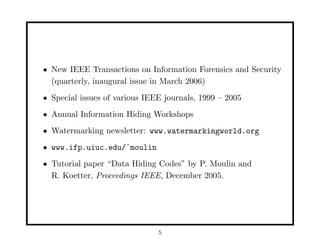
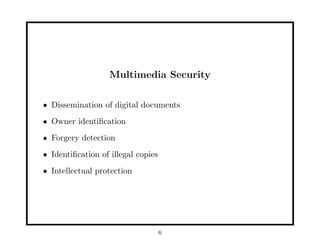
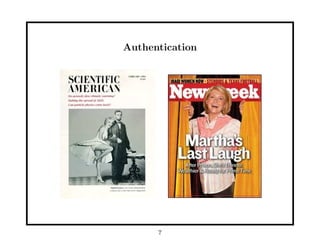
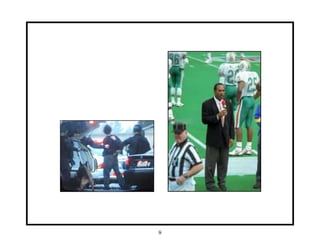
Authentication
7
8
Media Elements
• Audio
• Images
• Video
• Graphics
• Documents
• Computer programs
9
Nonadversarial Applications
• Database annotation
• Information embedding, e.g., audio in images, text in host
signals (movie subtitles, financial data, synchronization signals)
10
Data Hiding
• Embed data in covertext (high payload)
• Perceptual similarity requirement
• Multimedia database management
• Covert communications (military, spies, etc.)
• Steganography (στ γανω γραφω, covert writing):
conceal existence of hidden message
11
Watermarking
• Hide a few bits of information
• Original and modified signals should be perceptually similar
• Application to digital cameras, TV, DVD video, audio
• Authentication
• Transaction tracking
• Broadcast monitoring
12
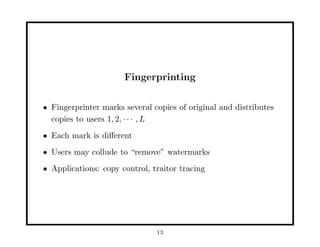
Fingerprinting
• Fingerprinter marks several copies of original and distributes
copies to users 1, 2, · · · , L
• Each mark is different
• Users may collude to “remove” watermarks
• Applications: copy control, traitor tracing
13
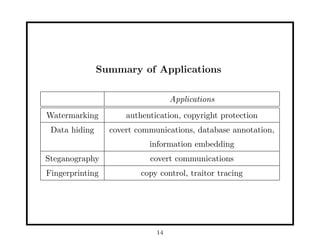
Summary of Applications
Applications
Watermarking authentication, copyright protection
Data hiding covert communications, database annotation,
information embedding
Steganography covert communications
Fingerprinting copy control, traitor tracing
14
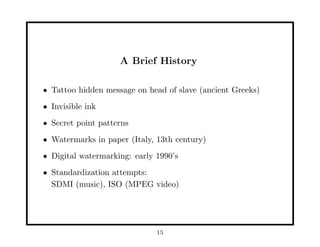
A Brief History
• Tattoo hidden message on head of slave (ancient Greeks)
• Invisible ink
• Secret point patterns
• Watermarks in paper (Italy, 13th century)
• Digital watermarking: early 1990’s
• Standardization attempts:
SDMI (music), ISO (MPEG video)
15
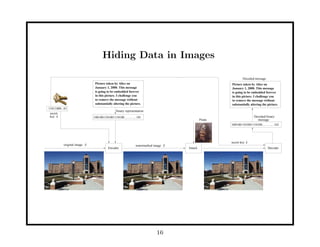
Hiding Data in Images
secret
key k
Encoder
original image S watermarked image X
Picture taken by Alice on
January 1, 2000. This message
is going to be embedded forever
in this picture. I challenge you
to remove the message without
substantially altering the picture.
1001001101001110100...............101
binary representation
Decoder
Picture taken by Alice on
January 1, 2000. This message
is going to be embedded forever
in this picture. I challenge you
to remove the message without
substantially altering the picture.
Decoded message
1001001101001110100...............101
Decoded binary
message
secret key k
Attack
Pirate
11011000...01
16
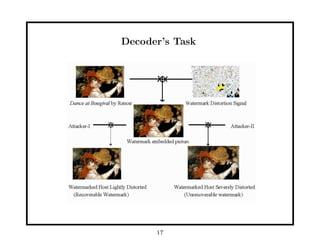
Decoder’s Task
17
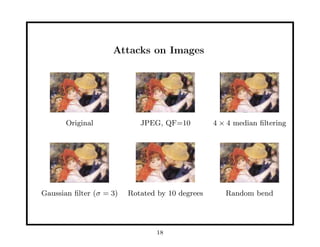
Attacks on Images
Original JPEG, QF=10 4 × 4 median filtering
Gaussian filter (σ = 3) Rotated by 10 degrees Random bend
18
Basic Properties
• Fidelity (in terms of signal distortion metric)
• Payload (number of transmitted bits)
• Robustness (against adversary)
• Security (cryptanalysis of randomized code)
• Detectability (by steganalyzers/eavesdroppers)
19
System Issues
• System complexity
• Does decoder know host signal?
(public vs private watermarking)
• Security level?
• Reliance on private or public cryptographic system?
20
Attack Models
• No attack
• Deterministic attacks (reversible & irreversible)
• Stochastic attacks (memoryless & stationary)
• Code breaking
• System attacks (e.g., ambiguity, sensitivity & scrambling)
• Benchmarking (e.g., Stirmark)
21
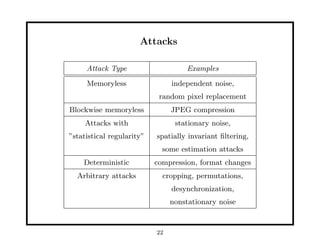
Attacks
Attack Type Examples
Memoryless independent noise,
random pixel replacement
Blockwise memoryless JPEG compression
Attacks with stationary noise,
”statistical regularity” spatially invariant filtering,
some estimation attacks
Deterministic compression, format changes
Arbitrary attacks cropping, permutations,
desynchronization,
nonstationary noise
22
Basic Theoretical Concepts
• Information theory
• Game theory
• Detection and estimation theory
• Coding theory
• Cryptography
23
Purposes of an Information-Theoretic Approach
• make appropriate simplifying assumptions to understand
fundamental limits of IH and optimally design algorithms
• provide new insights into IH
• provide a precise framework for evaluating any IH algorithm
• develop approach that generalizes easily to related problems
Caution: cost of mismodeling may be severe in game with
opponent!
24

shilpa

  • 1.
    Fundamentals of Watermarkingand Data Hiding Pierre Moulin University of Illinois at Urbana–Champaign Dept of Electrical and Computer Engineering moulin@ifp.uiuc.edu July 9, 2006 ISIT Tutorial, Seattle c 2006 by Pierre Moulin. All rights reserved. 1
  • 2.
    Outline 1. Overview 2. BasicTechniques 3. Binning Schemes and QIM Codes 4. Performance Analysis: Error Probabilities 5. Performance Analysis: Capacity 6. Applications to Images & Advanced Topics 2
  • 3.
    SESSION 1: OVERVIEW •Data hiding, watermarking, steganography • Basic properties: fidelity, payload, robustness, security 3
  • 4.
    Some Reading • Books: DigitalWatermarking, by I. Cox, M. Miller, J. Bloom, Morgan-Kaufmann, 2002 Information Hiding Techniques for Steganography and Digital Watermarking, by S. Katzenbeisser and F. Petitcolas, Eds., Artech House, 2000 Information Hiding: Steganography and Watermarking, by N. Johnson, Z. Duric and S. Jajodia, Kluwer, 2000 4
  • 5.
    • New IEEETransactions on Information Forensics and Security (quarterly, inaugural issue in March 2006) • Special issues of various IEEE journals, 1999 – 2005 • Annual Information Hiding Workshops • Watermarking newsletter: www.watermarkingworld.org • www.ifp.uiuc.edu/˜moulin • Tutorial paper “Data Hiding Codes” by P. Moulin and R. Koetter, Proceedings IEEE, December 2005. 5
  • 6.
    Multimedia Security • Disseminationof digital documents • Owner identification • Forgery detection • Identification of illegal copies • Intellectual protection 6
  • 7.
  • 8.
  • 9.
    Media Elements • Audio •Images • Video • Graphics • Documents • Computer programs 9
  • 10.
    Nonadversarial Applications • Databaseannotation • Information embedding, e.g., audio in images, text in host signals (movie subtitles, financial data, synchronization signals) 10
  • 11.
    Data Hiding • Embeddata in covertext (high payload) • Perceptual similarity requirement • Multimedia database management • Covert communications (military, spies, etc.) • Steganography (στ γανω γραφω, covert writing): conceal existence of hidden message 11
  • 12.
    Watermarking • Hide afew bits of information • Original and modified signals should be perceptually similar • Application to digital cameras, TV, DVD video, audio • Authentication • Transaction tracking • Broadcast monitoring 12
  • 13.
    Fingerprinting • Fingerprinter marksseveral copies of original and distributes copies to users 1, 2, · · · , L • Each mark is different • Users may collude to “remove” watermarks • Applications: copy control, traitor tracing 13
  • 14.
    Summary of Applications Applications Watermarkingauthentication, copyright protection Data hiding covert communications, database annotation, information embedding Steganography covert communications Fingerprinting copy control, traitor tracing 14
  • 15.
    A Brief History •Tattoo hidden message on head of slave (ancient Greeks) • Invisible ink • Secret point patterns • Watermarks in paper (Italy, 13th century) • Digital watermarking: early 1990’s • Standardization attempts: SDMI (music), ISO (MPEG video) 15
  • 16.
    Hiding Data inImages secret key k Encoder original image S watermarked image X Picture taken by Alice on January 1, 2000. This message is going to be embedded forever in this picture. I challenge you to remove the message without substantially altering the picture. 1001001101001110100...............101 binary representation Decoder Picture taken by Alice on January 1, 2000. This message is going to be embedded forever in this picture. I challenge you to remove the message without substantially altering the picture. Decoded message 1001001101001110100...............101 Decoded binary message secret key k Attack Pirate 11011000...01 16
  • 17.
  • 18.
    Attacks on Images OriginalJPEG, QF=10 4 × 4 median filtering Gaussian filter (σ = 3) Rotated by 10 degrees Random bend 18
  • 19.
    Basic Properties • Fidelity(in terms of signal distortion metric) • Payload (number of transmitted bits) • Robustness (against adversary) • Security (cryptanalysis of randomized code) • Detectability (by steganalyzers/eavesdroppers) 19
  • 20.
    System Issues • Systemcomplexity • Does decoder know host signal? (public vs private watermarking) • Security level? • Reliance on private or public cryptographic system? 20
  • 21.
    Attack Models • Noattack • Deterministic attacks (reversible & irreversible) • Stochastic attacks (memoryless & stationary) • Code breaking • System attacks (e.g., ambiguity, sensitivity & scrambling) • Benchmarking (e.g., Stirmark) 21
  • 22.
    Attacks Attack Type Examples Memorylessindependent noise, random pixel replacement Blockwise memoryless JPEG compression Attacks with stationary noise, ”statistical regularity” spatially invariant filtering, some estimation attacks Deterministic compression, format changes Arbitrary attacks cropping, permutations, desynchronization, nonstationary noise 22
  • 23.
    Basic Theoretical Concepts •Information theory • Game theory • Detection and estimation theory • Coding theory • Cryptography 23
  • 24.
    Purposes of anInformation-Theoretic Approach • make appropriate simplifying assumptions to understand fundamental limits of IH and optimally design algorithms • provide new insights into IH • provide a precise framework for evaluating any IH algorithm • develop approach that generalizes easily to related problems Caution: cost of mismodeling may be severe in game with opponent! 24