Software Engineering Lab
Faculty of Sciences
Tom Mens
tom.mens@umons.ac.be
@tom_mens
Is my software ecosystem healthy?
Directed by Tom Mens
Department of Computer Science
Faculty of Sciences
tom.mens@umons.ac.be
http://informatique.umons.ac.be
Software Engineering Lab
SECO-ASSIST
"Excellence of Science”
Research Project
2018-2021
secoassist.github.io@secoassist
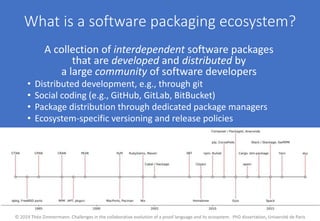
What is a software packaging ecosystem?
A collection of interdependent software packages
that are developed and distributed by
a large community of software developers
• Distributed development, e.g., through git
• Social coding (e.g., GitHub, GitLab, BitBucket)
• Package distribution through dedicated package managers
• Ecosystem-specific versioning and release policies
© 2019 Théo Zimmermann. Challenges in the collaborative evolution of a proof language and its ecosystem. PhD dissertation, Université de Paris
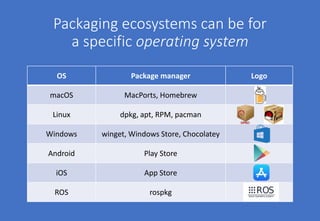
OS Package manager Logo
macOS MacPorts, Homebrew
Linux dpkg, apt, RPM, pacman
Windows winget, Windows Store, Chocolatey
Android Play Store
iOS App Store
ROS rospkg
Packaging ecosystems can be for
a specific operating system
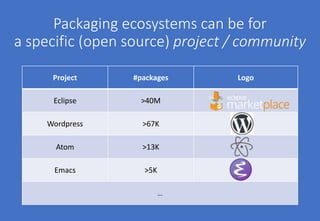
Project #packages Logo
Eclipse >40M
Wordpress >67K
Atom >13K
Emacs >5K
…
Packaging ecosystems can be for
a specific (open source) project / community
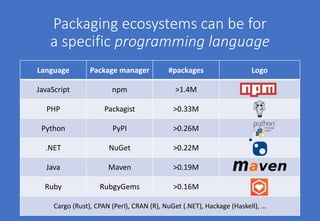
Language Package manager #packages Logo
JavaScript npm >1.4M
PHP Packagist >0.33M
Python PyPI >0.26M
.NET NuGet >0.22M
Java Maven >0.19M
Ruby RubgyGems >0.16M
Cargo (Rust), CPAN (Perl), CRAN (R), NuGet (.NET), Hackage (Haskell), …
Packaging ecosystems can be for
a specific programming language
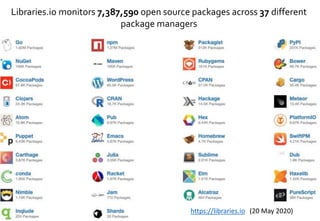
Libraries.io monitors 7,387,590 open source packages across 37 different
package managers
https://libraries.io (20 May 2020)
Packaging ecosystems can be unhealthy
• Bugs
• Security vulnerabilities
• Backward incompatibilities
• Single maintainer packages
• Abandoned packages
• Deprecated packages
• Outdated packages
• Bloated packages
• Micro-packages
• Non-compliance to versioning policies
• Incompatible or prohibited licenses
• Suboptimal release and update policies
• …
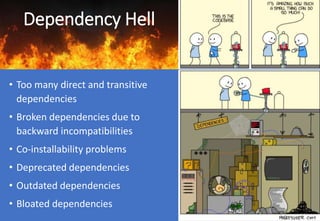
Dependency Hell
• Too many direct and transitive
dependencies
• Broken dependencies due to
backward incompatibilities
• Co-installability problems
• Deprecated dependencies
• Outdated dependencies
• Bloated dependencies
Case studies of
dependency-related
health issues in
software ecosystems
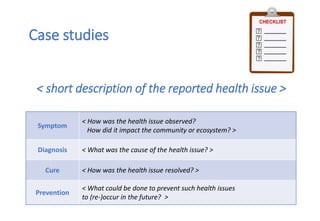
< short description of the reported health issue >
Symptom
< How was the health issue observed?
How did it impact the community or ecosystem? >
Diagnosis < What was the cause of the health issue? >
Cure < How was the health issue resolved? >
Prevention
< What could be done to prevent such health issues
to (re-)occur in the future? >
Case studies
data breach (May 2017)
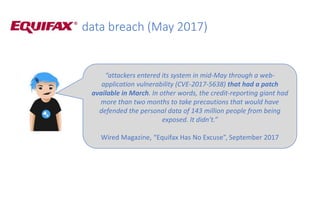
“attackers entered its system in mid-May through a web-
application vulnerability (CVE-2017-5638) that had a patch
available in March. In other words, the credit-reporting giant had
more than two months to take precautions that would have
defended the personal data of 143 million people from being
exposed. It didn’t.”
Wired Magazine, “Equifax Has No Excuse”, September 2017
data breach (May 2017)
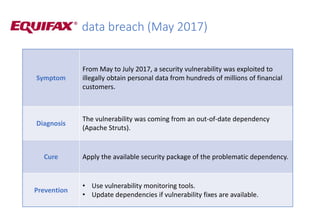
Symptom
From May to July 2017, a security vulnerability was exploited to
illegally obtain personal data from hundreds of millions of financial
customers.
Diagnosis
The vulnerability was coming from an out-of-date dependency
(Apache Struts).
Cure Apply the available security package of the problematic dependency.
Prevention
• Use vulnerability monitoring tools.
• Update dependencies if vulnerability fixes are available.
Typosquatting package names
(December 2018)
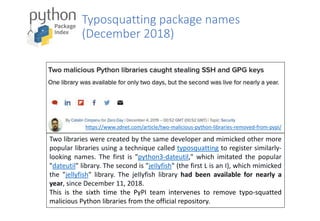
Two libraries were created by the same developer and mimicked other more
popular libraries using a technique called typosquatting to register similarly-
looking names. The first is "python3-dateutil," which imitated the popular
"dateutil" library. The second is "jeIlyfish" (the first L is an I), which mimicked
the "jellyfish" library. The jeIlyfish library had been available for nearly a
year, since December 11, 2018.
This is the sixth time the PyPI team intervenes to remove typo-squatted
malicious Python libraries from the official repository.
https://www.zdnet.com/article/two-malicious-python-libraries-removed-from-pypi/
Typosquatting package names
(December 2018)
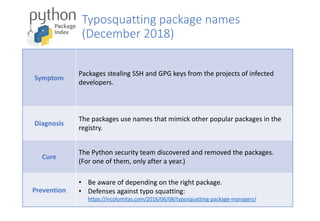
Symptom
Packages stealing SSH and GPG keys from the projects of infected
developers.
Diagnosis
The packages use names that mimick other popular packages in the
registry.
Cure
The Python security team discovered and removed the packages.
(For one of them, only after a year.)
Prevention
• Be aware of depending on the right package.
• Defenses against typo squatting:
https://incolumitas.com/2016/06/08/typosquatting-package-managers/
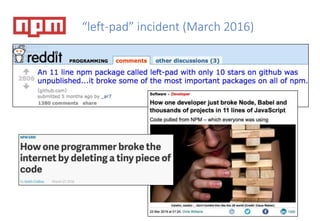
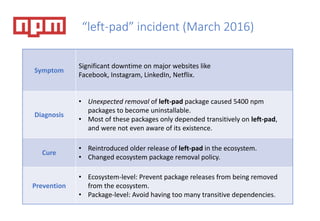
“left-pad” incident (March 2016)
Symptom
Significant downtime on major websites like
Facebook, Instagram, LinkedIn, Netflix.
Diagnosis
• Unexpected removal of left-pad package caused 5400 npm
packages to become uninstallable.
• Most of these packages only depended transitively on left-pad,
and were not even aware of its existence.
Cure
• Reintroduced older release of left-pad in the ecosystem.
• Changed ecosystem package removal policy.
Prevention
• Ecosystem-level: Prevent package releases from being removed
from the ecosystem.
• Package-level: Avoid having too many transitive dependencies.
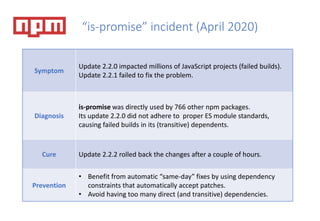
“is-promise” incident (April 2020)
Symptom
Update 2.2.0 impacted millions of JavaScript projects (failed builds).
Update 2.2.1 failed to fix the problem.
Diagnosis
is-promise was directly used by 766 other npm packages.
Its update 2.2.0 did not adhere to proper ES module standards,
causing failed builds in its (transitive) dependents.
Cure Update 2.2.2 rolled back the changes after a couple of hours.
Prevention
• Benefit from automatic “same-day” fixes by using dependency
constraints that automatically accept patches.
• Avoid having too many direct (and transitive) dependencies.
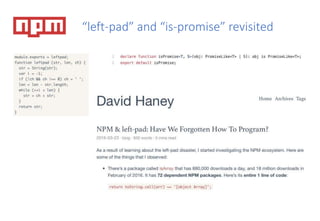
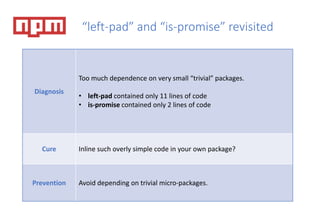
“left-pad” and “is-promise” revisited
Diagnosis
Too much dependence on very small “trivial” packages.
• left-pad contained only 11 lines of code
• is-promise contained only 2 lines of code
Cure Inline such overly simple code in your own package?
Prevention Avoid depending on trivial micro-packages.
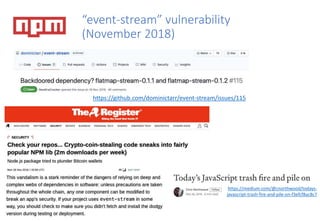
“event-stream” vulnerability
(November 2018)
https://github.com/dominictarr/event-stream/issues/115
https://medium.com/@cnorthwood/todays-
javascript-trash-fire-and-pile-on-f3efcf8ac8c7
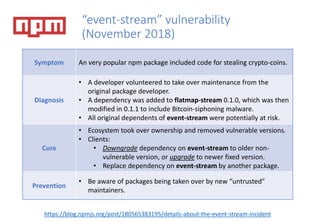
“event-stream” vulnerability
(November 2018)
Symptom An very popular npm package included code for stealing crypto-coins.
Diagnosis
• A developer volunteered to take over maintenance from the
original package developer.
• A dependency was added to flatmap-stream 0.1.0, which was then
modified in 0.1.1 to include Bitcoin-siphoning malware.
• All original dependents of event-stream were potentially at risk.
Cure
• Ecosystem took over ownership and removed vulnerable versions.
• Clients:
• Downgrade dependency on event-stream to older non-
vulnerable version, or upgrade to newer fixed version.
• Replace dependency on event-stream by another package.
Prevention
• Be aware of packages being taken over by new “untrusted”
maintainers.
https://blog.npmjs.org/post/180565383195/details-about-the-event-stream-incident
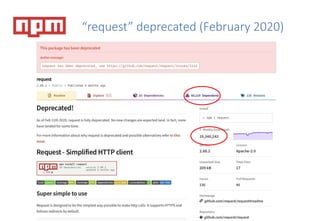
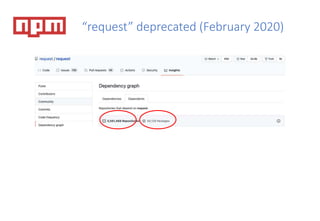
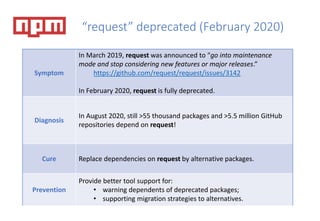
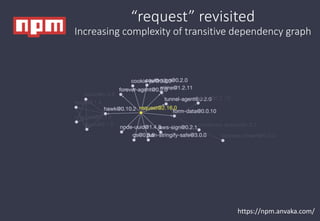
“request” deprecated (February 2020)
Symptom
In March 2019, request was announced to “go into maintenance
mode and stop considering new features or major releases.”
https://github.com/request/request/issues/3142
In February 2020, request is fully deprecated.
Diagnosis
In August 2020, still >55 thousand packages and >5.5 million GitHub
repositories depend on request!
Cure Replace dependencies on request by alternative packages.
Prevention
Provide better tool support for:
• warning dependents of deprecated packages;
• supporting migration strategies to alternatives.
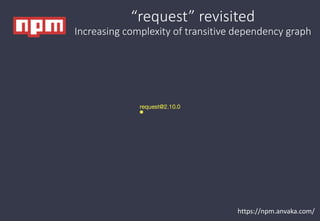
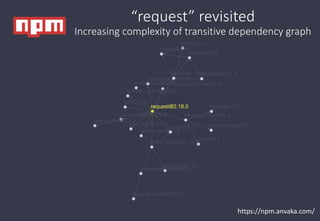
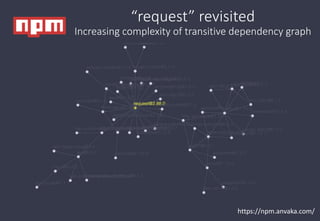
“request” revisited
Increasing complexity of transitive dependency graph
https://npm.anvaka.com/
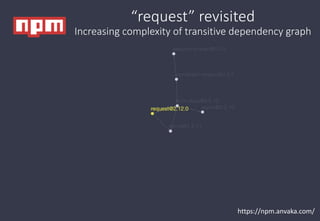
“request” revisited
Increasing complexity of transitive dependency graph
https://npm.anvaka.com/
“request” revisited
Increasing complexity of transitive dependency graph
https://npm.anvaka.com/
“request” revisited
Increasing complexity of transitive dependency graph
https://npm.anvaka.com/
“request” revisited
Increasing complexity of transitive dependency graph
Empirical Research on
dependency-related
health issues in
packaging ecosystems
Empirical research on packaging ecosystems
Why do developers use trivial packages? An empirical case study on npm
• R Abdalkareem et al., ESEC/FSE 2017
Do developers update their library dependencies? An empirical study on the impact of
security advisories on library migration
• R G Kula et al. Empirical Software Engineering Journal, 2017
On the impact of security vulnerabilities in the npm package dependency network
• A Decan et al., MSR 2018
On the evolution of technical lag in the npm package dependency network
• A Decan et al., ICSME 2018
An empirical study of dependency downgrades in the npm ecosystem
• F R Cogo et al., IEEE Transactions on Software Engineering, 2019
Empirical research on packaging ecosystems
What do package dependencies tell us about semantic versioning?
• A Decan et al., IEEE Transactions on Software Engineering, 2019
An empirical comparison of dependency network evolution in seven software
packaging ecosystems
• A Decan et al., Empirical Software Engineering Journal, 2019
An empirical study of same-day releases of popular packages in the npm ecosystem
• F R Cogo et al. Empirical Software Engineering Journal, 2020 (under review)
A comprehensive study of bloated dependencies in the Maven ecosystem
• C Soto-Valero et al. Empirical Software Engineering Journal, 2020 (under review)
Deprecation of packages and releases in software ecosystems: A case study on npm
• F Cogo et al., IEEE Transactions on Software Engineering, 2020 (under review)
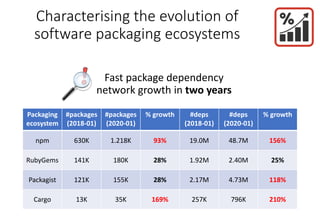
Characterising the evolution of
software packaging ecosystems
Fast package dependency
network growth in two years
Packaging
ecosystem
#packages
(2018-01)
#packages
(2020-01)
% growth #deps
(2018-01)
#deps
(2020-01)
% growth
npm 630K 1.218K 93% 19.0M 48.7M 156%
RubyGems 141K 180K 28% 1.92M 2.40M 25%
Packagist 121K 155K 28% 2.17M 4.73M 118%
Cargo 13K 35K 169% 257K 796K 210%
Characterising the evolution of
software packaging ecosystems
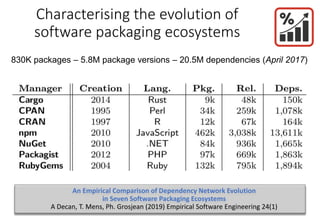
830K packages – 5.8M package versions – 20.5M dependencies (April 2017)
An Empirical Comparison of Dependency Network Evolution
in Seven Software Packaging Ecosystems
A Decan, T. Mens, Ph. Grosjean (2019) Empirical Software Engineering 24(1)
Characterising the evolution of
software packaging ecosystems
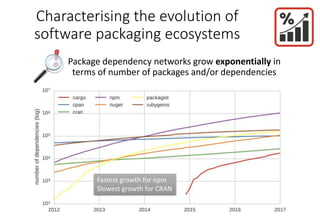
Package dependency networks grow exponentially in
terms of number of packages and/or dependencies
Fastest growth for npm
Slowest growth for CRAN
Characterising the evolution of
software packaging ecosystems
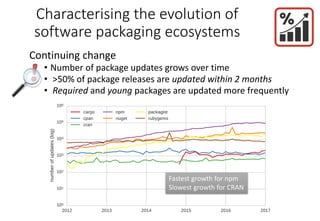
Continuing change
• Number of package updates grows over time
• >50% of package releases are updated within 2 months
• Required and young packages are updated more frequently
Fastest growth for npm
Slowest growth for CRAN
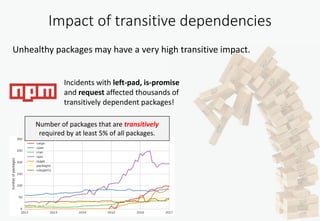
Impact of transitive dependencies
Incidents with left-pad, is-promise
and request affected thousands of
transitively dependent packages!
Number of packages that are transitively
required by at least 5% of all packages.
Unhealthy packages may have a very high transitive impact.
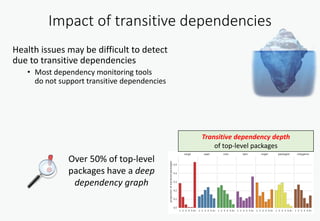
Impact of transitive dependencies
Transitive dependency depth
of top-level packages
Over 50% of top-level
packages have a deep
dependency graph
Health issues may be difficult to detect
due to transitive dependencies
• Most dependency monitoring tools
do not support transitive dependencies
Trivial Packages
• Trivial packages implement simple and trivial tasks
Cf. leftpad and “is-promise” case study
• Trivial packages are prominent
They make up 16.8% of 230K studied packages
• Developers perceive trivial packages as well implemented and well-tested
• In reality, less than half of all trivial packages have tests!
Why do developers use trivial packages? An empirical case study on npm.
R Abdalkareem, O. Nourry, et al. (2017) ESEC/FSE conference
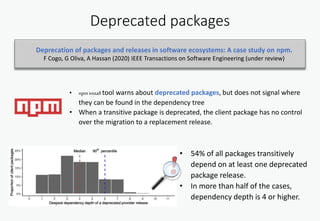
Deprecated packages
• 54% of all packages transitively
depend on at least one deprecated
package release.
• In more than half of the cases,
dependency depth is 4 or higher.
Deprecation of packages and releases in software ecosystems: A case study on npm.
F Cogo, G Oliva, A Hassan (2020) IEEE Transactions on Software Engineering (under review)
• npminstall tool warns about deprecated packages, but does not signal where
they can be found in the dependency tree
• When a transitive package is deprecated, the client package has no control
over the migration to a replacement release.
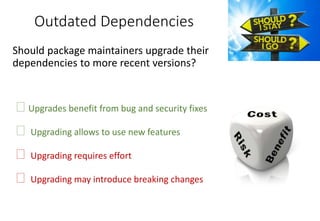
Outdated Dependencies
Should package maintainers upgrade their
dependencies to more recent versions?
�Upgrades benefit from bug and security fixes
� Upgrading allows to use new features
� Upgrading requires effort
� Upgrading may introduce breaking changes
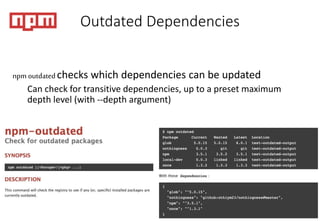
Outdated Dependencies
npm outdated checks which dependencies can be updated
Can check for transitive dependencies, up to a preset maximum
depth level (with --depth argument)
Outdated Dependencies
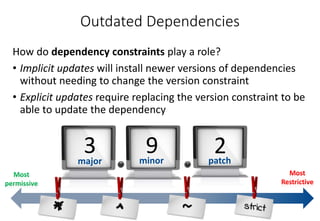
How do dependency constraints play a role?
• Implicit updates will install newer versions of dependencies
without needing to change the version constraint
• Explicit updates require replacing the version constraint to be
able to update the dependency
major minor patch
3 9 2
Most
permissive
Most
Restrictive
Outdated Dependencies
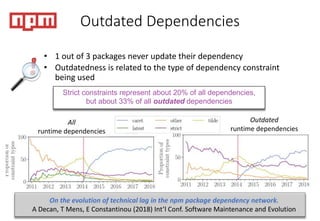
• 1 out of 3 packages never update their dependency
• Outdatedness is related to the type of dependency constraint
being used
Strict constraints represent about 20% of all dependencies,
but about 33% of all outdated dependencies
All
runtime dependencies
Outdated
runtime dependencies
On the evolution of technical lag in the npm package dependency network.
A Decan, T Mens, E Constantinou (2018) Int’l Conf. Software Maintenance and Evolution
Semantic Versioning
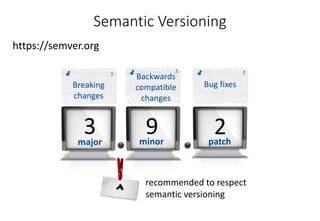
https://semver.org
major minor patch
3 9 2
Breaking
changes
Backwards
compatible
changes
Bug fixes
recommended to respect
semantic versioning
Semantic Versioning
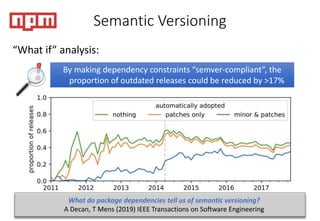
By making dependency constraints “semver-compliant”, the
proportion of outdated releases could be reduced by >17%
“What if” analysis:
What do package dependencies tell us of semantic versioning?
A Decan, T Mens (2019) IEEE Transactions on Software Engineering
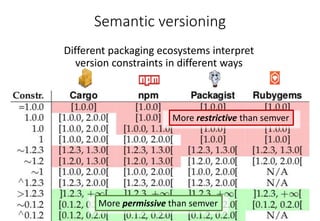
Semantic versioning
Different packaging ecosystems interpret
version constraints in different ways
More restrictive than semver
More permissive than semver
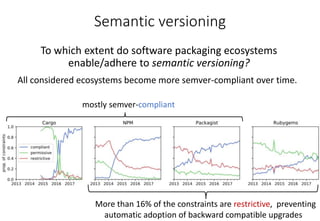
Semantic versioning
To which extent do software packaging ecosystems
enable/adhere to semantic versioning?
All considered ecosystems become more semver-compliant over time.
mostly semver-compliant
More than 16% of the constraints are restrictive, preventing
automatic adoption of backward compatible upgrades
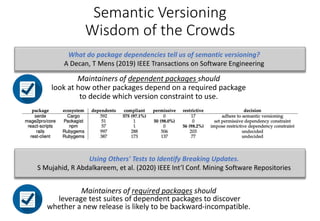
Semantic Versioning
Wisdom of the Crowds
Maintainers of required packages should
leverage test suites of dependent packages to discover
whether a new release is likely to be backward-incompatible.
Using Others' Tests to Identify Breaking Updates.
S Mujahid, R Abdalkareem, et al. (2020) IEEE Int’l Conf. Mining Software Repositories
What do package dependencies tell us of semantic versioning?
A Decan, T Mens (2019) IEEE Transactions on Software Engineering
Maintainers of dependent packages should
look at how other packages depend on a required package
to decide which version constraint to use.
Semantic Versioning
Semantic versioning reduces outdatedness
Ecosystem compliance to semver increases over time
- Trust is important
Not all provider packages respect semver
 risk of unexpected breaking changes
• Avoid dependency constraints that are too permissive
or too restrictive
• When using implicit dependencies on semver-
compliant packages, write automated CI tests for the
functionalities you use from those packages
• Use “wisdom of the crowds”: to verify semver-
compliance; to discover breaking releases
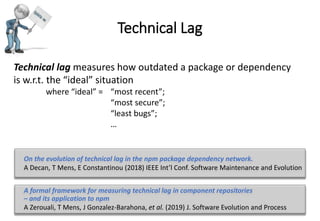
Technical Lag
Technical lag measures how outdated a package or dependency
is w.r.t. the “ideal” situation
where “ideal” = “most recent”;
“most secure”;
“least bugs”;
…
A formal framework for measuring technical lag in component repositories
– and its application to npm
A Zerouali, T Mens, J Gonzalez-Barahona, et al. (2019) J. Software Evolution and Process
On the evolution of technical lag in the npm package dependency network.
A Decan, T Mens, E Constantinou (2018) IEEE Int’l Conf. Software Maintenance and Evolution
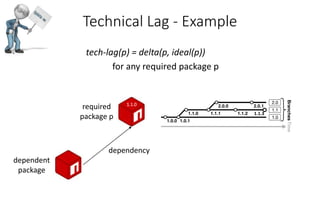
Technical Lag - Example
1.1.0
dependent
package
required
package p 1.1.3
tech-lag(p) = delta(p, ideal(p))
for any required package p
dependency
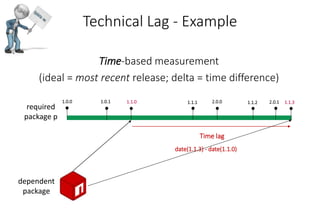
Technical Lag - Example
Time-based measurement
(ideal = most recent release; delta = time difference)
1.0.0 2.0.01.1.0 1.1.1 2.0.1
Time lag
date(1.1.3) - date(1.1.0)
1.0.1 1.1.2 1.1.3
dependent
package
required
package p
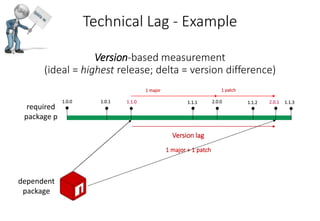
Technical Lag - Example
Version-based measurement
(ideal = highest release; delta = version difference)
1 major 1 patch
Version lag
1 major + 1 patch
required
package p
1.0.0 1.1.01.0.1
dependent
package
2.0.01.1.1 2.0.11.1.2 1.1.3
Technical Lag - Example
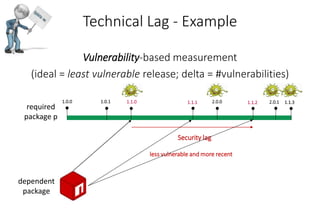
Vulnerability-based measurement
(ideal = least vulnerable release; delta = #vulnerabilities)
Security lag
less vulnerable and more recent
required
package p
1.0.0 1.1.01.0.1 2.0.01.1.1 2.0.11.1.2 1.1.3
dependent
package
Technical Lag - Example
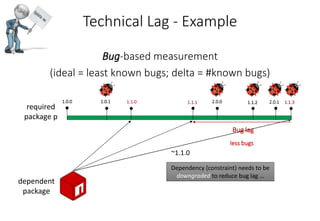
Bug-based measurement
(ideal = least known bugs; delta = #known bugs)
Bug lag
less bugs
required
package p
dependent
package
1.0.0 1.1.01.0.1 2.0.01.1.1 2.0.11.1.2 1.1.3
Dependency (constraint) needs to be
downgraded to reduce bug lag …
~1.1.0
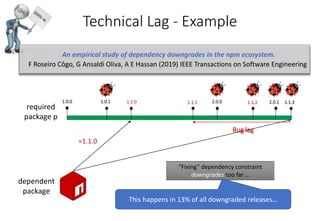
Technical Lag - Example
Bug lag
required
package p
dependent
package
1.0.0 1.1.01.0.1 2.0.01.1.1 2.0.11.1.2 1.1.3
“Fixing” dependency constraint
downgrades too far …
=1.1.0
An empirical study of dependency downgrades in the npm ecosystem.
F Roseiro Côgo, G Ansaldi Oliva, A E Hassan (2019) IEEE Transactions on Software Engineering
This happens in 13% of all downgraded releases…
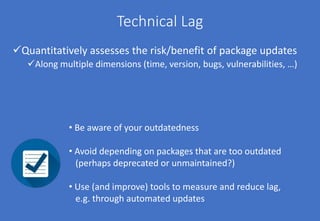
Technical Lag
Quantitatively assesses the risk/benefit of package updates
Along multiple dimensions (time, version, bugs, vulnerabilities, …)
• Be aware of your outdatedness
• Avoid depending on packages that are too outdated
(perhaps deprecated or unmaintained?)
• Use (and improve) tools to measure and reduce lag,
e.g. through automated updates
Unmaintained Packages
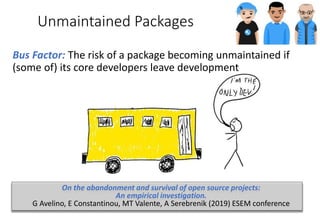
Bus Factor: The risk of a package becoming unmaintained if
(some of) its core developers leave development
On the abandonment and survival of open source projects:
An empirical investigation.
G Avelino, E Constantinou, MT Valente, A Serebrenik (2019) ESEM conference
Unmaintained Packages
Bus Factor
• Slows down development
• Increases risk of bugs and vulnerabilities
• That propagate (transitively) to dependent packages
• Leads to unmaintained packages if no replacement is found
• Increases risk of “hostile takeovers” by malevolent developers
• Cf. npm event-stream vulnerability case study
Unmaintained Packages
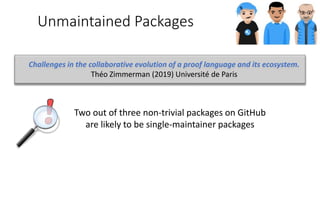
Challenges in the collaborative evolution of a proof language and its ecosystem.
Théo Zimmerman (2019) Université de Paris
Two out of three non-trivial packages on GitHub
are likely to be single-maintainer packages
Unmaintained Packages
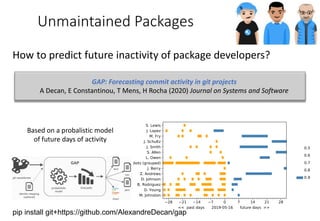
How to predict future inactivity of package developers?
GAP: Forecasting commit activity in git projects
A Decan, E Constantinou, T Mens, H Rocha (2020) Journal on Systems and Software
pip install git+https://github.com/AlexandreDecan/gap
Based on a probalistic model
of future days of activity
Unmaintained Packages
Unmaintained packages increase risk of becoming outdated
and vulnerable
This risk is ecosystem-wide, due to the strongly connected
transitive network of package dependencies
• Avoid depending on unmaintained packages
• Use (and improve) tools to detect and avoid developer
abandonment
• Rely on “community organizations” of volunteers willing to
“steward” and maintain important abandoned packages
A first look at an emerging model of community organizations for the
long-term maintenance of ecosystems' packages.
Théo Zimmermann (2020) ICSE Workshop on Software Health
How to increase health?
Recommendations for package maintainers
• Inform your dependents about
• Incompatible upgrades (cf. semantic versioning)
• Planned updates
• Deprecated features or releases
• Known bugs and security issues
• Limit the number of direct and transitive dependencies
• Remove any unused dependencies
• Write automated tests for the functionality you use from your
dependencies
• Monitor and improve your dependencies for
• outdated packages
• unmaintained packages
• security issues and bugs
• micro-packages
• deprecated packages
Conclusion
Is my software ecosystem healthy?
It probably isn’t, and it probably never will be.
• Depending on unhealthy packages impact the whole
ecosystem due to its dense package dependency network
• Communities and package maintainers should be aware
and vigilant.
• Trust is important, but so is being cautious.
• Monitoring tools and policies can help a long way but are
no silver bullet.
• More research is needed
Related Research
More precise package dependency analysis
at code level (e.g. function calls) to improve
accuracy

Is my software ecosystem healthy? It depends!

  • 1.
    Software Engineering Lab Facultyof Sciences Tom Mens tom.mens@umons.ac.be @tom_mens Is my software ecosystem healthy?
  • 2.
    Directed by TomMens Department of Computer Science Faculty of Sciences tom.mens@umons.ac.be http://informatique.umons.ac.be Software Engineering Lab
  • 3.
    SECO-ASSIST "Excellence of Science” ResearchProject 2018-2021 secoassist.github.io@secoassist
  • 4.
    What is asoftware packaging ecosystem? A collection of interdependent software packages that are developed and distributed by a large community of software developers • Distributed development, e.g., through git • Social coding (e.g., GitHub, GitLab, BitBucket) • Package distribution through dedicated package managers • Ecosystem-specific versioning and release policies © 2019 Théo Zimmermann. Challenges in the collaborative evolution of a proof language and its ecosystem. PhD dissertation, Université de Paris
  • 5.
    OS Package managerLogo macOS MacPorts, Homebrew Linux dpkg, apt, RPM, pacman Windows winget, Windows Store, Chocolatey Android Play Store iOS App Store ROS rospkg Packaging ecosystems can be for a specific operating system
  • 6.
    Project #packages Logo Eclipse>40M Wordpress >67K Atom >13K Emacs >5K … Packaging ecosystems can be for a specific (open source) project / community
  • 7.
    Language Package manager#packages Logo JavaScript npm >1.4M PHP Packagist >0.33M Python PyPI >0.26M .NET NuGet >0.22M Java Maven >0.19M Ruby RubgyGems >0.16M Cargo (Rust), CPAN (Perl), CRAN (R), NuGet (.NET), Hackage (Haskell), … Packaging ecosystems can be for a specific programming language
  • 8.
    Libraries.io monitors 7,387,590open source packages across 37 different package managers https://libraries.io (20 May 2020)
  • 9.
    Packaging ecosystems canbe unhealthy • Bugs • Security vulnerabilities • Backward incompatibilities • Single maintainer packages • Abandoned packages • Deprecated packages • Outdated packages • Bloated packages • Micro-packages • Non-compliance to versioning policies • Incompatible or prohibited licenses • Suboptimal release and update policies • …
  • 10.
    Dependency Hell • Toomany direct and transitive dependencies • Broken dependencies due to backward incompatibilities • Co-installability problems • Deprecated dependencies • Outdated dependencies • Bloated dependencies
  • 11.
    Case studies of dependency-related healthissues in software ecosystems
  • 12.
    < short descriptionof the reported health issue > Symptom < How was the health issue observed? How did it impact the community or ecosystem? > Diagnosis < What was the cause of the health issue? > Cure < How was the health issue resolved? > Prevention < What could be done to prevent such health issues to (re-)occur in the future? > Case studies
  • 13.
    data breach (May2017) “attackers entered its system in mid-May through a web- application vulnerability (CVE-2017-5638) that had a patch available in March. In other words, the credit-reporting giant had more than two months to take precautions that would have defended the personal data of 143 million people from being exposed. It didn’t.” Wired Magazine, “Equifax Has No Excuse”, September 2017
  • 14.
    data breach (May2017) Symptom From May to July 2017, a security vulnerability was exploited to illegally obtain personal data from hundreds of millions of financial customers. Diagnosis The vulnerability was coming from an out-of-date dependency (Apache Struts). Cure Apply the available security package of the problematic dependency. Prevention • Use vulnerability monitoring tools. • Update dependencies if vulnerability fixes are available.
  • 15.
    Typosquatting package names (December2018) Two libraries were created by the same developer and mimicked other more popular libraries using a technique called typosquatting to register similarly- looking names. The first is "python3-dateutil," which imitated the popular "dateutil" library. The second is "jeIlyfish" (the first L is an I), which mimicked the "jellyfish" library. The jeIlyfish library had been available for nearly a year, since December 11, 2018. This is the sixth time the PyPI team intervenes to remove typo-squatted malicious Python libraries from the official repository. https://www.zdnet.com/article/two-malicious-python-libraries-removed-from-pypi/
  • 16.
    Typosquatting package names (December2018) Symptom Packages stealing SSH and GPG keys from the projects of infected developers. Diagnosis The packages use names that mimick other popular packages in the registry. Cure The Python security team discovered and removed the packages. (For one of them, only after a year.) Prevention • Be aware of depending on the right package. • Defenses against typo squatting: https://incolumitas.com/2016/06/08/typosquatting-package-managers/
  • 17.
  • 18.
    “left-pad” incident (March2016) Symptom Significant downtime on major websites like Facebook, Instagram, LinkedIn, Netflix. Diagnosis • Unexpected removal of left-pad package caused 5400 npm packages to become uninstallable. • Most of these packages only depended transitively on left-pad, and were not even aware of its existence. Cure • Reintroduced older release of left-pad in the ecosystem. • Changed ecosystem package removal policy. Prevention • Ecosystem-level: Prevent package releases from being removed from the ecosystem. • Package-level: Avoid having too many transitive dependencies.
  • 19.
    “is-promise” incident (April2020) Symptom Update 2.2.0 impacted millions of JavaScript projects (failed builds). Update 2.2.1 failed to fix the problem. Diagnosis is-promise was directly used by 766 other npm packages. Its update 2.2.0 did not adhere to proper ES module standards, causing failed builds in its (transitive) dependents. Cure Update 2.2.2 rolled back the changes after a couple of hours. Prevention • Benefit from automatic “same-day” fixes by using dependency constraints that automatically accept patches. • Avoid having too many direct (and transitive) dependencies.
  • 20.
  • 21.
    “left-pad” and “is-promise”revisited Diagnosis Too much dependence on very small “trivial” packages. • left-pad contained only 11 lines of code • is-promise contained only 2 lines of code Cure Inline such overly simple code in your own package? Prevention Avoid depending on trivial micro-packages.
  • 22.
  • 23.
    “event-stream” vulnerability (November 2018) SymptomAn very popular npm package included code for stealing crypto-coins. Diagnosis • A developer volunteered to take over maintenance from the original package developer. • A dependency was added to flatmap-stream 0.1.0, which was then modified in 0.1.1 to include Bitcoin-siphoning malware. • All original dependents of event-stream were potentially at risk. Cure • Ecosystem took over ownership and removed vulnerable versions. • Clients: • Downgrade dependency on event-stream to older non- vulnerable version, or upgrade to newer fixed version. • Replace dependency on event-stream by another package. Prevention • Be aware of packages being taken over by new “untrusted” maintainers. https://blog.npmjs.org/post/180565383195/details-about-the-event-stream-incident
  • 24.
  • 25.
  • 26.
    “request” deprecated (February2020) Symptom In March 2019, request was announced to “go into maintenance mode and stop considering new features or major releases.” https://github.com/request/request/issues/3142 In February 2020, request is fully deprecated. Diagnosis In August 2020, still >55 thousand packages and >5.5 million GitHub repositories depend on request! Cure Replace dependencies on request by alternative packages. Prevention Provide better tool support for: • warning dependents of deprecated packages; • supporting migration strategies to alternatives.
  • 27.
    “request” revisited Increasing complexityof transitive dependency graph https://npm.anvaka.com/
  • 28.
  • 29.
  • 30.
  • 31.
  • 32.
  • 33.
    Empirical research onpackaging ecosystems Why do developers use trivial packages? An empirical case study on npm • R Abdalkareem et al., ESEC/FSE 2017 Do developers update their library dependencies? An empirical study on the impact of security advisories on library migration • R G Kula et al. Empirical Software Engineering Journal, 2017 On the impact of security vulnerabilities in the npm package dependency network • A Decan et al., MSR 2018 On the evolution of technical lag in the npm package dependency network • A Decan et al., ICSME 2018 An empirical study of dependency downgrades in the npm ecosystem • F R Cogo et al., IEEE Transactions on Software Engineering, 2019
  • 34.
    Empirical research onpackaging ecosystems What do package dependencies tell us about semantic versioning? • A Decan et al., IEEE Transactions on Software Engineering, 2019 An empirical comparison of dependency network evolution in seven software packaging ecosystems • A Decan et al., Empirical Software Engineering Journal, 2019 An empirical study of same-day releases of popular packages in the npm ecosystem • F R Cogo et al. Empirical Software Engineering Journal, 2020 (under review) A comprehensive study of bloated dependencies in the Maven ecosystem • C Soto-Valero et al. Empirical Software Engineering Journal, 2020 (under review) Deprecation of packages and releases in software ecosystems: A case study on npm • F Cogo et al., IEEE Transactions on Software Engineering, 2020 (under review)
  • 35.
    Characterising the evolutionof software packaging ecosystems Fast package dependency network growth in two years Packaging ecosystem #packages (2018-01) #packages (2020-01) % growth #deps (2018-01) #deps (2020-01) % growth npm 630K 1.218K 93% 19.0M 48.7M 156% RubyGems 141K 180K 28% 1.92M 2.40M 25% Packagist 121K 155K 28% 2.17M 4.73M 118% Cargo 13K 35K 169% 257K 796K 210%
  • 36.
    Characterising the evolutionof software packaging ecosystems 830K packages – 5.8M package versions – 20.5M dependencies (April 2017) An Empirical Comparison of Dependency Network Evolution in Seven Software Packaging Ecosystems A Decan, T. Mens, Ph. Grosjean (2019) Empirical Software Engineering 24(1)
  • 37.
    Characterising the evolutionof software packaging ecosystems Package dependency networks grow exponentially in terms of number of packages and/or dependencies Fastest growth for npm Slowest growth for CRAN
  • 38.
    Characterising the evolutionof software packaging ecosystems Continuing change • Number of package updates grows over time • >50% of package releases are updated within 2 months • Required and young packages are updated more frequently Fastest growth for npm Slowest growth for CRAN
  • 39.
    Impact of transitivedependencies Incidents with left-pad, is-promise and request affected thousands of transitively dependent packages! Number of packages that are transitively required by at least 5% of all packages. Unhealthy packages may have a very high transitive impact.
  • 40.
    Impact of transitivedependencies Transitive dependency depth of top-level packages Over 50% of top-level packages have a deep dependency graph Health issues may be difficult to detect due to transitive dependencies • Most dependency monitoring tools do not support transitive dependencies
  • 41.
    Trivial Packages • Trivialpackages implement simple and trivial tasks Cf. leftpad and “is-promise” case study • Trivial packages are prominent They make up 16.8% of 230K studied packages • Developers perceive trivial packages as well implemented and well-tested • In reality, less than half of all trivial packages have tests! Why do developers use trivial packages? An empirical case study on npm. R Abdalkareem, O. Nourry, et al. (2017) ESEC/FSE conference
  • 42.
    Deprecated packages • 54%of all packages transitively depend on at least one deprecated package release. • In more than half of the cases, dependency depth is 4 or higher. Deprecation of packages and releases in software ecosystems: A case study on npm. F Cogo, G Oliva, A Hassan (2020) IEEE Transactions on Software Engineering (under review) • npminstall tool warns about deprecated packages, but does not signal where they can be found in the dependency tree • When a transitive package is deprecated, the client package has no control over the migration to a replacement release.
  • 43.
    Outdated Dependencies Should packagemaintainers upgrade their dependencies to more recent versions? �Upgrades benefit from bug and security fixes � Upgrading allows to use new features � Upgrading requires effort � Upgrading may introduce breaking changes
  • 44.
    Outdated Dependencies npm outdatedchecks which dependencies can be updated Can check for transitive dependencies, up to a preset maximum depth level (with --depth argument)
  • 45.
    Outdated Dependencies How dodependency constraints play a role? • Implicit updates will install newer versions of dependencies without needing to change the version constraint • Explicit updates require replacing the version constraint to be able to update the dependency major minor patch 3 9 2 Most permissive Most Restrictive
  • 46.
    Outdated Dependencies • 1out of 3 packages never update their dependency • Outdatedness is related to the type of dependency constraint being used Strict constraints represent about 20% of all dependencies, but about 33% of all outdated dependencies All runtime dependencies Outdated runtime dependencies On the evolution of technical lag in the npm package dependency network. A Decan, T Mens, E Constantinou (2018) Int’l Conf. Software Maintenance and Evolution
  • 47.
    Semantic Versioning https://semver.org major minorpatch 3 9 2 Breaking changes Backwards compatible changes Bug fixes recommended to respect semantic versioning
  • 48.
    Semantic Versioning By makingdependency constraints “semver-compliant”, the proportion of outdated releases could be reduced by >17% “What if” analysis: What do package dependencies tell us of semantic versioning? A Decan, T Mens (2019) IEEE Transactions on Software Engineering
  • 49.
    Semantic versioning Different packagingecosystems interpret version constraints in different ways More restrictive than semver More permissive than semver
  • 50.
    Semantic versioning To whichextent do software packaging ecosystems enable/adhere to semantic versioning? All considered ecosystems become more semver-compliant over time. mostly semver-compliant More than 16% of the constraints are restrictive, preventing automatic adoption of backward compatible upgrades
  • 51.
    Semantic Versioning Wisdom ofthe Crowds Maintainers of required packages should leverage test suites of dependent packages to discover whether a new release is likely to be backward-incompatible. Using Others' Tests to Identify Breaking Updates. S Mujahid, R Abdalkareem, et al. (2020) IEEE Int’l Conf. Mining Software Repositories What do package dependencies tell us of semantic versioning? A Decan, T Mens (2019) IEEE Transactions on Software Engineering Maintainers of dependent packages should look at how other packages depend on a required package to decide which version constraint to use.
  • 52.
    Semantic Versioning Semantic versioningreduces outdatedness Ecosystem compliance to semver increases over time - Trust is important Not all provider packages respect semver  risk of unexpected breaking changes • Avoid dependency constraints that are too permissive or too restrictive • When using implicit dependencies on semver- compliant packages, write automated CI tests for the functionalities you use from those packages • Use “wisdom of the crowds”: to verify semver- compliance; to discover breaking releases
  • 53.
    Technical Lag Technical lagmeasures how outdated a package or dependency is w.r.t. the “ideal” situation where “ideal” = “most recent”; “most secure”; “least bugs”; … A formal framework for measuring technical lag in component repositories – and its application to npm A Zerouali, T Mens, J Gonzalez-Barahona, et al. (2019) J. Software Evolution and Process On the evolution of technical lag in the npm package dependency network. A Decan, T Mens, E Constantinou (2018) IEEE Int’l Conf. Software Maintenance and Evolution
  • 54.
    Technical Lag -Example 1.1.0 dependent package required package p 1.1.3 tech-lag(p) = delta(p, ideal(p)) for any required package p dependency
  • 55.
    Technical Lag -Example Time-based measurement (ideal = most recent release; delta = time difference) 1.0.0 2.0.01.1.0 1.1.1 2.0.1 Time lag date(1.1.3) - date(1.1.0) 1.0.1 1.1.2 1.1.3 dependent package required package p
  • 56.
    Technical Lag -Example Version-based measurement (ideal = highest release; delta = version difference) 1 major 1 patch Version lag 1 major + 1 patch required package p 1.0.0 1.1.01.0.1 dependent package 2.0.01.1.1 2.0.11.1.2 1.1.3
  • 57.
    Technical Lag -Example Vulnerability-based measurement (ideal = least vulnerable release; delta = #vulnerabilities) Security lag less vulnerable and more recent required package p 1.0.0 1.1.01.0.1 2.0.01.1.1 2.0.11.1.2 1.1.3 dependent package
  • 58.
    Technical Lag -Example Bug-based measurement (ideal = least known bugs; delta = #known bugs) Bug lag less bugs required package p dependent package 1.0.0 1.1.01.0.1 2.0.01.1.1 2.0.11.1.2 1.1.3 Dependency (constraint) needs to be downgraded to reduce bug lag … ~1.1.0
  • 59.
    Technical Lag -Example Bug lag required package p dependent package 1.0.0 1.1.01.0.1 2.0.01.1.1 2.0.11.1.2 1.1.3 “Fixing” dependency constraint downgrades too far … =1.1.0 An empirical study of dependency downgrades in the npm ecosystem. F Roseiro Côgo, G Ansaldi Oliva, A E Hassan (2019) IEEE Transactions on Software Engineering This happens in 13% of all downgraded releases…
  • 60.
    Technical Lag Quantitatively assessesthe risk/benefit of package updates Along multiple dimensions (time, version, bugs, vulnerabilities, …) • Be aware of your outdatedness • Avoid depending on packages that are too outdated (perhaps deprecated or unmaintained?) • Use (and improve) tools to measure and reduce lag, e.g. through automated updates
  • 62.
    Unmaintained Packages Bus Factor:The risk of a package becoming unmaintained if (some of) its core developers leave development On the abandonment and survival of open source projects: An empirical investigation. G Avelino, E Constantinou, MT Valente, A Serebrenik (2019) ESEM conference
  • 63.
    Unmaintained Packages Bus Factor •Slows down development • Increases risk of bugs and vulnerabilities • That propagate (transitively) to dependent packages • Leads to unmaintained packages if no replacement is found • Increases risk of “hostile takeovers” by malevolent developers • Cf. npm event-stream vulnerability case study
  • 64.
    Unmaintained Packages Challenges inthe collaborative evolution of a proof language and its ecosystem. Théo Zimmerman (2019) Université de Paris Two out of three non-trivial packages on GitHub are likely to be single-maintainer packages
  • 65.
    Unmaintained Packages How topredict future inactivity of package developers? GAP: Forecasting commit activity in git projects A Decan, E Constantinou, T Mens, H Rocha (2020) Journal on Systems and Software pip install git+https://github.com/AlexandreDecan/gap Based on a probalistic model of future days of activity
  • 66.
    Unmaintained Packages Unmaintained packagesincrease risk of becoming outdated and vulnerable This risk is ecosystem-wide, due to the strongly connected transitive network of package dependencies • Avoid depending on unmaintained packages • Use (and improve) tools to detect and avoid developer abandonment • Rely on “community organizations” of volunteers willing to “steward” and maintain important abandoned packages A first look at an emerging model of community organizations for the long-term maintenance of ecosystems' packages. Théo Zimmermann (2020) ICSE Workshop on Software Health
  • 67.
    How to increasehealth? Recommendations for package maintainers • Inform your dependents about • Incompatible upgrades (cf. semantic versioning) • Planned updates • Deprecated features or releases • Known bugs and security issues • Limit the number of direct and transitive dependencies • Remove any unused dependencies • Write automated tests for the functionality you use from your dependencies • Monitor and improve your dependencies for • outdated packages • unmaintained packages • security issues and bugs • micro-packages • deprecated packages
  • 68.
    Conclusion Is my softwareecosystem healthy? It probably isn’t, and it probably never will be. • Depending on unhealthy packages impact the whole ecosystem due to its dense package dependency network • Communities and package maintainers should be aware and vigilant. • Trust is important, but so is being cautious. • Monitoring tools and policies can help a long way but are no silver bullet. • More research is needed
  • 69.
    Related Research More precisepackage dependency analysis at code level (e.g. function calls) to improve accuracy

Editor's Notes

  • #7 Size of packaging ecosytems listed in decreasing number of packages Taken from libraries.io, 1 June 2020 With the exception of Eclipse, taken directly from its marketplace (they do not call it “packages” but rather “solutions” or “plugins”.
  • #8 Size of packaging ecosytems listed in decreasing number of packages (expressed in “millions”) Taken from libraries.io, 1 June 2020 CPAN (PERL) 37.8K >0.03M Cargo (Rust) 42.2K CRAN (R) 17.6K Clojars (Clojure) 24.3K Hackage (Haskell) 14.9K
  • #11 Bloated dependencies = dependencies that are part of the package build but that are not needed to build and run the application. This phenomenon artificially grows the size of the built binary and increases maintenance effort. 
  • #13 On March 7, the Apache Software Foundation released a patch for the vulnerabilities; on March 9, Equifax administrators were told to apply the patch to any affected systems, but the employee who should have done so didn't. Equifax's IT department ran a series of scans that were supposed to identify unpatched systems on March 15; there were in fact multiple vulnerable systems, including the aforementioned web portal, but the scans seemed to have not worked, and none of the vulnerable systems were flagged or patched.
  • #14 On March 7, the Apache Software Foundation released a patch for the vulnerabilities; on March 9, Equifax administrators were told to apply the patch to any affected systems, but the employee who should have done so didn't. Equifax's IT department ran a series of scans that were supposed to identify unpatched systems on March 15; there were in fact multiple vulnerable systems, including the aforementioned web portal, but the scans seemed to have not worked, and none of the vulnerable systems were flagged or patched.
  • #15 On March 7, the Apache Software Foundation released a patch for the vulnerabilities; on March 9, Equifax administrators were told to apply the patch to any affected systems, but the employee who should have done so didn't. Equifax's IT department ran a series of scans that were supposed to identify unpatched systems on March 15; there were in fact multiple vulnerable systems, including the aforementioned web portal, but the scans seemed to have not worked, and none of the vulnerable systems were flagged or patched.
  • #17 On March 7, the Apache Software Foundation released a patch for the vulnerabilities; on March 9, Equifax administrators were told to apply the patch to any affected systems, but the employee who should have done so didn't. Equifax's IT department ran a series of scans that were supposed to identify unpatched systems on March 15; there were in fact multiple vulnerable systems, including the aforementioned web portal, but the scans seemed to have not worked, and none of the vulnerable systems were flagged or patched.
  • #20 Alternative solution would be to lock your dependencies, and update them manually, but this requires much more effort, and could lead to other issues such as known security fixes such as Equifax incident that do not get fixed automatically. There is no silver bullet…
  • #23 Alternative solution would be to lock your dependencies, and update them manually, but this requires much more effort, and could lead to other issues such as known security fixes such as Equifax incident that do not get fixed automatically. There is no silver bullet…
  • #24 Alternative solution would be to lock your dependencies, and update them manually, but this requires much more effort, and could lead to other issues such as known security fixes such as Equifax incident that do not get fixed automatically. There is no silver bullet…
  • #25 Alternative solution would be to lock your dependencies, and update them manually, but this requires much more effort, and could lead to other issues such as known security fixes such as Equifax incident that do not get fixed automatically. There is no silver bullet…
  • #26 Alternative solution would be to lock your dependencies, and update them manually, but this requires much more effort, and could lead to other issues such as known security fixes such as Equifax incident that do not get fixed automatically. There is no silver bullet…
  • #27 Alternative solution would be to lock your dependencies, and update them manually, but this requires much more effort, and could lead to other issues such as known security fixes such as Equifax incident that do not get fixed automatically. There is no silver bullet…
  • #28 Transitive dependencies are a problem, especially since dependency monitoring tools typically only consider direct dependencies.
  • #29 Transitive dependencies are a problem, especially since dependency monitoring tools typically only consider direct dependencies.
  • #30 Transitive dependencies are a problem, especially since dependency monitoring tools typically only consider direct dependencies.
  • #31 Transitive dependencies are a problem, especially since dependency monitoring tools typically only consider direct dependencies.
  • #32 Transitive dependencies are a problem, especially since dependency monitoring tools typically only consider direct dependencies.
  • #34 This list of references is inevitably incomplete. It is meant to show the diversity of active research in package dependency ecosystems, carried out by different groups of researchers, and focusing on different topics. The main topic studied in each article is underlined. Code reuse is traditionally seen as good practice. Recent trends have pushed the concept of code reuse to an extreme, by using packages that implement simple and trivial tasks, which we call ‘trivial packages’. A recent incident where a trivial package led to the breakdown of some of the most popular web applications such as Facebook and Netflix made it imperative to question the growing use of trivial packages. Therefore, in this paper, we mine more than 230,000 npm pack- ages and 38,000 JavaScript applications in order to study the preva- lence of trivial packages. We found that trivial packages are com- mon and are increasing in popularity, making up 16.8% of the studied npm packages. We performed a survey with 88 Node.js developers who use trivial packages to understand the reasons and drawbacks of their use. Our survey revealed that trivial packages are used because they are perceived to be well implemented and tested pieces of code. However, developers are concerned about maintaining and the risks of breakages due to the extra dependen- cies trivial packages introduce. To objectively verify the survey results, we empirically validate the most cited reason and drawback and find that, contrary to developers’ beliefs, only 45.2% of trivial packages even have tests. However, trivial packages appear to be ‘deployment tested’ and to have similar test, usage and community interest as non-trivial packages. On the other hand, we found that 11.5% of the studied trivial packages have more than 20 depen- dencies. Hence, developers should be careful about which trivial packages they decide to use.
  • #35 This list of references is inevitably incomplete. It is meant to show the diversity of active research in package dependency ecosystems, carried out by different groups of researchers, and focusing on different topics. The main topic studied in each article is underlined. A Comprehensive Study of Bloated Dependencies in the Maven Ecosystem César Soto-Valero, Nicolas Harrand, Martin Monperrus, Benoit Baudry Build automation tools and package managers have a profound influence on software development. They facilitate the reuse of third-party libraries, support a clear separation between the application's code and its external dependencies, and automate several software development tasks. However, the wide adoption of these tools introduces new challenges related to dependency management. In this paper, we propose an original study of one such challenge: the emergence of bloated dependencies.  Bloated dependencies are libraries that the build tool packages with the application's compiled code but that are actually not necessary to build and run the application. This phenomenon artificially grows the size of the built binary and increases maintenance effort. We propose a tool, called DepClean, to analyze the presence of bloated dependencies in Maven artifacts. We analyze 9,639 Java artifacts hosted on Maven Central, which include a total of 723,444 dependency relationships. Our key result is that 75.1% of the analyzed dependency relationships are bloated. In other words, it is feasible to reduce the number of dependencies of Maven artifacts up to 1/4 of its current count. We also perform a qualitative study with 30 notable open-source projects. Our results indicate that developers pay attention to their dependencies and are willing to remove bloated dependencies: 18/21 answered pull requests were accepted and merged by developers, removing 131 dependencies in total.
  • #36 Cf. law of increasing growth
  • #38 Cf. law of increasing growth
  • #39 Cf. law of increasing growth
  • #41 Package maintainers only see the tip of the iceberg.
  • #42 A recent incident where a trivial package led to the breakdown of some of the most popular web applications such as Facebook and Netflix made it imperative to question the growing use of trivial packages. Therefore, in this paper, we mine more than 230,000 npm pack- ages and 38,000 JavaScript applications in order to study the preva- lence of trivial packages. We found that trivial packages are com- mon and are increasing in popularity, making up 16.8% of the studied npm packages. We performed a survey with 88 Node.js developers who use trivial packages to understand the reasons and drawbacks of their use. Our survey revealed that trivial packages are used because they are perceived to be well implemented and tested pieces of code. However, developers are concerned about maintaining and the risks of breakages due to the extra dependen- cies trivial packages introduce. To objectively verify the survey results, we empirically validate the most cited reason and drawback and find that, contrary to developers’ beliefs, only 45.2% of trivial packages even have tests. However, trivial packages appear to be ‘deployment tested’ and to have similar test, usage and community interest as non-trivial packages. On the other hand, we found that 11.5% of the studied trivial packages have more than 20 depen- dencies. Hence, developers should be careful about which trivial packages they decide to use.
  • #43 Package maintainers only see the tip of the iceberg.
  • #44 Quote by Ward Cunningham in 1992: “Shipping first-time code is like going into debt. A little debt speeds development so long as it is paid back promptly with a rewrite. Objects make the cost of this transaction tolerable. The danger occurs when the debt is not repaid. Every minute spent on not-quite-right code counts as interest on that debt. Entire engineering organizations can be brought to a stand-still under the debt load of an unconsolidated implementation, object-oriented or otherwise." The concept does not mean that debt should never be incurred. Just as leverage can help a company when used correctly, a quick solution can mean a faster time to market in software development. In addition, technical debt is not just poor code. Bad code is bad code, and technical debt can result from the work of good programmers under unrealistic project constraints.”
  • #45 Quote by Ward Cunningham in 1992: “Shipping first-time code is like going into debt. A little debt speeds development so long as it is paid back promptly with a rewrite. Objects make the cost of this transaction tolerable. The danger occurs when the debt is not repaid. Every minute spent on not-quite-right code counts as interest on that debt. Entire engineering organizations can be brought to a stand-still under the debt load of an unconsolidated implementation, object-oriented or otherwise." The concept does not mean that debt should never be incurred. Just as leverage can help a company when used correctly, a quick solution can mean a faster time to market in software development. In addition, technical debt is not just poor code. Bad code is bad code, and technical debt can result from the work of good programmers under unrealistic project constraints.”
  • #46 Benefits of semantic versioing: For package providers: Inform your dependents about which releases are backwards incompatible For package consumers: Decide and control which newer dependency releases are permitted
  • #47 1 out of 3 packages = 1 out of 3 DEPENDENT packages!
  • #48 Benefits of semantic versioing: For package providers: Inform your dependents about which releases are backwards incompatible For package consumers: Decide and control which newer dependency releases are permitted
  • #49 The proportion of releases suffering from technical lag could be reduced by >17%. Based on an analysis conducted in our ICSME 2018 paper.
  • #51 Proportion of dependency constraints (for package releases ≥1.0.0) that are semver-compliant, more permissive, or more restrictive (based on January 2018 dataset from libraries.io)
  • #52 The reuse of third-party packages has become a common practice in contemporary software development. Software dependencies are constantly evolving with newly added features and patches that fix bugs in older versions. However, updating dependencies could introduce new bugs or break backward compatibility. In this work, we propose a technique to detect breakage-inducing versions of third-party dependencies. The key insight behind our approach is to leverage the automated test suites of other projects that depend upon the same dependency to test newly released versions. We conjecture that this crowd-based approach will help to detect breakage-inducing versions because it broadens the set of realistic usage scenarios to which a package version has been exposed. To evaluate our conjecture, we perform an empirical study of 391,553 npm packages. We use the dependency network from these packages to identify candidate tests of third-party packages. Moreover, to evaluate our proposed technique, we mine the history of this dependency network to identify ten breakage-inducing versions. We find that our proposed technique can detect six of the ten studied breakage-inducing versions. Our findings can help developers to make more informed decisions when they update their dependencies.
  • #55 In other words, to compute the technical lag or the time lag for the time-based instatiation, we use the difference in days between the releases dates of the deployed version and the ideal version.
  • #56 In other words, to compute the technical lag or the time lag for the time-based instatiation, we use the difference in days between the releases dates of the deployed version and the ideal version.
  • #57 and then to compute the technical lag in terms of missing updates, we compute how many versions are between the deployed and the ideal versions while checking their version type. For example here, from here to here the minor version number changes,
  • #58 and then to compute the technical lag in terms of missing updates, we compute how many versions are between the deployed and the ideal versions while checking their version type. For example here, from here to here the minor version number changes,
  • #59 and then to compute the technical lag in terms of missing updates, we compute how many versions are between the deployed and the ideal versions while checking their version type. For example here, from here to here the minor version number changes,
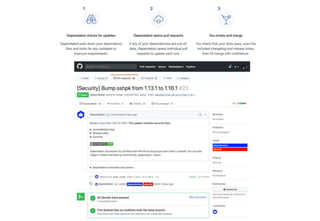
  • #61 An example of an automated tool to update pacakges to reduce vulnerabilities and outdatedness is Dependabot, integrated by GitHub, which also includes npm nowadays.
  • #63 Examples of community organisations: Https://hithub.com/elm-community for Elm language Vox Pupuli for Puppet Sous Chefs for Chef ReasonML-community Coq-community Ocaml-community React-native-community
  • #64 Based on an analysis of libraries.io packages on GitHub and after filtering out trivial packages, 2 out of 3 packages are likely to be single-maintainer packages
  • #65 Based on an analysis of libraries.io packages on GitHub and after filtering out trivial packages, 2 out of 3 packages are likely to be single-maintainer packages
  • #67 Examples of community organisations: Https://hithub.com/elm-community for Elm language Vox Pupuli for Puppet Sous Chefs for Chef ReasonML-community Coq-community Ocaml-community React-native-community