Perceptual Reversal of Bi-Stable Ambiguous Figures
                       Bi Stable
in the Upright and Supine Positions
Sonny Kohli, MD FRCPC (Internal Medicine, Critical Care), Flight Surgery, ISU SSP 2008

on behalf of the IRIS team investigators: Dawn Lim, Michael Demel, and Gilles Clément


Nov 21, 2009

CSS Summit
Kingston, Ontario
Perceptual Reversal of Bi-Stable Ambiguous Figures
in the Upright and Supine Positions

Dawn Lim, University of Toronto, Division of Emergency Medicine, Toronto, Canada
Michael Demel, International Space University, Strasbourg, France
Sonny Kohli, Oakville Trafalgar Memorial Hospital, ISUSSP 2008 Alumnus
Gilles Clément, Centre National de la Recherche Scientifique, Toulouse, France
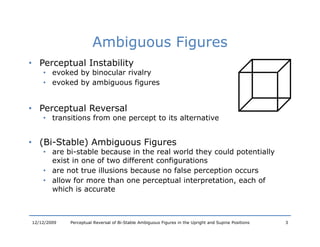
Ambiguous Figures
• Perceptual Instability
    • evoked by binocular rivalry
    • evoked by ambiguous figures


• Perceptual Reversal
    • transitions from one percept to its alternative


• (Bi St bl ) Ambiguous Fi
  (Bi-Stable) A bi      Figures
    • are bi-stable because in the real world they could potentially
      exist in one of two different configurations
    • are not true illusions because no false perception occurs
    • allow for more than one perceptual interpretation, each of
      which is accurate


12/12/2009   Perceptual Reversal of Bi-Stable Ambiguous Figures in the Upright and Supine Positions   3
“Iris” Experiment
                            Iris

• International Space University (ISU) Life Science Project
                 p             y(    )                 j


• Objective:
    j
     • investigate whether perception (of perspective-reversible figures)
       is altered by gravity

     Environments:
     E i
     • 1 g – supine versus upright (ie tilted to gravity)
     • 0 g - parabolic flight (ESA 50th Parabolic Flight Campaign)
     • Micro g orbital flight (ISS Increments 19/20)
             g-


• Supported by CSA, CNRS, UTSI, CNES, ESA, NASA
    pp       y    ,     ,     ,     ,    ,

 12/12/2009   Perceptual Reversal of Bi-Stable Ambiguous Figures in the Upright and Supine Positions   4
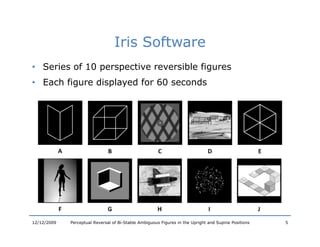
Iris Software
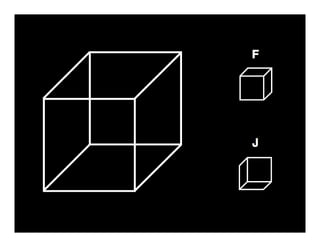
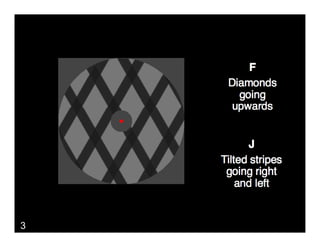
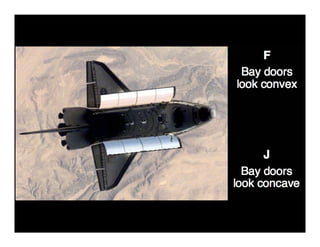
• Series of 10 perspective reversible figures
• Each figure displayed for 60 seconds


12/12/2009   Perceptual Reversal of Bi-Stable Ambiguous Figures in the Upright and Supine Positions   5
3
Method
• Test subject inclusion criteria
      • between 18-60 years of age
                   18 60
      • no uncorrectable ocular-vestibular pathology
      • ability to concentrate on a computer screen for approximately
        ten minutes at a time
      • able t commit to completing all three coupled trials over a
         bl to         it t      l ti  ll th       l dt i l
        two-week period

• 14 volunteers
      • 8 males, 6 females
            l      f    l
      • aged 28-36 years (mean: 32.2 years)
      • normal or corrected-to-normal visual acuity

• Studies performed in accordance with the ethical
     d       f     d         d        h h     h l
  standards laid down in the Declaration of Helsinki


12/12/2009   Perceptual Reversal of Bi-Stable Ambiguous Figures in the Upright and Supine Positions   9
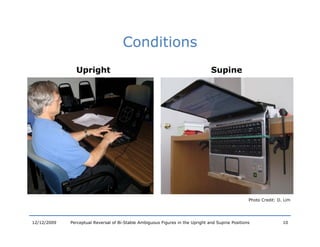
Conditions
               Upright                                                          Supine


                                                                                                  Photo Credit: D. Lim


12/12/2009   Perceptual Reversal of Bi-Stable Ambiguous Figures in the Upright and Supine Positions               10
Procedure
•   Three coupled trials spaced one week apart
      • 7 subjects randomly chosen to be tested in upright p
              j            y                          p g position first
        for each coupled trial
      • remaining 7 subjects to be tested in supine position first for each
        coupled trial
      • randomization used to counterbalance for any possible learning
         a do     a o u d o ou          ba a     o a y po b        a    g
        effects gained with the repetition of the experiment

•   For each trial:
      • presentation of all 10 figures in each of the upright and supine
        positions
      • test subjects were allowed to rest their eyes as needed in between
        each figure.

•   For
    F each figure:
         h fi
      • user was prompted to specify via predefined keystrokes ('F' or 'J')
        which percept he or she visualized first, then every subsequent
        change in perception until 60 seconds passed


12/12/2009   Perceptual Reversal of Bi-Stable Ambiguous Figures in the Upright and Supine Positions   11
Data Analysis

• Measurements:
      • the time for the first percept, i.e., the time from stimulus
        onset to the first percept report
      • the first percept seen ('F' or 'J’)
      • the time from the first percept report to the first perceptual
         h        f     h f                          h f             l
        reversal
      • the mean duration of perceptual reversals

• Perceptual reversal rate:
      • calculated as the time from the first percept report to the end
        of the trial divided by the mean percept duration


12/12/2009   Perceptual Reversal of Bi-Stable Ambiguous Figures in the Upright and Supine Positions   12
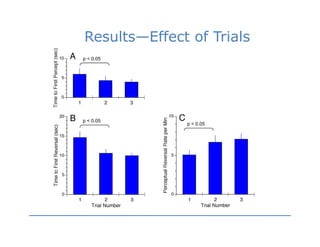
Results—Effect of Trials
p < 0.05


p < 0.05
              p < 0.05
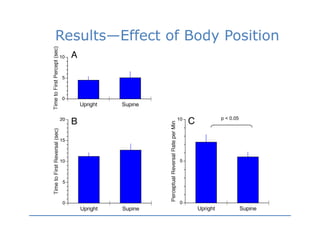
Results—Effect of Body Position


                      p < 0.05
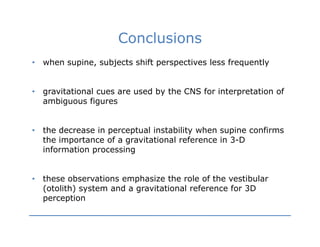
Conclusions
•   when supine, subjects shift perspectives less frequently


•   gravitational cues are used by the CNS for interpretation of
    ambiguous figures


•   the decrease in perceptual instability when supine confirms
    the importance of a gravitational reference in 3 D
                                                   3-D
    information processing


•   these observations emphasize the role of the vestibular
    (otolith) system and a gravitational reference for 3D
    p
    perception
          p
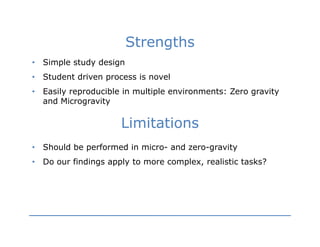
Strengths
•   Simple study design
•   Student driven process is novel
•   Easily reproducible in multiple environments: Zero gravity
    and Microgravity

                       Limitations
•   Should be performed in micro- and zero-gravity
•   Do our findings apply to more complex, realistic tasks?
Thank you for your attention
                   attention.


Figure Credits (Slide 4):
Fi     C dit (Slid 4)

(A) E. Mach; (B) L. A. Necker; (C) J.-M. Hupé; (D) L. Fagerlie; (E) G. Clément; (F) N.
Kayahara; (G) unkown; (H) NASA; (I) Y. Bonneh; (J) M. C. Escher

Iris CSS Summit 2009

  • 1.
    Perceptual Reversal ofBi-Stable Ambiguous Figures Bi Stable in the Upright and Supine Positions Sonny Kohli, MD FRCPC (Internal Medicine, Critical Care), Flight Surgery, ISU SSP 2008 on behalf of the IRIS team investigators: Dawn Lim, Michael Demel, and Gilles Clément Nov 21, 2009 CSS Summit Kingston, Ontario
  • 2.
    Perceptual Reversal ofBi-Stable Ambiguous Figures in the Upright and Supine Positions Dawn Lim, University of Toronto, Division of Emergency Medicine, Toronto, Canada Michael Demel, International Space University, Strasbourg, France Sonny Kohli, Oakville Trafalgar Memorial Hospital, ISUSSP 2008 Alumnus Gilles Clément, Centre National de la Recherche Scientifique, Toulouse, France
  • 3.
    Ambiguous Figures • PerceptualInstability • evoked by binocular rivalry • evoked by ambiguous figures • Perceptual Reversal • transitions from one percept to its alternative • (Bi St bl ) Ambiguous Fi (Bi-Stable) A bi Figures • are bi-stable because in the real world they could potentially exist in one of two different configurations • are not true illusions because no false perception occurs • allow for more than one perceptual interpretation, each of which is accurate 12/12/2009 Perceptual Reversal of Bi-Stable Ambiguous Figures in the Upright and Supine Positions 3
  • 4.
    “Iris” Experiment Iris • International Space University (ISU) Life Science Project p y( ) j • Objective: j • investigate whether perception (of perspective-reversible figures) is altered by gravity Environments: E i • 1 g – supine versus upright (ie tilted to gravity) • 0 g - parabolic flight (ESA 50th Parabolic Flight Campaign) • Micro g orbital flight (ISS Increments 19/20) g- • Supported by CSA, CNRS, UTSI, CNES, ESA, NASA pp y , , , , , 12/12/2009 Perceptual Reversal of Bi-Stable Ambiguous Figures in the Upright and Supine Positions 4
  • 5.
    Iris Software • Seriesof 10 perspective reversible figures • Each figure displayed for 60 seconds 12/12/2009 Perceptual Reversal of Bi-Stable Ambiguous Figures in the Upright and Supine Positions 5
  • 7.
  • 9.
    Method • Test subjectinclusion criteria • between 18-60 years of age 18 60 • no uncorrectable ocular-vestibular pathology • ability to concentrate on a computer screen for approximately ten minutes at a time • able t commit to completing all three coupled trials over a bl to it t l ti ll th l dt i l two-week period • 14 volunteers • 8 males, 6 females l f l • aged 28-36 years (mean: 32.2 years) • normal or corrected-to-normal visual acuity • Studies performed in accordance with the ethical d f d d h h h l standards laid down in the Declaration of Helsinki 12/12/2009 Perceptual Reversal of Bi-Stable Ambiguous Figures in the Upright and Supine Positions 9
  • 10.
    Conditions Upright Supine Photo Credit: D. Lim 12/12/2009 Perceptual Reversal of Bi-Stable Ambiguous Figures in the Upright and Supine Positions 10
  • 11.
    Procedure • Three coupled trials spaced one week apart • 7 subjects randomly chosen to be tested in upright p j y p g position first for each coupled trial • remaining 7 subjects to be tested in supine position first for each coupled trial • randomization used to counterbalance for any possible learning a do a o u d o ou ba a o a y po b a g effects gained with the repetition of the experiment • For each trial: • presentation of all 10 figures in each of the upright and supine positions • test subjects were allowed to rest their eyes as needed in between each figure. • For F each figure: h fi • user was prompted to specify via predefined keystrokes ('F' or 'J') which percept he or she visualized first, then every subsequent change in perception until 60 seconds passed 12/12/2009 Perceptual Reversal of Bi-Stable Ambiguous Figures in the Upright and Supine Positions 11
  • 12.
    Data Analysis • Measurements: • the time for the first percept, i.e., the time from stimulus onset to the first percept report • the first percept seen ('F' or 'J’) • the time from the first percept report to the first perceptual h f h f h f l reversal • the mean duration of perceptual reversals • Perceptual reversal rate: • calculated as the time from the first percept report to the end of the trial divided by the mean percept duration 12/12/2009 Perceptual Reversal of Bi-Stable Ambiguous Figures in the Upright and Supine Positions 12
  • 13.
    Results—Effect of Trials p< 0.05 p < 0.05 p < 0.05
  • 14.
    Results—Effect of BodyPosition p < 0.05
  • 15.
    Conclusions • when supine, subjects shift perspectives less frequently • gravitational cues are used by the CNS for interpretation of ambiguous figures • the decrease in perceptual instability when supine confirms the importance of a gravitational reference in 3 D 3-D information processing • these observations emphasize the role of the vestibular (otolith) system and a gravitational reference for 3D p perception p
  • 16.
    Strengths • Simple study design • Student driven process is novel • Easily reproducible in multiple environments: Zero gravity and Microgravity Limitations • Should be performed in micro- and zero-gravity • Do our findings apply to more complex, realistic tasks?
  • 17.
    Thank you foryour attention attention. Figure Credits (Slide 4): Fi C dit (Slid 4) (A) E. Mach; (B) L. A. Necker; (C) J.-M. Hupé; (D) L. Fagerlie; (E) G. Clément; (F) N. Kayahara; (G) unkown; (H) NASA; (I) Y. Bonneh; (J) M. C. Escher