IPv6, Act Now!
National Norwegian Meeting on IPv6
Alex Band – Product Manager
Chris Buckridge – External Relations Officer
• One of the five Regional Internet Registries
• Support coordination of Internet operations
• Not for profit membership organisation
• Over 7000 active members
- 650 new members in 2009
• Neutral, Impartial, Open, Transparent
2
RIPE NCC
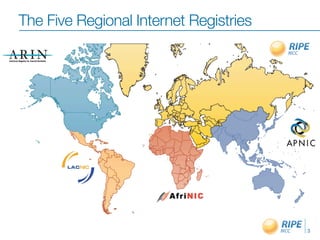
The Five Regional Internet Registries
3
IPv4 Address Distribution
4
Allocation PA Assignment PI Assignment
IANA
End User
LIR
RIR
/0
/21
/8
/25/23 /25
0
64
128
192
256
1999 2000 2001 2002 2003 2004 2005 2006 2007 2008 2009 2010 2011 2012
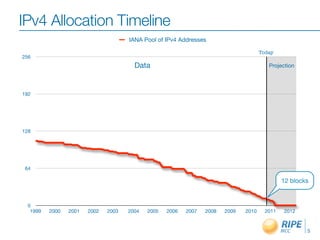
IPv4 Allocation Timeline
IANA Pool of IPv4 Addresses
Data Projection
Today
5
12 blocks
IPv4 Address Pool
APNIC
LACNIC
ARIN
AfriNIC
RIPE NCC
Organisations
Other IANA
less than
5%available
6
Reaching the Next Billion
• Around 1.9 billion Internet users now
- five times as many as there were in the year 2000
- around 29% of all people
• Mobile phones are becoming Internet devices
• The Internet of things
7
8
Wait and See?
IPv6 Address Basics
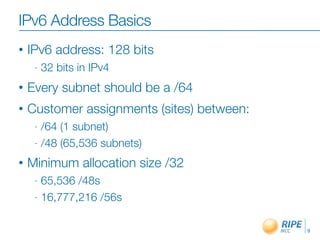
• IPv6 address: 128 bits
- 32 bits in IPv4
• Every subnet should be a /64
• Customer assignments (sites) between:
- /64 (1 subnet)
- /48 (65,536 subnets)
• Minimum allocation size /32
- 65,536 /48s
- 16,777,216 /56s
9
Getting an IPv6 Allocation
• To qualify, an organisation must:
- Be an LIR
- Have a plan for making assignments
• Minimum allocation size /32
10
What Does an IPv6 Allocation Cost?
• /32 = 1 scoring unit
• /31 = 2 scoring units
• points = ∑(2010-1992)x(scoring unit) =18x1+...
11
Category Points Fee 2010
Extra Small 0 - 16 € 1300
Small - 111 € 1800
Medium - 936 € 2550
Large - 7116 € 4100
Extra Large > 7116 € 5500
IPv6 RIPEness
12
• Rating system:
- One star if the LIR has an IPv6 allocation
- Additional stars if:
- IPv6 Prefix is announced on router
- A route6 object is in the RIPE Database
- Reverse DNS is set up
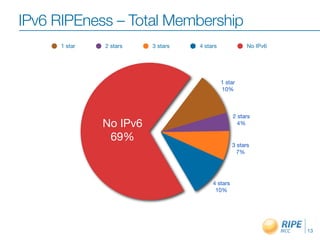
IPv6 RIPEness – Total Membership
13
No IPv6
69%
4 stars
10%
3 stars
7%
2 stars
4%
1 star
10%
1 star 2 stars 3 stars 4 stars No IPv6
IPv6 RIPEness – Norway (152 LIRs)
14
No IPv6
55%
4 stars
11%
3 stars
8%
2 stars
9%
1 star
17%
1 star 2 stars 3 stars 4 stars No IPv6
IPv6 RIPEness – Your Neighborhood
15
54%
1 star 2 stars 3 stars 4 stars No IPv6
62%
66% 62%
Germany Denmark
SwedenFinland
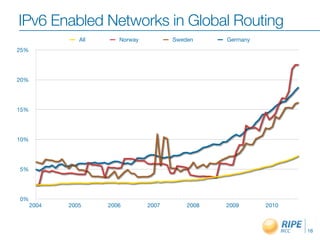
IPv6 Enabled Networks in Global Routing
16
0%
5%
10%
15%
20%
25%
2004 2005 2006 2007 2008 2009 2010
All Norway Sweden Germany
What We Know
• RIRs have been consistently allocating around
10 /8s each year worldwide
• There were 12 /8s remaining at the IANA as of
18 October 2010 (less than 5%)
• Projected exhaustion of unallocated IPv4 pool:
April 2011
17
What We Are Doing
• Raise awareness of the problem
- Different roles for different sectors
- Industry, government, civil society, technical
community
• Education
- Technical knowledge for stakeholders that need it
• Ensure IPv6 is accessible to all
• Engage with ALL stakeholders
18
• Policy forum
- Not a legal entity
- No official membership
- Open to everyone
• No voting
- Consensus decision making
• Work happens at meetings and on mailing lists:
- Working Groups
- Task forces
19
RIPE Community
RIPE Policy Development Process
• Open
- Anyone can participate
- Policy meetings
- Mailing lists
• Transparent
- List discussions archived publicly
- Meetings transcribed
• Developed bottom-up
- By the Internet community
- “Self-regulation” model
20
Flow of Information
RIPE
community
21
Government
RIPE Cooperation Working
Group
RIPE NCC Government
Roundtables
RIPE NCC Roundtable Meetings
• Regular events since 2005
- Held in Amsterdam and the Middle East (planning)
• Participants
- 40+ Governments representatives from 18+ countries
• Topics covered
- IPv6 deployment
- IPv4 depletion
- Internet governance
- DNSSEC
- Resource certification
22
RIPE Cooperation Working Group
• Formed in 2008
- After work by the Enhanced Cooperation Task Force
• Focus on cooperation between private and
public sectors
• Encouraging participation and input from
stakeholders outside the traditional RIPE
community
23
Other Fora
• Internet Governance Forum (IGF)
- Participating since WSIS (2003) and first IGF (2006)
- Co-organised IPv6 workshops at IGF 2009 and 2010
- Currently planning for future IGF events
• International Telecommunications Union (ITU)
- IPv6 Group (since March 2010)
- NRO presence at Plenipotentiary 2010
• OECD
- NRO contributed to the Ministerial Meeting in 2008
- RIPE NCC is a founding member of the Internet
Technical Advisory Committee (ITAC)
24
Other Fora
• European Commission
- IPv6 Deployment Monitoring Survey 2009, 2010
- IPv6 Workshops
- 6Deploy
• MENOG/RIPE NCC IPv6 Roadshow
- Standalone workshop hosted by a government or
enterprise organisation
• Technical community events
- NOGs, Internet Exchange Point (IXP) meetings
25
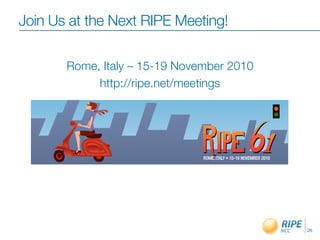
Rome, Italy – 15-19 November 2010
http://ripe.net/meetings
Join Us at the Next RIPE Meeting!
26
Questions?
Questions?
Alex:	 alexb@ripe.net
Chris:	chris@ripe.net
www.ipv6actnow.org
@RIPE_NCC

IPv6 Act Now!

  • 1.
    IPv6, Act Now! NationalNorwegian Meeting on IPv6 Alex Band – Product Manager Chris Buckridge – External Relations Officer
  • 2.
    • One ofthe five Regional Internet Registries • Support coordination of Internet operations • Not for profit membership organisation • Over 7000 active members - 650 new members in 2009 • Neutral, Impartial, Open, Transparent 2 RIPE NCC
  • 3.
    The Five RegionalInternet Registries 3
  • 4.
    IPv4 Address Distribution 4 AllocationPA Assignment PI Assignment IANA End User LIR RIR /0 /21 /8 /25/23 /25
  • 5.
    0 64 128 192 256 1999 2000 20012002 2003 2004 2005 2006 2007 2008 2009 2010 2011 2012 IPv4 Allocation Timeline IANA Pool of IPv4 Addresses Data Projection Today 5 12 blocks
  • 6.
    IPv4 Address Pool APNIC LACNIC ARIN AfriNIC RIPENCC Organisations Other IANA less than 5%available 6
  • 7.
    Reaching the NextBillion • Around 1.9 billion Internet users now - five times as many as there were in the year 2000 - around 29% of all people • Mobile phones are becoming Internet devices • The Internet of things 7
  • 8.
  • 9.
    IPv6 Address Basics •IPv6 address: 128 bits - 32 bits in IPv4 • Every subnet should be a /64 • Customer assignments (sites) between: - /64 (1 subnet) - /48 (65,536 subnets) • Minimum allocation size /32 - 65,536 /48s - 16,777,216 /56s 9
  • 10.
    Getting an IPv6Allocation • To qualify, an organisation must: - Be an LIR - Have a plan for making assignments • Minimum allocation size /32 10
  • 11.
    What Does anIPv6 Allocation Cost? • /32 = 1 scoring unit • /31 = 2 scoring units • points = ∑(2010-1992)x(scoring unit) =18x1+... 11 Category Points Fee 2010 Extra Small 0 - 16 € 1300 Small - 111 € 1800 Medium - 936 € 2550 Large - 7116 € 4100 Extra Large > 7116 € 5500
  • 12.
    IPv6 RIPEness 12 • Ratingsystem: - One star if the LIR has an IPv6 allocation - Additional stars if: - IPv6 Prefix is announced on router - A route6 object is in the RIPE Database - Reverse DNS is set up
  • 13.
    IPv6 RIPEness –Total Membership 13 No IPv6 69% 4 stars 10% 3 stars 7% 2 stars 4% 1 star 10% 1 star 2 stars 3 stars 4 stars No IPv6
  • 14.
    IPv6 RIPEness –Norway (152 LIRs) 14 No IPv6 55% 4 stars 11% 3 stars 8% 2 stars 9% 1 star 17% 1 star 2 stars 3 stars 4 stars No IPv6
  • 15.
    IPv6 RIPEness –Your Neighborhood 15 54% 1 star 2 stars 3 stars 4 stars No IPv6 62% 66% 62% Germany Denmark SwedenFinland
  • 16.
    IPv6 Enabled Networksin Global Routing 16 0% 5% 10% 15% 20% 25% 2004 2005 2006 2007 2008 2009 2010 All Norway Sweden Germany
  • 17.
    What We Know •RIRs have been consistently allocating around 10 /8s each year worldwide • There were 12 /8s remaining at the IANA as of 18 October 2010 (less than 5%) • Projected exhaustion of unallocated IPv4 pool: April 2011 17
  • 18.
    What We AreDoing • Raise awareness of the problem - Different roles for different sectors - Industry, government, civil society, technical community • Education - Technical knowledge for stakeholders that need it • Ensure IPv6 is accessible to all • Engage with ALL stakeholders 18
  • 19.
    • Policy forum -Not a legal entity - No official membership - Open to everyone • No voting - Consensus decision making • Work happens at meetings and on mailing lists: - Working Groups - Task forces 19 RIPE Community
  • 20.
    RIPE Policy DevelopmentProcess • Open - Anyone can participate - Policy meetings - Mailing lists • Transparent - List discussions archived publicly - Meetings transcribed • Developed bottom-up - By the Internet community - “Self-regulation” model 20
  • 21.
    Flow of Information RIPE community 21 Government RIPECooperation Working Group RIPE NCC Government Roundtables
  • 22.
    RIPE NCC RoundtableMeetings • Regular events since 2005 - Held in Amsterdam and the Middle East (planning) • Participants - 40+ Governments representatives from 18+ countries • Topics covered - IPv6 deployment - IPv4 depletion - Internet governance - DNSSEC - Resource certification 22
  • 23.
    RIPE Cooperation WorkingGroup • Formed in 2008 - After work by the Enhanced Cooperation Task Force • Focus on cooperation between private and public sectors • Encouraging participation and input from stakeholders outside the traditional RIPE community 23
  • 24.
    Other Fora • InternetGovernance Forum (IGF) - Participating since WSIS (2003) and first IGF (2006) - Co-organised IPv6 workshops at IGF 2009 and 2010 - Currently planning for future IGF events • International Telecommunications Union (ITU) - IPv6 Group (since March 2010) - NRO presence at Plenipotentiary 2010 • OECD - NRO contributed to the Ministerial Meeting in 2008 - RIPE NCC is a founding member of the Internet Technical Advisory Committee (ITAC) 24
  • 25.
    Other Fora • EuropeanCommission - IPv6 Deployment Monitoring Survey 2009, 2010 - IPv6 Workshops - 6Deploy • MENOG/RIPE NCC IPv6 Roadshow - Standalone workshop hosted by a government or enterprise organisation • Technical community events - NOGs, Internet Exchange Point (IXP) meetings 25
  • 26.
    Rome, Italy –15-19 November 2010 http://ripe.net/meetings Join Us at the Next RIPE Meeting! 26
  • 27.