INTRODUCTION TO CRIMES, IPC
& CRIMES AGAINST WOMEN
Adv. Uttara PV
Advocate,High Court of Kerala &
Supreme Court of India
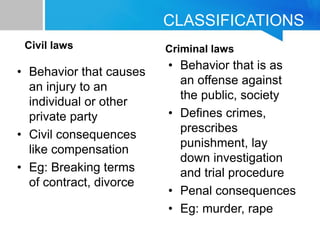
CLASSIFICATIONS
Civil laws
• Behavior that causes
an injury to an
individual or other
private party
• Civil consequences
like compensation
• Eg: Breaking terms
of contract, divorce
Criminal laws
• Behavior that is as
an offense against
the public, society
• Defines crimes,
prescribes
punishment, lay
down investigation
and trial procedure
• Penal consequences
• Eg: murder, rape
CONSTITUENTS OF CRIME
• Actus reus
• Mens rea
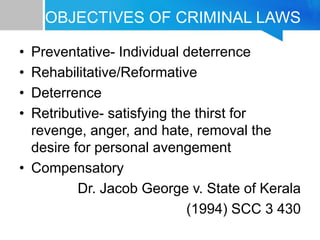
OBJECTIVES OF CRIMINAL LAWS
• Preventative- Individual deterrence
• Rehabilitative/Reformative
• Deterrence
• Retributive- satisfying the thirst for
revenge, anger, and hate, removal the
desire for personal avengement
• Compensatory
Dr. Jacob George v. State of Kerala
(1994) SCC 3 430
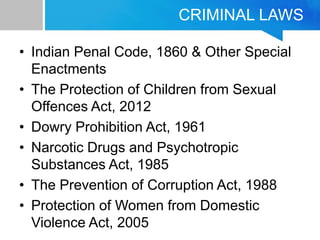
CRIMINAL LAWS
• Indian Penal Code, 1860 & Other Special
Enactments
• The Protection of Children from Sexual
Offences Act, 2012
• Dowry Prohibition Act, 1961
• Narcotic Drugs and Psychotropic
Substances Act, 1985
• The Prevention of Corruption Act, 1988
• Protection of Women from Domestic
Violence Act, 2005
SUBSTANTIVE V. PROCEDURAL LAW
• Indian Penal Code, 1860
• Code of Criminal Code, 1973
• Indian Evidence Act, 1872
IPC HISTORY
• First Law commission of India, 1834
• Lord Thomas Babington Macaulay
• Enacted:06.10.1860
• Date of Coming into effect: 01.01.1862
• Napoleanic Penal Code and Loiusana
Penal Code
• Malimath Committee
JURISDICTION
• Section 1
• Whole of India
• Jammu and Kashmir- Ranbir Penal Code-
Jammu and Kashmir Reorganisation Act,
2019.
JURISDICTION
• Section 2:
Punishment of offences committed within
India.—Every person shall be liable to
punishmentunder this Code and not
otherwise for every act or omission contrary
to the provisions thereof, of which he shall
be guilty within India
JURISDICTION
• Section 3: Punishment of offences
committed beyond, but which by law may
be tried within, India.—Any person liable,
by any Indian law, to be tried for an
offence committed beyond India shall be
dealt with according to the provisions of
this Code for any act committed beyond
India in the same manner as if such act
had been committed within India
JURISDICTION
Section 4. Extension of Code to extra-
territorial offences.—The provisions of this
Code apply also to any offence committed
by—
(1) any citizen of India in any place without
and beyond India;
(2) any person on any ship or aircraft
registered in India wherever it may be.
(3) any person in any place without and
beyond India committing offence targeting a
computer resource located in India
Classification of Crimes in IPC
• Number of Chapter: 25
• Crime against the body
• Crimes against property
• Crimes against public order
• Economic crimes
• Crimes against women
• Crimes against children
• Other crimes.
CRIMES AGAINST WOMEN
• Constitutional mandate of Gender Equality
• Crimes which are directed specifically
against women on account of their gender,
unlike general crimes which may also be
committed against women
• Crimes under the Indian Penal Code (IPC)
• Crimes under the Special Laws
Crimes against women under IPC
• Rape (Sec. 375 - 376E IPC)
• Kidnapping & Abduction of Women
(Section 363, 364, 364A, 365, 366 to 369
IPC)
• Dowry Deaths (Section 304B IPC)
• Assault on Woman with Intent to Outrage
Her Modesty (Sec. 354 IPC)
• Sexual Harassment (Sec.354A IPC)
Crimes against women under IPC
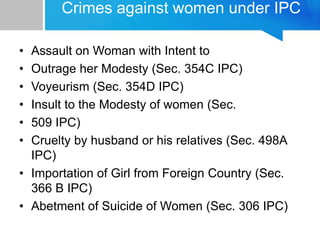
• Assault on Woman with Intent to
• Outrage her Modesty (Sec. 354C IPC)
• Voyeurism (Sec. 354D IPC)
• Insult to the Modesty of women (Sec.
• 509 IPC)
• Cruelty by husband or his relatives (Sec. 498A
IPC)
• Importation of Girl from Foreign Country (Sec.
366 B IPC)
• Abetment of Suicide of Women (Sec. 306 IPC)
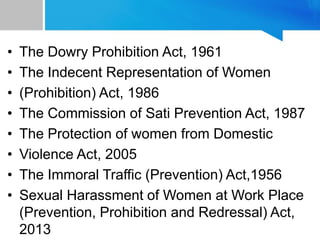
• The Dowry Prohibition Act, 1961
• The Indecent Representation of Women
• (Prohibition) Act, 1986
• The Commission of Sati Prevention Act, 1987
• The Protection of women from Domestic
• Violence Act, 2005
• The Immoral Traffic (Prevention) Act,1956
• Sexual Harassment of Women at Work Place
(Prevention, Prohibition and Redressal) Act,
2013
304B. Dowry death.
(1) Where the death of a woman is caused by any burs or bodily
injury or occurs otherwise than under normal circumstances within
seven years of her marriage and it is shown that soon before her
death she was subjected to cruelty or harassment by her husband
or any relative of her husband for, or in connection with, any
demand for dowry, such death shall be called “dowry death”, and
such husband or relative shall be deemed to have caused her
death.
Explanation.—For the purposes of this sub-section, “dowry” shall
have the same meaning as in
section 2 of the Dowry Prohibition Act, 1961 (28 of 1961).
(2) Whoever commits dowry death shall be punished with
imprisonment for a term which shall not be less than seven years
but which may extend to imprisonment for life.
[Emphasis supplied]
2. Definition of `dowry’.
In this act, `dowry’ means any property or valuable
security given or agreed to be given either directly or
indirectly:
a. by one party to a marriage to the other party to the
marriage; or
b. by the parents of either party to a marriage or by any
other person, to either party to the marriage or to any
other person;
at or before or any time after the marriage in connection
with the marriage of said parties but does not include
dower or mahr in the case of persons to whom the
Muslim Personal Law (Shariat) applies.
[Emphasis supplied]

IPC Demo.pptx

  • 1.
    INTRODUCTION TO CRIMES,IPC & CRIMES AGAINST WOMEN Adv. Uttara PV Advocate,High Court of Kerala & Supreme Court of India
  • 2.
    CLASSIFICATIONS Civil laws • Behaviorthat causes an injury to an individual or other private party • Civil consequences like compensation • Eg: Breaking terms of contract, divorce Criminal laws • Behavior that is as an offense against the public, society • Defines crimes, prescribes punishment, lay down investigation and trial procedure • Penal consequences • Eg: murder, rape
  • 3.
    CONSTITUENTS OF CRIME •Actus reus • Mens rea
  • 4.
    OBJECTIVES OF CRIMINALLAWS • Preventative- Individual deterrence • Rehabilitative/Reformative • Deterrence • Retributive- satisfying the thirst for revenge, anger, and hate, removal the desire for personal avengement • Compensatory Dr. Jacob George v. State of Kerala (1994) SCC 3 430
  • 5.
    CRIMINAL LAWS • IndianPenal Code, 1860 & Other Special Enactments • The Protection of Children from Sexual Offences Act, 2012 • Dowry Prohibition Act, 1961 • Narcotic Drugs and Psychotropic Substances Act, 1985 • The Prevention of Corruption Act, 1988 • Protection of Women from Domestic Violence Act, 2005
  • 6.
    SUBSTANTIVE V. PROCEDURALLAW • Indian Penal Code, 1860 • Code of Criminal Code, 1973 • Indian Evidence Act, 1872
  • 7.
    IPC HISTORY • FirstLaw commission of India, 1834 • Lord Thomas Babington Macaulay • Enacted:06.10.1860 • Date of Coming into effect: 01.01.1862 • Napoleanic Penal Code and Loiusana Penal Code • Malimath Committee
  • 8.
    JURISDICTION • Section 1 •Whole of India • Jammu and Kashmir- Ranbir Penal Code- Jammu and Kashmir Reorganisation Act, 2019.
  • 9.
    JURISDICTION • Section 2: Punishmentof offences committed within India.—Every person shall be liable to punishmentunder this Code and not otherwise for every act or omission contrary to the provisions thereof, of which he shall be guilty within India
  • 10.
    JURISDICTION • Section 3:Punishment of offences committed beyond, but which by law may be tried within, India.—Any person liable, by any Indian law, to be tried for an offence committed beyond India shall be dealt with according to the provisions of this Code for any act committed beyond India in the same manner as if such act had been committed within India
  • 11.
    JURISDICTION Section 4. Extensionof Code to extra- territorial offences.—The provisions of this Code apply also to any offence committed by— (1) any citizen of India in any place without and beyond India; (2) any person on any ship or aircraft registered in India wherever it may be. (3) any person in any place without and beyond India committing offence targeting a computer resource located in India
  • 13.
    Classification of Crimesin IPC • Number of Chapter: 25 • Crime against the body • Crimes against property • Crimes against public order • Economic crimes • Crimes against women • Crimes against children • Other crimes.
  • 14.
  • 15.
    • Constitutional mandateof Gender Equality • Crimes which are directed specifically against women on account of their gender, unlike general crimes which may also be committed against women • Crimes under the Indian Penal Code (IPC) • Crimes under the Special Laws
  • 16.
    Crimes against womenunder IPC • Rape (Sec. 375 - 376E IPC) • Kidnapping & Abduction of Women (Section 363, 364, 364A, 365, 366 to 369 IPC) • Dowry Deaths (Section 304B IPC) • Assault on Woman with Intent to Outrage Her Modesty (Sec. 354 IPC) • Sexual Harassment (Sec.354A IPC)
  • 17.
    Crimes against womenunder IPC • Assault on Woman with Intent to • Outrage her Modesty (Sec. 354C IPC) • Voyeurism (Sec. 354D IPC) • Insult to the Modesty of women (Sec. • 509 IPC) • Cruelty by husband or his relatives (Sec. 498A IPC) • Importation of Girl from Foreign Country (Sec. 366 B IPC) • Abetment of Suicide of Women (Sec. 306 IPC)
  • 18.
    • The DowryProhibition Act, 1961 • The Indecent Representation of Women • (Prohibition) Act, 1986 • The Commission of Sati Prevention Act, 1987 • The Protection of women from Domestic • Violence Act, 2005 • The Immoral Traffic (Prevention) Act,1956 • Sexual Harassment of Women at Work Place (Prevention, Prohibition and Redressal) Act, 2013
  • 19.
    304B. Dowry death. (1)Where the death of a woman is caused by any burs or bodily injury or occurs otherwise than under normal circumstances within seven years of her marriage and it is shown that soon before her death she was subjected to cruelty or harassment by her husband or any relative of her husband for, or in connection with, any demand for dowry, such death shall be called “dowry death”, and such husband or relative shall be deemed to have caused her death. Explanation.—For the purposes of this sub-section, “dowry” shall have the same meaning as in section 2 of the Dowry Prohibition Act, 1961 (28 of 1961). (2) Whoever commits dowry death shall be punished with imprisonment for a term which shall not be less than seven years but which may extend to imprisonment for life. [Emphasis supplied]
  • 20.
    2. Definition of`dowry’. In this act, `dowry’ means any property or valuable security given or agreed to be given either directly or indirectly: a. by one party to a marriage to the other party to the marriage; or b. by the parents of either party to a marriage or by any other person, to either party to the marriage or to any other person; at or before or any time after the marriage in connection with the marriage of said parties but does not include dower or mahr in the case of persons to whom the Muslim Personal Law (Shariat) applies. [Emphasis supplied]