LA / NY / SF / DC / arentfox.com
IP Licensing in
Outsourcing and
Tech Agreements
William A. Tanenbaum
Co-Head, Technology Transactions
Conflating IP and Subject Matter
Definition of Intellectual Property: “Intellectual
Property means copyrights, patents,
trademarks, domain names, software (in
object code and source code form),
confidential information”
Definition of Confidential Information:
“includes . . . all IP . . .”
Footer Text 2
Intellectual Property Regimes
Copyright
Patent
Trade Secret
Trademark and Service Mark
Moral Rights
Footer Text 3
IP Protection for Data
Compilation
Realities of multi-party transactions
Data sharing > data ownership
Footer Text 4
Work Made for Hire
“The Parties agree that all Custom Work
Product created for the Customer shall
constitute works made for hire.”
Effect of clause on ownership and payment
Ripple effects:
Footer Text 5
IP Law Different from Businessperson’s
Reflexive Positions
“I pay, I own”
– Work Made for Hire
Joint ownership
Problems
– Right of joint owner
– Free R&D?
– Is it joint? Authorship vs. inventorship
– Control patent prosecution
Footer Text 6
Ownership if Not a Work Made for Hire….
Assignment
– Not just copyright, all IP
Continuing obligation
Upstream assignments
– Otherwise a license right
Record
– Pre-agree to PTO/Copyright Office form
Register copyright
– Handling data
Footer Text 7
Moral Rights
Arise in international agreements
– … or in inherited forms
“Provider hereby licenses and agrees to
license to Licensee Provider’s moral rights
and droit morale in the Work Product.”
Footer Text 8
Moral Rights (continued)
“Provider will cause each individual providing
work product to waive his or her moral rights.”
Footer Text 9
Dynamic Online EULAs
Problem: future unilateral amendment by
provider/vendor/licensee
Addressing the problem:
– Amendments in standalone document
– Delete and replace entire provision
– State that licensee-specific amendments
survive future unilateral licensor amendments
– Make reference to section title as well as
number
Footer Text 10
Cloud Product Under EULA and Software
Vendor’s Custom Work for Customer
Need to coordinate two agreements
Issue: EULA gives provider ownership of
suggestions
– Does this cover actual coded improvements?
Addressing Licensee’s risks
– Indemnity
– Vendor and EULA platform try to resolve but
customer has no liability to Vendor
Footer Text 11
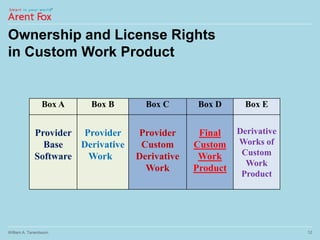
Ownership and License Rights
in Custom Work Product
Box A Box B Box C Box D Box E
Provider
Base
Software
Provider
Derivative
Work
Provider
Custom
Derivative
Work
Final
Custom
Work
Product
Derivative
Works of
Custom
Work
Product
William A. Tanenbaum 12
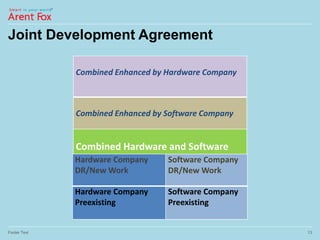
Joint Development Agreement
Combined Enhanced by Hardware Company
Combined Enhanced by Software Company
Combined Hardware and Software
Footer Text 13
Hardware Company
DR/New Work
Software Company
DR/New Work
Hardware Company
Preexisting
Software Company
Preexisting
Jointly Owned IP
Inventorship vs. authorship – may not be joint
Potential Problems
Dispute over what is “primarily related” for
technology
– Especially for IP that can be used outside the joint
venture
– When developed primarily by one party based on
confidential information of the other
Footer Text 14
Software IP Licenses
“Use” is a patent not copyright time
Section 106: reproduce, prepare derivative
works, distribute, display publicly, and for
sound recordings, perform publicly
May omit common software operations:
– install, operate, deploy, make available or
accessible on servers, etc., integrate and make
interoperable
Will “worldwide” be sufficient?
– But territoriality of IP rights
Footer Text 15
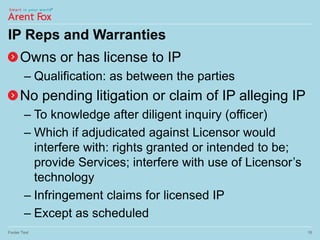
IP Reps and Warranties
Owns or has license to IP
– Qualification: as between the parties
No pending litigation or claim of IP alleging IP
– To knowledge after diligent inquiry (officer)
– Which if adjudicated against Licensor would
interfere with: rights granted or intended to be;
provide Services; interfere with use of Licensor’s
technology
– Infringement claims for licensed IP
– Except as scheduled
Footer Text 16
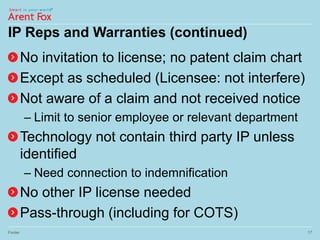
IP Reps and Warranties (continued)
No invitation to license; no patent claim chart
Except as scheduled (Licensee: not interfere)
Not aware of a claim and not received notice
– Limit to senior employee or relevant department
Technology not contain third party IP unless
identified
– Need connection to indemnification
No other IP license needed
Pass-through (including for COTS)
Footer 17
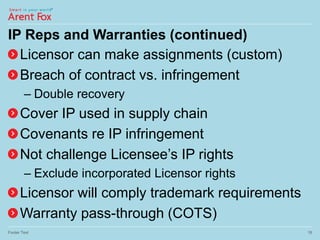
IP Reps and Warranties (continued)
Licensor can make assignments (custom)
Breach of contract vs. infringement
– Double recovery
Cover IP used in supply chain
Covenants re IP infringement
Not challenge Licensee’s IP rights
– Exclude incorporated Licensor rights
Licensor will comply trademark requirements
Warranty pass-through (COTS)
Footer Text 18
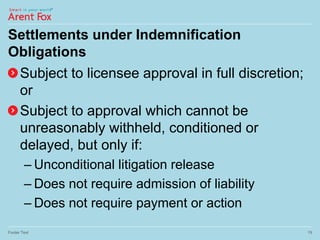
Settlements under Indemnification
Obligations
Subject to licensee approval in full discretion;
or
Subject to approval which cannot be
unreasonably withheld, conditioned or
delayed, but only if:
– Unconditional litigation release
– Does not require admission of liability
– Does not require payment or action
Footer Text 19
License from Licensee
Limitations:
– For purposes of engagement
– During Term
– What about Licensee reps and warranties?
Footer Text 20
Indemnity Exclusions and Exclusions to
Exclusions
Combinations
– Not authorized (including by subcontractors)
Exclusion from exclusion:
– *solely to extent combination caused the
infringement
Not used as designed or intended to be used
Modifications
– Unauthorized (including by subcontractors)
Footer Text 21
Indemnity Exclusions (continued)
Derivative Works
– But upgrades
Failure to discontinue alleging infringing
software after direction from Licensor
Where Licensor met specific requirements of
Licensee
Key: exclusion to exclusion -- “solely to the
extent [exception to the exception] caused the
infringement”
– May divide liability in infringement action
Footer Text 22
Impact on Arbitration Clause
Requires arbitrator with IP knowledge
But parties may exclude IP from arbitration
Footer Text 23
Data at C-Suite
Who does what?
CDO vs. CIO
CIO vs. CTO
CAO vs. CDO
Privacy is contextual
Litigation retention vs. revenue
Cybersecurity vs. revenue
Footer Text 24
Customer-Facing Outsourcing
“Traditional” focus on internal cost savings
Next generation outsourcing will be front-office
revenue generation
Goal: faster, more targeted product
development
B2B and B2
All data enabled
Footer Text 25
Who is the “Reader” of the IP and License
Agreement?
Need litigator skill
Opposing in-house counsel
Arbitrator
– What will be disputed?
Aim towards summary judgment
Lesson: technical schedules need to be legal
documents
One-sided evidence
Footer Text 26
Questions and Answers
William A. Tanenbaum
Co-Head, Technology
Transactions
Arent Fox LLP
William.Tanenbaum@arentfox.com
Footer Text 27
William A. Tanenbaum, Arent Fox LLP
William A. Tanenbaum was named as one of the Top Five IT lawyers in the country
by Who’s Who Legal in 2016, and was previously named as “Lawyer of the Year”
in IT in New York by US News & World Report/Best Lawyers. Chambers named
Bill as one of only five lawyers in Band One in Outsourcing & Technology in New
York, in Band Two nationally, and as a Leading Outsourcing Lawyer in its global
edition. Legal500 found that he is a “Leading Authority” on Technology &
Outsourcing. He was selection for inclusion in the inaugural edition of Who’s Who
Legal: Thought Leaders 2017. Bill is a Past President of the International
Technology Law Association. He is currently a Vice President of the Society for
Information Management (SIM) (New York Chapter), and industry CIO
organization, and the only lawyer on the Board of Directors.
Clients endorse Bill as “a brilliant lawyer. I cannot imagine working with anyone
else;” “brings extremely high integrity, a deep intellect, fearlessness and a
practical, real-world mindset to every problem;” “efficient, solution-driven and
makes excellent judgment calls” (Chambers); "one of the best IP lawyers I have
worked with" and "knows exactly how to get a deal done” (Clean Tech and Who's
Who Legal).
28

IP Licensing in Outsourcing and Tech Agreements

  • 1.
    LA / NY/ SF / DC / arentfox.com IP Licensing in Outsourcing and Tech Agreements William A. Tanenbaum Co-Head, Technology Transactions
  • 2.
    Conflating IP andSubject Matter Definition of Intellectual Property: “Intellectual Property means copyrights, patents, trademarks, domain names, software (in object code and source code form), confidential information” Definition of Confidential Information: “includes . . . all IP . . .” Footer Text 2
  • 3.
    Intellectual Property Regimes Copyright Patent TradeSecret Trademark and Service Mark Moral Rights Footer Text 3
  • 4.
    IP Protection forData Compilation Realities of multi-party transactions Data sharing > data ownership Footer Text 4
  • 5.
    Work Made forHire “The Parties agree that all Custom Work Product created for the Customer shall constitute works made for hire.” Effect of clause on ownership and payment Ripple effects: Footer Text 5
  • 6.
    IP Law Differentfrom Businessperson’s Reflexive Positions “I pay, I own” – Work Made for Hire Joint ownership Problems – Right of joint owner – Free R&D? – Is it joint? Authorship vs. inventorship – Control patent prosecution Footer Text 6
  • 7.
    Ownership if Nota Work Made for Hire…. Assignment – Not just copyright, all IP Continuing obligation Upstream assignments – Otherwise a license right Record – Pre-agree to PTO/Copyright Office form Register copyright – Handling data Footer Text 7
  • 8.
    Moral Rights Arise ininternational agreements – … or in inherited forms “Provider hereby licenses and agrees to license to Licensee Provider’s moral rights and droit morale in the Work Product.” Footer Text 8
  • 9.
    Moral Rights (continued) “Providerwill cause each individual providing work product to waive his or her moral rights.” Footer Text 9
  • 10.
    Dynamic Online EULAs Problem:future unilateral amendment by provider/vendor/licensee Addressing the problem: – Amendments in standalone document – Delete and replace entire provision – State that licensee-specific amendments survive future unilateral licensor amendments – Make reference to section title as well as number Footer Text 10
  • 11.
    Cloud Product UnderEULA and Software Vendor’s Custom Work for Customer Need to coordinate two agreements Issue: EULA gives provider ownership of suggestions – Does this cover actual coded improvements? Addressing Licensee’s risks – Indemnity – Vendor and EULA platform try to resolve but customer has no liability to Vendor Footer Text 11
  • 12.
    Ownership and LicenseRights in Custom Work Product Box A Box B Box C Box D Box E Provider Base Software Provider Derivative Work Provider Custom Derivative Work Final Custom Work Product Derivative Works of Custom Work Product William A. Tanenbaum 12
  • 13.
    Joint Development Agreement CombinedEnhanced by Hardware Company Combined Enhanced by Software Company Combined Hardware and Software Footer Text 13 Hardware Company DR/New Work Software Company DR/New Work Hardware Company Preexisting Software Company Preexisting
  • 14.
    Jointly Owned IP Inventorshipvs. authorship – may not be joint Potential Problems Dispute over what is “primarily related” for technology – Especially for IP that can be used outside the joint venture – When developed primarily by one party based on confidential information of the other Footer Text 14
  • 15.
    Software IP Licenses “Use”is a patent not copyright time Section 106: reproduce, prepare derivative works, distribute, display publicly, and for sound recordings, perform publicly May omit common software operations: – install, operate, deploy, make available or accessible on servers, etc., integrate and make interoperable Will “worldwide” be sufficient? – But territoriality of IP rights Footer Text 15
  • 16.
    IP Reps andWarranties Owns or has license to IP – Qualification: as between the parties No pending litigation or claim of IP alleging IP – To knowledge after diligent inquiry (officer) – Which if adjudicated against Licensor would interfere with: rights granted or intended to be; provide Services; interfere with use of Licensor’s technology – Infringement claims for licensed IP – Except as scheduled Footer Text 16
  • 17.
    IP Reps andWarranties (continued) No invitation to license; no patent claim chart Except as scheduled (Licensee: not interfere) Not aware of a claim and not received notice – Limit to senior employee or relevant department Technology not contain third party IP unless identified – Need connection to indemnification No other IP license needed Pass-through (including for COTS) Footer 17
  • 18.
    IP Reps andWarranties (continued) Licensor can make assignments (custom) Breach of contract vs. infringement – Double recovery Cover IP used in supply chain Covenants re IP infringement Not challenge Licensee’s IP rights – Exclude incorporated Licensor rights Licensor will comply trademark requirements Warranty pass-through (COTS) Footer Text 18
  • 19.
    Settlements under Indemnification Obligations Subjectto licensee approval in full discretion; or Subject to approval which cannot be unreasonably withheld, conditioned or delayed, but only if: – Unconditional litigation release – Does not require admission of liability – Does not require payment or action Footer Text 19
  • 20.
    License from Licensee Limitations: –For purposes of engagement – During Term – What about Licensee reps and warranties? Footer Text 20
  • 21.
    Indemnity Exclusions andExclusions to Exclusions Combinations – Not authorized (including by subcontractors) Exclusion from exclusion: – *solely to extent combination caused the infringement Not used as designed or intended to be used Modifications – Unauthorized (including by subcontractors) Footer Text 21
  • 22.
    Indemnity Exclusions (continued) DerivativeWorks – But upgrades Failure to discontinue alleging infringing software after direction from Licensor Where Licensor met specific requirements of Licensee Key: exclusion to exclusion -- “solely to the extent [exception to the exception] caused the infringement” – May divide liability in infringement action Footer Text 22
  • 23.
    Impact on ArbitrationClause Requires arbitrator with IP knowledge But parties may exclude IP from arbitration Footer Text 23
  • 24.
    Data at C-Suite Whodoes what? CDO vs. CIO CIO vs. CTO CAO vs. CDO Privacy is contextual Litigation retention vs. revenue Cybersecurity vs. revenue Footer Text 24
  • 25.
    Customer-Facing Outsourcing “Traditional” focuson internal cost savings Next generation outsourcing will be front-office revenue generation Goal: faster, more targeted product development B2B and B2 All data enabled Footer Text 25
  • 26.
    Who is the“Reader” of the IP and License Agreement? Need litigator skill Opposing in-house counsel Arbitrator – What will be disputed? Aim towards summary judgment Lesson: technical schedules need to be legal documents One-sided evidence Footer Text 26
  • 27.
    Questions and Answers WilliamA. Tanenbaum Co-Head, Technology Transactions Arent Fox LLP William.Tanenbaum@arentfox.com Footer Text 27
  • 28.
    William A. Tanenbaum,Arent Fox LLP William A. Tanenbaum was named as one of the Top Five IT lawyers in the country by Who’s Who Legal in 2016, and was previously named as “Lawyer of the Year” in IT in New York by US News & World Report/Best Lawyers. Chambers named Bill as one of only five lawyers in Band One in Outsourcing & Technology in New York, in Band Two nationally, and as a Leading Outsourcing Lawyer in its global edition. Legal500 found that he is a “Leading Authority” on Technology & Outsourcing. He was selection for inclusion in the inaugural edition of Who’s Who Legal: Thought Leaders 2017. Bill is a Past President of the International Technology Law Association. He is currently a Vice President of the Society for Information Management (SIM) (New York Chapter), and industry CIO organization, and the only lawyer on the Board of Directors. Clients endorse Bill as “a brilliant lawyer. I cannot imagine working with anyone else;” “brings extremely high integrity, a deep intellect, fearlessness and a practical, real-world mindset to every problem;” “efficient, solution-driven and makes excellent judgment calls” (Chambers); "one of the best IP lawyers I have worked with" and "knows exactly how to get a deal done” (Clean Tech and Who's Who Legal). 28