A Seminar presented by
K.Niranjan kumar
3rd ECE
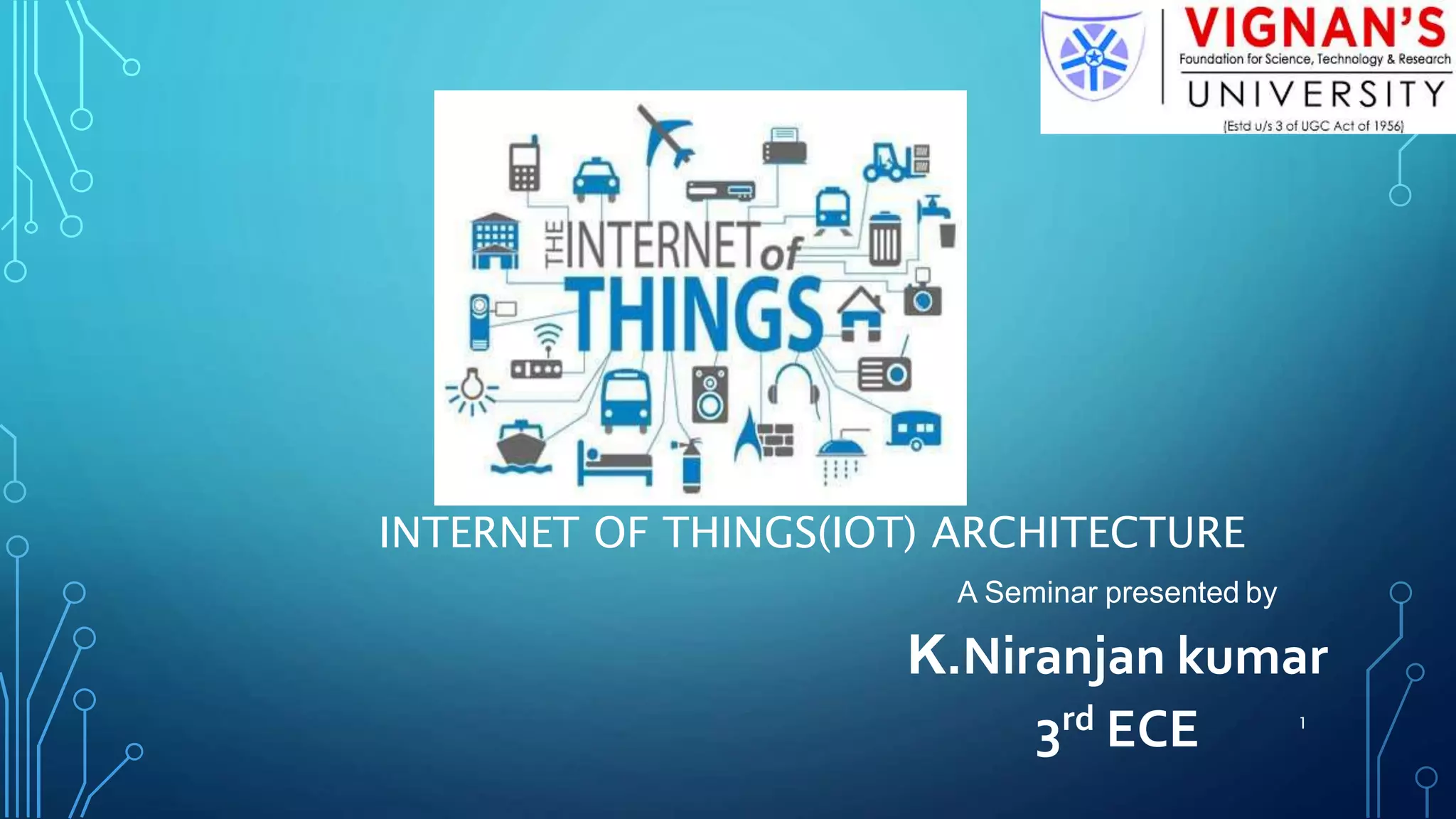
INTERNET OF THINGS(IOT) ARCHITECTURE
1
CONTENTS
Introduction
History of IOT
The structure of IOT
Layered structure of IOT
Future of IOT
Applications
Security in Iot
Conclusion
References
2
INTRODUCTION
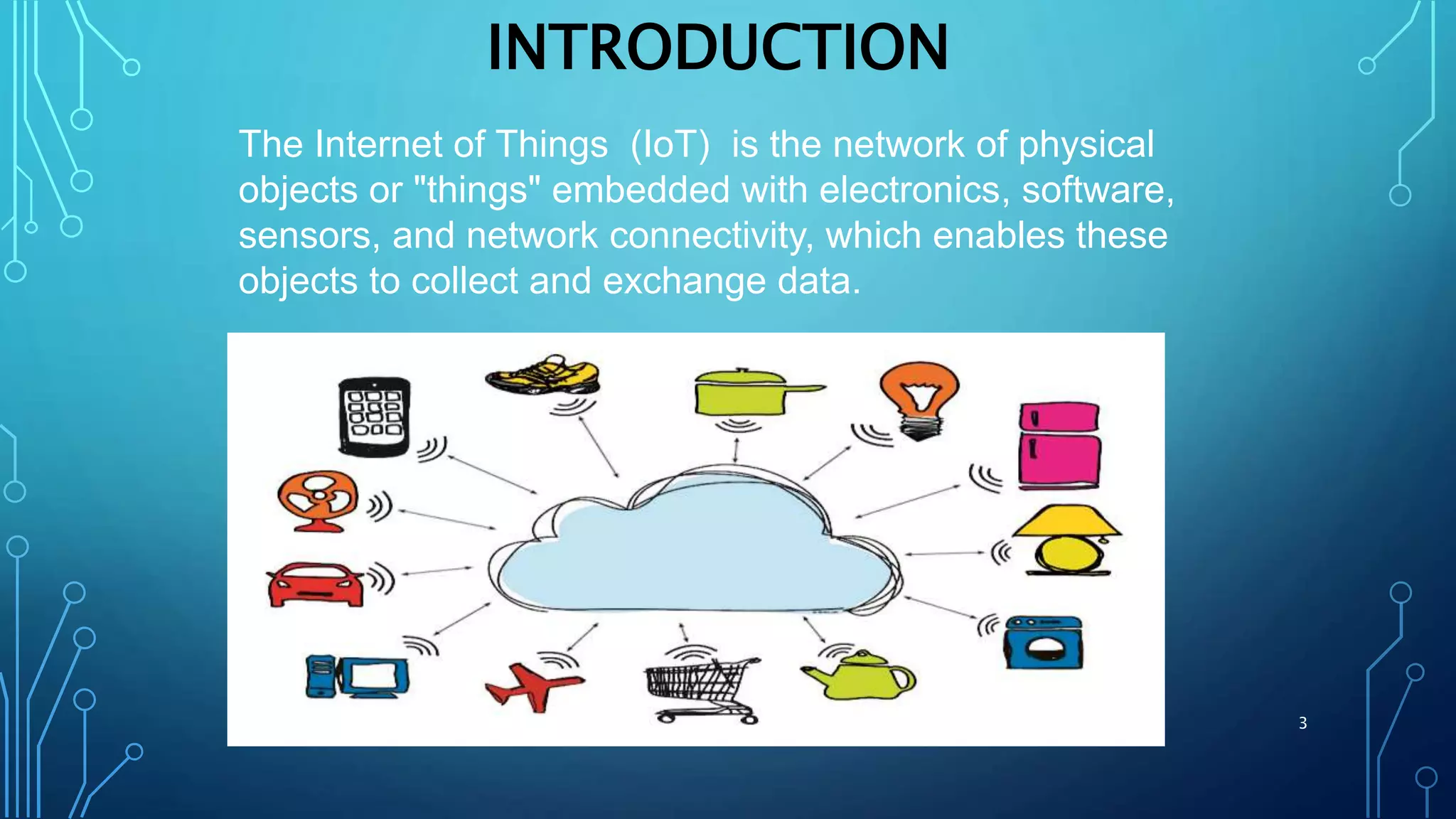
The Internet of Things (IoT) is the network of physical
objects or "things" embedded with electronics, software,
sensors, and network connectivity, which enables these
objects to collect and exchange data.
3
HISTORY OF IOT
• The concept of the Internet of Things first became popular in 1999
invented by kevin Ashton, through the Auto-ID Center at MIT and
related market-analysis publications.
• Radio-frequency identification (RFID) was seen as a prerequisite
for the IoT at that point.
4
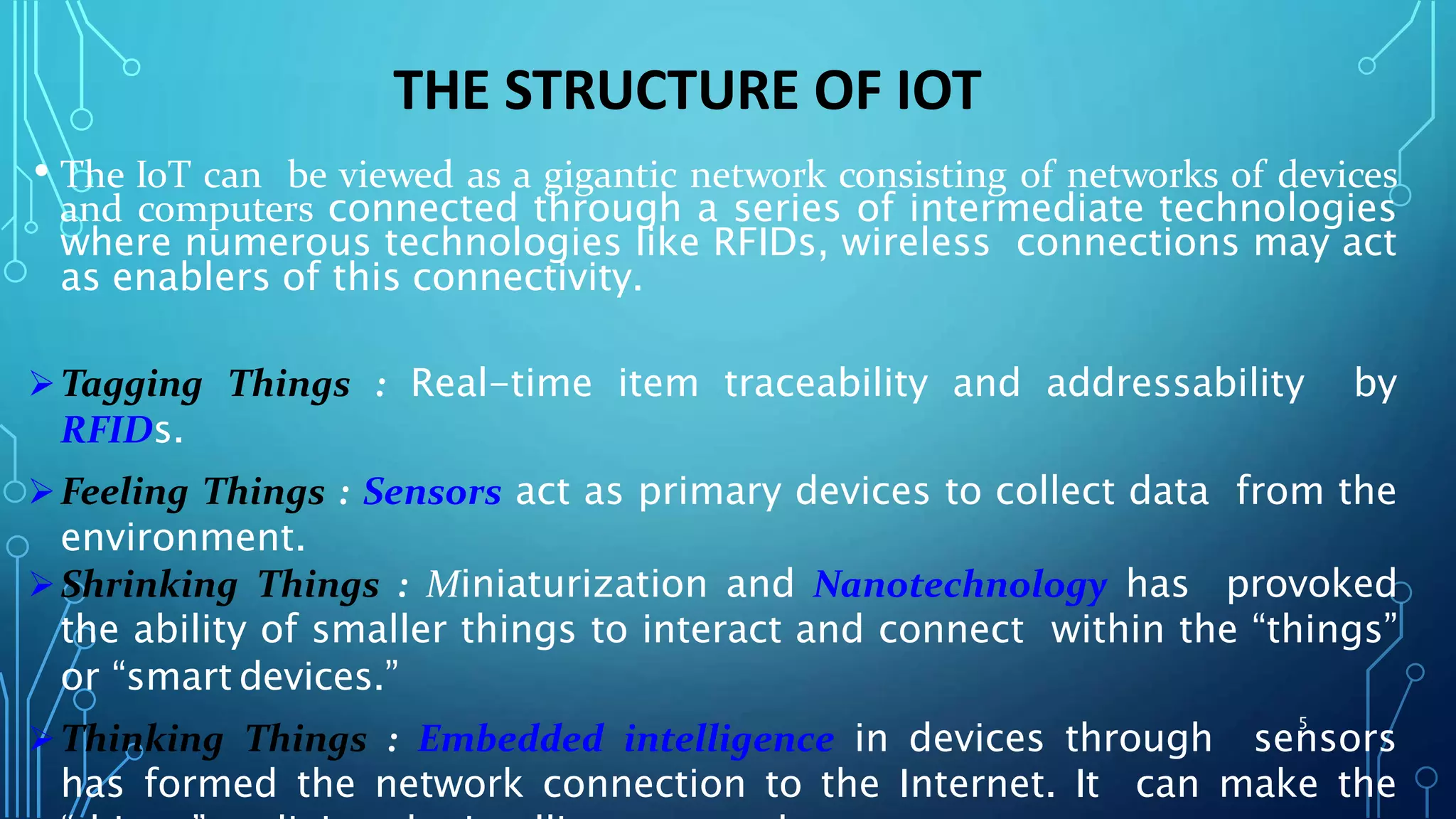
THE STRUCTURE OF IOT
• The IoT can be viewed as a gigantic network consisting of networks of devices
and computers connected through a series of intermediate technologies
where numerous technologies like RFIDs, wireless connections may act
as enablers of this connectivity.
Tagging Things : Real-time item traceability and addressability by
RFIDs.
Feeling Things : Sensors act as primary devices to collect data from the
environment.
Shrinking Things : Miniaturization and Nanotechnology has provoked
the ability of smaller things to interact and connect within the “things”
or “smart devices.”
Thinking Things : Embedded intelligence in devices through sensors
has formed the network connection to the Internet. It can make the
5
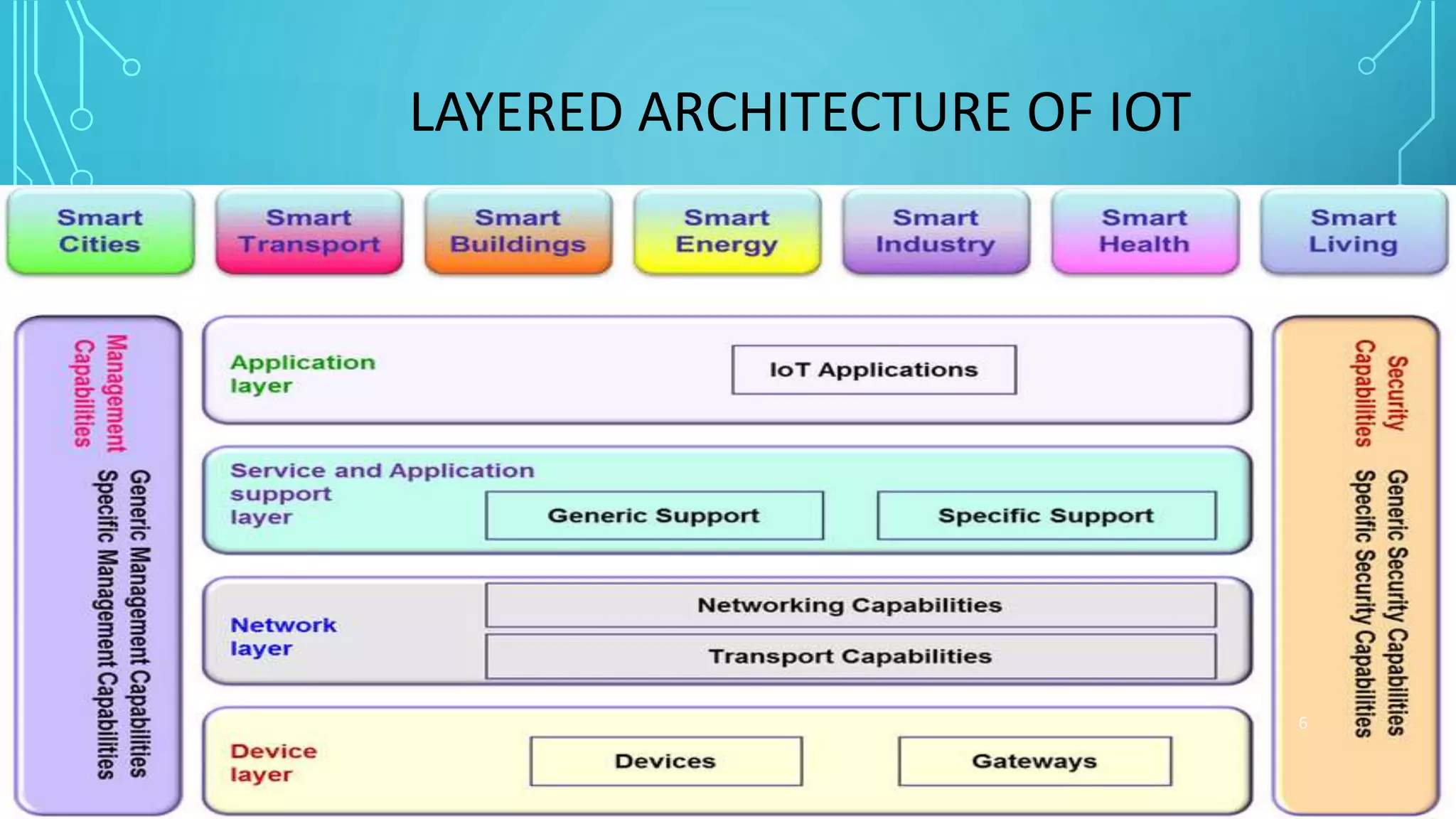
LAYERED ARCHITECTURE OF IOT
6
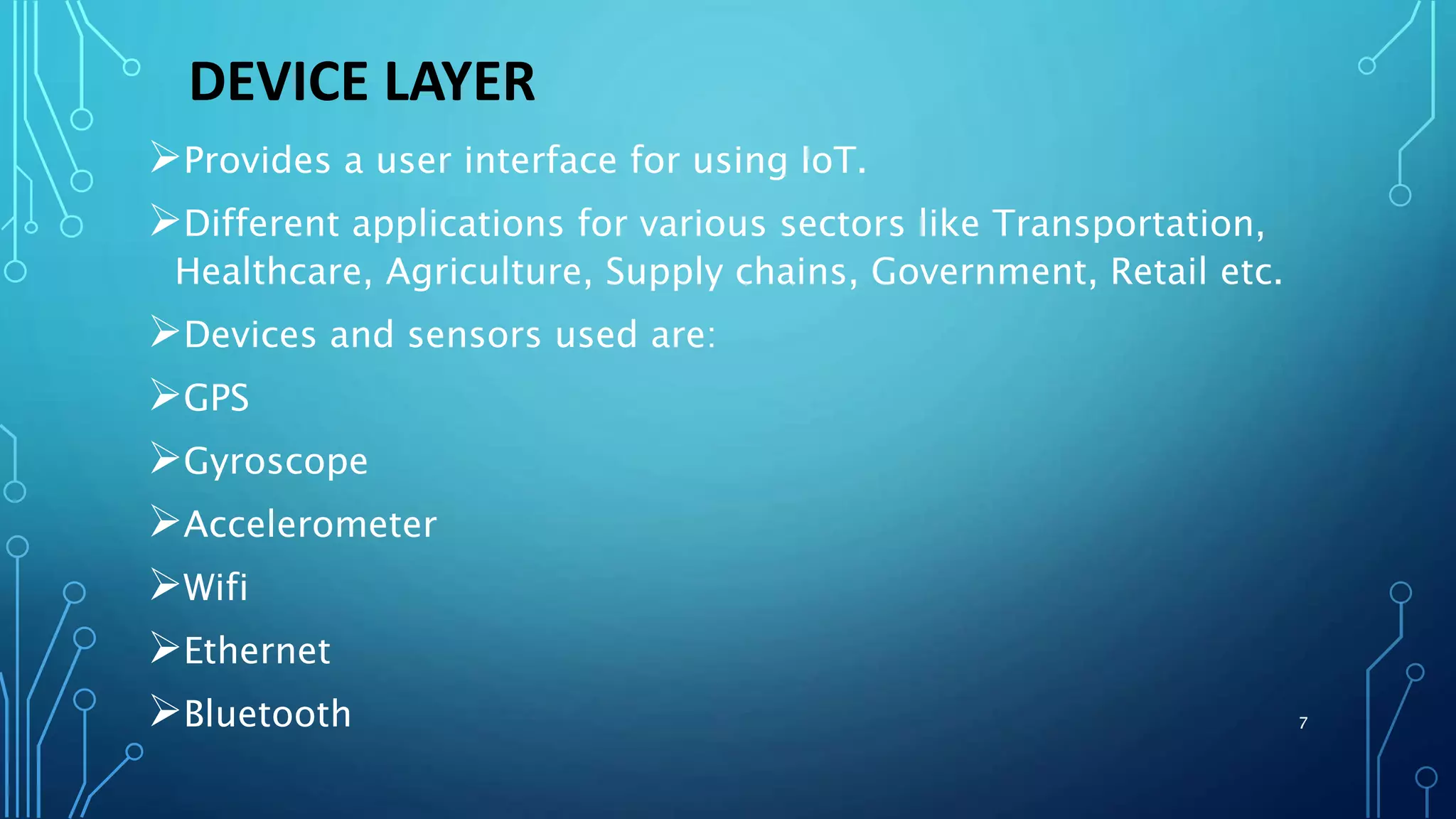
DEVICE LAYER
Provides a user interface for using IoT.
Different applications for various sectors like Transportation,
Healthcare, Agriculture, Supply chains, Government, Retail etc.
Devices and sensors used are:
GPS
Gyroscope
Accelerometer
Wifi
Ethernet
Bluetooth 7
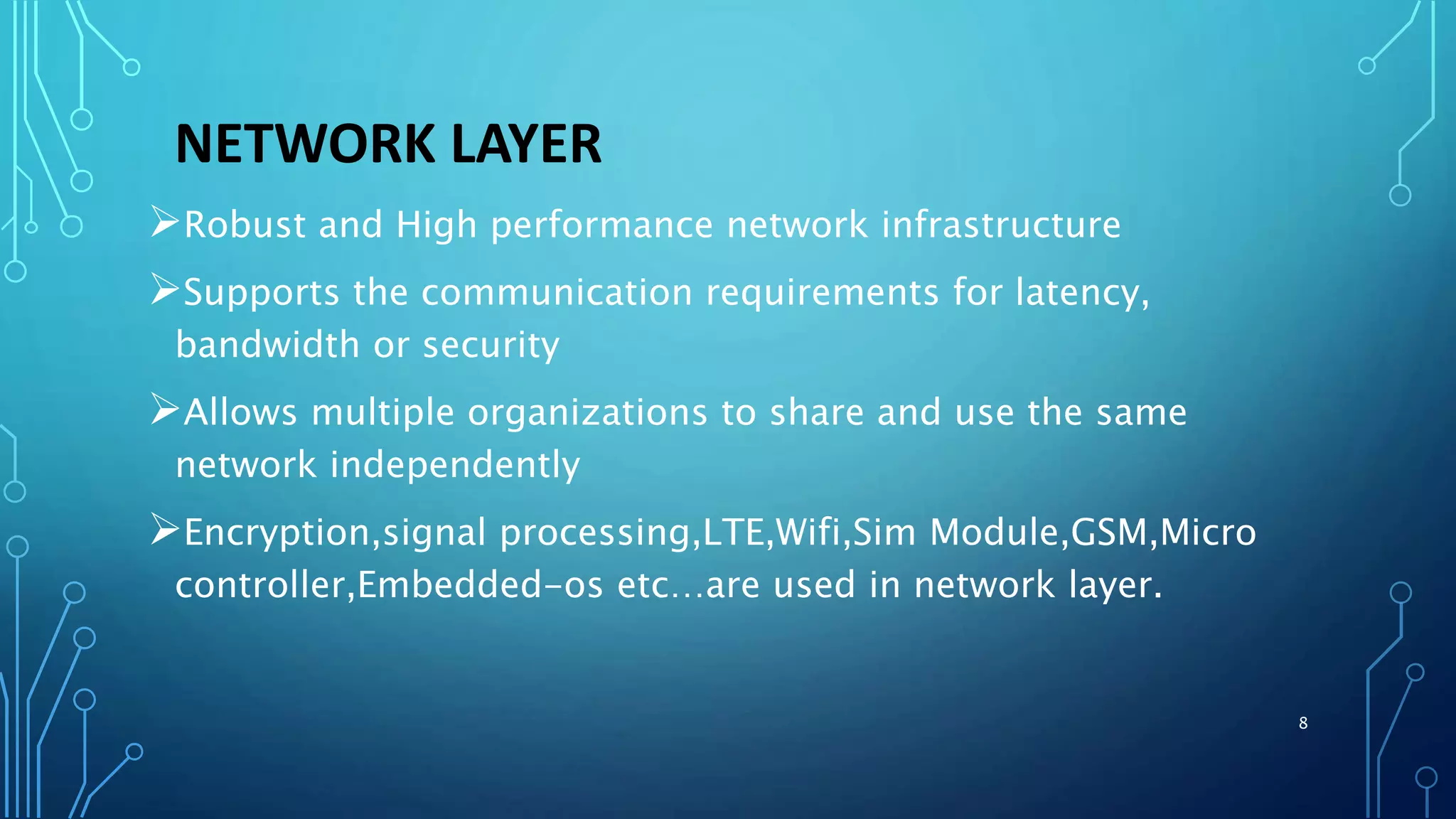
NETWORK LAYER
Robust and High performance network infrastructure
Supports the communication requirements for latency,
bandwidth or security
Allows multiple organizations to share and use the same
network independently
Encryption,signal processing,LTE,Wifi,Sim Module,GSM,Micro
controller,Embedded-os etc…are used in network layer.
8
SERVICE LAYER
Also termed as Application service Layer.
 Capturing of periodic sensory data .
Data Analytics (Extracts relevant information from massive amount
of raw data).
Streaming Analytics (Process real time data).
 Ensures security and privacy of data.
9
 Lowest Abstraction Layer.
 With sensors we are creating digital nervous system.
 Incorporated to measure physical quantities.
 Interconnects the physical and digital world.
 Collects and process the real time information.
Transportation,Health care,Tracing people,Climatic conditions.etc
comes under application layer.
APPLICATION LAYER
10
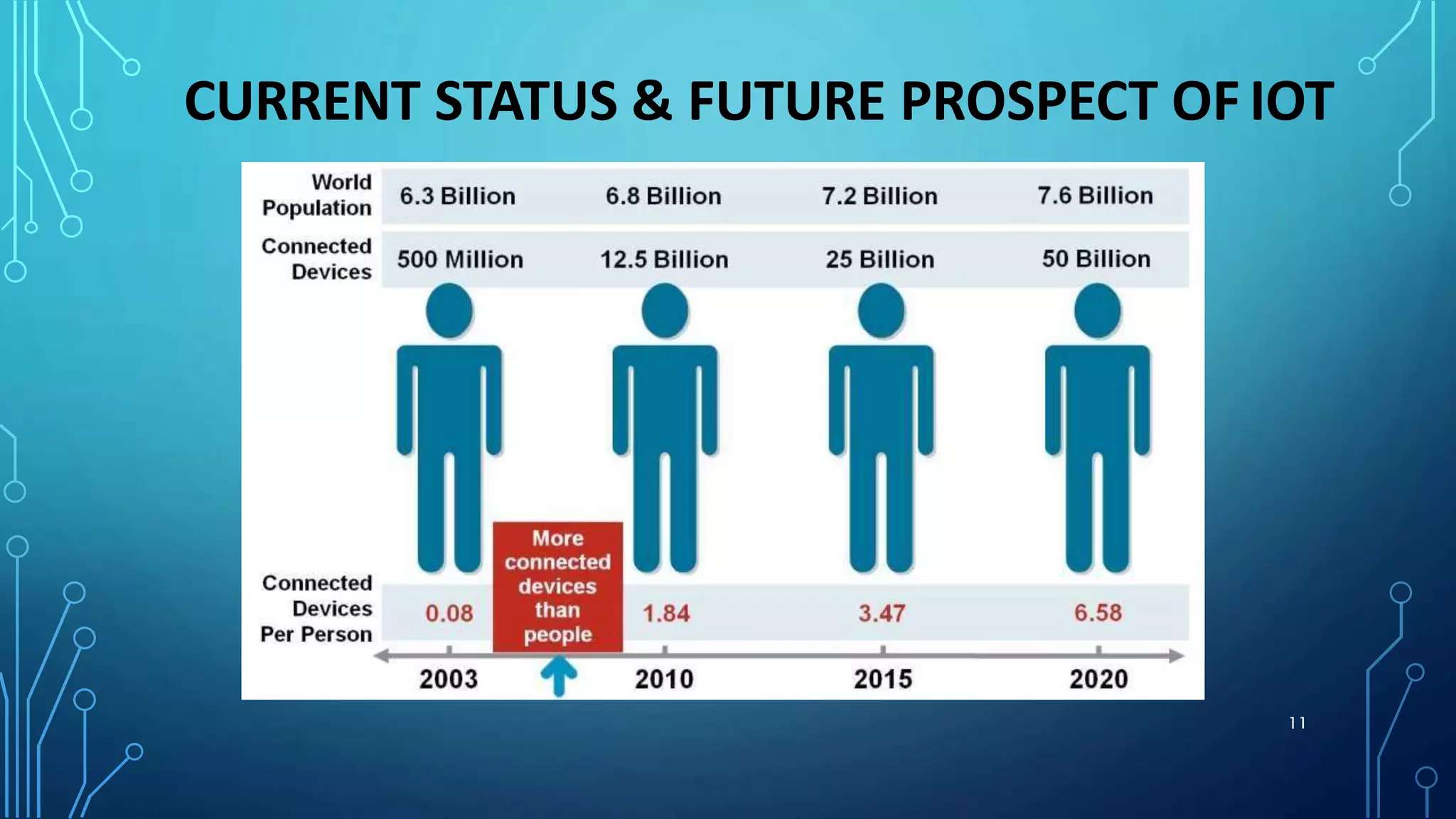
CURRENT STATUS & FUTURE PROSPECT OF IOT
11
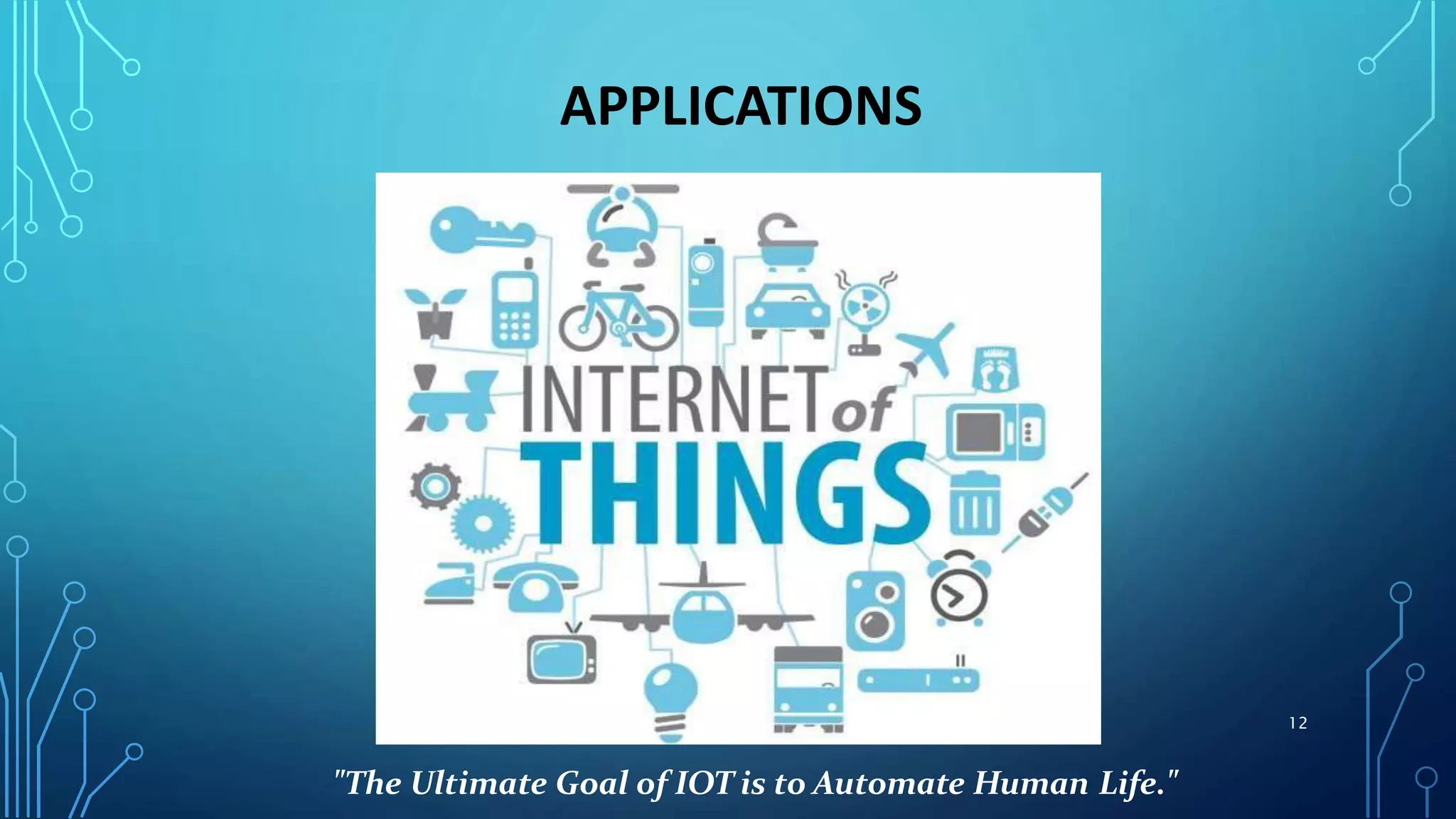
APPLICATIONS
"The Ultimate Goal of IOT is to Automate Human Life."
12
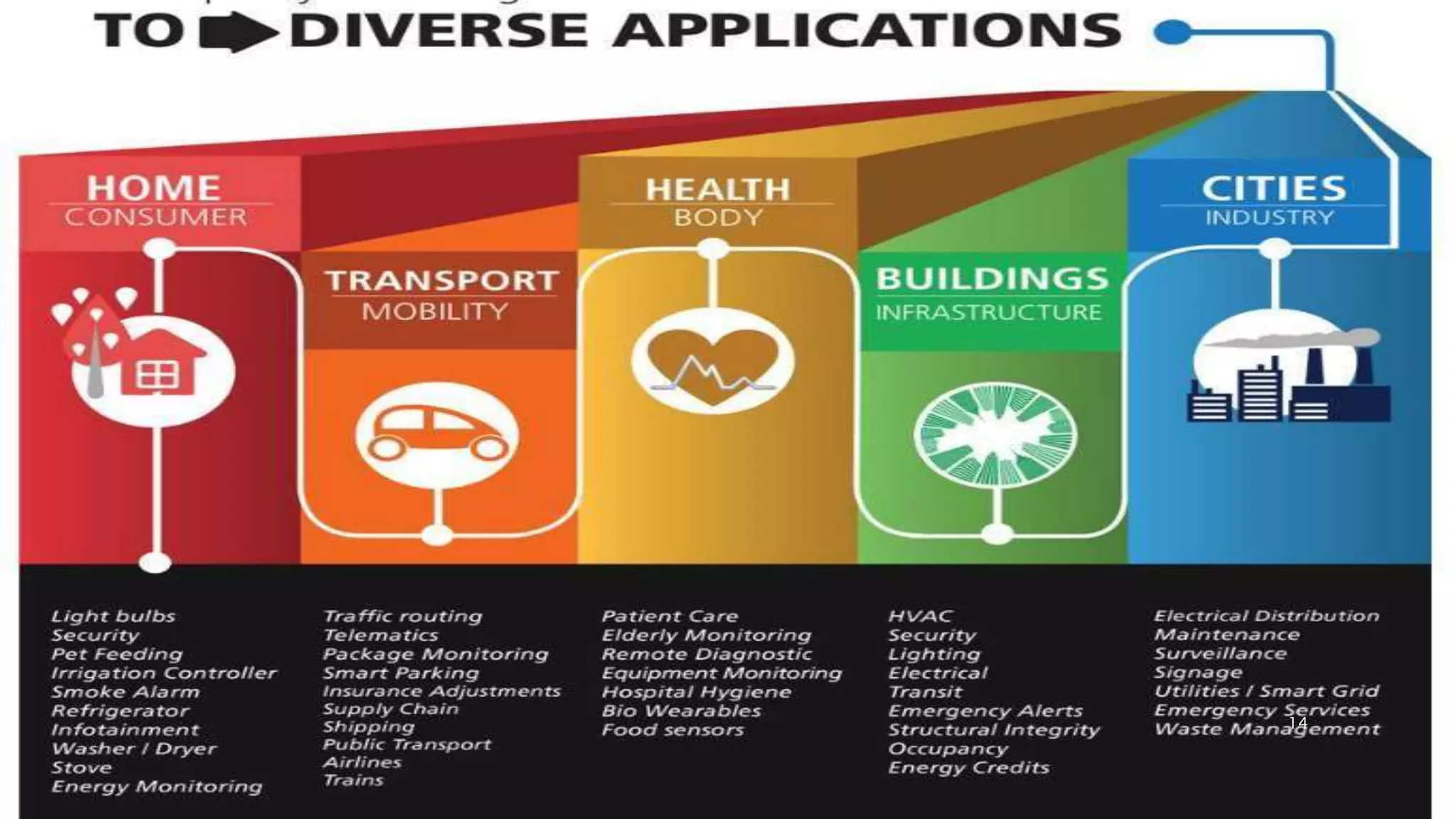
APPLICATIONS
 Building and Homeautomation
 Manufacturing
 Medical and Healthcaresystems
 Media
 Environmental monitoring
 Infrastructure management
 Energy management
 Transportation
 Better quality of life forelderly
 ... ... ...
13
14
SENSORS EVEN IN THE COW!
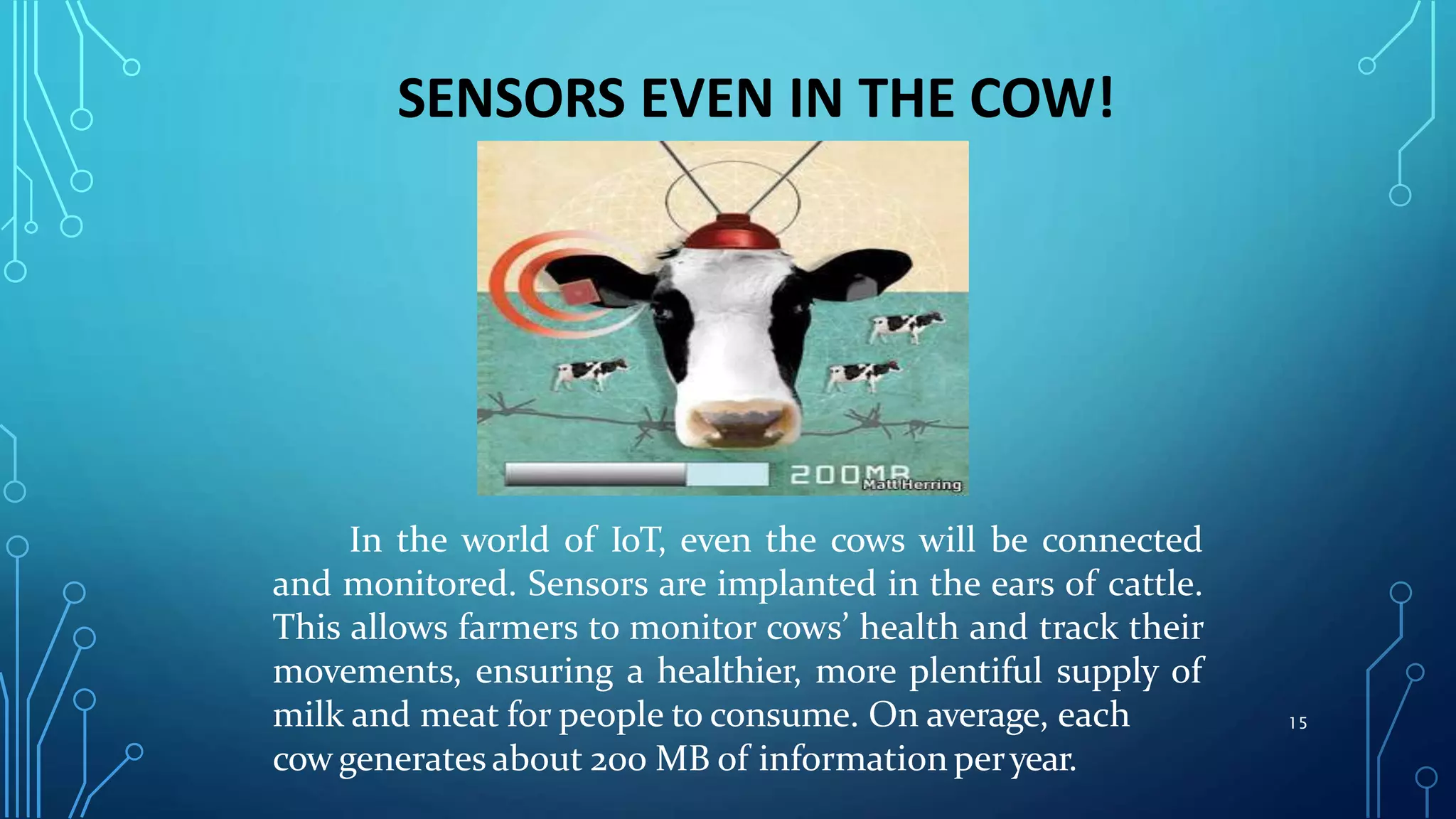
In the world of IoT, even the cows will be connected
and monitored. Sensors are implanted in the ears of cattle.
This allows farmers to monitor cows’ health and track their
movements, ensuring a healthier, more plentiful supply of
milk and meat for people to consume. On average, each
cow generates about 200 MB of information peryear.
15
SECURITY IN IOT
 Software can behackable.
 Connection isexposed.
 it is vulnerable, exposed, can be tapped.
 Weapons of mass disruption.
16
CONCLUSION
One certainty is that Internet of Things change our lifestyles, It is for
common good, The need is the input and support of technologists and
ordinary people to make it good for individuals and the society.
17
REFERENCES
1. www.google.com
2. https://en.wikipedia.org/wiki/Internet_of_Things
3. Cisco whitepaper, "The Internet of Things" - How the Next
Evolution of the Internet Is Changing Everything, by DaveEvans,
April 2011.
4. GE cloud expo 2014, "Industrial Internet as aService", by Shyam
Varan Nath, Principal Architect.
5. Dr. Mazlan Abbas, MIMOS Berhad, Wisma IEM, Petaling Jaya
18
19

Iot architecture

  • 1.
    A Seminar presentedby K.Niranjan kumar 3rd ECE INTERNET OF THINGS(IOT) ARCHITECTURE 1
  • 2.
    CONTENTS Introduction History of IOT Thestructure of IOT Layered structure of IOT Future of IOT Applications Security in Iot Conclusion References 2
  • 3.
    INTRODUCTION The Internet ofThings (IoT) is the network of physical objects or "things" embedded with electronics, software, sensors, and network connectivity, which enables these objects to collect and exchange data. 3
  • 4.
    HISTORY OF IOT •The concept of the Internet of Things first became popular in 1999 invented by kevin Ashton, through the Auto-ID Center at MIT and related market-analysis publications. • Radio-frequency identification (RFID) was seen as a prerequisite for the IoT at that point. 4
  • 5.
    THE STRUCTURE OFIOT • The IoT can be viewed as a gigantic network consisting of networks of devices and computers connected through a series of intermediate technologies where numerous technologies like RFIDs, wireless connections may act as enablers of this connectivity. Tagging Things : Real-time item traceability and addressability by RFIDs. Feeling Things : Sensors act as primary devices to collect data from the environment. Shrinking Things : Miniaturization and Nanotechnology has provoked the ability of smaller things to interact and connect within the “things” or “smart devices.” Thinking Things : Embedded intelligence in devices through sensors has formed the network connection to the Internet. It can make the 5
  • 6.
  • 7.
    DEVICE LAYER Provides auser interface for using IoT. Different applications for various sectors like Transportation, Healthcare, Agriculture, Supply chains, Government, Retail etc. Devices and sensors used are: GPS Gyroscope Accelerometer Wifi Ethernet Bluetooth 7
  • 8.
    NETWORK LAYER Robust andHigh performance network infrastructure Supports the communication requirements for latency, bandwidth or security Allows multiple organizations to share and use the same network independently Encryption,signal processing,LTE,Wifi,Sim Module,GSM,Micro controller,Embedded-os etc…are used in network layer. 8
  • 9.
    SERVICE LAYER Also termedas Application service Layer.  Capturing of periodic sensory data . Data Analytics (Extracts relevant information from massive amount of raw data). Streaming Analytics (Process real time data).  Ensures security and privacy of data. 9
  • 10.
     Lowest AbstractionLayer.  With sensors we are creating digital nervous system.  Incorporated to measure physical quantities.  Interconnects the physical and digital world.  Collects and process the real time information. Transportation,Health care,Tracing people,Climatic conditions.etc comes under application layer. APPLICATION LAYER 10
  • 11.
    CURRENT STATUS &FUTURE PROSPECT OF IOT 11
  • 12.
    APPLICATIONS "The Ultimate Goalof IOT is to Automate Human Life." 12
  • 13.
    APPLICATIONS  Building andHomeautomation  Manufacturing  Medical and Healthcaresystems  Media  Environmental monitoring  Infrastructure management  Energy management  Transportation  Better quality of life forelderly  ... ... ... 13
  • 14.
  • 15.
    SENSORS EVEN INTHE COW! In the world of IoT, even the cows will be connected and monitored. Sensors are implanted in the ears of cattle. This allows farmers to monitor cows’ health and track their movements, ensuring a healthier, more plentiful supply of milk and meat for people to consume. On average, each cow generates about 200 MB of information peryear. 15
  • 16.
    SECURITY IN IOT Software can behackable.  Connection isexposed.  it is vulnerable, exposed, can be tapped.  Weapons of mass disruption. 16
  • 17.
    CONCLUSION One certainty isthat Internet of Things change our lifestyles, It is for common good, The need is the input and support of technologists and ordinary people to make it good for individuals and the society. 17
  • 18.
    REFERENCES 1. www.google.com 2. https://en.wikipedia.org/wiki/Internet_of_Things 3.Cisco whitepaper, "The Internet of Things" - How the Next Evolution of the Internet Is Changing Everything, by DaveEvans, April 2011. 4. GE cloud expo 2014, "Industrial Internet as aService", by Shyam Varan Nath, Principal Architect. 5. Dr. Mazlan Abbas, MIMOS Berhad, Wisma IEM, Petaling Jaya 18
  • 19.

Editor's Notes

  • #4 The Internet of Things (IoT, sometimes Internet of Everything) is the network of physical objects or "things" embedded[1] with electronics, software, sensors[2] and connectivity to enable it to achieve greater value and service by exchanging data with the manufacturer, operator and/or other connected devices. Each thing is uniquely identifiable through its embedded computing system but is able to interoperate within the existing Internet infrastructure. Experts estimate that the IoT will consist of almost 50 billion objects by 2020.[3] The term “Internet of Things” was first documented by a British visionary, Kevin Ashton, in 1999.[4] Typically, IoT is expected to offer advanced connectivity of devices, systems, and services that goes beyond machine-to-machine communications (M2M) and covers a variety of protocols, domains, and applications.[5] The interconnection of these embedded devices (including smart objects), is expected to usher in automation in nearly all fields, while also enabling advanced applications like a Smart Grid.[6] Things, in the IoT, can refer to a wide variety of devices such as heart monitoring implants, biochip transponders on farm animals, electric clams in coastal waters,[7] automobiles with built-in sensors, or field operation devices that assist fire-fighters in search and rescue.[8] These devices collect useful data with the help of various existing technologies and then autonomously flow the data between other devices.[9] Current market examples include smart thermostat systems and washer/dryers that utilize Wi-Fi for remote monitoring. A thing, in the Internet of Things, can be a person with a heart monitor implant, a farm animal with a biochip transponder, an automobile that has built-in sensors to alert the driver when tire pressure is low — or any other natural or man-made object that can be assigned an IP address and provided with the ability to transfer data over a network. So far, the Internet of Things has been most closely associated with machine-to-machine (M2M) communication in manufacturing and power, oil and gas utilities. Products built with M2M communication capabilities are often referred to as being smart.