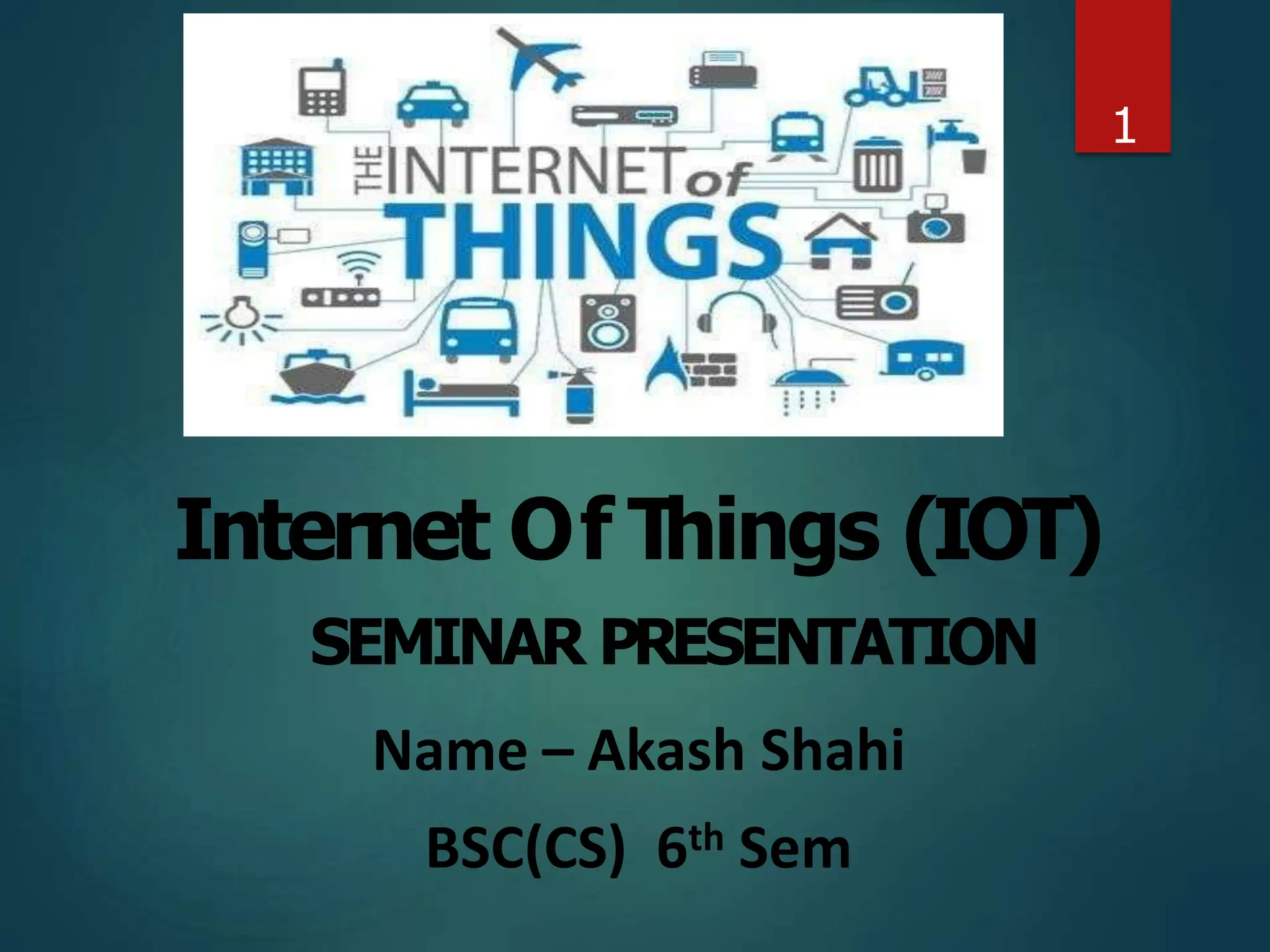
Internet Of Things (IOT)
SEMINAR PRESENTATION
Name – Akash Shahi
BSC(CS) 6th Sem
1
What is IOT? 2
 The Internet of Things is the network of physical objects or
"things" embedded with electronics, software, sensors, and
network connectivity, which enables these objects to collect
and exchange data.
 It allows objects to be sensed and controlled remotely across
existing network infrastructure, creating opportunities for
more direct integration between the physical world and
computer-based systems, and resulting in improved efficiency,
accuracy and economic benefit.

 These devices collect useful data with the help of various
existing technologies and then autonomously flow the data
between otherdevices.
3
"Things," in the IoT sense, can refer to a wide variety of devices
such as heart monitoring implants, biochip transponders on
farm animals, electric clams in coastal waters, automobiles
with built-in sensors, DNA analysis devices for
environmental/food/pathogen monitoring or field operation
devices that assist fire-fighters in search and rescue
operations.
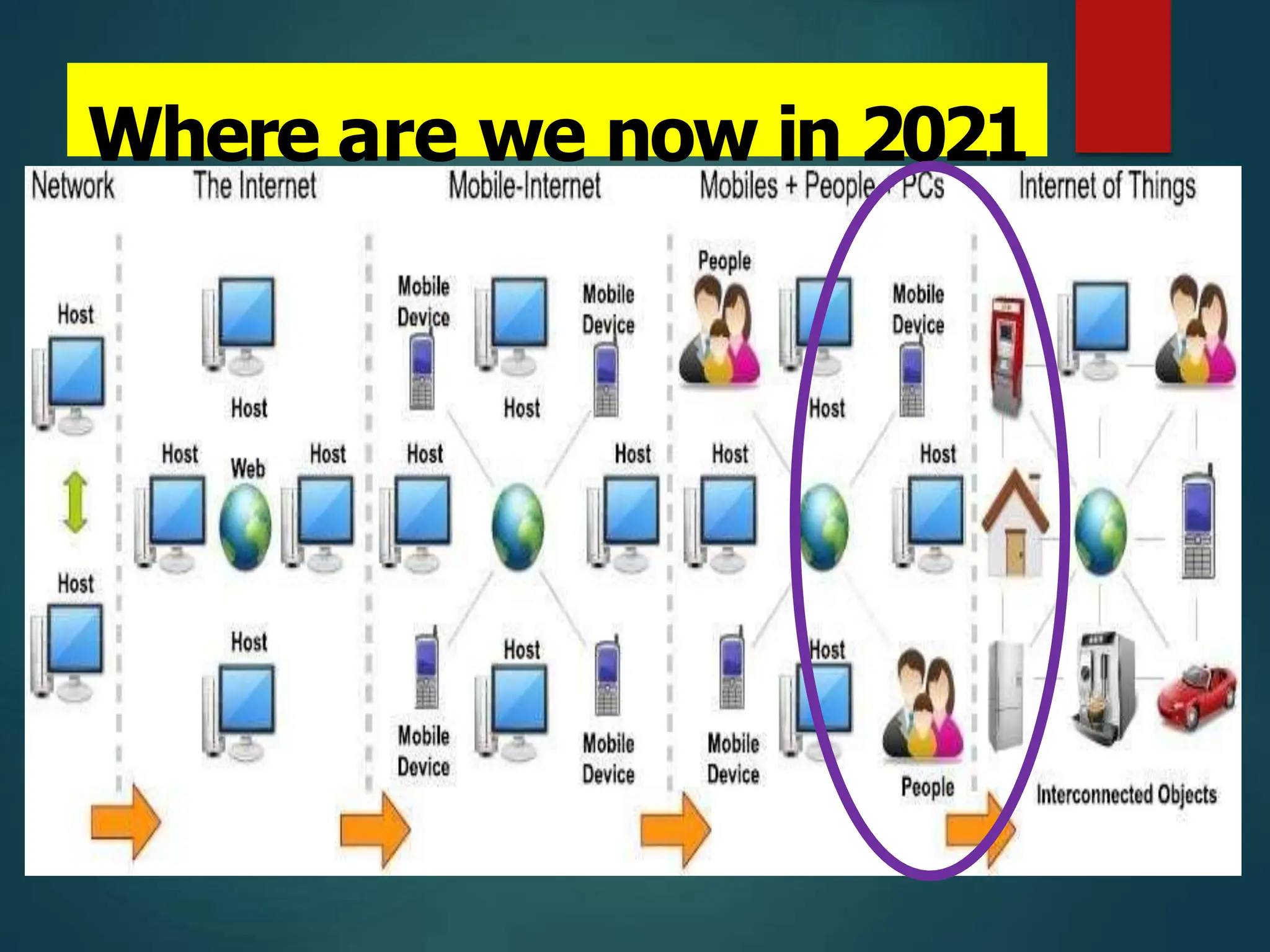
Where are we now in 2021
?
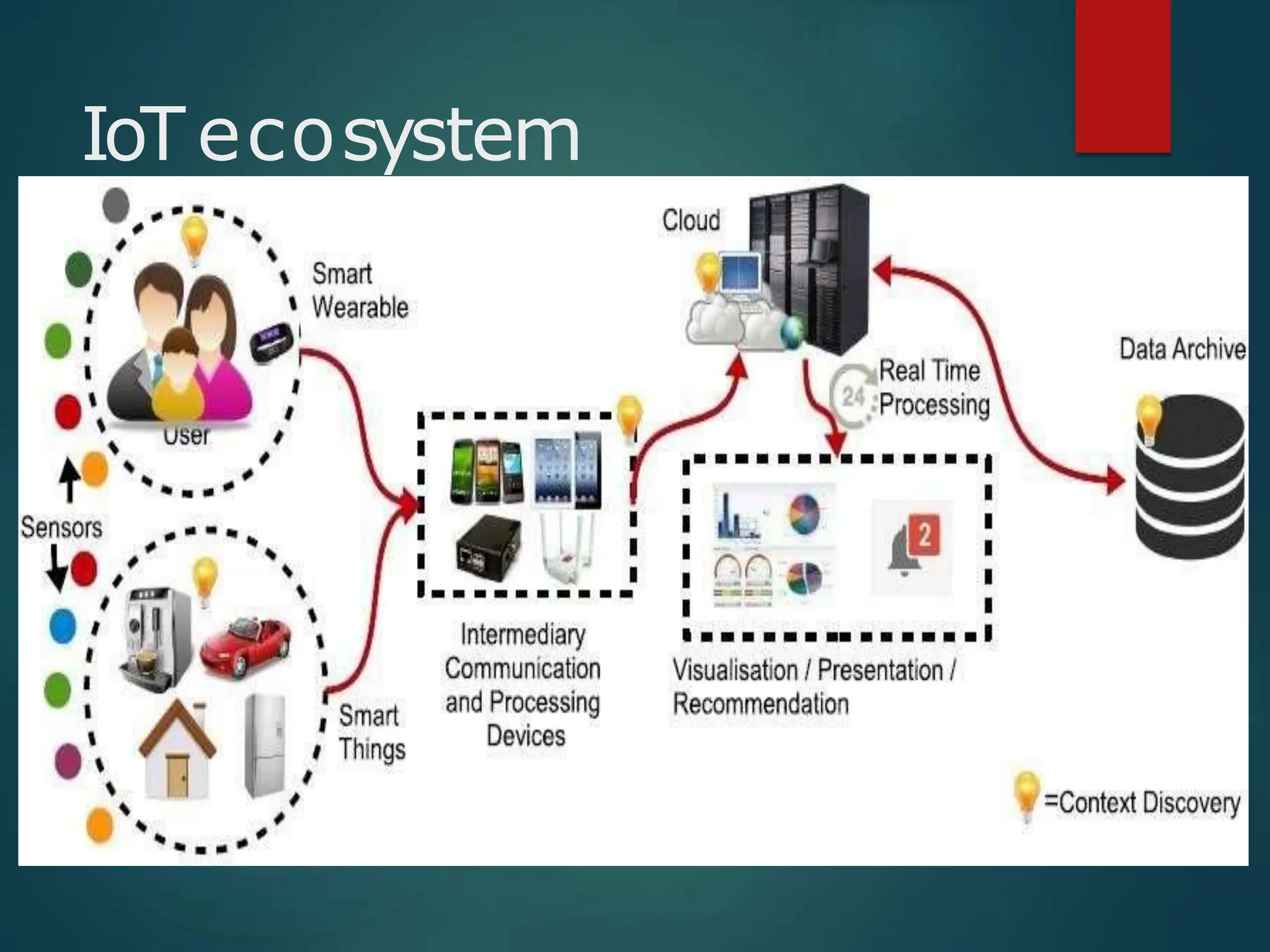
IoTecosystem
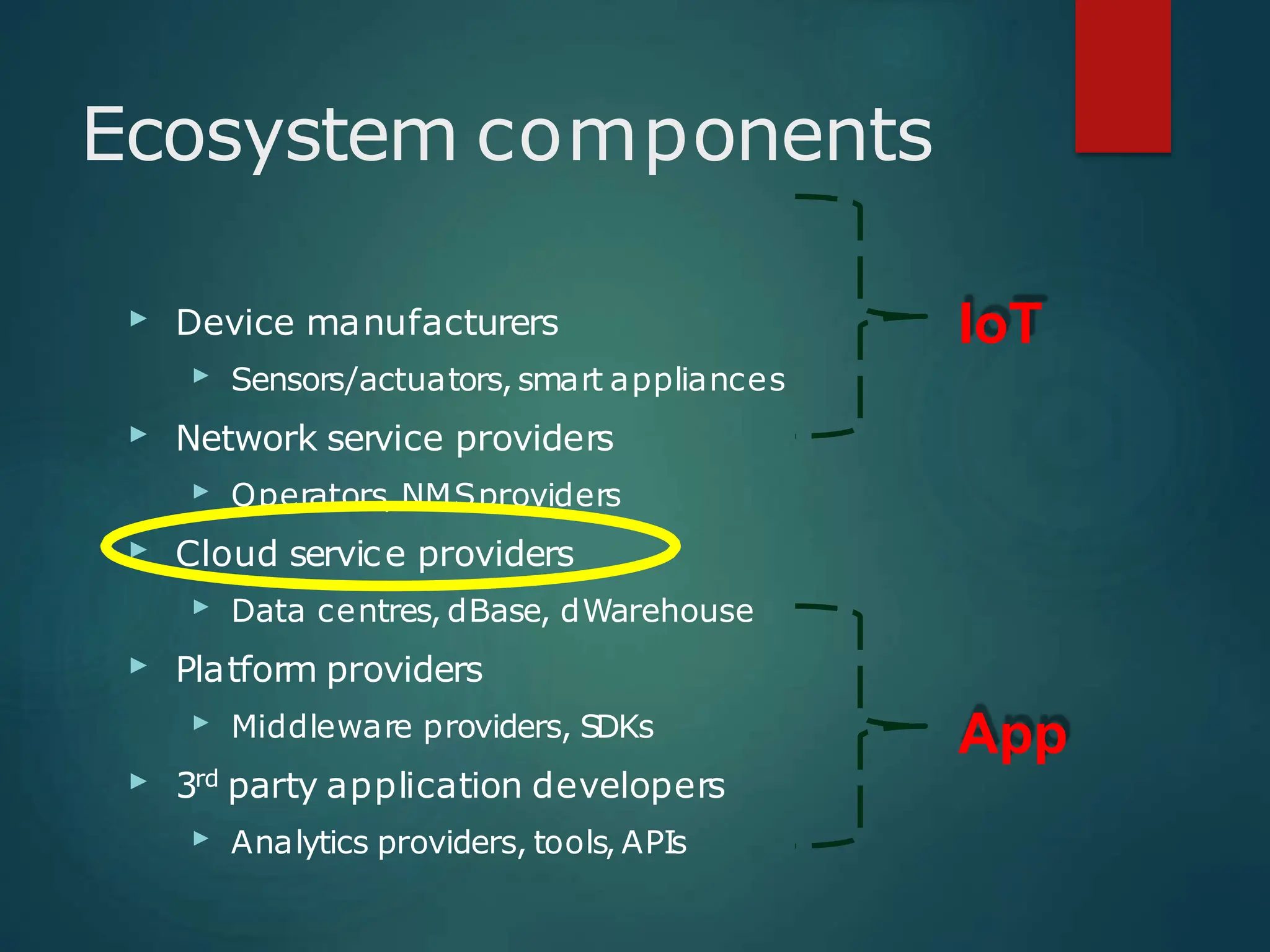
Ecosystem components
▶ Device manufacturers
▶ Sensors/actuators, smart appliances
▶ Network service providers
▶ Operators, NMSproviders
▶ Cloud service providers
▶ Data centres, dBase, dWarehouse
▶ Platform providers
▶ Middleware providers, SDKs
▶ 3rd party application developers
▶ Analytics providers, tools, APIs
IoT
App
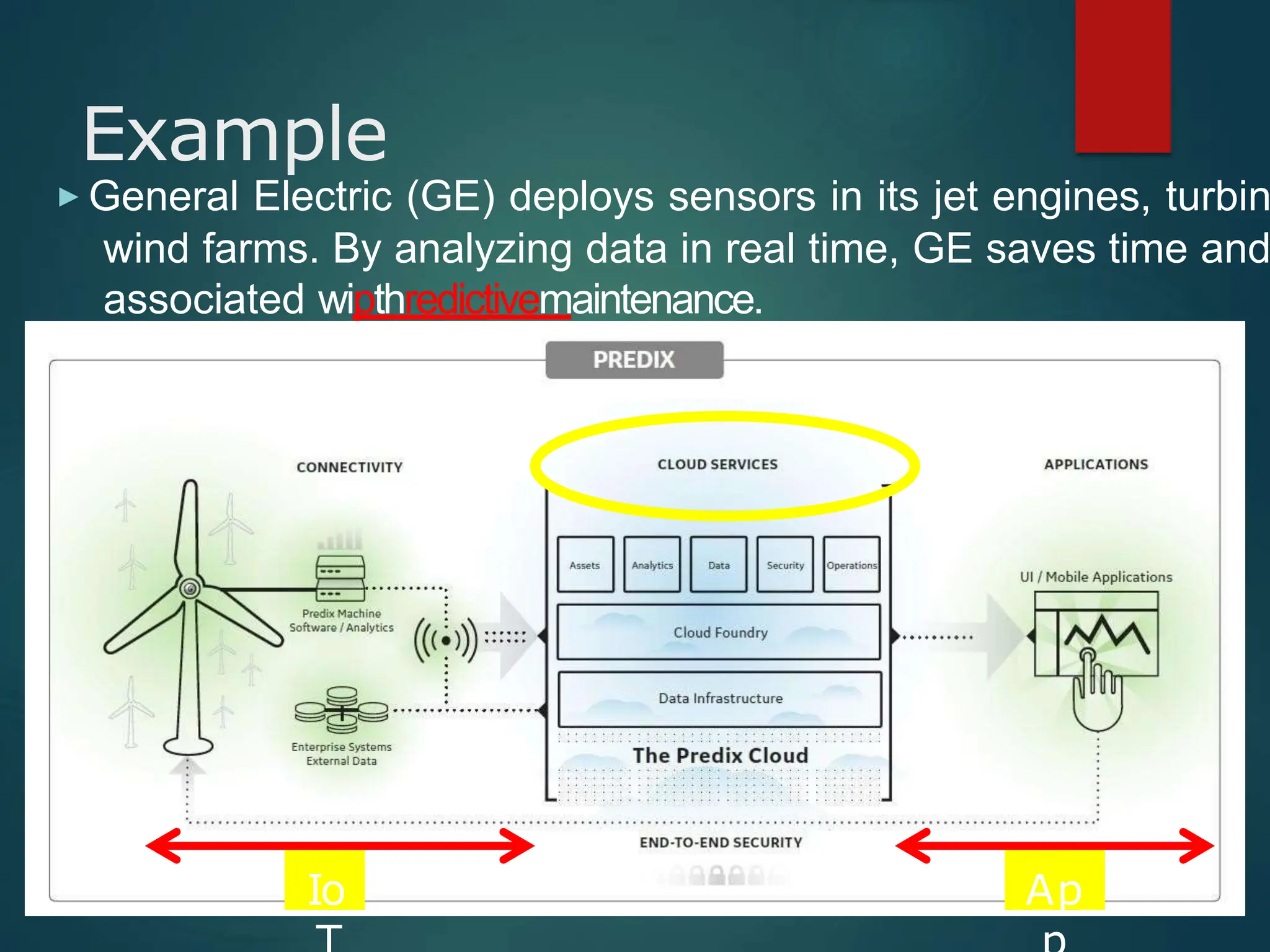
Example
▶ General Electric (GE) deploys sensors in its jet engines, turbin
wind farms. By analyzing data in real time, GE saves time and
associated wipthredictivemaintenance.
Io Ap
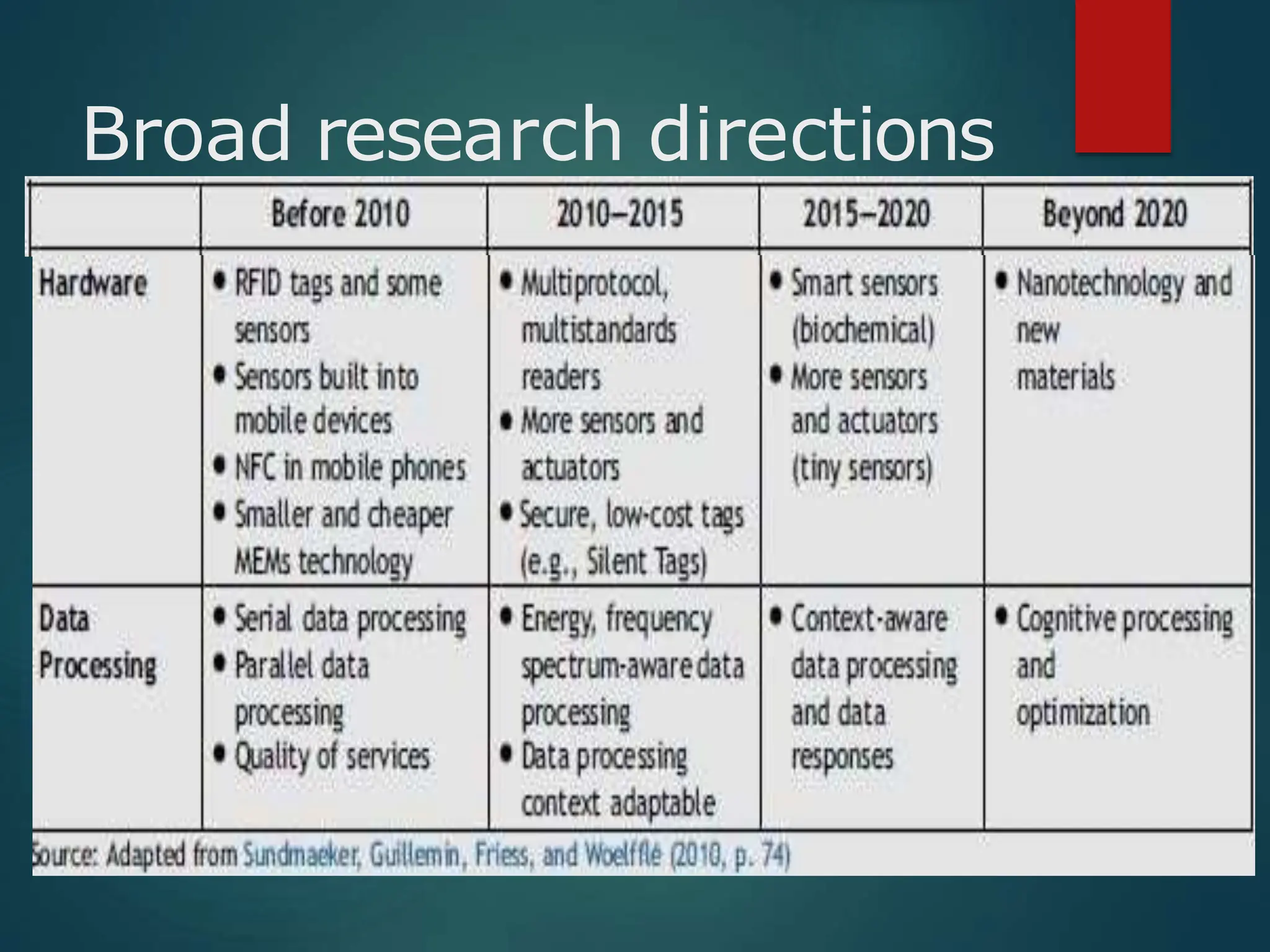
Broad research directions
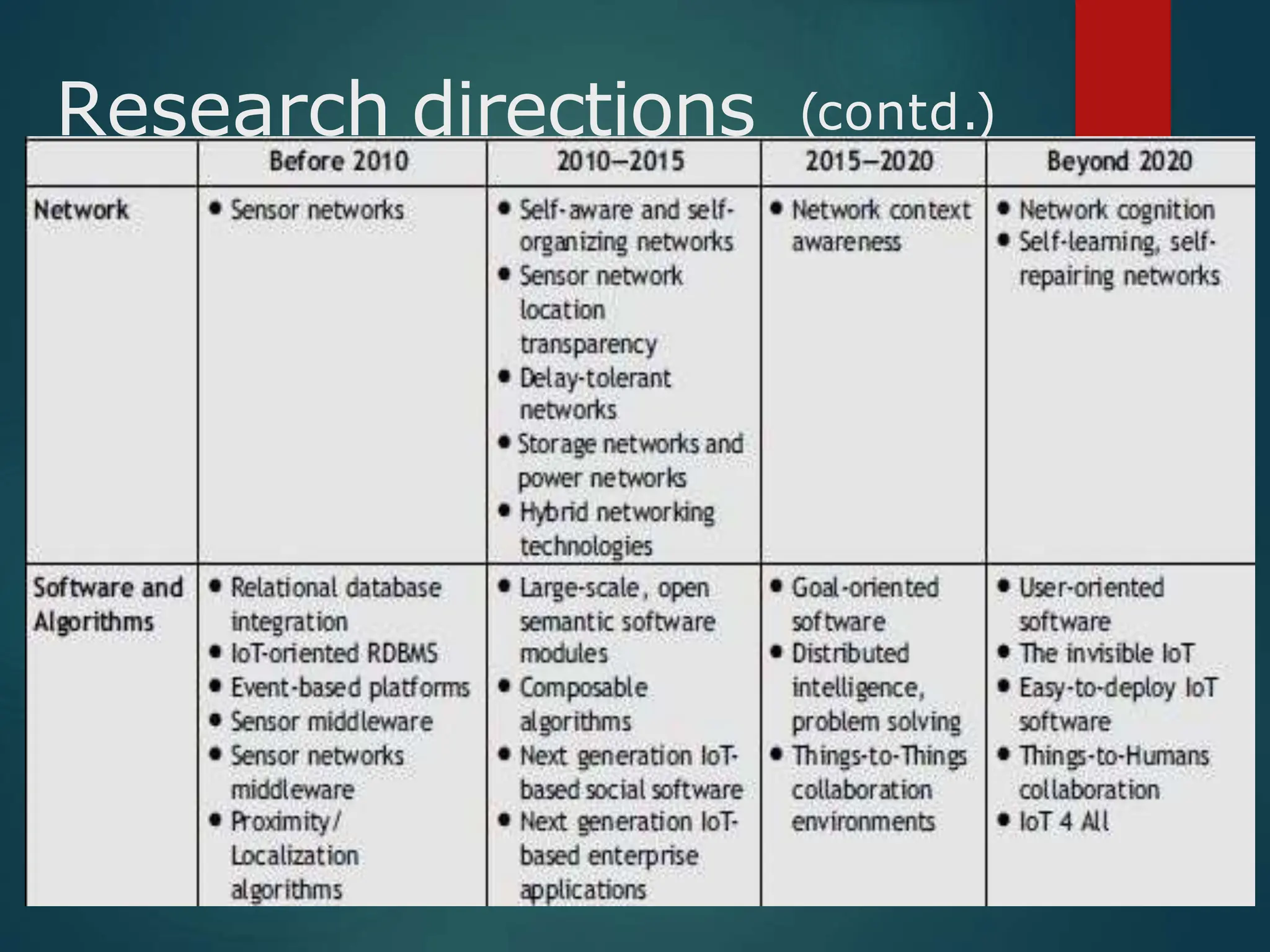
Research directions (contd.)
History of IoT
The concept of the Internet of Things first became popular in
1999, through the Auto-ID Center at MIT and related market-
analysispublications.
Radio-frequency identification (RFID) was seen as a
prerequisite for the IoT at that point. If all objects and people
in daily life were equipped with identifiers, computers could
manage and inventory them. Besides using RFID, the tagging
of things may be achieved through such technologies as near
field communication, barcodes, QR codes, blue-tooth, and
digital watermarking.
10
How IOT Works?
Internet of Things isnot the result of a single novel technology;
instead, several complementary technical developments








provide capabilities that taken together help to bridge the
gap between the virtual and physical world. These
capabilities include:
Communicationand cooperation
Addressability
Identification
Sensing
Actuation
Embedded informationprocessing
Localization
User interfaces
11
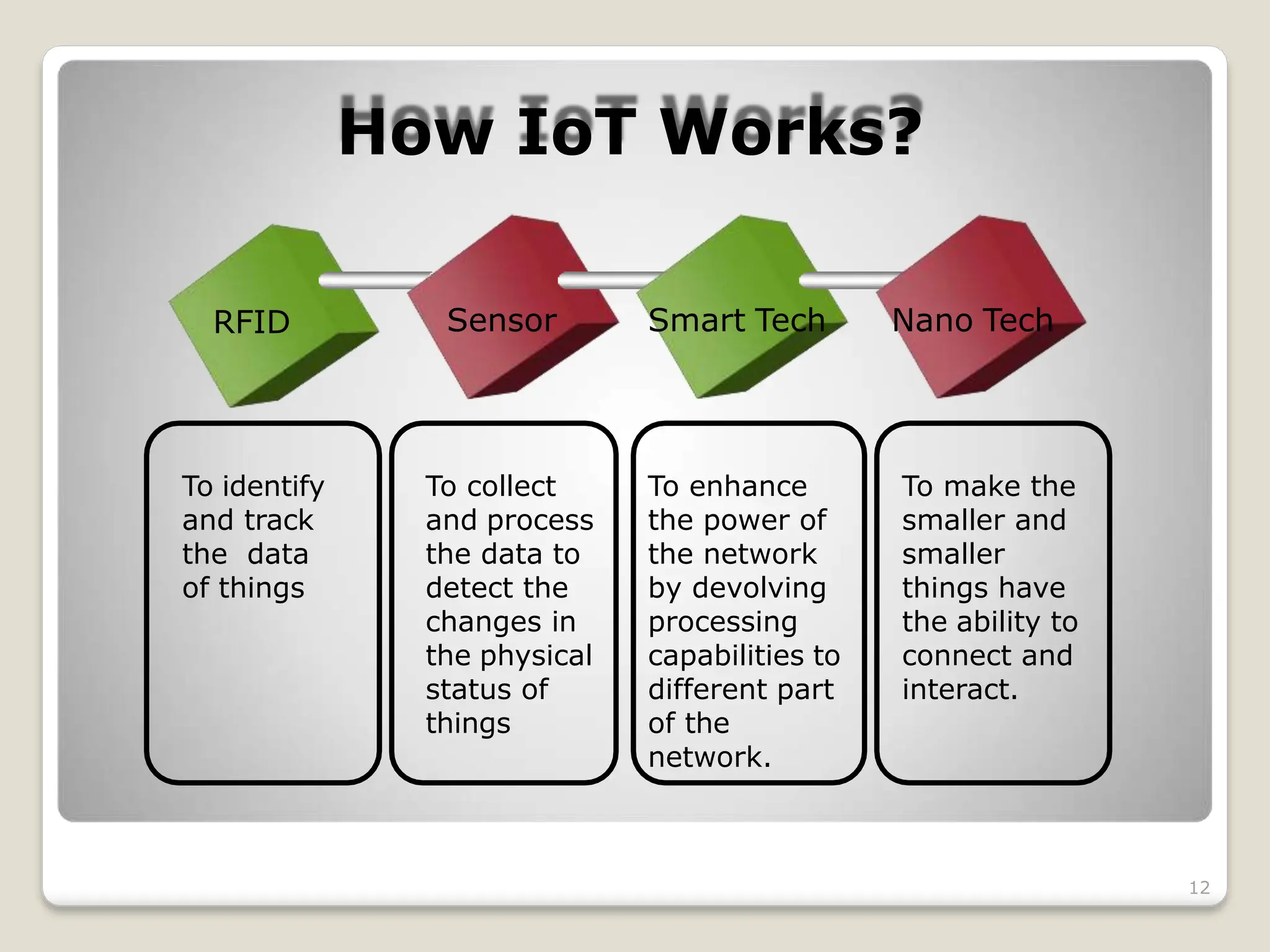
How IoT Works?
12
RFID Sensor Smart Tech Nano Tech
To identify
and track
the data
of things
To collect
and process
the data to
detect the
changes in
the physical
status of
things
To enhance
the power of
the network
by devolving
processing
capabilities to
different part
of the
network.
To make the
smaller and
smaller
things have
the ability to
connect and
interact.
The Structure of IoT 13
The IoT can be viewed as a gigantic network
consisting of networksof devices and computers
connected through a series of intermediate
technologies where numerous technologies like
RFIDs, wireless connections may act as enablers
of thisconnectivity.
 Tagging Things : Real-time item traceability and addressability by
RFIDs.
 Feeling Things:Sensorsact as primary devices to collect data from
the environment.
 Shrinking Things : Miniaturization and Nanotechnology has
provoked the ability of smaller things to interact and connect
within the “things” or “smart devices.”
 Thinking Things Embedded intelligence
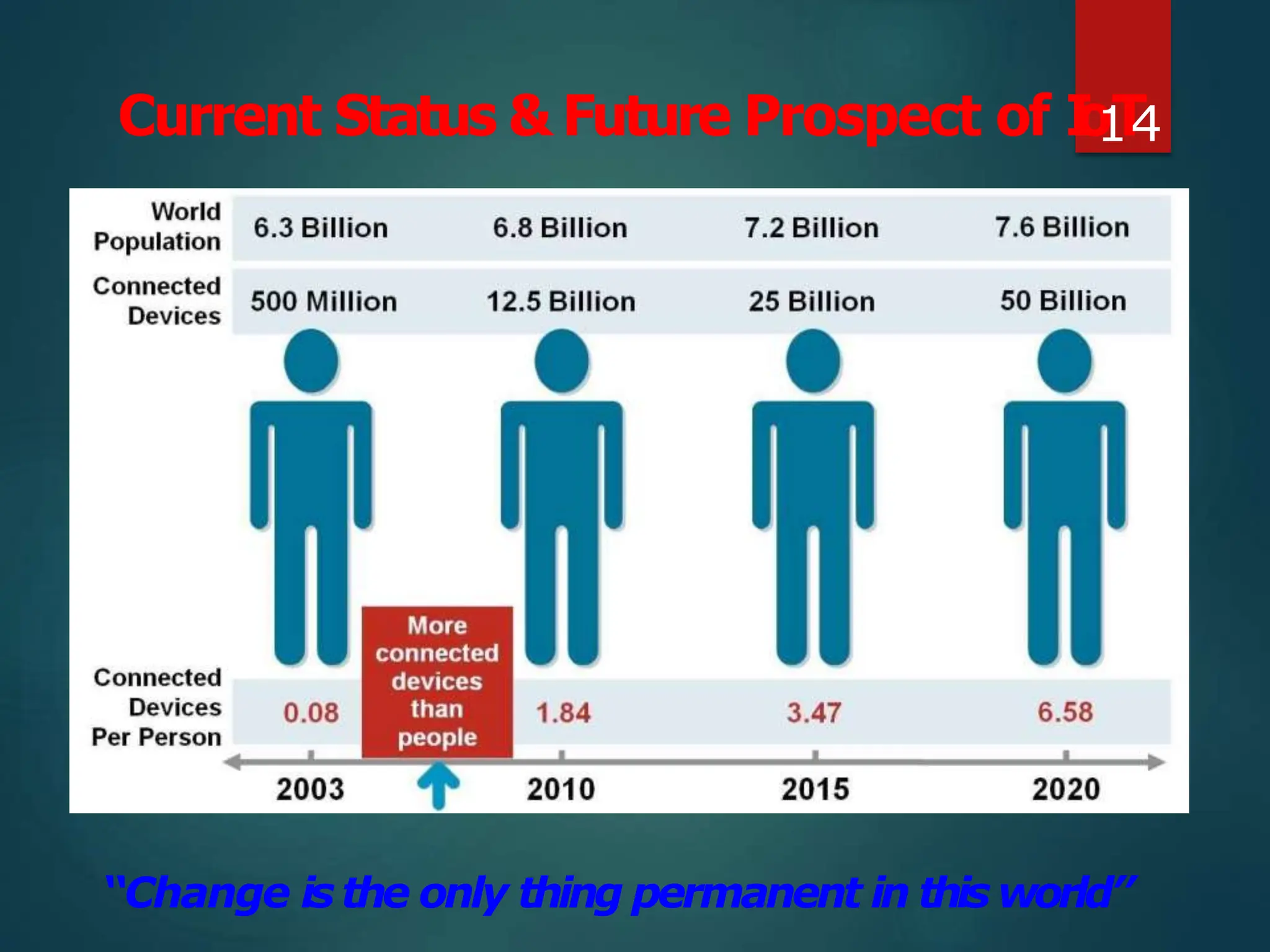
Current Status & Future Prospect of I
o
1
T
4
“Change is the only thing permanent in this world”
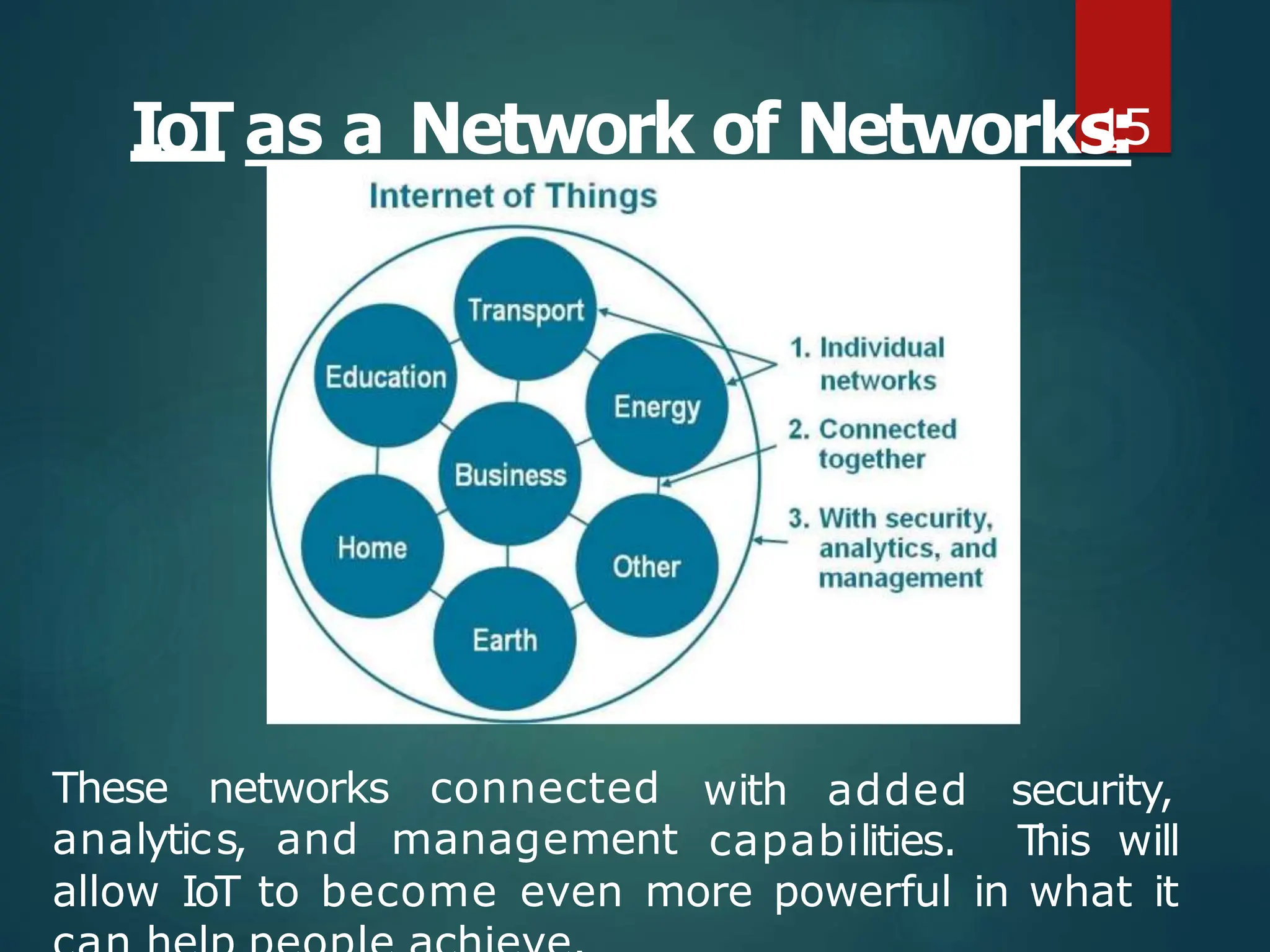
IoT as a Network of Networks
1
:
5
with added security,
These networks connected
analytics, and management capabilities. T
his will
allow IoT to become even more powerful in what it
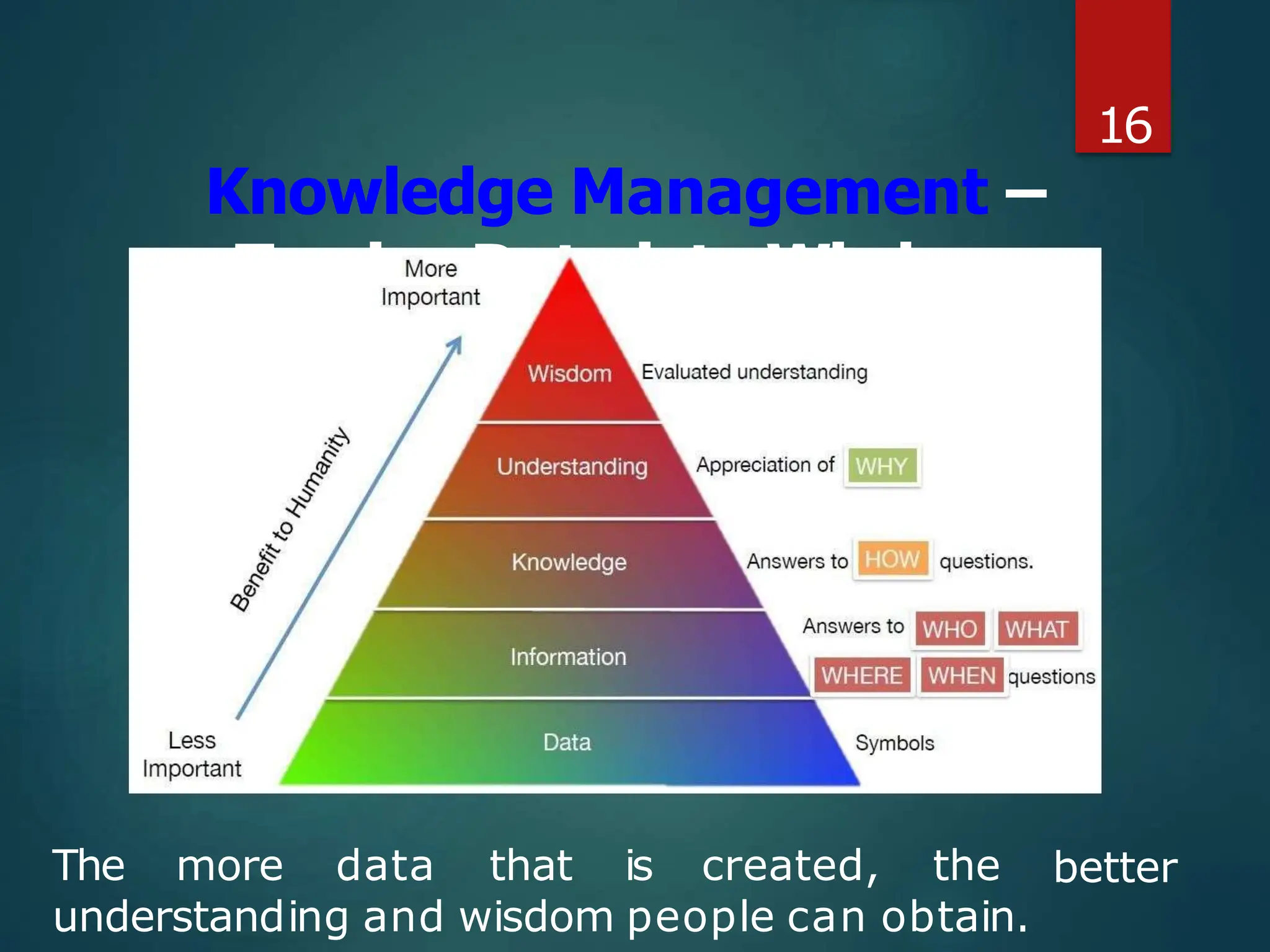
Knowledge Management –
Turning Data into Wisdom
16
better
The more data that is created, the
understanding and wisdom people can obtain.
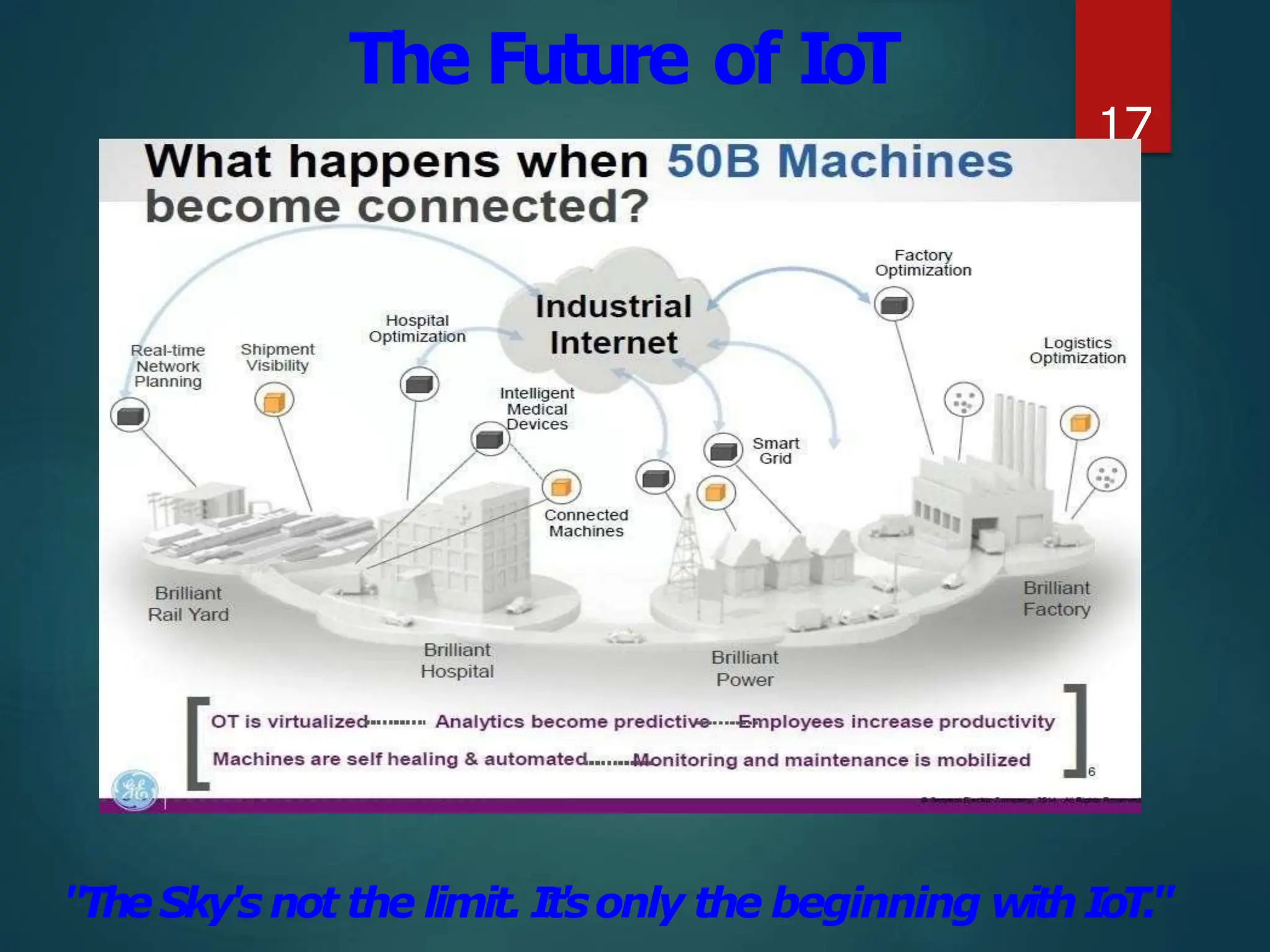
The Future of IoT
17
"TheSky's not the limit. It'sonly the beginning with IoT."
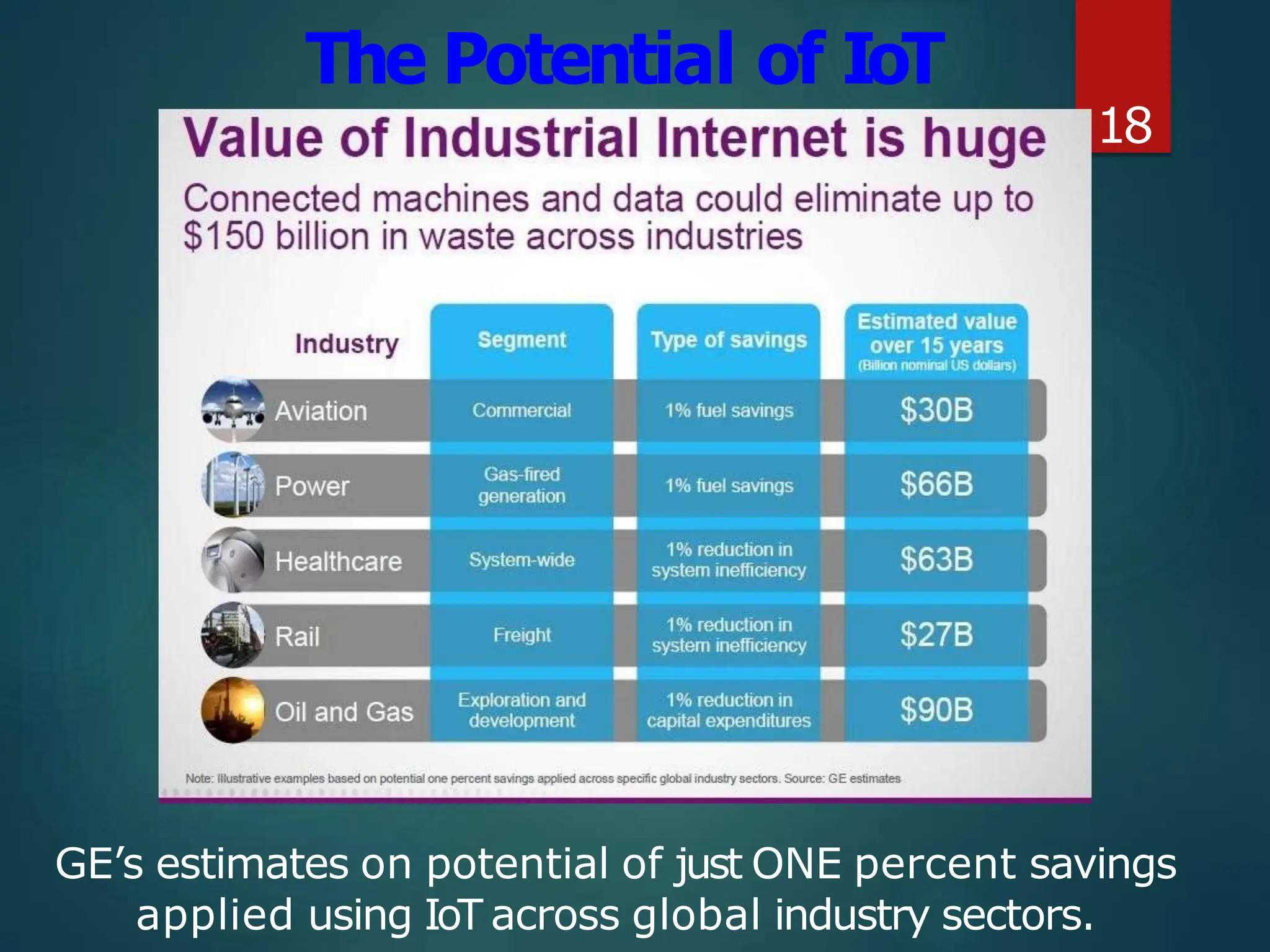
The Potential of IoT
18
GE’s estimates on potential of just ONE percent savings
applied using IoT across global industry sectors.
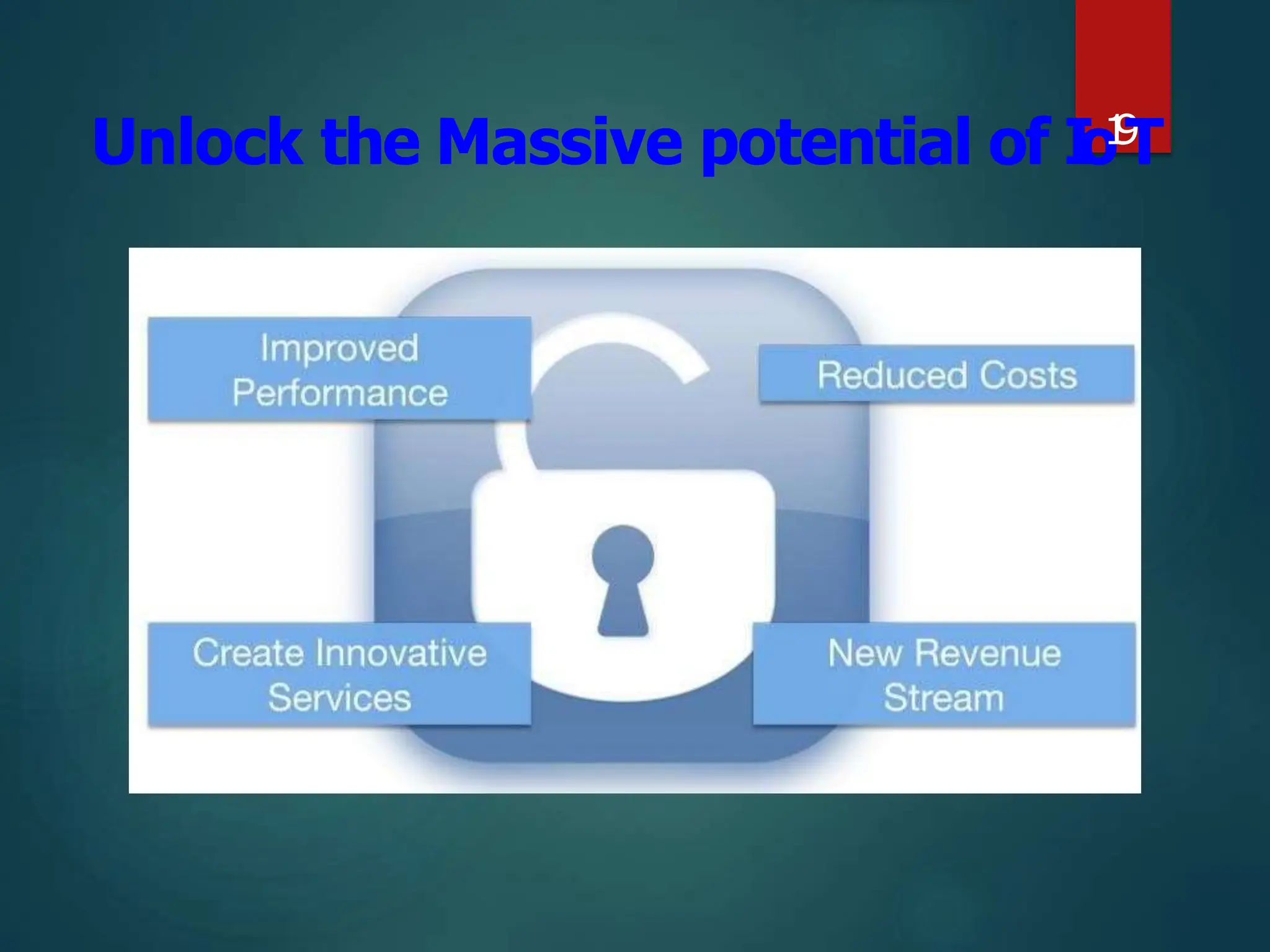
Unlock the Massive potential of I
o
1
9
T
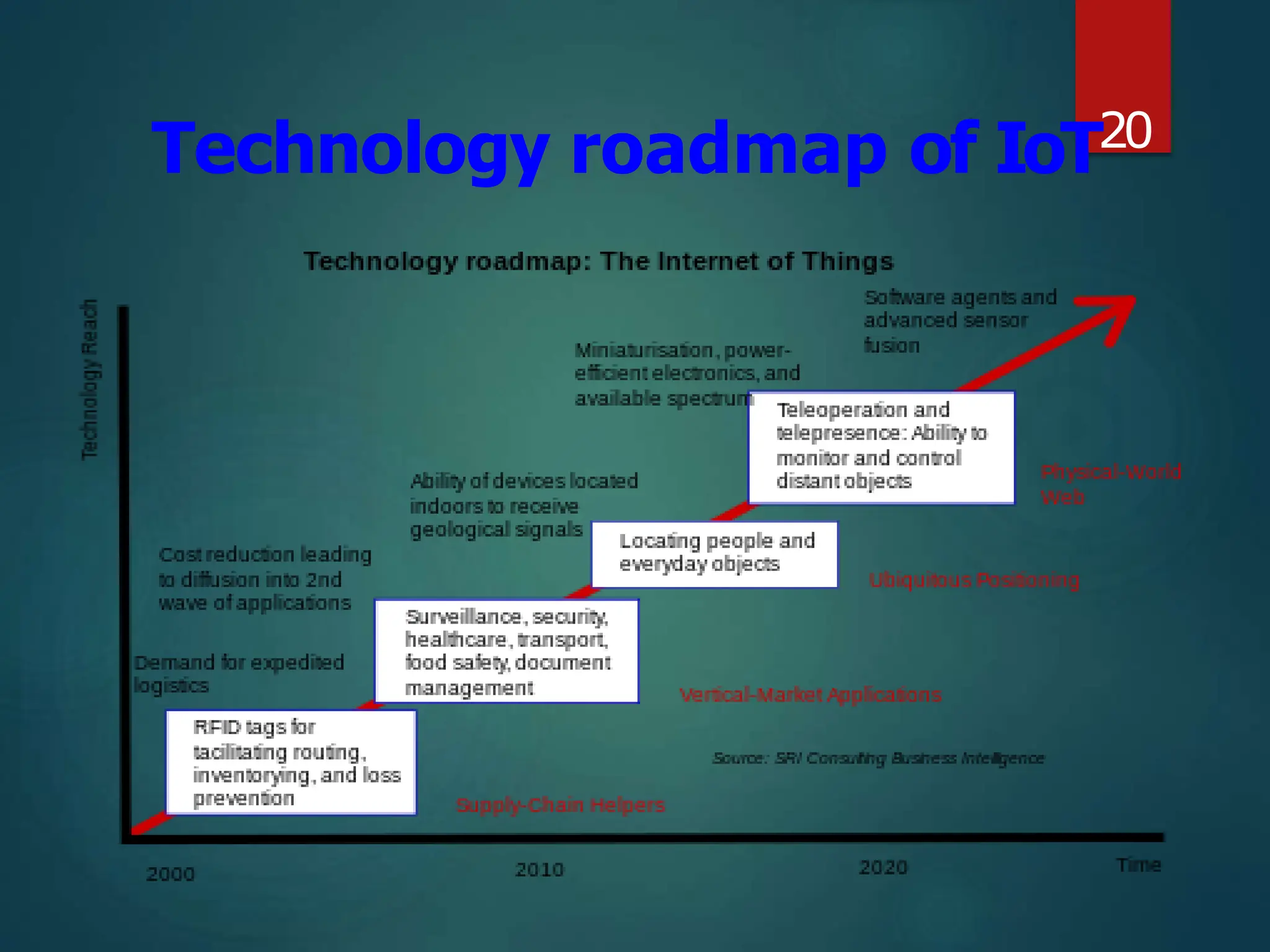
Technology roadmap of IoT20
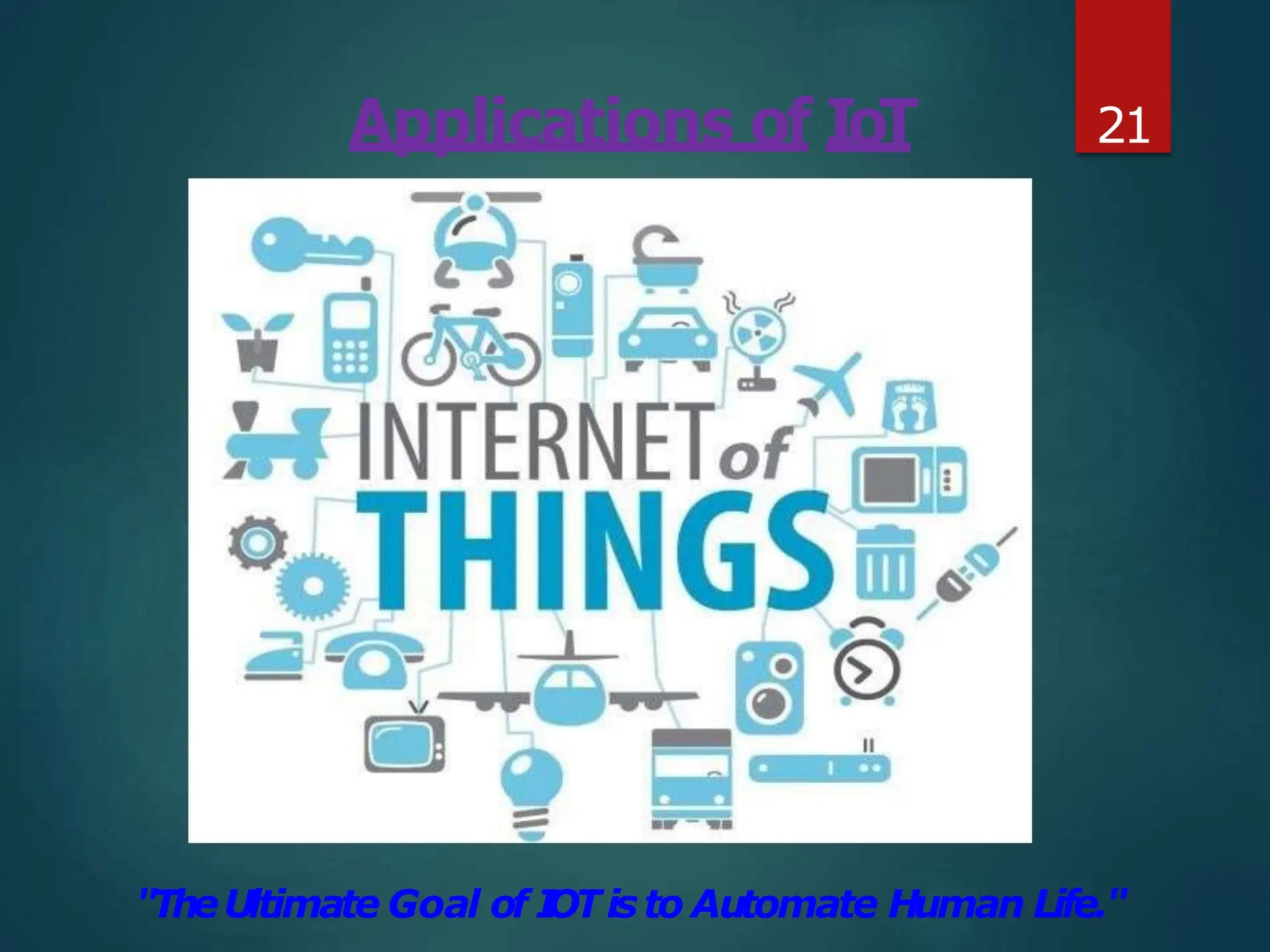
Applications of IoT
"TheUltimate Goal of I
OTis to Automate Human Life."
21
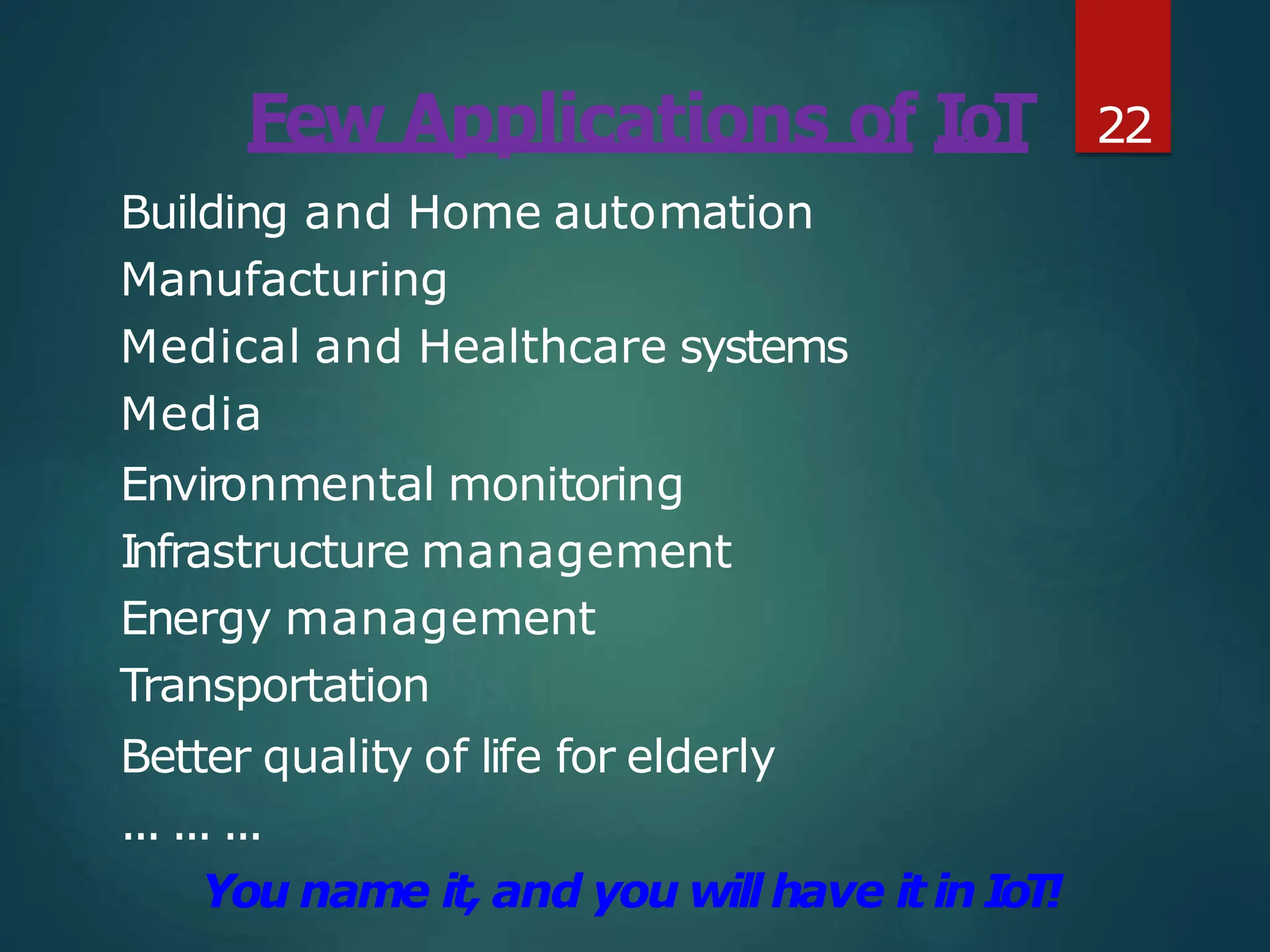
Few Applications of IoT
Building and Home automation
Manufacturing
Medical and Healthcare systems
Media
Environmental monitoring
Infrastructure management
Energy management
Transportation
Better quality of life for elderly
... ... ...
You name it, and you will have itinIoT!
22
23
24
25
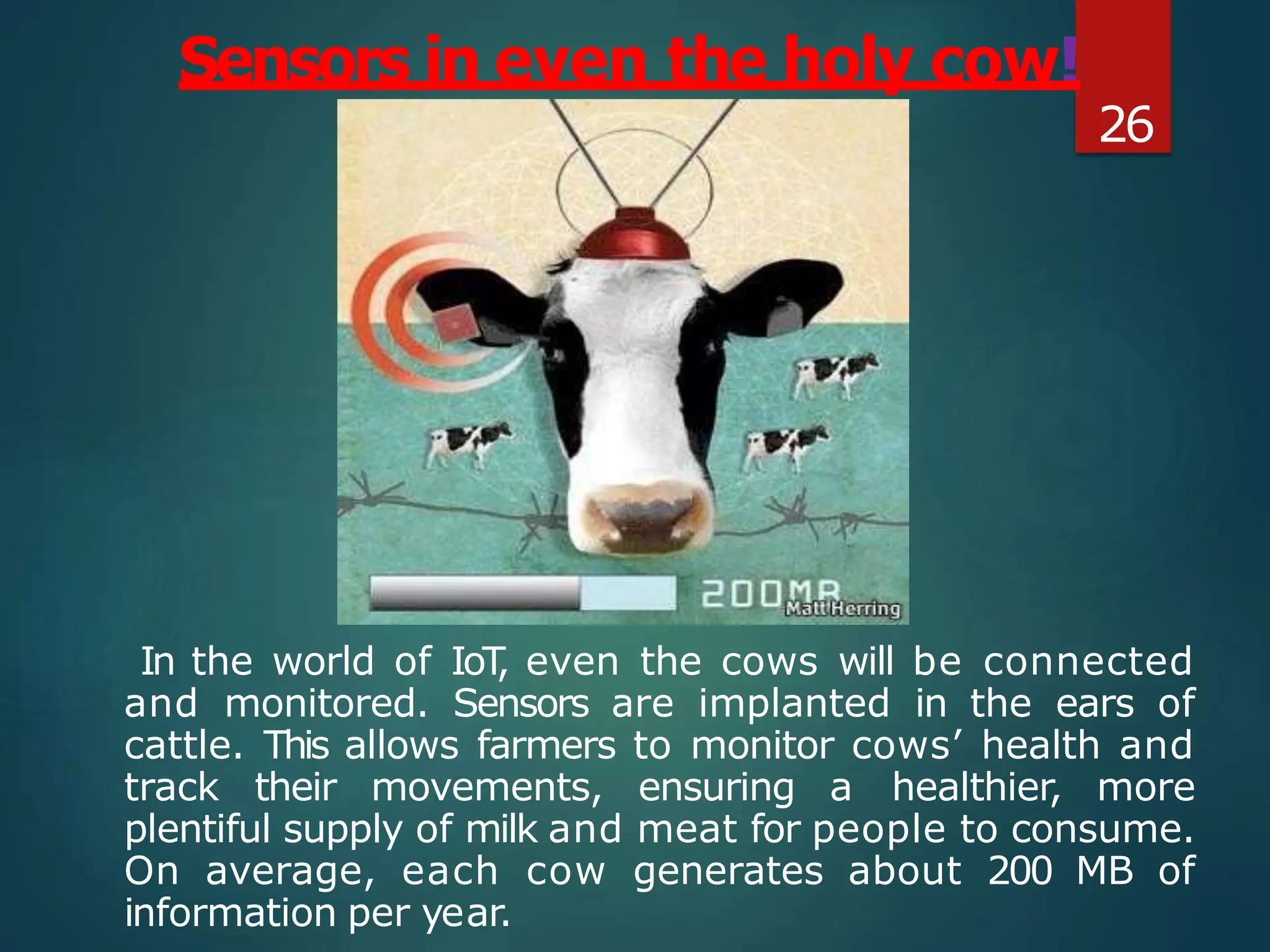
In the world of IoT
, even the cows will be connected
and monitored. Sensors are implanted in the ears of
cattle. This allows farmers to monitor cows’ health and
track their movements, ensuring a healthier, more
plentiful supply of milk and meat for people to consume.
On average, each cow generates about 200 MB of
information per year.
Sensors in even the holy cow!
26
27
28
29
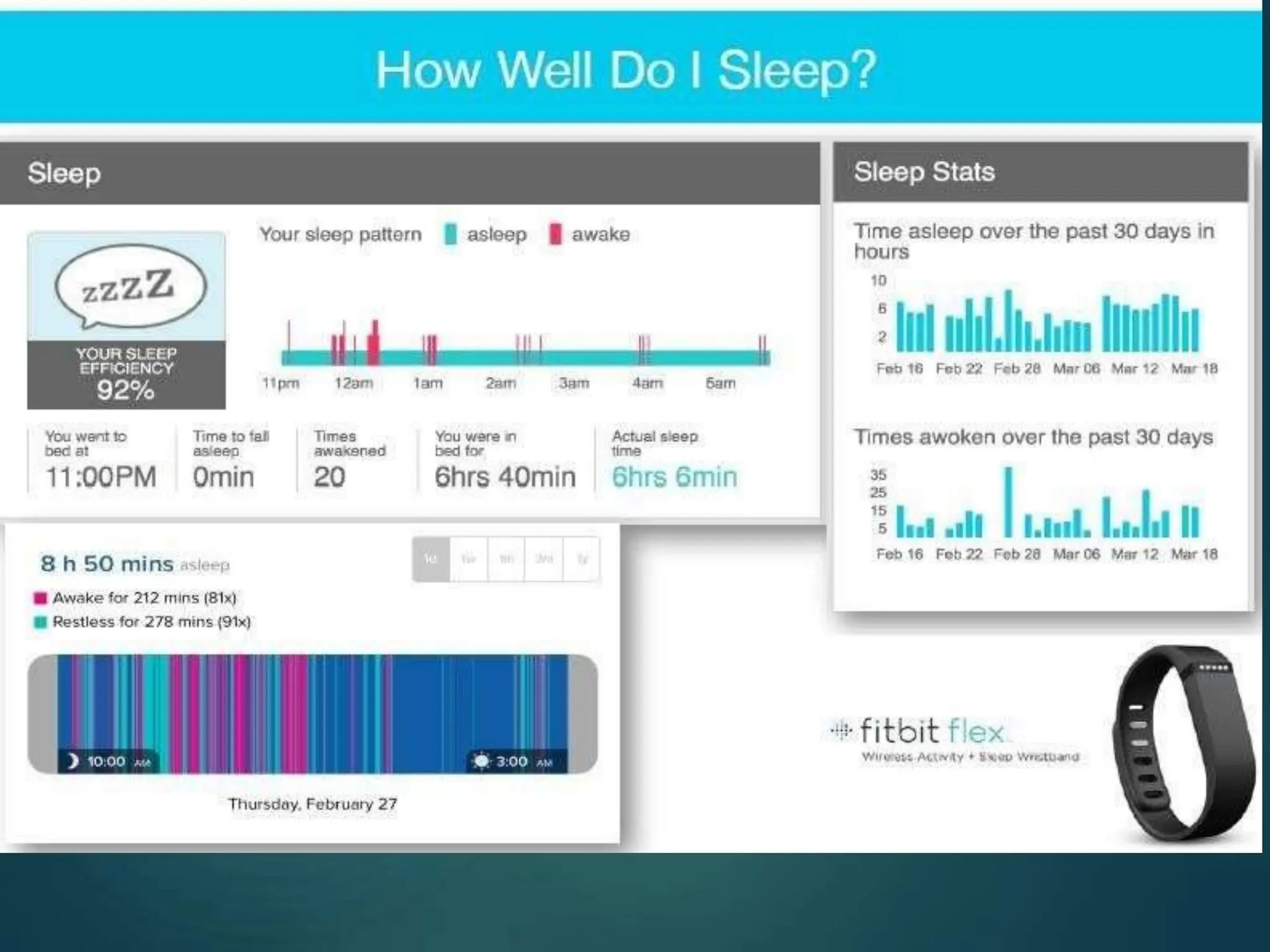
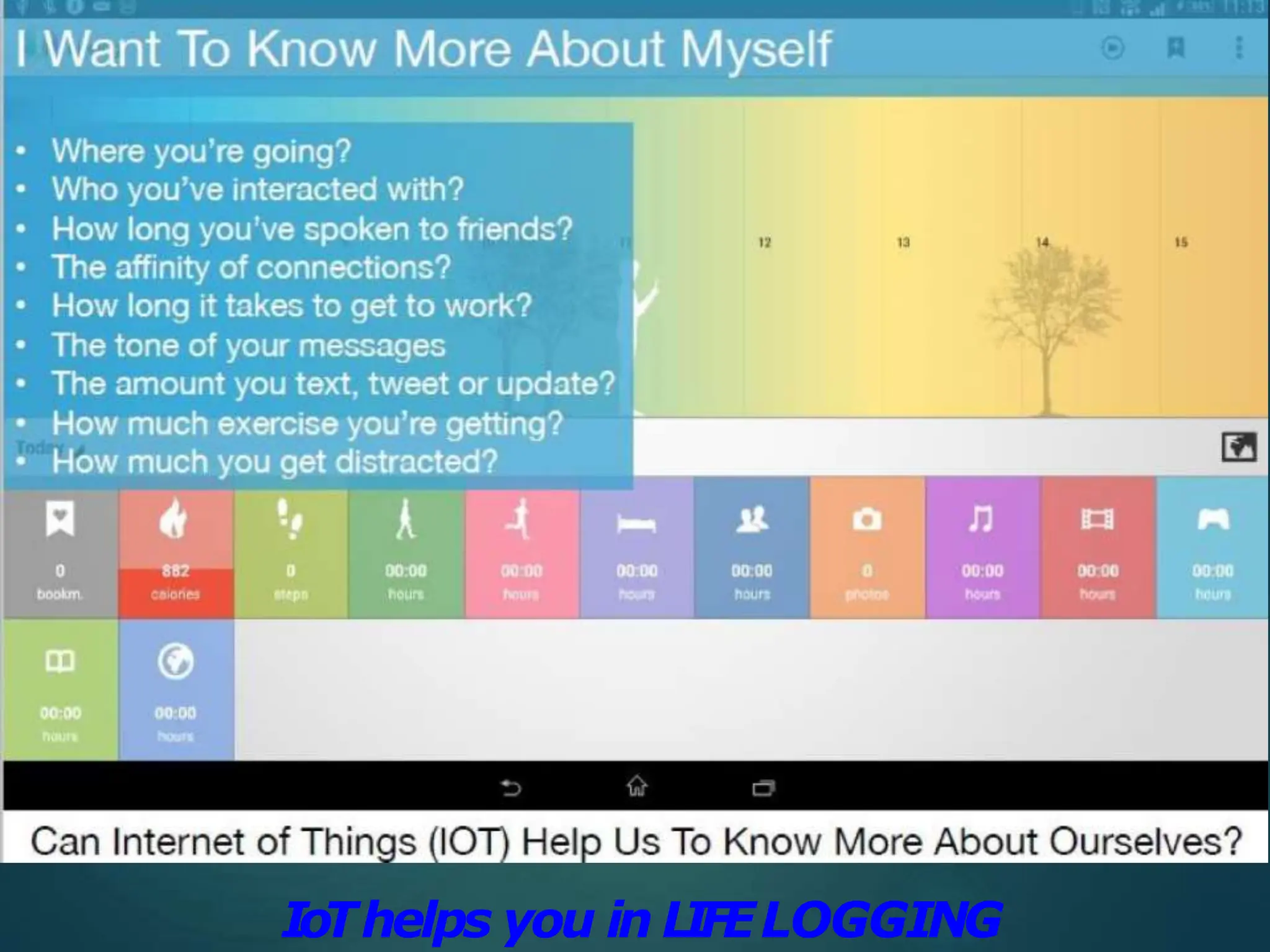
IoThelps you in L
I
FELOGGING
30
TECHNOLOGICAL CHALLENGES OF IOT
such as:
 Scalability
 Technological Standardization
 Inter operability
 Discovery
 Software complexity
 Data volumes and interpretation
 Power Supply
 Interaction and short range communication
 Wireless communication
 Fault tolerance
At present IoT is faced with many challenges3,1
32
Scholars and social observers and pessimists
have doubts about the promises of the
ubiquitous computing revolution, in the areas
as:
 Privacy
 Security
 Autonomy and Control
 Social control
 Political manipulation
 Design
 Environmental impact
 Influenceshuman moral decision making
Criticisms and Controversies of I
o
3
3
T
34
References
1. www.google.com
2.
3.
4.
https://en.wikipedia.org/wiki/Internet_of_Things
Cisco whitepaper, "The Internet of Things" - How the Next
Evolution of the Internet IsChanging Everything, by Dave
Evans, April 2011.
GE cloud expo 2014, "Industrial Internet as a Service", by
Shyam Varan Nath, Principal Architect.
5. Dr
. Mazlan Abbas, MIMOS Berhad, Wisma IEM, Petaling
Jaya
35
THANK YOU
36

Internet_of_things final.pptx very knowledgeable and. Good for learning

  • 1.
    Internet Of Things(IOT) SEMINAR PRESENTATION Name – Akash Shahi BSC(CS) 6th Sem 1
  • 2.
    What is IOT?2  The Internet of Things is the network of physical objects or "things" embedded with electronics, software, sensors, and network connectivity, which enables these objects to collect and exchange data.  It allows objects to be sensed and controlled remotely across existing network infrastructure, creating opportunities for more direct integration between the physical world and computer-based systems, and resulting in improved efficiency, accuracy and economic benefit.
  • 3.
      These devicescollect useful data with the help of various existing technologies and then autonomously flow the data between otherdevices. 3 "Things," in the IoT sense, can refer to a wide variety of devices such as heart monitoring implants, biochip transponders on farm animals, electric clams in coastal waters, automobiles with built-in sensors, DNA analysis devices for environmental/food/pathogen monitoring or field operation devices that assist fire-fighters in search and rescue operations.
  • 4.
    Where are wenow in 2021 ?
  • 5.
  • 6.
    Ecosystem components ▶ Devicemanufacturers ▶ Sensors/actuators, smart appliances ▶ Network service providers ▶ Operators, NMSproviders ▶ Cloud service providers ▶ Data centres, dBase, dWarehouse ▶ Platform providers ▶ Middleware providers, SDKs ▶ 3rd party application developers ▶ Analytics providers, tools, APIs IoT App
  • 7.
    Example ▶ General Electric(GE) deploys sensors in its jet engines, turbin wind farms. By analyzing data in real time, GE saves time and associated wipthredictivemaintenance. Io Ap
  • 8.
  • 9.
  • 10.
    History of IoT Theconcept of the Internet of Things first became popular in 1999, through the Auto-ID Center at MIT and related market- analysispublications. Radio-frequency identification (RFID) was seen as a prerequisite for the IoT at that point. If all objects and people in daily life were equipped with identifiers, computers could manage and inventory them. Besides using RFID, the tagging of things may be achieved through such technologies as near field communication, barcodes, QR codes, blue-tooth, and digital watermarking. 10
  • 11.
    How IOT Works? Internetof Things isnot the result of a single novel technology; instead, several complementary technical developments         provide capabilities that taken together help to bridge the gap between the virtual and physical world. These capabilities include: Communicationand cooperation Addressability Identification Sensing Actuation Embedded informationprocessing Localization User interfaces 11
  • 12.
    How IoT Works? 12 RFIDSensor Smart Tech Nano Tech To identify and track the data of things To collect and process the data to detect the changes in the physical status of things To enhance the power of the network by devolving processing capabilities to different part of the network. To make the smaller and smaller things have the ability to connect and interact.
  • 13.
    The Structure ofIoT 13 The IoT can be viewed as a gigantic network consisting of networksof devices and computers connected through a series of intermediate technologies where numerous technologies like RFIDs, wireless connections may act as enablers of thisconnectivity.  Tagging Things : Real-time item traceability and addressability by RFIDs.  Feeling Things:Sensorsact as primary devices to collect data from the environment.  Shrinking Things : Miniaturization and Nanotechnology has provoked the ability of smaller things to interact and connect within the “things” or “smart devices.”
  • 14.
     Thinking ThingsEmbedded intelligence
  • 15.
    Current Status &Future Prospect of I o 1 T 4 “Change is the only thing permanent in this world”
  • 16.
    IoT as aNetwork of Networks 1 : 5 with added security, These networks connected analytics, and management capabilities. T his will allow IoT to become even more powerful in what it
  • 17.
    Knowledge Management – TurningData into Wisdom 16 better The more data that is created, the understanding and wisdom people can obtain.
  • 18.
    The Future ofIoT 17 "TheSky's not the limit. It'sonly the beginning with IoT."
  • 19.
    The Potential ofIoT 18 GE’s estimates on potential of just ONE percent savings applied using IoT across global industry sectors.
  • 20.
    Unlock the Massivepotential of I o 1 9 T
  • 21.
  • 22.
    Applications of IoT "TheUltimateGoal of I OTis to Automate Human Life." 21
  • 23.
    Few Applications ofIoT Building and Home automation Manufacturing Medical and Healthcare systems Media Environmental monitoring Infrastructure management Energy management Transportation Better quality of life for elderly ... ... ... You name it, and you will have itinIoT! 22
  • 24.
  • 25.
  • 26.
  • 27.
    In the worldof IoT , even the cows will be connected and monitored. Sensors are implanted in the ears of cattle. This allows farmers to monitor cows’ health and track their movements, ensuring a healthier, more plentiful supply of milk and meat for people to consume. On average, each cow generates about 200 MB of information per year. Sensors in even the holy cow! 26
  • 28.
  • 29.
  • 30.
    29 IoThelps you inL I FELOGGING
  • 31.
  • 32.
    TECHNOLOGICAL CHALLENGES OFIOT such as:  Scalability  Technological Standardization  Inter operability  Discovery  Software complexity  Data volumes and interpretation  Power Supply  Interaction and short range communication  Wireless communication  Fault tolerance At present IoT is faced with many challenges3,1
  • 33.
  • 34.
    Scholars and socialobservers and pessimists have doubts about the promises of the ubiquitous computing revolution, in the areas as:  Privacy  Security  Autonomy and Control  Social control  Political manipulation  Design  Environmental impact  Influenceshuman moral decision making Criticisms and Controversies of I o 3 3 T
  • 35.
  • 36.
    References 1. www.google.com 2. 3. 4. https://en.wikipedia.org/wiki/Internet_of_Things Cisco whitepaper,"The Internet of Things" - How the Next Evolution of the Internet IsChanging Everything, by Dave Evans, April 2011. GE cloud expo 2014, "Industrial Internet as a Service", by Shyam Varan Nath, Principal Architect. 5. Dr . Mazlan Abbas, MIMOS Berhad, Wisma IEM, Petaling Jaya 35
  • 37.