IoT Enabling Technologies
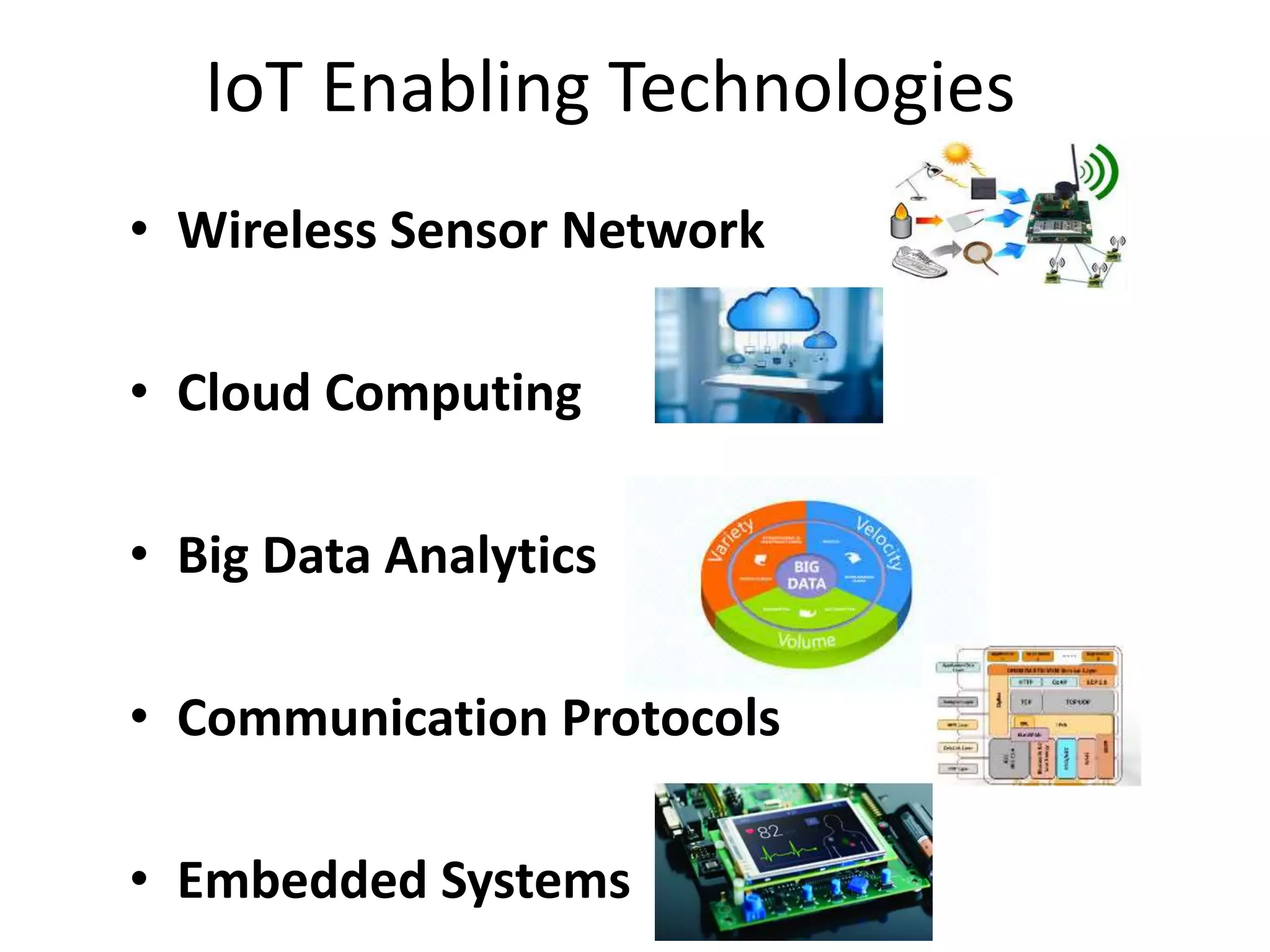
• Wireless Sensor Network
• Cloud Computing
• Big Data Analytics
• Communication Protocols
• Embedded Systems
1. Wireless Sensor Network
•Distributed Devices with sensors used to monitor the
environmental and physical conditions
Or
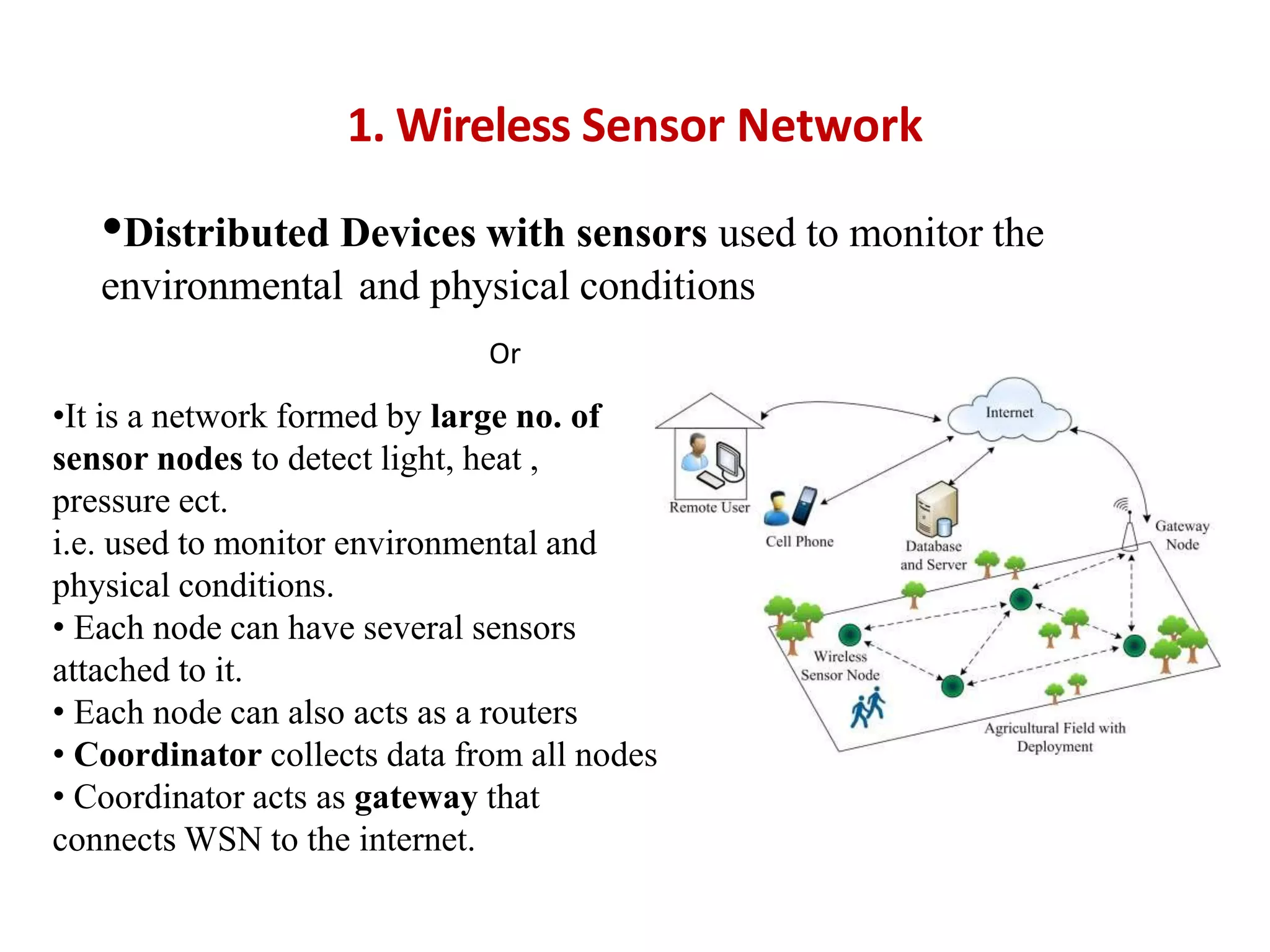
•It is a network formed by large no. of
sensor nodes to detect light, heat ,
pressure ect.
i.e. used to monitor environmental and
physical conditions.
• Each node can have several sensors
attached to it.
• Each node can also acts as a routers
• Coordinator collects data from all nodes
• Coordinator acts as gateway that
connects WSN to the internet.
Examples of WSNs
• Indoor Air Quality Monitoring system
• Weather Monitoring System
• Soil Moisture Monitoring System
• Survelliance Systems
• Health Monitoring Systems
Protocols used
WSNs are enabled by wireless communication protocols such as
IEEE802.15.4
Zigbee is one of the most popular wireless technology used by WSNs.
Zigbee specifications are based on IEEE802.15.4 which is used for
low powered devices.
Data rate: up to 250KBps. Range: upto 100 Meters
2. Cloud Computing
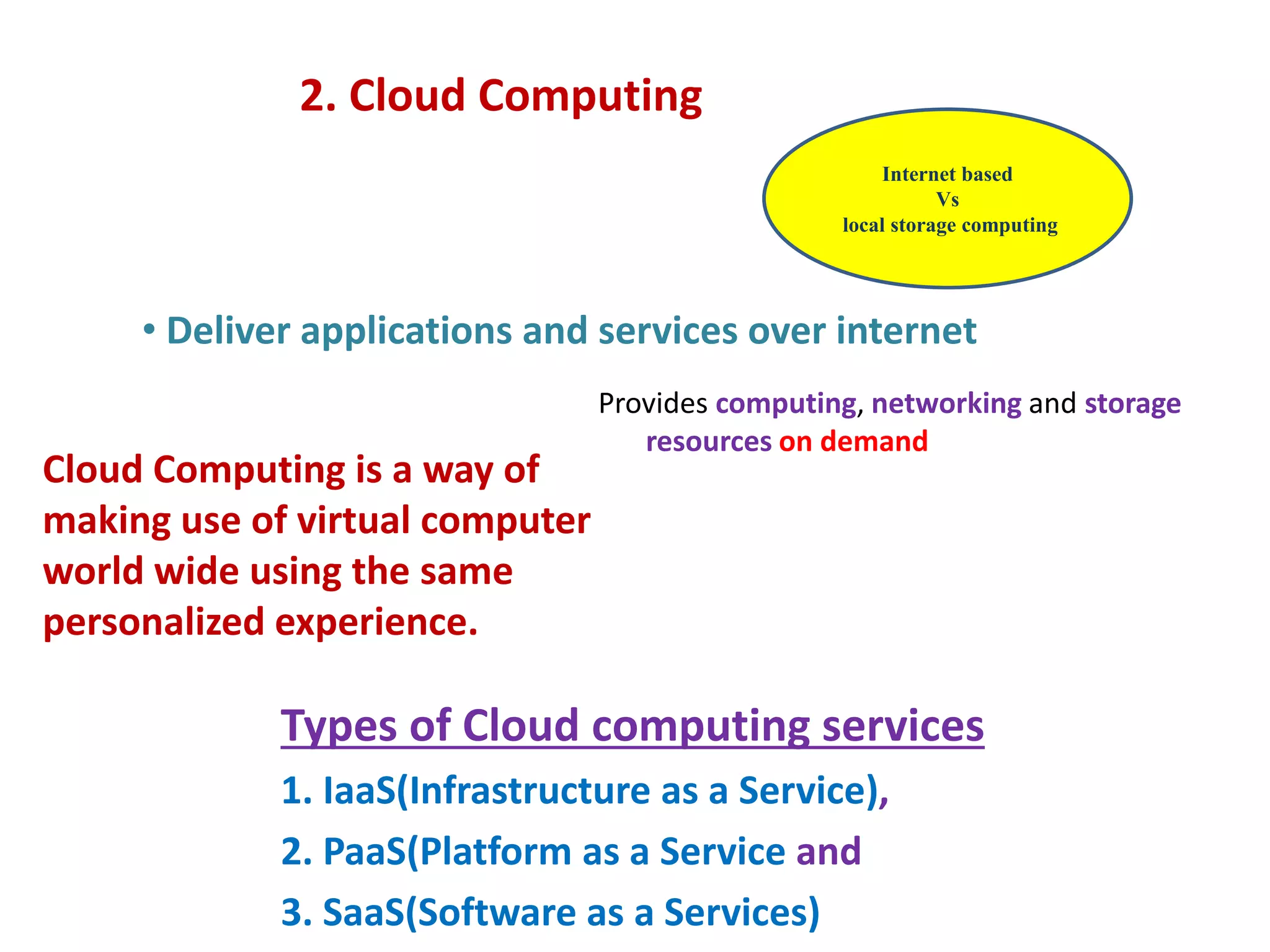
• Deliver applications and services over internet
Internet based
Vs
local storage computing
Cloud Computing is a way of
making use of virtual computer
world wide using the same
personalized experience.
Types of Cloud computing services
1. IaaS(Infrastructure as a Service),
2. PaaS(Platform as a Service and
3. SaaS(Software as a Services)
Provides computing, networking and storage
resources on demand
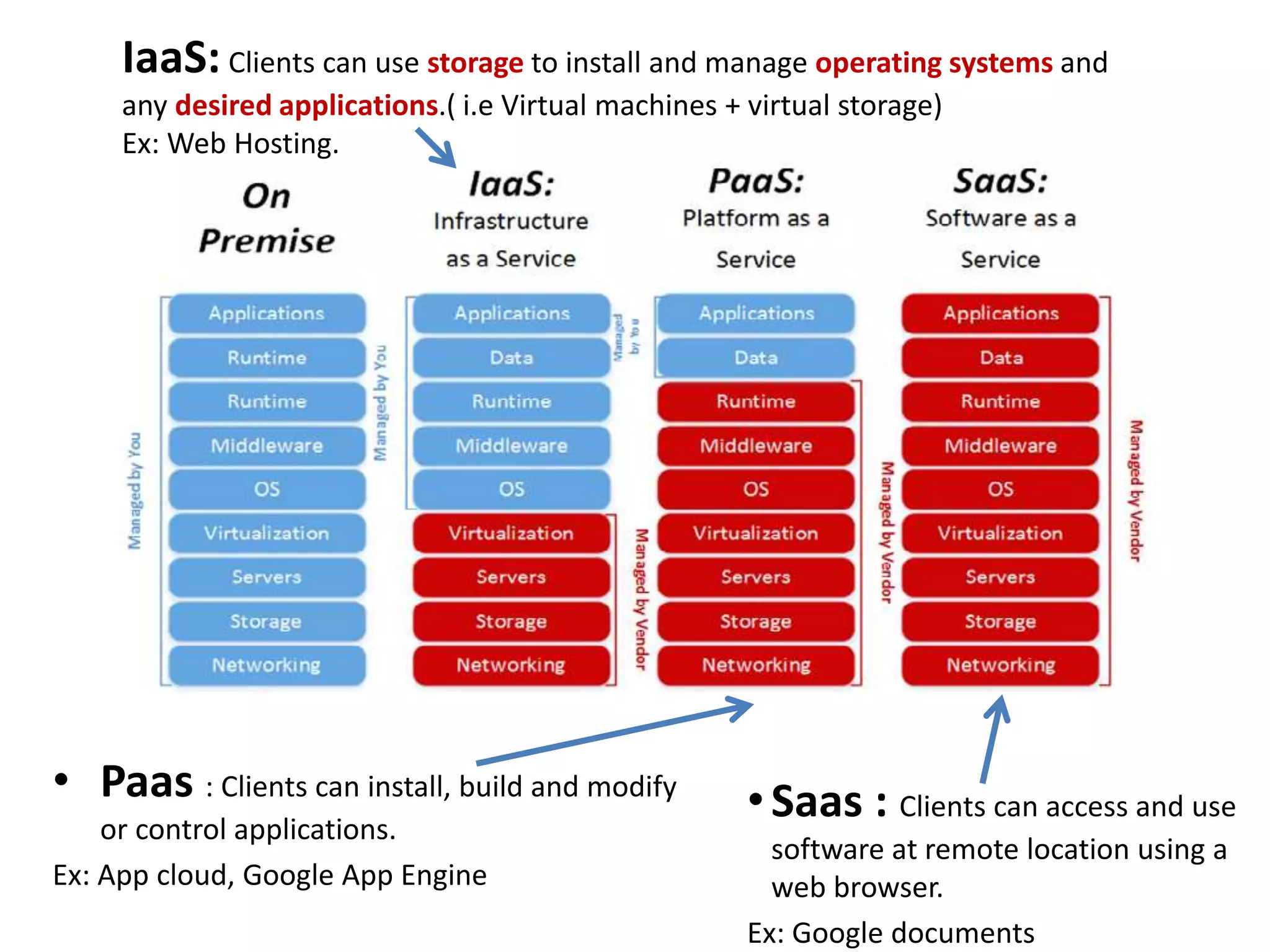
•Saas : Clients can access and use
software at remote location using a
web browser.
Ex: Google documents
• Paas : Clients can install, build and modify
or control applications.
Ex: App cloud, Google App Engine
IaaS: Clients can use storage to install and manage operating systems and
any desired applications.( i.e Virtual machines + virtual storage)
Ex: Web Hosting.
1. It doesn’t require you to maintain or manage it(no need to have an IT
expert).
2. Effectively infinite size, so no need to worry about running out of capacity.
3. You can access cloud based applications and services from anywhere(
Device independent ).
Benefits of Cloud Computing
2. Big Data Analytics
• Collection of data whose volume, velocity or variety is too
large and difficult to store, manage, process and analyze
the data using traditional databases.
Data cleansing
Data munging (Data Wrangling)
Data Processing and
Data Visualization
Correcting
Removing
Replacing
Converting data
from one format to
other
Big data Analytics involves
Big Data Analytics
Structured
Unstructured
Semi-Structured
All of above
-text, audio , video
Batch
Real-time
Streams
Terabyte
Records
Transactions
Files
Tables
VarietyIncludes different types of data
Characteristics of Big Data is 3V
VelocityRefers to speed at which data
is processed
Volumerefers to the amount of data
Acc to IBM in 2012: 2.5 Billion GB
data was generated everyday!
Forbes states: in 2020, 1.7 MB of
new information is will be created
• Lots of data is being collected and warehoused
• Web data, e-commerce
• purchases at department/ grocery stores
• Bank/Credit Card transactions
• Social Network
Examples
3. Communication Protocols
• Backbone of IOT system
•Allows devices to exchange data over networks.
• Define data exchange formats
- Data encoding
- Addressing Schemes
- Routing of packets from sources to destination
• Other Functions
- Sequence control(ordering data packets)
- Flow control(controlling transfer rate)
- Retransmission of lost packets
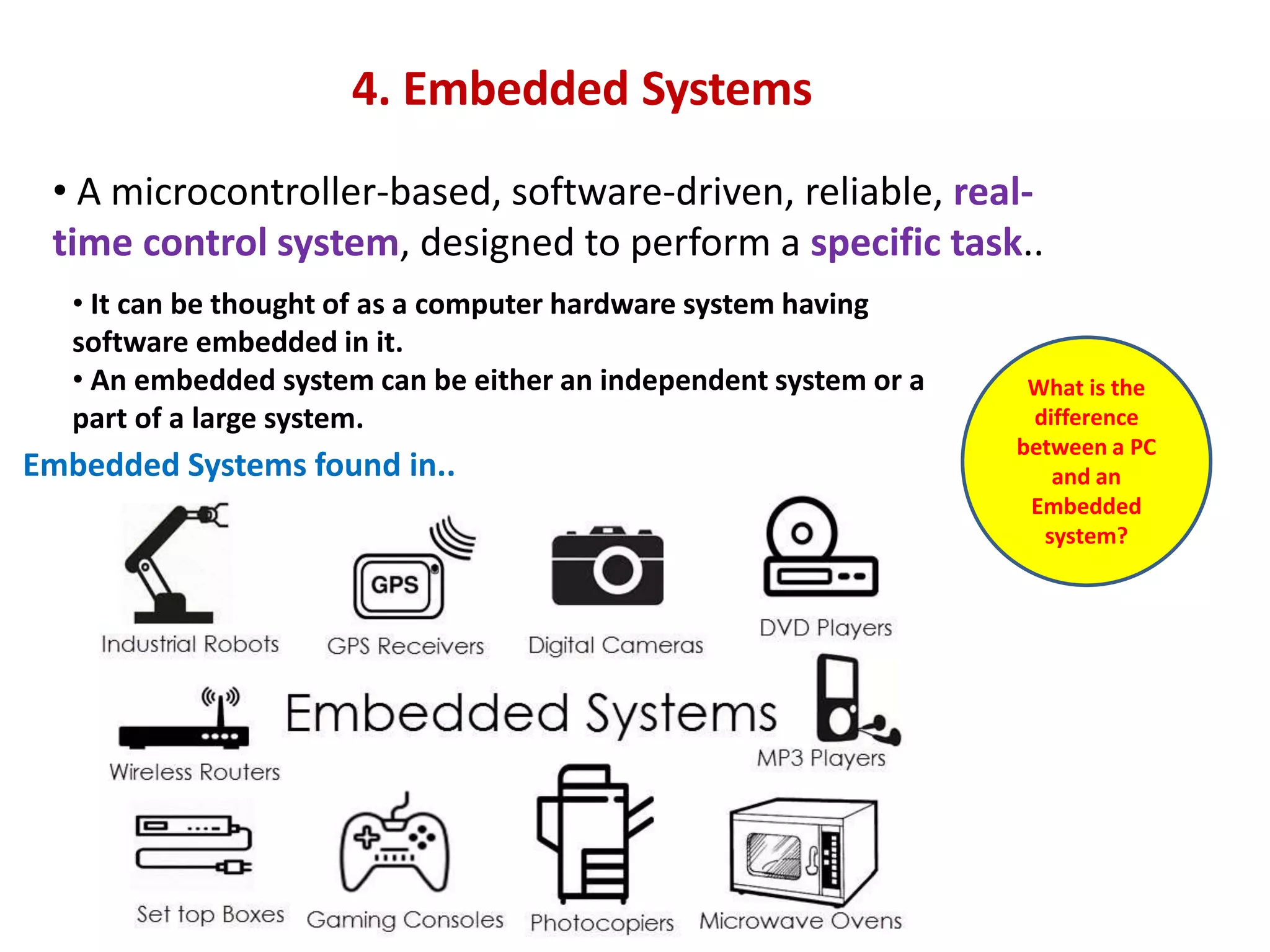
4. Embedded Systems
• A microcontroller-based, software-driven, reliable, real-
time control system, designed to perform a specific task..
What is the
difference
between a PC
and an
Embedded
system?
Embedded Systems found in..
• It can be thought of as a computer hardware system having
software embedded in it.
• An embedded system can be either an independent system or a
part of a large system.
Key Components
• Microprocessor or micro controller
• Memory (RAM, ROM ect.)
• Storage ( Flash Memory)
• Networking units(Ethernet, Wifi adaptors )
• I/O units ( Keyboard, display ect)
Some Embedded systems have
• DSP(Digital Signal Processor)
• Graphics Processor
• App Specific Processor
•Embedded systems run embedded OS
Ex: RTOS(Real Time OS)(like symbian, Vxworks , Windows
embedded compact ect.)

IoT Enabling Technologies

  • 1.
    IoT Enabling Technologies •Wireless Sensor Network • Cloud Computing • Big Data Analytics • Communication Protocols • Embedded Systems
  • 2.
    1. Wireless SensorNetwork •Distributed Devices with sensors used to monitor the environmental and physical conditions Or •It is a network formed by large no. of sensor nodes to detect light, heat , pressure ect. i.e. used to monitor environmental and physical conditions. • Each node can have several sensors attached to it. • Each node can also acts as a routers • Coordinator collects data from all nodes • Coordinator acts as gateway that connects WSN to the internet.
  • 3.
    Examples of WSNs •Indoor Air Quality Monitoring system • Weather Monitoring System • Soil Moisture Monitoring System • Survelliance Systems • Health Monitoring Systems Protocols used WSNs are enabled by wireless communication protocols such as IEEE802.15.4 Zigbee is one of the most popular wireless technology used by WSNs. Zigbee specifications are based on IEEE802.15.4 which is used for low powered devices. Data rate: up to 250KBps. Range: upto 100 Meters
  • 4.
    2. Cloud Computing •Deliver applications and services over internet Internet based Vs local storage computing Cloud Computing is a way of making use of virtual computer world wide using the same personalized experience. Types of Cloud computing services 1. IaaS(Infrastructure as a Service), 2. PaaS(Platform as a Service and 3. SaaS(Software as a Services) Provides computing, networking and storage resources on demand
  • 5.
    •Saas : Clientscan access and use software at remote location using a web browser. Ex: Google documents • Paas : Clients can install, build and modify or control applications. Ex: App cloud, Google App Engine IaaS: Clients can use storage to install and manage operating systems and any desired applications.( i.e Virtual machines + virtual storage) Ex: Web Hosting.
  • 6.
    1. It doesn’trequire you to maintain or manage it(no need to have an IT expert). 2. Effectively infinite size, so no need to worry about running out of capacity. 3. You can access cloud based applications and services from anywhere( Device independent ). Benefits of Cloud Computing
  • 7.
    2. Big DataAnalytics • Collection of data whose volume, velocity or variety is too large and difficult to store, manage, process and analyze the data using traditional databases. Data cleansing Data munging (Data Wrangling) Data Processing and Data Visualization Correcting Removing Replacing Converting data from one format to other Big data Analytics involves
  • 8.
    Big Data Analytics Structured Unstructured Semi-Structured Allof above -text, audio , video Batch Real-time Streams Terabyte Records Transactions Files Tables VarietyIncludes different types of data Characteristics of Big Data is 3V VelocityRefers to speed at which data is processed Volumerefers to the amount of data Acc to IBM in 2012: 2.5 Billion GB data was generated everyday! Forbes states: in 2020, 1.7 MB of new information is will be created
  • 9.
    • Lots ofdata is being collected and warehoused • Web data, e-commerce • purchases at department/ grocery stores • Bank/Credit Card transactions • Social Network Examples
  • 10.
    3. Communication Protocols •Backbone of IOT system •Allows devices to exchange data over networks. • Define data exchange formats - Data encoding - Addressing Schemes - Routing of packets from sources to destination • Other Functions - Sequence control(ordering data packets) - Flow control(controlling transfer rate) - Retransmission of lost packets
  • 11.
    4. Embedded Systems •A microcontroller-based, software-driven, reliable, real- time control system, designed to perform a specific task.. What is the difference between a PC and an Embedded system? Embedded Systems found in.. • It can be thought of as a computer hardware system having software embedded in it. • An embedded system can be either an independent system or a part of a large system.
  • 12.
    Key Components • Microprocessoror micro controller • Memory (RAM, ROM ect.) • Storage ( Flash Memory) • Networking units(Ethernet, Wifi adaptors ) • I/O units ( Keyboard, display ect) Some Embedded systems have • DSP(Digital Signal Processor) • Graphics Processor • App Specific Processor •Embedded systems run embedded OS Ex: RTOS(Real Time OS)(like symbian, Vxworks , Windows embedded compact ect.)