IoT Application Development
Trends to Watch Out in 2021
IoT, a term that not many businesses were aware of a decade ago, has now
become a vital technology for improving monitoring, enhancing security and
enabling proactive decision making in diverse industries. From Banking and
Finance to Manufacturing and E-Commerce, businesses have successfully
established industry-specific IoT use cases to make steep progress.
With its market size poised to reach the 1.6 trillion mark by 2025, new and
emerging businesses have also started to find opportunities to scale up with IoT
solution implementation. It is important to note that IoT use cases will continue to
expand in the years to come, however, in this article we have compiled the list of
four IoT use cases/trends that are being leveraged in by a broad-range of
industries.
List of Four IoT Use Cases
• Predictive Maintenance
• Smart Metering
• Asset Tracking
• IoT in Healthcare
Predictive Maintenance
It is important to keep business assets –
power plants, solar panels, quality control
machines, etc. up and running. However, in
cases when the specific assets are non-
operational or perform low, it increases the
operational expenditure and affects the
quality/performance of machines. By
leveraging predictive maintenance engines
developed by IoT solution providers,
businesses address the performance issues
much quicker.
Smart Metering
Smart meters are internet-enabled devices that measure
energy, water or power consumption in a home or a
building.
Such IoT Services are incorporated by power companies to
monitor consumer usage and to adjust prices based on the
power consumption. The data received is used for reducing
energy theft, enhancing power monitoring, improving
forecasting, and to manage operations remotely. The use
of smart meters are proving to be a game-changer for
power companies as they monitor energy utilization levels
of organizations/individuals.
Asset Tracking
Asset tracking IoT services are indispensable for most shipping businesses and
manufacturing firms. Efficiently tracking the location of goods and fleet in real-
time, these asset tracking applications are the new normal for shipping
businesses. By including an asset tracking application in business setup, logistics
and supply chain operations are streamlined as delivery is done on time while the
inventory levels are also maintained with ease.
Some shipment companies leverage internet-enabled asset tracking software that
uses sensors to give real-time temperature information of containers. Thus with
regulated temperature, perishable goods are kept fresh for longer durations.
However, only a small proportion – around 15% of those businesses actually have
a proper asset tracking software in place, though the percentage is surely going to
rise with more IoT solution providers raising the levels of their IoT services.
IoT in Healthcare
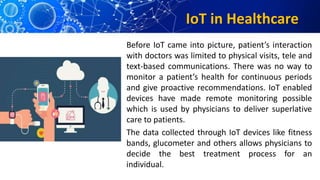
Before IoT came into picture, patient’s interaction
with doctors was limited to physical visits, tele and
text-based communications. There was no way to
monitor a patient’s health for continuous periods
and give proactive recommendations. IoT enabled
devices have made remote monitoring possible
which is used by physicians to deliver superlative
care to patients.
The data collected through IoT devices like fitness
bands, glucometer and others allows physicians to
decide the best treatment process for an
individual.
In a Nutshell
Incorporating an IoT solution in the business setup
enables real-time data access and performance
monitoring for enterprises. Moreover, with the use
of other transforming technologies including AI and
Blockchain with IoT enabled solutions, organizations
experience more accurate and secure data access in
an IoT network. However, the world of IoT enabled
devices continues to expand as businesses come up
with new industry-specific use cases.
Source Url:-
https://datafloq.com/read/iot-application-development-trends-
watch-out-2021/9162

IoT Application Development Trends to Watch Out in 2021

  • 1.
  • 2.
    IoT, a termthat not many businesses were aware of a decade ago, has now become a vital technology for improving monitoring, enhancing security and enabling proactive decision making in diverse industries. From Banking and Finance to Manufacturing and E-Commerce, businesses have successfully established industry-specific IoT use cases to make steep progress. With its market size poised to reach the 1.6 trillion mark by 2025, new and emerging businesses have also started to find opportunities to scale up with IoT solution implementation. It is important to note that IoT use cases will continue to expand in the years to come, however, in this article we have compiled the list of four IoT use cases/trends that are being leveraged in by a broad-range of industries.
  • 3.
    List of FourIoT Use Cases • Predictive Maintenance • Smart Metering • Asset Tracking • IoT in Healthcare
  • 4.
    Predictive Maintenance It isimportant to keep business assets – power plants, solar panels, quality control machines, etc. up and running. However, in cases when the specific assets are non- operational or perform low, it increases the operational expenditure and affects the quality/performance of machines. By leveraging predictive maintenance engines developed by IoT solution providers, businesses address the performance issues much quicker.
  • 5.
    Smart Metering Smart metersare internet-enabled devices that measure energy, water or power consumption in a home or a building. Such IoT Services are incorporated by power companies to monitor consumer usage and to adjust prices based on the power consumption. The data received is used for reducing energy theft, enhancing power monitoring, improving forecasting, and to manage operations remotely. The use of smart meters are proving to be a game-changer for power companies as they monitor energy utilization levels of organizations/individuals.
  • 6.
    Asset Tracking Asset trackingIoT services are indispensable for most shipping businesses and manufacturing firms. Efficiently tracking the location of goods and fleet in real- time, these asset tracking applications are the new normal for shipping businesses. By including an asset tracking application in business setup, logistics and supply chain operations are streamlined as delivery is done on time while the inventory levels are also maintained with ease. Some shipment companies leverage internet-enabled asset tracking software that uses sensors to give real-time temperature information of containers. Thus with regulated temperature, perishable goods are kept fresh for longer durations. However, only a small proportion – around 15% of those businesses actually have a proper asset tracking software in place, though the percentage is surely going to rise with more IoT solution providers raising the levels of their IoT services.
  • 7.
    IoT in Healthcare BeforeIoT came into picture, patient’s interaction with doctors was limited to physical visits, tele and text-based communications. There was no way to monitor a patient’s health for continuous periods and give proactive recommendations. IoT enabled devices have made remote monitoring possible which is used by physicians to deliver superlative care to patients. The data collected through IoT devices like fitness bands, glucometer and others allows physicians to decide the best treatment process for an individual.
  • 8.
    In a Nutshell Incorporatingan IoT solution in the business setup enables real-time data access and performance monitoring for enterprises. Moreover, with the use of other transforming technologies including AI and Blockchain with IoT enabled solutions, organizations experience more accurate and secure data access in an IoT network. However, the world of IoT enabled devices continues to expand as businesses come up with new industry-specific use cases.
  • 9.