

Integrating Consumer IoT 
Devices Into Business 
Workflow 
by Yakov Fain, Farata Systems
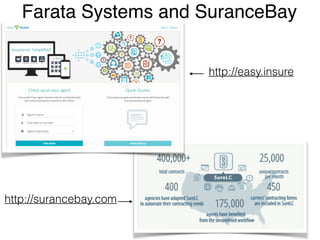
Farata Systems and SuranceBay 
http://easy.insure 
http://surancebay.com
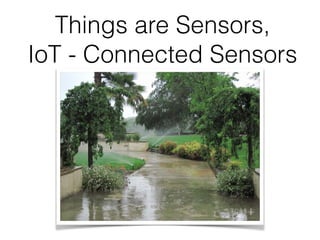
Things are Sensors, 
IoT - Connected Sensors
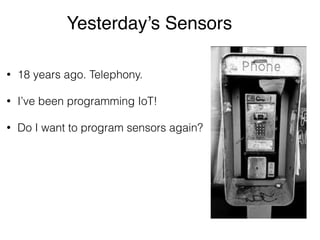
Yesterday’s Sensors 
• 18 years ago. Telephony. 
• I’ve been programming IoT! 
• Do I want to program sensors again?
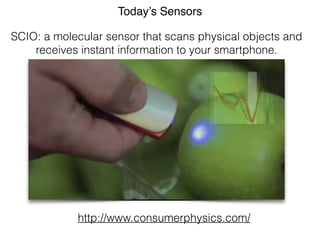
Today’s Sensors 
SCIO: a molecular sensor that scans physical objects and 
receives instant information to your smartphone. 
http://www.consumerphysics.com/
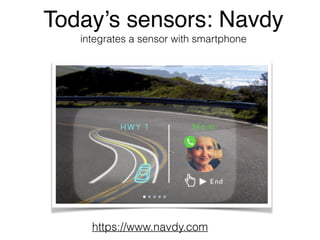
Today’s sensors: Navdy 
integrates a sensor with smartphone 
https://www.navdy.com
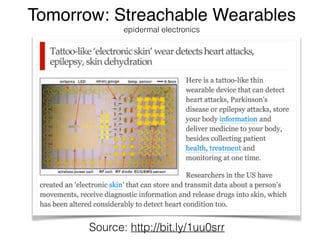
Tomorrow: Streachable Wearables 
epidermal electronics 
Source: http://bit.ly/1uu0srr
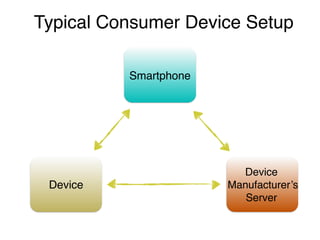
Typical Consumer Device Setup 
Smartphone 
Device 
Manufacturer’s 
Server 
Device
How to get involved with IoT? 
Going after thousands of vendors of things? 
Which protocols: MQTP, XMPP, CoAP? 
Buy Raspberry Pi or Arduino? 
Learn HomeKit and HealthKit from Apple?
How to get involved with IoT? 
Creating an exensive cloud-based IoT 
platform
How to get involved with IoT? 
Create custom-made solutions 
integrating things into an existing 
business workflow.
Why?
Why? 
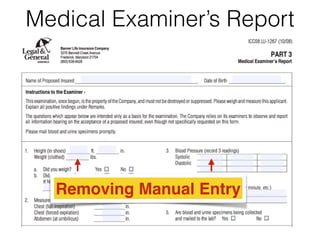
Manual Data Entry
Enterprise IoT is about 
automation of collecting and 
processing data required in 
the business workflow.
What we’re working on 
• integrating consumer devices into insurance business 
workflow 
• leveraging existing software technologies 
• creating a standard-based application layer that connects 
things
Things Oriented Middleware (TOM) 
• Build a layer in the middle of things. 
• Use consumer things in enterprise applications. " 
• Side benefit: being in the middle allows having valuable 
data for analisys.
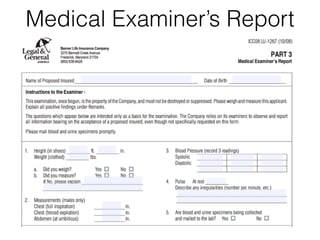
Medical Examiner’s Report
Medical Examiner’s Report 
Removing Manual Entry
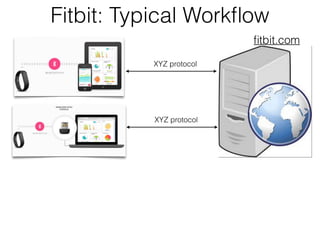
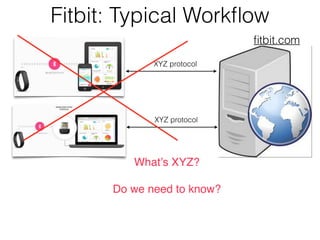
Fitbit: Typical Workflow 
fitbit.com 
XYZ protocol 
XYZ protocol
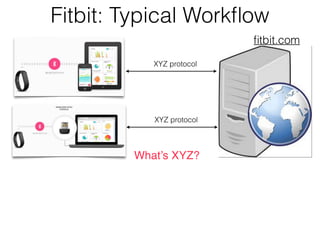
Fitbit: Typical Workflow 
fitbit.com 
XYZ protocol 
XYZ protocol 
What’s XYZ?
Fitbit: Typical Workflow 
fitbit.com 
XYZ protocol 
XYZ protocol 
What’s XYZ? 
Do we need to know?
What do we use for Integration 
• RESTful Web services 
• OAuth authentication 
• WebSocket protocol 
• JSON data format 
• Java servers 
• HTML5/JavaScript
What do we use for integration 
• RESTful Web services 
• OAuth authentication 
• WebSocket protocol 
• JSON data format 
• Java servers 
• HTML5/JavaScript 
Our recent book
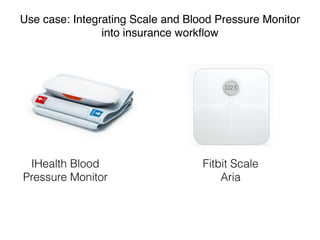
Use case: Integrating Scale and Blood Pressure Monitor 
into insurance workflow 
IHealth Blood 
Pressure Monitor 
Fitbit Scale 
Aria
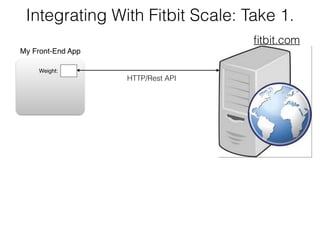
Integrating With Fitbit Scale: Take 1. 
fitbit.com 
My Front-End App 
HTTP/Rest API 
Weight:
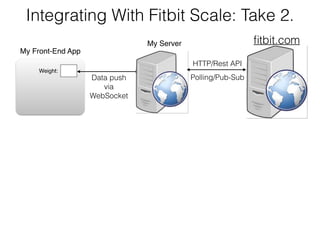
Integrating With Fitbit Scale: Take 2. 
fitbit.com 
HTTP/Rest API 
My Front-End App 
Weight: 
My Server 
Data push Polling/Pub-Sub 
via 
WebSocket
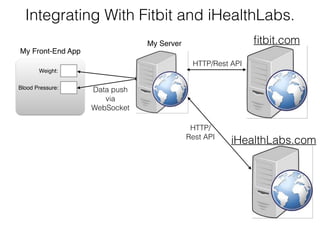
Integrating With Fitbit and iHealthLabs. 
fitbit.com 
Weight: 
iHealthLabs.com 
HTTP/ 
Rest API 
Blood Pressure: 
HTTP/Rest API 
Data push 
via 
WebSocket 
My Front-End App 
My Server
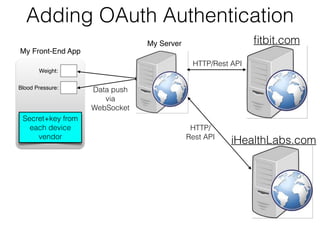
Adding OAuth Authentication 
fitbit.com 
My Front-End App 
Weight: 
iHealthLabs.com 
HTTP/ 
Rest API 
Blood Pressure: 
HTTP/Rest API 
Secret+key from 
each device 
vendor 
My Server 
Data push 
via 
WebSocket
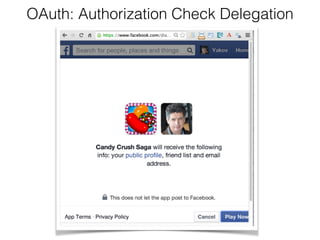
OAuth: Authorization Check Delegation
The OAuth Workflow 
• My company builds an app to use the thing’s API (e.g. with REST )
The OAuth Workflow 
• My company builds an app to use the thing’s API (e.g. with REST ) 
• My company registers the app with the thing’s vendor and receives an id and 
a secret.
The OAuth Workflow 
• My company builds an app to use the thing’s API (e.g. with REST ) 
• My company registers the app with the thing’s vendor and receives an id 
and a secret. 
• The thing’s owner opens my app and logs into thing’s vendor site.
The OAuth Workflow 
• My company builds an app to use the thing’s API (e.g. with REST ) 
• My company registers the app with the thing’s vendor and receives an id 
and a secret. 
• The thing’s owner opens the my app and logs into thing’s vendor site. 
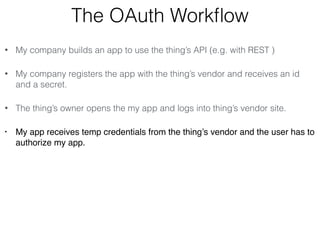
• My app receives temp credentials from the thing’s vendor and the user has to 
authorize my app.
The OAuth Workflow 
• My company builds an app to use the thing’s API (e.g. with REST ) 
• My company registers the app with the thing’s vendor and receives an id and 
a secret. 
• The thing’s owner opens my app and logs into thing’s vendor site. 
• My app receives temp credentials from the thing’s vendor and the user has to 
authorize my app. 
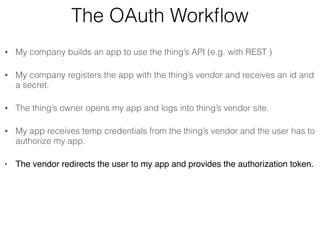
• The vendor redirects the user to my app and provides the authorization token.
The OAuth Workflow 
• My company builds an app to use the thing’s API (e.g. with REST ) 
• My company registers the app with the thing’s vendor and receives an id and 
a secret. 
• The thing’s owner opens the my app and logs into thing’s vendor site. 
• My app receives temp credentials from the thing’s vendor and the user has to 
authorize my app. 
• The vendor redirects the user to my app and provides the authorization token. 
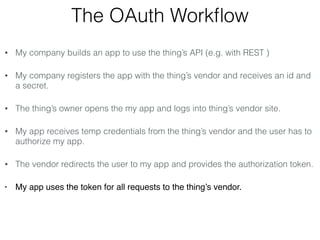
• My app uses the token for all requests to the thing’s vendor.
© 2014 Farata Systems 
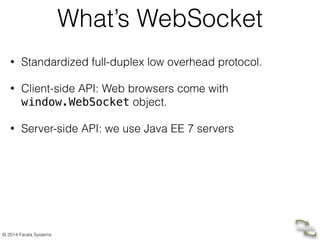
What’s WebSocket 
• Standardized full-duplex low overhead protocol. 
• Client-side API: Web browsers come with 
window.WebSocket object. 
• Server-side API: we use Java EE 7 servers
What about security? 
• We don’t deal with security between the thing and its 
vendor. 
• Our apps are as as secure as any other app that uses 
OAuth/REST services.
Demo: removingmanual entry of blood 
pressure and weight measurements.
Contact Info and Links 
• email: yfain@faratasystems.com" 
• Farata Systems: faratasystems.com" 
• SuranceBay: surancebay.com" 
• Find and rate insurance agents: easy.insure " 
• Twitter: @yfain" 
• Personal blog: yakovfain.com

Integrating consumers IoT devices into Business Workflow

  • 1.
    Integrating Consumer IoT Devices Into Business Workflow by Yakov Fain, Farata Systems
  • 2.
    Farata Systems andSuranceBay http://easy.insure http://surancebay.com
  • 3.
    Things are Sensors, IoT - Connected Sensors
  • 4.
    Yesterday’s Sensors •18 years ago. Telephony. • I’ve been programming IoT! • Do I want to program sensors again?
  • 5.
    Today’s Sensors SCIO:a molecular sensor that scans physical objects and receives instant information to your smartphone. http://www.consumerphysics.com/
  • 6.
    Today’s sensors: Navdy integrates a sensor with smartphone https://www.navdy.com
  • 7.
    Tomorrow: Streachable Wearables epidermal electronics Source: http://bit.ly/1uu0srr
  • 8.
    Typical Consumer DeviceSetup Smartphone Device Manufacturer’s Server Device
  • 9.
    How to getinvolved with IoT? Going after thousands of vendors of things? Which protocols: MQTP, XMPP, CoAP? Buy Raspberry Pi or Arduino? Learn HomeKit and HealthKit from Apple?
  • 10.
    How to getinvolved with IoT? Creating an exensive cloud-based IoT platform
  • 11.
    How to getinvolved with IoT? Create custom-made solutions integrating things into an existing business workflow.
  • 13.
  • 14.
  • 15.
    Enterprise IoT isabout automation of collecting and processing data required in the business workflow.
  • 16.
    What we’re workingon • integrating consumer devices into insurance business workflow • leveraging existing software technologies • creating a standard-based application layer that connects things
  • 17.
    Things Oriented Middleware(TOM) • Build a layer in the middle of things. • Use consumer things in enterprise applications. " • Side benefit: being in the middle allows having valuable data for analisys.
  • 18.
  • 19.
    Medical Examiner’s Report Removing Manual Entry
  • 20.
    Fitbit: Typical Workflow fitbit.com XYZ protocol XYZ protocol
  • 21.
    Fitbit: Typical Workflow fitbit.com XYZ protocol XYZ protocol What’s XYZ?
  • 22.
    Fitbit: Typical Workflow fitbit.com XYZ protocol XYZ protocol What’s XYZ? Do we need to know?
  • 23.
    What do weuse for Integration • RESTful Web services • OAuth authentication • WebSocket protocol • JSON data format • Java servers • HTML5/JavaScript
  • 24.
    What do weuse for integration • RESTful Web services • OAuth authentication • WebSocket protocol • JSON data format • Java servers • HTML5/JavaScript Our recent book
  • 25.
    Use case: IntegratingScale and Blood Pressure Monitor into insurance workflow IHealth Blood Pressure Monitor Fitbit Scale Aria
  • 26.
    Integrating With FitbitScale: Take 1. fitbit.com My Front-End App HTTP/Rest API Weight:
  • 27.
    Integrating With FitbitScale: Take 2. fitbit.com HTTP/Rest API My Front-End App Weight: My Server Data push Polling/Pub-Sub via WebSocket
  • 28.
    Integrating With Fitbitand iHealthLabs. fitbit.com Weight: iHealthLabs.com HTTP/ Rest API Blood Pressure: HTTP/Rest API Data push via WebSocket My Front-End App My Server
  • 29.
    Adding OAuth Authentication fitbit.com My Front-End App Weight: iHealthLabs.com HTTP/ Rest API Blood Pressure: HTTP/Rest API Secret+key from each device vendor My Server Data push via WebSocket
  • 30.
  • 31.
    The OAuth Workflow • My company builds an app to use the thing’s API (e.g. with REST )
  • 32.
    The OAuth Workflow • My company builds an app to use the thing’s API (e.g. with REST ) • My company registers the app with the thing’s vendor and receives an id and a secret.
  • 33.
    The OAuth Workflow • My company builds an app to use the thing’s API (e.g. with REST ) • My company registers the app with the thing’s vendor and receives an id and a secret. • The thing’s owner opens my app and logs into thing’s vendor site.
  • 34.
    The OAuth Workflow • My company builds an app to use the thing’s API (e.g. with REST ) • My company registers the app with the thing’s vendor and receives an id and a secret. • The thing’s owner opens the my app and logs into thing’s vendor site. • My app receives temp credentials from the thing’s vendor and the user has to authorize my app.
  • 35.
    The OAuth Workflow • My company builds an app to use the thing’s API (e.g. with REST ) • My company registers the app with the thing’s vendor and receives an id and a secret. • The thing’s owner opens my app and logs into thing’s vendor site. • My app receives temp credentials from the thing’s vendor and the user has to authorize my app. • The vendor redirects the user to my app and provides the authorization token.
  • 36.
    The OAuth Workflow • My company builds an app to use the thing’s API (e.g. with REST ) • My company registers the app with the thing’s vendor and receives an id and a secret. • The thing’s owner opens the my app and logs into thing’s vendor site. • My app receives temp credentials from the thing’s vendor and the user has to authorize my app. • The vendor redirects the user to my app and provides the authorization token. • My app uses the token for all requests to the thing’s vendor.
  • 37.
    © 2014 FarataSystems What’s WebSocket • Standardized full-duplex low overhead protocol. • Client-side API: Web browsers come with window.WebSocket object. • Server-side API: we use Java EE 7 servers
  • 38.
    What about security? • We don’t deal with security between the thing and its vendor. • Our apps are as as secure as any other app that uses OAuth/REST services.
  • 39.
    Demo: removingmanual entryof blood pressure and weight measurements.
  • 40.
    Contact Info andLinks • email: yfain@faratasystems.com" • Farata Systems: faratasystems.com" • SuranceBay: surancebay.com" • Find and rate insurance agents: easy.insure " • Twitter: @yfain" • Personal blog: yakovfain.com