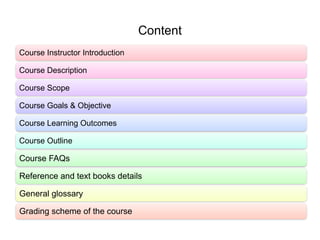
Content
Course Instructor Introduction
CourseDescription
Course Scope
Course Goals & Objective
Course Learning Outcomes
Course Outline
Course FAQs
Reference and text books details
General glossary
Grading scheme of the course
3.
Introduction
• Name: MuhammadWaqas Saghir
• Qualification: Chartered Accountant and Associate Public Accountant
• Member: Institute of Chartered Accountants of Pakistan and Pakistan
Institute of Public Finance Accountants
• Experience: 10 years Professional Experience in Assurance and Business
Advisory assignments
4.
Course Description
Thiscourse begins by describing the investment environment, the various
developments in investment theory, and the principles and practices of
valuation.
The analyses of fixed-income securities, equity securities, derivative
securities, together with other securities such as unit trusts, will then be
discussed.
The theories, principles, and techniques of portfolio management will be
presented.
5.
Course Scope
Investment analysis
The course is designed to provide students a thorough overview of financial
markets. Students will be able to understand fundamental and technical analysis
and to implement it in practical scenario.
It will help to perform economy, market and sector analysis for making wise
investment decisions. Students will know how to perform company analysis to
support investment decisions.
The course provides an overview and analysis of key modern valuation methods.
The course starts with a brief introduction and discussion of fundamental
definitions. Then, we discuss the uses of and general approaches to valuation.
The core of the course contains valuation methods applied by financial
institutions nowadays such as methods based on multiples, discounted cash
flows, and others. Please note that only those methods actually applied in
modern practice are going to be presented.
6.
Course Scope
Portfolio Management
The objective of this course is to provide students with an overview of the key
elements involved in the construction and management of portfolios. After providing a
review of the risk-return relationship of financial assets and a discussion of the
objectives of constructing different types of portfolios, we proceed to examine how
various securities should be combined to form portfolios that meet these objectives.
We also review the characteristics of derivative securities, and look into how they can
be used to manage and protect portfolios.
This course will introduce you to the concept of diversification, which is a key element
in portfolio design. We'll study and apply the Markowitz portfolio theory, CAPM, and
efficient market hypothesis to design portfolios, to identify under- and over-valued
securities, to measure price and manage risk and to evaluate investment
performance. We'll discuss the pricing of bonds and stock option. You'll learn how to
manage a bond portfolio and formulate option trading strategies to improve
investment performance.
7.
COURSE GOALS ANDOBJECTIVES:
Students will be able to:
Explain and apply basic concepts of investment analysis
Analyze and interpret financial data
Demonstrate knowledge of investment management
The goal of this course is for each student to develop a thorough
understanding of investments. The requirements for this course provide
the opportunity to learn how to make rational investment decisions.
8.
COURSE GOALS ANDOBJECTIVES:
The specific objectives of this course are
• Describe the current investment environment (domestic & international)
• Obtain & interpret investment information from various sources (both
traditional & electronic)
• Analyze the various investment vehicles such as:
– Common stock
– Fixed income securities
– Derivative securities
– Mutual funds and exchange traded funds, ETFs
• Relate financial theories of valuation (risk & return), portfolio
management and efficient markets to current market conditions.
9.
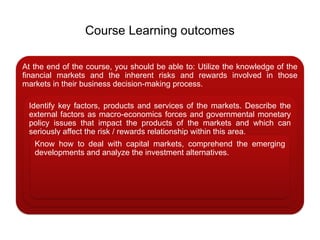
Course Learning outcomes
Atthe end of the course, you should be able to: Utilize the knowledge of the
financial markets and the inherent risks and rewards involved in those
markets in their business decision-making process.
Identify key factors, products and services of the markets. Describe the
external factors as macro-economics forces and governmental monetary
policy issues that impact the products of the markets and which can
seriously affect the risk / rewards relationship within this area.
Know how to deal with capital markets, comprehend the emerging
developments and analyze the investment alternatives.
10.
Course Learning outcomesInvestment
Analysis
• Explain the choice of alternative firm valuation models and alternative
approaches to arrive at the inputs required by a given firm valuation model.
• Analyze the financial statements of a firm to collect, compute and/or estimate
the inputs required by a firm valuation model.
• Apply discounted cash flow models and relative valuation multiples to arrive at
the fair value of a firm and make a trade recommendation ((buy/hold/sell)) on the
stock.
• Research relevant databases to look for firm-specific, industry-specific and/or
market- specific information that may support judgment on a firm’s financial
health, effectiveness of management, competitiveness, value and growth
potential.
• Communicate security valuation analysis and trade recommendation by a
professionally written report and an oral presentation.
• Collaborate with classmates to share and discuss the work required by the short
quizzes conducted in lectures and/or the firm valuation assignment.
11.
Course Learning outcomesPortfolio
Management
• Apply the empirical findings on the efficient market hypothesis to design
investment strategies.
• Apply the portfolio theory to rank and select portfolios; the CAPM to measure and
price risk, explain the popularity of index funds, separate market risk from firm-
specific risk, and identify mispriced securities; the theories of the term structure
and the concept of duration to explain the choice of bonds.
• Derive the linear relationship between risk and expected returns.
• Evaluate and compare the performances of managed funds.
• Identify violations of a no arbitrage equilibrium and outline a trading strategy to
exploit it.
• Apply option strategies to achieve a risk-return profile to suit some given market
condition.
• Use Excel to solve portfolio problems proficiently and creatively.
• Demonstrate your communication, teamwork and leadership skills through class
discussions and assignments.
12.
Course FAQs
What isInvestment Analysis?
Investment management is the professional asset management of various securities(shares,
bonds and other securities) and assets in order to meet specified investment goals for the
benefit of the investors. Investors may be institutions (insurance companies, pension funds,
corporations, charities, educational establishments etc.) or private investors (both directly via
investment contracts and more commonly via collective investments schemes.
What is the objective of portfolio
management ?
The main reason why people have
professionals manage their portfolio is to
leverage their expertise in order to
generate maximum wealth from their
investments. A well-managed portfolio will
not only take care of diversification, but
also allocate resources per the investor's
financial objectives and appetite for risks.
13.
Reference and TextBooks Details
– Investment Analysis and Portfolio Management by
Frank K. Reilly & keith C. Brown 10th
/13th
Edition
– Investment Analysis and Portfolio Management by Prasanna Chandra
– Investment Analysis And Portfolio Management by Jerome Bernard Cohen,
Edward D. Zinbarg, Arthur Zeikel
Websites
– http://reilly.swcollege.com
– http://www.cfapubs.org/loi/faj
14.
Course Methodology
The instructionalformat will include
virtual lecture;
reading material;
Topics Discussions;
Assignments; and
quizzes to check the level of understanding.
15.
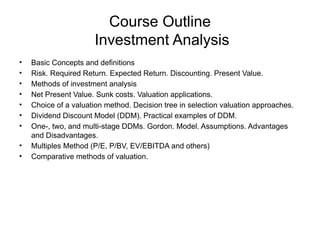
Course Outline
Investment Analysis
•Basic Concepts and definitions
• Risk. Required Return. Expected Return. Discounting. Present Value.
• Methods of investment analysis
• Net Present Value. Sunk costs. Valuation applications.
• Choice of a valuation method. Decision tree in selection valuation approaches.
• Dividend Discount Model (DDM). Practical examples of DDM.
• One-, two, and multi-stage DDMs. Gordon. Model. Assumptions. Advantages
and Disadvantages.
• Multiples Method (P/E, P/BV, EV/EBITDA and others)
• Comparative methods of valuation.
16.
Course Outline
Investment Analysis
•Most frequently used methods. Advantages and disadvantages of each method.
• Critique of EBITDA as an approximation of operating cash flows.
• Practical example Residual Value Method.
• Description of the method and areas of application.
• Venture Capital Method. This method can be applied to start-up businesses with no
sales or cash flows. It reflects the general approach of venture capitalists to investing.
• CAPEX Budgeting
Methods for CAPEX budgeting (payback, discounted payback, NPV, APV and IRR).
• Risk Estimation.
• Estimation of the required rate of return.
• Mergers & Acquisitions
Introduction. Motivation and other related issues, Valuing synergies. Real options and
their impact on M&A, Application of valuation methods to M&A activities.
Definition and Application of Free Cash Flows (FCFF & FCFE).
Free Cash Flow to the Firm (FCFF) and Free Cash Flow to Equity (FCFE).
17.
Course Outline
Portfolio Management
•The Process of Portfolio Management Valuation
• Risk, Return, and Uncertainty
• Setting Portfolio Objectives & Investment Policy
• The Mathematics of Diversification
• The Capital Markets & Market Efficiency
• Equity Valuation Tools
• Security Screening Bond Pricing & Selection
18.
Lectures Distribution
Lec 1Basic Introduction Investment and investment Analysis
Lec 2 Basic Introduction Securities
Lec 3 Investment Process, Buying & Selling, Introduction to Market
Lec 4 Investment analysis & its methods, Accounting rate of return, Pay
back period
Lec 5 Investment Analysis Methods
Lec 6 NET PRESENT VALUE – Basic considerations
19.
Lectures Distribution
Lec 7,8, 9
NPV Examples, IRR, Comparison of NPV and IRR, Comparing investment
appraisals methods, Lease or buy decisions, Internal Rate of Return
Lec 10
Risk Analysis in investment analysis and Techniques for risk analysis
Lec 11
Profitability index, Annuities and perpetuity ,Net terminal value and Capital
Rationing
Lec 12
Dividend
Lec 13& 14
Objectives Of Security Valuation And Cost Of Capital, Weighted
Average Cost Of Capital
20.
Lectures Distribution
Lec 15,16,17& 18
cost of equity - dividend with constant growth (example), cost of preference shares, cost of debt –
terminology, tax on interest , irredeemable debt , redeemable debt, convertible debt & efficient
market hypothesis
Lec 19,20,21 & 22
Weighted average cost of capital, gearing, financial risk and the cost of capital, traditional theory &
modigliani and miller’s theory
Lec 23
Portfolio Objective, Return, Stock returns, Portfolio returns, Portfolio proportion & mean return
Lec 24,25
Portfolio returns, Portfolio proportion, Mean or Average return, Variance and covariance, Sample covariance,
Expectations, Expected returns, Population variance and Population covariance
21.
Lectures Distribution
Lec 26,27
Risk,Portfolio Theory, Two assets Portfolio, Portfolio Selection, Risky and risk- free
assets, Implications for investment
Lec 28,29
Choosing an investment portfolio, CAPM, systematic and unsystematic risk, APV
Lec 29 , 30
CAPM, Alpha values, Risk adjusted WACC, Choosing a discount rate
Lec 31, 32
Business valuation - (free cash flow)







![PRESENTATION INVESTMENT MANAGEMENT[1].pptx](https://cdn.slidesharecdn.com/ss_thumbnails/presentationinvestmentmanagement1-250324161046-790b4a94-thumbnail.jpg?width=640&height=640&fit=bounds)


