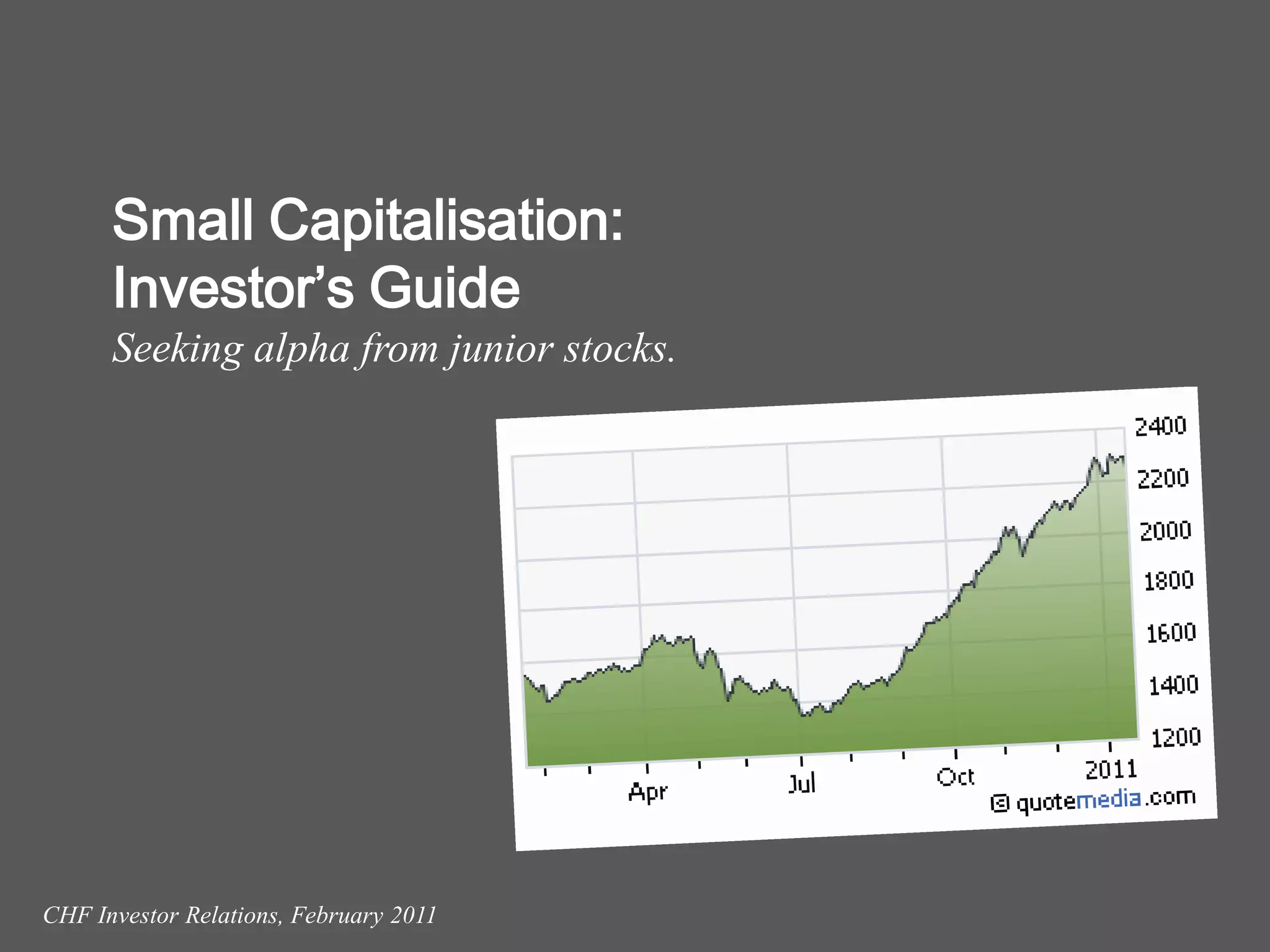
Small Capitalisation:
      Investor’s Guide
      Seeking alpha from junior stocks.


CHF Investor Relations, February 2011
What defines a small cap stock?

Serves a niche market.
Serves emerging high-growth markets.
No dividend, or little dividend.
More thinly traded than large caps.
Little analyst coverage.
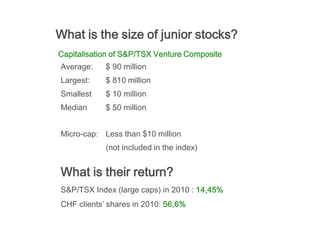
What is the size of junior stocks?
Capitalisation of S&P/TSX Venture Composite
Average:    $ 90 million
Largest:    $ 810 million
Smallest    $ 10 million
Median      $ 50 million


Micro-cap: Less than $10 million
            (not included in the index)


What is their return?
S&P/TSX Index (large caps) in 2010 : 14,45%
CHF clients’ shares in 2010: 56,6%
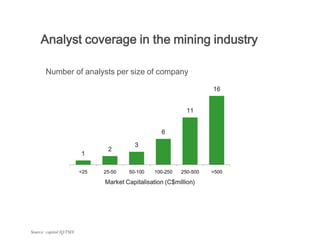
Analyst coverage in the mining industry

       Number of analysts per size of company

                                                                     16


                                                             11


                                                   6

                                         3
                                2
                         1

                         <25   25-50   50-100    100-250   250-500   >500

                               Market Capitalisation (C$million)


Source: capital IQ/TMX
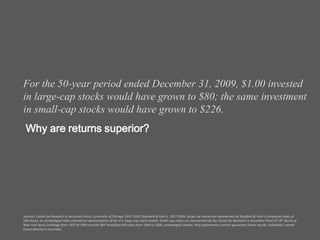
For the 50-year period ended December 31, 2009, $1.00 invested
in large-cap stocks would have grown to $80; the same investment
in small-cap stocks would have grown to $226.
 Why are returns superior?


Sources: Center for Research in Securities Prices, University of Chicago 1957-1993; Standard & Poor’s, 1957-2009. Large-cap stocks are represented by Standard & Poor’s Composite Index of
500 stocks, an unmanaged index considered representative of the U.S. large-cap stock market. Small-cap stocks are represented by the Center for Research in Securities Prices 6 th-8th Decile of
New York Stock Exchange from 1957 to 1993 and the S&P SmallCap 600 Index from 1994 to 2009, unmanaged indexes. Past performance cannot guarantee future results. Individuals cannot
invest directly in any index.
Market mispricing

The market often misprices small capitalisation stocks due to lack
of availability of information on companies since there is little
analyst coverage.

Poor liquidity also keeps away some investors resulting in lower
valuations.


However, as the company grows and builds momentum, the
mispricing is reduced as a result of increased interest from
investors and analysts. Value also comes from take-overs as
these companies become targets for larger firms.
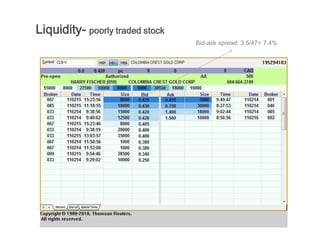
Liquidity- poorly traded stock
                                 Bid-ask spread: 3.5/47= 7.4%
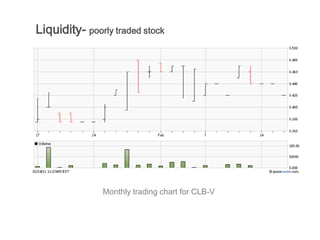
Liquidity- poorly traded stock


               Monthly trading chart for CLB-V
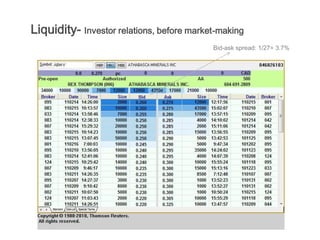
Liquidity- Investor relations, before market-making
                                           Bid-ask spread: 1/27= 3.7%
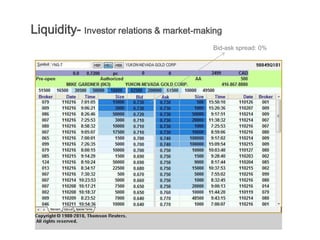
Liquidity- Investor relations & market-making
                                          Bid-ask spread: 0%
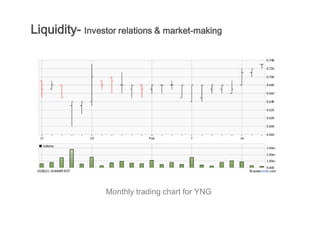
Liquidity- Investor relations & market-making


                 Monthly trading chart for YNG
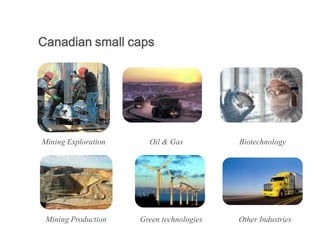
Canadian small caps


Mining Exploration     Oil & Gas          Biotechnology


 Mining Production   Green technologies   Other Industries
Mining is by far the largest industry on the TSX venture. We will
therefore spend some more time discussing investments in this
sector.
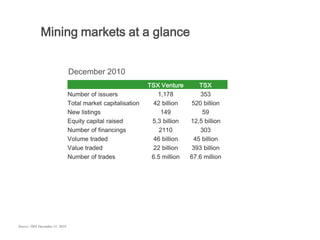
Mining markets at a glance


                                December 2010
                                                              TSX Venture       TSX
                                Number of issuers                1,178           353
                                Total market capitalisation    42 billion    520 billion
                                New listings                      149            59
                                Equity capital raised          5,3 billion   12,5 billion
                                Number of financings              2110           303
                                Volume traded                  46 billion     45 billion
                                Value traded                   22 billion    393 billion
                                Number of trades               6.5 million   67.6 million


Source: TMX December 31, 2010
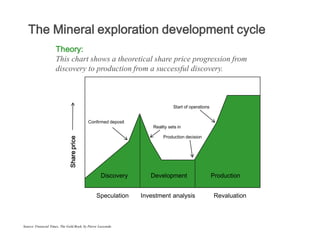
The Mineral exploration development cycle
                     Theory:
                     This chart shows a theoretical share price progression from
                     discovery to production from a successful discovery.


                                                                              Start of operations


                                            Confirmed deposit
                                                                    Reality sets in

                                                                         Production decision
                              Share price


                                                   Discovery       Development                      Production


                                                Speculation     Investment analysis                  Revaluation


Source: Financial Times, The Gold Book, by Pierre Lassonde.
The Mineral exploration development cycle
Theory

•Towards the end of the first exploration phase, resource, scoping and pre-
feasibility studies will be completed.

•The pre-feasibility study point in time comes close to the peak in
speculation.

•Stocks usually decline as the feasibility study is being tabled as
•reality sets in.

•Stocks are typically weak after the feasibility study, as a production decision
is made and financing is sought – mine construction would take up to 2
years.

•Stock prices should start to rise as production starts to become a certainty –
once in production stocks generally continue to rise as risk is removed and
earnings commence.
The Mineral exploration development cycle
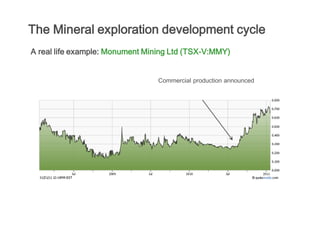
A real life example: Monument Mining Ltd (TSX-V:MMY)


                                 Commercial production announced
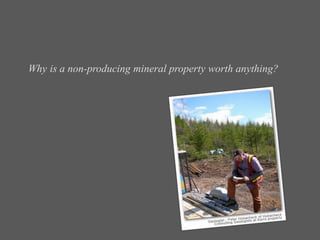
Why is a non-producing mineral property worth anything?
Why is a non-producing mineral property worth
anything?

Non producing properties represent potential for
eventual mineral production through:
•Exploration discovery
•Enhancement of existing mineral resources
•Improved circumstances
•New ownership

A market exists for non-producing mineral properties.
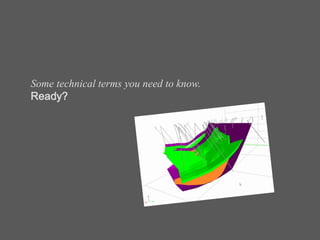
Some technical terms you need to know.
Ready?
What is a NI 43-101?
It is the National instrument 43-101 of the Canadian Securities
Administrators.

It sets standards of disclosure for mineral projects.

It governs resource and reserve estimates, also all exploration
information that comes out by news releases.

Four fundamental demands:
•Make disclosure of the responsibility of a qualified person.
•Fully disclose all relevant information, including data quality.
•Use recognised definitions for resources and reserves.
•Independent reports at trigger events like resource estimates and
economic assessments.
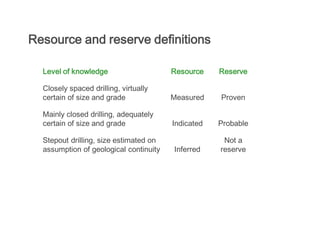
Resource and reserve definitions

  Level of knowledge                    Resource    Reserve

  Closely spaced drilling, virtually
  certain of size and grade             Measured    Proven

  Mainly closed drilling, adequately
  certain of size and grade             Indicated   Probable

  Stepout drilling, size estimated on                Not a
  assumption of geological continuity   Inferred    reserve
A good project, key indicators
Good ore body: Large reserves, high grade, low strip ratio.

Mining-friendly jurisdiction: Stable politics, predictable and timely
permitting process, existing mining operations, attractive fiscal regime.

Infrastructure: already exists or being built: power, transport, water.

Quality of Management: knowledge in mining? Ability to make deals
for long-term development? Board and corporate governance.

Technology: proven extractive technology of ore type.

Economics: Low expected cost of production.

Potential for future expansion.

Commodity: Does the commodity in question have a positive outlook?
Where do small cap stocks fit in a portfolio?
Some clues.
Who can invest in junior stock?

Since junior stock carry a higher risk of market
fluctuations, they may be appropriate for investors
with a long investment time frame who hold a well-
diversified portfolio.

In some cases, the regulators require that only
high net worth investors be invited to participate in
financings.

Some junior stock can be added in a portfolio for
tax purposes on financing for flow-through shares.
Growth strategies

Allocating a small portion of the portfolio to small
cap stocks.

Careful selection: given the lack of research on
small cap stocks, it is of the onus of the
broker/portfolio manager to carry out a due
diligence.

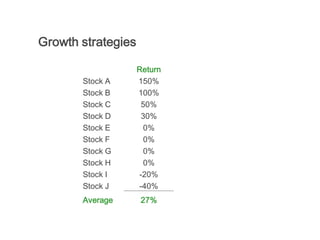
Some stocks will soar, others will lag. The objective
is to target an average return.
Growth strategies

                    Return
       Stock A      150%
       Stock B      100%
       Stock C       50%
       Stock D       30%
       Stock E        0%
       Stock F        0%
       Stock G        0%
       Stock H        0%
       Stock I      -20%
       Stock J      -40%
       Average       27%
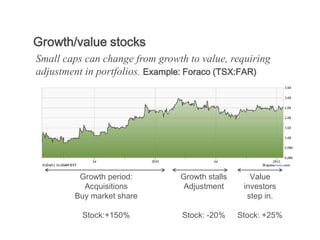
Growth/value stocks
Small caps can change from growth to value, requiring
adjustment in portfolios. Example: Foraco (TSX:FAR)


         Growth period:         Growth stalls      Value
          Acquisitions           Adjustment      investors
        Buy market share                          step in.

          Stock:+150%            Stock: -20%    Stock: +25%
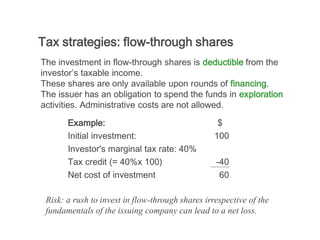
Tax strategies: flow-through shares
The investment in flow-through shares is deductible from the
investor’s taxable income.
These shares are only available upon rounds of financing.
The issuer has an obligation to spend the funds in exploration
activities. Administrative costs are not allowed.

       Example:                                    $
       Initial investment:                        100
       Investor's marginal tax rate: 40%
       Tax credit (= 40%x 100)                    -40
       Net cost of investment                      60

 Risk: a rush to invest in flow-through shares irrespective of the
 fundamentals of the issuing company can lead to a net loss.
Any questions?
CHF Investor Relations thanks you for your attention.
We would be happy to introduce you to small cap companies.
For more information, feel free to contact:

Anne Robert
Account Manager
Tel: 514 510 6338
Cell: 514 826 8121
E-mail: anne@chfir.com

Investing in small cap stocks

  • 1.
    Small Capitalisation: Investor’s Guide Seeking alpha from junior stocks. CHF Investor Relations, February 2011
  • 2.
    What defines asmall cap stock? Serves a niche market. Serves emerging high-growth markets. No dividend, or little dividend. More thinly traded than large caps. Little analyst coverage.
  • 3.
    What is thesize of junior stocks? Capitalisation of S&P/TSX Venture Composite Average: $ 90 million Largest: $ 810 million Smallest $ 10 million Median $ 50 million Micro-cap: Less than $10 million (not included in the index) What is their return? S&P/TSX Index (large caps) in 2010 : 14,45% CHF clients’ shares in 2010: 56,6%
  • 4.
    Analyst coverage inthe mining industry Number of analysts per size of company 16 11 6 3 2 1 <25 25-50 50-100 100-250 250-500 >500 Market Capitalisation (C$million) Source: capital IQ/TMX
  • 5.
    For the 50-yearperiod ended December 31, 2009, $1.00 invested in large-cap stocks would have grown to $80; the same investment in small-cap stocks would have grown to $226. Why are returns superior? Sources: Center for Research in Securities Prices, University of Chicago 1957-1993; Standard & Poor’s, 1957-2009. Large-cap stocks are represented by Standard & Poor’s Composite Index of 500 stocks, an unmanaged index considered representative of the U.S. large-cap stock market. Small-cap stocks are represented by the Center for Research in Securities Prices 6 th-8th Decile of New York Stock Exchange from 1957 to 1993 and the S&P SmallCap 600 Index from 1994 to 2009, unmanaged indexes. Past performance cannot guarantee future results. Individuals cannot invest directly in any index.
  • 6.
    Market mispricing The marketoften misprices small capitalisation stocks due to lack of availability of information on companies since there is little analyst coverage. Poor liquidity also keeps away some investors resulting in lower valuations. However, as the company grows and builds momentum, the mispricing is reduced as a result of increased interest from investors and analysts. Value also comes from take-overs as these companies become targets for larger firms.
  • 7.
    Liquidity- poorly tradedstock Bid-ask spread: 3.5/47= 7.4%
  • 8.
    Liquidity- poorly tradedstock Monthly trading chart for CLB-V
  • 9.
    Liquidity- Investor relations,before market-making Bid-ask spread: 1/27= 3.7%
  • 10.
    Liquidity- Investor relations& market-making Bid-ask spread: 0%
  • 11.
    Liquidity- Investor relations& market-making Monthly trading chart for YNG
  • 12.
    Canadian small caps MiningExploration Oil & Gas Biotechnology Mining Production Green technologies Other Industries
  • 13.
    Mining is byfar the largest industry on the TSX venture. We will therefore spend some more time discussing investments in this sector.
  • 14.
    Mining markets ata glance December 2010 TSX Venture TSX Number of issuers 1,178 353 Total market capitalisation 42 billion 520 billion New listings 149 59 Equity capital raised 5,3 billion 12,5 billion Number of financings 2110 303 Volume traded 46 billion 45 billion Value traded 22 billion 393 billion Number of trades 6.5 million 67.6 million Source: TMX December 31, 2010
  • 15.
    The Mineral explorationdevelopment cycle Theory: This chart shows a theoretical share price progression from discovery to production from a successful discovery. Start of operations Confirmed deposit Reality sets in Production decision Share price Discovery Development Production Speculation Investment analysis Revaluation Source: Financial Times, The Gold Book, by Pierre Lassonde.
  • 16.
    The Mineral explorationdevelopment cycle Theory •Towards the end of the first exploration phase, resource, scoping and pre- feasibility studies will be completed. •The pre-feasibility study point in time comes close to the peak in speculation. •Stocks usually decline as the feasibility study is being tabled as •reality sets in. •Stocks are typically weak after the feasibility study, as a production decision is made and financing is sought – mine construction would take up to 2 years. •Stock prices should start to rise as production starts to become a certainty – once in production stocks generally continue to rise as risk is removed and earnings commence.
  • 17.
    The Mineral explorationdevelopment cycle A real life example: Monument Mining Ltd (TSX-V:MMY) Commercial production announced
  • 18.
    Why is anon-producing mineral property worth anything?
  • 19.
    Why is anon-producing mineral property worth anything? Non producing properties represent potential for eventual mineral production through: •Exploration discovery •Enhancement of existing mineral resources •Improved circumstances •New ownership A market exists for non-producing mineral properties.
  • 20.
    Some technical termsyou need to know. Ready?
  • 21.
    What is aNI 43-101? It is the National instrument 43-101 of the Canadian Securities Administrators. It sets standards of disclosure for mineral projects. It governs resource and reserve estimates, also all exploration information that comes out by news releases. Four fundamental demands: •Make disclosure of the responsibility of a qualified person. •Fully disclose all relevant information, including data quality. •Use recognised definitions for resources and reserves. •Independent reports at trigger events like resource estimates and economic assessments.
  • 22.
    Resource and reservedefinitions Level of knowledge Resource Reserve Closely spaced drilling, virtually certain of size and grade Measured Proven Mainly closed drilling, adequately certain of size and grade Indicated Probable Stepout drilling, size estimated on Not a assumption of geological continuity Inferred reserve
  • 23.
    A good project,key indicators Good ore body: Large reserves, high grade, low strip ratio. Mining-friendly jurisdiction: Stable politics, predictable and timely permitting process, existing mining operations, attractive fiscal regime. Infrastructure: already exists or being built: power, transport, water. Quality of Management: knowledge in mining? Ability to make deals for long-term development? Board and corporate governance. Technology: proven extractive technology of ore type. Economics: Low expected cost of production. Potential for future expansion. Commodity: Does the commodity in question have a positive outlook?
  • 24.
    Where do smallcap stocks fit in a portfolio? Some clues.
  • 25.
    Who can investin junior stock? Since junior stock carry a higher risk of market fluctuations, they may be appropriate for investors with a long investment time frame who hold a well- diversified portfolio. In some cases, the regulators require that only high net worth investors be invited to participate in financings. Some junior stock can be added in a portfolio for tax purposes on financing for flow-through shares.
  • 26.
    Growth strategies Allocating asmall portion of the portfolio to small cap stocks. Careful selection: given the lack of research on small cap stocks, it is of the onus of the broker/portfolio manager to carry out a due diligence. Some stocks will soar, others will lag. The objective is to target an average return.
  • 27.
    Growth strategies Return Stock A 150% Stock B 100% Stock C 50% Stock D 30% Stock E 0% Stock F 0% Stock G 0% Stock H 0% Stock I -20% Stock J -40% Average 27%
  • 28.
    Growth/value stocks Small capscan change from growth to value, requiring adjustment in portfolios. Example: Foraco (TSX:FAR) Growth period: Growth stalls Value Acquisitions Adjustment investors Buy market share step in. Stock:+150% Stock: -20% Stock: +25%
  • 29.
    Tax strategies: flow-throughshares The investment in flow-through shares is deductible from the investor’s taxable income. These shares are only available upon rounds of financing. The issuer has an obligation to spend the funds in exploration activities. Administrative costs are not allowed. Example: $ Initial investment: 100 Investor's marginal tax rate: 40% Tax credit (= 40%x 100) -40 Net cost of investment 60 Risk: a rush to invest in flow-through shares irrespective of the fundamentals of the issuing company can lead to a net loss.
  • 30.
  • 31.
    CHF Investor Relationsthanks you for your attention. We would be happy to introduce you to small cap companies. For more information, feel free to contact: Anne Robert Account Manager Tel: 514 510 6338 Cell: 514 826 8121 E-mail: anne@chfir.com