INTRODUCTION
What is the role of inventors?
An inventor is someone who develops
new or unique products and processes. Their
inventions often aim to improve the lives of consumers
or solve specific challenges. Inventors typically
generate ideas then develop them into products they
can sell.
How do inventors think of ideas?
Inventors come up with brilliant ideas through bucking
trends and fostering creative mental spaces. Applied
observation and deep thought is a necessity if you're
going to invent something. Having an open mind to
INVENTOR OF ECG
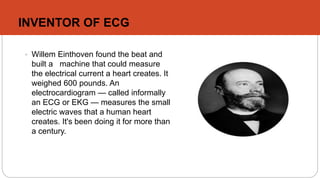
 Willem Einthoven found the beat and
built a machine that could measure
the electrical current a heart creates. It
weighed 600 pounds. An
electrocardiogram — called informally
an ECG or EKG — measures the small
electric waves that a human heart
creates. It's been doing it for more than
a century.
 Exercise ECG:
 Here the electrical activity of your heart
is measured while you are physically active.
This usually involves riding an exercise bike.
The amount of exertion is steadily increased
to a high level by making it increasingly
difficult to turn the pedals. The test is
stopped earlier if any irregularities in the
ECG occur. In addition to the ECG graph,
this test also provides data on the power
that was generated in Watts. Your blood
pressure is also checked regularly.
 Holter monitor:
 The electrical activity of the heart is
typically recorded over a period of 24 hours. Three
or four electrodes are attached to your chest, and
a small recording device is worn on a belt or hung
around your neck. The ECG data are then
transferred to a computer later on at the doctor's
office for analysis. To do this, the doctor also
needs information about your daily schedule (like
unusual events, physical activity and sleep). A
Holter monitor may be used if, for instance, you
only have an irregular heartbeat some of the time
and it doesn't show up in a “normal” ECG.
HOW TO PREPARE ECG?
 Avoid exercising immediately before an
electrocardiograph. Physical activity, such
as climbing stairs, or exercise may
increase your heart rate and affect the
results.
 Tell your doctor or nurse if you are taking
medication for your heart. You will be
advised about whether you need to stop
taking these medications before having a
heart test, and how soon you should start
taking it again after the test.
BENEFITS OF GETTING ECG
 Uncover the cause of chest pain
 Uncover the cause of chest fluttering
 Evaluate shortness of breath, chest tightness, and other
heart-related symptoms
 Check for abnormally fast or slow heart rates
 Check for irregular heart beats, such as skipped beats
 Determine the overall health of your heart
 Check on your heart health before and after
 surgery
 Find out if a heart medication is working
 See how a pacemaker is working
ADVANTAGES OF ECG
 ➨ECG is helpful to measure three basic parameters of
clinical interest viz. rhythm and heart rate, axis of the heart
and state of myocardial muscle.
➨ECG represents data in the topographic form which
provides higher diagnostical information.
➨ECG helps to prevent heart attacks by analyzing heart
parameters at the initial stage.
➨ECG is used to detect the cardiac conditions of the
patients after surgical or any other operation and after
application of anesthesia.
➨ECG test is quick, painless and safe.
➨ECG test is cheap in cost.
DISADVANTAGES OF ECG
 ➨It does not provide underlying heart
problems for patients not having any
symptoms.
➨It does not always provide help in
accurate diagnosis. More tests are
needed to trace serious heart problems
undetected by normal ECG curve.
RESULT OF ECG
 You will usually be told the results of your ECG
straight away unless it needs to be sent away
for reporting by a specialist.
 Your doctor will look at the pattern of spikes
and dips on your ECG to check the electrical
activity in different parts of your heart, and
show how your heart is working. Your doctor
will look for a consistent, even heart rhythm
and a heart rate between 50 and 100 beats a
minute. Having a faster, slower or irregular
heartbeat provides clues about your heart
health. It is important to note that a normal
ECG does not exclude heart disease, and
further testing may be necessary.
CONCLUSION
 Throughout history, many bright
minds have thought of many great ideas. Some
of those ideas have brought about inventions
that changed our lives forever. For example, it is
hard for those of us living in the twenty-first
century to imagine life without electricity. Yet,
without creative minds putting their ideas to the
test, many of the things we take for granted may
never have come to be.
inventors ppt.pptx

inventors ppt.pptx

  • 1.
    INTRODUCTION What is therole of inventors? An inventor is someone who develops new or unique products and processes. Their inventions often aim to improve the lives of consumers or solve specific challenges. Inventors typically generate ideas then develop them into products they can sell. How do inventors think of ideas? Inventors come up with brilliant ideas through bucking trends and fostering creative mental spaces. Applied observation and deep thought is a necessity if you're going to invent something. Having an open mind to
  • 2.
    INVENTOR OF ECG Willem Einthoven found the beat and built a machine that could measure the electrical current a heart creates. It weighed 600 pounds. An electrocardiogram — called informally an ECG or EKG — measures the small electric waves that a human heart creates. It's been doing it for more than a century.
  • 3.
     Exercise ECG: Here the electrical activity of your heart is measured while you are physically active. This usually involves riding an exercise bike. The amount of exertion is steadily increased to a high level by making it increasingly difficult to turn the pedals. The test is stopped earlier if any irregularities in the ECG occur. In addition to the ECG graph, this test also provides data on the power that was generated in Watts. Your blood pressure is also checked regularly.
  • 4.
     Holter monitor: The electrical activity of the heart is typically recorded over a period of 24 hours. Three or four electrodes are attached to your chest, and a small recording device is worn on a belt or hung around your neck. The ECG data are then transferred to a computer later on at the doctor's office for analysis. To do this, the doctor also needs information about your daily schedule (like unusual events, physical activity and sleep). A Holter monitor may be used if, for instance, you only have an irregular heartbeat some of the time and it doesn't show up in a “normal” ECG.
  • 5.
    HOW TO PREPAREECG?  Avoid exercising immediately before an electrocardiograph. Physical activity, such as climbing stairs, or exercise may increase your heart rate and affect the results.  Tell your doctor or nurse if you are taking medication for your heart. You will be advised about whether you need to stop taking these medications before having a heart test, and how soon you should start taking it again after the test.
  • 6.
    BENEFITS OF GETTINGECG  Uncover the cause of chest pain  Uncover the cause of chest fluttering  Evaluate shortness of breath, chest tightness, and other heart-related symptoms  Check for abnormally fast or slow heart rates  Check for irregular heart beats, such as skipped beats  Determine the overall health of your heart  Check on your heart health before and after  surgery  Find out if a heart medication is working  See how a pacemaker is working
  • 7.
    ADVANTAGES OF ECG ➨ECG is helpful to measure three basic parameters of clinical interest viz. rhythm and heart rate, axis of the heart and state of myocardial muscle. ➨ECG represents data in the topographic form which provides higher diagnostical information. ➨ECG helps to prevent heart attacks by analyzing heart parameters at the initial stage. ➨ECG is used to detect the cardiac conditions of the patients after surgical or any other operation and after application of anesthesia. ➨ECG test is quick, painless and safe. ➨ECG test is cheap in cost.
  • 8.
    DISADVANTAGES OF ECG ➨It does not provide underlying heart problems for patients not having any symptoms. ➨It does not always provide help in accurate diagnosis. More tests are needed to trace serious heart problems undetected by normal ECG curve.
  • 9.
    RESULT OF ECG You will usually be told the results of your ECG straight away unless it needs to be sent away for reporting by a specialist.  Your doctor will look at the pattern of spikes and dips on your ECG to check the electrical activity in different parts of your heart, and show how your heart is working. Your doctor will look for a consistent, even heart rhythm and a heart rate between 50 and 100 beats a minute. Having a faster, slower or irregular heartbeat provides clues about your heart health. It is important to note that a normal ECG does not exclude heart disease, and further testing may be necessary.
  • 10.
    CONCLUSION  Throughout history,many bright minds have thought of many great ideas. Some of those ideas have brought about inventions that changed our lives forever. For example, it is hard for those of us living in the twenty-first century to imagine life without electricity. Yet, without creative minds putting their ideas to the test, many of the things we take for granted may never have come to be.