Introductory PPT during first lecture class (as per university SOP)
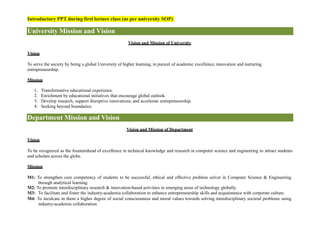
University Mission and Vision
Vision and Mission of University
Vision
To serve the society by being a global University of higher learning, in pursuit of academic excellence, innovation and nurturing
entrepreneurship.
Mission
1. Transformative educational experience.
2. Enrichment by educational initiatives that encourage global outlook.
3. Develop research, support disruptive innovations, and accelerate entrepreneurship.
4. Seeking beyond boundaries.
Department Mission and Vision
Vision and Mission of Department
Vision
To be recognized as the fountainhead of excellence in technical knowledge and research in computer science and engineering to attract students
and scholars across the globe.
Mission
M1: To strengthen core competency of students to be successful, ethical and effective problem solver in Computer Science & Engineering
through analytical learning.
M2: To promote interdisciplinary research & innovation-based activities in emerging areas of technology globally.
M3: To facilitate and foster the industry-academia collaboration to enhance entrepreneurship skills and acquaintance with corporate culture.
M4: To inculcate in them a higher degree of social consciousness and moral values towards solving interdisciplinary societal problems using
industry-academia collaboration.
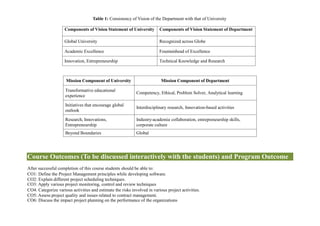
Table 1: Consistency of Vision of the Department with that of University
Components of Vision Statement of University Components of Vision Statement of Department
Global University Recognized across Globe
Academic Excellence Fountainhead of Excellence
Innovation, Entrepreneurship Technical Knowledge and Research
Mission Component of University Mission Component of Department
Transformative educational
experience
Competency, Ethical, Problem Solver, Analytical learning
Initiatives that encourage global
outlook
Interdisciplinary research, Innovation-based activities
Research, Innovations,
Entrepreneurship
Industry-academia collaboration, entrepreneurship skills,
corporate culture
Beyond Boundaries Global
Course Outcomes (To be discussed interactively with the students) and Program Outcome
After successful completion of this course students should be able to:
CO1: Define the Project Management principles while developing software.
CO2: Explain different project scheduling techniques.
CO3: Apply various project monitoring, control and review techniques
CO4: Categorize various activities and estimate the risks involved in various project activities.
CO5: Assess project quality and issues related to contract management.
CO6: Discuss the impact project planning on the performance of the organizations
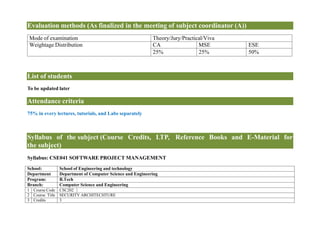
Evaluation methods (As finalized in the meeting of subject coordinator (A))
Mode of examination Theory/Jury/Practical/Viva
Weightage Distribution CA MSE ESE
25% 25% 50%
List of students
To be updated later
Attendance criteria
75% in every lectures, tutorials, and Labs separately
Syllabus of the subject (Course Credits, LTP, Reference Books and E-Material for
the subject)
Syllabus: CSE041 SOFTWARE PROJECT MANAGEMENT
School: School of Engineering and technology
Department Department of Computer Science and Engineering
Program: B.Tech
Branch: Computer Science and Engineering
1 Course Code CSC202
2 Course Title SECURITY ARCHITECHTURE
3 Credits 3
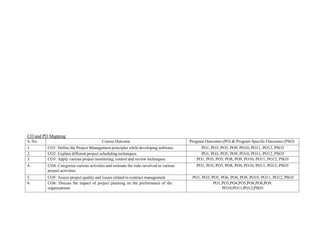
CO and PO Mapping
S. No. Course Outcome Program Outcomes (PO) & Program Specific Outcomes (PSO)
1. CO1: Define the Project Management principles while developing software. PO1, PO3, PO5, PO9, PO10, PO11, PO12, PSO3
2. CO2: Explain different project scheduling techniques. PO1, PO3, PO5, PO9, PO10, PO11, PO12, PSO3
3. CO3: Apply various project monitoring, control and review techniques PO1, PO3, PO5, PO8, PO9, PO10, PO11, PO12, PSO3
4. CO4: Categorize various activities and estimate the risks involved in various
project activities.
PO1, PO3, PO5, PO8, PO9, PO10, PO11, PO12, PSO3
5. CO5: Assess project quality and issues related to contract management. PO1, PO3, PO5, PO6, PO8, PO9, PO10, PO11, PO12, PSO3
6. CO6: Discuss the impact of project planning on the performance of the
organizations
PO1,PO3,PO4,PO5,PO6,PO8,PO9,
PO10,PO11,PO12,PSO3
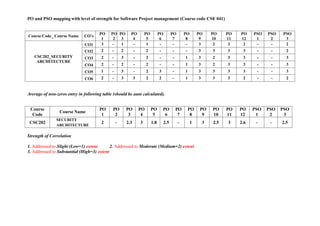
PO and PSO mapping with level of strength for Software Project management (Course code CSE 041)
Course Code_ Course Name CO’s
PO
1
PO
2
PO
3
PO
4
PO
5
PO
6
PO
7
PO
8
PO
9
PO
10
PO
11
PO
12
PSO
1
PSO
2
PSO
3
CSC202_SECURITY
ARCHITECTURE
CO1 3 - 1 - 1 - - - 3 2 3 2 - - 2
CO2 2 - 2 - 2 - - - 3 3 3 3 - - 2
CO3 2 - 3 - 2 - - 1 3 2 3 3 - - 3
CO4 2 - 2 - 2 - - 1 3 2 3 3 - - 3
CO5 1 - 3 - 2 3 - 1 3 3 3 3 - - 3
CO6 2 - 3 3 2 2 - 1 3 3 3 2 - - 2
Average of non-zeros entry in following table (should be auto calculated).
Course
Code
Course Name
PO
1
PO
2
PO
3
PO
4
PO
5
PO
6
PO
7
PO
8
PO
9
PO
10
PO
11
PO
12
PSO
1
PSO
2
PSO
3
CSC202
SECURITY
ARCHITECTURE
2 - 2.3 3 1.8 2.5 - 1 3 2.5 3 2.6 - - 2.5
Strength of Correlation
1. Addressed to Slight (Low=1) extent 2. Addressed to Moderate (Medium=2) extent
3. Addressed to Substantial (High=3) extent
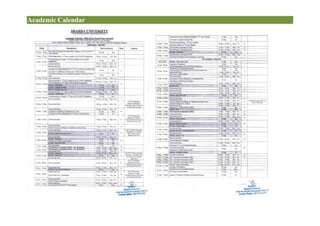
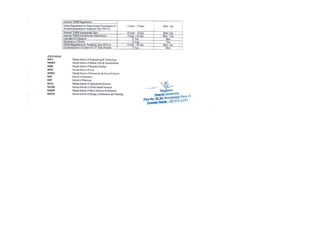
Academic Calendar
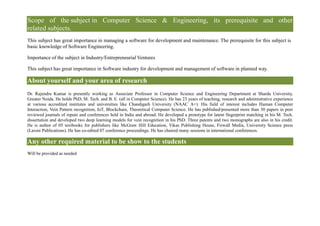
Scope of the subject in Computer Science & Engineering, its prerequisite and other
related subjects.
This subject has great importance in managing a software for development and maintenance. The prerequisite for this subject is
basic knowledge of Software Engineering.
Importance of the subject in Industry/Entrepreneurial Ventures
This subject has great importance in Software industry for development and management of software in planned way.
About yourself and your area of research
Dr. Rajendra Kumar is presently working as Associate Professor in Computer Science and Engineering Department at Sharda University,
Greater Noida. He holds PhD, M. Tech. and B. E. (all in Computer Science). He has 23 years of teaching, research and administrative experience
at various accredited institutes and universities like Chandigarh University (NAAC A+). His field of interest includes Human Computer
Interaction, Vein Pattern recognition, IoT, Blockchain, Theoretical Computer Science. He has published/presented more than 30 papers in peer
reviewed journals of repute and conferences held in India and abroad. He developed a prototype for latent fingerprint matching in his M. Tech.
dissertation and developed two deep learning models for vein recognition in his PhD. Three patents and two monographs are also in his credit.
He is author of 05 textbooks for publishers like McGraw Hill Education, Vikas Publishing House, Firwall Media, University Science press
(Laxmi Publications). He has co-edited 07 conference proceedings. He has chaired many sessions in international conferences.
Any other required material to be show to the students
Will be provided as needed

Introductory PPT CSC202 SECURITY ARCHITECTURE.pptx

  • 1.
    Introductory PPT duringfirst lecture class (as per university SOP) University Mission and Vision Vision and Mission of University Vision To serve the society by being a global University of higher learning, in pursuit of academic excellence, innovation and nurturing entrepreneurship. Mission 1. Transformative educational experience. 2. Enrichment by educational initiatives that encourage global outlook. 3. Develop research, support disruptive innovations, and accelerate entrepreneurship. 4. Seeking beyond boundaries. Department Mission and Vision Vision and Mission of Department Vision To be recognized as the fountainhead of excellence in technical knowledge and research in computer science and engineering to attract students and scholars across the globe. Mission M1: To strengthen core competency of students to be successful, ethical and effective problem solver in Computer Science & Engineering through analytical learning. M2: To promote interdisciplinary research & innovation-based activities in emerging areas of technology globally. M3: To facilitate and foster the industry-academia collaboration to enhance entrepreneurship skills and acquaintance with corporate culture. M4: To inculcate in them a higher degree of social consciousness and moral values towards solving interdisciplinary societal problems using industry-academia collaboration.
  • 2.
    Table 1: Consistencyof Vision of the Department with that of University Components of Vision Statement of University Components of Vision Statement of Department Global University Recognized across Globe Academic Excellence Fountainhead of Excellence Innovation, Entrepreneurship Technical Knowledge and Research Mission Component of University Mission Component of Department Transformative educational experience Competency, Ethical, Problem Solver, Analytical learning Initiatives that encourage global outlook Interdisciplinary research, Innovation-based activities Research, Innovations, Entrepreneurship Industry-academia collaboration, entrepreneurship skills, corporate culture Beyond Boundaries Global Course Outcomes (To be discussed interactively with the students) and Program Outcome After successful completion of this course students should be able to: CO1: Define the Project Management principles while developing software. CO2: Explain different project scheduling techniques. CO3: Apply various project monitoring, control and review techniques CO4: Categorize various activities and estimate the risks involved in various project activities. CO5: Assess project quality and issues related to contract management. CO6: Discuss the impact project planning on the performance of the organizations
  • 3.
    Evaluation methods (Asfinalized in the meeting of subject coordinator (A)) Mode of examination Theory/Jury/Practical/Viva Weightage Distribution CA MSE ESE 25% 25% 50% List of students To be updated later Attendance criteria 75% in every lectures, tutorials, and Labs separately Syllabus of the subject (Course Credits, LTP, Reference Books and E-Material for the subject) Syllabus: CSE041 SOFTWARE PROJECT MANAGEMENT School: School of Engineering and technology Department Department of Computer Science and Engineering Program: B.Tech Branch: Computer Science and Engineering 1 Course Code CSC202 2 Course Title SECURITY ARCHITECHTURE 3 Credits 3
  • 5.
    CO and POMapping S. No. Course Outcome Program Outcomes (PO) & Program Specific Outcomes (PSO) 1. CO1: Define the Project Management principles while developing software. PO1, PO3, PO5, PO9, PO10, PO11, PO12, PSO3 2. CO2: Explain different project scheduling techniques. PO1, PO3, PO5, PO9, PO10, PO11, PO12, PSO3 3. CO3: Apply various project monitoring, control and review techniques PO1, PO3, PO5, PO8, PO9, PO10, PO11, PO12, PSO3 4. CO4: Categorize various activities and estimate the risks involved in various project activities. PO1, PO3, PO5, PO8, PO9, PO10, PO11, PO12, PSO3 5. CO5: Assess project quality and issues related to contract management. PO1, PO3, PO5, PO6, PO8, PO9, PO10, PO11, PO12, PSO3 6. CO6: Discuss the impact of project planning on the performance of the organizations PO1,PO3,PO4,PO5,PO6,PO8,PO9, PO10,PO11,PO12,PSO3
  • 6.
    PO and PSOmapping with level of strength for Software Project management (Course code CSE 041) Course Code_ Course Name CO’s PO 1 PO 2 PO 3 PO 4 PO 5 PO 6 PO 7 PO 8 PO 9 PO 10 PO 11 PO 12 PSO 1 PSO 2 PSO 3 CSC202_SECURITY ARCHITECTURE CO1 3 - 1 - 1 - - - 3 2 3 2 - - 2 CO2 2 - 2 - 2 - - - 3 3 3 3 - - 2 CO3 2 - 3 - 2 - - 1 3 2 3 3 - - 3 CO4 2 - 2 - 2 - - 1 3 2 3 3 - - 3 CO5 1 - 3 - 2 3 - 1 3 3 3 3 - - 3 CO6 2 - 3 3 2 2 - 1 3 3 3 2 - - 2 Average of non-zeros entry in following table (should be auto calculated). Course Code Course Name PO 1 PO 2 PO 3 PO 4 PO 5 PO 6 PO 7 PO 8 PO 9 PO 10 PO 11 PO 12 PSO 1 PSO 2 PSO 3 CSC202 SECURITY ARCHITECTURE 2 - 2.3 3 1.8 2.5 - 1 3 2.5 3 2.6 - - 2.5 Strength of Correlation 1. Addressed to Slight (Low=1) extent 2. Addressed to Moderate (Medium=2) extent 3. Addressed to Substantial (High=3) extent
  • 7.
  • 9.
    Scope of thesubject in Computer Science & Engineering, its prerequisite and other related subjects. This subject has great importance in managing a software for development and maintenance. The prerequisite for this subject is basic knowledge of Software Engineering. Importance of the subject in Industry/Entrepreneurial Ventures This subject has great importance in Software industry for development and management of software in planned way. About yourself and your area of research Dr. Rajendra Kumar is presently working as Associate Professor in Computer Science and Engineering Department at Sharda University, Greater Noida. He holds PhD, M. Tech. and B. E. (all in Computer Science). He has 23 years of teaching, research and administrative experience at various accredited institutes and universities like Chandigarh University (NAAC A+). His field of interest includes Human Computer Interaction, Vein Pattern recognition, IoT, Blockchain, Theoretical Computer Science. He has published/presented more than 30 papers in peer reviewed journals of repute and conferences held in India and abroad. He developed a prototype for latent fingerprint matching in his M. Tech. dissertation and developed two deep learning models for vein recognition in his PhD. Three patents and two monographs are also in his credit. He is author of 05 textbooks for publishers like McGraw Hill Education, Vikas Publishing House, Firwall Media, University Science press (Laxmi Publications). He has co-edited 07 conference proceedings. He has chaired many sessions in international conferences. Any other required material to be show to the students Will be provided as needed