Advanced/Unconventional/Non-
traditional Machining Process -
An introduction
Mr.C.Dharmaraja
Assistant Professor
Department of Mechanical Engineering
University College Of Engineering
Dindigul
ME 2026 - Syllabus
1. INTRODUCTION 5hrs
• Unconventional machining Process – Need –
classification – Brief overview of all techniques.
2. MECHANICAL ENERGY BASED PROCESSES
10hrs
• Abrasive Jet Machining – Water Jet Machining –
Ultrasonic Machining. (AJM, WJM and USM).
Working Principles – equipment used – Process
parameters – MRR-Variation in techniques used
– Applications.
3. ELECTRICAL ENERGY BASED PROCESSES 8hrs
• Electric Discharge Machining (EDM)- working Principles-
equipments-Process Parameters-MRR- electrode / Tool –
Power Circuits-Tool Wear – Dielectric – Flushing – Wire cut
EDM – Applications.
4. CHEMICAL AND ELECTRO-CHEMICAL ENERGY BASED
PROCESSES 12hrs
• Chemical machining and Electro-Chemical machining (CHM
and ECM)-Etchants-maskant-techniques of applying
maskants-Process Parameters – MRR-Applications.
• Principles of ECM-equipments-MRR-Electrical circuit-Process
Parameters-ECG and ECH Applications.
5. THERMAL ENERGY BASED PROCESSES 10hrs
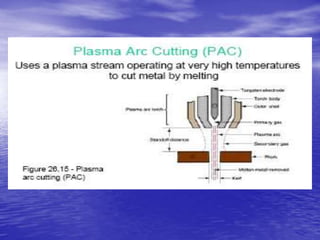
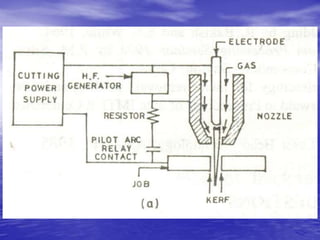
• Laser Beam machining (LBM), plasma Arc machining (PAM)
and Electron Beam Machining (EBM).
• Principles-Equipment-Types-Beam control techniques –
Applications.
Objective of the course – ME2026
• To give a perspective view with adequate
depth to understand the UCM processes,
its relative advantages over conventional
techniques
Non-traditional Machining Processes
Manufacturing processes can be broadly divided into two groups:
a) primary manufacturing processes : Provide basic shape and size
b) secondary manufacturing processes : Provide final shape and
size with tighter control on dimension, surface characteristics
Material removal processes once again can be divided into two groups
1. Conventional Machining Processes
2. Non-Traditional Manufacturing Processes or non-conventional
Manufacturing processes
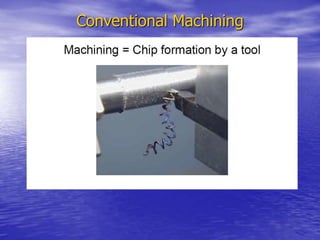
Conventional Machining Processes mostly remove material in the
form of chips by applying forces on the work material with a
wedge shaped cutting tool that is harder than the work material
under machining condition.
Conventional Machining
Non-traditional Machining Processes
The major characteristics of conventional machining are:
– • Generally macroscopic chip formation by shear
deformation
– • Material removal takes place due to application of cutting
forces – energy domain can be classified as mechanical
– • Cutting tool is harder than work piece at room
temperature as well as under machining conditions
Non-conventional manufacturing processes is defined as a
group of processes that remove excess material by various
techniques involving mechanical, thermal, electrical or chemical
energy or combinations of these energies but do not use a
sharp cutting tools as it needs to be used for traditional
manufacturing processes.
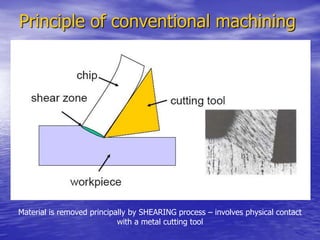
Principle of conventional machining
Material is removed principally by SHEARING process – involves physical contact
with a metal cutting tool
Non-traditional Machining Processes
The major characteristics of Non-conventional machining:
1. Material removal may occur with chip formation or even no chip
formation may take place. For example in AJM, chips are of
microscopic size and in case of Electrochemical machining material
removal occurs due to electrochemical dissolution at atomic level.
2. In NTM, there may not be a physical tool present. For example in
laser jet machining, machining is carried out by laser beam. However
in Electrochemical Machining there is a physical tool that is very much
required for machining
3. In NTM, the tool need not be harder than the work piece material.
For example, in EDM, copper is used as the tool material to machine
hardened steels.
4. Mostly NTM processes do not necessarily use mechanical energy to
provide material removal. They use different energy domains to
provide machining. For example, in USM, AJM, WJM mechanical
energy is used to machine material, whereas in ECM electrochemical
dissolution constitutes material removal.
Classification of NTM processes
classification of NTM processes is carried out depending on the nature
of energy used for material removal.
1. Mechanical Processes
• Abrasive Jet Machining (AJM)
• Ultrasonic Machining (USM)
• Water Jet Machining (WJM)
• Abrasive Water Jet Machining (AWJM)
2. Electrochemical Processes
• Electrochemical Machining (ECM)
• Electro Chemical Grinding (ECG)
• Electro Jet Drilling (EJD)
3. Electro-Thermal Processes
• Electro-discharge machining (EDM)
• Laser Jet Machining (LJM)
• Electron Beam Machining (EBM)
4. Chemical Processes
• Chemical Milling (CHM)
• Photochemical Milling (PCM)
UCM Processes
• Energy in its direct form is used to remove
the materials from the workpiece
• Employs fundamental machining energy
such as: Mechanical, Electro-chemical,
Chemical and Thermo-electric
Need for UCM processes
1. Limitations of conventional processes - tool material
hardness > W/p hardness
2. Rapid improvements in the properties of materials –
high strength alloys
3. Product requirements
• Complex shapes
• Machining in inaccessible areas
• Low tolerances
• Better surface integrity
• High surface finish
4. Precision and ultra precision machining – requires
material removal in the form of atoms or molecules
5. Low cost of production – especially in producing
desired accuracy and surface finish in hard w/p
materials
6. High production rate
Case studies to highlight the need for UCM
processes
• Square blind hole in any material with
high surface finish (about 10 microns)
• Square blind hole with certain accuracy
requirement
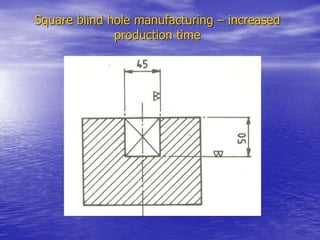
Square blind hole manufacturing – increased
production time
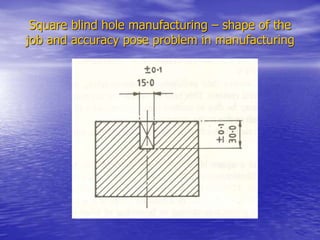
Square blind hole manufacturing – shape of the
job and accuracy pose problem in manufacturing
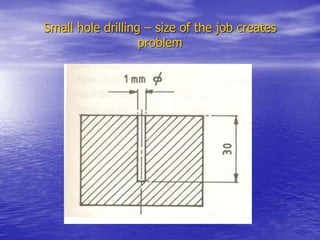
Small hole drilling – size of the job creates
problem
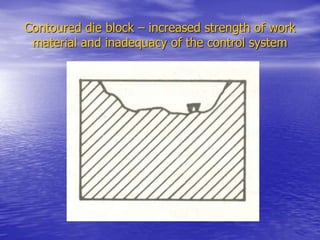
Contoured die block – increased strength of work
material and inadequacy of the control system
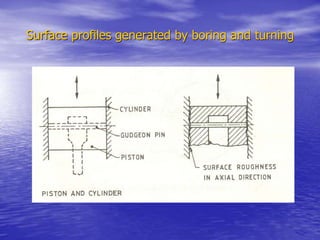
Surface profiles generated by boring and turning
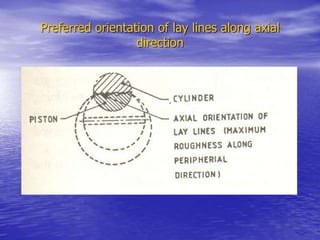
Preferred orientation of lay lines along axial
direction
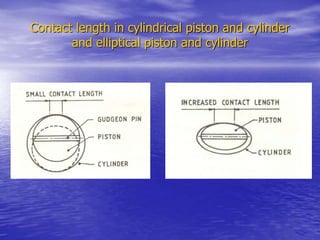
Contact length in cylindrical piston and cylinder
and elliptical piston and cylinder
Brief overview of all techniques
• Mechanical energy based
• Electrical energy based
• Chemical and electrochemical energy
based
• Thermal energy based
Conventional Machining VS
NonConventional Machining
• The cutting tool and workpiece are always in physical contact, with a
relative motion against each other, which results in friction and a
significant tool wear.
• In non-traditional processes, there is no physical contact between the
tool and workpiece. Although in some non-traditional processes tool
wear exists, it rarely is a significant problem.
• Material removal rate of the traditional processes is limited by the
mechanical properties of the work material. Non-traditional processes
easily deal with such difficult-to-cut materials like ceramics and
ceramic based tool materials, fiber reinforced materials, carbides,
titanium-based alloys.
Continue…
• In traditional processes, the relative motion between the tool and work
piece is typically rotary or reciprocating. Thus, the shape of the work
surfaces is limited to circular or flat shapes. In spite of widely used CNC
systems, machining of three-dimensional surfaces is still a difficult task.
Most non-traditional processes were develop just to solve this problem.
• Machining of small cavities, slits, blind or through holes is difficult with
traditional processes, whereas it is a simple work for some non-
traditional processes.
• Traditional processes are well established, use relatively simple and
inexpensive machinery and readily available cutting tools. Non-
traditional processes require expensive equipment and tooling as well as
skilled labor, which increases significantly the production cost.
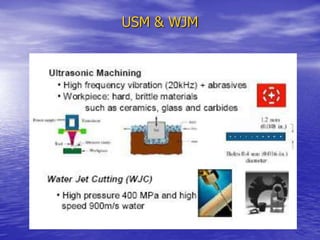
Mechanical Energy
Principle: Erosion
Examples: USM, WJM & AJM
USM & WJM
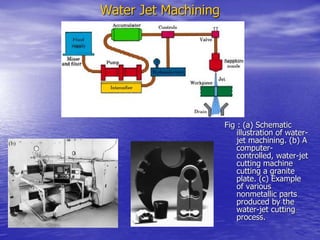
Water Jet Machining
Fig : (a) Schematic
illustration of water-
jet machining. (b) A
computer-
controlled, water-jet
cutting machine
cutting a granite
plate. (c) Example
of various
nonmetallic parts
produced by the
water-jet cutting
process.
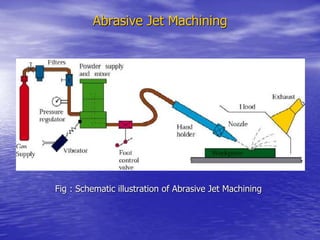
Abrasive Jet Machining
Fig : Schematic illustration of Abrasive Jet Machining
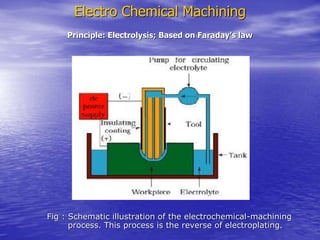
Electro Chemical Machining
Fig : Schematic illustration of the electrochemical-machining
process. This process is the reverse of electroplating.
Principle: Electrolysis; Based on Faraday’s law
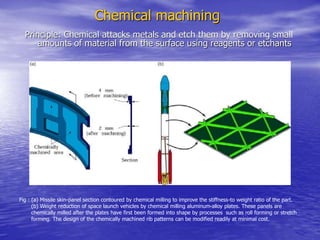
Chemical machining
Principle: Chemical attacks metals and etch them by removing small
amounts of material from the surface using reagents or etchants
Fig : (a) Missile skin-panel section contoured by chemical milling to improve the stiffness-to weight ratio of the part.
(b) Weight reduction of space launch vehicles by chemical milling aluminum-alloy plates. These panels are
chemically milled after the plates have first been formed into shape by processes such as roll forming or stretch
forming. The design of the chemically machined rib patterns can be modified readily at minimal cost.
Thermo-electric
EDM, WEDM, LBM, EBM
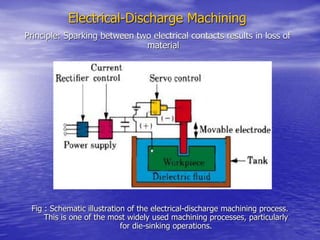
Electrical-Discharge Machining
Fig : Schematic illustration of the electrical-discharge machining process.
This is one of the most widely used machining processes, particularly
for die-sinking operations.
Principle: Sparking between two electrical contacts results in loss of
material
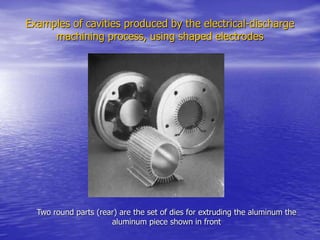
Examples of cavities produced by the electrical-discharge
machining process, using shaped electrodes
Two round parts (rear) are the set of dies for extruding the aluminum the
aluminum piece shown in front
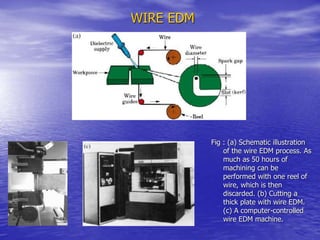
WIRE EDM
Fig : (a) Schematic illustration
of the wire EDM process. As
much as 50 hours of
machining can be
performed with one reel of
wire, which is then
discarded. (b) Cutting a
thick plate with wire EDM.
(c) A computer-controlled
wire EDM machine.
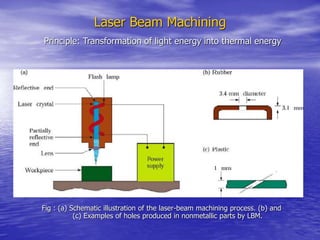
Laser Beam Machining
Fig : (a) Schematic illustration of the laser-beam machining process. (b) and
(c) Examples of holes produced in nonmetallic parts by LBM.
Principle: Transformation of light energy into thermal energy
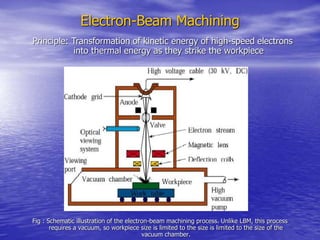
Electron-Beam Machining
Fig : Schematic illustration of the electron-beam machining process. Unlike LBM, this process
requires a vacuum, so workpiece size is limited to the size is limited to the size of the
vacuum chamber.
Principle: Transformation of kinetic energy of high-speed electrons
into thermal energy as they strike the workpiece
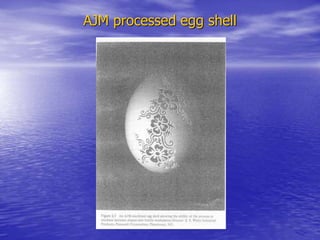
AJM processed egg shell
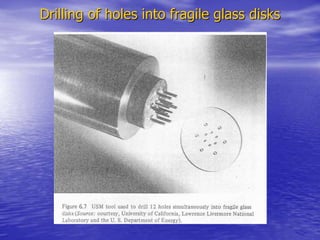
Drilling of holes into fragile glass disks
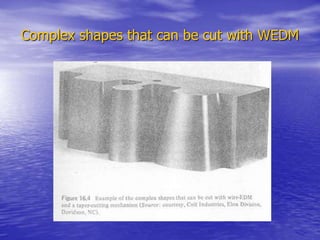
Complex shapes that can be cut with WEDM
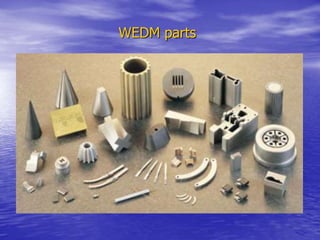
WEDM parts
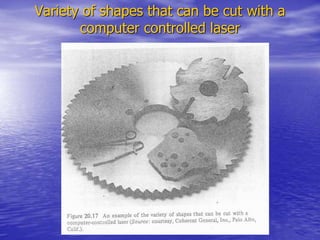
Variety of shapes that can be cut with a
computer controlled laser
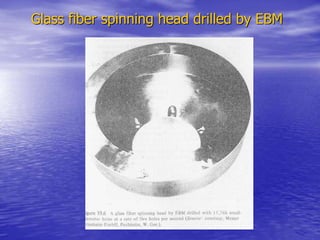
Glass fiber spinning head drilled by EBM
Important characteristics of UCM
processes
• Performance is independent of strength barrier
• Performance depends upon thermal, electrical
or/and chemical properties of w/p
• Use different kinds of energy in direct form
• In general, low MRR but better quality products
• Comparatively high initial investment cost
Selection of UCM processes
• Following factors should be considered when
selecting a specific process for a particular
application:
1. Process capability – MRR, Surface finish,
Surface damage, Tolerance, Corner radii
2. Physical parameters – potential, current,
power, gap, medium
3. Shape capabilities – holes (L/D), through
cavities, pocketing, surfacing , through cutting,
special applications
4. Properties of w/p material to be cut – Electrical
5. Economics of the processes – capital cost,
tooling cost, power required, removal
efficiency and tool wear

Introduction-1-VSA.ppt

  • 1.
    Advanced/Unconventional/Non- traditional Machining Process- An introduction Mr.C.Dharmaraja Assistant Professor Department of Mechanical Engineering University College Of Engineering Dindigul
  • 2.
    ME 2026 -Syllabus 1. INTRODUCTION 5hrs • Unconventional machining Process – Need – classification – Brief overview of all techniques. 2. MECHANICAL ENERGY BASED PROCESSES 10hrs • Abrasive Jet Machining – Water Jet Machining – Ultrasonic Machining. (AJM, WJM and USM). Working Principles – equipment used – Process parameters – MRR-Variation in techniques used – Applications.
  • 3.
    3. ELECTRICAL ENERGYBASED PROCESSES 8hrs • Electric Discharge Machining (EDM)- working Principles- equipments-Process Parameters-MRR- electrode / Tool – Power Circuits-Tool Wear – Dielectric – Flushing – Wire cut EDM – Applications. 4. CHEMICAL AND ELECTRO-CHEMICAL ENERGY BASED PROCESSES 12hrs • Chemical machining and Electro-Chemical machining (CHM and ECM)-Etchants-maskant-techniques of applying maskants-Process Parameters – MRR-Applications. • Principles of ECM-equipments-MRR-Electrical circuit-Process Parameters-ECG and ECH Applications. 5. THERMAL ENERGY BASED PROCESSES 10hrs • Laser Beam machining (LBM), plasma Arc machining (PAM) and Electron Beam Machining (EBM). • Principles-Equipment-Types-Beam control techniques – Applications.
  • 4.
    Objective of thecourse – ME2026 • To give a perspective view with adequate depth to understand the UCM processes, its relative advantages over conventional techniques
  • 5.
    Non-traditional Machining Processes Manufacturingprocesses can be broadly divided into two groups: a) primary manufacturing processes : Provide basic shape and size b) secondary manufacturing processes : Provide final shape and size with tighter control on dimension, surface characteristics Material removal processes once again can be divided into two groups 1. Conventional Machining Processes 2. Non-Traditional Manufacturing Processes or non-conventional Manufacturing processes Conventional Machining Processes mostly remove material in the form of chips by applying forces on the work material with a wedge shaped cutting tool that is harder than the work material under machining condition.
  • 6.
  • 7.
    Non-traditional Machining Processes Themajor characteristics of conventional machining are: – • Generally macroscopic chip formation by shear deformation – • Material removal takes place due to application of cutting forces – energy domain can be classified as mechanical – • Cutting tool is harder than work piece at room temperature as well as under machining conditions Non-conventional manufacturing processes is defined as a group of processes that remove excess material by various techniques involving mechanical, thermal, electrical or chemical energy or combinations of these energies but do not use a sharp cutting tools as it needs to be used for traditional manufacturing processes.
  • 8.
    Principle of conventionalmachining Material is removed principally by SHEARING process – involves physical contact with a metal cutting tool
  • 9.
    Non-traditional Machining Processes Themajor characteristics of Non-conventional machining: 1. Material removal may occur with chip formation or even no chip formation may take place. For example in AJM, chips are of microscopic size and in case of Electrochemical machining material removal occurs due to electrochemical dissolution at atomic level. 2. In NTM, there may not be a physical tool present. For example in laser jet machining, machining is carried out by laser beam. However in Electrochemical Machining there is a physical tool that is very much required for machining 3. In NTM, the tool need not be harder than the work piece material. For example, in EDM, copper is used as the tool material to machine hardened steels. 4. Mostly NTM processes do not necessarily use mechanical energy to provide material removal. They use different energy domains to provide machining. For example, in USM, AJM, WJM mechanical energy is used to machine material, whereas in ECM electrochemical dissolution constitutes material removal.
  • 10.
    Classification of NTMprocesses classification of NTM processes is carried out depending on the nature of energy used for material removal. 1. Mechanical Processes • Abrasive Jet Machining (AJM) • Ultrasonic Machining (USM) • Water Jet Machining (WJM) • Abrasive Water Jet Machining (AWJM) 2. Electrochemical Processes • Electrochemical Machining (ECM) • Electro Chemical Grinding (ECG) • Electro Jet Drilling (EJD) 3. Electro-Thermal Processes • Electro-discharge machining (EDM) • Laser Jet Machining (LJM) • Electron Beam Machining (EBM) 4. Chemical Processes • Chemical Milling (CHM) • Photochemical Milling (PCM)
  • 11.
    UCM Processes • Energyin its direct form is used to remove the materials from the workpiece • Employs fundamental machining energy such as: Mechanical, Electro-chemical, Chemical and Thermo-electric
  • 12.
    Need for UCMprocesses 1. Limitations of conventional processes - tool material hardness > W/p hardness 2. Rapid improvements in the properties of materials – high strength alloys 3. Product requirements • Complex shapes • Machining in inaccessible areas • Low tolerances • Better surface integrity • High surface finish 4. Precision and ultra precision machining – requires material removal in the form of atoms or molecules 5. Low cost of production – especially in producing desired accuracy and surface finish in hard w/p materials 6. High production rate
  • 13.
    Case studies tohighlight the need for UCM processes • Square blind hole in any material with high surface finish (about 10 microns) • Square blind hole with certain accuracy requirement
  • 14.
    Square blind holemanufacturing – increased production time
  • 15.
    Square blind holemanufacturing – shape of the job and accuracy pose problem in manufacturing
  • 16.
    Small hole drilling– size of the job creates problem
  • 17.
    Contoured die block– increased strength of work material and inadequacy of the control system
  • 18.
    Surface profiles generatedby boring and turning
  • 19.
    Preferred orientation oflay lines along axial direction
  • 20.
    Contact length incylindrical piston and cylinder and elliptical piston and cylinder
  • 21.
    Brief overview ofall techniques • Mechanical energy based • Electrical energy based • Chemical and electrochemical energy based • Thermal energy based
  • 22.
    Conventional Machining VS NonConventionalMachining • The cutting tool and workpiece are always in physical contact, with a relative motion against each other, which results in friction and a significant tool wear. • In non-traditional processes, there is no physical contact between the tool and workpiece. Although in some non-traditional processes tool wear exists, it rarely is a significant problem. • Material removal rate of the traditional processes is limited by the mechanical properties of the work material. Non-traditional processes easily deal with such difficult-to-cut materials like ceramics and ceramic based tool materials, fiber reinforced materials, carbides, titanium-based alloys.
  • 23.
    Continue… • In traditionalprocesses, the relative motion between the tool and work piece is typically rotary or reciprocating. Thus, the shape of the work surfaces is limited to circular or flat shapes. In spite of widely used CNC systems, machining of three-dimensional surfaces is still a difficult task. Most non-traditional processes were develop just to solve this problem. • Machining of small cavities, slits, blind or through holes is difficult with traditional processes, whereas it is a simple work for some non- traditional processes. • Traditional processes are well established, use relatively simple and inexpensive machinery and readily available cutting tools. Non- traditional processes require expensive equipment and tooling as well as skilled labor, which increases significantly the production cost.
  • 24.
  • 25.
  • 26.
    Water Jet Machining Fig: (a) Schematic illustration of water- jet machining. (b) A computer- controlled, water-jet cutting machine cutting a granite plate. (c) Example of various nonmetallic parts produced by the water-jet cutting process.
  • 27.
    Abrasive Jet Machining Fig: Schematic illustration of Abrasive Jet Machining
  • 28.
    Electro Chemical Machining Fig: Schematic illustration of the electrochemical-machining process. This process is the reverse of electroplating. Principle: Electrolysis; Based on Faraday’s law
  • 29.
    Chemical machining Principle: Chemicalattacks metals and etch them by removing small amounts of material from the surface using reagents or etchants Fig : (a) Missile skin-panel section contoured by chemical milling to improve the stiffness-to weight ratio of the part. (b) Weight reduction of space launch vehicles by chemical milling aluminum-alloy plates. These panels are chemically milled after the plates have first been formed into shape by processes such as roll forming or stretch forming. The design of the chemically machined rib patterns can be modified readily at minimal cost.
  • 30.
  • 31.
    Electrical-Discharge Machining Fig :Schematic illustration of the electrical-discharge machining process. This is one of the most widely used machining processes, particularly for die-sinking operations. Principle: Sparking between two electrical contacts results in loss of material
  • 32.
    Examples of cavitiesproduced by the electrical-discharge machining process, using shaped electrodes Two round parts (rear) are the set of dies for extruding the aluminum the aluminum piece shown in front
  • 33.
    WIRE EDM Fig :(a) Schematic illustration of the wire EDM process. As much as 50 hours of machining can be performed with one reel of wire, which is then discarded. (b) Cutting a thick plate with wire EDM. (c) A computer-controlled wire EDM machine.
  • 34.
    Laser Beam Machining Fig: (a) Schematic illustration of the laser-beam machining process. (b) and (c) Examples of holes produced in nonmetallic parts by LBM. Principle: Transformation of light energy into thermal energy
  • 35.
    Electron-Beam Machining Fig :Schematic illustration of the electron-beam machining process. Unlike LBM, this process requires a vacuum, so workpiece size is limited to the size is limited to the size of the vacuum chamber. Principle: Transformation of kinetic energy of high-speed electrons into thermal energy as they strike the workpiece
  • 39.
  • 40.
    Drilling of holesinto fragile glass disks
  • 41.
    Complex shapes thatcan be cut with WEDM
  • 42.
  • 43.
    Variety of shapesthat can be cut with a computer controlled laser
  • 44.
    Glass fiber spinninghead drilled by EBM
  • 45.
    Important characteristics ofUCM processes • Performance is independent of strength barrier • Performance depends upon thermal, electrical or/and chemical properties of w/p • Use different kinds of energy in direct form • In general, low MRR but better quality products • Comparatively high initial investment cost
  • 46.
    Selection of UCMprocesses • Following factors should be considered when selecting a specific process for a particular application: 1. Process capability – MRR, Surface finish, Surface damage, Tolerance, Corner radii 2. Physical parameters – potential, current, power, gap, medium 3. Shape capabilities – holes (L/D), through cavities, pocketing, surfacing , through cutting, special applications 4. Properties of w/p material to be cut – Electrical 5. Economics of the processes – capital cost, tooling cost, power required, removal efficiency and tool wear