SPECIAL CASTING PROCESSES
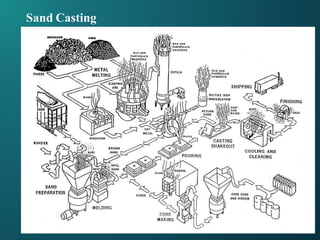
Sand Casting
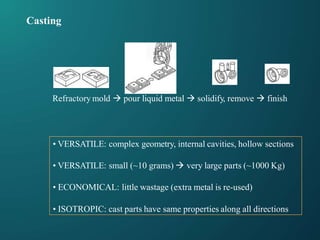
Casting
Refractory mold  pour liquid metal  solidify, remove  finish
• VERSATILE: complex geometry, internal cavities, hollow sections
• VERSATILE: small (~10 grams)  very large parts (~1000 Kg)
• ECONOMICAL: little wastage (extra metal is re-used)
• ISOTROPIC: cast parts have same properties along all directions
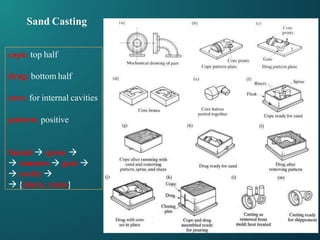
Sand Casting
cope: top half
drag: bottom half
core: for internal cavities
pattern: positive
funnel  sprue 
 runners  gate 
 cavity 
 {risers, vents}
5
SPECIAL CASTING PROCESSES
 Sand moulds are single purpose moulds as they are completely
destroyed after the casting has been removed from the moulding
box
 It becomes therefore obvious that the use of a permanent mould
would do a considerable saving in labor cost of mould making
ADVANTAGES
 Greater dimensional accuracy
 High production rates and hence lower production cost
 Ability to cast extremely thin sections
 Posses higher mechanical properties
Shell Mould casting
Pressure die casting
Hot chamber
Cold chamber
Gravity Die Casting
Centrifugal Casting
CO2 Casting
Investment or Lost Wax process
SPECIAL CASTING PROCESSES
7
Metal piece pattern is used, so it reused to make more
number of mould.
It allows the higher production rate.
Shell mold casting allows the use of both ferrous and non-
ferrous metals, most commonly cast iron, carbon steel,
alloy steel, stainless steel, aluminum alloys, and copper
alloys used.
8
1.Pattern creation: A two-piece metal pattern is
created in the shape of the desired part, typically
from iron or steel. Other materials such as
aluminum for low volume production or graphite
for casting reactive materials.
2.Mould creation
3.Mould assembly
4.Pouring
5.Cooling
6.Casting removal
7.Trimming and cleaning process
9
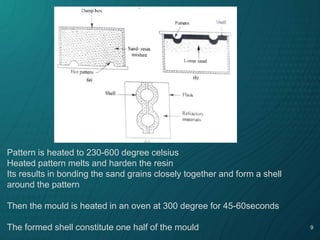
Pattern is heated to 230-600 degree celsius
Heated pattern melts and harden the resin
Its results in bonding the sand grains closely together and form a shell
around the pattern
Then the mould is heated in an oven at 300 degree for 45-60seconds
The formed shell constitute one half of the mould
10
SHELL CASTING
11
SHELL MOULDING
ADVANTAGES
 Castings as thin as 1.5 mm
 Machining often not required
 Smoother cavity surface permits easier flow of molten metal and better
surface finish
DISADVANTAGES
 Uneconomical to small scale production
 Resin costs are comparatively high
 Heavy weight castings (>10kg)
APPLICATIONS
 Automotive rocker arms, valves, small pipes, camshaft, bushings, valve
bodies, brackets, bearing caps, shafts, gears and so on.
12
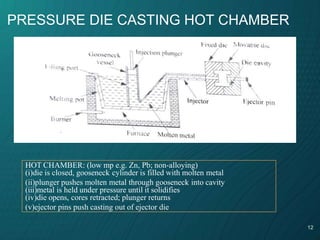
PRESSURE DIE CASTING HOT CHAMBER
HOT CHAMBER: (low mp e.g. Zn, Pb; non-alloying)
(i)die is closed, gooseneck cylinder is filled with molten metal
(ii)plunger pushes molten metal through gooseneck into cavity
(iii)metal is held under pressure until it solidifies
(iv)die opens, cores retracted; plunger returns
(v)ejector pins push casting out of ejector die
13
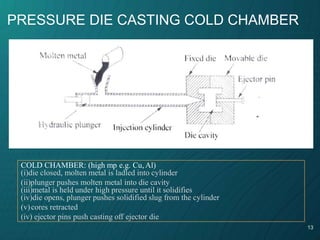
PRESSURE DIE CASTING COLD CHAMBER
COLD CHAMBER: (high mp e.g. Cu,Al)
(i)die closed, molten metal is ladled into cylinder
(ii)plunger pushes molten metal into die cavity
(iii)metal is held under high pressure until it solidifies
(iv)die opens, plunger pushes solidified slug from the cylinder
(v)cores retracted
(iv) ejector pins push casting off ejector die
14
PRESSURE DIE CASTING
ADVANTAGES
 High production rate
 High accuracy in part dimensions
 Smooth surface finish for minimum mechanical finishing
 Ability to make many intricate parts
DISADVANTAGES
 Hollow shapes are not readily casted because of the high metal pressure
 Limited sizes of the products can be produced based on the availability of the equipment
 High melting temperature alloys are practically not die casted
APPLICATIONS
 Die casting process is preferred for nonferrous metal parts of intricate shapes
 Automobiles appliances, hand tools, computer peripherals, toys, optical and
photographic equipment etc
- a type of permanent mold casting
-common uses: components for rice cookers, stoves, fans, washing-,
drying machines,fridges, motors, toys, hand-tools, car wheels, …
15
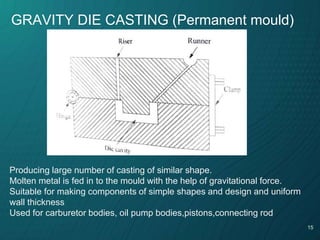
GRAVITY DIE CASTING (Permanent mould)
Producing large number of casting of similar shape.
Molten metal is fed in to the mould with the help of gravitational force.
Suitable for making components of simple shapes and design and uniform
wall thickness
Used for carburetor bodies, oil pump bodies,pistons,connecting rod
16
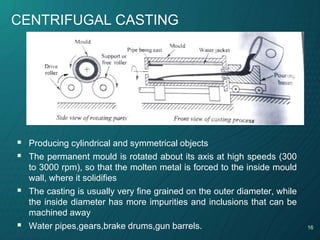
CENTRIFUGAL CASTING
 Producing cylindrical and symmetrical objects
 The permanent mould is rotated about its axis at high speeds (300
to 3000 rpm), so that the molten metal is forced to the inside mould
wall, where it solidifies
 The casting is usually very fine grained on the outer diameter, while
the inside diameter has more impurities and inclusions that can be
machined away
 Water pipes,gears,brake drums,gun barrels.
17
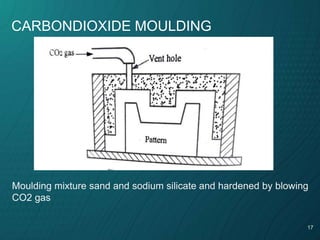
CARBONDIOXIDE MOULDING
Moulding mixture sand and sodium silicate and hardened by blowing
CO2 gas
18
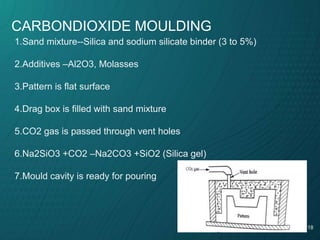
1.Sand mixture--Silica and sodium silicate binder (3 to 5%)
2.Additives –Al2O3, Molasses
3.Pattern is flat surface
4.Drag box is filled with sand mixture
5.CO2 gas is passed through vent holes
6.Na2SiO3 +CO2 –Na2CO3 +SiO2 (Silica gel)
7.Mould cavity is ready for pouring
CARBONDIOXIDE MOULDING
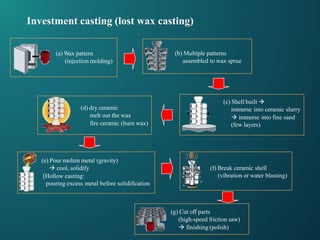
Investment casting (lost wax casting)
(a) Wax pattern
(injection molding)
(b) Multiple patterns
assembled to wax sprue
(c) Shell built 
immerse into ceramic slurry
 immerse into fine sand
(few layers)
(d) dry ceramic
melt out the wax
fire ceramic (burn wax)
(e) Pour molten metal (gravity)
 cool, solidify
[Hollow casting:
pouring excess metal before solidification
(f) Break ceramic shell
(vibration or water blasting)
(g) Cut off parts
(high-speed friction saw)
 finishing (polish)
20
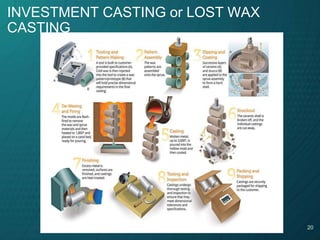
INVESTMENT CASTING or LOST WAX
CASTING
21
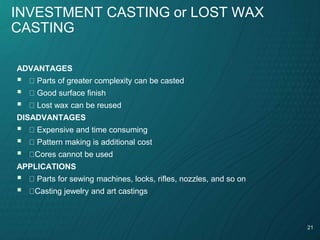
INVESTMENT CASTING or LOST WAX
CASTING
ADVANTAGES
 Parts of greater complexity can be casted
 Good surface finish
 Lost wax can be reused
DISADVANTAGES
 Expensive and time consuming
 Pattern making is additional cost
 Cores cannot be used
APPLICATIONS
 Parts for sewing machines, locks, rifles, nozzles, and so on
 Casting jewelry and art castings
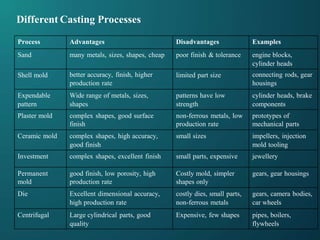
Different Casting Processes
Process Advantages Disadvantages Examples
Sand many metals, sizes, shapes, cheap poor finish & tolerance engine blocks,
cylinder heads
Shell mold better accuracy, finish, higher
production rate
limited part size connecting rods, gear
housings
Expendable
pattern
Wide range of metals, sizes,
shapes
patterns have low
strength
cylinder heads, brake
components
Plaster mold complex shapes, good surface
finish
non-ferrous metals, low
production rate
prototypes of
mechanical parts
Ceramic mold complex shapes, high accuracy,
good finish
small sizes impellers, injection
mold tooling
Investment complex shapes, excellent finish small parts, expensive jewellery
Permanent
mold
good finish, low porosity, high
production rate
Costly mold, simpler
shapes only
gears, gear housings
Die Excellent dimensional accuracy,
high production rate
costly dies, small parts,
non-ferrous metals
gears, camera bodies,
car wheels
Centrifugal Large cylindrical parts, good
quality
Expensive, few shapes pipes, boilers,
flywheels
SAND CASTING DEFECTS
24
SAND CASTING DEFECTS
 Various defects can develop in manufacturing processes depending
on factors such as
- Materials
- Part design
- Processing techniques
 While some defects affect only the appearance of the parts made,
others can have major adverse effects on the structural integrity of
the parts
 Defects found in castings may be divided into three classes
- Visual examination or measurement
- Machining, sectioning or radiography
- Material defects by mechanical testing
25
CLASSIFICATION OF DEFECTS
Defects caused by
 Patterns and moulding box equipment
 Molten metal
 Improper mould drying and core baking
 Moulding, core making, gating etc.
 Moulding and core making materials
 Improper sand mixing and distribution
 Closing and pouring the moulds
26
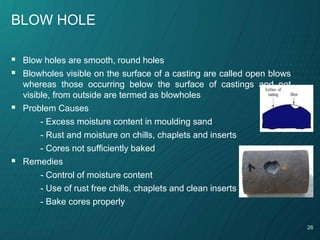
BLOW HOLE
 Blow holes are smooth, round holes
 Blowholes visible on the surface of a casting are called open blows
whereas those occurring below the surface of castings and not
visible, from outside are termed as blowholes
 Problem Causes
- Excess moisture content in moulding sand
- Rust and moisture on chills, chaplets and inserts
- Cores not sufficiently baked
 Remedies
- Control of moisture content
- Use of rust free chills, chaplets and clean inserts
- Bake cores properly
27
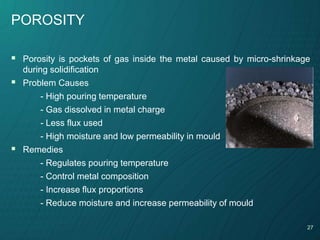
POROSITY
 Porosity is pockets of gas inside the metal caused by micro-shrinkage
during solidification
 Problem Causes
- High pouring temperature
- Gas dissolved in metal charge
- Less flux used
- High moisture and low permeability in mould
 Remedies
- Regulates pouring temperature
- Control metal composition
- Increase flux proportions
- Reduce moisture and increase permeability of mould
28
MISRUNS
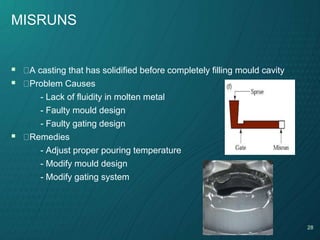
 A casting that has solidified before completely filling mould cavity
 Problem Causes
- Lack of fluidity in molten metal
- Faulty mould design
- Faulty gating design
 Remedies
- Adjust proper pouring temperature
- Modify mould design
- Modify gating system
29
HOT TEARS
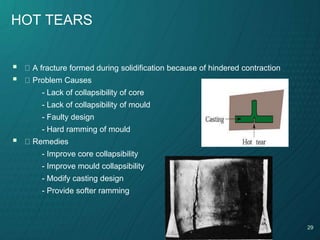
 A fracture formed during solidification because of hindered contraction
 Problem Causes
- Lack of collapsibility of core
- Lack of collapsibility of mould
- Faulty design
- Hard ramming of mould
 Remedies
- Improve core collapsibility
- Improve mould collapsibility
- Modify casting design
- Provide softer ramming
30
METAL PENETRATION
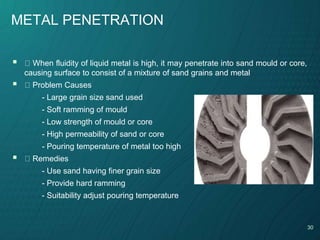
 When fluidity of liquid metal is high, it may penetrate into sand mould or core,
causing surface to consist of a mixture of sand grains and metal
 Problem Causes
- Large grain size sand used
- Soft ramming of mould
- Low strength of mould or core
- High permeability of sand or core
- Pouring temperature of metal too high
 Remedies
- Use sand having finer grain size
- Provide hard ramming
- Suitability adjust pouring temperature
31
COLD SHUTS
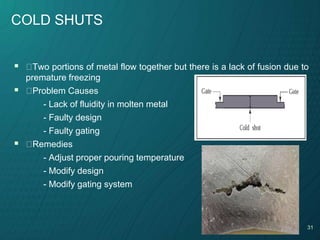
 Two portions of metal flow together but there is a lack of fusion due to
premature freezing
 Problem Causes
- Lack of fluidity in molten metal
- Faulty design
- Faulty gating
 Remedies
- Adjust proper pouring temperature
- Modify design
- Modify gating system
32
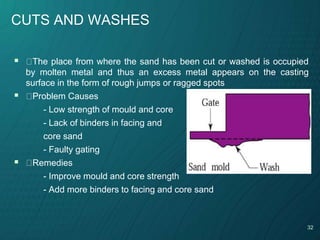
CUTS AND WASHES
 The place from where the sand has been cut or washed is occupied
by molten metal and thus an excess metal appears on the casting
surface in the form of rough jumps or ragged spots
 Problem Causes
- Low strength of mould and core
- Lack of binders in facing and
core sand
- Faulty gating
 Remedies
- Improve mould and core strength
- Add more binders to facing and core sand
33
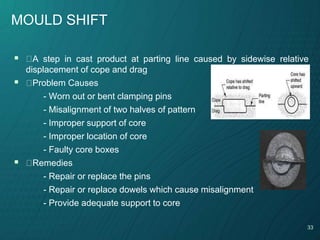
MOULD SHIFT
 A step in cast product at parting line caused by sidewise relative
displacement of cope and drag
 Problem Causes
- Worn out or bent clamping pins
- Misalignment of two halves of pattern
- Improper support of core
- Improper location of core
- Faulty core boxes
 Remedies
- Repair or replace the pins
- Repair or replace dowels which cause misalignment
- Provide adequate support to core

SPECIAL CASTING PROCESSES.pptx

  • 1.
  • 2.
  • 3.
    Casting Refractory mold pour liquid metal  solidify, remove  finish • VERSATILE: complex geometry, internal cavities, hollow sections • VERSATILE: small (~10 grams)  very large parts (~1000 Kg) • ECONOMICAL: little wastage (extra metal is re-used) • ISOTROPIC: cast parts have same properties along all directions
  • 4.
    Sand Casting cope: tophalf drag: bottom half core: for internal cavities pattern: positive funnel  sprue   runners  gate   cavity   {risers, vents}
  • 5.
    5 SPECIAL CASTING PROCESSES Sand moulds are single purpose moulds as they are completely destroyed after the casting has been removed from the moulding box  It becomes therefore obvious that the use of a permanent mould would do a considerable saving in labor cost of mould making ADVANTAGES  Greater dimensional accuracy  High production rates and hence lower production cost  Ability to cast extremely thin sections  Posses higher mechanical properties
  • 6.
    Shell Mould casting Pressuredie casting Hot chamber Cold chamber Gravity Die Casting Centrifugal Casting CO2 Casting Investment or Lost Wax process SPECIAL CASTING PROCESSES
  • 7.
    7 Metal piece patternis used, so it reused to make more number of mould. It allows the higher production rate. Shell mold casting allows the use of both ferrous and non- ferrous metals, most commonly cast iron, carbon steel, alloy steel, stainless steel, aluminum alloys, and copper alloys used.
  • 8.
    8 1.Pattern creation: Atwo-piece metal pattern is created in the shape of the desired part, typically from iron or steel. Other materials such as aluminum for low volume production or graphite for casting reactive materials. 2.Mould creation 3.Mould assembly 4.Pouring 5.Cooling 6.Casting removal 7.Trimming and cleaning process
  • 9.
    9 Pattern is heatedto 230-600 degree celsius Heated pattern melts and harden the resin Its results in bonding the sand grains closely together and form a shell around the pattern Then the mould is heated in an oven at 300 degree for 45-60seconds The formed shell constitute one half of the mould
  • 10.
  • 11.
    11 SHELL MOULDING ADVANTAGES  Castingsas thin as 1.5 mm  Machining often not required  Smoother cavity surface permits easier flow of molten metal and better surface finish DISADVANTAGES  Uneconomical to small scale production  Resin costs are comparatively high  Heavy weight castings (>10kg) APPLICATIONS  Automotive rocker arms, valves, small pipes, camshaft, bushings, valve bodies, brackets, bearing caps, shafts, gears and so on.
  • 12.
    12 PRESSURE DIE CASTINGHOT CHAMBER HOT CHAMBER: (low mp e.g. Zn, Pb; non-alloying) (i)die is closed, gooseneck cylinder is filled with molten metal (ii)plunger pushes molten metal through gooseneck into cavity (iii)metal is held under pressure until it solidifies (iv)die opens, cores retracted; plunger returns (v)ejector pins push casting out of ejector die
  • 13.
    13 PRESSURE DIE CASTINGCOLD CHAMBER COLD CHAMBER: (high mp e.g. Cu,Al) (i)die closed, molten metal is ladled into cylinder (ii)plunger pushes molten metal into die cavity (iii)metal is held under high pressure until it solidifies (iv)die opens, plunger pushes solidified slug from the cylinder (v)cores retracted (iv) ejector pins push casting off ejector die
  • 14.
    14 PRESSURE DIE CASTING ADVANTAGES High production rate  High accuracy in part dimensions  Smooth surface finish for minimum mechanical finishing  Ability to make many intricate parts DISADVANTAGES  Hollow shapes are not readily casted because of the high metal pressure  Limited sizes of the products can be produced based on the availability of the equipment  High melting temperature alloys are practically not die casted APPLICATIONS  Die casting process is preferred for nonferrous metal parts of intricate shapes  Automobiles appliances, hand tools, computer peripherals, toys, optical and photographic equipment etc - a type of permanent mold casting -common uses: components for rice cookers, stoves, fans, washing-, drying machines,fridges, motors, toys, hand-tools, car wheels, …
  • 15.
    15 GRAVITY DIE CASTING(Permanent mould) Producing large number of casting of similar shape. Molten metal is fed in to the mould with the help of gravitational force. Suitable for making components of simple shapes and design and uniform wall thickness Used for carburetor bodies, oil pump bodies,pistons,connecting rod
  • 16.
    16 CENTRIFUGAL CASTING  Producingcylindrical and symmetrical objects  The permanent mould is rotated about its axis at high speeds (300 to 3000 rpm), so that the molten metal is forced to the inside mould wall, where it solidifies  The casting is usually very fine grained on the outer diameter, while the inside diameter has more impurities and inclusions that can be machined away  Water pipes,gears,brake drums,gun barrels.
  • 17.
    17 CARBONDIOXIDE MOULDING Moulding mixturesand and sodium silicate and hardened by blowing CO2 gas
  • 18.
    18 1.Sand mixture--Silica andsodium silicate binder (3 to 5%) 2.Additives –Al2O3, Molasses 3.Pattern is flat surface 4.Drag box is filled with sand mixture 5.CO2 gas is passed through vent holes 6.Na2SiO3 +CO2 –Na2CO3 +SiO2 (Silica gel) 7.Mould cavity is ready for pouring CARBONDIOXIDE MOULDING
  • 19.
    Investment casting (lostwax casting) (a) Wax pattern (injection molding) (b) Multiple patterns assembled to wax sprue (c) Shell built  immerse into ceramic slurry  immerse into fine sand (few layers) (d) dry ceramic melt out the wax fire ceramic (burn wax) (e) Pour molten metal (gravity)  cool, solidify [Hollow casting: pouring excess metal before solidification (f) Break ceramic shell (vibration or water blasting) (g) Cut off parts (high-speed friction saw)  finishing (polish)
  • 20.
    20 INVESTMENT CASTING orLOST WAX CASTING
  • 21.
    21 INVESTMENT CASTING orLOST WAX CASTING ADVANTAGES  Parts of greater complexity can be casted  Good surface finish  Lost wax can be reused DISADVANTAGES  Expensive and time consuming  Pattern making is additional cost  Cores cannot be used APPLICATIONS  Parts for sewing machines, locks, rifles, nozzles, and so on  Casting jewelry and art castings
  • 22.
    Different Casting Processes ProcessAdvantages Disadvantages Examples Sand many metals, sizes, shapes, cheap poor finish & tolerance engine blocks, cylinder heads Shell mold better accuracy, finish, higher production rate limited part size connecting rods, gear housings Expendable pattern Wide range of metals, sizes, shapes patterns have low strength cylinder heads, brake components Plaster mold complex shapes, good surface finish non-ferrous metals, low production rate prototypes of mechanical parts Ceramic mold complex shapes, high accuracy, good finish small sizes impellers, injection mold tooling Investment complex shapes, excellent finish small parts, expensive jewellery Permanent mold good finish, low porosity, high production rate Costly mold, simpler shapes only gears, gear housings Die Excellent dimensional accuracy, high production rate costly dies, small parts, non-ferrous metals gears, camera bodies, car wheels Centrifugal Large cylindrical parts, good quality Expensive, few shapes pipes, boilers, flywheels
  • 23.
  • 24.
    24 SAND CASTING DEFECTS Various defects can develop in manufacturing processes depending on factors such as - Materials - Part design - Processing techniques  While some defects affect only the appearance of the parts made, others can have major adverse effects on the structural integrity of the parts  Defects found in castings may be divided into three classes - Visual examination or measurement - Machining, sectioning or radiography - Material defects by mechanical testing
  • 25.
    25 CLASSIFICATION OF DEFECTS Defectscaused by  Patterns and moulding box equipment  Molten metal  Improper mould drying and core baking  Moulding, core making, gating etc.  Moulding and core making materials  Improper sand mixing and distribution  Closing and pouring the moulds
  • 26.
    26 BLOW HOLE  Blowholes are smooth, round holes  Blowholes visible on the surface of a casting are called open blows whereas those occurring below the surface of castings and not visible, from outside are termed as blowholes  Problem Causes - Excess moisture content in moulding sand - Rust and moisture on chills, chaplets and inserts - Cores not sufficiently baked  Remedies - Control of moisture content - Use of rust free chills, chaplets and clean inserts - Bake cores properly
  • 27.
    27 POROSITY  Porosity ispockets of gas inside the metal caused by micro-shrinkage during solidification  Problem Causes - High pouring temperature - Gas dissolved in metal charge - Less flux used - High moisture and low permeability in mould  Remedies - Regulates pouring temperature - Control metal composition - Increase flux proportions - Reduce moisture and increase permeability of mould
  • 28.
    28 MISRUNS  A castingthat has solidified before completely filling mould cavity  Problem Causes - Lack of fluidity in molten metal - Faulty mould design - Faulty gating design  Remedies - Adjust proper pouring temperature - Modify mould design - Modify gating system
  • 29.
    29 HOT TEARS  Afracture formed during solidification because of hindered contraction  Problem Causes - Lack of collapsibility of core - Lack of collapsibility of mould - Faulty design - Hard ramming of mould  Remedies - Improve core collapsibility - Improve mould collapsibility - Modify casting design - Provide softer ramming
  • 30.
    30 METAL PENETRATION  Whenfluidity of liquid metal is high, it may penetrate into sand mould or core, causing surface to consist of a mixture of sand grains and metal  Problem Causes - Large grain size sand used - Soft ramming of mould - Low strength of mould or core - High permeability of sand or core - Pouring temperature of metal too high  Remedies - Use sand having finer grain size - Provide hard ramming - Suitability adjust pouring temperature
  • 31.
    31 COLD SHUTS  Twoportions of metal flow together but there is a lack of fusion due to premature freezing  Problem Causes - Lack of fluidity in molten metal - Faulty design - Faulty gating  Remedies - Adjust proper pouring temperature - Modify design - Modify gating system
  • 32.
    32 CUTS AND WASHES The place from where the sand has been cut or washed is occupied by molten metal and thus an excess metal appears on the casting surface in the form of rough jumps or ragged spots  Problem Causes - Low strength of mould and core - Lack of binders in facing and core sand - Faulty gating  Remedies - Improve mould and core strength - Add more binders to facing and core sand
  • 33.
    33 MOULD SHIFT  Astep in cast product at parting line caused by sidewise relative displacement of cope and drag  Problem Causes - Worn out or bent clamping pins - Misalignment of two halves of pattern - Improper support of core - Improper location of core - Faulty core boxes  Remedies - Repair or replace the pins - Repair or replace dowels which cause misalignment - Provide adequate support to core