ADVANCED MACHINING
PROCESS(Manufacturing process)
INTRODUCTION
Man u fact u r in g processes can be broadly div ided in t o t wo grou ps:
a) pr imar y man u fact u r in g processes : Prov ide basic sh ape an d siz e
b) secon dar y man u fact u r ing processes : Prov ide fin al sh ape an d
siz e wit h t igh t er con t rol on dimen sion , su r face ch ar act er istics
Mat er ial remov al processes on ce again can be div ided in t o t wo
grou ps
1. Con ven tion al Mach in in g Processes
2 . Non - Tr adit ion al Man u fact u r ing Processes or n on - con v en t ion al
Man u fact u r in g processes
Con v en t ion al Mach in in g Processes most ly remov e mat er ial in
th e for m of ch ips by applyin g forces on th e wor k mater ial with
a wedge sh aped cu t t in g t ool t h at is h arder t h an t h e wor k
mat er ial u n der mach in in g con dit ion .
The major characteristics of conventional machining are:
• Generally macroscopic chip formation by shear deformation
• Material removal takes place due to application of cutting forces – energy
domain can be classified as mechanical
• Cutting tool is harder than work piece at room temperature as well as under
machining conditions
Non-conventional manufacturing processes is defined as a group of processes
that remove excess material by various techniques involving mechanical, thermal,
electrical or chemical energy or combinations of these energies but do not use a
sharp cutting tools as it needs to be used for traditional manufacturing processes.
The major characteristics of Non-conventional machining are:
1. Material removal may occur with chip formation or even no chip formation may
take place. For example in AJM, chips are of microscopic size and in case of
Electrochemical machining material removal occurs due to electrochemical
dissolution at atomic level.
The major characteristics of Non-conventional machining:
2. In NCM, there may not be a physical tool present. For example in laser jet machining,
machining is carried out by laser beam. However in Electrochemical Machining there
a physical tool that is very much required for machining
3. In NCM, the tool need not be harder than the work piece material. For example, in
copper is used as the tool material to machine hardened steels.
4. Mostly NCM processes do not necessarily use mechanical energy to provide material
removal. They use different energy domains to provide machining. For example, in
USM, AJM, WJM mechanical energy is used to machine material, whereas in ECM
electrochemical dissolution constitutes material removal.
Needs for Non Traditional Machining
 Extremely hard and brittle materials or Difficult to machine materials are difficult to
machine by traditional machining processes.
 When the workpiece is too flexible or slender to support the cutting or grinding
forces.
 When the shape of the part is too complex.
 Intricate shaped blind hole – e.g. square hole of 15 mmx15 mm with a depth of 30
mm
 Deep hole with small hole diameter – e.g. φ 1.5 mm hole with l/d = 20
 Machining of composites.
CLASSIFICATION OF NON-CONVENTIONAL
METHOD
classification of NTM processes is carried out depending on the nature of
energy used for material removal.
1. Mechanical Processes
• Abrasive Jet Machining (AJM)
• Ultrasonic Machining (USM)
• Water Jet Machining (WJM)
• Abrasive Water Jet Machining (AWJM)
2. Electrochemical Processes
• Electrochemical Machining (ECM)
• Electro Chemical Grinding (ECG)
• Electro Jet Drilling (EJD)
3. Electro-Thermal Processes
• Electro-discharge machining (EDM)
• Laser Jet Machining (LJM)
• Electron Beam Machining (EBM)
4. Chemical Processes
• Chemical Milling (CHM)
• Photochemical Milling (PCM)
Abrasive Jet Machining
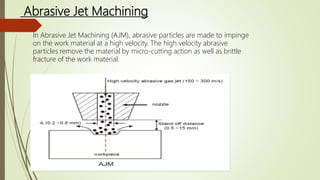
In Abrasive Jet Machining (AJM), abrasive particles are made to impinge
on the work material at a high velocity. The high velocity abrasive
particles remove the material by micro-cutting action as well as brittle
fracture of the work material.
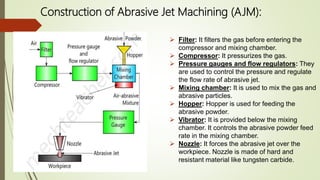
Construction of Abrasive Jet Machining (AJM):
 Filter: It filters the gas before entering the
compressor and mixing chamber.
 Compressor: It pressurizes the gas.
 Pressure gauges and flow regulators: They
are used to control the pressure and regulate
the flow rate of abrasive jet.
 Mixing chamber: It is used to mix the gas and
abrasive particles.
 Hopper: Hopper is used for feeding the
abrasive powder.
 Vibrator: It is provided below the mixing
chamber. It controls the abrasive powder feed
rate in the mixing chamber.
 Nozzle: It forces the abrasive jet over the
workpiece. Nozzle is made of hard and
resistant material like tungsten carbide.
Working
 Dry air or gas is filtered and compressed by passing it through the filter
and compressor.
 A pressure gauge and a flow regulator are used to control the pressure
and regulate the flow rate of the compressed air.
 Compressed air is then passed into the mixing chamber. In the mixing
chamber, abrasive powder is fed. A vibrator is used to control the feed
of the abrasive powder. The abrasive powder and the compressed air
are thoroughly mixed in the chamber. The pressure of this mixture is
regulated and sent to nozzle.
 The nozzle increases the velocity of the mixture at the expense of its
pressure. A fine abrasive jet is rendered by the nozzle. This jet is used to
remove unwanted material from the workpiece.
Electron Beam Machining (EBM)
EBM is a metal removal process by a high velocity focused stream of
electrons. As the electrons strike the workpiece with high velocity ,their
kinetic energy is transformed into thermal energy which melts and vaporizes
the material.
Like other this machines is also used to remove material.
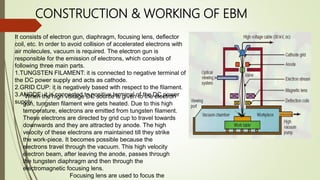
CONSTRUCTION & WORKING OF EBM
It consists of electron gun, diaphragm, focusing lens, deflector
coil, etc. In order to avoid collision of accelerated electrons with
air molecules, vacuum is required. The electron gun is
responsible for the emission of electrons, which consists of
following three main parts.
1.TUNGSTEN FILAMENT: it is connected to negative terminal of
the DC power supply and acts as cathode.
2.GRID CUP: it is negatively based with respect to the filament.
3.ANODE: it is connected to positive terminal of the DC power
supply.
When the high voltage DC source is given to the electron
gun, tungsten filament wire gets heated. Due to this high
temperature, electrons are emitted from tungsten filament.
These electrons are directed by grid cup to travel towards
downwards and they are attracted by anode. The high
velocity of these electrons are maintained till they strike
the work-piece. It becomes possible because the
electrons travel through the vacuum. This high velocity
electron beam, after leaving the anode, passes through
the tungsten diaphragm and then through the
electromagnetic focusing lens.
Focusing lens are used to focus the

Advanced machining

  • 1.
  • 2.
    INTRODUCTION Man u factu r in g processes can be broadly div ided in t o t wo grou ps: a) pr imar y man u fact u r in g processes : Prov ide basic sh ape an d siz e b) secon dar y man u fact u r ing processes : Prov ide fin al sh ape an d siz e wit h t igh t er con t rol on dimen sion , su r face ch ar act er istics Mat er ial remov al processes on ce again can be div ided in t o t wo grou ps 1. Con ven tion al Mach in in g Processes 2 . Non - Tr adit ion al Man u fact u r ing Processes or n on - con v en t ion al Man u fact u r in g processes Con v en t ion al Mach in in g Processes most ly remov e mat er ial in th e for m of ch ips by applyin g forces on th e wor k mater ial with a wedge sh aped cu t t in g t ool t h at is h arder t h an t h e wor k mat er ial u n der mach in in g con dit ion .
  • 3.
    The major characteristicsof conventional machining are: • Generally macroscopic chip formation by shear deformation • Material removal takes place due to application of cutting forces – energy domain can be classified as mechanical • Cutting tool is harder than work piece at room temperature as well as under machining conditions Non-conventional manufacturing processes is defined as a group of processes that remove excess material by various techniques involving mechanical, thermal, electrical or chemical energy or combinations of these energies but do not use a sharp cutting tools as it needs to be used for traditional manufacturing processes. The major characteristics of Non-conventional machining are: 1. Material removal may occur with chip formation or even no chip formation may take place. For example in AJM, chips are of microscopic size and in case of Electrochemical machining material removal occurs due to electrochemical dissolution at atomic level.
  • 4.
    The major characteristicsof Non-conventional machining: 2. In NCM, there may not be a physical tool present. For example in laser jet machining, machining is carried out by laser beam. However in Electrochemical Machining there a physical tool that is very much required for machining 3. In NCM, the tool need not be harder than the work piece material. For example, in copper is used as the tool material to machine hardened steels. 4. Mostly NCM processes do not necessarily use mechanical energy to provide material removal. They use different energy domains to provide machining. For example, in USM, AJM, WJM mechanical energy is used to machine material, whereas in ECM electrochemical dissolution constitutes material removal.
  • 5.
    Needs for NonTraditional Machining  Extremely hard and brittle materials or Difficult to machine materials are difficult to machine by traditional machining processes.  When the workpiece is too flexible or slender to support the cutting or grinding forces.  When the shape of the part is too complex.  Intricate shaped blind hole – e.g. square hole of 15 mmx15 mm with a depth of 30 mm  Deep hole with small hole diameter – e.g. φ 1.5 mm hole with l/d = 20  Machining of composites.
  • 6.
    CLASSIFICATION OF NON-CONVENTIONAL METHOD classificationof NTM processes is carried out depending on the nature of energy used for material removal. 1. Mechanical Processes • Abrasive Jet Machining (AJM) • Ultrasonic Machining (USM) • Water Jet Machining (WJM) • Abrasive Water Jet Machining (AWJM) 2. Electrochemical Processes • Electrochemical Machining (ECM) • Electro Chemical Grinding (ECG) • Electro Jet Drilling (EJD) 3. Electro-Thermal Processes • Electro-discharge machining (EDM) • Laser Jet Machining (LJM) • Electron Beam Machining (EBM) 4. Chemical Processes • Chemical Milling (CHM) • Photochemical Milling (PCM)
  • 7.
    Abrasive Jet Machining InAbrasive Jet Machining (AJM), abrasive particles are made to impinge on the work material at a high velocity. The high velocity abrasive particles remove the material by micro-cutting action as well as brittle fracture of the work material.
  • 8.
    Construction of AbrasiveJet Machining (AJM):  Filter: It filters the gas before entering the compressor and mixing chamber.  Compressor: It pressurizes the gas.  Pressure gauges and flow regulators: They are used to control the pressure and regulate the flow rate of abrasive jet.  Mixing chamber: It is used to mix the gas and abrasive particles.  Hopper: Hopper is used for feeding the abrasive powder.  Vibrator: It is provided below the mixing chamber. It controls the abrasive powder feed rate in the mixing chamber.  Nozzle: It forces the abrasive jet over the workpiece. Nozzle is made of hard and resistant material like tungsten carbide.
  • 9.
    Working  Dry airor gas is filtered and compressed by passing it through the filter and compressor.  A pressure gauge and a flow regulator are used to control the pressure and regulate the flow rate of the compressed air.  Compressed air is then passed into the mixing chamber. In the mixing chamber, abrasive powder is fed. A vibrator is used to control the feed of the abrasive powder. The abrasive powder and the compressed air are thoroughly mixed in the chamber. The pressure of this mixture is regulated and sent to nozzle.  The nozzle increases the velocity of the mixture at the expense of its pressure. A fine abrasive jet is rendered by the nozzle. This jet is used to remove unwanted material from the workpiece.
  • 10.
    Electron Beam Machining(EBM) EBM is a metal removal process by a high velocity focused stream of electrons. As the electrons strike the workpiece with high velocity ,their kinetic energy is transformed into thermal energy which melts and vaporizes the material. Like other this machines is also used to remove material.
  • 11.
    CONSTRUCTION & WORKINGOF EBM It consists of electron gun, diaphragm, focusing lens, deflector coil, etc. In order to avoid collision of accelerated electrons with air molecules, vacuum is required. The electron gun is responsible for the emission of electrons, which consists of following three main parts. 1.TUNGSTEN FILAMENT: it is connected to negative terminal of the DC power supply and acts as cathode. 2.GRID CUP: it is negatively based with respect to the filament. 3.ANODE: it is connected to positive terminal of the DC power supply. When the high voltage DC source is given to the electron gun, tungsten filament wire gets heated. Due to this high temperature, electrons are emitted from tungsten filament. These electrons are directed by grid cup to travel towards downwards and they are attracted by anode. The high velocity of these electrons are maintained till they strike the work-piece. It becomes possible because the electrons travel through the vacuum. This high velocity electron beam, after leaving the anode, passes through the tungsten diaphragm and then through the electromagnetic focusing lens. Focusing lens are used to focus the