Introduction To Useful WPFDemystifying The Model-View-  ViewModel Design Pattern (MVVM)Burke Holland
About MeA working guySharePoint, ASP.NET, WPFAdobe Flex?
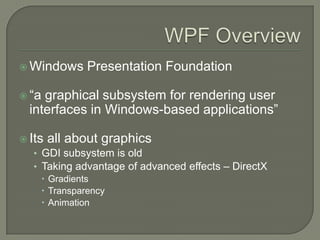
WPF OverviewWindows Presentation Foundation“a graphical subsystem for rendering user interfaces in Windows-based applications”Its all about graphicsGDI subsystem is oldTaking advantage of advanced effects – DirectXGradientsTransparencyAnimation
Why You Should Use ItDesignMuch more flexibility in the UILess need for 3rd party controlsSegmentation between designer and developerProgramming ModelCode behindSupport for new patternsPRISMMVPMVVM
What’s The DifferenceXAML based design vs. declarative object designLike HTML for Windows FormsWindows And UserControls
You already know how to do itSame file/code behind modelMany of the same UI controls with different or similar propertiesIts still just .NET
Visual Studio vs. Expression BlendWhy is there a new IDE?You do not need bothBut it really helpsOther ToolsKXAMLXAMLPAD
WPF vs. SilverlightThe difference is accessibilityThe drawbacks to SilverlightData AccessLimited access to the frameworkNot FULLY MVVM capable – yetNo commanding
WPF Out-Of-The-BoxDemo App
MVVMProblems with the traditional modelTight couplingLess flexibleMore difficult to maintain and implementModel-View-ViewModelModel-View-Presenter2005 John Grossman
Understandable DefinitionModel = DataView = WPF FormsViewModelThink of it as your code-behind on steroids
Why Now“Databinding Rocks!” – Mike EatonCommandingData Modeling Tools
Refactor The Demo
Important MVVM/WPF ConceptsSingle Responsibility PrincipleDependency InjectionStatic Resources
ResourcesWPF/MVVMJosh Smith (MSDN Article)http://msdn.microsoft.com/en-us/magazine/dd419663.aspxShawn Wildermuth (MDSN Article)http://msdn.microsoft.com/en-us/magazine/dd458800.aspx

Introduction To Useful Wpf

  • 1.
    Introduction To UsefulWPFDemystifying The Model-View- ViewModel Design Pattern (MVVM)Burke Holland
  • 2.
    About MeA workingguySharePoint, ASP.NET, WPFAdobe Flex?
  • 3.
    WPF OverviewWindows PresentationFoundation“a graphical subsystem for rendering user interfaces in Windows-based applications”Its all about graphicsGDI subsystem is oldTaking advantage of advanced effects – DirectXGradientsTransparencyAnimation
  • 4.
    Why You ShouldUse ItDesignMuch more flexibility in the UILess need for 3rd party controlsSegmentation between designer and developerProgramming ModelCode behindSupport for new patternsPRISMMVPMVVM
  • 5.
    What’s The DifferenceXAMLbased design vs. declarative object designLike HTML for Windows FormsWindows And UserControls
  • 6.
    You already knowhow to do itSame file/code behind modelMany of the same UI controls with different or similar propertiesIts still just .NET
  • 7.
    Visual Studio vs.Expression BlendWhy is there a new IDE?You do not need bothBut it really helpsOther ToolsKXAMLXAMLPAD
  • 8.
    WPF vs. SilverlightThedifference is accessibilityThe drawbacks to SilverlightData AccessLimited access to the frameworkNot FULLY MVVM capable – yetNo commanding
  • 9.
  • 10.
    MVVMProblems with thetraditional modelTight couplingLess flexibleMore difficult to maintain and implementModel-View-ViewModelModel-View-Presenter2005 John Grossman
  • 11.
    Understandable DefinitionModel =DataView = WPF FormsViewModelThink of it as your code-behind on steroids
  • 12.
    Why Now“Databinding Rocks!”– Mike EatonCommandingData Modeling Tools
  • 13.
  • 14.
    Important MVVM/WPF ConceptsSingleResponsibility PrincipleDependency InjectionStatic Resources
  • 15.
    ResourcesWPF/MVVMJosh Smith (MSDNArticle)http://msdn.microsoft.com/en-us/magazine/dd419663.aspxShawn Wildermuth (MDSN Article)http://msdn.microsoft.com/en-us/magazine/dd458800.aspx