Introduction to UFT
Archana Krushnan
Agenda
 Introduction to UFT
 Some basics about UFT
 Need for using UFT
 Advantages of UFT over other tools
 Testing Process in UFT
 UFT / QTP Test Script
 Limitations of UFT
Introduction to UFT
(Unified Functional Testing)
 Unified Functional Testing (QuickTest Professional), popularly known
by its acronym UFT is an automation testing tool originally from
Mercury Interactive which was acquired by Hewlett Packard (HP) in
2006. UFT is primarily used for functional, regression and service
testing.
 UFT is widely used to automate user actions on a web or client based
computer application and test the same.
Some basics about UFT…
 It’s a commercial tool by HP
 Its mostly used for Automation Testing
 UFT/QTP is based on scripting language VB script
 It supports largest pool of software development environments like
SAP, Oracle etc..
New features in UFT over QTP
 Unified Functional Testing(UFT) = QuickTest Pro(QTP) + Service Test(ST)
 Multiple script Debugging
 Mobile Testing Support
 Support Open Source CI Systems
 PDF Check points
Need for using UFT
 Enables functional tests to be carried out automatically to increase
the speed and cost effectiveness of application development and
delivery.
 Helps to reduce cost and increase ROI.
 UFT comes with an inbuilt IDE, which is simple and easy to use.
 Only tool available to automate desktop based applications.
Advantages of UFT over other tools
 It supports wide range of protocols and applications
 HP UFT has introduced Service or API testing in new version.
 HP UFT manages exception handling using recovery scenarios; the goal is to
continue running tests if an unexpected failure occurs
 Object recognition feature is very advanced in UFT, it has object spy , smart
identification tools which can easily identify objects.
 Mobile testing also extended in UFT.
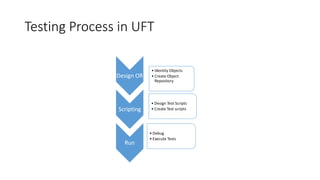
Testing Process in UFT
Design OR
• Identity Objects
• Create Object
Repository
Scripting
• Design Test Scripts
• Create Test scripts
Run
• Debug
• Execute Tests
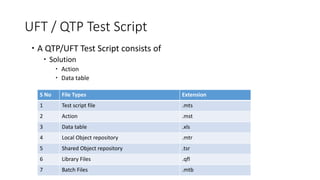
UFT / QTP Test Script
 A QTP/UFT Test Script consists of
 Solution
 Action
 Data table
S No File Types Extension
1 Test script file .mts
2 Action .mst
3 Data table .xls
4 Local Object repository .mtr
5 Shared Object repository .tsr
6 Library Files .qfl
7 Batch Files .mtb
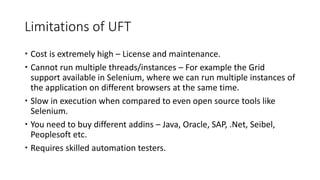
Limitations of UFT
 Cost is extremely high – License and maintenance.
 Cannot run multiple threads/instances – For example the Grid
support available in Selenium, where we can run multiple instances of
the application on different browsers at the same time.
 Slow in execution when compared to even open source tools like
Selenium.
 You need to buy different addins – Java, Oracle, SAP, .Net, Seibel,
Peoplesoft etc.
 Requires skilled automation testers.
Thanks !!!
Prepared By :
Archana Krushnan
Test Analyst
For any queries Please email,
Email : archs_1988@rediffmail.com

Introduction to Unified Func. Test..pptx

  • 1.
  • 2.
    Agenda  Introduction toUFT  Some basics about UFT  Need for using UFT  Advantages of UFT over other tools  Testing Process in UFT  UFT / QTP Test Script  Limitations of UFT
  • 3.
    Introduction to UFT (UnifiedFunctional Testing)  Unified Functional Testing (QuickTest Professional), popularly known by its acronym UFT is an automation testing tool originally from Mercury Interactive which was acquired by Hewlett Packard (HP) in 2006. UFT is primarily used for functional, regression and service testing.  UFT is widely used to automate user actions on a web or client based computer application and test the same.
  • 4.
    Some basics aboutUFT…  It’s a commercial tool by HP  Its mostly used for Automation Testing  UFT/QTP is based on scripting language VB script  It supports largest pool of software development environments like SAP, Oracle etc..
  • 5.
    New features inUFT over QTP  Unified Functional Testing(UFT) = QuickTest Pro(QTP) + Service Test(ST)  Multiple script Debugging  Mobile Testing Support  Support Open Source CI Systems  PDF Check points
  • 6.
    Need for usingUFT  Enables functional tests to be carried out automatically to increase the speed and cost effectiveness of application development and delivery.  Helps to reduce cost and increase ROI.  UFT comes with an inbuilt IDE, which is simple and easy to use.  Only tool available to automate desktop based applications.
  • 7.
    Advantages of UFTover other tools  It supports wide range of protocols and applications  HP UFT has introduced Service or API testing in new version.  HP UFT manages exception handling using recovery scenarios; the goal is to continue running tests if an unexpected failure occurs  Object recognition feature is very advanced in UFT, it has object spy , smart identification tools which can easily identify objects.  Mobile testing also extended in UFT.
  • 8.
    Testing Process inUFT Design OR • Identity Objects • Create Object Repository Scripting • Design Test Scripts • Create Test scripts Run • Debug • Execute Tests
  • 9.
    UFT / QTPTest Script  A QTP/UFT Test Script consists of  Solution  Action  Data table S No File Types Extension 1 Test script file .mts 2 Action .mst 3 Data table .xls 4 Local Object repository .mtr 5 Shared Object repository .tsr 6 Library Files .qfl 7 Batch Files .mtb
  • 10.
    Limitations of UFT Cost is extremely high – License and maintenance.  Cannot run multiple threads/instances – For example the Grid support available in Selenium, where we can run multiple instances of the application on different browsers at the same time.  Slow in execution when compared to even open source tools like Selenium.  You need to buy different addins – Java, Oracle, SAP, .Net, Seibel, Peoplesoft etc.  Requires skilled automation testers.
  • 11.
    Thanks !!! Prepared By: Archana Krushnan Test Analyst For any queries Please email, Email : archs_1988@rediffmail.com