SEMICONDUCTOR
PPT PRESENTED BY:
AMRUTHA.S
DEEPALAKSHMAI.K
 A transistor is a semiconductor device with at
least three terminals for connection to an
electric circuit. ... John Bardeen, Walter Brattain
and William Shockley invented the first
working transistors at Bell Labs, the point-
contact transistorin 1947 and the bipolar
junction transistor in 1948.
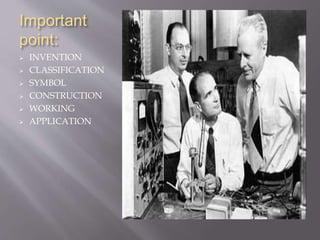
Important
point:
 INVENTION
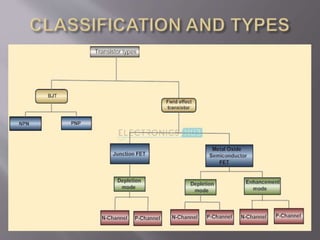
 CLASSIFICATION
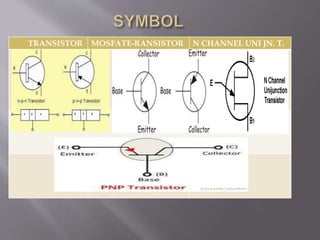
 SYMBOL
 CONSTRUCTION
 WORKING
 APPLICATION
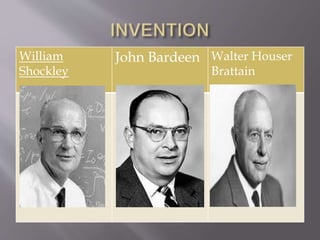
William
Shockley
John Bardeen Walter Houser
Brattain
One of his major contributions to the
electronics industry was to apply quantum
theory to the development of
semiconductors. In 1947, with colleagues
John Bardeen and Walter Brattain, he made
the first successful amplifying
semiconductor device. They called it
a transistor (from transfer and resistor).
TRANSISTOR MOSFATE-RANSISTOR N CHANNEL UNI JN. T.
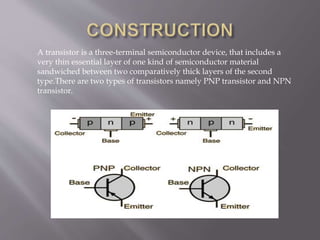
A transistor is a three-terminal semiconductor device, that includes a
very thin essential layer of one kind of semiconductor material
sandwiched between two comparatively thick layers of the second
type.There are two types of transistors namely PNP transistor and NPN
transistor.
PNP Transistor
In PNP transistor, N-type semiconductor part is sandwiched between
two sections of p-type semiconductor layers.
NPN Transistor
In NPN transistor, P-type semiconductor part is sandwiched between
two sections of n-type semiconductor layers.
Consider any type of the transistor, for instance,
a PNP-transistor. Let the two P ends of the
transistor are connected to 2-batteries which are
shown in the below diagram. The forward bias
reasons the holes in the P-type emitter to run
towards the base terminal which integral to Ie
current. These holes annoyed into the N-type
base terminal, they try to combine with
electrons, but the base terminal is casually
doped and is very thin.
The three different types of transistor
configurations are:
 Common base transistor configuration
 Common emitter transistor configuration
 Common collector transistor configuration
The following table shows the configurations
of the common emitter(CE), common base
(CB) and common collector (CC) transistors.
Applications of Transistor
A An Amplifier
A transistor is used as an amplifier to amplify the current and a small
change in base current makes a large change in CC (collector current). For
example, microphone.
As a Switch
In a transistor, the current flow is zero in the collector circuit except for
a current flow in the base circuit. By changing the base terminal, it can
be used as a switch to turn ON/OFF. There are different types of
switching circuits which are operated by transistors such as
Light operated switch
Heat operated the switch.
Integrated Circuits
An IC (Integrated Circuit) comprises of resistors,
transistors, capacitors, diodes that are inbuilt in one wafer-
thin chip of Si (silicon). This chip is called as a microchip
and the thickness of this chip is a few millimetres like
0.5mm.
This is all about transistor working, transistor construction
and applications.
Introduction to transistor and explanation

Introduction to transistor and explanation

  • 1.
  • 2.
     A transistoris a semiconductor device with at least three terminals for connection to an electric circuit. ... John Bardeen, Walter Brattain and William Shockley invented the first working transistors at Bell Labs, the point- contact transistorin 1947 and the bipolar junction transistor in 1948.
  • 3.
    Important point:  INVENTION  CLASSIFICATION SYMBOL  CONSTRUCTION  WORKING  APPLICATION
  • 4.
  • 5.
    One of hismajor contributions to the electronics industry was to apply quantum theory to the development of semiconductors. In 1947, with colleagues John Bardeen and Walter Brattain, he made the first successful amplifying semiconductor device. They called it a transistor (from transfer and resistor).
  • 7.
  • 8.
    A transistor isa three-terminal semiconductor device, that includes a very thin essential layer of one kind of semiconductor material sandwiched between two comparatively thick layers of the second type.There are two types of transistors namely PNP transistor and NPN transistor.
  • 9.
    PNP Transistor In PNPtransistor, N-type semiconductor part is sandwiched between two sections of p-type semiconductor layers. NPN Transistor In NPN transistor, P-type semiconductor part is sandwiched between two sections of n-type semiconductor layers.
  • 10.
    Consider any typeof the transistor, for instance, a PNP-transistor. Let the two P ends of the transistor are connected to 2-batteries which are shown in the below diagram. The forward bias reasons the holes in the P-type emitter to run towards the base terminal which integral to Ie current. These holes annoyed into the N-type base terminal, they try to combine with electrons, but the base terminal is casually doped and is very thin.
  • 12.
    The three differenttypes of transistor configurations are:  Common base transistor configuration  Common emitter transistor configuration  Common collector transistor configuration The following table shows the configurations of the common emitter(CE), common base (CB) and common collector (CC) transistors.
  • 13.
    Applications of Transistor AAn Amplifier A transistor is used as an amplifier to amplify the current and a small change in base current makes a large change in CC (collector current). For example, microphone. As a Switch In a transistor, the current flow is zero in the collector circuit except for a current flow in the base circuit. By changing the base terminal, it can be used as a switch to turn ON/OFF. There are different types of switching circuits which are operated by transistors such as Light operated switch Heat operated the switch.
  • 14.
    Integrated Circuits An IC(Integrated Circuit) comprises of resistors, transistors, capacitors, diodes that are inbuilt in one wafer- thin chip of Si (silicon). This chip is called as a microchip and the thickness of this chip is a few millimetres like 0.5mm. This is all about transistor working, transistor construction and applications.