Learning and Living Retreat on May 1-3, 2009
Turn to Mark Chapter 6:30-32
Observation # 1 - “come away” is an invitation by way of a
command
In our culture when life is hectic and crazy and there is a build up of
stress and strain then advice we often hear is:
“What you need to do is to get away”
But at the very stressful point and time in the life of the Lord Jesus
He told His own disciples to “come away.”
What does it mean when someone invites you to come?
The nice thing about it is Jesus has already gone before us and will
sustain us while there.
Jesus says to “come away” and not “get away” - (Matthew 11:28 -
“come to Me all who are weary…”)
Mark Chapter 6
Observation #2 - We also tend to give advice that says “you just
need to get away and be by yourself for a few days”
 But notice again that Jesus tells them to “come away by
themselves” which is in the plural.
 So many times people just want to isolate and get away from
others but Jesus is encouraging us to come away with others
Observation #3 - And we can lean toward places that can offer
distractions like Vegas, Disney World, Myrtle Beach or maybe a
quick trip to New York
 But look at the advice of Christ “come away by yourselves to a
secluded place” or a place of solitude
Observation #4 - We are commanded by Christ to “rest”
 It is the Greek word “anapauo” which is a verb that means to
cease from labor in order to recover one’s strength also is
translated in the NASB as “refreshed”
So Jesus is first of all inviting those who are stressed and burdened
to:
Come away as an invitation and not get away
The invitation is for us to come away in community
Christ wants to take us to a place that can be solitary and without
lots of distractions
And He commands that we cease from labor to be refreshed
Observation #5 - Finally He says this is to last for awhile, which is
a short degree of intensity
A blast from the past
Romans 6:1-14
Question #1 - What are we learning about Paul’s style of writing
here in Romans?
Question #2 - What does the phrase “died to sin” mean?
Question #3 - What word picture does Paul give us regarding dead
to sin and alive to Christ? Explain
Question #4 - What are the 4 indicative steps that Paul tells us are
true in Romans 6:6-7?
Question #5 - What are the 4 imperatives that should flow from the
indicative in Romans 6:14?
Homework for this coming week March 15-21:
Terms to learn:
Doctrine - this is what the “whole” Bible has to say about any
particular subject or topic.
Trinity - (short definition) - God eternally exists as three persons,
Father, Son and Holy Spirit, and each Person is fully God, and there
is one God.
READ EPHESIANS 1:3-14
Observe the “distinction” of the Trinity
Observe the “ranking” of the Trinity
Observe the “centrality” of the Trinity
READ BLOG ARTICLE - “Beware of Application Only”
Where are we headed regarding Trinity in next 4 weeks:
 Introduction to the study of doctrine
 Foundational - 10 critical reasons to study the Trinity
 Historical - how we came to orthodox view of the Trinity
 Theological - a Biblical view of the Father, Son and Spirit
Belief is no good without practice is a stupid statement. Yes, I have
read James (once or twice).
My argument has been pretty simple so far. God is glorified when
he is known truly. God is glorified by our trust in what he says. It
is God’s great pleasure to reveal himself to his children. God is
glorified when he is known and understood. God desires orthodoxy
and right belief.
I was in a small group venting about my expository preaching class
ten years ago. I said, “They are trying to get me to pull out direct
immediate application—something for the people to do—out of
every sermon.” I complained about this. My group of young
seminarians were divided. I told them that not only were some
passages of Scripture not able to produce direct immediate
application without sinful manipulation, but sometimes, I told them,
“God simply wants us to believe what he said. This is application
enough!”
In our Evangelical/emerging climate, we have those who seem to
have come to some sort of personal epiphany about the problem with
the church. “Doctrine divides and causes problems.” Fair enough.
“Christians have the tendency to have an arrogant attitude about
doctrine, systematically condemning those who don’t agree with
them on everything and, in doing so, fail to express love. They
elevate correct doctrine above love.”
Agreed. “Therefore, we should quit talking about doctrine and just
love each other.” Time out! Love without truth is not Christian.
“But what does being doctrinally correct actually do? How can it
help the world today? How does it alleviate oppression? How does it
feed the hungry? How does it promote equality? And what about the
environment?”
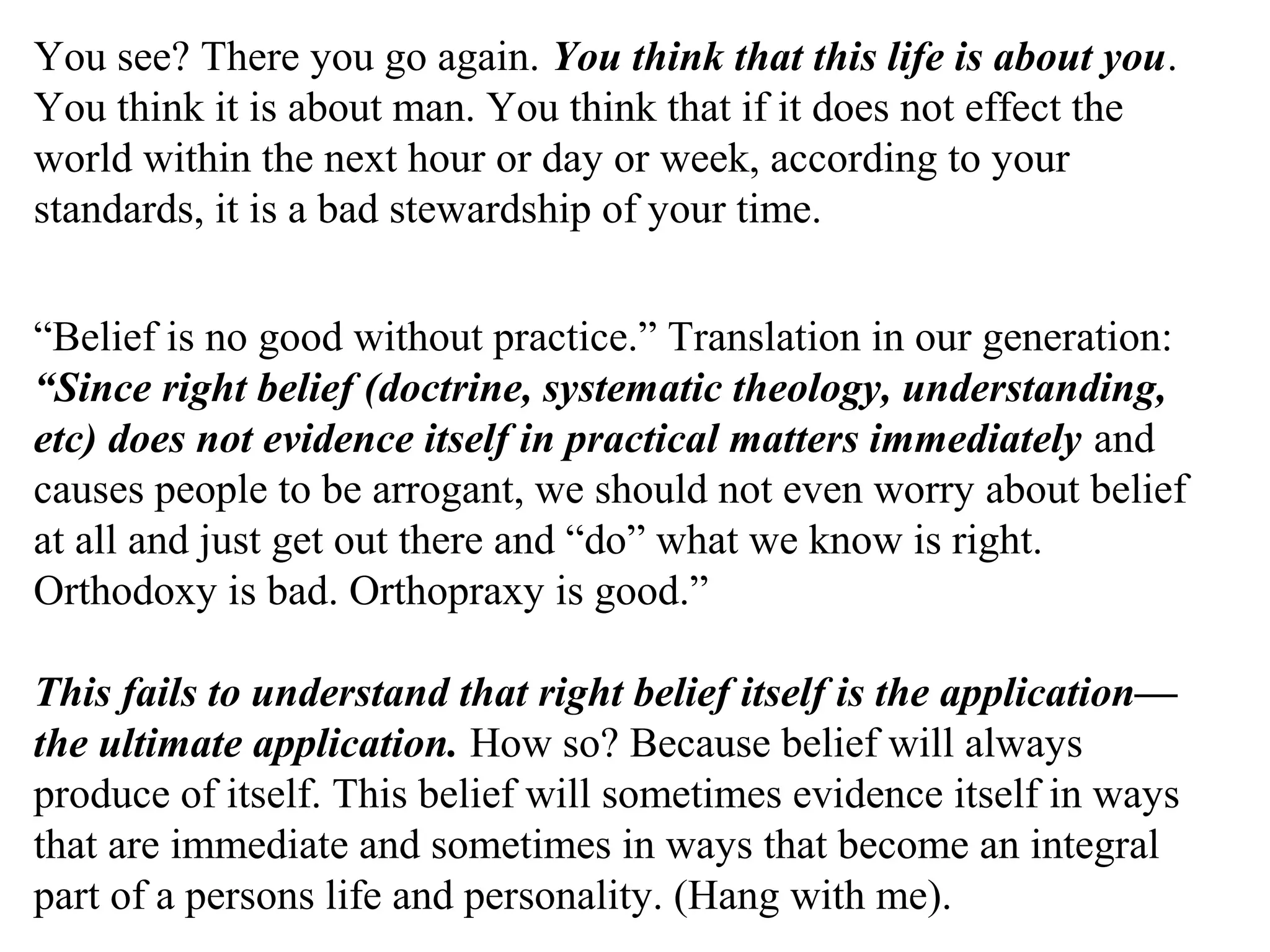
You see? There you go again. You think that this life is about you.
You think it is about man. You think that if it does not effect the
world within the next hour or day or week, according to your
standards, it is a bad stewardship of your time.
“Belief is no good without practice.” Translation in our generation:
“Since right belief (doctrine, systematic theology, understanding,
etc) does not evidence itself in practical matters immediately and
causes people to be arrogant, we should not even worry about belief
at all and just get out there and “do” what we know is right.
Orthodoxy is bad. Orthopraxy is good.”
This fails to understand that right belief itself is the application—
the ultimate application. How so? Because belief will always
produce of itself. This belief will sometimes evidence itself in ways
that are immediate and sometimes in ways that become an integral
part of a persons life and personality. (Hang with me).
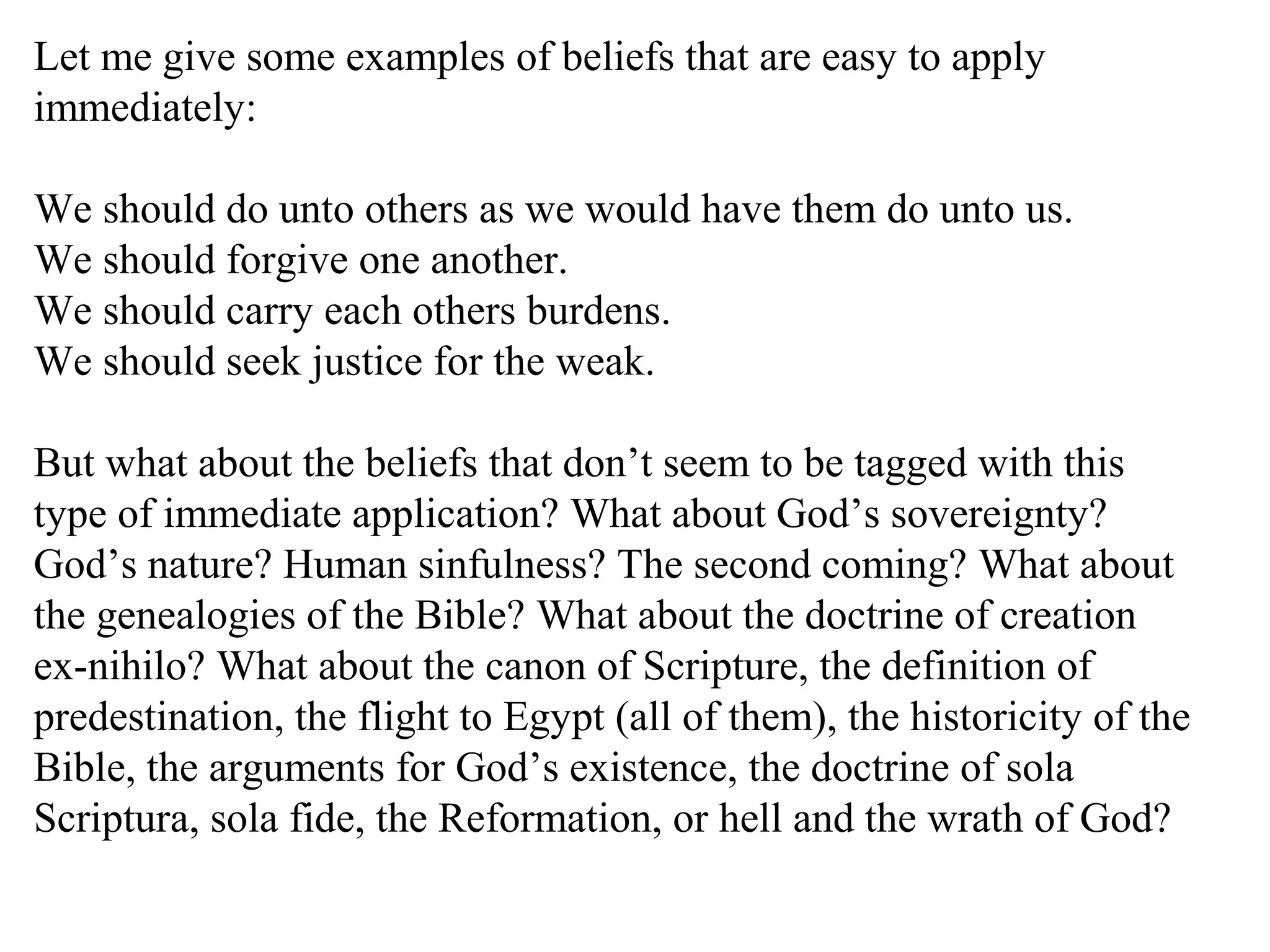
Let me give some examples of beliefs that are easy to apply
immediately:
We should do unto others as we would have them do unto us.
We should forgive one another.
We should carry each others burdens.
We should seek justice for the weak.
But what about the beliefs that don’t seem to be tagged with this
type of immediate application? What about God’s sovereignty?
God’s nature? Human sinfulness? The second coming? What about
the genealogies of the Bible? What about the doctrine of creation
ex-nihilo? What about the canon of Scripture, the definition of
predestination, the flight to Egypt (all of them), the historicity of the
Bible, the arguments for God’s existence, the doctrine of sola
Scriptura, sola fide, the Reformation, or hell and the wrath of God?
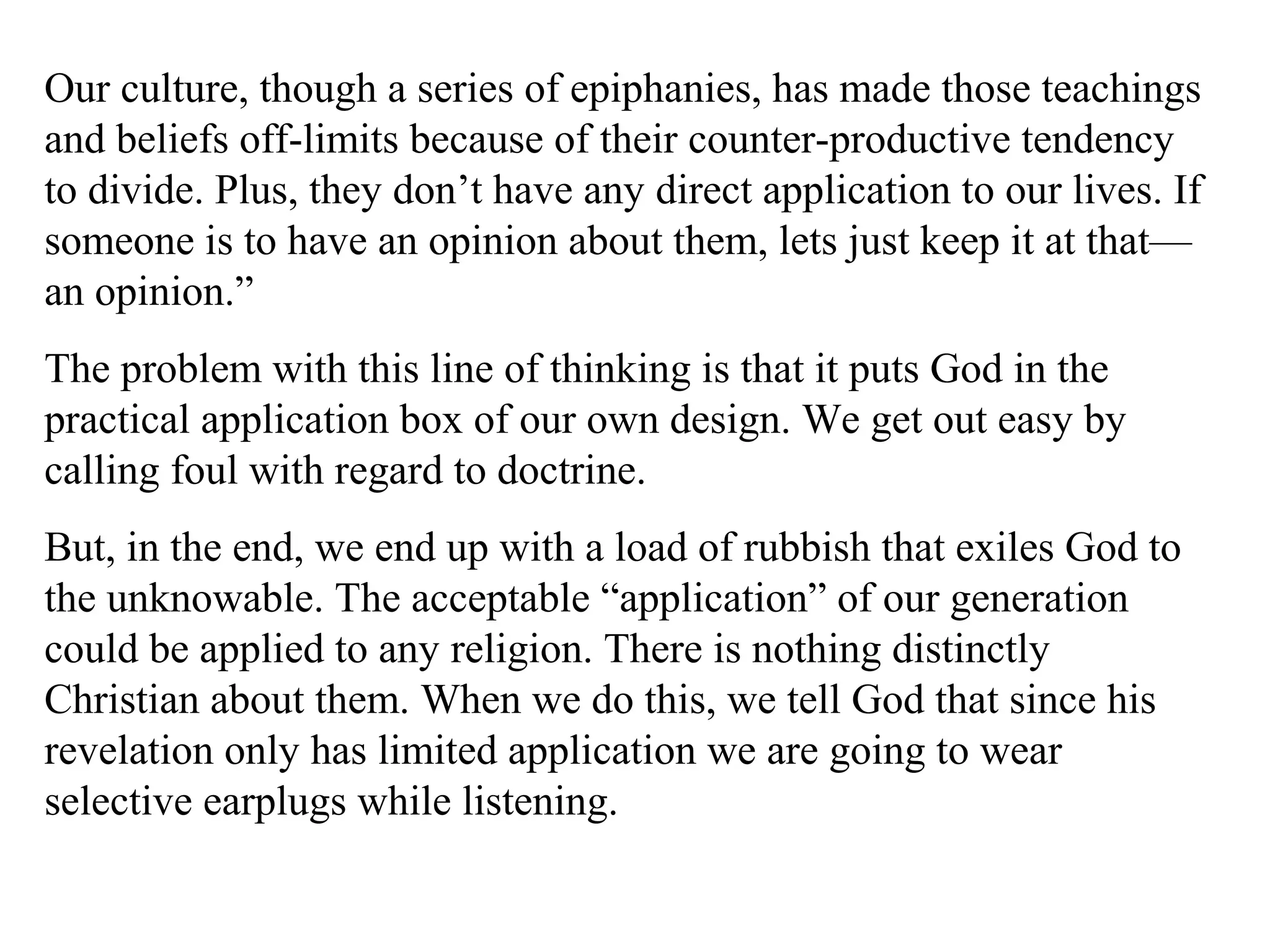
Our culture, though a series of epiphanies, has made those teachings
and beliefs off-limits because of their counter-productive tendency
to divide. Plus, they don’t have any direct application to our lives. If
someone is to have an opinion about them, lets just keep it at that—
an opinion.”
The problem with this line of thinking is that it puts God in the
practical application box of our own design. We get out easy by
calling foul with regard to doctrine.
But, in the end, we end up with a load of rubbish that exiles God to
the unknowable. The acceptable “application” of our generation
could be applied to any religion. There is nothing distinctly
Christian about them. When we do this, we tell God that since his
revelation only has limited application we are going to wear
selective earplugs while listening.
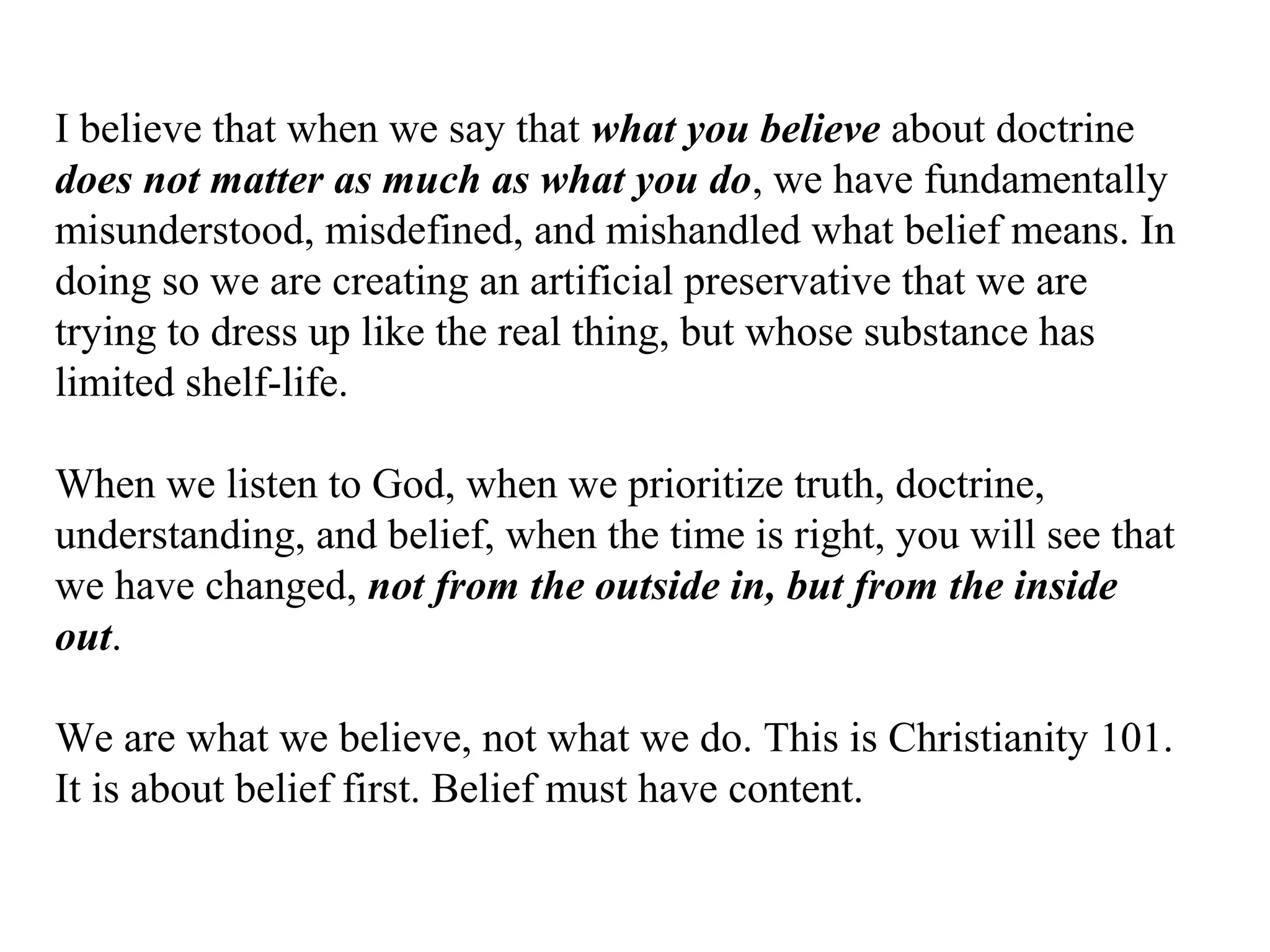
I believe that when we say that what you believe about doctrine
does not matter as much as what you do, we have fundamentally
misunderstood, misdefined, and mishandled what belief means. In
doing so we are creating an artificial preservative that we are
trying to dress up like the real thing, but whose substance has
limited shelf-life.
When we listen to God, when we prioritize truth, doctrine,
understanding, and belief, when the time is right, you will see that
we have changed, not from the outside in, but from the inside
out.
We are what we believe, not what we do. This is Christianity 101.
It is about belief first. Belief must have content.
For example, take the Theology Proper (the doctrine of God).
God has revealed himself as one who is the creator of all things, who
transcends all of creation, being holy, unchangeable, without any
need whatsoever (aseity), who loves man but will not let the
unrighteous go unpunished. It is only when we have intellectually
wrestled with and reflected upon it that we can recognize his
majesty. It is only when we recognize his majesty that we can
recognize our sinfulness, hopelessness, and helplessness without
him. It is only by doctrine—right doctrine—that we can come to a
state of brokenness. It is only in this brokenness that we can worship
him truly. (When is the last time you repented?)
This belief—when truly understood and believed—will produce a
fragrance of a character which is in conformity to Christ. Call the
fragrance “application” if you will, but it is only present because of
an understanding and belief. But what you must understand is that
this brokenness is application.
It pleases God to be known as Trinity. Knowing God is application.
Worship is expressed as the deepest longings of our heart are
fulfilled by coming to know our creator and all that he has revealed
to us and we rejoice in this knowledge.
We need to recognize that giving people the truth is our first
priority. The fragrance produced by this truth will be inevitable. It is
the nature of belief to find expression. I can’t always tell you exactly
what this expression will look like and in what manner it is
identified.
But the belief is the foundation. The belief brings great glory to God.
Belief is always enough. So long as it is true belief, the fragrance
will permeate from us. If it does not, then the belief is not there. This
is what James meant: “Belief is not true belief when it does not have
a fragrance.” But he was not try to elevate the action above its
source.
Will there be people who believe—truly believe—but don’t have
this fragrance?
No. Never.
What is our mission?
To know God and to do our part to make God known. Truth,
orthodoxy, belief, and understanding are foundational to
Christianity as the substance is foundational to the aroma produced.
10 Reasons why it is critical that we study the Trinity
Here are the first three to consider for our study:
Reason #1 - It is critical to our Christian uniqueness
It is one of the most distinguishing doctrines of the Christian faith.
It not only distinguishes the Christian faith from all others, is also
establishes the basis for all we hold dear as Christians. If we are to
know God rightly then we must know Him as He is and as He has
revealed Himself.
This means to know Him as the one true God who is Father, Son and
Holy Spirit.
Reason #2 - It is critical to understand salvation
The doctrine of the Trinity is both central and necessary for the
Christian faith, if you remove the Trinity then the Christian faith
disintegrates.
Just consider for a minute the relation of the Trinity to the doctrine of
salvation.
Example: A Christian is one who sees God the Father at one and the
same time judging our sin, the one making payment of infinite value
for sin is God the Son, and finally God the Spirit who empowered
and directed the incarnate Son so as to live and obey the Father and
go to the cross in order to be a substitute for us.
Salvation comes as the Father judges our sin in His Son, who became
incarnate and lived His life in the power of the Spirit as the perfect
sinless God-man, and accomplished His perfect obedience to the
Father at the cross through the power of the Spirit.
Reason #3 - It is critical to understand worship
Worship of the true and living God is our constant
acknowledgement of the Father, Son and Spirit.
We can see in Ephesians 1:3-14 the whole of God’s work is
accomplished in a trinitarian framework.
Since God has revealed Himself as triune we His people should care
to know what it means and what difference it can make for our
lives.

Introduction to the Trinity_March 15, 2009

  • 1.
    Learning and LivingRetreat on May 1-3, 2009 Turn to Mark Chapter 6:30-32 Observation # 1 - “come away” is an invitation by way of a command In our culture when life is hectic and crazy and there is a build up of stress and strain then advice we often hear is: “What you need to do is to get away” But at the very stressful point and time in the life of the Lord Jesus He told His own disciples to “come away.” What does it mean when someone invites you to come? The nice thing about it is Jesus has already gone before us and will sustain us while there. Jesus says to “come away” and not “get away” - (Matthew 11:28 - “come to Me all who are weary…”)
  • 2.
    Mark Chapter 6 Observation#2 - We also tend to give advice that says “you just need to get away and be by yourself for a few days”  But notice again that Jesus tells them to “come away by themselves” which is in the plural.  So many times people just want to isolate and get away from others but Jesus is encouraging us to come away with others Observation #3 - And we can lean toward places that can offer distractions like Vegas, Disney World, Myrtle Beach or maybe a quick trip to New York  But look at the advice of Christ “come away by yourselves to a secluded place” or a place of solitude
  • 3.
    Observation #4 -We are commanded by Christ to “rest”  It is the Greek word “anapauo” which is a verb that means to cease from labor in order to recover one’s strength also is translated in the NASB as “refreshed” So Jesus is first of all inviting those who are stressed and burdened to: Come away as an invitation and not get away The invitation is for us to come away in community Christ wants to take us to a place that can be solitary and without lots of distractions And He commands that we cease from labor to be refreshed Observation #5 - Finally He says this is to last for awhile, which is a short degree of intensity
  • 4.
    A blast fromthe past Romans 6:1-14 Question #1 - What are we learning about Paul’s style of writing here in Romans? Question #2 - What does the phrase “died to sin” mean? Question #3 - What word picture does Paul give us regarding dead to sin and alive to Christ? Explain Question #4 - What are the 4 indicative steps that Paul tells us are true in Romans 6:6-7? Question #5 - What are the 4 imperatives that should flow from the indicative in Romans 6:14?
  • 5.
    Homework for thiscoming week March 15-21: Terms to learn: Doctrine - this is what the “whole” Bible has to say about any particular subject or topic. Trinity - (short definition) - God eternally exists as three persons, Father, Son and Holy Spirit, and each Person is fully God, and there is one God. READ EPHESIANS 1:3-14 Observe the “distinction” of the Trinity Observe the “ranking” of the Trinity Observe the “centrality” of the Trinity READ BLOG ARTICLE - “Beware of Application Only”
  • 6.
    Where are weheaded regarding Trinity in next 4 weeks:  Introduction to the study of doctrine  Foundational - 10 critical reasons to study the Trinity  Historical - how we came to orthodox view of the Trinity  Theological - a Biblical view of the Father, Son and Spirit
  • 7.
    Belief is nogood without practice is a stupid statement. Yes, I have read James (once or twice). My argument has been pretty simple so far. God is glorified when he is known truly. God is glorified by our trust in what he says. It is God’s great pleasure to reveal himself to his children. God is glorified when he is known and understood. God desires orthodoxy and right belief. I was in a small group venting about my expository preaching class ten years ago. I said, “They are trying to get me to pull out direct immediate application—something for the people to do—out of every sermon.” I complained about this. My group of young seminarians were divided. I told them that not only were some passages of Scripture not able to produce direct immediate application without sinful manipulation, but sometimes, I told them, “God simply wants us to believe what he said. This is application enough!”
  • 8.
    In our Evangelical/emergingclimate, we have those who seem to have come to some sort of personal epiphany about the problem with the church. “Doctrine divides and causes problems.” Fair enough. “Christians have the tendency to have an arrogant attitude about doctrine, systematically condemning those who don’t agree with them on everything and, in doing so, fail to express love. They elevate correct doctrine above love.” Agreed. “Therefore, we should quit talking about doctrine and just love each other.” Time out! Love without truth is not Christian. “But what does being doctrinally correct actually do? How can it help the world today? How does it alleviate oppression? How does it feed the hungry? How does it promote equality? And what about the environment?”
  • 9.
    You see? Thereyou go again. You think that this life is about you. You think it is about man. You think that if it does not effect the world within the next hour or day or week, according to your standards, it is a bad stewardship of your time. “Belief is no good without practice.” Translation in our generation: “Since right belief (doctrine, systematic theology, understanding, etc) does not evidence itself in practical matters immediately and causes people to be arrogant, we should not even worry about belief at all and just get out there and “do” what we know is right. Orthodoxy is bad. Orthopraxy is good.” This fails to understand that right belief itself is the application— the ultimate application. How so? Because belief will always produce of itself. This belief will sometimes evidence itself in ways that are immediate and sometimes in ways that become an integral part of a persons life and personality. (Hang with me).
  • 10.
    Let me givesome examples of beliefs that are easy to apply immediately: We should do unto others as we would have them do unto us. We should forgive one another. We should carry each others burdens. We should seek justice for the weak. But what about the beliefs that don’t seem to be tagged with this type of immediate application? What about God’s sovereignty? God’s nature? Human sinfulness? The second coming? What about the genealogies of the Bible? What about the doctrine of creation ex-nihilo? What about the canon of Scripture, the definition of predestination, the flight to Egypt (all of them), the historicity of the Bible, the arguments for God’s existence, the doctrine of sola Scriptura, sola fide, the Reformation, or hell and the wrath of God?
  • 11.
    Our culture, thougha series of epiphanies, has made those teachings and beliefs off-limits because of their counter-productive tendency to divide. Plus, they don’t have any direct application to our lives. If someone is to have an opinion about them, lets just keep it at that— an opinion.” The problem with this line of thinking is that it puts God in the practical application box of our own design. We get out easy by calling foul with regard to doctrine. But, in the end, we end up with a load of rubbish that exiles God to the unknowable. The acceptable “application” of our generation could be applied to any religion. There is nothing distinctly Christian about them. When we do this, we tell God that since his revelation only has limited application we are going to wear selective earplugs while listening.
  • 12.
    I believe thatwhen we say that what you believe about doctrine does not matter as much as what you do, we have fundamentally misunderstood, misdefined, and mishandled what belief means. In doing so we are creating an artificial preservative that we are trying to dress up like the real thing, but whose substance has limited shelf-life. When we listen to God, when we prioritize truth, doctrine, understanding, and belief, when the time is right, you will see that we have changed, not from the outside in, but from the inside out. We are what we believe, not what we do. This is Christianity 101. It is about belief first. Belief must have content.
  • 13.
    For example, takethe Theology Proper (the doctrine of God). God has revealed himself as one who is the creator of all things, who transcends all of creation, being holy, unchangeable, without any need whatsoever (aseity), who loves man but will not let the unrighteous go unpunished. It is only when we have intellectually wrestled with and reflected upon it that we can recognize his majesty. It is only when we recognize his majesty that we can recognize our sinfulness, hopelessness, and helplessness without him. It is only by doctrine—right doctrine—that we can come to a state of brokenness. It is only in this brokenness that we can worship him truly. (When is the last time you repented?) This belief—when truly understood and believed—will produce a fragrance of a character which is in conformity to Christ. Call the fragrance “application” if you will, but it is only present because of an understanding and belief. But what you must understand is that this brokenness is application.
  • 14.
    It pleases Godto be known as Trinity. Knowing God is application. Worship is expressed as the deepest longings of our heart are fulfilled by coming to know our creator and all that he has revealed to us and we rejoice in this knowledge. We need to recognize that giving people the truth is our first priority. The fragrance produced by this truth will be inevitable. It is the nature of belief to find expression. I can’t always tell you exactly what this expression will look like and in what manner it is identified. But the belief is the foundation. The belief brings great glory to God. Belief is always enough. So long as it is true belief, the fragrance will permeate from us. If it does not, then the belief is not there. This is what James meant: “Belief is not true belief when it does not have a fragrance.” But he was not try to elevate the action above its source.
  • 15.
    Will there bepeople who believe—truly believe—but don’t have this fragrance? No. Never. What is our mission? To know God and to do our part to make God known. Truth, orthodoxy, belief, and understanding are foundational to Christianity as the substance is foundational to the aroma produced.
  • 16.
    10 Reasons whyit is critical that we study the Trinity Here are the first three to consider for our study: Reason #1 - It is critical to our Christian uniqueness It is one of the most distinguishing doctrines of the Christian faith. It not only distinguishes the Christian faith from all others, is also establishes the basis for all we hold dear as Christians. If we are to know God rightly then we must know Him as He is and as He has revealed Himself. This means to know Him as the one true God who is Father, Son and Holy Spirit.
  • 17.
    Reason #2 -It is critical to understand salvation The doctrine of the Trinity is both central and necessary for the Christian faith, if you remove the Trinity then the Christian faith disintegrates. Just consider for a minute the relation of the Trinity to the doctrine of salvation. Example: A Christian is one who sees God the Father at one and the same time judging our sin, the one making payment of infinite value for sin is God the Son, and finally God the Spirit who empowered and directed the incarnate Son so as to live and obey the Father and go to the cross in order to be a substitute for us. Salvation comes as the Father judges our sin in His Son, who became incarnate and lived His life in the power of the Spirit as the perfect sinless God-man, and accomplished His perfect obedience to the Father at the cross through the power of the Spirit.
  • 18.
    Reason #3 -It is critical to understand worship Worship of the true and living God is our constant acknowledgement of the Father, Son and Spirit. We can see in Ephesians 1:3-14 the whole of God’s work is accomplished in a trinitarian framework. Since God has revealed Himself as triune we His people should care to know what it means and what difference it can make for our lives.