Introduction to theHuman
Cardiovascular System
Dr. Rakesh Kumar Verma
Assistant Professor
Department of Anatomy
KGMU UP Lucknow
2.
INTRODUCTION
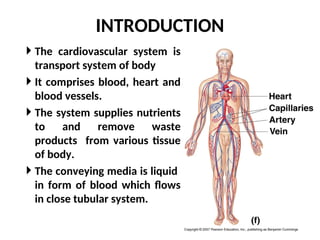
The cardiovascularsystem is
transport system of body
It comprises blood, heart and
blood vessels.
The system supplies nutrients
to and remove waste
products from various tissue
of body.
The conveying media is liquid
in form of blood which flows
in close tubular system.
Figure 1-2(f)
3.
FUNCTION OF CARDIOVASCULAR
SYSTEM
Transportnutrients, hormones
Remove waste products
Gaseous exchange
Immunity
Blood vessels transport blood
◦ Carries oxygen and carbon dioxide
◦ Also carries nutrients and wastes
Heart pumps blood through blood vessels
HEART
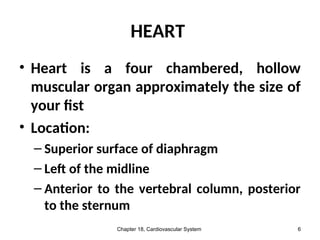
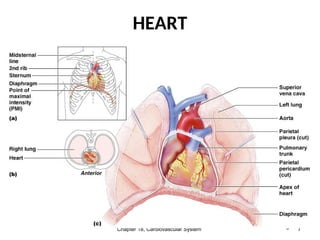
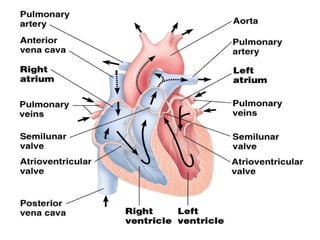
• Heart isa four chambered, hollow
muscular organ approximately the size of
your fist
• Location:
– Superior surface of diaphragm
– Left of the midline
– Anterior to the vertebral column, posterior
to the sternum
Chapter 18, Cardiovascular System 6
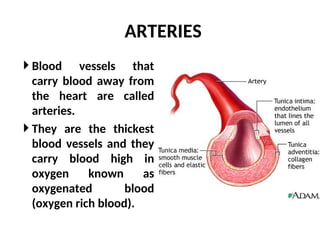
ARTERIES
Blood vesselsthat
carry blood away from
the heart are called
arteries.
They are the thickest
blood vessels and they
carry blood high in
oxygen known as
oxygenated blood
(oxygen rich blood).
CLASSIFICATION OF ARTEIES
•Elastic- e.g. (Aorta & its Major branches)
• Muscular -e.g.(Renal, Testicular, Radial, Tibial
etc.)
• Arterioles (<0.1 mm)-
Terminal arterioles
Meta-arterioles
Thoroughfare
channel/ preferred
17.
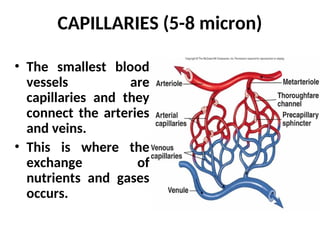
CAPILLARIES (5-8 micron)
•The smallest blood
vessels are
capillaries and they
connect the arteries
and veins.
• This is where the
exchange of
nutrients and gases
occurs.
18.
BODY CONTAINS TWOKINDS OF CAPILLARIES
• CONTINUOUS-SKIN, LUNG, SMMOTH MUSCLE,
CONNECTIVE TISSUES
• FENESTRATED- PANCREAS,ENDOCRINE GLANDS,
SMALL INTESTINE,CHOROID PLEXUS,CILLIARY
PROCESS etc.
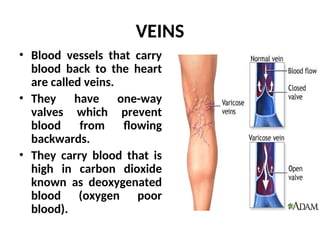
VEINS
• Blood vesselsthat carry
blood back to the heart
are called veins.
• They have one-way
valves which prevent
blood from flowing
backwards.
• They carry blood that is
high in carbon dioxide
known as deoxygenated
blood (oxygen poor
blood).
21.
VEINS
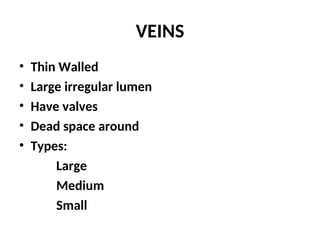
• Thin Walled
•Large irregular lumen
• Have valves
• Dead space around
• Types:
Large
Medium
Small
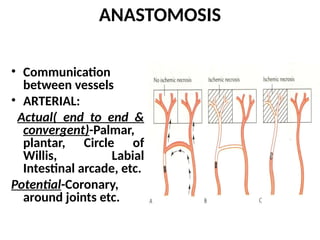
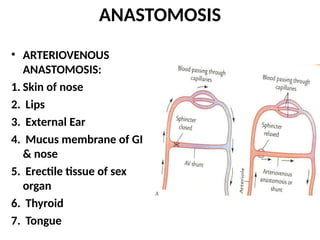
ANASTOMOSIS
• Communication
between vessels
•ARTERIAL:
Actual( end to end &
convergent)-Palmar,
plantar, Circle of
Willis, Labial
Intestinal arcade, etc.
Potential-Coronary,
around joints etc.
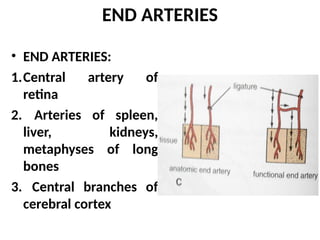
END ARTERIES
• ENDARTERIES:
1.Central artery of
retina
2. Arteries of spleen,
liver, kidneys,
metaphyses of long
bones
3. Central branches of
cerebral cortex
28.
CIRCULATION
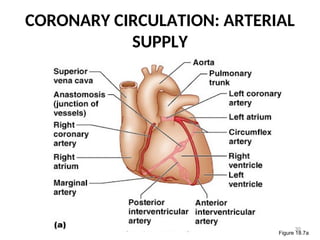
–Coronary circulation –the circulation
of blood within the heart.
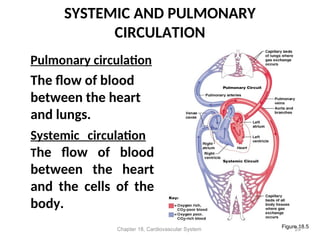
–Pulmonary circulation – the flow of
blood between the heart and lungs.
–Systemic circulation – the flow of
blood between the heart and the cells
of the body.
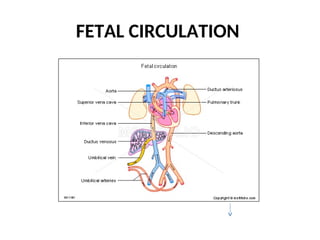
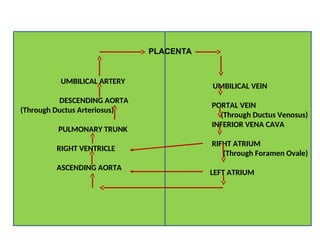
–Fetal Circulation
29.
SYSTEMIC AND PULMONARY
CIRCULATION
Pulmonarycirculation
The flow of blood
between the heart
and lungs.
Systemic circulation
The flow of blood
between the heart
and the cells of the
body.
Chapter 18, Cardiovascular System 29
Figure 18.5
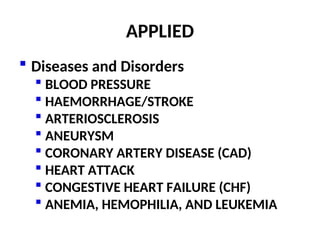
APPLIED
• Problems withthe
cardiovascular system
are common, but they
don’t just affect older
people.
• Many heart problems
affect children and
teenagers.
37.
QUESTIONS
1-All of thefollowing are the example of elastic
arteries except:
a)Aorta
b)Common carotid artery
c)Subclavian artery
d)Radial artery
38.
QUESTIONS
2-All of thefollowing are the example of end
arteries except:
a)Central branches of cerebral arteries
b)Central artery of retina
c)Facial artery
d)Splenic artery
QUESTIONS
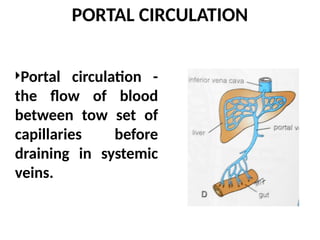
4-All of thefollowing are the example of portal
circulation except:
a)Hepatic circulation
b)Renal circulation
c)Circulation of hypophysis cerebri
d)Pulmonary circulation
41.
QUESTIONS
5-All of thefollowing are features of veins
except:
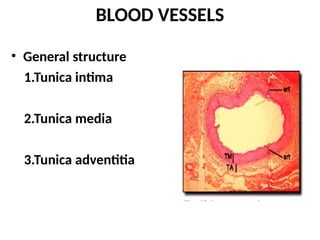
a)Thin walls
b)Thin tunica media
c)Thin tunica adventia
d)Wide lumen