2EC302-Signals and Systems
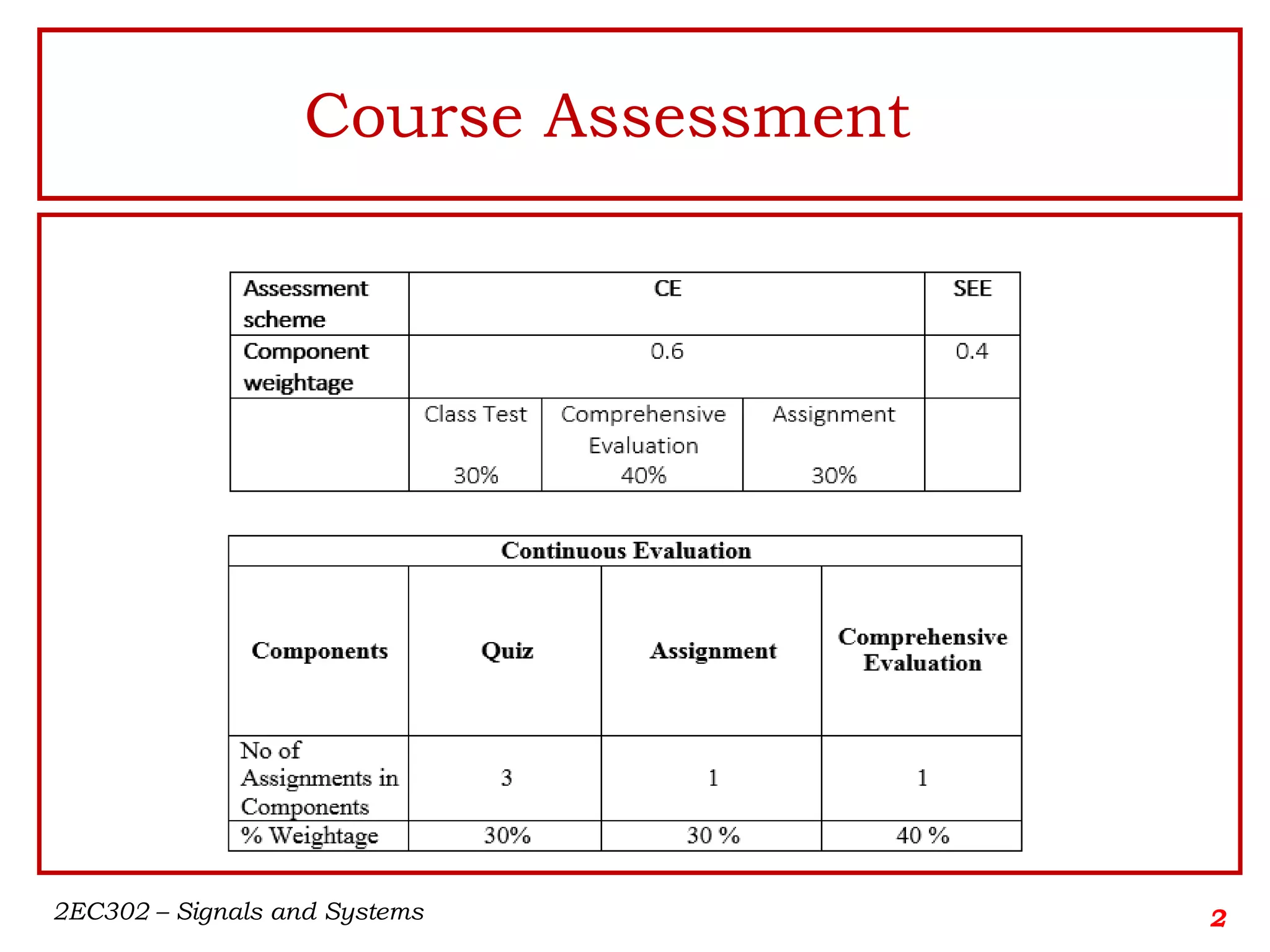
Course Assessment
2EC302 – Signals and Systems 2
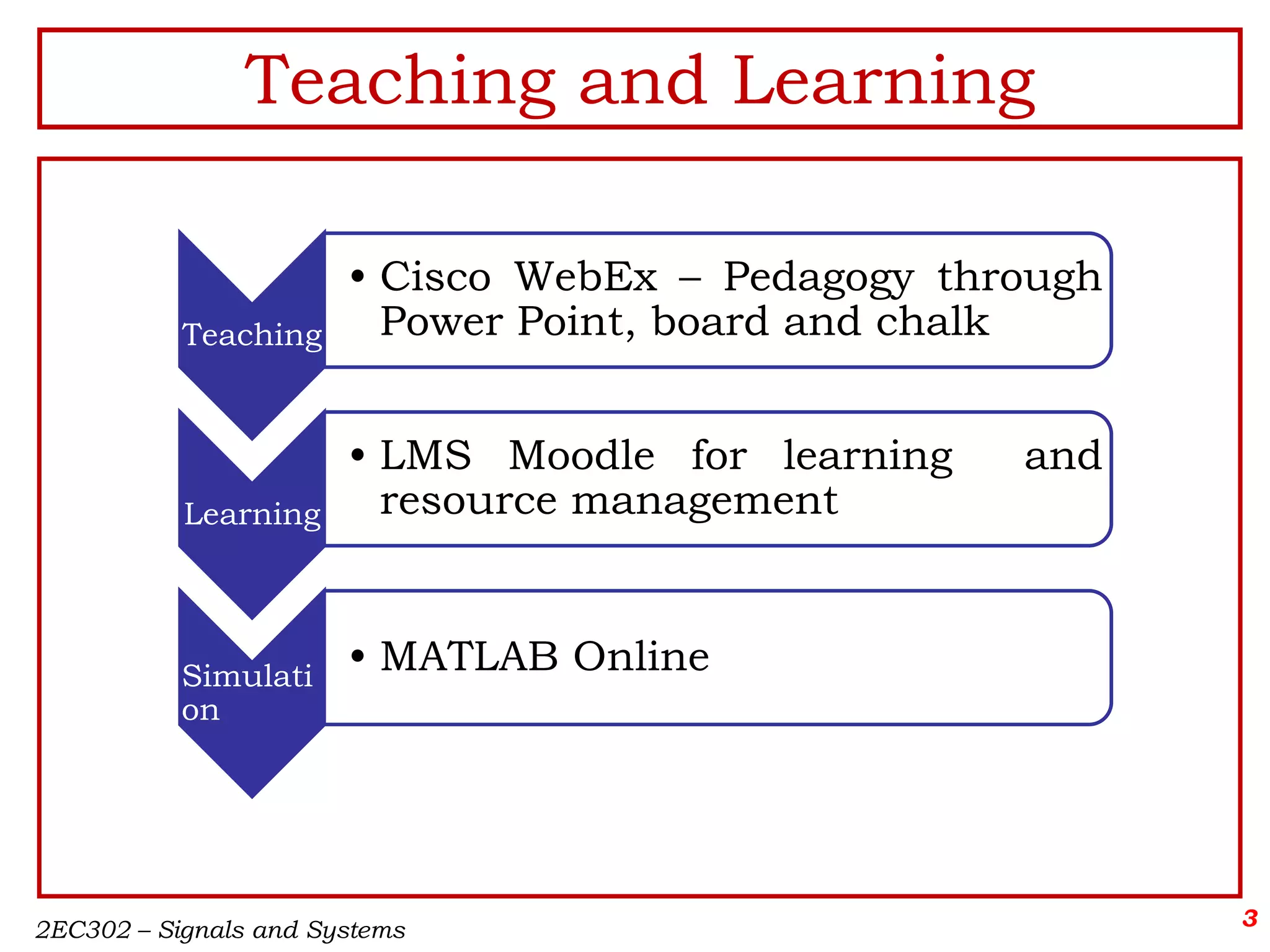
Teaching and Learning
2EC302 – Signals and Systems 3
Teaching
• Cisco WebEx – Pedagogy through
Power Point, board and chalk
Learning
• LMS Moodle for learning and
resource management
Simulati
on
• MATLAB Online
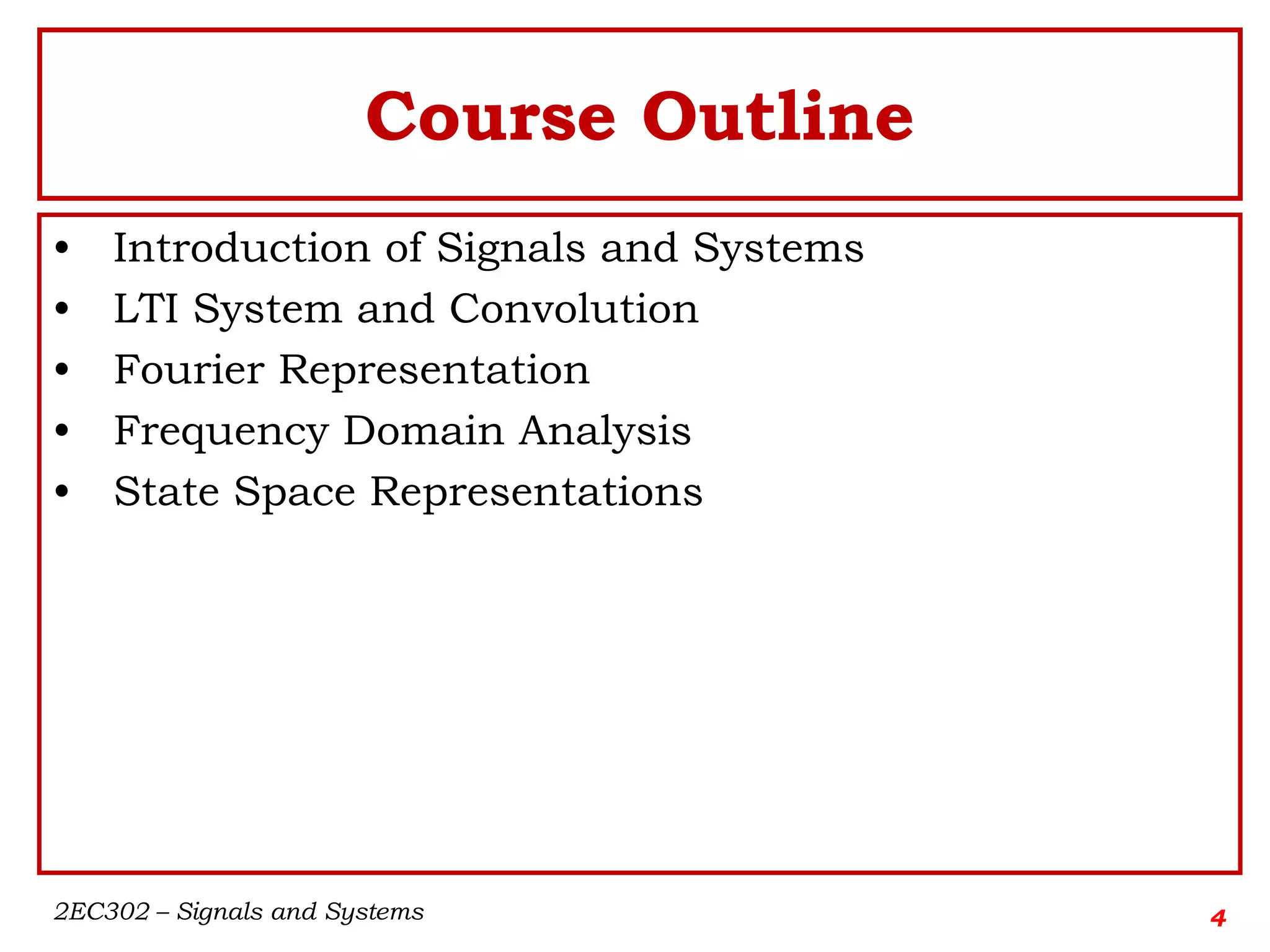
Course Outline
2EC302 – Signals and Systems 4
• Introduction of Signals and Systems
• LTI System and Convolution
• Fourier Representation
• Frequency Domain Analysis
• State Space Representations
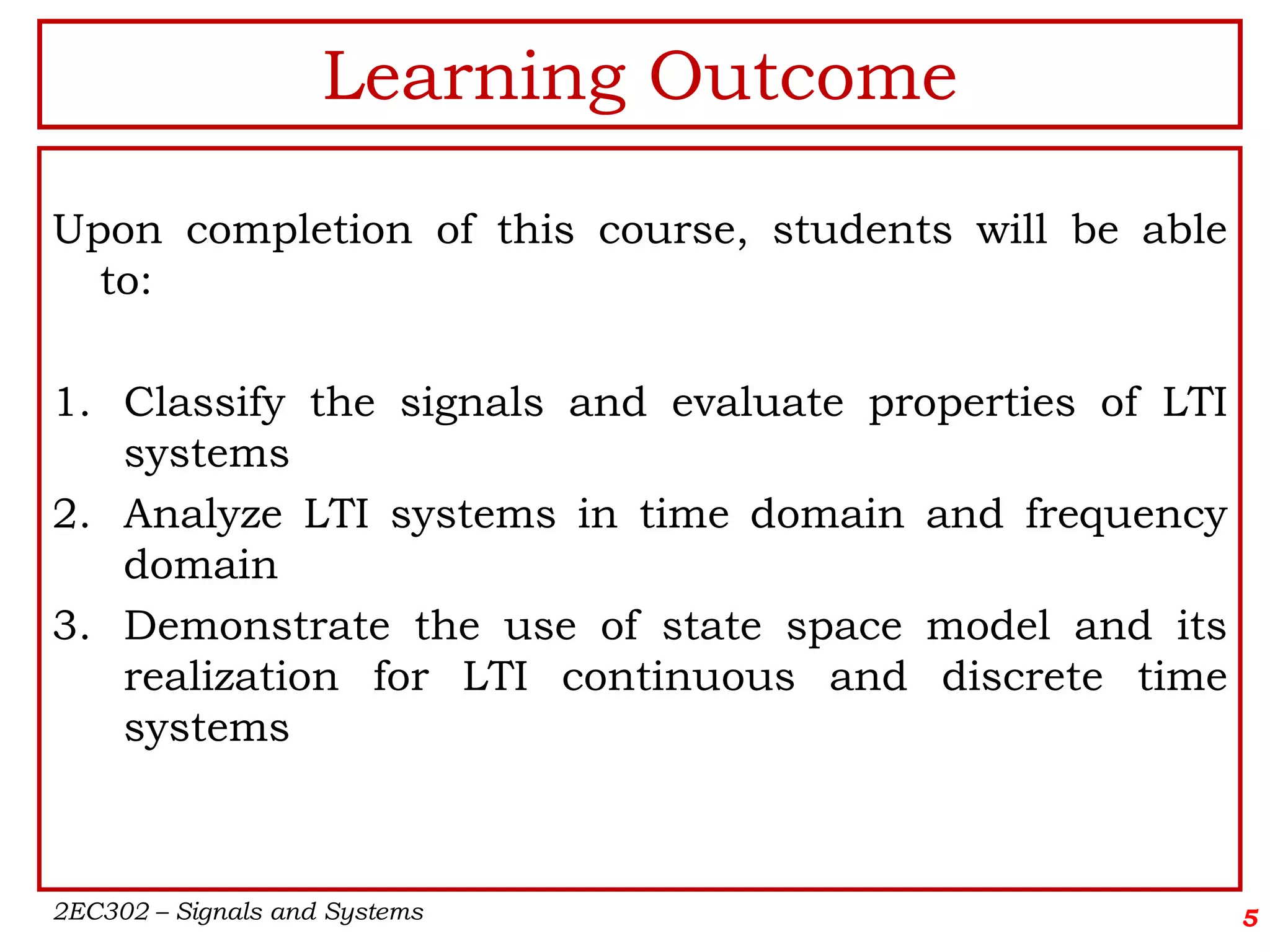
Learning Outcome
Upon completion of this course, students will be able
to:
1. Classify the signals and evaluate properties of LTI
systems
2. Analyze LTI systems in time domain and frequency
domain
3. Demonstrate the use of state space model and its
realization for LTI continuous and discrete time
systems
2EC302 – Signals and Systems 5
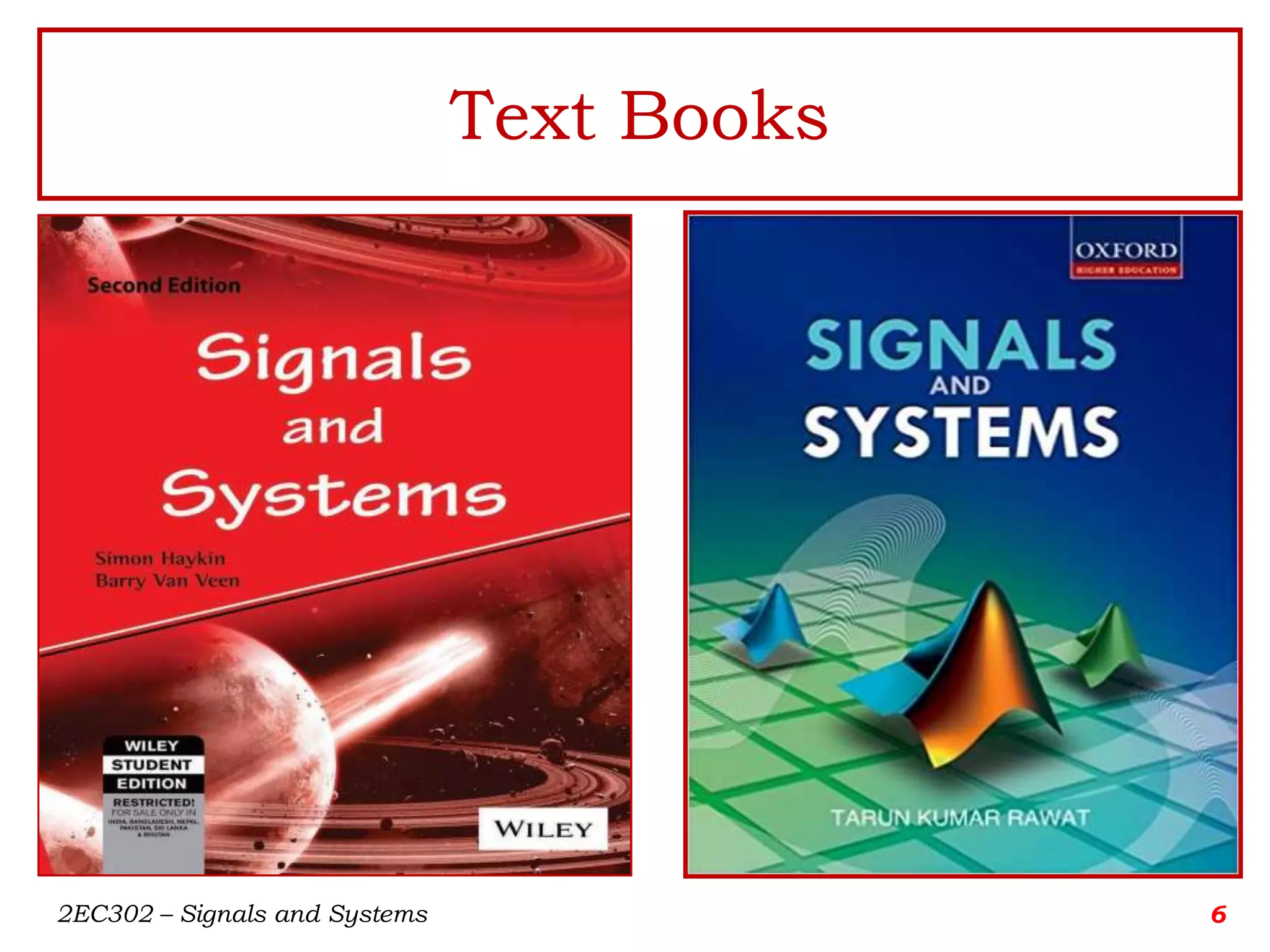
Text Books
https://1.bp.blogspot.co
m/-5ax98-
K0bvk/XJtGc5zcfOI/AA
AAAAAAAac/3GA1kyM
oJ7IetCOHh1uSnQYM_
2zCb6m3wCLcBGAs/s1
600/91jP7BDKc5L.jpg
2EC302 – Signals and Systems 6
Suggested Books
1. Simon Haykin, Signals and Systems, John Wiley
2. Mrinal Mandal and Amir Asif, Continuous and
Discrete time signals and systems, Cambridge
University Press
3. Oppenheim & Wilsky, Signals and Systems, PHI
4. M. J. Roberts, Signals and Systems TMH India
5. Tarun Kumar Rawat, Signals and systems Oxford
Univ. Press
2EC302 – Signals and Systems 7
Examples of Signals
2EC302 – Signals and Systems 8
• Human Communication
– Speech Signals
– Face-to-Face conversation
– Over a telephone channel
– Visual in nature ( signals taking the form of images of people
or objects around us)
– Electronic mail over the Internet
• Listening heartbeat of patient and monitoring blood
pressure and temperature, diagnose the disease
• Weather forecast
• Fluctuations in the process of stocks
What is Signal?
2EC302 – Signals and Systems 9
• Signal is defined as a function of one or more variable
that conveys information on the nature of a physical
phenomenon
• A signal is a single-valued function of time that
conveys information.
• At every point in time, there is a unique value of the
function
• Value may either be a real number, giving a real-
valued signal or a complex number
2EC302 – Signals and Systems 10
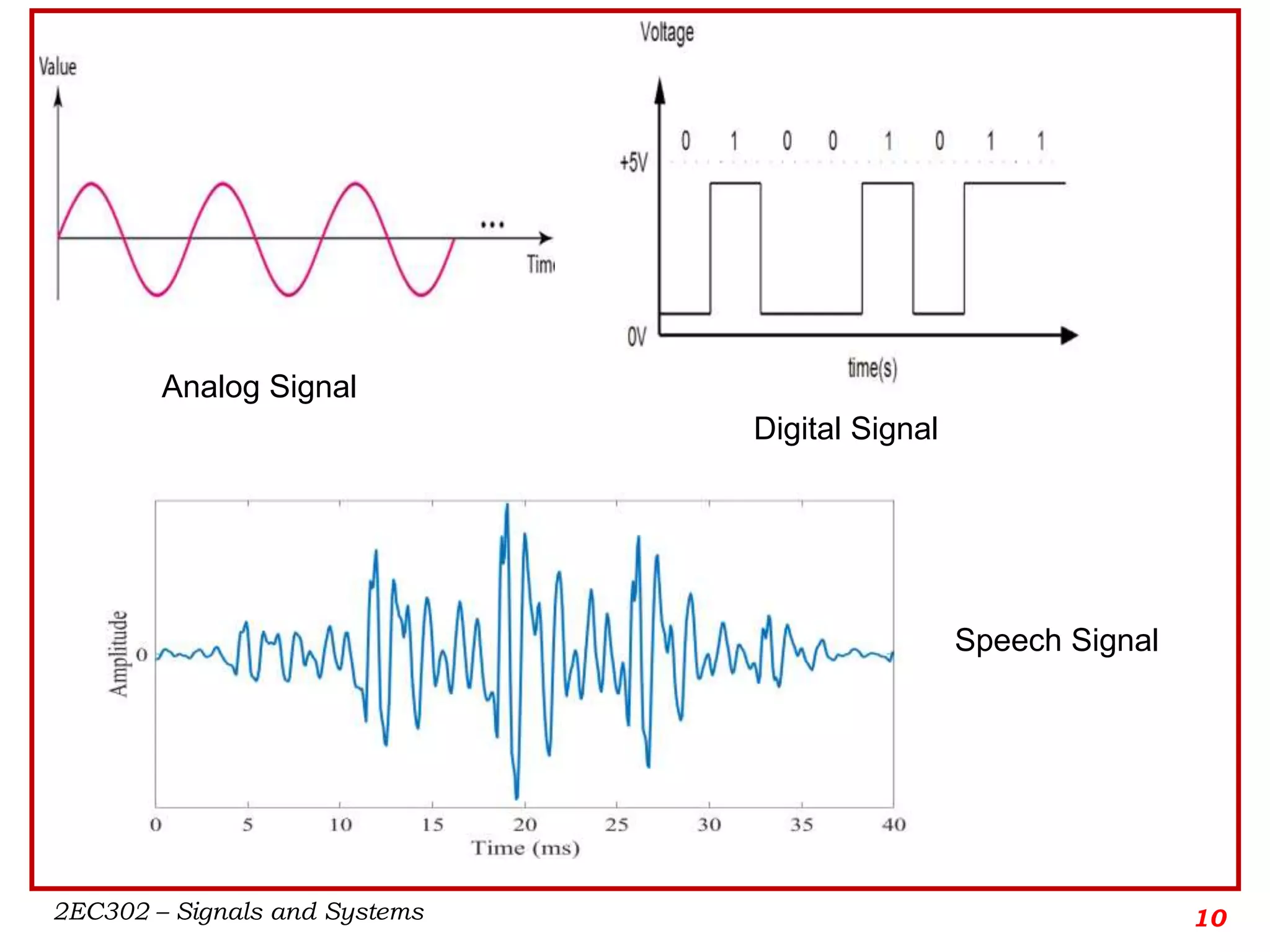
Analog Signal
Digital Signal
Speech Signal
What is the System?
2EC302 – Signals and Systems 11
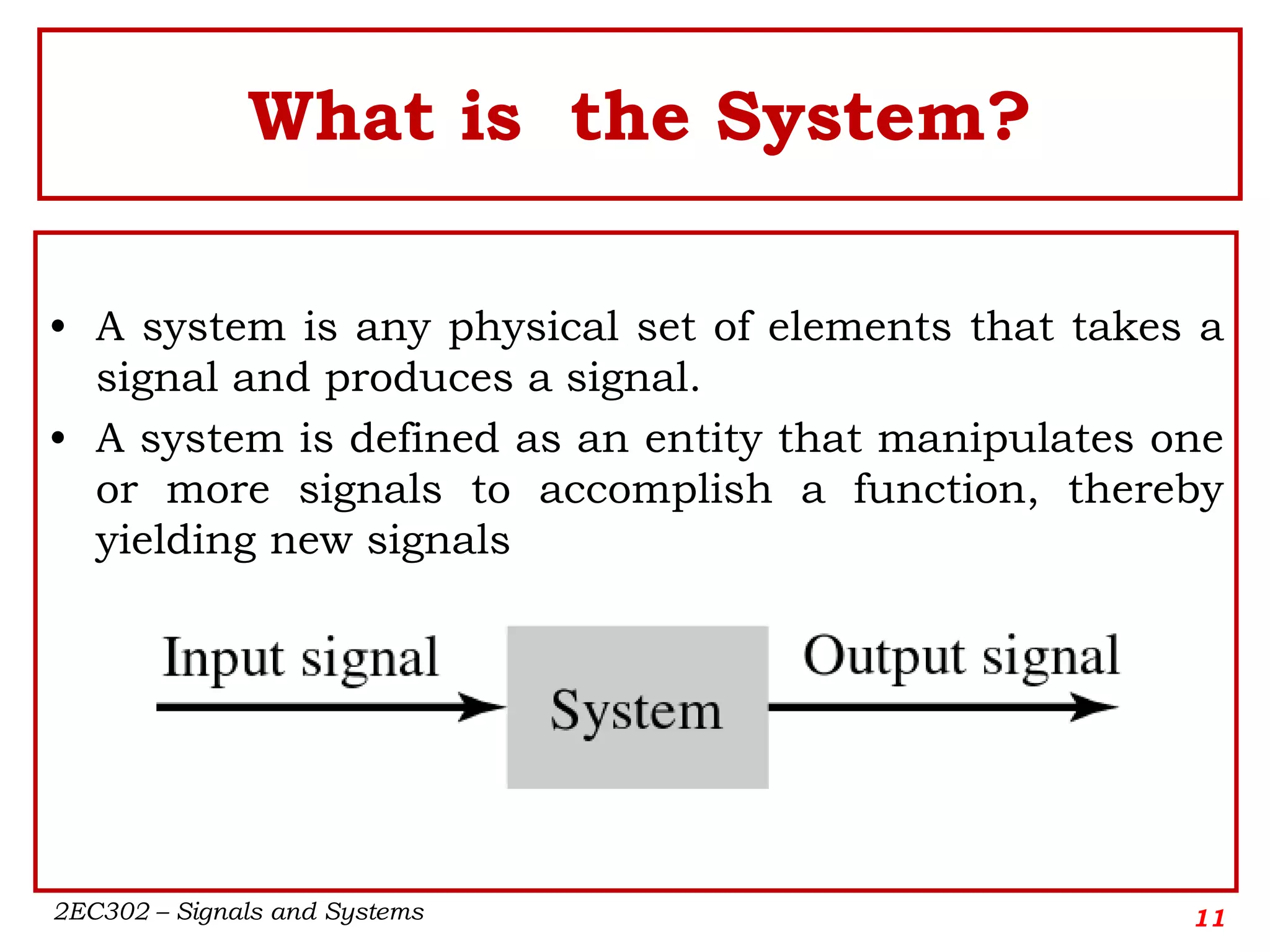
• A system is any physical set of elements that takes a
signal and produces a signal.
• A system is defined as an entity that manipulates one
or more signals to accomplish a function, thereby
yielding new signals
Example of Signals and
Systems
2EC302 – Signals and Systems 12
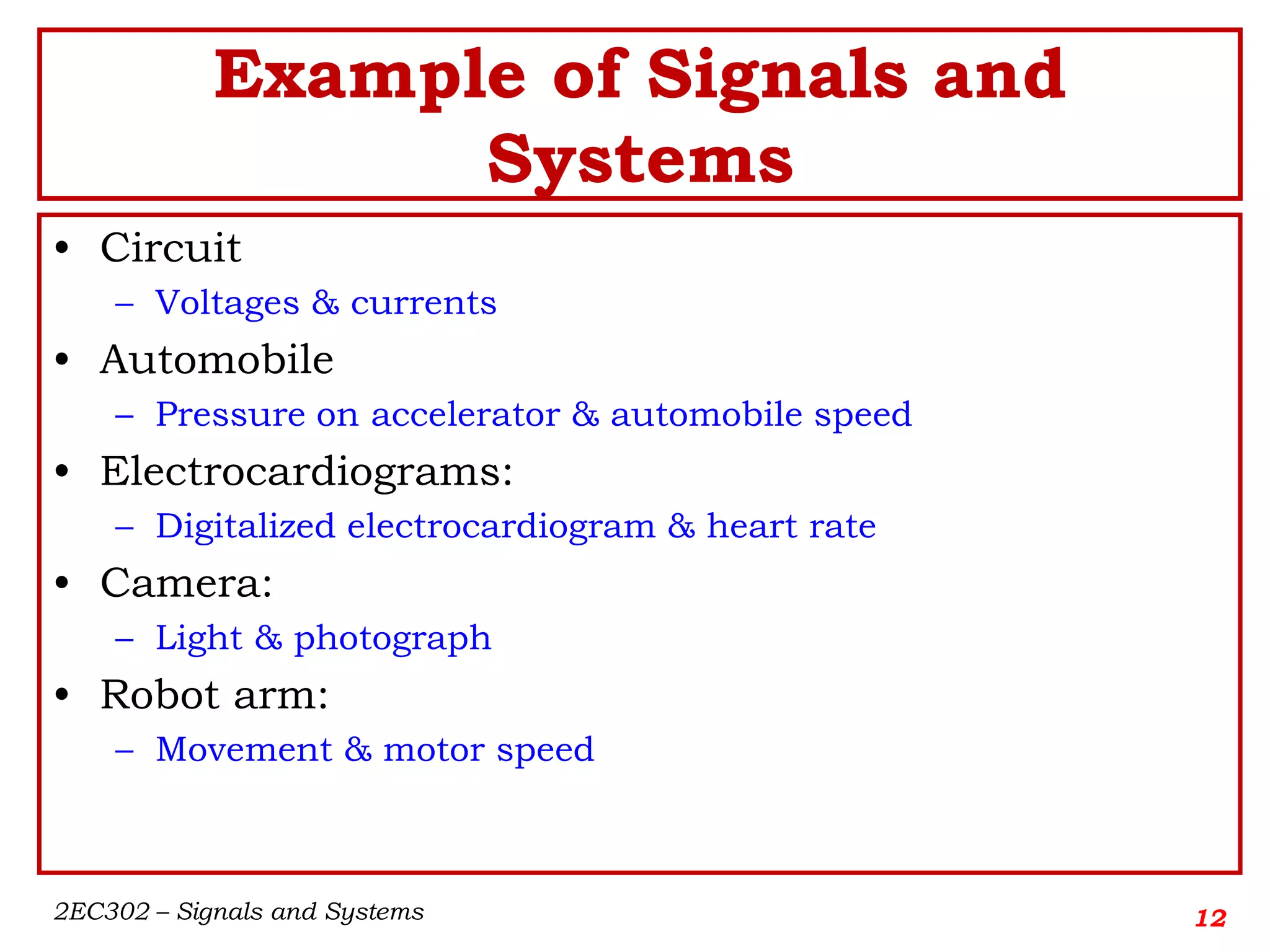
• Circuit
– Voltages & currents
• Automobile
– Pressure on accelerator & automobile speed
• Electrocardiograms:
– Digitalized electrocardiogram & heart rate
• Camera:
– Light & photograph
• Robot arm:
– Movement & motor speed
EC502/2EC302 – Integrated Circuits and Applications
t
0
 
t
t
x 
 sin
)
(

1 2
2 1
t
0
 
t
t
x 
 sin
)
(

1 2
2 1
Audio
Output
Audio
Output
u
v
An electric circuit
An audio recording system
A digital camera
Example of Signals and
Systems
2EC302 – Signals and Systems 14
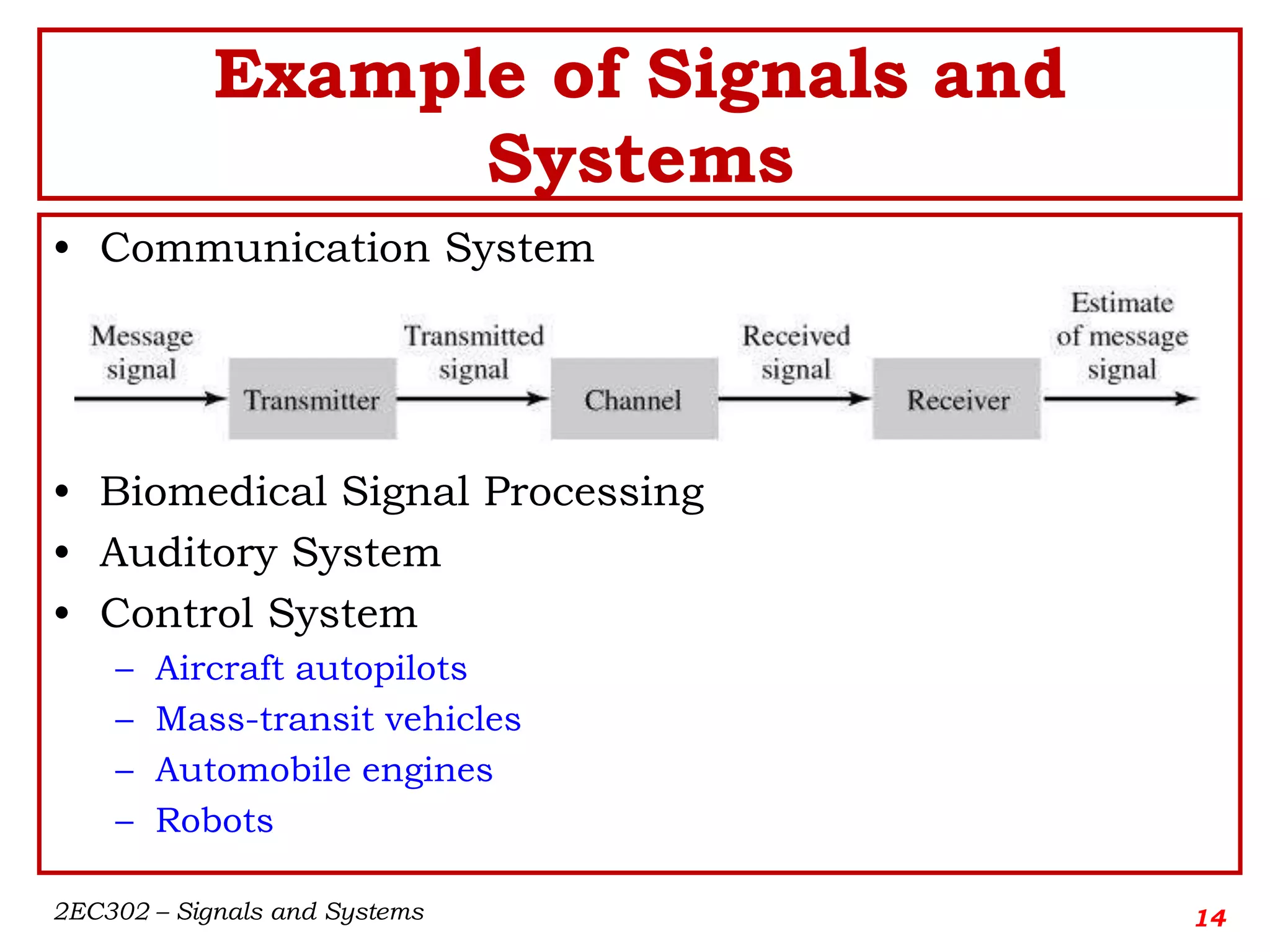
• Communication System
• Biomedical Signal Processing
• Auditory System
• Control System
– Aircraft autopilots
– Mass-transit vehicles
– Automobile engines
– Robots
Example of Signals and
Systems
2EC302 – Signals and Systems 15
• Remote Sensing
Perspectival view
of Mount Shasta
(California),
derived from a pair
of stereo radar
images acquired
from orbit with the
shuttle Imaging
Radar (SIR-B).
(Courtesy of Jet
Propulsion
Laboratory.)
Motivations
2EC302 – Signals and Systems 16
• A specific circuit
– How to quantify its response to different voltage & current
sources
• An aircraft Landing System
– Input Signal: desire position of the aircraft relative to runway
– System: Aircraft
– Output Signal: Correction to the lateral position of the
aircraft
• Communication between aircraft pilot and traffic
control tower
– Signals or information is degraded by noise
– Can a system retrain the pilot’s voice and reject unwanted
noise?
Motivations
2EC302 – Signals and Systems 17
• Images from deep space probes
– Images might be degraded by atmospheric effects,
transmission errors
– How to compensate for these degradation or enhance some
features?
• Estimation of heart rate from an electrocardiogram
• Economic forecasting
• Long distance communication through atmosphere
– Require the use of signals with frequencies in a particular
part of the electromagnetic spectrum
– Take into account possible distortion & interference
Analog Versus Digital Signal
Processing
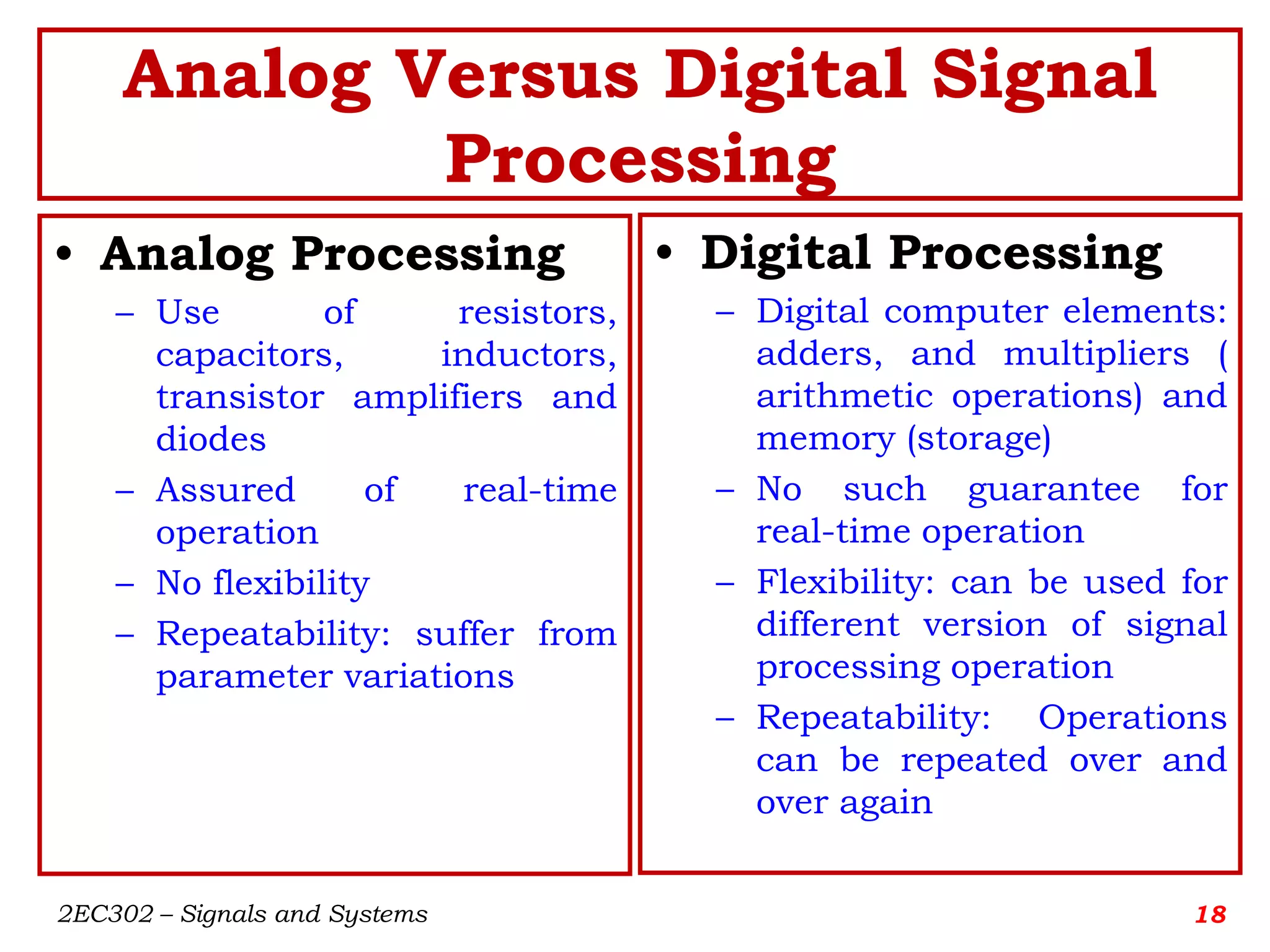
• Analog Processing
– Use of resistors,
capacitors, inductors,
transistor amplifiers and
diodes
– Assured of real-time
operation
– No flexibility
– Repeatability: suffer from
parameter variations
• Digital Processing
– Digital computer elements:
adders, and multipliers (
arithmetic operations) and
memory (storage)
– No such guarantee for
real-time operation
– Flexibility: can be used for
different version of signal
processing operation
– Repeatability: Operations
can be repeated over and
over again
2EC302 – Signals and Systems 18
Best Wishes, Good Vibes and
Stay Blessed!!!
2EC302 – Signals and Systems 19

Introduction to Signals and Systems 2EC302 new.pptx

  • 1.
  • 2.
    Course Assessment 2EC302 –Signals and Systems 2
  • 3.
    Teaching and Learning 2EC302– Signals and Systems 3 Teaching • Cisco WebEx – Pedagogy through Power Point, board and chalk Learning • LMS Moodle for learning and resource management Simulati on • MATLAB Online
  • 4.
    Course Outline 2EC302 –Signals and Systems 4 • Introduction of Signals and Systems • LTI System and Convolution • Fourier Representation • Frequency Domain Analysis • State Space Representations
  • 5.
    Learning Outcome Upon completionof this course, students will be able to: 1. Classify the signals and evaluate properties of LTI systems 2. Analyze LTI systems in time domain and frequency domain 3. Demonstrate the use of state space model and its realization for LTI continuous and discrete time systems 2EC302 – Signals and Systems 5
  • 6.
  • 7.
    Suggested Books 1. SimonHaykin, Signals and Systems, John Wiley 2. Mrinal Mandal and Amir Asif, Continuous and Discrete time signals and systems, Cambridge University Press 3. Oppenheim & Wilsky, Signals and Systems, PHI 4. M. J. Roberts, Signals and Systems TMH India 5. Tarun Kumar Rawat, Signals and systems Oxford Univ. Press 2EC302 – Signals and Systems 7
  • 8.
    Examples of Signals 2EC302– Signals and Systems 8 • Human Communication – Speech Signals – Face-to-Face conversation – Over a telephone channel – Visual in nature ( signals taking the form of images of people or objects around us) – Electronic mail over the Internet • Listening heartbeat of patient and monitoring blood pressure and temperature, diagnose the disease • Weather forecast • Fluctuations in the process of stocks
  • 9.
    What is Signal? 2EC302– Signals and Systems 9 • Signal is defined as a function of one or more variable that conveys information on the nature of a physical phenomenon • A signal is a single-valued function of time that conveys information. • At every point in time, there is a unique value of the function • Value may either be a real number, giving a real- valued signal or a complex number
  • 10.
    2EC302 – Signalsand Systems 10 Analog Signal Digital Signal Speech Signal
  • 11.
    What is theSystem? 2EC302 – Signals and Systems 11 • A system is any physical set of elements that takes a signal and produces a signal. • A system is defined as an entity that manipulates one or more signals to accomplish a function, thereby yielding new signals
  • 12.
    Example of Signalsand Systems 2EC302 – Signals and Systems 12 • Circuit – Voltages & currents • Automobile – Pressure on accelerator & automobile speed • Electrocardiograms: – Digitalized electrocardiogram & heart rate • Camera: – Light & photograph • Robot arm: – Movement & motor speed
  • 13.
    EC502/2EC302 – IntegratedCircuits and Applications t 0   t t x   sin ) (  1 2 2 1 t 0   t t x   sin ) (  1 2 2 1 Audio Output Audio Output u v An electric circuit An audio recording system A digital camera
  • 14.
    Example of Signalsand Systems 2EC302 – Signals and Systems 14 • Communication System • Biomedical Signal Processing • Auditory System • Control System – Aircraft autopilots – Mass-transit vehicles – Automobile engines – Robots
  • 15.
    Example of Signalsand Systems 2EC302 – Signals and Systems 15 • Remote Sensing Perspectival view of Mount Shasta (California), derived from a pair of stereo radar images acquired from orbit with the shuttle Imaging Radar (SIR-B). (Courtesy of Jet Propulsion Laboratory.)
  • 16.
    Motivations 2EC302 – Signalsand Systems 16 • A specific circuit – How to quantify its response to different voltage & current sources • An aircraft Landing System – Input Signal: desire position of the aircraft relative to runway – System: Aircraft – Output Signal: Correction to the lateral position of the aircraft • Communication between aircraft pilot and traffic control tower – Signals or information is degraded by noise – Can a system retrain the pilot’s voice and reject unwanted noise?
  • 17.
    Motivations 2EC302 – Signalsand Systems 17 • Images from deep space probes – Images might be degraded by atmospheric effects, transmission errors – How to compensate for these degradation or enhance some features? • Estimation of heart rate from an electrocardiogram • Economic forecasting • Long distance communication through atmosphere – Require the use of signals with frequencies in a particular part of the electromagnetic spectrum – Take into account possible distortion & interference
  • 18.
    Analog Versus DigitalSignal Processing • Analog Processing – Use of resistors, capacitors, inductors, transistor amplifiers and diodes – Assured of real-time operation – No flexibility – Repeatability: suffer from parameter variations • Digital Processing – Digital computer elements: adders, and multipliers ( arithmetic operations) and memory (storage) – No such guarantee for real-time operation – Flexibility: can be used for different version of signal processing operation – Repeatability: Operations can be repeated over and over again 2EC302 – Signals and Systems 18
  • 19.
    Best Wishes, GoodVibes and Stay Blessed!!! 2EC302 – Signals and Systems 19

Editor's Notes

  • #5 Notes: Economic forecasting is the process of making predictions about the economy. Forecasts can be carried out at a high level of aggregation—for example for GDP, inflation, unemployment or the fiscal deficit—or at a more disaggregated level, for specific sectors of the economy or even specific firms.
  • #15 Notes: Economic forecasting is the process of making predictions about the economy. Forecasts can be carried out at a high level of aggregation—for example for GDP, inflation, unemployment or the fiscal deficit—or at a more disaggregated level, for specific sectors of the economy or even specific firms.
  • #16 Notes: Economic forecasting is the process of making predictions about the economy. Forecasts can be carried out at a high level of aggregation—for example for GDP, inflation, unemployment or the fiscal deficit—or at a more disaggregated level, for specific sectors of the economy or even specific firms.
  • #18 Notes: Economic forecasting is the process of making predictions about the economy. Forecasts can be carried out at a high level of aggregation—for example for GDP, inflation, unemployment or the fiscal deficit—or at a more disaggregated level, for specific sectors of the economy or even specific firms.
  • #19 Notes: Economic forecasting is the process of making predictions about the economy. Forecasts can be carried out at a high level of aggregation—for example for GDP, inflation, unemployment or the fiscal deficit—or at a more disaggregated level, for specific sectors of the economy or even specific firms.