INTRODUCTION TO SCALA
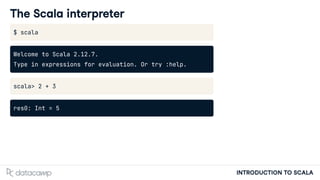
TheScala interpreter
$ scala
Welcome to Scala 2.12.7.
Type in expressions for evaluation. Or try :help.
scala> 2 + 3
res0: Int = 5
3.
INTRODUCTION TO SCALA
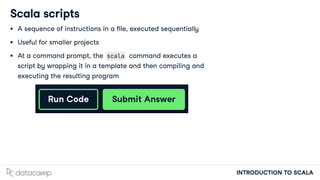
Scalascripts
A sequence of instructions in a le, executed sequentially
Useful for smaller projects
At a command prompt, the scala command executes a
script by wrapping it in a template and then compiling and
executing the resulting program
4.
INTRODUCTION TO SCALA
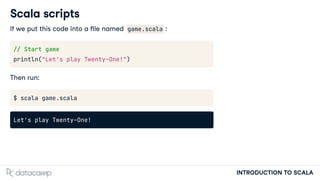
Scalascripts
If we put this code into a le named game.scala :
// Start game
println("Let's play Twenty-One!")
Then run:
$ scala game.scala
Let's play Twenty-One!
5.
INTRODUCTION TO SCALA
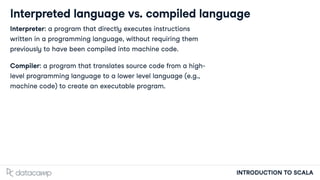
Interpretedlanguage vs. compiled language
Interpreter: a program that directly executes instructions
wri en in a programming language, without requiring them
previously to have been compiled into machine code.
Compiler: a program that translates source code from a high-
level programming language to a lower level language (e.g.,
machine code) to create an executable program.
6.
INTRODUCTION TO SCALA
Scalaapplications
Compiled explicitly then run explicitly
Consist of many source les that can be compiled individually
Useful for larger programs
No lag time since applications are precompiled
7.
INTRODUCTION TO SCALA
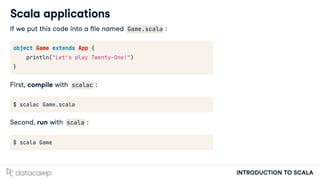
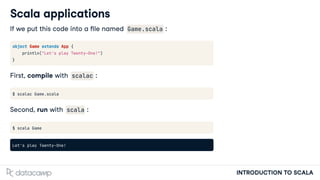
Scalaapplications
If we put this code into a le named Game.scala :
object Game extends App {
println("Let's play Twenty-One!")
}
First, compile with scalac :
$ scalac Game.scala
Second, run with scala :
$ scala Game
8.
INTRODUCTION TO SCALA
Scalaapplications
If we put this code into a le named Game.scala :
object Game extends App {
println("Let's play Twenty-One!")
}
First, compile with scalac :
$ scalac Game.scala
Second, run with scala :
$ scala Game
Let's play Twenty-One!
9.
INTRODUCTION TO SCALA
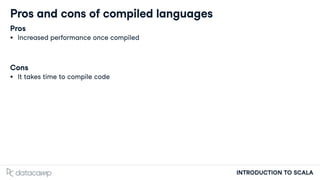
Prosand cons of compiled languages
Pros
Increased performance once compiled
Cons
It takes time to compile code
10.
INTRODUCTION TO SCALA
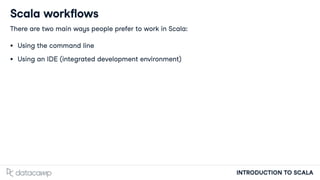
Scalaworkflows
There are two main ways people prefer to work in Scala:
Using the command line
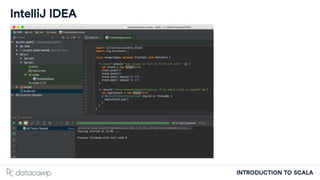
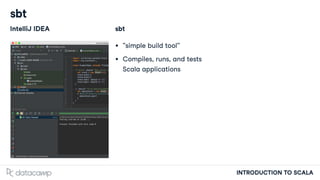
Using an IDE (integrated development environment)
INTRODUCTION TO SCALA
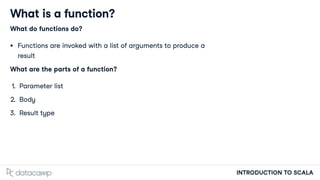
Whatis a function?
What do functions do?
Functions are invoked with a list of arguments to produce a
result
What are the parts of a function?
1. Parameter list
2. Body
3. Result type
20.
INTRODUCTION TO SCALA
Whatis a function?
What do functions do?
Functions are invoked with a list of arguments to produce a
result
What are the parts of a function?
1. Parameter list
2. Body
3. Result type
INTRODUCTION TO SCALA
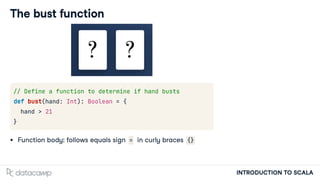
Thebust function
// Define a function to determine if hand busts
def bust(hand: Int): Boolean = {
hand > 21
}
Function body: follows equals sign = in curly braces {}
27.
INTRODUCTION TO SCALA
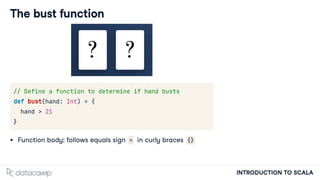
Thebust function
// Define a function to determine if hand busts
def bust(hand: Int) = {
hand > 21
}
Function body: follows equals sign = in curly braces {}
28.
INTRODUCTION TO SCALA
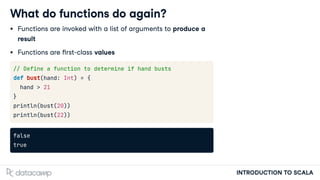
Whatdo functions do again?
Functions are invoked with a list of arguments to produce a
result
Functions are rst-class values
// Define a function to determine if hand busts
def bust(hand: Int) = {
hand > 21
}
println(bust(20))
println(bust(22))
false
true
INTRODUCTION TO SCALA
Array
Mutablesequence of objects that share the same type
Parameterize an array: con gure its types and parameter
values
Initialize elements of an array: give the array data
scala> val players = Array("Alex", "Chen", "Marta")
players: Array[String] = Array(Alex, Chen, Marta)
34.
INTRODUCTION TO SCALA
Array
Parameterizean array: con gure its types and parameter
values
scala> val players = new Array[String](3)
players: Array[String] = Array(null, null, null)
Type parameter: String
Value parameter: length which is 3
35.
INTRODUCTION TO SCALA
Array
Parameterizean array: con gure its types and parameter
values
scala> val players: Array[String] = new Array[String](3)
players: Array[String] = Array(null, null, null)
Type parameter: String
Value parameter: length which is 3
36.
INTRODUCTION TO SCALA
Array
Parameterizean array: con gure its types and parameter
values
Initialize elements of an array: give the array data
scala> players(0) = "Alex"
scala> players(1) = "Chen"
scala> players(2) = "Marta"
scala> players
res3: Array[String] = Array(Alex, Chen, Marta)
INTRODUCTION TO SCALA
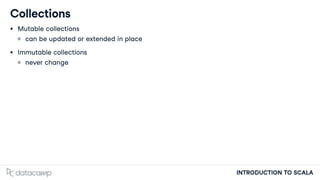
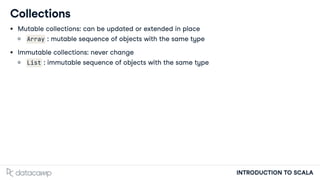
Collections
Mutablecollections: can be updated or extended in place
Array : mutable sequence of objects with the same type
Immutable collections: never change
List : immutable sequence of objects with the same type
45.
INTRODUCTION TO SCALA
Listshave a type parameter
Array
scala> val players = Array("Alex", "Chen", "Marta")
players: Array[String] = Array(Alex, Chen, Marta)
List
scala> val players = List("Alex", "Chen", "Marta")
players: List[String] = List(Alex, Chen, Marta)
46.
INTRODUCTION TO SCALA
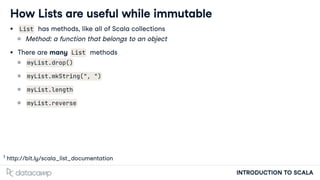
HowLists are useful while immutable
List has methods, like all of Scala collections
Method: a function that belongs to an object
There are many List methods
myList.drop()
myList.mkString(", ")
myList.length
myList.reverse
h p://bit.ly/scala_list_documentation
1
47.
INTRODUCTION TO SCALA
HowLists are useful while immutable
scala> val players = List("Alex", "Chen", "Marta")
players: List[String] = List(Alex, Chen, Marta)
scala> val newPlayers = "Sindhu" :: players
newPlayers: List[String] = List(Sindhu, Alex, Chen, Marta)
48.
INTRODUCTION TO SCALA
HowLists are useful while immutable
scala> var players = List("Alex", "Chen", "Marta")
players: List[String] = List(Alex, Chen, Marta)
scala> players = "Sindhu" :: players
players: List[String] = List(Sindhu, Alex, Chen, Marta)
49.
INTRODUCTION TO SCALA
cons(::)
Prepends a new element to the beginning of an existing
List and returns the resulting List
scala> val players = List("Alex", "Chen", "Marta")
players: List[String] = List(Alex, Chen, Marta)
scala> val newPlayers = "Sindhu" :: players
newPlayers: List[String] = List(Sindhu, Alex, Chen, Marta)
An append operation exists, but its rarely used
h p://bit.ly/append_list_ine cient
1
INTRODUCTION TO SCALA
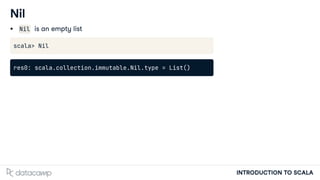
Nil
Acommon way to initialize new lists combines Nil and ::
scala> val players = "Alex" :: "Chen" :: "Marta" :: Nil
players: List[String] = List(Alex, Chen, Marta)
scala> val playersError = "Alex" :: "Chen" :: "Marta"
<console>:11: error: value :: is not a member of String
val playersError = "Alex" :: "Chen" :: "Marta"
52.
INTRODUCTION TO SCALA
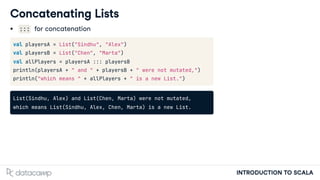
ConcatenatingLists
::: for concatenation
val playersA = List("Sindhu", "Alex")
val playersB = List("Chen", "Marta")
val allPlayers = playersA ::: playersB
println(playersA + " and " + playersB + " were not mutated,")
println("which means " + allPlayers + " is a new List.")
List(Sindhu, Alex) and List(Chen, Marta) were not mutated,
which means List(Sindhu, Alex, Chen, Marta) is a new List.
INTRODUCTION TO SCALA
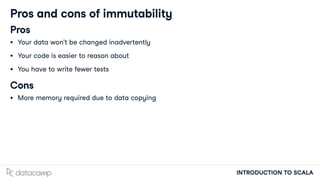
Prosand cons of immutability
Pros
Your data won't be changed inadvertently
Your code is easier to reason about
You have to write fewer tests
Cons
More memory required due to data copying
![INTRODUCTION TO SCALA
Array
Mutable sequence of objects that share the same type
Parameterize an array: con gure its types and parameter
values
Initialize elements of an array: give the array data
scala> val players = Array("Alex", "Chen", "Marta")
players: Array[String] = Array(Alex, Chen, Marta)](https://image.slidesharecdn.com/chapter2-251206184059-298b4bbc/85/Introduction-to-scala-programming-language-33-320.jpg)

players: Array[String] = Array(null, null, null)
Type parameter: String
Value parameter: length which is 3](https://image.slidesharecdn.com/chapter2-251206184059-298b4bbc/85/Introduction-to-scala-programming-language-34-320.jpg)
![INTRODUCTION TO SCALA
Array
Parameterize an array: con gure its types and parameter
values
scala> val players: Array[String] = new Array[String](3)
players: Array[String] = Array(null, null, null)
Type parameter: String
Value parameter: length which is 3](https://image.slidesharecdn.com/chapter2-251206184059-298b4bbc/85/Introduction-to-scala-programming-language-35-320.jpg)
![INTRODUCTION TO SCALA
Array
Parameterize an array: con gure its types and parameter
values
Initialize elements of an array: give the array data
scala> players(0) = "Alex"
scala> players(1) = "Chen"
scala> players(2) = "Marta"
scala> players
res3: Array[String] = Array(Alex, Chen, Marta)](https://image.slidesharecdn.com/chapter2-251206184059-298b4bbc/85/Introduction-to-scala-programming-language-36-320.jpg)
![INTRODUCTION TO SCALA
Arrays are mutable
scala> val players = Array("Alex", "Chen", "Marta")
players: Array[String] = Array(Alex, Chen, Marta)
scala> players(0) = "Sindhu"
res5: Array[String] = Array(Sindhu, Chen, Marta)](https://image.slidesharecdn.com/chapter2-251206184059-298b4bbc/85/Introduction-to-scala-programming-language-37-320.jpg)
![INTRODUCTION TO SCALA
Arrays are mutable
scala> val players = Array("Alex", "Chen", "Marta")
players: Array[String] = Array(Alex, Chen, Marta)
scala> players(0) = 500
<console>:13: error: type mismatch;
found : Int(500)
required: String
players(0) = 500](https://image.slidesharecdn.com/chapter2-251206184059-298b4bbc/85/Introduction-to-scala-programming-language-38-320.jpg)
![INTRODUCTION TO SCALA
Recommendation: use val with Array
scala> var players = Array("Alex", "Chen", "Marta")
players: Array[String] = Array(Alex, Chen, Marta)
Elements can change
scala> players(0) = "Sindhu"
players can be reassigned
scala> players = new Array[String](5)
scala> players
res2: Array[String] = Array(null, null, null, null, null)](https://image.slidesharecdn.com/chapter2-251206184059-298b4bbc/85/Introduction-to-scala-programming-language-39-320.jpg)

mixedTypes: Array[Any] = Array(null, null, null)
scala> mixedTypes(0) = "I like turtles"
scala> mixedTypes(1) = 5000
scala> mixedTypes(2) = true
scala> mixedTypes
res3: Array[Any] = Array(I like turtles, 5000, true)](https://image.slidesharecdn.com/chapter2-251206184059-298b4bbc/85/Introduction-to-scala-programming-language-41-320.jpg)
![INTRODUCTION TO SCALA
Lists have a type parameter
Array
scala> val players = Array("Alex", "Chen", "Marta")
players: Array[String] = Array(Alex, Chen, Marta)
List
scala> val players = List("Alex", "Chen", "Marta")
players: List[String] = List(Alex, Chen, Marta)](https://image.slidesharecdn.com/chapter2-251206184059-298b4bbc/85/Introduction-to-scala-programming-language-45-320.jpg)
![INTRODUCTION TO SCALA
How Lists are useful while immutable
scala> val players = List("Alex", "Chen", "Marta")
players: List[String] = List(Alex, Chen, Marta)
scala> val newPlayers = "Sindhu" :: players
newPlayers: List[String] = List(Sindhu, Alex, Chen, Marta)](https://image.slidesharecdn.com/chapter2-251206184059-298b4bbc/85/Introduction-to-scala-programming-language-47-320.jpg)
![INTRODUCTION TO SCALA
How Lists are useful while immutable
scala> var players = List("Alex", "Chen", "Marta")
players: List[String] = List(Alex, Chen, Marta)
scala> players = "Sindhu" :: players
players: List[String] = List(Sindhu, Alex, Chen, Marta)](https://image.slidesharecdn.com/chapter2-251206184059-298b4bbc/85/Introduction-to-scala-programming-language-48-320.jpg)
![INTRODUCTION TO SCALA
cons (::)
Prepends a new element to the beginning of an existing
List and returns the resulting List
scala> val players = List("Alex", "Chen", "Marta")
players: List[String] = List(Alex, Chen, Marta)
scala> val newPlayers = "Sindhu" :: players
newPlayers: List[String] = List(Sindhu, Alex, Chen, Marta)
An append operation exists, but its rarely used
h p://bit.ly/append_list_ine cient
1](https://image.slidesharecdn.com/chapter2-251206184059-298b4bbc/85/Introduction-to-scala-programming-language-49-320.jpg)
![INTRODUCTION TO SCALA
Nil
A common way to initialize new lists combines Nil and ::
scala> val players = "Alex" :: "Chen" :: "Marta" :: Nil
players: List[String] = List(Alex, Chen, Marta)
scala> val playersError = "Alex" :: "Chen" :: "Marta"
<console>:11: error: value :: is not a member of String
val playersError = "Alex" :: "Chen" :: "Marta"](https://image.slidesharecdn.com/chapter2-251206184059-298b4bbc/85/Introduction-to-scala-programming-language-51-320.jpg)


![[Deck] What's New in Spark-Iceberg Integration via DSV2.pptx](https://cdn.slidesharecdn.com/ss_thumbnails/deckwhatsnewinspark-icebergintegrationviadsv2-260210005337-25955b12-thumbnail.jpg?width=640&height=640&fit=bounds)


