ADMCLD
Introduction to SAP Business
Technology Platform (BTP)
Administration
.
.
PARTICIPANT HANDBOOK
INSTRUCTOR-LED TRAINING
.
Course Version: 25
Course Duration: 3 Days
Librería ERP — Sample | libreriaerp.com/us | info@libreriaerp.com
SAP Copyrights, Trademarks and
Disclaimers
© 2025 SAP SE or an SAP affiliate company. All rights reserved.
No part of this publication may be reproduced or transmitted in any form or for any purpose without the
express permission of SAP SE or an SAP affiliate company.
SAP and other SAP products and services mentioned herein as well as their respective logos are
trademarks or registered trademarks of SAP SE (or an SAP affiliate company) in Germany and other
countries. Please see https://www.sap.com/corporate/en/legal/copyright.html for additional
trademark information and notices.
Some software products marketed by SAP SE and its distributors contain proprietary software
components of other software vendors.
National product specifications may vary.
These materials may have been machine translated and may contain grammatical errors or
inaccuracies.
These materials are provided by SAP SE or an SAP affiliate company for informational purposes only,
without representation or warranty of any kind, and SAP SE or its affiliated companies shall not be liable
for errors or omissions with respect to the materials. The only warranties for SAP SE or SAP affiliate
company products and services are those that are set forth in the express warranty statements
accompanying such products and services, if any. Nothing herein should be construed as constituting an
additional warranty.
In particular, SAP SE or its affiliated companies have no obligation to pursue any course of business
outlined in this document or any related presentation, or to develop or release any functionality
mentioned therein. This document, or any related presentation, and SAP SE’s or its affiliated companies’
strategy and possible future developments, products, and/or platform directions and functionality are
all subject to change and may be changed by SAP SE or its affiliated companies at any time for any
reason without notice. The information in this document is not a commitment, promise, or legal
obligation to deliver any material, code, or functionality. All forward-looking statements are subject to
various risks and uncertainties that could cause actual results to differ materially from expectations.
Readers are cautioned not to place undue reliance on these forward-looking statements, which speak
only as of their dates, and they should not be relied upon in making purchasing decisions.
© Copyright. All rights reserved. iii
Librería ERP — Sample | libreriaerp.com/us | info@libreriaerp.com
Typographic Conventions
American English is the standard used in this handbook.
The following typographic conventions are also used.
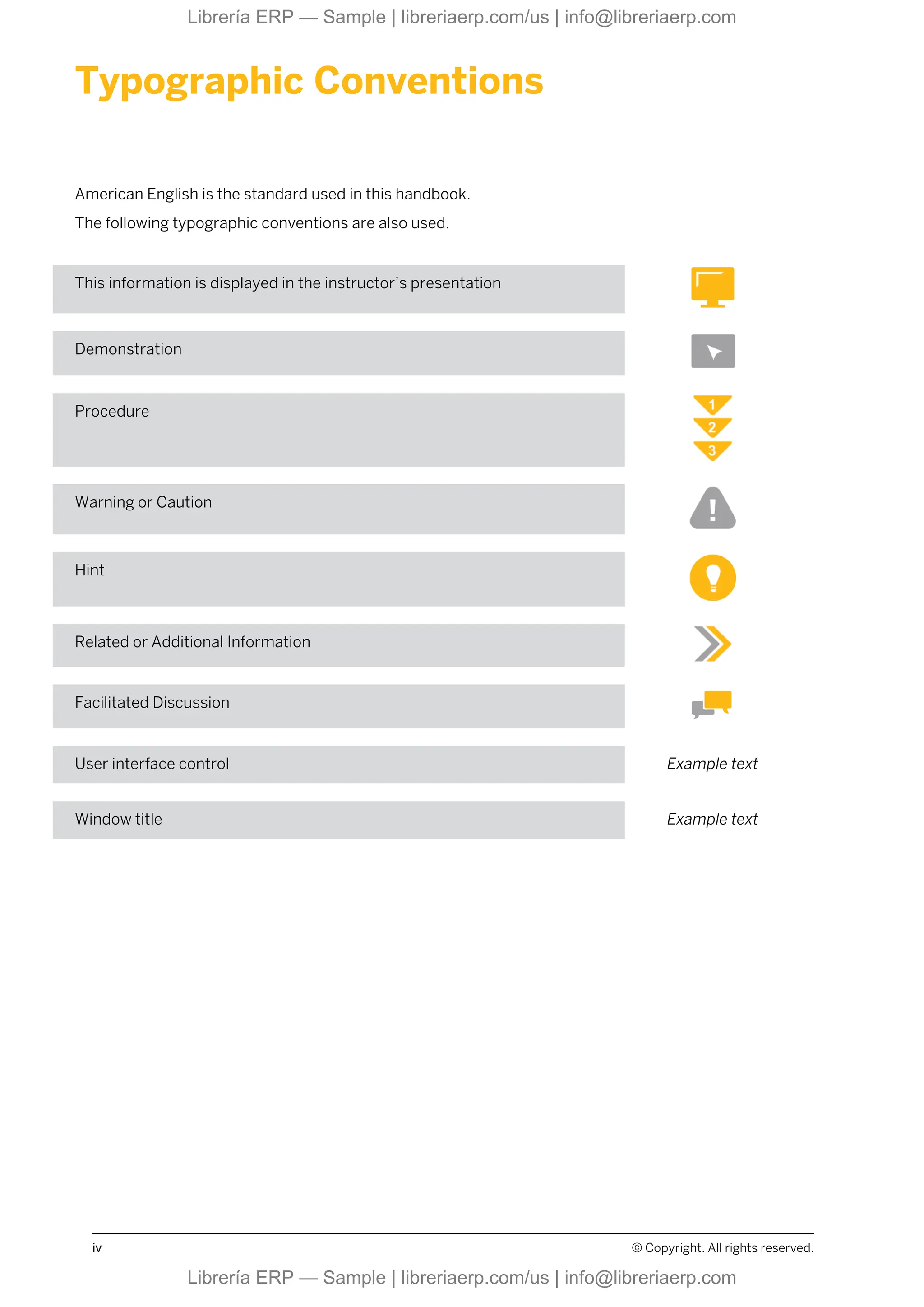
This information is displayed in the instructor’s presentation
Demonstration
Procedure
Warning or Caution
Hint
Related or Additional Information
Facilitated Discussion
User interface control Example text
Window title Example text
iv © Copyright. All rights reserved.
Librería ERP — Sample | libreriaerp.com/us | info@libreriaerp.com
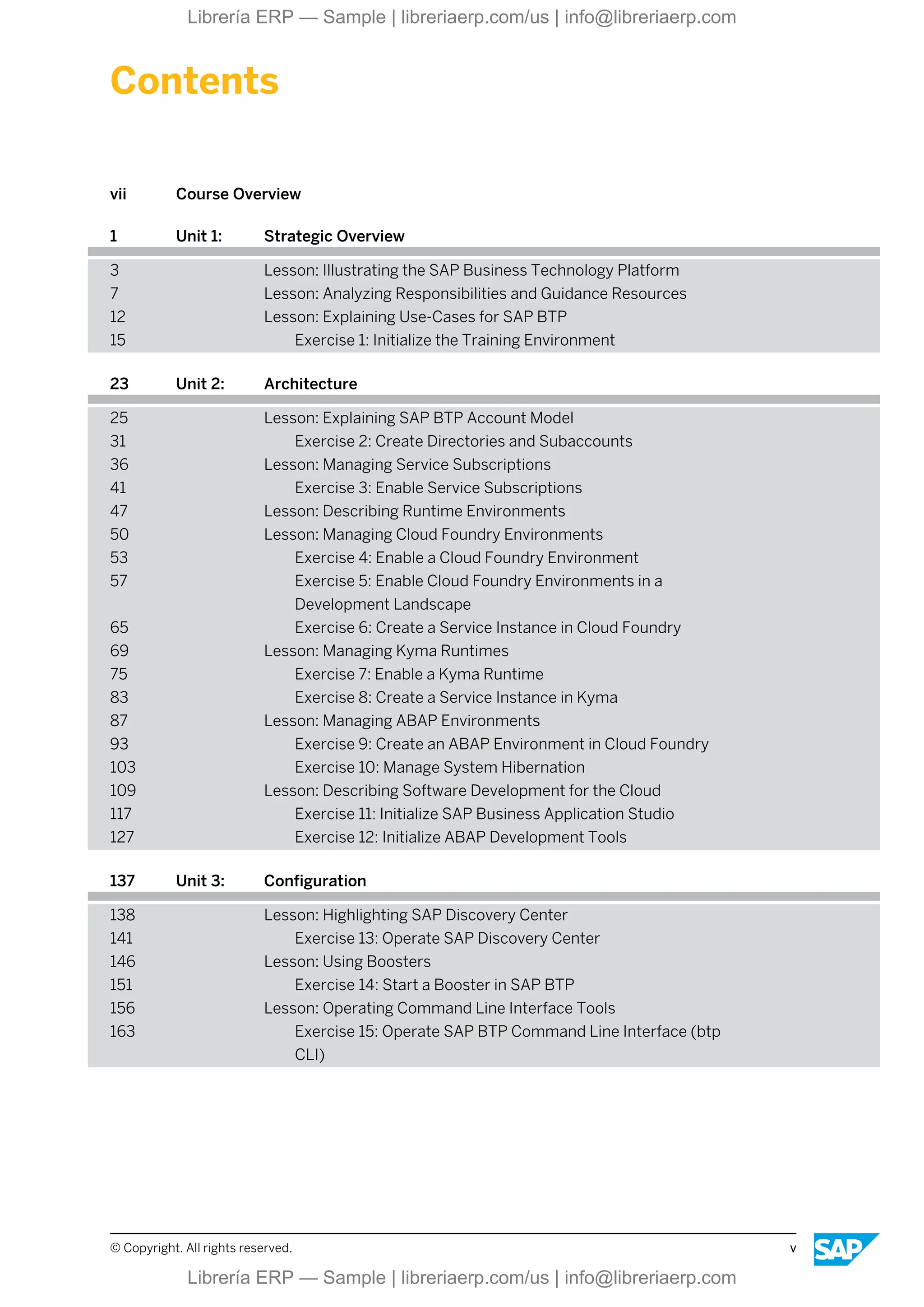
Contents
vii Course Overview
1 Unit 1: Strategic Overview
3 Lesson: Illustrating the SAP Business Technology Platform
7 Lesson: Analyzing Responsibilities and Guidance Resources
12 Lesson: Explaining Use-Cases for SAP BTP
15 Exercise 1: Initialize the Training Environment
23 Unit 2: Architecture
25 Lesson: Explaining SAP BTP Account Model
31 Exercise 2: Create Directories and Subaccounts
36 Lesson: Managing Service Subscriptions
41 Exercise 3: Enable Service Subscriptions
47 Lesson: Describing Runtime Environments
50 Lesson: Managing Cloud Foundry Environments
53 Exercise 4: Enable a Cloud Foundry Environment
57 Exercise 5: Enable Cloud Foundry Environments in a
Development Landscape
65 Exercise 6: Create a Service Instance in Cloud Foundry
69 Lesson: Managing Kyma Runtimes
75 Exercise 7: Enable a Kyma Runtime
83 Exercise 8: Create a Service Instance in Kyma
87 Lesson: Managing ABAP Environments
93 Exercise 9: Create an ABAP Environment in Cloud Foundry
103 Exercise 10: Manage System Hibernation
109 Lesson: Describing Software Development for the Cloud
117 Exercise 11: Initialize SAP Business Application Studio
127 Exercise 12: Initialize ABAP Development Tools
137 Unit 3: Configuration
138 Lesson: Highlighting SAP Discovery Center
141 Exercise 13: Operate SAP Discovery Center
146 Lesson: Using Boosters
151 Exercise 14: Start a Booster in SAP BTP
156 Lesson: Operating Command Line Interface Tools
163 Exercise 15: Operate SAP BTP Command Line Interface (btp
CLI)
© Copyright. All rights reserved. v
Librería ERP — Sample | libreriaerp.com/us | info@libreriaerp.com
179 Unit 4: Identity and Access Management
181 Lesson: Explaining Identity and Access Management on SAP BTP
190 Lesson: Managing Users and Authorizations on SAP BTP
195 Exercise 16: Create Administrator User in a Subaccount
205 Exercise 17: Inspect and Assign Predefined Role Collections for
Applications
213 Lesson: Working with SAP Cloud Identity Services - Identity
Authentication
227 Unit 5: Connectivity
228 Lesson: Using Destinations
233 Exercise 18: Create a Destination
237 Lesson: Operating Cloud Connector
243 Exercise 19: Provide and Start the Portable Version of the Cloud
Connector
255 Exercise 20: Configure the Cloud Connector
281 Exercise 21: Deploy an SAP Fiori Freestyle Application
295 Unit 6: SAP HANA Cloud
296 Lesson: Exploring SAP HANA Cloud
319 Exercise 22: Explore SAP HANA Cloud
325 Lesson: Identifying Database Offerings
331 Unit 7: Application Lifecycle Management
333 Lesson: Identify SAP Application Lifecycle Management Offerings
343 Unit 8: Monitoring
344 Lesson: Using Local Monitoring Services
349 Exercise 23: Operate SAP Application Logging Service for SAP
BTP
363 Lesson: Explaining SAP Application Lifecycle Management
Monitoring Tools
373 Unit 9: Transport Management
375 Lesson: Exploring SAP Cloud Transport Management Service
379 Lesson: Configuring SAP Cloud Transport Management Service
389 Exercise 24: Configure SAP Cloud Transport Management
395 Exercise 25: Create the Destinations to Your Target
Subaccounts
401 Exercise 26: Create the Transport Routes in Cloud Transport
Management
407 Lesson: Transporting Changes
411 Exercise 27: Transport Changes with SAP Cloud Transport
Management
vi © Copyright. All rights reserved.
Librería ERP — Sample | libreriaerp.com/us | info@libreriaerp.com
Course Overview
TARGET AUDIENCE
This course is intended for the following audiences:
● Systems Architect
● Project Manager
● Change Manager
● Development Consultant
● Technology Consultant
● Support Consultant
● Super / Key / Power User
● Business Process Architect
● Business Process Owner/Team Lead/Power User
● Database Administrator
● Developer
● Enterprise Architect
● Solution Architect
● System Administrator
● System Architect
© Copyright. All rights reserved. vii
Librería ERP — Sample | libreriaerp.com/us | info@libreriaerp.com
viii © Copyright. All rights reserved.
Librería ERP — Sample | libreriaerp.com/us | info@libreriaerp.com
UNIT 1 Strategic Overview
Lesson 1
Illustrating the SAP Business Technology Platform 3
Lesson 2
Analyzing Responsibilities and Guidance Resources 7
Lesson 3
Explaining Use-Cases for SAP BTP 12
Exercise 1: Initialize the Training Environment 15
UNIT OBJECTIVES
● Illustrate the SAP Business Technology Platform.
● Explain the responsibilities of administrators
● Introduce the SAP BTP Guidance Framework
● Explain Use-Cases for SAP BTP
© Copyright. All rights reserved. 1
Librería ERP — Sample | libreriaerp.com/us | info@libreriaerp.com
Unit 1: Strategic Overview
2 © Copyright. All rights reserved.
Librería ERP — Sample | libreriaerp.com/us | info@libreriaerp.com
Unit 1
Lesson 1
Illustrating the SAP Business Technology
Platform
LESSON OBJECTIVES
After completing this lesson, you will be able to:
● Illustrate the SAP Business Technology Platform.
What is the SAP Business Technology Platform?
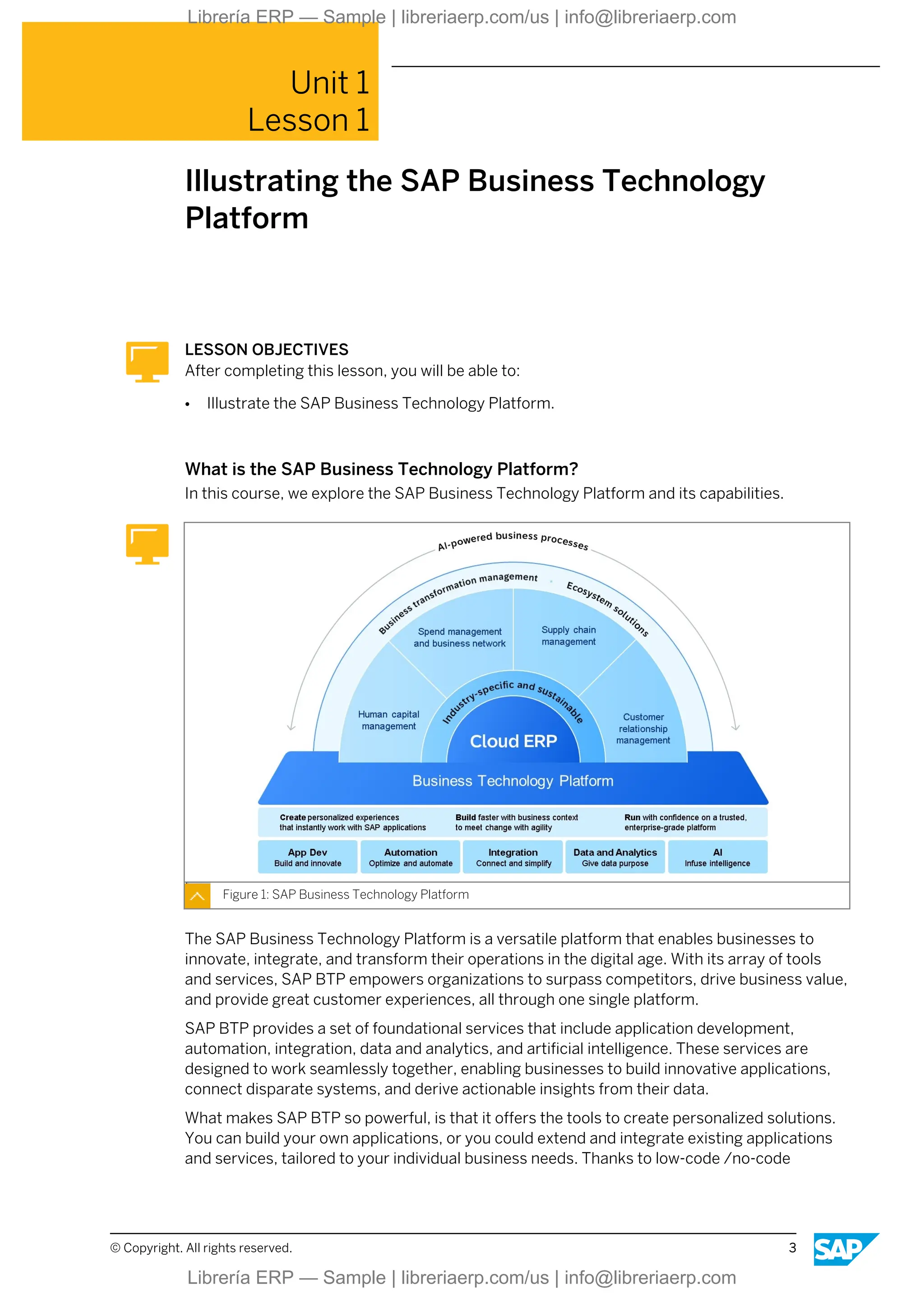
In this course, we explore the SAP Business Technology Platform and its capabilities.
Figure 1: SAP Business Technology Platform
The SAP Business Technology Platform is a versatile platform that enables businesses to
innovate, integrate, and transform their operations in the digital age. With its array of tools
and services, SAP BTP empowers organizations to surpass competitors, drive business value,
and provide great customer experiences, all through one single platform.
SAP BTP provides a set of foundational services that include application development,
automation, integration, data and analytics, and artificial intelligence. These services are
designed to work seamlessly together, enabling businesses to build innovative applications,
connect disparate systems, and derive actionable insights from their data.
What makes SAP BTP so powerful, is that it offers the tools to create personalized solutions.
You can build your own applications, or you could extend and integrate existing applications
and services, tailored to your individual business needs. Thanks to low-code /no-code
© Copyright. All rights reserved. 3
Librería ERP — Sample | libreriaerp.com/us | info@libreriaerp.com
solutions also offered through SAP BTP, business users are enabled to automate tasks,
establish workflows, and craft their own customized interfaces.
Another notable feature of SAP BTP is its capacity to support both cloud-native and hybrid
solutions of the cloud while also integrating with on-premise systems and data sources. This
flexibility enables organizations to adapt to changing business needs and infrastructure
requirements without compromising security or performance.
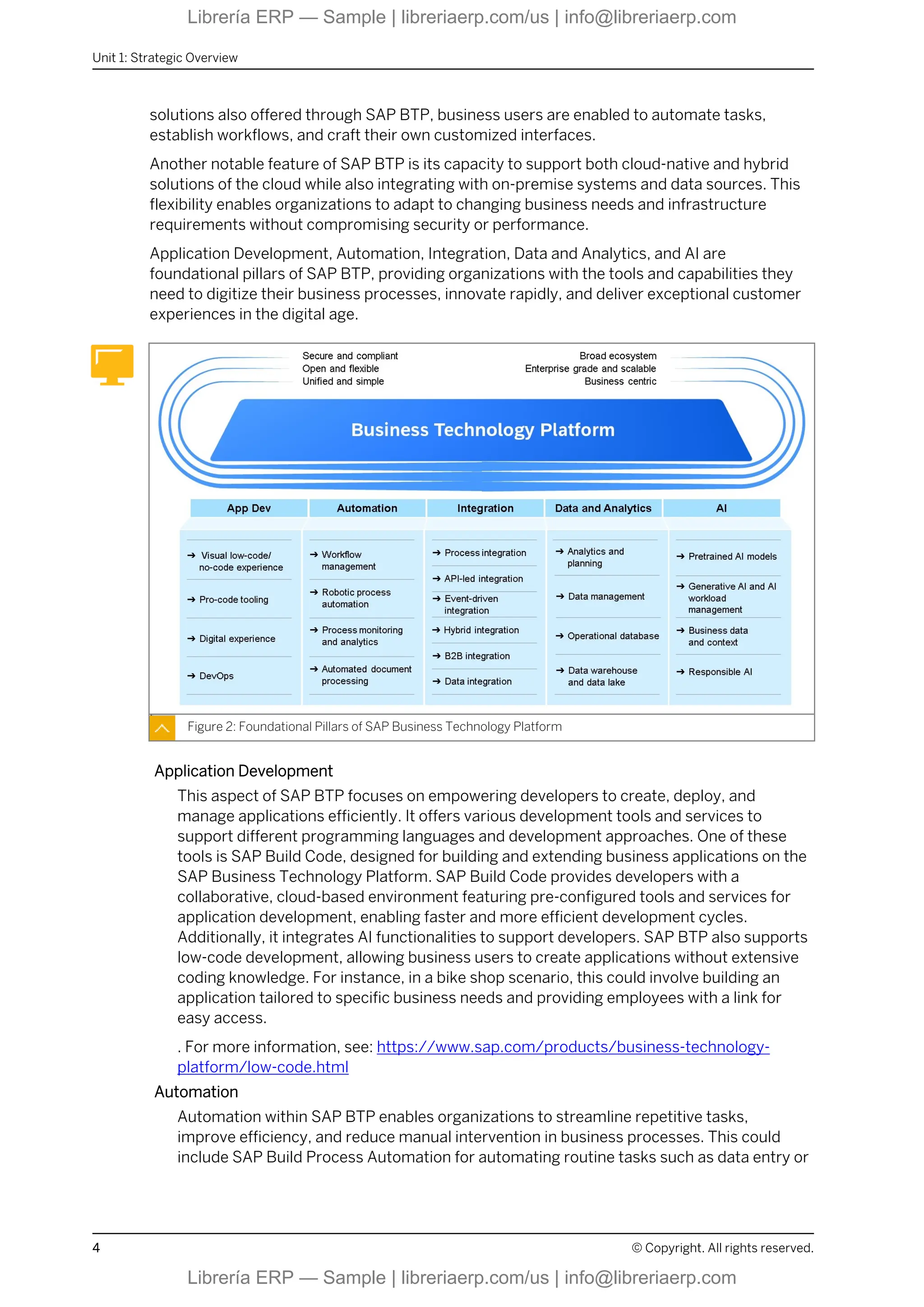
Application Development, Automation, Integration, Data and Analytics, and AI are
foundational pillars of SAP BTP, providing organizations with the tools and capabilities they
need to digitize their business processes, innovate rapidly, and deliver exceptional customer
experiences in the digital age.
Figure 2: Foundational Pillars of SAP Business Technology Platform
Application Development
This aspect of SAP BTP focuses on empowering developers to create, deploy, and
manage applications efficiently. It offers various development tools and services to
support different programming languages and development approaches. One of these
tools is SAP Build Code, designed for building and extending business applications on the
SAP Business Technology Platform. SAP Build Code provides developers with a
collaborative, cloud-based environment featuring pre-configured tools and services for
application development, enabling faster and more efficient development cycles.
Additionally, it integrates AI functionalities to support developers. SAP BTP also supports
low-code development, allowing business users to create applications without extensive
coding knowledge. For instance, in a bike shop scenario, this could involve building an
application tailored to specific business needs and providing employees with a link for
easy access.
. For more information, see: https://www.sap.com/products/business-technology-
platform/low-code.html
Automation
Automation within SAP BTP enables organizations to streamline repetitive tasks,
improve efficiency, and reduce manual intervention in business processes. This could
include SAP Build Process Automation for automating routine tasks such as data entry or
Unit 1: Strategic Overview
4 © Copyright. All rights reserved.
Librería ERP — Sample | libreriaerp.com/us | info@libreriaerp.com
invoice processing. SAP BTP also offers workflow automation capabilities, allowing
organizations to design, execute, and monitor complex business workflows with ease. By
automating mundane tasks and workflows, organizations can free up resources,
minimize errors, and focus on higher-value activities that drive business growth. If our
bike shop wants to order new parts before they run out, it could automate this process.
For example, as soon as the system detects that certain parts are low in stock, an order
to the manufacturer could be triggered. For more information, see: https://
www.sap.com/products/technology-platform/process-automation.html
Integration
Integration is a critical aspect of SAP BTP that enables seamless communication and
data exchange between different systems, applications, and data sources. SAP BTP
offers the SAP Integration Suite to facilitate connectivity across on-premise and cloud
environments, as well as with external partners and customers. There are also resources
for API management and pre-built business content for out-of-the-box solutions. With
integration on SAP BTP, organizations can break down data silos, streamline business
processes, and unlock the full potential of their digital ecosystem. If our bike shop needs
to connect to the system of the manufacturer, it can either check for existing APIs in the
SAP Business Accelerator Hub or create APIs with SAP Integration Suite. For more
information, see: https://www.sap.com/products/integration.html
Data and Analytics
Data and analytics capabilities on SAP BTP empower organizations to derive insights
from their data, make informed decisions, and drive business outcomes. This includes
services for data warehousing, data modeling, and advanced analytics. SAP BTP also
offers data visualization capabilities and machine learning services to enable
organizations to uncover hidden patterns, trends, and opportunities in their data. By
harnessing the power of data and analytics on SAP BTP, organizations can gain a
competitive edge, optimize operations, and innovate with confidence. With suppliers,
customers, and sales, our bike shop accumulates a lot of valuable data. This data could
be stored, managed, and visualized with SAP BTP data management products such as
SAP Analytics Cloud, SAP Datasphere, SAP HANA Cloud, and more. For more
information, see: https://www.sap.com/products/analytics.html
Artificial Intelligence (AI)
SAP BTP offers a comprehensive set of AI technologies and services, for example SAP AI
Business Services and Generative AI Hub. They enable organizations to harness the
power of artificial intelligence to foster innovation, enhance efficiency, and provide added
value to customers. By leveraging these AI capabilities, organizations can stay ahead of
the competition and thrive in today's digital economy. Customers of our fictional bike
shop can get personalized, AI-based recommendations to find the product that fits best
and benefit from an enriched customer experience. For more information, see: https://
www.sap.com/products/artificial-intelligence.html
LESSON SUMMARY
You should now be able to:
● Illustrate the SAP Business Technology Platform.
Lesson: Illustrating the SAP Business Technology Platform
© Copyright. All rights reserved. 5
Librería ERP — Sample | libreriaerp.com/us | info@libreriaerp.com
Unit 1: Strategic Overview
6 © Copyright. All rights reserved.
Librería ERP — Sample | libreriaerp.com/us | info@libreriaerp.com
Unit 1
Lesson 2
Analyzing Responsibilities and Guidance
Resources
LESSON OBJECTIVES
After completing this lesson, you will be able to:
● Explain the responsibilities of administrators
● Introduce the SAP BTP Guidance Framework
Shared Responsibility Model
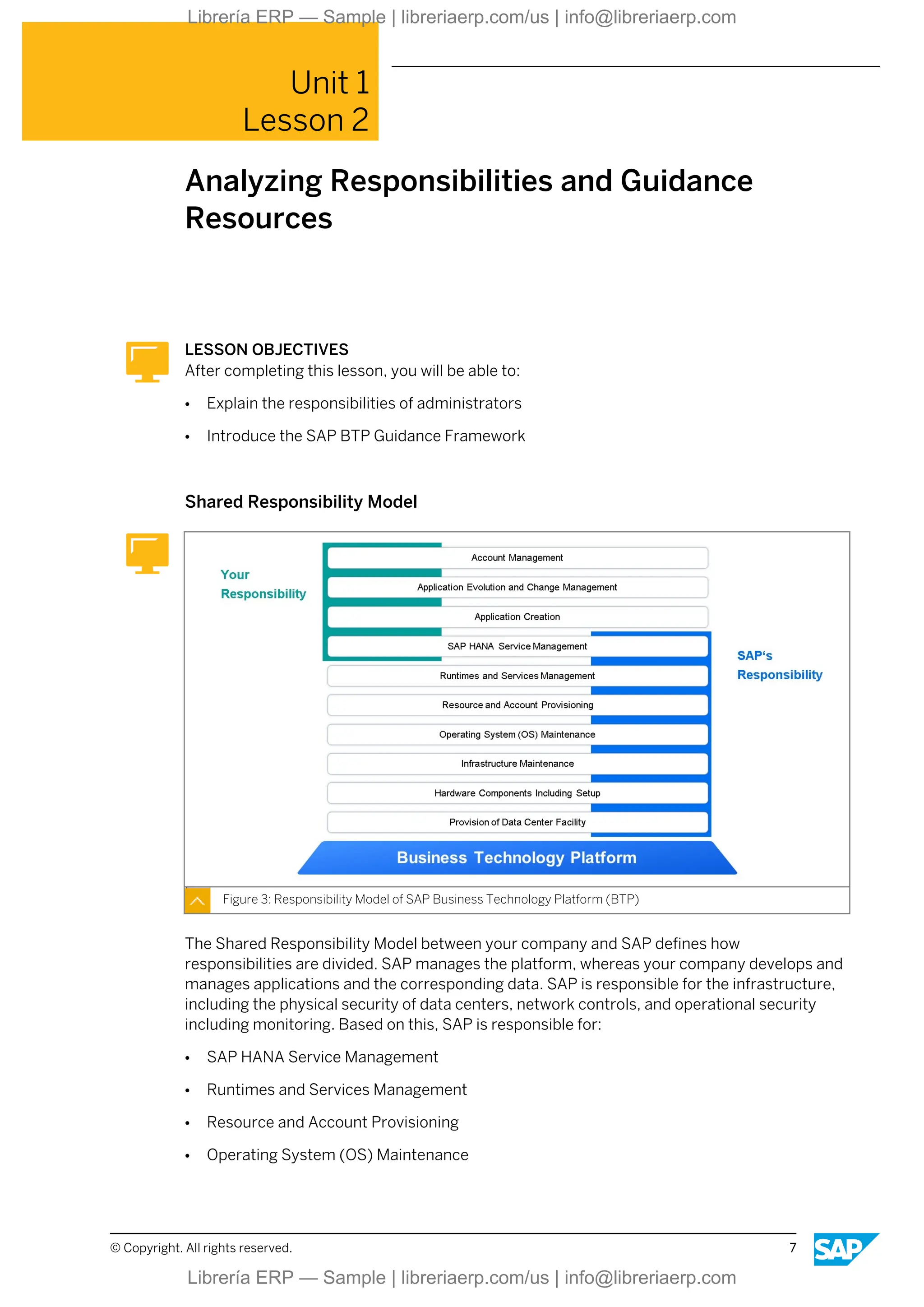
Figure 3: Responsibility Model of SAP Business Technology Platform (BTP)
The Shared Responsibility Model between your company and SAP defines how
responsibilities are divided. SAP manages the platform, whereas your company develops and
manages applications and the corresponding data. SAP is responsible for the infrastructure,
including the physical security of data centers, network controls, and operational security
including monitoring. Based on this, SAP is responsible for:
● SAP HANA Service Management
● Runtimes and Services Management
● Resource and Account Provisioning
● Operating System (OS) Maintenance
© Copyright. All rights reserved. 7
Librería ERP — Sample | libreriaerp.com/us | info@libreriaerp.com
● Infrastructure Maintenance
● Hardware Components including Setup
● Provision of Data Center Facility
Customers are responsible for their data, access management, and applications and their
security. This model ensures that both parties contribute to maintaining a secure
environment, with SAP handling the underlying platform, in this case SAP BTP, and users
managing their specific configurations.
Product Documentation: Shared Responsibility Model Between You and SAP
SAP BTP Guidance Framework
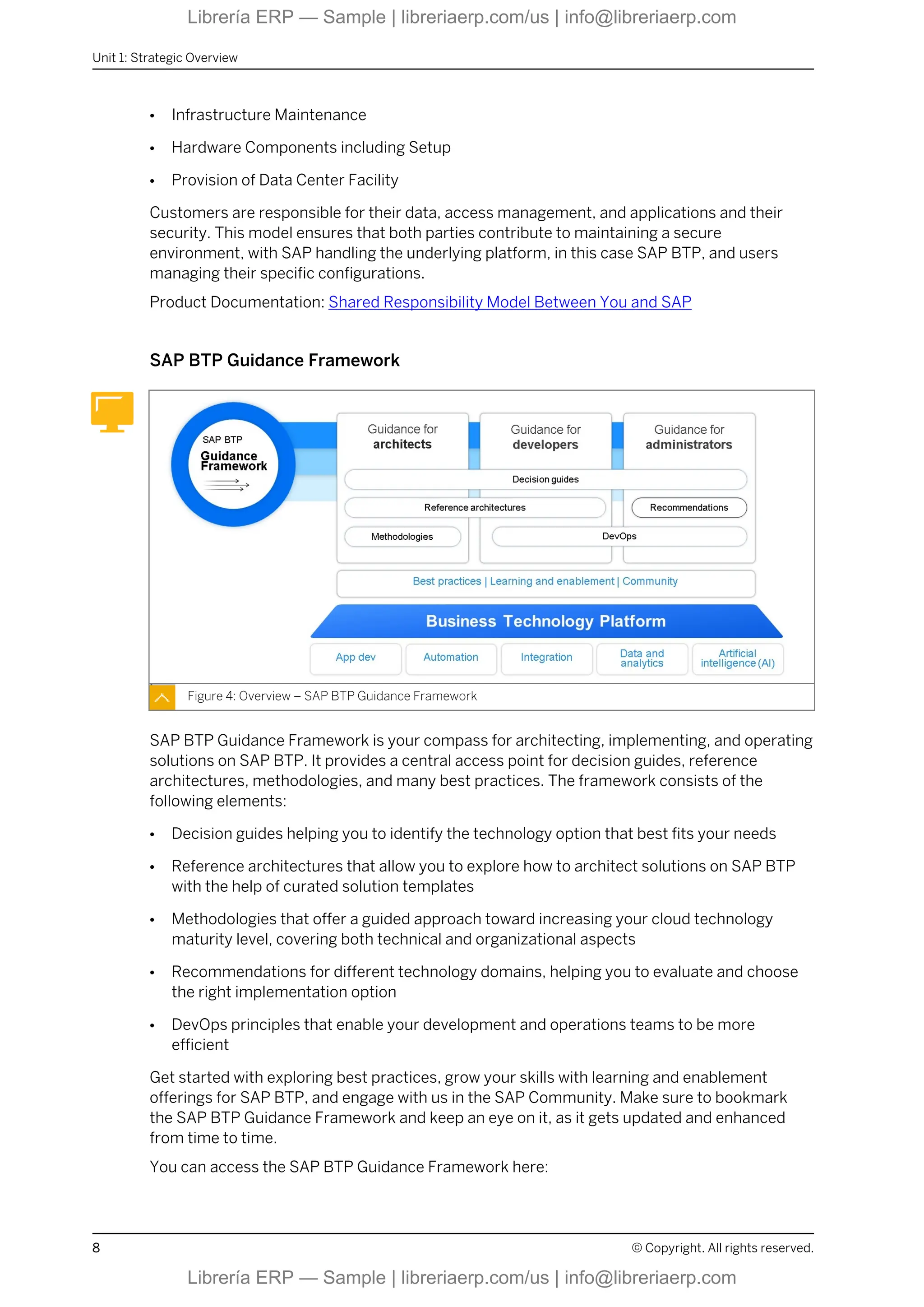
Figure 4: Overview – SAP BTP Guidance Framework
SAP BTP Guidance Framework is your compass for architecting, implementing, and operating
solutions on SAP BTP. It provides a central access point for decision guides, reference
architectures, methodologies, and many best practices. The framework consists of the
following elements:
● Decision guides helping you to identify the technology option that best fits your needs
● Reference architectures that allow you to explore how to architect solutions on SAP BTP
with the help of curated solution templates
● Methodologies that offer a guided approach toward increasing your cloud technology
maturity level, covering both technical and organizational aspects
● Recommendations for different technology domains, helping you to evaluate and choose
the right implementation option
● DevOps principles that enable your development and operations teams to be more
efficient
Get started with exploring best practices, grow your skills with learning and enablement
offerings for SAP BTP, and engage with us in the SAP Community. Make sure to bookmark
the SAP BTP Guidance Framework and keep an eye on it, as it gets updated and enhanced
from time to time.
You can access the SAP BTP Guidance Framework here:
Unit 1: Strategic Overview
8 © Copyright. All rights reserved.
Librería ERP — Sample | libreriaerp.com/us | info@libreriaerp.com
SAP BTP Guidance Framework
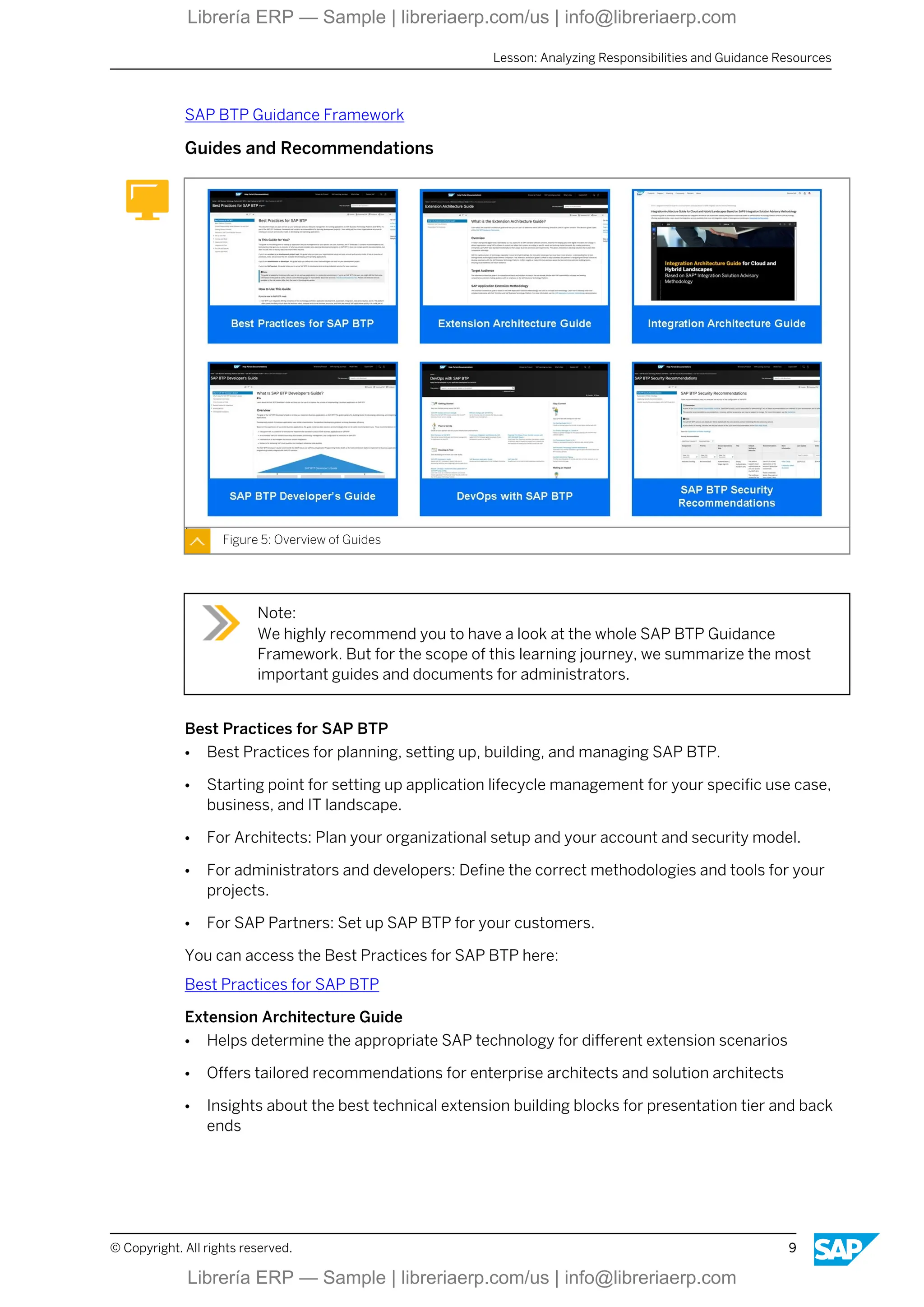
Guides and Recommendations
Figure 5: Overview of Guides
Note:
We highly recommend you to have a look at the whole SAP BTP Guidance
Framework. But for the scope of this learning journey, we summarize the most
important guides and documents for administrators.
Best Practices for SAP BTP
● Best Practices for planning, setting up, building, and managing SAP BTP.
● Starting point for setting up application lifecycle management for your specific use case,
business, and IT landscape.
● For Architects: Plan your organizational setup and your account and security model.
● For administrators and developers: Define the correct methodologies and tools for your
projects.
● For SAP Partners: Set up SAP BTP for your customers.
You can access the Best Practices for SAP BTP here:
Best Practices for SAP BTP
Extension Architecture Guide
● Helps determine the appropriate SAP technology for different extension scenarios
● Offers tailored recommendations for enterprise architects and solution architects
● Insights about the best technical extension building blocks for presentation tier and back
ends
Lesson: Analyzing Responsibilities and Guidance Resources
© Copyright. All rights reserved. 9
Librería ERP — Sample | libreriaerp.com/us | info@libreriaerp.com
● Helps to determine which extensions run on SAP S/4HANA as an on-stack extension and
which on SAP BTP
● Based on the SAP Application Extension Methodology (SAP Application Extension
Methodology)
You can access the Extension Architecture Guide here:
Extension Architecture Guide
Integration Architecture Guide
● Detailed guide to integration technologies from SAP
● Guidance along Process Integration, Data integration, and Analytics integration
● Guidance on how to evolve their existing integration architectures with the SAP technology
offerings available today
● Based on the SAP Integration Solution Advisory Methodology (SAP Integration Solution
Advisory Methodology)
You can access the Integration Architecture Guide here:
Integration Architecture Guide
SAP BTP Developer’s Guide
The goal of the SAP BTP Developer’s Guide is to help you implement business applications on
SAP BTP. The guide includes:
● Blueprints with core SAP BTP services
● An automated SAP BTP Infrastructure setup
● Standard technologies for smooth integrations
● Guidance for delivering cloud and suite qualities
You can access the SAP BTP Developer’s Guide here:SAP BTP Developer's Guide
DevOps with SAP BTP
This page is a collection of resources around the topic of DevOps with SAP BTP. There are
references and cross-links for the topics of planning and setting up, development and testing,
delivery and change management, and last but not least, for monitoring and operations.
You can access the DevOps with SAP BTP page here:DevOps with SAP BTP
Note:
Next to this, there's a whole standalone learning journey on the topic of DevOps
with SAP BTP. You can explore it here:
Discovering DevOps with SAP BTP
SAP BTP Security Recommendations
Security is a crucial topic in IT infrastructures, especially in cloud environments. SAP BTP
fulfills a lot of security standards and certifications. You can get an overview about all
certifications and attestations for SAP solutions in the SAP Trust Center: SAP Trust Center
Unit 1: Strategic Overview
10 © Copyright. All rights reserved.
Librería ERP — Sample | libreriaerp.com/us | info@libreriaerp.com
Besides the security and compliance topics that are SAP managed, there are a couple of
topics and services to consider where administrators are in charge of operating the services
and extensions in a secure and compliant manner. For these Scenarios, SAP offers a
collection of recommendations. You can access them here:SAP BTP Security
Recommendations
LESSON SUMMARY
You should now be able to:
● Explain the responsibilities of administrators
● Introduce the SAP BTP Guidance Framework
Lesson: Analyzing Responsibilities and Guidance Resources
© Copyright. All rights reserved. 11
Librería ERP — Sample | libreriaerp.com/us | info@libreriaerp.com
Unit 1
Lesson 3
Explaining Use-Cases for SAP BTP
LESSON OBJECTIVES
After completing this lesson, you will be able to:
● Explain Use-Cases for SAP BTP
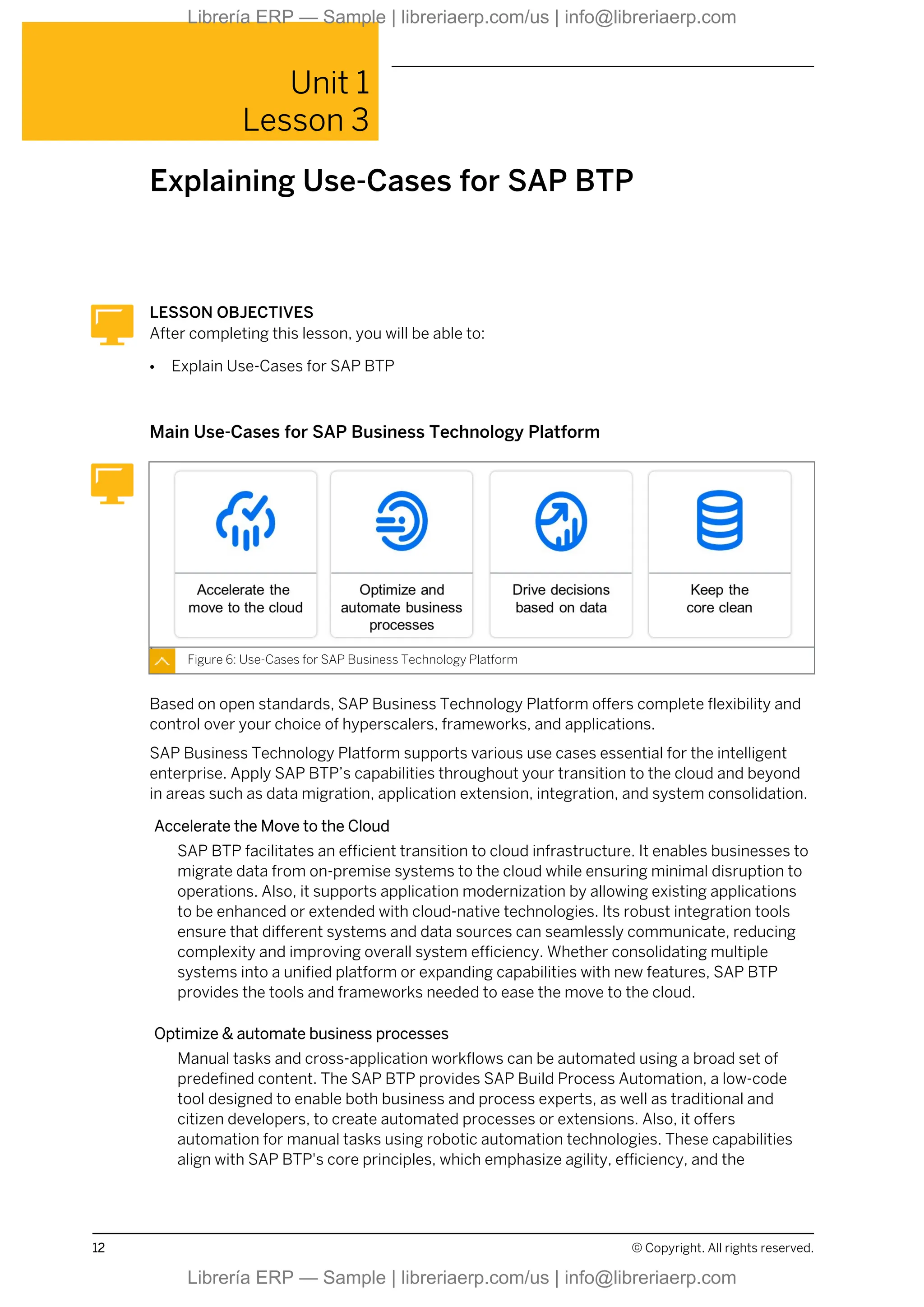
Main Use-Cases for SAP Business Technology Platform
Figure 6: Use-Cases for SAP Business Technology Platform
Based on open standards, SAP Business Technology Platform offers complete flexibility and
control over your choice of hyperscalers, frameworks, and applications.
SAP Business Technology Platform supports various use cases essential for the intelligent
enterprise. Apply SAP BTP’s capabilities throughout your transition to the cloud and beyond
in areas such as data migration, application extension, integration, and system consolidation.
Accelerate the Move to the Cloud
SAP BTP facilitates an efficient transition to cloud infrastructure. It enables businesses to
migrate data from on-premise systems to the cloud while ensuring minimal disruption to
operations. Also, it supports application modernization by allowing existing applications
to be enhanced or extended with cloud-native technologies. Its robust integration tools
ensure that different systems and data sources can seamlessly communicate, reducing
complexity and improving overall system efficiency. Whether consolidating multiple
systems into a unified platform or expanding capabilities with new features, SAP BTP
provides the tools and frameworks needed to ease the move to the cloud.
Optimize & automate business processes
Manual tasks and cross-application workflows can be automated using a broad set of
predefined content. The SAP BTP provides SAP Build Process Automation, a low-code
tool designed to enable both business and process experts, as well as traditional and
citizen developers, to create automated processes or extensions. Also, it offers
automation for manual tasks using robotic automation technologies. These capabilities
align with SAP BTP's core principles, which emphasize agility, efficiency, and the
12 © Copyright. All rights reserved.
Librería ERP — Sample | libreriaerp.com/us | info@libreriaerp.com

Introduction to SAP BTP Administration and Management

  • 1.
    ADMCLD Introduction to SAPBusiness Technology Platform (BTP) Administration . . PARTICIPANT HANDBOOK INSTRUCTOR-LED TRAINING . Course Version: 25 Course Duration: 3 Days Librería ERP — Sample | libreriaerp.com/us | info@libreriaerp.com Librería ERP — Sample | libreriaerp.com/us | info@libreriaerp.com
  • 2.
    Librería ERP —Sample | libreriaerp.com/us | info@libreriaerp.com Librería ERP — Sample | libreriaerp.com/us | info@libreriaerp.com
  • 3.
    SAP Copyrights, Trademarksand Disclaimers © 2025 SAP SE or an SAP affiliate company. All rights reserved. No part of this publication may be reproduced or transmitted in any form or for any purpose without the express permission of SAP SE or an SAP affiliate company. SAP and other SAP products and services mentioned herein as well as their respective logos are trademarks or registered trademarks of SAP SE (or an SAP affiliate company) in Germany and other countries. Please see https://www.sap.com/corporate/en/legal/copyright.html for additional trademark information and notices. Some software products marketed by SAP SE and its distributors contain proprietary software components of other software vendors. National product specifications may vary. These materials may have been machine translated and may contain grammatical errors or inaccuracies. These materials are provided by SAP SE or an SAP affiliate company for informational purposes only, without representation or warranty of any kind, and SAP SE or its affiliated companies shall not be liable for errors or omissions with respect to the materials. The only warranties for SAP SE or SAP affiliate company products and services are those that are set forth in the express warranty statements accompanying such products and services, if any. Nothing herein should be construed as constituting an additional warranty. In particular, SAP SE or its affiliated companies have no obligation to pursue any course of business outlined in this document or any related presentation, or to develop or release any functionality mentioned therein. This document, or any related presentation, and SAP SE’s or its affiliated companies’ strategy and possible future developments, products, and/or platform directions and functionality are all subject to change and may be changed by SAP SE or its affiliated companies at any time for any reason without notice. The information in this document is not a commitment, promise, or legal obligation to deliver any material, code, or functionality. All forward-looking statements are subject to various risks and uncertainties that could cause actual results to differ materially from expectations. Readers are cautioned not to place undue reliance on these forward-looking statements, which speak only as of their dates, and they should not be relied upon in making purchasing decisions. © Copyright. All rights reserved. iii Librería ERP — Sample | libreriaerp.com/us | info@libreriaerp.com Librería ERP — Sample | libreriaerp.com/us | info@libreriaerp.com
  • 4.
    Typographic Conventions American Englishis the standard used in this handbook. The following typographic conventions are also used. This information is displayed in the instructor’s presentation Demonstration Procedure Warning or Caution Hint Related or Additional Information Facilitated Discussion User interface control Example text Window title Example text iv © Copyright. All rights reserved. Librería ERP — Sample | libreriaerp.com/us | info@libreriaerp.com Librería ERP — Sample | libreriaerp.com/us | info@libreriaerp.com
  • 5.
    Contents vii Course Overview 1Unit 1: Strategic Overview 3 Lesson: Illustrating the SAP Business Technology Platform 7 Lesson: Analyzing Responsibilities and Guidance Resources 12 Lesson: Explaining Use-Cases for SAP BTP 15 Exercise 1: Initialize the Training Environment 23 Unit 2: Architecture 25 Lesson: Explaining SAP BTP Account Model 31 Exercise 2: Create Directories and Subaccounts 36 Lesson: Managing Service Subscriptions 41 Exercise 3: Enable Service Subscriptions 47 Lesson: Describing Runtime Environments 50 Lesson: Managing Cloud Foundry Environments 53 Exercise 4: Enable a Cloud Foundry Environment 57 Exercise 5: Enable Cloud Foundry Environments in a Development Landscape 65 Exercise 6: Create a Service Instance in Cloud Foundry 69 Lesson: Managing Kyma Runtimes 75 Exercise 7: Enable a Kyma Runtime 83 Exercise 8: Create a Service Instance in Kyma 87 Lesson: Managing ABAP Environments 93 Exercise 9: Create an ABAP Environment in Cloud Foundry 103 Exercise 10: Manage System Hibernation 109 Lesson: Describing Software Development for the Cloud 117 Exercise 11: Initialize SAP Business Application Studio 127 Exercise 12: Initialize ABAP Development Tools 137 Unit 3: Configuration 138 Lesson: Highlighting SAP Discovery Center 141 Exercise 13: Operate SAP Discovery Center 146 Lesson: Using Boosters 151 Exercise 14: Start a Booster in SAP BTP 156 Lesson: Operating Command Line Interface Tools 163 Exercise 15: Operate SAP BTP Command Line Interface (btp CLI) © Copyright. All rights reserved. v Librería ERP — Sample | libreriaerp.com/us | info@libreriaerp.com Librería ERP — Sample | libreriaerp.com/us | info@libreriaerp.com
  • 6.
    179 Unit 4:Identity and Access Management 181 Lesson: Explaining Identity and Access Management on SAP BTP 190 Lesson: Managing Users and Authorizations on SAP BTP 195 Exercise 16: Create Administrator User in a Subaccount 205 Exercise 17: Inspect and Assign Predefined Role Collections for Applications 213 Lesson: Working with SAP Cloud Identity Services - Identity Authentication 227 Unit 5: Connectivity 228 Lesson: Using Destinations 233 Exercise 18: Create a Destination 237 Lesson: Operating Cloud Connector 243 Exercise 19: Provide and Start the Portable Version of the Cloud Connector 255 Exercise 20: Configure the Cloud Connector 281 Exercise 21: Deploy an SAP Fiori Freestyle Application 295 Unit 6: SAP HANA Cloud 296 Lesson: Exploring SAP HANA Cloud 319 Exercise 22: Explore SAP HANA Cloud 325 Lesson: Identifying Database Offerings 331 Unit 7: Application Lifecycle Management 333 Lesson: Identify SAP Application Lifecycle Management Offerings 343 Unit 8: Monitoring 344 Lesson: Using Local Monitoring Services 349 Exercise 23: Operate SAP Application Logging Service for SAP BTP 363 Lesson: Explaining SAP Application Lifecycle Management Monitoring Tools 373 Unit 9: Transport Management 375 Lesson: Exploring SAP Cloud Transport Management Service 379 Lesson: Configuring SAP Cloud Transport Management Service 389 Exercise 24: Configure SAP Cloud Transport Management 395 Exercise 25: Create the Destinations to Your Target Subaccounts 401 Exercise 26: Create the Transport Routes in Cloud Transport Management 407 Lesson: Transporting Changes 411 Exercise 27: Transport Changes with SAP Cloud Transport Management vi © Copyright. All rights reserved. Librería ERP — Sample | libreriaerp.com/us | info@libreriaerp.com Librería ERP — Sample | libreriaerp.com/us | info@libreriaerp.com
  • 7.
    Course Overview TARGET AUDIENCE Thiscourse is intended for the following audiences: ● Systems Architect ● Project Manager ● Change Manager ● Development Consultant ● Technology Consultant ● Support Consultant ● Super / Key / Power User ● Business Process Architect ● Business Process Owner/Team Lead/Power User ● Database Administrator ● Developer ● Enterprise Architect ● Solution Architect ● System Administrator ● System Architect © Copyright. All rights reserved. vii Librería ERP — Sample | libreriaerp.com/us | info@libreriaerp.com Librería ERP — Sample | libreriaerp.com/us | info@libreriaerp.com
  • 8.
    viii © Copyright.All rights reserved. Librería ERP — Sample | libreriaerp.com/us | info@libreriaerp.com Librería ERP — Sample | libreriaerp.com/us | info@libreriaerp.com
  • 9.
    UNIT 1 StrategicOverview Lesson 1 Illustrating the SAP Business Technology Platform 3 Lesson 2 Analyzing Responsibilities and Guidance Resources 7 Lesson 3 Explaining Use-Cases for SAP BTP 12 Exercise 1: Initialize the Training Environment 15 UNIT OBJECTIVES ● Illustrate the SAP Business Technology Platform. ● Explain the responsibilities of administrators ● Introduce the SAP BTP Guidance Framework ● Explain Use-Cases for SAP BTP © Copyright. All rights reserved. 1 Librería ERP — Sample | libreriaerp.com/us | info@libreriaerp.com Librería ERP — Sample | libreriaerp.com/us | info@libreriaerp.com
  • 10.
    Unit 1: StrategicOverview 2 © Copyright. All rights reserved. Librería ERP — Sample | libreriaerp.com/us | info@libreriaerp.com Librería ERP — Sample | libreriaerp.com/us | info@libreriaerp.com
  • 11.
    Unit 1 Lesson 1 Illustratingthe SAP Business Technology Platform LESSON OBJECTIVES After completing this lesson, you will be able to: ● Illustrate the SAP Business Technology Platform. What is the SAP Business Technology Platform? In this course, we explore the SAP Business Technology Platform and its capabilities. Figure 1: SAP Business Technology Platform The SAP Business Technology Platform is a versatile platform that enables businesses to innovate, integrate, and transform their operations in the digital age. With its array of tools and services, SAP BTP empowers organizations to surpass competitors, drive business value, and provide great customer experiences, all through one single platform. SAP BTP provides a set of foundational services that include application development, automation, integration, data and analytics, and artificial intelligence. These services are designed to work seamlessly together, enabling businesses to build innovative applications, connect disparate systems, and derive actionable insights from their data. What makes SAP BTP so powerful, is that it offers the tools to create personalized solutions. You can build your own applications, or you could extend and integrate existing applications and services, tailored to your individual business needs. Thanks to low-code /no-code © Copyright. All rights reserved. 3 Librería ERP — Sample | libreriaerp.com/us | info@libreriaerp.com Librería ERP — Sample | libreriaerp.com/us | info@libreriaerp.com
  • 12.
    solutions also offeredthrough SAP BTP, business users are enabled to automate tasks, establish workflows, and craft their own customized interfaces. Another notable feature of SAP BTP is its capacity to support both cloud-native and hybrid solutions of the cloud while also integrating with on-premise systems and data sources. This flexibility enables organizations to adapt to changing business needs and infrastructure requirements without compromising security or performance. Application Development, Automation, Integration, Data and Analytics, and AI are foundational pillars of SAP BTP, providing organizations with the tools and capabilities they need to digitize their business processes, innovate rapidly, and deliver exceptional customer experiences in the digital age. Figure 2: Foundational Pillars of SAP Business Technology Platform Application Development This aspect of SAP BTP focuses on empowering developers to create, deploy, and manage applications efficiently. It offers various development tools and services to support different programming languages and development approaches. One of these tools is SAP Build Code, designed for building and extending business applications on the SAP Business Technology Platform. SAP Build Code provides developers with a collaborative, cloud-based environment featuring pre-configured tools and services for application development, enabling faster and more efficient development cycles. Additionally, it integrates AI functionalities to support developers. SAP BTP also supports low-code development, allowing business users to create applications without extensive coding knowledge. For instance, in a bike shop scenario, this could involve building an application tailored to specific business needs and providing employees with a link for easy access. . For more information, see: https://www.sap.com/products/business-technology- platform/low-code.html Automation Automation within SAP BTP enables organizations to streamline repetitive tasks, improve efficiency, and reduce manual intervention in business processes. This could include SAP Build Process Automation for automating routine tasks such as data entry or Unit 1: Strategic Overview 4 © Copyright. All rights reserved. Librería ERP — Sample | libreriaerp.com/us | info@libreriaerp.com Librería ERP — Sample | libreriaerp.com/us | info@libreriaerp.com
  • 13.
    invoice processing. SAPBTP also offers workflow automation capabilities, allowing organizations to design, execute, and monitor complex business workflows with ease. By automating mundane tasks and workflows, organizations can free up resources, minimize errors, and focus on higher-value activities that drive business growth. If our bike shop wants to order new parts before they run out, it could automate this process. For example, as soon as the system detects that certain parts are low in stock, an order to the manufacturer could be triggered. For more information, see: https:// www.sap.com/products/technology-platform/process-automation.html Integration Integration is a critical aspect of SAP BTP that enables seamless communication and data exchange between different systems, applications, and data sources. SAP BTP offers the SAP Integration Suite to facilitate connectivity across on-premise and cloud environments, as well as with external partners and customers. There are also resources for API management and pre-built business content for out-of-the-box solutions. With integration on SAP BTP, organizations can break down data silos, streamline business processes, and unlock the full potential of their digital ecosystem. If our bike shop needs to connect to the system of the manufacturer, it can either check for existing APIs in the SAP Business Accelerator Hub or create APIs with SAP Integration Suite. For more information, see: https://www.sap.com/products/integration.html Data and Analytics Data and analytics capabilities on SAP BTP empower organizations to derive insights from their data, make informed decisions, and drive business outcomes. This includes services for data warehousing, data modeling, and advanced analytics. SAP BTP also offers data visualization capabilities and machine learning services to enable organizations to uncover hidden patterns, trends, and opportunities in their data. By harnessing the power of data and analytics on SAP BTP, organizations can gain a competitive edge, optimize operations, and innovate with confidence. With suppliers, customers, and sales, our bike shop accumulates a lot of valuable data. This data could be stored, managed, and visualized with SAP BTP data management products such as SAP Analytics Cloud, SAP Datasphere, SAP HANA Cloud, and more. For more information, see: https://www.sap.com/products/analytics.html Artificial Intelligence (AI) SAP BTP offers a comprehensive set of AI technologies and services, for example SAP AI Business Services and Generative AI Hub. They enable organizations to harness the power of artificial intelligence to foster innovation, enhance efficiency, and provide added value to customers. By leveraging these AI capabilities, organizations can stay ahead of the competition and thrive in today's digital economy. Customers of our fictional bike shop can get personalized, AI-based recommendations to find the product that fits best and benefit from an enriched customer experience. For more information, see: https:// www.sap.com/products/artificial-intelligence.html LESSON SUMMARY You should now be able to: ● Illustrate the SAP Business Technology Platform. Lesson: Illustrating the SAP Business Technology Platform © Copyright. All rights reserved. 5 Librería ERP — Sample | libreriaerp.com/us | info@libreriaerp.com Librería ERP — Sample | libreriaerp.com/us | info@libreriaerp.com
  • 14.
    Unit 1: StrategicOverview 6 © Copyright. All rights reserved. Librería ERP — Sample | libreriaerp.com/us | info@libreriaerp.com Librería ERP — Sample | libreriaerp.com/us | info@libreriaerp.com
  • 15.
    Unit 1 Lesson 2 AnalyzingResponsibilities and Guidance Resources LESSON OBJECTIVES After completing this lesson, you will be able to: ● Explain the responsibilities of administrators ● Introduce the SAP BTP Guidance Framework Shared Responsibility Model Figure 3: Responsibility Model of SAP Business Technology Platform (BTP) The Shared Responsibility Model between your company and SAP defines how responsibilities are divided. SAP manages the platform, whereas your company develops and manages applications and the corresponding data. SAP is responsible for the infrastructure, including the physical security of data centers, network controls, and operational security including monitoring. Based on this, SAP is responsible for: ● SAP HANA Service Management ● Runtimes and Services Management ● Resource and Account Provisioning ● Operating System (OS) Maintenance © Copyright. All rights reserved. 7 Librería ERP — Sample | libreriaerp.com/us | info@libreriaerp.com Librería ERP — Sample | libreriaerp.com/us | info@libreriaerp.com
  • 16.
    ● Infrastructure Maintenance ●Hardware Components including Setup ● Provision of Data Center Facility Customers are responsible for their data, access management, and applications and their security. This model ensures that both parties contribute to maintaining a secure environment, with SAP handling the underlying platform, in this case SAP BTP, and users managing their specific configurations. Product Documentation: Shared Responsibility Model Between You and SAP SAP BTP Guidance Framework Figure 4: Overview – SAP BTP Guidance Framework SAP BTP Guidance Framework is your compass for architecting, implementing, and operating solutions on SAP BTP. It provides a central access point for decision guides, reference architectures, methodologies, and many best practices. The framework consists of the following elements: ● Decision guides helping you to identify the technology option that best fits your needs ● Reference architectures that allow you to explore how to architect solutions on SAP BTP with the help of curated solution templates ● Methodologies that offer a guided approach toward increasing your cloud technology maturity level, covering both technical and organizational aspects ● Recommendations for different technology domains, helping you to evaluate and choose the right implementation option ● DevOps principles that enable your development and operations teams to be more efficient Get started with exploring best practices, grow your skills with learning and enablement offerings for SAP BTP, and engage with us in the SAP Community. Make sure to bookmark the SAP BTP Guidance Framework and keep an eye on it, as it gets updated and enhanced from time to time. You can access the SAP BTP Guidance Framework here: Unit 1: Strategic Overview 8 © Copyright. All rights reserved. Librería ERP — Sample | libreriaerp.com/us | info@libreriaerp.com Librería ERP — Sample | libreriaerp.com/us | info@libreriaerp.com
  • 17.
    SAP BTP GuidanceFramework Guides and Recommendations Figure 5: Overview of Guides Note: We highly recommend you to have a look at the whole SAP BTP Guidance Framework. But for the scope of this learning journey, we summarize the most important guides and documents for administrators. Best Practices for SAP BTP ● Best Practices for planning, setting up, building, and managing SAP BTP. ● Starting point for setting up application lifecycle management for your specific use case, business, and IT landscape. ● For Architects: Plan your organizational setup and your account and security model. ● For administrators and developers: Define the correct methodologies and tools for your projects. ● For SAP Partners: Set up SAP BTP for your customers. You can access the Best Practices for SAP BTP here: Best Practices for SAP BTP Extension Architecture Guide ● Helps determine the appropriate SAP technology for different extension scenarios ● Offers tailored recommendations for enterprise architects and solution architects ● Insights about the best technical extension building blocks for presentation tier and back ends Lesson: Analyzing Responsibilities and Guidance Resources © Copyright. All rights reserved. 9 Librería ERP — Sample | libreriaerp.com/us | info@libreriaerp.com Librería ERP — Sample | libreriaerp.com/us | info@libreriaerp.com
  • 18.
    ● Helps todetermine which extensions run on SAP S/4HANA as an on-stack extension and which on SAP BTP ● Based on the SAP Application Extension Methodology (SAP Application Extension Methodology) You can access the Extension Architecture Guide here: Extension Architecture Guide Integration Architecture Guide ● Detailed guide to integration technologies from SAP ● Guidance along Process Integration, Data integration, and Analytics integration ● Guidance on how to evolve their existing integration architectures with the SAP technology offerings available today ● Based on the SAP Integration Solution Advisory Methodology (SAP Integration Solution Advisory Methodology) You can access the Integration Architecture Guide here: Integration Architecture Guide SAP BTP Developer’s Guide The goal of the SAP BTP Developer’s Guide is to help you implement business applications on SAP BTP. The guide includes: ● Blueprints with core SAP BTP services ● An automated SAP BTP Infrastructure setup ● Standard technologies for smooth integrations ● Guidance for delivering cloud and suite qualities You can access the SAP BTP Developer’s Guide here:SAP BTP Developer's Guide DevOps with SAP BTP This page is a collection of resources around the topic of DevOps with SAP BTP. There are references and cross-links for the topics of planning and setting up, development and testing, delivery and change management, and last but not least, for monitoring and operations. You can access the DevOps with SAP BTP page here:DevOps with SAP BTP Note: Next to this, there's a whole standalone learning journey on the topic of DevOps with SAP BTP. You can explore it here: Discovering DevOps with SAP BTP SAP BTP Security Recommendations Security is a crucial topic in IT infrastructures, especially in cloud environments. SAP BTP fulfills a lot of security standards and certifications. You can get an overview about all certifications and attestations for SAP solutions in the SAP Trust Center: SAP Trust Center Unit 1: Strategic Overview 10 © Copyright. All rights reserved. Librería ERP — Sample | libreriaerp.com/us | info@libreriaerp.com Librería ERP — Sample | libreriaerp.com/us | info@libreriaerp.com
  • 19.
    Besides the securityand compliance topics that are SAP managed, there are a couple of topics and services to consider where administrators are in charge of operating the services and extensions in a secure and compliant manner. For these Scenarios, SAP offers a collection of recommendations. You can access them here:SAP BTP Security Recommendations LESSON SUMMARY You should now be able to: ● Explain the responsibilities of administrators ● Introduce the SAP BTP Guidance Framework Lesson: Analyzing Responsibilities and Guidance Resources © Copyright. All rights reserved. 11 Librería ERP — Sample | libreriaerp.com/us | info@libreriaerp.com Librería ERP — Sample | libreriaerp.com/us | info@libreriaerp.com
  • 20.
    Unit 1 Lesson 3 ExplainingUse-Cases for SAP BTP LESSON OBJECTIVES After completing this lesson, you will be able to: ● Explain Use-Cases for SAP BTP Main Use-Cases for SAP Business Technology Platform Figure 6: Use-Cases for SAP Business Technology Platform Based on open standards, SAP Business Technology Platform offers complete flexibility and control over your choice of hyperscalers, frameworks, and applications. SAP Business Technology Platform supports various use cases essential for the intelligent enterprise. Apply SAP BTP’s capabilities throughout your transition to the cloud and beyond in areas such as data migration, application extension, integration, and system consolidation. Accelerate the Move to the Cloud SAP BTP facilitates an efficient transition to cloud infrastructure. It enables businesses to migrate data from on-premise systems to the cloud while ensuring minimal disruption to operations. Also, it supports application modernization by allowing existing applications to be enhanced or extended with cloud-native technologies. Its robust integration tools ensure that different systems and data sources can seamlessly communicate, reducing complexity and improving overall system efficiency. Whether consolidating multiple systems into a unified platform or expanding capabilities with new features, SAP BTP provides the tools and frameworks needed to ease the move to the cloud. Optimize & automate business processes Manual tasks and cross-application workflows can be automated using a broad set of predefined content. The SAP BTP provides SAP Build Process Automation, a low-code tool designed to enable both business and process experts, as well as traditional and citizen developers, to create automated processes or extensions. Also, it offers automation for manual tasks using robotic automation technologies. These capabilities align with SAP BTP's core principles, which emphasize agility, efficiency, and the 12 © Copyright. All rights reserved. Librería ERP — Sample | libreriaerp.com/us | info@libreriaerp.com Librería ERP — Sample | libreriaerp.com/us | info@libreriaerp.com