1
INTRODUCTION TO QUALITATIVE RESEARCH
1st
October 2019
Qualitative Medical Research: 0500591
Qualitative Medical Research: 0500591 2
LEARNING OBJECTIVES
 This introductory lecture will help you to:
1. Recognise the meaning of research design, research methodology and research methods.
2. Recognise the key characteristics of qualitative research.
3. Distinguish between qualitative and quantitative methods in research.
4. Describe qualitative research approaches (designs).
5. Describe methods of data collection and analysis in qualitative study.
6. Discuss the linkages between selection of method and types of research questions.
Qualitative Medical Research: 0500591 3
LECTURE OUTLINE
 Definition of research and research design.
 Definition of qualitative research.
 Qualitative versus quantitative research.
 Data collection in qualitative research.
 Sampling in qualitative research.
 Rigour and trustworthiness of qualitative research.
 Feasibility of the research project.
Qualitative Medical Research: 0500591 4
DEFINITION OF RESEARCH
 Research is defined as a planned course of action that aims to
understand a phenomenon or find answers to research questions
(Johnston, 2010).
 Quantitative and Qualitative.
Qualitative Medical Research: 0500591 5
RESEARCH DESIGN
 The blueprint for performing the research.
 The scheme or action plan for achieving the objectives of the research (Research questions
should be finalised before deciding the research design).
 The logical sequence that connects the empirical data to a study's initial research questions
and, ultimately, to its conclusions.
 It includes how the study will be conducted, type of data that will be gathered, the means
(tools and techniques) to be used to obtain these data, sample size, and research setting.
Qualitative Medical Research: 0500591 6
RESEARCH METHODOLOGY AND METHODS
 Research Methodology: The pathway or approach of action that justifies the
selection and employment of certain methods (Adams, Khan, Raeside, & White,
2007).
 Research Methods: The means of execution of the research (Adams, Khan,
Raeside, & White, 2007).
Qualitative Medical Research: 0500591 7
WHAT IS QUALITATIVE RESEARCH?
 All research (quantitative and qualitative):
 Seeks answers to questions.
 Utilised a predetermined group of procedures (methods) to get these answers.
 Collects data.
 Generates results that were not determined in advance.
 Generate results that are often applicable beyond the immediate boundaries of the
study.
Qualitative Medical Research: 0500591 8
WHAT IS QUALITATIVE RESEARCH? CONT’D
 Qualitative research is linked to the “Quality” concept.
 Quality refers to the What, How, When, Where, and Why of a thing.
 Qualitative research refers to the meanings, concepts, definitions, characteristics,
metaphors, symbols, and descriptions of things.
(Lune & Berg, 2016)
Qualitative Medical Research: 0500591 9
WHAT IS QUALITATIVE RESEARCH? CONT’D
 Qualitative research provides a holistic view for the social phenomenon.
 Qualitative research answers “how” questions rather than “how many” :
“It looks at X in terms of how X varies in different circumstances rather than how big X is or how many Xs there are”
(Anderson, 2010).
 Qualitative research seeks to understand a given research problem from the perspective of the local population it involves.
 It is effective in obtaining culturally specific information about values, opinions, behaviours, and social contexts of specific
populations.
 Describes how people experience a given research issue.
Qualitative Medical Research: 0500591 10
WHAT IS QUALITATIVE RESEARCH? CONT’D
 Qualitative research focuses on the social world, not the world of nature
 Qualitative research offers unique opportunities for understanding complex situations
(Austin & Sutton, 2014).
 Qualitative research is concerned with the concepts and idiosyncratic characteristics of
a select group; therefore, the findings or theory may only applicable to a similar group
(Auerbach & Silverstein, 2003).
 Qualitative research seeks to understand the phenomenon under study in the context
of the culture or the setting in which it has been studied (naturalistic) (Al-Busaidi,
2008).
 Adjectives like: Rich, Deep, Thick used when talking about qualitative research.
Qualitative Medical Research: 0500591 11
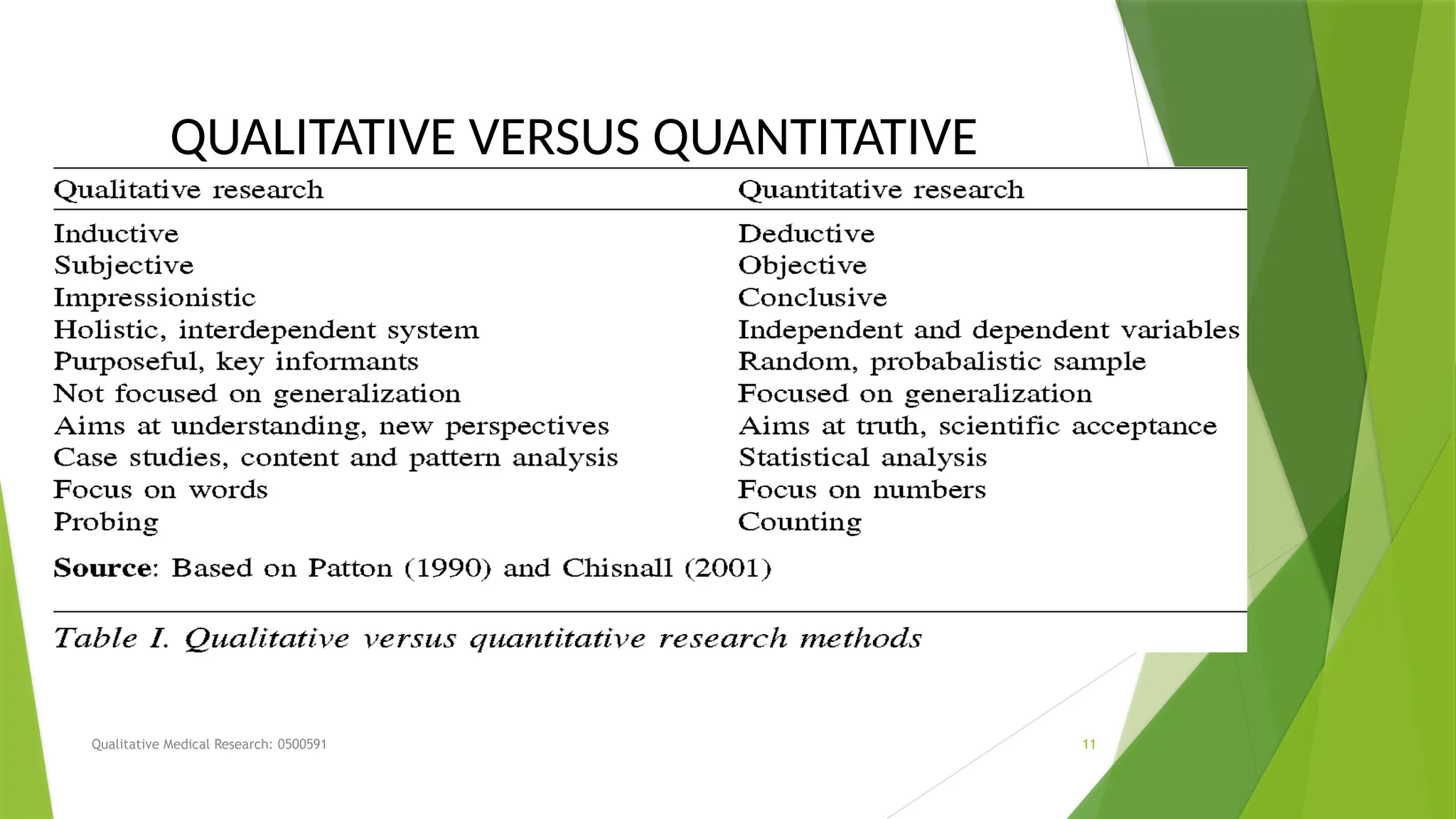
QUALITATIVE VERSUS QUANTITATIVE
Qualitative Medical Research: 0500591 12
QUALITATIVE VERSUS QUANTITATIVE (CONT’D)
 Qualitative and quantitative methods give different, complementary pictures of
the things we observe (Lune & Berg, 2016; Al-Busaidi, 2008)).
 Qualitative is linked to Quality WHERAS Quantitative is linked to Quantity.
 Qualitative studies involve the systematic collection, organization, description
and interpretation of textual, verbal or visual data (Hammarberg, Kirkman, & de
Lacey, 2016).
 Quantitative studies generally involve the systematic collection of data about a
phenomenon, using standardized measures and statistical analysis
(Hammarberg, Kirkman, & de Lacey, 2016).
Qualitative Medical Research: 0500591 13
QUALITATIVE VERSUS QUANTITATIVE (CONT’D)
 Quantitative research leans toward “what” questions, while
qualitative tends toward “why” and “how” (Lune & Berg, 2016).
 Ethical considerations are often more complex in qualitative
research (Rapport et al., 2018).
Qualitative Medical Research: 0500591 14
WHY TO USE QUALITATIVE RESEARCH
 The limitations ( and criticism) of quantitative approaches
have always been taken as a starting point to give reasons
why qualitative research should be used (Flick, 2018).
 Qualitative research emphasises that human beings should
be studied as agents capable of self reflection and giving
meanings to their actions.
Qualitative Medical Research: 0500591 15
ESSENTIAL FEATURES OF QUALITATIVE
RESEARCH
1. Perspectives of the participants and their diversity (Flick, 2018)
2. Reflexivity of the researcher (Flick, 2018).
3. Variety of approaches and methods in qualitative research (Flick, 2018).
4. Subjectivity (Leung, 2015) .
5. Focus on the whole (holistic picture) (Leung, 2015).
Qualitative Medical Research: 0500591 16
PURPOSES OF QUALITATIVE RESEARCH
Describe
Understand
Explain
Identify
Develop
Generate
Qualitative Medical Research: 0500591 17
MAJOR TYPES OF QUALITATIVE RESEARCH
 Ethnographies, in which the researcher studies an intact cultural group in a
natural setting over a prolonged period of time by collecting, primarily
observational data. The research process is flexible and typically evolves
contextually in response to the lived realities encountered in the field setting.
 Case studies, in which the researcher explores in depth a program, an event,
a process, or one or more individuals.
 Narrative research, a form of inquiry in which the researcher studies the lives
of the individuals and asks one or more individuals to provide stories about
their lives.
(Creswell & Poth, 2007)
Qualitative Medical Research: 0500591 18
MAJOR TYPES OF QUALITATIVE RESEARCH (CONT’D)
 Phenomenological research, in which the researcher identifies the essence
of human experiences concerning a phenomenon, as described by
participants in a study. Understanding the lived experiences marks
phenomenology as a philosophy as well as a method, and the procedure
involves studying a small number of subjects through extensive and
prolonged engagement to develop patterns and relationship of meanings.
 Grounded theory, in which the researcher attempts to derive a general,
abstract theory of a process, action or interaction grounded in the views of
participants in a study. This process involves using multiple stages of data
collection and the refinement and interrelationship of categories of
information.
(Creswell & Poth, 2007)
Qualitative Medical Research: 0500591 19
DATA COLLECTION IN
QUALITATIVE RESEARCH
 Observations
 Interviews
 Documents review/analysis
Qualitative Medical Research: 0500591 20
QUALITATIVE DATA COLLECTION METHODS (CONT’D)
 Observations, in which the researcher takes field notes on the activities and
behaviour of the individuals at the research site. In these field notes, the researcher
records in an unstructured or semi-structured way, activities at the research site.
 Interviews, the research conducts face to face interviews with participants,
interviews participants by telephone or engages in focus group interviews with six
to eight interviewees in each group. These interviews involve unstructured and
generally open ended questions that are few in number and intended to elicit views
and opinions from participants.
 Document review/analysis, the researcher may collect documents, these may be
public documents (newspapers, reports, letters, mails)
(Creswell & Poth, 2007)
Qualitative Medical Research: 0500591 21
QUALITATIVE DATA ANALYSIS AND INTERPRETATION
 Data analysis in qualitative research is an ongoing process involving
continual reflection about the data, asking analytic questions, and
writing memos during the study.
 It is not sharply divided from other activities such as collecting data.
(Creswell & Poth,
2007)
Qualitative Medical Research: 0500591 22
QUALITATIVE DATA ANALYSIS
 The first step in qualitative analysis is to develop
thorough and comprehensive descriptions of the
phenomenon under study (thick descriptions)
(Dey, 2003)
Qualitative Medical Research: 0500591 23
Qualitative research process
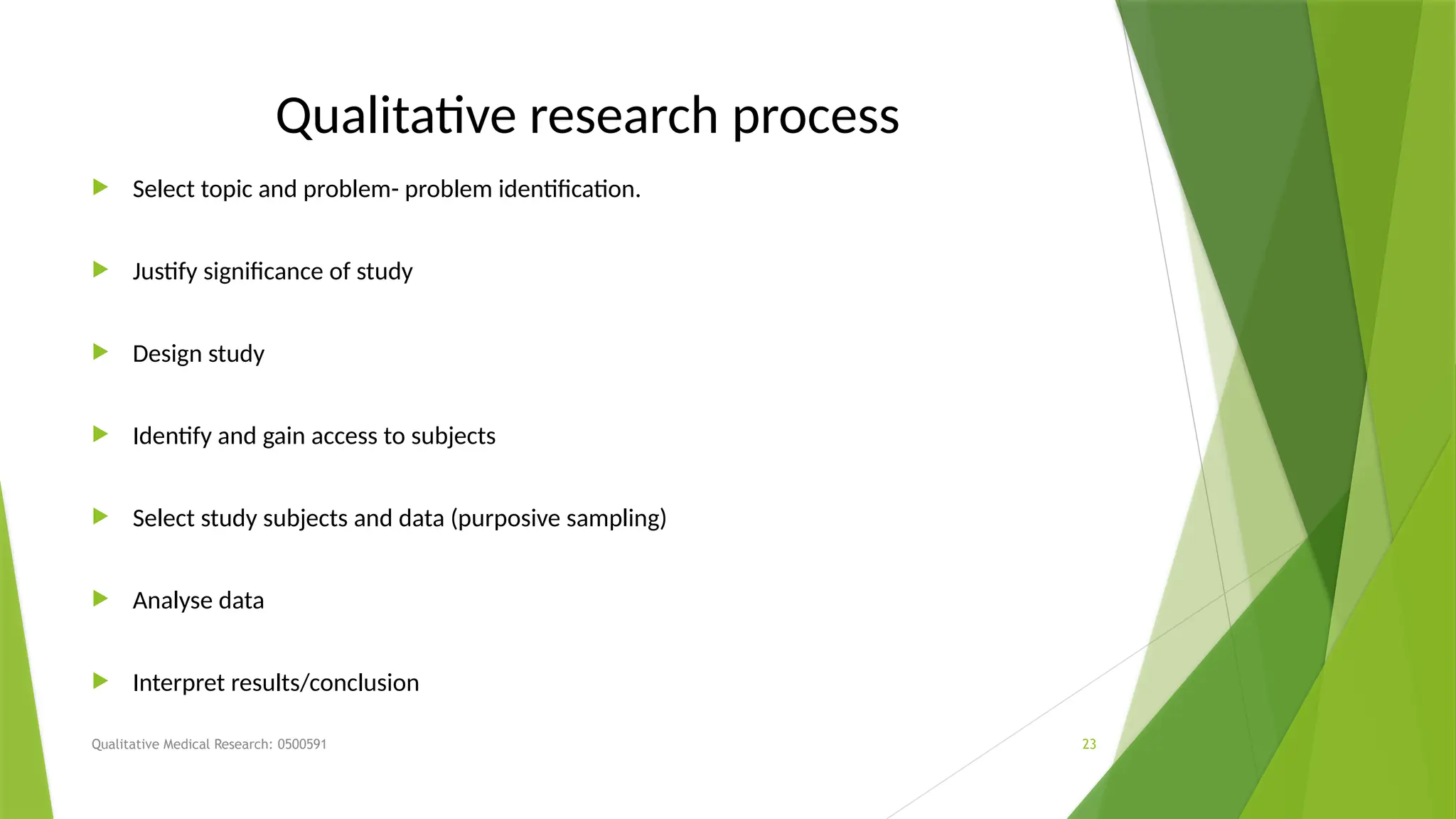
 Select topic and problem- problem identification.
 Justify significance of study
 Design study
 Identify and gain access to subjects
 Select study subjects and data (purposive sampling)
 Analyse data
 Interpret results/conclusion
Qualitative Medical Research: 0500591 24
APPROACHES TO QUALITATIVE RESEARCH
 There is no ‘right’ way of doing qualitative research, but some approaches are more
appropriate to certain research goals than others.
 Once researchers have identified an approach that aligns with their research goals it is
beholden on them to explore the methodology in some depth in order to consider the
assumptions and values they bring to their research and conduct analyses that go beyond
common sense.
 Qualitative research design is emergent.
 The initial plan for research cannot be tightly prescribed, and that all phases of the process
may change or shift after the researchers enter the field and begin to collect data.
Qualitative Medical Research: 0500591 25
WHAT RESEARCH QUESTION CAN
QUALITATIVE RESEARCH BEST ANSWER?
 Consider the following:
• ‘Lived experience’.
• ‘Insider’ perspective of reality (emic).
o Emic approach refers to interpretation of the data from the perspective of the population under study
(Astalin, 2013).
• Context/ meaning oriented rather than measurement oriented. The information gathered by actually talking
directly to people and seeing them behave and act within their context.
Qualitative Medical Research: 0500591 26
QUALITATIVE SAMPLING
 Selection of a sample is a key element of a study design.
 Usually non-probability (purposive or convenience) sampling.
 Convenience sampling allows the researcher to select participants who are readily accessible or available.
 Purposive sampling avails of accessible participants, but it provides the additional advantage of facilitating
the selection of participants whose qualities or experiences are required for the study.
(Bradshaw, Atkinson, & Doody, 2017)
Qualitative Medical Research: 0500591 27
RIGOUR OF QUALITATIVE RESEARCH
 Rigour refers to the quality of the research.
 Strategies that help in achieving rigour in qualitative research.
1. Clear descriptions of the sample necessary for the study to be meaningful.
2. An indication of how and why the sample was chosen.
3. Engagement with others, such as multiple researchers, in order to code or discuss data widely.
4. The use of quotations in the representation of data findings.
5. An assessment of a researcher or group of researchers’ assumptions about the data (also known as
‘member-checking’, participant validation).
6. Peer review of findings.
7. Clearly defined study design.
8. Triangulation (examining the phenomenon from different angles; measures, methods, researchers).
(Rapport et al., 2018)
Qualitative Medical Research: 0500591 28
TRUSTWORTHINESS
 Trustworthiness refers to the assessment of the quality and worth of the complete study.
 Help to determine how study findings reflect the aims of the study, according to the data provided by
respondents.
 Trustworthiness has four components:
1. Credibility, which refers to whether the representation of multiple participant perspectives is reflected
appropriately and considered trustworthy, that is to say, whether they are deemed genuine and reliable.
2. Transferability, which refers to the possibility that a qualitative study’s theoretical position can be used in
other contexts, or with other population groups and that findings can be applied to other contexts, cohorts
or population groups.
3. Dependability, which refers to whether a study’s findings could be achieved, and the working methods
repeated, were another researcher to conduct the same study.
4. Confirmability, which ensures that a study’s findings are clearly representative of the participants’ views,
rather than the researchers’ preferences.
(Rapport et al., 2018)
Qualitative Medical Research: 0500591 29
FEASIBILTY
 The feasibility of research projects must be considered early on in the design phase of a
study, in order to determine whether the research is likely to be successfully completed.
 Researchers need to consider staffing requirements for data collection, and analysis, and
the presentation of results, as well as budget constraints, and required time frames.
 For example, asking a group of participants to complete a one hundred-page questionnaire
survey or attend a two-day focus group meeting is unlikely to be considered feasible by
most people.
 The scope of the project must also be feasible, with refinement of research questions to a
focused topic.
 When considering the feasibility of research, the limitations of researcher expertise must
also be taken into account.
(Rapport et al., 2018)
Qualitative Medical Research: 0500591 30
LIMITATIONS OF QUALITATIVE RESEARCH
 The main limitation of qualitative research is that their findings
cannot be extended to wider populations with the same degree of
certainty that quantitative analyses can (limited generalisability) .
(Atieno, 2009)
Qualitative Medical Research: 0500591 31
REQUIRED TEXT BOOK
 Qualitative Inquiry and Research Design: Choosing
Among Five Approaches By John W. Creswell.
Qualitative Medical Research: 0500591 32
TASK FOR THE NEXT LECTURE
 What are the key differences between subjective and
objective research?
Qualitative Medical Research: 0500591 33
REFERENCES
Adams, J., Khan, H. T., Raeside, R., & White, D. I. (2007). Research methods for graduate business and social science students: SAGE publications India.
Al-Busaidi, Z. Q. (2008). Qualitative research and its uses in health care. Sultan Qaboos University Medical Journal, 8(1), 11.
Anderson, C. (2010). Presenting and evaluating qualitative research. American journal of pharmaceutical education, 74(8), 141.
Astalin, P. K. (2013). Qualitative research designs: A conceptual framework. International Journal of Social Science and Interdisciplinary Research, 2(1), 118-124.
Atieno, O. P. (2009). An analysis of the strengths and limitation of qualitative and quantitative research paradigms. Problems of Education in the 21st Century, 13(1), 13-
38.
Auerbach, C., & Silverstein, L. B. (2003). Qualitative data: An introduction to coding and analysis: NYU press.
Austin, Z., & Sutton, J. (2014). Qualitative research: Getting started. The Canadian journal of hospital pharmacy, 67(6), 436.
Bradshaw, C., Atkinson, S., & Doody, O. (2017). Employing a qualitative description approach in health care research. Global qualitative nursing research, 4,
2333393617742282.
Creswell, J. W., & Poth, C. N. (2007). Qualitative inquiry and research design: Choosing among five approaches: Sage publications.
Dew, K. (2007). A health researcher's guide to qualitative methodologies. Australian and New Zealand journal of public health, 31(5), 433-437.
Dey, I. (2003). Qualitative data analysis: A user friendly guide for social scientists: Routledge.
Flick, U. (2018). An introduction to qualitative research: Sage Publications Limited.
Hammarberg, K., Kirkman, M., & de Lacey, S. (2016). Qualitative research methods: when to use them and how to judge them. Human reproduction, 31(3), 498-501.
Johnston, J. (2010). Qualitative research methods. Radiologic technology, 82(2), 188-189.
Leung, L. (2015). Validity, reliability, and generalizability in qualitative research. Journal of family medicine and primary care, 4(3), 324.
Lune, H., & Berg, B. L. (2016). Qualitative research methods for the social sciences: Pearson Higher Ed.
Rapport, F., Hogden, A., Faris, M., Bierbaum, M., Clay-Williams, R., Long, J., . . . Braithwaite, J. (2018). Qualitative research in healthcare: modern methods, clear
translation: a white paper.

Qualitative Medical Research: 0500591 34
THANK YOU!
QUESTIONS? COMMENTS

INTRODUCTION TO QUALITATIVE RESEARCH.pptx

  • 1.
    1 INTRODUCTION TO QUALITATIVERESEARCH 1st October 2019 Qualitative Medical Research: 0500591
  • 2.
    Qualitative Medical Research:0500591 2 LEARNING OBJECTIVES  This introductory lecture will help you to: 1. Recognise the meaning of research design, research methodology and research methods. 2. Recognise the key characteristics of qualitative research. 3. Distinguish between qualitative and quantitative methods in research. 4. Describe qualitative research approaches (designs). 5. Describe methods of data collection and analysis in qualitative study. 6. Discuss the linkages between selection of method and types of research questions.
  • 3.
    Qualitative Medical Research:0500591 3 LECTURE OUTLINE  Definition of research and research design.  Definition of qualitative research.  Qualitative versus quantitative research.  Data collection in qualitative research.  Sampling in qualitative research.  Rigour and trustworthiness of qualitative research.  Feasibility of the research project.
  • 4.
    Qualitative Medical Research:0500591 4 DEFINITION OF RESEARCH  Research is defined as a planned course of action that aims to understand a phenomenon or find answers to research questions (Johnston, 2010).  Quantitative and Qualitative.
  • 5.
    Qualitative Medical Research:0500591 5 RESEARCH DESIGN  The blueprint for performing the research.  The scheme or action plan for achieving the objectives of the research (Research questions should be finalised before deciding the research design).  The logical sequence that connects the empirical data to a study's initial research questions and, ultimately, to its conclusions.  It includes how the study will be conducted, type of data that will be gathered, the means (tools and techniques) to be used to obtain these data, sample size, and research setting.
  • 6.
    Qualitative Medical Research:0500591 6 RESEARCH METHODOLOGY AND METHODS  Research Methodology: The pathway or approach of action that justifies the selection and employment of certain methods (Adams, Khan, Raeside, & White, 2007).  Research Methods: The means of execution of the research (Adams, Khan, Raeside, & White, 2007).
  • 7.
    Qualitative Medical Research:0500591 7 WHAT IS QUALITATIVE RESEARCH?  All research (quantitative and qualitative):  Seeks answers to questions.  Utilised a predetermined group of procedures (methods) to get these answers.  Collects data.  Generates results that were not determined in advance.  Generate results that are often applicable beyond the immediate boundaries of the study.
  • 8.
    Qualitative Medical Research:0500591 8 WHAT IS QUALITATIVE RESEARCH? CONT’D  Qualitative research is linked to the “Quality” concept.  Quality refers to the What, How, When, Where, and Why of a thing.  Qualitative research refers to the meanings, concepts, definitions, characteristics, metaphors, symbols, and descriptions of things. (Lune & Berg, 2016)
  • 9.
    Qualitative Medical Research:0500591 9 WHAT IS QUALITATIVE RESEARCH? CONT’D  Qualitative research provides a holistic view for the social phenomenon.  Qualitative research answers “how” questions rather than “how many” : “It looks at X in terms of how X varies in different circumstances rather than how big X is or how many Xs there are” (Anderson, 2010).  Qualitative research seeks to understand a given research problem from the perspective of the local population it involves.  It is effective in obtaining culturally specific information about values, opinions, behaviours, and social contexts of specific populations.  Describes how people experience a given research issue.
  • 10.
    Qualitative Medical Research:0500591 10 WHAT IS QUALITATIVE RESEARCH? CONT’D  Qualitative research focuses on the social world, not the world of nature  Qualitative research offers unique opportunities for understanding complex situations (Austin & Sutton, 2014).  Qualitative research is concerned with the concepts and idiosyncratic characteristics of a select group; therefore, the findings or theory may only applicable to a similar group (Auerbach & Silverstein, 2003).  Qualitative research seeks to understand the phenomenon under study in the context of the culture or the setting in which it has been studied (naturalistic) (Al-Busaidi, 2008).  Adjectives like: Rich, Deep, Thick used when talking about qualitative research.
  • 11.
    Qualitative Medical Research:0500591 11 QUALITATIVE VERSUS QUANTITATIVE
  • 12.
    Qualitative Medical Research:0500591 12 QUALITATIVE VERSUS QUANTITATIVE (CONT’D)  Qualitative and quantitative methods give different, complementary pictures of the things we observe (Lune & Berg, 2016; Al-Busaidi, 2008)).  Qualitative is linked to Quality WHERAS Quantitative is linked to Quantity.  Qualitative studies involve the systematic collection, organization, description and interpretation of textual, verbal or visual data (Hammarberg, Kirkman, & de Lacey, 2016).  Quantitative studies generally involve the systematic collection of data about a phenomenon, using standardized measures and statistical analysis (Hammarberg, Kirkman, & de Lacey, 2016).
  • 13.
    Qualitative Medical Research:0500591 13 QUALITATIVE VERSUS QUANTITATIVE (CONT’D)  Quantitative research leans toward “what” questions, while qualitative tends toward “why” and “how” (Lune & Berg, 2016).  Ethical considerations are often more complex in qualitative research (Rapport et al., 2018).
  • 14.
    Qualitative Medical Research:0500591 14 WHY TO USE QUALITATIVE RESEARCH  The limitations ( and criticism) of quantitative approaches have always been taken as a starting point to give reasons why qualitative research should be used (Flick, 2018).  Qualitative research emphasises that human beings should be studied as agents capable of self reflection and giving meanings to their actions.
  • 15.
    Qualitative Medical Research:0500591 15 ESSENTIAL FEATURES OF QUALITATIVE RESEARCH 1. Perspectives of the participants and their diversity (Flick, 2018) 2. Reflexivity of the researcher (Flick, 2018). 3. Variety of approaches and methods in qualitative research (Flick, 2018). 4. Subjectivity (Leung, 2015) . 5. Focus on the whole (holistic picture) (Leung, 2015).
  • 16.
    Qualitative Medical Research:0500591 16 PURPOSES OF QUALITATIVE RESEARCH Describe Understand Explain Identify Develop Generate
  • 17.
    Qualitative Medical Research:0500591 17 MAJOR TYPES OF QUALITATIVE RESEARCH  Ethnographies, in which the researcher studies an intact cultural group in a natural setting over a prolonged period of time by collecting, primarily observational data. The research process is flexible and typically evolves contextually in response to the lived realities encountered in the field setting.  Case studies, in which the researcher explores in depth a program, an event, a process, or one or more individuals.  Narrative research, a form of inquiry in which the researcher studies the lives of the individuals and asks one or more individuals to provide stories about their lives. (Creswell & Poth, 2007) (Creswell & Poth, 2007)
  • 18.
    Qualitative Medical Research:0500591 18 MAJOR TYPES OF QUALITATIVE RESEARCH (CONT’D)  Phenomenological research, in which the researcher identifies the essence of human experiences concerning a phenomenon, as described by participants in a study. Understanding the lived experiences marks phenomenology as a philosophy as well as a method, and the procedure involves studying a small number of subjects through extensive and prolonged engagement to develop patterns and relationship of meanings.  Grounded theory, in which the researcher attempts to derive a general, abstract theory of a process, action or interaction grounded in the views of participants in a study. This process involves using multiple stages of data collection and the refinement and interrelationship of categories of information. (Creswell & Poth, 2007)
  • 19.
    Qualitative Medical Research:0500591 19 DATA COLLECTION IN QUALITATIVE RESEARCH  Observations  Interviews  Documents review/analysis
  • 20.
    Qualitative Medical Research:0500591 20 QUALITATIVE DATA COLLECTION METHODS (CONT’D)  Observations, in which the researcher takes field notes on the activities and behaviour of the individuals at the research site. In these field notes, the researcher records in an unstructured or semi-structured way, activities at the research site.  Interviews, the research conducts face to face interviews with participants, interviews participants by telephone or engages in focus group interviews with six to eight interviewees in each group. These interviews involve unstructured and generally open ended questions that are few in number and intended to elicit views and opinions from participants.  Document review/analysis, the researcher may collect documents, these may be public documents (newspapers, reports, letters, mails) (Creswell & Poth, 2007)
  • 21.
    Qualitative Medical Research:0500591 21 QUALITATIVE DATA ANALYSIS AND INTERPRETATION  Data analysis in qualitative research is an ongoing process involving continual reflection about the data, asking analytic questions, and writing memos during the study.  It is not sharply divided from other activities such as collecting data. (Creswell & Poth, 2007)
  • 22.
    Qualitative Medical Research:0500591 22 QUALITATIVE DATA ANALYSIS  The first step in qualitative analysis is to develop thorough and comprehensive descriptions of the phenomenon under study (thick descriptions) (Dey, 2003)
  • 23.
    Qualitative Medical Research:0500591 23 Qualitative research process  Select topic and problem- problem identification.  Justify significance of study  Design study  Identify and gain access to subjects  Select study subjects and data (purposive sampling)  Analyse data  Interpret results/conclusion
  • 24.
    Qualitative Medical Research:0500591 24 APPROACHES TO QUALITATIVE RESEARCH  There is no ‘right’ way of doing qualitative research, but some approaches are more appropriate to certain research goals than others.  Once researchers have identified an approach that aligns with their research goals it is beholden on them to explore the methodology in some depth in order to consider the assumptions and values they bring to their research and conduct analyses that go beyond common sense.  Qualitative research design is emergent.  The initial plan for research cannot be tightly prescribed, and that all phases of the process may change or shift after the researchers enter the field and begin to collect data.
  • 25.
    Qualitative Medical Research:0500591 25 WHAT RESEARCH QUESTION CAN QUALITATIVE RESEARCH BEST ANSWER?  Consider the following: • ‘Lived experience’. • ‘Insider’ perspective of reality (emic). o Emic approach refers to interpretation of the data from the perspective of the population under study (Astalin, 2013). • Context/ meaning oriented rather than measurement oriented. The information gathered by actually talking directly to people and seeing them behave and act within their context.
  • 26.
    Qualitative Medical Research:0500591 26 QUALITATIVE SAMPLING  Selection of a sample is a key element of a study design.  Usually non-probability (purposive or convenience) sampling.  Convenience sampling allows the researcher to select participants who are readily accessible or available.  Purposive sampling avails of accessible participants, but it provides the additional advantage of facilitating the selection of participants whose qualities or experiences are required for the study. (Bradshaw, Atkinson, & Doody, 2017)
  • 27.
    Qualitative Medical Research:0500591 27 RIGOUR OF QUALITATIVE RESEARCH  Rigour refers to the quality of the research.  Strategies that help in achieving rigour in qualitative research. 1. Clear descriptions of the sample necessary for the study to be meaningful. 2. An indication of how and why the sample was chosen. 3. Engagement with others, such as multiple researchers, in order to code or discuss data widely. 4. The use of quotations in the representation of data findings. 5. An assessment of a researcher or group of researchers’ assumptions about the data (also known as ‘member-checking’, participant validation). 6. Peer review of findings. 7. Clearly defined study design. 8. Triangulation (examining the phenomenon from different angles; measures, methods, researchers). (Rapport et al., 2018)
  • 28.
    Qualitative Medical Research:0500591 28 TRUSTWORTHINESS  Trustworthiness refers to the assessment of the quality and worth of the complete study.  Help to determine how study findings reflect the aims of the study, according to the data provided by respondents.  Trustworthiness has four components: 1. Credibility, which refers to whether the representation of multiple participant perspectives is reflected appropriately and considered trustworthy, that is to say, whether they are deemed genuine and reliable. 2. Transferability, which refers to the possibility that a qualitative study’s theoretical position can be used in other contexts, or with other population groups and that findings can be applied to other contexts, cohorts or population groups. 3. Dependability, which refers to whether a study’s findings could be achieved, and the working methods repeated, were another researcher to conduct the same study. 4. Confirmability, which ensures that a study’s findings are clearly representative of the participants’ views, rather than the researchers’ preferences. (Rapport et al., 2018)
  • 29.
    Qualitative Medical Research:0500591 29 FEASIBILTY  The feasibility of research projects must be considered early on in the design phase of a study, in order to determine whether the research is likely to be successfully completed.  Researchers need to consider staffing requirements for data collection, and analysis, and the presentation of results, as well as budget constraints, and required time frames.  For example, asking a group of participants to complete a one hundred-page questionnaire survey or attend a two-day focus group meeting is unlikely to be considered feasible by most people.  The scope of the project must also be feasible, with refinement of research questions to a focused topic.  When considering the feasibility of research, the limitations of researcher expertise must also be taken into account. (Rapport et al., 2018)
  • 30.
    Qualitative Medical Research:0500591 30 LIMITATIONS OF QUALITATIVE RESEARCH  The main limitation of qualitative research is that their findings cannot be extended to wider populations with the same degree of certainty that quantitative analyses can (limited generalisability) . (Atieno, 2009)
  • 31.
    Qualitative Medical Research:0500591 31 REQUIRED TEXT BOOK  Qualitative Inquiry and Research Design: Choosing Among Five Approaches By John W. Creswell.
  • 32.
    Qualitative Medical Research:0500591 32 TASK FOR THE NEXT LECTURE  What are the key differences between subjective and objective research?
  • 33.
    Qualitative Medical Research:0500591 33 REFERENCES Adams, J., Khan, H. T., Raeside, R., & White, D. I. (2007). Research methods for graduate business and social science students: SAGE publications India. Al-Busaidi, Z. Q. (2008). Qualitative research and its uses in health care. Sultan Qaboos University Medical Journal, 8(1), 11. Anderson, C. (2010). Presenting and evaluating qualitative research. American journal of pharmaceutical education, 74(8), 141. Astalin, P. K. (2013). Qualitative research designs: A conceptual framework. International Journal of Social Science and Interdisciplinary Research, 2(1), 118-124. Atieno, O. P. (2009). An analysis of the strengths and limitation of qualitative and quantitative research paradigms. Problems of Education in the 21st Century, 13(1), 13- 38. Auerbach, C., & Silverstein, L. B. (2003). Qualitative data: An introduction to coding and analysis: NYU press. Austin, Z., & Sutton, J. (2014). Qualitative research: Getting started. The Canadian journal of hospital pharmacy, 67(6), 436. Bradshaw, C., Atkinson, S., & Doody, O. (2017). Employing a qualitative description approach in health care research. Global qualitative nursing research, 4, 2333393617742282. Creswell, J. W., & Poth, C. N. (2007). Qualitative inquiry and research design: Choosing among five approaches: Sage publications. Dew, K. (2007). A health researcher's guide to qualitative methodologies. Australian and New Zealand journal of public health, 31(5), 433-437. Dey, I. (2003). Qualitative data analysis: A user friendly guide for social scientists: Routledge. Flick, U. (2018). An introduction to qualitative research: Sage Publications Limited. Hammarberg, K., Kirkman, M., & de Lacey, S. (2016). Qualitative research methods: when to use them and how to judge them. Human reproduction, 31(3), 498-501. Johnston, J. (2010). Qualitative research methods. Radiologic technology, 82(2), 188-189. Leung, L. (2015). Validity, reliability, and generalizability in qualitative research. Journal of family medicine and primary care, 4(3), 324. Lune, H., & Berg, B. L. (2016). Qualitative research methods for the social sciences: Pearson Higher Ed. Rapport, F., Hogden, A., Faris, M., Bierbaum, M., Clay-Williams, R., Long, J., . . . Braithwaite, J. (2018). Qualitative research in healthcare: modern methods, clear translation: a white paper.
  • 34.
    Qualitative Medical Research:0500591 34 THANK YOU! QUESTIONS? COMMENTS