QUALITATIVE
RESEARCH
PRESENTED BY
PG Student
DEPT OF COMMUNITY MEDICINE
TABLE OF CONTENT
• What is a Qualitative Research?
• Difference Between Qualitative and Quantitative Research.
• Purpose Of Qualitative Methods
• Types Of Qualitative Research
• How to do a Qualitative Research?
• Method of Data Collection
• Analysis of Qualitative Data
• Types of Qualitative Research Techniques
• In Depth Interview
• Focus Group Discussion
• Ethical Issues In Qualitative Research
• Summary
• References
WHAT IS A QUALITATIVE RESEARCH?
• Any type of research that employs non-numeric information to explore
individual or group characteristics, producing findings not arrived by
statistical procedures or other quantitative means.
• Qualitative research explores people’s needs, values, perceptions and
their experiences of the world around them.
• This includes their health or illness, healthcare services and more
broadly, social systems and their policies and processes.
• It answers the how's and why’s instead of how many or how much.
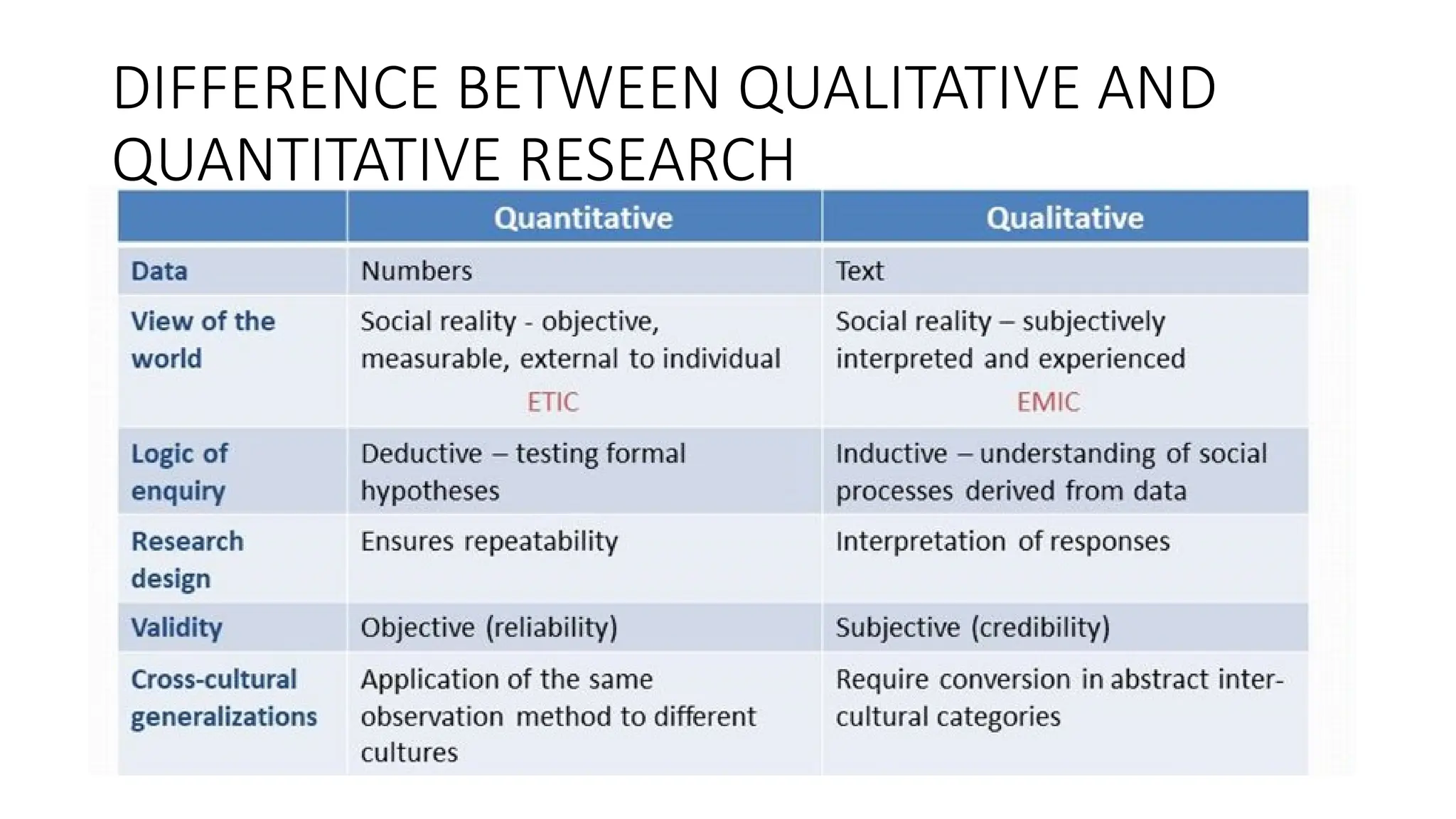
DIFFERENCE BETWEEN QUALITATIVE AND
QUANTITATIVE RESEARCH
PURPOSE OF QUALITATIVE METHODS
• To emphasize on quality rather than quantity .
• To understand why do people do the things they do.
• To find out how behaviours, system and relationships are maintained or change.
• To understand how social organisations function.
• To stimulate action experience learning cycle of participants and community.
TYPES OF QUALITATIVE RESEARCH
• Ethnography Methods
• Narrative Methods
• Phenomenological Methods
• Grounded Theory
• Case Study
• Historical Methods
ETHNOGRAPHY METHOD
• Ethnography is a qualitative research method that involves the in-depth
study of a cultural or social group by the researcher directly participating
in or observing the group's activities over an extended period of time.
• The goal is to gain a deep, holistic understanding of the group's behaviors,
interactions, and meanings within their natural context.
• For example, A child psychologist observing the social dynamics of
toddlers in a play school (interactions with teachers and with one another).
NARRATIVE METHOD
• Narrative research is a qualitative approach that explores the stories
and personal experiences of individuals.
• The goal is to understand how people make sense of their lives and the
world around them through the stories they tell.
• Examples of narrative research include : stories, interviews, life
histories, journals and photographs.
PHENOMENOLOGICAL METHOD
• Phenomenological research is a qualitative approach that aims to
describe and understand the subjective, lived experiences of individuals.
• The goal is to uncover the essential structures and meanings of a
particular phenomenon as it is experienced by the participants.
• For example, How does a single-mother experiences while taking her
child to a doctor?
GROUNDED THEORY
• Grounded Theory is a systematic, inductive approach to qualitative research that
aims to generate or discover a new theory grounded in the observations and
experiences of research participants.
• The goal is to move beyond description to construct explanatory theories about
social processes and phenomena.
• The goal of grounded theory is to uncover the underlying structures and
mechanisms that drive human behavior.
• For example, What are the beliefs and values that drive people’s behavior?
CASE STUDY
Case study research is a qualitative approach that involves an in-depth
examination of a single case or multiple cases.
CAN BE USED IN -
• Organizational and management research
• Educational and policy studies
• Healthcare and medical research
• Social and community-based programs
HISTORICAL METHOD
• Historical research is a qualitative approach that involves the
systematic collection, evaluation, and interpretation of past events,
facts, and information to gain a deeper understanding of the past and
its relationship to the present.
• The goal is to reconstruct and analyze historical phenomena in order to
identify patterns, trends, and causal relationships.
HOW TO DO A QUALITATIVE
RESEARCH?
• Defining the Problem and Searching the Literature.
• Identifying the Research Design.
• Identifying Data Sources and Selecting Participants.
• Identifying or Constructing Data Collection Instruments and Methods.
• Analysing, Interpreting, Reporting and Using Results.
Methods of data collection
• Questionnaires with open ended questions
• Individual interviews
• Discussions
• Testimonials, logs, journals, diaries
• Participatory observations
• Documents, reports, news articles
Analysis of Qualitative data
Consists of three parts:
Noticing
• Breaking up, separating, or disassembling of research materials into pieces, parts,
elements, or units.
Collecting
• With facts broken down into manageable pieces, the researcher sorts them.
Thinking
• Searching for types, classes, sequences, processes, patterns, or wholes.
• The aim of this process is to assemble or reconstruct the data in meaningful or
comprehensible fashion.
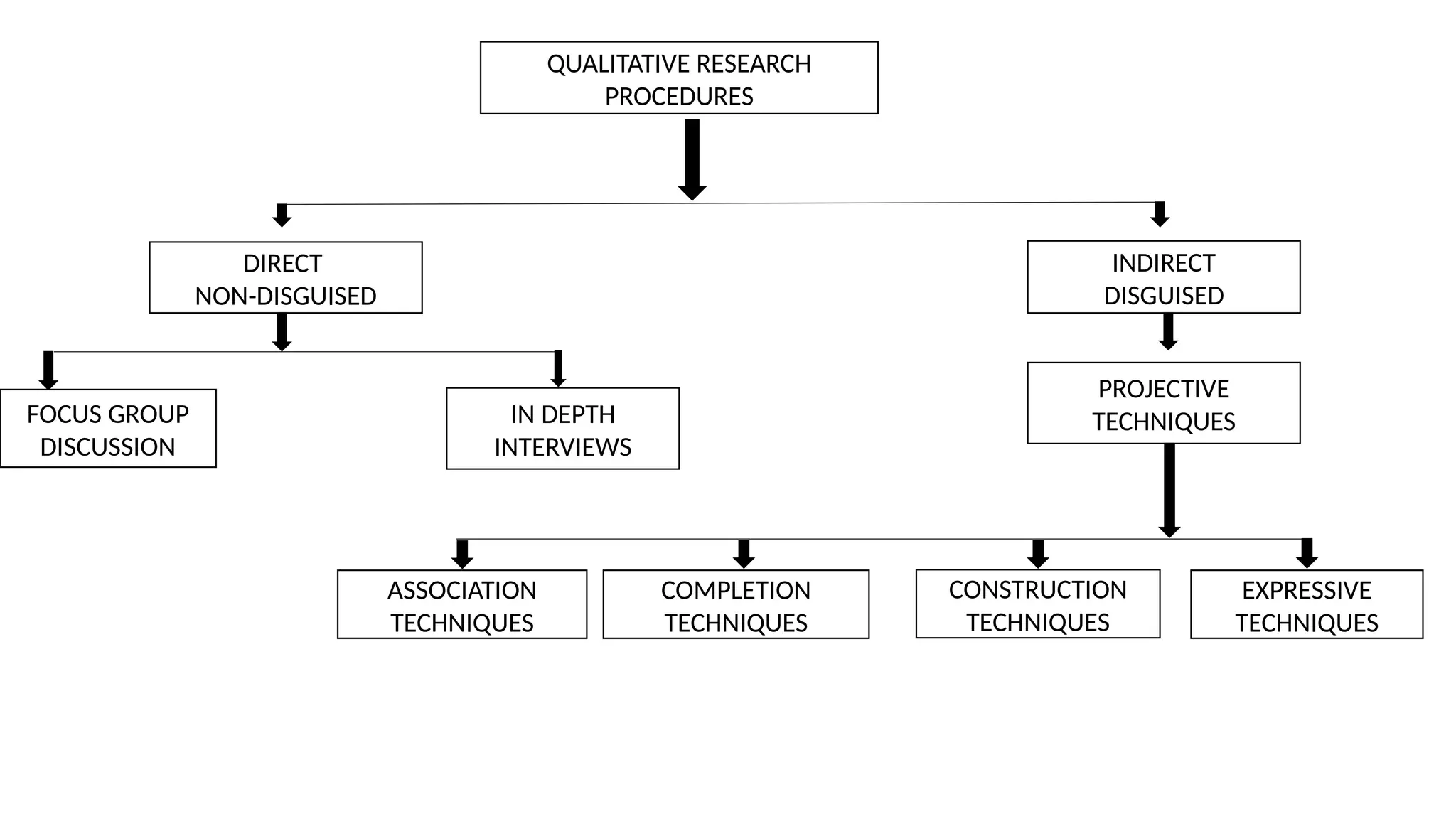
Type of Qualitative Research Techniques
QUALITATIVE RESEARCH
PROCEDURES
DIRECT
NON-DISGUISED
INDIRECT
DISGUISED
FOCUS GROUP
DISCUSSION
IN DEPTH
INTERVIEWS
PROJECTIVE
TECHNIQUES
ASSOCIATION
TECHNIQUES
COMPLETION
TECHNIQUES
CONSTRUCTION
TECHNIQUES
EXPRESSIVE
TECHNIQUES
OBSERVATIONAL TECHNIQUES
• DIRECT (NON-DISGUISED) –
OBSERVING BEHAVIOUR AS IT OCCURS
For example observer is physically present to monitor.
• INDIRECT (DISGUISED) –
OBSERVING THE EFFECT OR RESULT OF BEHAVIOUR
INSTEAD OF BEHAVIOUR ITSELF
For example done by mechanical electronic devices.
IN DEPTH INTERVIEW
• Interview one individual at a time.
• Open ended discovery oriented questions
• 3 elements are there
asking questions (Personal and leading questions eg How are you feeling today?)
Systematic recording
Documenting of responses
• Intense probing for deeper meaning and understanding of the responses.
• Often require repeated interviews.
FOCUS GROUP DISCUSSION
• Focus group discussion is a group discussion among approximately 6-12
number of persons guided by a facilitator during which group members
talk freely and spontaneously about a certain topic.
• It is designed to obtain perceptions of a defined area of interest in a
permissive and non threatening environment.
• An interview is conducted by a trained moderator who have good
observational interpersonal and communication skills in a non structured
and natural manner with a small group of respondents.
GUIDELINES FOR FGD
• Purpose of the FGD (participants interest and also of concern)
• Composition - Participants, one moderator, one facilitator and may be one
rapporteur.
• Location: Private so that participants may speak without being overheard or seen
by others not in the group.
• Size: Preferably odd number of participants.
• Seating arrangement preferably in a circle to encourage participation and
interaction
CONTINUED…
• Duration: 40-45 minutes
• Participation should be allowed maximum
• Questions should be “open-ended”
• Questions should be clearly stated
• Respect comments of all participants
• ‘What is said here; stays here’.....
STEPS IN CONDUCTING A FOCUS
GROUP DISCUSSION
USES OF FGD
• To develop research hypotheses by exploring depth of the problem to be
investigated and its possible causes.
• To formulate appropriate questions for more structured and larger scale surveys.
• To understand and solve unexpected problems in interventions.
• To develop appropriate messages for health education programs.
• To explore controversial topics.
Ethical issues in qualitative research
• Researchers should consider treating informed consent as a process.
• Ensure that information and support for participants are available
when necessary
• Care required to ensure the anonymity of participants in published
work
• Risk of misrepresentation can be minimized by ensuring that
researchers are adequately trained and supervised
• Researchers, funding bodies and reviewers should fully understand the
scientific basis and methodology of qualitative research
SUMMARY
• Qualitative research explores individuals' experiences, perceptions, and social
interactions, focusing on understanding "how" and "why" rather than quantitative
metrics.
• It involves various methods such as ethnography, which studies cultural groups,
narrative research, phenomenology for subjective experiences, grounded theory to
develop theories from data, case studies for in-depth single-case analysis, and
historical research.
• Key techniques include in-depth interviews and focus groups, which use open-
ended questions to uncover insights in a natural setting.
• Overall, qualitative research provides deep insights into human behaviors and
social dynamics, valuable for fields like healthcare, education, and community
development.
REFERENCES
• GOYAL RC. Research methodology for health professionals. New Delhi: Jaypee Brothers Medical Publishers
(P) Ltd; 2013.
• Im D, Pyo J, Lee H, Jung H, Ock M. Qualitative Research in Healthcare: Data Analysis. Journal of Preventive
Medicine and Public Health [Internet]. 2023 Mar 31;56(2):100–10. Available from:
https://www.ncbi.nlm.nih.gov/pmc/articles/PMC10111102/
• Kuller LH. A dictionary of epidemiology. Annals of Epidemiology. 1996 Mar;6(2):168.
Qualitative research methods and its type

Qualitative research methods and its type

  • 1.
  • 2.
    TABLE OF CONTENT •What is a Qualitative Research? • Difference Between Qualitative and Quantitative Research. • Purpose Of Qualitative Methods • Types Of Qualitative Research • How to do a Qualitative Research? • Method of Data Collection • Analysis of Qualitative Data • Types of Qualitative Research Techniques • In Depth Interview • Focus Group Discussion • Ethical Issues In Qualitative Research • Summary • References
  • 3.
    WHAT IS AQUALITATIVE RESEARCH? • Any type of research that employs non-numeric information to explore individual or group characteristics, producing findings not arrived by statistical procedures or other quantitative means. • Qualitative research explores people’s needs, values, perceptions and their experiences of the world around them. • This includes their health or illness, healthcare services and more broadly, social systems and their policies and processes. • It answers the how's and why’s instead of how many or how much.
  • 4.
    DIFFERENCE BETWEEN QUALITATIVEAND QUANTITATIVE RESEARCH
  • 5.
    PURPOSE OF QUALITATIVEMETHODS • To emphasize on quality rather than quantity . • To understand why do people do the things they do. • To find out how behaviours, system and relationships are maintained or change. • To understand how social organisations function. • To stimulate action experience learning cycle of participants and community.
  • 6.
    TYPES OF QUALITATIVERESEARCH • Ethnography Methods • Narrative Methods • Phenomenological Methods • Grounded Theory • Case Study • Historical Methods
  • 7.
    ETHNOGRAPHY METHOD • Ethnographyis a qualitative research method that involves the in-depth study of a cultural or social group by the researcher directly participating in or observing the group's activities over an extended period of time. • The goal is to gain a deep, holistic understanding of the group's behaviors, interactions, and meanings within their natural context. • For example, A child psychologist observing the social dynamics of toddlers in a play school (interactions with teachers and with one another).
  • 8.
    NARRATIVE METHOD • Narrativeresearch is a qualitative approach that explores the stories and personal experiences of individuals. • The goal is to understand how people make sense of their lives and the world around them through the stories they tell. • Examples of narrative research include : stories, interviews, life histories, journals and photographs.
  • 9.
    PHENOMENOLOGICAL METHOD • Phenomenologicalresearch is a qualitative approach that aims to describe and understand the subjective, lived experiences of individuals. • The goal is to uncover the essential structures and meanings of a particular phenomenon as it is experienced by the participants. • For example, How does a single-mother experiences while taking her child to a doctor?
  • 10.
    GROUNDED THEORY • GroundedTheory is a systematic, inductive approach to qualitative research that aims to generate or discover a new theory grounded in the observations and experiences of research participants. • The goal is to move beyond description to construct explanatory theories about social processes and phenomena. • The goal of grounded theory is to uncover the underlying structures and mechanisms that drive human behavior. • For example, What are the beliefs and values that drive people’s behavior?
  • 11.
    CASE STUDY Case studyresearch is a qualitative approach that involves an in-depth examination of a single case or multiple cases. CAN BE USED IN - • Organizational and management research • Educational and policy studies • Healthcare and medical research • Social and community-based programs
  • 12.
    HISTORICAL METHOD • Historicalresearch is a qualitative approach that involves the systematic collection, evaluation, and interpretation of past events, facts, and information to gain a deeper understanding of the past and its relationship to the present. • The goal is to reconstruct and analyze historical phenomena in order to identify patterns, trends, and causal relationships.
  • 13.
    HOW TO DOA QUALITATIVE RESEARCH? • Defining the Problem and Searching the Literature. • Identifying the Research Design. • Identifying Data Sources and Selecting Participants. • Identifying or Constructing Data Collection Instruments and Methods. • Analysing, Interpreting, Reporting and Using Results.
  • 14.
    Methods of datacollection • Questionnaires with open ended questions • Individual interviews • Discussions • Testimonials, logs, journals, diaries • Participatory observations • Documents, reports, news articles
  • 15.
    Analysis of Qualitativedata Consists of three parts: Noticing • Breaking up, separating, or disassembling of research materials into pieces, parts, elements, or units. Collecting • With facts broken down into manageable pieces, the researcher sorts them. Thinking • Searching for types, classes, sequences, processes, patterns, or wholes. • The aim of this process is to assemble or reconstruct the data in meaningful or comprehensible fashion.
  • 16.
    Type of QualitativeResearch Techniques
  • 17.
    QUALITATIVE RESEARCH PROCEDURES DIRECT NON-DISGUISED INDIRECT DISGUISED FOCUS GROUP DISCUSSION INDEPTH INTERVIEWS PROJECTIVE TECHNIQUES ASSOCIATION TECHNIQUES COMPLETION TECHNIQUES CONSTRUCTION TECHNIQUES EXPRESSIVE TECHNIQUES
  • 18.
    OBSERVATIONAL TECHNIQUES • DIRECT(NON-DISGUISED) – OBSERVING BEHAVIOUR AS IT OCCURS For example observer is physically present to monitor. • INDIRECT (DISGUISED) – OBSERVING THE EFFECT OR RESULT OF BEHAVIOUR INSTEAD OF BEHAVIOUR ITSELF For example done by mechanical electronic devices.
  • 19.
    IN DEPTH INTERVIEW •Interview one individual at a time. • Open ended discovery oriented questions • 3 elements are there asking questions (Personal and leading questions eg How are you feeling today?) Systematic recording Documenting of responses • Intense probing for deeper meaning and understanding of the responses. • Often require repeated interviews.
  • 20.
    FOCUS GROUP DISCUSSION •Focus group discussion is a group discussion among approximately 6-12 number of persons guided by a facilitator during which group members talk freely and spontaneously about a certain topic. • It is designed to obtain perceptions of a defined area of interest in a permissive and non threatening environment. • An interview is conducted by a trained moderator who have good observational interpersonal and communication skills in a non structured and natural manner with a small group of respondents.
  • 21.
    GUIDELINES FOR FGD •Purpose of the FGD (participants interest and also of concern) • Composition - Participants, one moderator, one facilitator and may be one rapporteur. • Location: Private so that participants may speak without being overheard or seen by others not in the group. • Size: Preferably odd number of participants. • Seating arrangement preferably in a circle to encourage participation and interaction
  • 22.
    CONTINUED… • Duration: 40-45minutes • Participation should be allowed maximum • Questions should be “open-ended” • Questions should be clearly stated • Respect comments of all participants • ‘What is said here; stays here’.....
  • 23.
    STEPS IN CONDUCTINGA FOCUS GROUP DISCUSSION
  • 24.
    USES OF FGD •To develop research hypotheses by exploring depth of the problem to be investigated and its possible causes. • To formulate appropriate questions for more structured and larger scale surveys. • To understand and solve unexpected problems in interventions. • To develop appropriate messages for health education programs. • To explore controversial topics.
  • 25.
    Ethical issues inqualitative research • Researchers should consider treating informed consent as a process. • Ensure that information and support for participants are available when necessary • Care required to ensure the anonymity of participants in published work • Risk of misrepresentation can be minimized by ensuring that researchers are adequately trained and supervised • Researchers, funding bodies and reviewers should fully understand the scientific basis and methodology of qualitative research
  • 26.
    SUMMARY • Qualitative researchexplores individuals' experiences, perceptions, and social interactions, focusing on understanding "how" and "why" rather than quantitative metrics. • It involves various methods such as ethnography, which studies cultural groups, narrative research, phenomenology for subjective experiences, grounded theory to develop theories from data, case studies for in-depth single-case analysis, and historical research. • Key techniques include in-depth interviews and focus groups, which use open- ended questions to uncover insights in a natural setting. • Overall, qualitative research provides deep insights into human behaviors and social dynamics, valuable for fields like healthcare, education, and community development.
  • 27.
    REFERENCES • GOYAL RC.Research methodology for health professionals. New Delhi: Jaypee Brothers Medical Publishers (P) Ltd; 2013. • Im D, Pyo J, Lee H, Jung H, Ock M. Qualitative Research in Healthcare: Data Analysis. Journal of Preventive Medicine and Public Health [Internet]. 2023 Mar 31;56(2):100–10. Available from: https://www.ncbi.nlm.nih.gov/pmc/articles/PMC10111102/ • Kuller LH. A dictionary of epidemiology. Annals of Epidemiology. 1996 Mar;6(2):168.

Editor's Notes

  • #4 The icmr logo can be hidden. A text box can be added above it.
  • #10 This can be discussed in a bit detail. The process is important.