This document provides an overview of fundamentals of qualitative research. It discusses key topics such as what qualitative research is, developing qualitative research questions, common qualitative research designs including phenomenology, ethnography and grounded theory. It also covers qualitative data collection methods like in-depth interviews and focus groups. The document outlines the process of qualitative data analysis including coding, developing a code structure and analyzing themes. Finally, it discusses different types of qualitative analysis such as thematic analysis, content analysis and narrative analysis.
Discusses fundamentals and aims of qualitative research, enhancing students' capacity in public health.
Explains qualitative research, its definition, characteristics, and differences from quantitative research.
Highlights goals of qualitative research: exploration, description, and interpretation of phenomena.
Focuses on developing qualitative research questions and their importance in guiding studies.
Introduction to types of qualitative research designs such as ethnography, grounded theory, and case studies.
Explains narrative research and case studies as qualitative designs for in-depth examination of experiences.
Outlines qualitative data collection methods, including in-depth interviews, focus group discussions, and observations.
Defines focus groups, their uses, design, and the analysis of data as group units.Overview of qualitative data analysis, including iterative processes and strategies for organizing data.
Introduces various methods of qualitative analysis including thematic, content, and discourse analysis.
Discusses structure of qualitative research reporting, challenges, and elements of introduction, methods, results, and discussion.
Addresses the importance of rigor and validity in qualitative studies, strategies to enhance credibility.
Encourages discussion and inquiries regarding qualitative research, marking the end of the presentation.
Overview of thechapter
Aim: To enhance students’ capacity to conceptualize, design and
conduct qualitative research in public health and health sciences.
Topics:
• What is a qualitative research?
• Developing a qualitative research question
• Qualitative research designs
• Data collection in qualitative research
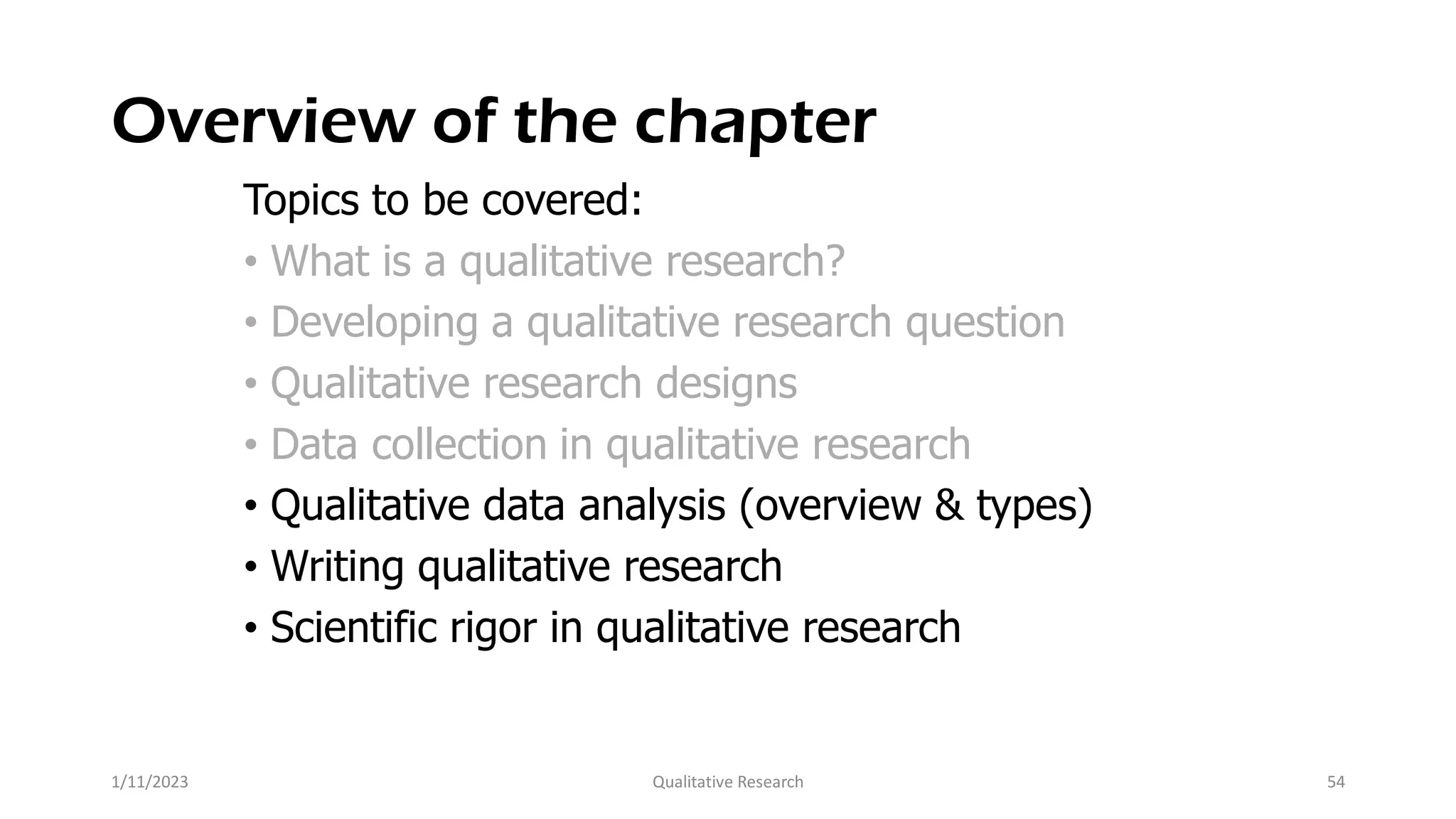
• Qualitative data analysis (overview & types)
• Scientific rigor in qualitative research
1/11/2023 Qualitative Research 2
Introduction
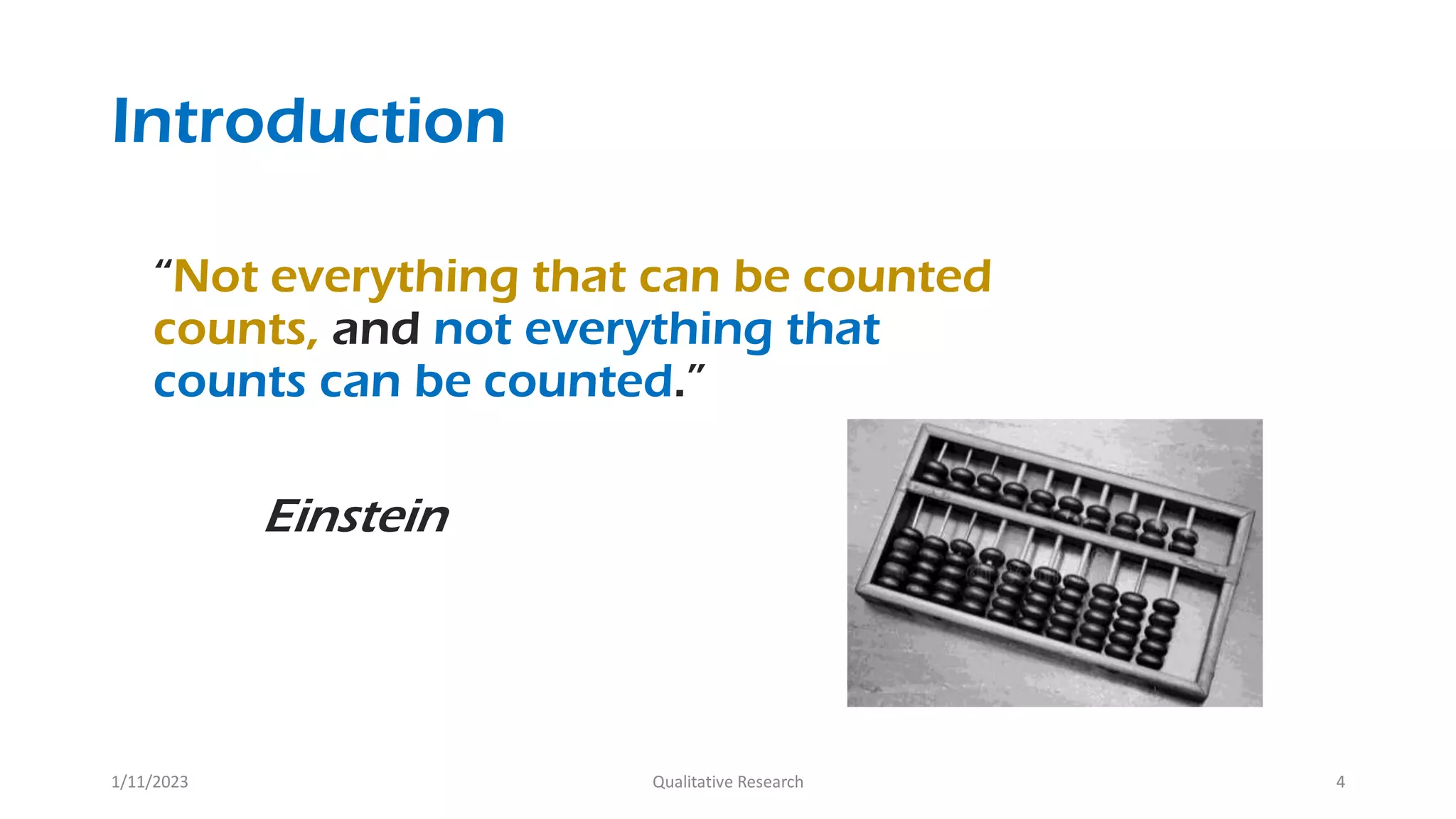
“Not everything thatcan be counted
counts, and not everything that
counts can be counted.”
Einstein
1/11/2023 Qualitative Research 4
5.
Introduction
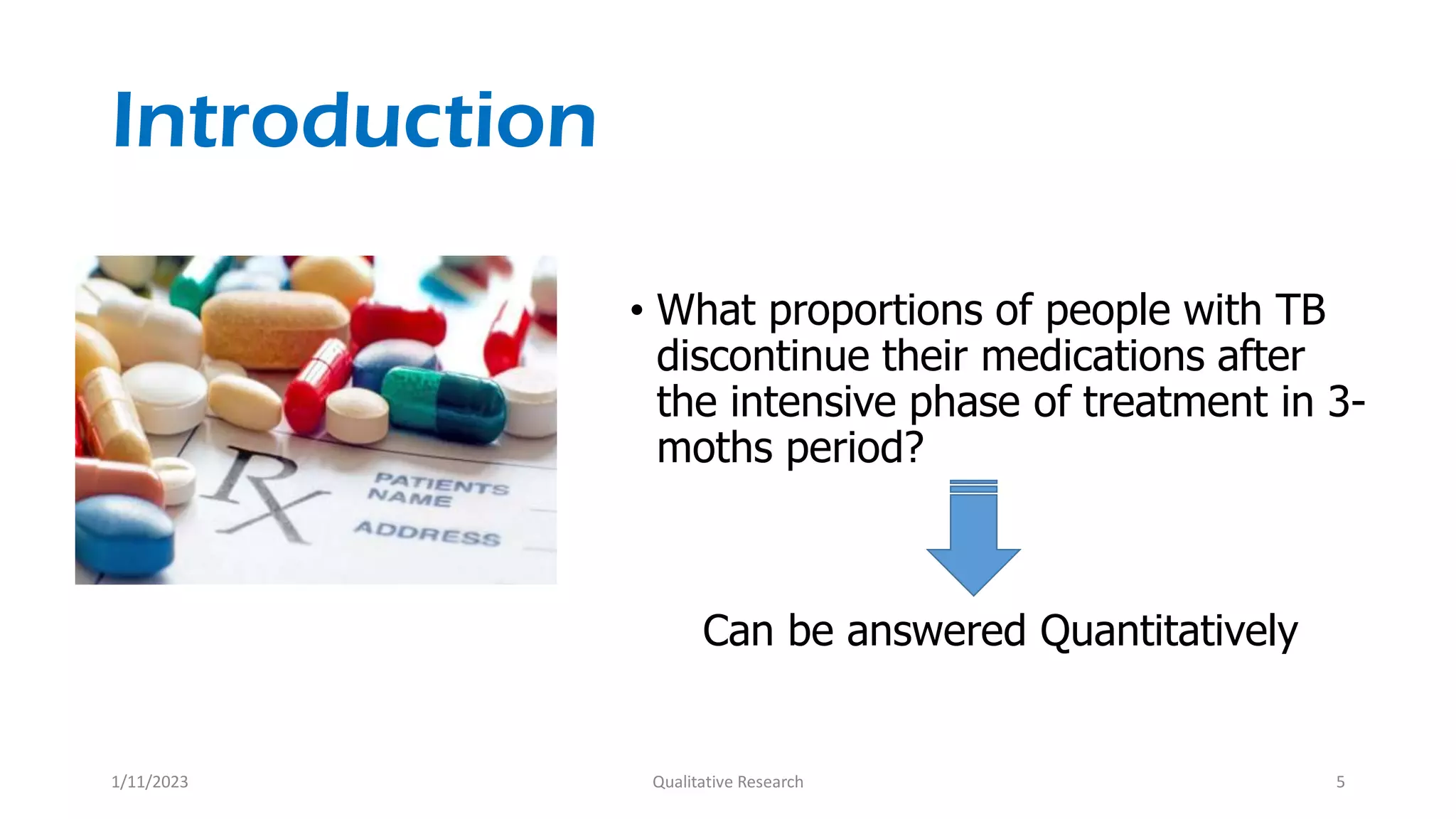
• What proportionsof people with TB
discontinue their medications after
the intensive phase of treatment in 3-
moths period?
Can be answered Quantitatively
1/11/2023 Qualitative Research 5
6.
Introduction
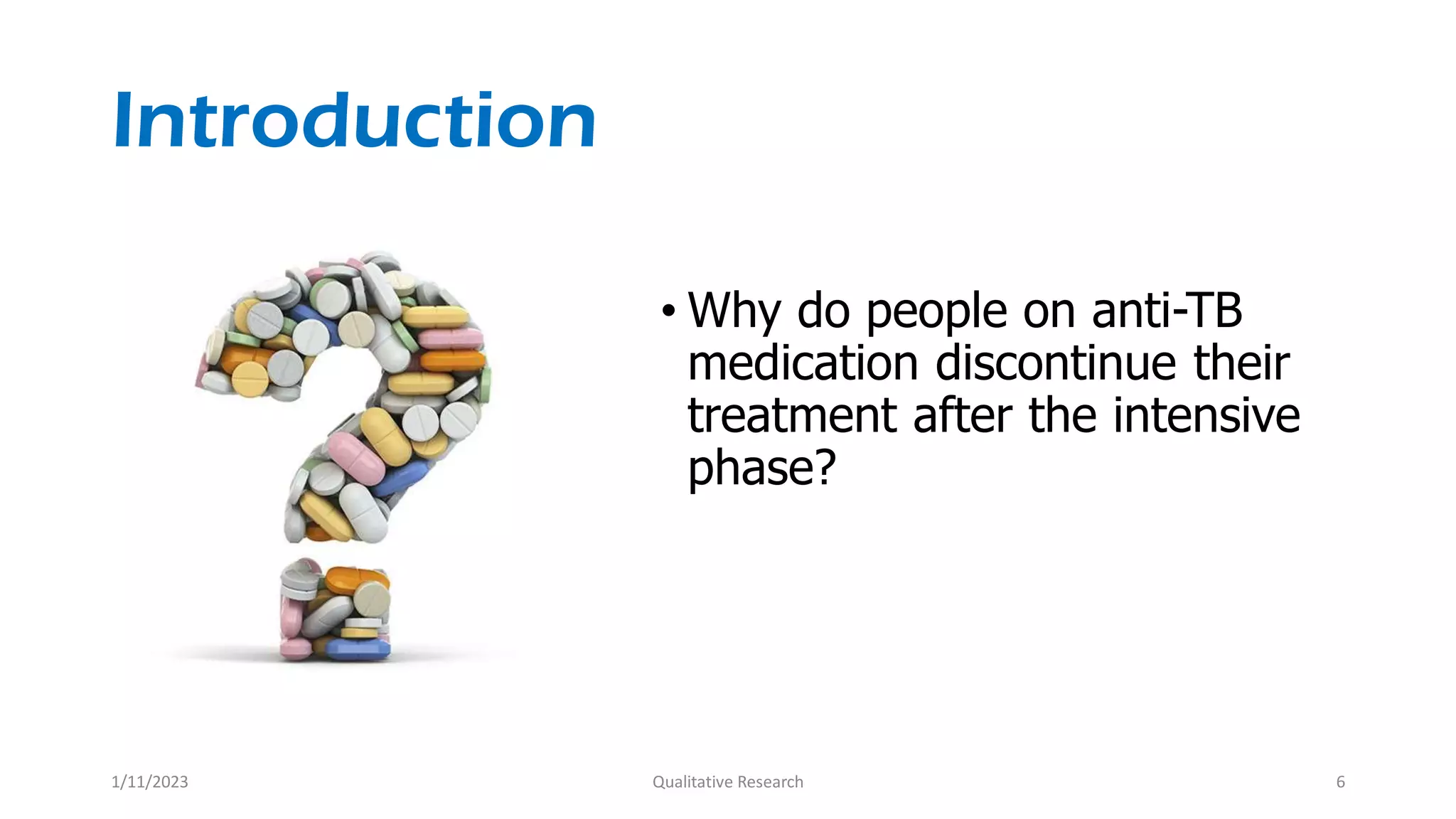
• Why dopeople on anti-TB
medication discontinue their
treatment after the intensive
phase?
1/11/2023 Qualitative Research 6
7.
What is qualitativeresearch?
“A scientific strategy which helps us to understand complex
social phenomena in natural (rather than experimental)
settings, giving due emphasis to the meanings, experiences
and views of participants.”
1/11/2023 Qualitative Research 7
8.
What is qualitativeresearch?
• A strategy for systematic collection, organization and
analysis of textual information.
• Uses inductive approaches to generate new insights
into a certain phenomena that are difficult to measure
quantitatively.
• They can characterize participant perspectives and
experiences in great depth
1/11/2023 Qualitative Research 8
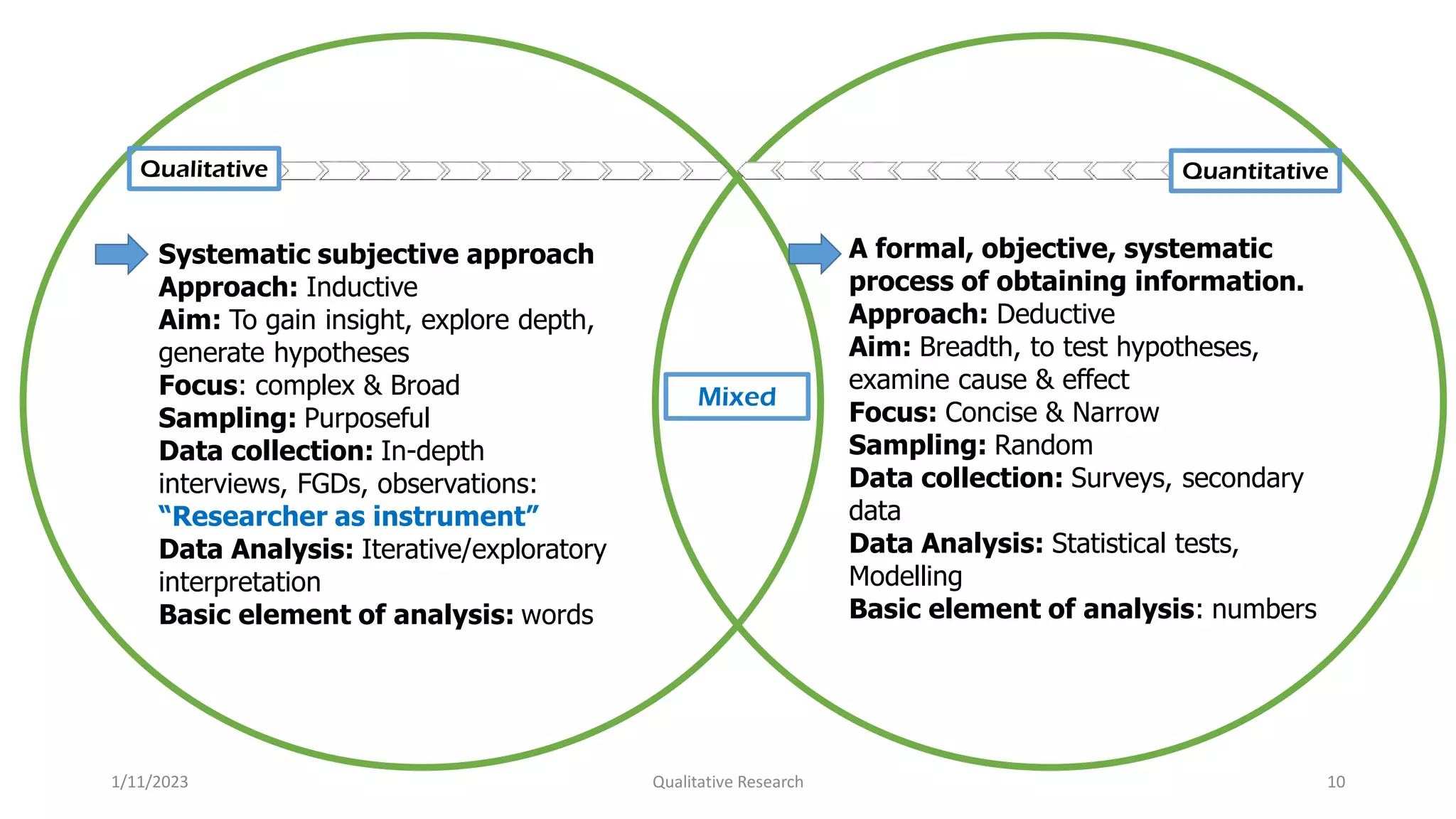
Qualitative Quantitative
Mixed
Systematic subjectiveapproach
Approach: Inductive
Aim: To gain insight, explore depth,
generate hypotheses
Focus: complex & Broad
Sampling: Purposeful
Data collection: In-depth
interviews, FGDs, observations:
“Researcher as instrument”
Data Analysis: Iterative/exploratory
interpretation
Basic element of analysis: words
A formal, objective, systematic
process of obtaining information.
Approach: Deductive
Aim: Breadth, to test hypotheses,
examine cause & effect
Focus: Concise & Narrow
Sampling: Random
Data collection: Surveys, secondary
data
Data Analysis: Statistical tests,
Modelling
Basic element of analysis: numbers
1/11/2023 Qualitative Research 10
11.
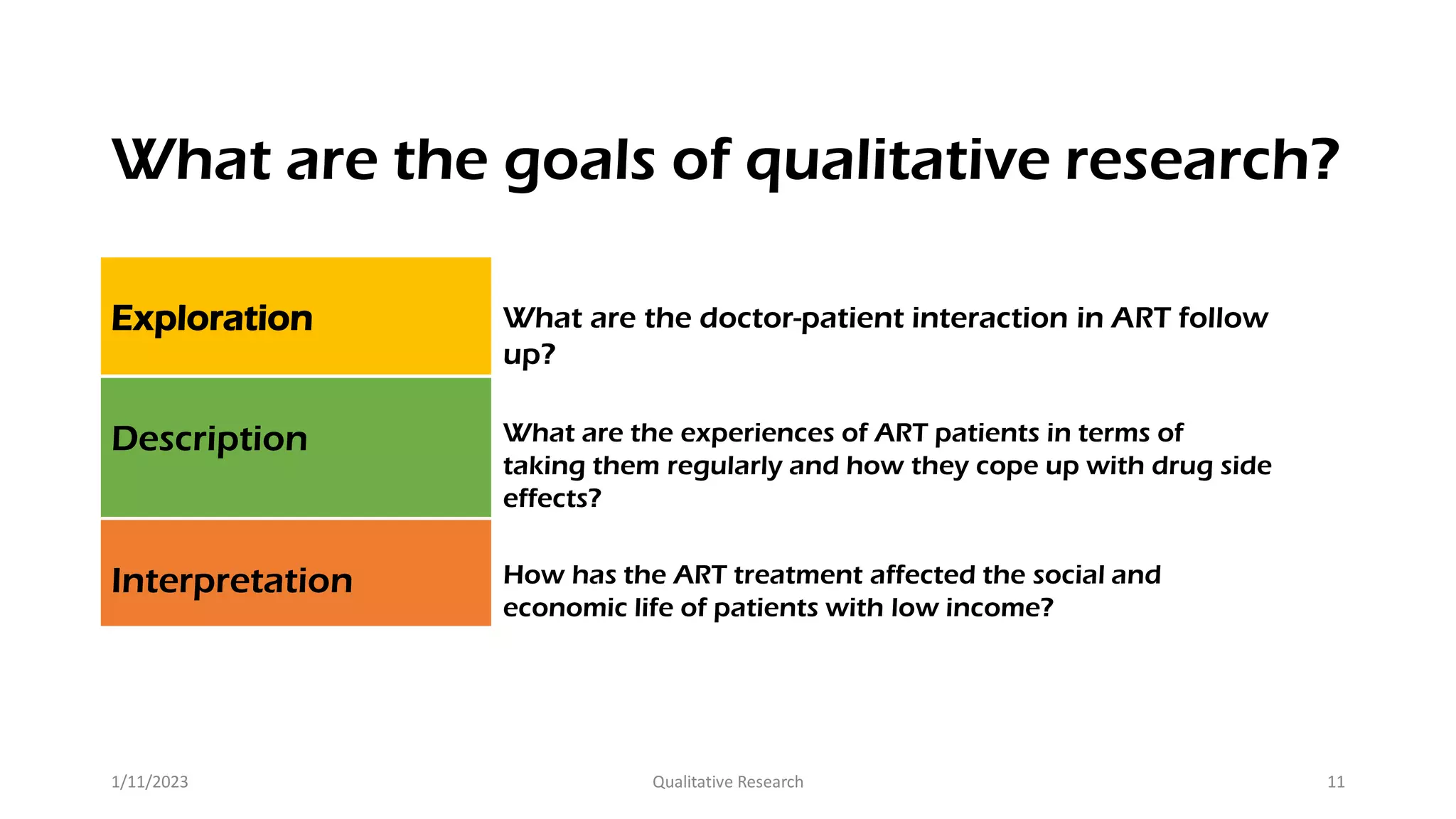
What are thegoals of qualitative research?
Exploration What are the doctor-patient interaction in ART follow
up?
1/11/2023 Qualitative Research 11
Description What are the experiences of ART patients in terms of
taking them regularly and how they cope up with drug side
effects?
Interpretation How has the ART treatment affected the social and
economic life of patients with low income?
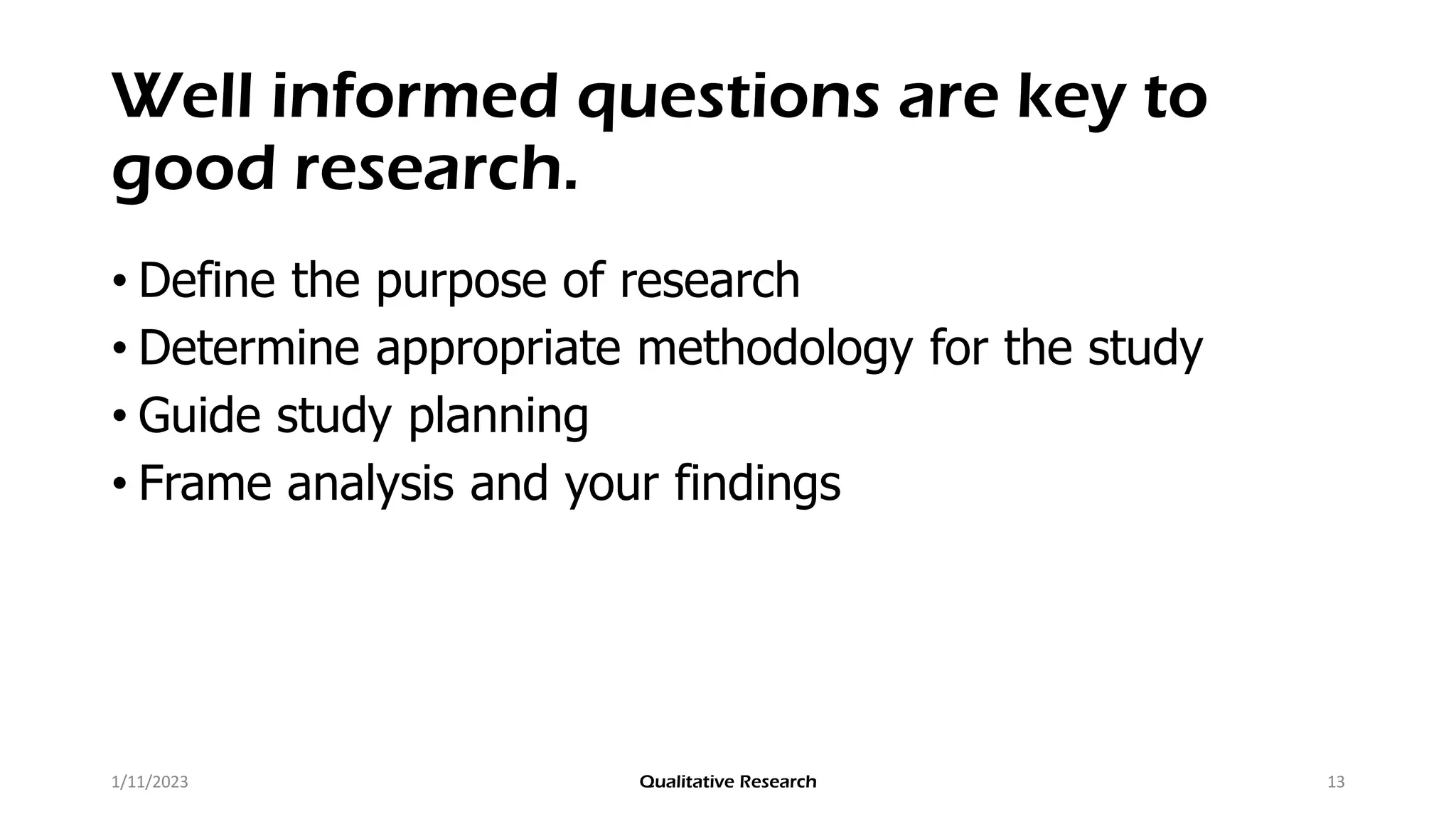
Well informed questionsare key to
good research.
• Define the purpose of research
• Determine appropriate methodology for the study
• Guide study planning
• Frame analysis and your findings
1/11/2023 Qualitative Research 13
14.
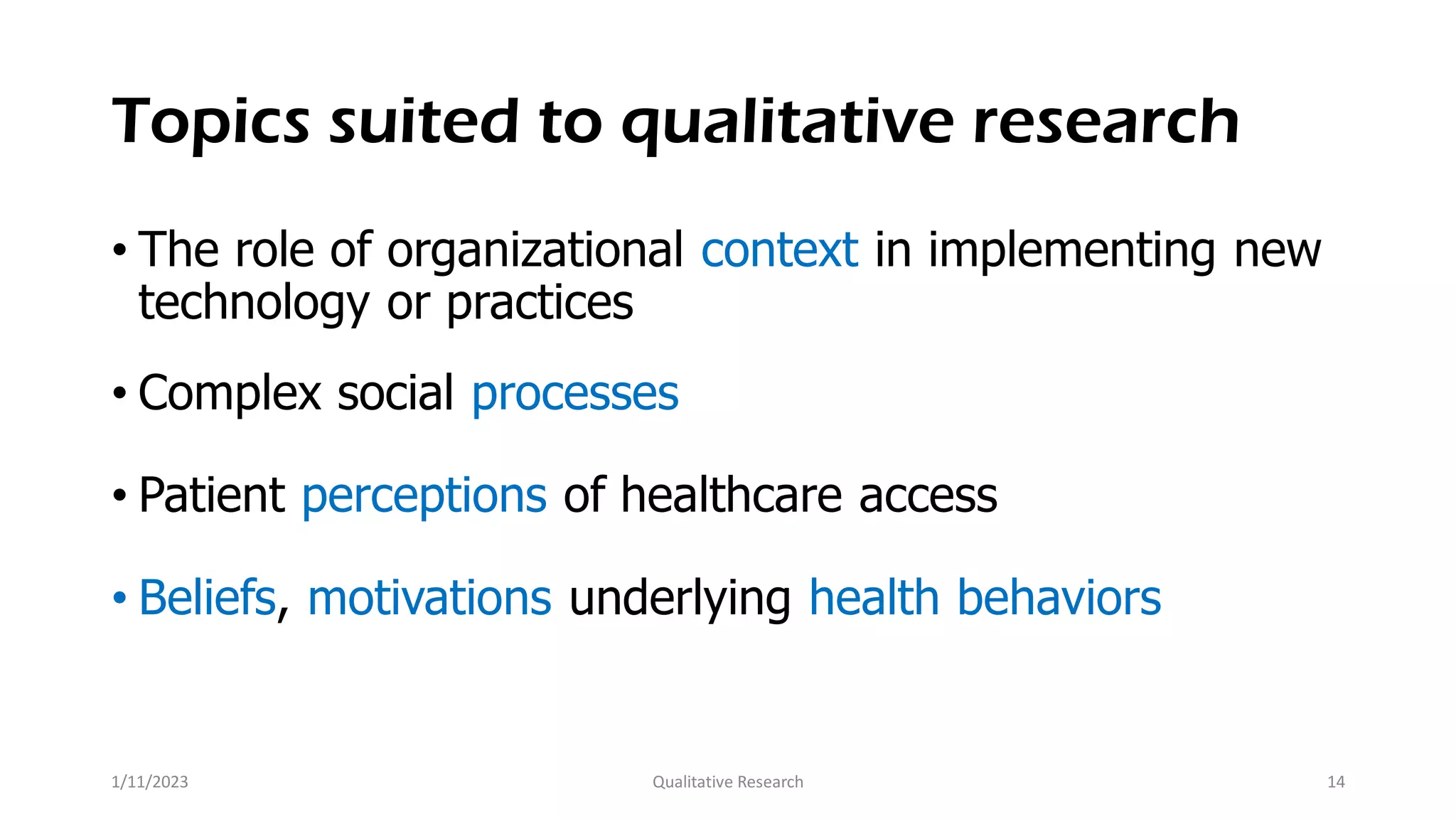
Topics suited toqualitative research
• The role of organizational context in implementing new
technology or practices
• Complex social processes
• Patient perceptions of healthcare access
• Beliefs, motivations underlying health behaviors
1/11/2023 Qualitative Research 14
15.
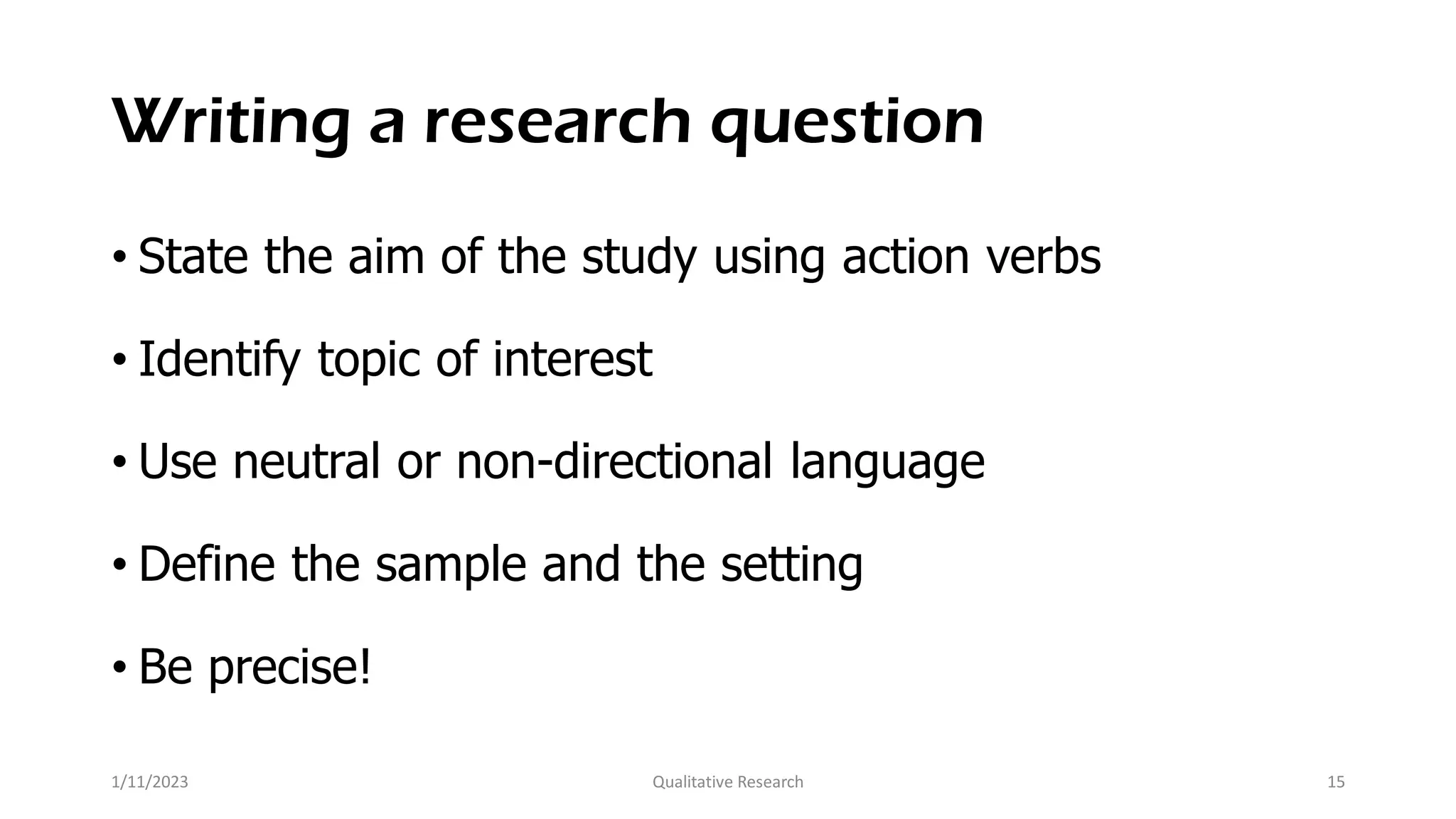
Writing a researchquestion
• State the aim of the study using action verbs
• Identify topic of interest
• Use neutral or non-directional language
• Define the sample and the setting
• Be precise!
1/11/2023 Qualitative Research 15
16.
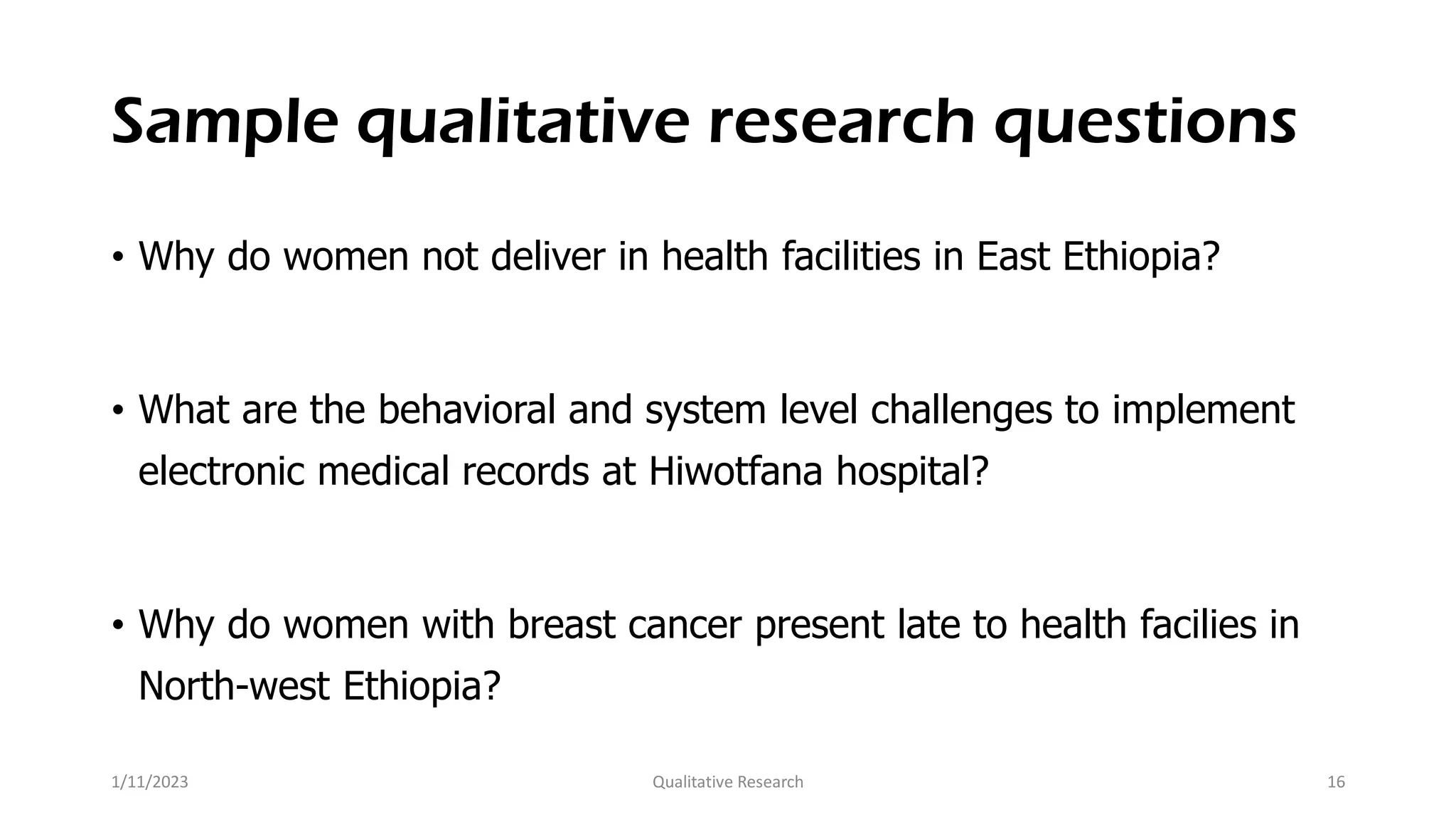
Sample qualitative researchquestions
• Why do women not deliver in health facilities in East Ethiopia?
• What are the behavioral and system level challenges to implement
electronic medical records at Hiwotfana hospital?
• Why do women with breast cancer present late to health facilies in
North-west Ethiopia?
1/11/2023 Qualitative Research 16
17.
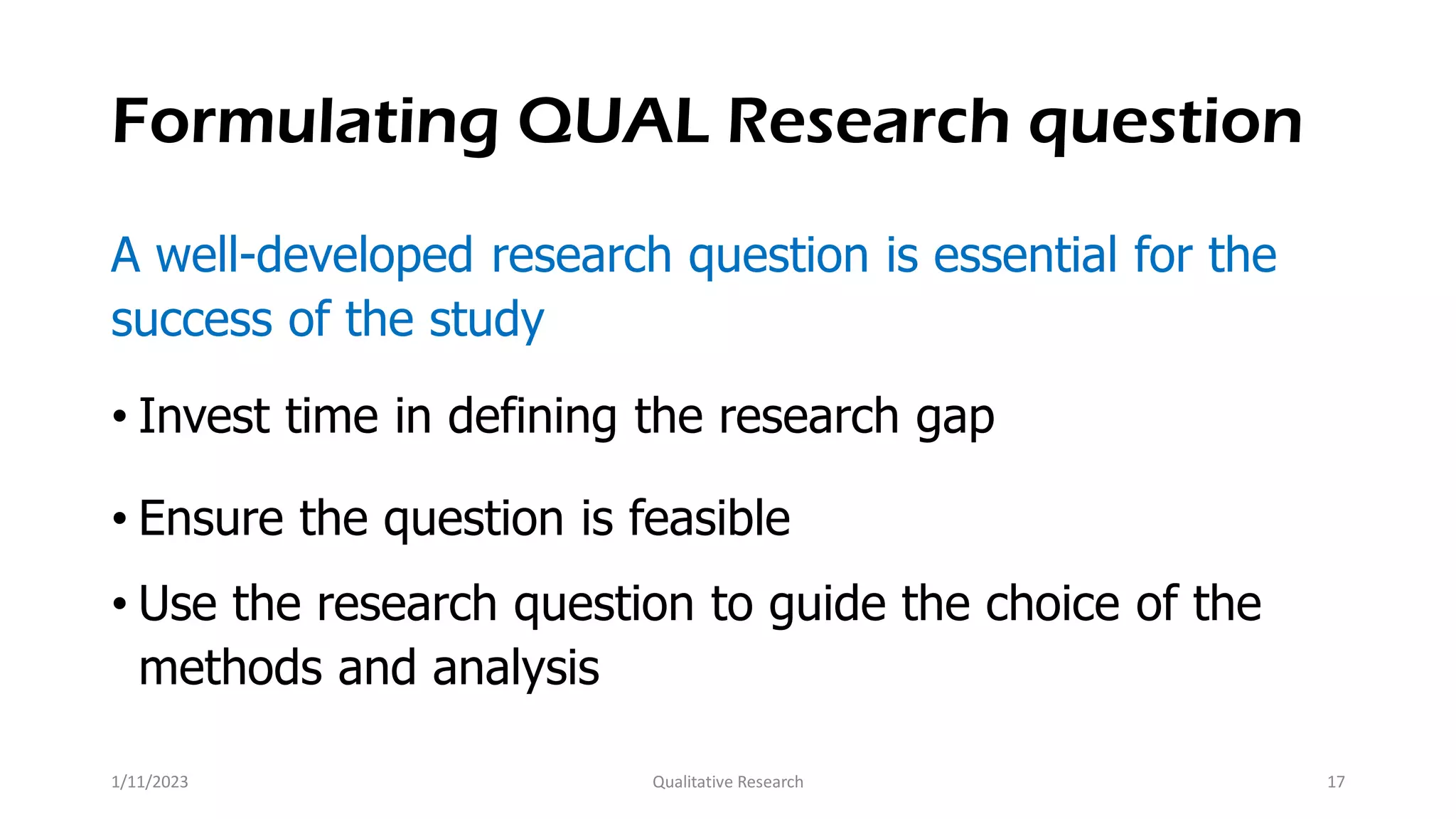
Formulating QUAL Researchquestion
A well-developed research question is essential for the
success of the study
• Invest time in defining the research gap
• Ensure the question is feasible
• Use the research question to guide the choice of the
methods and analysis
1/11/2023 Qualitative Research 17
18.
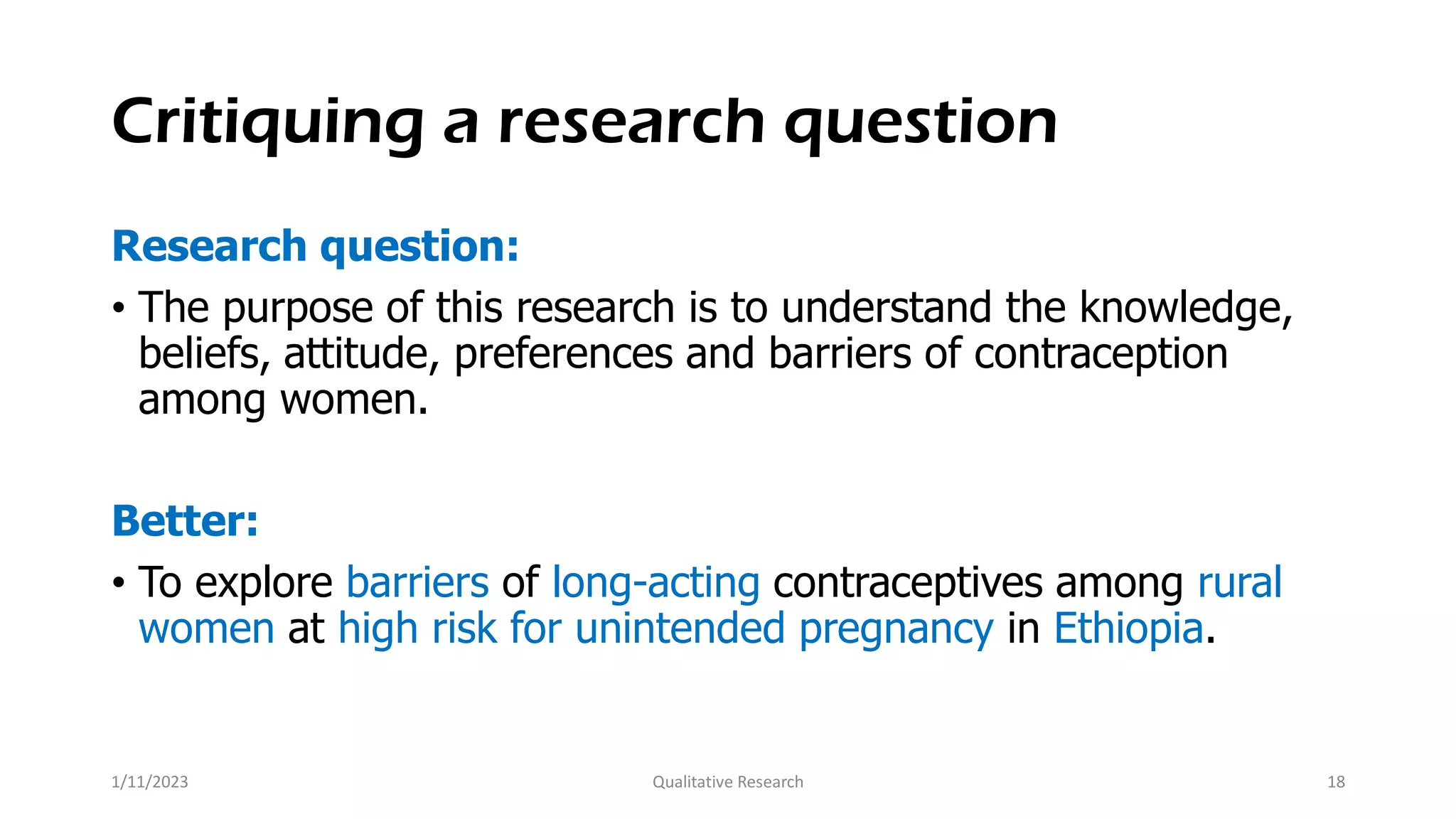
Critiquing a researchquestion
Research question:
• The purpose of this research is to understand the knowledge,
beliefs, attitude, preferences and barriers of contraception
among women.
Better:
• To explore barriers of long-acting contraceptives among rural
women at high risk for unintended pregnancy in Ethiopia.
1/11/2023 Qualitative Research 18
Types of qualitativeresearch designs
• Phenomenological
• Ethnography
• Narrative studies
• Grounded theory
• Historical studies
• Case studies
1/11/2023 Qualitative Research 20
21.
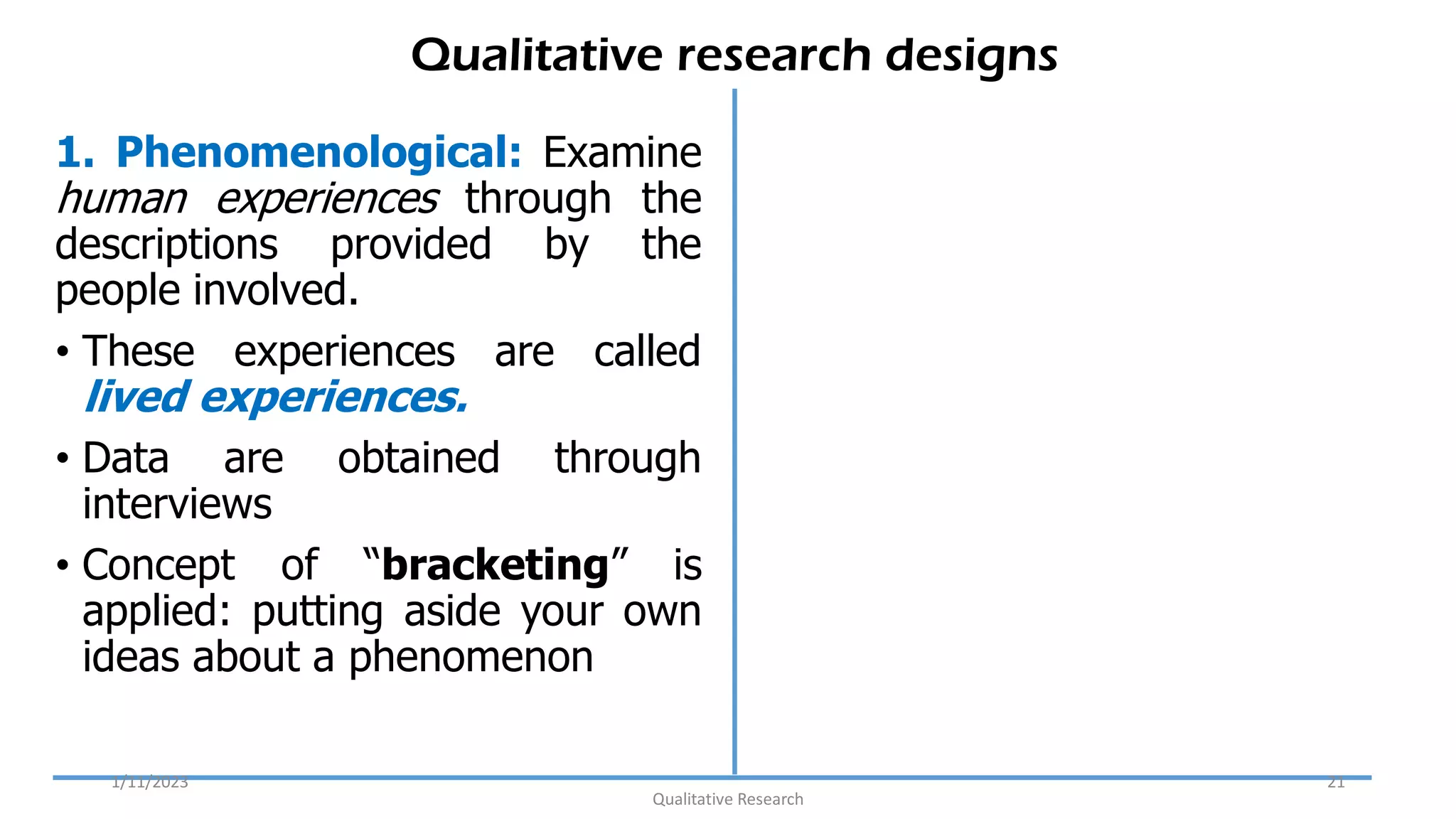
Qualitative research designs
1.Phenomenological: Examine
human experiences through the
descriptions provided by the
people involved.
• These experiences are called
lived experiences.
• Data are obtained through
interviews
• Concept of “bracketing” is
applied: putting aside your own
ideas about a phenomenon
1/11/2023
Qualitative Research
21
Qualitative research designs
1.Phenomenology: Examine
human experiences through the
descriptions provided by the
people involved.
• These experiences are called
lived experiences.
• Data are obtained through
interviews
• Concept of “bracketing” is
applied: putting aside your own
ideas about a phenomenon
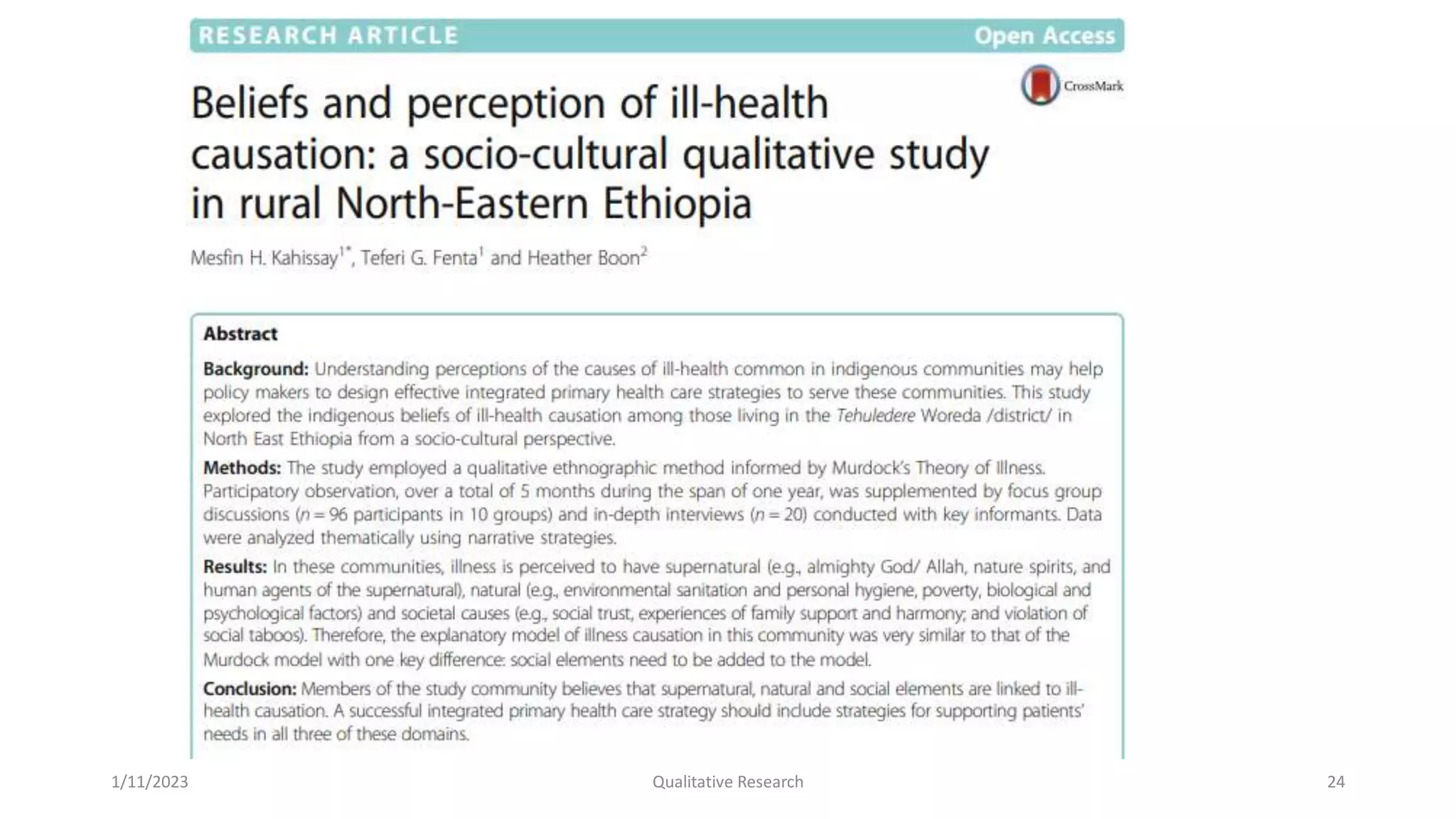
2. Ethnography: involve the
collection and analysis of data
about cultural groups.
“Learning from people”
• Ethnographers live with people
they are studying
• Data collection: Observation &
interview of key informants
1/11/2023
Qualitative Research
23
Qualitative research designs
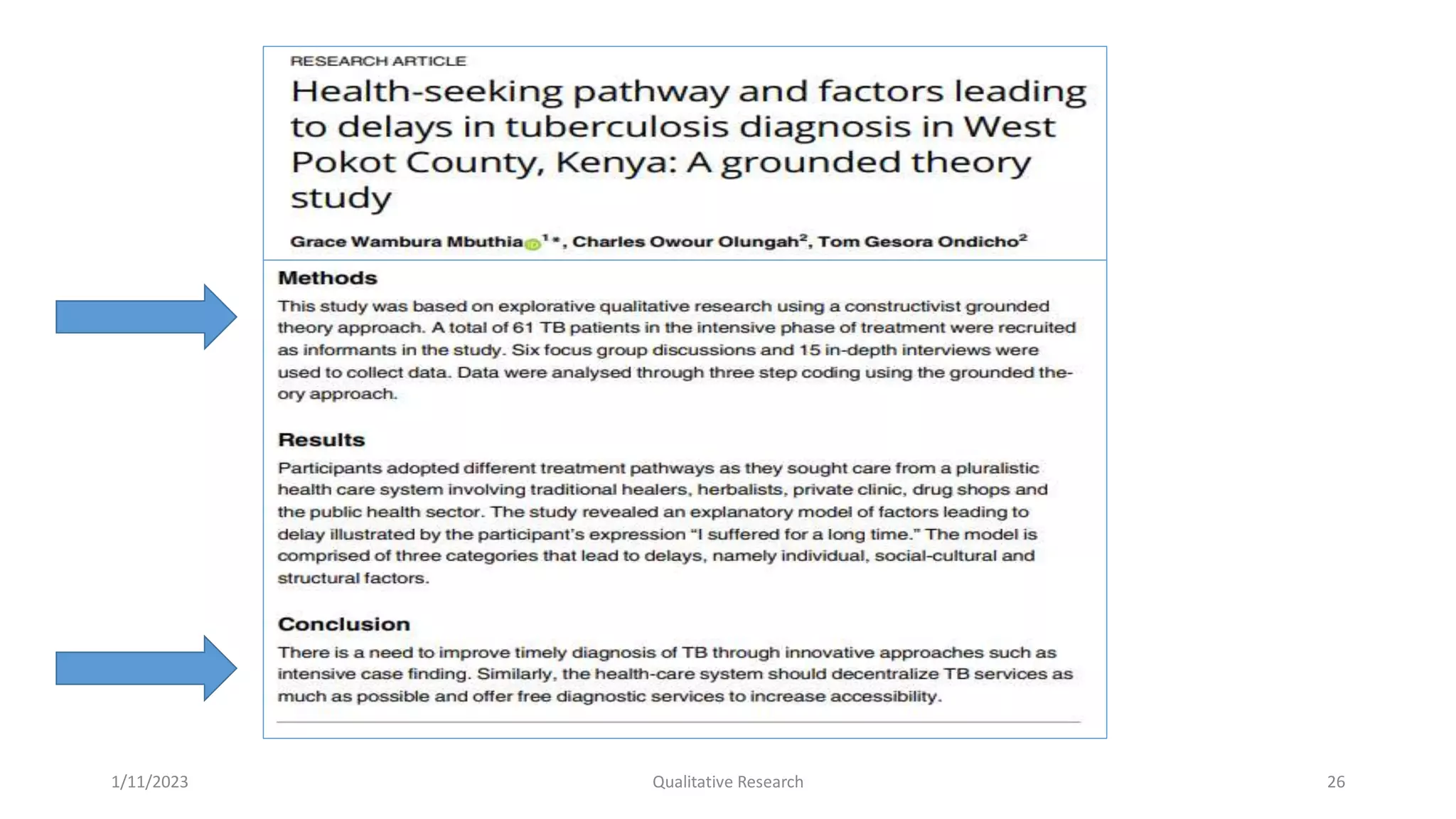
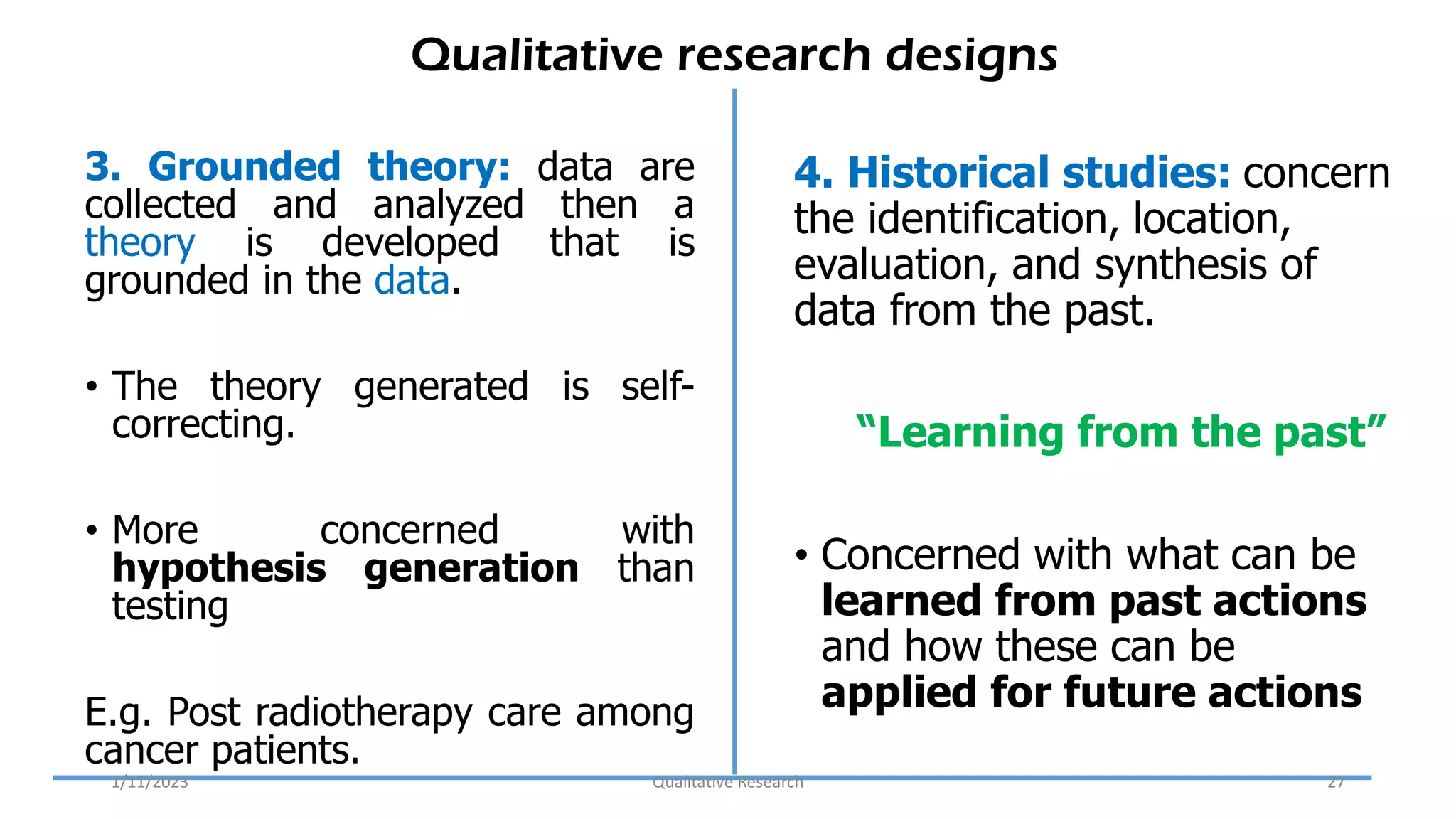
3.Grounded theory: data are
collected and analyzed then a
theory is developed that is
grounded in the data.
• The theory generated is self-
correcting.
• More concerned with
hypothesis generation than
testing
E.g. Post radiotherapy care among
cancer patients.
4. Historical studies: concern
the identification, location,
evaluation, and synthesis of
data from the past.
“Learning from the past”
• Concerned with what can be
learned from past actions
and how these can be
applied for future actions
1/11/2023 Qualitative Research 25
Qualitative research designs
3.Grounded theory: data are
collected and analyzed then a
theory is developed that is
grounded in the data.
• The theory generated is self-
correcting.
• More concerned with
hypothesis generation than
testing
E.g. Post radiotherapy care among
cancer patients.
4. Historical studies: concern
the identification, location,
evaluation, and synthesis of
data from the past.
“Learning from the past”
• Concerned with what can be
learned from past actions
and how these can be
applied for future actions
1/11/2023 Qualitative Research 27
28.
Qualitative research designs
5.Narrative research: involves
collection of data from personal
experience.
• Aims to explore and
conceptualize human experience
as it is represented in textual
format.
• Spoken or written stories
E.g. Autobiography, life history
6. Case studies: involves
in-depth examinations of
people or groups of people.
• Can be both quantitative or
qualitative depending on the
purpose
• E.g. diaries of DM patients on
insulin pump
1/11/2023 Qualitative Research 28
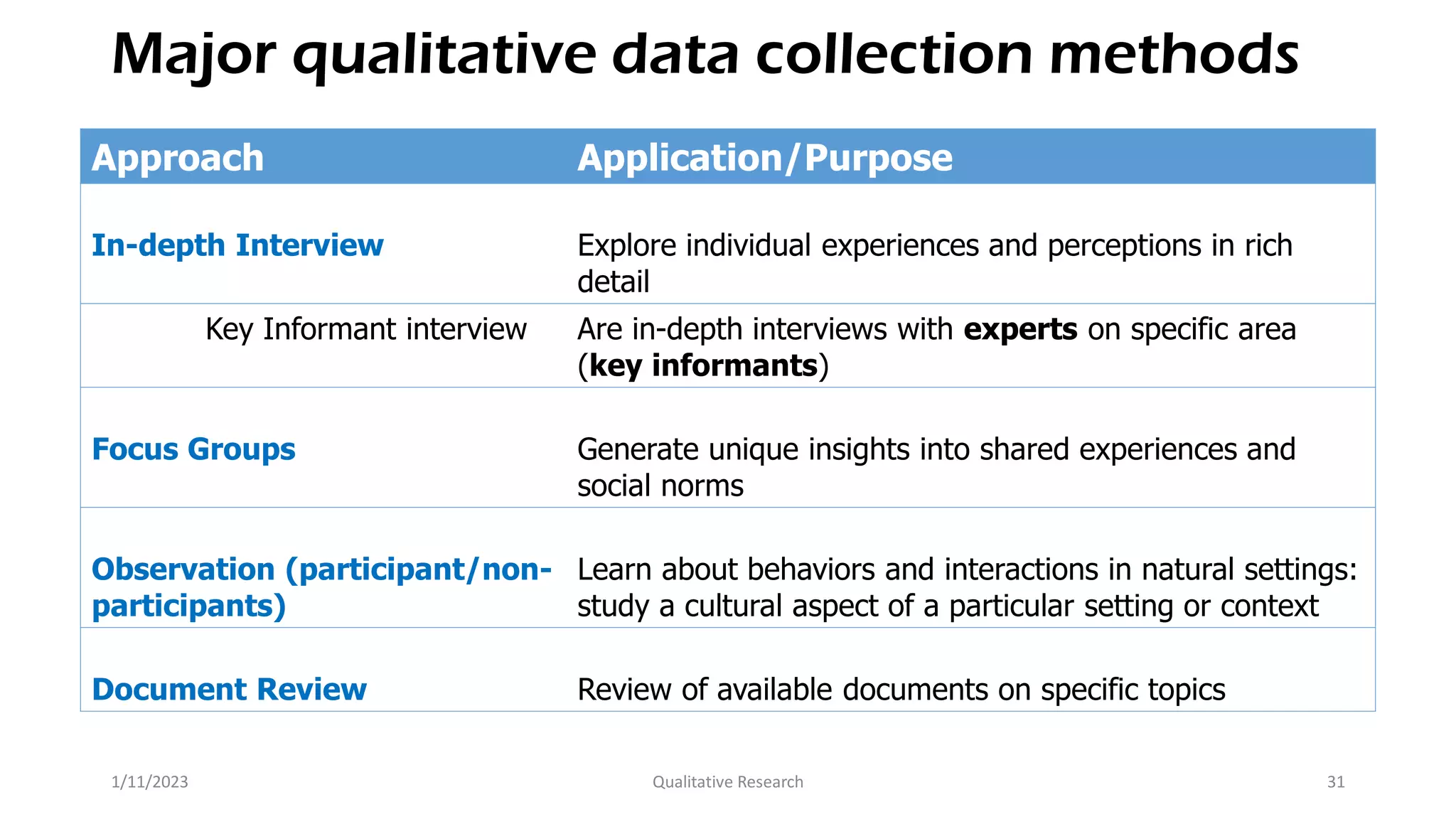
Major qualitative datacollection methods
Approach Application/Purpose
In-depth Interview Explore individual experiences and perceptions in rich
detail
Key Informant interview Are in-depth interviews with experts on specific area
(key informants)
Focus Groups Generate unique insights into shared experiences and
social norms
Observation (participant/non-
participants)
Learn about behaviors and interactions in natural settings:
study a cultural aspect of a particular setting or context
Document Review Review of available documents on specific topics
1/11/2023 Qualitative Research 31
31.
In-depth Interviews
• Areguided conversations with
informants.
• We don’t know what we are
going to obtain during the
interview
1/11/2023 Qualitative Research 32
32.
When to usein-depth interviews
• Individual perspectives and experiences
• Addressing sensitive topics
• Concerns about fear of reprisal
• When structured survey approaches do not work
1/11/2023 Qualitative Research 33
33.
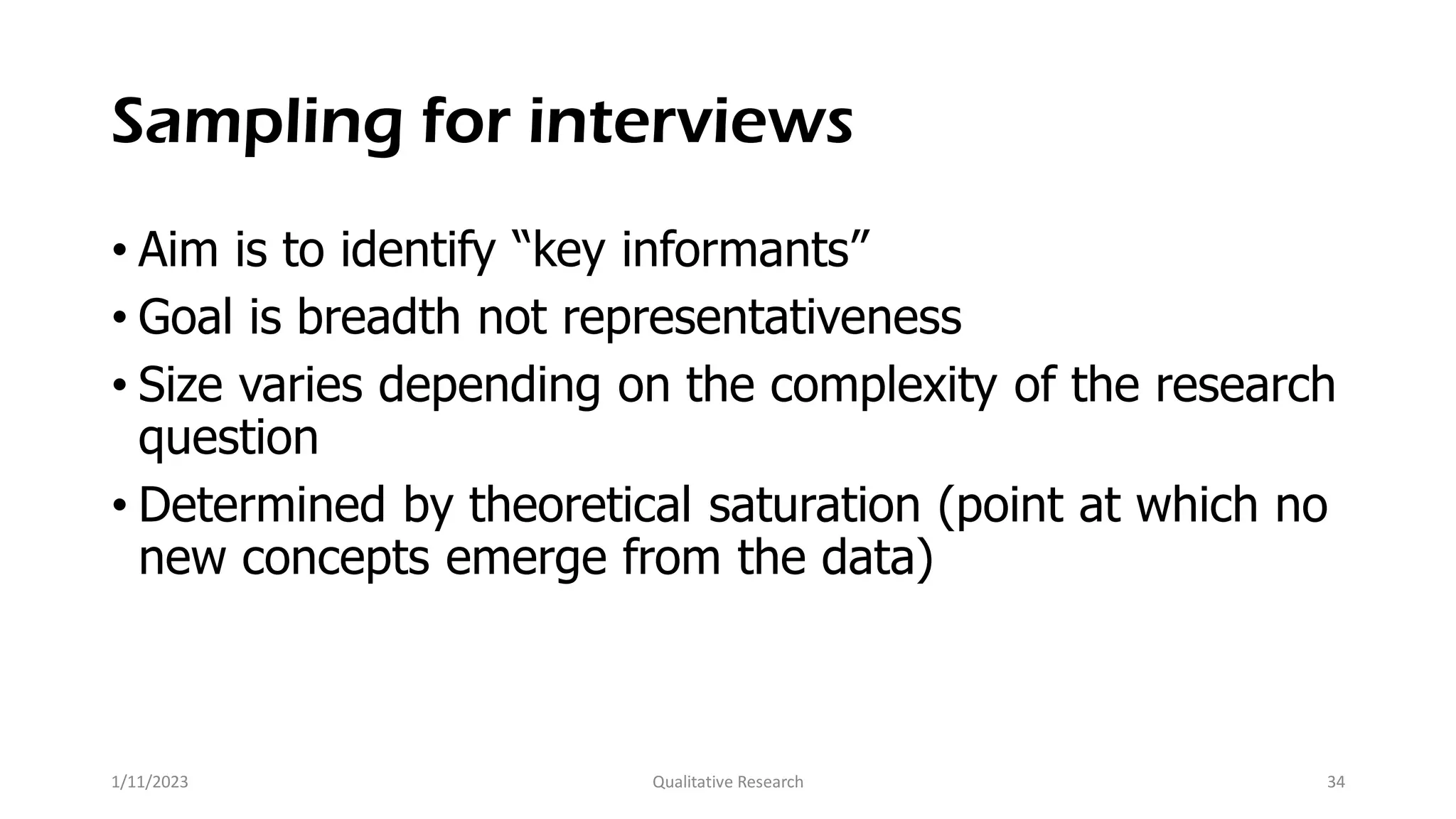
Sampling for interviews
•Aim is to identify “key informants”
• Goal is breadth not representativeness
• Size varies depending on the complexity of the research
question
• Determined by theoretical saturation (point at which no
new concepts emerge from the data)
1/11/2023 Qualitative Research 34
34.
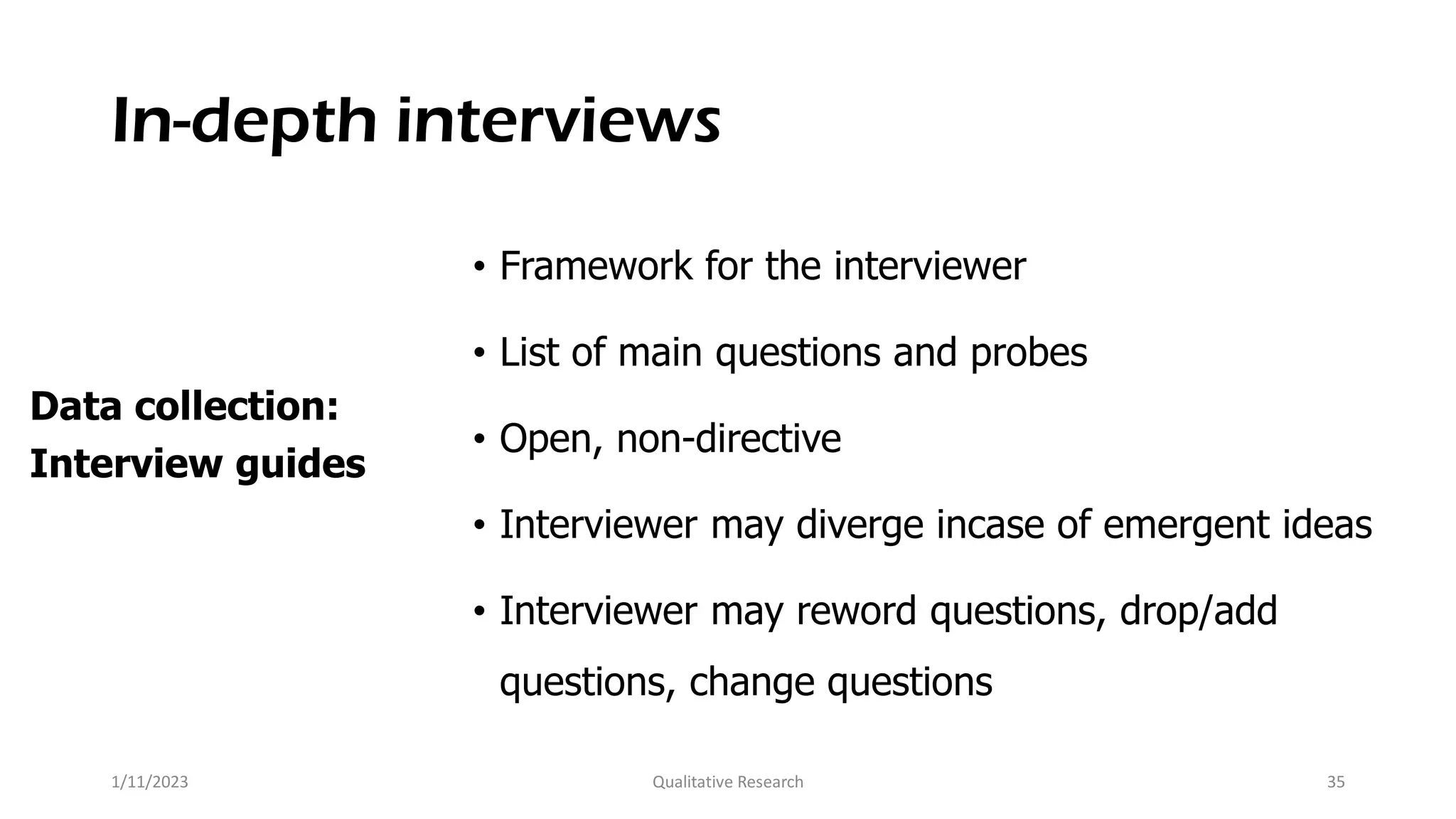
In-depth interviews
Data collection:
Interviewguides
• Framework for the interviewer
• List of main questions and probes
• Open, non-directive
• Interviewer may diverge incase of emergent ideas
• Interviewer may reword questions, drop/add
questions, change questions
1/11/2023 Qualitative Research 35
35.
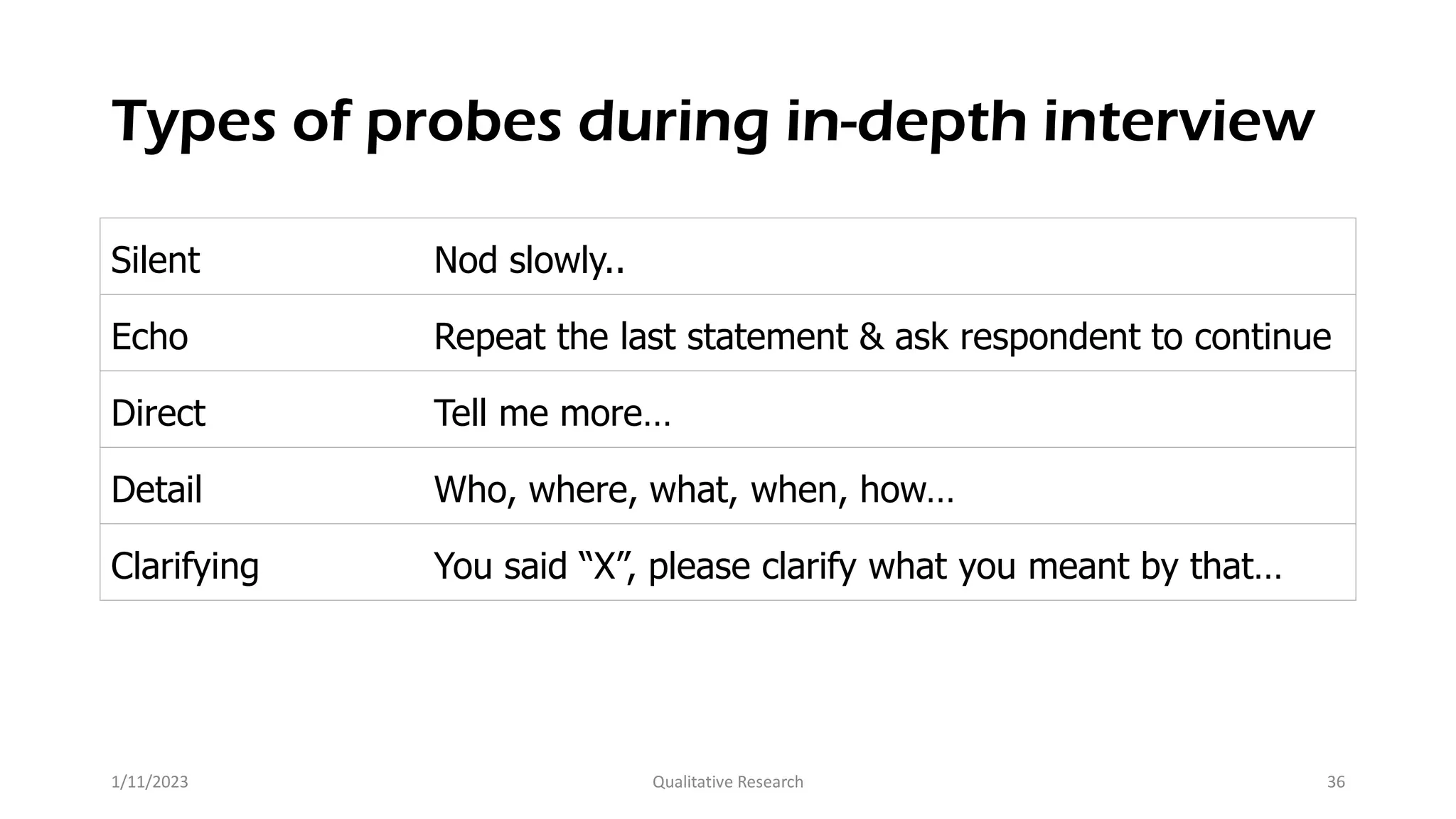
Types of probesduring in-depth interview
Silent Nod slowly..
Echo Repeat the last statement & ask respondent to continue
Direct Tell me more…
Detail Who, where, what, when, how…
Clarifying You said “X”, please clarify what you meant by that…
1/11/2023 Qualitative Research 36
36.
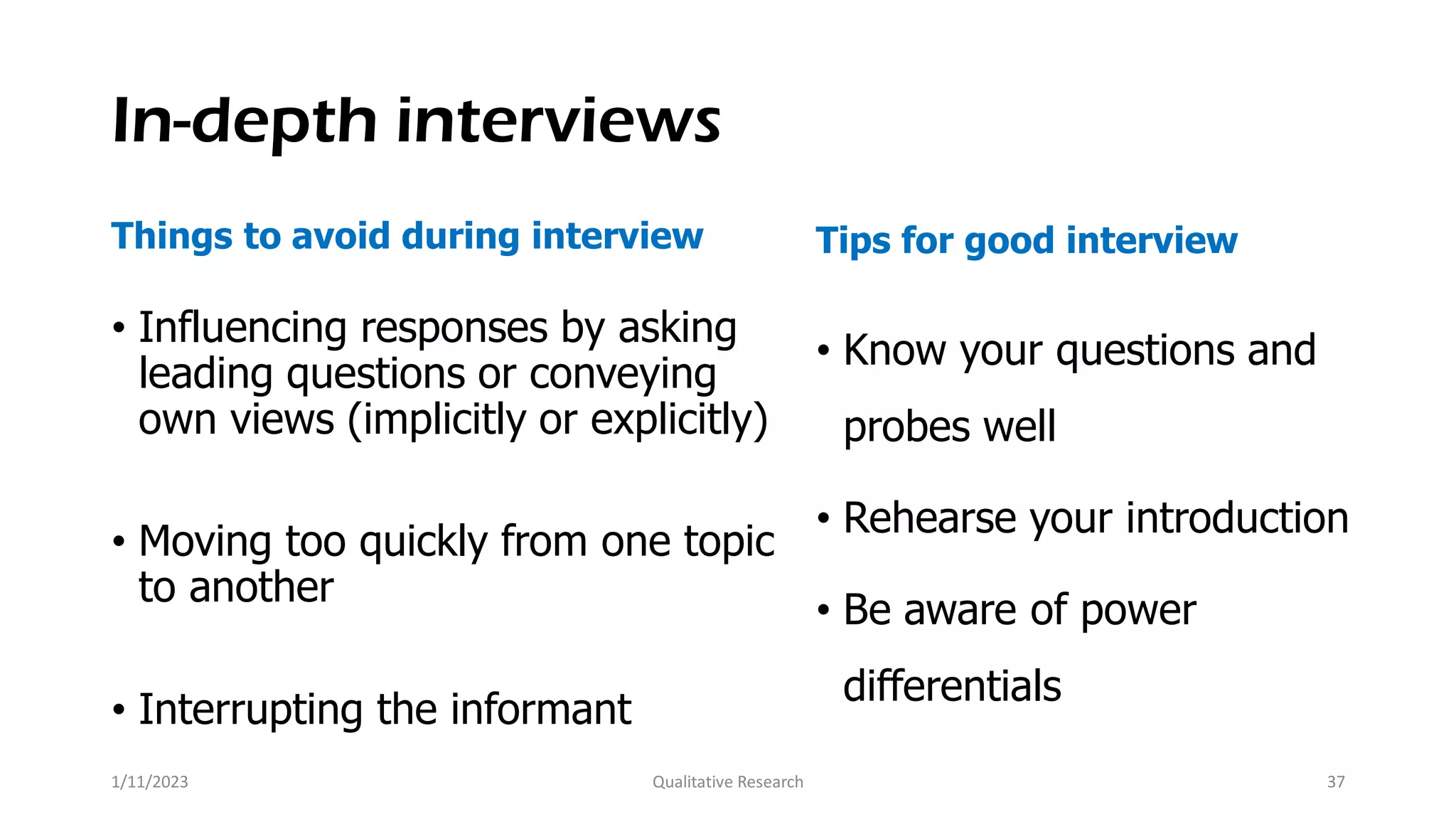
In-depth interviews
Things toavoid during interview
• Influencing responses by asking
leading questions or conveying
own views (implicitly or explicitly)
• Moving too quickly from one topic
to another
• Interrupting the informant
Tips for good interview
• Know your questions and
probes well
• Rehearse your introduction
• Be aware of power
differentials
1/11/2023 Qualitative Research 37
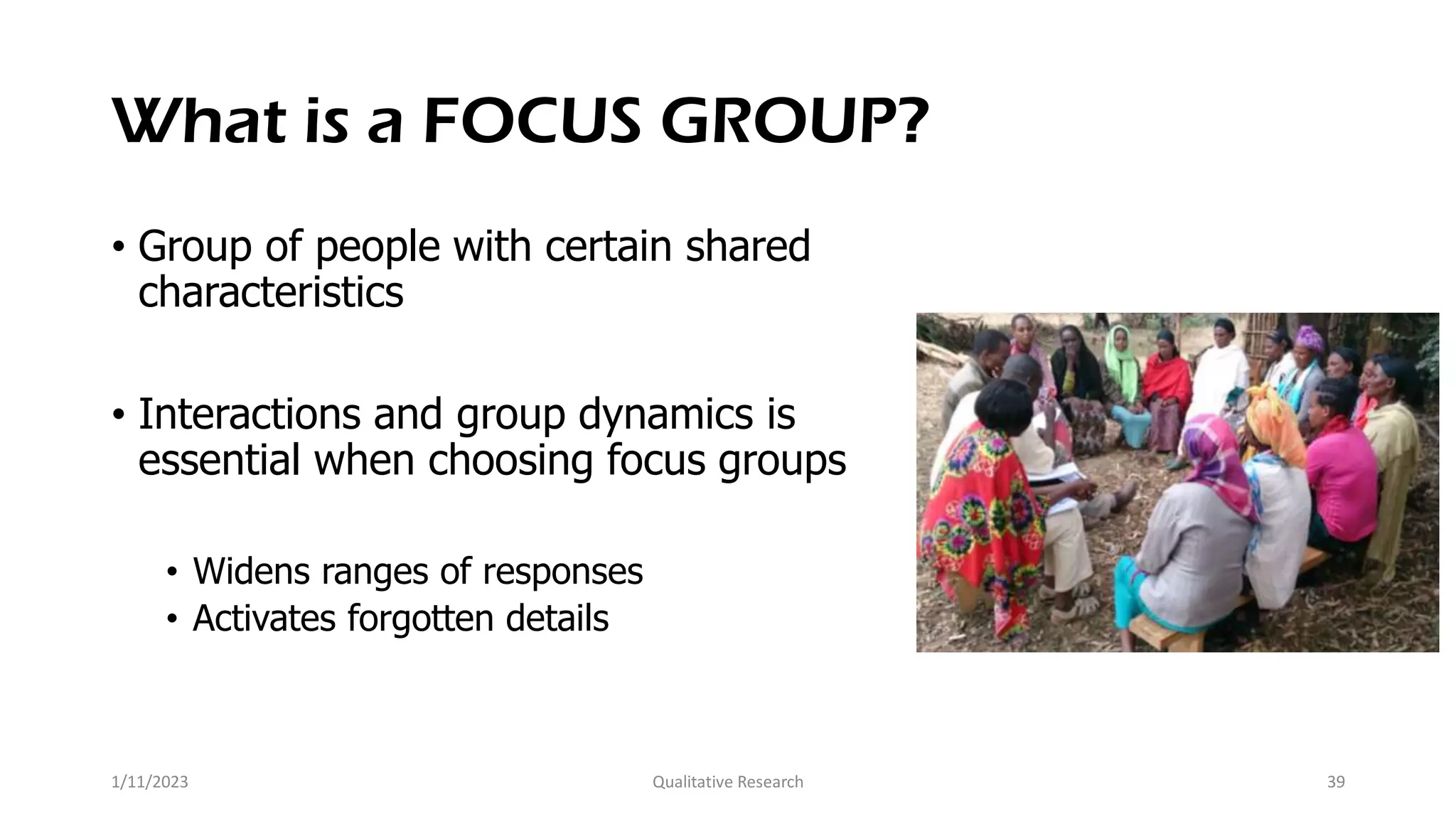
What is aFOCUS GROUP?
• Group of people with certain shared
characteristics
• Interactions and group dynamics is
essential when choosing focus groups
• Widens ranges of responses
• Activates forgotten details
1/11/2023 Qualitative Research 39
39.
Focus groups areuseful for…
• Characterizing social & cultural norms
• Sharing and comparing ideas
• Exploring potentially sensitive issues
1/11/2023 Qualitative Research 40
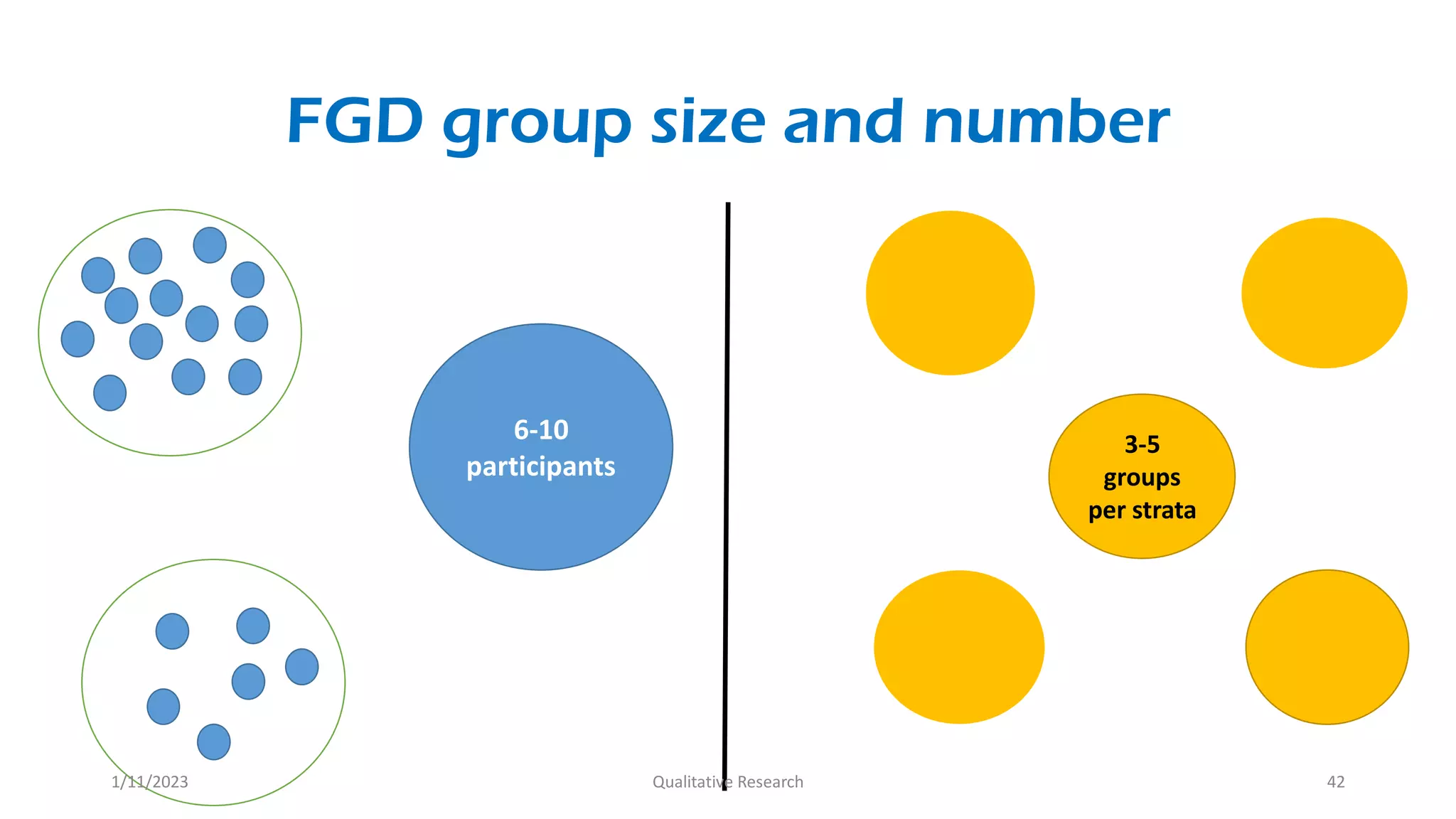
FGD group sizeand number
6-10
participants
3-5
groups
per strata
1/11/2023 Qualitative Research 42
42.
Analysis of FGDdata
• The group is the unit of analysis (not individuals within it)
• View of one individual or theme of the group
• Response to question or emerged spontaneously
1/11/2023 Qualitative Research 43
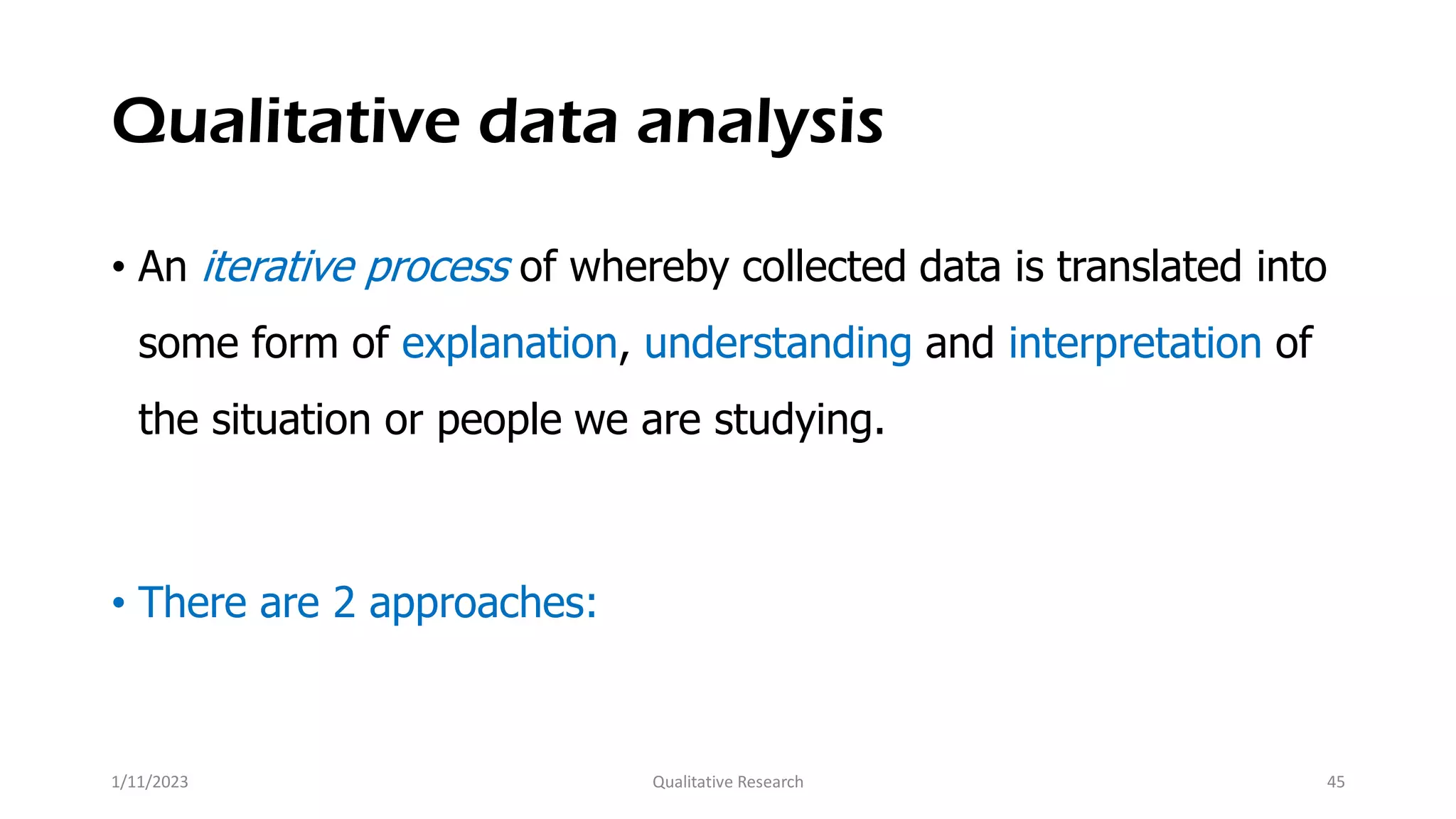
Qualitative data analysis
•An iterative process of whereby collected data is translated into
some form of explanation, understanding and interpretation of
the situation or people we are studying.
• There are 2 approaches:
1/11/2023 Qualitative Research 45
45.
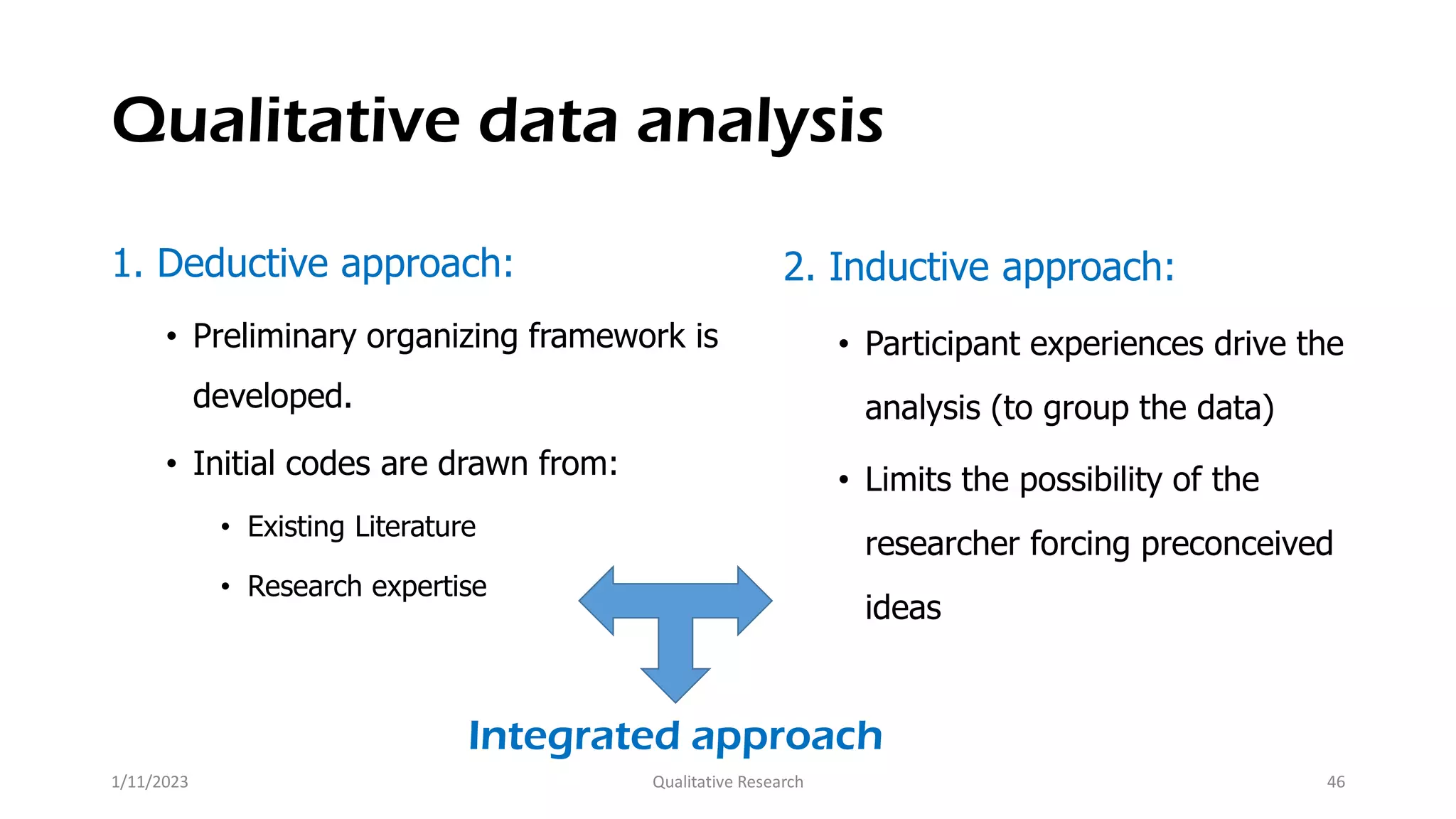
Qualitative data analysis
1.Deductive approach:
• Preliminary organizing framework is
developed.
• Initial codes are drawn from:
• Existing Literature
• Research expertise
2. Inductive approach:
• Participant experiences drive the
analysis (to group the data)
• Limits the possibility of the
researcher forcing preconceived
ideas
Integrated approach
1/11/2023 Qualitative Research 46
46.
What are Codes?
•Codes are words or short phrases that represent the essence or
key attributes of narrative/verbal information.
• Used to codify or categorize data
• Coding is the process of organizing the data into “chunks” that
are alike
• Codes are developed into code structure
1/11/2023 Qualitative Research 47
47.
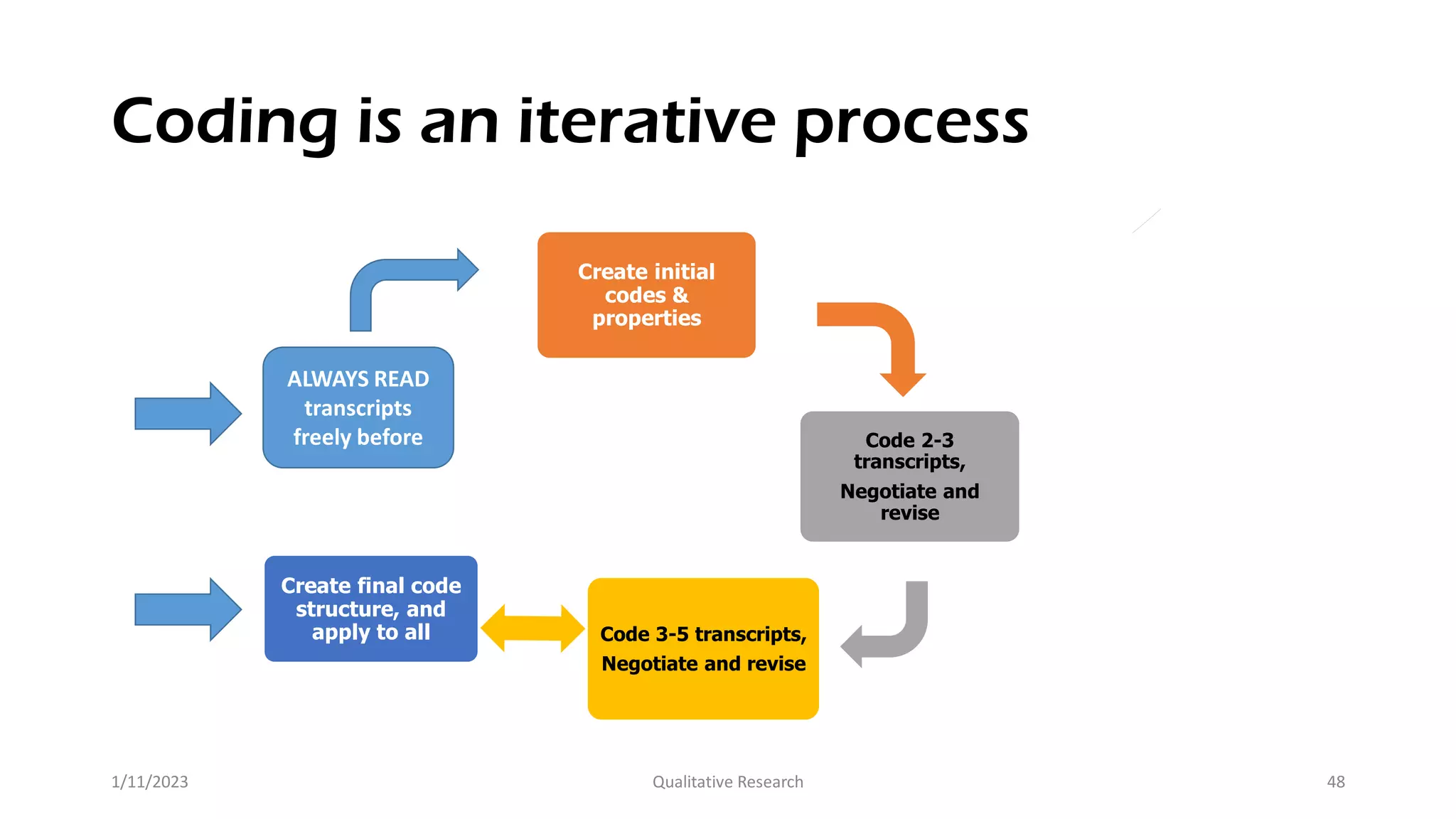
Coding is aniterative process
Create initial
codes &
properties
Code 2-3
transcripts,
Negotiate and
revise
Code 3-5 transcripts,
Negotiate and revise
Create final code
structure, and
apply to all
ALWAYS READ
transcripts
freely before
1/11/2023 Qualitative Research 48
48.
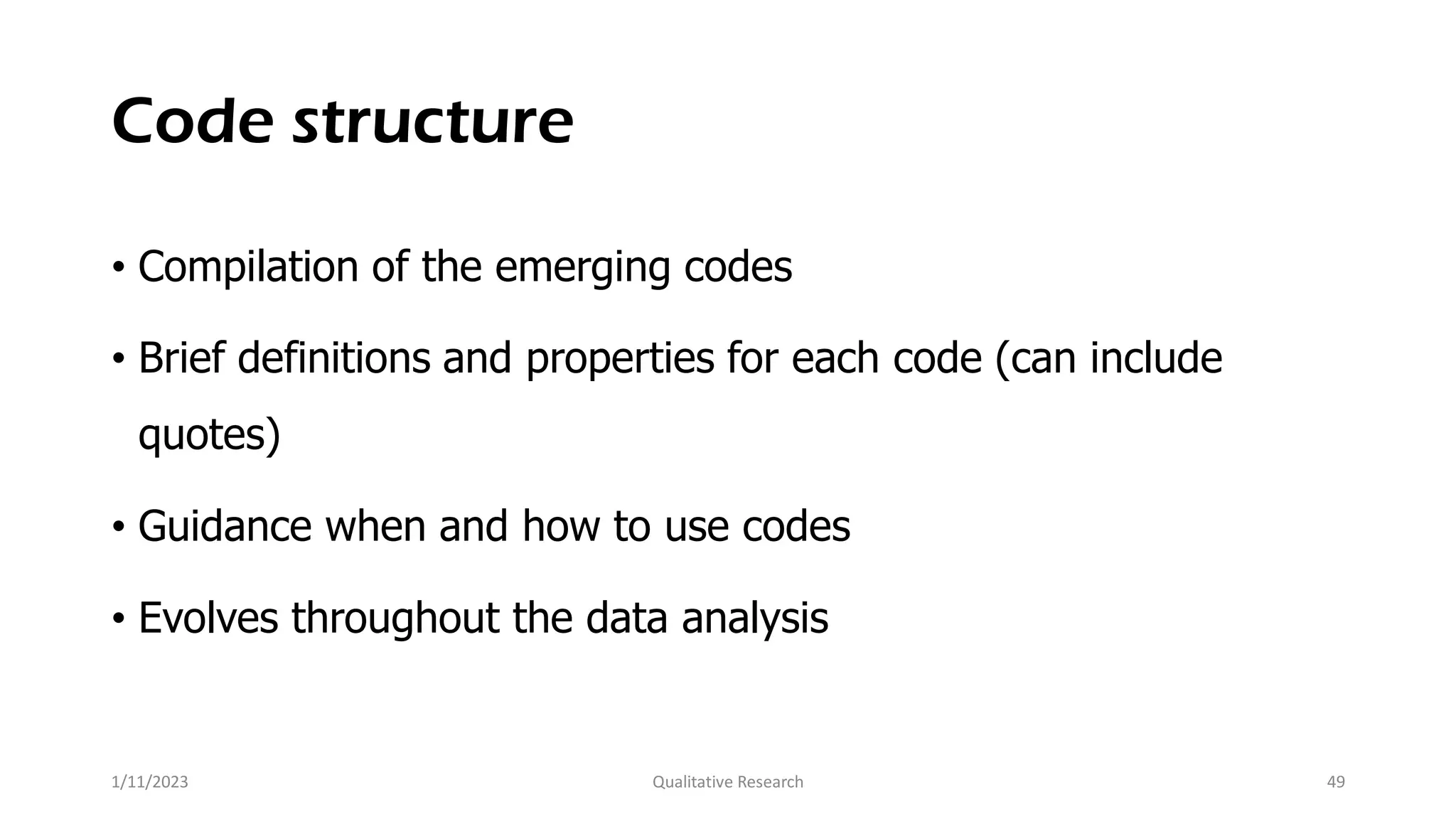
Code structure
• Compilationof the emerging codes
• Brief definitions and properties for each code (can include
quotes)
• Guidance when and how to use codes
• Evolves throughout the data analysis
1/11/2023 Qualitative Research 49
49.
Be flexible inrefining code structure
• Negotiation may be required
• Expand to encompass more ideas
• Merge into existing codes
1/11/2023 Qualitative Research 50
50.
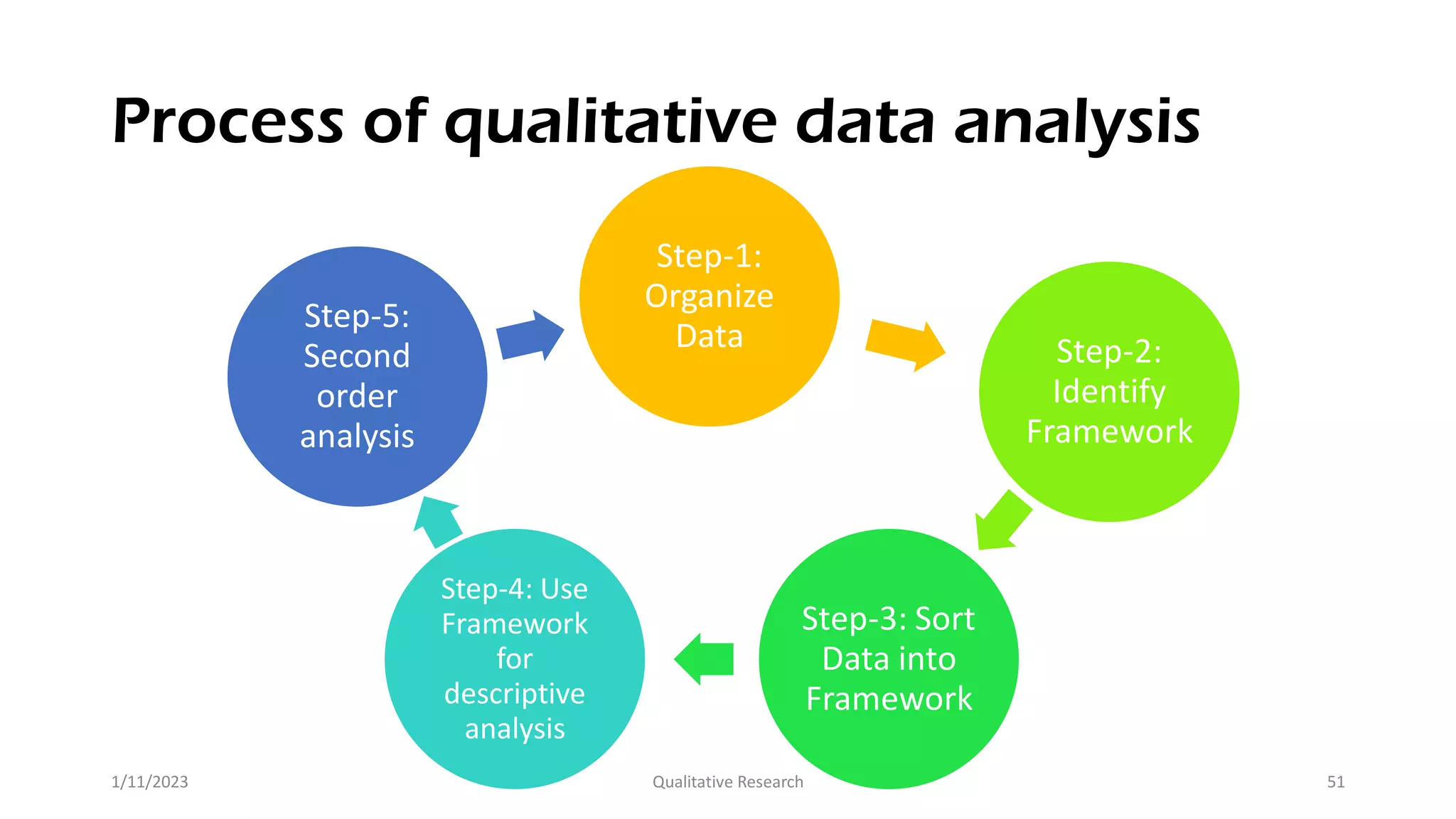
Process of qualitativedata analysis
Step-1:
Organize
Data Step-2:
Identify
Framework
Step-3: Sort
Data into
Framework
Step-4: Use
Framework
for
descriptive
analysis
Step-5:
Second
order
analysis
1/11/2023 Qualitative Research 51
51.
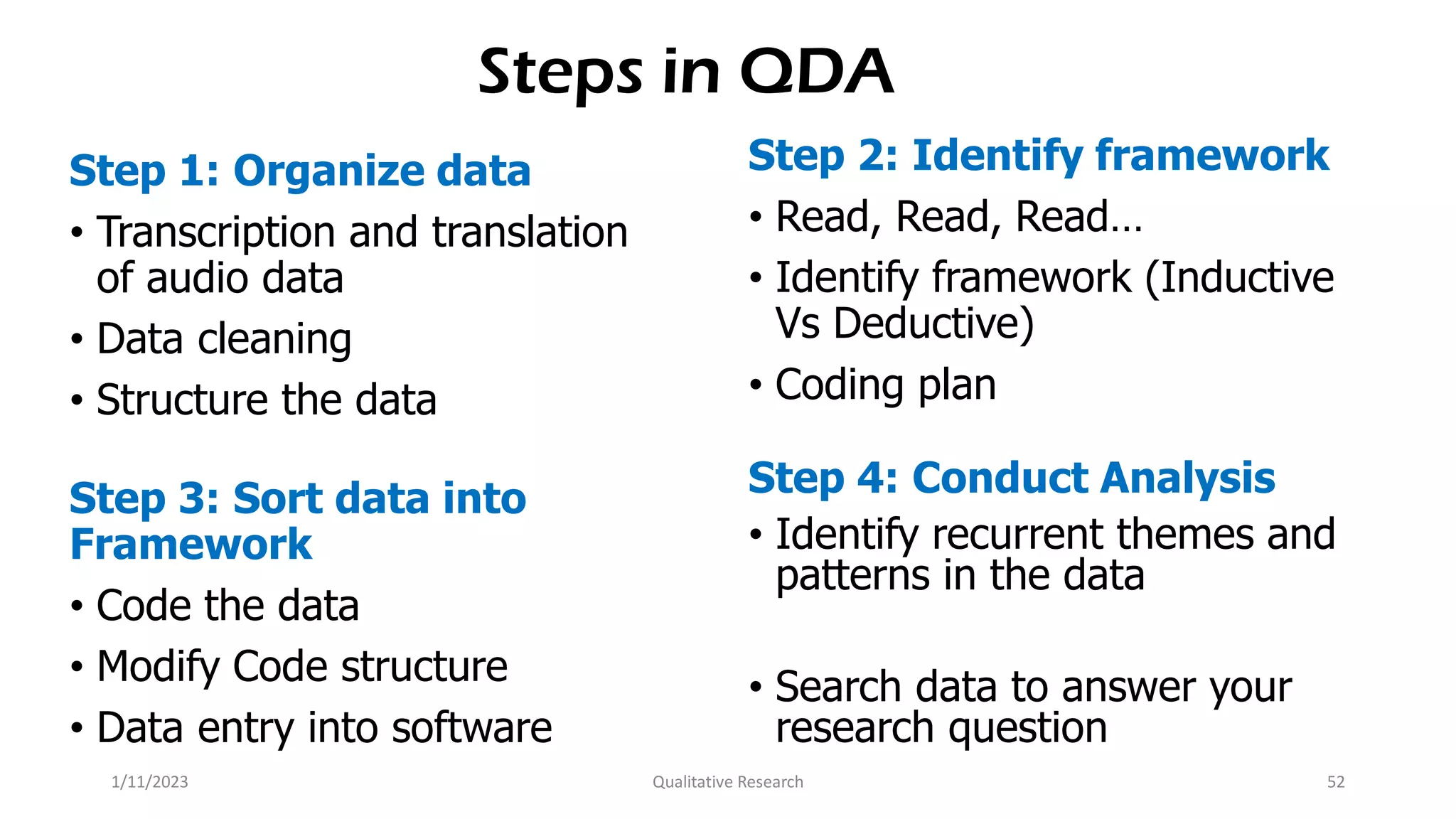
Steps in QDA
Step1: Organize data
• Transcription and translation
of audio data
• Data cleaning
• Structure the data
Step 2: Identify framework
• Read, Read, Read…
• Identify framework (Inductive
Vs Deductive)
• Coding plan
Step 3: Sort data into
Framework
• Code the data
• Modify Code structure
• Data entry into software
Step 4: Conduct Analysis
• Identify recurrent themes and
patterns in the data
• Search data to answer your
research question
1/11/2023 Qualitative Research 52
52.
Using software foranalysis
• Increasingly seen as a standard
• Key to organizing large amount of data
• Supports transparency
• Software can support analysis but DOES NOT do
analysis for you!
1/11/2023 Qualitative Research 53
53.
Overview of thechapter
Topics to be covered:
• What is a qualitative research?
• Developing a qualitative research question
• Qualitative research designs
• Data collection in qualitative research
• Qualitative data analysis (overview & types)
• Writing qualitative research
• Scientific rigor in qualitative research
1/11/2023 Qualitative Research 54
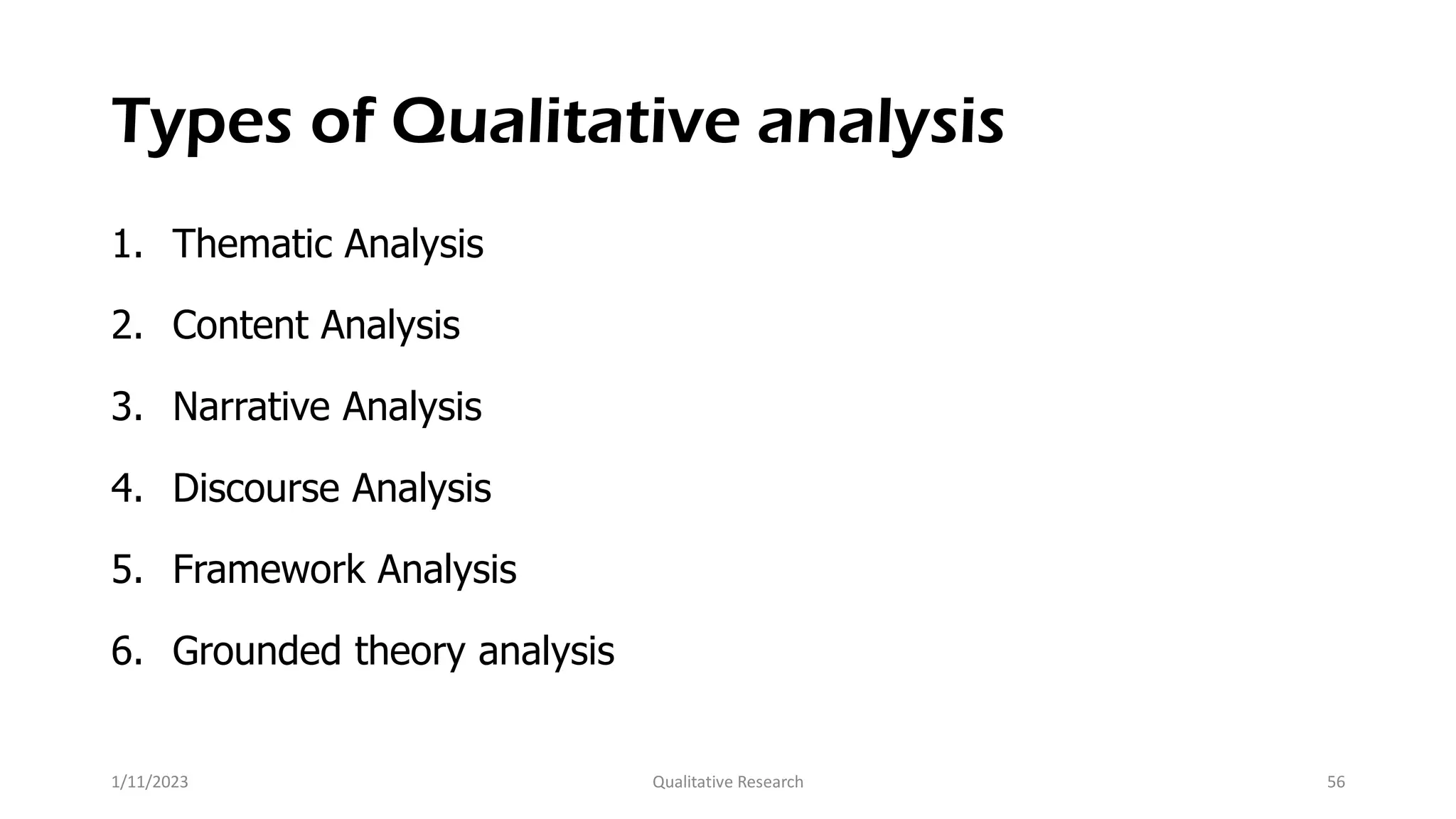
Types of Qualitativeanalysis
1. Thematic Analysis
2. Content Analysis
3. Narrative Analysis
4. Discourse Analysis
5. Framework Analysis
6. Grounded theory analysis
1/11/2023 Qualitative Research 56
56.
1. Thematic Analysis
•Thematic analysis helps to identify, analyze, and
interpret patterns in qualitative data.
• Focuses on identifying patterns and ‘themes’.
1/11/2023 Qualitative Research 57
57.
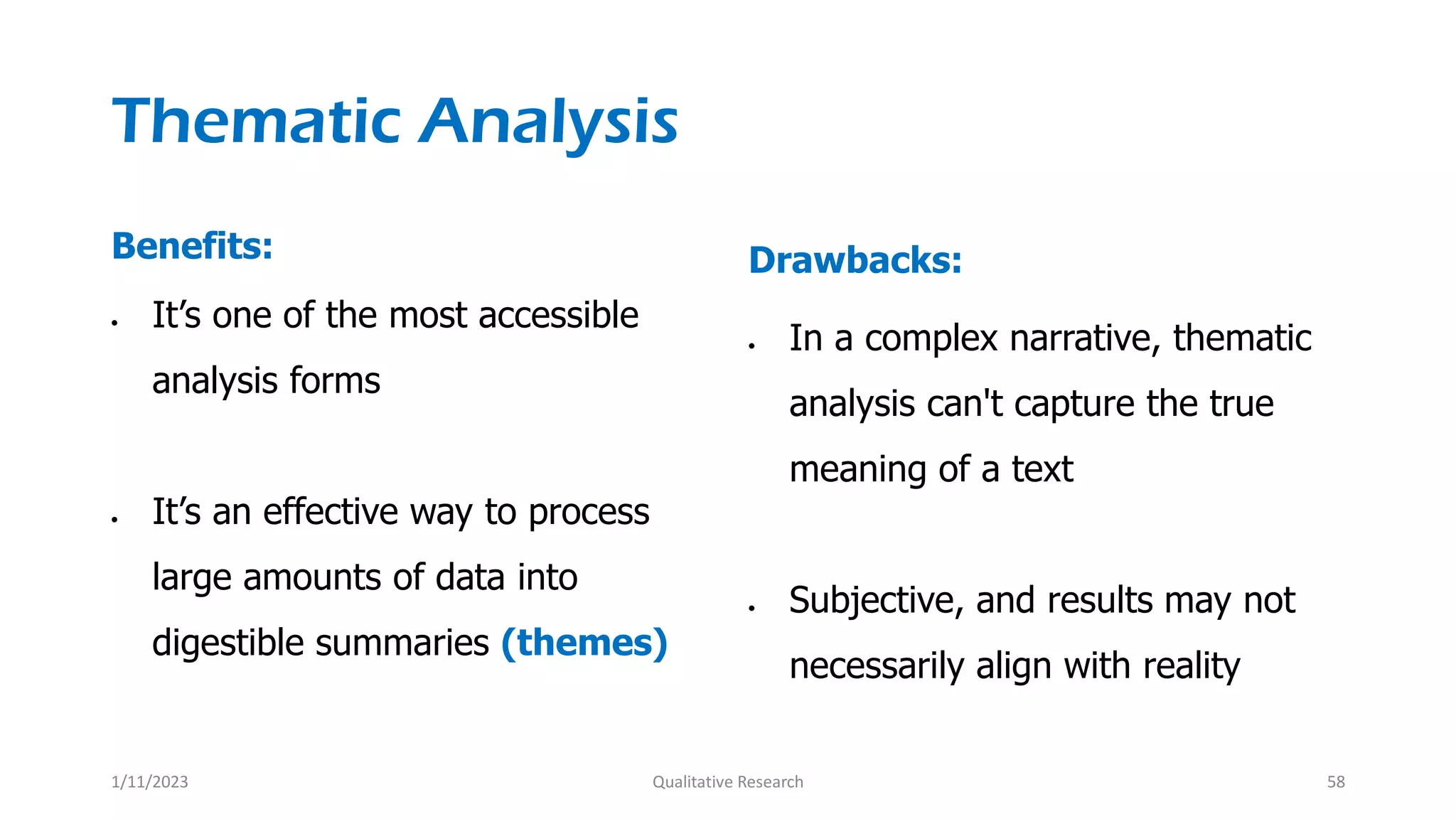
Thematic Analysis
Benefits:
It’sone of the most accessible
analysis forms
It’s an effective way to process
large amounts of data into
digestible summaries (themes)
Drawbacks:
In a complex narrative, thematic
analysis can't capture the true
meaning of a text
Subjective, and results may not
necessarily align with reality
1/11/2023 Qualitative Research 58
58.
2. Content Analysis
•Examines and quantifies the presence of concepts in text,
image, video, or audio messages.
• Procedure for categorization of verbal or behavioral data for the
purpose of classification, summarization and tabulation.
1/11/2023 Qualitative Research 59
59.
Content Analysis
Advantages:
• Youdon’t need to directly
interact with participants to
collect data
• It doesn’t require high
investments or sophisticated
solutions
Drawbacks:
• Subjective interpretation
affects your results
• Less effective for complex
textual analysis
1/11/2023 Qualitative Research 60
60.
3. Narrative analysis
•Is used to interpret research participants’ stories or
experiences
• Every interview has narrative aspect that the researcher has to
sort out and reflect upon them, enhance them, and present
them in revised shape to readers.
1/11/2023 Qualitative Research 61
61.
Narrative analysis
Advantages:
• Themethod provides you with a
deep understanding of
participants' actions — & the
motivations behind them
• Keeps experiences as wholes,
instead of fragmenting them
into themes that can be
interpreted differently
Drawbacks:
• It requires a lot of time and
manual effort to make
conclusions
1/11/2023 Qualitative Research 62
62.
4. Grounded theoryanalysis
• A method of conducting qualitative research to develop
theories by examining real-world data.
• The technique involves the generation of hypotheses and
theories based on data
1/11/2023 Qualitative Research 63
63.
Grounded theory analysis
Advantages:
•It explains events that can’t
be explained with existing
theories
• The results are data-
informed, and therefore
represent the proven state of
things.
Drawbacks:
• Requires a lot of objectivity,
creativity, and critical thinking
• Overly theoretical
1/11/2023 Qualitative Research 64
64.
5. Discourse analysis
•Method of analyzing naturally occurring interactions or written
texts.
• Making sense of everyday social life.
• In contrast to content analysis, the method focuses on the
contextual meanings.
• What people think of a topic, and why they feel the way they
do about it.
1/11/2023 Qualitative Research 65
65.
Which qualitative dataanalysis
method should you choose?
• The techniques are different in their intent and approaches.
• The choice of the method of analysis is driven by your research
question.
1/11/2023 Qualitative Research 66
66.
Tools for helpingthe Analytical
Process
• Summaries
• Should contain the key points that emerge from undertaking
the specific activity
• Self Memos
• Allow you to make a record of the ideas which occur to you
about any aspect of your research, as you think of them
• Researcher Diary
67.
Summary of QDA
•Qualitative data analysis is not easy or fast
• Best accomplished with multidisciplinary team
• Data collection and analysis are iterative processes
• Common approach is constant comparative method
• Code structure evolves inductively
1/11/2023 Qualitative Research 68
Writing the QualitativeResearch report
• Researcher analyzes data and writes the analysis in
back-and-forth reflective steps
• Writing the report is part of developing the
interpretation of the data
• Rich thick descriptions – places readers in the setting
1/11/2023 Qualitative Research 70
70.
Challenges to writingqualitative research
• In addition to challenges of writing any report,
researcher prejudice/bias is another challenge
• Qualitative studies tend to be longer
1/11/2023 Qualitative Research 71
71.
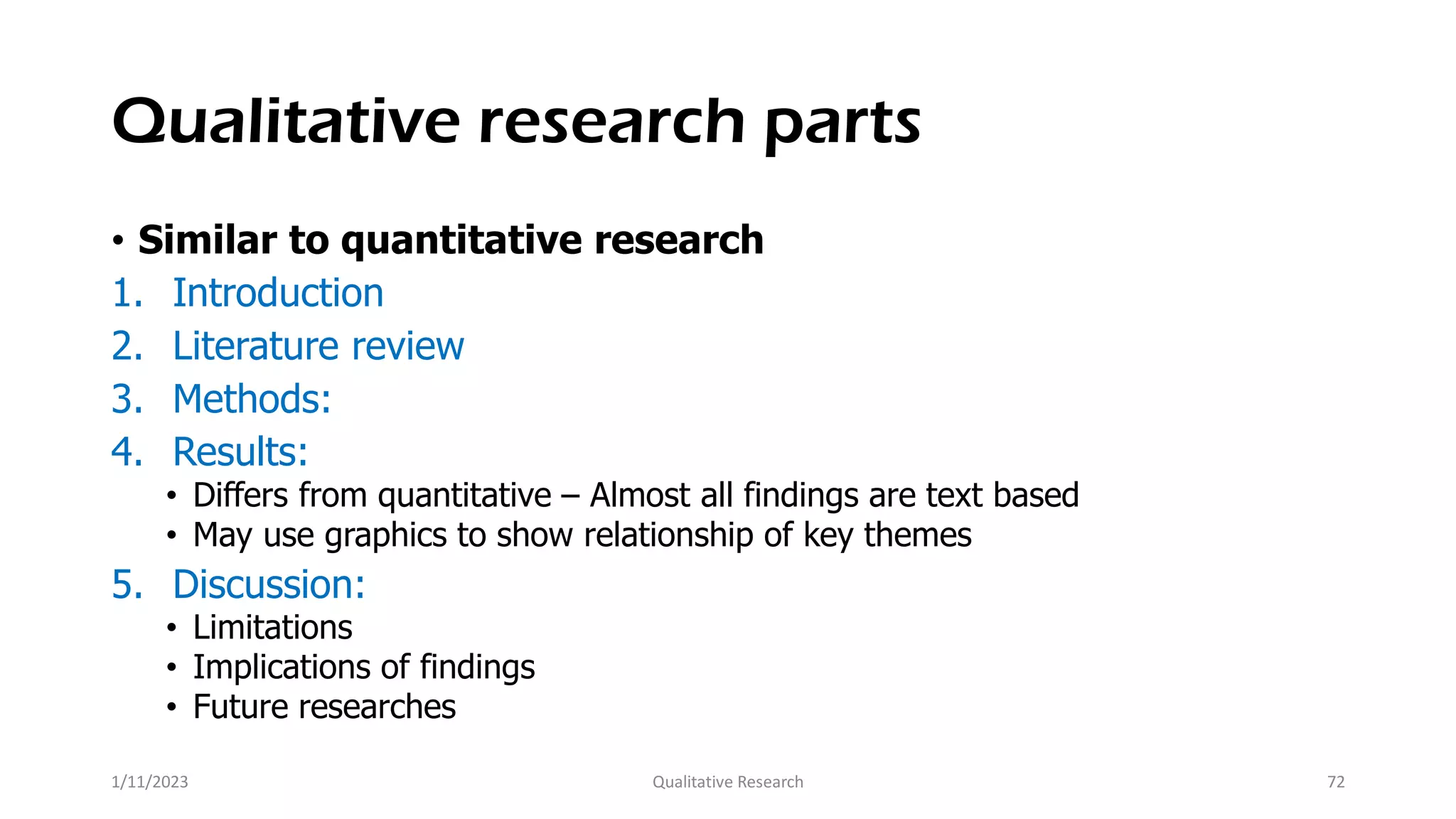
Qualitative research parts
•Similar to quantitative research
1. Introduction
2. Literature review
3. Methods:
4. Results:
• Differs from quantitative – Almost all findings are text based
• May use graphics to show relationship of key themes
5. Discussion:
• Limitations
• Implications of findings
• Future researches
1/11/2023 Qualitative Research 72
72.
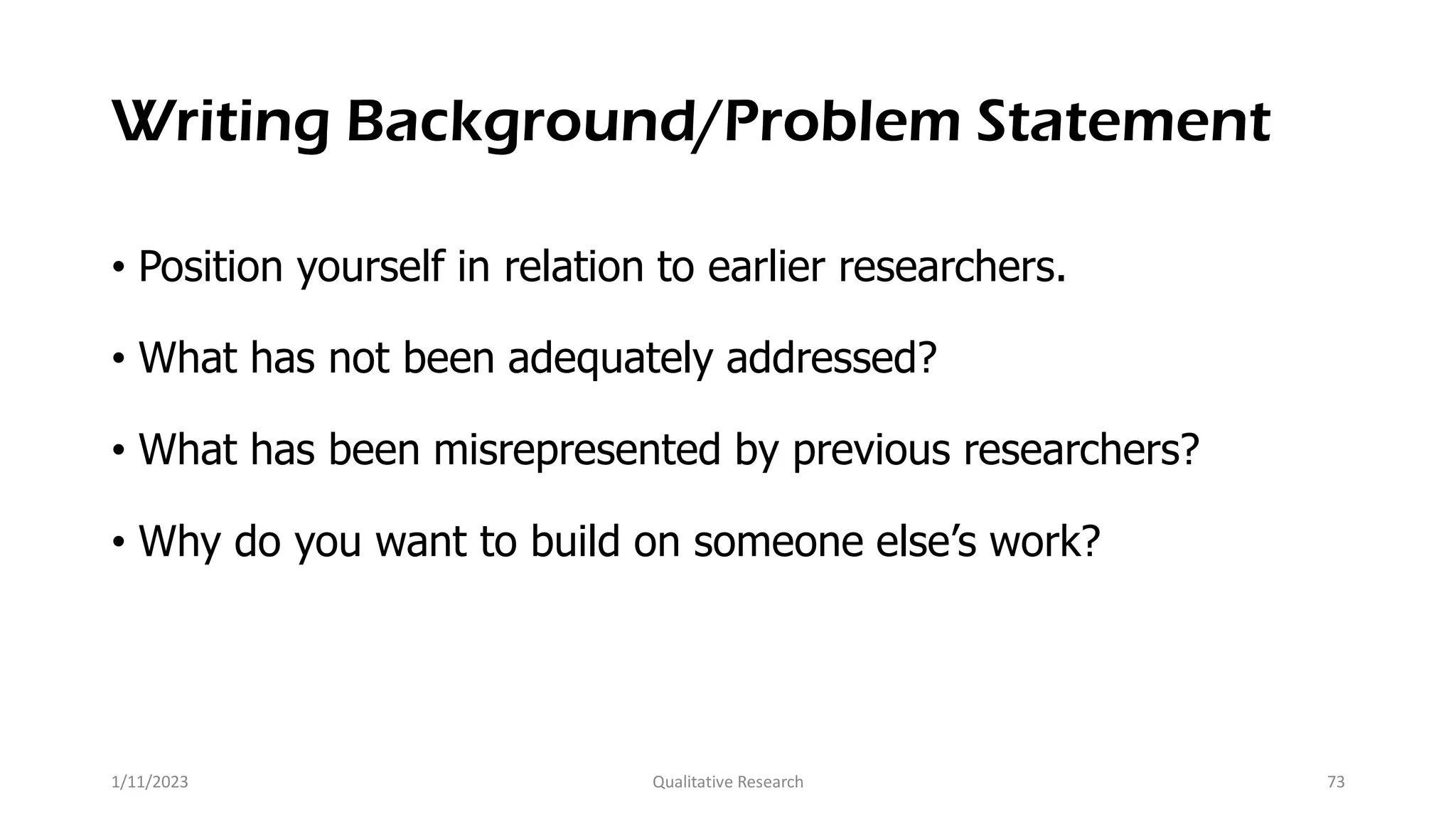
Writing Background/Problem Statement
•Position yourself in relation to earlier researchers.
• What has not been adequately addressed?
• What has been misrepresented by previous researchers?
• Why do you want to build on someone else’s work?
1/11/2023 Qualitative Research 73
73.
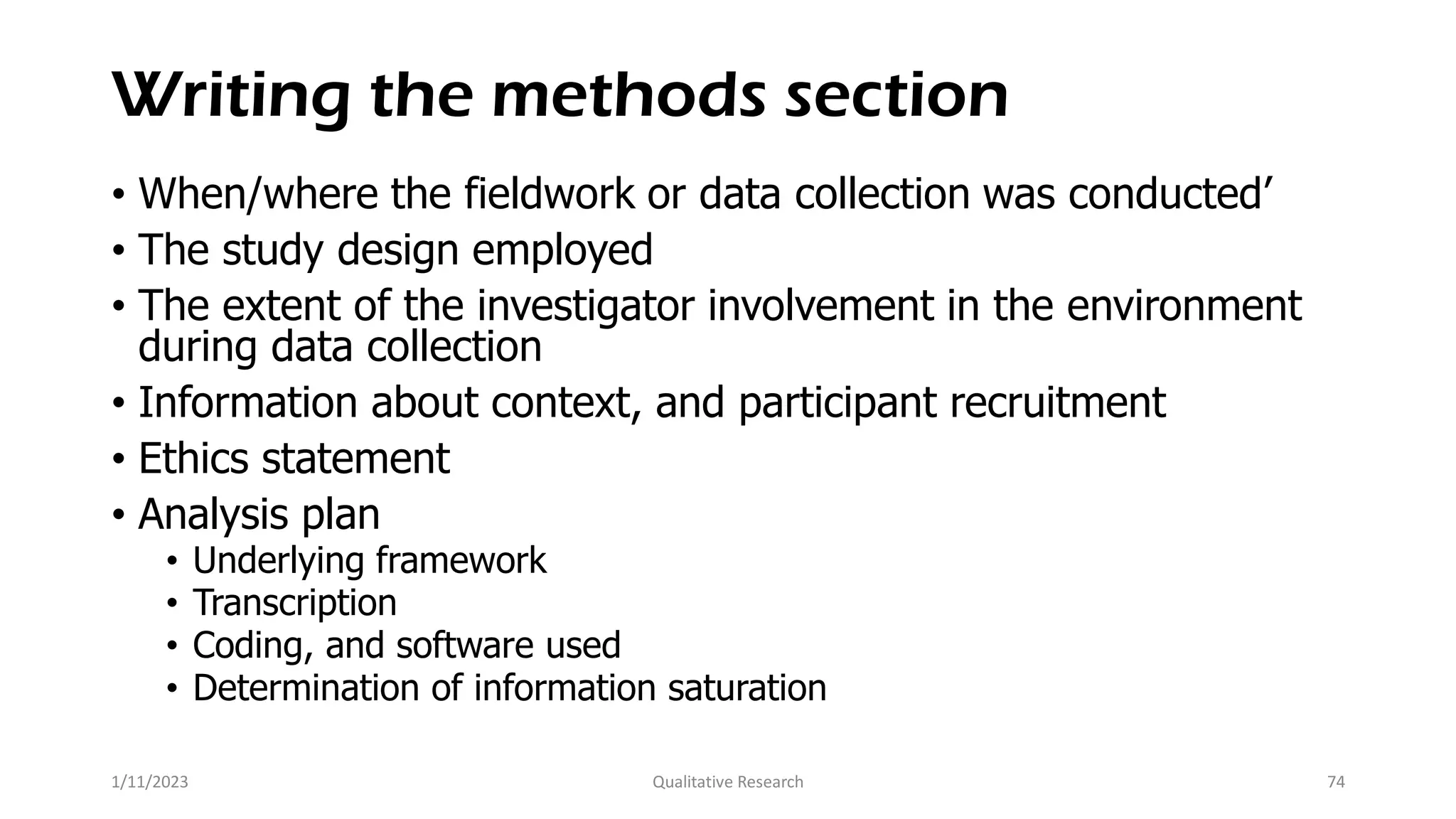
Writing the methodssection
• When/where the fieldwork or data collection was conducted’
• The study design employed
• The extent of the investigator involvement in the environment
during data collection
• Information about context, and participant recruitment
• Ethics statement
• Analysis plan
• Underlying framework
• Transcription
• Coding, and software used
• Determination of information saturation
1/11/2023 Qualitative Research 74
74.
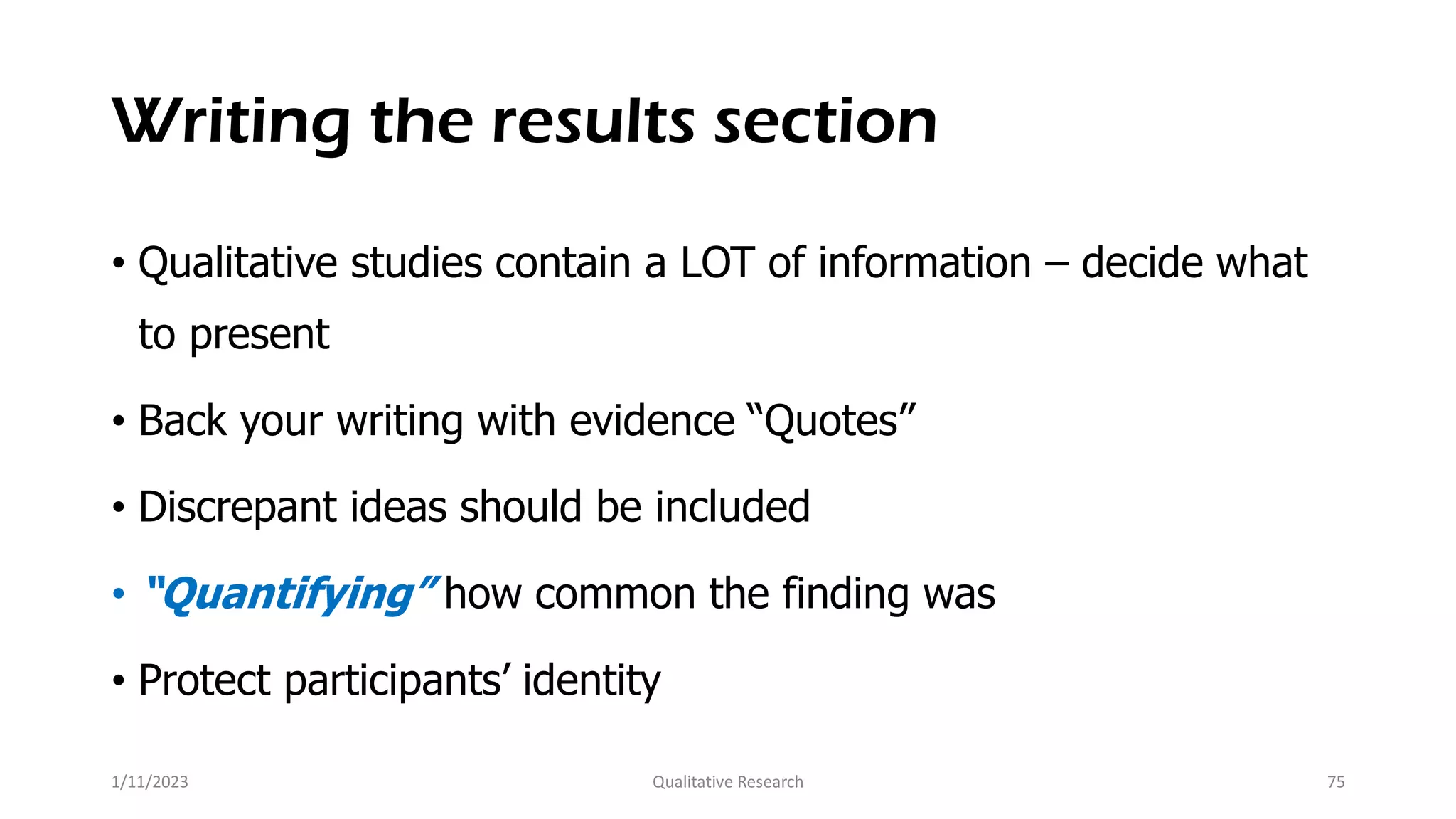
Writing the resultssection
• Qualitative studies contain a LOT of information – decide what
to present
• Back your writing with evidence “Quotes”
• Discrepant ideas should be included
• “Quantifying” how common the finding was
• Protect participants’ identity
1/11/2023 Qualitative Research 75
75.
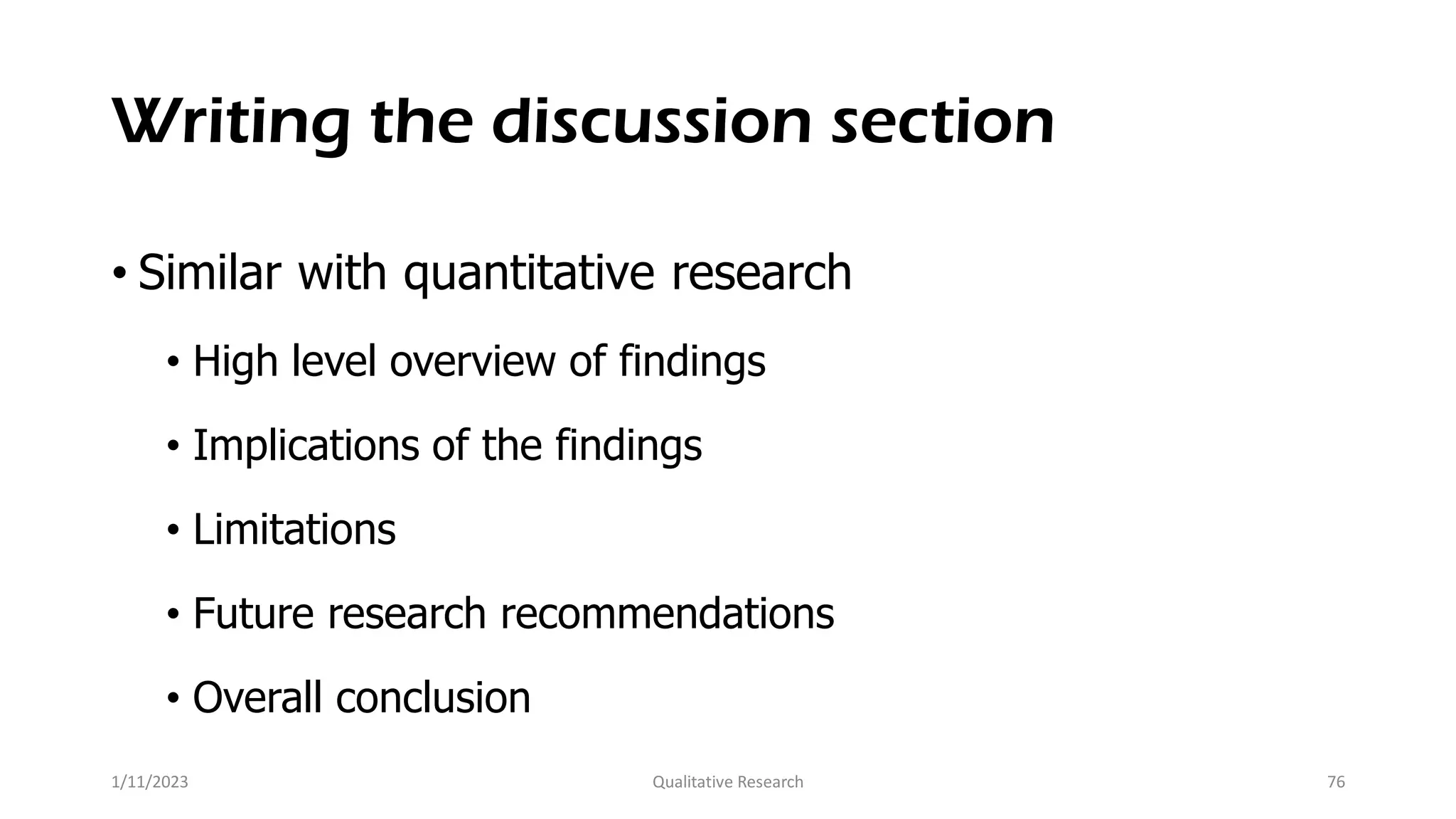
Writing the discussionsection
• Similar with quantitative research
• High level overview of findings
• Implications of the findings
• Limitations
• Future research recommendations
• Overall conclusion
1/11/2023 Qualitative Research 76
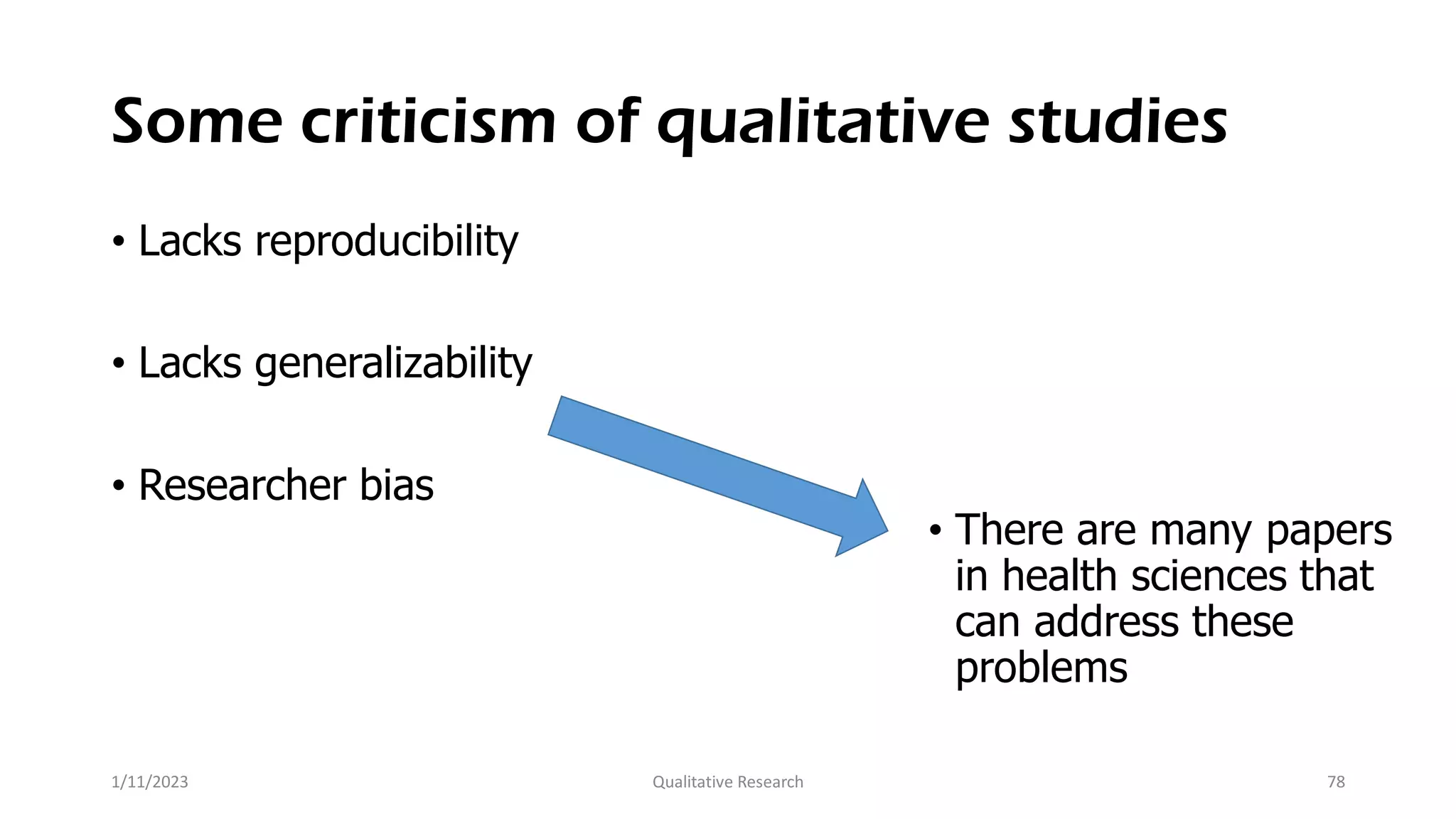
Some criticism ofqualitative studies
• Lacks reproducibility
• Lacks generalizability
• Researcher bias
• There are many papers
in health sciences that
can address these
problems
1/11/2023 Qualitative Research 78
78.
Standards for rigor
QuantitativeQualitative Issues addressed
Internal Validity Credibility Truth value
External Validity Transferability Generalizability
Reliability Dependability or
trustworthiness
Consistency
Objectivity Confirmability Neutrality
1/11/2023 Qualitative Research 79
79.
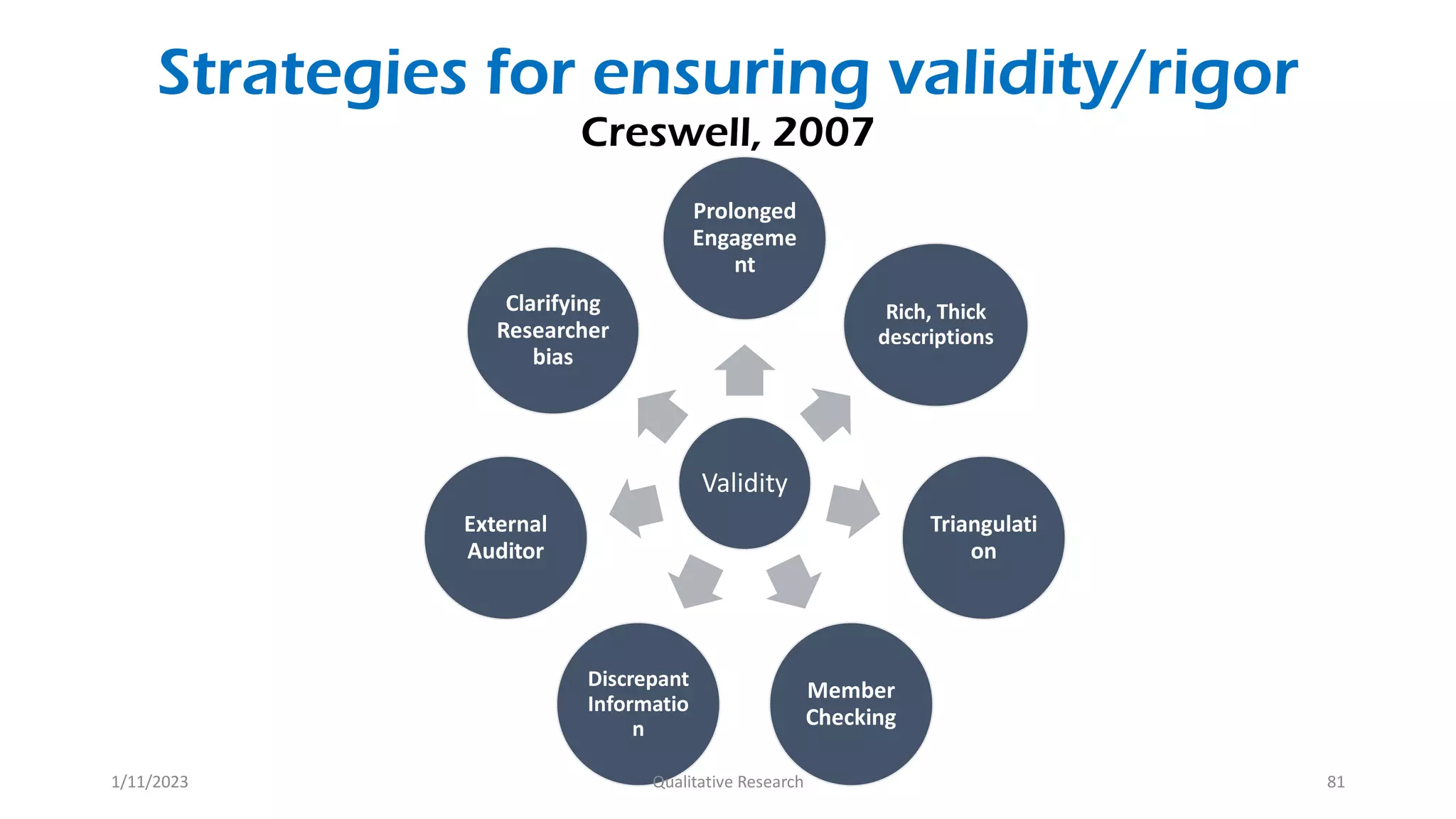
Strategies for ensuringvalidity/rigor
Creswell, 2007
Validity
Prolonged
Engageme
nt
Rich, Thick
descriptions
Triangulati
on
Member
Checking
Discrepant
Informatio
n
External
Auditor
Clarifying
Researcher
bias
1/11/2023 Qualitative Research 81