INTRODUCTION TO
PYTHON.NET
ABOUT ME
• Stefan Schukat
• Software Architect, Physicist
• Different programming stages over the last 30 years
• Pascal, TCL/TK
• C/C++, ATL/MFC, COM, (VB)
• Python
• M
• C#
• Interest in software forensic and cross language techniques
• Twitter @tschodila
• https://www.xing.com/profile/Stefan_Schukat2
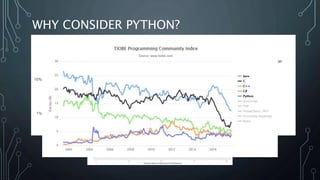
WHY CONSIDER PYTHON?
BASE OF PYTHON
• High level interpreted language
• Dynamic execution with no static typing
• Only few basic data types and programming elements are
defined
• Interpreter engine could be implemented on different
languages
• Extendable and embeddable
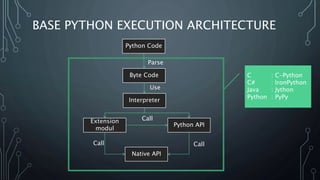
BASE PYTHON EXECUTION ARCHITECTURE
Python Code
Byte Code
Python API
Parse
Interpreter
Use
Extension
modul
Call
Native API
Call Call
C : C-Python
C# : IronPython
Java : Jython
Python : PyPy
PYTHON .NET
• Python Extension module for C-Python
• Access .NET runtime and libraries from Python scripting
• Combines history and amount of extensions from C-Python
with .NET
• Allows scripting access to .NET libraries in C-Python
• Allows embedding in console .NET Application to use C-Python
in .NET
• https://github.com/pythonnet/pythonnet
PYTHON.NET HISTORY
• Developer Brian Lloyd, Barton Cline, Christian Heimes
• Goal integrate .NET seamlessly in Python on Mono and Windows
• 1.0 for .NET 1.0 (2005), .NET 2.0 (2006)
• 2.0 Beta .NET 4.0 (2013) project abandoned
• Revived 2014 on GitHub
• Denis Akhiyarov, David Anthoff, Tony Roberts, Victor Uriarte
• 2.1 for .NET 4.x, Python 2.x, 3.x (2016)
• 2.2 for .NET 4.x, Added Python 3.6 (2017)
• .NET Core support is planned
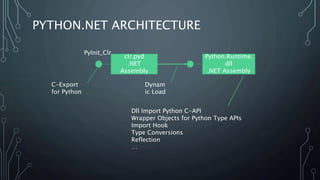
PYTHON.NET ARCHITECTURE
clr.pyd
.NET
Assembly
Dynam
ic Load
PyInit_Clr
Python.Runtime.
dll
.NET Assembly
C-Export
for Python
Dll Import Python C-API
Wrapper Objects for Python Type APIs
Import Hook
Type Conversions
Reflection
…
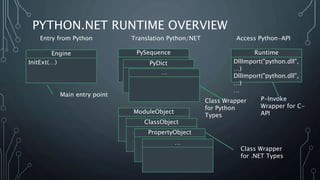
PYTHON.NET RUNTIME OVERVIEW
DllImport("python.dll",
…)
DllImport("python.dll",
…)
…
Runtime
InitExt(…)
Engine PySequence
PyDict
ModuleObject
ClassObject
PropertyObject
…
Class Wrapper
for .NET Types
P-Invoke
Wrapper for C-
API
Class Wrapper
for Python
Types
…
Main entry point
Entry from Python Translation Python/NET Access Python-API
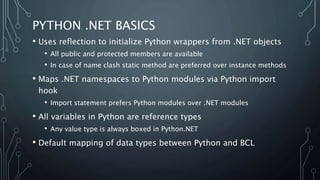
PYTHON .NET BASICS
• Uses reflection to initialize Python wrappers from .NET objects
• All public and protected members are available
• In case of name clash static method are preferred over instance methods
• Maps .NET namespaces to Python modules via Python import
hook
• Import statement prefers Python modules over .NET modules
• All variables in Python are reference types
• Any value type is always boxed in Python.NET
• Default mapping of data types between Python and BCL
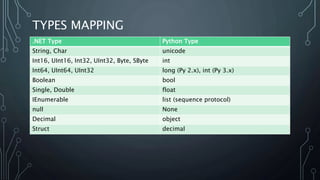
TYPES MAPPING
.NET Type Python Type
String, Char unicode
Int16, UInt16, Int32, UInt32, Byte, SByte int
Int64, UInt64, UInt32 long (Py 2.x), int (Py 3.x)
Boolean bool
Single, Double float
IEnumerable list (sequence protocol)
null None
Decimal object
Struct decimal
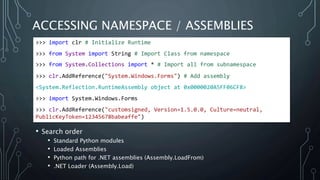
ACCESSING NAMESPACE / ASSEMBLIES
>>> import clr # Initialize Runtime
>>> from System import String # Import Class from namespace
>>> from System.Collections import * # Import all from subnamespace
>>> clr.AddReference("System.Windows.Forms") # Add assembly
<System.Reflection.RuntimeAssembly object at 0x0000020A5FF06CF8>
>>> import System.Windows.Forms
>>> clr.AddReference("customsigned, Version=1.5.0.0, Culture=neutral,
PublicKeyToken=12345678babeaffe")
• Search order
• Standard Python modules
• Loaded Assemblies
• Python path for .NET assemblies (Assembly.LoadFrom)
• .NET Loader (Assembly.Load)
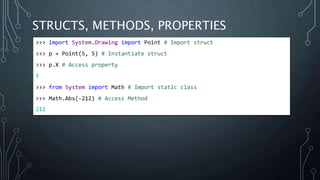
STRUCTS, METHODS, PROPERTIES
>>> import System.Drawing import Point # Import struct
>>> p = Point(5, 5) # Instantiate struct
>>> p.X # Access property
5
>>> from System import Math # Import static class
>>> Math.Abs(-212) # Access Method
212
GENERICS AND OVERLOADS
>>> from System import String, Char, Int32 # Import used types
>>> s = String.Overloads[Char, Int32]("A", 10) # Use overloaded constructor
>>> s # display class
<System.String object at 0x0000020A5FF64908>
>>> print(s) # Use ToString method
AAAAAAAA
>>> from System.Collections.Generic import Dictionary # Import used types
>>> d = Dictionary[String, String]() # Use generic constructor
>>> d2 = Dictionary[str, str]() # Use auto mapped types
>>> print(d) # Use ToString method
System.Collections.Generic.Dictionary`2[System.String,System.String]
INDEXERS, ARRAYS
>>> from System.Collections.Generic import Dictionary as d
>>> jagged = d[str, d[str, int]]() # Create dict of dicts
>>> jagged["a"] = d[str, int]()
>>> jagged["a"]["b"] = 10
>>> jagged["a"]["b"]
10
>>> from System import Array
>>> a = Array[int]([2,2])
>>> a
<System.Int32[] object at 0x0000020A5FF838D0>
>>> a[0] # Multidimensional a[1,1]
2
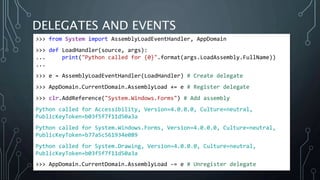
DELEGATES AND EVENTS
>>> from System import AssemblyLoadEventHandler, AppDomain
>>> def LoadHandler(source, args):
... print("Python called for {0}".format(args.LoadAssembly.FullName))
...
>>> e = AssemblyLoadEventHandler(LoadHandler) # Create delegate
>>> AppDomain.CurrentDomain.AssemblyLoad += e # Register delegate
>>> clr.AddReference("System.Windows.Forms") # Add assembly
Python called for Accessibility, Version=4.0.0.0, Culture=neutral,
PublicKeyToken=b03f5f7f11d50a3a
Python called for System.Windows.Forms, Version=4.0.0.0, Culture=neutral,
PublicKeyToken=b77a5c561934e089
Python called for System.Drawing, Version=4.0.0.0, Culture=neutral,
PublicKeyToken=b03f5f7f11d50a3a
>>> AppDomain.CurrentDomain.AssemblyLoad -= e # Unregister delegate
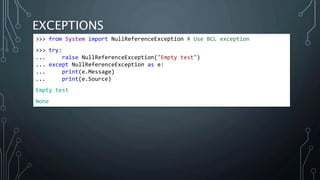
EXCEPTIONS
>>> from System import NullReferenceException # Use BCL exception
>>> try:
... raise NullReferenceException("Empty test")
... except NullReferenceException as e:
... print(e.Message)
... print(e.Source)
Empty test
None
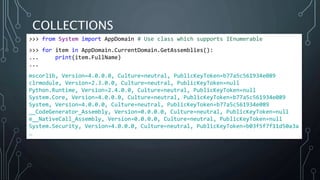
COLLECTIONS
>>> from System import AppDomain # Use class which supports IEnumerable
>>> for item in AppDomain.CurrentDomain.GetAssemblies():
... print(item.FullName)
...
mscorlib, Version=4.0.0.0, Culture=neutral, PublicKeyToken=b77a5c561934e089
clrmodule, Version=2.3.0.0, Culture=neutral, PublicKeyToken=null
Python.Runtime, Version=2.4.0.0, Culture=neutral, PublicKeyToken=null
System.Core, Version=4.0.0.0, Culture=neutral, PublicKeyToken=b77a5c561934e089
System, Version=4.0.0.0, Culture=neutral, PublicKeyToken=b77a5c561934e089
__CodeGenerator_Assembly, Version=0.0.0.0, Culture=neutral, PublicKeyToken=null
e__NativeCall_Assembly, Version=0.0.0.0, Culture=neutral, PublicKeyToken=null
System.Security, Version=4.0.0.0, Culture=neutral, PublicKeyToken=b03f5f7f11d50a3a
…
UI PYTHON .NET
• Simple way
• Write .NET Class Assembly with UI (Winforms or WPF)
• Export functions to be used
• Hard way
• Rewrite generated code via Python.NET
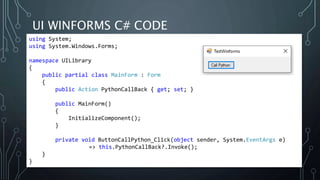
UI WINFORMS C# CODE
using System;
using System.Windows.Forms;
namespace UILibrary
{
public partial class MainForm : Form
{
public Action PythonCallBack { get; set; }
public MainForm()
{
InitializeComponent();
}
private void ButtonCallPython_Click(object sender, System.EventArgs e)
=> this.PythonCallBack?.Invoke();
}
}
UI WINFORMS PYTHON CODE IN UI
APPLICATIONimport clr
clr.AddReference("UILibrary")
import UILibrary
from System import Action
def CallBack():
"""Button click event handler"""
print("Button clicked!")
MainForm = UILibrary.MainForm()
MainForm.PythonCallBack = Action(CallBack)
MainForm.ShowDialog()
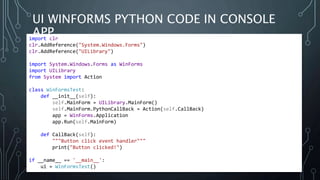
UI WINFORMS PYTHON CODE IN CONSOLE
APPimport clr
clr.AddReference("System.Windows.Forms")
clr.AddReference("UILibrary")
import System.Windows.Forms as WinForms
import UILibrary
from System import Action
class WinFormsTest:
def __init__(self):
self.MainForm = UILibrary.MainForm()
self.MainForm.PythonCallBack = Action(self.CallBack)
app = WinForms.Application
app.Run(self.MainForm)
def CallBack(self):
"""Button click event handler"""
print("Button clicked!")
if __name__ == '__main__':
ui = WinFormsTest()
WINFORMS PURE PYTHON
self.buttonCallPython.Click +=
System.EventHandler(self.ButtonCallPython_Click)
self.AutoScaleDimensions =
System.Drawing.SizeF(6.0, 13.0)
self.AutoScaleMode =
System.Windows.Forms.AutoScaleMode.Font
self.ClientSize = System.Drawing.Size(245, 44)
self.Controls.Add(self.buttonCallPython)
self.MaximizeBox = False
self.MinimizeBox = False
self.Name = "MainForm"
self.Text = "TestWinforms"
self.ResumeLayout(False)
if __name__ == "__main__":
m = MainForm()
m.ShowDialog()
import clr
import System
import System.Windows.Forms
import System.Drawing
class MainForm(System.Windows.Forms.Form):
def __init__(self):
self.InitializeComponent()
def ButtonCallPython_Click(self, source, args):
print("Button clicked")
def InitializeComponent(self):
self.buttonCallPython =
System.Windows.Forms.Button()
self.SuspendLayout()
self.buttonCallPython.Location =
System.Drawing.Point(12, 12)
self.buttonCallPython.Name = "buttonCallPython"
self.buttonCallPython.Size =
System.Drawing.Size(75, 23)
self.buttonCallPython.TabIndex = 0
self.buttonCallPython.Text = "Call Python"
self.buttonCallPython.UseVisualStyleBackColor =
True
FURTHER USE CASES
• Automatic conversion of Python dictionary as .NET dictionary
• Usage of .NET enums as Python enums
• Routing of win32com.client COM objects as __ComObject
THANK YOU!
???????

Introduction to Python.Net

  • 1.
  • 2.
    ABOUT ME • StefanSchukat • Software Architect, Physicist • Different programming stages over the last 30 years • Pascal, TCL/TK • C/C++, ATL/MFC, COM, (VB) • Python • M • C# • Interest in software forensic and cross language techniques • Twitter @tschodila • https://www.xing.com/profile/Stefan_Schukat2
  • 3.
  • 4.
    BASE OF PYTHON •High level interpreted language • Dynamic execution with no static typing • Only few basic data types and programming elements are defined • Interpreter engine could be implemented on different languages • Extendable and embeddable
  • 5.
    BASE PYTHON EXECUTIONARCHITECTURE Python Code Byte Code Python API Parse Interpreter Use Extension modul Call Native API Call Call C : C-Python C# : IronPython Java : Jython Python : PyPy
  • 6.
    PYTHON .NET • PythonExtension module for C-Python • Access .NET runtime and libraries from Python scripting • Combines history and amount of extensions from C-Python with .NET • Allows scripting access to .NET libraries in C-Python • Allows embedding in console .NET Application to use C-Python in .NET • https://github.com/pythonnet/pythonnet
  • 7.
    PYTHON.NET HISTORY • DeveloperBrian Lloyd, Barton Cline, Christian Heimes • Goal integrate .NET seamlessly in Python on Mono and Windows • 1.0 for .NET 1.0 (2005), .NET 2.0 (2006) • 2.0 Beta .NET 4.0 (2013) project abandoned • Revived 2014 on GitHub • Denis Akhiyarov, David Anthoff, Tony Roberts, Victor Uriarte • 2.1 for .NET 4.x, Python 2.x, 3.x (2016) • 2.2 for .NET 4.x, Added Python 3.6 (2017) • .NET Core support is planned
  • 8.
    PYTHON.NET ARCHITECTURE clr.pyd .NET Assembly Dynam ic Load PyInit_Clr Python.Runtime. dll .NETAssembly C-Export for Python Dll Import Python C-API Wrapper Objects for Python Type APIs Import Hook Type Conversions Reflection …
  • 9.
    PYTHON.NET RUNTIME OVERVIEW DllImport("python.dll", …) DllImport("python.dll", …) … Runtime InitExt(…) EnginePySequence PyDict ModuleObject ClassObject PropertyObject … Class Wrapper for .NET Types P-Invoke Wrapper for C- API Class Wrapper for Python Types … Main entry point Entry from Python Translation Python/NET Access Python-API
  • 10.
    PYTHON .NET BASICS •Uses reflection to initialize Python wrappers from .NET objects • All public and protected members are available • In case of name clash static method are preferred over instance methods • Maps .NET namespaces to Python modules via Python import hook • Import statement prefers Python modules over .NET modules • All variables in Python are reference types • Any value type is always boxed in Python.NET • Default mapping of data types between Python and BCL
  • 11.
    TYPES MAPPING .NET TypePython Type String, Char unicode Int16, UInt16, Int32, UInt32, Byte, SByte int Int64, UInt64, UInt32 long (Py 2.x), int (Py 3.x) Boolean bool Single, Double float IEnumerable list (sequence protocol) null None Decimal object Struct decimal
  • 12.
    ACCESSING NAMESPACE /ASSEMBLIES >>> import clr # Initialize Runtime >>> from System import String # Import Class from namespace >>> from System.Collections import * # Import all from subnamespace >>> clr.AddReference("System.Windows.Forms") # Add assembly <System.Reflection.RuntimeAssembly object at 0x0000020A5FF06CF8> >>> import System.Windows.Forms >>> clr.AddReference("customsigned, Version=1.5.0.0, Culture=neutral, PublicKeyToken=12345678babeaffe") • Search order • Standard Python modules • Loaded Assemblies • Python path for .NET assemblies (Assembly.LoadFrom) • .NET Loader (Assembly.Load)
  • 13.
    STRUCTS, METHODS, PROPERTIES >>>import System.Drawing import Point # Import struct >>> p = Point(5, 5) # Instantiate struct >>> p.X # Access property 5 >>> from System import Math # Import static class >>> Math.Abs(-212) # Access Method 212
  • 14.
    GENERICS AND OVERLOADS >>>from System import String, Char, Int32 # Import used types >>> s = String.Overloads[Char, Int32]("A", 10) # Use overloaded constructor >>> s # display class <System.String object at 0x0000020A5FF64908> >>> print(s) # Use ToString method AAAAAAAA >>> from System.Collections.Generic import Dictionary # Import used types >>> d = Dictionary[String, String]() # Use generic constructor >>> d2 = Dictionary[str, str]() # Use auto mapped types >>> print(d) # Use ToString method System.Collections.Generic.Dictionary`2[System.String,System.String]
  • 15.
    INDEXERS, ARRAYS >>> fromSystem.Collections.Generic import Dictionary as d >>> jagged = d[str, d[str, int]]() # Create dict of dicts >>> jagged["a"] = d[str, int]() >>> jagged["a"]["b"] = 10 >>> jagged["a"]["b"] 10 >>> from System import Array >>> a = Array[int]([2,2]) >>> a <System.Int32[] object at 0x0000020A5FF838D0> >>> a[0] # Multidimensional a[1,1] 2
  • 16.
    DELEGATES AND EVENTS >>>from System import AssemblyLoadEventHandler, AppDomain >>> def LoadHandler(source, args): ... print("Python called for {0}".format(args.LoadAssembly.FullName)) ... >>> e = AssemblyLoadEventHandler(LoadHandler) # Create delegate >>> AppDomain.CurrentDomain.AssemblyLoad += e # Register delegate >>> clr.AddReference("System.Windows.Forms") # Add assembly Python called for Accessibility, Version=4.0.0.0, Culture=neutral, PublicKeyToken=b03f5f7f11d50a3a Python called for System.Windows.Forms, Version=4.0.0.0, Culture=neutral, PublicKeyToken=b77a5c561934e089 Python called for System.Drawing, Version=4.0.0.0, Culture=neutral, PublicKeyToken=b03f5f7f11d50a3a >>> AppDomain.CurrentDomain.AssemblyLoad -= e # Unregister delegate
  • 17.
    EXCEPTIONS >>> from Systemimport NullReferenceException # Use BCL exception >>> try: ... raise NullReferenceException("Empty test") ... except NullReferenceException as e: ... print(e.Message) ... print(e.Source) Empty test None
  • 18.
    COLLECTIONS >>> from Systemimport AppDomain # Use class which supports IEnumerable >>> for item in AppDomain.CurrentDomain.GetAssemblies(): ... print(item.FullName) ... mscorlib, Version=4.0.0.0, Culture=neutral, PublicKeyToken=b77a5c561934e089 clrmodule, Version=2.3.0.0, Culture=neutral, PublicKeyToken=null Python.Runtime, Version=2.4.0.0, Culture=neutral, PublicKeyToken=null System.Core, Version=4.0.0.0, Culture=neutral, PublicKeyToken=b77a5c561934e089 System, Version=4.0.0.0, Culture=neutral, PublicKeyToken=b77a5c561934e089 __CodeGenerator_Assembly, Version=0.0.0.0, Culture=neutral, PublicKeyToken=null e__NativeCall_Assembly, Version=0.0.0.0, Culture=neutral, PublicKeyToken=null System.Security, Version=4.0.0.0, Culture=neutral, PublicKeyToken=b03f5f7f11d50a3a …
  • 19.
    UI PYTHON .NET •Simple way • Write .NET Class Assembly with UI (Winforms or WPF) • Export functions to be used • Hard way • Rewrite generated code via Python.NET
  • 20.
    UI WINFORMS C#CODE using System; using System.Windows.Forms; namespace UILibrary { public partial class MainForm : Form { public Action PythonCallBack { get; set; } public MainForm() { InitializeComponent(); } private void ButtonCallPython_Click(object sender, System.EventArgs e) => this.PythonCallBack?.Invoke(); } }
  • 21.
    UI WINFORMS PYTHONCODE IN UI APPLICATIONimport clr clr.AddReference("UILibrary") import UILibrary from System import Action def CallBack(): """Button click event handler""" print("Button clicked!") MainForm = UILibrary.MainForm() MainForm.PythonCallBack = Action(CallBack) MainForm.ShowDialog()
  • 22.
    UI WINFORMS PYTHONCODE IN CONSOLE APPimport clr clr.AddReference("System.Windows.Forms") clr.AddReference("UILibrary") import System.Windows.Forms as WinForms import UILibrary from System import Action class WinFormsTest: def __init__(self): self.MainForm = UILibrary.MainForm() self.MainForm.PythonCallBack = Action(self.CallBack) app = WinForms.Application app.Run(self.MainForm) def CallBack(self): """Button click event handler""" print("Button clicked!") if __name__ == '__main__': ui = WinFormsTest()
  • 23.
    WINFORMS PURE PYTHON self.buttonCallPython.Click+= System.EventHandler(self.ButtonCallPython_Click) self.AutoScaleDimensions = System.Drawing.SizeF(6.0, 13.0) self.AutoScaleMode = System.Windows.Forms.AutoScaleMode.Font self.ClientSize = System.Drawing.Size(245, 44) self.Controls.Add(self.buttonCallPython) self.MaximizeBox = False self.MinimizeBox = False self.Name = "MainForm" self.Text = "TestWinforms" self.ResumeLayout(False) if __name__ == "__main__": m = MainForm() m.ShowDialog() import clr import System import System.Windows.Forms import System.Drawing class MainForm(System.Windows.Forms.Form): def __init__(self): self.InitializeComponent() def ButtonCallPython_Click(self, source, args): print("Button clicked") def InitializeComponent(self): self.buttonCallPython = System.Windows.Forms.Button() self.SuspendLayout() self.buttonCallPython.Location = System.Drawing.Point(12, 12) self.buttonCallPython.Name = "buttonCallPython" self.buttonCallPython.Size = System.Drawing.Size(75, 23) self.buttonCallPython.TabIndex = 0 self.buttonCallPython.Text = "Call Python" self.buttonCallPython.UseVisualStyleBackColor = True
  • 24.
    FURTHER USE CASES •Automatic conversion of Python dictionary as .NET dictionary • Usage of .NET enums as Python enums • Routing of win32com.client COM objects as __ComObject
  • 25.

Editor's Notes

  • #9 [DllExport("PyInit_clr", CallingConvention.StdCall)] public static IntPtr PyInit_clr()
  • #10 [DllExport("PyInit_clr", CallingConvention.StdCall)] public static IntPtr PyInit_clr()
  • #13 Search sequence with given name Python path + name + (.dll|.exe) (Assembly.LoadFrom) .NET loader (Assembly.Load)
  • #17 Any error in a delegate is swallowed
  • #18 Any error in a delegate is swallowed
  • #19 Any error in a delegate is swallowed
  • #21 Any error in a delegate is swallowed
  • #22 Any error in a delegate is swallowed
  • #23 Any error in a delegate is swallowed
  • #24 Any error in a delegate is swallowed