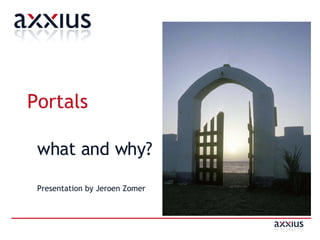
Portals what and why? Presentation by Jeroen Zomer
Agenda Definition Reasoning business drivers usability drivers architectural drivers single, key driver Challenges Products and Technology Examples Assignment
Definition of a Portal Main Entry: por·tal  Pronunciation: \ˈpȯr-təl\  Function: noun   Etymology: Middle English, from Anglo-French, from Medieval Latin  portale  city gate, porch, from neuter of  portalis  of a gate, from Latin  porta  gate — more at port door, entrance;  especially   :   a grand or imposing one the whole architectural composition  surrounding and including the doorways and porches of a church the approach or entrance  to a bridge or tunnel a  communicating part or area  of an organism;  specifically   :  the point at which something (as a pathogen) enters the body a site  serving as a guide or point of entry  to the World Wide Web and usually including a search engine or a collection of links to other sites arranged especially by topic
Why does business want them? prevent silo's, think user-centric configure before build out of the box functionality  (i.e. language preferences) white-labeling capabilities functionality without infrastructure context sensitive applications profiled experience  (bronze, silver, gold) reuse of functionality
Why do users want them? single supplier single screen, all information Single Sign On (SSO) Single Identity unified look & feel consistency personal (pull and push) multimodal
Why do architects want them? simplify architecture (UI on SOA?) unified architecture create the generics once modular HA and 24x7 are feasible smaller deployments easier scalability less components
Key Driver Time To Market!
Portal challenges user centric thinking required more coordination needed thinking in reusable requirements concept guarding ownership organizational change new technology adaptation
Products and Technology Just a quick overview, for context products: IBM WebSphere Portal, Pluto, uPortal, JetSpeed, BEA (Plumtree) Portal, Liferay, Microsoft Sharepoint Portal, SAP .., Peoplesoft .., SUN .., Oracle .., ....... technology: JSR 168/286 (1.0 vs. 2.0), WSRP 1.0/2.0
Key components small modules  (windows, gadgets, portlets) title bars  aggregated functionality customization personalization: pull - request personification: push - profiled context and cooperation Single Sign On persistent preferences
Designing for Portal Tips think user centric think task oriented think workflow think small component, but not too small portlet content is not important draw small windows, titles, buttons do not start with drawing
Common objections Portals are expensive Why fix something that isn't broken? Portals are overcomplicated Portals are not widely accepted (yet) We want to own our products
Thank you Please remember: this was just an introduction, touching the surface of a iceberg of details "He who asks is a fool for five minutes,  but he who does not ask, remains a fool forever." Chinese Proverb

Introduction to Portals

  • 1.
    Portals what andwhy? Presentation by Jeroen Zomer
  • 2.
    Agenda Definition Reasoningbusiness drivers usability drivers architectural drivers single, key driver Challenges Products and Technology Examples Assignment
  • 3.
    Definition of aPortal Main Entry: por·tal Pronunciation: \ˈpȯr-təl\ Function: noun Etymology: Middle English, from Anglo-French, from Medieval Latin portale city gate, porch, from neuter of portalis of a gate, from Latin porta gate — more at port door, entrance; especially :   a grand or imposing one the whole architectural composition surrounding and including the doorways and porches of a church the approach or entrance to a bridge or tunnel a communicating part or area of an organism; specifically :  the point at which something (as a pathogen) enters the body a site serving as a guide or point of entry to the World Wide Web and usually including a search engine or a collection of links to other sites arranged especially by topic
  • 4.
    Why does businesswant them? prevent silo's, think user-centric configure before build out of the box functionality (i.e. language preferences) white-labeling capabilities functionality without infrastructure context sensitive applications profiled experience (bronze, silver, gold) reuse of functionality
  • 5.
    Why do userswant them? single supplier single screen, all information Single Sign On (SSO) Single Identity unified look & feel consistency personal (pull and push) multimodal
  • 6.
    Why do architectswant them? simplify architecture (UI on SOA?) unified architecture create the generics once modular HA and 24x7 are feasible smaller deployments easier scalability less components
  • 7.
    Key Driver TimeTo Market!
  • 8.
    Portal challenges usercentric thinking required more coordination needed thinking in reusable requirements concept guarding ownership organizational change new technology adaptation
  • 9.
    Products and TechnologyJust a quick overview, for context products: IBM WebSphere Portal, Pluto, uPortal, JetSpeed, BEA (Plumtree) Portal, Liferay, Microsoft Sharepoint Portal, SAP .., Peoplesoft .., SUN .., Oracle .., ....... technology: JSR 168/286 (1.0 vs. 2.0), WSRP 1.0/2.0
  • 10.
    Key components smallmodules (windows, gadgets, portlets) title bars aggregated functionality customization personalization: pull - request personification: push - profiled context and cooperation Single Sign On persistent preferences
  • 11.
    Designing for PortalTips think user centric think task oriented think workflow think small component, but not too small portlet content is not important draw small windows, titles, buttons do not start with drawing
  • 12.
    Common objections Portalsare expensive Why fix something that isn't broken? Portals are overcomplicated Portals are not widely accepted (yet) We want to own our products
  • 13.
    Thank you Pleaseremember: this was just an introduction, touching the surface of a iceberg of details "He who asks is a fool for five minutes, but he who does not ask, remains a fool forever." Chinese Proverb